


In the summer of 2020, the year “Ted Lasso” debuted on Apple TV, the largest audience for a televised soccer match in the U.S. was 1.7 million. Shortly before the soccer-based sitcom returned for a fourth season last Wednesday, nearly 63 million viewers in the U.S. watched the World Cup final.
Brendan Hunt, the actor who plays Lasso’s loyal sidekick Coach Beard in the series, can’t prove the show is responsible for that growth. But since he can’t disprove it either, he’ll just go with the flow.
“I would love it if we’ve had a role at all,” he said. “If we are a pebble in that avalanche, then I’m happy.”
What the Emmy-winning series has undeniably done is bring soccer into millions of unsuspecting households that had previously avoided the sport like a plague. So while Jason Sudeikis, the star and co-creator, alongside Hunt, of “Ted Lasso,” insists the show is not about soccer, the sport sure gets a lot of screen time. And that has made the game more palatable and popular for a public that can now relate to it.
“We tricked them by putting soccer in a comedy show,” Hunt said. “The first thing you’ve got to do to get somebody to become a soccer fan is just make them care about one team, to find one team.
“In this instance we’ve made them care about this fictional team and that easily can transmute, if you’re not careful, into caring about other teams. And then hopefully the sport itself.”
After a three-year hiatus, “Lasso” returned for Season 4 last week with the series’ eponymous title character, played by Sudeikis, returning to Richmond to coach a fledgling second-division women’s team. Hunt’s understated character makes his first appearance of the season in Episode 2 Wednesday.
“He is clearly going through something,” Hunt said. “Is it just what happens to Beard when he’s away from Ted for too long or is there something important that has happened? We’ll find out before too long.”
Speaking of having gone through something, Hunt, who plays a fictional coach for a fictional team, spent the first part of his summer being a very real journalist at a very real tournament, attending 14 World Cup games in more than half a dozen stadiums — including the Spain-France semifinal in Arlington, Texas, which he watched from the press box, and the Spain-Argentina final, part of which he watched from field level.
“That was a really cool experience,” said Hunt, who did a World Cup podcast with Rebecca Lowe, the studio host of Fox’s tournament coverage.
But for Hunt, 54, the most passionate soccer fan among the writers and actors on “Ted Lasso,” the sport was an acquired taste. Half a lifetime ago, Hunt was a die-hard Chicago Bears fan working in residence with an improv group at a small, aging theater in Amsterdam when he got swept up in Dutch soccer culture.
Eventually, he said, he was contributing weekly columns to Sp!ts, a free commuter newspaper in Amsterdam, chronicling his growing infatuation with the sport. When Sudeikis, another Midwesterner, joined the comedy troupe, Hunt began proselytizing about the sport, using PlayStation games to draw in Sudeikis.
“I found a secret that I had to tell everybody,” Hunt said. “When Jason came to Amsterdam, by that point I was fully a zealot. It was like a new recipe. ‘This thing is great!’
“I’ve been doing it ever since. I just have a slightly larger platform from which to do it.”
That platform is “Ted Lasso,” based around a soft-drawling college football coach, and Beard, his quiet but intense assistant. The concept debuted in a 2013 promo for NBC’s coverage of the English Premier League, then launched as a full-blown sitcom during the angst and fear of the coronavirus pandemic seven years later.
The series, with its message of optimism, kindness and patience and its call to “be curious, not judgmental” — a sentiment Lasso mistakenly credits to Walt Whitman — proved to be the perfect tonic for those trying times. Before it paused after Season 3, it had become the most-watched original streaming series across all platforms and the first Apple TV show to cross the billion-minute mark in a single tracking week.
But in addition to all the messaging and positivity, the show also included soccer. The offside rule and promotion and relegation are the butts of repeated jokes and there are discussions of tactics, positions, formations and other game-related details that would have previously frustrated viewers.
“Lasso,” however, proved U.S. soccer IQ was higher than expected; the sport may not have become fully mainstream, but it was no longer a foreign concept.
“There’s just a wider sense of like, ‘yeah, we’re fine. Soccer’s fine,’” Hunt said of the U.S. public. “We don’t need to explain it to people or impress it upon people. The World Cup has sort of finally cemented that.
“It feels like less and less of a capital S struggle right now.”
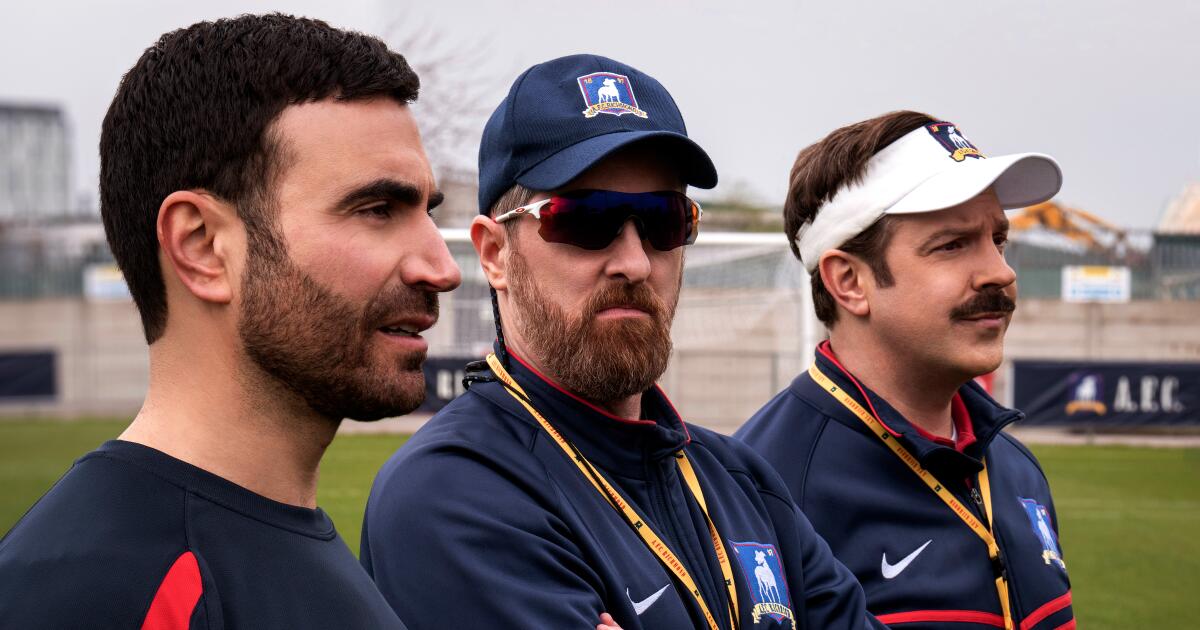
Brendan Hunt, left, and Jason Sudeikis in “Ted Lasso.”
(Apple TV)
For Hunt, who has been a season-ticket holder for LAFC and Angel City, getting to be a credentialed World Cup journalist — and a participant in the halftime show at the final — were once such far-fetched dreams that they never even made his bucket list. Getting paid to write scripts for a project he’s passionate about, then act out those scripts as a make-believe coach, was once only slightly less unbelievable.
Yet Hunt has done it all — and after a three-year break he’s back doing it again.
“It’s definitely fun,” he said. “For one thing it makes me a little more useful in the writers’ room than I would be on ‘Grey’s Anatomy.’ And it also means that a world that I already really enjoy has now opened its arms to us.
“The world of football, to have responded so well to this show, has been truly a touching part of this experience.”
And no one can’t prove the show hasn’t played at least a small role in making the U.S. a soccer country at last.

In the summer of 2020, the year “Ted Lasso” debuted on Apple TV, the largest audience for a televised soccer match in the U.S. was 1.7 million. Shortly before the soccer-based sitcom returned for a fourth season last Wednesday, nearly 63 million viewers in the U.S. watched the World Cup final.
Brendan Hunt, the actor who plays Lasso’s loyal sidekick Coach Beard in the series, can’t prove the show is responsible for that growth. But since he can’t disprove it either, he’ll just go with the flow.
“I would love it if we’ve had a role at all,” he said. “If we are a pebble in that avalanche, then I’m happy.”
What the Emmy-winning series has undeniably done is bring soccer into millions of unsuspecting households that had previously avoided the sport like a plague. So while Jason Sudeikis, the star and co-creator, alongside Hunt, of “Ted Lasso,” insists the show is not about soccer, the sport sure gets a lot of screen time. And that has made the game more palatable and popular for a public that can now relate to it.
“We tricked them by putting soccer in a comedy show,” Hunt said. “The first thing you’ve got to do to get somebody to become a soccer fan is just make them care about one team, to find one team.
“In this instance we’ve made them care about this fictional team and that easily can transmute, if you’re not careful, into caring about other teams. And then hopefully the sport itself.”
After a three-year hiatus, “Lasso” returned for Season 4 last week with the series’ eponymous title character, played by Sudeikis, returning to Richmond to coach a fledgling second-division women’s team. Hunt’s understated character makes his first appearance of the season in Episode 2 Wednesday.
“He is clearly going through something,” Hunt said. “Is it just what happens to Beard when he’s away from Ted for too long or is there something important that has happened? We’ll find out before too long.”
Speaking of having gone through something, Hunt, who plays a fictional coach for a fictional team, spent the first part of his summer being a very real journalist at a very real tournament, attending 14 World Cup games in more than half a dozen stadiums — including the Spain-France semifinal in Arlington, Texas, which he watched from the press box, and the Spain-Argentina final, part of which he watched from field level.
“That was a really cool experience,” said Hunt, who did a World Cup podcast with Rebecca Lowe, the studio host of Fox’s tournament coverage.
But for Hunt, 54, the most passionate soccer fan among the writers and actors on “Ted Lasso,” the sport was an acquired taste. Half a lifetime ago, Hunt was a die-hard Chicago Bears fan working in residence with an improv group at a small, aging theater in Amsterdam when he got swept up in Dutch soccer culture.
Eventually, he said, he was contributing weekly columns to Sp!ts, a free commuter newspaper in Amsterdam, chronicling his growing infatuation with the sport. When Sudeikis, another Midwesterner, joined the comedy troupe, Hunt began proselytizing about the sport, using PlayStation games to draw in Sudeikis.
“I found a secret that I had to tell everybody,” Hunt said. “When Jason came to Amsterdam, by that point I was fully a zealot. It was like a new recipe. ‘This thing is great!’
“I’ve been doing it ever since. I just have a slightly larger platform from which to do it.”
That platform is “Ted Lasso,” based around a soft-drawling college football coach, and Beard, his quiet but intense assistant. The concept debuted in a 2013 promo for NBC’s coverage of the English Premier League, then launched as a full-blown sitcom during the angst and fear of the coronavirus pandemic seven years later.
The series, with its message of optimism, kindness and patience and its call to “be curious, not judgmental” — a sentiment Lasso mistakenly credits to Walt Whitman — proved to be the perfect tonic for those trying times. Before it paused after Season 3, it had become the most-watched original streaming series across all platforms and the first Apple TV show to cross the billion-minute mark in a single tracking week.
But in addition to all the messaging and positivity, the show also included soccer. The offside rule and promotion and relegation are the butts of repeated jokes and there are discussions of tactics, positions, formations and other game-related details that would have previously frustrated viewers.
“Lasso,” however, proved U.S. soccer IQ was higher than expected; the sport may not have become fully mainstream, but it was no longer a foreign concept.
“There’s just a wider sense of like, ‘yeah, we’re fine. Soccer’s fine,’” Hunt said of the U.S. public. “We don’t need to explain it to people or impress it upon people. The World Cup has sort of finally cemented that.
“It feels like less and less of a capital S struggle right now.”
Brendan Hunt, left, and Jason Sudeikis in “Ted Lasso.”
(Apple TV)
For Hunt, who has been a season-ticket holder for LAFC and Angel City, getting to be a credentialed World Cup journalist — and a participant in the halftime show at the final — were once such far-fetched dreams that they never even made his bucket list. Getting paid to write scripts for a project he’s passionate about, then act out those scripts as a make-believe coach, was once only slightly less unbelievable.
Yet Hunt has done it all — and after a three-year break he’s back doing it again.
“It’s definitely fun,” he said. “For one thing it makes me a little more useful in the writers’ room than I would be on ‘Grey’s Anatomy.’ And it also means that a world that I already really enjoy has now opened its arms to us.
“The world of football, to have responded so well to this show, has been truly a touching part of this experience.”
And no one can’t prove the show hasn’t played at least a small role in making the U.S. a soccer country at last.

In the summer of 2020, the year “Ted Lasso” debuted on Apple TV, the largest audience for a televised soccer match in the U.S. was 1.7 million. Shortly before the soccer-based sitcom returned for a fourth season last Wednesday, nearly 63 million viewers in the U.S. watched the World Cup final.
Brendan Hunt, the actor who plays Lasso’s loyal sidekick Coach Beard in the series, can’t prove the show is responsible for that growth. But since he can’t disprove it either, he’ll just go with the flow.
“I would love it if we’ve had a role at all,” he said. “If we are a pebble in that avalanche, then I’m happy.”
What the Emmy-winning series has undeniably done is bring soccer into millions of unsuspecting households that had previously avoided the sport like a plague. So while Jason Sudeikis, the star and co-creator, alongside Hunt, of “Ted Lasso,” insists the show is not about soccer, the sport sure gets a lot of screen time. And that has made the game more palatable and popular for a public that can now relate to it.
“We tricked them by putting soccer in a comedy show,” Hunt said. “The first thing you’ve got to do to get somebody to become a soccer fan is just make them care about one team, to find one team.
“In this instance we’ve made them care about this fictional team and that easily can transmute, if you’re not careful, into caring about other teams. And then hopefully the sport itself.”
After a three-year hiatus, “Lasso” returned for Season 4 last week with the series’ eponymous title character, played by Sudeikis, returning to Richmond to coach a fledgling second-division women’s team. Hunt’s understated character makes his first appearance of the season in Episode 2 Wednesday.
“He is clearly going through something,” Hunt said. “Is it just what happens to Beard when he’s away from Ted for too long or is there something important that has happened? We’ll find out before too long.”
Speaking of having gone through something, Hunt, who plays a fictional coach for a fictional team, spent the first part of his summer being a very real journalist at a very real tournament, attending 14 World Cup games in more than half a dozen stadiums — including the Spain-France semifinal in Arlington, Texas, which he watched from the press box, and the Spain-Argentina final, part of which he watched from field level.
“That was a really cool experience,” said Hunt, who did a World Cup podcast with Rebecca Lowe, the studio host of Fox’s tournament coverage.
But for Hunt, 54, the most passionate soccer fan among the writers and actors on “Ted Lasso,” the sport was an acquired taste. Half a lifetime ago, Hunt was a die-hard Chicago Bears fan working in residence with an improv group at a small, aging theater in Amsterdam when he got swept up in Dutch soccer culture.
Eventually, he said, he was contributing weekly columns to Sp!ts, a free commuter newspaper in Amsterdam, chronicling his growing infatuation with the sport. When Sudeikis, another Midwesterner, joined the comedy troupe, Hunt began proselytizing about the sport, using PlayStation games to draw in Sudeikis.
“I found a secret that I had to tell everybody,” Hunt said. “When Jason came to Amsterdam, by that point I was fully a zealot. It was like a new recipe. ‘This thing is great!’
“I’ve been doing it ever since. I just have a slightly larger platform from which to do it.”
That platform is “Ted Lasso,” based around a soft-drawling college football coach, and Beard, his quiet but intense assistant. The concept debuted in a 2013 promo for NBC’s coverage of the English Premier League, then launched as a full-blown sitcom during the angst and fear of the coronavirus pandemic seven years later.
The series, with its message of optimism, kindness and patience and its call to “be curious, not judgmental” — a sentiment Lasso mistakenly credits to Walt Whitman — proved to be the perfect tonic for those trying times. Before it paused after Season 3, it had become the most-watched original streaming series across all platforms and the first Apple TV show to cross the billion-minute mark in a single tracking week.
But in addition to all the messaging and positivity, the show also included soccer. The offside rule and promotion and relegation are the butts of repeated jokes and there are discussions of tactics, positions, formations and other game-related details that would have previously frustrated viewers.
“Lasso,” however, proved U.S. soccer IQ was higher than expected; the sport may not have become fully mainstream, but it was no longer a foreign concept.
“There’s just a wider sense of like, ‘yeah, we’re fine. Soccer’s fine,’” Hunt said of the U.S. public. “We don’t need to explain it to people or impress it upon people. The World Cup has sort of finally cemented that.
“It feels like less and less of a capital S struggle right now.”
Brendan Hunt, left, and Jason Sudeikis in “Ted Lasso.”
(Apple TV)
For Hunt, who has been a season-ticket holder for LAFC and Angel City, getting to be a credentialed World Cup journalist — and a participant in the halftime show at the final — were once such far-fetched dreams that they never even made his bucket list. Getting paid to write scripts for a project he’s passionate about, then act out those scripts as a make-believe coach, was once only slightly less unbelievable.
Yet Hunt has done it all — and after a three-year break he’s back doing it again.
“It’s definitely fun,” he said. “For one thing it makes me a little more useful in the writers’ room than I would be on ‘Grey’s Anatomy.’ And it also means that a world that I already really enjoy has now opened its arms to us.
“The world of football, to have responded so well to this show, has been truly a touching part of this experience.”
And no one can’t prove the show hasn’t played at least a small role in making the U.S. a soccer country at last.
In the summer of 2020, the year “Ted Lasso” debuted on Apple TV, the largest audience for a televised soccer match in the U.S. was 1.7 million. Shortly before the soccer-based sitcom returned for a fourth season last Wednesday, nearly 63 million viewers in the U.S. watched the World Cup final.
Brendan Hunt, the actor who plays Lasso’s loyal sidekick Coach Beard in the series, can’t prove the show is responsible for that growth. But since he can’t disprove it either, he’ll just go with the flow.
“I would love it if we’ve had a role at all,” he said. “If we are a pebble in that avalanche, then I’m happy.”
What the Emmy-winning series has undeniably done is bring soccer into millions of unsuspecting households that had previously avoided the sport like a plague. So while Jason Sudeikis, the star and co-creator, alongside Hunt, of “Ted Lasso,” insists the show is not about soccer, the sport sure gets a lot of screen time. And that has made the game more palatable and popular for a public that can now relate to it.
“We tricked them by putting soccer in a comedy show,” Hunt said. “The first thing you’ve got to do to get somebody to become a soccer fan is just make them care about one team, to find one team.
“In this instance we’ve made them care about this fictional team and that easily can transmute, if you’re not careful, into caring about other teams. And then hopefully the sport itself.”
After a three-year hiatus, “Lasso” returned for Season 4 last week with the series’ eponymous title character, played by Sudeikis, returning to Richmond to coach a fledgling second-division women’s team. Hunt’s understated character makes his first appearance of the season in Episode 2 Wednesday.
“He is clearly going through something,” Hunt said. “Is it just what happens to Beard when he’s away from Ted for too long or is there something important that has happened? We’ll find out before too long.”
Speaking of having gone through something, Hunt, who plays a fictional coach for a fictional team, spent the first part of his summer being a very real journalist at a very real tournament, attending 14 World Cup games in more than half a dozen stadiums — including the Spain-France semifinal in Arlington, Texas, which he watched from the press box, and the Spain-Argentina final, part of which he watched from field level.
“That was a really cool experience,” said Hunt, who did a World Cup podcast with Rebecca Lowe, the studio host of Fox’s tournament coverage.
But for Hunt, 54, the most passionate soccer fan among the writers and actors on “Ted Lasso,” the sport was an acquired taste. Half a lifetime ago, Hunt was a die-hard Chicago Bears fan working in residence with an improv group at a small, aging theater in Amsterdam when he got swept up in Dutch soccer culture.
Eventually, he said, he was contributing weekly columns to Sp!ts, a free commuter newspaper in Amsterdam, chronicling his growing infatuation with the sport. When Sudeikis, another Midwesterner, joined the comedy troupe, Hunt began proselytizing about the sport, using PlayStation games to draw in Sudeikis.
“I found a secret that I had to tell everybody,” Hunt said. “When Jason came to Amsterdam, by that point I was fully a zealot. It was like a new recipe. ‘This thing is great!’
“I’ve been doing it ever since. I just have a slightly larger platform from which to do it.”
That platform is “Ted Lasso,” based around a soft-drawling college football coach, and Beard, his quiet but intense assistant. The concept debuted in a 2013 promo for NBC’s coverage of the English Premier League, then launched as a full-blown sitcom during the angst and fear of the coronavirus pandemic seven years later.
The series, with its message of optimism, kindness and patience and its call to “be curious, not judgmental” — a sentiment Lasso mistakenly credits to Walt Whitman — proved to be the perfect tonic for those trying times. Before it paused after Season 3, it had become the most-watched original streaming series across all platforms and the first Apple TV show to cross the billion-minute mark in a single tracking week.
But in addition to all the messaging and positivity, the show also included soccer. The offside rule and promotion and relegation are the butts of repeated jokes and there are discussions of tactics, positions, formations and other game-related details that would have previously frustrated viewers.
“Lasso,” however, proved U.S. soccer IQ was higher than expected; the sport may not have become fully mainstream, but it was no longer a foreign concept.
“There’s just a wider sense of like, ‘yeah, we’re fine. Soccer’s fine,’” Hunt said of the U.S. public. “We don’t need to explain it to people or impress it upon people. The World Cup has sort of finally cemented that.
“It feels like less and less of a capital S struggle right now.”
Brendan Hunt, left, and Jason Sudeikis in “Ted Lasso.”
(Apple TV)
For Hunt, who has been a season-ticket holder for LAFC and Angel City, getting to be a credentialed World Cup journalist — and a participant in the halftime show at the final — were once such far-fetched dreams that they never even made his bucket list. Getting paid to write scripts for a project he’s passionate about, then act out those scripts as a make-believe coach, was once only slightly less unbelievable.
Yet Hunt has done it all — and after a three-year break he’s back doing it again.
“It’s definitely fun,” he said. “For one thing it makes me a little more useful in the writers’ room than I would be on ‘Grey’s Anatomy.’ And it also means that a world that I already really enjoy has now opened its arms to us.
“The world of football, to have responded so well to this show, has been truly a touching part of this experience.”
And no one can’t prove the show hasn’t played at least a small role in making the U.S. a soccer country at last.

In the summer of 2020, the year “Ted Lasso” debuted on Apple TV, the largest audience for a televised soccer match in the U.S. was 1.7 million. Shortly before the soccer-based sitcom returned for a fourth season last Wednesday, nearly 63 million viewers in the U.S. watched the World Cup final.
Brendan Hunt, the actor who plays Lasso’s loyal sidekick Coach Beard in the series, can’t prove the show is responsible for that growth. But since he can’t disprove it either, he’ll just go with the flow.
“I would love it if we’ve had a role at all,” he said. “If we are a pebble in that avalanche, then I’m happy.”
What the Emmy-winning series has undeniably done is bring soccer into millions of unsuspecting households that had previously avoided the sport like a plague. So while Jason Sudeikis, the star and co-creator, alongside Hunt, of “Ted Lasso,” insists the show is not about soccer, the sport sure gets a lot of screen time. And that has made the game more palatable and popular for a public that can now relate to it.
“We tricked them by putting soccer in a comedy show,” Hunt said. “The first thing you’ve got to do to get somebody to become a soccer fan is just make them care about one team, to find one team.
“In this instance we’ve made them care about this fictional team and that easily can transmute, if you’re not careful, into caring about other teams. And then hopefully the sport itself.”
After a three-year hiatus, “Lasso” returned for Season 4 last week with the series’ eponymous title character, played by Sudeikis, returning to Richmond to coach a fledgling second-division women’s team. Hunt’s understated character makes his first appearance of the season in Episode 2 Wednesday.
“He is clearly going through something,” Hunt said. “Is it just what happens to Beard when he’s away from Ted for too long or is there something important that has happened? We’ll find out before too long.”
Speaking of having gone through something, Hunt, who plays a fictional coach for a fictional team, spent the first part of his summer being a very real journalist at a very real tournament, attending 14 World Cup games in more than half a dozen stadiums — including the Spain-France semifinal in Arlington, Texas, which he watched from the press box, and the Spain-Argentina final, part of which he watched from field level.
“That was a really cool experience,” said Hunt, who did a World Cup podcast with Rebecca Lowe, the studio host of Fox’s tournament coverage.
But for Hunt, 54, the most passionate soccer fan among the writers and actors on “Ted Lasso,” the sport was an acquired taste. Half a lifetime ago, Hunt was a die-hard Chicago Bears fan working in residence with an improv group at a small, aging theater in Amsterdam when he got swept up in Dutch soccer culture.
Eventually, he said, he was contributing weekly columns to Sp!ts, a free commuter newspaper in Amsterdam, chronicling his growing infatuation with the sport. When Sudeikis, another Midwesterner, joined the comedy troupe, Hunt began proselytizing about the sport, using PlayStation games to draw in Sudeikis.
“I found a secret that I had to tell everybody,” Hunt said. “When Jason came to Amsterdam, by that point I was fully a zealot. It was like a new recipe. ‘This thing is great!’
“I’ve been doing it ever since. I just have a slightly larger platform from which to do it.”
That platform is “Ted Lasso,” based around a soft-drawling college football coach, and Beard, his quiet but intense assistant. The concept debuted in a 2013 promo for NBC’s coverage of the English Premier League, then launched as a full-blown sitcom during the angst and fear of the coronavirus pandemic seven years later.
The series, with its message of optimism, kindness and patience and its call to “be curious, not judgmental” — a sentiment Lasso mistakenly credits to Walt Whitman — proved to be the perfect tonic for those trying times. Before it paused after Season 3, it had become the most-watched original streaming series across all platforms and the first Apple TV show to cross the billion-minute mark in a single tracking week.
But in addition to all the messaging and positivity, the show also included soccer. The offside rule and promotion and relegation are the butts of repeated jokes and there are discussions of tactics, positions, formations and other game-related details that would have previously frustrated viewers.
“Lasso,” however, proved U.S. soccer IQ was higher than expected; the sport may not have become fully mainstream, but it was no longer a foreign concept.
“There’s just a wider sense of like, ‘yeah, we’re fine. Soccer’s fine,’” Hunt said of the U.S. public. “We don’t need to explain it to people or impress it upon people. The World Cup has sort of finally cemented that.
“It feels like less and less of a capital S struggle right now.”
Brendan Hunt, left, and Jason Sudeikis in “Ted Lasso.”
(Apple TV)
For Hunt, who has been a season-ticket holder for LAFC and Angel City, getting to be a credentialed World Cup journalist — and a participant in the halftime show at the final — were once such far-fetched dreams that they never even made his bucket list. Getting paid to write scripts for a project he’s passionate about, then act out those scripts as a make-believe coach, was once only slightly less unbelievable.
Yet Hunt has done it all — and after a three-year break he’s back doing it again.
“It’s definitely fun,” he said. “For one thing it makes me a little more useful in the writers’ room than I would be on ‘Grey’s Anatomy.’ And it also means that a world that I already really enjoy has now opened its arms to us.
“The world of football, to have responded so well to this show, has been truly a touching part of this experience.”
And no one can’t prove the show hasn’t played at least a small role in making the U.S. a soccer country at last.
In the summer of 2020, the year “Ted Lasso” debuted on Apple TV, the largest audience for a televised soccer match in the U.S. was 1.7 million. Shortly before the soccer-based sitcom returned for a fourth season last Wednesday, nearly 63 million viewers in the U.S. watched the World Cup final.
Brendan Hunt, the actor who plays Lasso’s loyal sidekick Coach Beard in the series, can’t prove the show is responsible for that growth. But since he can’t disprove it either, he’ll just go with the flow.
“I would love it if we’ve had a role at all,” he said. “If we are a pebble in that avalanche, then I’m happy.”
What the Emmy-winning series has undeniably done is bring soccer into millions of unsuspecting households that had previously avoided the sport like a plague. So while Jason Sudeikis, the star and co-creator, alongside Hunt, of “Ted Lasso,” insists the show is not about soccer, the sport sure gets a lot of screen time. And that has made the game more palatable and popular for a public that can now relate to it.
“We tricked them by putting soccer in a comedy show,” Hunt said. “The first thing you’ve got to do to get somebody to become a soccer fan is just make them care about one team, to find one team.
“In this instance we’ve made them care about this fictional team and that easily can transmute, if you’re not careful, into caring about other teams. And then hopefully the sport itself.”
After a three-year hiatus, “Lasso” returned for Season 4 last week with the series’ eponymous title character, played by Sudeikis, returning to Richmond to coach a fledgling second-division women’s team. Hunt’s understated character makes his first appearance of the season in Episode 2 Wednesday.
“He is clearly going through something,” Hunt said. “Is it just what happens to Beard when he’s away from Ted for too long or is there something important that has happened? We’ll find out before too long.”
Speaking of having gone through something, Hunt, who plays a fictional coach for a fictional team, spent the first part of his summer being a very real journalist at a very real tournament, attending 14 World Cup games in more than half a dozen stadiums — including the Spain-France semifinal in Arlington, Texas, which he watched from the press box, and the Spain-Argentina final, part of which he watched from field level.
“That was a really cool experience,” said Hunt, who did a World Cup podcast with Rebecca Lowe, the studio host of Fox’s tournament coverage.
But for Hunt, 54, the most passionate soccer fan among the writers and actors on “Ted Lasso,” the sport was an acquired taste. Half a lifetime ago, Hunt was a die-hard Chicago Bears fan working in residence with an improv group at a small, aging theater in Amsterdam when he got swept up in Dutch soccer culture.
Eventually, he said, he was contributing weekly columns to Sp!ts, a free commuter newspaper in Amsterdam, chronicling his growing infatuation with the sport. When Sudeikis, another Midwesterner, joined the comedy troupe, Hunt began proselytizing about the sport, using PlayStation games to draw in Sudeikis.
“I found a secret that I had to tell everybody,” Hunt said. “When Jason came to Amsterdam, by that point I was fully a zealot. It was like a new recipe. ‘This thing is great!’
“I’ve been doing it ever since. I just have a slightly larger platform from which to do it.”
That platform is “Ted Lasso,” based around a soft-drawling college football coach, and Beard, his quiet but intense assistant. The concept debuted in a 2013 promo for NBC’s coverage of the English Premier League, then launched as a full-blown sitcom during the angst and fear of the coronavirus pandemic seven years later.
The series, with its message of optimism, kindness and patience and its call to “be curious, not judgmental” — a sentiment Lasso mistakenly credits to Walt Whitman — proved to be the perfect tonic for those trying times. Before it paused after Season 3, it had become the most-watched original streaming series across all platforms and the first Apple TV show to cross the billion-minute mark in a single tracking week.
But in addition to all the messaging and positivity, the show also included soccer. The offside rule and promotion and relegation are the butts of repeated jokes and there are discussions of tactics, positions, formations and other game-related details that would have previously frustrated viewers.
“Lasso,” however, proved U.S. soccer IQ was higher than expected; the sport may not have become fully mainstream, but it was no longer a foreign concept.
“There’s just a wider sense of like, ‘yeah, we’re fine. Soccer’s fine,’” Hunt said of the U.S. public. “We don’t need to explain it to people or impress it upon people. The World Cup has sort of finally cemented that.
“It feels like less and less of a capital S struggle right now.”
Brendan Hunt, left, and Jason Sudeikis in “Ted Lasso.”
(Apple TV)
For Hunt, who has been a season-ticket holder for LAFC and Angel City, getting to be a credentialed World Cup journalist — and a participant in the halftime show at the final — were once such far-fetched dreams that they never even made his bucket list. Getting paid to write scripts for a project he’s passionate about, then act out those scripts as a make-believe coach, was once only slightly less unbelievable.
Yet Hunt has done it all — and after a three-year break he’s back doing it again.
“It’s definitely fun,” he said. “For one thing it makes me a little more useful in the writers’ room than I would be on ‘Grey’s Anatomy.’ And it also means that a world that I already really enjoy has now opened its arms to us.
“The world of football, to have responded so well to this show, has been truly a touching part of this experience.”
And no one can’t prove the show hasn’t played at least a small role in making the U.S. a soccer country at last.
In the summer of 2020, the year “Ted Lasso” debuted on Apple TV, the largest audience for a televised soccer match in the U.S. was 1.7 million. Shortly before the soccer-based sitcom returned for a fourth season last Wednesday, nearly 63 million viewers in the U.S. watched the World Cup final.
Brendan Hunt, the actor who plays Lasso’s loyal sidekick Coach Beard in the series, can’t prove the show is responsible for that growth. But since he can’t disprove it either, he’ll just go with the flow.
“I would love it if we’ve had a role at all,” he said. “If we are a pebble in that avalanche, then I’m happy.”
What the Emmy-winning series has undeniably done is bring soccer into millions of unsuspecting households that had previously avoided the sport like a plague. So while Jason Sudeikis, the star and co-creator, alongside Hunt, of “Ted Lasso,” insists the show is not about soccer, the sport sure gets a lot of screen time. And that has made the game more palatable and popular for a public that can now relate to it.
“We tricked them by putting soccer in a comedy show,” Hunt said. “The first thing you’ve got to do to get somebody to become a soccer fan is just make them care about one team, to find one team.
“In this instance we’ve made them care about this fictional team and that easily can transmute, if you’re not careful, into caring about other teams. And then hopefully the sport itself.”
After a three-year hiatus, “Lasso” returned for Season 4 last week with the series’ eponymous title character, played by Sudeikis, returning to Richmond to coach a fledgling second-division women’s team. Hunt’s understated character makes his first appearance of the season in Episode 2 Wednesday.
“He is clearly going through something,” Hunt said. “Is it just what happens to Beard when he’s away from Ted for too long or is there something important that has happened? We’ll find out before too long.”
Speaking of having gone through something, Hunt, who plays a fictional coach for a fictional team, spent the first part of his summer being a very real journalist at a very real tournament, attending 14 World Cup games in more than half a dozen stadiums — including the Spain-France semifinal in Arlington, Texas, which he watched from the press box, and the Spain-Argentina final, part of which he watched from field level.
“That was a really cool experience,” said Hunt, who did a World Cup podcast with Rebecca Lowe, the studio host of Fox’s tournament coverage.
But for Hunt, 54, the most passionate soccer fan among the writers and actors on “Ted Lasso,” the sport was an acquired taste. Half a lifetime ago, Hunt was a die-hard Chicago Bears fan working in residence with an improv group at a small, aging theater in Amsterdam when he got swept up in Dutch soccer culture.
Eventually, he said, he was contributing weekly columns to Sp!ts, a free commuter newspaper in Amsterdam, chronicling his growing infatuation with the sport. When Sudeikis, another Midwesterner, joined the comedy troupe, Hunt began proselytizing about the sport, using PlayStation games to draw in Sudeikis.
“I found a secret that I had to tell everybody,” Hunt said. “When Jason came to Amsterdam, by that point I was fully a zealot. It was like a new recipe. ‘This thing is great!’
“I’ve been doing it ever since. I just have a slightly larger platform from which to do it.”
That platform is “Ted Lasso,” based around a soft-drawling college football coach, and Beard, his quiet but intense assistant. The concept debuted in a 2013 promo for NBC’s coverage of the English Premier League, then launched as a full-blown sitcom during the angst and fear of the coronavirus pandemic seven years later.
The series, with its message of optimism, kindness and patience and its call to “be curious, not judgmental” — a sentiment Lasso mistakenly credits to Walt Whitman — proved to be the perfect tonic for those trying times. Before it paused after Season 3, it had become the most-watched original streaming series across all platforms and the first Apple TV show to cross the billion-minute mark in a single tracking week.
But in addition to all the messaging and positivity, the show also included soccer. The offside rule and promotion and relegation are the butts of repeated jokes and there are discussions of tactics, positions, formations and other game-related details that would have previously frustrated viewers.
“Lasso,” however, proved U.S. soccer IQ was higher than expected; the sport may not have become fully mainstream, but it was no longer a foreign concept.
“There’s just a wider sense of like, ‘yeah, we’re fine. Soccer’s fine,’” Hunt said of the U.S. public. “We don’t need to explain it to people or impress it upon people. The World Cup has sort of finally cemented that.
“It feels like less and less of a capital S struggle right now.”
Brendan Hunt, left, and Jason Sudeikis in “Ted Lasso.”
(Apple TV)
For Hunt, who has been a season-ticket holder for LAFC and Angel City, getting to be a credentialed World Cup journalist — and a participant in the halftime show at the final — were once such far-fetched dreams that they never even made his bucket list. Getting paid to write scripts for a project he’s passionate about, then act out those scripts as a make-believe coach, was once only slightly less unbelievable.
Yet Hunt has done it all — and after a three-year break he’s back doing it again.
“It’s definitely fun,” he said. “For one thing it makes me a little more useful in the writers’ room than I would be on ‘Grey’s Anatomy.’ And it also means that a world that I already really enjoy has now opened its arms to us.
“The world of football, to have responded so well to this show, has been truly a touching part of this experience.”
And no one can’t prove the show hasn’t played at least a small role in making the U.S. a soccer country at last.
In the summer of 2020, the year “Ted Lasso” debuted on Apple TV, the largest audience for a televised soccer match in the U.S. was 1.7 million. Shortly before the soccer-based sitcom returned for a fourth season last Wednesday, nearly 63 million viewers in the U.S. watched the World Cup final.
Brendan Hunt, the actor who plays Lasso’s loyal sidekick Coach Beard in the series, can’t prove the show is responsible for that growth. But since he can’t disprove it either, he’ll just go with the flow.
“I would love it if we’ve had a role at all,” he said. “If we are a pebble in that avalanche, then I’m happy.”
What the Emmy-winning series has undeniably done is bring soccer into millions of unsuspecting households that had previously avoided the sport like a plague. So while Jason Sudeikis, the star and co-creator, alongside Hunt, of “Ted Lasso,” insists the show is not about soccer, the sport sure gets a lot of screen time. And that has made the game more palatable and popular for a public that can now relate to it.
“We tricked them by putting soccer in a comedy show,” Hunt said. “The first thing you’ve got to do to get somebody to become a soccer fan is just make them care about one team, to find one team.
“In this instance we’ve made them care about this fictional team and that easily can transmute, if you’re not careful, into caring about other teams. And then hopefully the sport itself.”
After a three-year hiatus, “Lasso” returned for Season 4 last week with the series’ eponymous title character, played by Sudeikis, returning to Richmond to coach a fledgling second-division women’s team. Hunt’s understated character makes his first appearance of the season in Episode 2 Wednesday.
“He is clearly going through something,” Hunt said. “Is it just what happens to Beard when he’s away from Ted for too long or is there something important that has happened? We’ll find out before too long.”
Speaking of having gone through something, Hunt, who plays a fictional coach for a fictional team, spent the first part of his summer being a very real journalist at a very real tournament, attending 14 World Cup games in more than half a dozen stadiums — including the Spain-France semifinal in Arlington, Texas, which he watched from the press box, and the Spain-Argentina final, part of which he watched from field level.
“That was a really cool experience,” said Hunt, who did a World Cup podcast with Rebecca Lowe, the studio host of Fox’s tournament coverage.
But for Hunt, 54, the most passionate soccer fan among the writers and actors on “Ted Lasso,” the sport was an acquired taste. Half a lifetime ago, Hunt was a die-hard Chicago Bears fan working in residence with an improv group at a small, aging theater in Amsterdam when he got swept up in Dutch soccer culture.
Eventually, he said, he was contributing weekly columns to Sp!ts, a free commuter newspaper in Amsterdam, chronicling his growing infatuation with the sport. When Sudeikis, another Midwesterner, joined the comedy troupe, Hunt began proselytizing about the sport, using PlayStation games to draw in Sudeikis.
“I found a secret that I had to tell everybody,” Hunt said. “When Jason came to Amsterdam, by that point I was fully a zealot. It was like a new recipe. ‘This thing is great!’
“I’ve been doing it ever since. I just have a slightly larger platform from which to do it.”
That platform is “Ted Lasso,” based around a soft-drawling college football coach, and Beard, his quiet but intense assistant. The concept debuted in a 2013 promo for NBC’s coverage of the English Premier League, then launched as a full-blown sitcom during the angst and fear of the coronavirus pandemic seven years later.
The series, with its message of optimism, kindness and patience and its call to “be curious, not judgmental” — a sentiment Lasso mistakenly credits to Walt Whitman — proved to be the perfect tonic for those trying times. Before it paused after Season 3, it had become the most-watched original streaming series across all platforms and the first Apple TV show to cross the billion-minute mark in a single tracking week.
But in addition to all the messaging and positivity, the show also included soccer. The offside rule and promotion and relegation are the butts of repeated jokes and there are discussions of tactics, positions, formations and other game-related details that would have previously frustrated viewers.
“Lasso,” however, proved U.S. soccer IQ was higher than expected; the sport may not have become fully mainstream, but it was no longer a foreign concept.
“There’s just a wider sense of like, ‘yeah, we’re fine. Soccer’s fine,’” Hunt said of the U.S. public. “We don’t need to explain it to people or impress it upon people. The World Cup has sort of finally cemented that.
“It feels like less and less of a capital S struggle right now.”
Brendan Hunt, left, and Jason Sudeikis in “Ted Lasso.”
(Apple TV)
For Hunt, who has been a season-ticket holder for LAFC and Angel City, getting to be a credentialed World Cup journalist — and a participant in the halftime show at the final — were once such far-fetched dreams that they never even made his bucket list. Getting paid to write scripts for a project he’s passionate about, then act out those scripts as a make-believe coach, was once only slightly less unbelievable.
Yet Hunt has done it all — and after a three-year break he’s back doing it again.
“It’s definitely fun,” he said. “For one thing it makes me a little more useful in the writers’ room than I would be on ‘Grey’s Anatomy.’ And it also means that a world that I already really enjoy has now opened its arms to us.
“The world of football, to have responded so well to this show, has been truly a touching part of this experience.”
And no one can’t prove the show hasn’t played at least a small role in making the U.S. a soccer country at last.

