

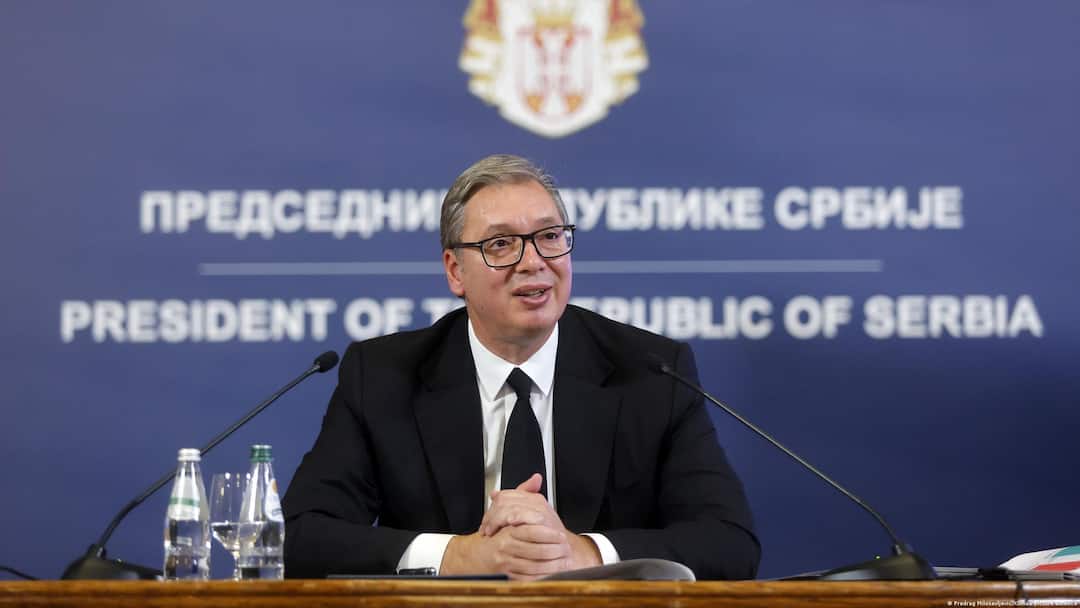
- President Vucic resigned to run for prime minister.
- Snap elections follow protests over tragedy and corruption.
- Vucic dominates Serbian politics, balancing EU aspirations, Russian ties.
Reported by: Jenipher Camino Gonzalez with dpa, AFP, Reuters, AP | Edited by: Srinivas Mazumdaru, Wesley Dockery
Serbia’s long-time President Aleksandar Vucic announced on Sunday that he would resign from his post in order to run for prime minister in the upcoming October snap elections.

From the presidential palace in Belgrade, Vucic spoke to supporters: “I am resigning as president.”

“Tomorrow morning I will hand over my duties to the parliament speaker,” he added “This is the last evening for me in this building,” Vucic declared.
“I served you faithfully. I served all of you, and our homeland Serbia, honourably and honestly throughout my presidential term,” Vucic told supporters. “The fight is only beginning,” he added.
Dominating Serbian politics
Vucic is banned by the Serbian Constitution from seeking a third term. He was serving his second term and would have left office in May of 2027.
The 56-year-old, who has ties to Serbian nationalism and had once served as minister under the administration of Slobodan Milosevic, has dominated Serbian politics for more over a decade.
Vucic supporters praise him for his stability, stated commitment to development projects in Serbia and his patriotism, in a country long overshadowed by war in the 1990s and subsequent international isolation.

Opponents, however, have decried what they see as increasingly authoritarian tendencies and leading a government accused of endemic corruption.
Abroad, Vucic has had to juggle the competing interests of his country’s European Union aspirations and its close ties to Russia.
Opposition had sought snap elections
Earlier in September, Vucic called for snap elections for October. He cited “major turbulence on the domestic political scene,” as the reason.

Vucic was referring to the political movement and major setback for his government that was triggered by a tragedy in Serbia’s second-largest city of Novi Sad. In November 2024, an awning of a newly reconstructed railway station in Novi Sad collapsed, killing 16 people.
The disaster triggered nationwide protests by students and the opposition. They demanded accountability for those responsible for the disaster, transparency in public procurement, an end to systemic corruption, and an early parliamentary vote.
Vucic’s government repeatedly denied accusations, but still, several officials, including two ministers, were arrested or resigned after the incident. The upcoming snap election will test Vucic’s popularity and political survival.
Disclaimer: This report first appeared on Deutsche Welle, and has been republished on ABP Live as part of a special arrangement. Apart from the headline, no changes have been made in the report by ABP Live.

