

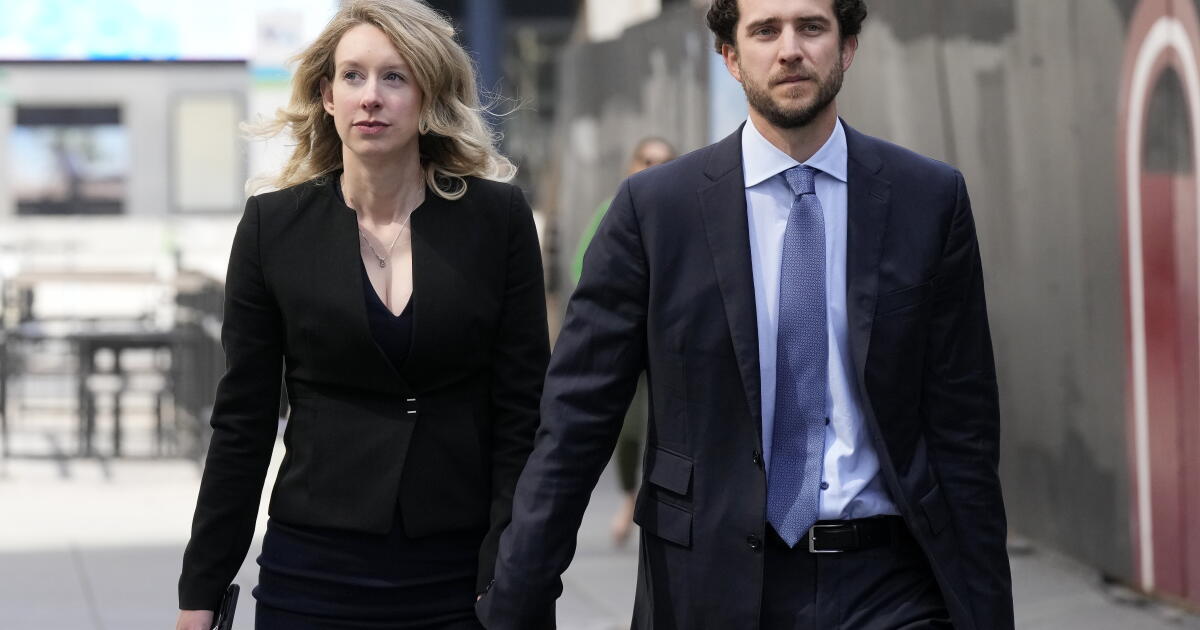



Elizabeth Holmes is the convicted fraudster at the center of Nathan Fielder and Lance Oppenheim’s hit documentary “You Can See Everything,” but for many viewers, it’s her longtime partner, Billy Evans, who has emerged as the film’s marquee villain.
Evans, 34, comes from a wealthy San Diego hotel family and stood by Holmes as her blood-testing startup Theranos collapsed and she was convicted in 2022 of defrauding investors. The couple have two children, 5-year-old son William and 3-year-old daughter Invicta. With Holmes serving an 11-year federal prison sentence in Texas, Evans is raising their children while pursuing a new biotech venture of his own.
In the film — warning: spoilers ahead — Evans comes across as controlling and increasingly volatile, taking over from Holmes as she whisks eggs, interrupting an interview to demand that the cameras be turned off and at one point casually brushing his teeth while standing stark naked in the shower, with Fielder awkwardly looking on. He speaks of Holmes dedicating her life to building “monuments of love” to him, and in one heated confrontation threatens to ruin the lives of people he believes have wronged her. “I’ve got vengeance in my heart,” he declares.
So who is Evans, how did he end up with one of Silicon Valley’s most infamous figures and what is he up to now?
What do we know about Evans’ upbringing?
Evans grew up in one of San Diego’s wealthiest families. His grandparents, William and Anne Evans, founded Evans Hotels in 1953, opening what became the Bahia Resort Hotel on Mission Bay. The family business later expanded to include the Catamaran Resort Hotel and Spa and the Lodge at Torrey Pines in La Jolla.
Evans attended Francis Parker School, an exclusive private school in San Diego, before graduating from MIT with a degree in economics in 2015. Despite his family’s wealth, Evans is neither an employee nor a shareholder of Evans Hotels, according to a statement the company issued Oct. 1.
His family reportedly had reservations about his relationship with Holmes at first. But his father, also named William, became a supporter — and even went undercover of sorts at her 2021 fraud trial. According to NPR, the elder Evans showed up for jury selection under the name “Hanson,” introducing himself to reporters as a concerned citizen who fixed up old cars for a living. His expensive loafers and a Starbucks cup bearing a different name eventually raised suspicions.
How did Evans meet Holmes?
The two met Oct. 7, 2017, at a Fleet Week party hosted by a venture capitalist in San Francisco, according to Evans. Theranos was already engulfed in scandal, though Holmes had yet to be criminally charged.
In the documentary, Evans recalls that he initially didn’t recognize Holmes because she was wearing a floppy hat, dark sunglasses and a Band-Aid on her face from a scratch by her husky. He says he fell in love with her almost immediately. When Fielder points out that he could barely see her face, Evans replies, “I guess that wasn’t what mattered to me.”
Nathan Fielder observes Elizabeth Holmes with her family in “You Can See Everything.”
(A24)
Holmes says the attraction was mutual. The two became friends and started dating about six months later, just weeks before she was indicted on federal fraud charges.
Fielder asks Evans whether he worried early on that Holmes might be conning him. “100%,” Evans replies, before asking what she would have had to gain from him. “Well, isn’t your family rich?” Fielder asks.
Pressed about the family’s money, Evans grows visibly uncomfortable and cuts the conversation short, saying he needs to get to a cousin’s event.
How is Evans managing life with Holmes in prison?
Since Holmes entered federal prison in May 2023, Evans has been raising their two children in Austin, Texas, bringing them to visit her at the federal prison camp in Bryan. Holmes is expected to transfer to a halfway house outside Austin in August.
In an appearance last week on the tech podcast “All-In,” Evans described the difficulty of the experience. “It’s hard because I’m building a business and I’m trying to free my wife from federal prison and I’m raising two kids,” he said.
Though Evans routinely refers to Holmes as his wife, Holmes said in a 2025 interview from prison with People that they had not legally married: “Maybe we’ll get married someday, but our bond is more than a piece of paper.” The two got engaged in 2018, reportedly at a Taylor Swift concert.
Is Evans trying to revive Theranos?
After graduating from MIT, Evans reportedly attempted to launch a medical concierge service before working at companies including LinkedIn and Luminar Technologies, which developed lidar systems for autonomous vehicles.
In 2022, he founded Haemanthus, a biotech startup developing technology to analyze biological samples using lasers. The company hopes to make diagnostic testing cheaper and more accessible — a mission that may sound awfully familiar to anyone who followed the rise and fall of Theranos.
Haemanthus has reportedly raised millions of dollars but has yet to release a commercial product. Eric Potma, a UC Irvine chemistry professor who consults for the company, told Wired this week that its technology is worth exploring despite significant technical challenges. “The engineers at Haemanthus are legit,” he said.
Holmes’ name does not appear in Haemanthus’ incorporation documents, according to Wired. But in the documentary, the couple is shown discussing plans for a new diagnostic venture, with Evans speaking openly about his desire to revive her original ambitions.
“The idea is to put the band back together and do it all again,” Evans tells Fielder.
How has Evans responded to ‘You Can See Everything’?
Evans and Holmes agreed to participate in the documentary in hopes of changing the public perception of her. Early in the film, Evans explains that they wanted to give the filmmakers extraordinary access to their daily lives, embracing what he calls “radical transparency.”
But Evans’ commitment to transparency had its limits. In the film, he repeatedly tries to shut down uncomfortable conversations and, in a meeting reenacted for the cameras, demands a share of the documentary’s profits — an arrangement Fielder fears could compromise the project’s integrity. Evans ultimately agreed to forgo payment.
At the documentary’s surprise premiere at the Telluride Film Festival in September, Fielder acknowledged that his relationship with Evans had deteriorated as the project unfolded.
“We felt Billy was trying to exert a lot of control over the process, and it sort of caused our communication to break down a little bit,” Fielder said during a Q&A after the screening. “The challenging thing is he’s sort of a conduit to her.”
Speaking on the “All-In” podcast before seeing the finished movie, Evans acknowledged that participating might turn out to be a mistake. “I haven’t seen it yet,” he said. “I might think this is like the dumbest thing I’ve ever done.”
Evans attended a private screening of the documentary on Oct. 16, followed by an off-the-record conversation with Bryan Johnson, the tech entrepreneur known for his elaborate efforts to reverse aging.
In a post on X the following day, Johnson called the film “a masterpiece” and described Evans as “magnanimous in conversation.” Though Johnson said he gave Evans every opportunity to defend himself and “strike back because Fielder roughed him up,” Evans declined.
Evans replied publicly, thanking Johnson for treating their conversation with care. “When the world is against you and the pain is so real,” Evans wrote, “it means so much to have people like you show such kindness.”

Elizabeth Holmes is the convicted fraudster at the center of Nathan Fielder and Lance Oppenheim’s hit documentary “You Can See Everything,” but for many viewers, it’s her longtime partner, Billy Evans, who has emerged as the film’s marquee villain.
Evans, 34, comes from a wealthy San Diego hotel family and stood by Holmes as her blood-testing startup Theranos collapsed and she was convicted in 2022 of defrauding investors. The couple have two children, 5-year-old son William and 3-year-old daughter Invicta. With Holmes serving an 11-year federal prison sentence in Texas, Evans is raising their children while pursuing a new biotech venture of his own.
In the film — warning: spoilers ahead — Evans comes across as controlling and increasingly volatile, taking over from Holmes as she whisks eggs, interrupting an interview to demand that the cameras be turned off and at one point casually brushing his teeth while standing stark naked in the shower, with Fielder awkwardly looking on. He speaks of Holmes dedicating her life to building “monuments of love” to him, and in one heated confrontation threatens to ruin the lives of people he believes have wronged her. “I’ve got vengeance in my heart,” he declares.
So who is Evans, how did he end up with one of Silicon Valley’s most infamous figures and what is he up to now?
What do we know about Evans’ upbringing?
Evans grew up in one of San Diego’s wealthiest families. His grandparents, William and Anne Evans, founded Evans Hotels in 1953, opening what became the Bahia Resort Hotel on Mission Bay. The family business later expanded to include the Catamaran Resort Hotel and Spa and the Lodge at Torrey Pines in La Jolla.
Evans attended Francis Parker School, an exclusive private school in San Diego, before graduating from MIT with a degree in economics in 2015. Despite his family’s wealth, Evans is neither an employee nor a shareholder of Evans Hotels, according to a statement the company issued Oct. 1.
His family reportedly had reservations about his relationship with Holmes at first. But his father, also named William, became a supporter — and even went undercover of sorts at her 2021 fraud trial. According to NPR, the elder Evans showed up for jury selection under the name “Hanson,” introducing himself to reporters as a concerned citizen who fixed up old cars for a living. His expensive loafers and a Starbucks cup bearing a different name eventually raised suspicions.
How did Evans meet Holmes?
The two met Oct. 7, 2017, at a Fleet Week party hosted by a venture capitalist in San Francisco, according to Evans. Theranos was already engulfed in scandal, though Holmes had yet to be criminally charged.
In the documentary, Evans recalls that he initially didn’t recognize Holmes because she was wearing a floppy hat, dark sunglasses and a Band-Aid on her face from a scratch by her husky. He says he fell in love with her almost immediately. When Fielder points out that he could barely see her face, Evans replies, “I guess that wasn’t what mattered to me.”
Nathan Fielder observes Elizabeth Holmes with her family in “You Can See Everything.”
(A24)
Holmes says the attraction was mutual. The two became friends and started dating about six months later, just weeks before she was indicted on federal fraud charges.
Fielder asks Evans whether he worried early on that Holmes might be conning him. “100%,” Evans replies, before asking what she would have had to gain from him. “Well, isn’t your family rich?” Fielder asks.
Pressed about the family’s money, Evans grows visibly uncomfortable and cuts the conversation short, saying he needs to get to a cousin’s event.
How is Evans managing life with Holmes in prison?
Since Holmes entered federal prison in May 2023, Evans has been raising their two children in Austin, Texas, bringing them to visit her at the federal prison camp in Bryan. Holmes is expected to transfer to a halfway house outside Austin in August.
In an appearance last week on the tech podcast “All-In,” Evans described the difficulty of the experience. “It’s hard because I’m building a business and I’m trying to free my wife from federal prison and I’m raising two kids,” he said.
Though Evans routinely refers to Holmes as his wife, Holmes said in a 2025 interview from prison with People that they had not legally married: “Maybe we’ll get married someday, but our bond is more than a piece of paper.” The two got engaged in 2018, reportedly at a Taylor Swift concert.
Is Evans trying to revive Theranos?
After graduating from MIT, Evans reportedly attempted to launch a medical concierge service before working at companies including LinkedIn and Luminar Technologies, which developed lidar systems for autonomous vehicles.
In 2022, he founded Haemanthus, a biotech startup developing technology to analyze biological samples using lasers. The company hopes to make diagnostic testing cheaper and more accessible — a mission that may sound awfully familiar to anyone who followed the rise and fall of Theranos.
Haemanthus has reportedly raised millions of dollars but has yet to release a commercial product. Eric Potma, a UC Irvine chemistry professor who consults for the company, told Wired this week that its technology is worth exploring despite significant technical challenges. “The engineers at Haemanthus are legit,” he said.
Holmes’ name does not appear in Haemanthus’ incorporation documents, according to Wired. But in the documentary, the couple is shown discussing plans for a new diagnostic venture, with Evans speaking openly about his desire to revive her original ambitions.
“The idea is to put the band back together and do it all again,” Evans tells Fielder.
How has Evans responded to ‘You Can See Everything’?
Evans and Holmes agreed to participate in the documentary in hopes of changing the public perception of her. Early in the film, Evans explains that they wanted to give the filmmakers extraordinary access to their daily lives, embracing what he calls “radical transparency.”
But Evans’ commitment to transparency had its limits. In the film, he repeatedly tries to shut down uncomfortable conversations and, in a meeting reenacted for the cameras, demands a share of the documentary’s profits — an arrangement Fielder fears could compromise the project’s integrity. Evans ultimately agreed to forgo payment.
At the documentary’s surprise premiere at the Telluride Film Festival in September, Fielder acknowledged that his relationship with Evans had deteriorated as the project unfolded.
“We felt Billy was trying to exert a lot of control over the process, and it sort of caused our communication to break down a little bit,” Fielder said during a Q&A after the screening. “The challenging thing is he’s sort of a conduit to her.”
Speaking on the “All-In” podcast before seeing the finished movie, Evans acknowledged that participating might turn out to be a mistake. “I haven’t seen it yet,” he said. “I might think this is like the dumbest thing I’ve ever done.”
Evans attended a private screening of the documentary on Oct. 16, followed by an off-the-record conversation with Bryan Johnson, the tech entrepreneur known for his elaborate efforts to reverse aging.
In a post on X the following day, Johnson called the film “a masterpiece” and described Evans as “magnanimous in conversation.” Though Johnson said he gave Evans every opportunity to defend himself and “strike back because Fielder roughed him up,” Evans declined.
Evans replied publicly, thanking Johnson for treating their conversation with care. “When the world is against you and the pain is so real,” Evans wrote, “it means so much to have people like you show such kindness.”

