

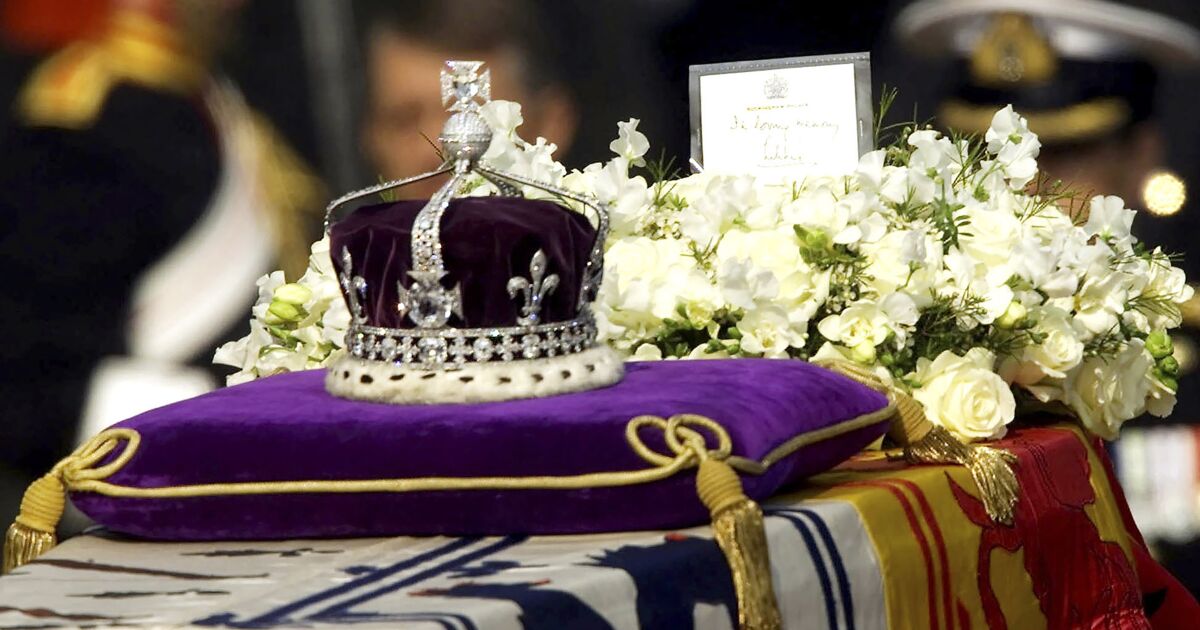
Britain’s most important crowns have arches over the top. These can signify that the kingdom is an empire unto itself, not subject to any authority but God’s, which is why there’s a cross. They can also just make the crown sturdier, or both.
As for tiaras: Brace yourselves, ye lovers of grandeur and glitter, for there are distressing reports that, as part of scaling down and cutting back on the glitter factor, Catherine, the Princess of Wales and the next queen, will wear not a tiara but a circlet of flowers. The horror! Charles wants a low-key event — but no tiaras? That’s like the Angelenos who wear cargo shorts and tank tops to opening night at the opera!
(Side note: Peers and peeresses — dukes, marquises and marchionesses, earls and countesses and so on — have been asked not to wear their traditional ermine-and-red-velvet cloaks, or the silver-gilt coronets of their rank. Peers can be notoriously eccentric, so who knows what outfits they might wear instead — maybe cargo shorts? — but this is not an unmixed blessing. Those robes can stink of mothballs, and poorer peers have been known to rent-a-robe, or to use rabbit fur and apply smudges of charcoal to replicate the patterns of ermine.)
Now for the starring bling.
St. Edward’s Crown
Charles will be crowned with St. Edward’s Crown. St. Edward the Confessor was a bona fide saint and English king who died in 1066, not long before England was invaded by that William the Conqueror guy, the illegitimate son of a French Norman duke and a tanner’s daughter. This crown is the 1660s version of the original, and it’s worn only once in any reign: for the coronation.
It’s not as valuable as other crowns, for it’s set with mostly semiprecious stones. But 22-karat gold is heavy, and this crown weighs about five pounds. Before her coronation, Elizabeth II sat at her desk wearing it in order to get used to its weight.
If you want to feel the burden of royalty, try wearing a five-pound sack of flour on your head for three hours.
Heavy are the heads that wear the crowns — one that will feature in the coronation weighs about five pounds.
(Associated Press)
The Imperial State Crown
Just as Charles III will change from a red velvet cloak to one of purple after he’s crowned, so will he remove St. Edward’s Crown and put on the Imperial State Crown. It’s the same crown he’ll wear every year for the opening of Parliament. It weighs less than half as much as St. Edward’s Crown, so, whew.
And it’s much more valuable, with nearly 3,000 diamonds and extraordinary, historic jewels. The biggest of these, gleaming like a headlamp in a miner’s hard hat, is the 317-carat Cullinan II. It’s the second-largest stone cut from a 3,106-carat monster diamond given to King Edward VII in 1907, after the Boer War, by a British-run region of South Africa. Above that is a 170-carat lump of red, the Black Prince’s ruby, supposedly worn in the helmet of Henry V at his improbable victory over the French at Agincourt. (“We few, we happy few” — that Shakespeare bit.) Above are pearls that belonged to Queen Elizabeth I. The second Queen Elizabeth loved pearls and felt sorry for these — they look “not very happy,” she said, because pearls are “like living things, they need warming.” They get no cuddles in the Tower of London.
At the back of the crown is the oblong 104-carat Stuart sapphire. It used to be at the front but got demoted to make way for the Cullinan II diamond. A truly ancient sapphire, St. Edward’s, is at the center of the Maltese cross on top. Fairly good authorities say it was found when the saint-king’s body was moved to the abbey nearly 900 years ago.
Even though this crown is lighter than the coronation crown, Queen Victoria wrote that it “hurt me a good deal.” Queen Elizabeth II described it as “unwieldy,” especially when trying to read a speech; you had to hold the speech in front of you, because if you looked down to read it, the crown “would fall off.”
Queen Mary’s Crown
King Charles III adored his grandmother, Queen Elizabeth the Queen Mother, and probably would have liked his wife, Camilla, to wear her crown for the coronation. But it comes with too much political baggage, 105 carats’ worth — the contentious Koh-i-Noor diamond, a trophy of 19th century empire that the Indian government would very much like back.
Instead, Camilla will be crowned with the crown that Charles’ great-grandmother, Queen Mary, wife of King George V, received in 1911. It had the Koh-i-Noor mounted in it then, but the stone has been removed. We may see in its place Cullinans III and IV, a mere 95 and 63 carats, respectively, along with Cullinan V, 19 carats, all cut from that same heart-size raw diamond.
This is the first time in almost 300 years that a queen consort has been crowned with another queen’s crown; Charles is a great believer in recycling.

Britain’s most important crowns have arches over the top. These can signify that the kingdom is an empire unto itself, not subject to any authority but God’s, which is why there’s a cross. They can also just make the crown sturdier, or both.
As for tiaras: Brace yourselves, ye lovers of grandeur and glitter, for there are distressing reports that, as part of scaling down and cutting back on the glitter factor, Catherine, the Princess of Wales and the next queen, will wear not a tiara but a circlet of flowers. The horror! Charles wants a low-key event — but no tiaras? That’s like the Angelenos who wear cargo shorts and tank tops to opening night at the opera!
(Side note: Peers and peeresses — dukes, marquises and marchionesses, earls and countesses and so on — have been asked not to wear their traditional ermine-and-red-velvet cloaks, or the silver-gilt coronets of their rank. Peers can be notoriously eccentric, so who knows what outfits they might wear instead — maybe cargo shorts? — but this is not an unmixed blessing. Those robes can stink of mothballs, and poorer peers have been known to rent-a-robe, or to use rabbit fur and apply smudges of charcoal to replicate the patterns of ermine.)
Now for the starring bling.
St. Edward’s Crown
Charles will be crowned with St. Edward’s Crown. St. Edward the Confessor was a bona fide saint and English king who died in 1066, not long before England was invaded by that William the Conqueror guy, the illegitimate son of a French Norman duke and a tanner’s daughter. This crown is the 1660s version of the original, and it’s worn only once in any reign: for the coronation.
It’s not as valuable as other crowns, for it’s set with mostly semiprecious stones. But 22-karat gold is heavy, and this crown weighs about five pounds. Before her coronation, Elizabeth II sat at her desk wearing it in order to get used to its weight.
If you want to feel the burden of royalty, try wearing a five-pound sack of flour on your head for three hours.
Heavy are the heads that wear the crowns — one that will feature in the coronation weighs about five pounds.
(Associated Press)
The Imperial State Crown
Just as Charles III will change from a red velvet cloak to one of purple after he’s crowned, so will he remove St. Edward’s Crown and put on the Imperial State Crown. It’s the same crown he’ll wear every year for the opening of Parliament. It weighs less than half as much as St. Edward’s Crown, so, whew.
And it’s much more valuable, with nearly 3,000 diamonds and extraordinary, historic jewels. The biggest of these, gleaming like a headlamp in a miner’s hard hat, is the 317-carat Cullinan II. It’s the second-largest stone cut from a 3,106-carat monster diamond given to King Edward VII in 1907, after the Boer War, by a British-run region of South Africa. Above that is a 170-carat lump of red, the Black Prince’s ruby, supposedly worn in the helmet of Henry V at his improbable victory over the French at Agincourt. (“We few, we happy few” — that Shakespeare bit.) Above are pearls that belonged to Queen Elizabeth I. The second Queen Elizabeth loved pearls and felt sorry for these — they look “not very happy,” she said, because pearls are “like living things, they need warming.” They get no cuddles in the Tower of London.
At the back of the crown is the oblong 104-carat Stuart sapphire. It used to be at the front but got demoted to make way for the Cullinan II diamond. A truly ancient sapphire, St. Edward’s, is at the center of the Maltese cross on top. Fairly good authorities say it was found when the saint-king’s body was moved to the abbey nearly 900 years ago.
Even though this crown is lighter than the coronation crown, Queen Victoria wrote that it “hurt me a good deal.” Queen Elizabeth II described it as “unwieldy,” especially when trying to read a speech; you had to hold the speech in front of you, because if you looked down to read it, the crown “would fall off.”
Queen Mary’s Crown
King Charles III adored his grandmother, Queen Elizabeth the Queen Mother, and probably would have liked his wife, Camilla, to wear her crown for the coronation. But it comes with too much political baggage, 105 carats’ worth — the contentious Koh-i-Noor diamond, a trophy of 19th century empire that the Indian government would very much like back.
Instead, Camilla will be crowned with the crown that Charles’ great-grandmother, Queen Mary, wife of King George V, received in 1911. It had the Koh-i-Noor mounted in it then, but the stone has been removed. We may see in its place Cullinans III and IV, a mere 95 and 63 carats, respectively, along with Cullinan V, 19 carats, all cut from that same heart-size raw diamond.
This is the first time in almost 300 years that a queen consort has been crowned with another queen’s crown; Charles is a great believer in recycling.

Britain’s most important crowns have arches over the top. These can signify that the kingdom is an empire unto itself, not subject to any authority but God’s, which is why there’s a cross. They can also just make the crown sturdier, or both.
As for tiaras: Brace yourselves, ye lovers of grandeur and glitter, for there are distressing reports that, as part of scaling down and cutting back on the glitter factor, Catherine, the Princess of Wales and the next queen, will wear not a tiara but a circlet of flowers. The horror! Charles wants a low-key event — but no tiaras? That’s like the Angelenos who wear cargo shorts and tank tops to opening night at the opera!
(Side note: Peers and peeresses — dukes, marquises and marchionesses, earls and countesses and so on — have been asked not to wear their traditional ermine-and-red-velvet cloaks, or the silver-gilt coronets of their rank. Peers can be notoriously eccentric, so who knows what outfits they might wear instead — maybe cargo shorts? — but this is not an unmixed blessing. Those robes can stink of mothballs, and poorer peers have been known to rent-a-robe, or to use rabbit fur and apply smudges of charcoal to replicate the patterns of ermine.)
Now for the starring bling.
St. Edward’s Crown
Charles will be crowned with St. Edward’s Crown. St. Edward the Confessor was a bona fide saint and English king who died in 1066, not long before England was invaded by that William the Conqueror guy, the illegitimate son of a French Norman duke and a tanner’s daughter. This crown is the 1660s version of the original, and it’s worn only once in any reign: for the coronation.
It’s not as valuable as other crowns, for it’s set with mostly semiprecious stones. But 22-karat gold is heavy, and this crown weighs about five pounds. Before her coronation, Elizabeth II sat at her desk wearing it in order to get used to its weight.
If you want to feel the burden of royalty, try wearing a five-pound sack of flour on your head for three hours.
Heavy are the heads that wear the crowns — one that will feature in the coronation weighs about five pounds.
(Associated Press)
The Imperial State Crown
Just as Charles III will change from a red velvet cloak to one of purple after he’s crowned, so will he remove St. Edward’s Crown and put on the Imperial State Crown. It’s the same crown he’ll wear every year for the opening of Parliament. It weighs less than half as much as St. Edward’s Crown, so, whew.
And it’s much more valuable, with nearly 3,000 diamonds and extraordinary, historic jewels. The biggest of these, gleaming like a headlamp in a miner’s hard hat, is the 317-carat Cullinan II. It’s the second-largest stone cut from a 3,106-carat monster diamond given to King Edward VII in 1907, after the Boer War, by a British-run region of South Africa. Above that is a 170-carat lump of red, the Black Prince’s ruby, supposedly worn in the helmet of Henry V at his improbable victory over the French at Agincourt. (“We few, we happy few” — that Shakespeare bit.) Above are pearls that belonged to Queen Elizabeth I. The second Queen Elizabeth loved pearls and felt sorry for these — they look “not very happy,” she said, because pearls are “like living things, they need warming.” They get no cuddles in the Tower of London.
At the back of the crown is the oblong 104-carat Stuart sapphire. It used to be at the front but got demoted to make way for the Cullinan II diamond. A truly ancient sapphire, St. Edward’s, is at the center of the Maltese cross on top. Fairly good authorities say it was found when the saint-king’s body was moved to the abbey nearly 900 years ago.
Even though this crown is lighter than the coronation crown, Queen Victoria wrote that it “hurt me a good deal.” Queen Elizabeth II described it as “unwieldy,” especially when trying to read a speech; you had to hold the speech in front of you, because if you looked down to read it, the crown “would fall off.”
Queen Mary’s Crown
King Charles III adored his grandmother, Queen Elizabeth the Queen Mother, and probably would have liked his wife, Camilla, to wear her crown for the coronation. But it comes with too much political baggage, 105 carats’ worth — the contentious Koh-i-Noor diamond, a trophy of 19th century empire that the Indian government would very much like back.
Instead, Camilla will be crowned with the crown that Charles’ great-grandmother, Queen Mary, wife of King George V, received in 1911. It had the Koh-i-Noor mounted in it then, but the stone has been removed. We may see in its place Cullinans III and IV, a mere 95 and 63 carats, respectively, along with Cullinan V, 19 carats, all cut from that same heart-size raw diamond.
This is the first time in almost 300 years that a queen consort has been crowned with another queen’s crown; Charles is a great believer in recycling.
Britain’s most important crowns have arches over the top. These can signify that the kingdom is an empire unto itself, not subject to any authority but God’s, which is why there’s a cross. They can also just make the crown sturdier, or both.
As for tiaras: Brace yourselves, ye lovers of grandeur and glitter, for there are distressing reports that, as part of scaling down and cutting back on the glitter factor, Catherine, the Princess of Wales and the next queen, will wear not a tiara but a circlet of flowers. The horror! Charles wants a low-key event — but no tiaras? That’s like the Angelenos who wear cargo shorts and tank tops to opening night at the opera!
(Side note: Peers and peeresses — dukes, marquises and marchionesses, earls and countesses and so on — have been asked not to wear their traditional ermine-and-red-velvet cloaks, or the silver-gilt coronets of their rank. Peers can be notoriously eccentric, so who knows what outfits they might wear instead — maybe cargo shorts? — but this is not an unmixed blessing. Those robes can stink of mothballs, and poorer peers have been known to rent-a-robe, or to use rabbit fur and apply smudges of charcoal to replicate the patterns of ermine.)
Now for the starring bling.
St. Edward’s Crown
Charles will be crowned with St. Edward’s Crown. St. Edward the Confessor was a bona fide saint and English king who died in 1066, not long before England was invaded by that William the Conqueror guy, the illegitimate son of a French Norman duke and a tanner’s daughter. This crown is the 1660s version of the original, and it’s worn only once in any reign: for the coronation.
It’s not as valuable as other crowns, for it’s set with mostly semiprecious stones. But 22-karat gold is heavy, and this crown weighs about five pounds. Before her coronation, Elizabeth II sat at her desk wearing it in order to get used to its weight.
If you want to feel the burden of royalty, try wearing a five-pound sack of flour on your head for three hours.
Heavy are the heads that wear the crowns — one that will feature in the coronation weighs about five pounds.
(Associated Press)
The Imperial State Crown
Just as Charles III will change from a red velvet cloak to one of purple after he’s crowned, so will he remove St. Edward’s Crown and put on the Imperial State Crown. It’s the same crown he’ll wear every year for the opening of Parliament. It weighs less than half as much as St. Edward’s Crown, so, whew.
And it’s much more valuable, with nearly 3,000 diamonds and extraordinary, historic jewels. The biggest of these, gleaming like a headlamp in a miner’s hard hat, is the 317-carat Cullinan II. It’s the second-largest stone cut from a 3,106-carat monster diamond given to King Edward VII in 1907, after the Boer War, by a British-run region of South Africa. Above that is a 170-carat lump of red, the Black Prince’s ruby, supposedly worn in the helmet of Henry V at his improbable victory over the French at Agincourt. (“We few, we happy few” — that Shakespeare bit.) Above are pearls that belonged to Queen Elizabeth I. The second Queen Elizabeth loved pearls and felt sorry for these — they look “not very happy,” she said, because pearls are “like living things, they need warming.” They get no cuddles in the Tower of London.
At the back of the crown is the oblong 104-carat Stuart sapphire. It used to be at the front but got demoted to make way for the Cullinan II diamond. A truly ancient sapphire, St. Edward’s, is at the center of the Maltese cross on top. Fairly good authorities say it was found when the saint-king’s body was moved to the abbey nearly 900 years ago.
Even though this crown is lighter than the coronation crown, Queen Victoria wrote that it “hurt me a good deal.” Queen Elizabeth II described it as “unwieldy,” especially when trying to read a speech; you had to hold the speech in front of you, because if you looked down to read it, the crown “would fall off.”
Queen Mary’s Crown
King Charles III adored his grandmother, Queen Elizabeth the Queen Mother, and probably would have liked his wife, Camilla, to wear her crown for the coronation. But it comes with too much political baggage, 105 carats’ worth — the contentious Koh-i-Noor diamond, a trophy of 19th century empire that the Indian government would very much like back.
Instead, Camilla will be crowned with the crown that Charles’ great-grandmother, Queen Mary, wife of King George V, received in 1911. It had the Koh-i-Noor mounted in it then, but the stone has been removed. We may see in its place Cullinans III and IV, a mere 95 and 63 carats, respectively, along with Cullinan V, 19 carats, all cut from that same heart-size raw diamond.
This is the first time in almost 300 years that a queen consort has been crowned with another queen’s crown; Charles is a great believer in recycling.

Britain’s most important crowns have arches over the top. These can signify that the kingdom is an empire unto itself, not subject to any authority but God’s, which is why there’s a cross. They can also just make the crown sturdier, or both.
As for tiaras: Brace yourselves, ye lovers of grandeur and glitter, for there are distressing reports that, as part of scaling down and cutting back on the glitter factor, Catherine, the Princess of Wales and the next queen, will wear not a tiara but a circlet of flowers. The horror! Charles wants a low-key event — but no tiaras? That’s like the Angelenos who wear cargo shorts and tank tops to opening night at the opera!
(Side note: Peers and peeresses — dukes, marquises and marchionesses, earls and countesses and so on — have been asked not to wear their traditional ermine-and-red-velvet cloaks, or the silver-gilt coronets of their rank. Peers can be notoriously eccentric, so who knows what outfits they might wear instead — maybe cargo shorts? — but this is not an unmixed blessing. Those robes can stink of mothballs, and poorer peers have been known to rent-a-robe, or to use rabbit fur and apply smudges of charcoal to replicate the patterns of ermine.)
Now for the starring bling.
St. Edward’s Crown
Charles will be crowned with St. Edward’s Crown. St. Edward the Confessor was a bona fide saint and English king who died in 1066, not long before England was invaded by that William the Conqueror guy, the illegitimate son of a French Norman duke and a tanner’s daughter. This crown is the 1660s version of the original, and it’s worn only once in any reign: for the coronation.
It’s not as valuable as other crowns, for it’s set with mostly semiprecious stones. But 22-karat gold is heavy, and this crown weighs about five pounds. Before her coronation, Elizabeth II sat at her desk wearing it in order to get used to its weight.
If you want to feel the burden of royalty, try wearing a five-pound sack of flour on your head for three hours.
Heavy are the heads that wear the crowns — one that will feature in the coronation weighs about five pounds.
(Associated Press)
The Imperial State Crown
Just as Charles III will change from a red velvet cloak to one of purple after he’s crowned, so will he remove St. Edward’s Crown and put on the Imperial State Crown. It’s the same crown he’ll wear every year for the opening of Parliament. It weighs less than half as much as St. Edward’s Crown, so, whew.
And it’s much more valuable, with nearly 3,000 diamonds and extraordinary, historic jewels. The biggest of these, gleaming like a headlamp in a miner’s hard hat, is the 317-carat Cullinan II. It’s the second-largest stone cut from a 3,106-carat monster diamond given to King Edward VII in 1907, after the Boer War, by a British-run region of South Africa. Above that is a 170-carat lump of red, the Black Prince’s ruby, supposedly worn in the helmet of Henry V at his improbable victory over the French at Agincourt. (“We few, we happy few” — that Shakespeare bit.) Above are pearls that belonged to Queen Elizabeth I. The second Queen Elizabeth loved pearls and felt sorry for these — they look “not very happy,” she said, because pearls are “like living things, they need warming.” They get no cuddles in the Tower of London.
At the back of the crown is the oblong 104-carat Stuart sapphire. It used to be at the front but got demoted to make way for the Cullinan II diamond. A truly ancient sapphire, St. Edward’s, is at the center of the Maltese cross on top. Fairly good authorities say it was found when the saint-king’s body was moved to the abbey nearly 900 years ago.
Even though this crown is lighter than the coronation crown, Queen Victoria wrote that it “hurt me a good deal.” Queen Elizabeth II described it as “unwieldy,” especially when trying to read a speech; you had to hold the speech in front of you, because if you looked down to read it, the crown “would fall off.”
Queen Mary’s Crown
King Charles III adored his grandmother, Queen Elizabeth the Queen Mother, and probably would have liked his wife, Camilla, to wear her crown for the coronation. But it comes with too much political baggage, 105 carats’ worth — the contentious Koh-i-Noor diamond, a trophy of 19th century empire that the Indian government would very much like back.
Instead, Camilla will be crowned with the crown that Charles’ great-grandmother, Queen Mary, wife of King George V, received in 1911. It had the Koh-i-Noor mounted in it then, but the stone has been removed. We may see in its place Cullinans III and IV, a mere 95 and 63 carats, respectively, along with Cullinan V, 19 carats, all cut from that same heart-size raw diamond.
This is the first time in almost 300 years that a queen consort has been crowned with another queen’s crown; Charles is a great believer in recycling.
Britain’s most important crowns have arches over the top. These can signify that the kingdom is an empire unto itself, not subject to any authority but God’s, which is why there’s a cross. They can also just make the crown sturdier, or both.
As for tiaras: Brace yourselves, ye lovers of grandeur and glitter, for there are distressing reports that, as part of scaling down and cutting back on the glitter factor, Catherine, the Princess of Wales and the next queen, will wear not a tiara but a circlet of flowers. The horror! Charles wants a low-key event — but no tiaras? That’s like the Angelenos who wear cargo shorts and tank tops to opening night at the opera!
(Side note: Peers and peeresses — dukes, marquises and marchionesses, earls and countesses and so on — have been asked not to wear their traditional ermine-and-red-velvet cloaks, or the silver-gilt coronets of their rank. Peers can be notoriously eccentric, so who knows what outfits they might wear instead — maybe cargo shorts? — but this is not an unmixed blessing. Those robes can stink of mothballs, and poorer peers have been known to rent-a-robe, or to use rabbit fur and apply smudges of charcoal to replicate the patterns of ermine.)
Now for the starring bling.
St. Edward’s Crown
Charles will be crowned with St. Edward’s Crown. St. Edward the Confessor was a bona fide saint and English king who died in 1066, not long before England was invaded by that William the Conqueror guy, the illegitimate son of a French Norman duke and a tanner’s daughter. This crown is the 1660s version of the original, and it’s worn only once in any reign: for the coronation.
It’s not as valuable as other crowns, for it’s set with mostly semiprecious stones. But 22-karat gold is heavy, and this crown weighs about five pounds. Before her coronation, Elizabeth II sat at her desk wearing it in order to get used to its weight.
If you want to feel the burden of royalty, try wearing a five-pound sack of flour on your head for three hours.
Heavy are the heads that wear the crowns — one that will feature in the coronation weighs about five pounds.
(Associated Press)
The Imperial State Crown
Just as Charles III will change from a red velvet cloak to one of purple after he’s crowned, so will he remove St. Edward’s Crown and put on the Imperial State Crown. It’s the same crown he’ll wear every year for the opening of Parliament. It weighs less than half as much as St. Edward’s Crown, so, whew.
And it’s much more valuable, with nearly 3,000 diamonds and extraordinary, historic jewels. The biggest of these, gleaming like a headlamp in a miner’s hard hat, is the 317-carat Cullinan II. It’s the second-largest stone cut from a 3,106-carat monster diamond given to King Edward VII in 1907, after the Boer War, by a British-run region of South Africa. Above that is a 170-carat lump of red, the Black Prince’s ruby, supposedly worn in the helmet of Henry V at his improbable victory over the French at Agincourt. (“We few, we happy few” — that Shakespeare bit.) Above are pearls that belonged to Queen Elizabeth I. The second Queen Elizabeth loved pearls and felt sorry for these — they look “not very happy,” she said, because pearls are “like living things, they need warming.” They get no cuddles in the Tower of London.
At the back of the crown is the oblong 104-carat Stuart sapphire. It used to be at the front but got demoted to make way for the Cullinan II diamond. A truly ancient sapphire, St. Edward’s, is at the center of the Maltese cross on top. Fairly good authorities say it was found when the saint-king’s body was moved to the abbey nearly 900 years ago.
Even though this crown is lighter than the coronation crown, Queen Victoria wrote that it “hurt me a good deal.” Queen Elizabeth II described it as “unwieldy,” especially when trying to read a speech; you had to hold the speech in front of you, because if you looked down to read it, the crown “would fall off.”
Queen Mary’s Crown
King Charles III adored his grandmother, Queen Elizabeth the Queen Mother, and probably would have liked his wife, Camilla, to wear her crown for the coronation. But it comes with too much political baggage, 105 carats’ worth — the contentious Koh-i-Noor diamond, a trophy of 19th century empire that the Indian government would very much like back.
Instead, Camilla will be crowned with the crown that Charles’ great-grandmother, Queen Mary, wife of King George V, received in 1911. It had the Koh-i-Noor mounted in it then, but the stone has been removed. We may see in its place Cullinans III and IV, a mere 95 and 63 carats, respectively, along with Cullinan V, 19 carats, all cut from that same heart-size raw diamond.
This is the first time in almost 300 years that a queen consort has been crowned with another queen’s crown; Charles is a great believer in recycling.
Britain’s most important crowns have arches over the top. These can signify that the kingdom is an empire unto itself, not subject to any authority but God’s, which is why there’s a cross. They can also just make the crown sturdier, or both.
As for tiaras: Brace yourselves, ye lovers of grandeur and glitter, for there are distressing reports that, as part of scaling down and cutting back on the glitter factor, Catherine, the Princess of Wales and the next queen, will wear not a tiara but a circlet of flowers. The horror! Charles wants a low-key event — but no tiaras? That’s like the Angelenos who wear cargo shorts and tank tops to opening night at the opera!
(Side note: Peers and peeresses — dukes, marquises and marchionesses, earls and countesses and so on — have been asked not to wear their traditional ermine-and-red-velvet cloaks, or the silver-gilt coronets of their rank. Peers can be notoriously eccentric, so who knows what outfits they might wear instead — maybe cargo shorts? — but this is not an unmixed blessing. Those robes can stink of mothballs, and poorer peers have been known to rent-a-robe, or to use rabbit fur and apply smudges of charcoal to replicate the patterns of ermine.)
Now for the starring bling.
St. Edward’s Crown
Charles will be crowned with St. Edward’s Crown. St. Edward the Confessor was a bona fide saint and English king who died in 1066, not long before England was invaded by that William the Conqueror guy, the illegitimate son of a French Norman duke and a tanner’s daughter. This crown is the 1660s version of the original, and it’s worn only once in any reign: for the coronation.
It’s not as valuable as other crowns, for it’s set with mostly semiprecious stones. But 22-karat gold is heavy, and this crown weighs about five pounds. Before her coronation, Elizabeth II sat at her desk wearing it in order to get used to its weight.
If you want to feel the burden of royalty, try wearing a five-pound sack of flour on your head for three hours.
Heavy are the heads that wear the crowns — one that will feature in the coronation weighs about five pounds.
(Associated Press)
The Imperial State Crown
Just as Charles III will change from a red velvet cloak to one of purple after he’s crowned, so will he remove St. Edward’s Crown and put on the Imperial State Crown. It’s the same crown he’ll wear every year for the opening of Parliament. It weighs less than half as much as St. Edward’s Crown, so, whew.
And it’s much more valuable, with nearly 3,000 diamonds and extraordinary, historic jewels. The biggest of these, gleaming like a headlamp in a miner’s hard hat, is the 317-carat Cullinan II. It’s the second-largest stone cut from a 3,106-carat monster diamond given to King Edward VII in 1907, after the Boer War, by a British-run region of South Africa. Above that is a 170-carat lump of red, the Black Prince’s ruby, supposedly worn in the helmet of Henry V at his improbable victory over the French at Agincourt. (“We few, we happy few” — that Shakespeare bit.) Above are pearls that belonged to Queen Elizabeth I. The second Queen Elizabeth loved pearls and felt sorry for these — they look “not very happy,” she said, because pearls are “like living things, they need warming.” They get no cuddles in the Tower of London.
At the back of the crown is the oblong 104-carat Stuart sapphire. It used to be at the front but got demoted to make way for the Cullinan II diamond. A truly ancient sapphire, St. Edward’s, is at the center of the Maltese cross on top. Fairly good authorities say it was found when the saint-king’s body was moved to the abbey nearly 900 years ago.
Even though this crown is lighter than the coronation crown, Queen Victoria wrote that it “hurt me a good deal.” Queen Elizabeth II described it as “unwieldy,” especially when trying to read a speech; you had to hold the speech in front of you, because if you looked down to read it, the crown “would fall off.”
Queen Mary’s Crown
King Charles III adored his grandmother, Queen Elizabeth the Queen Mother, and probably would have liked his wife, Camilla, to wear her crown for the coronation. But it comes with too much political baggage, 105 carats’ worth — the contentious Koh-i-Noor diamond, a trophy of 19th century empire that the Indian government would very much like back.
Instead, Camilla will be crowned with the crown that Charles’ great-grandmother, Queen Mary, wife of King George V, received in 1911. It had the Koh-i-Noor mounted in it then, but the stone has been removed. We may see in its place Cullinans III and IV, a mere 95 and 63 carats, respectively, along with Cullinan V, 19 carats, all cut from that same heart-size raw diamond.
This is the first time in almost 300 years that a queen consort has been crowned with another queen’s crown; Charles is a great believer in recycling.
Britain’s most important crowns have arches over the top. These can signify that the kingdom is an empire unto itself, not subject to any authority but God’s, which is why there’s a cross. They can also just make the crown sturdier, or both.
As for tiaras: Brace yourselves, ye lovers of grandeur and glitter, for there are distressing reports that, as part of scaling down and cutting back on the glitter factor, Catherine, the Princess of Wales and the next queen, will wear not a tiara but a circlet of flowers. The horror! Charles wants a low-key event — but no tiaras? That’s like the Angelenos who wear cargo shorts and tank tops to opening night at the opera!
(Side note: Peers and peeresses — dukes, marquises and marchionesses, earls and countesses and so on — have been asked not to wear their traditional ermine-and-red-velvet cloaks, or the silver-gilt coronets of their rank. Peers can be notoriously eccentric, so who knows what outfits they might wear instead — maybe cargo shorts? — but this is not an unmixed blessing. Those robes can stink of mothballs, and poorer peers have been known to rent-a-robe, or to use rabbit fur and apply smudges of charcoal to replicate the patterns of ermine.)
Now for the starring bling.
St. Edward’s Crown
Charles will be crowned with St. Edward’s Crown. St. Edward the Confessor was a bona fide saint and English king who died in 1066, not long before England was invaded by that William the Conqueror guy, the illegitimate son of a French Norman duke and a tanner’s daughter. This crown is the 1660s version of the original, and it’s worn only once in any reign: for the coronation.
It’s not as valuable as other crowns, for it’s set with mostly semiprecious stones. But 22-karat gold is heavy, and this crown weighs about five pounds. Before her coronation, Elizabeth II sat at her desk wearing it in order to get used to its weight.
If you want to feel the burden of royalty, try wearing a five-pound sack of flour on your head for three hours.
Heavy are the heads that wear the crowns — one that will feature in the coronation weighs about five pounds.
(Associated Press)
The Imperial State Crown
Just as Charles III will change from a red velvet cloak to one of purple after he’s crowned, so will he remove St. Edward’s Crown and put on the Imperial State Crown. It’s the same crown he’ll wear every year for the opening of Parliament. It weighs less than half as much as St. Edward’s Crown, so, whew.
And it’s much more valuable, with nearly 3,000 diamonds and extraordinary, historic jewels. The biggest of these, gleaming like a headlamp in a miner’s hard hat, is the 317-carat Cullinan II. It’s the second-largest stone cut from a 3,106-carat monster diamond given to King Edward VII in 1907, after the Boer War, by a British-run region of South Africa. Above that is a 170-carat lump of red, the Black Prince’s ruby, supposedly worn in the helmet of Henry V at his improbable victory over the French at Agincourt. (“We few, we happy few” — that Shakespeare bit.) Above are pearls that belonged to Queen Elizabeth I. The second Queen Elizabeth loved pearls and felt sorry for these — they look “not very happy,” she said, because pearls are “like living things, they need warming.” They get no cuddles in the Tower of London.
At the back of the crown is the oblong 104-carat Stuart sapphire. It used to be at the front but got demoted to make way for the Cullinan II diamond. A truly ancient sapphire, St. Edward’s, is at the center of the Maltese cross on top. Fairly good authorities say it was found when the saint-king’s body was moved to the abbey nearly 900 years ago.
Even though this crown is lighter than the coronation crown, Queen Victoria wrote that it “hurt me a good deal.” Queen Elizabeth II described it as “unwieldy,” especially when trying to read a speech; you had to hold the speech in front of you, because if you looked down to read it, the crown “would fall off.”
Queen Mary’s Crown
King Charles III adored his grandmother, Queen Elizabeth the Queen Mother, and probably would have liked his wife, Camilla, to wear her crown for the coronation. But it comes with too much political baggage, 105 carats’ worth — the contentious Koh-i-Noor diamond, a trophy of 19th century empire that the Indian government would very much like back.
Instead, Camilla will be crowned with the crown that Charles’ great-grandmother, Queen Mary, wife of King George V, received in 1911. It had the Koh-i-Noor mounted in it then, but the stone has been removed. We may see in its place Cullinans III and IV, a mere 95 and 63 carats, respectively, along with Cullinan V, 19 carats, all cut from that same heart-size raw diamond.
This is the first time in almost 300 years that a queen consort has been crowned with another queen’s crown; Charles is a great believer in recycling.

Britain’s most important crowns have arches over the top. These can signify that the kingdom is an empire unto itself, not subject to any authority but God’s, which is why there’s a cross. They can also just make the crown sturdier, or both.
As for tiaras: Brace yourselves, ye lovers of grandeur and glitter, for there are distressing reports that, as part of scaling down and cutting back on the glitter factor, Catherine, the Princess of Wales and the next queen, will wear not a tiara but a circlet of flowers. The horror! Charles wants a low-key event — but no tiaras? That’s like the Angelenos who wear cargo shorts and tank tops to opening night at the opera!
(Side note: Peers and peeresses — dukes, marquises and marchionesses, earls and countesses and so on — have been asked not to wear their traditional ermine-and-red-velvet cloaks, or the silver-gilt coronets of their rank. Peers can be notoriously eccentric, so who knows what outfits they might wear instead — maybe cargo shorts? — but this is not an unmixed blessing. Those robes can stink of mothballs, and poorer peers have been known to rent-a-robe, or to use rabbit fur and apply smudges of charcoal to replicate the patterns of ermine.)
Now for the starring bling.
St. Edward’s Crown
Charles will be crowned with St. Edward’s Crown. St. Edward the Confessor was a bona fide saint and English king who died in 1066, not long before England was invaded by that William the Conqueror guy, the illegitimate son of a French Norman duke and a tanner’s daughter. This crown is the 1660s version of the original, and it’s worn only once in any reign: for the coronation.
It’s not as valuable as other crowns, for it’s set with mostly semiprecious stones. But 22-karat gold is heavy, and this crown weighs about five pounds. Before her coronation, Elizabeth II sat at her desk wearing it in order to get used to its weight.
If you want to feel the burden of royalty, try wearing a five-pound sack of flour on your head for three hours.
Heavy are the heads that wear the crowns — one that will feature in the coronation weighs about five pounds.
(Associated Press)
The Imperial State Crown
Just as Charles III will change from a red velvet cloak to one of purple after he’s crowned, so will he remove St. Edward’s Crown and put on the Imperial State Crown. It’s the same crown he’ll wear every year for the opening of Parliament. It weighs less than half as much as St. Edward’s Crown, so, whew.
And it’s much more valuable, with nearly 3,000 diamonds and extraordinary, historic jewels. The biggest of these, gleaming like a headlamp in a miner’s hard hat, is the 317-carat Cullinan II. It’s the second-largest stone cut from a 3,106-carat monster diamond given to King Edward VII in 1907, after the Boer War, by a British-run region of South Africa. Above that is a 170-carat lump of red, the Black Prince’s ruby, supposedly worn in the helmet of Henry V at his improbable victory over the French at Agincourt. (“We few, we happy few” — that Shakespeare bit.) Above are pearls that belonged to Queen Elizabeth I. The second Queen Elizabeth loved pearls and felt sorry for these — they look “not very happy,” she said, because pearls are “like living things, they need warming.” They get no cuddles in the Tower of London.
At the back of the crown is the oblong 104-carat Stuart sapphire. It used to be at the front but got demoted to make way for the Cullinan II diamond. A truly ancient sapphire, St. Edward’s, is at the center of the Maltese cross on top. Fairly good authorities say it was found when the saint-king’s body was moved to the abbey nearly 900 years ago.
Even though this crown is lighter than the coronation crown, Queen Victoria wrote that it “hurt me a good deal.” Queen Elizabeth II described it as “unwieldy,” especially when trying to read a speech; you had to hold the speech in front of you, because if you looked down to read it, the crown “would fall off.”
Queen Mary’s Crown
King Charles III adored his grandmother, Queen Elizabeth the Queen Mother, and probably would have liked his wife, Camilla, to wear her crown for the coronation. But it comes with too much political baggage, 105 carats’ worth — the contentious Koh-i-Noor diamond, a trophy of 19th century empire that the Indian government would very much like back.
Instead, Camilla will be crowned with the crown that Charles’ great-grandmother, Queen Mary, wife of King George V, received in 1911. It had the Koh-i-Noor mounted in it then, but the stone has been removed. We may see in its place Cullinans III and IV, a mere 95 and 63 carats, respectively, along with Cullinan V, 19 carats, all cut from that same heart-size raw diamond.
This is the first time in almost 300 years that a queen consort has been crowned with another queen’s crown; Charles is a great believer in recycling.
Britain’s most important crowns have arches over the top. These can signify that the kingdom is an empire unto itself, not subject to any authority but God’s, which is why there’s a cross. They can also just make the crown sturdier, or both.
As for tiaras: Brace yourselves, ye lovers of grandeur and glitter, for there are distressing reports that, as part of scaling down and cutting back on the glitter factor, Catherine, the Princess of Wales and the next queen, will wear not a tiara but a circlet of flowers. The horror! Charles wants a low-key event — but no tiaras? That’s like the Angelenos who wear cargo shorts and tank tops to opening night at the opera!
(Side note: Peers and peeresses — dukes, marquises and marchionesses, earls and countesses and so on — have been asked not to wear their traditional ermine-and-red-velvet cloaks, or the silver-gilt coronets of their rank. Peers can be notoriously eccentric, so who knows what outfits they might wear instead — maybe cargo shorts? — but this is not an unmixed blessing. Those robes can stink of mothballs, and poorer peers have been known to rent-a-robe, or to use rabbit fur and apply smudges of charcoal to replicate the patterns of ermine.)
Now for the starring bling.
St. Edward’s Crown
Charles will be crowned with St. Edward’s Crown. St. Edward the Confessor was a bona fide saint and English king who died in 1066, not long before England was invaded by that William the Conqueror guy, the illegitimate son of a French Norman duke and a tanner’s daughter. This crown is the 1660s version of the original, and it’s worn only once in any reign: for the coronation.
It’s not as valuable as other crowns, for it’s set with mostly semiprecious stones. But 22-karat gold is heavy, and this crown weighs about five pounds. Before her coronation, Elizabeth II sat at her desk wearing it in order to get used to its weight.
If you want to feel the burden of royalty, try wearing a five-pound sack of flour on your head for three hours.
Heavy are the heads that wear the crowns — one that will feature in the coronation weighs about five pounds.
(Associated Press)
The Imperial State Crown
Just as Charles III will change from a red velvet cloak to one of purple after he’s crowned, so will he remove St. Edward’s Crown and put on the Imperial State Crown. It’s the same crown he’ll wear every year for the opening of Parliament. It weighs less than half as much as St. Edward’s Crown, so, whew.
And it’s much more valuable, with nearly 3,000 diamonds and extraordinary, historic jewels. The biggest of these, gleaming like a headlamp in a miner’s hard hat, is the 317-carat Cullinan II. It’s the second-largest stone cut from a 3,106-carat monster diamond given to King Edward VII in 1907, after the Boer War, by a British-run region of South Africa. Above that is a 170-carat lump of red, the Black Prince’s ruby, supposedly worn in the helmet of Henry V at his improbable victory over the French at Agincourt. (“We few, we happy few” — that Shakespeare bit.) Above are pearls that belonged to Queen Elizabeth I. The second Queen Elizabeth loved pearls and felt sorry for these — they look “not very happy,” she said, because pearls are “like living things, they need warming.” They get no cuddles in the Tower of London.
At the back of the crown is the oblong 104-carat Stuart sapphire. It used to be at the front but got demoted to make way for the Cullinan II diamond. A truly ancient sapphire, St. Edward’s, is at the center of the Maltese cross on top. Fairly good authorities say it was found when the saint-king’s body was moved to the abbey nearly 900 years ago.
Even though this crown is lighter than the coronation crown, Queen Victoria wrote that it “hurt me a good deal.” Queen Elizabeth II described it as “unwieldy,” especially when trying to read a speech; you had to hold the speech in front of you, because if you looked down to read it, the crown “would fall off.”
Queen Mary’s Crown
King Charles III adored his grandmother, Queen Elizabeth the Queen Mother, and probably would have liked his wife, Camilla, to wear her crown for the coronation. But it comes with too much political baggage, 105 carats’ worth — the contentious Koh-i-Noor diamond, a trophy of 19th century empire that the Indian government would very much like back.
Instead, Camilla will be crowned with the crown that Charles’ great-grandmother, Queen Mary, wife of King George V, received in 1911. It had the Koh-i-Noor mounted in it then, but the stone has been removed. We may see in its place Cullinans III and IV, a mere 95 and 63 carats, respectively, along with Cullinan V, 19 carats, all cut from that same heart-size raw diamond.
This is the first time in almost 300 years that a queen consort has been crowned with another queen’s crown; Charles is a great believer in recycling.
Britain’s most important crowns have arches over the top. These can signify that the kingdom is an empire unto itself, not subject to any authority but God’s, which is why there’s a cross. They can also just make the crown sturdier, or both.
As for tiaras: Brace yourselves, ye lovers of grandeur and glitter, for there are distressing reports that, as part of scaling down and cutting back on the glitter factor, Catherine, the Princess of Wales and the next queen, will wear not a tiara but a circlet of flowers. The horror! Charles wants a low-key event — but no tiaras? That’s like the Angelenos who wear cargo shorts and tank tops to opening night at the opera!
(Side note: Peers and peeresses — dukes, marquises and marchionesses, earls and countesses and so on — have been asked not to wear their traditional ermine-and-red-velvet cloaks, or the silver-gilt coronets of their rank. Peers can be notoriously eccentric, so who knows what outfits they might wear instead — maybe cargo shorts? — but this is not an unmixed blessing. Those robes can stink of mothballs, and poorer peers have been known to rent-a-robe, or to use rabbit fur and apply smudges of charcoal to replicate the patterns of ermine.)
Now for the starring bling.
St. Edward’s Crown
Charles will be crowned with St. Edward’s Crown. St. Edward the Confessor was a bona fide saint and English king who died in 1066, not long before England was invaded by that William the Conqueror guy, the illegitimate son of a French Norman duke and a tanner’s daughter. This crown is the 1660s version of the original, and it’s worn only once in any reign: for the coronation.
It’s not as valuable as other crowns, for it’s set with mostly semiprecious stones. But 22-karat gold is heavy, and this crown weighs about five pounds. Before her coronation, Elizabeth II sat at her desk wearing it in order to get used to its weight.
If you want to feel the burden of royalty, try wearing a five-pound sack of flour on your head for three hours.
Heavy are the heads that wear the crowns — one that will feature in the coronation weighs about five pounds.
(Associated Press)
The Imperial State Crown
Just as Charles III will change from a red velvet cloak to one of purple after he’s crowned, so will he remove St. Edward’s Crown and put on the Imperial State Crown. It’s the same crown he’ll wear every year for the opening of Parliament. It weighs less than half as much as St. Edward’s Crown, so, whew.
And it’s much more valuable, with nearly 3,000 diamonds and extraordinary, historic jewels. The biggest of these, gleaming like a headlamp in a miner’s hard hat, is the 317-carat Cullinan II. It’s the second-largest stone cut from a 3,106-carat monster diamond given to King Edward VII in 1907, after the Boer War, by a British-run region of South Africa. Above that is a 170-carat lump of red, the Black Prince’s ruby, supposedly worn in the helmet of Henry V at his improbable victory over the French at Agincourt. (“We few, we happy few” — that Shakespeare bit.) Above are pearls that belonged to Queen Elizabeth I. The second Queen Elizabeth loved pearls and felt sorry for these — they look “not very happy,” she said, because pearls are “like living things, they need warming.” They get no cuddles in the Tower of London.
At the back of the crown is the oblong 104-carat Stuart sapphire. It used to be at the front but got demoted to make way for the Cullinan II diamond. A truly ancient sapphire, St. Edward’s, is at the center of the Maltese cross on top. Fairly good authorities say it was found when the saint-king’s body was moved to the abbey nearly 900 years ago.
Even though this crown is lighter than the coronation crown, Queen Victoria wrote that it “hurt me a good deal.” Queen Elizabeth II described it as “unwieldy,” especially when trying to read a speech; you had to hold the speech in front of you, because if you looked down to read it, the crown “would fall off.”
Queen Mary’s Crown
King Charles III adored his grandmother, Queen Elizabeth the Queen Mother, and probably would have liked his wife, Camilla, to wear her crown for the coronation. But it comes with too much political baggage, 105 carats’ worth — the contentious Koh-i-Noor diamond, a trophy of 19th century empire that the Indian government would very much like back.
Instead, Camilla will be crowned with the crown that Charles’ great-grandmother, Queen Mary, wife of King George V, received in 1911. It had the Koh-i-Noor mounted in it then, but the stone has been removed. We may see in its place Cullinans III and IV, a mere 95 and 63 carats, respectively, along with Cullinan V, 19 carats, all cut from that same heart-size raw diamond.
This is the first time in almost 300 years that a queen consort has been crowned with another queen’s crown; Charles is a great believer in recycling.
Britain’s most important crowns have arches over the top. These can signify that the kingdom is an empire unto itself, not subject to any authority but God’s, which is why there’s a cross. They can also just make the crown sturdier, or both.
As for tiaras: Brace yourselves, ye lovers of grandeur and glitter, for there are distressing reports that, as part of scaling down and cutting back on the glitter factor, Catherine, the Princess of Wales and the next queen, will wear not a tiara but a circlet of flowers. The horror! Charles wants a low-key event — but no tiaras? That’s like the Angelenos who wear cargo shorts and tank tops to opening night at the opera!
(Side note: Peers and peeresses — dukes, marquises and marchionesses, earls and countesses and so on — have been asked not to wear their traditional ermine-and-red-velvet cloaks, or the silver-gilt coronets of their rank. Peers can be notoriously eccentric, so who knows what outfits they might wear instead — maybe cargo shorts? — but this is not an unmixed blessing. Those robes can stink of mothballs, and poorer peers have been known to rent-a-robe, or to use rabbit fur and apply smudges of charcoal to replicate the patterns of ermine.)
Now for the starring bling.
St. Edward’s Crown
Charles will be crowned with St. Edward’s Crown. St. Edward the Confessor was a bona fide saint and English king who died in 1066, not long before England was invaded by that William the Conqueror guy, the illegitimate son of a French Norman duke and a tanner’s daughter. This crown is the 1660s version of the original, and it’s worn only once in any reign: for the coronation.
It’s not as valuable as other crowns, for it’s set with mostly semiprecious stones. But 22-karat gold is heavy, and this crown weighs about five pounds. Before her coronation, Elizabeth II sat at her desk wearing it in order to get used to its weight.
If you want to feel the burden of royalty, try wearing a five-pound sack of flour on your head for three hours.
Heavy are the heads that wear the crowns — one that will feature in the coronation weighs about five pounds.
(Associated Press)
The Imperial State Crown
Just as Charles III will change from a red velvet cloak to one of purple after he’s crowned, so will he remove St. Edward’s Crown and put on the Imperial State Crown. It’s the same crown he’ll wear every year for the opening of Parliament. It weighs less than half as much as St. Edward’s Crown, so, whew.
And it’s much more valuable, with nearly 3,000 diamonds and extraordinary, historic jewels. The biggest of these, gleaming like a headlamp in a miner’s hard hat, is the 317-carat Cullinan II. It’s the second-largest stone cut from a 3,106-carat monster diamond given to King Edward VII in 1907, after the Boer War, by a British-run region of South Africa. Above that is a 170-carat lump of red, the Black Prince’s ruby, supposedly worn in the helmet of Henry V at his improbable victory over the French at Agincourt. (“We few, we happy few” — that Shakespeare bit.) Above are pearls that belonged to Queen Elizabeth I. The second Queen Elizabeth loved pearls and felt sorry for these — they look “not very happy,” she said, because pearls are “like living things, they need warming.” They get no cuddles in the Tower of London.
At the back of the crown is the oblong 104-carat Stuart sapphire. It used to be at the front but got demoted to make way for the Cullinan II diamond. A truly ancient sapphire, St. Edward’s, is at the center of the Maltese cross on top. Fairly good authorities say it was found when the saint-king’s body was moved to the abbey nearly 900 years ago.
Even though this crown is lighter than the coronation crown, Queen Victoria wrote that it “hurt me a good deal.” Queen Elizabeth II described it as “unwieldy,” especially when trying to read a speech; you had to hold the speech in front of you, because if you looked down to read it, the crown “would fall off.”
Queen Mary’s Crown
King Charles III adored his grandmother, Queen Elizabeth the Queen Mother, and probably would have liked his wife, Camilla, to wear her crown for the coronation. But it comes with too much political baggage, 105 carats’ worth — the contentious Koh-i-Noor diamond, a trophy of 19th century empire that the Indian government would very much like back.
Instead, Camilla will be crowned with the crown that Charles’ great-grandmother, Queen Mary, wife of King George V, received in 1911. It had the Koh-i-Noor mounted in it then, but the stone has been removed. We may see in its place Cullinans III and IV, a mere 95 and 63 carats, respectively, along with Cullinan V, 19 carats, all cut from that same heart-size raw diamond.
This is the first time in almost 300 years that a queen consort has been crowned with another queen’s crown; Charles is a great believer in recycling.
Britain’s most important crowns have arches over the top. These can signify that the kingdom is an empire unto itself, not subject to any authority but God’s, which is why there’s a cross. They can also just make the crown sturdier, or both.
As for tiaras: Brace yourselves, ye lovers of grandeur and glitter, for there are distressing reports that, as part of scaling down and cutting back on the glitter factor, Catherine, the Princess of Wales and the next queen, will wear not a tiara but a circlet of flowers. The horror! Charles wants a low-key event — but no tiaras? That’s like the Angelenos who wear cargo shorts and tank tops to opening night at the opera!
(Side note: Peers and peeresses — dukes, marquises and marchionesses, earls and countesses and so on — have been asked not to wear their traditional ermine-and-red-velvet cloaks, or the silver-gilt coronets of their rank. Peers can be notoriously eccentric, so who knows what outfits they might wear instead — maybe cargo shorts? — but this is not an unmixed blessing. Those robes can stink of mothballs, and poorer peers have been known to rent-a-robe, or to use rabbit fur and apply smudges of charcoal to replicate the patterns of ermine.)
Now for the starring bling.
St. Edward’s Crown
Charles will be crowned with St. Edward’s Crown. St. Edward the Confessor was a bona fide saint and English king who died in 1066, not long before England was invaded by that William the Conqueror guy, the illegitimate son of a French Norman duke and a tanner’s daughter. This crown is the 1660s version of the original, and it’s worn only once in any reign: for the coronation.
It’s not as valuable as other crowns, for it’s set with mostly semiprecious stones. But 22-karat gold is heavy, and this crown weighs about five pounds. Before her coronation, Elizabeth II sat at her desk wearing it in order to get used to its weight.
If you want to feel the burden of royalty, try wearing a five-pound sack of flour on your head for three hours.
Heavy are the heads that wear the crowns — one that will feature in the coronation weighs about five pounds.
(Associated Press)
The Imperial State Crown
Just as Charles III will change from a red velvet cloak to one of purple after he’s crowned, so will he remove St. Edward’s Crown and put on the Imperial State Crown. It’s the same crown he’ll wear every year for the opening of Parliament. It weighs less than half as much as St. Edward’s Crown, so, whew.
And it’s much more valuable, with nearly 3,000 diamonds and extraordinary, historic jewels. The biggest of these, gleaming like a headlamp in a miner’s hard hat, is the 317-carat Cullinan II. It’s the second-largest stone cut from a 3,106-carat monster diamond given to King Edward VII in 1907, after the Boer War, by a British-run region of South Africa. Above that is a 170-carat lump of red, the Black Prince’s ruby, supposedly worn in the helmet of Henry V at his improbable victory over the French at Agincourt. (“We few, we happy few” — that Shakespeare bit.) Above are pearls that belonged to Queen Elizabeth I. The second Queen Elizabeth loved pearls and felt sorry for these — they look “not very happy,” she said, because pearls are “like living things, they need warming.” They get no cuddles in the Tower of London.
At the back of the crown is the oblong 104-carat Stuart sapphire. It used to be at the front but got demoted to make way for the Cullinan II diamond. A truly ancient sapphire, St. Edward’s, is at the center of the Maltese cross on top. Fairly good authorities say it was found when the saint-king’s body was moved to the abbey nearly 900 years ago.
Even though this crown is lighter than the coronation crown, Queen Victoria wrote that it “hurt me a good deal.” Queen Elizabeth II described it as “unwieldy,” especially when trying to read a speech; you had to hold the speech in front of you, because if you looked down to read it, the crown “would fall off.”
Queen Mary’s Crown
King Charles III adored his grandmother, Queen Elizabeth the Queen Mother, and probably would have liked his wife, Camilla, to wear her crown for the coronation. But it comes with too much political baggage, 105 carats’ worth — the contentious Koh-i-Noor diamond, a trophy of 19th century empire that the Indian government would very much like back.
Instead, Camilla will be crowned with the crown that Charles’ great-grandmother, Queen Mary, wife of King George V, received in 1911. It had the Koh-i-Noor mounted in it then, but the stone has been removed. We may see in its place Cullinans III and IV, a mere 95 and 63 carats, respectively, along with Cullinan V, 19 carats, all cut from that same heart-size raw diamond.
This is the first time in almost 300 years that a queen consort has been crowned with another queen’s crown; Charles is a great believer in recycling.
Britain’s most important crowns have arches over the top. These can signify that the kingdom is an empire unto itself, not subject to any authority but God’s, which is why there’s a cross. They can also just make the crown sturdier, or both.
As for tiaras: Brace yourselves, ye lovers of grandeur and glitter, for there are distressing reports that, as part of scaling down and cutting back on the glitter factor, Catherine, the Princess of Wales and the next queen, will wear not a tiara but a circlet of flowers. The horror! Charles wants a low-key event — but no tiaras? That’s like the Angelenos who wear cargo shorts and tank tops to opening night at the opera!
(Side note: Peers and peeresses — dukes, marquises and marchionesses, earls and countesses and so on — have been asked not to wear their traditional ermine-and-red-velvet cloaks, or the silver-gilt coronets of their rank. Peers can be notoriously eccentric, so who knows what outfits they might wear instead — maybe cargo shorts? — but this is not an unmixed blessing. Those robes can stink of mothballs, and poorer peers have been known to rent-a-robe, or to use rabbit fur and apply smudges of charcoal to replicate the patterns of ermine.)
Now for the starring bling.
St. Edward’s Crown
Charles will be crowned with St. Edward’s Crown. St. Edward the Confessor was a bona fide saint and English king who died in 1066, not long before England was invaded by that William the Conqueror guy, the illegitimate son of a French Norman duke and a tanner’s daughter. This crown is the 1660s version of the original, and it’s worn only once in any reign: for the coronation.
It’s not as valuable as other crowns, for it’s set with mostly semiprecious stones. But 22-karat gold is heavy, and this crown weighs about five pounds. Before her coronation, Elizabeth II sat at her desk wearing it in order to get used to its weight.
If you want to feel the burden of royalty, try wearing a five-pound sack of flour on your head for three hours.
Heavy are the heads that wear the crowns — one that will feature in the coronation weighs about five pounds.
(Associated Press)
The Imperial State Crown
Just as Charles III will change from a red velvet cloak to one of purple after he’s crowned, so will he remove St. Edward’s Crown and put on the Imperial State Crown. It’s the same crown he’ll wear every year for the opening of Parliament. It weighs less than half as much as St. Edward’s Crown, so, whew.
And it’s much more valuable, with nearly 3,000 diamonds and extraordinary, historic jewels. The biggest of these, gleaming like a headlamp in a miner’s hard hat, is the 317-carat Cullinan II. It’s the second-largest stone cut from a 3,106-carat monster diamond given to King Edward VII in 1907, after the Boer War, by a British-run region of South Africa. Above that is a 170-carat lump of red, the Black Prince’s ruby, supposedly worn in the helmet of Henry V at his improbable victory over the French at Agincourt. (“We few, we happy few” — that Shakespeare bit.) Above are pearls that belonged to Queen Elizabeth I. The second Queen Elizabeth loved pearls and felt sorry for these — they look “not very happy,” she said, because pearls are “like living things, they need warming.” They get no cuddles in the Tower of London.
At the back of the crown is the oblong 104-carat Stuart sapphire. It used to be at the front but got demoted to make way for the Cullinan II diamond. A truly ancient sapphire, St. Edward’s, is at the center of the Maltese cross on top. Fairly good authorities say it was found when the saint-king’s body was moved to the abbey nearly 900 years ago.
Even though this crown is lighter than the coronation crown, Queen Victoria wrote that it “hurt me a good deal.” Queen Elizabeth II described it as “unwieldy,” especially when trying to read a speech; you had to hold the speech in front of you, because if you looked down to read it, the crown “would fall off.”
Queen Mary’s Crown
King Charles III adored his grandmother, Queen Elizabeth the Queen Mother, and probably would have liked his wife, Camilla, to wear her crown for the coronation. But it comes with too much political baggage, 105 carats’ worth — the contentious Koh-i-Noor diamond, a trophy of 19th century empire that the Indian government would very much like back.
Instead, Camilla will be crowned with the crown that Charles’ great-grandmother, Queen Mary, wife of King George V, received in 1911. It had the Koh-i-Noor mounted in it then, but the stone has been removed. We may see in its place Cullinans III and IV, a mere 95 and 63 carats, respectively, along with Cullinan V, 19 carats, all cut from that same heart-size raw diamond.
This is the first time in almost 300 years that a queen consort has been crowned with another queen’s crown; Charles is a great believer in recycling.
Britain’s most important crowns have arches over the top. These can signify that the kingdom is an empire unto itself, not subject to any authority but God’s, which is why there’s a cross. They can also just make the crown sturdier, or both.
As for tiaras: Brace yourselves, ye lovers of grandeur and glitter, for there are distressing reports that, as part of scaling down and cutting back on the glitter factor, Catherine, the Princess of Wales and the next queen, will wear not a tiara but a circlet of flowers. The horror! Charles wants a low-key event — but no tiaras? That’s like the Angelenos who wear cargo shorts and tank tops to opening night at the opera!
(Side note: Peers and peeresses — dukes, marquises and marchionesses, earls and countesses and so on — have been asked not to wear their traditional ermine-and-red-velvet cloaks, or the silver-gilt coronets of their rank. Peers can be notoriously eccentric, so who knows what outfits they might wear instead — maybe cargo shorts? — but this is not an unmixed blessing. Those robes can stink of mothballs, and poorer peers have been known to rent-a-robe, or to use rabbit fur and apply smudges of charcoal to replicate the patterns of ermine.)
Now for the starring bling.
St. Edward’s Crown
Charles will be crowned with St. Edward’s Crown. St. Edward the Confessor was a bona fide saint and English king who died in 1066, not long before England was invaded by that William the Conqueror guy, the illegitimate son of a French Norman duke and a tanner’s daughter. This crown is the 1660s version of the original, and it’s worn only once in any reign: for the coronation.
It’s not as valuable as other crowns, for it’s set with mostly semiprecious stones. But 22-karat gold is heavy, and this crown weighs about five pounds. Before her coronation, Elizabeth II sat at her desk wearing it in order to get used to its weight.
If you want to feel the burden of royalty, try wearing a five-pound sack of flour on your head for three hours.
Heavy are the heads that wear the crowns — one that will feature in the coronation weighs about five pounds.
(Associated Press)
The Imperial State Crown
Just as Charles III will change from a red velvet cloak to one of purple after he’s crowned, so will he remove St. Edward’s Crown and put on the Imperial State Crown. It’s the same crown he’ll wear every year for the opening of Parliament. It weighs less than half as much as St. Edward’s Crown, so, whew.
And it’s much more valuable, with nearly 3,000 diamonds and extraordinary, historic jewels. The biggest of these, gleaming like a headlamp in a miner’s hard hat, is the 317-carat Cullinan II. It’s the second-largest stone cut from a 3,106-carat monster diamond given to King Edward VII in 1907, after the Boer War, by a British-run region of South Africa. Above that is a 170-carat lump of red, the Black Prince’s ruby, supposedly worn in the helmet of Henry V at his improbable victory over the French at Agincourt. (“We few, we happy few” — that Shakespeare bit.) Above are pearls that belonged to Queen Elizabeth I. The second Queen Elizabeth loved pearls and felt sorry for these — they look “not very happy,” she said, because pearls are “like living things, they need warming.” They get no cuddles in the Tower of London.
At the back of the crown is the oblong 104-carat Stuart sapphire. It used to be at the front but got demoted to make way for the Cullinan II diamond. A truly ancient sapphire, St. Edward’s, is at the center of the Maltese cross on top. Fairly good authorities say it was found when the saint-king’s body was moved to the abbey nearly 900 years ago.
Even though this crown is lighter than the coronation crown, Queen Victoria wrote that it “hurt me a good deal.” Queen Elizabeth II described it as “unwieldy,” especially when trying to read a speech; you had to hold the speech in front of you, because if you looked down to read it, the crown “would fall off.”
Queen Mary’s Crown
King Charles III adored his grandmother, Queen Elizabeth the Queen Mother, and probably would have liked his wife, Camilla, to wear her crown for the coronation. But it comes with too much political baggage, 105 carats’ worth — the contentious Koh-i-Noor diamond, a trophy of 19th century empire that the Indian government would very much like back.
Instead, Camilla will be crowned with the crown that Charles’ great-grandmother, Queen Mary, wife of King George V, received in 1911. It had the Koh-i-Noor mounted in it then, but the stone has been removed. We may see in its place Cullinans III and IV, a mere 95 and 63 carats, respectively, along with Cullinan V, 19 carats, all cut from that same heart-size raw diamond.
This is the first time in almost 300 years that a queen consort has been crowned with another queen’s crown; Charles is a great believer in recycling.
Britain’s most important crowns have arches over the top. These can signify that the kingdom is an empire unto itself, not subject to any authority but God’s, which is why there’s a cross. They can also just make the crown sturdier, or both.
As for tiaras: Brace yourselves, ye lovers of grandeur and glitter, for there are distressing reports that, as part of scaling down and cutting back on the glitter factor, Catherine, the Princess of Wales and the next queen, will wear not a tiara but a circlet of flowers. The horror! Charles wants a low-key event — but no tiaras? That’s like the Angelenos who wear cargo shorts and tank tops to opening night at the opera!
(Side note: Peers and peeresses — dukes, marquises and marchionesses, earls and countesses and so on — have been asked not to wear their traditional ermine-and-red-velvet cloaks, or the silver-gilt coronets of their rank. Peers can be notoriously eccentric, so who knows what outfits they might wear instead — maybe cargo shorts? — but this is not an unmixed blessing. Those robes can stink of mothballs, and poorer peers have been known to rent-a-robe, or to use rabbit fur and apply smudges of charcoal to replicate the patterns of ermine.)
Now for the starring bling.
St. Edward’s Crown
Charles will be crowned with St. Edward’s Crown. St. Edward the Confessor was a bona fide saint and English king who died in 1066, not long before England was invaded by that William the Conqueror guy, the illegitimate son of a French Norman duke and a tanner’s daughter. This crown is the 1660s version of the original, and it’s worn only once in any reign: for the coronation.
It’s not as valuable as other crowns, for it’s set with mostly semiprecious stones. But 22-karat gold is heavy, and this crown weighs about five pounds. Before her coronation, Elizabeth II sat at her desk wearing it in order to get used to its weight.
If you want to feel the burden of royalty, try wearing a five-pound sack of flour on your head for three hours.
Heavy are the heads that wear the crowns — one that will feature in the coronation weighs about five pounds.
(Associated Press)
The Imperial State Crown
Just as Charles III will change from a red velvet cloak to one of purple after he’s crowned, so will he remove St. Edward’s Crown and put on the Imperial State Crown. It’s the same crown he’ll wear every year for the opening of Parliament. It weighs less than half as much as St. Edward’s Crown, so, whew.
And it’s much more valuable, with nearly 3,000 diamonds and extraordinary, historic jewels. The biggest of these, gleaming like a headlamp in a miner’s hard hat, is the 317-carat Cullinan II. It’s the second-largest stone cut from a 3,106-carat monster diamond given to King Edward VII in 1907, after the Boer War, by a British-run region of South Africa. Above that is a 170-carat lump of red, the Black Prince’s ruby, supposedly worn in the helmet of Henry V at his improbable victory over the French at Agincourt. (“We few, we happy few” — that Shakespeare bit.) Above are pearls that belonged to Queen Elizabeth I. The second Queen Elizabeth loved pearls and felt sorry for these — they look “not very happy,” she said, because pearls are “like living things, they need warming.” They get no cuddles in the Tower of London.
At the back of the crown is the oblong 104-carat Stuart sapphire. It used to be at the front but got demoted to make way for the Cullinan II diamond. A truly ancient sapphire, St. Edward’s, is at the center of the Maltese cross on top. Fairly good authorities say it was found when the saint-king’s body was moved to the abbey nearly 900 years ago.
Even though this crown is lighter than the coronation crown, Queen Victoria wrote that it “hurt me a good deal.” Queen Elizabeth II described it as “unwieldy,” especially when trying to read a speech; you had to hold the speech in front of you, because if you looked down to read it, the crown “would fall off.”
Queen Mary’s Crown
King Charles III adored his grandmother, Queen Elizabeth the Queen Mother, and probably would have liked his wife, Camilla, to wear her crown for the coronation. But it comes with too much political baggage, 105 carats’ worth — the contentious Koh-i-Noor diamond, a trophy of 19th century empire that the Indian government would very much like back.
Instead, Camilla will be crowned with the crown that Charles’ great-grandmother, Queen Mary, wife of King George V, received in 1911. It had the Koh-i-Noor mounted in it then, but the stone has been removed. We may see in its place Cullinans III and IV, a mere 95 and 63 carats, respectively, along with Cullinan V, 19 carats, all cut from that same heart-size raw diamond.
This is the first time in almost 300 years that a queen consort has been crowned with another queen’s crown; Charles is a great believer in recycling.

