

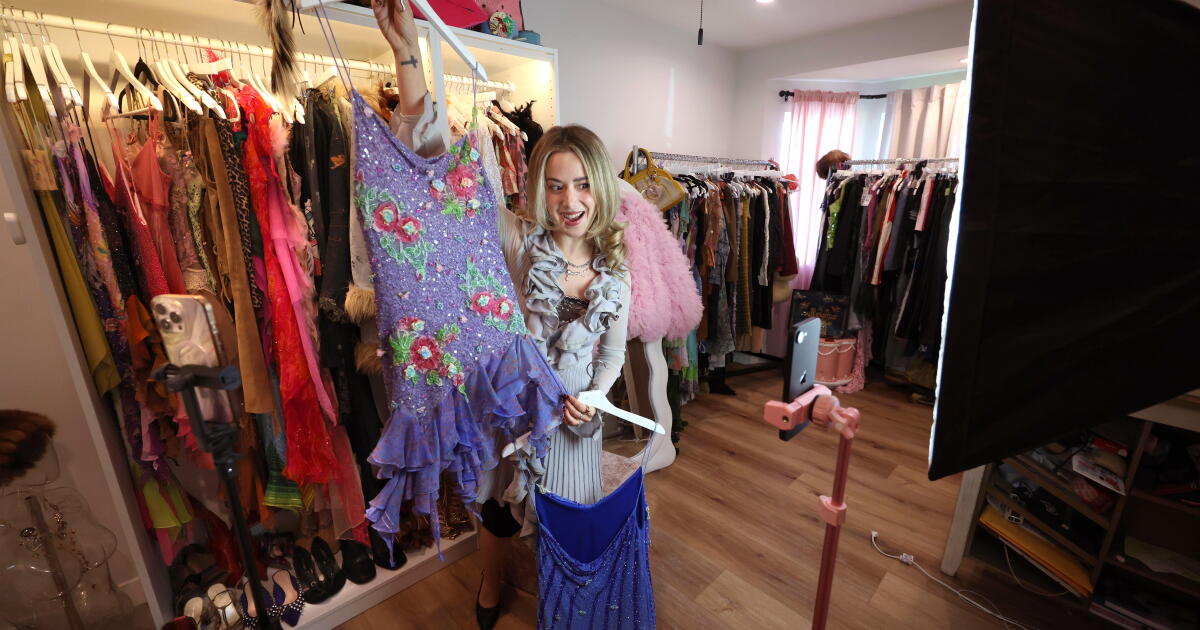



Stef Garcia stands in front of her phone and sells, sells, sells.
The former reality television worker who lives in North Hollywood shows off a neon-green watch in a live video as viewers bid on her rapid-fire offers. She gives shoppers seven seconds to bid.
“Don’t lose it for a dollar,” Garcia says, counting down.
“Let’s go!” screams her co-host. As time runs out, the winning bidder’s name flashes on the screen. The watch sells for $13. The duo moves on to the next piece from the early 2000s and quickly sells a snake-shaped watch, a blue polka-dot watch and a metallic watch as viewers chime in with questions and comments.
After an hour and a half, they’ve sold more than 200 vintage watches during a “Y2K Watch Party” on Whatnot, a livestream shopping platform from a Culver City startup. Over four years on the app, Garcia has raked in more than half a million dollars in sales selling vintage finds this way.
Welcome to the new wave of shopping: live commerce.
Vintage watches being sold through live commerce from the Los Angeles vintage fashion business Costura.
(Genaro Molina / Los Angeles Times)
It is QVC on steroids: thousands of people selling anything from soap to baseball cards live while interacting with their customers. It is already a massive industry, as hosts have stumbled on new ways to excite viewers into spending more and more.
Whatnot, founded in 2019 and now valued at $20 billion, has propelled the rise of live shopping in the U.S. The company said it surpassed $8 billion in live sales in 2025 and is on track to more than double that figure this year. Whatnot, which wouldn’t share its total user numbers, added more than 16 million new accounts this year.
It competes with TikTok, which launched live shopping in 2023. E-commerce giants EBay and Amazon have also jumped into the fray.
“Whatnot is really the first that has started to gain significant traction in the U.S.” outside of TikTok, said Sky Canaves, a principal analyst of retail at eMarketer.
In 2025, global TikTok Shop livestream sales reached $17.1 billion, according to Charm, a data intelligence platform that tracks sales on the platform. Roughly $2.8 billion of TikTok’s livestream sales are in the United States.
The phenomenon started in China, fueled by e-commerce giant Alibaba. People flocked to live shopping not only because it’s entertaining but also because it’s a place to find deals and win prizes. Livestreaming sales in China are projected to hit $1.1 trillion in 2026, making up roughly 31% of total e-commerce sales, according to eMarketer.

Stef Garcia has raked in more than half a million dollars in sales selling vintage finds.
(Genaro Molina / Los Angeles Times)
The United States has lagged behind, with live shopping making up roughly 1% of total e-commerce sales. Livestreaming e-commerce sales are expected to grow 58% from $19.76 billion in 2026 to $31.24 billion in 2029, according to a forecast from eMarketer.
Whatnot originally started as a business that acted as a marketplace buyers and sellers could use to authenticate popular Funko Pop figurines and later added livestreaming.
Whatnot co-founder Grant LaFontaine sold Pokemon cards as a kid and, as an adult, worked at Facebook and YouTube. Logan Head, another Whatnot co-founder, was a senior product manager at Los Angeles-based online sneaker marketplace GOAT Group.
Whatnot makes most of its money through fees, charging an average of 8% for every sale on the platform, said Armand Wilson, Whatnot’s chief revenue officer.
Wilson, who also co-founded a small business called Artefact that sells shoes and baseball caps, knows firsthand that starting a business can be expensive as advertising and real estate costs pile up. Livestreaming commerce lets entrepreneurs start small from home and use their passion and personality to interact with shoppers in ways big retailers, online and offline, cannot.
“It allows you to really do the storytelling behind the product and connect with potential buyers in a really authentic way,” Wilson said.
The possibility of making millions from selling live on Whatnot or TikTok has lured in former entertainment workers, moms, small-business owners and others to the platforms. Some sell as a side hustle, while others go all in.

Stef Garcia with a vintage dress.
(Genaro Molina / Los Angeles Times)
Jeff Tedmori, a former child actor turned entrepreneur, started a Costa Mesa-based seafood business called E-Fish in 2020. While recovering from surgery this year, he spent time watching livestreams on Whatnot and would later join the app to sell fish.
“That first livestream, I went all out. Super high energy, like screaming at the camera, and it was wild,” he said.
He’s hit $20,000 in sales in a single live show and even livestreamed from a boat for 48 hours as fish were reeled in.
Whatnot faces stiff competition from TikTok, where users see livestreams appear on their personalized feeds. On TikTok Shop, a separate tab on the app, viewers can ask questions and leave their comments and ratings.
Mandys Peña, founder of hair-care and beauty brand Simply Mandys, said she’s hit more than $1 million in sales in a single live session six times on TikTok. Her personal account has more than 2 million followers, and her brand has more than 581,000 followers.
“There are some people who just go on camera, and they sell like crazy,” said Peña, who views her followers as friends.
Her business, based in Reedley, Calif., sells flat irons, shampoo and other items. She has a physical store and a website, but more than 90% of her customers buy her products through TikTok Shop.
Other entrepreneurs are creating spaces where livestreaming sellers can go online and also have a physical place to sell items to walk-in customers.
In a studio on Third Street Promenade in Santa Monica, hosts stand in front of cameras and products from major brands such as Samsung and Samsonite that they’re selling on TikTok. Startup Outlandish, which offers video production, livestreaming and marketing services, opened the space in 2024, and people can also buy items there.
“You still need to go outside and socialize and touch things and experience things, and what better way to bring offline back than using online traffic,” Outlandish founder and Chief Executive William August said.
As live shopping grows, platforms like Whatnot have also grappled with issues such as theft, addiction claims and accusations that these platforms may be allowing illegal gambling.
One popular Los Angeles sneaker seller that used Whatnot and other platforms was accused of selling stolen goods.
Whatnot says it uses identity verification, automated detection and human review to stop bad actors.
Some shoppers have shown signs of addiction to the new form of shopping. One reportedly spent more than $1 million on the platform.
Vanessa Veliz has often spent hundreds of dollars on Whatnot buying collectibles. She deleted the app to avoid being enticed by deals.
“It does get addicting because it’s like you’re getting stuff on sale, even though you’re still spending money,” Veliz said.
Users can set spending and watch time limits on the platform, according to Whatnot’s trust and safety center.
Whatnot seller Garcia started selling full time on Whatnot after she lost her job in reality television.
She helped produce shows such as “Revenge Body with Khloe Kardashian” and the documentary series “Helter Skelter.” Now she looks for vintage clothes and accessories from the late 1990s and early 2000s to sell to her very niche audience who have a similar fashion sense. She ships more than 1,500 items a month.
She loves interacting with customers and finding things that she thinks they will like. She’s always surprised at how many people like her picks.
“You can show an item and start it at $5, and the crowd is going to tell you how much they think it’s worth,” said Garcia, who has been on Whatnot for four years. “I’ve always been into fashion, but I didn’t think that people love vintage or Y2K fashion as much as I did.”

Stef Garcia stands in front of her phone and sells, sells, sells.
The former reality television worker who lives in North Hollywood shows off a neon-green watch in a live video as viewers bid on her rapid-fire offers. She gives shoppers seven seconds to bid.
“Don’t lose it for a dollar,” Garcia says, counting down.
“Let’s go!” screams her co-host. As time runs out, the winning bidder’s name flashes on the screen. The watch sells for $13. The duo moves on to the next piece from the early 2000s and quickly sells a snake-shaped watch, a blue polka-dot watch and a metallic watch as viewers chime in with questions and comments.
After an hour and a half, they’ve sold more than 200 vintage watches during a “Y2K Watch Party” on Whatnot, a livestream shopping platform from a Culver City startup. Over four years on the app, Garcia has raked in more than half a million dollars in sales selling vintage finds this way.
Welcome to the new wave of shopping: live commerce.
Vintage watches being sold through live commerce from the Los Angeles vintage fashion business Costura.
(Genaro Molina / Los Angeles Times)
It is QVC on steroids: thousands of people selling anything from soap to baseball cards live while interacting with their customers. It is already a massive industry, as hosts have stumbled on new ways to excite viewers into spending more and more.
Whatnot, founded in 2019 and now valued at $20 billion, has propelled the rise of live shopping in the U.S. The company said it surpassed $8 billion in live sales in 2025 and is on track to more than double that figure this year. Whatnot, which wouldn’t share its total user numbers, added more than 16 million new accounts this year.
It competes with TikTok, which launched live shopping in 2023. E-commerce giants EBay and Amazon have also jumped into the fray.
“Whatnot is really the first that has started to gain significant traction in the U.S.” outside of TikTok, said Sky Canaves, a principal analyst of retail at eMarketer.
In 2025, global TikTok Shop livestream sales reached $17.1 billion, according to Charm, a data intelligence platform that tracks sales on the platform. Roughly $2.8 billion of TikTok’s livestream sales are in the United States.
The phenomenon started in China, fueled by e-commerce giant Alibaba. People flocked to live shopping not only because it’s entertaining but also because it’s a place to find deals and win prizes. Livestreaming sales in China are projected to hit $1.1 trillion in 2026, making up roughly 31% of total e-commerce sales, according to eMarketer.
Stef Garcia has raked in more than half a million dollars in sales selling vintage finds.
(Genaro Molina / Los Angeles Times)
The United States has lagged behind, with live shopping making up roughly 1% of total e-commerce sales. Livestreaming e-commerce sales are expected to grow 58% from $19.76 billion in 2026 to $31.24 billion in 2029, according to a forecast from eMarketer.
Whatnot originally started as a business that acted as a marketplace buyers and sellers could use to authenticate popular Funko Pop figurines and later added livestreaming.
Whatnot co-founder Grant LaFontaine sold Pokemon cards as a kid and, as an adult, worked at Facebook and YouTube. Logan Head, another Whatnot co-founder, was a senior product manager at Los Angeles-based online sneaker marketplace GOAT Group.
Whatnot makes most of its money through fees, charging an average of 8% for every sale on the platform, said Armand Wilson, Whatnot’s chief revenue officer.
Wilson, who also co-founded a small business called Artefact that sells shoes and baseball caps, knows firsthand that starting a business can be expensive as advertising and real estate costs pile up. Livestreaming commerce lets entrepreneurs start small from home and use their passion and personality to interact with shoppers in ways big retailers, online and offline, cannot.
“It allows you to really do the storytelling behind the product and connect with potential buyers in a really authentic way,” Wilson said.
The possibility of making millions from selling live on Whatnot or TikTok has lured in former entertainment workers, moms, small-business owners and others to the platforms. Some sell as a side hustle, while others go all in.
Stef Garcia with a vintage dress.
(Genaro Molina / Los Angeles Times)
Jeff Tedmori, a former child actor turned entrepreneur, started a Costa Mesa-based seafood business called E-Fish in 2020. While recovering from surgery this year, he spent time watching livestreams on Whatnot and would later join the app to sell fish.
“That first livestream, I went all out. Super high energy, like screaming at the camera, and it was wild,” he said.
He’s hit $20,000 in sales in a single live show and even livestreamed from a boat for 48 hours as fish were reeled in.
Whatnot faces stiff competition from TikTok, where users see livestreams appear on their personalized feeds. On TikTok Shop, a separate tab on the app, viewers can ask questions and leave their comments and ratings.
Mandys Peña, founder of hair-care and beauty brand Simply Mandys, said she’s hit more than $1 million in sales in a single live session six times on TikTok. Her personal account has more than 2 million followers, and her brand has more than 581,000 followers.
“There are some people who just go on camera, and they sell like crazy,” said Peña, who views her followers as friends.
Her business, based in Reedley, Calif., sells flat irons, shampoo and other items. She has a physical store and a website, but more than 90% of her customers buy her products through TikTok Shop.
Other entrepreneurs are creating spaces where livestreaming sellers can go online and also have a physical place to sell items to walk-in customers.
In a studio on Third Street Promenade in Santa Monica, hosts stand in front of cameras and products from major brands such as Samsung and Samsonite that they’re selling on TikTok. Startup Outlandish, which offers video production, livestreaming and marketing services, opened the space in 2024, and people can also buy items there.
“You still need to go outside and socialize and touch things and experience things, and what better way to bring offline back than using online traffic,” Outlandish founder and Chief Executive William August said.
As live shopping grows, platforms like Whatnot have also grappled with issues such as theft, addiction claims and accusations that these platforms may be allowing illegal gambling.
One popular Los Angeles sneaker seller that used Whatnot and other platforms was accused of selling stolen goods.
Whatnot says it uses identity verification, automated detection and human review to stop bad actors.
Some shoppers have shown signs of addiction to the new form of shopping. One reportedly spent more than $1 million on the platform.
Vanessa Veliz has often spent hundreds of dollars on Whatnot buying collectibles. She deleted the app to avoid being enticed by deals.
“It does get addicting because it’s like you’re getting stuff on sale, even though you’re still spending money,” Veliz said.
Users can set spending and watch time limits on the platform, according to Whatnot’s trust and safety center.
Whatnot seller Garcia started selling full time on Whatnot after she lost her job in reality television.
She helped produce shows such as “Revenge Body with Khloe Kardashian” and the documentary series “Helter Skelter.” Now she looks for vintage clothes and accessories from the late 1990s and early 2000s to sell to her very niche audience who have a similar fashion sense. She ships more than 1,500 items a month.
She loves interacting with customers and finding things that she thinks they will like. She’s always surprised at how many people like her picks.
“You can show an item and start it at $5, and the crowd is going to tell you how much they think it’s worth,” said Garcia, who has been on Whatnot for four years. “I’ve always been into fashion, but I didn’t think that people love vintage or Y2K fashion as much as I did.”

