

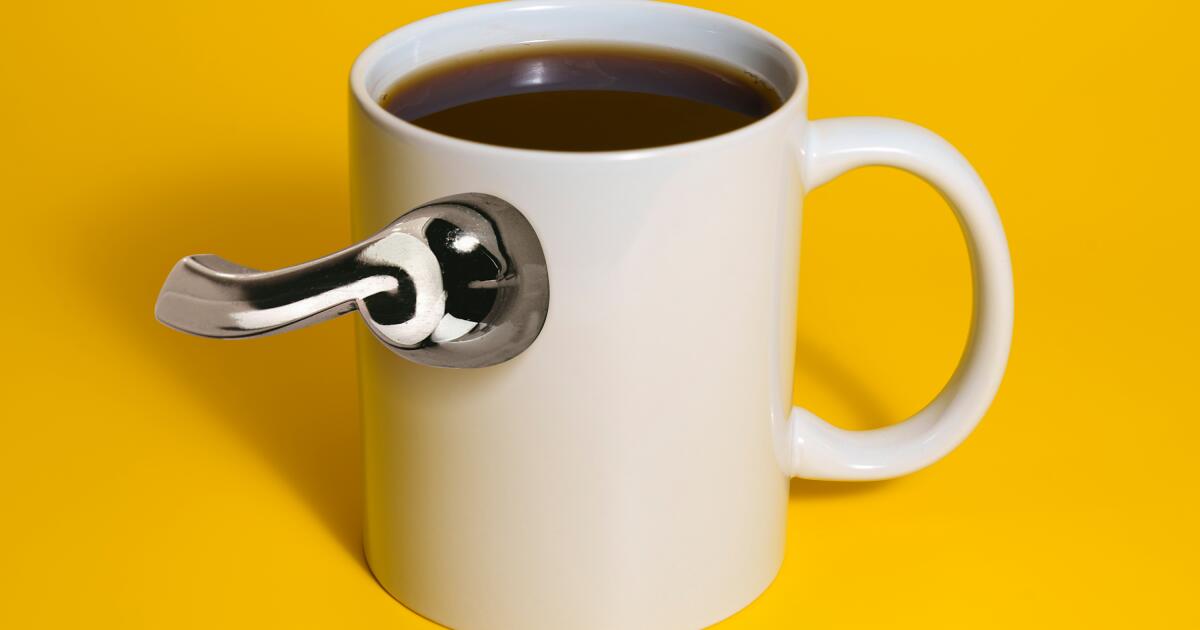



It seems like nothing is off limits these days in L.A.’s most woo-woo wellness scenes. From ayahuasca circles and mail-order ketamine lozenges to off-label peptide injections, IV drips and longevity treatments, there’s a seemingly infinite number of ways to look and feel better that people will swear by in this town. Coffee enemas — mostly for digestive issues, but also for a host of other emotional and physiological conditions — is on that alleged miracle menu, and far more common than I even realized before I started writing this article.
“Oh, I have a friend who does that,” “Oh, my cousin swears by it,” I began hearing from people as soon as I started looking for interviewees.
Reddit contains hundreds of anecdotes — both enthusiastic and cautionary — about coffee enemas, which involve a person, often on their own, but sometimes with the assistance of an alternative health practitioner, filling a bag with coffee fluid, inserting a tube into their rectum, and slowly allowing the liquid to be absorbed. “Beware of coffee enemas,” reads the subject line of a post from a woman who did them regularly for a decade and reports feelings of exhaustion, spaciness and cravings when she tries to stop. “Caffeine in any form only (temporarily) masks and provides salve toward bigger, unaddressed issue(s),” she writes.
In response, another user — a person with Stage 4 ovarian cancer — jumps in to defend the practice. “Let’s respect what we are all doing, whether we agree or not,” they write. “I am doing conventional [treatment] in conjunction with alternative (I believe there is a place for both). I haven’t felt this good since my diagnosis. I feel light, have never felt jittery and chemotherapy had me so constipated I would cry.”
Over the last couple of decades, the interest in digestive health has grown exponentially, prompted by research on the gut-brain connection. According to a report by Grand View Research, the global gut health market was valued at $60.31 billion in 2025 and is projected to reach $114.83 billion by 2033. The growing number of people who are quietly (and often devoutly) doing coffee enemas is a part of this larger trend, which also includes fasting, cleanses, colonics, probiotics, food allergy and stool tests, and a number of other products and services intended to address everything from irregular or uncomfortable bowel movements to energy levels and mood. But what’s the deal with coffee enemas? And are they actually good for you? We talked to a wide range of people with an equally wide range of opinions.
Five enemas a day? Inside the controversial Gerson therapy
The pro-enema Reddit user coping with Stage 4 cancer posted that they do three coffee enemas daily. They discovered the practice through Gerson, an institute founded in 1978 to promote a treatment plan initially developed for tuberculosis, and later for cancer, migraines and other chronic conditions, by German American physician Dr. Max Gerson in the 1930s. If you visit the Gerson Institute website, the supplies for a coffee enema — organic therapy blend coffee ($9.75) and the complete enema bucket kit with catheter ($19) — are listed in its store. It has clinics in Tijuana, Budapest and Shangri-La, China.
Nicole Ferrer-Clement, executive director of the Gerson Institute, says the treatment plan, referred to as the Gerson therapy, has four parts, with five coffee enemas per day being the first part and an essential component of the protocol. The other parts include a vegetarian, fat-free diet, three juices (carrot, carrot and apple, and a green juice) and supplements. The idea behind the coffee enemas, she says, is that compounds (theobromine, theophylline, caffeine) in coffee stimulate the liver to produce more bile, which helps carry toxins out of the body through the digestive tract. Ferrer-Clement says this is important for cancer patients, whose livers may already be compromised while processing toxins released during treatment. Even though many people reach out to Gerson about coffee enemas for general health and wellness and constipation, she says that’s not generally something they recommend. The therapy remains controversial among mainstream oncologists, in part because there are few rigorous clinical studies evaluating its efficacy.
“We want research on [coffee enemas], we’re happy and open to do that, if someone is going to fund it,” Ferrer-Clement says, estimating the institute has treated thousands of patients over the years.
In addition to using coffee enemas to treat cancer, the majority of users online report turning to them for constipation. Many anecdotes are from people who tried more conventional medicine for digestive issues and, from a place of desperation, decided to look elsewhere for solutions. Others, like Chevanni Davids, a 33-year-old South African man living in Bali, use them to maintain a general sense of well-being. Davids — who grew up in South Africa, where culturally it’s common for grandmothers to administer enemas to children in rural areas — does a coffee enema twice per month. He was introduced to the practice of enemas with coffee by someone he describes as a Brazilian grandmother or elder. He swears by the practice, saying it’s kept his bowel movements regular and his emotional state at an equilibrium. Davids warns against doing them too frequently, however. “The addiction is a thing,” he says, “because it feels so, so good. After you do it once, you’re going to say, ‘I’m going to do that tomorrow.’”
A doctor’s take
Unsurprisingly, given that most people tend to find coffee enemas after reports of being failed by Western medicine, mainstream gastroenterology is not on board with this practice. “Coffee enemas are based on the ill-conceived idea that you’re washing toxins out of your colon, but your colon is not an organ that clears toxins like the liver,” says Dr. Barry Zamost, a gastroenterologist who was in private practice in Long Beach for more than 40 years. “This just flies in the face of all logic and physiology that any doctor has learned for 100 years.”
Zamost remembers first hearing of coffee enemas decades ago when Michael Landon, an actor best known for his roles on “Little House on the Prairie” and “Bonanza,” decided to reject chemotherapy in favor of alternative treatments following a pancreatic cancer diagnosis in 1991. Over his four decades in private practice, Zamost says he frequently saw patients with constipation who were frustrated and trying alternate methods, but that oral therapies such as laxatives, supplements and prescription medications remain the most safe and effective treatments.
A review of case reports from nine people who self-administered coffee enemas also concluded that there’s insufficient evidence to prove that the practice is helpful, and that it could be harmful, to the colon. Zamost says he thinks it’s unlikely for someone to cause themselves serious harm by doing coffee enemas, although it’s happened. He also says that in rare cases that enemas — not with coffee — are appropriate for patients who are severely constipated to provide temporary relief. But, generally, he doesn’t see any benefit to using coffee. As for why people report loving them? That’s easy enough to explain, he says. “Everybody feels better after a bowel movement. So if you gave yourself an enema that really made you feel like you were emptied, you’ll feel good. It doesn’t mean your health is better.”
The takeaway
Coffee enemas are likely not harmful when done in moderation, but we don’t have much more than anecdotal evidence at this point to indicate that they’re helpful either.

It seems like nothing is off limits these days in L.A.’s most woo-woo wellness scenes. From ayahuasca circles and mail-order ketamine lozenges to off-label peptide injections, IV drips and longevity treatments, there’s a seemingly infinite number of ways to look and feel better that people will swear by in this town. Coffee enemas — mostly for digestive issues, but also for a host of other emotional and physiological conditions — is on that alleged miracle menu, and far more common than I even realized before I started writing this article.
“Oh, I have a friend who does that,” “Oh, my cousin swears by it,” I began hearing from people as soon as I started looking for interviewees.
Reddit contains hundreds of anecdotes — both enthusiastic and cautionary — about coffee enemas, which involve a person, often on their own, but sometimes with the assistance of an alternative health practitioner, filling a bag with coffee fluid, inserting a tube into their rectum, and slowly allowing the liquid to be absorbed. “Beware of coffee enemas,” reads the subject line of a post from a woman who did them regularly for a decade and reports feelings of exhaustion, spaciness and cravings when she tries to stop. “Caffeine in any form only (temporarily) masks and provides salve toward bigger, unaddressed issue(s),” she writes.
In response, another user — a person with Stage 4 ovarian cancer — jumps in to defend the practice. “Let’s respect what we are all doing, whether we agree or not,” they write. “I am doing conventional [treatment] in conjunction with alternative (I believe there is a place for both). I haven’t felt this good since my diagnosis. I feel light, have never felt jittery and chemotherapy had me so constipated I would cry.”
Over the last couple of decades, the interest in digestive health has grown exponentially, prompted by research on the gut-brain connection. According to a report by Grand View Research, the global gut health market was valued at $60.31 billion in 2025 and is projected to reach $114.83 billion by 2033. The growing number of people who are quietly (and often devoutly) doing coffee enemas is a part of this larger trend, which also includes fasting, cleanses, colonics, probiotics, food allergy and stool tests, and a number of other products and services intended to address everything from irregular or uncomfortable bowel movements to energy levels and mood. But what’s the deal with coffee enemas? And are they actually good for you? We talked to a wide range of people with an equally wide range of opinions.
Five enemas a day? Inside the controversial Gerson therapy
The pro-enema Reddit user coping with Stage 4 cancer posted that they do three coffee enemas daily. They discovered the practice through Gerson, an institute founded in 1978 to promote a treatment plan initially developed for tuberculosis, and later for cancer, migraines and other chronic conditions, by German American physician Dr. Max Gerson in the 1930s. If you visit the Gerson Institute website, the supplies for a coffee enema — organic therapy blend coffee ($9.75) and the complete enema bucket kit with catheter ($19) — are listed in its store. It has clinics in Tijuana, Budapest and Shangri-La, China.
Nicole Ferrer-Clement, executive director of the Gerson Institute, says the treatment plan, referred to as the Gerson therapy, has four parts, with five coffee enemas per day being the first part and an essential component of the protocol. The other parts include a vegetarian, fat-free diet, three juices (carrot, carrot and apple, and a green juice) and supplements. The idea behind the coffee enemas, she says, is that compounds (theobromine, theophylline, caffeine) in coffee stimulate the liver to produce more bile, which helps carry toxins out of the body through the digestive tract. Ferrer-Clement says this is important for cancer patients, whose livers may already be compromised while processing toxins released during treatment. Even though many people reach out to Gerson about coffee enemas for general health and wellness and constipation, she says that’s not generally something they recommend. The therapy remains controversial among mainstream oncologists, in part because there are few rigorous clinical studies evaluating its efficacy.
“We want research on [coffee enemas], we’re happy and open to do that, if someone is going to fund it,” Ferrer-Clement says, estimating the institute has treated thousands of patients over the years.
In addition to using coffee enemas to treat cancer, the majority of users online report turning to them for constipation. Many anecdotes are from people who tried more conventional medicine for digestive issues and, from a place of desperation, decided to look elsewhere for solutions. Others, like Chevanni Davids, a 33-year-old South African man living in Bali, use them to maintain a general sense of well-being. Davids — who grew up in South Africa, where culturally it’s common for grandmothers to administer enemas to children in rural areas — does a coffee enema twice per month. He was introduced to the practice of enemas with coffee by someone he describes as a Brazilian grandmother or elder. He swears by the practice, saying it’s kept his bowel movements regular and his emotional state at an equilibrium. Davids warns against doing them too frequently, however. “The addiction is a thing,” he says, “because it feels so, so good. After you do it once, you’re going to say, ‘I’m going to do that tomorrow.’”
A doctor’s take
Unsurprisingly, given that most people tend to find coffee enemas after reports of being failed by Western medicine, mainstream gastroenterology is not on board with this practice. “Coffee enemas are based on the ill-conceived idea that you’re washing toxins out of your colon, but your colon is not an organ that clears toxins like the liver,” says Dr. Barry Zamost, a gastroenterologist who was in private practice in Long Beach for more than 40 years. “This just flies in the face of all logic and physiology that any doctor has learned for 100 years.”
Zamost remembers first hearing of coffee enemas decades ago when Michael Landon, an actor best known for his roles on “Little House on the Prairie” and “Bonanza,” decided to reject chemotherapy in favor of alternative treatments following a pancreatic cancer diagnosis in 1991. Over his four decades in private practice, Zamost says he frequently saw patients with constipation who were frustrated and trying alternate methods, but that oral therapies such as laxatives, supplements and prescription medications remain the most safe and effective treatments.
A review of case reports from nine people who self-administered coffee enemas also concluded that there’s insufficient evidence to prove that the practice is helpful, and that it could be harmful, to the colon. Zamost says he thinks it’s unlikely for someone to cause themselves serious harm by doing coffee enemas, although it’s happened. He also says that in rare cases that enemas — not with coffee — are appropriate for patients who are severely constipated to provide temporary relief. But, generally, he doesn’t see any benefit to using coffee. As for why people report loving them? That’s easy enough to explain, he says. “Everybody feels better after a bowel movement. So if you gave yourself an enema that really made you feel like you were emptied, you’ll feel good. It doesn’t mean your health is better.”
The takeaway
Coffee enemas are likely not harmful when done in moderation, but we don’t have much more than anecdotal evidence at this point to indicate that they’re helpful either.

