

WASHINGTON — For more than four hours, a ground stop of virtually all aircraft in the United States brought unprecedented chaos and delays that are expected to last days.
Here is what we know about what went wrong.
What caused the stop?
Secretary of Transportation Sean Duffy said switches and routers on the Federal Aviation Administration’s analog air traffic control system became overloaded with data, causing inconsistencies in communication with airlines. As a result, the decision was made to shut the system down shortly after 12:30 p.m.
“We have old, old switches, old routers, we use 1980s little copper lines,” he said. “It’s an old system that went down and went down everywhere.”
The ground stop ended around 5:15 p.m. Duffy said the FAA was able to deploy fixes to reduce the overloading and bring its towers and air traffic control facilities known as TRACONs back online.
Duffy said the problem was with the TDM — time-division multiplexing — a dated, still mostly copper-wire technology used to transmit air traffic control voice and radar data. He said there was no evidence to suggest a cyberattack or the involvement of foreign adversaries.
What problems did this cause?
The technological breakdown led to intermittent communication and radar, but not a complete blackout, Duffy said.
“We were able to keep some of those communications going, but when you have issues and you can’t immediately communicate and immediately see where aircraft are at — that’s a risk that we’re unwilling to tolerate,” he said.
What do we know about the technology?
Duffy lambasted the aging infrastructure that the FAA relies on and said that President Trump is pushing for the funding needed to update the equipment.
“None of your networks run on 1980 technology,” he said to the gaggle of reporters at a Friday evening news conference. “You have all got fiber, state-of-the-art, high-speed networks that cover all of your stations, but not the FAA.”
He said the FAA was in the process of upgrading its air traffic control system thanks to $12.5 billion in funding secured through Trump’s Big Beautiful Bill, but called on Congress to approve an additional $50 billion to complete the modernization of the system.
“I believe that should be a priority,” he said. “America, Congress, let’s make this system more safe.”
Homeland Security Secretary Markwayne Mullin noted that the communications failure was caused as the FAA was performing upgrades.
“That new equipment, new technology — It was overwhelming the older system,” he said. “The patchwork doesn’t work. We need one complete system.”
What is the impact?
There were more than 3,500 airplanes flying across America when the decision to close the airspace was made, Duffy said.
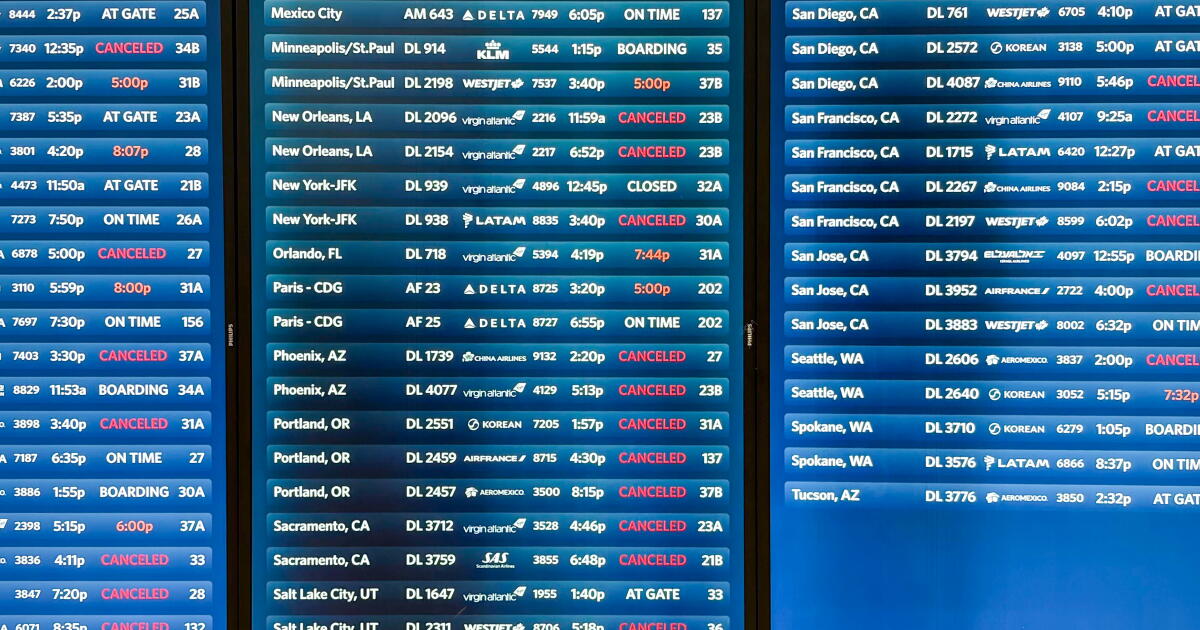
Tens of thousands of travelers were left stranded and FEMA was mobilized to ensure lifesaving medication was not being missed by passengers, said Mullin. Some college football teams were left scrambling to find alternative transportation to this weekend’s games.
Duffy said that air traffic control would try to move as many planes as possible Friday night, but noted that this will depend on the availability of flight crews and pilots.

WASHINGTON — For more than four hours, a ground stop of virtually all aircraft in the United States brought unprecedented chaos and delays that are expected to last days.
Here is what we know about what went wrong.
What caused the stop?
Secretary of Transportation Sean Duffy said switches and routers on the Federal Aviation Administration’s analog air traffic control system became overloaded with data, causing inconsistencies in communication with airlines. As a result, the decision was made to shut the system down shortly after 12:30 p.m.
“We have old, old switches, old routers, we use 1980s little copper lines,” he said. “It’s an old system that went down and went down everywhere.”
The ground stop ended around 5:15 p.m. Duffy said the FAA was able to deploy fixes to reduce the overloading and bring its towers and air traffic control facilities known as TRACONs back online.
Duffy said the problem was with the TDM — time-division multiplexing — a dated, still mostly copper-wire technology used to transmit air traffic control voice and radar data. He said there was no evidence to suggest a cyberattack or the involvement of foreign adversaries.
What problems did this cause?
The technological breakdown led to intermittent communication and radar, but not a complete blackout, Duffy said.
“We were able to keep some of those communications going, but when you have issues and you can’t immediately communicate and immediately see where aircraft are at — that’s a risk that we’re unwilling to tolerate,” he said.
What do we know about the technology?
Duffy lambasted the aging infrastructure that the FAA relies on and said that President Trump is pushing for the funding needed to update the equipment.
“None of your networks run on 1980 technology,” he said to the gaggle of reporters at a Friday evening news conference. “You have all got fiber, state-of-the-art, high-speed networks that cover all of your stations, but not the FAA.”
He said the FAA was in the process of upgrading its air traffic control system thanks to $12.5 billion in funding secured through Trump’s Big Beautiful Bill, but called on Congress to approve an additional $50 billion to complete the modernization of the system.
“I believe that should be a priority,” he said. “America, Congress, let’s make this system more safe.”
Homeland Security Secretary Markwayne Mullin noted that the communications failure was caused as the FAA was performing upgrades.
“That new equipment, new technology — It was overwhelming the older system,” he said. “The patchwork doesn’t work. We need one complete system.”
What is the impact?
There were more than 3,500 airplanes flying across America when the decision to close the airspace was made, Duffy said.
Tens of thousands of travelers were left stranded and FEMA was mobilized to ensure lifesaving medication was not being missed by passengers, said Mullin. Some college football teams were left scrambling to find alternative transportation to this weekend’s games.
Duffy said that air traffic control would try to move as many planes as possible Friday night, but noted that this will depend on the availability of flight crews and pilots.

WASHINGTON — For more than four hours, a ground stop of virtually all aircraft in the United States brought unprecedented chaos and delays that are expected to last days.
Here is what we know about what went wrong.
What caused the stop?
Secretary of Transportation Sean Duffy said switches and routers on the Federal Aviation Administration’s analog air traffic control system became overloaded with data, causing inconsistencies in communication with airlines. As a result, the decision was made to shut the system down shortly after 12:30 p.m.
“We have old, old switches, old routers, we use 1980s little copper lines,” he said. “It’s an old system that went down and went down everywhere.”
The ground stop ended around 5:15 p.m. Duffy said the FAA was able to deploy fixes to reduce the overloading and bring its towers and air traffic control facilities known as TRACONs back online.
Duffy said the problem was with the TDM — time-division multiplexing — a dated, still mostly copper-wire technology used to transmit air traffic control voice and radar data. He said there was no evidence to suggest a cyberattack or the involvement of foreign adversaries.
What problems did this cause?
The technological breakdown led to intermittent communication and radar, but not a complete blackout, Duffy said.
“We were able to keep some of those communications going, but when you have issues and you can’t immediately communicate and immediately see where aircraft are at — that’s a risk that we’re unwilling to tolerate,” he said.
What do we know about the technology?
Duffy lambasted the aging infrastructure that the FAA relies on and said that President Trump is pushing for the funding needed to update the equipment.
“None of your networks run on 1980 technology,” he said to the gaggle of reporters at a Friday evening news conference. “You have all got fiber, state-of-the-art, high-speed networks that cover all of your stations, but not the FAA.”
He said the FAA was in the process of upgrading its air traffic control system thanks to $12.5 billion in funding secured through Trump’s Big Beautiful Bill, but called on Congress to approve an additional $50 billion to complete the modernization of the system.
“I believe that should be a priority,” he said. “America, Congress, let’s make this system more safe.”
Homeland Security Secretary Markwayne Mullin noted that the communications failure was caused as the FAA was performing upgrades.
“That new equipment, new technology — It was overwhelming the older system,” he said. “The patchwork doesn’t work. We need one complete system.”
What is the impact?
There were more than 3,500 airplanes flying across America when the decision to close the airspace was made, Duffy said.
Tens of thousands of travelers were left stranded and FEMA was mobilized to ensure lifesaving medication was not being missed by passengers, said Mullin. Some college football teams were left scrambling to find alternative transportation to this weekend’s games.
Duffy said that air traffic control would try to move as many planes as possible Friday night, but noted that this will depend on the availability of flight crews and pilots.

WASHINGTON — For more than four hours, a ground stop of virtually all aircraft in the United States brought unprecedented chaos and delays that are expected to last days.
Here is what we know about what went wrong.
What caused the stop?
Secretary of Transportation Sean Duffy said switches and routers on the Federal Aviation Administration’s analog air traffic control system became overloaded with data, causing inconsistencies in communication with airlines. As a result, the decision was made to shut the system down shortly after 12:30 p.m.
“We have old, old switches, old routers, we use 1980s little copper lines,” he said. “It’s an old system that went down and went down everywhere.”
The ground stop ended around 5:15 p.m. Duffy said the FAA was able to deploy fixes to reduce the overloading and bring its towers and air traffic control facilities known as TRACONs back online.
Duffy said the problem was with the TDM — time-division multiplexing — a dated, still mostly copper-wire technology used to transmit air traffic control voice and radar data. He said there was no evidence to suggest a cyberattack or the involvement of foreign adversaries.
What problems did this cause?
The technological breakdown led to intermittent communication and radar, but not a complete blackout, Duffy said.
“We were able to keep some of those communications going, but when you have issues and you can’t immediately communicate and immediately see where aircraft are at — that’s a risk that we’re unwilling to tolerate,” he said.
What do we know about the technology?
Duffy lambasted the aging infrastructure that the FAA relies on and said that President Trump is pushing for the funding needed to update the equipment.
“None of your networks run on 1980 technology,” he said to the gaggle of reporters at a Friday evening news conference. “You have all got fiber, state-of-the-art, high-speed networks that cover all of your stations, but not the FAA.”
He said the FAA was in the process of upgrading its air traffic control system thanks to $12.5 billion in funding secured through Trump’s Big Beautiful Bill, but called on Congress to approve an additional $50 billion to complete the modernization of the system.
“I believe that should be a priority,” he said. “America, Congress, let’s make this system more safe.”
Homeland Security Secretary Markwayne Mullin noted that the communications failure was caused as the FAA was performing upgrades.
“That new equipment, new technology — It was overwhelming the older system,” he said. “The patchwork doesn’t work. We need one complete system.”
What is the impact?
There were more than 3,500 airplanes flying across America when the decision to close the airspace was made, Duffy said.
Tens of thousands of travelers were left stranded and FEMA was mobilized to ensure lifesaving medication was not being missed by passengers, said Mullin. Some college football teams were left scrambling to find alternative transportation to this weekend’s games.
Duffy said that air traffic control would try to move as many planes as possible Friday night, but noted that this will depend on the availability of flight crews and pilots.

WASHINGTON — For more than four hours, a ground stop of virtually all aircraft in the United States brought unprecedented chaos and delays that are expected to last days.
Here is what we know about what went wrong.
What caused the stop?
Secretary of Transportation Sean Duffy said switches and routers on the Federal Aviation Administration’s analog air traffic control system became overloaded with data, causing inconsistencies in communication with airlines. As a result, the decision was made to shut the system down shortly after 12:30 p.m.
“We have old, old switches, old routers, we use 1980s little copper lines,” he said. “It’s an old system that went down and went down everywhere.”
The ground stop ended around 5:15 p.m. Duffy said the FAA was able to deploy fixes to reduce the overloading and bring its towers and air traffic control facilities known as TRACONs back online.
Duffy said the problem was with the TDM — time-division multiplexing — a dated, still mostly copper-wire technology used to transmit air traffic control voice and radar data. He said there was no evidence to suggest a cyberattack or the involvement of foreign adversaries.
What problems did this cause?
The technological breakdown led to intermittent communication and radar, but not a complete blackout, Duffy said.
“We were able to keep some of those communications going, but when you have issues and you can’t immediately communicate and immediately see where aircraft are at — that’s a risk that we’re unwilling to tolerate,” he said.
What do we know about the technology?
Duffy lambasted the aging infrastructure that the FAA relies on and said that President Trump is pushing for the funding needed to update the equipment.
“None of your networks run on 1980 technology,” he said to the gaggle of reporters at a Friday evening news conference. “You have all got fiber, state-of-the-art, high-speed networks that cover all of your stations, but not the FAA.”
He said the FAA was in the process of upgrading its air traffic control system thanks to $12.5 billion in funding secured through Trump’s Big Beautiful Bill, but called on Congress to approve an additional $50 billion to complete the modernization of the system.
“I believe that should be a priority,” he said. “America, Congress, let’s make this system more safe.”
Homeland Security Secretary Markwayne Mullin noted that the communications failure was caused as the FAA was performing upgrades.
“That new equipment, new technology — It was overwhelming the older system,” he said. “The patchwork doesn’t work. We need one complete system.”
What is the impact?
There were more than 3,500 airplanes flying across America when the decision to close the airspace was made, Duffy said.
Tens of thousands of travelers were left stranded and FEMA was mobilized to ensure lifesaving medication was not being missed by passengers, said Mullin. Some college football teams were left scrambling to find alternative transportation to this weekend’s games.
Duffy said that air traffic control would try to move as many planes as possible Friday night, but noted that this will depend on the availability of flight crews and pilots.

