

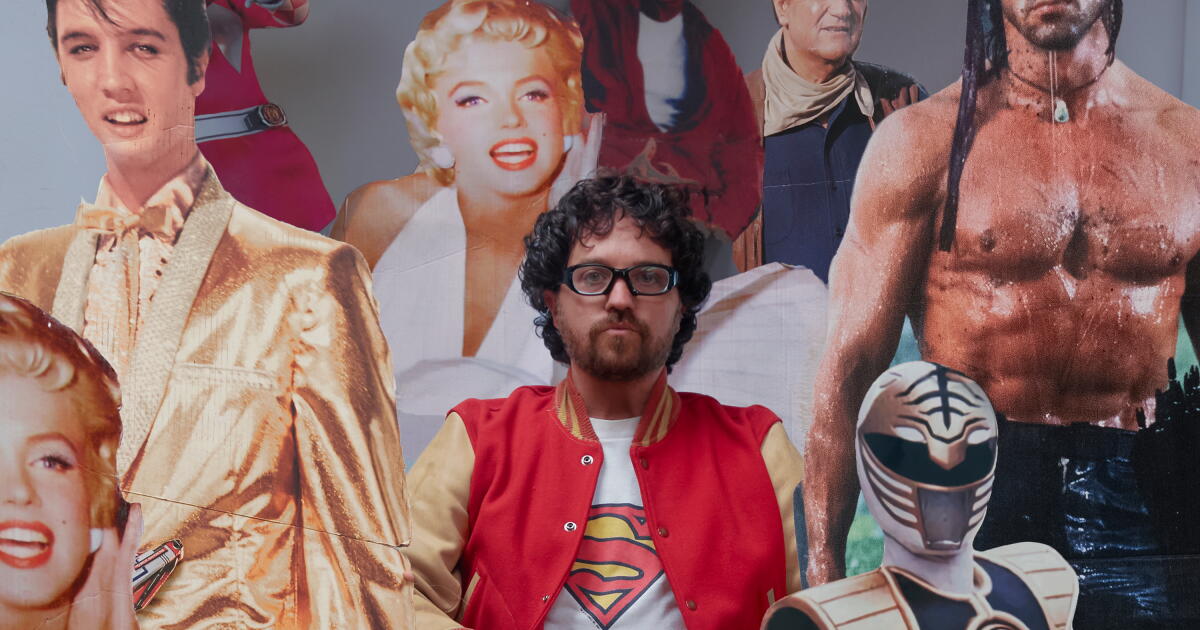
Tony Hawk is attempting to ollie in a pair of comically voluptuous shoes and a chic knit turtleneck sweater under the same roof where the Dennis Hopper died. To understand how Hawk ended up here, in Venice, on a Friday afternoon, one must understand the curly-haired man who is photographing him as it’s happening: Eli Russell Linnetz. The Southern California of it all is almost too much. It’s peaking. Linnetz’s rambunctious wire-haired Viszla mix, Einstein, barks at what is unbeknownst to him one of the most legendary skateboards of all time. The sound of it smacking the period-correct plywood floor. There are cardboard cutouts of Marilyn Monroe, Rocky, James Dean and Elvis in the background. Instead of reprimanding his pet, Linnetz seems to recognize the moment as a potentially good shot. He keeps on snapping his point-and-shoot camera.
This is just another scene in the life Linnetz has created for himself. He lives and works in this compound, the famous architectural landmark that Hopper had built in the mid-’80s made of air and wood and metal, which was partially designed by Frank Gehry. He designed the clothes Hawk is currently wearing under his brand, ERL, a semi-accidental career move that’s taken on a life of its own since he officially launched it in 2020, after Linnetz spent his formative years directing music videos for megastars. He called Hawk here to be a part of the shoot for this magazine, a request also sent out to Lisa Rinna and Amelia Gray, Jeffrey Deitch and Jeff Goldblum, Wolfgang Puck and his family, Travis Barker and the artist Mary Weatherford, to name a few. This concept was to capture part of the modern iconography of L.A. — an idea Linnetz is obsessed with. “I’m really thinking when I take this photo: How is this going to be perceived in 50 or 100 years?”

Still, he hates asking for favors — he’s been on the other side of that equation one too many times during his tenure in the funhouse of music industry celebrity. Mostly everyone he contacted to be a part of this project, though, said yes. It surprised him. These are actors and musicians Linnetz has dressed at some point. Others know him through the fine art world. Some are beloved ultra-famous weirdos who are down to clown, likely with plugged-in publicists who know that under Linnetz’s vision, they could be part of creating an indelible image — like ASAP Rocky wearing that multicolored ERL quilt at the Met Gala or Kid Cudi in an ERL wedding dress at the CFDA Awards.


“Any time he reaches out to me, I’ve always said to him, ‘I’ll do whatever you want,’ ” Rinna tells me. She met Linnetz through her daughter Amelia Gray’s boyfriend, Guess heir Nicolai Marciano. “I don’t do that with everybody. Whatever magic he holds, he calls me or he texts me, I’m like, ‘Where do I need to be?’ ”

Eli Russell Linnetz photographs Lisa Rinna and her daughter Amelia Gray dressed in ERL at his home in Venice, CA on July 27, 2026 for Image Magazine’s September 2026 Image Makers issue.
Being someone who lives in a personally architected fantasy world 99% of the time doesn’t always lend itself to understanding how people on the other side of it perceive you, which up until now was part of the point of the brand. He created it in the wake of needing something that was his own expression, not tied to pop stars or rappers he worked with, but a medium to create and expel. ERL is so connected to Linnetz and his experience — an amalgam of all the characters he saw growing up in Venice and all the ones he revered from the movies. That kind of specificity always manages to float to the top.
“I created this thing to protect myself,” Linnetz says about his brand. “It’s weird to then be like, ‘Wait, there’s an outside world.’ When I was working on the ‘Phil Spector’ movie for David Mamet, one of the last lines in the movie was about the Minotaur, an old myth, and it said, ‘Why does the Minotaur live in a cave? It’s not to hide away, but it was to protect himself.’ Sometimes I feel like I’m like a monster in a cave. But then I’m like, ‘Am I protecting the world from me, or protecting myself from the world?’ ”
Oh, right, Linnetz also worked for the playwright David Mamet, whom he met at temple as a teenager and ended up assisting on Broadway, film and TV sets for a time. There are so many dots to connect — so many dots it would shock you how many damned dots there are for someone who is only 35 — and so little time. Tracking Linnetz’s path toward star-designer-in-the-making reads like the kind of magical realism novel that could only be set in a place like L.A. An advertisement on maybe why, like Linnetz, you should never leave it. “The amount of work is massive,” Linnetz says. “It’s a hard web to weave for people.”
One of the first things Linnetz will tell you about himself is that he’s a liar. That the life he has now is one he’s lied himself into, or rather built lie by lie. His sister, Hilary Leigh Linnetz, who serves as director of VIP and talent relations for ERL, chuckles when she overhears him telling me this for the second time with a wild glint in his eye. He lied to the kids at school, told them he lived in the Hopper house — the house we’re sitting in now — because he thought his generic single-family home just down the street from here was too average. Linnetz has never been average. He grew up with a lawyer dad and graphic designer-artist mom in a West Side hippie-ish household where creativity was encouraged. His mom had him watching every musical imaginable. Technically fashion was a first love — he’d sketch costumes for characters, get lost in it as a storytelling device in the endless films he consumed. He eventually became a child actor, credited in titles like “Emperor’s New Groove,” “ER” and “Tortilla Soup.” He also went to USC for screenwriting, where he was both in a fraternity and the opera department, if that tells you anything.
A more generous read is that Linnetz isn’t a liar, exactly, but a master manifestor. What is manifestation if not telling yourself an aspirational lie until the universe responds accordingly? Even more accurately, he’s a dedicated storyteller. Linnetz’s allegiance has always been to a good story, and his experiences up until now have been a collection point. “My life is like a movie,” he says.
Most new ERL collections are accompanied by a short plot synopsis written by Linnetz, a world unfolding from his imagination that gives the clothes context. The ERL Surplus collection, for example, was a “repository of leftovers from the national machine,” told through the reconstruction and destruction of vintage military fatigues. The Wild Bunch — a blur of fur, mesh, ripped leather and heavy metal, made in collaboration with the queer `70s artist Peter Berlin — told the tale of a fictional Venice Beach gang called the Dudley Dozens, “a group of mercenary henchmen turned anarchists” who are as charismatic as they are unhinged. “After the Dozens are double-crossed in a robbery gone wrong, they descend upon the town looking for answers.” ERL’s fall/winter 2026 collection includes includes knit jumpers made to look like static on a TV screen, sharply tailored suits and leather jackets, turtlenecks and polos with academic-inspired ERL insignia, drop-waist cocktail dresses. It feels harsher, more exaggerated and formal than anything he’s done before. And for being a designer that’s known for his use of color, it has been the darkest ERL collection yet, born out of a “black hole” Linnetz was in from watching world events unfold on the news. He based the collection on what the sons of wealthy dictators at a boarding school in Austria would wear.

Jeff Goldblum wears ERL crest sweater, black track shorts, handcrafted leather loafers and soft socks.

Mary Weatherford wears ERL artisanal patchwork evening dress.

Lauren Halsey wears ERL artisanal shearling moto jacket, corduroy boardwalk shorts, bro sunglasses, noir croc vamps, soft socks and ERL X Tom Binns silver skate chain.

Alex Israel wears ERL argyle sweater, crest polo, track shorts and flip flops.
Whether you knew it was him or not, Linnetz’s images and stories have burrowed themselves into popular consciousness for the last decade. He directed arguably one of the most memorable hip-hop music videos in recent history when he was just 24 years old, Ye’s “Fade,” giving us the image of Teyana Taylor’s oil-slicked abs doing a “Flashdance” homage to cling on to forever more. He also had a hand in Ye’s controversial “Famous” video, serving as creative director of fabrication for the naked celebrity sculptures, immortalizing Taylor Swift and Bill Cosby in that massive white bed. (He connected with Ye because the rapper tweeted out an open call for his creative agency, and a friend emailed over Linnetz’s work.) Linnetz told the New York Times years ago that he treated this time as an artist’s residency. “I was probably the only person on Earth that would challenge him,” he tells me. After working on multiple projects for Ye and his family — including cover concepts for “The Life of Pablo” and the set design of its tour, and more intimate moments like photographing Kim Kardashian’s first public post after her traumatic Paris robbery — he did stage design and visual direction for Lady Gaga’s Las Vegas Enigma residency. He’s also dabbled in music production for artists including Kid Cudi and Teyana Taylor.
His path toward becoming a designer was weird, but probably fated if what happened next was any indication. He got a meeting with luxury fashion advertising creative director Ronnie Cooke Newhouse, whom he now sees as a fashion guardian angel. Newhouse hired him to direct a campaign for a Comme des Garçons Andy Warhol fragrance, “You’re In,” for which Linnetz created a freaky yellow monochromatic world — bodies, bodies, bodies crawling, dancing, interlocking all over each other. In what has become a Linnetz signature, it was artful and strangely erotic, referencing a million things you should probably know but can’t quite place. It got the attention of Dover Street Market president Adrian Joffe, whom Newhouse introduced Linnetz to. He was invited by Joffe to make a collection for the opening of Dover Street Market Los Angeles and then brought in to start a brand under Dover Street Market’s development program.
The CliffsNotes version of what came after reads like every aspiring menswear designer’s wildest dream. He guest-designed Dior’s spring 2023 collection under Kim Jones and staged the show on the Venice boardwalk. (“There’s few people in the world — like Adrian Joffe, Ronnie Cooke Newhouse, Kim Jones, Ye — who really can pull you out of your universe and see something in you,” Linnetz says.) He won the LVMH Karl Lagerfeld Prize and was honored as the guest designer at Pitti Uomo, where the concept of his show told a futuristic tale where Florence was now submerged under water and Venice surfers came to conquer its superwaves.
“My trajectory is so unorthodox,” Linnetz says. “People in fashion are a different breed…. I’m just a theater person. This is theater and costume and dress-up and play.”

ERL is building a new shape. Many have described Linnetz’s clothes as a fresh version of Americana, as vehicles for the indelible California spirit. All of those things are true. But what they feel like most, to me, are the signature costumes of a Southern California character — the ultimate Venetian. They’re wearable, but cinematic if you know where to look. A list of hits includes the wide-leg cargos, meticulously faded so that they look like they’ve been left on a south-facing balcony to dry on one too many Sunday afternoons, residual saltwater lifting the pigment. There are the Vamps, inflated shoes born of the puffy Y2K lineage of skate classics like Osirises or Etnies, taken to theatrical levels of bulbous. There is his penchant for color — an extension of the lens through which he must see the world, shocks of neon pink and electric green. ERL’s clothes make the wearer look like a character from “Rocket Power,” Arlene Klasky and Gábor Csupó‘s 1999 cartoon of a group of kids doing extreme sports in the fictional town of Ocean Shores, Calif. — all baggy jeans and T-shirts and stompers hanging in a relaxed triangle shape on the body.
The clothes are anchored by references that draw from Linnetz’s personal life and from our shared Southern California language and creed. You see bits of the Venice he grew up observing — bikers, gangsters, surfers and skaters — in the work. But you also see “The Sound of Music,” or “American Pie.” There are whispers of Busby Berkeley and Norman Rockwell. “My favorite thing is looking through infinite references and then reaching my hand almost into a black hole, a magical bag of the universe, and being like, ‘This is the shape,’ ” says Linnetz. It’s hedonism twisted to look like optimism.
At one point during the photo shoot, Hawk slipped on a pair of ERL kicks that looked like the corduroy house shoes worn by cholos in the ’90s, styled with long cream-colored terrycloth socks, and uttered those two magical words: “Sock check!” And even if it was technically impossible for Hawk to actually do a trick in the Vamps he wore in the previous look because of their size and orientation, that might only add to the essence of Linnetz’s designs: To me, these are not clothes made strictly to surf or skate in — these are clothes about surfing and skating. They’re clothes that tell a story.
“For me, it represents a more underground time of skating, very street-oriented,” Hawk says of Linnetz’s clothes. He was front row at Linnetz’s Dior fashion show three years ago in Venice, which felt like a turning point for the culture. “As a hardcore skater my whole life, seeing it come from where it was the most uncool thing you do, to the theme of a Dior fashion show thanks to Eli, it’s a huge step forward and a huge validation.”
Linnetz casts and shoots all of his campaign photos himself, some of which evoke the homoerotic undertones of muscular frat boys falling all over each other during a casual game of football, or the brown paper crinkle of a vintage Abercrombie and Fitch bag plastered with those images by Bruce Weber. There are shots of tan lines that feel dangerous, toes that would make your own curl. “I grew up watching [‘The Fabulous Life of…’ on VH1 in the 2000s], so I feel like I’m actually brainwashed — there’s an actual mental illness,” Linnetz says, joking about his photographic eye and ideas of beauty. “She’s one of my favorite people, but I used to work with Kim Kardashian retouching her photos, so I probably have a mental disorder from doing all of that work.”
I met Linnetz for the first time at Jonathan Anderson’s Dior Cruise show at LACMA in May. He was standing alone at the base of the new David Geffen Galleries and looking around with the same expression on his face now as we’re talking about participating in the fashion industry. He’s amiable and curious and SoCal warm, but perhaps more comfortable being an outside observer, tucked away in his Venice aerie. “If someone really wants to get ahold of me, they’ll come see me,” he says.

He showed womenswear for the first time at Paris fashion week in June, a pop-up in a hot pink room that seemed to swallow you whole and models that looked as if they‘d been plucked straight from California in the ’80s, and he didn’t even go.
“I was such a f— weirdo,” he says of his earlier experiences operating on the periphery. “I would be hazing pledges [at my frat] and then I would be singing Wagner’s West Coast premiere of ‘Das Liebesverbot.’ I’d be sewing costumes and then I was screenwriting and then I talked my way onto the diving team. I was always trying to see what I could get away with.”
The collective eyeroll when someone claims they’re a multihyphenate is probably only because most of the people who self-identify that way are just average in five different formats. Again, nothing about Linnetz is average. “In the times we live in, there are very few multihyphenates that are actually good — that are actually what they claim to be,” says Matthew Henson, a stylist who has worked with Linnetz on a GQ cover of Pharrell Williams and while styling Rocky’s Met Gala look. Linnetz is different.
The gallerist Jeffrey Deitch has worked with some of the most famous artist-designers over the years — from Stephen Sprouse to Jeremy Scott. He held Linnetz’s first solo fine art show in 2023 at his L.A. gallery, an exhibition called “Monuments” in which Linnetz created a Mt. Rushmore pizza oven. “He’s not just making art; he is contributing to contemporary culture,” Deitch says. “We have to differentiate between someone like Eli and then other people who go out into the culture and become viral. There’s quality and rigor to the work. These are images you remember.”
Linnetz relishes in his identity as a provocateur, a detail about him which has, in fact, produced more viral moments in five years than most people have in their entire career as a designer. But these moments, as Deitch says, feel part of a larger narrative. You get the sense that Linnetz is in on it all. It’s this mischievousness, this theater kid spirit, that makes him feel far away from the self-serious fashion people — but probably also why the self-serious fashion people are so drawn to him. When Rocky and Henson came to his studio looking to collaborate on the Met Gala, he hid any pieces he thought the rapper would have a natural inclination toward, including a suit that Linnetz knew he was interested in, hoping to push him toward something different. “If someone wants something so bad, I’m not interested in that,” Linnetz says. “I want to see what else there is. I want to create something new.”
He quotes the famous line from fictional “Sex and the City” character, party girl Lexi Featherston, before she falls out of a window in Season 6, Episode 18: “No one’s fun anymore! Whatever happened to fun?” The eggshells under the feet of other people trying to make it in the fashion industry seem to not apply to Linnetz. He speaks freely, with a heedless humor about what he thinks. (“I also appreciate perfection and the Adonis. I feel like people have become too comfortable being unattractive or something. I don’t know.”) But still possesses self-awareness. (“I mean, I dress like total s—. I just got dressed up because [you’re] here. I was in s—, torn clothes and I’m mostly barefoot.”) At some point in our second conversation, someone from his team keeps pausing him mid-sentence to remind him what should be off the record.
The stakes feel lower, maybe, because ERL is only one of his many mediums. Linnetz doesn’t drink, he doesn’t do drugs, he stopped smoking cigs years ago now. All of that energy is poured into his work unless he takes a rare break and goes to the movies (also a form of work for him) or like last week, when he went to Coni’Seafood with his homeless neighbor who lives around the corner. For fun, he sometimes puts together menu guides from places he loves to eat in painstaking detail for friends. He and Hilary show me the elaborate digital presentation Linnetz created outlining the best food at Disneyland. Linnetz has a natural high that’s infectious, no doubt the source of his endless energy to create, to try new things, to improvise. His photography work has run in places like Vogue, GQ, i-D, and earlier this year he shot an Armani/Archivio campaign. He’s also in the process of working on a feature film inspired by his time at USC — the exact details of which his staff member reminds him are also off the record.
But the flipside to that level of polymathic genius is a desire to apply it to everything, to mold it painstakingly in your own hyperspecific image. You have to be extreme, as Linnetz says, to not only produce, but shoot, up to 10 collections a year.
“I was having a hard time leaving my house last year because every time I went into the world, there were so many things I wanted to fix,” Linnetz says. “L.A. is this weird collage of hundreds of thousands of mistakes on top of each other. It’s agitating that it’s not utopia. There’s no place of pure perfection. There’s something I want to fix everywhere I go. I’ll see a movie and I’ll be like, ‘That’s not how a movie should be. I’m just gonna write one because this is how I think a movie should be.’ It’s obviously a control issue.”

Travis Barker wears ERL flower dress shirt, corduroy boardwalk shorts, artisanal hand-studded vamps and soft socks.

Jeffrey Deitch wears ERL suit jacket, dress shirt, suit trousers and handcrafted leather loafers.

Eli Russell Linnetz, left, wears ERL plaid shirt, tee and cargo pants. Model Sean Van Der Linden wears ERL FW27.

Benito Skinner wears ERL cable knit vest, track shorts, handcrafted leather loafers and soft socks.
The idea for this editorial seems to transform overnight, multiplying in the neon-colored trenches of Linnetz’s mind. His idea was to first take a meta self-portrait while photographing one of his celebrity friends, which turned into a full-fledged portfolio featuring nearly 20 L.A. people — artists, actors, musicians, chefs.
At the end of our first hour-and-a-half interview, a Fiji water bottle shows up on the table, placed there by his sister, Hilary, which was probably just a polite offering, but I take as a subtle signal that I should probably wrap things up. “I told Eli we should have you in the shoot,” Hilary says. Who? Me? “You could come back and I could take your portrait,” Linnetz follows up. Reactively, I say, “No, guys, because I’m writing the story, I don’t think I technically can.” They look puzzled. Like, What’s the big deal? It’s clear that my limiting beliefs don’t fly in a place like this, which makes me reconsider. “But I’ll ask my editor.”
Part of me wonders if this is just Linnetz’s attempt to have a larger hand in this particular story that I’m telling about him, to shape it into the image he wants. Another part of me doesn’t think it’s that deep for him — just another example of a creative idea pouring out. Most likely it’s just a part of Linnetz’s improvisational spirit and ethos and I need to get on board. After getting the OK from my manager, I suggest we do it on a day when I can also observe him photographing Hawk.
Anytime a writer gets asked to model in anything, it spurs both a low-level existential crisis and subtle inflation of one’s ego that feels totally outside of your control. Another “Sex and the City” reference: See Carrie Bradshaw in Season 4, Episode 2, in which she gets asked to model in a charity fashion show. They switch out Carrie’s Dolce & Gabbana dress at the last moment for a pair of jeweled underwear and a coat, worn open. “I can’t wear jeweled panties,” she pleads with a fictional version of the designers, before being rushed to the makeup chair, telling iconic makeup artist Kevyn Aucoin, “I know you’re a genius, but here’s the thing: I’m a writer.”
Cut to me back at Linnetz’s studio the following week.
“We were thinking of this look — it’s a bodysuit with tights underneath. Are you comfortable?” Hilary asks me before showing me an image of a short-sleeved black beaded velvet body suit with a high-neck and an ’80s cut that would likely land somewhere above the flare of my hips. The look is paired with opaque black tights, a patent leather black coat snatched at the waist and black pumps.
“Yeah, generally,” I say back, sounding like I’m lying. “I’m down. I really want to lean into this experience as much as possible. It’s just that I’m just a boring journalist, you know?” Another lie — and one that sounds like I’m saying for validation — but it’s easier than explaining the fear of being perceived coupled with my own need for control and ultimate desire for a good story. The process reveals my and Linnetz’s similarities, as his words from the week prior echo in my mind: “I’d rather someone lie to me, tell me an amazing story, than deliver reality in any sort of way.”
I cross the metal bridge on the upper level of the Hopper house to a corner bathroom, where I peel the give-less velvet over my legs, torso and chest, all of which lack the planar structure needed to easily slink into a sample of this size. I’m sweating, they’re waiting. S—, s—, s—, I mouth.
No one talks about how vulnerable it is to walk into a room full of people when you’re wearing a bodysuit. But these people in particular have seen it all. Reese Witherspoon and Ryan Phillippe’s son, Deacon Phillippe, was in here the other day bearing his prosthetic-looking abs and his famous mother’s face. This is nothing to them, I remind myself.
Linnetz sits on his chair and looks up at me from behind his thick-rimmed black glasses, still polite and open but more difficult to read than the last time we met. I can’t tell if this is him in work-mode or he’s just uninterested. My mind starts going places: Maybe he regrets asking me to do this, or he felt pressured by his sister in the moment and didn’t want to be rude. I try to snap out of the story I’m projecting and try to focus on the one happening in front of me.
“You like it? It looks hot,” Hilary tells me.
“It’s very ‘Catwoman,’ ” Linnetz chimes in from across the room.
I think of all the mixed Black women who’ve played Catwoman over the years. Comparing myself to any of them — from Zoë Kravitz to Halle Berry — feels like a self-flattering stretch, but what other choice do I have? “Eartha Kitt?” I probe. Linnetz reminds me that he worked with Kitt when he did the voice of Tipo on “The Emperor’s New Groove” alongside her Yzma. In Linnetz’s world, saying something like, “I know Eartha Kitt,” feels as commonplace as reciting what he had for lunch that day.
Every celebrity wants to feel like they’re on the cutting edge of something. Jeff Goldblum in an oversized ERL tux and skunk collar at the Vanity Fair Oscars party with his wife, Emilie, also in ERL? Zaddy, the internet yells in admiration. Rinna wearing nothing but a JFK tie covering her nipples while she poses next to her shirtless husband, Harry Hamlin, at the Hopper house? Mother, the Culture parrots approvingly. The urge to work with Linnetz, to be captured by his lens and in his clothes, comes from wanting what Deitch described as that lasting image — one that cuts through the noise. To be extremely clear: I am not and have no desire to be one of the celebrities orbiting Linnetz’s world. But I wanted to know what it was like to work with him directly in this way. To watch him do his genius thing up close and report back. It’s something Goldblum, who has been dressed and photographed by Linnetz multiple times and now considers a friend, described to me as “playtime.” He continues: “It feels like you’re doing something intimate and specific with him.”

Annie Moon wears ERL artisanal faux skunk fur coat and cutoff denim shorts.

AG Cook wears ERL tuxedo shirt, checkered bowtie, checkered cummerbund, velvet trousers, bro sunglasses, vulcs and soft socks.

From left to right: Oliver Wolfgang Puck wears ERL black suit jacket, jacquard dress shirt, white bowtie, nylon pleated trousers, bro sunglasses, leather gloves and noir croc vamps; Wolfgang Puck wears ERL suit jacket, dress shirt, suit trousers and handcrafted leather loafers; Gelila Assefa Puck wears ERL artisanal sequin suit; Alexander Wolfgang Puck wears ERL tailcoat evening jacket, sueded button up shirt, white bowtie, white cummerbund, nylon pleated trousers, handcrafted leather loafers.

Julissa James wears ERL polizia leather coat, artisanal hand-beaded bodysuit, black aviator sunglasses and high heels.
The entire process took less than 15 minutes. “If I’m not saying any notes, it’s because it looks good,” Linnetz says, as I hold my breath next to Marilyn. Hilary brings out a pair of dark aviators, and I say a silent thanks for something I can hide in. I apologize for being stoic but Linnetz says he’s into it. I watch him photograph Hawk with a seemingly identical energy. He’s decisive and not overly chatty when making the work. He knows what he’s looking for. You get the sense that he’s tapping in from somewhere beyond or in between; either way it’s a place the rest of us couldn’t access even if we tried. And it’s all presented in the most casual way possible.
“One of my goals this year was to shoot Tony Hawk,” Linnetz says after.
I ask him if he was phased by it, or as starstruck as I was as a fellow California kid who grew up idolizing Hawk. He says no matter-of-factly, which makes sense considering how many of these moments Linnetz has experienced in his life so far. “What happens to me in one day is some people’s goals for their entire year.”
In June, it was announced that ERL would be splitting from Dover Street Market’s incubator program. It was a decision that came from that desire to be fully independent and in control of the story, to oversee every stitch. He’s in a place of expansion. As much as the Hopper house is and will continue to be a part of the ERL story, he’s actively looking for a bigger space to stretch out and do operations. “As your mind expands, you just need higher ceilings,” he says. “It’s like this quantum relationship between how much space you need.”
Fashion may not have started out as a passion or a goal, but it has become a “weird obsession,” Linnetz says. He tries to actively fight the urge to get caught up in the residual desire of his predecessors to prove himself to anyone and everyone in the industry by playing by its rules. He’s relying mostly on the build-it-and-they-will-come approach, which up until this point has worked.
Still, Linnetz harbors a curious desire about the experience of helming a big house one day. He cites the fashion greats who came from other fields and made a mark that permeated fashion in their own way — both Tom Ford and Virgil Abloh had architecture backgrounds, and it only made their work more memorable. Why not a creative director-photographer-opera singer-writer-designer-etc.-etc.-etc.?
“I’ve said this before, but all the things I lied about, have come true,” Linnetz says. “I’m not gonna accept anything less than how I see the world.”

Tony Hawk wears ERL textured wool overcoat, mock neck, straight cut jeans, pirate black vamps and soft socks.

Photography & Styling Eli Russell Linnetz
Production Hilary Leigh Linnetz, Bei Wang
Casting Natalie Hazzout
Image Lettering Keyla Marquez

