



NASA’s James Webb Space Telescope (JWST) has captured a sparkling image of the Pillars of creation, where stars are born. Webb’s image reveals a highly detailed landscape and new stars within dense clouds of gas and dust. Though the three-dimensional pillars look like majestic rock formations, they are far more permeable. The pillars are made up of cool interstellar gas and dust. At times, these columns appear semi-transparent in near-infrared light.
Webb’s sparkling image of the Pillars of Creation: Explained
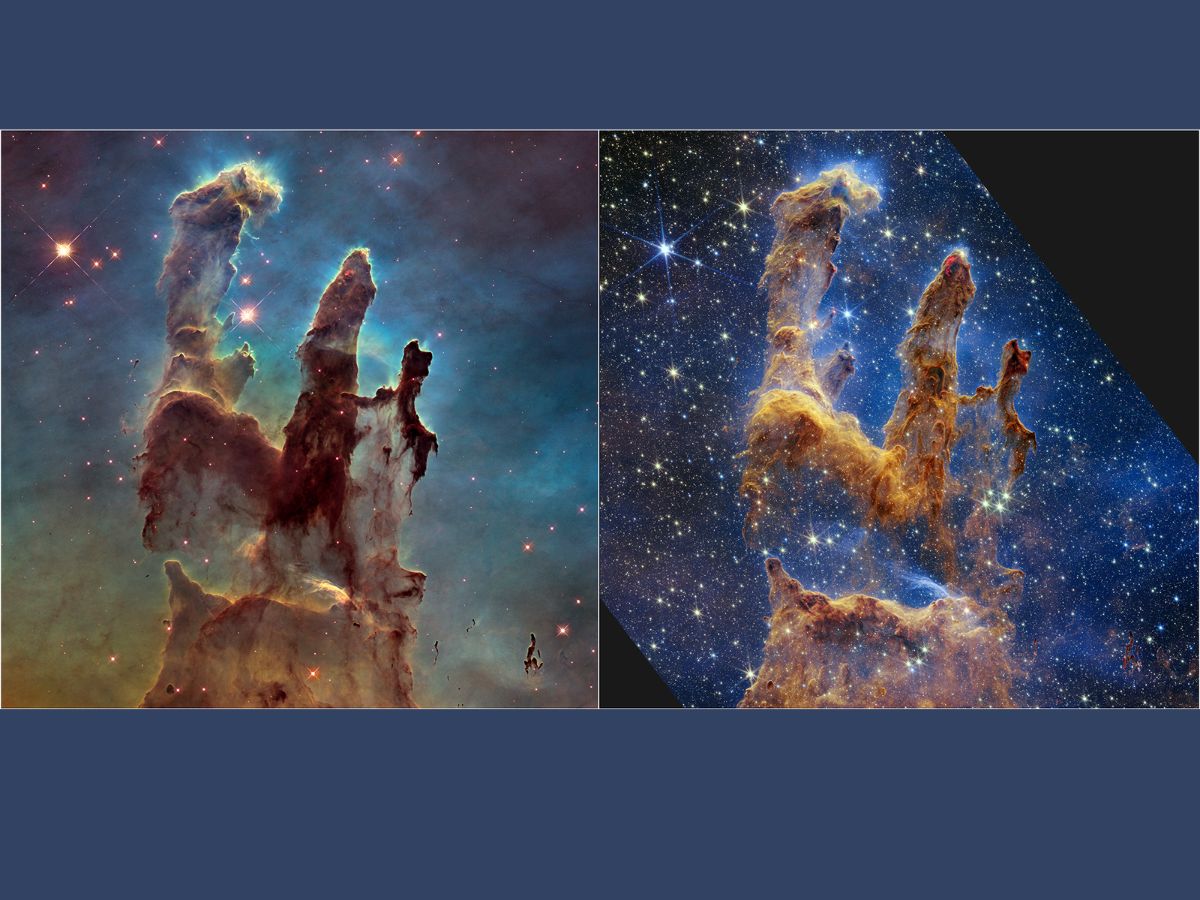
Webb’s Near-Infrared Camera (NIRCam) has captured the newly formed stars, which are the scene-stealers in the image of the Pillars of Creation. The bright red orbs in the image represent the newly formed structures of the gigantic cosmic entity. These orbs have diffraction spikes and lie outside one of the dusty pillars. Knots start forming within the pillars of gas and dust as mass accumulates. When these knots have sufficient mass, they begin to collapse under their own gravity. Eventually, they form new stars.
The wavy lines that look like lava at the edges of some pillars are ejections from stars that are still forming within the gas and dust. The thick pillars are clouds of material with which the supersonic jets shot out periodically by young stars collide. Sometimes, this results in bow shocks, leading to the formation of wavy patterns like those created by a boat as it moves through water.
The jets and shocks release energetic hydrogen molecules, which result in the crimson glow visible in the image.
ALSO READ | James Webb Space Telescope Finds Strange Organic Molecules In Galaxies Around Supermassive Black Holes
One can see the crimson glow in the second and third pillars from the top. The young stars in the Pillars of Creation are estimated to be only a few hundred thousand years old.
Webb’s near-infrared light view has set off the Pillars of Creation in a kaleidoscope of colours. The pillars are filled with semi-transparent gas and dust, are ever changing, and look like arches and spires rising out of a desert landscape. The pillars are the region where young stars are forming. Some stars have barely burst from their dusty cocoons as they continue to form.
ALSO READ | In A First, James Webb Space Telescope Captures ‘Tree Rings’ From Rare Type Of Star System
Why are no galaxies seen in Webb’s image of the Pillars of Creation?
There are no galaxies in the view, despite the fact that it appears that near-infrared light has allowed the world’s most powerful telescope to “pierce through” the clouds to reveal great cosmic distances beyond the pillars. The reason why galaxies are not seen in the image is that a mix of translucent gas and dust known as the interstellar medium in the densest part of the Milky Way galaxy’s disk blocks Earth’s view of the deeper universe.
ALSO READ | James Webb Space Telescope Reveals ‘Bones’ Of Spiral Galaxy In New Gothic Image
What Webb’s image of the Pillars of Creation will tell us about the cosmos
NASA’s Hubble Space Telescope captured the Pillars of Creation for the first time in 1995. Webb’s tightly cropped image is set within the vast Eagle Nebula, which lies 6,500 light-years away from Earth.
Webb’s image will help researchers identify far more precise counts of newly formed stars, along with the quantities of gas and dust in the region. This will allow researchers to revamp their models of star formation. Eventually, they will understand how stars form and burst out of these dusty clouds over millions of years.

NASA’s James Webb Space Telescope (JWST) has captured a sparkling image of the Pillars of creation, where stars are born. Webb’s image reveals a highly detailed landscape and new stars within dense clouds of gas and dust. Though the three-dimensional pillars look like majestic rock formations, they are far more permeable. The pillars are made up of cool interstellar gas and dust. At times, these columns appear semi-transparent in near-infrared light.
Webb’s sparkling image of the Pillars of Creation: Explained
Webb’s Near-Infrared Camera (NIRCam) has captured the newly formed stars, which are the scene-stealers in the image of the Pillars of Creation. The bright red orbs in the image represent the newly formed structures of the gigantic cosmic entity. These orbs have diffraction spikes and lie outside one of the dusty pillars. Knots start forming within the pillars of gas and dust as mass accumulates. When these knots have sufficient mass, they begin to collapse under their own gravity. Eventually, they form new stars.
The wavy lines that look like lava at the edges of some pillars are ejections from stars that are still forming within the gas and dust. The thick pillars are clouds of material with which the supersonic jets shot out periodically by young stars collide. Sometimes, this results in bow shocks, leading to the formation of wavy patterns like those created by a boat as it moves through water.
The jets and shocks release energetic hydrogen molecules, which result in the crimson glow visible in the image.
ALSO READ | James Webb Space Telescope Finds Strange Organic Molecules In Galaxies Around Supermassive Black Holes
One can see the crimson glow in the second and third pillars from the top. The young stars in the Pillars of Creation are estimated to be only a few hundred thousand years old.
Webb’s near-infrared light view has set off the Pillars of Creation in a kaleidoscope of colours. The pillars are filled with semi-transparent gas and dust, are ever changing, and look like arches and spires rising out of a desert landscape. The pillars are the region where young stars are forming. Some stars have barely burst from their dusty cocoons as they continue to form.
ALSO READ | In A First, James Webb Space Telescope Captures ‘Tree Rings’ From Rare Type Of Star System
Why are no galaxies seen in Webb’s image of the Pillars of Creation?
There are no galaxies in the view, despite the fact that it appears that near-infrared light has allowed the world’s most powerful telescope to “pierce through” the clouds to reveal great cosmic distances beyond the pillars. The reason why galaxies are not seen in the image is that a mix of translucent gas and dust known as the interstellar medium in the densest part of the Milky Way galaxy’s disk blocks Earth’s view of the deeper universe.
ALSO READ | James Webb Space Telescope Reveals ‘Bones’ Of Spiral Galaxy In New Gothic Image
What Webb’s image of the Pillars of Creation will tell us about the cosmos
NASA’s Hubble Space Telescope captured the Pillars of Creation for the first time in 1995. Webb’s tightly cropped image is set within the vast Eagle Nebula, which lies 6,500 light-years away from Earth.
Webb’s image will help researchers identify far more precise counts of newly formed stars, along with the quantities of gas and dust in the region. This will allow researchers to revamp their models of star formation. Eventually, they will understand how stars form and burst out of these dusty clouds over millions of years.

NASA’s James Webb Space Telescope (JWST) has captured a sparkling image of the Pillars of creation, where stars are born. Webb’s image reveals a highly detailed landscape and new stars within dense clouds of gas and dust. Though the three-dimensional pillars look like majestic rock formations, they are far more permeable. The pillars are made up of cool interstellar gas and dust. At times, these columns appear semi-transparent in near-infrared light.
Webb’s sparkling image of the Pillars of Creation: Explained
Webb’s Near-Infrared Camera (NIRCam) has captured the newly formed stars, which are the scene-stealers in the image of the Pillars of Creation. The bright red orbs in the image represent the newly formed structures of the gigantic cosmic entity. These orbs have diffraction spikes and lie outside one of the dusty pillars. Knots start forming within the pillars of gas and dust as mass accumulates. When these knots have sufficient mass, they begin to collapse under their own gravity. Eventually, they form new stars.
The wavy lines that look like lava at the edges of some pillars are ejections from stars that are still forming within the gas and dust. The thick pillars are clouds of material with which the supersonic jets shot out periodically by young stars collide. Sometimes, this results in bow shocks, leading to the formation of wavy patterns like those created by a boat as it moves through water.
The jets and shocks release energetic hydrogen molecules, which result in the crimson glow visible in the image.
ALSO READ | James Webb Space Telescope Finds Strange Organic Molecules In Galaxies Around Supermassive Black Holes
One can see the crimson glow in the second and third pillars from the top. The young stars in the Pillars of Creation are estimated to be only a few hundred thousand years old.
Webb’s near-infrared light view has set off the Pillars of Creation in a kaleidoscope of colours. The pillars are filled with semi-transparent gas and dust, are ever changing, and look like arches and spires rising out of a desert landscape. The pillars are the region where young stars are forming. Some stars have barely burst from their dusty cocoons as they continue to form.
ALSO READ | In A First, James Webb Space Telescope Captures ‘Tree Rings’ From Rare Type Of Star System
Why are no galaxies seen in Webb’s image of the Pillars of Creation?
There are no galaxies in the view, despite the fact that it appears that near-infrared light has allowed the world’s most powerful telescope to “pierce through” the clouds to reveal great cosmic distances beyond the pillars. The reason why galaxies are not seen in the image is that a mix of translucent gas and dust known as the interstellar medium in the densest part of the Milky Way galaxy’s disk blocks Earth’s view of the deeper universe.
ALSO READ | James Webb Space Telescope Reveals ‘Bones’ Of Spiral Galaxy In New Gothic Image
What Webb’s image of the Pillars of Creation will tell us about the cosmos
NASA’s Hubble Space Telescope captured the Pillars of Creation for the first time in 1995. Webb’s tightly cropped image is set within the vast Eagle Nebula, which lies 6,500 light-years away from Earth.
Webb’s image will help researchers identify far more precise counts of newly formed stars, along with the quantities of gas and dust in the region. This will allow researchers to revamp their models of star formation. Eventually, they will understand how stars form and burst out of these dusty clouds over millions of years.
NASA’s James Webb Space Telescope (JWST) has captured a sparkling image of the Pillars of creation, where stars are born. Webb’s image reveals a highly detailed landscape and new stars within dense clouds of gas and dust. Though the three-dimensional pillars look like majestic rock formations, they are far more permeable. The pillars are made up of cool interstellar gas and dust. At times, these columns appear semi-transparent in near-infrared light.
Webb’s sparkling image of the Pillars of Creation: Explained
Webb’s Near-Infrared Camera (NIRCam) has captured the newly formed stars, which are the scene-stealers in the image of the Pillars of Creation. The bright red orbs in the image represent the newly formed structures of the gigantic cosmic entity. These orbs have diffraction spikes and lie outside one of the dusty pillars. Knots start forming within the pillars of gas and dust as mass accumulates. When these knots have sufficient mass, they begin to collapse under their own gravity. Eventually, they form new stars.
The wavy lines that look like lava at the edges of some pillars are ejections from stars that are still forming within the gas and dust. The thick pillars are clouds of material with which the supersonic jets shot out periodically by young stars collide. Sometimes, this results in bow shocks, leading to the formation of wavy patterns like those created by a boat as it moves through water.
The jets and shocks release energetic hydrogen molecules, which result in the crimson glow visible in the image.
ALSO READ | James Webb Space Telescope Finds Strange Organic Molecules In Galaxies Around Supermassive Black Holes
One can see the crimson glow in the second and third pillars from the top. The young stars in the Pillars of Creation are estimated to be only a few hundred thousand years old.
Webb’s near-infrared light view has set off the Pillars of Creation in a kaleidoscope of colours. The pillars are filled with semi-transparent gas and dust, are ever changing, and look like arches and spires rising out of a desert landscape. The pillars are the region where young stars are forming. Some stars have barely burst from their dusty cocoons as they continue to form.
ALSO READ | In A First, James Webb Space Telescope Captures ‘Tree Rings’ From Rare Type Of Star System
Why are no galaxies seen in Webb’s image of the Pillars of Creation?
There are no galaxies in the view, despite the fact that it appears that near-infrared light has allowed the world’s most powerful telescope to “pierce through” the clouds to reveal great cosmic distances beyond the pillars. The reason why galaxies are not seen in the image is that a mix of translucent gas and dust known as the interstellar medium in the densest part of the Milky Way galaxy’s disk blocks Earth’s view of the deeper universe.
ALSO READ | James Webb Space Telescope Reveals ‘Bones’ Of Spiral Galaxy In New Gothic Image
What Webb’s image of the Pillars of Creation will tell us about the cosmos
NASA’s Hubble Space Telescope captured the Pillars of Creation for the first time in 1995. Webb’s tightly cropped image is set within the vast Eagle Nebula, which lies 6,500 light-years away from Earth.
Webb’s image will help researchers identify far more precise counts of newly formed stars, along with the quantities of gas and dust in the region. This will allow researchers to revamp their models of star formation. Eventually, they will understand how stars form and burst out of these dusty clouds over millions of years.

NASA’s James Webb Space Telescope (JWST) has captured a sparkling image of the Pillars of creation, where stars are born. Webb’s image reveals a highly detailed landscape and new stars within dense clouds of gas and dust. Though the three-dimensional pillars look like majestic rock formations, they are far more permeable. The pillars are made up of cool interstellar gas and dust. At times, these columns appear semi-transparent in near-infrared light.
Webb’s sparkling image of the Pillars of Creation: Explained
Webb’s Near-Infrared Camera (NIRCam) has captured the newly formed stars, which are the scene-stealers in the image of the Pillars of Creation. The bright red orbs in the image represent the newly formed structures of the gigantic cosmic entity. These orbs have diffraction spikes and lie outside one of the dusty pillars. Knots start forming within the pillars of gas and dust as mass accumulates. When these knots have sufficient mass, they begin to collapse under their own gravity. Eventually, they form new stars.
The wavy lines that look like lava at the edges of some pillars are ejections from stars that are still forming within the gas and dust. The thick pillars are clouds of material with which the supersonic jets shot out periodically by young stars collide. Sometimes, this results in bow shocks, leading to the formation of wavy patterns like those created by a boat as it moves through water.
The jets and shocks release energetic hydrogen molecules, which result in the crimson glow visible in the image.
ALSO READ | James Webb Space Telescope Finds Strange Organic Molecules In Galaxies Around Supermassive Black Holes
One can see the crimson glow in the second and third pillars from the top. The young stars in the Pillars of Creation are estimated to be only a few hundred thousand years old.
Webb’s near-infrared light view has set off the Pillars of Creation in a kaleidoscope of colours. The pillars are filled with semi-transparent gas and dust, are ever changing, and look like arches and spires rising out of a desert landscape. The pillars are the region where young stars are forming. Some stars have barely burst from their dusty cocoons as they continue to form.
ALSO READ | In A First, James Webb Space Telescope Captures ‘Tree Rings’ From Rare Type Of Star System
Why are no galaxies seen in Webb’s image of the Pillars of Creation?
There are no galaxies in the view, despite the fact that it appears that near-infrared light has allowed the world’s most powerful telescope to “pierce through” the clouds to reveal great cosmic distances beyond the pillars. The reason why galaxies are not seen in the image is that a mix of translucent gas and dust known as the interstellar medium in the densest part of the Milky Way galaxy’s disk blocks Earth’s view of the deeper universe.
ALSO READ | James Webb Space Telescope Reveals ‘Bones’ Of Spiral Galaxy In New Gothic Image
What Webb’s image of the Pillars of Creation will tell us about the cosmos
NASA’s Hubble Space Telescope captured the Pillars of Creation for the first time in 1995. Webb’s tightly cropped image is set within the vast Eagle Nebula, which lies 6,500 light-years away from Earth.
Webb’s image will help researchers identify far more precise counts of newly formed stars, along with the quantities of gas and dust in the region. This will allow researchers to revamp their models of star formation. Eventually, they will understand how stars form and burst out of these dusty clouds over millions of years.
NASA’s James Webb Space Telescope (JWST) has captured a sparkling image of the Pillars of creation, where stars are born. Webb’s image reveals a highly detailed landscape and new stars within dense clouds of gas and dust. Though the three-dimensional pillars look like majestic rock formations, they are far more permeable. The pillars are made up of cool interstellar gas and dust. At times, these columns appear semi-transparent in near-infrared light.
Webb’s sparkling image of the Pillars of Creation: Explained
Webb’s Near-Infrared Camera (NIRCam) has captured the newly formed stars, which are the scene-stealers in the image of the Pillars of Creation. The bright red orbs in the image represent the newly formed structures of the gigantic cosmic entity. These orbs have diffraction spikes and lie outside one of the dusty pillars. Knots start forming within the pillars of gas and dust as mass accumulates. When these knots have sufficient mass, they begin to collapse under their own gravity. Eventually, they form new stars.
The wavy lines that look like lava at the edges of some pillars are ejections from stars that are still forming within the gas and dust. The thick pillars are clouds of material with which the supersonic jets shot out periodically by young stars collide. Sometimes, this results in bow shocks, leading to the formation of wavy patterns like those created by a boat as it moves through water.
The jets and shocks release energetic hydrogen molecules, which result in the crimson glow visible in the image.
ALSO READ | James Webb Space Telescope Finds Strange Organic Molecules In Galaxies Around Supermassive Black Holes
One can see the crimson glow in the second and third pillars from the top. The young stars in the Pillars of Creation are estimated to be only a few hundred thousand years old.
Webb’s near-infrared light view has set off the Pillars of Creation in a kaleidoscope of colours. The pillars are filled with semi-transparent gas and dust, are ever changing, and look like arches and spires rising out of a desert landscape. The pillars are the region where young stars are forming. Some stars have barely burst from their dusty cocoons as they continue to form.
ALSO READ | In A First, James Webb Space Telescope Captures ‘Tree Rings’ From Rare Type Of Star System
Why are no galaxies seen in Webb’s image of the Pillars of Creation?
There are no galaxies in the view, despite the fact that it appears that near-infrared light has allowed the world’s most powerful telescope to “pierce through” the clouds to reveal great cosmic distances beyond the pillars. The reason why galaxies are not seen in the image is that a mix of translucent gas and dust known as the interstellar medium in the densest part of the Milky Way galaxy’s disk blocks Earth’s view of the deeper universe.
ALSO READ | James Webb Space Telescope Reveals ‘Bones’ Of Spiral Galaxy In New Gothic Image
What Webb’s image of the Pillars of Creation will tell us about the cosmos
NASA’s Hubble Space Telescope captured the Pillars of Creation for the first time in 1995. Webb’s tightly cropped image is set within the vast Eagle Nebula, which lies 6,500 light-years away from Earth.
Webb’s image will help researchers identify far more precise counts of newly formed stars, along with the quantities of gas and dust in the region. This will allow researchers to revamp their models of star formation. Eventually, they will understand how stars form and burst out of these dusty clouds over millions of years.
NASA’s James Webb Space Telescope (JWST) has captured a sparkling image of the Pillars of creation, where stars are born. Webb’s image reveals a highly detailed landscape and new stars within dense clouds of gas and dust. Though the three-dimensional pillars look like majestic rock formations, they are far more permeable. The pillars are made up of cool interstellar gas and dust. At times, these columns appear semi-transparent in near-infrared light.
Webb’s sparkling image of the Pillars of Creation: Explained
Webb’s Near-Infrared Camera (NIRCam) has captured the newly formed stars, which are the scene-stealers in the image of the Pillars of Creation. The bright red orbs in the image represent the newly formed structures of the gigantic cosmic entity. These orbs have diffraction spikes and lie outside one of the dusty pillars. Knots start forming within the pillars of gas and dust as mass accumulates. When these knots have sufficient mass, they begin to collapse under their own gravity. Eventually, they form new stars.
The wavy lines that look like lava at the edges of some pillars are ejections from stars that are still forming within the gas and dust. The thick pillars are clouds of material with which the supersonic jets shot out periodically by young stars collide. Sometimes, this results in bow shocks, leading to the formation of wavy patterns like those created by a boat as it moves through water.
The jets and shocks release energetic hydrogen molecules, which result in the crimson glow visible in the image.
ALSO READ | James Webb Space Telescope Finds Strange Organic Molecules In Galaxies Around Supermassive Black Holes
One can see the crimson glow in the second and third pillars from the top. The young stars in the Pillars of Creation are estimated to be only a few hundred thousand years old.
Webb’s near-infrared light view has set off the Pillars of Creation in a kaleidoscope of colours. The pillars are filled with semi-transparent gas and dust, are ever changing, and look like arches and spires rising out of a desert landscape. The pillars are the region where young stars are forming. Some stars have barely burst from their dusty cocoons as they continue to form.
ALSO READ | In A First, James Webb Space Telescope Captures ‘Tree Rings’ From Rare Type Of Star System
Why are no galaxies seen in Webb’s image of the Pillars of Creation?
There are no galaxies in the view, despite the fact that it appears that near-infrared light has allowed the world’s most powerful telescope to “pierce through” the clouds to reveal great cosmic distances beyond the pillars. The reason why galaxies are not seen in the image is that a mix of translucent gas and dust known as the interstellar medium in the densest part of the Milky Way galaxy’s disk blocks Earth’s view of the deeper universe.
ALSO READ | James Webb Space Telescope Reveals ‘Bones’ Of Spiral Galaxy In New Gothic Image
What Webb’s image of the Pillars of Creation will tell us about the cosmos
NASA’s Hubble Space Telescope captured the Pillars of Creation for the first time in 1995. Webb’s tightly cropped image is set within the vast Eagle Nebula, which lies 6,500 light-years away from Earth.
Webb’s image will help researchers identify far more precise counts of newly formed stars, along with the quantities of gas and dust in the region. This will allow researchers to revamp their models of star formation. Eventually, they will understand how stars form and burst out of these dusty clouds over millions of years.
NASA’s James Webb Space Telescope (JWST) has captured a sparkling image of the Pillars of creation, where stars are born. Webb’s image reveals a highly detailed landscape and new stars within dense clouds of gas and dust. Though the three-dimensional pillars look like majestic rock formations, they are far more permeable. The pillars are made up of cool interstellar gas and dust. At times, these columns appear semi-transparent in near-infrared light.
Webb’s sparkling image of the Pillars of Creation: Explained
Webb’s Near-Infrared Camera (NIRCam) has captured the newly formed stars, which are the scene-stealers in the image of the Pillars of Creation. The bright red orbs in the image represent the newly formed structures of the gigantic cosmic entity. These orbs have diffraction spikes and lie outside one of the dusty pillars. Knots start forming within the pillars of gas and dust as mass accumulates. When these knots have sufficient mass, they begin to collapse under their own gravity. Eventually, they form new stars.
The wavy lines that look like lava at the edges of some pillars are ejections from stars that are still forming within the gas and dust. The thick pillars are clouds of material with which the supersonic jets shot out periodically by young stars collide. Sometimes, this results in bow shocks, leading to the formation of wavy patterns like those created by a boat as it moves through water.
The jets and shocks release energetic hydrogen molecules, which result in the crimson glow visible in the image.
ALSO READ | James Webb Space Telescope Finds Strange Organic Molecules In Galaxies Around Supermassive Black Holes
One can see the crimson glow in the second and third pillars from the top. The young stars in the Pillars of Creation are estimated to be only a few hundred thousand years old.
Webb’s near-infrared light view has set off the Pillars of Creation in a kaleidoscope of colours. The pillars are filled with semi-transparent gas and dust, are ever changing, and look like arches and spires rising out of a desert landscape. The pillars are the region where young stars are forming. Some stars have barely burst from their dusty cocoons as they continue to form.
ALSO READ | In A First, James Webb Space Telescope Captures ‘Tree Rings’ From Rare Type Of Star System
Why are no galaxies seen in Webb’s image of the Pillars of Creation?
There are no galaxies in the view, despite the fact that it appears that near-infrared light has allowed the world’s most powerful telescope to “pierce through” the clouds to reveal great cosmic distances beyond the pillars. The reason why galaxies are not seen in the image is that a mix of translucent gas and dust known as the interstellar medium in the densest part of the Milky Way galaxy’s disk blocks Earth’s view of the deeper universe.
ALSO READ | James Webb Space Telescope Reveals ‘Bones’ Of Spiral Galaxy In New Gothic Image
What Webb’s image of the Pillars of Creation will tell us about the cosmos
NASA’s Hubble Space Telescope captured the Pillars of Creation for the first time in 1995. Webb’s tightly cropped image is set within the vast Eagle Nebula, which lies 6,500 light-years away from Earth.
Webb’s image will help researchers identify far more precise counts of newly formed stars, along with the quantities of gas and dust in the region. This will allow researchers to revamp their models of star formation. Eventually, they will understand how stars form and burst out of these dusty clouds over millions of years.

