

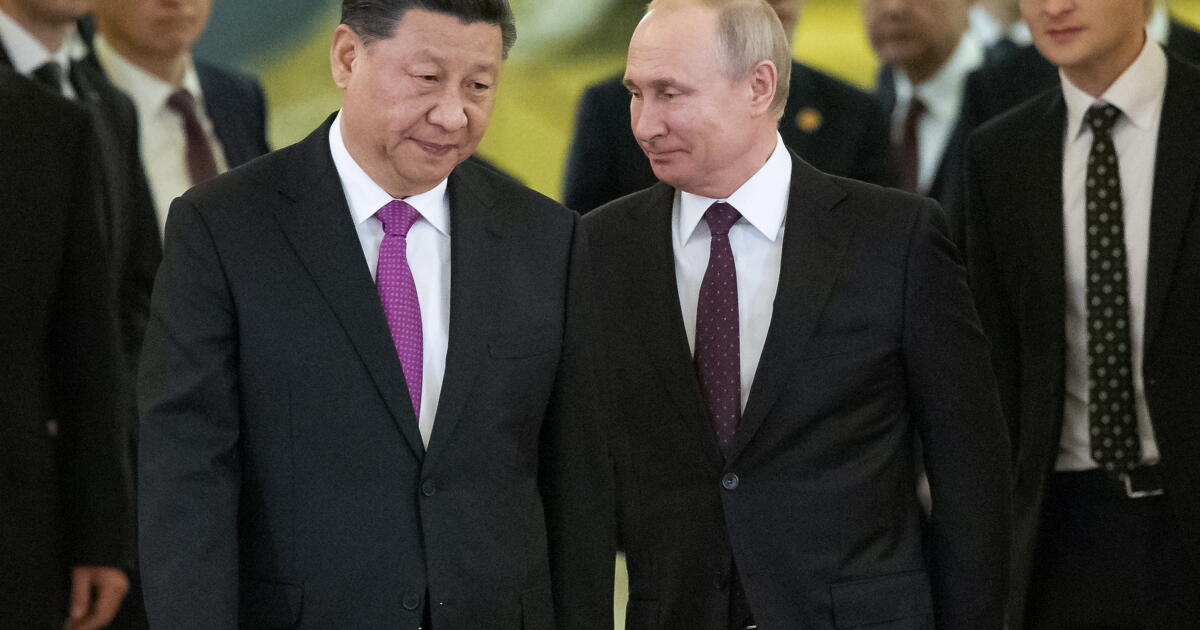
SEOUL — President Trump will get his wish for a historic meeting among the three most powerful men in the world — Xi Jinping of China, Vladimir Putin of Russia and himself — at a summit Thursday in southern China.
But Moscow, Beijing and Washington already know their leaders are arriving at the Shenzhen conference with disparate aims.
Trump hopes to focus the meeting on nuclear nonproliferation, urging the Russian and Chinese presidents to work with him to scale back the world’s largest nuclear stockpiles. Putin pressed for the meeting to discuss his ongoing war in Ukraine. And Xi wants to discuss neither, only embracing the idea of the summit to show the world China can help broker peace on the international stage, Chinese officials told The Times.
“That’ll be interesting,” Trump said earlier this week, teasing the trilateral summit before the White House formally confirmed the meeting Friday.
“We’re talking a lot of things, including denuclearization,” he added, “but we’ll be talking a lot of things.”
U.S. officials have acknowledged they do not expect the meeting to result in a breakthrough on arms control. China is openly racing to build up its nuclear capacity — a nonnegotiable policy in Beijing, which sees its arsenal dwarfed by an American stockpile nearly 10 times the size.
“We do not expect to get to any kind of agreement. I would characterize this as the entry point,” one senior Trump administration official said. “This is the beginning of hopefully a conversation that can be productive going forward.”
The Chinese, too, threw cold water on the chances of a breakthrough, with one Chinese official telling The Times the central government saw no benefit to a pause.
“It is a matter of survival,” the official said.
The United States and Russia still command the world’s two dominant nuclear arsenals, with over 5,000 warheads each. China has an estimated 620 — but in catching up, it is developing new warheads with more sophisticated delivery systems.
Moscow, too, is modernizing its weapons, after the Trump administration allowed the last major U.S.-Russian nuclear arms treaty to expire earlier this year.
Though expectations are low for a nuclear breakthrough, Trump doesn’t want to discuss Putin’s priorities, either, the U.S. official added.
“He does not intend to talk about Ukraine in that meeting,” the official said. “China is not really part of that track, so it doesn’t really seem appropriate.”
Ukraine has grown increasingly concerned by Trump’s pressure campaign to force it into concessions to Moscow as he pushes to end the war.
The Trump administration has brought Russian and Ukrainian officials together at a working level to explore the viability of peace talks. But a long-standing U.S. policy on the war — not to negotiate about Ukraine without Ukraine — could be further compromised at a trilateral with Putin and Xi.
The only American business leader confirmed to join Trump in Asia is Elon Musk, the Tesla and SpaceX chief who was seen as instrumental in the decision last month to restrict Ukraine’s access on the battlefield to Starlink, the satellite internet service owned by Musk.
Beijing has struck a careful balance on Ukraine, publicly issuing its respect for sovereign borders — a position popular among Chinese voices who support Kyiv — while giving Moscow diplomatic cover, an economic lifeline and technological support throughout the war.
Their competing agendas could make the summit little more than a spectacle, yet still produce images that hark back to the famous Yalta Conference — held in Crimea, the Ukrainian peninsula currently occupied by Russia, in 1945 — where Josef Stalin, Franklin Delano Roosevelt and Winston Churchill carved up a postwar order.
World War II allies Winston Churchill, Franklin D. Roosevelt and Josef Stalin meet on Feb. 4, 1945, at the Yalta Conference.
(Associated Press)
The summit on Chinese soil offers Xi a powerful image to broadcast worldwide, demonstrating an emergent superpower can bring together the leaders of two historic rivals in the name of peace.
Putin gets to present himself as a global player, despite the devastation wrought on Russia’s economy and military standing after four bruising years of war.
And it allows Trump to reassert his global relevance after this month’s midterms delivered the worst electoral rebuke to a president in half a century, rivaling the backlash against President Nixon during Watergate.

SEOUL — President Trump will get his wish for a historic meeting among the three most powerful men in the world — Xi Jinping of China, Vladimir Putin of Russia and himself — at a summit Thursday in southern China.
But Moscow, Beijing and Washington already know their leaders are arriving at the Shenzhen conference with disparate aims.
Trump hopes to focus the meeting on nuclear nonproliferation, urging the Russian and Chinese presidents to work with him to scale back the world’s largest nuclear stockpiles. Putin pressed for the meeting to discuss his ongoing war in Ukraine. And Xi wants to discuss neither, only embracing the idea of the summit to show the world China can help broker peace on the international stage, Chinese officials told The Times.
“That’ll be interesting,” Trump said earlier this week, teasing the trilateral summit before the White House formally confirmed the meeting Friday.
“We’re talking a lot of things, including denuclearization,” he added, “but we’ll be talking a lot of things.”
U.S. officials have acknowledged they do not expect the meeting to result in a breakthrough on arms control. China is openly racing to build up its nuclear capacity — a nonnegotiable policy in Beijing, which sees its arsenal dwarfed by an American stockpile nearly 10 times the size.
“We do not expect to get to any kind of agreement. I would characterize this as the entry point,” one senior Trump administration official said. “This is the beginning of hopefully a conversation that can be productive going forward.”
The Chinese, too, threw cold water on the chances of a breakthrough, with one Chinese official telling The Times the central government saw no benefit to a pause.
“It is a matter of survival,” the official said.
The United States and Russia still command the world’s two dominant nuclear arsenals, with over 5,000 warheads each. China has an estimated 620 — but in catching up, it is developing new warheads with more sophisticated delivery systems.
Moscow, too, is modernizing its weapons, after the Trump administration allowed the last major U.S.-Russian nuclear arms treaty to expire earlier this year.
Though expectations are low for a nuclear breakthrough, Trump doesn’t want to discuss Putin’s priorities, either, the U.S. official added.
“He does not intend to talk about Ukraine in that meeting,” the official said. “China is not really part of that track, so it doesn’t really seem appropriate.”
Ukraine has grown increasingly concerned by Trump’s pressure campaign to force it into concessions to Moscow as he pushes to end the war.
The Trump administration has brought Russian and Ukrainian officials together at a working level to explore the viability of peace talks. But a long-standing U.S. policy on the war — not to negotiate about Ukraine without Ukraine — could be further compromised at a trilateral with Putin and Xi.
The only American business leader confirmed to join Trump in Asia is Elon Musk, the Tesla and SpaceX chief who was seen as instrumental in the decision last month to restrict Ukraine’s access on the battlefield to Starlink, the satellite internet service owned by Musk.
Beijing has struck a careful balance on Ukraine, publicly issuing its respect for sovereign borders — a position popular among Chinese voices who support Kyiv — while giving Moscow diplomatic cover, an economic lifeline and technological support throughout the war.
Their competing agendas could make the summit little more than a spectacle, yet still produce images that hark back to the famous Yalta Conference — held in Crimea, the Ukrainian peninsula currently occupied by Russia, in 1945 — where Josef Stalin, Franklin Delano Roosevelt and Winston Churchill carved up a postwar order.
World War II allies Winston Churchill, Franklin D. Roosevelt and Josef Stalin meet on Feb. 4, 1945, at the Yalta Conference.
(Associated Press)
The summit on Chinese soil offers Xi a powerful image to broadcast worldwide, demonstrating an emergent superpower can bring together the leaders of two historic rivals in the name of peace.
Putin gets to present himself as a global player, despite the devastation wrought on Russia’s economy and military standing after four bruising years of war.
And it allows Trump to reassert his global relevance after this month’s midterms delivered the worst electoral rebuke to a president in half a century, rivaling the backlash against President Nixon during Watergate.

SEOUL — President Trump will get his wish for a historic meeting among the three most powerful men in the world — Xi Jinping of China, Vladimir Putin of Russia and himself — at a summit Thursday in southern China.
But Moscow, Beijing and Washington already know their leaders are arriving at the Shenzhen conference with disparate aims.
Trump hopes to focus the meeting on nuclear nonproliferation, urging the Russian and Chinese presidents to work with him to scale back the world’s largest nuclear stockpiles. Putin pressed for the meeting to discuss his ongoing war in Ukraine. And Xi wants to discuss neither, only embracing the idea of the summit to show the world China can help broker peace on the international stage, Chinese officials told The Times.
“That’ll be interesting,” Trump said earlier this week, teasing the trilateral summit before the White House formally confirmed the meeting Friday.
“We’re talking a lot of things, including denuclearization,” he added, “but we’ll be talking a lot of things.”
U.S. officials have acknowledged they do not expect the meeting to result in a breakthrough on arms control. China is openly racing to build up its nuclear capacity — a nonnegotiable policy in Beijing, which sees its arsenal dwarfed by an American stockpile nearly 10 times the size.
“We do not expect to get to any kind of agreement. I would characterize this as the entry point,” one senior Trump administration official said. “This is the beginning of hopefully a conversation that can be productive going forward.”
The Chinese, too, threw cold water on the chances of a breakthrough, with one Chinese official telling The Times the central government saw no benefit to a pause.
“It is a matter of survival,” the official said.
The United States and Russia still command the world’s two dominant nuclear arsenals, with over 5,000 warheads each. China has an estimated 620 — but in catching up, it is developing new warheads with more sophisticated delivery systems.
Moscow, too, is modernizing its weapons, after the Trump administration allowed the last major U.S.-Russian nuclear arms treaty to expire earlier this year.
Though expectations are low for a nuclear breakthrough, Trump doesn’t want to discuss Putin’s priorities, either, the U.S. official added.
“He does not intend to talk about Ukraine in that meeting,” the official said. “China is not really part of that track, so it doesn’t really seem appropriate.”
Ukraine has grown increasingly concerned by Trump’s pressure campaign to force it into concessions to Moscow as he pushes to end the war.
The Trump administration has brought Russian and Ukrainian officials together at a working level to explore the viability of peace talks. But a long-standing U.S. policy on the war — not to negotiate about Ukraine without Ukraine — could be further compromised at a trilateral with Putin and Xi.
The only American business leader confirmed to join Trump in Asia is Elon Musk, the Tesla and SpaceX chief who was seen as instrumental in the decision last month to restrict Ukraine’s access on the battlefield to Starlink, the satellite internet service owned by Musk.
Beijing has struck a careful balance on Ukraine, publicly issuing its respect for sovereign borders — a position popular among Chinese voices who support Kyiv — while giving Moscow diplomatic cover, an economic lifeline and technological support throughout the war.
Their competing agendas could make the summit little more than a spectacle, yet still produce images that hark back to the famous Yalta Conference — held in Crimea, the Ukrainian peninsula currently occupied by Russia, in 1945 — where Josef Stalin, Franklin Delano Roosevelt and Winston Churchill carved up a postwar order.
World War II allies Winston Churchill, Franklin D. Roosevelt and Josef Stalin meet on Feb. 4, 1945, at the Yalta Conference.
(Associated Press)
The summit on Chinese soil offers Xi a powerful image to broadcast worldwide, demonstrating an emergent superpower can bring together the leaders of two historic rivals in the name of peace.
Putin gets to present himself as a global player, despite the devastation wrought on Russia’s economy and military standing after four bruising years of war.
And it allows Trump to reassert his global relevance after this month’s midterms delivered the worst electoral rebuke to a president in half a century, rivaling the backlash against President Nixon during Watergate.

SEOUL — President Trump will get his wish for a historic meeting among the three most powerful men in the world — Xi Jinping of China, Vladimir Putin of Russia and himself — at a summit Thursday in southern China.
But Moscow, Beijing and Washington already know their leaders are arriving at the Shenzhen conference with disparate aims.
Trump hopes to focus the meeting on nuclear nonproliferation, urging the Russian and Chinese presidents to work with him to scale back the world’s largest nuclear stockpiles. Putin pressed for the meeting to discuss his ongoing war in Ukraine. And Xi wants to discuss neither, only embracing the idea of the summit to show the world China can help broker peace on the international stage, Chinese officials told The Times.
“That’ll be interesting,” Trump said earlier this week, teasing the trilateral summit before the White House formally confirmed the meeting Friday.
“We’re talking a lot of things, including denuclearization,” he added, “but we’ll be talking a lot of things.”
U.S. officials have acknowledged they do not expect the meeting to result in a breakthrough on arms control. China is openly racing to build up its nuclear capacity — a nonnegotiable policy in Beijing, which sees its arsenal dwarfed by an American stockpile nearly 10 times the size.
“We do not expect to get to any kind of agreement. I would characterize this as the entry point,” one senior Trump administration official said. “This is the beginning of hopefully a conversation that can be productive going forward.”
The Chinese, too, threw cold water on the chances of a breakthrough, with one Chinese official telling The Times the central government saw no benefit to a pause.
“It is a matter of survival,” the official said.
The United States and Russia still command the world’s two dominant nuclear arsenals, with over 5,000 warheads each. China has an estimated 620 — but in catching up, it is developing new warheads with more sophisticated delivery systems.
Moscow, too, is modernizing its weapons, after the Trump administration allowed the last major U.S.-Russian nuclear arms treaty to expire earlier this year.
Though expectations are low for a nuclear breakthrough, Trump doesn’t want to discuss Putin’s priorities, either, the U.S. official added.
“He does not intend to talk about Ukraine in that meeting,” the official said. “China is not really part of that track, so it doesn’t really seem appropriate.”
Ukraine has grown increasingly concerned by Trump’s pressure campaign to force it into concessions to Moscow as he pushes to end the war.
The Trump administration has brought Russian and Ukrainian officials together at a working level to explore the viability of peace talks. But a long-standing U.S. policy on the war — not to negotiate about Ukraine without Ukraine — could be further compromised at a trilateral with Putin and Xi.
The only American business leader confirmed to join Trump in Asia is Elon Musk, the Tesla and SpaceX chief who was seen as instrumental in the decision last month to restrict Ukraine’s access on the battlefield to Starlink, the satellite internet service owned by Musk.
Beijing has struck a careful balance on Ukraine, publicly issuing its respect for sovereign borders — a position popular among Chinese voices who support Kyiv — while giving Moscow diplomatic cover, an economic lifeline and technological support throughout the war.
Their competing agendas could make the summit little more than a spectacle, yet still produce images that hark back to the famous Yalta Conference — held in Crimea, the Ukrainian peninsula currently occupied by Russia, in 1945 — where Josef Stalin, Franklin Delano Roosevelt and Winston Churchill carved up a postwar order.
World War II allies Winston Churchill, Franklin D. Roosevelt and Josef Stalin meet on Feb. 4, 1945, at the Yalta Conference.
(Associated Press)
The summit on Chinese soil offers Xi a powerful image to broadcast worldwide, demonstrating an emergent superpower can bring together the leaders of two historic rivals in the name of peace.
Putin gets to present himself as a global player, despite the devastation wrought on Russia’s economy and military standing after four bruising years of war.
And it allows Trump to reassert his global relevance after this month’s midterms delivered the worst electoral rebuke to a president in half a century, rivaling the backlash against President Nixon during Watergate.

SEOUL — President Trump will get his wish for a historic meeting among the three most powerful men in the world — Xi Jinping of China, Vladimir Putin of Russia and himself — at a summit Thursday in southern China.
But Moscow, Beijing and Washington already know their leaders are arriving at the Shenzhen conference with disparate aims.
Trump hopes to focus the meeting on nuclear nonproliferation, urging the Russian and Chinese presidents to work with him to scale back the world’s largest nuclear stockpiles. Putin pressed for the meeting to discuss his ongoing war in Ukraine. And Xi wants to discuss neither, only embracing the idea of the summit to show the world China can help broker peace on the international stage, Chinese officials told The Times.
“That’ll be interesting,” Trump said earlier this week, teasing the trilateral summit before the White House formally confirmed the meeting Friday.
“We’re talking a lot of things, including denuclearization,” he added, “but we’ll be talking a lot of things.”
U.S. officials have acknowledged they do not expect the meeting to result in a breakthrough on arms control. China is openly racing to build up its nuclear capacity — a nonnegotiable policy in Beijing, which sees its arsenal dwarfed by an American stockpile nearly 10 times the size.
“We do not expect to get to any kind of agreement. I would characterize this as the entry point,” one senior Trump administration official said. “This is the beginning of hopefully a conversation that can be productive going forward.”
The Chinese, too, threw cold water on the chances of a breakthrough, with one Chinese official telling The Times the central government saw no benefit to a pause.
“It is a matter of survival,” the official said.
The United States and Russia still command the world’s two dominant nuclear arsenals, with over 5,000 warheads each. China has an estimated 620 — but in catching up, it is developing new warheads with more sophisticated delivery systems.
Moscow, too, is modernizing its weapons, after the Trump administration allowed the last major U.S.-Russian nuclear arms treaty to expire earlier this year.
Though expectations are low for a nuclear breakthrough, Trump doesn’t want to discuss Putin’s priorities, either, the U.S. official added.
“He does not intend to talk about Ukraine in that meeting,” the official said. “China is not really part of that track, so it doesn’t really seem appropriate.”
Ukraine has grown increasingly concerned by Trump’s pressure campaign to force it into concessions to Moscow as he pushes to end the war.
The Trump administration has brought Russian and Ukrainian officials together at a working level to explore the viability of peace talks. But a long-standing U.S. policy on the war — not to negotiate about Ukraine without Ukraine — could be further compromised at a trilateral with Putin and Xi.
The only American business leader confirmed to join Trump in Asia is Elon Musk, the Tesla and SpaceX chief who was seen as instrumental in the decision last month to restrict Ukraine’s access on the battlefield to Starlink, the satellite internet service owned by Musk.
Beijing has struck a careful balance on Ukraine, publicly issuing its respect for sovereign borders — a position popular among Chinese voices who support Kyiv — while giving Moscow diplomatic cover, an economic lifeline and technological support throughout the war.
Their competing agendas could make the summit little more than a spectacle, yet still produce images that hark back to the famous Yalta Conference — held in Crimea, the Ukrainian peninsula currently occupied by Russia, in 1945 — where Josef Stalin, Franklin Delano Roosevelt and Winston Churchill carved up a postwar order.
World War II allies Winston Churchill, Franklin D. Roosevelt and Josef Stalin meet on Feb. 4, 1945, at the Yalta Conference.
(Associated Press)
The summit on Chinese soil offers Xi a powerful image to broadcast worldwide, demonstrating an emergent superpower can bring together the leaders of two historic rivals in the name of peace.
Putin gets to present himself as a global player, despite the devastation wrought on Russia’s economy and military standing after four bruising years of war.
And it allows Trump to reassert his global relevance after this month’s midterms delivered the worst electoral rebuke to a president in half a century, rivaling the backlash against President Nixon during Watergate.

