

Drenched in pig’s blood, an innocent prom queen stands in front of her classmates, bystanders to her torment. Her expression is catatonic. Death and destruction follow.
That image of utter betrayal and cruelty has defined every screen adaptation of Stephen King’s 1974 novel about a high school girl with telekinetic abilities who becomes the target of incessant bullying: from Brian De Palma’s 1976 bona fide classic to the 2002 TV movie that aired on NBC, and even Kimberly Peirce’s 2013 reimagining with Chloë Grace Moretz in the titular role.
A new eight-episode series from prolific horror storyteller Mike Flanagan, “Carrie,” streaming Wednesday on Prime Video, brings the conflicted heroine to the present, to a reality where active shooter drills and social media have turned adolescence scarier than ever. Yet, some elements remain intact.
“We still go to prom, there’s still blood, the fans will be happy. But it’s just a slightly new take and it’s a broader story,” says Summer H. Howell sitting at a restaurant inside a Santa Monica hotel on a warm August morning.
The luminously charismatic 22-year-old Canadian actor from Manitoba plays Carrie White unlike any iteration before. After her father’s untimely death, this Carrie, who grew up in a sheltered, cult-like environment, gets to interact with the outside world for the first time.
Summer H. Howell as the titular teenager in Prime Video’s “Carrie.” Unlike previous versions, her Carrie is curious, kind and earnest.
(Robert Falconer/Prime)
“In every version, Carrie is this clenched up, traumatized, terrified person who is afraid of everything in the world from the minute we meet her,” says Flanagan during a recent chat in Los Feliz. “Part of the fun for me was thinking, ‘Let’s throw all that away. ‘What’s the opposite of Carrie?’ This Carrie is curious, eager, kind, earnest and excited to be there.”
Flanagan’s Carrie hasn’t been touched by trauma yet, so at first she engages with our cynical and chaotic modern world exuding unrestrained kindness toward others.
“My version of Carrie has been home her whole life, so she’s really excited to see people for the first time who aren’t her parents,” Howell explains. “She’s so excited to experience everything. That’s how I went about it. Everything I was looking at was brand new, sparkly.”
To reinterpret Margaret White, Carrie’s hateful and religious mother, Flanagan took the same approach: finding the opposite of what had been done. “In our show, everything [Margaret] does comes from a place of ferocious love for her daughter and a desire to keep her safe,” says Flanagan. That doesn’t mean, however, that she is no longer an antagonist.
“Because our Margaret is leading with so much love for Carrie I was like, ‘I want to make sure she’s not ever too kind,’ which is laughable because that was never going to happen because of the way the story goes,” recalls Samantha Sloyan, who embodies Margaret.
“I did want to make sure that there was still that anxiety for Carrie,” she adds, “because Carrie needs to be stuck between this horrific experience in high school and then not have a safe home to go to. She has nowhere to exist in between.”

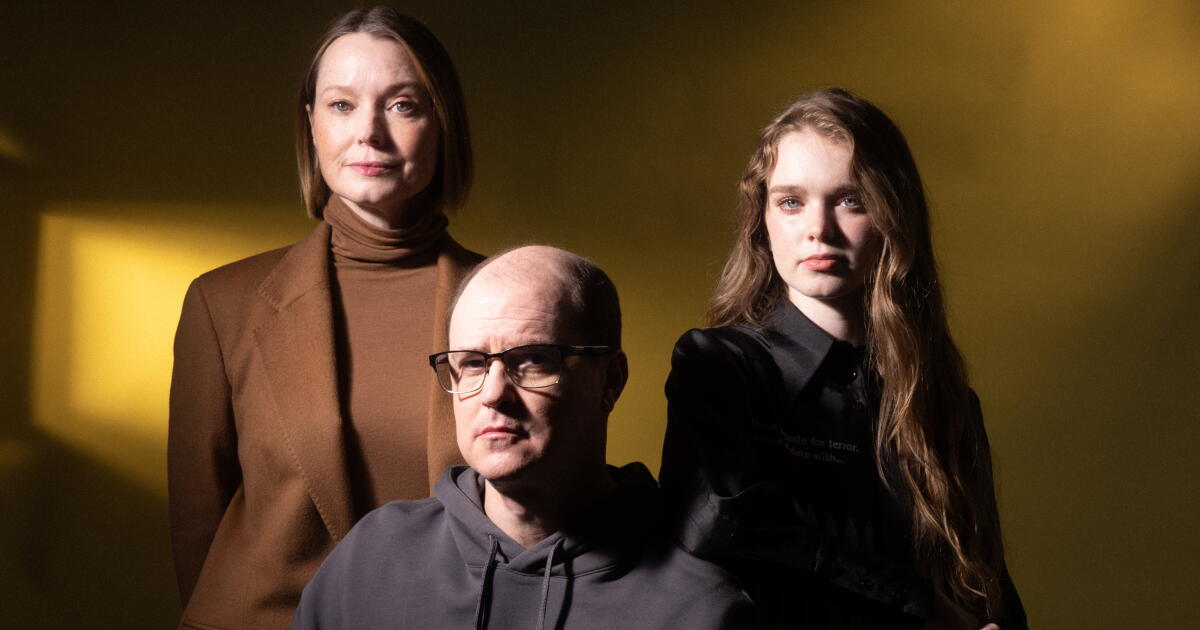
Samantha Sloyan, left, plays Margaret, Carrie’s mother. “Because Margaret is leading with so much love for Carrie I was like, ‘I want to make sure she’s not ever too kind,’” Sloyan says.
(Ebru Yildiz/For The Times)
Before finding his way in, Flanagan agreed with skeptics about what a “Carrie” series could deliver that hadn’t already been covered. When Amazon reached out, Flanagan initially told them he had no interest in pursuing it.
“I had pretty much thought, ‘It’s not for me. Let them go off and do it with someone else.’ But it wouldn’t leave me alone,” he says. “I would keep thinking, ‘Well, if I were to do it, why would it be relevant today?’”
The answer was closer than he anticipated. His oldest son Rigby was about to start high school, which filled Flanagan with dread about the viciousness that might await him.
“Even if he’s just making mistakes as he figures out who he is, that could live forever in the digital world. I never had to worry about that,” Flanagan says. “I thought about how much more frightening it is for teenagers today than it was for me, how much more fortitude and caution they need to have.”
All three of Flanagan’s children appear in the show. Rigby is one of Carrie’s classmates (seen giving her directions in an early episode), while his daughter Theodora Isabelle Irene plays a young Margaret White in a flashback. Flanagan’s wife, Kate Siegel, is one of the four women directors hired for the episodes he didn’t direct.
Aside from his parental anxieties, Flanagan also took inspiration from a case that rattled Albany, Calif., in 2017. The seemingly ordinary small town, he recalls, was wrecked by an Instagram account that was used to harass and humiliate high school students.
“It started as a private account with 10 people on it and it eventually consumed the entire town with riots and lawsuits and futures were destroyed,” he explains. “I looked at that case and I was like, ‘That’s our story.’ We’re not doing ‘Carrie’ again. We’re taking those characters and some of the iconic scenes, but we’re we’re going to build something new.”


“We’re not doing ‘Carrie’ again. We’re taking those characters and some of the iconic scenes, but we’re we’re going to build something new,” says Flanagan about his version of “Carrie.” (Ebru Yildiz/For The Times)
Armed with a strong vision, Flanagan went back to Amazon and pitched his reinvented narrative. Before moving forward, though, it was King’s opinion that mattered most to him. The author wasn’t eager to see a new adaption, but he trusts Flanagan, who has now helmed multiple projects based on his work. King saw the potential.
“Mike Flanagan has been called the ‘King whisperer,’ because his takes on my material have been very smart. ‘Doctor Sleep’ is true to the book, and ‘The Life of Chuck’ is a fine meditation on growing old,” King says via email. “As for the new version of ‘Carrie’ — it does a kick-ass prom scene and adds to it the destructive power of social media, which didn’t exist when I wrote the book.”
To better understand adolescence and high school today, Flanagan and his team brought teenagers, including Rigby, into the writers’ room.
“We asked them, ‘What’s important to you? What kind of things do you deal with every day that we don’t know about?’,” he recalls, saying it helped him bond with his son.
“I can see a direct line between the choices that these kids have to make and the influence of social media, the nature of cruelty and how that has changed the face of our planet and our politics and our discourse,” Flanagan adds.
In a scene at the beginning of Episode 8, actor Siena Agudong, who plays Sue, expresses Flanagan’s belief that sincerely open-hearted people like Carrie are met with rejection and seen as alien in a world where cynicism is our default mode. He calls the speech a thesis for the show.
“Kids are inherently prone to being kind and being earnest. And it’s beaten out of them by their peers, by their movies and their TV shows, by their social media, by their feeds,” he says.
Though she grew up in the digital age, Howell, who landed her first role in a major movie with “Curse of Chucky” at 8, is wary of social media.
“I’m on Instagram, but the more I become known, the more I want to stay off of it because there are so many comments and it can be very overwhelming,” she says. “I really try to stay in the real world.”


“My version of Carrie has been home her whole life, so she’s really excited to see people for the first time who aren’t her parents,” Howell says. (Ebru Yildiz/For The Times)
From roughly 1,400 candidates (the most Flanagan has ever considered for any part), Howell rose to the top based on a self-tape she submitted in January 2025. Her performance then and throughout the production was not informed by the other adaptations.
Flanagan encouraged her not to watch them. He saw many actors gesturing toward Sissy Spacek, who played Carrie in De Palma’s film, but Howell didn’t regurgitate the actor’s emblematic choices and instead started from an entirely different place.
“What I loved about Summer was that she was playing that earnestness, kindness and eagerness without feeling naive,” he said. “That’s an amazing gift that Summer brings with her because in life, she’s one of the strongest women I know.”
Howell knows what it’s like to be in today’s society during a crucial time in your life, discovering who you want to be. After all, she was a teenager not long ago.
“I was never bullied, but I definitely was picked on or left out and felt all those feelings. I drew from that a lot,” Howell says, “but I definitely saw bullying happening and I felt like [Carrie’s classmate] Sue in a lot of moments like, ‘Do I join in?’ And sometimes you do slip into [Carrie’s bully] Chris because you’re a teenager and you don’t want to be the target.”
Howell only watched De Palma’s take after production wrapped on the show when the cast, crew and Vancouver locals gathered at the Rio Theatre for a screening. “I sat next to Summer and watched her watch it,” Flanagan says. “Everything was so different that she kept looking at me going, ‘This isn’t anything like what we’re doing.’ And I’d go, ‘I know, that was the point.’”
As for Sloyan, she’s a veteran of Flanagan’s stories. The two have collaborated on multiple projects including “The Haunting of Hill House” and “Midnight Mass.” Flanagan felt she was the only person who could play Margaret. “With Amazon, I thought it would be a big fight,” Flanagan says. But after Sloyan self-taped her character’s final scene with Carrie, her work spoke for itself.
“I felt like this was the part she was born for,” he says. “This version of someone who can project and summon enormous strength, that may be off-putting to some, because underneath it there’s a full conviction in what that character wants.”

Flanagan says Sloyvan was the only person who could play Margaret: “I felt like this was the part she was born for.”
(Ebru Yildiz/For The Times)
Flanagan describes filming the final version of that scene in the prayer closet as “one of the finest pieces of acting” he’s witnessed on one of his sets. “We were crying at the monitor,” he adds.
“Mike let me choose the song that I sang in that section, and I chose a song my dad would sing to me,” Sloyan recalls. “It was lovely for me to be able to personalize it. Where that scene ends up going is so horrific, but it also shows an intimate relationship between a mother and a daughter.”
It’s not only the teens who fall prey to online danger, Sloyan’s Margaret also gets enticed by the “social media siren song,” where she finds an audience to air her grievances about Carrie’s bullies and the school’s administration. “Having that many people stoke your point of view feels powerful and it feels like you’re in control of something,” she says.
Taking a page from what King wrote in the novel, the series frames Carrie as one woman among many carrying the “TK gene” granting them supernatural powers. Introducing a larger group of friends or foes opens the possibility of further seasons. But Flanagan has learned to be cautious about planning too far ahead.
“The one time I designed a show to carry on, we didn’t get a second season, and it ended on a cliffhanger,” he said. I felt bad for years that our fans who loved [‘Midnight Club’] were never going to know how it ended. I ended up having to answer that on a Tumblr post, just so that they’d have closure.”
Flanagan first watched De Palma’s “Carrie” on cable on a 19-inch tube TV when he was just starting high school. Back then he couldn’t fully relate to her trauma, even though he was being bullied. Now he’s conjured up a different kind of Carrie for a new generation, but he’s conscious that the character doesn’t belong to him, nor King anymore.
“The only person who can ever really claim she belonged to him is Steve, but he’s sent Carrie out into the world for 50 years,” Flanagan says. “I like to think that he’s proud of this one and that he is glad to have seen her come to life one more time.”

Drenched in pig’s blood, an innocent prom queen stands in front of her classmates, bystanders to her torment. Her expression is catatonic. Death and destruction follow.
That image of utter betrayal and cruelty has defined every screen adaptation of Stephen King’s 1974 novel about a high school girl with telekinetic abilities who becomes the target of incessant bullying: from Brian De Palma’s 1976 bona fide classic to the 2002 TV movie that aired on NBC, and even Kimberly Peirce’s 2013 reimagining with Chloë Grace Moretz in the titular role.
A new eight-episode series from prolific horror storyteller Mike Flanagan, “Carrie,” streaming Wednesday on Prime Video, brings the conflicted heroine to the present, to a reality where active shooter drills and social media have turned adolescence scarier than ever. Yet, some elements remain intact.
“We still go to prom, there’s still blood, the fans will be happy. But it’s just a slightly new take and it’s a broader story,” says Summer H. Howell sitting at a restaurant inside a Santa Monica hotel on a warm August morning.
The luminously charismatic 22-year-old Canadian actor from Manitoba plays Carrie White unlike any iteration before. After her father’s untimely death, this Carrie, who grew up in a sheltered, cult-like environment, gets to interact with the outside world for the first time.
Summer H. Howell as the titular teenager in Prime Video’s “Carrie.” Unlike previous versions, her Carrie is curious, kind and earnest.
(Robert Falconer/Prime)
“In every version, Carrie is this clenched up, traumatized, terrified person who is afraid of everything in the world from the minute we meet her,” says Flanagan during a recent chat in Los Feliz. “Part of the fun for me was thinking, ‘Let’s throw all that away. ‘What’s the opposite of Carrie?’ This Carrie is curious, eager, kind, earnest and excited to be there.”
Flanagan’s Carrie hasn’t been touched by trauma yet, so at first she engages with our cynical and chaotic modern world exuding unrestrained kindness toward others.
“My version of Carrie has been home her whole life, so she’s really excited to see people for the first time who aren’t her parents,” Howell explains. “She’s so excited to experience everything. That’s how I went about it. Everything I was looking at was brand new, sparkly.”
To reinterpret Margaret White, Carrie’s hateful and religious mother, Flanagan took the same approach: finding the opposite of what had been done. “In our show, everything [Margaret] does comes from a place of ferocious love for her daughter and a desire to keep her safe,” says Flanagan. That doesn’t mean, however, that she is no longer an antagonist.
“Because our Margaret is leading with so much love for Carrie I was like, ‘I want to make sure she’s not ever too kind,’ which is laughable because that was never going to happen because of the way the story goes,” recalls Samantha Sloyan, who embodies Margaret.
“I did want to make sure that there was still that anxiety for Carrie,” she adds, “because Carrie needs to be stuck between this horrific experience in high school and then not have a safe home to go to. She has nowhere to exist in between.”
Samantha Sloyan, left, plays Margaret, Carrie’s mother. “Because Margaret is leading with so much love for Carrie I was like, ‘I want to make sure she’s not ever too kind,’” Sloyan says.
(Ebru Yildiz/For The Times)
Before finding his way in, Flanagan agreed with skeptics about what a “Carrie” series could deliver that hadn’t already been covered. When Amazon reached out, Flanagan initially told them he had no interest in pursuing it.
“I had pretty much thought, ‘It’s not for me. Let them go off and do it with someone else.’ But it wouldn’t leave me alone,” he says. “I would keep thinking, ‘Well, if I were to do it, why would it be relevant today?’”
The answer was closer than he anticipated. His oldest son Rigby was about to start high school, which filled Flanagan with dread about the viciousness that might await him.
“Even if he’s just making mistakes as he figures out who he is, that could live forever in the digital world. I never had to worry about that,” Flanagan says. “I thought about how much more frightening it is for teenagers today than it was for me, how much more fortitude and caution they need to have.”
All three of Flanagan’s children appear in the show. Rigby is one of Carrie’s classmates (seen giving her directions in an early episode), while his daughter Theodora Isabelle Irene plays a young Margaret White in a flashback. Flanagan’s wife, Kate Siegel, is one of the four women directors hired for the episodes he didn’t direct.
Aside from his parental anxieties, Flanagan also took inspiration from a case that rattled Albany, Calif., in 2017. The seemingly ordinary small town, he recalls, was wrecked by an Instagram account that was used to harass and humiliate high school students.
“It started as a private account with 10 people on it and it eventually consumed the entire town with riots and lawsuits and futures were destroyed,” he explains. “I looked at that case and I was like, ‘That’s our story.’ We’re not doing ‘Carrie’ again. We’re taking those characters and some of the iconic scenes, but we’re we’re going to build something new.”
“We’re not doing ‘Carrie’ again. We’re taking those characters and some of the iconic scenes, but we’re we’re going to build something new,” says Flanagan about his version of “Carrie.” (Ebru Yildiz/For The Times)
Armed with a strong vision, Flanagan went back to Amazon and pitched his reinvented narrative. Before moving forward, though, it was King’s opinion that mattered most to him. The author wasn’t eager to see a new adaption, but he trusts Flanagan, who has now helmed multiple projects based on his work. King saw the potential.
“Mike Flanagan has been called the ‘King whisperer,’ because his takes on my material have been very smart. ‘Doctor Sleep’ is true to the book, and ‘The Life of Chuck’ is a fine meditation on growing old,” King says via email. “As for the new version of ‘Carrie’ — it does a kick-ass prom scene and adds to it the destructive power of social media, which didn’t exist when I wrote the book.”
To better understand adolescence and high school today, Flanagan and his team brought teenagers, including Rigby, into the writers’ room.
“We asked them, ‘What’s important to you? What kind of things do you deal with every day that we don’t know about?’,” he recalls, saying it helped him bond with his son.
“I can see a direct line between the choices that these kids have to make and the influence of social media, the nature of cruelty and how that has changed the face of our planet and our politics and our discourse,” Flanagan adds.
In a scene at the beginning of Episode 8, actor Siena Agudong, who plays Sue, expresses Flanagan’s belief that sincerely open-hearted people like Carrie are met with rejection and seen as alien in a world where cynicism is our default mode. He calls the speech a thesis for the show.
“Kids are inherently prone to being kind and being earnest. And it’s beaten out of them by their peers, by their movies and their TV shows, by their social media, by their feeds,” he says.
Though she grew up in the digital age, Howell, who landed her first role in a major movie with “Curse of Chucky” at 8, is wary of social media.
“I’m on Instagram, but the more I become known, the more I want to stay off of it because there are so many comments and it can be very overwhelming,” she says. “I really try to stay in the real world.”
“My version of Carrie has been home her whole life, so she’s really excited to see people for the first time who aren’t her parents,” Howell says. (Ebru Yildiz/For The Times)
From roughly 1,400 candidates (the most Flanagan has ever considered for any part), Howell rose to the top based on a self-tape she submitted in January 2025. Her performance then and throughout the production was not informed by the other adaptations.
Flanagan encouraged her not to watch them. He saw many actors gesturing toward Sissy Spacek, who played Carrie in De Palma’s film, but Howell didn’t regurgitate the actor’s emblematic choices and instead started from an entirely different place.
“What I loved about Summer was that she was playing that earnestness, kindness and eagerness without feeling naive,” he said. “That’s an amazing gift that Summer brings with her because in life, she’s one of the strongest women I know.”
Howell knows what it’s like to be in today’s society during a crucial time in your life, discovering who you want to be. After all, she was a teenager not long ago.
“I was never bullied, but I definitely was picked on or left out and felt all those feelings. I drew from that a lot,” Howell says, “but I definitely saw bullying happening and I felt like [Carrie’s classmate] Sue in a lot of moments like, ‘Do I join in?’ And sometimes you do slip into [Carrie’s bully] Chris because you’re a teenager and you don’t want to be the target.”
Howell only watched De Palma’s take after production wrapped on the show when the cast, crew and Vancouver locals gathered at the Rio Theatre for a screening. “I sat next to Summer and watched her watch it,” Flanagan says. “Everything was so different that she kept looking at me going, ‘This isn’t anything like what we’re doing.’ And I’d go, ‘I know, that was the point.’”
As for Sloyan, she’s a veteran of Flanagan’s stories. The two have collaborated on multiple projects including “The Haunting of Hill House” and “Midnight Mass.” Flanagan felt she was the only person who could play Margaret. “With Amazon, I thought it would be a big fight,” Flanagan says. But after Sloyan self-taped her character’s final scene with Carrie, her work spoke for itself.
“I felt like this was the part she was born for,” he says. “This version of someone who can project and summon enormous strength, that may be off-putting to some, because underneath it there’s a full conviction in what that character wants.”
Flanagan says Sloyvan was the only person who could play Margaret: “I felt like this was the part she was born for.”
(Ebru Yildiz/For The Times)
Flanagan describes filming the final version of that scene in the prayer closet as “one of the finest pieces of acting” he’s witnessed on one of his sets. “We were crying at the monitor,” he adds.
“Mike let me choose the song that I sang in that section, and I chose a song my dad would sing to me,” Sloyan recalls. “It was lovely for me to be able to personalize it. Where that scene ends up going is so horrific, but it also shows an intimate relationship between a mother and a daughter.”
It’s not only the teens who fall prey to online danger, Sloyan’s Margaret also gets enticed by the “social media siren song,” where she finds an audience to air her grievances about Carrie’s bullies and the school’s administration. “Having that many people stoke your point of view feels powerful and it feels like you’re in control of something,” she says.
Taking a page from what King wrote in the novel, the series frames Carrie as one woman among many carrying the “TK gene” granting them supernatural powers. Introducing a larger group of friends or foes opens the possibility of further seasons. But Flanagan has learned to be cautious about planning too far ahead.
“The one time I designed a show to carry on, we didn’t get a second season, and it ended on a cliffhanger,” he said. I felt bad for years that our fans who loved [‘Midnight Club’] were never going to know how it ended. I ended up having to answer that on a Tumblr post, just so that they’d have closure.”
Flanagan first watched De Palma’s “Carrie” on cable on a 19-inch tube TV when he was just starting high school. Back then he couldn’t fully relate to her trauma, even though he was being bullied. Now he’s conjured up a different kind of Carrie for a new generation, but he’s conscious that the character doesn’t belong to him, nor King anymore.
“The only person who can ever really claim she belonged to him is Steve, but he’s sent Carrie out into the world for 50 years,” Flanagan says. “I like to think that he’s proud of this one and that he is glad to have seen her come to life one more time.”

Drenched in pig’s blood, an innocent prom queen stands in front of her classmates, bystanders to her torment. Her expression is catatonic. Death and destruction follow.
That image of utter betrayal and cruelty has defined every screen adaptation of Stephen King’s 1974 novel about a high school girl with telekinetic abilities who becomes the target of incessant bullying: from Brian De Palma’s 1976 bona fide classic to the 2002 TV movie that aired on NBC, and even Kimberly Peirce’s 2013 reimagining with Chloë Grace Moretz in the titular role.
A new eight-episode series from prolific horror storyteller Mike Flanagan, “Carrie,” streaming Wednesday on Prime Video, brings the conflicted heroine to the present, to a reality where active shooter drills and social media have turned adolescence scarier than ever. Yet, some elements remain intact.
“We still go to prom, there’s still blood, the fans will be happy. But it’s just a slightly new take and it’s a broader story,” says Summer H. Howell sitting at a restaurant inside a Santa Monica hotel on a warm August morning.
The luminously charismatic 22-year-old Canadian actor from Manitoba plays Carrie White unlike any iteration before. After her father’s untimely death, this Carrie, who grew up in a sheltered, cult-like environment, gets to interact with the outside world for the first time.
Summer H. Howell as the titular teenager in Prime Video’s “Carrie.” Unlike previous versions, her Carrie is curious, kind and earnest.
(Robert Falconer/Prime)
“In every version, Carrie is this clenched up, traumatized, terrified person who is afraid of everything in the world from the minute we meet her,” says Flanagan during a recent chat in Los Feliz. “Part of the fun for me was thinking, ‘Let’s throw all that away. ‘What’s the opposite of Carrie?’ This Carrie is curious, eager, kind, earnest and excited to be there.”
Flanagan’s Carrie hasn’t been touched by trauma yet, so at first she engages with our cynical and chaotic modern world exuding unrestrained kindness toward others.
“My version of Carrie has been home her whole life, so she’s really excited to see people for the first time who aren’t her parents,” Howell explains. “She’s so excited to experience everything. That’s how I went about it. Everything I was looking at was brand new, sparkly.”
To reinterpret Margaret White, Carrie’s hateful and religious mother, Flanagan took the same approach: finding the opposite of what had been done. “In our show, everything [Margaret] does comes from a place of ferocious love for her daughter and a desire to keep her safe,” says Flanagan. That doesn’t mean, however, that she is no longer an antagonist.
“Because our Margaret is leading with so much love for Carrie I was like, ‘I want to make sure she’s not ever too kind,’ which is laughable because that was never going to happen because of the way the story goes,” recalls Samantha Sloyan, who embodies Margaret.
“I did want to make sure that there was still that anxiety for Carrie,” she adds, “because Carrie needs to be stuck between this horrific experience in high school and then not have a safe home to go to. She has nowhere to exist in between.”
Samantha Sloyan, left, plays Margaret, Carrie’s mother. “Because Margaret is leading with so much love for Carrie I was like, ‘I want to make sure she’s not ever too kind,’” Sloyan says.
(Ebru Yildiz/For The Times)
Before finding his way in, Flanagan agreed with skeptics about what a “Carrie” series could deliver that hadn’t already been covered. When Amazon reached out, Flanagan initially told them he had no interest in pursuing it.
“I had pretty much thought, ‘It’s not for me. Let them go off and do it with someone else.’ But it wouldn’t leave me alone,” he says. “I would keep thinking, ‘Well, if I were to do it, why would it be relevant today?’”
The answer was closer than he anticipated. His oldest son Rigby was about to start high school, which filled Flanagan with dread about the viciousness that might await him.
“Even if he’s just making mistakes as he figures out who he is, that could live forever in the digital world. I never had to worry about that,” Flanagan says. “I thought about how much more frightening it is for teenagers today than it was for me, how much more fortitude and caution they need to have.”
All three of Flanagan’s children appear in the show. Rigby is one of Carrie’s classmates (seen giving her directions in an early episode), while his daughter Theodora Isabelle Irene plays a young Margaret White in a flashback. Flanagan’s wife, Kate Siegel, is one of the four women directors hired for the episodes he didn’t direct.
Aside from his parental anxieties, Flanagan also took inspiration from a case that rattled Albany, Calif., in 2017. The seemingly ordinary small town, he recalls, was wrecked by an Instagram account that was used to harass and humiliate high school students.
“It started as a private account with 10 people on it and it eventually consumed the entire town with riots and lawsuits and futures were destroyed,” he explains. “I looked at that case and I was like, ‘That’s our story.’ We’re not doing ‘Carrie’ again. We’re taking those characters and some of the iconic scenes, but we’re we’re going to build something new.”
“We’re not doing ‘Carrie’ again. We’re taking those characters and some of the iconic scenes, but we’re we’re going to build something new,” says Flanagan about his version of “Carrie.” (Ebru Yildiz/For The Times)
Armed with a strong vision, Flanagan went back to Amazon and pitched his reinvented narrative. Before moving forward, though, it was King’s opinion that mattered most to him. The author wasn’t eager to see a new adaption, but he trusts Flanagan, who has now helmed multiple projects based on his work. King saw the potential.
“Mike Flanagan has been called the ‘King whisperer,’ because his takes on my material have been very smart. ‘Doctor Sleep’ is true to the book, and ‘The Life of Chuck’ is a fine meditation on growing old,” King says via email. “As for the new version of ‘Carrie’ — it does a kick-ass prom scene and adds to it the destructive power of social media, which didn’t exist when I wrote the book.”
To better understand adolescence and high school today, Flanagan and his team brought teenagers, including Rigby, into the writers’ room.
“We asked them, ‘What’s important to you? What kind of things do you deal with every day that we don’t know about?’,” he recalls, saying it helped him bond with his son.
“I can see a direct line between the choices that these kids have to make and the influence of social media, the nature of cruelty and how that has changed the face of our planet and our politics and our discourse,” Flanagan adds.
In a scene at the beginning of Episode 8, actor Siena Agudong, who plays Sue, expresses Flanagan’s belief that sincerely open-hearted people like Carrie are met with rejection and seen as alien in a world where cynicism is our default mode. He calls the speech a thesis for the show.
“Kids are inherently prone to being kind and being earnest. And it’s beaten out of them by their peers, by their movies and their TV shows, by their social media, by their feeds,” he says.
Though she grew up in the digital age, Howell, who landed her first role in a major movie with “Curse of Chucky” at 8, is wary of social media.
“I’m on Instagram, but the more I become known, the more I want to stay off of it because there are so many comments and it can be very overwhelming,” she says. “I really try to stay in the real world.”
“My version of Carrie has been home her whole life, so she’s really excited to see people for the first time who aren’t her parents,” Howell says. (Ebru Yildiz/For The Times)
From roughly 1,400 candidates (the most Flanagan has ever considered for any part), Howell rose to the top based on a self-tape she submitted in January 2025. Her performance then and throughout the production was not informed by the other adaptations.
Flanagan encouraged her not to watch them. He saw many actors gesturing toward Sissy Spacek, who played Carrie in De Palma’s film, but Howell didn’t regurgitate the actor’s emblematic choices and instead started from an entirely different place.
“What I loved about Summer was that she was playing that earnestness, kindness and eagerness without feeling naive,” he said. “That’s an amazing gift that Summer brings with her because in life, she’s one of the strongest women I know.”
Howell knows what it’s like to be in today’s society during a crucial time in your life, discovering who you want to be. After all, she was a teenager not long ago.
“I was never bullied, but I definitely was picked on or left out and felt all those feelings. I drew from that a lot,” Howell says, “but I definitely saw bullying happening and I felt like [Carrie’s classmate] Sue in a lot of moments like, ‘Do I join in?’ And sometimes you do slip into [Carrie’s bully] Chris because you’re a teenager and you don’t want to be the target.”
Howell only watched De Palma’s take after production wrapped on the show when the cast, crew and Vancouver locals gathered at the Rio Theatre for a screening. “I sat next to Summer and watched her watch it,” Flanagan says. “Everything was so different that she kept looking at me going, ‘This isn’t anything like what we’re doing.’ And I’d go, ‘I know, that was the point.’”
As for Sloyan, she’s a veteran of Flanagan’s stories. The two have collaborated on multiple projects including “The Haunting of Hill House” and “Midnight Mass.” Flanagan felt she was the only person who could play Margaret. “With Amazon, I thought it would be a big fight,” Flanagan says. But after Sloyan self-taped her character’s final scene with Carrie, her work spoke for itself.
“I felt like this was the part she was born for,” he says. “This version of someone who can project and summon enormous strength, that may be off-putting to some, because underneath it there’s a full conviction in what that character wants.”
Flanagan says Sloyvan was the only person who could play Margaret: “I felt like this was the part she was born for.”
(Ebru Yildiz/For The Times)
Flanagan describes filming the final version of that scene in the prayer closet as “one of the finest pieces of acting” he’s witnessed on one of his sets. “We were crying at the monitor,” he adds.
“Mike let me choose the song that I sang in that section, and I chose a song my dad would sing to me,” Sloyan recalls. “It was lovely for me to be able to personalize it. Where that scene ends up going is so horrific, but it also shows an intimate relationship between a mother and a daughter.”
It’s not only the teens who fall prey to online danger, Sloyan’s Margaret also gets enticed by the “social media siren song,” where she finds an audience to air her grievances about Carrie’s bullies and the school’s administration. “Having that many people stoke your point of view feels powerful and it feels like you’re in control of something,” she says.
Taking a page from what King wrote in the novel, the series frames Carrie as one woman among many carrying the “TK gene” granting them supernatural powers. Introducing a larger group of friends or foes opens the possibility of further seasons. But Flanagan has learned to be cautious about planning too far ahead.
“The one time I designed a show to carry on, we didn’t get a second season, and it ended on a cliffhanger,” he said. I felt bad for years that our fans who loved [‘Midnight Club’] were never going to know how it ended. I ended up having to answer that on a Tumblr post, just so that they’d have closure.”
Flanagan first watched De Palma’s “Carrie” on cable on a 19-inch tube TV when he was just starting high school. Back then he couldn’t fully relate to her trauma, even though he was being bullied. Now he’s conjured up a different kind of Carrie for a new generation, but he’s conscious that the character doesn’t belong to him, nor King anymore.
“The only person who can ever really claim she belonged to him is Steve, but he’s sent Carrie out into the world for 50 years,” Flanagan says. “I like to think that he’s proud of this one and that he is glad to have seen her come to life one more time.”
Drenched in pig’s blood, an innocent prom queen stands in front of her classmates, bystanders to her torment. Her expression is catatonic. Death and destruction follow.
That image of utter betrayal and cruelty has defined every screen adaptation of Stephen King’s 1974 novel about a high school girl with telekinetic abilities who becomes the target of incessant bullying: from Brian De Palma’s 1976 bona fide classic to the 2002 TV movie that aired on NBC, and even Kimberly Peirce’s 2013 reimagining with Chloë Grace Moretz in the titular role.
A new eight-episode series from prolific horror storyteller Mike Flanagan, “Carrie,” streaming Wednesday on Prime Video, brings the conflicted heroine to the present, to a reality where active shooter drills and social media have turned adolescence scarier than ever. Yet, some elements remain intact.
“We still go to prom, there’s still blood, the fans will be happy. But it’s just a slightly new take and it’s a broader story,” says Summer H. Howell sitting at a restaurant inside a Santa Monica hotel on a warm August morning.
The luminously charismatic 22-year-old Canadian actor from Manitoba plays Carrie White unlike any iteration before. After her father’s untimely death, this Carrie, who grew up in a sheltered, cult-like environment, gets to interact with the outside world for the first time.
Summer H. Howell as the titular teenager in Prime Video’s “Carrie.” Unlike previous versions, her Carrie is curious, kind and earnest.
(Robert Falconer/Prime)
“In every version, Carrie is this clenched up, traumatized, terrified person who is afraid of everything in the world from the minute we meet her,” says Flanagan during a recent chat in Los Feliz. “Part of the fun for me was thinking, ‘Let’s throw all that away. ‘What’s the opposite of Carrie?’ This Carrie is curious, eager, kind, earnest and excited to be there.”
Flanagan’s Carrie hasn’t been touched by trauma yet, so at first she engages with our cynical and chaotic modern world exuding unrestrained kindness toward others.
“My version of Carrie has been home her whole life, so she’s really excited to see people for the first time who aren’t her parents,” Howell explains. “She’s so excited to experience everything. That’s how I went about it. Everything I was looking at was brand new, sparkly.”
To reinterpret Margaret White, Carrie’s hateful and religious mother, Flanagan took the same approach: finding the opposite of what had been done. “In our show, everything [Margaret] does comes from a place of ferocious love for her daughter and a desire to keep her safe,” says Flanagan. That doesn’t mean, however, that she is no longer an antagonist.
“Because our Margaret is leading with so much love for Carrie I was like, ‘I want to make sure she’s not ever too kind,’ which is laughable because that was never going to happen because of the way the story goes,” recalls Samantha Sloyan, who embodies Margaret.
“I did want to make sure that there was still that anxiety for Carrie,” she adds, “because Carrie needs to be stuck between this horrific experience in high school and then not have a safe home to go to. She has nowhere to exist in between.”
Samantha Sloyan, left, plays Margaret, Carrie’s mother. “Because Margaret is leading with so much love for Carrie I was like, ‘I want to make sure she’s not ever too kind,’” Sloyan says.
(Ebru Yildiz/For The Times)
Before finding his way in, Flanagan agreed with skeptics about what a “Carrie” series could deliver that hadn’t already been covered. When Amazon reached out, Flanagan initially told them he had no interest in pursuing it.
“I had pretty much thought, ‘It’s not for me. Let them go off and do it with someone else.’ But it wouldn’t leave me alone,” he says. “I would keep thinking, ‘Well, if I were to do it, why would it be relevant today?’”
The answer was closer than he anticipated. His oldest son Rigby was about to start high school, which filled Flanagan with dread about the viciousness that might await him.
“Even if he’s just making mistakes as he figures out who he is, that could live forever in the digital world. I never had to worry about that,” Flanagan says. “I thought about how much more frightening it is for teenagers today than it was for me, how much more fortitude and caution they need to have.”
All three of Flanagan’s children appear in the show. Rigby is one of Carrie’s classmates (seen giving her directions in an early episode), while his daughter Theodora Isabelle Irene plays a young Margaret White in a flashback. Flanagan’s wife, Kate Siegel, is one of the four women directors hired for the episodes he didn’t direct.
Aside from his parental anxieties, Flanagan also took inspiration from a case that rattled Albany, Calif., in 2017. The seemingly ordinary small town, he recalls, was wrecked by an Instagram account that was used to harass and humiliate high school students.
“It started as a private account with 10 people on it and it eventually consumed the entire town with riots and lawsuits and futures were destroyed,” he explains. “I looked at that case and I was like, ‘That’s our story.’ We’re not doing ‘Carrie’ again. We’re taking those characters and some of the iconic scenes, but we’re we’re going to build something new.”
“We’re not doing ‘Carrie’ again. We’re taking those characters and some of the iconic scenes, but we’re we’re going to build something new,” says Flanagan about his version of “Carrie.” (Ebru Yildiz/For The Times)
Armed with a strong vision, Flanagan went back to Amazon and pitched his reinvented narrative. Before moving forward, though, it was King’s opinion that mattered most to him. The author wasn’t eager to see a new adaption, but he trusts Flanagan, who has now helmed multiple projects based on his work. King saw the potential.
“Mike Flanagan has been called the ‘King whisperer,’ because his takes on my material have been very smart. ‘Doctor Sleep’ is true to the book, and ‘The Life of Chuck’ is a fine meditation on growing old,” King says via email. “As for the new version of ‘Carrie’ — it does a kick-ass prom scene and adds to it the destructive power of social media, which didn’t exist when I wrote the book.”
To better understand adolescence and high school today, Flanagan and his team brought teenagers, including Rigby, into the writers’ room.
“We asked them, ‘What’s important to you? What kind of things do you deal with every day that we don’t know about?’,” he recalls, saying it helped him bond with his son.
“I can see a direct line between the choices that these kids have to make and the influence of social media, the nature of cruelty and how that has changed the face of our planet and our politics and our discourse,” Flanagan adds.
In a scene at the beginning of Episode 8, actor Siena Agudong, who plays Sue, expresses Flanagan’s belief that sincerely open-hearted people like Carrie are met with rejection and seen as alien in a world where cynicism is our default mode. He calls the speech a thesis for the show.
“Kids are inherently prone to being kind and being earnest. And it’s beaten out of them by their peers, by their movies and their TV shows, by their social media, by their feeds,” he says.
Though she grew up in the digital age, Howell, who landed her first role in a major movie with “Curse of Chucky” at 8, is wary of social media.
“I’m on Instagram, but the more I become known, the more I want to stay off of it because there are so many comments and it can be very overwhelming,” she says. “I really try to stay in the real world.”
“My version of Carrie has been home her whole life, so she’s really excited to see people for the first time who aren’t her parents,” Howell says. (Ebru Yildiz/For The Times)
From roughly 1,400 candidates (the most Flanagan has ever considered for any part), Howell rose to the top based on a self-tape she submitted in January 2025. Her performance then and throughout the production was not informed by the other adaptations.
Flanagan encouraged her not to watch them. He saw many actors gesturing toward Sissy Spacek, who played Carrie in De Palma’s film, but Howell didn’t regurgitate the actor’s emblematic choices and instead started from an entirely different place.
“What I loved about Summer was that she was playing that earnestness, kindness and eagerness without feeling naive,” he said. “That’s an amazing gift that Summer brings with her because in life, she’s one of the strongest women I know.”
Howell knows what it’s like to be in today’s society during a crucial time in your life, discovering who you want to be. After all, she was a teenager not long ago.
“I was never bullied, but I definitely was picked on or left out and felt all those feelings. I drew from that a lot,” Howell says, “but I definitely saw bullying happening and I felt like [Carrie’s classmate] Sue in a lot of moments like, ‘Do I join in?’ And sometimes you do slip into [Carrie’s bully] Chris because you’re a teenager and you don’t want to be the target.”
Howell only watched De Palma’s take after production wrapped on the show when the cast, crew and Vancouver locals gathered at the Rio Theatre for a screening. “I sat next to Summer and watched her watch it,” Flanagan says. “Everything was so different that she kept looking at me going, ‘This isn’t anything like what we’re doing.’ And I’d go, ‘I know, that was the point.’”
As for Sloyan, she’s a veteran of Flanagan’s stories. The two have collaborated on multiple projects including “The Haunting of Hill House” and “Midnight Mass.” Flanagan felt she was the only person who could play Margaret. “With Amazon, I thought it would be a big fight,” Flanagan says. But after Sloyan self-taped her character’s final scene with Carrie, her work spoke for itself.
“I felt like this was the part she was born for,” he says. “This version of someone who can project and summon enormous strength, that may be off-putting to some, because underneath it there’s a full conviction in what that character wants.”
Flanagan says Sloyvan was the only person who could play Margaret: “I felt like this was the part she was born for.”
(Ebru Yildiz/For The Times)
Flanagan describes filming the final version of that scene in the prayer closet as “one of the finest pieces of acting” he’s witnessed on one of his sets. “We were crying at the monitor,” he adds.
“Mike let me choose the song that I sang in that section, and I chose a song my dad would sing to me,” Sloyan recalls. “It was lovely for me to be able to personalize it. Where that scene ends up going is so horrific, but it also shows an intimate relationship between a mother and a daughter.”
It’s not only the teens who fall prey to online danger, Sloyan’s Margaret also gets enticed by the “social media siren song,” where she finds an audience to air her grievances about Carrie’s bullies and the school’s administration. “Having that many people stoke your point of view feels powerful and it feels like you’re in control of something,” she says.
Taking a page from what King wrote in the novel, the series frames Carrie as one woman among many carrying the “TK gene” granting them supernatural powers. Introducing a larger group of friends or foes opens the possibility of further seasons. But Flanagan has learned to be cautious about planning too far ahead.
“The one time I designed a show to carry on, we didn’t get a second season, and it ended on a cliffhanger,” he said. I felt bad for years that our fans who loved [‘Midnight Club’] were never going to know how it ended. I ended up having to answer that on a Tumblr post, just so that they’d have closure.”
Flanagan first watched De Palma’s “Carrie” on cable on a 19-inch tube TV when he was just starting high school. Back then he couldn’t fully relate to her trauma, even though he was being bullied. Now he’s conjured up a different kind of Carrie for a new generation, but he’s conscious that the character doesn’t belong to him, nor King anymore.
“The only person who can ever really claim she belonged to him is Steve, but he’s sent Carrie out into the world for 50 years,” Flanagan says. “I like to think that he’s proud of this one and that he is glad to have seen her come to life one more time.”

Drenched in pig’s blood, an innocent prom queen stands in front of her classmates, bystanders to her torment. Her expression is catatonic. Death and destruction follow.
That image of utter betrayal and cruelty has defined every screen adaptation of Stephen King’s 1974 novel about a high school girl with telekinetic abilities who becomes the target of incessant bullying: from Brian De Palma’s 1976 bona fide classic to the 2002 TV movie that aired on NBC, and even Kimberly Peirce’s 2013 reimagining with Chloë Grace Moretz in the titular role.
A new eight-episode series from prolific horror storyteller Mike Flanagan, “Carrie,” streaming Wednesday on Prime Video, brings the conflicted heroine to the present, to a reality where active shooter drills and social media have turned adolescence scarier than ever. Yet, some elements remain intact.
“We still go to prom, there’s still blood, the fans will be happy. But it’s just a slightly new take and it’s a broader story,” says Summer H. Howell sitting at a restaurant inside a Santa Monica hotel on a warm August morning.
The luminously charismatic 22-year-old Canadian actor from Manitoba plays Carrie White unlike any iteration before. After her father’s untimely death, this Carrie, who grew up in a sheltered, cult-like environment, gets to interact with the outside world for the first time.
Summer H. Howell as the titular teenager in Prime Video’s “Carrie.” Unlike previous versions, her Carrie is curious, kind and earnest.
(Robert Falconer/Prime)
“In every version, Carrie is this clenched up, traumatized, terrified person who is afraid of everything in the world from the minute we meet her,” says Flanagan during a recent chat in Los Feliz. “Part of the fun for me was thinking, ‘Let’s throw all that away. ‘What’s the opposite of Carrie?’ This Carrie is curious, eager, kind, earnest and excited to be there.”
Flanagan’s Carrie hasn’t been touched by trauma yet, so at first she engages with our cynical and chaotic modern world exuding unrestrained kindness toward others.
“My version of Carrie has been home her whole life, so she’s really excited to see people for the first time who aren’t her parents,” Howell explains. “She’s so excited to experience everything. That’s how I went about it. Everything I was looking at was brand new, sparkly.”
To reinterpret Margaret White, Carrie’s hateful and religious mother, Flanagan took the same approach: finding the opposite of what had been done. “In our show, everything [Margaret] does comes from a place of ferocious love for her daughter and a desire to keep her safe,” says Flanagan. That doesn’t mean, however, that she is no longer an antagonist.
“Because our Margaret is leading with so much love for Carrie I was like, ‘I want to make sure she’s not ever too kind,’ which is laughable because that was never going to happen because of the way the story goes,” recalls Samantha Sloyan, who embodies Margaret.
“I did want to make sure that there was still that anxiety for Carrie,” she adds, “because Carrie needs to be stuck between this horrific experience in high school and then not have a safe home to go to. She has nowhere to exist in between.”
Samantha Sloyan, left, plays Margaret, Carrie’s mother. “Because Margaret is leading with so much love for Carrie I was like, ‘I want to make sure she’s not ever too kind,’” Sloyan says.
(Ebru Yildiz/For The Times)
Before finding his way in, Flanagan agreed with skeptics about what a “Carrie” series could deliver that hadn’t already been covered. When Amazon reached out, Flanagan initially told them he had no interest in pursuing it.
“I had pretty much thought, ‘It’s not for me. Let them go off and do it with someone else.’ But it wouldn’t leave me alone,” he says. “I would keep thinking, ‘Well, if I were to do it, why would it be relevant today?’”
The answer was closer than he anticipated. His oldest son Rigby was about to start high school, which filled Flanagan with dread about the viciousness that might await him.
“Even if he’s just making mistakes as he figures out who he is, that could live forever in the digital world. I never had to worry about that,” Flanagan says. “I thought about how much more frightening it is for teenagers today than it was for me, how much more fortitude and caution they need to have.”
All three of Flanagan’s children appear in the show. Rigby is one of Carrie’s classmates (seen giving her directions in an early episode), while his daughter Theodora Isabelle Irene plays a young Margaret White in a flashback. Flanagan’s wife, Kate Siegel, is one of the four women directors hired for the episodes he didn’t direct.
Aside from his parental anxieties, Flanagan also took inspiration from a case that rattled Albany, Calif., in 2017. The seemingly ordinary small town, he recalls, was wrecked by an Instagram account that was used to harass and humiliate high school students.
“It started as a private account with 10 people on it and it eventually consumed the entire town with riots and lawsuits and futures were destroyed,” he explains. “I looked at that case and I was like, ‘That’s our story.’ We’re not doing ‘Carrie’ again. We’re taking those characters and some of the iconic scenes, but we’re we’re going to build something new.”
“We’re not doing ‘Carrie’ again. We’re taking those characters and some of the iconic scenes, but we’re we’re going to build something new,” says Flanagan about his version of “Carrie.” (Ebru Yildiz/For The Times)
Armed with a strong vision, Flanagan went back to Amazon and pitched his reinvented narrative. Before moving forward, though, it was King’s opinion that mattered most to him. The author wasn’t eager to see a new adaption, but he trusts Flanagan, who has now helmed multiple projects based on his work. King saw the potential.
“Mike Flanagan has been called the ‘King whisperer,’ because his takes on my material have been very smart. ‘Doctor Sleep’ is true to the book, and ‘The Life of Chuck’ is a fine meditation on growing old,” King says via email. “As for the new version of ‘Carrie’ — it does a kick-ass prom scene and adds to it the destructive power of social media, which didn’t exist when I wrote the book.”
To better understand adolescence and high school today, Flanagan and his team brought teenagers, including Rigby, into the writers’ room.
“We asked them, ‘What’s important to you? What kind of things do you deal with every day that we don’t know about?’,” he recalls, saying it helped him bond with his son.
“I can see a direct line between the choices that these kids have to make and the influence of social media, the nature of cruelty and how that has changed the face of our planet and our politics and our discourse,” Flanagan adds.
In a scene at the beginning of Episode 8, actor Siena Agudong, who plays Sue, expresses Flanagan’s belief that sincerely open-hearted people like Carrie are met with rejection and seen as alien in a world where cynicism is our default mode. He calls the speech a thesis for the show.
“Kids are inherently prone to being kind and being earnest. And it’s beaten out of them by their peers, by their movies and their TV shows, by their social media, by their feeds,” he says.
Though she grew up in the digital age, Howell, who landed her first role in a major movie with “Curse of Chucky” at 8, is wary of social media.
“I’m on Instagram, but the more I become known, the more I want to stay off of it because there are so many comments and it can be very overwhelming,” she says. “I really try to stay in the real world.”
“My version of Carrie has been home her whole life, so she’s really excited to see people for the first time who aren’t her parents,” Howell says. (Ebru Yildiz/For The Times)
From roughly 1,400 candidates (the most Flanagan has ever considered for any part), Howell rose to the top based on a self-tape she submitted in January 2025. Her performance then and throughout the production was not informed by the other adaptations.
Flanagan encouraged her not to watch them. He saw many actors gesturing toward Sissy Spacek, who played Carrie in De Palma’s film, but Howell didn’t regurgitate the actor’s emblematic choices and instead started from an entirely different place.
“What I loved about Summer was that she was playing that earnestness, kindness and eagerness without feeling naive,” he said. “That’s an amazing gift that Summer brings with her because in life, she’s one of the strongest women I know.”
Howell knows what it’s like to be in today’s society during a crucial time in your life, discovering who you want to be. After all, she was a teenager not long ago.
“I was never bullied, but I definitely was picked on or left out and felt all those feelings. I drew from that a lot,” Howell says, “but I definitely saw bullying happening and I felt like [Carrie’s classmate] Sue in a lot of moments like, ‘Do I join in?’ And sometimes you do slip into [Carrie’s bully] Chris because you’re a teenager and you don’t want to be the target.”
Howell only watched De Palma’s take after production wrapped on the show when the cast, crew and Vancouver locals gathered at the Rio Theatre for a screening. “I sat next to Summer and watched her watch it,” Flanagan says. “Everything was so different that she kept looking at me going, ‘This isn’t anything like what we’re doing.’ And I’d go, ‘I know, that was the point.’”
As for Sloyan, she’s a veteran of Flanagan’s stories. The two have collaborated on multiple projects including “The Haunting of Hill House” and “Midnight Mass.” Flanagan felt she was the only person who could play Margaret. “With Amazon, I thought it would be a big fight,” Flanagan says. But after Sloyan self-taped her character’s final scene with Carrie, her work spoke for itself.
“I felt like this was the part she was born for,” he says. “This version of someone who can project and summon enormous strength, that may be off-putting to some, because underneath it there’s a full conviction in what that character wants.”
Flanagan says Sloyvan was the only person who could play Margaret: “I felt like this was the part she was born for.”
(Ebru Yildiz/For The Times)
Flanagan describes filming the final version of that scene in the prayer closet as “one of the finest pieces of acting” he’s witnessed on one of his sets. “We were crying at the monitor,” he adds.
“Mike let me choose the song that I sang in that section, and I chose a song my dad would sing to me,” Sloyan recalls. “It was lovely for me to be able to personalize it. Where that scene ends up going is so horrific, but it also shows an intimate relationship between a mother and a daughter.”
It’s not only the teens who fall prey to online danger, Sloyan’s Margaret also gets enticed by the “social media siren song,” where she finds an audience to air her grievances about Carrie’s bullies and the school’s administration. “Having that many people stoke your point of view feels powerful and it feels like you’re in control of something,” she says.
Taking a page from what King wrote in the novel, the series frames Carrie as one woman among many carrying the “TK gene” granting them supernatural powers. Introducing a larger group of friends or foes opens the possibility of further seasons. But Flanagan has learned to be cautious about planning too far ahead.
“The one time I designed a show to carry on, we didn’t get a second season, and it ended on a cliffhanger,” he said. I felt bad for years that our fans who loved [‘Midnight Club’] were never going to know how it ended. I ended up having to answer that on a Tumblr post, just so that they’d have closure.”
Flanagan first watched De Palma’s “Carrie” on cable on a 19-inch tube TV when he was just starting high school. Back then he couldn’t fully relate to her trauma, even though he was being bullied. Now he’s conjured up a different kind of Carrie for a new generation, but he’s conscious that the character doesn’t belong to him, nor King anymore.
“The only person who can ever really claim she belonged to him is Steve, but he’s sent Carrie out into the world for 50 years,” Flanagan says. “I like to think that he’s proud of this one and that he is glad to have seen her come to life one more time.”
Drenched in pig’s blood, an innocent prom queen stands in front of her classmates, bystanders to her torment. Her expression is catatonic. Death and destruction follow.
That image of utter betrayal and cruelty has defined every screen adaptation of Stephen King’s 1974 novel about a high school girl with telekinetic abilities who becomes the target of incessant bullying: from Brian De Palma’s 1976 bona fide classic to the 2002 TV movie that aired on NBC, and even Kimberly Peirce’s 2013 reimagining with Chloë Grace Moretz in the titular role.
A new eight-episode series from prolific horror storyteller Mike Flanagan, “Carrie,” streaming Wednesday on Prime Video, brings the conflicted heroine to the present, to a reality where active shooter drills and social media have turned adolescence scarier than ever. Yet, some elements remain intact.
“We still go to prom, there’s still blood, the fans will be happy. But it’s just a slightly new take and it’s a broader story,” says Summer H. Howell sitting at a restaurant inside a Santa Monica hotel on a warm August morning.
The luminously charismatic 22-year-old Canadian actor from Manitoba plays Carrie White unlike any iteration before. After her father’s untimely death, this Carrie, who grew up in a sheltered, cult-like environment, gets to interact with the outside world for the first time.
Summer H. Howell as the titular teenager in Prime Video’s “Carrie.” Unlike previous versions, her Carrie is curious, kind and earnest.
(Robert Falconer/Prime)
“In every version, Carrie is this clenched up, traumatized, terrified person who is afraid of everything in the world from the minute we meet her,” says Flanagan during a recent chat in Los Feliz. “Part of the fun for me was thinking, ‘Let’s throw all that away. ‘What’s the opposite of Carrie?’ This Carrie is curious, eager, kind, earnest and excited to be there.”
Flanagan’s Carrie hasn’t been touched by trauma yet, so at first she engages with our cynical and chaotic modern world exuding unrestrained kindness toward others.
“My version of Carrie has been home her whole life, so she’s really excited to see people for the first time who aren’t her parents,” Howell explains. “She’s so excited to experience everything. That’s how I went about it. Everything I was looking at was brand new, sparkly.”
To reinterpret Margaret White, Carrie’s hateful and religious mother, Flanagan took the same approach: finding the opposite of what had been done. “In our show, everything [Margaret] does comes from a place of ferocious love for her daughter and a desire to keep her safe,” says Flanagan. That doesn’t mean, however, that she is no longer an antagonist.
“Because our Margaret is leading with so much love for Carrie I was like, ‘I want to make sure she’s not ever too kind,’ which is laughable because that was never going to happen because of the way the story goes,” recalls Samantha Sloyan, who embodies Margaret.
“I did want to make sure that there was still that anxiety for Carrie,” she adds, “because Carrie needs to be stuck between this horrific experience in high school and then not have a safe home to go to. She has nowhere to exist in between.”
Samantha Sloyan, left, plays Margaret, Carrie’s mother. “Because Margaret is leading with so much love for Carrie I was like, ‘I want to make sure she’s not ever too kind,’” Sloyan says.
(Ebru Yildiz/For The Times)
Before finding his way in, Flanagan agreed with skeptics about what a “Carrie” series could deliver that hadn’t already been covered. When Amazon reached out, Flanagan initially told them he had no interest in pursuing it.
“I had pretty much thought, ‘It’s not for me. Let them go off and do it with someone else.’ But it wouldn’t leave me alone,” he says. “I would keep thinking, ‘Well, if I were to do it, why would it be relevant today?’”
The answer was closer than he anticipated. His oldest son Rigby was about to start high school, which filled Flanagan with dread about the viciousness that might await him.
“Even if he’s just making mistakes as he figures out who he is, that could live forever in the digital world. I never had to worry about that,” Flanagan says. “I thought about how much more frightening it is for teenagers today than it was for me, how much more fortitude and caution they need to have.”
All three of Flanagan’s children appear in the show. Rigby is one of Carrie’s classmates (seen giving her directions in an early episode), while his daughter Theodora Isabelle Irene plays a young Margaret White in a flashback. Flanagan’s wife, Kate Siegel, is one of the four women directors hired for the episodes he didn’t direct.
Aside from his parental anxieties, Flanagan also took inspiration from a case that rattled Albany, Calif., in 2017. The seemingly ordinary small town, he recalls, was wrecked by an Instagram account that was used to harass and humiliate high school students.
“It started as a private account with 10 people on it and it eventually consumed the entire town with riots and lawsuits and futures were destroyed,” he explains. “I looked at that case and I was like, ‘That’s our story.’ We’re not doing ‘Carrie’ again. We’re taking those characters and some of the iconic scenes, but we’re we’re going to build something new.”
“We’re not doing ‘Carrie’ again. We’re taking those characters and some of the iconic scenes, but we’re we’re going to build something new,” says Flanagan about his version of “Carrie.” (Ebru Yildiz/For The Times)
Armed with a strong vision, Flanagan went back to Amazon and pitched his reinvented narrative. Before moving forward, though, it was King’s opinion that mattered most to him. The author wasn’t eager to see a new adaption, but he trusts Flanagan, who has now helmed multiple projects based on his work. King saw the potential.
“Mike Flanagan has been called the ‘King whisperer,’ because his takes on my material have been very smart. ‘Doctor Sleep’ is true to the book, and ‘The Life of Chuck’ is a fine meditation on growing old,” King says via email. “As for the new version of ‘Carrie’ — it does a kick-ass prom scene and adds to it the destructive power of social media, which didn’t exist when I wrote the book.”
To better understand adolescence and high school today, Flanagan and his team brought teenagers, including Rigby, into the writers’ room.
“We asked them, ‘What’s important to you? What kind of things do you deal with every day that we don’t know about?’,” he recalls, saying it helped him bond with his son.
“I can see a direct line between the choices that these kids have to make and the influence of social media, the nature of cruelty and how that has changed the face of our planet and our politics and our discourse,” Flanagan adds.
In a scene at the beginning of Episode 8, actor Siena Agudong, who plays Sue, expresses Flanagan’s belief that sincerely open-hearted people like Carrie are met with rejection and seen as alien in a world where cynicism is our default mode. He calls the speech a thesis for the show.
“Kids are inherently prone to being kind and being earnest. And it’s beaten out of them by their peers, by their movies and their TV shows, by their social media, by their feeds,” he says.
Though she grew up in the digital age, Howell, who landed her first role in a major movie with “Curse of Chucky” at 8, is wary of social media.
“I’m on Instagram, but the more I become known, the more I want to stay off of it because there are so many comments and it can be very overwhelming,” she says. “I really try to stay in the real world.”
“My version of Carrie has been home her whole life, so she’s really excited to see people for the first time who aren’t her parents,” Howell says. (Ebru Yildiz/For The Times)
From roughly 1,400 candidates (the most Flanagan has ever considered for any part), Howell rose to the top based on a self-tape she submitted in January 2025. Her performance then and throughout the production was not informed by the other adaptations.
Flanagan encouraged her not to watch them. He saw many actors gesturing toward Sissy Spacek, who played Carrie in De Palma’s film, but Howell didn’t regurgitate the actor’s emblematic choices and instead started from an entirely different place.
“What I loved about Summer was that she was playing that earnestness, kindness and eagerness without feeling naive,” he said. “That’s an amazing gift that Summer brings with her because in life, she’s one of the strongest women I know.”
Howell knows what it’s like to be in today’s society during a crucial time in your life, discovering who you want to be. After all, she was a teenager not long ago.
“I was never bullied, but I definitely was picked on or left out and felt all those feelings. I drew from that a lot,” Howell says, “but I definitely saw bullying happening and I felt like [Carrie’s classmate] Sue in a lot of moments like, ‘Do I join in?’ And sometimes you do slip into [Carrie’s bully] Chris because you’re a teenager and you don’t want to be the target.”
Howell only watched De Palma’s take after production wrapped on the show when the cast, crew and Vancouver locals gathered at the Rio Theatre for a screening. “I sat next to Summer and watched her watch it,” Flanagan says. “Everything was so different that she kept looking at me going, ‘This isn’t anything like what we’re doing.’ And I’d go, ‘I know, that was the point.’”
As for Sloyan, she’s a veteran of Flanagan’s stories. The two have collaborated on multiple projects including “The Haunting of Hill House” and “Midnight Mass.” Flanagan felt she was the only person who could play Margaret. “With Amazon, I thought it would be a big fight,” Flanagan says. But after Sloyan self-taped her character’s final scene with Carrie, her work spoke for itself.
“I felt like this was the part she was born for,” he says. “This version of someone who can project and summon enormous strength, that may be off-putting to some, because underneath it there’s a full conviction in what that character wants.”
Flanagan says Sloyvan was the only person who could play Margaret: “I felt like this was the part she was born for.”
(Ebru Yildiz/For The Times)
Flanagan describes filming the final version of that scene in the prayer closet as “one of the finest pieces of acting” he’s witnessed on one of his sets. “We were crying at the monitor,” he adds.
“Mike let me choose the song that I sang in that section, and I chose a song my dad would sing to me,” Sloyan recalls. “It was lovely for me to be able to personalize it. Where that scene ends up going is so horrific, but it also shows an intimate relationship between a mother and a daughter.”
It’s not only the teens who fall prey to online danger, Sloyan’s Margaret also gets enticed by the “social media siren song,” where she finds an audience to air her grievances about Carrie’s bullies and the school’s administration. “Having that many people stoke your point of view feels powerful and it feels like you’re in control of something,” she says.
Taking a page from what King wrote in the novel, the series frames Carrie as one woman among many carrying the “TK gene” granting them supernatural powers. Introducing a larger group of friends or foes opens the possibility of further seasons. But Flanagan has learned to be cautious about planning too far ahead.
“The one time I designed a show to carry on, we didn’t get a second season, and it ended on a cliffhanger,” he said. I felt bad for years that our fans who loved [‘Midnight Club’] were never going to know how it ended. I ended up having to answer that on a Tumblr post, just so that they’d have closure.”
Flanagan first watched De Palma’s “Carrie” on cable on a 19-inch tube TV when he was just starting high school. Back then he couldn’t fully relate to her trauma, even though he was being bullied. Now he’s conjured up a different kind of Carrie for a new generation, but he’s conscious that the character doesn’t belong to him, nor King anymore.
“The only person who can ever really claim she belonged to him is Steve, but he’s sent Carrie out into the world for 50 years,” Flanagan says. “I like to think that he’s proud of this one and that he is glad to have seen her come to life one more time.”
Drenched in pig’s blood, an innocent prom queen stands in front of her classmates, bystanders to her torment. Her expression is catatonic. Death and destruction follow.
That image of utter betrayal and cruelty has defined every screen adaptation of Stephen King’s 1974 novel about a high school girl with telekinetic abilities who becomes the target of incessant bullying: from Brian De Palma’s 1976 bona fide classic to the 2002 TV movie that aired on NBC, and even Kimberly Peirce’s 2013 reimagining with Chloë Grace Moretz in the titular role.
A new eight-episode series from prolific horror storyteller Mike Flanagan, “Carrie,” streaming Wednesday on Prime Video, brings the conflicted heroine to the present, to a reality where active shooter drills and social media have turned adolescence scarier than ever. Yet, some elements remain intact.
“We still go to prom, there’s still blood, the fans will be happy. But it’s just a slightly new take and it’s a broader story,” says Summer H. Howell sitting at a restaurant inside a Santa Monica hotel on a warm August morning.
The luminously charismatic 22-year-old Canadian actor from Manitoba plays Carrie White unlike any iteration before. After her father’s untimely death, this Carrie, who grew up in a sheltered, cult-like environment, gets to interact with the outside world for the first time.
Summer H. Howell as the titular teenager in Prime Video’s “Carrie.” Unlike previous versions, her Carrie is curious, kind and earnest.
(Robert Falconer/Prime)
“In every version, Carrie is this clenched up, traumatized, terrified person who is afraid of everything in the world from the minute we meet her,” says Flanagan during a recent chat in Los Feliz. “Part of the fun for me was thinking, ‘Let’s throw all that away. ‘What’s the opposite of Carrie?’ This Carrie is curious, eager, kind, earnest and excited to be there.”
Flanagan’s Carrie hasn’t been touched by trauma yet, so at first she engages with our cynical and chaotic modern world exuding unrestrained kindness toward others.
“My version of Carrie has been home her whole life, so she’s really excited to see people for the first time who aren’t her parents,” Howell explains. “She’s so excited to experience everything. That’s how I went about it. Everything I was looking at was brand new, sparkly.”
To reinterpret Margaret White, Carrie’s hateful and religious mother, Flanagan took the same approach: finding the opposite of what had been done. “In our show, everything [Margaret] does comes from a place of ferocious love for her daughter and a desire to keep her safe,” says Flanagan. That doesn’t mean, however, that she is no longer an antagonist.
“Because our Margaret is leading with so much love for Carrie I was like, ‘I want to make sure she’s not ever too kind,’ which is laughable because that was never going to happen because of the way the story goes,” recalls Samantha Sloyan, who embodies Margaret.
“I did want to make sure that there was still that anxiety for Carrie,” she adds, “because Carrie needs to be stuck between this horrific experience in high school and then not have a safe home to go to. She has nowhere to exist in between.”
Samantha Sloyan, left, plays Margaret, Carrie’s mother. “Because Margaret is leading with so much love for Carrie I was like, ‘I want to make sure she’s not ever too kind,’” Sloyan says.
(Ebru Yildiz/For The Times)
Before finding his way in, Flanagan agreed with skeptics about what a “Carrie” series could deliver that hadn’t already been covered. When Amazon reached out, Flanagan initially told them he had no interest in pursuing it.
“I had pretty much thought, ‘It’s not for me. Let them go off and do it with someone else.’ But it wouldn’t leave me alone,” he says. “I would keep thinking, ‘Well, if I were to do it, why would it be relevant today?’”
The answer was closer than he anticipated. His oldest son Rigby was about to start high school, which filled Flanagan with dread about the viciousness that might await him.
“Even if he’s just making mistakes as he figures out who he is, that could live forever in the digital world. I never had to worry about that,” Flanagan says. “I thought about how much more frightening it is for teenagers today than it was for me, how much more fortitude and caution they need to have.”
All three of Flanagan’s children appear in the show. Rigby is one of Carrie’s classmates (seen giving her directions in an early episode), while his daughter Theodora Isabelle Irene plays a young Margaret White in a flashback. Flanagan’s wife, Kate Siegel, is one of the four women directors hired for the episodes he didn’t direct.
Aside from his parental anxieties, Flanagan also took inspiration from a case that rattled Albany, Calif., in 2017. The seemingly ordinary small town, he recalls, was wrecked by an Instagram account that was used to harass and humiliate high school students.
“It started as a private account with 10 people on it and it eventually consumed the entire town with riots and lawsuits and futures were destroyed,” he explains. “I looked at that case and I was like, ‘That’s our story.’ We’re not doing ‘Carrie’ again. We’re taking those characters and some of the iconic scenes, but we’re we’re going to build something new.”
“We’re not doing ‘Carrie’ again. We’re taking those characters and some of the iconic scenes, but we’re we’re going to build something new,” says Flanagan about his version of “Carrie.” (Ebru Yildiz/For The Times)
Armed with a strong vision, Flanagan went back to Amazon and pitched his reinvented narrative. Before moving forward, though, it was King’s opinion that mattered most to him. The author wasn’t eager to see a new adaption, but he trusts Flanagan, who has now helmed multiple projects based on his work. King saw the potential.
“Mike Flanagan has been called the ‘King whisperer,’ because his takes on my material have been very smart. ‘Doctor Sleep’ is true to the book, and ‘The Life of Chuck’ is a fine meditation on growing old,” King says via email. “As for the new version of ‘Carrie’ — it does a kick-ass prom scene and adds to it the destructive power of social media, which didn’t exist when I wrote the book.”
To better understand adolescence and high school today, Flanagan and his team brought teenagers, including Rigby, into the writers’ room.
“We asked them, ‘What’s important to you? What kind of things do you deal with every day that we don’t know about?’,” he recalls, saying it helped him bond with his son.
“I can see a direct line between the choices that these kids have to make and the influence of social media, the nature of cruelty and how that has changed the face of our planet and our politics and our discourse,” Flanagan adds.
In a scene at the beginning of Episode 8, actor Siena Agudong, who plays Sue, expresses Flanagan’s belief that sincerely open-hearted people like Carrie are met with rejection and seen as alien in a world where cynicism is our default mode. He calls the speech a thesis for the show.
“Kids are inherently prone to being kind and being earnest. And it’s beaten out of them by their peers, by their movies and their TV shows, by their social media, by their feeds,” he says.
Though she grew up in the digital age, Howell, who landed her first role in a major movie with “Curse of Chucky” at 8, is wary of social media.
“I’m on Instagram, but the more I become known, the more I want to stay off of it because there are so many comments and it can be very overwhelming,” she says. “I really try to stay in the real world.”
“My version of Carrie has been home her whole life, so she’s really excited to see people for the first time who aren’t her parents,” Howell says. (Ebru Yildiz/For The Times)
From roughly 1,400 candidates (the most Flanagan has ever considered for any part), Howell rose to the top based on a self-tape she submitted in January 2025. Her performance then and throughout the production was not informed by the other adaptations.
Flanagan encouraged her not to watch them. He saw many actors gesturing toward Sissy Spacek, who played Carrie in De Palma’s film, but Howell didn’t regurgitate the actor’s emblematic choices and instead started from an entirely different place.
“What I loved about Summer was that she was playing that earnestness, kindness and eagerness without feeling naive,” he said. “That’s an amazing gift that Summer brings with her because in life, she’s one of the strongest women I know.”
Howell knows what it’s like to be in today’s society during a crucial time in your life, discovering who you want to be. After all, she was a teenager not long ago.
“I was never bullied, but I definitely was picked on or left out and felt all those feelings. I drew from that a lot,” Howell says, “but I definitely saw bullying happening and I felt like [Carrie’s classmate] Sue in a lot of moments like, ‘Do I join in?’ And sometimes you do slip into [Carrie’s bully] Chris because you’re a teenager and you don’t want to be the target.”
Howell only watched De Palma’s take after production wrapped on the show when the cast, crew and Vancouver locals gathered at the Rio Theatre for a screening. “I sat next to Summer and watched her watch it,” Flanagan says. “Everything was so different that she kept looking at me going, ‘This isn’t anything like what we’re doing.’ And I’d go, ‘I know, that was the point.’”
As for Sloyan, she’s a veteran of Flanagan’s stories. The two have collaborated on multiple projects including “The Haunting of Hill House” and “Midnight Mass.” Flanagan felt she was the only person who could play Margaret. “With Amazon, I thought it would be a big fight,” Flanagan says. But after Sloyan self-taped her character’s final scene with Carrie, her work spoke for itself.
“I felt like this was the part she was born for,” he says. “This version of someone who can project and summon enormous strength, that may be off-putting to some, because underneath it there’s a full conviction in what that character wants.”
Flanagan says Sloyvan was the only person who could play Margaret: “I felt like this was the part she was born for.”
(Ebru Yildiz/For The Times)
Flanagan describes filming the final version of that scene in the prayer closet as “one of the finest pieces of acting” he’s witnessed on one of his sets. “We were crying at the monitor,” he adds.
“Mike let me choose the song that I sang in that section, and I chose a song my dad would sing to me,” Sloyan recalls. “It was lovely for me to be able to personalize it. Where that scene ends up going is so horrific, but it also shows an intimate relationship between a mother and a daughter.”
It’s not only the teens who fall prey to online danger, Sloyan’s Margaret also gets enticed by the “social media siren song,” where she finds an audience to air her grievances about Carrie’s bullies and the school’s administration. “Having that many people stoke your point of view feels powerful and it feels like you’re in control of something,” she says.
Taking a page from what King wrote in the novel, the series frames Carrie as one woman among many carrying the “TK gene” granting them supernatural powers. Introducing a larger group of friends or foes opens the possibility of further seasons. But Flanagan has learned to be cautious about planning too far ahead.
“The one time I designed a show to carry on, we didn’t get a second season, and it ended on a cliffhanger,” he said. I felt bad for years that our fans who loved [‘Midnight Club’] were never going to know how it ended. I ended up having to answer that on a Tumblr post, just so that they’d have closure.”
Flanagan first watched De Palma’s “Carrie” on cable on a 19-inch tube TV when he was just starting high school. Back then he couldn’t fully relate to her trauma, even though he was being bullied. Now he’s conjured up a different kind of Carrie for a new generation, but he’s conscious that the character doesn’t belong to him, nor King anymore.
“The only person who can ever really claim she belonged to him is Steve, but he’s sent Carrie out into the world for 50 years,” Flanagan says. “I like to think that he’s proud of this one and that he is glad to have seen her come to life one more time.”
Drenched in pig’s blood, an innocent prom queen stands in front of her classmates, bystanders to her torment. Her expression is catatonic. Death and destruction follow.
That image of utter betrayal and cruelty has defined every screen adaptation of Stephen King’s 1974 novel about a high school girl with telekinetic abilities who becomes the target of incessant bullying: from Brian De Palma’s 1976 bona fide classic to the 2002 TV movie that aired on NBC, and even Kimberly Peirce’s 2013 reimagining with Chloë Grace Moretz in the titular role.
A new eight-episode series from prolific horror storyteller Mike Flanagan, “Carrie,” streaming Wednesday on Prime Video, brings the conflicted heroine to the present, to a reality where active shooter drills and social media have turned adolescence scarier than ever. Yet, some elements remain intact.
“We still go to prom, there’s still blood, the fans will be happy. But it’s just a slightly new take and it’s a broader story,” says Summer H. Howell sitting at a restaurant inside a Santa Monica hotel on a warm August morning.
The luminously charismatic 22-year-old Canadian actor from Manitoba plays Carrie White unlike any iteration before. After her father’s untimely death, this Carrie, who grew up in a sheltered, cult-like environment, gets to interact with the outside world for the first time.
Summer H. Howell as the titular teenager in Prime Video’s “Carrie.” Unlike previous versions, her Carrie is curious, kind and earnest.
(Robert Falconer/Prime)
“In every version, Carrie is this clenched up, traumatized, terrified person who is afraid of everything in the world from the minute we meet her,” says Flanagan during a recent chat in Los Feliz. “Part of the fun for me was thinking, ‘Let’s throw all that away. ‘What’s the opposite of Carrie?’ This Carrie is curious, eager, kind, earnest and excited to be there.”
Flanagan’s Carrie hasn’t been touched by trauma yet, so at first she engages with our cynical and chaotic modern world exuding unrestrained kindness toward others.
“My version of Carrie has been home her whole life, so she’s really excited to see people for the first time who aren’t her parents,” Howell explains. “She’s so excited to experience everything. That’s how I went about it. Everything I was looking at was brand new, sparkly.”
To reinterpret Margaret White, Carrie’s hateful and religious mother, Flanagan took the same approach: finding the opposite of what had been done. “In our show, everything [Margaret] does comes from a place of ferocious love for her daughter and a desire to keep her safe,” says Flanagan. That doesn’t mean, however, that she is no longer an antagonist.
“Because our Margaret is leading with so much love for Carrie I was like, ‘I want to make sure she’s not ever too kind,’ which is laughable because that was never going to happen because of the way the story goes,” recalls Samantha Sloyan, who embodies Margaret.
“I did want to make sure that there was still that anxiety for Carrie,” she adds, “because Carrie needs to be stuck between this horrific experience in high school and then not have a safe home to go to. She has nowhere to exist in between.”
Samantha Sloyan, left, plays Margaret, Carrie’s mother. “Because Margaret is leading with so much love for Carrie I was like, ‘I want to make sure she’s not ever too kind,’” Sloyan says.
(Ebru Yildiz/For The Times)
Before finding his way in, Flanagan agreed with skeptics about what a “Carrie” series could deliver that hadn’t already been covered. When Amazon reached out, Flanagan initially told them he had no interest in pursuing it.
“I had pretty much thought, ‘It’s not for me. Let them go off and do it with someone else.’ But it wouldn’t leave me alone,” he says. “I would keep thinking, ‘Well, if I were to do it, why would it be relevant today?’”
The answer was closer than he anticipated. His oldest son Rigby was about to start high school, which filled Flanagan with dread about the viciousness that might await him.
“Even if he’s just making mistakes as he figures out who he is, that could live forever in the digital world. I never had to worry about that,” Flanagan says. “I thought about how much more frightening it is for teenagers today than it was for me, how much more fortitude and caution they need to have.”
All three of Flanagan’s children appear in the show. Rigby is one of Carrie’s classmates (seen giving her directions in an early episode), while his daughter Theodora Isabelle Irene plays a young Margaret White in a flashback. Flanagan’s wife, Kate Siegel, is one of the four women directors hired for the episodes he didn’t direct.
Aside from his parental anxieties, Flanagan also took inspiration from a case that rattled Albany, Calif., in 2017. The seemingly ordinary small town, he recalls, was wrecked by an Instagram account that was used to harass and humiliate high school students.
“It started as a private account with 10 people on it and it eventually consumed the entire town with riots and lawsuits and futures were destroyed,” he explains. “I looked at that case and I was like, ‘That’s our story.’ We’re not doing ‘Carrie’ again. We’re taking those characters and some of the iconic scenes, but we’re we’re going to build something new.”
“We’re not doing ‘Carrie’ again. We’re taking those characters and some of the iconic scenes, but we’re we’re going to build something new,” says Flanagan about his version of “Carrie.” (Ebru Yildiz/For The Times)
Armed with a strong vision, Flanagan went back to Amazon and pitched his reinvented narrative. Before moving forward, though, it was King’s opinion that mattered most to him. The author wasn’t eager to see a new adaption, but he trusts Flanagan, who has now helmed multiple projects based on his work. King saw the potential.
“Mike Flanagan has been called the ‘King whisperer,’ because his takes on my material have been very smart. ‘Doctor Sleep’ is true to the book, and ‘The Life of Chuck’ is a fine meditation on growing old,” King says via email. “As for the new version of ‘Carrie’ — it does a kick-ass prom scene and adds to it the destructive power of social media, which didn’t exist when I wrote the book.”
To better understand adolescence and high school today, Flanagan and his team brought teenagers, including Rigby, into the writers’ room.
“We asked them, ‘What’s important to you? What kind of things do you deal with every day that we don’t know about?’,” he recalls, saying it helped him bond with his son.
“I can see a direct line between the choices that these kids have to make and the influence of social media, the nature of cruelty and how that has changed the face of our planet and our politics and our discourse,” Flanagan adds.
In a scene at the beginning of Episode 8, actor Siena Agudong, who plays Sue, expresses Flanagan’s belief that sincerely open-hearted people like Carrie are met with rejection and seen as alien in a world where cynicism is our default mode. He calls the speech a thesis for the show.
“Kids are inherently prone to being kind and being earnest. And it’s beaten out of them by their peers, by their movies and their TV shows, by their social media, by their feeds,” he says.
Though she grew up in the digital age, Howell, who landed her first role in a major movie with “Curse of Chucky” at 8, is wary of social media.
“I’m on Instagram, but the more I become known, the more I want to stay off of it because there are so many comments and it can be very overwhelming,” she says. “I really try to stay in the real world.”
“My version of Carrie has been home her whole life, so she’s really excited to see people for the first time who aren’t her parents,” Howell says. (Ebru Yildiz/For The Times)
From roughly 1,400 candidates (the most Flanagan has ever considered for any part), Howell rose to the top based on a self-tape she submitted in January 2025. Her performance then and throughout the production was not informed by the other adaptations.
Flanagan encouraged her not to watch them. He saw many actors gesturing toward Sissy Spacek, who played Carrie in De Palma’s film, but Howell didn’t regurgitate the actor’s emblematic choices and instead started from an entirely different place.
“What I loved about Summer was that she was playing that earnestness, kindness and eagerness without feeling naive,” he said. “That’s an amazing gift that Summer brings with her because in life, she’s one of the strongest women I know.”
Howell knows what it’s like to be in today’s society during a crucial time in your life, discovering who you want to be. After all, she was a teenager not long ago.
“I was never bullied, but I definitely was picked on or left out and felt all those feelings. I drew from that a lot,” Howell says, “but I definitely saw bullying happening and I felt like [Carrie’s classmate] Sue in a lot of moments like, ‘Do I join in?’ And sometimes you do slip into [Carrie’s bully] Chris because you’re a teenager and you don’t want to be the target.”
Howell only watched De Palma’s take after production wrapped on the show when the cast, crew and Vancouver locals gathered at the Rio Theatre for a screening. “I sat next to Summer and watched her watch it,” Flanagan says. “Everything was so different that she kept looking at me going, ‘This isn’t anything like what we’re doing.’ And I’d go, ‘I know, that was the point.’”
As for Sloyan, she’s a veteran of Flanagan’s stories. The two have collaborated on multiple projects including “The Haunting of Hill House” and “Midnight Mass.” Flanagan felt she was the only person who could play Margaret. “With Amazon, I thought it would be a big fight,” Flanagan says. But after Sloyan self-taped her character’s final scene with Carrie, her work spoke for itself.
“I felt like this was the part she was born for,” he says. “This version of someone who can project and summon enormous strength, that may be off-putting to some, because underneath it there’s a full conviction in what that character wants.”
Flanagan says Sloyvan was the only person who could play Margaret: “I felt like this was the part she was born for.”
(Ebru Yildiz/For The Times)
Flanagan describes filming the final version of that scene in the prayer closet as “one of the finest pieces of acting” he’s witnessed on one of his sets. “We were crying at the monitor,” he adds.
“Mike let me choose the song that I sang in that section, and I chose a song my dad would sing to me,” Sloyan recalls. “It was lovely for me to be able to personalize it. Where that scene ends up going is so horrific, but it also shows an intimate relationship between a mother and a daughter.”
It’s not only the teens who fall prey to online danger, Sloyan’s Margaret also gets enticed by the “social media siren song,” where she finds an audience to air her grievances about Carrie’s bullies and the school’s administration. “Having that many people stoke your point of view feels powerful and it feels like you’re in control of something,” she says.
Taking a page from what King wrote in the novel, the series frames Carrie as one woman among many carrying the “TK gene” granting them supernatural powers. Introducing a larger group of friends or foes opens the possibility of further seasons. But Flanagan has learned to be cautious about planning too far ahead.
“The one time I designed a show to carry on, we didn’t get a second season, and it ended on a cliffhanger,” he said. I felt bad for years that our fans who loved [‘Midnight Club’] were never going to know how it ended. I ended up having to answer that on a Tumblr post, just so that they’d have closure.”
Flanagan first watched De Palma’s “Carrie” on cable on a 19-inch tube TV when he was just starting high school. Back then he couldn’t fully relate to her trauma, even though he was being bullied. Now he’s conjured up a different kind of Carrie for a new generation, but he’s conscious that the character doesn’t belong to him, nor King anymore.
“The only person who can ever really claim she belonged to him is Steve, but he’s sent Carrie out into the world for 50 years,” Flanagan says. “I like to think that he’s proud of this one and that he is glad to have seen her come to life one more time.”

Drenched in pig’s blood, an innocent prom queen stands in front of her classmates, bystanders to her torment. Her expression is catatonic. Death and destruction follow.
That image of utter betrayal and cruelty has defined every screen adaptation of Stephen King’s 1974 novel about a high school girl with telekinetic abilities who becomes the target of incessant bullying: from Brian De Palma’s 1976 bona fide classic to the 2002 TV movie that aired on NBC, and even Kimberly Peirce’s 2013 reimagining with Chloë Grace Moretz in the titular role.
A new eight-episode series from prolific horror storyteller Mike Flanagan, “Carrie,” streaming Wednesday on Prime Video, brings the conflicted heroine to the present, to a reality where active shooter drills and social media have turned adolescence scarier than ever. Yet, some elements remain intact.
“We still go to prom, there’s still blood, the fans will be happy. But it’s just a slightly new take and it’s a broader story,” says Summer H. Howell sitting at a restaurant inside a Santa Monica hotel on a warm August morning.
The luminously charismatic 22-year-old Canadian actor from Manitoba plays Carrie White unlike any iteration before. After her father’s untimely death, this Carrie, who grew up in a sheltered, cult-like environment, gets to interact with the outside world for the first time.
Summer H. Howell as the titular teenager in Prime Video’s “Carrie.” Unlike previous versions, her Carrie is curious, kind and earnest.
(Robert Falconer/Prime)
“In every version, Carrie is this clenched up, traumatized, terrified person who is afraid of everything in the world from the minute we meet her,” says Flanagan during a recent chat in Los Feliz. “Part of the fun for me was thinking, ‘Let’s throw all that away. ‘What’s the opposite of Carrie?’ This Carrie is curious, eager, kind, earnest and excited to be there.”
Flanagan’s Carrie hasn’t been touched by trauma yet, so at first she engages with our cynical and chaotic modern world exuding unrestrained kindness toward others.
“My version of Carrie has been home her whole life, so she’s really excited to see people for the first time who aren’t her parents,” Howell explains. “She’s so excited to experience everything. That’s how I went about it. Everything I was looking at was brand new, sparkly.”
To reinterpret Margaret White, Carrie’s hateful and religious mother, Flanagan took the same approach: finding the opposite of what had been done. “In our show, everything [Margaret] does comes from a place of ferocious love for her daughter and a desire to keep her safe,” says Flanagan. That doesn’t mean, however, that she is no longer an antagonist.
“Because our Margaret is leading with so much love for Carrie I was like, ‘I want to make sure she’s not ever too kind,’ which is laughable because that was never going to happen because of the way the story goes,” recalls Samantha Sloyan, who embodies Margaret.
“I did want to make sure that there was still that anxiety for Carrie,” she adds, “because Carrie needs to be stuck between this horrific experience in high school and then not have a safe home to go to. She has nowhere to exist in between.”
Samantha Sloyan, left, plays Margaret, Carrie’s mother. “Because Margaret is leading with so much love for Carrie I was like, ‘I want to make sure she’s not ever too kind,’” Sloyan says.
(Ebru Yildiz/For The Times)
Before finding his way in, Flanagan agreed with skeptics about what a “Carrie” series could deliver that hadn’t already been covered. When Amazon reached out, Flanagan initially told them he had no interest in pursuing it.
“I had pretty much thought, ‘It’s not for me. Let them go off and do it with someone else.’ But it wouldn’t leave me alone,” he says. “I would keep thinking, ‘Well, if I were to do it, why would it be relevant today?’”
The answer was closer than he anticipated. His oldest son Rigby was about to start high school, which filled Flanagan with dread about the viciousness that might await him.
“Even if he’s just making mistakes as he figures out who he is, that could live forever in the digital world. I never had to worry about that,” Flanagan says. “I thought about how much more frightening it is for teenagers today than it was for me, how much more fortitude and caution they need to have.”
All three of Flanagan’s children appear in the show. Rigby is one of Carrie’s classmates (seen giving her directions in an early episode), while his daughter Theodora Isabelle Irene plays a young Margaret White in a flashback. Flanagan’s wife, Kate Siegel, is one of the four women directors hired for the episodes he didn’t direct.
Aside from his parental anxieties, Flanagan also took inspiration from a case that rattled Albany, Calif., in 2017. The seemingly ordinary small town, he recalls, was wrecked by an Instagram account that was used to harass and humiliate high school students.
“It started as a private account with 10 people on it and it eventually consumed the entire town with riots and lawsuits and futures were destroyed,” he explains. “I looked at that case and I was like, ‘That’s our story.’ We’re not doing ‘Carrie’ again. We’re taking those characters and some of the iconic scenes, but we’re we’re going to build something new.”
“We’re not doing ‘Carrie’ again. We’re taking those characters and some of the iconic scenes, but we’re we’re going to build something new,” says Flanagan about his version of “Carrie.” (Ebru Yildiz/For The Times)
Armed with a strong vision, Flanagan went back to Amazon and pitched his reinvented narrative. Before moving forward, though, it was King’s opinion that mattered most to him. The author wasn’t eager to see a new adaption, but he trusts Flanagan, who has now helmed multiple projects based on his work. King saw the potential.
“Mike Flanagan has been called the ‘King whisperer,’ because his takes on my material have been very smart. ‘Doctor Sleep’ is true to the book, and ‘The Life of Chuck’ is a fine meditation on growing old,” King says via email. “As for the new version of ‘Carrie’ — it does a kick-ass prom scene and adds to it the destructive power of social media, which didn’t exist when I wrote the book.”
To better understand adolescence and high school today, Flanagan and his team brought teenagers, including Rigby, into the writers’ room.
“We asked them, ‘What’s important to you? What kind of things do you deal with every day that we don’t know about?’,” he recalls, saying it helped him bond with his son.
“I can see a direct line between the choices that these kids have to make and the influence of social media, the nature of cruelty and how that has changed the face of our planet and our politics and our discourse,” Flanagan adds.
In a scene at the beginning of Episode 8, actor Siena Agudong, who plays Sue, expresses Flanagan’s belief that sincerely open-hearted people like Carrie are met with rejection and seen as alien in a world where cynicism is our default mode. He calls the speech a thesis for the show.
“Kids are inherently prone to being kind and being earnest. And it’s beaten out of them by their peers, by their movies and their TV shows, by their social media, by their feeds,” he says.
Though she grew up in the digital age, Howell, who landed her first role in a major movie with “Curse of Chucky” at 8, is wary of social media.
“I’m on Instagram, but the more I become known, the more I want to stay off of it because there are so many comments and it can be very overwhelming,” she says. “I really try to stay in the real world.”
“My version of Carrie has been home her whole life, so she’s really excited to see people for the first time who aren’t her parents,” Howell says. (Ebru Yildiz/For The Times)
From roughly 1,400 candidates (the most Flanagan has ever considered for any part), Howell rose to the top based on a self-tape she submitted in January 2025. Her performance then and throughout the production was not informed by the other adaptations.
Flanagan encouraged her not to watch them. He saw many actors gesturing toward Sissy Spacek, who played Carrie in De Palma’s film, but Howell didn’t regurgitate the actor’s emblematic choices and instead started from an entirely different place.
“What I loved about Summer was that she was playing that earnestness, kindness and eagerness without feeling naive,” he said. “That’s an amazing gift that Summer brings with her because in life, she’s one of the strongest women I know.”
Howell knows what it’s like to be in today’s society during a crucial time in your life, discovering who you want to be. After all, she was a teenager not long ago.
“I was never bullied, but I definitely was picked on or left out and felt all those feelings. I drew from that a lot,” Howell says, “but I definitely saw bullying happening and I felt like [Carrie’s classmate] Sue in a lot of moments like, ‘Do I join in?’ And sometimes you do slip into [Carrie’s bully] Chris because you’re a teenager and you don’t want to be the target.”
Howell only watched De Palma’s take after production wrapped on the show when the cast, crew and Vancouver locals gathered at the Rio Theatre for a screening. “I sat next to Summer and watched her watch it,” Flanagan says. “Everything was so different that she kept looking at me going, ‘This isn’t anything like what we’re doing.’ And I’d go, ‘I know, that was the point.’”
As for Sloyan, she’s a veteran of Flanagan’s stories. The two have collaborated on multiple projects including “The Haunting of Hill House” and “Midnight Mass.” Flanagan felt she was the only person who could play Margaret. “With Amazon, I thought it would be a big fight,” Flanagan says. But after Sloyan self-taped her character’s final scene with Carrie, her work spoke for itself.
“I felt like this was the part she was born for,” he says. “This version of someone who can project and summon enormous strength, that may be off-putting to some, because underneath it there’s a full conviction in what that character wants.”
Flanagan says Sloyvan was the only person who could play Margaret: “I felt like this was the part she was born for.”
(Ebru Yildiz/For The Times)
Flanagan describes filming the final version of that scene in the prayer closet as “one of the finest pieces of acting” he’s witnessed on one of his sets. “We were crying at the monitor,” he adds.
“Mike let me choose the song that I sang in that section, and I chose a song my dad would sing to me,” Sloyan recalls. “It was lovely for me to be able to personalize it. Where that scene ends up going is so horrific, but it also shows an intimate relationship between a mother and a daughter.”
It’s not only the teens who fall prey to online danger, Sloyan’s Margaret also gets enticed by the “social media siren song,” where she finds an audience to air her grievances about Carrie’s bullies and the school’s administration. “Having that many people stoke your point of view feels powerful and it feels like you’re in control of something,” she says.
Taking a page from what King wrote in the novel, the series frames Carrie as one woman among many carrying the “TK gene” granting them supernatural powers. Introducing a larger group of friends or foes opens the possibility of further seasons. But Flanagan has learned to be cautious about planning too far ahead.
“The one time I designed a show to carry on, we didn’t get a second season, and it ended on a cliffhanger,” he said. I felt bad for years that our fans who loved [‘Midnight Club’] were never going to know how it ended. I ended up having to answer that on a Tumblr post, just so that they’d have closure.”
Flanagan first watched De Palma’s “Carrie” on cable on a 19-inch tube TV when he was just starting high school. Back then he couldn’t fully relate to her trauma, even though he was being bullied. Now he’s conjured up a different kind of Carrie for a new generation, but he’s conscious that the character doesn’t belong to him, nor King anymore.
“The only person who can ever really claim she belonged to him is Steve, but he’s sent Carrie out into the world for 50 years,” Flanagan says. “I like to think that he’s proud of this one and that he is glad to have seen her come to life one more time.”
Drenched in pig’s blood, an innocent prom queen stands in front of her classmates, bystanders to her torment. Her expression is catatonic. Death and destruction follow.
That image of utter betrayal and cruelty has defined every screen adaptation of Stephen King’s 1974 novel about a high school girl with telekinetic abilities who becomes the target of incessant bullying: from Brian De Palma’s 1976 bona fide classic to the 2002 TV movie that aired on NBC, and even Kimberly Peirce’s 2013 reimagining with Chloë Grace Moretz in the titular role.
A new eight-episode series from prolific horror storyteller Mike Flanagan, “Carrie,” streaming Wednesday on Prime Video, brings the conflicted heroine to the present, to a reality where active shooter drills and social media have turned adolescence scarier than ever. Yet, some elements remain intact.
“We still go to prom, there’s still blood, the fans will be happy. But it’s just a slightly new take and it’s a broader story,” says Summer H. Howell sitting at a restaurant inside a Santa Monica hotel on a warm August morning.
The luminously charismatic 22-year-old Canadian actor from Manitoba plays Carrie White unlike any iteration before. After her father’s untimely death, this Carrie, who grew up in a sheltered, cult-like environment, gets to interact with the outside world for the first time.
Summer H. Howell as the titular teenager in Prime Video’s “Carrie.” Unlike previous versions, her Carrie is curious, kind and earnest.
(Robert Falconer/Prime)
“In every version, Carrie is this clenched up, traumatized, terrified person who is afraid of everything in the world from the minute we meet her,” says Flanagan during a recent chat in Los Feliz. “Part of the fun for me was thinking, ‘Let’s throw all that away. ‘What’s the opposite of Carrie?’ This Carrie is curious, eager, kind, earnest and excited to be there.”
Flanagan’s Carrie hasn’t been touched by trauma yet, so at first she engages with our cynical and chaotic modern world exuding unrestrained kindness toward others.
“My version of Carrie has been home her whole life, so she’s really excited to see people for the first time who aren’t her parents,” Howell explains. “She’s so excited to experience everything. That’s how I went about it. Everything I was looking at was brand new, sparkly.”
To reinterpret Margaret White, Carrie’s hateful and religious mother, Flanagan took the same approach: finding the opposite of what had been done. “In our show, everything [Margaret] does comes from a place of ferocious love for her daughter and a desire to keep her safe,” says Flanagan. That doesn’t mean, however, that she is no longer an antagonist.
“Because our Margaret is leading with so much love for Carrie I was like, ‘I want to make sure she’s not ever too kind,’ which is laughable because that was never going to happen because of the way the story goes,” recalls Samantha Sloyan, who embodies Margaret.
“I did want to make sure that there was still that anxiety for Carrie,” she adds, “because Carrie needs to be stuck between this horrific experience in high school and then not have a safe home to go to. She has nowhere to exist in between.”
Samantha Sloyan, left, plays Margaret, Carrie’s mother. “Because Margaret is leading with so much love for Carrie I was like, ‘I want to make sure she’s not ever too kind,’” Sloyan says.
(Ebru Yildiz/For The Times)
Before finding his way in, Flanagan agreed with skeptics about what a “Carrie” series could deliver that hadn’t already been covered. When Amazon reached out, Flanagan initially told them he had no interest in pursuing it.
“I had pretty much thought, ‘It’s not for me. Let them go off and do it with someone else.’ But it wouldn’t leave me alone,” he says. “I would keep thinking, ‘Well, if I were to do it, why would it be relevant today?’”
The answer was closer than he anticipated. His oldest son Rigby was about to start high school, which filled Flanagan with dread about the viciousness that might await him.
“Even if he’s just making mistakes as he figures out who he is, that could live forever in the digital world. I never had to worry about that,” Flanagan says. “I thought about how much more frightening it is for teenagers today than it was for me, how much more fortitude and caution they need to have.”
All three of Flanagan’s children appear in the show. Rigby is one of Carrie’s classmates (seen giving her directions in an early episode), while his daughter Theodora Isabelle Irene plays a young Margaret White in a flashback. Flanagan’s wife, Kate Siegel, is one of the four women directors hired for the episodes he didn’t direct.
Aside from his parental anxieties, Flanagan also took inspiration from a case that rattled Albany, Calif., in 2017. The seemingly ordinary small town, he recalls, was wrecked by an Instagram account that was used to harass and humiliate high school students.
“It started as a private account with 10 people on it and it eventually consumed the entire town with riots and lawsuits and futures were destroyed,” he explains. “I looked at that case and I was like, ‘That’s our story.’ We’re not doing ‘Carrie’ again. We’re taking those characters and some of the iconic scenes, but we’re we’re going to build something new.”
“We’re not doing ‘Carrie’ again. We’re taking those characters and some of the iconic scenes, but we’re we’re going to build something new,” says Flanagan about his version of “Carrie.” (Ebru Yildiz/For The Times)
Armed with a strong vision, Flanagan went back to Amazon and pitched his reinvented narrative. Before moving forward, though, it was King’s opinion that mattered most to him. The author wasn’t eager to see a new adaption, but he trusts Flanagan, who has now helmed multiple projects based on his work. King saw the potential.
“Mike Flanagan has been called the ‘King whisperer,’ because his takes on my material have been very smart. ‘Doctor Sleep’ is true to the book, and ‘The Life of Chuck’ is a fine meditation on growing old,” King says via email. “As for the new version of ‘Carrie’ — it does a kick-ass prom scene and adds to it the destructive power of social media, which didn’t exist when I wrote the book.”
To better understand adolescence and high school today, Flanagan and his team brought teenagers, including Rigby, into the writers’ room.
“We asked them, ‘What’s important to you? What kind of things do you deal with every day that we don’t know about?’,” he recalls, saying it helped him bond with his son.
“I can see a direct line between the choices that these kids have to make and the influence of social media, the nature of cruelty and how that has changed the face of our planet and our politics and our discourse,” Flanagan adds.
In a scene at the beginning of Episode 8, actor Siena Agudong, who plays Sue, expresses Flanagan’s belief that sincerely open-hearted people like Carrie are met with rejection and seen as alien in a world where cynicism is our default mode. He calls the speech a thesis for the show.
“Kids are inherently prone to being kind and being earnest. And it’s beaten out of them by their peers, by their movies and their TV shows, by their social media, by their feeds,” he says.
Though she grew up in the digital age, Howell, who landed her first role in a major movie with “Curse of Chucky” at 8, is wary of social media.
“I’m on Instagram, but the more I become known, the more I want to stay off of it because there are so many comments and it can be very overwhelming,” she says. “I really try to stay in the real world.”
“My version of Carrie has been home her whole life, so she’s really excited to see people for the first time who aren’t her parents,” Howell says. (Ebru Yildiz/For The Times)
From roughly 1,400 candidates (the most Flanagan has ever considered for any part), Howell rose to the top based on a self-tape she submitted in January 2025. Her performance then and throughout the production was not informed by the other adaptations.
Flanagan encouraged her not to watch them. He saw many actors gesturing toward Sissy Spacek, who played Carrie in De Palma’s film, but Howell didn’t regurgitate the actor’s emblematic choices and instead started from an entirely different place.
“What I loved about Summer was that she was playing that earnestness, kindness and eagerness without feeling naive,” he said. “That’s an amazing gift that Summer brings with her because in life, she’s one of the strongest women I know.”
Howell knows what it’s like to be in today’s society during a crucial time in your life, discovering who you want to be. After all, she was a teenager not long ago.
“I was never bullied, but I definitely was picked on or left out and felt all those feelings. I drew from that a lot,” Howell says, “but I definitely saw bullying happening and I felt like [Carrie’s classmate] Sue in a lot of moments like, ‘Do I join in?’ And sometimes you do slip into [Carrie’s bully] Chris because you’re a teenager and you don’t want to be the target.”
Howell only watched De Palma’s take after production wrapped on the show when the cast, crew and Vancouver locals gathered at the Rio Theatre for a screening. “I sat next to Summer and watched her watch it,” Flanagan says. “Everything was so different that she kept looking at me going, ‘This isn’t anything like what we’re doing.’ And I’d go, ‘I know, that was the point.’”
As for Sloyan, she’s a veteran of Flanagan’s stories. The two have collaborated on multiple projects including “The Haunting of Hill House” and “Midnight Mass.” Flanagan felt she was the only person who could play Margaret. “With Amazon, I thought it would be a big fight,” Flanagan says. But after Sloyan self-taped her character’s final scene with Carrie, her work spoke for itself.
“I felt like this was the part she was born for,” he says. “This version of someone who can project and summon enormous strength, that may be off-putting to some, because underneath it there’s a full conviction in what that character wants.”
Flanagan says Sloyvan was the only person who could play Margaret: “I felt like this was the part she was born for.”
(Ebru Yildiz/For The Times)
Flanagan describes filming the final version of that scene in the prayer closet as “one of the finest pieces of acting” he’s witnessed on one of his sets. “We were crying at the monitor,” he adds.
“Mike let me choose the song that I sang in that section, and I chose a song my dad would sing to me,” Sloyan recalls. “It was lovely for me to be able to personalize it. Where that scene ends up going is so horrific, but it also shows an intimate relationship between a mother and a daughter.”
It’s not only the teens who fall prey to online danger, Sloyan’s Margaret also gets enticed by the “social media siren song,” where she finds an audience to air her grievances about Carrie’s bullies and the school’s administration. “Having that many people stoke your point of view feels powerful and it feels like you’re in control of something,” she says.
Taking a page from what King wrote in the novel, the series frames Carrie as one woman among many carrying the “TK gene” granting them supernatural powers. Introducing a larger group of friends or foes opens the possibility of further seasons. But Flanagan has learned to be cautious about planning too far ahead.
“The one time I designed a show to carry on, we didn’t get a second season, and it ended on a cliffhanger,” he said. I felt bad for years that our fans who loved [‘Midnight Club’] were never going to know how it ended. I ended up having to answer that on a Tumblr post, just so that they’d have closure.”
Flanagan first watched De Palma’s “Carrie” on cable on a 19-inch tube TV when he was just starting high school. Back then he couldn’t fully relate to her trauma, even though he was being bullied. Now he’s conjured up a different kind of Carrie for a new generation, but he’s conscious that the character doesn’t belong to him, nor King anymore.
“The only person who can ever really claim she belonged to him is Steve, but he’s sent Carrie out into the world for 50 years,” Flanagan says. “I like to think that he’s proud of this one and that he is glad to have seen her come to life one more time.”
Drenched in pig’s blood, an innocent prom queen stands in front of her classmates, bystanders to her torment. Her expression is catatonic. Death and destruction follow.
That image of utter betrayal and cruelty has defined every screen adaptation of Stephen King’s 1974 novel about a high school girl with telekinetic abilities who becomes the target of incessant bullying: from Brian De Palma’s 1976 bona fide classic to the 2002 TV movie that aired on NBC, and even Kimberly Peirce’s 2013 reimagining with Chloë Grace Moretz in the titular role.
A new eight-episode series from prolific horror storyteller Mike Flanagan, “Carrie,” streaming Wednesday on Prime Video, brings the conflicted heroine to the present, to a reality where active shooter drills and social media have turned adolescence scarier than ever. Yet, some elements remain intact.
“We still go to prom, there’s still blood, the fans will be happy. But it’s just a slightly new take and it’s a broader story,” says Summer H. Howell sitting at a restaurant inside a Santa Monica hotel on a warm August morning.
The luminously charismatic 22-year-old Canadian actor from Manitoba plays Carrie White unlike any iteration before. After her father’s untimely death, this Carrie, who grew up in a sheltered, cult-like environment, gets to interact with the outside world for the first time.
Summer H. Howell as the titular teenager in Prime Video’s “Carrie.” Unlike previous versions, her Carrie is curious, kind and earnest.
(Robert Falconer/Prime)
“In every version, Carrie is this clenched up, traumatized, terrified person who is afraid of everything in the world from the minute we meet her,” says Flanagan during a recent chat in Los Feliz. “Part of the fun for me was thinking, ‘Let’s throw all that away. ‘What’s the opposite of Carrie?’ This Carrie is curious, eager, kind, earnest and excited to be there.”
Flanagan’s Carrie hasn’t been touched by trauma yet, so at first she engages with our cynical and chaotic modern world exuding unrestrained kindness toward others.
“My version of Carrie has been home her whole life, so she’s really excited to see people for the first time who aren’t her parents,” Howell explains. “She’s so excited to experience everything. That’s how I went about it. Everything I was looking at was brand new, sparkly.”
To reinterpret Margaret White, Carrie’s hateful and religious mother, Flanagan took the same approach: finding the opposite of what had been done. “In our show, everything [Margaret] does comes from a place of ferocious love for her daughter and a desire to keep her safe,” says Flanagan. That doesn’t mean, however, that she is no longer an antagonist.
“Because our Margaret is leading with so much love for Carrie I was like, ‘I want to make sure she’s not ever too kind,’ which is laughable because that was never going to happen because of the way the story goes,” recalls Samantha Sloyan, who embodies Margaret.
“I did want to make sure that there was still that anxiety for Carrie,” she adds, “because Carrie needs to be stuck between this horrific experience in high school and then not have a safe home to go to. She has nowhere to exist in between.”
Samantha Sloyan, left, plays Margaret, Carrie’s mother. “Because Margaret is leading with so much love for Carrie I was like, ‘I want to make sure she’s not ever too kind,’” Sloyan says.
(Ebru Yildiz/For The Times)
Before finding his way in, Flanagan agreed with skeptics about what a “Carrie” series could deliver that hadn’t already been covered. When Amazon reached out, Flanagan initially told them he had no interest in pursuing it.
“I had pretty much thought, ‘It’s not for me. Let them go off and do it with someone else.’ But it wouldn’t leave me alone,” he says. “I would keep thinking, ‘Well, if I were to do it, why would it be relevant today?’”
The answer was closer than he anticipated. His oldest son Rigby was about to start high school, which filled Flanagan with dread about the viciousness that might await him.
“Even if he’s just making mistakes as he figures out who he is, that could live forever in the digital world. I never had to worry about that,” Flanagan says. “I thought about how much more frightening it is for teenagers today than it was for me, how much more fortitude and caution they need to have.”
All three of Flanagan’s children appear in the show. Rigby is one of Carrie’s classmates (seen giving her directions in an early episode), while his daughter Theodora Isabelle Irene plays a young Margaret White in a flashback. Flanagan’s wife, Kate Siegel, is one of the four women directors hired for the episodes he didn’t direct.
Aside from his parental anxieties, Flanagan also took inspiration from a case that rattled Albany, Calif., in 2017. The seemingly ordinary small town, he recalls, was wrecked by an Instagram account that was used to harass and humiliate high school students.
“It started as a private account with 10 people on it and it eventually consumed the entire town with riots and lawsuits and futures were destroyed,” he explains. “I looked at that case and I was like, ‘That’s our story.’ We’re not doing ‘Carrie’ again. We’re taking those characters and some of the iconic scenes, but we’re we’re going to build something new.”
“We’re not doing ‘Carrie’ again. We’re taking those characters and some of the iconic scenes, but we’re we’re going to build something new,” says Flanagan about his version of “Carrie.” (Ebru Yildiz/For The Times)
Armed with a strong vision, Flanagan went back to Amazon and pitched his reinvented narrative. Before moving forward, though, it was King’s opinion that mattered most to him. The author wasn’t eager to see a new adaption, but he trusts Flanagan, who has now helmed multiple projects based on his work. King saw the potential.
“Mike Flanagan has been called the ‘King whisperer,’ because his takes on my material have been very smart. ‘Doctor Sleep’ is true to the book, and ‘The Life of Chuck’ is a fine meditation on growing old,” King says via email. “As for the new version of ‘Carrie’ — it does a kick-ass prom scene and adds to it the destructive power of social media, which didn’t exist when I wrote the book.”
To better understand adolescence and high school today, Flanagan and his team brought teenagers, including Rigby, into the writers’ room.
“We asked them, ‘What’s important to you? What kind of things do you deal with every day that we don’t know about?’,” he recalls, saying it helped him bond with his son.
“I can see a direct line between the choices that these kids have to make and the influence of social media, the nature of cruelty and how that has changed the face of our planet and our politics and our discourse,” Flanagan adds.
In a scene at the beginning of Episode 8, actor Siena Agudong, who plays Sue, expresses Flanagan’s belief that sincerely open-hearted people like Carrie are met with rejection and seen as alien in a world where cynicism is our default mode. He calls the speech a thesis for the show.
“Kids are inherently prone to being kind and being earnest. And it’s beaten out of them by their peers, by their movies and their TV shows, by their social media, by their feeds,” he says.
Though she grew up in the digital age, Howell, who landed her first role in a major movie with “Curse of Chucky” at 8, is wary of social media.
“I’m on Instagram, but the more I become known, the more I want to stay off of it because there are so many comments and it can be very overwhelming,” she says. “I really try to stay in the real world.”
“My version of Carrie has been home her whole life, so she’s really excited to see people for the first time who aren’t her parents,” Howell says. (Ebru Yildiz/For The Times)
From roughly 1,400 candidates (the most Flanagan has ever considered for any part), Howell rose to the top based on a self-tape she submitted in January 2025. Her performance then and throughout the production was not informed by the other adaptations.
Flanagan encouraged her not to watch them. He saw many actors gesturing toward Sissy Spacek, who played Carrie in De Palma’s film, but Howell didn’t regurgitate the actor’s emblematic choices and instead started from an entirely different place.
“What I loved about Summer was that she was playing that earnestness, kindness and eagerness without feeling naive,” he said. “That’s an amazing gift that Summer brings with her because in life, she’s one of the strongest women I know.”
Howell knows what it’s like to be in today’s society during a crucial time in your life, discovering who you want to be. After all, she was a teenager not long ago.
“I was never bullied, but I definitely was picked on or left out and felt all those feelings. I drew from that a lot,” Howell says, “but I definitely saw bullying happening and I felt like [Carrie’s classmate] Sue in a lot of moments like, ‘Do I join in?’ And sometimes you do slip into [Carrie’s bully] Chris because you’re a teenager and you don’t want to be the target.”
Howell only watched De Palma’s take after production wrapped on the show when the cast, crew and Vancouver locals gathered at the Rio Theatre for a screening. “I sat next to Summer and watched her watch it,” Flanagan says. “Everything was so different that she kept looking at me going, ‘This isn’t anything like what we’re doing.’ And I’d go, ‘I know, that was the point.’”
As for Sloyan, she’s a veteran of Flanagan’s stories. The two have collaborated on multiple projects including “The Haunting of Hill House” and “Midnight Mass.” Flanagan felt she was the only person who could play Margaret. “With Amazon, I thought it would be a big fight,” Flanagan says. But after Sloyan self-taped her character’s final scene with Carrie, her work spoke for itself.
“I felt like this was the part she was born for,” he says. “This version of someone who can project and summon enormous strength, that may be off-putting to some, because underneath it there’s a full conviction in what that character wants.”
Flanagan says Sloyvan was the only person who could play Margaret: “I felt like this was the part she was born for.”
(Ebru Yildiz/For The Times)
Flanagan describes filming the final version of that scene in the prayer closet as “one of the finest pieces of acting” he’s witnessed on one of his sets. “We were crying at the monitor,” he adds.
“Mike let me choose the song that I sang in that section, and I chose a song my dad would sing to me,” Sloyan recalls. “It was lovely for me to be able to personalize it. Where that scene ends up going is so horrific, but it also shows an intimate relationship between a mother and a daughter.”
It’s not only the teens who fall prey to online danger, Sloyan’s Margaret also gets enticed by the “social media siren song,” where she finds an audience to air her grievances about Carrie’s bullies and the school’s administration. “Having that many people stoke your point of view feels powerful and it feels like you’re in control of something,” she says.
Taking a page from what King wrote in the novel, the series frames Carrie as one woman among many carrying the “TK gene” granting them supernatural powers. Introducing a larger group of friends or foes opens the possibility of further seasons. But Flanagan has learned to be cautious about planning too far ahead.
“The one time I designed a show to carry on, we didn’t get a second season, and it ended on a cliffhanger,” he said. I felt bad for years that our fans who loved [‘Midnight Club’] were never going to know how it ended. I ended up having to answer that on a Tumblr post, just so that they’d have closure.”
Flanagan first watched De Palma’s “Carrie” on cable on a 19-inch tube TV when he was just starting high school. Back then he couldn’t fully relate to her trauma, even though he was being bullied. Now he’s conjured up a different kind of Carrie for a new generation, but he’s conscious that the character doesn’t belong to him, nor King anymore.
“The only person who can ever really claim she belonged to him is Steve, but he’s sent Carrie out into the world for 50 years,” Flanagan says. “I like to think that he’s proud of this one and that he is glad to have seen her come to life one more time.”
Drenched in pig’s blood, an innocent prom queen stands in front of her classmates, bystanders to her torment. Her expression is catatonic. Death and destruction follow.
That image of utter betrayal and cruelty has defined every screen adaptation of Stephen King’s 1974 novel about a high school girl with telekinetic abilities who becomes the target of incessant bullying: from Brian De Palma’s 1976 bona fide classic to the 2002 TV movie that aired on NBC, and even Kimberly Peirce’s 2013 reimagining with Chloë Grace Moretz in the titular role.
A new eight-episode series from prolific horror storyteller Mike Flanagan, “Carrie,” streaming Wednesday on Prime Video, brings the conflicted heroine to the present, to a reality where active shooter drills and social media have turned adolescence scarier than ever. Yet, some elements remain intact.
“We still go to prom, there’s still blood, the fans will be happy. But it’s just a slightly new take and it’s a broader story,” says Summer H. Howell sitting at a restaurant inside a Santa Monica hotel on a warm August morning.
The luminously charismatic 22-year-old Canadian actor from Manitoba plays Carrie White unlike any iteration before. After her father’s untimely death, this Carrie, who grew up in a sheltered, cult-like environment, gets to interact with the outside world for the first time.
Summer H. Howell as the titular teenager in Prime Video’s “Carrie.” Unlike previous versions, her Carrie is curious, kind and earnest.
(Robert Falconer/Prime)
“In every version, Carrie is this clenched up, traumatized, terrified person who is afraid of everything in the world from the minute we meet her,” says Flanagan during a recent chat in Los Feliz. “Part of the fun for me was thinking, ‘Let’s throw all that away. ‘What’s the opposite of Carrie?’ This Carrie is curious, eager, kind, earnest and excited to be there.”
Flanagan’s Carrie hasn’t been touched by trauma yet, so at first she engages with our cynical and chaotic modern world exuding unrestrained kindness toward others.
“My version of Carrie has been home her whole life, so she’s really excited to see people for the first time who aren’t her parents,” Howell explains. “She’s so excited to experience everything. That’s how I went about it. Everything I was looking at was brand new, sparkly.”
To reinterpret Margaret White, Carrie’s hateful and religious mother, Flanagan took the same approach: finding the opposite of what had been done. “In our show, everything [Margaret] does comes from a place of ferocious love for her daughter and a desire to keep her safe,” says Flanagan. That doesn’t mean, however, that she is no longer an antagonist.
“Because our Margaret is leading with so much love for Carrie I was like, ‘I want to make sure she’s not ever too kind,’ which is laughable because that was never going to happen because of the way the story goes,” recalls Samantha Sloyan, who embodies Margaret.
“I did want to make sure that there was still that anxiety for Carrie,” she adds, “because Carrie needs to be stuck between this horrific experience in high school and then not have a safe home to go to. She has nowhere to exist in between.”
Samantha Sloyan, left, plays Margaret, Carrie’s mother. “Because Margaret is leading with so much love for Carrie I was like, ‘I want to make sure she’s not ever too kind,’” Sloyan says.
(Ebru Yildiz/For The Times)
Before finding his way in, Flanagan agreed with skeptics about what a “Carrie” series could deliver that hadn’t already been covered. When Amazon reached out, Flanagan initially told them he had no interest in pursuing it.
“I had pretty much thought, ‘It’s not for me. Let them go off and do it with someone else.’ But it wouldn’t leave me alone,” he says. “I would keep thinking, ‘Well, if I were to do it, why would it be relevant today?’”
The answer was closer than he anticipated. His oldest son Rigby was about to start high school, which filled Flanagan with dread about the viciousness that might await him.
“Even if he’s just making mistakes as he figures out who he is, that could live forever in the digital world. I never had to worry about that,” Flanagan says. “I thought about how much more frightening it is for teenagers today than it was for me, how much more fortitude and caution they need to have.”
All three of Flanagan’s children appear in the show. Rigby is one of Carrie’s classmates (seen giving her directions in an early episode), while his daughter Theodora Isabelle Irene plays a young Margaret White in a flashback. Flanagan’s wife, Kate Siegel, is one of the four women directors hired for the episodes he didn’t direct.
Aside from his parental anxieties, Flanagan also took inspiration from a case that rattled Albany, Calif., in 2017. The seemingly ordinary small town, he recalls, was wrecked by an Instagram account that was used to harass and humiliate high school students.
“It started as a private account with 10 people on it and it eventually consumed the entire town with riots and lawsuits and futures were destroyed,” he explains. “I looked at that case and I was like, ‘That’s our story.’ We’re not doing ‘Carrie’ again. We’re taking those characters and some of the iconic scenes, but we’re we’re going to build something new.”
“We’re not doing ‘Carrie’ again. We’re taking those characters and some of the iconic scenes, but we’re we’re going to build something new,” says Flanagan about his version of “Carrie.” (Ebru Yildiz/For The Times)
Armed with a strong vision, Flanagan went back to Amazon and pitched his reinvented narrative. Before moving forward, though, it was King’s opinion that mattered most to him. The author wasn’t eager to see a new adaption, but he trusts Flanagan, who has now helmed multiple projects based on his work. King saw the potential.
“Mike Flanagan has been called the ‘King whisperer,’ because his takes on my material have been very smart. ‘Doctor Sleep’ is true to the book, and ‘The Life of Chuck’ is a fine meditation on growing old,” King says via email. “As for the new version of ‘Carrie’ — it does a kick-ass prom scene and adds to it the destructive power of social media, which didn’t exist when I wrote the book.”
To better understand adolescence and high school today, Flanagan and his team brought teenagers, including Rigby, into the writers’ room.
“We asked them, ‘What’s important to you? What kind of things do you deal with every day that we don’t know about?’,” he recalls, saying it helped him bond with his son.
“I can see a direct line between the choices that these kids have to make and the influence of social media, the nature of cruelty and how that has changed the face of our planet and our politics and our discourse,” Flanagan adds.
In a scene at the beginning of Episode 8, actor Siena Agudong, who plays Sue, expresses Flanagan’s belief that sincerely open-hearted people like Carrie are met with rejection and seen as alien in a world where cynicism is our default mode. He calls the speech a thesis for the show.
“Kids are inherently prone to being kind and being earnest. And it’s beaten out of them by their peers, by their movies and their TV shows, by their social media, by their feeds,” he says.
Though she grew up in the digital age, Howell, who landed her first role in a major movie with “Curse of Chucky” at 8, is wary of social media.
“I’m on Instagram, but the more I become known, the more I want to stay off of it because there are so many comments and it can be very overwhelming,” she says. “I really try to stay in the real world.”
“My version of Carrie has been home her whole life, so she’s really excited to see people for the first time who aren’t her parents,” Howell says. (Ebru Yildiz/For The Times)
From roughly 1,400 candidates (the most Flanagan has ever considered for any part), Howell rose to the top based on a self-tape she submitted in January 2025. Her performance then and throughout the production was not informed by the other adaptations.
Flanagan encouraged her not to watch them. He saw many actors gesturing toward Sissy Spacek, who played Carrie in De Palma’s film, but Howell didn’t regurgitate the actor’s emblematic choices and instead started from an entirely different place.
“What I loved about Summer was that she was playing that earnestness, kindness and eagerness without feeling naive,” he said. “That’s an amazing gift that Summer brings with her because in life, she’s one of the strongest women I know.”
Howell knows what it’s like to be in today’s society during a crucial time in your life, discovering who you want to be. After all, she was a teenager not long ago.
“I was never bullied, but I definitely was picked on or left out and felt all those feelings. I drew from that a lot,” Howell says, “but I definitely saw bullying happening and I felt like [Carrie’s classmate] Sue in a lot of moments like, ‘Do I join in?’ And sometimes you do slip into [Carrie’s bully] Chris because you’re a teenager and you don’t want to be the target.”
Howell only watched De Palma’s take after production wrapped on the show when the cast, crew and Vancouver locals gathered at the Rio Theatre for a screening. “I sat next to Summer and watched her watch it,” Flanagan says. “Everything was so different that she kept looking at me going, ‘This isn’t anything like what we’re doing.’ And I’d go, ‘I know, that was the point.’”
As for Sloyan, she’s a veteran of Flanagan’s stories. The two have collaborated on multiple projects including “The Haunting of Hill House” and “Midnight Mass.” Flanagan felt she was the only person who could play Margaret. “With Amazon, I thought it would be a big fight,” Flanagan says. But after Sloyan self-taped her character’s final scene with Carrie, her work spoke for itself.
“I felt like this was the part she was born for,” he says. “This version of someone who can project and summon enormous strength, that may be off-putting to some, because underneath it there’s a full conviction in what that character wants.”
Flanagan says Sloyvan was the only person who could play Margaret: “I felt like this was the part she was born for.”
(Ebru Yildiz/For The Times)
Flanagan describes filming the final version of that scene in the prayer closet as “one of the finest pieces of acting” he’s witnessed on one of his sets. “We were crying at the monitor,” he adds.
“Mike let me choose the song that I sang in that section, and I chose a song my dad would sing to me,” Sloyan recalls. “It was lovely for me to be able to personalize it. Where that scene ends up going is so horrific, but it also shows an intimate relationship between a mother and a daughter.”
It’s not only the teens who fall prey to online danger, Sloyan’s Margaret also gets enticed by the “social media siren song,” where she finds an audience to air her grievances about Carrie’s bullies and the school’s administration. “Having that many people stoke your point of view feels powerful and it feels like you’re in control of something,” she says.
Taking a page from what King wrote in the novel, the series frames Carrie as one woman among many carrying the “TK gene” granting them supernatural powers. Introducing a larger group of friends or foes opens the possibility of further seasons. But Flanagan has learned to be cautious about planning too far ahead.
“The one time I designed a show to carry on, we didn’t get a second season, and it ended on a cliffhanger,” he said. I felt bad for years that our fans who loved [‘Midnight Club’] were never going to know how it ended. I ended up having to answer that on a Tumblr post, just so that they’d have closure.”
Flanagan first watched De Palma’s “Carrie” on cable on a 19-inch tube TV when he was just starting high school. Back then he couldn’t fully relate to her trauma, even though he was being bullied. Now he’s conjured up a different kind of Carrie for a new generation, but he’s conscious that the character doesn’t belong to him, nor King anymore.
“The only person who can ever really claim she belonged to him is Steve, but he’s sent Carrie out into the world for 50 years,” Flanagan says. “I like to think that he’s proud of this one and that he is glad to have seen her come to life one more time.”
Drenched in pig’s blood, an innocent prom queen stands in front of her classmates, bystanders to her torment. Her expression is catatonic. Death and destruction follow.
That image of utter betrayal and cruelty has defined every screen adaptation of Stephen King’s 1974 novel about a high school girl with telekinetic abilities who becomes the target of incessant bullying: from Brian De Palma’s 1976 bona fide classic to the 2002 TV movie that aired on NBC, and even Kimberly Peirce’s 2013 reimagining with Chloë Grace Moretz in the titular role.
A new eight-episode series from prolific horror storyteller Mike Flanagan, “Carrie,” streaming Wednesday on Prime Video, brings the conflicted heroine to the present, to a reality where active shooter drills and social media have turned adolescence scarier than ever. Yet, some elements remain intact.
“We still go to prom, there’s still blood, the fans will be happy. But it’s just a slightly new take and it’s a broader story,” says Summer H. Howell sitting at a restaurant inside a Santa Monica hotel on a warm August morning.
The luminously charismatic 22-year-old Canadian actor from Manitoba plays Carrie White unlike any iteration before. After her father’s untimely death, this Carrie, who grew up in a sheltered, cult-like environment, gets to interact with the outside world for the first time.
Summer H. Howell as the titular teenager in Prime Video’s “Carrie.” Unlike previous versions, her Carrie is curious, kind and earnest.
(Robert Falconer/Prime)
“In every version, Carrie is this clenched up, traumatized, terrified person who is afraid of everything in the world from the minute we meet her,” says Flanagan during a recent chat in Los Feliz. “Part of the fun for me was thinking, ‘Let’s throw all that away. ‘What’s the opposite of Carrie?’ This Carrie is curious, eager, kind, earnest and excited to be there.”
Flanagan’s Carrie hasn’t been touched by trauma yet, so at first she engages with our cynical and chaotic modern world exuding unrestrained kindness toward others.
“My version of Carrie has been home her whole life, so she’s really excited to see people for the first time who aren’t her parents,” Howell explains. “She’s so excited to experience everything. That’s how I went about it. Everything I was looking at was brand new, sparkly.”
To reinterpret Margaret White, Carrie’s hateful and religious mother, Flanagan took the same approach: finding the opposite of what had been done. “In our show, everything [Margaret] does comes from a place of ferocious love for her daughter and a desire to keep her safe,” says Flanagan. That doesn’t mean, however, that she is no longer an antagonist.
“Because our Margaret is leading with so much love for Carrie I was like, ‘I want to make sure she’s not ever too kind,’ which is laughable because that was never going to happen because of the way the story goes,” recalls Samantha Sloyan, who embodies Margaret.
“I did want to make sure that there was still that anxiety for Carrie,” she adds, “because Carrie needs to be stuck between this horrific experience in high school and then not have a safe home to go to. She has nowhere to exist in between.”
Samantha Sloyan, left, plays Margaret, Carrie’s mother. “Because Margaret is leading with so much love for Carrie I was like, ‘I want to make sure she’s not ever too kind,’” Sloyan says.
(Ebru Yildiz/For The Times)
Before finding his way in, Flanagan agreed with skeptics about what a “Carrie” series could deliver that hadn’t already been covered. When Amazon reached out, Flanagan initially told them he had no interest in pursuing it.
“I had pretty much thought, ‘It’s not for me. Let them go off and do it with someone else.’ But it wouldn’t leave me alone,” he says. “I would keep thinking, ‘Well, if I were to do it, why would it be relevant today?’”
The answer was closer than he anticipated. His oldest son Rigby was about to start high school, which filled Flanagan with dread about the viciousness that might await him.
“Even if he’s just making mistakes as he figures out who he is, that could live forever in the digital world. I never had to worry about that,” Flanagan says. “I thought about how much more frightening it is for teenagers today than it was for me, how much more fortitude and caution they need to have.”
All three of Flanagan’s children appear in the show. Rigby is one of Carrie’s classmates (seen giving her directions in an early episode), while his daughter Theodora Isabelle Irene plays a young Margaret White in a flashback. Flanagan’s wife, Kate Siegel, is one of the four women directors hired for the episodes he didn’t direct.
Aside from his parental anxieties, Flanagan also took inspiration from a case that rattled Albany, Calif., in 2017. The seemingly ordinary small town, he recalls, was wrecked by an Instagram account that was used to harass and humiliate high school students.
“It started as a private account with 10 people on it and it eventually consumed the entire town with riots and lawsuits and futures were destroyed,” he explains. “I looked at that case and I was like, ‘That’s our story.’ We’re not doing ‘Carrie’ again. We’re taking those characters and some of the iconic scenes, but we’re we’re going to build something new.”
“We’re not doing ‘Carrie’ again. We’re taking those characters and some of the iconic scenes, but we’re we’re going to build something new,” says Flanagan about his version of “Carrie.” (Ebru Yildiz/For The Times)
Armed with a strong vision, Flanagan went back to Amazon and pitched his reinvented narrative. Before moving forward, though, it was King’s opinion that mattered most to him. The author wasn’t eager to see a new adaption, but he trusts Flanagan, who has now helmed multiple projects based on his work. King saw the potential.
“Mike Flanagan has been called the ‘King whisperer,’ because his takes on my material have been very smart. ‘Doctor Sleep’ is true to the book, and ‘The Life of Chuck’ is a fine meditation on growing old,” King says via email. “As for the new version of ‘Carrie’ — it does a kick-ass prom scene and adds to it the destructive power of social media, which didn’t exist when I wrote the book.”
To better understand adolescence and high school today, Flanagan and his team brought teenagers, including Rigby, into the writers’ room.
“We asked them, ‘What’s important to you? What kind of things do you deal with every day that we don’t know about?’,” he recalls, saying it helped him bond with his son.
“I can see a direct line between the choices that these kids have to make and the influence of social media, the nature of cruelty and how that has changed the face of our planet and our politics and our discourse,” Flanagan adds.
In a scene at the beginning of Episode 8, actor Siena Agudong, who plays Sue, expresses Flanagan’s belief that sincerely open-hearted people like Carrie are met with rejection and seen as alien in a world where cynicism is our default mode. He calls the speech a thesis for the show.
“Kids are inherently prone to being kind and being earnest. And it’s beaten out of them by their peers, by their movies and their TV shows, by their social media, by their feeds,” he says.
Though she grew up in the digital age, Howell, who landed her first role in a major movie with “Curse of Chucky” at 8, is wary of social media.
“I’m on Instagram, but the more I become known, the more I want to stay off of it because there are so many comments and it can be very overwhelming,” she says. “I really try to stay in the real world.”
“My version of Carrie has been home her whole life, so she’s really excited to see people for the first time who aren’t her parents,” Howell says. (Ebru Yildiz/For The Times)
From roughly 1,400 candidates (the most Flanagan has ever considered for any part), Howell rose to the top based on a self-tape she submitted in January 2025. Her performance then and throughout the production was not informed by the other adaptations.
Flanagan encouraged her not to watch them. He saw many actors gesturing toward Sissy Spacek, who played Carrie in De Palma’s film, but Howell didn’t regurgitate the actor’s emblematic choices and instead started from an entirely different place.
“What I loved about Summer was that she was playing that earnestness, kindness and eagerness without feeling naive,” he said. “That’s an amazing gift that Summer brings with her because in life, she’s one of the strongest women I know.”
Howell knows what it’s like to be in today’s society during a crucial time in your life, discovering who you want to be. After all, she was a teenager not long ago.
“I was never bullied, but I definitely was picked on or left out and felt all those feelings. I drew from that a lot,” Howell says, “but I definitely saw bullying happening and I felt like [Carrie’s classmate] Sue in a lot of moments like, ‘Do I join in?’ And sometimes you do slip into [Carrie’s bully] Chris because you’re a teenager and you don’t want to be the target.”
Howell only watched De Palma’s take after production wrapped on the show when the cast, crew and Vancouver locals gathered at the Rio Theatre for a screening. “I sat next to Summer and watched her watch it,” Flanagan says. “Everything was so different that she kept looking at me going, ‘This isn’t anything like what we’re doing.’ And I’d go, ‘I know, that was the point.’”
As for Sloyan, she’s a veteran of Flanagan’s stories. The two have collaborated on multiple projects including “The Haunting of Hill House” and “Midnight Mass.” Flanagan felt she was the only person who could play Margaret. “With Amazon, I thought it would be a big fight,” Flanagan says. But after Sloyan self-taped her character’s final scene with Carrie, her work spoke for itself.
“I felt like this was the part she was born for,” he says. “This version of someone who can project and summon enormous strength, that may be off-putting to some, because underneath it there’s a full conviction in what that character wants.”
Flanagan says Sloyvan was the only person who could play Margaret: “I felt like this was the part she was born for.”
(Ebru Yildiz/For The Times)
Flanagan describes filming the final version of that scene in the prayer closet as “one of the finest pieces of acting” he’s witnessed on one of his sets. “We were crying at the monitor,” he adds.
“Mike let me choose the song that I sang in that section, and I chose a song my dad would sing to me,” Sloyan recalls. “It was lovely for me to be able to personalize it. Where that scene ends up going is so horrific, but it also shows an intimate relationship between a mother and a daughter.”
It’s not only the teens who fall prey to online danger, Sloyan’s Margaret also gets enticed by the “social media siren song,” where she finds an audience to air her grievances about Carrie’s bullies and the school’s administration. “Having that many people stoke your point of view feels powerful and it feels like you’re in control of something,” she says.
Taking a page from what King wrote in the novel, the series frames Carrie as one woman among many carrying the “TK gene” granting them supernatural powers. Introducing a larger group of friends or foes opens the possibility of further seasons. But Flanagan has learned to be cautious about planning too far ahead.
“The one time I designed a show to carry on, we didn’t get a second season, and it ended on a cliffhanger,” he said. I felt bad for years that our fans who loved [‘Midnight Club’] were never going to know how it ended. I ended up having to answer that on a Tumblr post, just so that they’d have closure.”
Flanagan first watched De Palma’s “Carrie” on cable on a 19-inch tube TV when he was just starting high school. Back then he couldn’t fully relate to her trauma, even though he was being bullied. Now he’s conjured up a different kind of Carrie for a new generation, but he’s conscious that the character doesn’t belong to him, nor King anymore.
“The only person who can ever really claim she belonged to him is Steve, but he’s sent Carrie out into the world for 50 years,” Flanagan says. “I like to think that he’s proud of this one and that he is glad to have seen her come to life one more time.”
Drenched in pig’s blood, an innocent prom queen stands in front of her classmates, bystanders to her torment. Her expression is catatonic. Death and destruction follow.
That image of utter betrayal and cruelty has defined every screen adaptation of Stephen King’s 1974 novel about a high school girl with telekinetic abilities who becomes the target of incessant bullying: from Brian De Palma’s 1976 bona fide classic to the 2002 TV movie that aired on NBC, and even Kimberly Peirce’s 2013 reimagining with Chloë Grace Moretz in the titular role.
A new eight-episode series from prolific horror storyteller Mike Flanagan, “Carrie,” streaming Wednesday on Prime Video, brings the conflicted heroine to the present, to a reality where active shooter drills and social media have turned adolescence scarier than ever. Yet, some elements remain intact.
“We still go to prom, there’s still blood, the fans will be happy. But it’s just a slightly new take and it’s a broader story,” says Summer H. Howell sitting at a restaurant inside a Santa Monica hotel on a warm August morning.
The luminously charismatic 22-year-old Canadian actor from Manitoba plays Carrie White unlike any iteration before. After her father’s untimely death, this Carrie, who grew up in a sheltered, cult-like environment, gets to interact with the outside world for the first time.
Summer H. Howell as the titular teenager in Prime Video’s “Carrie.” Unlike previous versions, her Carrie is curious, kind and earnest.
(Robert Falconer/Prime)
“In every version, Carrie is this clenched up, traumatized, terrified person who is afraid of everything in the world from the minute we meet her,” says Flanagan during a recent chat in Los Feliz. “Part of the fun for me was thinking, ‘Let’s throw all that away. ‘What’s the opposite of Carrie?’ This Carrie is curious, eager, kind, earnest and excited to be there.”
Flanagan’s Carrie hasn’t been touched by trauma yet, so at first she engages with our cynical and chaotic modern world exuding unrestrained kindness toward others.
“My version of Carrie has been home her whole life, so she’s really excited to see people for the first time who aren’t her parents,” Howell explains. “She’s so excited to experience everything. That’s how I went about it. Everything I was looking at was brand new, sparkly.”
To reinterpret Margaret White, Carrie’s hateful and religious mother, Flanagan took the same approach: finding the opposite of what had been done. “In our show, everything [Margaret] does comes from a place of ferocious love for her daughter and a desire to keep her safe,” says Flanagan. That doesn’t mean, however, that she is no longer an antagonist.
“Because our Margaret is leading with so much love for Carrie I was like, ‘I want to make sure she’s not ever too kind,’ which is laughable because that was never going to happen because of the way the story goes,” recalls Samantha Sloyan, who embodies Margaret.
“I did want to make sure that there was still that anxiety for Carrie,” she adds, “because Carrie needs to be stuck between this horrific experience in high school and then not have a safe home to go to. She has nowhere to exist in between.”
Samantha Sloyan, left, plays Margaret, Carrie’s mother. “Because Margaret is leading with so much love for Carrie I was like, ‘I want to make sure she’s not ever too kind,’” Sloyan says.
(Ebru Yildiz/For The Times)
Before finding his way in, Flanagan agreed with skeptics about what a “Carrie” series could deliver that hadn’t already been covered. When Amazon reached out, Flanagan initially told them he had no interest in pursuing it.
“I had pretty much thought, ‘It’s not for me. Let them go off and do it with someone else.’ But it wouldn’t leave me alone,” he says. “I would keep thinking, ‘Well, if I were to do it, why would it be relevant today?’”
The answer was closer than he anticipated. His oldest son Rigby was about to start high school, which filled Flanagan with dread about the viciousness that might await him.
“Even if he’s just making mistakes as he figures out who he is, that could live forever in the digital world. I never had to worry about that,” Flanagan says. “I thought about how much more frightening it is for teenagers today than it was for me, how much more fortitude and caution they need to have.”
All three of Flanagan’s children appear in the show. Rigby is one of Carrie’s classmates (seen giving her directions in an early episode), while his daughter Theodora Isabelle Irene plays a young Margaret White in a flashback. Flanagan’s wife, Kate Siegel, is one of the four women directors hired for the episodes he didn’t direct.
Aside from his parental anxieties, Flanagan also took inspiration from a case that rattled Albany, Calif., in 2017. The seemingly ordinary small town, he recalls, was wrecked by an Instagram account that was used to harass and humiliate high school students.
“It started as a private account with 10 people on it and it eventually consumed the entire town with riots and lawsuits and futures were destroyed,” he explains. “I looked at that case and I was like, ‘That’s our story.’ We’re not doing ‘Carrie’ again. We’re taking those characters and some of the iconic scenes, but we’re we’re going to build something new.”
“We’re not doing ‘Carrie’ again. We’re taking those characters and some of the iconic scenes, but we’re we’re going to build something new,” says Flanagan about his version of “Carrie.” (Ebru Yildiz/For The Times)
Armed with a strong vision, Flanagan went back to Amazon and pitched his reinvented narrative. Before moving forward, though, it was King’s opinion that mattered most to him. The author wasn’t eager to see a new adaption, but he trusts Flanagan, who has now helmed multiple projects based on his work. King saw the potential.
“Mike Flanagan has been called the ‘King whisperer,’ because his takes on my material have been very smart. ‘Doctor Sleep’ is true to the book, and ‘The Life of Chuck’ is a fine meditation on growing old,” King says via email. “As for the new version of ‘Carrie’ — it does a kick-ass prom scene and adds to it the destructive power of social media, which didn’t exist when I wrote the book.”
To better understand adolescence and high school today, Flanagan and his team brought teenagers, including Rigby, into the writers’ room.
“We asked them, ‘What’s important to you? What kind of things do you deal with every day that we don’t know about?’,” he recalls, saying it helped him bond with his son.
“I can see a direct line between the choices that these kids have to make and the influence of social media, the nature of cruelty and how that has changed the face of our planet and our politics and our discourse,” Flanagan adds.
In a scene at the beginning of Episode 8, actor Siena Agudong, who plays Sue, expresses Flanagan’s belief that sincerely open-hearted people like Carrie are met with rejection and seen as alien in a world where cynicism is our default mode. He calls the speech a thesis for the show.
“Kids are inherently prone to being kind and being earnest. And it’s beaten out of them by their peers, by their movies and their TV shows, by their social media, by their feeds,” he says.
Though she grew up in the digital age, Howell, who landed her first role in a major movie with “Curse of Chucky” at 8, is wary of social media.
“I’m on Instagram, but the more I become known, the more I want to stay off of it because there are so many comments and it can be very overwhelming,” she says. “I really try to stay in the real world.”
“My version of Carrie has been home her whole life, so she’s really excited to see people for the first time who aren’t her parents,” Howell says. (Ebru Yildiz/For The Times)
From roughly 1,400 candidates (the most Flanagan has ever considered for any part), Howell rose to the top based on a self-tape she submitted in January 2025. Her performance then and throughout the production was not informed by the other adaptations.
Flanagan encouraged her not to watch them. He saw many actors gesturing toward Sissy Spacek, who played Carrie in De Palma’s film, but Howell didn’t regurgitate the actor’s emblematic choices and instead started from an entirely different place.
“What I loved about Summer was that she was playing that earnestness, kindness and eagerness without feeling naive,” he said. “That’s an amazing gift that Summer brings with her because in life, she’s one of the strongest women I know.”
Howell knows what it’s like to be in today’s society during a crucial time in your life, discovering who you want to be. After all, she was a teenager not long ago.
“I was never bullied, but I definitely was picked on or left out and felt all those feelings. I drew from that a lot,” Howell says, “but I definitely saw bullying happening and I felt like [Carrie’s classmate] Sue in a lot of moments like, ‘Do I join in?’ And sometimes you do slip into [Carrie’s bully] Chris because you’re a teenager and you don’t want to be the target.”
Howell only watched De Palma’s take after production wrapped on the show when the cast, crew and Vancouver locals gathered at the Rio Theatre for a screening. “I sat next to Summer and watched her watch it,” Flanagan says. “Everything was so different that she kept looking at me going, ‘This isn’t anything like what we’re doing.’ And I’d go, ‘I know, that was the point.’”
As for Sloyan, she’s a veteran of Flanagan’s stories. The two have collaborated on multiple projects including “The Haunting of Hill House” and “Midnight Mass.” Flanagan felt she was the only person who could play Margaret. “With Amazon, I thought it would be a big fight,” Flanagan says. But after Sloyan self-taped her character’s final scene with Carrie, her work spoke for itself.
“I felt like this was the part she was born for,” he says. “This version of someone who can project and summon enormous strength, that may be off-putting to some, because underneath it there’s a full conviction in what that character wants.”
Flanagan says Sloyvan was the only person who could play Margaret: “I felt like this was the part she was born for.”
(Ebru Yildiz/For The Times)
Flanagan describes filming the final version of that scene in the prayer closet as “one of the finest pieces of acting” he’s witnessed on one of his sets. “We were crying at the monitor,” he adds.
“Mike let me choose the song that I sang in that section, and I chose a song my dad would sing to me,” Sloyan recalls. “It was lovely for me to be able to personalize it. Where that scene ends up going is so horrific, but it also shows an intimate relationship between a mother and a daughter.”
It’s not only the teens who fall prey to online danger, Sloyan’s Margaret also gets enticed by the “social media siren song,” where she finds an audience to air her grievances about Carrie’s bullies and the school’s administration. “Having that many people stoke your point of view feels powerful and it feels like you’re in control of something,” she says.
Taking a page from what King wrote in the novel, the series frames Carrie as one woman among many carrying the “TK gene” granting them supernatural powers. Introducing a larger group of friends or foes opens the possibility of further seasons. But Flanagan has learned to be cautious about planning too far ahead.
“The one time I designed a show to carry on, we didn’t get a second season, and it ended on a cliffhanger,” he said. I felt bad for years that our fans who loved [‘Midnight Club’] were never going to know how it ended. I ended up having to answer that on a Tumblr post, just so that they’d have closure.”
Flanagan first watched De Palma’s “Carrie” on cable on a 19-inch tube TV when he was just starting high school. Back then he couldn’t fully relate to her trauma, even though he was being bullied. Now he’s conjured up a different kind of Carrie for a new generation, but he’s conscious that the character doesn’t belong to him, nor King anymore.
“The only person who can ever really claim she belonged to him is Steve, but he’s sent Carrie out into the world for 50 years,” Flanagan says. “I like to think that he’s proud of this one and that he is glad to have seen her come to life one more time.”
Drenched in pig’s blood, an innocent prom queen stands in front of her classmates, bystanders to her torment. Her expression is catatonic. Death and destruction follow.
That image of utter betrayal and cruelty has defined every screen adaptation of Stephen King’s 1974 novel about a high school girl with telekinetic abilities who becomes the target of incessant bullying: from Brian De Palma’s 1976 bona fide classic to the 2002 TV movie that aired on NBC, and even Kimberly Peirce’s 2013 reimagining with Chloë Grace Moretz in the titular role.
A new eight-episode series from prolific horror storyteller Mike Flanagan, “Carrie,” streaming Wednesday on Prime Video, brings the conflicted heroine to the present, to a reality where active shooter drills and social media have turned adolescence scarier than ever. Yet, some elements remain intact.
“We still go to prom, there’s still blood, the fans will be happy. But it’s just a slightly new take and it’s a broader story,” says Summer H. Howell sitting at a restaurant inside a Santa Monica hotel on a warm August morning.
The luminously charismatic 22-year-old Canadian actor from Manitoba plays Carrie White unlike any iteration before. After her father’s untimely death, this Carrie, who grew up in a sheltered, cult-like environment, gets to interact with the outside world for the first time.
Summer H. Howell as the titular teenager in Prime Video’s “Carrie.” Unlike previous versions, her Carrie is curious, kind and earnest.
(Robert Falconer/Prime)
“In every version, Carrie is this clenched up, traumatized, terrified person who is afraid of everything in the world from the minute we meet her,” says Flanagan during a recent chat in Los Feliz. “Part of the fun for me was thinking, ‘Let’s throw all that away. ‘What’s the opposite of Carrie?’ This Carrie is curious, eager, kind, earnest and excited to be there.”
Flanagan’s Carrie hasn’t been touched by trauma yet, so at first she engages with our cynical and chaotic modern world exuding unrestrained kindness toward others.
“My version of Carrie has been home her whole life, so she’s really excited to see people for the first time who aren’t her parents,” Howell explains. “She’s so excited to experience everything. That’s how I went about it. Everything I was looking at was brand new, sparkly.”
To reinterpret Margaret White, Carrie’s hateful and religious mother, Flanagan took the same approach: finding the opposite of what had been done. “In our show, everything [Margaret] does comes from a place of ferocious love for her daughter and a desire to keep her safe,” says Flanagan. That doesn’t mean, however, that she is no longer an antagonist.
“Because our Margaret is leading with so much love for Carrie I was like, ‘I want to make sure she’s not ever too kind,’ which is laughable because that was never going to happen because of the way the story goes,” recalls Samantha Sloyan, who embodies Margaret.
“I did want to make sure that there was still that anxiety for Carrie,” she adds, “because Carrie needs to be stuck between this horrific experience in high school and then not have a safe home to go to. She has nowhere to exist in between.”
Samantha Sloyan, left, plays Margaret, Carrie’s mother. “Because Margaret is leading with so much love for Carrie I was like, ‘I want to make sure she’s not ever too kind,’” Sloyan says.
(Ebru Yildiz/For The Times)
Before finding his way in, Flanagan agreed with skeptics about what a “Carrie” series could deliver that hadn’t already been covered. When Amazon reached out, Flanagan initially told them he had no interest in pursuing it.
“I had pretty much thought, ‘It’s not for me. Let them go off and do it with someone else.’ But it wouldn’t leave me alone,” he says. “I would keep thinking, ‘Well, if I were to do it, why would it be relevant today?’”
The answer was closer than he anticipated. His oldest son Rigby was about to start high school, which filled Flanagan with dread about the viciousness that might await him.
“Even if he’s just making mistakes as he figures out who he is, that could live forever in the digital world. I never had to worry about that,” Flanagan says. “I thought about how much more frightening it is for teenagers today than it was for me, how much more fortitude and caution they need to have.”
All three of Flanagan’s children appear in the show. Rigby is one of Carrie’s classmates (seen giving her directions in an early episode), while his daughter Theodora Isabelle Irene plays a young Margaret White in a flashback. Flanagan’s wife, Kate Siegel, is one of the four women directors hired for the episodes he didn’t direct.
Aside from his parental anxieties, Flanagan also took inspiration from a case that rattled Albany, Calif., in 2017. The seemingly ordinary small town, he recalls, was wrecked by an Instagram account that was used to harass and humiliate high school students.
“It started as a private account with 10 people on it and it eventually consumed the entire town with riots and lawsuits and futures were destroyed,” he explains. “I looked at that case and I was like, ‘That’s our story.’ We’re not doing ‘Carrie’ again. We’re taking those characters and some of the iconic scenes, but we’re we’re going to build something new.”
“We’re not doing ‘Carrie’ again. We’re taking those characters and some of the iconic scenes, but we’re we’re going to build something new,” says Flanagan about his version of “Carrie.” (Ebru Yildiz/For The Times)
Armed with a strong vision, Flanagan went back to Amazon and pitched his reinvented narrative. Before moving forward, though, it was King’s opinion that mattered most to him. The author wasn’t eager to see a new adaption, but he trusts Flanagan, who has now helmed multiple projects based on his work. King saw the potential.
“Mike Flanagan has been called the ‘King whisperer,’ because his takes on my material have been very smart. ‘Doctor Sleep’ is true to the book, and ‘The Life of Chuck’ is a fine meditation on growing old,” King says via email. “As for the new version of ‘Carrie’ — it does a kick-ass prom scene and adds to it the destructive power of social media, which didn’t exist when I wrote the book.”
To better understand adolescence and high school today, Flanagan and his team brought teenagers, including Rigby, into the writers’ room.
“We asked them, ‘What’s important to you? What kind of things do you deal with every day that we don’t know about?’,” he recalls, saying it helped him bond with his son.
“I can see a direct line between the choices that these kids have to make and the influence of social media, the nature of cruelty and how that has changed the face of our planet and our politics and our discourse,” Flanagan adds.
In a scene at the beginning of Episode 8, actor Siena Agudong, who plays Sue, expresses Flanagan’s belief that sincerely open-hearted people like Carrie are met with rejection and seen as alien in a world where cynicism is our default mode. He calls the speech a thesis for the show.
“Kids are inherently prone to being kind and being earnest. And it’s beaten out of them by their peers, by their movies and their TV shows, by their social media, by their feeds,” he says.
Though she grew up in the digital age, Howell, who landed her first role in a major movie with “Curse of Chucky” at 8, is wary of social media.
“I’m on Instagram, but the more I become known, the more I want to stay off of it because there are so many comments and it can be very overwhelming,” she says. “I really try to stay in the real world.”
“My version of Carrie has been home her whole life, so she’s really excited to see people for the first time who aren’t her parents,” Howell says. (Ebru Yildiz/For The Times)
From roughly 1,400 candidates (the most Flanagan has ever considered for any part), Howell rose to the top based on a self-tape she submitted in January 2025. Her performance then and throughout the production was not informed by the other adaptations.
Flanagan encouraged her not to watch them. He saw many actors gesturing toward Sissy Spacek, who played Carrie in De Palma’s film, but Howell didn’t regurgitate the actor’s emblematic choices and instead started from an entirely different place.
“What I loved about Summer was that she was playing that earnestness, kindness and eagerness without feeling naive,” he said. “That’s an amazing gift that Summer brings with her because in life, she’s one of the strongest women I know.”
Howell knows what it’s like to be in today’s society during a crucial time in your life, discovering who you want to be. After all, she was a teenager not long ago.
“I was never bullied, but I definitely was picked on or left out and felt all those feelings. I drew from that a lot,” Howell says, “but I definitely saw bullying happening and I felt like [Carrie’s classmate] Sue in a lot of moments like, ‘Do I join in?’ And sometimes you do slip into [Carrie’s bully] Chris because you’re a teenager and you don’t want to be the target.”
Howell only watched De Palma’s take after production wrapped on the show when the cast, crew and Vancouver locals gathered at the Rio Theatre for a screening. “I sat next to Summer and watched her watch it,” Flanagan says. “Everything was so different that she kept looking at me going, ‘This isn’t anything like what we’re doing.’ And I’d go, ‘I know, that was the point.’”
As for Sloyan, she’s a veteran of Flanagan’s stories. The two have collaborated on multiple projects including “The Haunting of Hill House” and “Midnight Mass.” Flanagan felt she was the only person who could play Margaret. “With Amazon, I thought it would be a big fight,” Flanagan says. But after Sloyan self-taped her character’s final scene with Carrie, her work spoke for itself.
“I felt like this was the part she was born for,” he says. “This version of someone who can project and summon enormous strength, that may be off-putting to some, because underneath it there’s a full conviction in what that character wants.”
Flanagan says Sloyvan was the only person who could play Margaret: “I felt like this was the part she was born for.”
(Ebru Yildiz/For The Times)
Flanagan describes filming the final version of that scene in the prayer closet as “one of the finest pieces of acting” he’s witnessed on one of his sets. “We were crying at the monitor,” he adds.
“Mike let me choose the song that I sang in that section, and I chose a song my dad would sing to me,” Sloyan recalls. “It was lovely for me to be able to personalize it. Where that scene ends up going is so horrific, but it also shows an intimate relationship between a mother and a daughter.”
It’s not only the teens who fall prey to online danger, Sloyan’s Margaret also gets enticed by the “social media siren song,” where she finds an audience to air her grievances about Carrie’s bullies and the school’s administration. “Having that many people stoke your point of view feels powerful and it feels like you’re in control of something,” she says.
Taking a page from what King wrote in the novel, the series frames Carrie as one woman among many carrying the “TK gene” granting them supernatural powers. Introducing a larger group of friends or foes opens the possibility of further seasons. But Flanagan has learned to be cautious about planning too far ahead.
“The one time I designed a show to carry on, we didn’t get a second season, and it ended on a cliffhanger,” he said. I felt bad for years that our fans who loved [‘Midnight Club’] were never going to know how it ended. I ended up having to answer that on a Tumblr post, just so that they’d have closure.”
Flanagan first watched De Palma’s “Carrie” on cable on a 19-inch tube TV when he was just starting high school. Back then he couldn’t fully relate to her trauma, even though he was being bullied. Now he’s conjured up a different kind of Carrie for a new generation, but he’s conscious that the character doesn’t belong to him, nor King anymore.
“The only person who can ever really claim she belonged to him is Steve, but he’s sent Carrie out into the world for 50 years,” Flanagan says. “I like to think that he’s proud of this one and that he is glad to have seen her come to life one more time.”
Drenched in pig’s blood, an innocent prom queen stands in front of her classmates, bystanders to her torment. Her expression is catatonic. Death and destruction follow.
That image of utter betrayal and cruelty has defined every screen adaptation of Stephen King’s 1974 novel about a high school girl with telekinetic abilities who becomes the target of incessant bullying: from Brian De Palma’s 1976 bona fide classic to the 2002 TV movie that aired on NBC, and even Kimberly Peirce’s 2013 reimagining with Chloë Grace Moretz in the titular role.
A new eight-episode series from prolific horror storyteller Mike Flanagan, “Carrie,” streaming Wednesday on Prime Video, brings the conflicted heroine to the present, to a reality where active shooter drills and social media have turned adolescence scarier than ever. Yet, some elements remain intact.
“We still go to prom, there’s still blood, the fans will be happy. But it’s just a slightly new take and it’s a broader story,” says Summer H. Howell sitting at a restaurant inside a Santa Monica hotel on a warm August morning.
The luminously charismatic 22-year-old Canadian actor from Manitoba plays Carrie White unlike any iteration before. After her father’s untimely death, this Carrie, who grew up in a sheltered, cult-like environment, gets to interact with the outside world for the first time.
Summer H. Howell as the titular teenager in Prime Video’s “Carrie.” Unlike previous versions, her Carrie is curious, kind and earnest.
(Robert Falconer/Prime)
“In every version, Carrie is this clenched up, traumatized, terrified person who is afraid of everything in the world from the minute we meet her,” says Flanagan during a recent chat in Los Feliz. “Part of the fun for me was thinking, ‘Let’s throw all that away. ‘What’s the opposite of Carrie?’ This Carrie is curious, eager, kind, earnest and excited to be there.”
Flanagan’s Carrie hasn’t been touched by trauma yet, so at first she engages with our cynical and chaotic modern world exuding unrestrained kindness toward others.
“My version of Carrie has been home her whole life, so she’s really excited to see people for the first time who aren’t her parents,” Howell explains. “She’s so excited to experience everything. That’s how I went about it. Everything I was looking at was brand new, sparkly.”
To reinterpret Margaret White, Carrie’s hateful and religious mother, Flanagan took the same approach: finding the opposite of what had been done. “In our show, everything [Margaret] does comes from a place of ferocious love for her daughter and a desire to keep her safe,” says Flanagan. That doesn’t mean, however, that she is no longer an antagonist.
“Because our Margaret is leading with so much love for Carrie I was like, ‘I want to make sure she’s not ever too kind,’ which is laughable because that was never going to happen because of the way the story goes,” recalls Samantha Sloyan, who embodies Margaret.
“I did want to make sure that there was still that anxiety for Carrie,” she adds, “because Carrie needs to be stuck between this horrific experience in high school and then not have a safe home to go to. She has nowhere to exist in between.”
Samantha Sloyan, left, plays Margaret, Carrie’s mother. “Because Margaret is leading with so much love for Carrie I was like, ‘I want to make sure she’s not ever too kind,’” Sloyan says.
(Ebru Yildiz/For The Times)
Before finding his way in, Flanagan agreed with skeptics about what a “Carrie” series could deliver that hadn’t already been covered. When Amazon reached out, Flanagan initially told them he had no interest in pursuing it.
“I had pretty much thought, ‘It’s not for me. Let them go off and do it with someone else.’ But it wouldn’t leave me alone,” he says. “I would keep thinking, ‘Well, if I were to do it, why would it be relevant today?’”
The answer was closer than he anticipated. His oldest son Rigby was about to start high school, which filled Flanagan with dread about the viciousness that might await him.
“Even if he’s just making mistakes as he figures out who he is, that could live forever in the digital world. I never had to worry about that,” Flanagan says. “I thought about how much more frightening it is for teenagers today than it was for me, how much more fortitude and caution they need to have.”
All three of Flanagan’s children appear in the show. Rigby is one of Carrie’s classmates (seen giving her directions in an early episode), while his daughter Theodora Isabelle Irene plays a young Margaret White in a flashback. Flanagan’s wife, Kate Siegel, is one of the four women directors hired for the episodes he didn’t direct.
Aside from his parental anxieties, Flanagan also took inspiration from a case that rattled Albany, Calif., in 2017. The seemingly ordinary small town, he recalls, was wrecked by an Instagram account that was used to harass and humiliate high school students.
“It started as a private account with 10 people on it and it eventually consumed the entire town with riots and lawsuits and futures were destroyed,” he explains. “I looked at that case and I was like, ‘That’s our story.’ We’re not doing ‘Carrie’ again. We’re taking those characters and some of the iconic scenes, but we’re we’re going to build something new.”
“We’re not doing ‘Carrie’ again. We’re taking those characters and some of the iconic scenes, but we’re we’re going to build something new,” says Flanagan about his version of “Carrie.” (Ebru Yildiz/For The Times)
Armed with a strong vision, Flanagan went back to Amazon and pitched his reinvented narrative. Before moving forward, though, it was King’s opinion that mattered most to him. The author wasn’t eager to see a new adaption, but he trusts Flanagan, who has now helmed multiple projects based on his work. King saw the potential.
“Mike Flanagan has been called the ‘King whisperer,’ because his takes on my material have been very smart. ‘Doctor Sleep’ is true to the book, and ‘The Life of Chuck’ is a fine meditation on growing old,” King says via email. “As for the new version of ‘Carrie’ — it does a kick-ass prom scene and adds to it the destructive power of social media, which didn’t exist when I wrote the book.”
To better understand adolescence and high school today, Flanagan and his team brought teenagers, including Rigby, into the writers’ room.
“We asked them, ‘What’s important to you? What kind of things do you deal with every day that we don’t know about?’,” he recalls, saying it helped him bond with his son.
“I can see a direct line between the choices that these kids have to make and the influence of social media, the nature of cruelty and how that has changed the face of our planet and our politics and our discourse,” Flanagan adds.
In a scene at the beginning of Episode 8, actor Siena Agudong, who plays Sue, expresses Flanagan’s belief that sincerely open-hearted people like Carrie are met with rejection and seen as alien in a world where cynicism is our default mode. He calls the speech a thesis for the show.
“Kids are inherently prone to being kind and being earnest. And it’s beaten out of them by their peers, by their movies and their TV shows, by their social media, by their feeds,” he says.
Though she grew up in the digital age, Howell, who landed her first role in a major movie with “Curse of Chucky” at 8, is wary of social media.
“I’m on Instagram, but the more I become known, the more I want to stay off of it because there are so many comments and it can be very overwhelming,” she says. “I really try to stay in the real world.”
“My version of Carrie has been home her whole life, so she’s really excited to see people for the first time who aren’t her parents,” Howell says. (Ebru Yildiz/For The Times)
From roughly 1,400 candidates (the most Flanagan has ever considered for any part), Howell rose to the top based on a self-tape she submitted in January 2025. Her performance then and throughout the production was not informed by the other adaptations.
Flanagan encouraged her not to watch them. He saw many actors gesturing toward Sissy Spacek, who played Carrie in De Palma’s film, but Howell didn’t regurgitate the actor’s emblematic choices and instead started from an entirely different place.
“What I loved about Summer was that she was playing that earnestness, kindness and eagerness without feeling naive,” he said. “That’s an amazing gift that Summer brings with her because in life, she’s one of the strongest women I know.”
Howell knows what it’s like to be in today’s society during a crucial time in your life, discovering who you want to be. After all, she was a teenager not long ago.
“I was never bullied, but I definitely was picked on or left out and felt all those feelings. I drew from that a lot,” Howell says, “but I definitely saw bullying happening and I felt like [Carrie’s classmate] Sue in a lot of moments like, ‘Do I join in?’ And sometimes you do slip into [Carrie’s bully] Chris because you’re a teenager and you don’t want to be the target.”
Howell only watched De Palma’s take after production wrapped on the show when the cast, crew and Vancouver locals gathered at the Rio Theatre for a screening. “I sat next to Summer and watched her watch it,” Flanagan says. “Everything was so different that she kept looking at me going, ‘This isn’t anything like what we’re doing.’ And I’d go, ‘I know, that was the point.’”
As for Sloyan, she’s a veteran of Flanagan’s stories. The two have collaborated on multiple projects including “The Haunting of Hill House” and “Midnight Mass.” Flanagan felt she was the only person who could play Margaret. “With Amazon, I thought it would be a big fight,” Flanagan says. But after Sloyan self-taped her character’s final scene with Carrie, her work spoke for itself.
“I felt like this was the part she was born for,” he says. “This version of someone who can project and summon enormous strength, that may be off-putting to some, because underneath it there’s a full conviction in what that character wants.”
Flanagan says Sloyvan was the only person who could play Margaret: “I felt like this was the part she was born for.”
(Ebru Yildiz/For The Times)
Flanagan describes filming the final version of that scene in the prayer closet as “one of the finest pieces of acting” he’s witnessed on one of his sets. “We were crying at the monitor,” he adds.
“Mike let me choose the song that I sang in that section, and I chose a song my dad would sing to me,” Sloyan recalls. “It was lovely for me to be able to personalize it. Where that scene ends up going is so horrific, but it also shows an intimate relationship between a mother and a daughter.”
It’s not only the teens who fall prey to online danger, Sloyan’s Margaret also gets enticed by the “social media siren song,” where she finds an audience to air her grievances about Carrie’s bullies and the school’s administration. “Having that many people stoke your point of view feels powerful and it feels like you’re in control of something,” she says.
Taking a page from what King wrote in the novel, the series frames Carrie as one woman among many carrying the “TK gene” granting them supernatural powers. Introducing a larger group of friends or foes opens the possibility of further seasons. But Flanagan has learned to be cautious about planning too far ahead.
“The one time I designed a show to carry on, we didn’t get a second season, and it ended on a cliffhanger,” he said. I felt bad for years that our fans who loved [‘Midnight Club’] were never going to know how it ended. I ended up having to answer that on a Tumblr post, just so that they’d have closure.”
Flanagan first watched De Palma’s “Carrie” on cable on a 19-inch tube TV when he was just starting high school. Back then he couldn’t fully relate to her trauma, even though he was being bullied. Now he’s conjured up a different kind of Carrie for a new generation, but he’s conscious that the character doesn’t belong to him, nor King anymore.
“The only person who can ever really claim she belonged to him is Steve, but he’s sent Carrie out into the world for 50 years,” Flanagan says. “I like to think that he’s proud of this one and that he is glad to have seen her come to life one more time.”

