

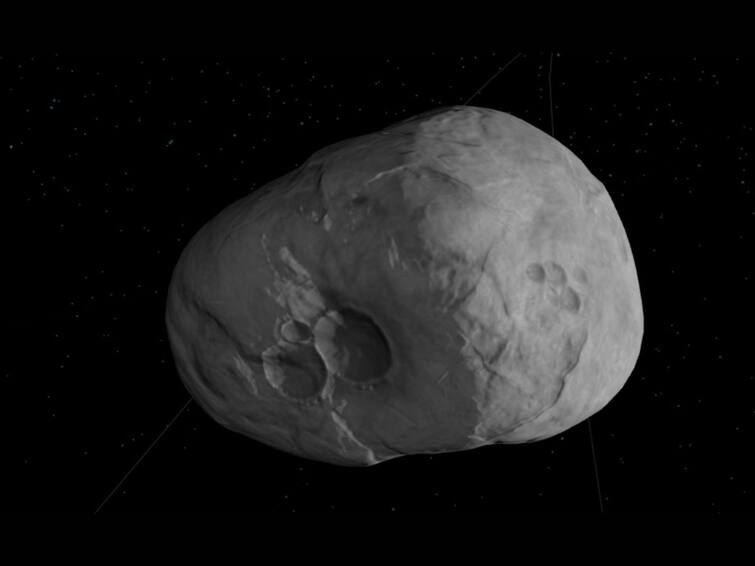
A new asteroid which NASA has been tracking has a “very small chance” of impacting Earth in 2046, according to the space agency’s Planetary Defense Coordination Office. The asteroid, called 2023 DW, might hit Earth on Valentine’s Day in 2046.
All about asteroid 2023 DW
Asteroid 2023 DW has an average estimated diameter of 49.29 metres, and a mass of about eight kilograms, according to Jet Propulsion Laboratory’s Center for Near Earth Object Studies. The velocity of the asteroid at the time of the likely impact will be 15.43 kilometres per second.

We’ve been tracking a new asteroid named 2023 DW that has a very small chance of impacting Earth in 2046. Often when new objects are first discovered, it takes several weeks of data to reduce the uncertainties and adequately predict their orbits years into the future. (1/2) pic.twitter.com/SaLC0AUSdP
— NASA Asteroid Watch (@AsteroidWatch) March 7, 2023
The number of potential impacts of 2023 DW with Earth is 10. According to the European Space Agency, the probability of 2023 DW striking Earth is 1/625, and the time of impact will be 21:44 UTC on February 14, 2046.
Asteroid 2023 DW was discovered on February 26, 2023, by MAP Observatory in San Pedro de Atacama.
Asteroid 2023 DW will make its next close approach to Earth on March 16, 2026, at a distance of 0.15495 astronomical units, 2,31,80,321 kilometres from Earth’s centre, according to the European Space Agency’s Near-Earth Objects Coordination Centre.
However, the asteroid will make its closest approach to Earth on February 14, 2046, at a distance of less than 0.05 astronomical units. An astronomical unit is the mean distance between the centre of Earth and the centre of the Sun, and is equivalent to approximately 150 million kilometres.

According to NASA’s Eyes On Asteroids, 2023 DW’s nearest distance to Earth on February 14, 2046 will be 18,28,086 kilometres.
The orbital period of 2023 DW is 271 days.
What is the Torino Scale?

Asteroid 2023 DW ranks 1 on the Torino Scale, which ranges from 0 to 10. The Torino Scale was adopted by the International Astronomical Union in 1999. It is a scale for categorising potential Earth impact events, according to the Jet Propulsion Laboratory.
The Torino Scale is an integer scale ranging from 0 to 10 with associated colour coding, and is intended to primarily facilitate public communication by the asteroid impact hazard monitoring community. The different colours of the scale are white, green, yellow, orange and red, which signify no hazard, normal, meriting attention by astronomers, threatening, and certain collision zones, respectively.
The ‘no hazard’ zone has rank zero, the ‘normal zone’ has rank 1, the ‘meriting attention by astronomers’ zone includes ranks 2, 3 and 4, the ‘threatening’ zone includes ranks 5, 6 and 7, and ‘certain collisions’ zone includes ranks 8, 9 and 10.
How severe could 2023 DW’s potential impact be?
When an asteroid is ranked 1 on the Torino Scale, it means that the near Earth object is a routine discovery in which a pass near the Earth is predicted. However, the pass near the Blue Planet poses no unusual level of danger. An asteroid is assigned rank 1 when current calculations show that the chance of collision is extremely unlikely with no cause for public attention or public concern. When new telescopic observations will be made in the future, they will likely lead to re-assignment of rank 0, according to NASA.
However, 2023 DW is the only near Earth object with rank 1 on the Torino Scale in NASA’s risk list, which is a catalogue of all objects for which a non-zero impact probability has been computed.
Meanwhile, all other near Earth objects on NASA’s risk list rank 0 on the Torino Scale.

NASA’s Planetary Defense Coordination Office wrote on Twitter that often when new objects are first discovered, it takes several weeks of data to reduce the uncertainties and adequately predict their orbits years into the future, and hence, orbit analysts will continue to monitor 2023 DW and update predictions.

