

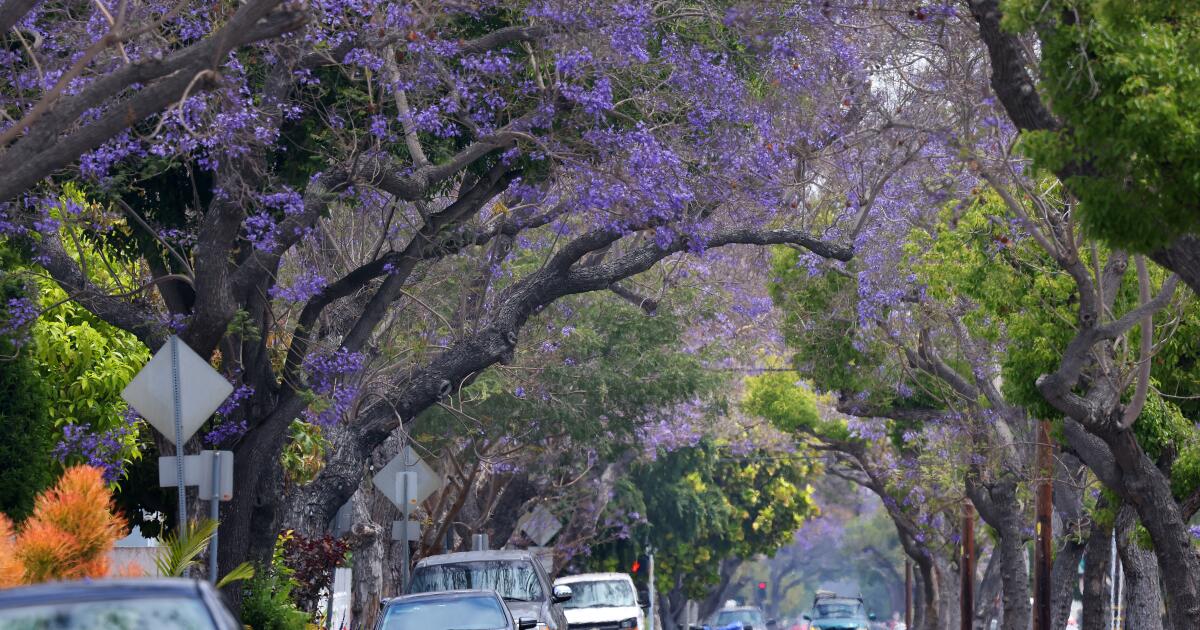
What would Los Angeles be like without the nearly 30,000 jacaranda trees on city streets?
It depends on who you ask.
“The tree stands for California at its worst: all flash, no substance, a pain left for others to clean up, inspiration for a thousand delusions and a million excuses,” The Times’ Gustavo Arellano wrote in a 2022 column titled “Why I hate jacarandas.” Evan Meyer, executive director of the Theodore Payne Foundation for Wild Flowers and Native Plants, noted last year that trees like jacaranda, native to Brazil, Argentina and Bolivia, are not beneficial to Los Angeles’s wildlife.
Despite its non-native status and exasperating tendency to blanket cars and sidewalks with slippery, aphid-attracting flowers, jacaranda trees have their fans, especially right now when streets, freeways and medians are saturated with bluish-purple flowers. There are more than 58,000 of them across Los Angeles and Orange counties.
Lora Hall, an urban forester for the city of San Marino, which has about 270 jacaranda trees with two new ones recently planted, says residents generally love them. So much so that when she requests feedback when replacing dead or damaged trees, residents often pick jacaranda. “Our population prefers flowering trees to nonflowering trees,” she says. Jacaranda are “second only to our ginkgo displays, which turn gold in the fall.”
Michael King, forestry program coordinator for the city of Pasadena, which has nearly 2,000 jacaranda, or Jacaranda mimosifolia, says the tree’s popularity likely spread throughout Southern California, including Pasadena, “as other horticulturalists and landowners took a liking to the purple flowers and the tree’s ability to thrive in our local climate.” According to the city’s Official Street Tree List published in 1940 by the City’s Park Department, the jacaranda tree is listed as the official street tree for Del Monte and Paloma streets.
While jacaranda trees inspire a love-hate relationship, their benefits include their resiliency compared to most tree species, says Lisa Smith, a board-certified master arborist and trees instructor for the UCLA Extension Landscape Architecture program.
“The city of L.A. would be pretty lacking in tree canopy without many non-natives,” she says. “Although it’s always great to plant natives, to grow our urban canopy, we need a greater diversity of species, which we can accomplish by utilizing climate-resilient species.”
Regarding density, Smith believes that some parts of Southern California like Pasadena have greater concentrations because the trees thrive in hot conditions. “You’ll find this species more commonly in the city’s warmer and more inland areas,” she says.
To illustrate, Smith points to the jacaranda planted on the median along Wilshire Boulevard near the West Los Angeles VA Medical Center. “They were installed for the Democratic convention over a decade ago,” she says. Today, they are “rocking and thriving, even in that windy, harsh, heat island of a location.”
The flowering trees, which grow 25 to 40 feet tall and can be just as wide, became popular in Los Angeles during the 1920s and ‘30s thanks to the efforts of botanist Kate Sessions, who introduced more than 100 species in San Diego in 1892.
Jacaranda trees usually bloom by June, but they may flower at any time of year depending on conditions such as light, heat, rain or pruning.
If you are wondering where you can see jacarandas around Los Angeles and Orange counties, The Times gathered all the publicly available tree data we could find. Jacaranda-rich areas include Santa Ana (nearly 4,200), Anaheim (2,000), Pasadena, Santa Monica (1,050), and the Mid-Wilshire neighborhood (940). Areas with the most jacaranda trees per square mile include West Hollywood (1,400), West Los Angeles (639) and Beverly Grove (720).
And here are some specific streets where you can find jacarandas. In Pasadena, forester King recommends East Del Mar Boulevard (from Arroyo Parkway to Lake Avenue); Del Monte Street (North Arroyo Boulevard to Lincoln Avenue); and Paloma Street (from Allen Avenue to Altadena Drive). In San Marino, Hall recommends Monterey Road (from Garfield Avenue to Old Mill Road).
According to the mapping data, other jacaranda-lined streets include Oakhurst and Palm drives (from Burton Way to Santa Monica Boulevard) in Beverly Grove; Palm and Alta drives (from Santa Monica Boulevard to Sunset Avenue) in Beverly Hills; Poinsettia Place and the intersection of Santa Monica Boulevard and Fairfax Avenue in West Hollywood; Whittier Drive along Holmby Park just outside Westwood; and South Garnsey Street (from West McFadden to West Wilshire avenues) in Santa Ana.
— Brittany Levine Beckman contributed to this report

What would Los Angeles be like without the nearly 30,000 jacaranda trees on city streets?
It depends on who you ask.
“The tree stands for California at its worst: all flash, no substance, a pain left for others to clean up, inspiration for a thousand delusions and a million excuses,” The Times’ Gustavo Arellano wrote in a 2022 column titled “Why I hate jacarandas.” Evan Meyer, executive director of the Theodore Payne Foundation for Wild Flowers and Native Plants, noted last year that trees like jacaranda, native to Brazil, Argentina and Bolivia, are not beneficial to Los Angeles’s wildlife.
Despite its non-native status and exasperating tendency to blanket cars and sidewalks with slippery, aphid-attracting flowers, jacaranda trees have their fans, especially right now when streets, freeways and medians are saturated with bluish-purple flowers. There are more than 58,000 of them across Los Angeles and Orange counties.
Lora Hall, an urban forester for the city of San Marino, which has about 270 jacaranda trees with two new ones recently planted, says residents generally love them. So much so that when she requests feedback when replacing dead or damaged trees, residents often pick jacaranda. “Our population prefers flowering trees to nonflowering trees,” she says. Jacaranda are “second only to our ginkgo displays, which turn gold in the fall.”
Michael King, forestry program coordinator for the city of Pasadena, which has nearly 2,000 jacaranda, or Jacaranda mimosifolia, says the tree’s popularity likely spread throughout Southern California, including Pasadena, “as other horticulturalists and landowners took a liking to the purple flowers and the tree’s ability to thrive in our local climate.” According to the city’s Official Street Tree List published in 1940 by the City’s Park Department, the jacaranda tree is listed as the official street tree for Del Monte and Paloma streets.
While jacaranda trees inspire a love-hate relationship, their benefits include their resiliency compared to most tree species, says Lisa Smith, a board-certified master arborist and trees instructor for the UCLA Extension Landscape Architecture program.
“The city of L.A. would be pretty lacking in tree canopy without many non-natives,” she says. “Although it’s always great to plant natives, to grow our urban canopy, we need a greater diversity of species, which we can accomplish by utilizing climate-resilient species.”
Regarding density, Smith believes that some parts of Southern California like Pasadena have greater concentrations because the trees thrive in hot conditions. “You’ll find this species more commonly in the city’s warmer and more inland areas,” she says.
To illustrate, Smith points to the jacaranda planted on the median along Wilshire Boulevard near the West Los Angeles VA Medical Center. “They were installed for the Democratic convention over a decade ago,” she says. Today, they are “rocking and thriving, even in that windy, harsh, heat island of a location.”
The flowering trees, which grow 25 to 40 feet tall and can be just as wide, became popular in Los Angeles during the 1920s and ‘30s thanks to the efforts of botanist Kate Sessions, who introduced more than 100 species in San Diego in 1892.
Jacaranda trees usually bloom by June, but they may flower at any time of year depending on conditions such as light, heat, rain or pruning.
If you are wondering where you can see jacarandas around Los Angeles and Orange counties, The Times gathered all the publicly available tree data we could find. Jacaranda-rich areas include Santa Ana (nearly 4,200), Anaheim (2,000), Pasadena, Santa Monica (1,050), and the Mid-Wilshire neighborhood (940). Areas with the most jacaranda trees per square mile include West Hollywood (1,400), West Los Angeles (639) and Beverly Grove (720).
And here are some specific streets where you can find jacarandas. In Pasadena, forester King recommends East Del Mar Boulevard (from Arroyo Parkway to Lake Avenue); Del Monte Street (North Arroyo Boulevard to Lincoln Avenue); and Paloma Street (from Allen Avenue to Altadena Drive). In San Marino, Hall recommends Monterey Road (from Garfield Avenue to Old Mill Road).
According to the mapping data, other jacaranda-lined streets include Oakhurst and Palm drives (from Burton Way to Santa Monica Boulevard) in Beverly Grove; Palm and Alta drives (from Santa Monica Boulevard to Sunset Avenue) in Beverly Hills; Poinsettia Place and the intersection of Santa Monica Boulevard and Fairfax Avenue in West Hollywood; Whittier Drive along Holmby Park just outside Westwood; and South Garnsey Street (from West McFadden to West Wilshire avenues) in Santa Ana.
— Brittany Levine Beckman contributed to this report

What would Los Angeles be like without the nearly 30,000 jacaranda trees on city streets?
It depends on who you ask.
“The tree stands for California at its worst: all flash, no substance, a pain left for others to clean up, inspiration for a thousand delusions and a million excuses,” The Times’ Gustavo Arellano wrote in a 2022 column titled “Why I hate jacarandas.” Evan Meyer, executive director of the Theodore Payne Foundation for Wild Flowers and Native Plants, noted last year that trees like jacaranda, native to Brazil, Argentina and Bolivia, are not beneficial to Los Angeles’s wildlife.
Despite its non-native status and exasperating tendency to blanket cars and sidewalks with slippery, aphid-attracting flowers, jacaranda trees have their fans, especially right now when streets, freeways and medians are saturated with bluish-purple flowers. There are more than 58,000 of them across Los Angeles and Orange counties.
Lora Hall, an urban forester for the city of San Marino, which has about 270 jacaranda trees with two new ones recently planted, says residents generally love them. So much so that when she requests feedback when replacing dead or damaged trees, residents often pick jacaranda. “Our population prefers flowering trees to nonflowering trees,” she says. Jacaranda are “second only to our ginkgo displays, which turn gold in the fall.”
Michael King, forestry program coordinator for the city of Pasadena, which has nearly 2,000 jacaranda, or Jacaranda mimosifolia, says the tree’s popularity likely spread throughout Southern California, including Pasadena, “as other horticulturalists and landowners took a liking to the purple flowers and the tree’s ability to thrive in our local climate.” According to the city’s Official Street Tree List published in 1940 by the City’s Park Department, the jacaranda tree is listed as the official street tree for Del Monte and Paloma streets.
While jacaranda trees inspire a love-hate relationship, their benefits include their resiliency compared to most tree species, says Lisa Smith, a board-certified master arborist and trees instructor for the UCLA Extension Landscape Architecture program.
“The city of L.A. would be pretty lacking in tree canopy without many non-natives,” she says. “Although it’s always great to plant natives, to grow our urban canopy, we need a greater diversity of species, which we can accomplish by utilizing climate-resilient species.”
Regarding density, Smith believes that some parts of Southern California like Pasadena have greater concentrations because the trees thrive in hot conditions. “You’ll find this species more commonly in the city’s warmer and more inland areas,” she says.
To illustrate, Smith points to the jacaranda planted on the median along Wilshire Boulevard near the West Los Angeles VA Medical Center. “They were installed for the Democratic convention over a decade ago,” she says. Today, they are “rocking and thriving, even in that windy, harsh, heat island of a location.”
The flowering trees, which grow 25 to 40 feet tall and can be just as wide, became popular in Los Angeles during the 1920s and ‘30s thanks to the efforts of botanist Kate Sessions, who introduced more than 100 species in San Diego in 1892.
Jacaranda trees usually bloom by June, but they may flower at any time of year depending on conditions such as light, heat, rain or pruning.
If you are wondering where you can see jacarandas around Los Angeles and Orange counties, The Times gathered all the publicly available tree data we could find. Jacaranda-rich areas include Santa Ana (nearly 4,200), Anaheim (2,000), Pasadena, Santa Monica (1,050), and the Mid-Wilshire neighborhood (940). Areas with the most jacaranda trees per square mile include West Hollywood (1,400), West Los Angeles (639) and Beverly Grove (720).
And here are some specific streets where you can find jacarandas. In Pasadena, forester King recommends East Del Mar Boulevard (from Arroyo Parkway to Lake Avenue); Del Monte Street (North Arroyo Boulevard to Lincoln Avenue); and Paloma Street (from Allen Avenue to Altadena Drive). In San Marino, Hall recommends Monterey Road (from Garfield Avenue to Old Mill Road).
According to the mapping data, other jacaranda-lined streets include Oakhurst and Palm drives (from Burton Way to Santa Monica Boulevard) in Beverly Grove; Palm and Alta drives (from Santa Monica Boulevard to Sunset Avenue) in Beverly Hills; Poinsettia Place and the intersection of Santa Monica Boulevard and Fairfax Avenue in West Hollywood; Whittier Drive along Holmby Park just outside Westwood; and South Garnsey Street (from West McFadden to West Wilshire avenues) in Santa Ana.
— Brittany Levine Beckman contributed to this report
What would Los Angeles be like without the nearly 30,000 jacaranda trees on city streets?
It depends on who you ask.
“The tree stands for California at its worst: all flash, no substance, a pain left for others to clean up, inspiration for a thousand delusions and a million excuses,” The Times’ Gustavo Arellano wrote in a 2022 column titled “Why I hate jacarandas.” Evan Meyer, executive director of the Theodore Payne Foundation for Wild Flowers and Native Plants, noted last year that trees like jacaranda, native to Brazil, Argentina and Bolivia, are not beneficial to Los Angeles’s wildlife.
Despite its non-native status and exasperating tendency to blanket cars and sidewalks with slippery, aphid-attracting flowers, jacaranda trees have their fans, especially right now when streets, freeways and medians are saturated with bluish-purple flowers. There are more than 58,000 of them across Los Angeles and Orange counties.
Lora Hall, an urban forester for the city of San Marino, which has about 270 jacaranda trees with two new ones recently planted, says residents generally love them. So much so that when she requests feedback when replacing dead or damaged trees, residents often pick jacaranda. “Our population prefers flowering trees to nonflowering trees,” she says. Jacaranda are “second only to our ginkgo displays, which turn gold in the fall.”
Michael King, forestry program coordinator for the city of Pasadena, which has nearly 2,000 jacaranda, or Jacaranda mimosifolia, says the tree’s popularity likely spread throughout Southern California, including Pasadena, “as other horticulturalists and landowners took a liking to the purple flowers and the tree’s ability to thrive in our local climate.” According to the city’s Official Street Tree List published in 1940 by the City’s Park Department, the jacaranda tree is listed as the official street tree for Del Monte and Paloma streets.
While jacaranda trees inspire a love-hate relationship, their benefits include their resiliency compared to most tree species, says Lisa Smith, a board-certified master arborist and trees instructor for the UCLA Extension Landscape Architecture program.
“The city of L.A. would be pretty lacking in tree canopy without many non-natives,” she says. “Although it’s always great to plant natives, to grow our urban canopy, we need a greater diversity of species, which we can accomplish by utilizing climate-resilient species.”
Regarding density, Smith believes that some parts of Southern California like Pasadena have greater concentrations because the trees thrive in hot conditions. “You’ll find this species more commonly in the city’s warmer and more inland areas,” she says.
To illustrate, Smith points to the jacaranda planted on the median along Wilshire Boulevard near the West Los Angeles VA Medical Center. “They were installed for the Democratic convention over a decade ago,” she says. Today, they are “rocking and thriving, even in that windy, harsh, heat island of a location.”
The flowering trees, which grow 25 to 40 feet tall and can be just as wide, became popular in Los Angeles during the 1920s and ‘30s thanks to the efforts of botanist Kate Sessions, who introduced more than 100 species in San Diego in 1892.
Jacaranda trees usually bloom by June, but they may flower at any time of year depending on conditions such as light, heat, rain or pruning.
If you are wondering where you can see jacarandas around Los Angeles and Orange counties, The Times gathered all the publicly available tree data we could find. Jacaranda-rich areas include Santa Ana (nearly 4,200), Anaheim (2,000), Pasadena, Santa Monica (1,050), and the Mid-Wilshire neighborhood (940). Areas with the most jacaranda trees per square mile include West Hollywood (1,400), West Los Angeles (639) and Beverly Grove (720).
And here are some specific streets where you can find jacarandas. In Pasadena, forester King recommends East Del Mar Boulevard (from Arroyo Parkway to Lake Avenue); Del Monte Street (North Arroyo Boulevard to Lincoln Avenue); and Paloma Street (from Allen Avenue to Altadena Drive). In San Marino, Hall recommends Monterey Road (from Garfield Avenue to Old Mill Road).
According to the mapping data, other jacaranda-lined streets include Oakhurst and Palm drives (from Burton Way to Santa Monica Boulevard) in Beverly Grove; Palm and Alta drives (from Santa Monica Boulevard to Sunset Avenue) in Beverly Hills; Poinsettia Place and the intersection of Santa Monica Boulevard and Fairfax Avenue in West Hollywood; Whittier Drive along Holmby Park just outside Westwood; and South Garnsey Street (from West McFadden to West Wilshire avenues) in Santa Ana.
— Brittany Levine Beckman contributed to this report

What would Los Angeles be like without the nearly 30,000 jacaranda trees on city streets?
It depends on who you ask.
“The tree stands for California at its worst: all flash, no substance, a pain left for others to clean up, inspiration for a thousand delusions and a million excuses,” The Times’ Gustavo Arellano wrote in a 2022 column titled “Why I hate jacarandas.” Evan Meyer, executive director of the Theodore Payne Foundation for Wild Flowers and Native Plants, noted last year that trees like jacaranda, native to Brazil, Argentina and Bolivia, are not beneficial to Los Angeles’s wildlife.
Despite its non-native status and exasperating tendency to blanket cars and sidewalks with slippery, aphid-attracting flowers, jacaranda trees have their fans, especially right now when streets, freeways and medians are saturated with bluish-purple flowers. There are more than 58,000 of them across Los Angeles and Orange counties.
Lora Hall, an urban forester for the city of San Marino, which has about 270 jacaranda trees with two new ones recently planted, says residents generally love them. So much so that when she requests feedback when replacing dead or damaged trees, residents often pick jacaranda. “Our population prefers flowering trees to nonflowering trees,” she says. Jacaranda are “second only to our ginkgo displays, which turn gold in the fall.”
Michael King, forestry program coordinator for the city of Pasadena, which has nearly 2,000 jacaranda, or Jacaranda mimosifolia, says the tree’s popularity likely spread throughout Southern California, including Pasadena, “as other horticulturalists and landowners took a liking to the purple flowers and the tree’s ability to thrive in our local climate.” According to the city’s Official Street Tree List published in 1940 by the City’s Park Department, the jacaranda tree is listed as the official street tree for Del Monte and Paloma streets.
While jacaranda trees inspire a love-hate relationship, their benefits include their resiliency compared to most tree species, says Lisa Smith, a board-certified master arborist and trees instructor for the UCLA Extension Landscape Architecture program.
“The city of L.A. would be pretty lacking in tree canopy without many non-natives,” she says. “Although it’s always great to plant natives, to grow our urban canopy, we need a greater diversity of species, which we can accomplish by utilizing climate-resilient species.”
Regarding density, Smith believes that some parts of Southern California like Pasadena have greater concentrations because the trees thrive in hot conditions. “You’ll find this species more commonly in the city’s warmer and more inland areas,” she says.
To illustrate, Smith points to the jacaranda planted on the median along Wilshire Boulevard near the West Los Angeles VA Medical Center. “They were installed for the Democratic convention over a decade ago,” she says. Today, they are “rocking and thriving, even in that windy, harsh, heat island of a location.”
The flowering trees, which grow 25 to 40 feet tall and can be just as wide, became popular in Los Angeles during the 1920s and ‘30s thanks to the efforts of botanist Kate Sessions, who introduced more than 100 species in San Diego in 1892.
Jacaranda trees usually bloom by June, but they may flower at any time of year depending on conditions such as light, heat, rain or pruning.
If you are wondering where you can see jacarandas around Los Angeles and Orange counties, The Times gathered all the publicly available tree data we could find. Jacaranda-rich areas include Santa Ana (nearly 4,200), Anaheim (2,000), Pasadena, Santa Monica (1,050), and the Mid-Wilshire neighborhood (940). Areas with the most jacaranda trees per square mile include West Hollywood (1,400), West Los Angeles (639) and Beverly Grove (720).
And here are some specific streets where you can find jacarandas. In Pasadena, forester King recommends East Del Mar Boulevard (from Arroyo Parkway to Lake Avenue); Del Monte Street (North Arroyo Boulevard to Lincoln Avenue); and Paloma Street (from Allen Avenue to Altadena Drive). In San Marino, Hall recommends Monterey Road (from Garfield Avenue to Old Mill Road).
According to the mapping data, other jacaranda-lined streets include Oakhurst and Palm drives (from Burton Way to Santa Monica Boulevard) in Beverly Grove; Palm and Alta drives (from Santa Monica Boulevard to Sunset Avenue) in Beverly Hills; Poinsettia Place and the intersection of Santa Monica Boulevard and Fairfax Avenue in West Hollywood; Whittier Drive along Holmby Park just outside Westwood; and South Garnsey Street (from West McFadden to West Wilshire avenues) in Santa Ana.
— Brittany Levine Beckman contributed to this report
What would Los Angeles be like without the nearly 30,000 jacaranda trees on city streets?
It depends on who you ask.
“The tree stands for California at its worst: all flash, no substance, a pain left for others to clean up, inspiration for a thousand delusions and a million excuses,” The Times’ Gustavo Arellano wrote in a 2022 column titled “Why I hate jacarandas.” Evan Meyer, executive director of the Theodore Payne Foundation for Wild Flowers and Native Plants, noted last year that trees like jacaranda, native to Brazil, Argentina and Bolivia, are not beneficial to Los Angeles’s wildlife.
Despite its non-native status and exasperating tendency to blanket cars and sidewalks with slippery, aphid-attracting flowers, jacaranda trees have their fans, especially right now when streets, freeways and medians are saturated with bluish-purple flowers. There are more than 58,000 of them across Los Angeles and Orange counties.
Lora Hall, an urban forester for the city of San Marino, which has about 270 jacaranda trees with two new ones recently planted, says residents generally love them. So much so that when she requests feedback when replacing dead or damaged trees, residents often pick jacaranda. “Our population prefers flowering trees to nonflowering trees,” she says. Jacaranda are “second only to our ginkgo displays, which turn gold in the fall.”
Michael King, forestry program coordinator for the city of Pasadena, which has nearly 2,000 jacaranda, or Jacaranda mimosifolia, says the tree’s popularity likely spread throughout Southern California, including Pasadena, “as other horticulturalists and landowners took a liking to the purple flowers and the tree’s ability to thrive in our local climate.” According to the city’s Official Street Tree List published in 1940 by the City’s Park Department, the jacaranda tree is listed as the official street tree for Del Monte and Paloma streets.
While jacaranda trees inspire a love-hate relationship, their benefits include their resiliency compared to most tree species, says Lisa Smith, a board-certified master arborist and trees instructor for the UCLA Extension Landscape Architecture program.
“The city of L.A. would be pretty lacking in tree canopy without many non-natives,” she says. “Although it’s always great to plant natives, to grow our urban canopy, we need a greater diversity of species, which we can accomplish by utilizing climate-resilient species.”
Regarding density, Smith believes that some parts of Southern California like Pasadena have greater concentrations because the trees thrive in hot conditions. “You’ll find this species more commonly in the city’s warmer and more inland areas,” she says.
To illustrate, Smith points to the jacaranda planted on the median along Wilshire Boulevard near the West Los Angeles VA Medical Center. “They were installed for the Democratic convention over a decade ago,” she says. Today, they are “rocking and thriving, even in that windy, harsh, heat island of a location.”
The flowering trees, which grow 25 to 40 feet tall and can be just as wide, became popular in Los Angeles during the 1920s and ‘30s thanks to the efforts of botanist Kate Sessions, who introduced more than 100 species in San Diego in 1892.
Jacaranda trees usually bloom by June, but they may flower at any time of year depending on conditions such as light, heat, rain or pruning.
If you are wondering where you can see jacarandas around Los Angeles and Orange counties, The Times gathered all the publicly available tree data we could find. Jacaranda-rich areas include Santa Ana (nearly 4,200), Anaheim (2,000), Pasadena, Santa Monica (1,050), and the Mid-Wilshire neighborhood (940). Areas with the most jacaranda trees per square mile include West Hollywood (1,400), West Los Angeles (639) and Beverly Grove (720).
And here are some specific streets where you can find jacarandas. In Pasadena, forester King recommends East Del Mar Boulevard (from Arroyo Parkway to Lake Avenue); Del Monte Street (North Arroyo Boulevard to Lincoln Avenue); and Paloma Street (from Allen Avenue to Altadena Drive). In San Marino, Hall recommends Monterey Road (from Garfield Avenue to Old Mill Road).
According to the mapping data, other jacaranda-lined streets include Oakhurst and Palm drives (from Burton Way to Santa Monica Boulevard) in Beverly Grove; Palm and Alta drives (from Santa Monica Boulevard to Sunset Avenue) in Beverly Hills; Poinsettia Place and the intersection of Santa Monica Boulevard and Fairfax Avenue in West Hollywood; Whittier Drive along Holmby Park just outside Westwood; and South Garnsey Street (from West McFadden to West Wilshire avenues) in Santa Ana.
— Brittany Levine Beckman contributed to this report
What would Los Angeles be like without the nearly 30,000 jacaranda trees on city streets?
It depends on who you ask.
“The tree stands for California at its worst: all flash, no substance, a pain left for others to clean up, inspiration for a thousand delusions and a million excuses,” The Times’ Gustavo Arellano wrote in a 2022 column titled “Why I hate jacarandas.” Evan Meyer, executive director of the Theodore Payne Foundation for Wild Flowers and Native Plants, noted last year that trees like jacaranda, native to Brazil, Argentina and Bolivia, are not beneficial to Los Angeles’s wildlife.
Despite its non-native status and exasperating tendency to blanket cars and sidewalks with slippery, aphid-attracting flowers, jacaranda trees have their fans, especially right now when streets, freeways and medians are saturated with bluish-purple flowers. There are more than 58,000 of them across Los Angeles and Orange counties.
Lora Hall, an urban forester for the city of San Marino, which has about 270 jacaranda trees with two new ones recently planted, says residents generally love them. So much so that when she requests feedback when replacing dead or damaged trees, residents often pick jacaranda. “Our population prefers flowering trees to nonflowering trees,” she says. Jacaranda are “second only to our ginkgo displays, which turn gold in the fall.”
Michael King, forestry program coordinator for the city of Pasadena, which has nearly 2,000 jacaranda, or Jacaranda mimosifolia, says the tree’s popularity likely spread throughout Southern California, including Pasadena, “as other horticulturalists and landowners took a liking to the purple flowers and the tree’s ability to thrive in our local climate.” According to the city’s Official Street Tree List published in 1940 by the City’s Park Department, the jacaranda tree is listed as the official street tree for Del Monte and Paloma streets.
While jacaranda trees inspire a love-hate relationship, their benefits include their resiliency compared to most tree species, says Lisa Smith, a board-certified master arborist and trees instructor for the UCLA Extension Landscape Architecture program.
“The city of L.A. would be pretty lacking in tree canopy without many non-natives,” she says. “Although it’s always great to plant natives, to grow our urban canopy, we need a greater diversity of species, which we can accomplish by utilizing climate-resilient species.”
Regarding density, Smith believes that some parts of Southern California like Pasadena have greater concentrations because the trees thrive in hot conditions. “You’ll find this species more commonly in the city’s warmer and more inland areas,” she says.
To illustrate, Smith points to the jacaranda planted on the median along Wilshire Boulevard near the West Los Angeles VA Medical Center. “They were installed for the Democratic convention over a decade ago,” she says. Today, they are “rocking and thriving, even in that windy, harsh, heat island of a location.”
The flowering trees, which grow 25 to 40 feet tall and can be just as wide, became popular in Los Angeles during the 1920s and ‘30s thanks to the efforts of botanist Kate Sessions, who introduced more than 100 species in San Diego in 1892.
Jacaranda trees usually bloom by June, but they may flower at any time of year depending on conditions such as light, heat, rain or pruning.
If you are wondering where you can see jacarandas around Los Angeles and Orange counties, The Times gathered all the publicly available tree data we could find. Jacaranda-rich areas include Santa Ana (nearly 4,200), Anaheim (2,000), Pasadena, Santa Monica (1,050), and the Mid-Wilshire neighborhood (940). Areas with the most jacaranda trees per square mile include West Hollywood (1,400), West Los Angeles (639) and Beverly Grove (720).
And here are some specific streets where you can find jacarandas. In Pasadena, forester King recommends East Del Mar Boulevard (from Arroyo Parkway to Lake Avenue); Del Monte Street (North Arroyo Boulevard to Lincoln Avenue); and Paloma Street (from Allen Avenue to Altadena Drive). In San Marino, Hall recommends Monterey Road (from Garfield Avenue to Old Mill Road).
According to the mapping data, other jacaranda-lined streets include Oakhurst and Palm drives (from Burton Way to Santa Monica Boulevard) in Beverly Grove; Palm and Alta drives (from Santa Monica Boulevard to Sunset Avenue) in Beverly Hills; Poinsettia Place and the intersection of Santa Monica Boulevard and Fairfax Avenue in West Hollywood; Whittier Drive along Holmby Park just outside Westwood; and South Garnsey Street (from West McFadden to West Wilshire avenues) in Santa Ana.
— Brittany Levine Beckman contributed to this report
What would Los Angeles be like without the nearly 30,000 jacaranda trees on city streets?
It depends on who you ask.
“The tree stands for California at its worst: all flash, no substance, a pain left for others to clean up, inspiration for a thousand delusions and a million excuses,” The Times’ Gustavo Arellano wrote in a 2022 column titled “Why I hate jacarandas.” Evan Meyer, executive director of the Theodore Payne Foundation for Wild Flowers and Native Plants, noted last year that trees like jacaranda, native to Brazil, Argentina and Bolivia, are not beneficial to Los Angeles’s wildlife.
Despite its non-native status and exasperating tendency to blanket cars and sidewalks with slippery, aphid-attracting flowers, jacaranda trees have their fans, especially right now when streets, freeways and medians are saturated with bluish-purple flowers. There are more than 58,000 of them across Los Angeles and Orange counties.
Lora Hall, an urban forester for the city of San Marino, which has about 270 jacaranda trees with two new ones recently planted, says residents generally love them. So much so that when she requests feedback when replacing dead or damaged trees, residents often pick jacaranda. “Our population prefers flowering trees to nonflowering trees,” she says. Jacaranda are “second only to our ginkgo displays, which turn gold in the fall.”
Michael King, forestry program coordinator for the city of Pasadena, which has nearly 2,000 jacaranda, or Jacaranda mimosifolia, says the tree’s popularity likely spread throughout Southern California, including Pasadena, “as other horticulturalists and landowners took a liking to the purple flowers and the tree’s ability to thrive in our local climate.” According to the city’s Official Street Tree List published in 1940 by the City’s Park Department, the jacaranda tree is listed as the official street tree for Del Monte and Paloma streets.
While jacaranda trees inspire a love-hate relationship, their benefits include their resiliency compared to most tree species, says Lisa Smith, a board-certified master arborist and trees instructor for the UCLA Extension Landscape Architecture program.
“The city of L.A. would be pretty lacking in tree canopy without many non-natives,” she says. “Although it’s always great to plant natives, to grow our urban canopy, we need a greater diversity of species, which we can accomplish by utilizing climate-resilient species.”
Regarding density, Smith believes that some parts of Southern California like Pasadena have greater concentrations because the trees thrive in hot conditions. “You’ll find this species more commonly in the city’s warmer and more inland areas,” she says.
To illustrate, Smith points to the jacaranda planted on the median along Wilshire Boulevard near the West Los Angeles VA Medical Center. “They were installed for the Democratic convention over a decade ago,” she says. Today, they are “rocking and thriving, even in that windy, harsh, heat island of a location.”
The flowering trees, which grow 25 to 40 feet tall and can be just as wide, became popular in Los Angeles during the 1920s and ‘30s thanks to the efforts of botanist Kate Sessions, who introduced more than 100 species in San Diego in 1892.
Jacaranda trees usually bloom by June, but they may flower at any time of year depending on conditions such as light, heat, rain or pruning.
If you are wondering where you can see jacarandas around Los Angeles and Orange counties, The Times gathered all the publicly available tree data we could find. Jacaranda-rich areas include Santa Ana (nearly 4,200), Anaheim (2,000), Pasadena, Santa Monica (1,050), and the Mid-Wilshire neighborhood (940). Areas with the most jacaranda trees per square mile include West Hollywood (1,400), West Los Angeles (639) and Beverly Grove (720).
And here are some specific streets where you can find jacarandas. In Pasadena, forester King recommends East Del Mar Boulevard (from Arroyo Parkway to Lake Avenue); Del Monte Street (North Arroyo Boulevard to Lincoln Avenue); and Paloma Street (from Allen Avenue to Altadena Drive). In San Marino, Hall recommends Monterey Road (from Garfield Avenue to Old Mill Road).
According to the mapping data, other jacaranda-lined streets include Oakhurst and Palm drives (from Burton Way to Santa Monica Boulevard) in Beverly Grove; Palm and Alta drives (from Santa Monica Boulevard to Sunset Avenue) in Beverly Hills; Poinsettia Place and the intersection of Santa Monica Boulevard and Fairfax Avenue in West Hollywood; Whittier Drive along Holmby Park just outside Westwood; and South Garnsey Street (from West McFadden to West Wilshire avenues) in Santa Ana.
— Brittany Levine Beckman contributed to this report

What would Los Angeles be like without the nearly 30,000 jacaranda trees on city streets?
It depends on who you ask.
“The tree stands for California at its worst: all flash, no substance, a pain left for others to clean up, inspiration for a thousand delusions and a million excuses,” The Times’ Gustavo Arellano wrote in a 2022 column titled “Why I hate jacarandas.” Evan Meyer, executive director of the Theodore Payne Foundation for Wild Flowers and Native Plants, noted last year that trees like jacaranda, native to Brazil, Argentina and Bolivia, are not beneficial to Los Angeles’s wildlife.
Despite its non-native status and exasperating tendency to blanket cars and sidewalks with slippery, aphid-attracting flowers, jacaranda trees have their fans, especially right now when streets, freeways and medians are saturated with bluish-purple flowers. There are more than 58,000 of them across Los Angeles and Orange counties.
Lora Hall, an urban forester for the city of San Marino, which has about 270 jacaranda trees with two new ones recently planted, says residents generally love them. So much so that when she requests feedback when replacing dead or damaged trees, residents often pick jacaranda. “Our population prefers flowering trees to nonflowering trees,” she says. Jacaranda are “second only to our ginkgo displays, which turn gold in the fall.”
Michael King, forestry program coordinator for the city of Pasadena, which has nearly 2,000 jacaranda, or Jacaranda mimosifolia, says the tree’s popularity likely spread throughout Southern California, including Pasadena, “as other horticulturalists and landowners took a liking to the purple flowers and the tree’s ability to thrive in our local climate.” According to the city’s Official Street Tree List published in 1940 by the City’s Park Department, the jacaranda tree is listed as the official street tree for Del Monte and Paloma streets.
While jacaranda trees inspire a love-hate relationship, their benefits include their resiliency compared to most tree species, says Lisa Smith, a board-certified master arborist and trees instructor for the UCLA Extension Landscape Architecture program.
“The city of L.A. would be pretty lacking in tree canopy without many non-natives,” she says. “Although it’s always great to plant natives, to grow our urban canopy, we need a greater diversity of species, which we can accomplish by utilizing climate-resilient species.”
Regarding density, Smith believes that some parts of Southern California like Pasadena have greater concentrations because the trees thrive in hot conditions. “You’ll find this species more commonly in the city’s warmer and more inland areas,” she says.
To illustrate, Smith points to the jacaranda planted on the median along Wilshire Boulevard near the West Los Angeles VA Medical Center. “They were installed for the Democratic convention over a decade ago,” she says. Today, they are “rocking and thriving, even in that windy, harsh, heat island of a location.”
The flowering trees, which grow 25 to 40 feet tall and can be just as wide, became popular in Los Angeles during the 1920s and ‘30s thanks to the efforts of botanist Kate Sessions, who introduced more than 100 species in San Diego in 1892.
Jacaranda trees usually bloom by June, but they may flower at any time of year depending on conditions such as light, heat, rain or pruning.
If you are wondering where you can see jacarandas around Los Angeles and Orange counties, The Times gathered all the publicly available tree data we could find. Jacaranda-rich areas include Santa Ana (nearly 4,200), Anaheim (2,000), Pasadena, Santa Monica (1,050), and the Mid-Wilshire neighborhood (940). Areas with the most jacaranda trees per square mile include West Hollywood (1,400), West Los Angeles (639) and Beverly Grove (720).
And here are some specific streets where you can find jacarandas. In Pasadena, forester King recommends East Del Mar Boulevard (from Arroyo Parkway to Lake Avenue); Del Monte Street (North Arroyo Boulevard to Lincoln Avenue); and Paloma Street (from Allen Avenue to Altadena Drive). In San Marino, Hall recommends Monterey Road (from Garfield Avenue to Old Mill Road).
According to the mapping data, other jacaranda-lined streets include Oakhurst and Palm drives (from Burton Way to Santa Monica Boulevard) in Beverly Grove; Palm and Alta drives (from Santa Monica Boulevard to Sunset Avenue) in Beverly Hills; Poinsettia Place and the intersection of Santa Monica Boulevard and Fairfax Avenue in West Hollywood; Whittier Drive along Holmby Park just outside Westwood; and South Garnsey Street (from West McFadden to West Wilshire avenues) in Santa Ana.
— Brittany Levine Beckman contributed to this report
What would Los Angeles be like without the nearly 30,000 jacaranda trees on city streets?
It depends on who you ask.
“The tree stands for California at its worst: all flash, no substance, a pain left for others to clean up, inspiration for a thousand delusions and a million excuses,” The Times’ Gustavo Arellano wrote in a 2022 column titled “Why I hate jacarandas.” Evan Meyer, executive director of the Theodore Payne Foundation for Wild Flowers and Native Plants, noted last year that trees like jacaranda, native to Brazil, Argentina and Bolivia, are not beneficial to Los Angeles’s wildlife.
Despite its non-native status and exasperating tendency to blanket cars and sidewalks with slippery, aphid-attracting flowers, jacaranda trees have their fans, especially right now when streets, freeways and medians are saturated with bluish-purple flowers. There are more than 58,000 of them across Los Angeles and Orange counties.
Lora Hall, an urban forester for the city of San Marino, which has about 270 jacaranda trees with two new ones recently planted, says residents generally love them. So much so that when she requests feedback when replacing dead or damaged trees, residents often pick jacaranda. “Our population prefers flowering trees to nonflowering trees,” she says. Jacaranda are “second only to our ginkgo displays, which turn gold in the fall.”
Michael King, forestry program coordinator for the city of Pasadena, which has nearly 2,000 jacaranda, or Jacaranda mimosifolia, says the tree’s popularity likely spread throughout Southern California, including Pasadena, “as other horticulturalists and landowners took a liking to the purple flowers and the tree’s ability to thrive in our local climate.” According to the city’s Official Street Tree List published in 1940 by the City’s Park Department, the jacaranda tree is listed as the official street tree for Del Monte and Paloma streets.
While jacaranda trees inspire a love-hate relationship, their benefits include their resiliency compared to most tree species, says Lisa Smith, a board-certified master arborist and trees instructor for the UCLA Extension Landscape Architecture program.
“The city of L.A. would be pretty lacking in tree canopy without many non-natives,” she says. “Although it’s always great to plant natives, to grow our urban canopy, we need a greater diversity of species, which we can accomplish by utilizing climate-resilient species.”
Regarding density, Smith believes that some parts of Southern California like Pasadena have greater concentrations because the trees thrive in hot conditions. “You’ll find this species more commonly in the city’s warmer and more inland areas,” she says.
To illustrate, Smith points to the jacaranda planted on the median along Wilshire Boulevard near the West Los Angeles VA Medical Center. “They were installed for the Democratic convention over a decade ago,” she says. Today, they are “rocking and thriving, even in that windy, harsh, heat island of a location.”
The flowering trees, which grow 25 to 40 feet tall and can be just as wide, became popular in Los Angeles during the 1920s and ‘30s thanks to the efforts of botanist Kate Sessions, who introduced more than 100 species in San Diego in 1892.
Jacaranda trees usually bloom by June, but they may flower at any time of year depending on conditions such as light, heat, rain or pruning.
If you are wondering where you can see jacarandas around Los Angeles and Orange counties, The Times gathered all the publicly available tree data we could find. Jacaranda-rich areas include Santa Ana (nearly 4,200), Anaheim (2,000), Pasadena, Santa Monica (1,050), and the Mid-Wilshire neighborhood (940). Areas with the most jacaranda trees per square mile include West Hollywood (1,400), West Los Angeles (639) and Beverly Grove (720).
And here are some specific streets where you can find jacarandas. In Pasadena, forester King recommends East Del Mar Boulevard (from Arroyo Parkway to Lake Avenue); Del Monte Street (North Arroyo Boulevard to Lincoln Avenue); and Paloma Street (from Allen Avenue to Altadena Drive). In San Marino, Hall recommends Monterey Road (from Garfield Avenue to Old Mill Road).
According to the mapping data, other jacaranda-lined streets include Oakhurst and Palm drives (from Burton Way to Santa Monica Boulevard) in Beverly Grove; Palm and Alta drives (from Santa Monica Boulevard to Sunset Avenue) in Beverly Hills; Poinsettia Place and the intersection of Santa Monica Boulevard and Fairfax Avenue in West Hollywood; Whittier Drive along Holmby Park just outside Westwood; and South Garnsey Street (from West McFadden to West Wilshire avenues) in Santa Ana.
— Brittany Levine Beckman contributed to this report
What would Los Angeles be like without the nearly 30,000 jacaranda trees on city streets?
It depends on who you ask.
“The tree stands for California at its worst: all flash, no substance, a pain left for others to clean up, inspiration for a thousand delusions and a million excuses,” The Times’ Gustavo Arellano wrote in a 2022 column titled “Why I hate jacarandas.” Evan Meyer, executive director of the Theodore Payne Foundation for Wild Flowers and Native Plants, noted last year that trees like jacaranda, native to Brazil, Argentina and Bolivia, are not beneficial to Los Angeles’s wildlife.
Despite its non-native status and exasperating tendency to blanket cars and sidewalks with slippery, aphid-attracting flowers, jacaranda trees have their fans, especially right now when streets, freeways and medians are saturated with bluish-purple flowers. There are more than 58,000 of them across Los Angeles and Orange counties.
Lora Hall, an urban forester for the city of San Marino, which has about 270 jacaranda trees with two new ones recently planted, says residents generally love them. So much so that when she requests feedback when replacing dead or damaged trees, residents often pick jacaranda. “Our population prefers flowering trees to nonflowering trees,” she says. Jacaranda are “second only to our ginkgo displays, which turn gold in the fall.”
Michael King, forestry program coordinator for the city of Pasadena, which has nearly 2,000 jacaranda, or Jacaranda mimosifolia, says the tree’s popularity likely spread throughout Southern California, including Pasadena, “as other horticulturalists and landowners took a liking to the purple flowers and the tree’s ability to thrive in our local climate.” According to the city’s Official Street Tree List published in 1940 by the City’s Park Department, the jacaranda tree is listed as the official street tree for Del Monte and Paloma streets.
While jacaranda trees inspire a love-hate relationship, their benefits include their resiliency compared to most tree species, says Lisa Smith, a board-certified master arborist and trees instructor for the UCLA Extension Landscape Architecture program.
“The city of L.A. would be pretty lacking in tree canopy without many non-natives,” she says. “Although it’s always great to plant natives, to grow our urban canopy, we need a greater diversity of species, which we can accomplish by utilizing climate-resilient species.”
Regarding density, Smith believes that some parts of Southern California like Pasadena have greater concentrations because the trees thrive in hot conditions. “You’ll find this species more commonly in the city’s warmer and more inland areas,” she says.
To illustrate, Smith points to the jacaranda planted on the median along Wilshire Boulevard near the West Los Angeles VA Medical Center. “They were installed for the Democratic convention over a decade ago,” she says. Today, they are “rocking and thriving, even in that windy, harsh, heat island of a location.”
The flowering trees, which grow 25 to 40 feet tall and can be just as wide, became popular in Los Angeles during the 1920s and ‘30s thanks to the efforts of botanist Kate Sessions, who introduced more than 100 species in San Diego in 1892.
Jacaranda trees usually bloom by June, but they may flower at any time of year depending on conditions such as light, heat, rain or pruning.
If you are wondering where you can see jacarandas around Los Angeles and Orange counties, The Times gathered all the publicly available tree data we could find. Jacaranda-rich areas include Santa Ana (nearly 4,200), Anaheim (2,000), Pasadena, Santa Monica (1,050), and the Mid-Wilshire neighborhood (940). Areas with the most jacaranda trees per square mile include West Hollywood (1,400), West Los Angeles (639) and Beverly Grove (720).
And here are some specific streets where you can find jacarandas. In Pasadena, forester King recommends East Del Mar Boulevard (from Arroyo Parkway to Lake Avenue); Del Monte Street (North Arroyo Boulevard to Lincoln Avenue); and Paloma Street (from Allen Avenue to Altadena Drive). In San Marino, Hall recommends Monterey Road (from Garfield Avenue to Old Mill Road).
According to the mapping data, other jacaranda-lined streets include Oakhurst and Palm drives (from Burton Way to Santa Monica Boulevard) in Beverly Grove; Palm and Alta drives (from Santa Monica Boulevard to Sunset Avenue) in Beverly Hills; Poinsettia Place and the intersection of Santa Monica Boulevard and Fairfax Avenue in West Hollywood; Whittier Drive along Holmby Park just outside Westwood; and South Garnsey Street (from West McFadden to West Wilshire avenues) in Santa Ana.
— Brittany Levine Beckman contributed to this report
What would Los Angeles be like without the nearly 30,000 jacaranda trees on city streets?
It depends on who you ask.
“The tree stands for California at its worst: all flash, no substance, a pain left for others to clean up, inspiration for a thousand delusions and a million excuses,” The Times’ Gustavo Arellano wrote in a 2022 column titled “Why I hate jacarandas.” Evan Meyer, executive director of the Theodore Payne Foundation for Wild Flowers and Native Plants, noted last year that trees like jacaranda, native to Brazil, Argentina and Bolivia, are not beneficial to Los Angeles’s wildlife.
Despite its non-native status and exasperating tendency to blanket cars and sidewalks with slippery, aphid-attracting flowers, jacaranda trees have their fans, especially right now when streets, freeways and medians are saturated with bluish-purple flowers. There are more than 58,000 of them across Los Angeles and Orange counties.
Lora Hall, an urban forester for the city of San Marino, which has about 270 jacaranda trees with two new ones recently planted, says residents generally love them. So much so that when she requests feedback when replacing dead or damaged trees, residents often pick jacaranda. “Our population prefers flowering trees to nonflowering trees,” she says. Jacaranda are “second only to our ginkgo displays, which turn gold in the fall.”
Michael King, forestry program coordinator for the city of Pasadena, which has nearly 2,000 jacaranda, or Jacaranda mimosifolia, says the tree’s popularity likely spread throughout Southern California, including Pasadena, “as other horticulturalists and landowners took a liking to the purple flowers and the tree’s ability to thrive in our local climate.” According to the city’s Official Street Tree List published in 1940 by the City’s Park Department, the jacaranda tree is listed as the official street tree for Del Monte and Paloma streets.
While jacaranda trees inspire a love-hate relationship, their benefits include their resiliency compared to most tree species, says Lisa Smith, a board-certified master arborist and trees instructor for the UCLA Extension Landscape Architecture program.
“The city of L.A. would be pretty lacking in tree canopy without many non-natives,” she says. “Although it’s always great to plant natives, to grow our urban canopy, we need a greater diversity of species, which we can accomplish by utilizing climate-resilient species.”
Regarding density, Smith believes that some parts of Southern California like Pasadena have greater concentrations because the trees thrive in hot conditions. “You’ll find this species more commonly in the city’s warmer and more inland areas,” she says.
To illustrate, Smith points to the jacaranda planted on the median along Wilshire Boulevard near the West Los Angeles VA Medical Center. “They were installed for the Democratic convention over a decade ago,” she says. Today, they are “rocking and thriving, even in that windy, harsh, heat island of a location.”
The flowering trees, which grow 25 to 40 feet tall and can be just as wide, became popular in Los Angeles during the 1920s and ‘30s thanks to the efforts of botanist Kate Sessions, who introduced more than 100 species in San Diego in 1892.
Jacaranda trees usually bloom by June, but they may flower at any time of year depending on conditions such as light, heat, rain or pruning.
If you are wondering where you can see jacarandas around Los Angeles and Orange counties, The Times gathered all the publicly available tree data we could find. Jacaranda-rich areas include Santa Ana (nearly 4,200), Anaheim (2,000), Pasadena, Santa Monica (1,050), and the Mid-Wilshire neighborhood (940). Areas with the most jacaranda trees per square mile include West Hollywood (1,400), West Los Angeles (639) and Beverly Grove (720).
And here are some specific streets where you can find jacarandas. In Pasadena, forester King recommends East Del Mar Boulevard (from Arroyo Parkway to Lake Avenue); Del Monte Street (North Arroyo Boulevard to Lincoln Avenue); and Paloma Street (from Allen Avenue to Altadena Drive). In San Marino, Hall recommends Monterey Road (from Garfield Avenue to Old Mill Road).
According to the mapping data, other jacaranda-lined streets include Oakhurst and Palm drives (from Burton Way to Santa Monica Boulevard) in Beverly Grove; Palm and Alta drives (from Santa Monica Boulevard to Sunset Avenue) in Beverly Hills; Poinsettia Place and the intersection of Santa Monica Boulevard and Fairfax Avenue in West Hollywood; Whittier Drive along Holmby Park just outside Westwood; and South Garnsey Street (from West McFadden to West Wilshire avenues) in Santa Ana.
— Brittany Levine Beckman contributed to this report
What would Los Angeles be like without the nearly 30,000 jacaranda trees on city streets?
It depends on who you ask.
“The tree stands for California at its worst: all flash, no substance, a pain left for others to clean up, inspiration for a thousand delusions and a million excuses,” The Times’ Gustavo Arellano wrote in a 2022 column titled “Why I hate jacarandas.” Evan Meyer, executive director of the Theodore Payne Foundation for Wild Flowers and Native Plants, noted last year that trees like jacaranda, native to Brazil, Argentina and Bolivia, are not beneficial to Los Angeles’s wildlife.
Despite its non-native status and exasperating tendency to blanket cars and sidewalks with slippery, aphid-attracting flowers, jacaranda trees have their fans, especially right now when streets, freeways and medians are saturated with bluish-purple flowers. There are more than 58,000 of them across Los Angeles and Orange counties.
Lora Hall, an urban forester for the city of San Marino, which has about 270 jacaranda trees with two new ones recently planted, says residents generally love them. So much so that when she requests feedback when replacing dead or damaged trees, residents often pick jacaranda. “Our population prefers flowering trees to nonflowering trees,” she says. Jacaranda are “second only to our ginkgo displays, which turn gold in the fall.”
Michael King, forestry program coordinator for the city of Pasadena, which has nearly 2,000 jacaranda, or Jacaranda mimosifolia, says the tree’s popularity likely spread throughout Southern California, including Pasadena, “as other horticulturalists and landowners took a liking to the purple flowers and the tree’s ability to thrive in our local climate.” According to the city’s Official Street Tree List published in 1940 by the City’s Park Department, the jacaranda tree is listed as the official street tree for Del Monte and Paloma streets.
While jacaranda trees inspire a love-hate relationship, their benefits include their resiliency compared to most tree species, says Lisa Smith, a board-certified master arborist and trees instructor for the UCLA Extension Landscape Architecture program.
“The city of L.A. would be pretty lacking in tree canopy without many non-natives,” she says. “Although it’s always great to plant natives, to grow our urban canopy, we need a greater diversity of species, which we can accomplish by utilizing climate-resilient species.”
Regarding density, Smith believes that some parts of Southern California like Pasadena have greater concentrations because the trees thrive in hot conditions. “You’ll find this species more commonly in the city’s warmer and more inland areas,” she says.
To illustrate, Smith points to the jacaranda planted on the median along Wilshire Boulevard near the West Los Angeles VA Medical Center. “They were installed for the Democratic convention over a decade ago,” she says. Today, they are “rocking and thriving, even in that windy, harsh, heat island of a location.”
The flowering trees, which grow 25 to 40 feet tall and can be just as wide, became popular in Los Angeles during the 1920s and ‘30s thanks to the efforts of botanist Kate Sessions, who introduced more than 100 species in San Diego in 1892.
Jacaranda trees usually bloom by June, but they may flower at any time of year depending on conditions such as light, heat, rain or pruning.
If you are wondering where you can see jacarandas around Los Angeles and Orange counties, The Times gathered all the publicly available tree data we could find. Jacaranda-rich areas include Santa Ana (nearly 4,200), Anaheim (2,000), Pasadena, Santa Monica (1,050), and the Mid-Wilshire neighborhood (940). Areas with the most jacaranda trees per square mile include West Hollywood (1,400), West Los Angeles (639) and Beverly Grove (720).
And here are some specific streets where you can find jacarandas. In Pasadena, forester King recommends East Del Mar Boulevard (from Arroyo Parkway to Lake Avenue); Del Monte Street (North Arroyo Boulevard to Lincoln Avenue); and Paloma Street (from Allen Avenue to Altadena Drive). In San Marino, Hall recommends Monterey Road (from Garfield Avenue to Old Mill Road).
According to the mapping data, other jacaranda-lined streets include Oakhurst and Palm drives (from Burton Way to Santa Monica Boulevard) in Beverly Grove; Palm and Alta drives (from Santa Monica Boulevard to Sunset Avenue) in Beverly Hills; Poinsettia Place and the intersection of Santa Monica Boulevard and Fairfax Avenue in West Hollywood; Whittier Drive along Holmby Park just outside Westwood; and South Garnsey Street (from West McFadden to West Wilshire avenues) in Santa Ana.
— Brittany Levine Beckman contributed to this report
What would Los Angeles be like without the nearly 30,000 jacaranda trees on city streets?
It depends on who you ask.
“The tree stands for California at its worst: all flash, no substance, a pain left for others to clean up, inspiration for a thousand delusions and a million excuses,” The Times’ Gustavo Arellano wrote in a 2022 column titled “Why I hate jacarandas.” Evan Meyer, executive director of the Theodore Payne Foundation for Wild Flowers and Native Plants, noted last year that trees like jacaranda, native to Brazil, Argentina and Bolivia, are not beneficial to Los Angeles’s wildlife.
Despite its non-native status and exasperating tendency to blanket cars and sidewalks with slippery, aphid-attracting flowers, jacaranda trees have their fans, especially right now when streets, freeways and medians are saturated with bluish-purple flowers. There are more than 58,000 of them across Los Angeles and Orange counties.
Lora Hall, an urban forester for the city of San Marino, which has about 270 jacaranda trees with two new ones recently planted, says residents generally love them. So much so that when she requests feedback when replacing dead or damaged trees, residents often pick jacaranda. “Our population prefers flowering trees to nonflowering trees,” she says. Jacaranda are “second only to our ginkgo displays, which turn gold in the fall.”
Michael King, forestry program coordinator for the city of Pasadena, which has nearly 2,000 jacaranda, or Jacaranda mimosifolia, says the tree’s popularity likely spread throughout Southern California, including Pasadena, “as other horticulturalists and landowners took a liking to the purple flowers and the tree’s ability to thrive in our local climate.” According to the city’s Official Street Tree List published in 1940 by the City’s Park Department, the jacaranda tree is listed as the official street tree for Del Monte and Paloma streets.
While jacaranda trees inspire a love-hate relationship, their benefits include their resiliency compared to most tree species, says Lisa Smith, a board-certified master arborist and trees instructor for the UCLA Extension Landscape Architecture program.
“The city of L.A. would be pretty lacking in tree canopy without many non-natives,” she says. “Although it’s always great to plant natives, to grow our urban canopy, we need a greater diversity of species, which we can accomplish by utilizing climate-resilient species.”
Regarding density, Smith believes that some parts of Southern California like Pasadena have greater concentrations because the trees thrive in hot conditions. “You’ll find this species more commonly in the city’s warmer and more inland areas,” she says.
To illustrate, Smith points to the jacaranda planted on the median along Wilshire Boulevard near the West Los Angeles VA Medical Center. “They were installed for the Democratic convention over a decade ago,” she says. Today, they are “rocking and thriving, even in that windy, harsh, heat island of a location.”
The flowering trees, which grow 25 to 40 feet tall and can be just as wide, became popular in Los Angeles during the 1920s and ‘30s thanks to the efforts of botanist Kate Sessions, who introduced more than 100 species in San Diego in 1892.
Jacaranda trees usually bloom by June, but they may flower at any time of year depending on conditions such as light, heat, rain or pruning.
If you are wondering where you can see jacarandas around Los Angeles and Orange counties, The Times gathered all the publicly available tree data we could find. Jacaranda-rich areas include Santa Ana (nearly 4,200), Anaheim (2,000), Pasadena, Santa Monica (1,050), and the Mid-Wilshire neighborhood (940). Areas with the most jacaranda trees per square mile include West Hollywood (1,400), West Los Angeles (639) and Beverly Grove (720).
And here are some specific streets where you can find jacarandas. In Pasadena, forester King recommends East Del Mar Boulevard (from Arroyo Parkway to Lake Avenue); Del Monte Street (North Arroyo Boulevard to Lincoln Avenue); and Paloma Street (from Allen Avenue to Altadena Drive). In San Marino, Hall recommends Monterey Road (from Garfield Avenue to Old Mill Road).
According to the mapping data, other jacaranda-lined streets include Oakhurst and Palm drives (from Burton Way to Santa Monica Boulevard) in Beverly Grove; Palm and Alta drives (from Santa Monica Boulevard to Sunset Avenue) in Beverly Hills; Poinsettia Place and the intersection of Santa Monica Boulevard and Fairfax Avenue in West Hollywood; Whittier Drive along Holmby Park just outside Westwood; and South Garnsey Street (from West McFadden to West Wilshire avenues) in Santa Ana.
— Brittany Levine Beckman contributed to this report
What would Los Angeles be like without the nearly 30,000 jacaranda trees on city streets?
It depends on who you ask.
“The tree stands for California at its worst: all flash, no substance, a pain left for others to clean up, inspiration for a thousand delusions and a million excuses,” The Times’ Gustavo Arellano wrote in a 2022 column titled “Why I hate jacarandas.” Evan Meyer, executive director of the Theodore Payne Foundation for Wild Flowers and Native Plants, noted last year that trees like jacaranda, native to Brazil, Argentina and Bolivia, are not beneficial to Los Angeles’s wildlife.
Despite its non-native status and exasperating tendency to blanket cars and sidewalks with slippery, aphid-attracting flowers, jacaranda trees have their fans, especially right now when streets, freeways and medians are saturated with bluish-purple flowers. There are more than 58,000 of them across Los Angeles and Orange counties.
Lora Hall, an urban forester for the city of San Marino, which has about 270 jacaranda trees with two new ones recently planted, says residents generally love them. So much so that when she requests feedback when replacing dead or damaged trees, residents often pick jacaranda. “Our population prefers flowering trees to nonflowering trees,” she says. Jacaranda are “second only to our ginkgo displays, which turn gold in the fall.”
Michael King, forestry program coordinator for the city of Pasadena, which has nearly 2,000 jacaranda, or Jacaranda mimosifolia, says the tree’s popularity likely spread throughout Southern California, including Pasadena, “as other horticulturalists and landowners took a liking to the purple flowers and the tree’s ability to thrive in our local climate.” According to the city’s Official Street Tree List published in 1940 by the City’s Park Department, the jacaranda tree is listed as the official street tree for Del Monte and Paloma streets.
While jacaranda trees inspire a love-hate relationship, their benefits include their resiliency compared to most tree species, says Lisa Smith, a board-certified master arborist and trees instructor for the UCLA Extension Landscape Architecture program.
“The city of L.A. would be pretty lacking in tree canopy without many non-natives,” she says. “Although it’s always great to plant natives, to grow our urban canopy, we need a greater diversity of species, which we can accomplish by utilizing climate-resilient species.”
Regarding density, Smith believes that some parts of Southern California like Pasadena have greater concentrations because the trees thrive in hot conditions. “You’ll find this species more commonly in the city’s warmer and more inland areas,” she says.
To illustrate, Smith points to the jacaranda planted on the median along Wilshire Boulevard near the West Los Angeles VA Medical Center. “They were installed for the Democratic convention over a decade ago,” she says. Today, they are “rocking and thriving, even in that windy, harsh, heat island of a location.”
The flowering trees, which grow 25 to 40 feet tall and can be just as wide, became popular in Los Angeles during the 1920s and ‘30s thanks to the efforts of botanist Kate Sessions, who introduced more than 100 species in San Diego in 1892.
Jacaranda trees usually bloom by June, but they may flower at any time of year depending on conditions such as light, heat, rain or pruning.
If you are wondering where you can see jacarandas around Los Angeles and Orange counties, The Times gathered all the publicly available tree data we could find. Jacaranda-rich areas include Santa Ana (nearly 4,200), Anaheim (2,000), Pasadena, Santa Monica (1,050), and the Mid-Wilshire neighborhood (940). Areas with the most jacaranda trees per square mile include West Hollywood (1,400), West Los Angeles (639) and Beverly Grove (720).
And here are some specific streets where you can find jacarandas. In Pasadena, forester King recommends East Del Mar Boulevard (from Arroyo Parkway to Lake Avenue); Del Monte Street (North Arroyo Boulevard to Lincoln Avenue); and Paloma Street (from Allen Avenue to Altadena Drive). In San Marino, Hall recommends Monterey Road (from Garfield Avenue to Old Mill Road).
According to the mapping data, other jacaranda-lined streets include Oakhurst and Palm drives (from Burton Way to Santa Monica Boulevard) in Beverly Grove; Palm and Alta drives (from Santa Monica Boulevard to Sunset Avenue) in Beverly Hills; Poinsettia Place and the intersection of Santa Monica Boulevard and Fairfax Avenue in West Hollywood; Whittier Drive along Holmby Park just outside Westwood; and South Garnsey Street (from West McFadden to West Wilshire avenues) in Santa Ana.
— Brittany Levine Beckman contributed to this report
What would Los Angeles be like without the nearly 30,000 jacaranda trees on city streets?
It depends on who you ask.
“The tree stands for California at its worst: all flash, no substance, a pain left for others to clean up, inspiration for a thousand delusions and a million excuses,” The Times’ Gustavo Arellano wrote in a 2022 column titled “Why I hate jacarandas.” Evan Meyer, executive director of the Theodore Payne Foundation for Wild Flowers and Native Plants, noted last year that trees like jacaranda, native to Brazil, Argentina and Bolivia, are not beneficial to Los Angeles’s wildlife.
Despite its non-native status and exasperating tendency to blanket cars and sidewalks with slippery, aphid-attracting flowers, jacaranda trees have their fans, especially right now when streets, freeways and medians are saturated with bluish-purple flowers. There are more than 58,000 of them across Los Angeles and Orange counties.
Lora Hall, an urban forester for the city of San Marino, which has about 270 jacaranda trees with two new ones recently planted, says residents generally love them. So much so that when she requests feedback when replacing dead or damaged trees, residents often pick jacaranda. “Our population prefers flowering trees to nonflowering trees,” she says. Jacaranda are “second only to our ginkgo displays, which turn gold in the fall.”
Michael King, forestry program coordinator for the city of Pasadena, which has nearly 2,000 jacaranda, or Jacaranda mimosifolia, says the tree’s popularity likely spread throughout Southern California, including Pasadena, “as other horticulturalists and landowners took a liking to the purple flowers and the tree’s ability to thrive in our local climate.” According to the city’s Official Street Tree List published in 1940 by the City’s Park Department, the jacaranda tree is listed as the official street tree for Del Monte and Paloma streets.
While jacaranda trees inspire a love-hate relationship, their benefits include their resiliency compared to most tree species, says Lisa Smith, a board-certified master arborist and trees instructor for the UCLA Extension Landscape Architecture program.
“The city of L.A. would be pretty lacking in tree canopy without many non-natives,” she says. “Although it’s always great to plant natives, to grow our urban canopy, we need a greater diversity of species, which we can accomplish by utilizing climate-resilient species.”
Regarding density, Smith believes that some parts of Southern California like Pasadena have greater concentrations because the trees thrive in hot conditions. “You’ll find this species more commonly in the city’s warmer and more inland areas,” she says.
To illustrate, Smith points to the jacaranda planted on the median along Wilshire Boulevard near the West Los Angeles VA Medical Center. “They were installed for the Democratic convention over a decade ago,” she says. Today, they are “rocking and thriving, even in that windy, harsh, heat island of a location.”
The flowering trees, which grow 25 to 40 feet tall and can be just as wide, became popular in Los Angeles during the 1920s and ‘30s thanks to the efforts of botanist Kate Sessions, who introduced more than 100 species in San Diego in 1892.
Jacaranda trees usually bloom by June, but they may flower at any time of year depending on conditions such as light, heat, rain or pruning.
If you are wondering where you can see jacarandas around Los Angeles and Orange counties, The Times gathered all the publicly available tree data we could find. Jacaranda-rich areas include Santa Ana (nearly 4,200), Anaheim (2,000), Pasadena, Santa Monica (1,050), and the Mid-Wilshire neighborhood (940). Areas with the most jacaranda trees per square mile include West Hollywood (1,400), West Los Angeles (639) and Beverly Grove (720).
And here are some specific streets where you can find jacarandas. In Pasadena, forester King recommends East Del Mar Boulevard (from Arroyo Parkway to Lake Avenue); Del Monte Street (North Arroyo Boulevard to Lincoln Avenue); and Paloma Street (from Allen Avenue to Altadena Drive). In San Marino, Hall recommends Monterey Road (from Garfield Avenue to Old Mill Road).
According to the mapping data, other jacaranda-lined streets include Oakhurst and Palm drives (from Burton Way to Santa Monica Boulevard) in Beverly Grove; Palm and Alta drives (from Santa Monica Boulevard to Sunset Avenue) in Beverly Hills; Poinsettia Place and the intersection of Santa Monica Boulevard and Fairfax Avenue in West Hollywood; Whittier Drive along Holmby Park just outside Westwood; and South Garnsey Street (from West McFadden to West Wilshire avenues) in Santa Ana.
— Brittany Levine Beckman contributed to this report

