

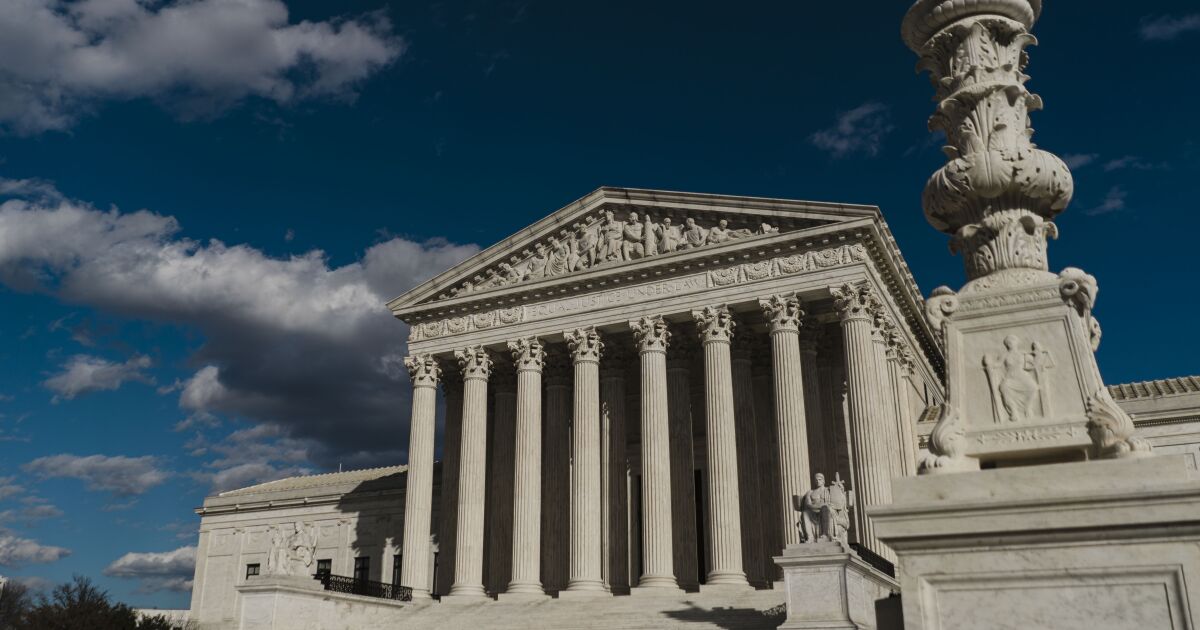

The Supreme Court on Thursday upheld the reach of the Voting Rights Act, ruling that Alabama’s Republican lawmakers are required to draw a new election district that would likely elect a Black Democrat to Congress.
By a 5-4 vote, the court rejected an appeal from Alabama’s Republican lawmakers and said they need to draw a second district to achieve greater equality and to give Black or Latino voters a better chance to elect a candidate of their choice.

The ruling in Allen vs. Milligan is a surprising win for civil rights lawyers. They had argued the voting power of Black people would be “diluted” and made meaningless if nearly all the districts can be carefully drawn to preserve white majorities.

Chief Justice John G. Roberts Jr. joined by the court’s three liberals and by Justice Brett M. Kavanaugh said the Voting Rights Act called for creating a new district that might elect a Black candidate.

Since the 1980s, the court has held that, whenever possible, states must draw an election map that includes one or more compact districts that give Black and Latino candidates a chance of winning, Roberts wrote. Alabama could have drawn a second compact, majority-minority district, but did not, he added, echoing last year’s ruling by a three-judge panel.
The ruling could change congressional maps across the South. In addition to Alabama, new district lines could be drawn in Louisiana, South Carolina and Georgia and lead to the “creation of 2-4 new Black-majority districts, netting [Democrats] 2-4 seats,” David Wasserman, the House expert at the nonpartisan Cook Political Report, wrote on Twitter. Given how closely divided the House currently is, those changes could be enough to determine control of the chamber.
The decision also applies to election districts for state legislatures, county boards and city councils.
Voting rights advocates hailed the ruling as a major victory, not because it expanded the law but because a conservative high court voted to preserve it.
Alabama Republicans had argued it was unconstitutional to consider race in drawing the district lines.
The National Redistricting Foundation, an affiliate of the National Democratic Redistricting Committee, called the decision a “massive win for voting and for voters across the country. Black voters in Alabama have long been denied fair representation — and today’s Supreme Court decision in favor of voters marks a landmark moment to move the needle in the right direction,” said Marina Jenkins, the group’s executive director.
In 1982, Congress amended the Voting Rights Act to forbid drawing election districts “in a manner which results in a denial or abridgement of the right … to vote on account of race or color.”
Six of Alabama’s seven congressional districts reliably elect a Republican, although about 27% of the state’s population is Black.
Last year, a three-judge panel ruled the state must redraw its map to create a second compact district with a near Black majority. The judges, including two appointed by President Trump, said the Voting Rights Act required giving Black voters a meaningful opportunity to elect a representative of their choice.
But in a preliminary win for the GOP, the Supreme Court last year blocked that decision from taking effect.
Congress amended the Voting Rights Act in 1982 to require states make an extra effort to ensure that Blacks and Latinos had a fair opportunity “to elect representatives of their choice.” That provision was strongly opposed by Roberts, who was then a young Justice Department lawyer in the Reagan administration.
In response to the amended law, judges agreed states had to consider the race of the voters when drawing new districts.
Doing so often led to partisan conflicts. Republicans said they opposed using race as a factor for drawing election districts, and they said it was not required by the 1982 law or the Constitution. Republican-controlled states also resisted the demand to draw more districts that would elect Black Democrats instead of white Republicans.

