

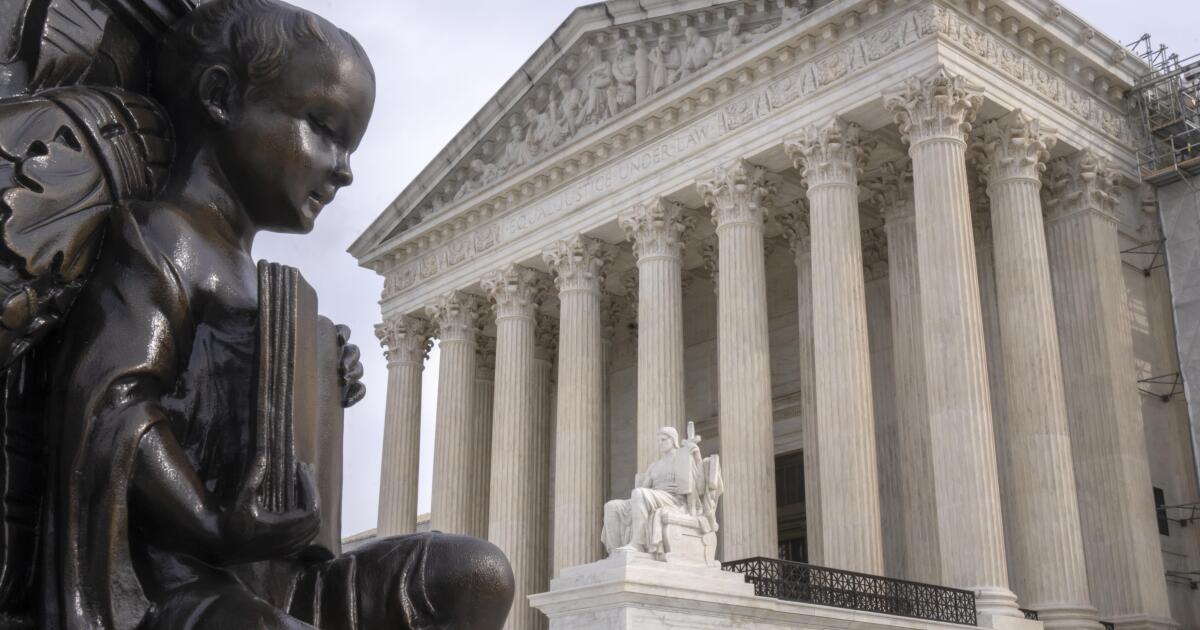

The Supreme Court on Thursday upheld a California woman’s drug smuggling conviction that was based in part on an expert’s testimony that criminal gangs rarely use “blind mules” to move drugs across the southern border.
In a 6-3 decision, the justices rejected Delilah Diaz’s contention that the expert testimony was unfair and illegal because it strongly suggested to jurors that she must have known drugs were hidden in her car.
Federal rules of evidence say an expert cannot state an opinion on a defendant’s “mental state or condition,” but the justices said the expert’s testimony about drug smuggling operations in general did not violate that rule.
Justice Ketanji Brown Jackson joined most of the court’s conservatives in the decision in Diaz vs. United States. A former trial judge, she said experts often testify on both sides of the case.
“This very case illustrates the significance of mental-state evidence to both parties in a criminal trial,” Jackson wrote in a concurring opinion. “The government expert opined (based on his almost 30 years of experience as a special agent) that, ‘in most circumstances,’ drug couriers know that they are transporting drugs….Notably, however, the government was not the only party that relied on this type of mental-state evidence during the trial. Diaz called an automobile specialist who testified that a driver of her particular car would almost certainly not know that it contained drugs.”
In August 2020, Diaz, a U.S. citizen, was stopped at a border crossing when she was returning from Mexico. When the Border Patrol agent asked her to roll down one of the car’s windows, she said it was manual. When he tried, he heard a “crunch-like sound in the door.”
When the car was pulled aside and checked, officers discovered 56 packages of methamphetamine tucked inside the door panels and under the carpet in the trunk. The methamphetamine weighed just over 54 pounds and had an estimated retail value of $368,550.
Diaz said the car was her boyfriend’s and she knew nothing about the drugs.
She was charged with drug trafficking, and prosecutors were required to prove to the jury that she knew she was transporting drugs.
They called Andrew Flood, a Department of Homeland Security special agent, who testified that in his experience, drug traffickers “generally do not entrust large quantities of drugs to people who are unaware they are transporting them.”
Diaz was convicted and given a seven-year prison term. A federal judge in San Diego and the 9th Circuit Court of Appeals rejected her claim that the agent’s testimony violated the federal rules.
The Supreme Court in Diaz vs. U.S. affirmed the conviction Thursday.
“Because Agent Flood did not express an opinion about whether Diaz herself knowingly transported methamphetamine, his testimony did not violate” the federal rules, said Justice Clarence Thomas for the court. “An expert’s conclusion that ‘most people’ in a group have a particular mental state is not an opinion about the defendant.”
Chief Justice John G. Roberts Jr. and Justices Samuel A. Alito Jr., Brett M. Kavanaugh, Amy Coney Barrett and Jackson agreed.
In dissent, Justice Neil M. Gorsuch said “the government comes away with a powerful new tool in its pocket. Prosecutors can now put an expert on the stand — someone who apparently has the convenient ability to read minds — and let him hold forth on what ‘most’ people like the defendant think when they commit a legally proscribed act …. What authority exists for allowing that kind of charade in federal criminal trials is anybody’s guess, but certainly it cannot be found” in the federal rules of evidence.
Justices Sonia Sotomayor and Elena Kagan agreed.

The Supreme Court on Thursday upheld a California woman’s drug smuggling conviction that was based in part on an expert’s testimony that criminal gangs rarely use “blind mules” to move drugs across the southern border.
In a 6-3 decision, the justices rejected Delilah Diaz’s contention that the expert testimony was unfair and illegal because it strongly suggested to jurors that she must have known drugs were hidden in her car.
Federal rules of evidence say an expert cannot state an opinion on a defendant’s “mental state or condition,” but the justices said the expert’s testimony about drug smuggling operations in general did not violate that rule.
Justice Ketanji Brown Jackson joined most of the court’s conservatives in the decision in Diaz vs. United States. A former trial judge, she said experts often testify on both sides of the case.
“This very case illustrates the significance of mental-state evidence to both parties in a criminal trial,” Jackson wrote in a concurring opinion. “The government expert opined (based on his almost 30 years of experience as a special agent) that, ‘in most circumstances,’ drug couriers know that they are transporting drugs….Notably, however, the government was not the only party that relied on this type of mental-state evidence during the trial. Diaz called an automobile specialist who testified that a driver of her particular car would almost certainly not know that it contained drugs.”
In August 2020, Diaz, a U.S. citizen, was stopped at a border crossing when she was returning from Mexico. When the Border Patrol agent asked her to roll down one of the car’s windows, she said it was manual. When he tried, he heard a “crunch-like sound in the door.”
When the car was pulled aside and checked, officers discovered 56 packages of methamphetamine tucked inside the door panels and under the carpet in the trunk. The methamphetamine weighed just over 54 pounds and had an estimated retail value of $368,550.
Diaz said the car was her boyfriend’s and she knew nothing about the drugs.
She was charged with drug trafficking, and prosecutors were required to prove to the jury that she knew she was transporting drugs.
They called Andrew Flood, a Department of Homeland Security special agent, who testified that in his experience, drug traffickers “generally do not entrust large quantities of drugs to people who are unaware they are transporting them.”
Diaz was convicted and given a seven-year prison term. A federal judge in San Diego and the 9th Circuit Court of Appeals rejected her claim that the agent’s testimony violated the federal rules.
The Supreme Court in Diaz vs. U.S. affirmed the conviction Thursday.
“Because Agent Flood did not express an opinion about whether Diaz herself knowingly transported methamphetamine, his testimony did not violate” the federal rules, said Justice Clarence Thomas for the court. “An expert’s conclusion that ‘most people’ in a group have a particular mental state is not an opinion about the defendant.”
Chief Justice John G. Roberts Jr. and Justices Samuel A. Alito Jr., Brett M. Kavanaugh, Amy Coney Barrett and Jackson agreed.
In dissent, Justice Neil M. Gorsuch said “the government comes away with a powerful new tool in its pocket. Prosecutors can now put an expert on the stand — someone who apparently has the convenient ability to read minds — and let him hold forth on what ‘most’ people like the defendant think when they commit a legally proscribed act …. What authority exists for allowing that kind of charade in federal criminal trials is anybody’s guess, but certainly it cannot be found” in the federal rules of evidence.
Justices Sonia Sotomayor and Elena Kagan agreed.

The Supreme Court on Thursday upheld a California woman’s drug smuggling conviction that was based in part on an expert’s testimony that criminal gangs rarely use “blind mules” to move drugs across the southern border.
In a 6-3 decision, the justices rejected Delilah Diaz’s contention that the expert testimony was unfair and illegal because it strongly suggested to jurors that she must have known drugs were hidden in her car.
Federal rules of evidence say an expert cannot state an opinion on a defendant’s “mental state or condition,” but the justices said the expert’s testimony about drug smuggling operations in general did not violate that rule.
Justice Ketanji Brown Jackson joined most of the court’s conservatives in the decision in Diaz vs. United States. A former trial judge, she said experts often testify on both sides of the case.
“This very case illustrates the significance of mental-state evidence to both parties in a criminal trial,” Jackson wrote in a concurring opinion. “The government expert opined (based on his almost 30 years of experience as a special agent) that, ‘in most circumstances,’ drug couriers know that they are transporting drugs….Notably, however, the government was not the only party that relied on this type of mental-state evidence during the trial. Diaz called an automobile specialist who testified that a driver of her particular car would almost certainly not know that it contained drugs.”
In August 2020, Diaz, a U.S. citizen, was stopped at a border crossing when she was returning from Mexico. When the Border Patrol agent asked her to roll down one of the car’s windows, she said it was manual. When he tried, he heard a “crunch-like sound in the door.”
When the car was pulled aside and checked, officers discovered 56 packages of methamphetamine tucked inside the door panels and under the carpet in the trunk. The methamphetamine weighed just over 54 pounds and had an estimated retail value of $368,550.
Diaz said the car was her boyfriend’s and she knew nothing about the drugs.
She was charged with drug trafficking, and prosecutors were required to prove to the jury that she knew she was transporting drugs.
They called Andrew Flood, a Department of Homeland Security special agent, who testified that in his experience, drug traffickers “generally do not entrust large quantities of drugs to people who are unaware they are transporting them.”
Diaz was convicted and given a seven-year prison term. A federal judge in San Diego and the 9th Circuit Court of Appeals rejected her claim that the agent’s testimony violated the federal rules.
The Supreme Court in Diaz vs. U.S. affirmed the conviction Thursday.
“Because Agent Flood did not express an opinion about whether Diaz herself knowingly transported methamphetamine, his testimony did not violate” the federal rules, said Justice Clarence Thomas for the court. “An expert’s conclusion that ‘most people’ in a group have a particular mental state is not an opinion about the defendant.”
Chief Justice John G. Roberts Jr. and Justices Samuel A. Alito Jr., Brett M. Kavanaugh, Amy Coney Barrett and Jackson agreed.
In dissent, Justice Neil M. Gorsuch said “the government comes away with a powerful new tool in its pocket. Prosecutors can now put an expert on the stand — someone who apparently has the convenient ability to read minds — and let him hold forth on what ‘most’ people like the defendant think when they commit a legally proscribed act …. What authority exists for allowing that kind of charade in federal criminal trials is anybody’s guess, but certainly it cannot be found” in the federal rules of evidence.
Justices Sonia Sotomayor and Elena Kagan agreed.

The Supreme Court on Thursday upheld a California woman’s drug smuggling conviction that was based in part on an expert’s testimony that criminal gangs rarely use “blind mules” to move drugs across the southern border.
In a 6-3 decision, the justices rejected Delilah Diaz’s contention that the expert testimony was unfair and illegal because it strongly suggested to jurors that she must have known drugs were hidden in her car.
Federal rules of evidence say an expert cannot state an opinion on a defendant’s “mental state or condition,” but the justices said the expert’s testimony about drug smuggling operations in general did not violate that rule.
Justice Ketanji Brown Jackson joined most of the court’s conservatives in the decision in Diaz vs. United States. A former trial judge, she said experts often testify on both sides of the case.
“This very case illustrates the significance of mental-state evidence to both parties in a criminal trial,” Jackson wrote in a concurring opinion. “The government expert opined (based on his almost 30 years of experience as a special agent) that, ‘in most circumstances,’ drug couriers know that they are transporting drugs….Notably, however, the government was not the only party that relied on this type of mental-state evidence during the trial. Diaz called an automobile specialist who testified that a driver of her particular car would almost certainly not know that it contained drugs.”
In August 2020, Diaz, a U.S. citizen, was stopped at a border crossing when she was returning from Mexico. When the Border Patrol agent asked her to roll down one of the car’s windows, she said it was manual. When he tried, he heard a “crunch-like sound in the door.”
When the car was pulled aside and checked, officers discovered 56 packages of methamphetamine tucked inside the door panels and under the carpet in the trunk. The methamphetamine weighed just over 54 pounds and had an estimated retail value of $368,550.
Diaz said the car was her boyfriend’s and she knew nothing about the drugs.
She was charged with drug trafficking, and prosecutors were required to prove to the jury that she knew she was transporting drugs.
They called Andrew Flood, a Department of Homeland Security special agent, who testified that in his experience, drug traffickers “generally do not entrust large quantities of drugs to people who are unaware they are transporting them.”
Diaz was convicted and given a seven-year prison term. A federal judge in San Diego and the 9th Circuit Court of Appeals rejected her claim that the agent’s testimony violated the federal rules.
The Supreme Court in Diaz vs. U.S. affirmed the conviction Thursday.
“Because Agent Flood did not express an opinion about whether Diaz herself knowingly transported methamphetamine, his testimony did not violate” the federal rules, said Justice Clarence Thomas for the court. “An expert’s conclusion that ‘most people’ in a group have a particular mental state is not an opinion about the defendant.”
Chief Justice John G. Roberts Jr. and Justices Samuel A. Alito Jr., Brett M. Kavanaugh, Amy Coney Barrett and Jackson agreed.
In dissent, Justice Neil M. Gorsuch said “the government comes away with a powerful new tool in its pocket. Prosecutors can now put an expert on the stand — someone who apparently has the convenient ability to read minds — and let him hold forth on what ‘most’ people like the defendant think when they commit a legally proscribed act …. What authority exists for allowing that kind of charade in federal criminal trials is anybody’s guess, but certainly it cannot be found” in the federal rules of evidence.
Justices Sonia Sotomayor and Elena Kagan agreed.

