

- Sudanese military welcomed defecting RSF commanders, offering amnesty.
- UAE is accused of heavily arming RSF, sustaining conflict.
- Report details Colombian mercenaries recruited to fight for RSF.
- Sudan faces immense displacement, hunger, and war crimes concerns.
When Sudan’s military leader Abdel Fattah al-Burhan welcomed Al-Nour Ahmed Adam — also known as Al-Nour Al-Qubba and a former senior commander of the Rapid Support Forces (RSF) militia — into the ranks of the Sudanese Armed Forces (SAF) earlier this year, it was one of the most high-profile defections in the Sudanese civil war to date.
While the SAF controls the capital Khartoum, Port Sudan and large parts of the east and center of the country, its rival RSF holds vast areas in the west of the country, particularly in Darfur, including the city of El Fasher.
Al-Nour Al-Qubba is not the only defector: He was followed a few weeks later by high-ranking RSF commander, Ali Rizq Allah, also known as Al-Savannah.

Human Rights Watch (HRW) has reviewed videos purportedly showing these two defectors during the siege of El Fasher, where the international NGO has documented war crimes committed by the RSF, led by General Mohamed Hamdan Daglo, commonly known as Hemedti, during the city’s capture in October 2025.
General amnesty for RSF fighters?
Since the war began in 2023, Abdel Fattah al-Burhan has been trying to recruit defectors from the RSF into the SAF. Almost from the beginning, he declared a general amnesty for members of the militia if they laid down their arms, saying they could be integrated into the military. Human Rights Watch says it was unable to verify whether this also applied to the most recent defectors.
For Mohamed Osman, a Sudan researcher at Human Rights Watch, there must not be impunity. “Those responsible for serious international crimes and human rights violations do not get a free pass if they switch sides,” he said, adding that “Sudanese people who have experienced horrific abuses under any commander’s watch deserve justice.”
According to conflict monitors at Armed Conflict Location & Event Data Project (ACLED), the recent defections could be a sign of increasing tension within the RSF ranks and of “cracks in the RSF’s core alliances.” They assume that “local loyalties are superseding central command, sparking violent intra-coalition competition over remaining war spoils.”
‘The war would be over if not for the UAE’
The defections come at a time when both the SAF and the RSF have external support. Though the front is in Sudan, the alliances that are keeping the war going extend far beyond the country’s borders. The RSF’s supporters are believed to include the United Arab Emirates (UAE), Ethiopia, Libya, Chad and Kenya. The SAF, which has also been accused of war crimes, is supported by Egypt, Saudi Arabia, Turkey and Eritrea. Iran is also suspected of having provided military aid to the SAF.
Last year, US intelligence sources told the US daily The Wall Street Journal that the UAE was believed to have supplied the RSF with “advanced Chinese-made drones along with small arms, heavy machine guns, vehicles, artillery, mortars and ammunition.” The report cited Cameron Hudson, a former chief of staff to several special envoys for Sudan, as saying that the “only thing that is keeping them [the RSF] in this war is the overwhelming amount of military support that they’re receiving from the UAE.”
“The war would be over if not for the UAE,” he insisted.
In 2025, the human rights organization Amnesty International also found evidence suggesting that the UAE had “almost certainly” re-exported Chinese-made weapons to the RSF.
The UAE rejects the accusations. Salem Aljaberi, the UAE’s assistant minister for security and military affairs, said that Amnesty International’s allegations were “baseless” and lacked “substantiated evidence.”
Mercenaries from Colombia alongside RSF
In late May, Human Rights Watch published a report entitled “From Bogota to El Fasher: The UAE’s Role in the Deployment of Colombian Fighters and Other Backing to the Rapid Support Forces in Sudan.” The 83-page document details how hundreds of Colombian mercenaries have been recruited to fight alongside the RSF in Sudan since 2024. It claims that a Colombia-based recruitment agency worked with the “Abu Dhabi-based Global Security Services Group (GSSG), which appears to have hired the contractors who were deployed to Sudan.”
“Thankfully for us, Colombian contractors are not very hygienic with their social media presence so we were able to get a lot of information from their own Tik Tok accounts and other social media that they posted publicly and geolocate them in these sensitive UAE military sites before they were then deployed to Sudan,” Human Rights Watch’s Joey Shea told the US news organization Democracy Now.
HRW spoke to two Colombian military contractors who had been deployed to Sudan, three retired Colombian officers, a former GSSG employee, residents of El Fasher and other sources before compiling their report. It also analyzed company records, official documents and photos and videos. It said that some images showed Spanish-speaking private military contractors (PMCs), presumed to be Colombian, alongside RSF fighters in Sudan. Others documented training sessions at military facilities in the United Arab Emirates.
“Our investigation documented how this Abu Dhabi-based security company Global Security Services Group has apparently hired hundreds of these Colombian fighters before they were deployed to fight alongside arm-and-arm with the Rapid Support Forces, an armed group accused of war crimes and crimes against humanity in Sudan,” Shea said.
Experts believe that former Colombian soldiers were recruited to fight in Sudan because they had extensive combat experience and had often been trained using US weapons systems. Human Rights Watch said in its report that according to media outlets, “the UAE authorities recruited Colombian security and military personnel as far back as 2011.” It said that in Sudan, “the UAE appears to be using the same playbook”
“The New York Times, UN experts, human rights organizations like ours have repeatedly reported on UAE military support to the RSF,” said Shea. “Yet the international community has remained silent. To this day not a single EU member state, the EU, the US, the UK has publicly called out the UAE’s role in helping to fund support and militarily support the rapid support forces.”
In April, the security analysis organization Conflict Insights Group published a report based on data obtained by tracking the cell phones of the Colombian fighters to argue that the UAE enabled the fall of El Fasher. The investigation led to a military training facility in Ghayathi, UAE, where Colombian mercenaries operated as part of the “Desert Wolves” brigade led by retired Colombian Army Colonel Alvaro Quijano. The US and the UK have placed sanctions on him for fueling Sudan’s war.

Here too, the UAE denies the allegations. “We are calling for an immediate ceasefire,” Anwar Mohammad Gargash, an advisor to the president of the UAE, told the news agency Reuters in late 2025. “And most importantly we don’t see the future of Sudan in a military junta. We see the future in Sudan in a civilian transition.”
‘Hallmarks of genocide’
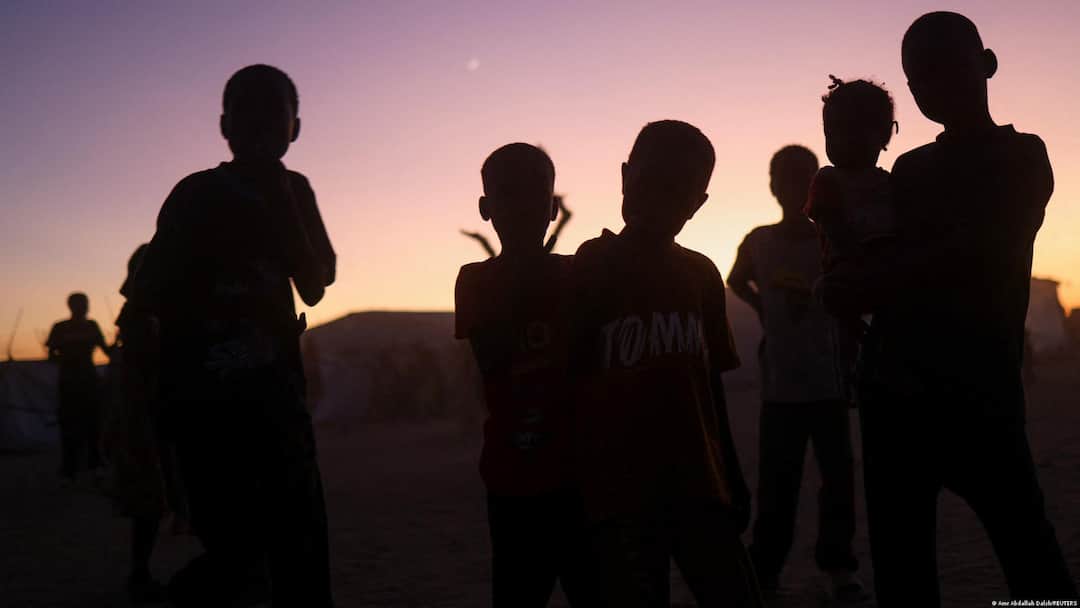
The defections from the RSF, the recurring allegations against the UAE and the investigations into Colombian fighters show just how far this war has spread beyond Sudan. But for the civilians being killed, wounded and displaced, this makes very little difference. Human rights organizations have documented mass killings and other crimes against civilians. A UN fact-finding mission has concluded that the siege of El Fasher bore the “hallmarks of genocide.”
The RSF is thought to have killed around 70,000 people in El Fasher alone.
Aid organizations say that Sudan is currently the site of the world’s largest and fastest-growing displacement and humanitarian crisis, with the World Food Program saying Sudan faces one of the world’s largest hunger crises.
Around 12 million have been forced from their homes and almost 20 million face acute hunger.


(Disclaimer: This report first appeared on Deutsche Welle, and has been republished on ABP Live as part of a special arrangement. Apart from the headline, no changes have been made in the report by ABP Live.)
World Focus: Iran Signals Peace Deal Progress as US Military Build-Up Keeps Pressure Intact

