

SpaceX’s Starship Mars rocket and spacecraft launched for the second time early Saturday morning, making it through lift-off and a planned separation of the uncrewed ship and rocket booster before both ended up exploding.
The massive Starship rocket launched around 5:03 a.m. Pacific from SpaceX’s launch facility near Boca Chica, Texas. On a livestream of the launch, SpaceX employees tempered viewers’ expectations, warning that the company didn’t expect to recover any hardware for future re-flight from either rocket booster or launch, even in the best case scenario.
The stated goal, employees said, was to make it to separation of the rocket booster and the Starship craft.
The Hawthorne company has added a new, hot-stage separation system into the rocket, in which the rocket booster keeps a few engines burning while the spaceship ignites all of its engines to get more boost. Though it puts more pressure on the booster, the complicated procedure is intended to increase the carrying capacity for the ship.
About three minutes after lift-off, the booster and ship did successfully separate, but the booster broke apart shortly after. The Starship craft continued to ascend, but about nine minutes after lift-off, the company said it lost data from the craft.
The company said it believes the automated flight termination system on the ship was triggered “very late in the burn” as it headed over the Gulf of Mexico, said John Insprucker, a longtime SpaceX employee who frequently appears on the company’s livestream to give technical updates and explanations. The automated flight termination system is a safety mechanism embedded in the rocket’s software that destroys the vehicle if it senses that its course or performance is awry or unsafe.
Though the flight did not reach completion, company employees on the livestream called it “an incredibly successful day” that would yield data for future improvements.
It did mark progress compared with the last test seven months ago, which ended in an explosion a few minutes after lift-off, raining debris over the nearby area and destroying its launch pad.
That explosion, too, was triggered by the rocket’s autonomous flight termination system.
SpaceX said at the time that Starship started going off course during that flight due to a propellant leak in the rocket’s booster, which affected the main flight computer and resulted in a loss of communications. That led to the majority of the booster’s engines going out.
After that test flight, the Federal Aviation Administration ordered SpaceX to make fixes to the rocket, including redesigning its hardware to prevent leaks and fires. On Wednesday, the FAA said it authorized Starship’s second test flight. The company said it has put into place “leak mitigations” and improved its engine and rocket booster testing.
SpaceX also said it made “significant reinforcements” of the launch pad’s foundation and added a flame deflector intended to prevent future launch pad damage.
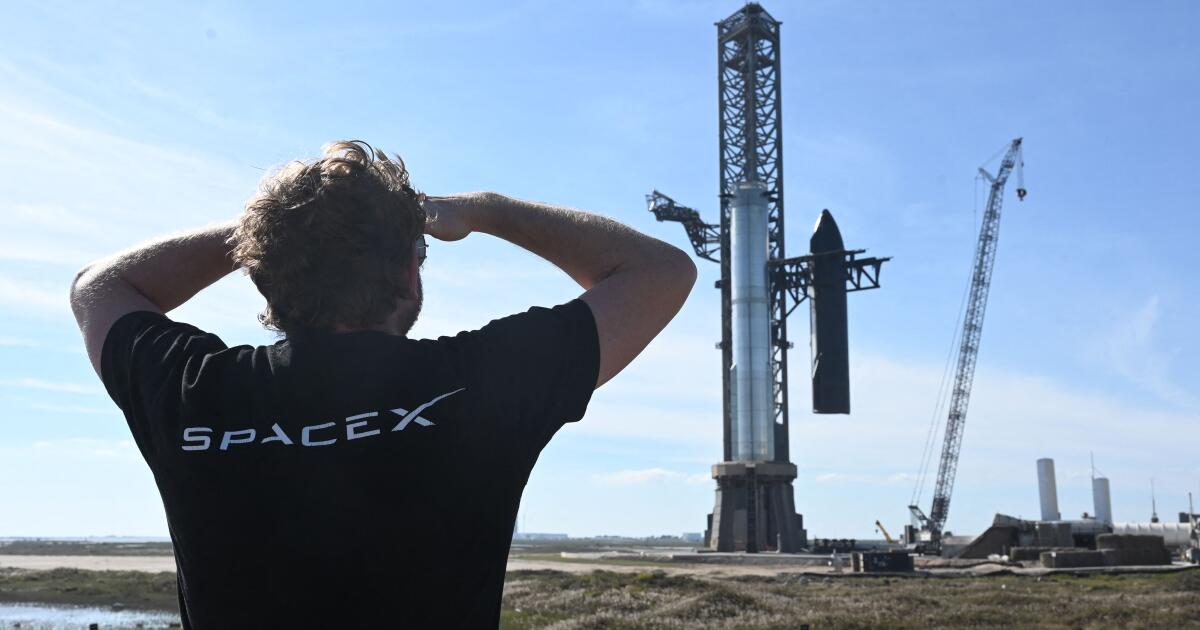
SpaceX Starship is poised for its launch attempt.
(Scott Schilke / Associated Press)
Starship is key to SpaceX’s future business plans and the U.S.’s return to the moon. SpaceX is under contract with NASA to develop the Starship spacecraft into a lunar lander for NASA’s Artemis program.
The company also plans to eventually phase out its workhorse Falcon 9 rocket in favor of the much larger Starship, which it also envisions for use in missions to Mars.
SpaceX also intends to expand its Starlink broadband internet network through Starship launches, which will be able to carry many more satellites than the Falcon 9 or Falcon Heavy rockets.

SpaceX’s Starship Mars rocket and spacecraft launched for the second time early Saturday morning, making it through lift-off and a planned separation of the uncrewed ship and rocket booster before both ended up exploding.
The massive Starship rocket launched around 5:03 a.m. Pacific from SpaceX’s launch facility near Boca Chica, Texas. On a livestream of the launch, SpaceX employees tempered viewers’ expectations, warning that the company didn’t expect to recover any hardware for future re-flight from either rocket booster or launch, even in the best case scenario.
The stated goal, employees said, was to make it to separation of the rocket booster and the Starship craft.
The Hawthorne company has added a new, hot-stage separation system into the rocket, in which the rocket booster keeps a few engines burning while the spaceship ignites all of its engines to get more boost. Though it puts more pressure on the booster, the complicated procedure is intended to increase the carrying capacity for the ship.
About three minutes after lift-off, the booster and ship did successfully separate, but the booster broke apart shortly after. The Starship craft continued to ascend, but about nine minutes after lift-off, the company said it lost data from the craft.
The company said it believes the automated flight termination system on the ship was triggered “very late in the burn” as it headed over the Gulf of Mexico, said John Insprucker, a longtime SpaceX employee who frequently appears on the company’s livestream to give technical updates and explanations. The automated flight termination system is a safety mechanism embedded in the rocket’s software that destroys the vehicle if it senses that its course or performance is awry or unsafe.
Though the flight did not reach completion, company employees on the livestream called it “an incredibly successful day” that would yield data for future improvements.
It did mark progress compared with the last test seven months ago, which ended in an explosion a few minutes after lift-off, raining debris over the nearby area and destroying its launch pad.
That explosion, too, was triggered by the rocket’s autonomous flight termination system.
SpaceX said at the time that Starship started going off course during that flight due to a propellant leak in the rocket’s booster, which affected the main flight computer and resulted in a loss of communications. That led to the majority of the booster’s engines going out.
After that test flight, the Federal Aviation Administration ordered SpaceX to make fixes to the rocket, including redesigning its hardware to prevent leaks and fires. On Wednesday, the FAA said it authorized Starship’s second test flight. The company said it has put into place “leak mitigations” and improved its engine and rocket booster testing.
SpaceX also said it made “significant reinforcements” of the launch pad’s foundation and added a flame deflector intended to prevent future launch pad damage.
SpaceX Starship is poised for its launch attempt.
(Scott Schilke / Associated Press)
Starship is key to SpaceX’s future business plans and the U.S.’s return to the moon. SpaceX is under contract with NASA to develop the Starship spacecraft into a lunar lander for NASA’s Artemis program.
The company also plans to eventually phase out its workhorse Falcon 9 rocket in favor of the much larger Starship, which it also envisions for use in missions to Mars.
SpaceX also intends to expand its Starlink broadband internet network through Starship launches, which will be able to carry many more satellites than the Falcon 9 or Falcon Heavy rockets.

SpaceX’s Starship Mars rocket and spacecraft launched for the second time early Saturday morning, making it through lift-off and a planned separation of the uncrewed ship and rocket booster before both ended up exploding.
The massive Starship rocket launched around 5:03 a.m. Pacific from SpaceX’s launch facility near Boca Chica, Texas. On a livestream of the launch, SpaceX employees tempered viewers’ expectations, warning that the company didn’t expect to recover any hardware for future re-flight from either rocket booster or launch, even in the best case scenario.
The stated goal, employees said, was to make it to separation of the rocket booster and the Starship craft.
The Hawthorne company has added a new, hot-stage separation system into the rocket, in which the rocket booster keeps a few engines burning while the spaceship ignites all of its engines to get more boost. Though it puts more pressure on the booster, the complicated procedure is intended to increase the carrying capacity for the ship.
About three minutes after lift-off, the booster and ship did successfully separate, but the booster broke apart shortly after. The Starship craft continued to ascend, but about nine minutes after lift-off, the company said it lost data from the craft.
The company said it believes the automated flight termination system on the ship was triggered “very late in the burn” as it headed over the Gulf of Mexico, said John Insprucker, a longtime SpaceX employee who frequently appears on the company’s livestream to give technical updates and explanations. The automated flight termination system is a safety mechanism embedded in the rocket’s software that destroys the vehicle if it senses that its course or performance is awry or unsafe.
Though the flight did not reach completion, company employees on the livestream called it “an incredibly successful day” that would yield data for future improvements.
It did mark progress compared with the last test seven months ago, which ended in an explosion a few minutes after lift-off, raining debris over the nearby area and destroying its launch pad.
That explosion, too, was triggered by the rocket’s autonomous flight termination system.
SpaceX said at the time that Starship started going off course during that flight due to a propellant leak in the rocket’s booster, which affected the main flight computer and resulted in a loss of communications. That led to the majority of the booster’s engines going out.
After that test flight, the Federal Aviation Administration ordered SpaceX to make fixes to the rocket, including redesigning its hardware to prevent leaks and fires. On Wednesday, the FAA said it authorized Starship’s second test flight. The company said it has put into place “leak mitigations” and improved its engine and rocket booster testing.
SpaceX also said it made “significant reinforcements” of the launch pad’s foundation and added a flame deflector intended to prevent future launch pad damage.
SpaceX Starship is poised for its launch attempt.
(Scott Schilke / Associated Press)
Starship is key to SpaceX’s future business plans and the U.S.’s return to the moon. SpaceX is under contract with NASA to develop the Starship spacecraft into a lunar lander for NASA’s Artemis program.
The company also plans to eventually phase out its workhorse Falcon 9 rocket in favor of the much larger Starship, which it also envisions for use in missions to Mars.
SpaceX also intends to expand its Starlink broadband internet network through Starship launches, which will be able to carry many more satellites than the Falcon 9 or Falcon Heavy rockets.
SpaceX’s Starship Mars rocket and spacecraft launched for the second time early Saturday morning, making it through lift-off and a planned separation of the uncrewed ship and rocket booster before both ended up exploding.
The massive Starship rocket launched around 5:03 a.m. Pacific from SpaceX’s launch facility near Boca Chica, Texas. On a livestream of the launch, SpaceX employees tempered viewers’ expectations, warning that the company didn’t expect to recover any hardware for future re-flight from either rocket booster or launch, even in the best case scenario.
The stated goal, employees said, was to make it to separation of the rocket booster and the Starship craft.
The Hawthorne company has added a new, hot-stage separation system into the rocket, in which the rocket booster keeps a few engines burning while the spaceship ignites all of its engines to get more boost. Though it puts more pressure on the booster, the complicated procedure is intended to increase the carrying capacity for the ship.
About three minutes after lift-off, the booster and ship did successfully separate, but the booster broke apart shortly after. The Starship craft continued to ascend, but about nine minutes after lift-off, the company said it lost data from the craft.
The company said it believes the automated flight termination system on the ship was triggered “very late in the burn” as it headed over the Gulf of Mexico, said John Insprucker, a longtime SpaceX employee who frequently appears on the company’s livestream to give technical updates and explanations. The automated flight termination system is a safety mechanism embedded in the rocket’s software that destroys the vehicle if it senses that its course or performance is awry or unsafe.
Though the flight did not reach completion, company employees on the livestream called it “an incredibly successful day” that would yield data for future improvements.
It did mark progress compared with the last test seven months ago, which ended in an explosion a few minutes after lift-off, raining debris over the nearby area and destroying its launch pad.
That explosion, too, was triggered by the rocket’s autonomous flight termination system.
SpaceX said at the time that Starship started going off course during that flight due to a propellant leak in the rocket’s booster, which affected the main flight computer and resulted in a loss of communications. That led to the majority of the booster’s engines going out.
After that test flight, the Federal Aviation Administration ordered SpaceX to make fixes to the rocket, including redesigning its hardware to prevent leaks and fires. On Wednesday, the FAA said it authorized Starship’s second test flight. The company said it has put into place “leak mitigations” and improved its engine and rocket booster testing.
SpaceX also said it made “significant reinforcements” of the launch pad’s foundation and added a flame deflector intended to prevent future launch pad damage.
SpaceX Starship is poised for its launch attempt.
(Scott Schilke / Associated Press)
Starship is key to SpaceX’s future business plans and the U.S.’s return to the moon. SpaceX is under contract with NASA to develop the Starship spacecraft into a lunar lander for NASA’s Artemis program.
The company also plans to eventually phase out its workhorse Falcon 9 rocket in favor of the much larger Starship, which it also envisions for use in missions to Mars.
SpaceX also intends to expand its Starlink broadband internet network through Starship launches, which will be able to carry many more satellites than the Falcon 9 or Falcon Heavy rockets.

SpaceX’s Starship Mars rocket and spacecraft launched for the second time early Saturday morning, making it through lift-off and a planned separation of the uncrewed ship and rocket booster before both ended up exploding.
The massive Starship rocket launched around 5:03 a.m. Pacific from SpaceX’s launch facility near Boca Chica, Texas. On a livestream of the launch, SpaceX employees tempered viewers’ expectations, warning that the company didn’t expect to recover any hardware for future re-flight from either rocket booster or launch, even in the best case scenario.
The stated goal, employees said, was to make it to separation of the rocket booster and the Starship craft.
The Hawthorne company has added a new, hot-stage separation system into the rocket, in which the rocket booster keeps a few engines burning while the spaceship ignites all of its engines to get more boost. Though it puts more pressure on the booster, the complicated procedure is intended to increase the carrying capacity for the ship.
About three minutes after lift-off, the booster and ship did successfully separate, but the booster broke apart shortly after. The Starship craft continued to ascend, but about nine minutes after lift-off, the company said it lost data from the craft.
The company said it believes the automated flight termination system on the ship was triggered “very late in the burn” as it headed over the Gulf of Mexico, said John Insprucker, a longtime SpaceX employee who frequently appears on the company’s livestream to give technical updates and explanations. The automated flight termination system is a safety mechanism embedded in the rocket’s software that destroys the vehicle if it senses that its course or performance is awry or unsafe.
Though the flight did not reach completion, company employees on the livestream called it “an incredibly successful day” that would yield data for future improvements.
It did mark progress compared with the last test seven months ago, which ended in an explosion a few minutes after lift-off, raining debris over the nearby area and destroying its launch pad.
That explosion, too, was triggered by the rocket’s autonomous flight termination system.
SpaceX said at the time that Starship started going off course during that flight due to a propellant leak in the rocket’s booster, which affected the main flight computer and resulted in a loss of communications. That led to the majority of the booster’s engines going out.
After that test flight, the Federal Aviation Administration ordered SpaceX to make fixes to the rocket, including redesigning its hardware to prevent leaks and fires. On Wednesday, the FAA said it authorized Starship’s second test flight. The company said it has put into place “leak mitigations” and improved its engine and rocket booster testing.
SpaceX also said it made “significant reinforcements” of the launch pad’s foundation and added a flame deflector intended to prevent future launch pad damage.
SpaceX Starship is poised for its launch attempt.
(Scott Schilke / Associated Press)
Starship is key to SpaceX’s future business plans and the U.S.’s return to the moon. SpaceX is under contract with NASA to develop the Starship spacecraft into a lunar lander for NASA’s Artemis program.
The company also plans to eventually phase out its workhorse Falcon 9 rocket in favor of the much larger Starship, which it also envisions for use in missions to Mars.
SpaceX also intends to expand its Starlink broadband internet network through Starship launches, which will be able to carry many more satellites than the Falcon 9 or Falcon Heavy rockets.
SpaceX’s Starship Mars rocket and spacecraft launched for the second time early Saturday morning, making it through lift-off and a planned separation of the uncrewed ship and rocket booster before both ended up exploding.
The massive Starship rocket launched around 5:03 a.m. Pacific from SpaceX’s launch facility near Boca Chica, Texas. On a livestream of the launch, SpaceX employees tempered viewers’ expectations, warning that the company didn’t expect to recover any hardware for future re-flight from either rocket booster or launch, even in the best case scenario.
The stated goal, employees said, was to make it to separation of the rocket booster and the Starship craft.
The Hawthorne company has added a new, hot-stage separation system into the rocket, in which the rocket booster keeps a few engines burning while the spaceship ignites all of its engines to get more boost. Though it puts more pressure on the booster, the complicated procedure is intended to increase the carrying capacity for the ship.
About three minutes after lift-off, the booster and ship did successfully separate, but the booster broke apart shortly after. The Starship craft continued to ascend, but about nine minutes after lift-off, the company said it lost data from the craft.
The company said it believes the automated flight termination system on the ship was triggered “very late in the burn” as it headed over the Gulf of Mexico, said John Insprucker, a longtime SpaceX employee who frequently appears on the company’s livestream to give technical updates and explanations. The automated flight termination system is a safety mechanism embedded in the rocket’s software that destroys the vehicle if it senses that its course or performance is awry or unsafe.
Though the flight did not reach completion, company employees on the livestream called it “an incredibly successful day” that would yield data for future improvements.
It did mark progress compared with the last test seven months ago, which ended in an explosion a few minutes after lift-off, raining debris over the nearby area and destroying its launch pad.
That explosion, too, was triggered by the rocket’s autonomous flight termination system.
SpaceX said at the time that Starship started going off course during that flight due to a propellant leak in the rocket’s booster, which affected the main flight computer and resulted in a loss of communications. That led to the majority of the booster’s engines going out.
After that test flight, the Federal Aviation Administration ordered SpaceX to make fixes to the rocket, including redesigning its hardware to prevent leaks and fires. On Wednesday, the FAA said it authorized Starship’s second test flight. The company said it has put into place “leak mitigations” and improved its engine and rocket booster testing.
SpaceX also said it made “significant reinforcements” of the launch pad’s foundation and added a flame deflector intended to prevent future launch pad damage.
SpaceX Starship is poised for its launch attempt.
(Scott Schilke / Associated Press)
Starship is key to SpaceX’s future business plans and the U.S.’s return to the moon. SpaceX is under contract with NASA to develop the Starship spacecraft into a lunar lander for NASA’s Artemis program.
The company also plans to eventually phase out its workhorse Falcon 9 rocket in favor of the much larger Starship, which it also envisions for use in missions to Mars.
SpaceX also intends to expand its Starlink broadband internet network through Starship launches, which will be able to carry many more satellites than the Falcon 9 or Falcon Heavy rockets.
SpaceX’s Starship Mars rocket and spacecraft launched for the second time early Saturday morning, making it through lift-off and a planned separation of the uncrewed ship and rocket booster before both ended up exploding.
The massive Starship rocket launched around 5:03 a.m. Pacific from SpaceX’s launch facility near Boca Chica, Texas. On a livestream of the launch, SpaceX employees tempered viewers’ expectations, warning that the company didn’t expect to recover any hardware for future re-flight from either rocket booster or launch, even in the best case scenario.
The stated goal, employees said, was to make it to separation of the rocket booster and the Starship craft.
The Hawthorne company has added a new, hot-stage separation system into the rocket, in which the rocket booster keeps a few engines burning while the spaceship ignites all of its engines to get more boost. Though it puts more pressure on the booster, the complicated procedure is intended to increase the carrying capacity for the ship.
About three minutes after lift-off, the booster and ship did successfully separate, but the booster broke apart shortly after. The Starship craft continued to ascend, but about nine minutes after lift-off, the company said it lost data from the craft.
The company said it believes the automated flight termination system on the ship was triggered “very late in the burn” as it headed over the Gulf of Mexico, said John Insprucker, a longtime SpaceX employee who frequently appears on the company’s livestream to give technical updates and explanations. The automated flight termination system is a safety mechanism embedded in the rocket’s software that destroys the vehicle if it senses that its course or performance is awry or unsafe.
Though the flight did not reach completion, company employees on the livestream called it “an incredibly successful day” that would yield data for future improvements.
It did mark progress compared with the last test seven months ago, which ended in an explosion a few minutes after lift-off, raining debris over the nearby area and destroying its launch pad.
That explosion, too, was triggered by the rocket’s autonomous flight termination system.
SpaceX said at the time that Starship started going off course during that flight due to a propellant leak in the rocket’s booster, which affected the main flight computer and resulted in a loss of communications. That led to the majority of the booster’s engines going out.
After that test flight, the Federal Aviation Administration ordered SpaceX to make fixes to the rocket, including redesigning its hardware to prevent leaks and fires. On Wednesday, the FAA said it authorized Starship’s second test flight. The company said it has put into place “leak mitigations” and improved its engine and rocket booster testing.
SpaceX also said it made “significant reinforcements” of the launch pad’s foundation and added a flame deflector intended to prevent future launch pad damage.
SpaceX Starship is poised for its launch attempt.
(Scott Schilke / Associated Press)
Starship is key to SpaceX’s future business plans and the U.S.’s return to the moon. SpaceX is under contract with NASA to develop the Starship spacecraft into a lunar lander for NASA’s Artemis program.
The company also plans to eventually phase out its workhorse Falcon 9 rocket in favor of the much larger Starship, which it also envisions for use in missions to Mars.
SpaceX also intends to expand its Starlink broadband internet network through Starship launches, which will be able to carry many more satellites than the Falcon 9 or Falcon Heavy rockets.
SpaceX’s Starship Mars rocket and spacecraft launched for the second time early Saturday morning, making it through lift-off and a planned separation of the uncrewed ship and rocket booster before both ended up exploding.
The massive Starship rocket launched around 5:03 a.m. Pacific from SpaceX’s launch facility near Boca Chica, Texas. On a livestream of the launch, SpaceX employees tempered viewers’ expectations, warning that the company didn’t expect to recover any hardware for future re-flight from either rocket booster or launch, even in the best case scenario.
The stated goal, employees said, was to make it to separation of the rocket booster and the Starship craft.
The Hawthorne company has added a new, hot-stage separation system into the rocket, in which the rocket booster keeps a few engines burning while the spaceship ignites all of its engines to get more boost. Though it puts more pressure on the booster, the complicated procedure is intended to increase the carrying capacity for the ship.
About three minutes after lift-off, the booster and ship did successfully separate, but the booster broke apart shortly after. The Starship craft continued to ascend, but about nine minutes after lift-off, the company said it lost data from the craft.
The company said it believes the automated flight termination system on the ship was triggered “very late in the burn” as it headed over the Gulf of Mexico, said John Insprucker, a longtime SpaceX employee who frequently appears on the company’s livestream to give technical updates and explanations. The automated flight termination system is a safety mechanism embedded in the rocket’s software that destroys the vehicle if it senses that its course or performance is awry or unsafe.
Though the flight did not reach completion, company employees on the livestream called it “an incredibly successful day” that would yield data for future improvements.
It did mark progress compared with the last test seven months ago, which ended in an explosion a few minutes after lift-off, raining debris over the nearby area and destroying its launch pad.
That explosion, too, was triggered by the rocket’s autonomous flight termination system.
SpaceX said at the time that Starship started going off course during that flight due to a propellant leak in the rocket’s booster, which affected the main flight computer and resulted in a loss of communications. That led to the majority of the booster’s engines going out.
After that test flight, the Federal Aviation Administration ordered SpaceX to make fixes to the rocket, including redesigning its hardware to prevent leaks and fires. On Wednesday, the FAA said it authorized Starship’s second test flight. The company said it has put into place “leak mitigations” and improved its engine and rocket booster testing.
SpaceX also said it made “significant reinforcements” of the launch pad’s foundation and added a flame deflector intended to prevent future launch pad damage.
SpaceX Starship is poised for its launch attempt.
(Scott Schilke / Associated Press)
Starship is key to SpaceX’s future business plans and the U.S.’s return to the moon. SpaceX is under contract with NASA to develop the Starship spacecraft into a lunar lander for NASA’s Artemis program.
The company also plans to eventually phase out its workhorse Falcon 9 rocket in favor of the much larger Starship, which it also envisions for use in missions to Mars.
SpaceX also intends to expand its Starlink broadband internet network through Starship launches, which will be able to carry many more satellites than the Falcon 9 or Falcon Heavy rockets.

SpaceX’s Starship Mars rocket and spacecraft launched for the second time early Saturday morning, making it through lift-off and a planned separation of the uncrewed ship and rocket booster before both ended up exploding.
The massive Starship rocket launched around 5:03 a.m. Pacific from SpaceX’s launch facility near Boca Chica, Texas. On a livestream of the launch, SpaceX employees tempered viewers’ expectations, warning that the company didn’t expect to recover any hardware for future re-flight from either rocket booster or launch, even in the best case scenario.
The stated goal, employees said, was to make it to separation of the rocket booster and the Starship craft.
The Hawthorne company has added a new, hot-stage separation system into the rocket, in which the rocket booster keeps a few engines burning while the spaceship ignites all of its engines to get more boost. Though it puts more pressure on the booster, the complicated procedure is intended to increase the carrying capacity for the ship.
About three minutes after lift-off, the booster and ship did successfully separate, but the booster broke apart shortly after. The Starship craft continued to ascend, but about nine minutes after lift-off, the company said it lost data from the craft.
The company said it believes the automated flight termination system on the ship was triggered “very late in the burn” as it headed over the Gulf of Mexico, said John Insprucker, a longtime SpaceX employee who frequently appears on the company’s livestream to give technical updates and explanations. The automated flight termination system is a safety mechanism embedded in the rocket’s software that destroys the vehicle if it senses that its course or performance is awry or unsafe.
Though the flight did not reach completion, company employees on the livestream called it “an incredibly successful day” that would yield data for future improvements.
It did mark progress compared with the last test seven months ago, which ended in an explosion a few minutes after lift-off, raining debris over the nearby area and destroying its launch pad.
That explosion, too, was triggered by the rocket’s autonomous flight termination system.
SpaceX said at the time that Starship started going off course during that flight due to a propellant leak in the rocket’s booster, which affected the main flight computer and resulted in a loss of communications. That led to the majority of the booster’s engines going out.
After that test flight, the Federal Aviation Administration ordered SpaceX to make fixes to the rocket, including redesigning its hardware to prevent leaks and fires. On Wednesday, the FAA said it authorized Starship’s second test flight. The company said it has put into place “leak mitigations” and improved its engine and rocket booster testing.
SpaceX also said it made “significant reinforcements” of the launch pad’s foundation and added a flame deflector intended to prevent future launch pad damage.
SpaceX Starship is poised for its launch attempt.
(Scott Schilke / Associated Press)
Starship is key to SpaceX’s future business plans and the U.S.’s return to the moon. SpaceX is under contract with NASA to develop the Starship spacecraft into a lunar lander for NASA’s Artemis program.
The company also plans to eventually phase out its workhorse Falcon 9 rocket in favor of the much larger Starship, which it also envisions for use in missions to Mars.
SpaceX also intends to expand its Starlink broadband internet network through Starship launches, which will be able to carry many more satellites than the Falcon 9 or Falcon Heavy rockets.
SpaceX’s Starship Mars rocket and spacecraft launched for the second time early Saturday morning, making it through lift-off and a planned separation of the uncrewed ship and rocket booster before both ended up exploding.
The massive Starship rocket launched around 5:03 a.m. Pacific from SpaceX’s launch facility near Boca Chica, Texas. On a livestream of the launch, SpaceX employees tempered viewers’ expectations, warning that the company didn’t expect to recover any hardware for future re-flight from either rocket booster or launch, even in the best case scenario.
The stated goal, employees said, was to make it to separation of the rocket booster and the Starship craft.
The Hawthorne company has added a new, hot-stage separation system into the rocket, in which the rocket booster keeps a few engines burning while the spaceship ignites all of its engines to get more boost. Though it puts more pressure on the booster, the complicated procedure is intended to increase the carrying capacity for the ship.
About three minutes after lift-off, the booster and ship did successfully separate, but the booster broke apart shortly after. The Starship craft continued to ascend, but about nine minutes after lift-off, the company said it lost data from the craft.
The company said it believes the automated flight termination system on the ship was triggered “very late in the burn” as it headed over the Gulf of Mexico, said John Insprucker, a longtime SpaceX employee who frequently appears on the company’s livestream to give technical updates and explanations. The automated flight termination system is a safety mechanism embedded in the rocket’s software that destroys the vehicle if it senses that its course or performance is awry or unsafe.
Though the flight did not reach completion, company employees on the livestream called it “an incredibly successful day” that would yield data for future improvements.
It did mark progress compared with the last test seven months ago, which ended in an explosion a few minutes after lift-off, raining debris over the nearby area and destroying its launch pad.
That explosion, too, was triggered by the rocket’s autonomous flight termination system.
SpaceX said at the time that Starship started going off course during that flight due to a propellant leak in the rocket’s booster, which affected the main flight computer and resulted in a loss of communications. That led to the majority of the booster’s engines going out.
After that test flight, the Federal Aviation Administration ordered SpaceX to make fixes to the rocket, including redesigning its hardware to prevent leaks and fires. On Wednesday, the FAA said it authorized Starship’s second test flight. The company said it has put into place “leak mitigations” and improved its engine and rocket booster testing.
SpaceX also said it made “significant reinforcements” of the launch pad’s foundation and added a flame deflector intended to prevent future launch pad damage.
SpaceX Starship is poised for its launch attempt.
(Scott Schilke / Associated Press)
Starship is key to SpaceX’s future business plans and the U.S.’s return to the moon. SpaceX is under contract with NASA to develop the Starship spacecraft into a lunar lander for NASA’s Artemis program.
The company also plans to eventually phase out its workhorse Falcon 9 rocket in favor of the much larger Starship, which it also envisions for use in missions to Mars.
SpaceX also intends to expand its Starlink broadband internet network through Starship launches, which will be able to carry many more satellites than the Falcon 9 or Falcon Heavy rockets.
SpaceX’s Starship Mars rocket and spacecraft launched for the second time early Saturday morning, making it through lift-off and a planned separation of the uncrewed ship and rocket booster before both ended up exploding.
The massive Starship rocket launched around 5:03 a.m. Pacific from SpaceX’s launch facility near Boca Chica, Texas. On a livestream of the launch, SpaceX employees tempered viewers’ expectations, warning that the company didn’t expect to recover any hardware for future re-flight from either rocket booster or launch, even in the best case scenario.
The stated goal, employees said, was to make it to separation of the rocket booster and the Starship craft.
The Hawthorne company has added a new, hot-stage separation system into the rocket, in which the rocket booster keeps a few engines burning while the spaceship ignites all of its engines to get more boost. Though it puts more pressure on the booster, the complicated procedure is intended to increase the carrying capacity for the ship.
About three minutes after lift-off, the booster and ship did successfully separate, but the booster broke apart shortly after. The Starship craft continued to ascend, but about nine minutes after lift-off, the company said it lost data from the craft.
The company said it believes the automated flight termination system on the ship was triggered “very late in the burn” as it headed over the Gulf of Mexico, said John Insprucker, a longtime SpaceX employee who frequently appears on the company’s livestream to give technical updates and explanations. The automated flight termination system is a safety mechanism embedded in the rocket’s software that destroys the vehicle if it senses that its course or performance is awry or unsafe.
Though the flight did not reach completion, company employees on the livestream called it “an incredibly successful day” that would yield data for future improvements.
It did mark progress compared with the last test seven months ago, which ended in an explosion a few minutes after lift-off, raining debris over the nearby area and destroying its launch pad.
That explosion, too, was triggered by the rocket’s autonomous flight termination system.
SpaceX said at the time that Starship started going off course during that flight due to a propellant leak in the rocket’s booster, which affected the main flight computer and resulted in a loss of communications. That led to the majority of the booster’s engines going out.
After that test flight, the Federal Aviation Administration ordered SpaceX to make fixes to the rocket, including redesigning its hardware to prevent leaks and fires. On Wednesday, the FAA said it authorized Starship’s second test flight. The company said it has put into place “leak mitigations” and improved its engine and rocket booster testing.
SpaceX also said it made “significant reinforcements” of the launch pad’s foundation and added a flame deflector intended to prevent future launch pad damage.
SpaceX Starship is poised for its launch attempt.
(Scott Schilke / Associated Press)
Starship is key to SpaceX’s future business plans and the U.S.’s return to the moon. SpaceX is under contract with NASA to develop the Starship spacecraft into a lunar lander for NASA’s Artemis program.
The company also plans to eventually phase out its workhorse Falcon 9 rocket in favor of the much larger Starship, which it also envisions for use in missions to Mars.
SpaceX also intends to expand its Starlink broadband internet network through Starship launches, which will be able to carry many more satellites than the Falcon 9 or Falcon Heavy rockets.
SpaceX’s Starship Mars rocket and spacecraft launched for the second time early Saturday morning, making it through lift-off and a planned separation of the uncrewed ship and rocket booster before both ended up exploding.
The massive Starship rocket launched around 5:03 a.m. Pacific from SpaceX’s launch facility near Boca Chica, Texas. On a livestream of the launch, SpaceX employees tempered viewers’ expectations, warning that the company didn’t expect to recover any hardware for future re-flight from either rocket booster or launch, even in the best case scenario.
The stated goal, employees said, was to make it to separation of the rocket booster and the Starship craft.
The Hawthorne company has added a new, hot-stage separation system into the rocket, in which the rocket booster keeps a few engines burning while the spaceship ignites all of its engines to get more boost. Though it puts more pressure on the booster, the complicated procedure is intended to increase the carrying capacity for the ship.
About three minutes after lift-off, the booster and ship did successfully separate, but the booster broke apart shortly after. The Starship craft continued to ascend, but about nine minutes after lift-off, the company said it lost data from the craft.
The company said it believes the automated flight termination system on the ship was triggered “very late in the burn” as it headed over the Gulf of Mexico, said John Insprucker, a longtime SpaceX employee who frequently appears on the company’s livestream to give technical updates and explanations. The automated flight termination system is a safety mechanism embedded in the rocket’s software that destroys the vehicle if it senses that its course or performance is awry or unsafe.
Though the flight did not reach completion, company employees on the livestream called it “an incredibly successful day” that would yield data for future improvements.
It did mark progress compared with the last test seven months ago, which ended in an explosion a few minutes after lift-off, raining debris over the nearby area and destroying its launch pad.
That explosion, too, was triggered by the rocket’s autonomous flight termination system.
SpaceX said at the time that Starship started going off course during that flight due to a propellant leak in the rocket’s booster, which affected the main flight computer and resulted in a loss of communications. That led to the majority of the booster’s engines going out.
After that test flight, the Federal Aviation Administration ordered SpaceX to make fixes to the rocket, including redesigning its hardware to prevent leaks and fires. On Wednesday, the FAA said it authorized Starship’s second test flight. The company said it has put into place “leak mitigations” and improved its engine and rocket booster testing.
SpaceX also said it made “significant reinforcements” of the launch pad’s foundation and added a flame deflector intended to prevent future launch pad damage.
SpaceX Starship is poised for its launch attempt.
(Scott Schilke / Associated Press)
Starship is key to SpaceX’s future business plans and the U.S.’s return to the moon. SpaceX is under contract with NASA to develop the Starship spacecraft into a lunar lander for NASA’s Artemis program.
The company also plans to eventually phase out its workhorse Falcon 9 rocket in favor of the much larger Starship, which it also envisions for use in missions to Mars.
SpaceX also intends to expand its Starlink broadband internet network through Starship launches, which will be able to carry many more satellites than the Falcon 9 or Falcon Heavy rockets.
SpaceX’s Starship Mars rocket and spacecraft launched for the second time early Saturday morning, making it through lift-off and a planned separation of the uncrewed ship and rocket booster before both ended up exploding.
The massive Starship rocket launched around 5:03 a.m. Pacific from SpaceX’s launch facility near Boca Chica, Texas. On a livestream of the launch, SpaceX employees tempered viewers’ expectations, warning that the company didn’t expect to recover any hardware for future re-flight from either rocket booster or launch, even in the best case scenario.
The stated goal, employees said, was to make it to separation of the rocket booster and the Starship craft.
The Hawthorne company has added a new, hot-stage separation system into the rocket, in which the rocket booster keeps a few engines burning while the spaceship ignites all of its engines to get more boost. Though it puts more pressure on the booster, the complicated procedure is intended to increase the carrying capacity for the ship.
About three minutes after lift-off, the booster and ship did successfully separate, but the booster broke apart shortly after. The Starship craft continued to ascend, but about nine minutes after lift-off, the company said it lost data from the craft.
The company said it believes the automated flight termination system on the ship was triggered “very late in the burn” as it headed over the Gulf of Mexico, said John Insprucker, a longtime SpaceX employee who frequently appears on the company’s livestream to give technical updates and explanations. The automated flight termination system is a safety mechanism embedded in the rocket’s software that destroys the vehicle if it senses that its course or performance is awry or unsafe.
Though the flight did not reach completion, company employees on the livestream called it “an incredibly successful day” that would yield data for future improvements.
It did mark progress compared with the last test seven months ago, which ended in an explosion a few minutes after lift-off, raining debris over the nearby area and destroying its launch pad.
That explosion, too, was triggered by the rocket’s autonomous flight termination system.
SpaceX said at the time that Starship started going off course during that flight due to a propellant leak in the rocket’s booster, which affected the main flight computer and resulted in a loss of communications. That led to the majority of the booster’s engines going out.
After that test flight, the Federal Aviation Administration ordered SpaceX to make fixes to the rocket, including redesigning its hardware to prevent leaks and fires. On Wednesday, the FAA said it authorized Starship’s second test flight. The company said it has put into place “leak mitigations” and improved its engine and rocket booster testing.
SpaceX also said it made “significant reinforcements” of the launch pad’s foundation and added a flame deflector intended to prevent future launch pad damage.
SpaceX Starship is poised for its launch attempt.
(Scott Schilke / Associated Press)
Starship is key to SpaceX’s future business plans and the U.S.’s return to the moon. SpaceX is under contract with NASA to develop the Starship spacecraft into a lunar lander for NASA’s Artemis program.
The company also plans to eventually phase out its workhorse Falcon 9 rocket in favor of the much larger Starship, which it also envisions for use in missions to Mars.
SpaceX also intends to expand its Starlink broadband internet network through Starship launches, which will be able to carry many more satellites than the Falcon 9 or Falcon Heavy rockets.
SpaceX’s Starship Mars rocket and spacecraft launched for the second time early Saturday morning, making it through lift-off and a planned separation of the uncrewed ship and rocket booster before both ended up exploding.
The massive Starship rocket launched around 5:03 a.m. Pacific from SpaceX’s launch facility near Boca Chica, Texas. On a livestream of the launch, SpaceX employees tempered viewers’ expectations, warning that the company didn’t expect to recover any hardware for future re-flight from either rocket booster or launch, even in the best case scenario.
The stated goal, employees said, was to make it to separation of the rocket booster and the Starship craft.
The Hawthorne company has added a new, hot-stage separation system into the rocket, in which the rocket booster keeps a few engines burning while the spaceship ignites all of its engines to get more boost. Though it puts more pressure on the booster, the complicated procedure is intended to increase the carrying capacity for the ship.
About three minutes after lift-off, the booster and ship did successfully separate, but the booster broke apart shortly after. The Starship craft continued to ascend, but about nine minutes after lift-off, the company said it lost data from the craft.
The company said it believes the automated flight termination system on the ship was triggered “very late in the burn” as it headed over the Gulf of Mexico, said John Insprucker, a longtime SpaceX employee who frequently appears on the company’s livestream to give technical updates and explanations. The automated flight termination system is a safety mechanism embedded in the rocket’s software that destroys the vehicle if it senses that its course or performance is awry or unsafe.
Though the flight did not reach completion, company employees on the livestream called it “an incredibly successful day” that would yield data for future improvements.
It did mark progress compared with the last test seven months ago, which ended in an explosion a few minutes after lift-off, raining debris over the nearby area and destroying its launch pad.
That explosion, too, was triggered by the rocket’s autonomous flight termination system.
SpaceX said at the time that Starship started going off course during that flight due to a propellant leak in the rocket’s booster, which affected the main flight computer and resulted in a loss of communications. That led to the majority of the booster’s engines going out.
After that test flight, the Federal Aviation Administration ordered SpaceX to make fixes to the rocket, including redesigning its hardware to prevent leaks and fires. On Wednesday, the FAA said it authorized Starship’s second test flight. The company said it has put into place “leak mitigations” and improved its engine and rocket booster testing.
SpaceX also said it made “significant reinforcements” of the launch pad’s foundation and added a flame deflector intended to prevent future launch pad damage.
SpaceX Starship is poised for its launch attempt.
(Scott Schilke / Associated Press)
Starship is key to SpaceX’s future business plans and the U.S.’s return to the moon. SpaceX is under contract with NASA to develop the Starship spacecraft into a lunar lander for NASA’s Artemis program.
The company also plans to eventually phase out its workhorse Falcon 9 rocket in favor of the much larger Starship, which it also envisions for use in missions to Mars.
SpaceX also intends to expand its Starlink broadband internet network through Starship launches, which will be able to carry many more satellites than the Falcon 9 or Falcon Heavy rockets.
SpaceX’s Starship Mars rocket and spacecraft launched for the second time early Saturday morning, making it through lift-off and a planned separation of the uncrewed ship and rocket booster before both ended up exploding.
The massive Starship rocket launched around 5:03 a.m. Pacific from SpaceX’s launch facility near Boca Chica, Texas. On a livestream of the launch, SpaceX employees tempered viewers’ expectations, warning that the company didn’t expect to recover any hardware for future re-flight from either rocket booster or launch, even in the best case scenario.
The stated goal, employees said, was to make it to separation of the rocket booster and the Starship craft.
The Hawthorne company has added a new, hot-stage separation system into the rocket, in which the rocket booster keeps a few engines burning while the spaceship ignites all of its engines to get more boost. Though it puts more pressure on the booster, the complicated procedure is intended to increase the carrying capacity for the ship.
About three minutes after lift-off, the booster and ship did successfully separate, but the booster broke apart shortly after. The Starship craft continued to ascend, but about nine minutes after lift-off, the company said it lost data from the craft.
The company said it believes the automated flight termination system on the ship was triggered “very late in the burn” as it headed over the Gulf of Mexico, said John Insprucker, a longtime SpaceX employee who frequently appears on the company’s livestream to give technical updates and explanations. The automated flight termination system is a safety mechanism embedded in the rocket’s software that destroys the vehicle if it senses that its course or performance is awry or unsafe.
Though the flight did not reach completion, company employees on the livestream called it “an incredibly successful day” that would yield data for future improvements.
It did mark progress compared with the last test seven months ago, which ended in an explosion a few minutes after lift-off, raining debris over the nearby area and destroying its launch pad.
That explosion, too, was triggered by the rocket’s autonomous flight termination system.
SpaceX said at the time that Starship started going off course during that flight due to a propellant leak in the rocket’s booster, which affected the main flight computer and resulted in a loss of communications. That led to the majority of the booster’s engines going out.
After that test flight, the Federal Aviation Administration ordered SpaceX to make fixes to the rocket, including redesigning its hardware to prevent leaks and fires. On Wednesday, the FAA said it authorized Starship’s second test flight. The company said it has put into place “leak mitigations” and improved its engine and rocket booster testing.
SpaceX also said it made “significant reinforcements” of the launch pad’s foundation and added a flame deflector intended to prevent future launch pad damage.
SpaceX Starship is poised for its launch attempt.
(Scott Schilke / Associated Press)
Starship is key to SpaceX’s future business plans and the U.S.’s return to the moon. SpaceX is under contract with NASA to develop the Starship spacecraft into a lunar lander for NASA’s Artemis program.
The company also plans to eventually phase out its workhorse Falcon 9 rocket in favor of the much larger Starship, which it also envisions for use in missions to Mars.
SpaceX also intends to expand its Starlink broadband internet network through Starship launches, which will be able to carry many more satellites than the Falcon 9 or Falcon Heavy rockets.
SpaceX’s Starship Mars rocket and spacecraft launched for the second time early Saturday morning, making it through lift-off and a planned separation of the uncrewed ship and rocket booster before both ended up exploding.
The massive Starship rocket launched around 5:03 a.m. Pacific from SpaceX’s launch facility near Boca Chica, Texas. On a livestream of the launch, SpaceX employees tempered viewers’ expectations, warning that the company didn’t expect to recover any hardware for future re-flight from either rocket booster or launch, even in the best case scenario.
The stated goal, employees said, was to make it to separation of the rocket booster and the Starship craft.
The Hawthorne company has added a new, hot-stage separation system into the rocket, in which the rocket booster keeps a few engines burning while the spaceship ignites all of its engines to get more boost. Though it puts more pressure on the booster, the complicated procedure is intended to increase the carrying capacity for the ship.
About three minutes after lift-off, the booster and ship did successfully separate, but the booster broke apart shortly after. The Starship craft continued to ascend, but about nine minutes after lift-off, the company said it lost data from the craft.
The company said it believes the automated flight termination system on the ship was triggered “very late in the burn” as it headed over the Gulf of Mexico, said John Insprucker, a longtime SpaceX employee who frequently appears on the company’s livestream to give technical updates and explanations. The automated flight termination system is a safety mechanism embedded in the rocket’s software that destroys the vehicle if it senses that its course or performance is awry or unsafe.
Though the flight did not reach completion, company employees on the livestream called it “an incredibly successful day” that would yield data for future improvements.
It did mark progress compared with the last test seven months ago, which ended in an explosion a few minutes after lift-off, raining debris over the nearby area and destroying its launch pad.
That explosion, too, was triggered by the rocket’s autonomous flight termination system.
SpaceX said at the time that Starship started going off course during that flight due to a propellant leak in the rocket’s booster, which affected the main flight computer and resulted in a loss of communications. That led to the majority of the booster’s engines going out.
After that test flight, the Federal Aviation Administration ordered SpaceX to make fixes to the rocket, including redesigning its hardware to prevent leaks and fires. On Wednesday, the FAA said it authorized Starship’s second test flight. The company said it has put into place “leak mitigations” and improved its engine and rocket booster testing.
SpaceX also said it made “significant reinforcements” of the launch pad’s foundation and added a flame deflector intended to prevent future launch pad damage.
SpaceX Starship is poised for its launch attempt.
(Scott Schilke / Associated Press)
Starship is key to SpaceX’s future business plans and the U.S.’s return to the moon. SpaceX is under contract with NASA to develop the Starship spacecraft into a lunar lander for NASA’s Artemis program.
The company also plans to eventually phase out its workhorse Falcon 9 rocket in favor of the much larger Starship, which it also envisions for use in missions to Mars.
SpaceX also intends to expand its Starlink broadband internet network through Starship launches, which will be able to carry many more satellites than the Falcon 9 or Falcon Heavy rockets.

