


Elon Musk wants to take investors on a ride to the moon — and beyond.
His pioneering rocket company SpaceX filed Wednesday for what’s expected to be the largest initial public offering in history, potentially raising at least $75 billion and valuing the company at as much as $2 trillion.
The registration statement with the Securities and Exchange Commission for an expected public offering next month explicitly sets aside stocks for retail investors, though the exact number will be spelled out in a later filing, as will the offering price and company valuation.
Interest in the stock offering is expected to be high despite the billionaire’s controversial politics, including his involvement last year with the Department of Government Efficiency, the makeshift cost-cutting effort that resulted in the loss of hundreds of thousands of government jobs.
“Potential investors are probably just as polarized as the electorate is too, given his dabbling in politics,” said Carol Schleif, chief market strategist for BMO Private Wealth. “But it’s not just the SpaceX IPO per se, it’s a bigger, broader excitement among investors for space investment in general.”
Investor interest was piqued by the Artemis II moon mission this year that SpaceX did not participate in, she said. However, the company is expected to play a larger role in future missions that land astronauts to the moon by ferrying them there in its massive Starship rocket under development.
Ultimately, Musk, 54, wants to establish a colony on Mars but those plans have been set on the back burner, with NASA now focusing on moon missions.
Musk will remain the company’s chief executive and chairman. Under a dual-class stock structure as a holder of special Class B shares he will be able to control the election of directors, the filing says.
The IPO is expected to be at least twice as large as the current record holder: Saudi Aramco, the state-controlled national oil and gas company of Saudi Arabia, which raised nearly $30 billion in 2019.
Nearly two dozen banks will be underwriting the IPO and offering shares to investors, including Goldman Sachs, Bank of America and Citigroup.
Founded in 2002 in El Segundo, SpaceX has revolutionized the aerospace industry by developing the reusable Falcon 9 rocket that has radically lowered launch costs.
The company moved its headquarters from Hawthorne to Texas in 2024. However, SpaceX retains large operations in the South Bay city and blasts off regularly from Vandenberg Space Force Base in Santa Barbara County.
Scores of former SpaceX employees have launched startups in Southern California, including rocket company Relativity Space, hypersonic missile startup Castelion and satellite manufacturer Apex Space.
Since developing its reusable rocket technology, SpaceX has established its Starlink network as the leading satellite-based broadband internet service. It also is moving into satellite-based cellular service and this year merged with Musk’s xAi artificial intelligence company that also included his X social network.
Marco Cáceres, an aerospace analyst at Teal Group, said that the advantage of going public for SpaceX lies in the IPO’s ability to raise a large amount of capital quickly to complete development of its Starship rocket.
“It is going to dominate the market even more than the Falcon 9 is dominating the market now,” he said. “That’s going to be ultimately what’s going to drive their business for the next 10 years.”
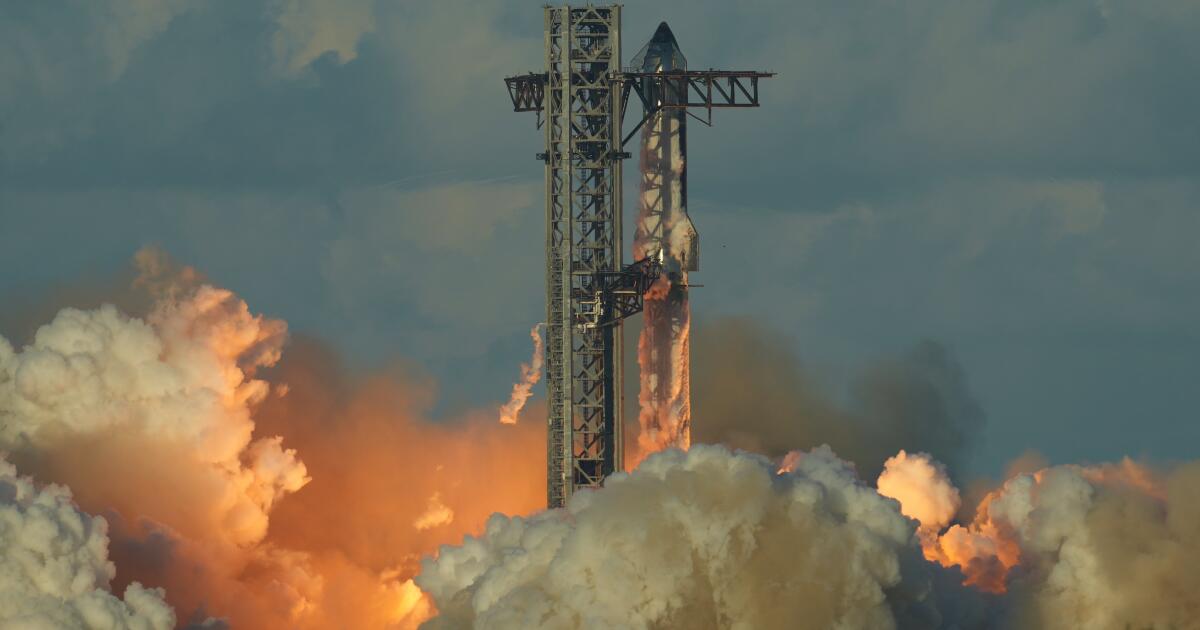
The 12th test launch of Starship is set for Friday from the company’s south Texas launch facility. The rocket is the third version of craft, standing more than 400 feet tall and with about three times the payload.
The regulatory filing claims that the market for its rocket, internet and mobile telephone businesses could be as large as $28.5 trillion.
SpaceX also plans to launch thousands of orbiting data centers powered by the sun that would perform AI calculations.
With the company making massive capital investments, it recorded a $4.28-billion loss in the first quarter. Last year, it recorded $18.7 billion in revenue and lost $4.94 billion, according to the filing.
The public offering is expected to hit the market next month after a “road show,” during which SpaceX will seek to drum up interest from institutional and retail investors.
It will arrive after a fairly quiet year for IPOs that was brightened last week when Cerebras Systems, a Sunnyvale company that makes semiconductors for AI supercomputers, went public.
Shares at Cerebras were offered at $185 and jumped 68% on its opening day. They closed Wednesday at $290.69.
Matt Kennedy, a senior strategist at Renaissance Capital, said the SpaceX offering would dwarf that of Cerebras, as it is expected to raise more than every IPO combined in the last two years.
“A win here or a loss could really impact the IPO market,” he said. “The sheer size of this deal is going to make or lose fortunes.”
Among the oddest disclosures of the IPO is a decision by the company’s board in January to grant Musk 1 billion Class B shares if the company reaches a certain market capitalization and establishes a “permanent human colony on Mars with at least one million inhabitants.”

Elon Musk wants to take investors on a ride to the moon — and beyond.
His pioneering rocket company SpaceX filed Wednesday for what’s expected to be the largest initial public offering in history, potentially raising at least $75 billion and valuing the company at as much as $2 trillion.
The registration statement with the Securities and Exchange Commission for an expected public offering next month explicitly sets aside stocks for retail investors, though the exact number will be spelled out in a later filing, as will the offering price and company valuation.
Interest in the stock offering is expected to be high despite the billionaire’s controversial politics, including his involvement last year with the Department of Government Efficiency, the makeshift cost-cutting effort that resulted in the loss of hundreds of thousands of government jobs.
“Potential investors are probably just as polarized as the electorate is too, given his dabbling in politics,” said Carol Schleif, chief market strategist for BMO Private Wealth. “But it’s not just the SpaceX IPO per se, it’s a bigger, broader excitement among investors for space investment in general.”
Investor interest was piqued by the Artemis II moon mission this year that SpaceX did not participate in, she said. However, the company is expected to play a larger role in future missions that land astronauts to the moon by ferrying them there in its massive Starship rocket under development.
Ultimately, Musk, 54, wants to establish a colony on Mars but those plans have been set on the back burner, with NASA now focusing on moon missions.
Musk will remain the company’s chief executive and chairman. Under a dual-class stock structure as a holder of special Class B shares he will be able to control the election of directors, the filing says.
The IPO is expected to be at least twice as large as the current record holder: Saudi Aramco, the state-controlled national oil and gas company of Saudi Arabia, which raised nearly $30 billion in 2019.
Nearly two dozen banks will be underwriting the IPO and offering shares to investors, including Goldman Sachs, Bank of America and Citigroup.
Founded in 2002 in El Segundo, SpaceX has revolutionized the aerospace industry by developing the reusable Falcon 9 rocket that has radically lowered launch costs.
The company moved its headquarters from Hawthorne to Texas in 2024. However, SpaceX retains large operations in the South Bay city and blasts off regularly from Vandenberg Space Force Base in Santa Barbara County.
Scores of former SpaceX employees have launched startups in Southern California, including rocket company Relativity Space, hypersonic missile startup Castelion and satellite manufacturer Apex Space.
Since developing its reusable rocket technology, SpaceX has established its Starlink network as the leading satellite-based broadband internet service. It also is moving into satellite-based cellular service and this year merged with Musk’s xAi artificial intelligence company that also included his X social network.
Marco Cáceres, an aerospace analyst at Teal Group, said that the advantage of going public for SpaceX lies in the IPO’s ability to raise a large amount of capital quickly to complete development of its Starship rocket.
“It is going to dominate the market even more than the Falcon 9 is dominating the market now,” he said. “That’s going to be ultimately what’s going to drive their business for the next 10 years.”
The 12th test launch of Starship is set for Friday from the company’s south Texas launch facility. The rocket is the third version of craft, standing more than 400 feet tall and with about three times the payload.
The regulatory filing claims that the market for its rocket, internet and mobile telephone businesses could be as large as $28.5 trillion.
SpaceX also plans to launch thousands of orbiting data centers powered by the sun that would perform AI calculations.
With the company making massive capital investments, it recorded a $4.28-billion loss in the first quarter. Last year, it recorded $18.7 billion in revenue and lost $4.94 billion, according to the filing.
The public offering is expected to hit the market next month after a “road show,” during which SpaceX will seek to drum up interest from institutional and retail investors.
It will arrive after a fairly quiet year for IPOs that was brightened last week when Cerebras Systems, a Sunnyvale company that makes semiconductors for AI supercomputers, went public.
Shares at Cerebras were offered at $185 and jumped 68% on its opening day. They closed Wednesday at $290.69.
Matt Kennedy, a senior strategist at Renaissance Capital, said the SpaceX offering would dwarf that of Cerebras, as it is expected to raise more than every IPO combined in the last two years.
“A win here or a loss could really impact the IPO market,” he said. “The sheer size of this deal is going to make or lose fortunes.”
Among the oddest disclosures of the IPO is a decision by the company’s board in January to grant Musk 1 billion Class B shares if the company reaches a certain market capitalization and establishes a “permanent human colony on Mars with at least one million inhabitants.”

Elon Musk wants to take investors on a ride to the moon — and beyond.
His pioneering rocket company SpaceX filed Wednesday for what’s expected to be the largest initial public offering in history, potentially raising at least $75 billion and valuing the company at as much as $2 trillion.
The registration statement with the Securities and Exchange Commission for an expected public offering next month explicitly sets aside stocks for retail investors, though the exact number will be spelled out in a later filing, as will the offering price and company valuation.
Interest in the stock offering is expected to be high despite the billionaire’s controversial politics, including his involvement last year with the Department of Government Efficiency, the makeshift cost-cutting effort that resulted in the loss of hundreds of thousands of government jobs.
“Potential investors are probably just as polarized as the electorate is too, given his dabbling in politics,” said Carol Schleif, chief market strategist for BMO Private Wealth. “But it’s not just the SpaceX IPO per se, it’s a bigger, broader excitement among investors for space investment in general.”
Investor interest was piqued by the Artemis II moon mission this year that SpaceX did not participate in, she said. However, the company is expected to play a larger role in future missions that land astronauts to the moon by ferrying them there in its massive Starship rocket under development.
Ultimately, Musk, 54, wants to establish a colony on Mars but those plans have been set on the back burner, with NASA now focusing on moon missions.
Musk will remain the company’s chief executive and chairman. Under a dual-class stock structure as a holder of special Class B shares he will be able to control the election of directors, the filing says.
The IPO is expected to be at least twice as large as the current record holder: Saudi Aramco, the state-controlled national oil and gas company of Saudi Arabia, which raised nearly $30 billion in 2019.
Nearly two dozen banks will be underwriting the IPO and offering shares to investors, including Goldman Sachs, Bank of America and Citigroup.
Founded in 2002 in El Segundo, SpaceX has revolutionized the aerospace industry by developing the reusable Falcon 9 rocket that has radically lowered launch costs.
The company moved its headquarters from Hawthorne to Texas in 2024. However, SpaceX retains large operations in the South Bay city and blasts off regularly from Vandenberg Space Force Base in Santa Barbara County.
Scores of former SpaceX employees have launched startups in Southern California, including rocket company Relativity Space, hypersonic missile startup Castelion and satellite manufacturer Apex Space.
Since developing its reusable rocket technology, SpaceX has established its Starlink network as the leading satellite-based broadband internet service. It also is moving into satellite-based cellular service and this year merged with Musk’s xAi artificial intelligence company that also included his X social network.
Marco Cáceres, an aerospace analyst at Teal Group, said that the advantage of going public for SpaceX lies in the IPO’s ability to raise a large amount of capital quickly to complete development of its Starship rocket.
“It is going to dominate the market even more than the Falcon 9 is dominating the market now,” he said. “That’s going to be ultimately what’s going to drive their business for the next 10 years.”
The 12th test launch of Starship is set for Friday from the company’s south Texas launch facility. The rocket is the third version of craft, standing more than 400 feet tall and with about three times the payload.
The regulatory filing claims that the market for its rocket, internet and mobile telephone businesses could be as large as $28.5 trillion.
SpaceX also plans to launch thousands of orbiting data centers powered by the sun that would perform AI calculations.
With the company making massive capital investments, it recorded a $4.28-billion loss in the first quarter. Last year, it recorded $18.7 billion in revenue and lost $4.94 billion, according to the filing.
The public offering is expected to hit the market next month after a “road show,” during which SpaceX will seek to drum up interest from institutional and retail investors.
It will arrive after a fairly quiet year for IPOs that was brightened last week when Cerebras Systems, a Sunnyvale company that makes semiconductors for AI supercomputers, went public.
Shares at Cerebras were offered at $185 and jumped 68% on its opening day. They closed Wednesday at $290.69.
Matt Kennedy, a senior strategist at Renaissance Capital, said the SpaceX offering would dwarf that of Cerebras, as it is expected to raise more than every IPO combined in the last two years.
“A win here or a loss could really impact the IPO market,” he said. “The sheer size of this deal is going to make or lose fortunes.”
Among the oddest disclosures of the IPO is a decision by the company’s board in January to grant Musk 1 billion Class B shares if the company reaches a certain market capitalization and establishes a “permanent human colony on Mars with at least one million inhabitants.”
Elon Musk wants to take investors on a ride to the moon — and beyond.
His pioneering rocket company SpaceX filed Wednesday for what’s expected to be the largest initial public offering in history, potentially raising at least $75 billion and valuing the company at as much as $2 trillion.
The registration statement with the Securities and Exchange Commission for an expected public offering next month explicitly sets aside stocks for retail investors, though the exact number will be spelled out in a later filing, as will the offering price and company valuation.
Interest in the stock offering is expected to be high despite the billionaire’s controversial politics, including his involvement last year with the Department of Government Efficiency, the makeshift cost-cutting effort that resulted in the loss of hundreds of thousands of government jobs.
“Potential investors are probably just as polarized as the electorate is too, given his dabbling in politics,” said Carol Schleif, chief market strategist for BMO Private Wealth. “But it’s not just the SpaceX IPO per se, it’s a bigger, broader excitement among investors for space investment in general.”
Investor interest was piqued by the Artemis II moon mission this year that SpaceX did not participate in, she said. However, the company is expected to play a larger role in future missions that land astronauts to the moon by ferrying them there in its massive Starship rocket under development.
Ultimately, Musk, 54, wants to establish a colony on Mars but those plans have been set on the back burner, with NASA now focusing on moon missions.
Musk will remain the company’s chief executive and chairman. Under a dual-class stock structure as a holder of special Class B shares he will be able to control the election of directors, the filing says.
The IPO is expected to be at least twice as large as the current record holder: Saudi Aramco, the state-controlled national oil and gas company of Saudi Arabia, which raised nearly $30 billion in 2019.
Nearly two dozen banks will be underwriting the IPO and offering shares to investors, including Goldman Sachs, Bank of America and Citigroup.
Founded in 2002 in El Segundo, SpaceX has revolutionized the aerospace industry by developing the reusable Falcon 9 rocket that has radically lowered launch costs.
The company moved its headquarters from Hawthorne to Texas in 2024. However, SpaceX retains large operations in the South Bay city and blasts off regularly from Vandenberg Space Force Base in Santa Barbara County.
Scores of former SpaceX employees have launched startups in Southern California, including rocket company Relativity Space, hypersonic missile startup Castelion and satellite manufacturer Apex Space.
Since developing its reusable rocket technology, SpaceX has established its Starlink network as the leading satellite-based broadband internet service. It also is moving into satellite-based cellular service and this year merged with Musk’s xAi artificial intelligence company that also included his X social network.
Marco Cáceres, an aerospace analyst at Teal Group, said that the advantage of going public for SpaceX lies in the IPO’s ability to raise a large amount of capital quickly to complete development of its Starship rocket.
“It is going to dominate the market even more than the Falcon 9 is dominating the market now,” he said. “That’s going to be ultimately what’s going to drive their business for the next 10 years.”
The 12th test launch of Starship is set for Friday from the company’s south Texas launch facility. The rocket is the third version of craft, standing more than 400 feet tall and with about three times the payload.
The regulatory filing claims that the market for its rocket, internet and mobile telephone businesses could be as large as $28.5 trillion.
SpaceX also plans to launch thousands of orbiting data centers powered by the sun that would perform AI calculations.
With the company making massive capital investments, it recorded a $4.28-billion loss in the first quarter. Last year, it recorded $18.7 billion in revenue and lost $4.94 billion, according to the filing.
The public offering is expected to hit the market next month after a “road show,” during which SpaceX will seek to drum up interest from institutional and retail investors.
It will arrive after a fairly quiet year for IPOs that was brightened last week when Cerebras Systems, a Sunnyvale company that makes semiconductors for AI supercomputers, went public.
Shares at Cerebras were offered at $185 and jumped 68% on its opening day. They closed Wednesday at $290.69.
Matt Kennedy, a senior strategist at Renaissance Capital, said the SpaceX offering would dwarf that of Cerebras, as it is expected to raise more than every IPO combined in the last two years.
“A win here or a loss could really impact the IPO market,” he said. “The sheer size of this deal is going to make or lose fortunes.”
Among the oddest disclosures of the IPO is a decision by the company’s board in January to grant Musk 1 billion Class B shares if the company reaches a certain market capitalization and establishes a “permanent human colony on Mars with at least one million inhabitants.”

Elon Musk wants to take investors on a ride to the moon — and beyond.
His pioneering rocket company SpaceX filed Wednesday for what’s expected to be the largest initial public offering in history, potentially raising at least $75 billion and valuing the company at as much as $2 trillion.
The registration statement with the Securities and Exchange Commission for an expected public offering next month explicitly sets aside stocks for retail investors, though the exact number will be spelled out in a later filing, as will the offering price and company valuation.
Interest in the stock offering is expected to be high despite the billionaire’s controversial politics, including his involvement last year with the Department of Government Efficiency, the makeshift cost-cutting effort that resulted in the loss of hundreds of thousands of government jobs.
“Potential investors are probably just as polarized as the electorate is too, given his dabbling in politics,” said Carol Schleif, chief market strategist for BMO Private Wealth. “But it’s not just the SpaceX IPO per se, it’s a bigger, broader excitement among investors for space investment in general.”
Investor interest was piqued by the Artemis II moon mission this year that SpaceX did not participate in, she said. However, the company is expected to play a larger role in future missions that land astronauts to the moon by ferrying them there in its massive Starship rocket under development.
Ultimately, Musk, 54, wants to establish a colony on Mars but those plans have been set on the back burner, with NASA now focusing on moon missions.
Musk will remain the company’s chief executive and chairman. Under a dual-class stock structure as a holder of special Class B shares he will be able to control the election of directors, the filing says.
The IPO is expected to be at least twice as large as the current record holder: Saudi Aramco, the state-controlled national oil and gas company of Saudi Arabia, which raised nearly $30 billion in 2019.
Nearly two dozen banks will be underwriting the IPO and offering shares to investors, including Goldman Sachs, Bank of America and Citigroup.
Founded in 2002 in El Segundo, SpaceX has revolutionized the aerospace industry by developing the reusable Falcon 9 rocket that has radically lowered launch costs.
The company moved its headquarters from Hawthorne to Texas in 2024. However, SpaceX retains large operations in the South Bay city and blasts off regularly from Vandenberg Space Force Base in Santa Barbara County.
Scores of former SpaceX employees have launched startups in Southern California, including rocket company Relativity Space, hypersonic missile startup Castelion and satellite manufacturer Apex Space.
Since developing its reusable rocket technology, SpaceX has established its Starlink network as the leading satellite-based broadband internet service. It also is moving into satellite-based cellular service and this year merged with Musk’s xAi artificial intelligence company that also included his X social network.
Marco Cáceres, an aerospace analyst at Teal Group, said that the advantage of going public for SpaceX lies in the IPO’s ability to raise a large amount of capital quickly to complete development of its Starship rocket.
“It is going to dominate the market even more than the Falcon 9 is dominating the market now,” he said. “That’s going to be ultimately what’s going to drive their business for the next 10 years.”
The 12th test launch of Starship is set for Friday from the company’s south Texas launch facility. The rocket is the third version of craft, standing more than 400 feet tall and with about three times the payload.
The regulatory filing claims that the market for its rocket, internet and mobile telephone businesses could be as large as $28.5 trillion.
SpaceX also plans to launch thousands of orbiting data centers powered by the sun that would perform AI calculations.
With the company making massive capital investments, it recorded a $4.28-billion loss in the first quarter. Last year, it recorded $18.7 billion in revenue and lost $4.94 billion, according to the filing.
The public offering is expected to hit the market next month after a “road show,” during which SpaceX will seek to drum up interest from institutional and retail investors.
It will arrive after a fairly quiet year for IPOs that was brightened last week when Cerebras Systems, a Sunnyvale company that makes semiconductors for AI supercomputers, went public.
Shares at Cerebras were offered at $185 and jumped 68% on its opening day. They closed Wednesday at $290.69.
Matt Kennedy, a senior strategist at Renaissance Capital, said the SpaceX offering would dwarf that of Cerebras, as it is expected to raise more than every IPO combined in the last two years.
“A win here or a loss could really impact the IPO market,” he said. “The sheer size of this deal is going to make or lose fortunes.”
Among the oddest disclosures of the IPO is a decision by the company’s board in January to grant Musk 1 billion Class B shares if the company reaches a certain market capitalization and establishes a “permanent human colony on Mars with at least one million inhabitants.”
Elon Musk wants to take investors on a ride to the moon — and beyond.
His pioneering rocket company SpaceX filed Wednesday for what’s expected to be the largest initial public offering in history, potentially raising at least $75 billion and valuing the company at as much as $2 trillion.
The registration statement with the Securities and Exchange Commission for an expected public offering next month explicitly sets aside stocks for retail investors, though the exact number will be spelled out in a later filing, as will the offering price and company valuation.
Interest in the stock offering is expected to be high despite the billionaire’s controversial politics, including his involvement last year with the Department of Government Efficiency, the makeshift cost-cutting effort that resulted in the loss of hundreds of thousands of government jobs.
“Potential investors are probably just as polarized as the electorate is too, given his dabbling in politics,” said Carol Schleif, chief market strategist for BMO Private Wealth. “But it’s not just the SpaceX IPO per se, it’s a bigger, broader excitement among investors for space investment in general.”
Investor interest was piqued by the Artemis II moon mission this year that SpaceX did not participate in, she said. However, the company is expected to play a larger role in future missions that land astronauts to the moon by ferrying them there in its massive Starship rocket under development.
Ultimately, Musk, 54, wants to establish a colony on Mars but those plans have been set on the back burner, with NASA now focusing on moon missions.
Musk will remain the company’s chief executive and chairman. Under a dual-class stock structure as a holder of special Class B shares he will be able to control the election of directors, the filing says.
The IPO is expected to be at least twice as large as the current record holder: Saudi Aramco, the state-controlled national oil and gas company of Saudi Arabia, which raised nearly $30 billion in 2019.
Nearly two dozen banks will be underwriting the IPO and offering shares to investors, including Goldman Sachs, Bank of America and Citigroup.
Founded in 2002 in El Segundo, SpaceX has revolutionized the aerospace industry by developing the reusable Falcon 9 rocket that has radically lowered launch costs.
The company moved its headquarters from Hawthorne to Texas in 2024. However, SpaceX retains large operations in the South Bay city and blasts off regularly from Vandenberg Space Force Base in Santa Barbara County.
Scores of former SpaceX employees have launched startups in Southern California, including rocket company Relativity Space, hypersonic missile startup Castelion and satellite manufacturer Apex Space.
Since developing its reusable rocket technology, SpaceX has established its Starlink network as the leading satellite-based broadband internet service. It also is moving into satellite-based cellular service and this year merged with Musk’s xAi artificial intelligence company that also included his X social network.
Marco Cáceres, an aerospace analyst at Teal Group, said that the advantage of going public for SpaceX lies in the IPO’s ability to raise a large amount of capital quickly to complete development of its Starship rocket.
“It is going to dominate the market even more than the Falcon 9 is dominating the market now,” he said. “That’s going to be ultimately what’s going to drive their business for the next 10 years.”
The 12th test launch of Starship is set for Friday from the company’s south Texas launch facility. The rocket is the third version of craft, standing more than 400 feet tall and with about three times the payload.
The regulatory filing claims that the market for its rocket, internet and mobile telephone businesses could be as large as $28.5 trillion.
SpaceX also plans to launch thousands of orbiting data centers powered by the sun that would perform AI calculations.
With the company making massive capital investments, it recorded a $4.28-billion loss in the first quarter. Last year, it recorded $18.7 billion in revenue and lost $4.94 billion, according to the filing.
The public offering is expected to hit the market next month after a “road show,” during which SpaceX will seek to drum up interest from institutional and retail investors.
It will arrive after a fairly quiet year for IPOs that was brightened last week when Cerebras Systems, a Sunnyvale company that makes semiconductors for AI supercomputers, went public.
Shares at Cerebras were offered at $185 and jumped 68% on its opening day. They closed Wednesday at $290.69.
Matt Kennedy, a senior strategist at Renaissance Capital, said the SpaceX offering would dwarf that of Cerebras, as it is expected to raise more than every IPO combined in the last two years.
“A win here or a loss could really impact the IPO market,” he said. “The sheer size of this deal is going to make or lose fortunes.”
Among the oddest disclosures of the IPO is a decision by the company’s board in January to grant Musk 1 billion Class B shares if the company reaches a certain market capitalization and establishes a “permanent human colony on Mars with at least one million inhabitants.”
Elon Musk wants to take investors on a ride to the moon — and beyond.
His pioneering rocket company SpaceX filed Wednesday for what’s expected to be the largest initial public offering in history, potentially raising at least $75 billion and valuing the company at as much as $2 trillion.
The registration statement with the Securities and Exchange Commission for an expected public offering next month explicitly sets aside stocks for retail investors, though the exact number will be spelled out in a later filing, as will the offering price and company valuation.
Interest in the stock offering is expected to be high despite the billionaire’s controversial politics, including his involvement last year with the Department of Government Efficiency, the makeshift cost-cutting effort that resulted in the loss of hundreds of thousands of government jobs.
“Potential investors are probably just as polarized as the electorate is too, given his dabbling in politics,” said Carol Schleif, chief market strategist for BMO Private Wealth. “But it’s not just the SpaceX IPO per se, it’s a bigger, broader excitement among investors for space investment in general.”
Investor interest was piqued by the Artemis II moon mission this year that SpaceX did not participate in, she said. However, the company is expected to play a larger role in future missions that land astronauts to the moon by ferrying them there in its massive Starship rocket under development.
Ultimately, Musk, 54, wants to establish a colony on Mars but those plans have been set on the back burner, with NASA now focusing on moon missions.
Musk will remain the company’s chief executive and chairman. Under a dual-class stock structure as a holder of special Class B shares he will be able to control the election of directors, the filing says.
The IPO is expected to be at least twice as large as the current record holder: Saudi Aramco, the state-controlled national oil and gas company of Saudi Arabia, which raised nearly $30 billion in 2019.
Nearly two dozen banks will be underwriting the IPO and offering shares to investors, including Goldman Sachs, Bank of America and Citigroup.
Founded in 2002 in El Segundo, SpaceX has revolutionized the aerospace industry by developing the reusable Falcon 9 rocket that has radically lowered launch costs.
The company moved its headquarters from Hawthorne to Texas in 2024. However, SpaceX retains large operations in the South Bay city and blasts off regularly from Vandenberg Space Force Base in Santa Barbara County.
Scores of former SpaceX employees have launched startups in Southern California, including rocket company Relativity Space, hypersonic missile startup Castelion and satellite manufacturer Apex Space.
Since developing its reusable rocket technology, SpaceX has established its Starlink network as the leading satellite-based broadband internet service. It also is moving into satellite-based cellular service and this year merged with Musk’s xAi artificial intelligence company that also included his X social network.
Marco Cáceres, an aerospace analyst at Teal Group, said that the advantage of going public for SpaceX lies in the IPO’s ability to raise a large amount of capital quickly to complete development of its Starship rocket.
“It is going to dominate the market even more than the Falcon 9 is dominating the market now,” he said. “That’s going to be ultimately what’s going to drive their business for the next 10 years.”
The 12th test launch of Starship is set for Friday from the company’s south Texas launch facility. The rocket is the third version of craft, standing more than 400 feet tall and with about three times the payload.
The regulatory filing claims that the market for its rocket, internet and mobile telephone businesses could be as large as $28.5 trillion.
SpaceX also plans to launch thousands of orbiting data centers powered by the sun that would perform AI calculations.
With the company making massive capital investments, it recorded a $4.28-billion loss in the first quarter. Last year, it recorded $18.7 billion in revenue and lost $4.94 billion, according to the filing.
The public offering is expected to hit the market next month after a “road show,” during which SpaceX will seek to drum up interest from institutional and retail investors.
It will arrive after a fairly quiet year for IPOs that was brightened last week when Cerebras Systems, a Sunnyvale company that makes semiconductors for AI supercomputers, went public.
Shares at Cerebras were offered at $185 and jumped 68% on its opening day. They closed Wednesday at $290.69.
Matt Kennedy, a senior strategist at Renaissance Capital, said the SpaceX offering would dwarf that of Cerebras, as it is expected to raise more than every IPO combined in the last two years.
“A win here or a loss could really impact the IPO market,” he said. “The sheer size of this deal is going to make or lose fortunes.”
Among the oddest disclosures of the IPO is a decision by the company’s board in January to grant Musk 1 billion Class B shares if the company reaches a certain market capitalization and establishes a “permanent human colony on Mars with at least one million inhabitants.”
Elon Musk wants to take investors on a ride to the moon — and beyond.
His pioneering rocket company SpaceX filed Wednesday for what’s expected to be the largest initial public offering in history, potentially raising at least $75 billion and valuing the company at as much as $2 trillion.
The registration statement with the Securities and Exchange Commission for an expected public offering next month explicitly sets aside stocks for retail investors, though the exact number will be spelled out in a later filing, as will the offering price and company valuation.
Interest in the stock offering is expected to be high despite the billionaire’s controversial politics, including his involvement last year with the Department of Government Efficiency, the makeshift cost-cutting effort that resulted in the loss of hundreds of thousands of government jobs.
“Potential investors are probably just as polarized as the electorate is too, given his dabbling in politics,” said Carol Schleif, chief market strategist for BMO Private Wealth. “But it’s not just the SpaceX IPO per se, it’s a bigger, broader excitement among investors for space investment in general.”
Investor interest was piqued by the Artemis II moon mission this year that SpaceX did not participate in, she said. However, the company is expected to play a larger role in future missions that land astronauts to the moon by ferrying them there in its massive Starship rocket under development.
Ultimately, Musk, 54, wants to establish a colony on Mars but those plans have been set on the back burner, with NASA now focusing on moon missions.
Musk will remain the company’s chief executive and chairman. Under a dual-class stock structure as a holder of special Class B shares he will be able to control the election of directors, the filing says.
The IPO is expected to be at least twice as large as the current record holder: Saudi Aramco, the state-controlled national oil and gas company of Saudi Arabia, which raised nearly $30 billion in 2019.
Nearly two dozen banks will be underwriting the IPO and offering shares to investors, including Goldman Sachs, Bank of America and Citigroup.
Founded in 2002 in El Segundo, SpaceX has revolutionized the aerospace industry by developing the reusable Falcon 9 rocket that has radically lowered launch costs.
The company moved its headquarters from Hawthorne to Texas in 2024. However, SpaceX retains large operations in the South Bay city and blasts off regularly from Vandenberg Space Force Base in Santa Barbara County.
Scores of former SpaceX employees have launched startups in Southern California, including rocket company Relativity Space, hypersonic missile startup Castelion and satellite manufacturer Apex Space.
Since developing its reusable rocket technology, SpaceX has established its Starlink network as the leading satellite-based broadband internet service. It also is moving into satellite-based cellular service and this year merged with Musk’s xAi artificial intelligence company that also included his X social network.
Marco Cáceres, an aerospace analyst at Teal Group, said that the advantage of going public for SpaceX lies in the IPO’s ability to raise a large amount of capital quickly to complete development of its Starship rocket.
“It is going to dominate the market even more than the Falcon 9 is dominating the market now,” he said. “That’s going to be ultimately what’s going to drive their business for the next 10 years.”
The 12th test launch of Starship is set for Friday from the company’s south Texas launch facility. The rocket is the third version of craft, standing more than 400 feet tall and with about three times the payload.
The regulatory filing claims that the market for its rocket, internet and mobile telephone businesses could be as large as $28.5 trillion.
SpaceX also plans to launch thousands of orbiting data centers powered by the sun that would perform AI calculations.
With the company making massive capital investments, it recorded a $4.28-billion loss in the first quarter. Last year, it recorded $18.7 billion in revenue and lost $4.94 billion, according to the filing.
The public offering is expected to hit the market next month after a “road show,” during which SpaceX will seek to drum up interest from institutional and retail investors.
It will arrive after a fairly quiet year for IPOs that was brightened last week when Cerebras Systems, a Sunnyvale company that makes semiconductors for AI supercomputers, went public.
Shares at Cerebras were offered at $185 and jumped 68% on its opening day. They closed Wednesday at $290.69.
Matt Kennedy, a senior strategist at Renaissance Capital, said the SpaceX offering would dwarf that of Cerebras, as it is expected to raise more than every IPO combined in the last two years.
“A win here or a loss could really impact the IPO market,” he said. “The sheer size of this deal is going to make or lose fortunes.”
Among the oddest disclosures of the IPO is a decision by the company’s board in January to grant Musk 1 billion Class B shares if the company reaches a certain market capitalization and establishes a “permanent human colony on Mars with at least one million inhabitants.”

