

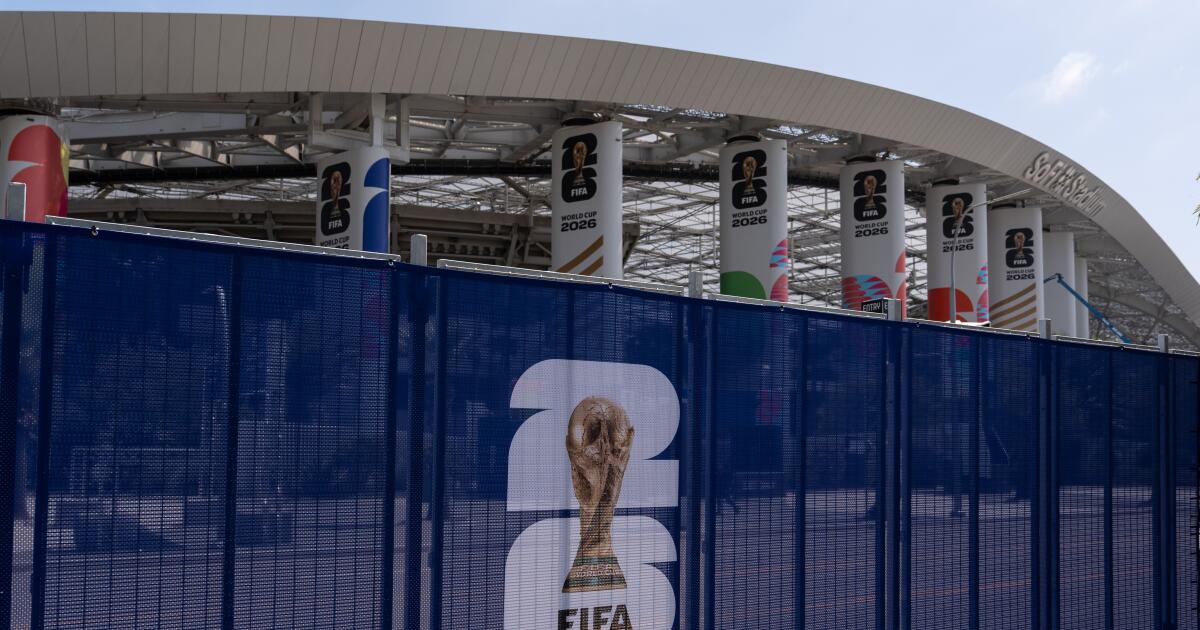
A strike that had the potential to disrupt the U.S. World Cup opener at SoFi Stadium has been averted, with United Here Local 11 and Legends Global, the stadium’s food-service operator, agreeing Tuesday to a tentative deal.
The nearly 2,000 workers represented by the union, which includes dishwashers, concession workers, bartenders and servers, voted last week to authorize a strike with 96% of those voting supporting the decision to walk off the job. Workers were demanding salary increases, protection against subcontracting and job loss through automation, and were refusing to comply with FIFA’s request to collect sensitive private information such as nationality and home addresses.
Details of the new contract were not released but the union had demanded “substantial increases” in pay to more than $30 an hour while Legends proposed wage freezes for some workers and a 25-cent hourly increase for cooks and dishwashers.
“We got major economic gains and significant protections around subcontracting automation,” Kurt Petersen, the union’s co-president, said. “I don’t know the soccer analogy, but it’s a grand slam of a contract.”
Legends was also happy with the deal.
“We are pleased to have reached an agreement with Unite Here Local 11 and look forward to delivering an outstanding hospitality experience for fans at the FIFA World Cup matches,” the company said in a statement.
Petersen said the final sticking points included a prohibition preventing any accrediting agency, including Legends, from sharing workers’ personal information and the right for union members to walk off the job without prejudice if they feel threatened by the presence of Department of Homeland Security or Immigration and Customs Enforcement officials at the stadium.
“That was the last piece that fell into place [Monday] afternoon, which, you know, is a unique, unprecedented provision,” he said. “Because when you have a contract, you can’t strike. We carved out this exception.”
FIFA, global soccer’s governing body and the organizer of the World Cup, said it needed the information as part of its background-check procedure. But the union feared the sensitive date would be shared with immigration authorities.
Union members have been working without a contract for a year and Petersen said workers would have picketed the stadium ahead of Friday’s tournament opener between the U.S. and Paraguay. SoFi Stadium will play host to seven other World Cup games, including the U.S. group-play finale with Turkey on June 25.
“The privacy concerns, and then the ability to strike. It’s about being able to work in peace, right? Being able at least to have some protections,” Petersen said.
FIFA has declined to comment on the contract talks, saying they are “between Legends Global and Unite Here Local 11.” But its insistence on collecting personal information was a major stumbling block to a deal.
FIFA said it was partnering with the governments of the U.S., Canada and Mexico, the three countries in which the 39-day tournament will be played, “to enhance safety and security of all workers, staff, team members, vendors, journalists, volunteers, and spectators by mitigating potential insider threats. … Such name checks do not constitute pre-employment checks.”
Petersen said the contract runs through April 2028, expiring about 2 ½ months before the 2028 Olympics comes to SoFi Stadium.

A strike that had the potential to disrupt the U.S. World Cup opener at SoFi Stadium has been averted, with United Here Local 11 and Legends Global, the stadium’s food-service operator, agreeing Tuesday to a tentative deal.
The nearly 2,000 workers represented by the union, which includes dishwashers, concession workers, bartenders and servers, voted last week to authorize a strike with 96% of those voting supporting the decision to walk off the job. Workers were demanding salary increases, protection against subcontracting and job loss through automation, and were refusing to comply with FIFA’s request to collect sensitive private information such as nationality and home addresses.
Details of the new contract were not released but the union had demanded “substantial increases” in pay to more than $30 an hour while Legends proposed wage freezes for some workers and a 25-cent hourly increase for cooks and dishwashers.
“We got major economic gains and significant protections around subcontracting automation,” Kurt Petersen, the union’s co-president, said. “I don’t know the soccer analogy, but it’s a grand slam of a contract.”
Legends was also happy with the deal.
“We are pleased to have reached an agreement with Unite Here Local 11 and look forward to delivering an outstanding hospitality experience for fans at the FIFA World Cup matches,” the company said in a statement.
Petersen said the final sticking points included a prohibition preventing any accrediting agency, including Legends, from sharing workers’ personal information and the right for union members to walk off the job without prejudice if they feel threatened by the presence of Department of Homeland Security or Immigration and Customs Enforcement officials at the stadium.
“That was the last piece that fell into place [Monday] afternoon, which, you know, is a unique, unprecedented provision,” he said. “Because when you have a contract, you can’t strike. We carved out this exception.”
FIFA, global soccer’s governing body and the organizer of the World Cup, said it needed the information as part of its background-check procedure. But the union feared the sensitive date would be shared with immigration authorities.
Union members have been working without a contract for a year and Petersen said workers would have picketed the stadium ahead of Friday’s tournament opener between the U.S. and Paraguay. SoFi Stadium will play host to seven other World Cup games, including the U.S. group-play finale with Turkey on June 25.
“The privacy concerns, and then the ability to strike. It’s about being able to work in peace, right? Being able at least to have some protections,” Petersen said.
FIFA has declined to comment on the contract talks, saying they are “between Legends Global and Unite Here Local 11.” But its insistence on collecting personal information was a major stumbling block to a deal.
FIFA said it was partnering with the governments of the U.S., Canada and Mexico, the three countries in which the 39-day tournament will be played, “to enhance safety and security of all workers, staff, team members, vendors, journalists, volunteers, and spectators by mitigating potential insider threats. … Such name checks do not constitute pre-employment checks.”
Petersen said the contract runs through April 2028, expiring about 2 ½ months before the 2028 Olympics comes to SoFi Stadium.

A strike that had the potential to disrupt the U.S. World Cup opener at SoFi Stadium has been averted, with United Here Local 11 and Legends Global, the stadium’s food-service operator, agreeing Tuesday to a tentative deal.
The nearly 2,000 workers represented by the union, which includes dishwashers, concession workers, bartenders and servers, voted last week to authorize a strike with 96% of those voting supporting the decision to walk off the job. Workers were demanding salary increases, protection against subcontracting and job loss through automation, and were refusing to comply with FIFA’s request to collect sensitive private information such as nationality and home addresses.
Details of the new contract were not released but the union had demanded “substantial increases” in pay to more than $30 an hour while Legends proposed wage freezes for some workers and a 25-cent hourly increase for cooks and dishwashers.
“We got major economic gains and significant protections around subcontracting automation,” Kurt Petersen, the union’s co-president, said. “I don’t know the soccer analogy, but it’s a grand slam of a contract.”
Legends was also happy with the deal.
“We are pleased to have reached an agreement with Unite Here Local 11 and look forward to delivering an outstanding hospitality experience for fans at the FIFA World Cup matches,” the company said in a statement.
Petersen said the final sticking points included a prohibition preventing any accrediting agency, including Legends, from sharing workers’ personal information and the right for union members to walk off the job without prejudice if they feel threatened by the presence of Department of Homeland Security or Immigration and Customs Enforcement officials at the stadium.
“That was the last piece that fell into place [Monday] afternoon, which, you know, is a unique, unprecedented provision,” he said. “Because when you have a contract, you can’t strike. We carved out this exception.”
FIFA, global soccer’s governing body and the organizer of the World Cup, said it needed the information as part of its background-check procedure. But the union feared the sensitive date would be shared with immigration authorities.
Union members have been working without a contract for a year and Petersen said workers would have picketed the stadium ahead of Friday’s tournament opener between the U.S. and Paraguay. SoFi Stadium will play host to seven other World Cup games, including the U.S. group-play finale with Turkey on June 25.
“The privacy concerns, and then the ability to strike. It’s about being able to work in peace, right? Being able at least to have some protections,” Petersen said.
FIFA has declined to comment on the contract talks, saying they are “between Legends Global and Unite Here Local 11.” But its insistence on collecting personal information was a major stumbling block to a deal.
FIFA said it was partnering with the governments of the U.S., Canada and Mexico, the three countries in which the 39-day tournament will be played, “to enhance safety and security of all workers, staff, team members, vendors, journalists, volunteers, and spectators by mitigating potential insider threats. … Such name checks do not constitute pre-employment checks.”
Petersen said the contract runs through April 2028, expiring about 2 ½ months before the 2028 Olympics comes to SoFi Stadium.
A strike that had the potential to disrupt the U.S. World Cup opener at SoFi Stadium has been averted, with United Here Local 11 and Legends Global, the stadium’s food-service operator, agreeing Tuesday to a tentative deal.
The nearly 2,000 workers represented by the union, which includes dishwashers, concession workers, bartenders and servers, voted last week to authorize a strike with 96% of those voting supporting the decision to walk off the job. Workers were demanding salary increases, protection against subcontracting and job loss through automation, and were refusing to comply with FIFA’s request to collect sensitive private information such as nationality and home addresses.
Details of the new contract were not released but the union had demanded “substantial increases” in pay to more than $30 an hour while Legends proposed wage freezes for some workers and a 25-cent hourly increase for cooks and dishwashers.
“We got major economic gains and significant protections around subcontracting automation,” Kurt Petersen, the union’s co-president, said. “I don’t know the soccer analogy, but it’s a grand slam of a contract.”
Legends was also happy with the deal.
“We are pleased to have reached an agreement with Unite Here Local 11 and look forward to delivering an outstanding hospitality experience for fans at the FIFA World Cup matches,” the company said in a statement.
Petersen said the final sticking points included a prohibition preventing any accrediting agency, including Legends, from sharing workers’ personal information and the right for union members to walk off the job without prejudice if they feel threatened by the presence of Department of Homeland Security or Immigration and Customs Enforcement officials at the stadium.
“That was the last piece that fell into place [Monday] afternoon, which, you know, is a unique, unprecedented provision,” he said. “Because when you have a contract, you can’t strike. We carved out this exception.”
FIFA, global soccer’s governing body and the organizer of the World Cup, said it needed the information as part of its background-check procedure. But the union feared the sensitive date would be shared with immigration authorities.
Union members have been working without a contract for a year and Petersen said workers would have picketed the stadium ahead of Friday’s tournament opener between the U.S. and Paraguay. SoFi Stadium will play host to seven other World Cup games, including the U.S. group-play finale with Turkey on June 25.
“The privacy concerns, and then the ability to strike. It’s about being able to work in peace, right? Being able at least to have some protections,” Petersen said.
FIFA has declined to comment on the contract talks, saying they are “between Legends Global and Unite Here Local 11.” But its insistence on collecting personal information was a major stumbling block to a deal.
FIFA said it was partnering with the governments of the U.S., Canada and Mexico, the three countries in which the 39-day tournament will be played, “to enhance safety and security of all workers, staff, team members, vendors, journalists, volunteers, and spectators by mitigating potential insider threats. … Such name checks do not constitute pre-employment checks.”
Petersen said the contract runs through April 2028, expiring about 2 ½ months before the 2028 Olympics comes to SoFi Stadium.

A strike that had the potential to disrupt the U.S. World Cup opener at SoFi Stadium has been averted, with United Here Local 11 and Legends Global, the stadium’s food-service operator, agreeing Tuesday to a tentative deal.
The nearly 2,000 workers represented by the union, which includes dishwashers, concession workers, bartenders and servers, voted last week to authorize a strike with 96% of those voting supporting the decision to walk off the job. Workers were demanding salary increases, protection against subcontracting and job loss through automation, and were refusing to comply with FIFA’s request to collect sensitive private information such as nationality and home addresses.
Details of the new contract were not released but the union had demanded “substantial increases” in pay to more than $30 an hour while Legends proposed wage freezes for some workers and a 25-cent hourly increase for cooks and dishwashers.
“We got major economic gains and significant protections around subcontracting automation,” Kurt Petersen, the union’s co-president, said. “I don’t know the soccer analogy, but it’s a grand slam of a contract.”
Legends was also happy with the deal.
“We are pleased to have reached an agreement with Unite Here Local 11 and look forward to delivering an outstanding hospitality experience for fans at the FIFA World Cup matches,” the company said in a statement.
Petersen said the final sticking points included a prohibition preventing any accrediting agency, including Legends, from sharing workers’ personal information and the right for union members to walk off the job without prejudice if they feel threatened by the presence of Department of Homeland Security or Immigration and Customs Enforcement officials at the stadium.
“That was the last piece that fell into place [Monday] afternoon, which, you know, is a unique, unprecedented provision,” he said. “Because when you have a contract, you can’t strike. We carved out this exception.”
FIFA, global soccer’s governing body and the organizer of the World Cup, said it needed the information as part of its background-check procedure. But the union feared the sensitive date would be shared with immigration authorities.
Union members have been working without a contract for a year and Petersen said workers would have picketed the stadium ahead of Friday’s tournament opener between the U.S. and Paraguay. SoFi Stadium will play host to seven other World Cup games, including the U.S. group-play finale with Turkey on June 25.
“The privacy concerns, and then the ability to strike. It’s about being able to work in peace, right? Being able at least to have some protections,” Petersen said.
FIFA has declined to comment on the contract talks, saying they are “between Legends Global and Unite Here Local 11.” But its insistence on collecting personal information was a major stumbling block to a deal.
FIFA said it was partnering with the governments of the U.S., Canada and Mexico, the three countries in which the 39-day tournament will be played, “to enhance safety and security of all workers, staff, team members, vendors, journalists, volunteers, and spectators by mitigating potential insider threats. … Such name checks do not constitute pre-employment checks.”
Petersen said the contract runs through April 2028, expiring about 2 ½ months before the 2028 Olympics comes to SoFi Stadium.
A strike that had the potential to disrupt the U.S. World Cup opener at SoFi Stadium has been averted, with United Here Local 11 and Legends Global, the stadium’s food-service operator, agreeing Tuesday to a tentative deal.
The nearly 2,000 workers represented by the union, which includes dishwashers, concession workers, bartenders and servers, voted last week to authorize a strike with 96% of those voting supporting the decision to walk off the job. Workers were demanding salary increases, protection against subcontracting and job loss through automation, and were refusing to comply with FIFA’s request to collect sensitive private information such as nationality and home addresses.
Details of the new contract were not released but the union had demanded “substantial increases” in pay to more than $30 an hour while Legends proposed wage freezes for some workers and a 25-cent hourly increase for cooks and dishwashers.
“We got major economic gains and significant protections around subcontracting automation,” Kurt Petersen, the union’s co-president, said. “I don’t know the soccer analogy, but it’s a grand slam of a contract.”
Legends was also happy with the deal.
“We are pleased to have reached an agreement with Unite Here Local 11 and look forward to delivering an outstanding hospitality experience for fans at the FIFA World Cup matches,” the company said in a statement.
Petersen said the final sticking points included a prohibition preventing any accrediting agency, including Legends, from sharing workers’ personal information and the right for union members to walk off the job without prejudice if they feel threatened by the presence of Department of Homeland Security or Immigration and Customs Enforcement officials at the stadium.
“That was the last piece that fell into place [Monday] afternoon, which, you know, is a unique, unprecedented provision,” he said. “Because when you have a contract, you can’t strike. We carved out this exception.”
FIFA, global soccer’s governing body and the organizer of the World Cup, said it needed the information as part of its background-check procedure. But the union feared the sensitive date would be shared with immigration authorities.
Union members have been working without a contract for a year and Petersen said workers would have picketed the stadium ahead of Friday’s tournament opener between the U.S. and Paraguay. SoFi Stadium will play host to seven other World Cup games, including the U.S. group-play finale with Turkey on June 25.
“The privacy concerns, and then the ability to strike. It’s about being able to work in peace, right? Being able at least to have some protections,” Petersen said.
FIFA has declined to comment on the contract talks, saying they are “between Legends Global and Unite Here Local 11.” But its insistence on collecting personal information was a major stumbling block to a deal.
FIFA said it was partnering with the governments of the U.S., Canada and Mexico, the three countries in which the 39-day tournament will be played, “to enhance safety and security of all workers, staff, team members, vendors, journalists, volunteers, and spectators by mitigating potential insider threats. … Such name checks do not constitute pre-employment checks.”
Petersen said the contract runs through April 2028, expiring about 2 ½ months before the 2028 Olympics comes to SoFi Stadium.
A strike that had the potential to disrupt the U.S. World Cup opener at SoFi Stadium has been averted, with United Here Local 11 and Legends Global, the stadium’s food-service operator, agreeing Tuesday to a tentative deal.
The nearly 2,000 workers represented by the union, which includes dishwashers, concession workers, bartenders and servers, voted last week to authorize a strike with 96% of those voting supporting the decision to walk off the job. Workers were demanding salary increases, protection against subcontracting and job loss through automation, and were refusing to comply with FIFA’s request to collect sensitive private information such as nationality and home addresses.
Details of the new contract were not released but the union had demanded “substantial increases” in pay to more than $30 an hour while Legends proposed wage freezes for some workers and a 25-cent hourly increase for cooks and dishwashers.
“We got major economic gains and significant protections around subcontracting automation,” Kurt Petersen, the union’s co-president, said. “I don’t know the soccer analogy, but it’s a grand slam of a contract.”
Legends was also happy with the deal.
“We are pleased to have reached an agreement with Unite Here Local 11 and look forward to delivering an outstanding hospitality experience for fans at the FIFA World Cup matches,” the company said in a statement.
Petersen said the final sticking points included a prohibition preventing any accrediting agency, including Legends, from sharing workers’ personal information and the right for union members to walk off the job without prejudice if they feel threatened by the presence of Department of Homeland Security or Immigration and Customs Enforcement officials at the stadium.
“That was the last piece that fell into place [Monday] afternoon, which, you know, is a unique, unprecedented provision,” he said. “Because when you have a contract, you can’t strike. We carved out this exception.”
FIFA, global soccer’s governing body and the organizer of the World Cup, said it needed the information as part of its background-check procedure. But the union feared the sensitive date would be shared with immigration authorities.
Union members have been working without a contract for a year and Petersen said workers would have picketed the stadium ahead of Friday’s tournament opener between the U.S. and Paraguay. SoFi Stadium will play host to seven other World Cup games, including the U.S. group-play finale with Turkey on June 25.
“The privacy concerns, and then the ability to strike. It’s about being able to work in peace, right? Being able at least to have some protections,” Petersen said.
FIFA has declined to comment on the contract talks, saying they are “between Legends Global and Unite Here Local 11.” But its insistence on collecting personal information was a major stumbling block to a deal.
FIFA said it was partnering with the governments of the U.S., Canada and Mexico, the three countries in which the 39-day tournament will be played, “to enhance safety and security of all workers, staff, team members, vendors, journalists, volunteers, and spectators by mitigating potential insider threats. … Such name checks do not constitute pre-employment checks.”
Petersen said the contract runs through April 2028, expiring about 2 ½ months before the 2028 Olympics comes to SoFi Stadium.
A strike that had the potential to disrupt the U.S. World Cup opener at SoFi Stadium has been averted, with United Here Local 11 and Legends Global, the stadium’s food-service operator, agreeing Tuesday to a tentative deal.
The nearly 2,000 workers represented by the union, which includes dishwashers, concession workers, bartenders and servers, voted last week to authorize a strike with 96% of those voting supporting the decision to walk off the job. Workers were demanding salary increases, protection against subcontracting and job loss through automation, and were refusing to comply with FIFA’s request to collect sensitive private information such as nationality and home addresses.
Details of the new contract were not released but the union had demanded “substantial increases” in pay to more than $30 an hour while Legends proposed wage freezes for some workers and a 25-cent hourly increase for cooks and dishwashers.
“We got major economic gains and significant protections around subcontracting automation,” Kurt Petersen, the union’s co-president, said. “I don’t know the soccer analogy, but it’s a grand slam of a contract.”
Legends was also happy with the deal.
“We are pleased to have reached an agreement with Unite Here Local 11 and look forward to delivering an outstanding hospitality experience for fans at the FIFA World Cup matches,” the company said in a statement.
Petersen said the final sticking points included a prohibition preventing any accrediting agency, including Legends, from sharing workers’ personal information and the right for union members to walk off the job without prejudice if they feel threatened by the presence of Department of Homeland Security or Immigration and Customs Enforcement officials at the stadium.
“That was the last piece that fell into place [Monday] afternoon, which, you know, is a unique, unprecedented provision,” he said. “Because when you have a contract, you can’t strike. We carved out this exception.”
FIFA, global soccer’s governing body and the organizer of the World Cup, said it needed the information as part of its background-check procedure. But the union feared the sensitive date would be shared with immigration authorities.
Union members have been working without a contract for a year and Petersen said workers would have picketed the stadium ahead of Friday’s tournament opener between the U.S. and Paraguay. SoFi Stadium will play host to seven other World Cup games, including the U.S. group-play finale with Turkey on June 25.
“The privacy concerns, and then the ability to strike. It’s about being able to work in peace, right? Being able at least to have some protections,” Petersen said.
FIFA has declined to comment on the contract talks, saying they are “between Legends Global and Unite Here Local 11.” But its insistence on collecting personal information was a major stumbling block to a deal.
FIFA said it was partnering with the governments of the U.S., Canada and Mexico, the three countries in which the 39-day tournament will be played, “to enhance safety and security of all workers, staff, team members, vendors, journalists, volunteers, and spectators by mitigating potential insider threats. … Such name checks do not constitute pre-employment checks.”
Petersen said the contract runs through April 2028, expiring about 2 ½ months before the 2028 Olympics comes to SoFi Stadium.

A strike that had the potential to disrupt the U.S. World Cup opener at SoFi Stadium has been averted, with United Here Local 11 and Legends Global, the stadium’s food-service operator, agreeing Tuesday to a tentative deal.
The nearly 2,000 workers represented by the union, which includes dishwashers, concession workers, bartenders and servers, voted last week to authorize a strike with 96% of those voting supporting the decision to walk off the job. Workers were demanding salary increases, protection against subcontracting and job loss through automation, and were refusing to comply with FIFA’s request to collect sensitive private information such as nationality and home addresses.
Details of the new contract were not released but the union had demanded “substantial increases” in pay to more than $30 an hour while Legends proposed wage freezes for some workers and a 25-cent hourly increase for cooks and dishwashers.
“We got major economic gains and significant protections around subcontracting automation,” Kurt Petersen, the union’s co-president, said. “I don’t know the soccer analogy, but it’s a grand slam of a contract.”
Legends was also happy with the deal.
“We are pleased to have reached an agreement with Unite Here Local 11 and look forward to delivering an outstanding hospitality experience for fans at the FIFA World Cup matches,” the company said in a statement.
Petersen said the final sticking points included a prohibition preventing any accrediting agency, including Legends, from sharing workers’ personal information and the right for union members to walk off the job without prejudice if they feel threatened by the presence of Department of Homeland Security or Immigration and Customs Enforcement officials at the stadium.
“That was the last piece that fell into place [Monday] afternoon, which, you know, is a unique, unprecedented provision,” he said. “Because when you have a contract, you can’t strike. We carved out this exception.”
FIFA, global soccer’s governing body and the organizer of the World Cup, said it needed the information as part of its background-check procedure. But the union feared the sensitive date would be shared with immigration authorities.
Union members have been working without a contract for a year and Petersen said workers would have picketed the stadium ahead of Friday’s tournament opener between the U.S. and Paraguay. SoFi Stadium will play host to seven other World Cup games, including the U.S. group-play finale with Turkey on June 25.
“The privacy concerns, and then the ability to strike. It’s about being able to work in peace, right? Being able at least to have some protections,” Petersen said.
FIFA has declined to comment on the contract talks, saying they are “between Legends Global and Unite Here Local 11.” But its insistence on collecting personal information was a major stumbling block to a deal.
FIFA said it was partnering with the governments of the U.S., Canada and Mexico, the three countries in which the 39-day tournament will be played, “to enhance safety and security of all workers, staff, team members, vendors, journalists, volunteers, and spectators by mitigating potential insider threats. … Such name checks do not constitute pre-employment checks.”
Petersen said the contract runs through April 2028, expiring about 2 ½ months before the 2028 Olympics comes to SoFi Stadium.
A strike that had the potential to disrupt the U.S. World Cup opener at SoFi Stadium has been averted, with United Here Local 11 and Legends Global, the stadium’s food-service operator, agreeing Tuesday to a tentative deal.
The nearly 2,000 workers represented by the union, which includes dishwashers, concession workers, bartenders and servers, voted last week to authorize a strike with 96% of those voting supporting the decision to walk off the job. Workers were demanding salary increases, protection against subcontracting and job loss through automation, and were refusing to comply with FIFA’s request to collect sensitive private information such as nationality and home addresses.
Details of the new contract were not released but the union had demanded “substantial increases” in pay to more than $30 an hour while Legends proposed wage freezes for some workers and a 25-cent hourly increase for cooks and dishwashers.
“We got major economic gains and significant protections around subcontracting automation,” Kurt Petersen, the union’s co-president, said. “I don’t know the soccer analogy, but it’s a grand slam of a contract.”
Legends was also happy with the deal.
“We are pleased to have reached an agreement with Unite Here Local 11 and look forward to delivering an outstanding hospitality experience for fans at the FIFA World Cup matches,” the company said in a statement.
Petersen said the final sticking points included a prohibition preventing any accrediting agency, including Legends, from sharing workers’ personal information and the right for union members to walk off the job without prejudice if they feel threatened by the presence of Department of Homeland Security or Immigration and Customs Enforcement officials at the stadium.
“That was the last piece that fell into place [Monday] afternoon, which, you know, is a unique, unprecedented provision,” he said. “Because when you have a contract, you can’t strike. We carved out this exception.”
FIFA, global soccer’s governing body and the organizer of the World Cup, said it needed the information as part of its background-check procedure. But the union feared the sensitive date would be shared with immigration authorities.
Union members have been working without a contract for a year and Petersen said workers would have picketed the stadium ahead of Friday’s tournament opener between the U.S. and Paraguay. SoFi Stadium will play host to seven other World Cup games, including the U.S. group-play finale with Turkey on June 25.
“The privacy concerns, and then the ability to strike. It’s about being able to work in peace, right? Being able at least to have some protections,” Petersen said.
FIFA has declined to comment on the contract talks, saying they are “between Legends Global and Unite Here Local 11.” But its insistence on collecting personal information was a major stumbling block to a deal.
FIFA said it was partnering with the governments of the U.S., Canada and Mexico, the three countries in which the 39-day tournament will be played, “to enhance safety and security of all workers, staff, team members, vendors, journalists, volunteers, and spectators by mitigating potential insider threats. … Such name checks do not constitute pre-employment checks.”
Petersen said the contract runs through April 2028, expiring about 2 ½ months before the 2028 Olympics comes to SoFi Stadium.
A strike that had the potential to disrupt the U.S. World Cup opener at SoFi Stadium has been averted, with United Here Local 11 and Legends Global, the stadium’s food-service operator, agreeing Tuesday to a tentative deal.
The nearly 2,000 workers represented by the union, which includes dishwashers, concession workers, bartenders and servers, voted last week to authorize a strike with 96% of those voting supporting the decision to walk off the job. Workers were demanding salary increases, protection against subcontracting and job loss through automation, and were refusing to comply with FIFA’s request to collect sensitive private information such as nationality and home addresses.
Details of the new contract were not released but the union had demanded “substantial increases” in pay to more than $30 an hour while Legends proposed wage freezes for some workers and a 25-cent hourly increase for cooks and dishwashers.
“We got major economic gains and significant protections around subcontracting automation,” Kurt Petersen, the union’s co-president, said. “I don’t know the soccer analogy, but it’s a grand slam of a contract.”
Legends was also happy with the deal.
“We are pleased to have reached an agreement with Unite Here Local 11 and look forward to delivering an outstanding hospitality experience for fans at the FIFA World Cup matches,” the company said in a statement.
Petersen said the final sticking points included a prohibition preventing any accrediting agency, including Legends, from sharing workers’ personal information and the right for union members to walk off the job without prejudice if they feel threatened by the presence of Department of Homeland Security or Immigration and Customs Enforcement officials at the stadium.
“That was the last piece that fell into place [Monday] afternoon, which, you know, is a unique, unprecedented provision,” he said. “Because when you have a contract, you can’t strike. We carved out this exception.”
FIFA, global soccer’s governing body and the organizer of the World Cup, said it needed the information as part of its background-check procedure. But the union feared the sensitive date would be shared with immigration authorities.
Union members have been working without a contract for a year and Petersen said workers would have picketed the stadium ahead of Friday’s tournament opener between the U.S. and Paraguay. SoFi Stadium will play host to seven other World Cup games, including the U.S. group-play finale with Turkey on June 25.
“The privacy concerns, and then the ability to strike. It’s about being able to work in peace, right? Being able at least to have some protections,” Petersen said.
FIFA has declined to comment on the contract talks, saying they are “between Legends Global and Unite Here Local 11.” But its insistence on collecting personal information was a major stumbling block to a deal.
FIFA said it was partnering with the governments of the U.S., Canada and Mexico, the three countries in which the 39-day tournament will be played, “to enhance safety and security of all workers, staff, team members, vendors, journalists, volunteers, and spectators by mitigating potential insider threats. … Such name checks do not constitute pre-employment checks.”
Petersen said the contract runs through April 2028, expiring about 2 ½ months before the 2028 Olympics comes to SoFi Stadium.
A strike that had the potential to disrupt the U.S. World Cup opener at SoFi Stadium has been averted, with United Here Local 11 and Legends Global, the stadium’s food-service operator, agreeing Tuesday to a tentative deal.
The nearly 2,000 workers represented by the union, which includes dishwashers, concession workers, bartenders and servers, voted last week to authorize a strike with 96% of those voting supporting the decision to walk off the job. Workers were demanding salary increases, protection against subcontracting and job loss through automation, and were refusing to comply with FIFA’s request to collect sensitive private information such as nationality and home addresses.
Details of the new contract were not released but the union had demanded “substantial increases” in pay to more than $30 an hour while Legends proposed wage freezes for some workers and a 25-cent hourly increase for cooks and dishwashers.
“We got major economic gains and significant protections around subcontracting automation,” Kurt Petersen, the union’s co-president, said. “I don’t know the soccer analogy, but it’s a grand slam of a contract.”
Legends was also happy with the deal.
“We are pleased to have reached an agreement with Unite Here Local 11 and look forward to delivering an outstanding hospitality experience for fans at the FIFA World Cup matches,” the company said in a statement.
Petersen said the final sticking points included a prohibition preventing any accrediting agency, including Legends, from sharing workers’ personal information and the right for union members to walk off the job without prejudice if they feel threatened by the presence of Department of Homeland Security or Immigration and Customs Enforcement officials at the stadium.
“That was the last piece that fell into place [Monday] afternoon, which, you know, is a unique, unprecedented provision,” he said. “Because when you have a contract, you can’t strike. We carved out this exception.”
FIFA, global soccer’s governing body and the organizer of the World Cup, said it needed the information as part of its background-check procedure. But the union feared the sensitive date would be shared with immigration authorities.
Union members have been working without a contract for a year and Petersen said workers would have picketed the stadium ahead of Friday’s tournament opener between the U.S. and Paraguay. SoFi Stadium will play host to seven other World Cup games, including the U.S. group-play finale with Turkey on June 25.
“The privacy concerns, and then the ability to strike. It’s about being able to work in peace, right? Being able at least to have some protections,” Petersen said.
FIFA has declined to comment on the contract talks, saying they are “between Legends Global and Unite Here Local 11.” But its insistence on collecting personal information was a major stumbling block to a deal.
FIFA said it was partnering with the governments of the U.S., Canada and Mexico, the three countries in which the 39-day tournament will be played, “to enhance safety and security of all workers, staff, team members, vendors, journalists, volunteers, and spectators by mitigating potential insider threats. … Such name checks do not constitute pre-employment checks.”
Petersen said the contract runs through April 2028, expiring about 2 ½ months before the 2028 Olympics comes to SoFi Stadium.
A strike that had the potential to disrupt the U.S. World Cup opener at SoFi Stadium has been averted, with United Here Local 11 and Legends Global, the stadium’s food-service operator, agreeing Tuesday to a tentative deal.
The nearly 2,000 workers represented by the union, which includes dishwashers, concession workers, bartenders and servers, voted last week to authorize a strike with 96% of those voting supporting the decision to walk off the job. Workers were demanding salary increases, protection against subcontracting and job loss through automation, and were refusing to comply with FIFA’s request to collect sensitive private information such as nationality and home addresses.
Details of the new contract were not released but the union had demanded “substantial increases” in pay to more than $30 an hour while Legends proposed wage freezes for some workers and a 25-cent hourly increase for cooks and dishwashers.
“We got major economic gains and significant protections around subcontracting automation,” Kurt Petersen, the union’s co-president, said. “I don’t know the soccer analogy, but it’s a grand slam of a contract.”
Legends was also happy with the deal.
“We are pleased to have reached an agreement with Unite Here Local 11 and look forward to delivering an outstanding hospitality experience for fans at the FIFA World Cup matches,” the company said in a statement.
Petersen said the final sticking points included a prohibition preventing any accrediting agency, including Legends, from sharing workers’ personal information and the right for union members to walk off the job without prejudice if they feel threatened by the presence of Department of Homeland Security or Immigration and Customs Enforcement officials at the stadium.
“That was the last piece that fell into place [Monday] afternoon, which, you know, is a unique, unprecedented provision,” he said. “Because when you have a contract, you can’t strike. We carved out this exception.”
FIFA, global soccer’s governing body and the organizer of the World Cup, said it needed the information as part of its background-check procedure. But the union feared the sensitive date would be shared with immigration authorities.
Union members have been working without a contract for a year and Petersen said workers would have picketed the stadium ahead of Friday’s tournament opener between the U.S. and Paraguay. SoFi Stadium will play host to seven other World Cup games, including the U.S. group-play finale with Turkey on June 25.
“The privacy concerns, and then the ability to strike. It’s about being able to work in peace, right? Being able at least to have some protections,” Petersen said.
FIFA has declined to comment on the contract talks, saying they are “between Legends Global and Unite Here Local 11.” But its insistence on collecting personal information was a major stumbling block to a deal.
FIFA said it was partnering with the governments of the U.S., Canada and Mexico, the three countries in which the 39-day tournament will be played, “to enhance safety and security of all workers, staff, team members, vendors, journalists, volunteers, and spectators by mitigating potential insider threats. … Such name checks do not constitute pre-employment checks.”
Petersen said the contract runs through April 2028, expiring about 2 ½ months before the 2028 Olympics comes to SoFi Stadium.
A strike that had the potential to disrupt the U.S. World Cup opener at SoFi Stadium has been averted, with United Here Local 11 and Legends Global, the stadium’s food-service operator, agreeing Tuesday to a tentative deal.
The nearly 2,000 workers represented by the union, which includes dishwashers, concession workers, bartenders and servers, voted last week to authorize a strike with 96% of those voting supporting the decision to walk off the job. Workers were demanding salary increases, protection against subcontracting and job loss through automation, and were refusing to comply with FIFA’s request to collect sensitive private information such as nationality and home addresses.
Details of the new contract were not released but the union had demanded “substantial increases” in pay to more than $30 an hour while Legends proposed wage freezes for some workers and a 25-cent hourly increase for cooks and dishwashers.
“We got major economic gains and significant protections around subcontracting automation,” Kurt Petersen, the union’s co-president, said. “I don’t know the soccer analogy, but it’s a grand slam of a contract.”
Legends was also happy with the deal.
“We are pleased to have reached an agreement with Unite Here Local 11 and look forward to delivering an outstanding hospitality experience for fans at the FIFA World Cup matches,” the company said in a statement.
Petersen said the final sticking points included a prohibition preventing any accrediting agency, including Legends, from sharing workers’ personal information and the right for union members to walk off the job without prejudice if they feel threatened by the presence of Department of Homeland Security or Immigration and Customs Enforcement officials at the stadium.
“That was the last piece that fell into place [Monday] afternoon, which, you know, is a unique, unprecedented provision,” he said. “Because when you have a contract, you can’t strike. We carved out this exception.”
FIFA, global soccer’s governing body and the organizer of the World Cup, said it needed the information as part of its background-check procedure. But the union feared the sensitive date would be shared with immigration authorities.
Union members have been working without a contract for a year and Petersen said workers would have picketed the stadium ahead of Friday’s tournament opener between the U.S. and Paraguay. SoFi Stadium will play host to seven other World Cup games, including the U.S. group-play finale with Turkey on June 25.
“The privacy concerns, and then the ability to strike. It’s about being able to work in peace, right? Being able at least to have some protections,” Petersen said.
FIFA has declined to comment on the contract talks, saying they are “between Legends Global and Unite Here Local 11.” But its insistence on collecting personal information was a major stumbling block to a deal.
FIFA said it was partnering with the governments of the U.S., Canada and Mexico, the three countries in which the 39-day tournament will be played, “to enhance safety and security of all workers, staff, team members, vendors, journalists, volunteers, and spectators by mitigating potential insider threats. … Such name checks do not constitute pre-employment checks.”
Petersen said the contract runs through April 2028, expiring about 2 ½ months before the 2028 Olympics comes to SoFi Stadium.
A strike that had the potential to disrupt the U.S. World Cup opener at SoFi Stadium has been averted, with United Here Local 11 and Legends Global, the stadium’s food-service operator, agreeing Tuesday to a tentative deal.
The nearly 2,000 workers represented by the union, which includes dishwashers, concession workers, bartenders and servers, voted last week to authorize a strike with 96% of those voting supporting the decision to walk off the job. Workers were demanding salary increases, protection against subcontracting and job loss through automation, and were refusing to comply with FIFA’s request to collect sensitive private information such as nationality and home addresses.
Details of the new contract were not released but the union had demanded “substantial increases” in pay to more than $30 an hour while Legends proposed wage freezes for some workers and a 25-cent hourly increase for cooks and dishwashers.
“We got major economic gains and significant protections around subcontracting automation,” Kurt Petersen, the union’s co-president, said. “I don’t know the soccer analogy, but it’s a grand slam of a contract.”
Legends was also happy with the deal.
“We are pleased to have reached an agreement with Unite Here Local 11 and look forward to delivering an outstanding hospitality experience for fans at the FIFA World Cup matches,” the company said in a statement.
Petersen said the final sticking points included a prohibition preventing any accrediting agency, including Legends, from sharing workers’ personal information and the right for union members to walk off the job without prejudice if they feel threatened by the presence of Department of Homeland Security or Immigration and Customs Enforcement officials at the stadium.
“That was the last piece that fell into place [Monday] afternoon, which, you know, is a unique, unprecedented provision,” he said. “Because when you have a contract, you can’t strike. We carved out this exception.”
FIFA, global soccer’s governing body and the organizer of the World Cup, said it needed the information as part of its background-check procedure. But the union feared the sensitive date would be shared with immigration authorities.
Union members have been working without a contract for a year and Petersen said workers would have picketed the stadium ahead of Friday’s tournament opener between the U.S. and Paraguay. SoFi Stadium will play host to seven other World Cup games, including the U.S. group-play finale with Turkey on June 25.
“The privacy concerns, and then the ability to strike. It’s about being able to work in peace, right? Being able at least to have some protections,” Petersen said.
FIFA has declined to comment on the contract talks, saying they are “between Legends Global and Unite Here Local 11.” But its insistence on collecting personal information was a major stumbling block to a deal.
FIFA said it was partnering with the governments of the U.S., Canada and Mexico, the three countries in which the 39-day tournament will be played, “to enhance safety and security of all workers, staff, team members, vendors, journalists, volunteers, and spectators by mitigating potential insider threats. … Such name checks do not constitute pre-employment checks.”
Petersen said the contract runs through April 2028, expiring about 2 ½ months before the 2028 Olympics comes to SoFi Stadium.
A strike that had the potential to disrupt the U.S. World Cup opener at SoFi Stadium has been averted, with United Here Local 11 and Legends Global, the stadium’s food-service operator, agreeing Tuesday to a tentative deal.
The nearly 2,000 workers represented by the union, which includes dishwashers, concession workers, bartenders and servers, voted last week to authorize a strike with 96% of those voting supporting the decision to walk off the job. Workers were demanding salary increases, protection against subcontracting and job loss through automation, and were refusing to comply with FIFA’s request to collect sensitive private information such as nationality and home addresses.
Details of the new contract were not released but the union had demanded “substantial increases” in pay to more than $30 an hour while Legends proposed wage freezes for some workers and a 25-cent hourly increase for cooks and dishwashers.
“We got major economic gains and significant protections around subcontracting automation,” Kurt Petersen, the union’s co-president, said. “I don’t know the soccer analogy, but it’s a grand slam of a contract.”
Legends was also happy with the deal.
“We are pleased to have reached an agreement with Unite Here Local 11 and look forward to delivering an outstanding hospitality experience for fans at the FIFA World Cup matches,” the company said in a statement.
Petersen said the final sticking points included a prohibition preventing any accrediting agency, including Legends, from sharing workers’ personal information and the right for union members to walk off the job without prejudice if they feel threatened by the presence of Department of Homeland Security or Immigration and Customs Enforcement officials at the stadium.
“That was the last piece that fell into place [Monday] afternoon, which, you know, is a unique, unprecedented provision,” he said. “Because when you have a contract, you can’t strike. We carved out this exception.”
FIFA, global soccer’s governing body and the organizer of the World Cup, said it needed the information as part of its background-check procedure. But the union feared the sensitive date would be shared with immigration authorities.
Union members have been working without a contract for a year and Petersen said workers would have picketed the stadium ahead of Friday’s tournament opener between the U.S. and Paraguay. SoFi Stadium will play host to seven other World Cup games, including the U.S. group-play finale with Turkey on June 25.
“The privacy concerns, and then the ability to strike. It’s about being able to work in peace, right? Being able at least to have some protections,” Petersen said.
FIFA has declined to comment on the contract talks, saying they are “between Legends Global and Unite Here Local 11.” But its insistence on collecting personal information was a major stumbling block to a deal.
FIFA said it was partnering with the governments of the U.S., Canada and Mexico, the three countries in which the 39-day tournament will be played, “to enhance safety and security of all workers, staff, team members, vendors, journalists, volunteers, and spectators by mitigating potential insider threats. … Such name checks do not constitute pre-employment checks.”
Petersen said the contract runs through April 2028, expiring about 2 ½ months before the 2028 Olympics comes to SoFi Stadium.

