

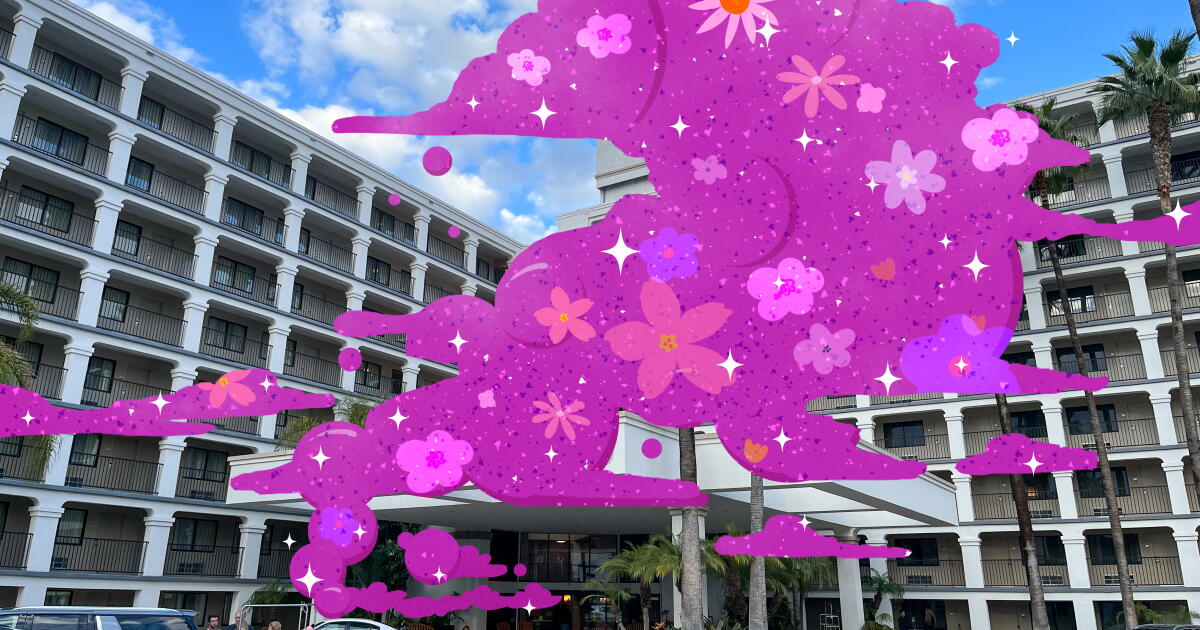
Take a deep breath in Hollywood’s Kimpton Everly Hotel and you may catch a whiff of sandalwood, leather, fennel, cardamom, violet and cedar.
And if you sniff the lobby of downtown Los Angeles’ Ritz-Carlton, you may detect “bright effervescent notes … layered with soft florals,” a custom fragrance known as Champagne & Shimmer.
For years now, hotels have been spending more and more on signature fragrances to woo and hook guests. But what if they make some people sick instead? Would those visitors be victims of discrimination?
One California law firm says yes, and has filed a barrage of lawsuits this year, targeting hotels in California and elsewhere over synthetic fragrances in common areas. (The Kimpton Everly and downtown Ritz-Carlton are not named.)
The conflict highlights an emerging debate about synthetic scents: Many hotels use them, but some sensitive guests consider those aromas as welcome as secondhand smoke.
For better and for worse, smells “can trigger so many things,” said Juliana R. V. Tkatch, an assistant professor at the Harrah College of Hospitality at the University of Nevada Las Vegas, who specializes in experience design, events and theme parks.
Tkatch added that there’s nothing new about using scent as a marketing tool, at least not since the first time “the owner of a restaurant cooked a pie and put it on the top shelf.”
The difference now, Tkatch said, is more advanced technology, making it easier to widely circulate synthetic fragrances and natural scents in a way that’s discreet and constant. Doing so can strengthen customer loyalty, she said, but “it’s a good practice to let people know up front.”
The current controversy began in May and June, when the Oakland-based law firm Cole & Van Note filed a series of class-action lawsuits representing California hotel customers with fragrance sensitivities and targeting major hotel chains.
Some cases, including a May 8 filing that targeted Marriott International Inc., have already been dropped. Others, including a June 4 filing that named Hyatt Hotels Corp., remain in early stages.
In general, the lawsuits allege that artificial fragrances used in many hotel public rooms violate the federal Americans With Disabilities Act (ADA) and California’s Unruh Civil Rights Act, because those fragrances make it dangerous or impossible for some people to share the space.
Attorney Scott Cole, founder of Cole & Van Note, described a recent visit to Las Vegas. “At least 95% of the places that I visited had some kind of fragrance or heightened VOC [volatile organic compound] levels,” Cole said. “I was shocked at how widespread it was there.”
In court filings, Cole’s firm asserts that 26.8% of adults suffer from asthma or asthma-like conditions and 27.5% suffer from chemical sensitivity. He contends that when hotels circulate synthetic fragrances through scent dispersion machines, they may be spreading toxic chemicals, potentially causing respiratory problems, headaches, skin irritation and gastrointestinal, cardiovascular and cognitive problems among vulnerable guests.
As his firm’s campaign has evolved, Cole said, some of the dropped federal cases are being refiled in state courts. He said he expects more filings outside California in coming months.
A spokesman for the California Hotel & Lodging Assn. said its members “work hard to create safe and accessible spaces” and that the industry “consistently reviews best practices to ensure guests are welcomed, comfortable, and safe.”
Representatives for Marriott, Hilton, Hyatt, Intercontinental Hotels Group and Loews hotel chains, all targeted in the first volley of lawsuits, did not respond to requests for comment. Nor did the American Hotel & Lodging Assn., the industry’s leading trade group.
But the association’s website asserts that the Americans With Disabilities Act “has been used as a weapon by scheming lawyers seeking to extort easy settlements … after alleging ambiguous violations of the law.”
This debate turns on several questions, including what constitutes a disability under ADA, what responsibilities businesses should shoulder and how the U.S. regulates fragrances.
Many of the companies that supply hotel fragrances belong to the Switzerland-based International Fragrance Assn. (IFRA), which sets voluntary guidelines for ingredients. But the U.S. government frequently doesn’t require disclosure of fragrance ingredients because blends are often trade secrets.
“It’s outside of the [Food and Drug Administration’s] domain and so the regulatory framework becomes much less stringent,” said Alexander M. Spokoyny, professor and chair of UCLA’s Department of Chemistry and Biochemistry.
Outside the courtroom, a broader conversation simmers on social media.
“It’s honestly time all these scents are banned the same way smoking has been banned pretty much everywhere,” one traveler complained on Reddit.
Another, citing their allergies, wrote that “it’s REALLY hard to find a place that doesn’t stink.”
Yet another responded that “I’m very sensitive to scents and never noticed this.”
Hotel industry veterans note that if guests call in advance, many hotels are able to prepare guest rooms without artificial scents. And some hotels with green leanings, like those in the Laguna Beach-based boutique Soul Community Planet (SCP) Hotels chain, use essential oil diffusers, which rely on plant-based ingredients instead of synthetic ones.
Meanwhile, sales figures suggest that strategic scents, synthetic and otherwise, are helping businesses win over travelers and other consumers. By one estimate, the global scent-marketing business now adds up to $4.1 billion yearly.
The Marriott chain sells candles and diffusers with “the signature scent of your favorite hotels,” including subsidiary brands Ritz-Carlton, St. Regis, Westin, Sheraton and Courtyard. You can even order up the scent of a Fairfield by Marriott, often favored by travelers on tight budgets.
Scentair, a scent-marketing company based in North Carolina, claims customers in 119 countries, including many hotels, and says its creation was “inspired by a Disney Imagineer’s Idea in 1994 to add scents to attractions.”
Another scent company, Australia-based Air Aroma, has created fragrances for Hilton’s Waldorf Astoria Beverly Hills (“notes of blackberry and Damascan Rose”), for DoubleTree properties (“uplifting notes of lemon, white tea, and freesia, and warm comforting notes of cedar and musk”) and for the Hilton Curio Collection’s Starling Atlanta Midtown (“ginger flower, orange, coriander, ivy, and lavender”).
Scent is “memory, mood and emotion, distilled into something you can’t see but never forget,” Air Aroma said in a Facebook post earlier this year.
Yet among skeptics, questions and doubts remain on the safety of chemical entities, fragrances included.
“Even if something might be natural, if you aerosolize it and spread it across buildings, it’s not necessarily great,” UCLA’s Spokoyny said. “I do think it requires more thorough public scrutiny. … You just don’t know what you don’t know.”

Take a deep breath in Hollywood’s Kimpton Everly Hotel and you may catch a whiff of sandalwood, leather, fennel, cardamom, violet and cedar.
And if you sniff the lobby of downtown Los Angeles’ Ritz-Carlton, you may detect “bright effervescent notes … layered with soft florals,” a custom fragrance known as Champagne & Shimmer.
For years now, hotels have been spending more and more on signature fragrances to woo and hook guests. But what if they make some people sick instead? Would those visitors be victims of discrimination?
One California law firm says yes, and has filed a barrage of lawsuits this year, targeting hotels in California and elsewhere over synthetic fragrances in common areas. (The Kimpton Everly and downtown Ritz-Carlton are not named.)
The conflict highlights an emerging debate about synthetic scents: Many hotels use them, but some sensitive guests consider those aromas as welcome as secondhand smoke.
For better and for worse, smells “can trigger so many things,” said Juliana R. V. Tkatch, an assistant professor at the Harrah College of Hospitality at the University of Nevada Las Vegas, who specializes in experience design, events and theme parks.
Tkatch added that there’s nothing new about using scent as a marketing tool, at least not since the first time “the owner of a restaurant cooked a pie and put it on the top shelf.”
The difference now, Tkatch said, is more advanced technology, making it easier to widely circulate synthetic fragrances and natural scents in a way that’s discreet and constant. Doing so can strengthen customer loyalty, she said, but “it’s a good practice to let people know up front.”
The current controversy began in May and June, when the Oakland-based law firm Cole & Van Note filed a series of class-action lawsuits representing California hotel customers with fragrance sensitivities and targeting major hotel chains.
Some cases, including a May 8 filing that targeted Marriott International Inc., have already been dropped. Others, including a June 4 filing that named Hyatt Hotels Corp., remain in early stages.
In general, the lawsuits allege that artificial fragrances used in many hotel public rooms violate the federal Americans With Disabilities Act (ADA) and California’s Unruh Civil Rights Act, because those fragrances make it dangerous or impossible for some people to share the space.
Attorney Scott Cole, founder of Cole & Van Note, described a recent visit to Las Vegas. “At least 95% of the places that I visited had some kind of fragrance or heightened VOC [volatile organic compound] levels,” Cole said. “I was shocked at how widespread it was there.”
In court filings, Cole’s firm asserts that 26.8% of adults suffer from asthma or asthma-like conditions and 27.5% suffer from chemical sensitivity. He contends that when hotels circulate synthetic fragrances through scent dispersion machines, they may be spreading toxic chemicals, potentially causing respiratory problems, headaches, skin irritation and gastrointestinal, cardiovascular and cognitive problems among vulnerable guests.
As his firm’s campaign has evolved, Cole said, some of the dropped federal cases are being refiled in state courts. He said he expects more filings outside California in coming months.
A spokesman for the California Hotel & Lodging Assn. said its members “work hard to create safe and accessible spaces” and that the industry “consistently reviews best practices to ensure guests are welcomed, comfortable, and safe.”
Representatives for Marriott, Hilton, Hyatt, Intercontinental Hotels Group and Loews hotel chains, all targeted in the first volley of lawsuits, did not respond to requests for comment. Nor did the American Hotel & Lodging Assn., the industry’s leading trade group.
But the association’s website asserts that the Americans With Disabilities Act “has been used as a weapon by scheming lawyers seeking to extort easy settlements … after alleging ambiguous violations of the law.”
This debate turns on several questions, including what constitutes a disability under ADA, what responsibilities businesses should shoulder and how the U.S. regulates fragrances.
Many of the companies that supply hotel fragrances belong to the Switzerland-based International Fragrance Assn. (IFRA), which sets voluntary guidelines for ingredients. But the U.S. government frequently doesn’t require disclosure of fragrance ingredients because blends are often trade secrets.
“It’s outside of the [Food and Drug Administration’s] domain and so the regulatory framework becomes much less stringent,” said Alexander M. Spokoyny, professor and chair of UCLA’s Department of Chemistry and Biochemistry.
Outside the courtroom, a broader conversation simmers on social media.
“It’s honestly time all these scents are banned the same way smoking has been banned pretty much everywhere,” one traveler complained on Reddit.
Another, citing their allergies, wrote that “it’s REALLY hard to find a place that doesn’t stink.”
Yet another responded that “I’m very sensitive to scents and never noticed this.”
Hotel industry veterans note that if guests call in advance, many hotels are able to prepare guest rooms without artificial scents. And some hotels with green leanings, like those in the Laguna Beach-based boutique Soul Community Planet (SCP) Hotels chain, use essential oil diffusers, which rely on plant-based ingredients instead of synthetic ones.
Meanwhile, sales figures suggest that strategic scents, synthetic and otherwise, are helping businesses win over travelers and other consumers. By one estimate, the global scent-marketing business now adds up to $4.1 billion yearly.
The Marriott chain sells candles and diffusers with “the signature scent of your favorite hotels,” including subsidiary brands Ritz-Carlton, St. Regis, Westin, Sheraton and Courtyard. You can even order up the scent of a Fairfield by Marriott, often favored by travelers on tight budgets.
Scentair, a scent-marketing company based in North Carolina, claims customers in 119 countries, including many hotels, and says its creation was “inspired by a Disney Imagineer’s Idea in 1994 to add scents to attractions.”
Another scent company, Australia-based Air Aroma, has created fragrances for Hilton’s Waldorf Astoria Beverly Hills (“notes of blackberry and Damascan Rose”), for DoubleTree properties (“uplifting notes of lemon, white tea, and freesia, and warm comforting notes of cedar and musk”) and for the Hilton Curio Collection’s Starling Atlanta Midtown (“ginger flower, orange, coriander, ivy, and lavender”).
Scent is “memory, mood and emotion, distilled into something you can’t see but never forget,” Air Aroma said in a Facebook post earlier this year.
Yet among skeptics, questions and doubts remain on the safety of chemical entities, fragrances included.
“Even if something might be natural, if you aerosolize it and spread it across buildings, it’s not necessarily great,” UCLA’s Spokoyny said. “I do think it requires more thorough public scrutiny. … You just don’t know what you don’t know.”

Take a deep breath in Hollywood’s Kimpton Everly Hotel and you may catch a whiff of sandalwood, leather, fennel, cardamom, violet and cedar.
And if you sniff the lobby of downtown Los Angeles’ Ritz-Carlton, you may detect “bright effervescent notes … layered with soft florals,” a custom fragrance known as Champagne & Shimmer.
For years now, hotels have been spending more and more on signature fragrances to woo and hook guests. But what if they make some people sick instead? Would those visitors be victims of discrimination?
One California law firm says yes, and has filed a barrage of lawsuits this year, targeting hotels in California and elsewhere over synthetic fragrances in common areas. (The Kimpton Everly and downtown Ritz-Carlton are not named.)
The conflict highlights an emerging debate about synthetic scents: Many hotels use them, but some sensitive guests consider those aromas as welcome as secondhand smoke.
For better and for worse, smells “can trigger so many things,” said Juliana R. V. Tkatch, an assistant professor at the Harrah College of Hospitality at the University of Nevada Las Vegas, who specializes in experience design, events and theme parks.
Tkatch added that there’s nothing new about using scent as a marketing tool, at least not since the first time “the owner of a restaurant cooked a pie and put it on the top shelf.”
The difference now, Tkatch said, is more advanced technology, making it easier to widely circulate synthetic fragrances and natural scents in a way that’s discreet and constant. Doing so can strengthen customer loyalty, she said, but “it’s a good practice to let people know up front.”
The current controversy began in May and June, when the Oakland-based law firm Cole & Van Note filed a series of class-action lawsuits representing California hotel customers with fragrance sensitivities and targeting major hotel chains.
Some cases, including a May 8 filing that targeted Marriott International Inc., have already been dropped. Others, including a June 4 filing that named Hyatt Hotels Corp., remain in early stages.
In general, the lawsuits allege that artificial fragrances used in many hotel public rooms violate the federal Americans With Disabilities Act (ADA) and California’s Unruh Civil Rights Act, because those fragrances make it dangerous or impossible for some people to share the space.
Attorney Scott Cole, founder of Cole & Van Note, described a recent visit to Las Vegas. “At least 95% of the places that I visited had some kind of fragrance or heightened VOC [volatile organic compound] levels,” Cole said. “I was shocked at how widespread it was there.”
In court filings, Cole’s firm asserts that 26.8% of adults suffer from asthma or asthma-like conditions and 27.5% suffer from chemical sensitivity. He contends that when hotels circulate synthetic fragrances through scent dispersion machines, they may be spreading toxic chemicals, potentially causing respiratory problems, headaches, skin irritation and gastrointestinal, cardiovascular and cognitive problems among vulnerable guests.
As his firm’s campaign has evolved, Cole said, some of the dropped federal cases are being refiled in state courts. He said he expects more filings outside California in coming months.
A spokesman for the California Hotel & Lodging Assn. said its members “work hard to create safe and accessible spaces” and that the industry “consistently reviews best practices to ensure guests are welcomed, comfortable, and safe.”
Representatives for Marriott, Hilton, Hyatt, Intercontinental Hotels Group and Loews hotel chains, all targeted in the first volley of lawsuits, did not respond to requests for comment. Nor did the American Hotel & Lodging Assn., the industry’s leading trade group.
But the association’s website asserts that the Americans With Disabilities Act “has been used as a weapon by scheming lawyers seeking to extort easy settlements … after alleging ambiguous violations of the law.”
This debate turns on several questions, including what constitutes a disability under ADA, what responsibilities businesses should shoulder and how the U.S. regulates fragrances.
Many of the companies that supply hotel fragrances belong to the Switzerland-based International Fragrance Assn. (IFRA), which sets voluntary guidelines for ingredients. But the U.S. government frequently doesn’t require disclosure of fragrance ingredients because blends are often trade secrets.
“It’s outside of the [Food and Drug Administration’s] domain and so the regulatory framework becomes much less stringent,” said Alexander M. Spokoyny, professor and chair of UCLA’s Department of Chemistry and Biochemistry.
Outside the courtroom, a broader conversation simmers on social media.
“It’s honestly time all these scents are banned the same way smoking has been banned pretty much everywhere,” one traveler complained on Reddit.
Another, citing their allergies, wrote that “it’s REALLY hard to find a place that doesn’t stink.”
Yet another responded that “I’m very sensitive to scents and never noticed this.”
Hotel industry veterans note that if guests call in advance, many hotels are able to prepare guest rooms without artificial scents. And some hotels with green leanings, like those in the Laguna Beach-based boutique Soul Community Planet (SCP) Hotels chain, use essential oil diffusers, which rely on plant-based ingredients instead of synthetic ones.
Meanwhile, sales figures suggest that strategic scents, synthetic and otherwise, are helping businesses win over travelers and other consumers. By one estimate, the global scent-marketing business now adds up to $4.1 billion yearly.
The Marriott chain sells candles and diffusers with “the signature scent of your favorite hotels,” including subsidiary brands Ritz-Carlton, St. Regis, Westin, Sheraton and Courtyard. You can even order up the scent of a Fairfield by Marriott, often favored by travelers on tight budgets.
Scentair, a scent-marketing company based in North Carolina, claims customers in 119 countries, including many hotels, and says its creation was “inspired by a Disney Imagineer’s Idea in 1994 to add scents to attractions.”
Another scent company, Australia-based Air Aroma, has created fragrances for Hilton’s Waldorf Astoria Beverly Hills (“notes of blackberry and Damascan Rose”), for DoubleTree properties (“uplifting notes of lemon, white tea, and freesia, and warm comforting notes of cedar and musk”) and for the Hilton Curio Collection’s Starling Atlanta Midtown (“ginger flower, orange, coriander, ivy, and lavender”).
Scent is “memory, mood and emotion, distilled into something you can’t see but never forget,” Air Aroma said in a Facebook post earlier this year.
Yet among skeptics, questions and doubts remain on the safety of chemical entities, fragrances included.
“Even if something might be natural, if you aerosolize it and spread it across buildings, it’s not necessarily great,” UCLA’s Spokoyny said. “I do think it requires more thorough public scrutiny. … You just don’t know what you don’t know.”
Take a deep breath in Hollywood’s Kimpton Everly Hotel and you may catch a whiff of sandalwood, leather, fennel, cardamom, violet and cedar.
And if you sniff the lobby of downtown Los Angeles’ Ritz-Carlton, you may detect “bright effervescent notes … layered with soft florals,” a custom fragrance known as Champagne & Shimmer.
For years now, hotels have been spending more and more on signature fragrances to woo and hook guests. But what if they make some people sick instead? Would those visitors be victims of discrimination?
One California law firm says yes, and has filed a barrage of lawsuits this year, targeting hotels in California and elsewhere over synthetic fragrances in common areas. (The Kimpton Everly and downtown Ritz-Carlton are not named.)
The conflict highlights an emerging debate about synthetic scents: Many hotels use them, but some sensitive guests consider those aromas as welcome as secondhand smoke.
For better and for worse, smells “can trigger so many things,” said Juliana R. V. Tkatch, an assistant professor at the Harrah College of Hospitality at the University of Nevada Las Vegas, who specializes in experience design, events and theme parks.
Tkatch added that there’s nothing new about using scent as a marketing tool, at least not since the first time “the owner of a restaurant cooked a pie and put it on the top shelf.”
The difference now, Tkatch said, is more advanced technology, making it easier to widely circulate synthetic fragrances and natural scents in a way that’s discreet and constant. Doing so can strengthen customer loyalty, she said, but “it’s a good practice to let people know up front.”
The current controversy began in May and June, when the Oakland-based law firm Cole & Van Note filed a series of class-action lawsuits representing California hotel customers with fragrance sensitivities and targeting major hotel chains.
Some cases, including a May 8 filing that targeted Marriott International Inc., have already been dropped. Others, including a June 4 filing that named Hyatt Hotels Corp., remain in early stages.
In general, the lawsuits allege that artificial fragrances used in many hotel public rooms violate the federal Americans With Disabilities Act (ADA) and California’s Unruh Civil Rights Act, because those fragrances make it dangerous or impossible for some people to share the space.
Attorney Scott Cole, founder of Cole & Van Note, described a recent visit to Las Vegas. “At least 95% of the places that I visited had some kind of fragrance or heightened VOC [volatile organic compound] levels,” Cole said. “I was shocked at how widespread it was there.”
In court filings, Cole’s firm asserts that 26.8% of adults suffer from asthma or asthma-like conditions and 27.5% suffer from chemical sensitivity. He contends that when hotels circulate synthetic fragrances through scent dispersion machines, they may be spreading toxic chemicals, potentially causing respiratory problems, headaches, skin irritation and gastrointestinal, cardiovascular and cognitive problems among vulnerable guests.
As his firm’s campaign has evolved, Cole said, some of the dropped federal cases are being refiled in state courts. He said he expects more filings outside California in coming months.
A spokesman for the California Hotel & Lodging Assn. said its members “work hard to create safe and accessible spaces” and that the industry “consistently reviews best practices to ensure guests are welcomed, comfortable, and safe.”
Representatives for Marriott, Hilton, Hyatt, Intercontinental Hotels Group and Loews hotel chains, all targeted in the first volley of lawsuits, did not respond to requests for comment. Nor did the American Hotel & Lodging Assn., the industry’s leading trade group.
But the association’s website asserts that the Americans With Disabilities Act “has been used as a weapon by scheming lawyers seeking to extort easy settlements … after alleging ambiguous violations of the law.”
This debate turns on several questions, including what constitutes a disability under ADA, what responsibilities businesses should shoulder and how the U.S. regulates fragrances.
Many of the companies that supply hotel fragrances belong to the Switzerland-based International Fragrance Assn. (IFRA), which sets voluntary guidelines for ingredients. But the U.S. government frequently doesn’t require disclosure of fragrance ingredients because blends are often trade secrets.
“It’s outside of the [Food and Drug Administration’s] domain and so the regulatory framework becomes much less stringent,” said Alexander M. Spokoyny, professor and chair of UCLA’s Department of Chemistry and Biochemistry.
Outside the courtroom, a broader conversation simmers on social media.
“It’s honestly time all these scents are banned the same way smoking has been banned pretty much everywhere,” one traveler complained on Reddit.
Another, citing their allergies, wrote that “it’s REALLY hard to find a place that doesn’t stink.”
Yet another responded that “I’m very sensitive to scents and never noticed this.”
Hotel industry veterans note that if guests call in advance, many hotels are able to prepare guest rooms without artificial scents. And some hotels with green leanings, like those in the Laguna Beach-based boutique Soul Community Planet (SCP) Hotels chain, use essential oil diffusers, which rely on plant-based ingredients instead of synthetic ones.
Meanwhile, sales figures suggest that strategic scents, synthetic and otherwise, are helping businesses win over travelers and other consumers. By one estimate, the global scent-marketing business now adds up to $4.1 billion yearly.
The Marriott chain sells candles and diffusers with “the signature scent of your favorite hotels,” including subsidiary brands Ritz-Carlton, St. Regis, Westin, Sheraton and Courtyard. You can even order up the scent of a Fairfield by Marriott, often favored by travelers on tight budgets.
Scentair, a scent-marketing company based in North Carolina, claims customers in 119 countries, including many hotels, and says its creation was “inspired by a Disney Imagineer’s Idea in 1994 to add scents to attractions.”
Another scent company, Australia-based Air Aroma, has created fragrances for Hilton’s Waldorf Astoria Beverly Hills (“notes of blackberry and Damascan Rose”), for DoubleTree properties (“uplifting notes of lemon, white tea, and freesia, and warm comforting notes of cedar and musk”) and for the Hilton Curio Collection’s Starling Atlanta Midtown (“ginger flower, orange, coriander, ivy, and lavender”).
Scent is “memory, mood and emotion, distilled into something you can’t see but never forget,” Air Aroma said in a Facebook post earlier this year.
Yet among skeptics, questions and doubts remain on the safety of chemical entities, fragrances included.
“Even if something might be natural, if you aerosolize it and spread it across buildings, it’s not necessarily great,” UCLA’s Spokoyny said. “I do think it requires more thorough public scrutiny. … You just don’t know what you don’t know.”

Take a deep breath in Hollywood’s Kimpton Everly Hotel and you may catch a whiff of sandalwood, leather, fennel, cardamom, violet and cedar.
And if you sniff the lobby of downtown Los Angeles’ Ritz-Carlton, you may detect “bright effervescent notes … layered with soft florals,” a custom fragrance known as Champagne & Shimmer.
For years now, hotels have been spending more and more on signature fragrances to woo and hook guests. But what if they make some people sick instead? Would those visitors be victims of discrimination?
One California law firm says yes, and has filed a barrage of lawsuits this year, targeting hotels in California and elsewhere over synthetic fragrances in common areas. (The Kimpton Everly and downtown Ritz-Carlton are not named.)
The conflict highlights an emerging debate about synthetic scents: Many hotels use them, but some sensitive guests consider those aromas as welcome as secondhand smoke.
For better and for worse, smells “can trigger so many things,” said Juliana R. V. Tkatch, an assistant professor at the Harrah College of Hospitality at the University of Nevada Las Vegas, who specializes in experience design, events and theme parks.
Tkatch added that there’s nothing new about using scent as a marketing tool, at least not since the first time “the owner of a restaurant cooked a pie and put it on the top shelf.”
The difference now, Tkatch said, is more advanced technology, making it easier to widely circulate synthetic fragrances and natural scents in a way that’s discreet and constant. Doing so can strengthen customer loyalty, she said, but “it’s a good practice to let people know up front.”
The current controversy began in May and June, when the Oakland-based law firm Cole & Van Note filed a series of class-action lawsuits representing California hotel customers with fragrance sensitivities and targeting major hotel chains.
Some cases, including a May 8 filing that targeted Marriott International Inc., have already been dropped. Others, including a June 4 filing that named Hyatt Hotels Corp., remain in early stages.
In general, the lawsuits allege that artificial fragrances used in many hotel public rooms violate the federal Americans With Disabilities Act (ADA) and California’s Unruh Civil Rights Act, because those fragrances make it dangerous or impossible for some people to share the space.
Attorney Scott Cole, founder of Cole & Van Note, described a recent visit to Las Vegas. “At least 95% of the places that I visited had some kind of fragrance or heightened VOC [volatile organic compound] levels,” Cole said. “I was shocked at how widespread it was there.”
In court filings, Cole’s firm asserts that 26.8% of adults suffer from asthma or asthma-like conditions and 27.5% suffer from chemical sensitivity. He contends that when hotels circulate synthetic fragrances through scent dispersion machines, they may be spreading toxic chemicals, potentially causing respiratory problems, headaches, skin irritation and gastrointestinal, cardiovascular and cognitive problems among vulnerable guests.
As his firm’s campaign has evolved, Cole said, some of the dropped federal cases are being refiled in state courts. He said he expects more filings outside California in coming months.
A spokesman for the California Hotel & Lodging Assn. said its members “work hard to create safe and accessible spaces” and that the industry “consistently reviews best practices to ensure guests are welcomed, comfortable, and safe.”
Representatives for Marriott, Hilton, Hyatt, Intercontinental Hotels Group and Loews hotel chains, all targeted in the first volley of lawsuits, did not respond to requests for comment. Nor did the American Hotel & Lodging Assn., the industry’s leading trade group.
But the association’s website asserts that the Americans With Disabilities Act “has been used as a weapon by scheming lawyers seeking to extort easy settlements … after alleging ambiguous violations of the law.”
This debate turns on several questions, including what constitutes a disability under ADA, what responsibilities businesses should shoulder and how the U.S. regulates fragrances.
Many of the companies that supply hotel fragrances belong to the Switzerland-based International Fragrance Assn. (IFRA), which sets voluntary guidelines for ingredients. But the U.S. government frequently doesn’t require disclosure of fragrance ingredients because blends are often trade secrets.
“It’s outside of the [Food and Drug Administration’s] domain and so the regulatory framework becomes much less stringent,” said Alexander M. Spokoyny, professor and chair of UCLA’s Department of Chemistry and Biochemistry.
Outside the courtroom, a broader conversation simmers on social media.
“It’s honestly time all these scents are banned the same way smoking has been banned pretty much everywhere,” one traveler complained on Reddit.
Another, citing their allergies, wrote that “it’s REALLY hard to find a place that doesn’t stink.”
Yet another responded that “I’m very sensitive to scents and never noticed this.”
Hotel industry veterans note that if guests call in advance, many hotels are able to prepare guest rooms without artificial scents. And some hotels with green leanings, like those in the Laguna Beach-based boutique Soul Community Planet (SCP) Hotels chain, use essential oil diffusers, which rely on plant-based ingredients instead of synthetic ones.
Meanwhile, sales figures suggest that strategic scents, synthetic and otherwise, are helping businesses win over travelers and other consumers. By one estimate, the global scent-marketing business now adds up to $4.1 billion yearly.
The Marriott chain sells candles and diffusers with “the signature scent of your favorite hotels,” including subsidiary brands Ritz-Carlton, St. Regis, Westin, Sheraton and Courtyard. You can even order up the scent of a Fairfield by Marriott, often favored by travelers on tight budgets.
Scentair, a scent-marketing company based in North Carolina, claims customers in 119 countries, including many hotels, and says its creation was “inspired by a Disney Imagineer’s Idea in 1994 to add scents to attractions.”
Another scent company, Australia-based Air Aroma, has created fragrances for Hilton’s Waldorf Astoria Beverly Hills (“notes of blackberry and Damascan Rose”), for DoubleTree properties (“uplifting notes of lemon, white tea, and freesia, and warm comforting notes of cedar and musk”) and for the Hilton Curio Collection’s Starling Atlanta Midtown (“ginger flower, orange, coriander, ivy, and lavender”).
Scent is “memory, mood and emotion, distilled into something you can’t see but never forget,” Air Aroma said in a Facebook post earlier this year.
Yet among skeptics, questions and doubts remain on the safety of chemical entities, fragrances included.
“Even if something might be natural, if you aerosolize it and spread it across buildings, it’s not necessarily great,” UCLA’s Spokoyny said. “I do think it requires more thorough public scrutiny. … You just don’t know what you don’t know.”
Take a deep breath in Hollywood’s Kimpton Everly Hotel and you may catch a whiff of sandalwood, leather, fennel, cardamom, violet and cedar.
And if you sniff the lobby of downtown Los Angeles’ Ritz-Carlton, you may detect “bright effervescent notes … layered with soft florals,” a custom fragrance known as Champagne & Shimmer.
For years now, hotels have been spending more and more on signature fragrances to woo and hook guests. But what if they make some people sick instead? Would those visitors be victims of discrimination?
One California law firm says yes, and has filed a barrage of lawsuits this year, targeting hotels in California and elsewhere over synthetic fragrances in common areas. (The Kimpton Everly and downtown Ritz-Carlton are not named.)
The conflict highlights an emerging debate about synthetic scents: Many hotels use them, but some sensitive guests consider those aromas as welcome as secondhand smoke.
For better and for worse, smells “can trigger so many things,” said Juliana R. V. Tkatch, an assistant professor at the Harrah College of Hospitality at the University of Nevada Las Vegas, who specializes in experience design, events and theme parks.
Tkatch added that there’s nothing new about using scent as a marketing tool, at least not since the first time “the owner of a restaurant cooked a pie and put it on the top shelf.”
The difference now, Tkatch said, is more advanced technology, making it easier to widely circulate synthetic fragrances and natural scents in a way that’s discreet and constant. Doing so can strengthen customer loyalty, she said, but “it’s a good practice to let people know up front.”
The current controversy began in May and June, when the Oakland-based law firm Cole & Van Note filed a series of class-action lawsuits representing California hotel customers with fragrance sensitivities and targeting major hotel chains.
Some cases, including a May 8 filing that targeted Marriott International Inc., have already been dropped. Others, including a June 4 filing that named Hyatt Hotels Corp., remain in early stages.
In general, the lawsuits allege that artificial fragrances used in many hotel public rooms violate the federal Americans With Disabilities Act (ADA) and California’s Unruh Civil Rights Act, because those fragrances make it dangerous or impossible for some people to share the space.
Attorney Scott Cole, founder of Cole & Van Note, described a recent visit to Las Vegas. “At least 95% of the places that I visited had some kind of fragrance or heightened VOC [volatile organic compound] levels,” Cole said. “I was shocked at how widespread it was there.”
In court filings, Cole’s firm asserts that 26.8% of adults suffer from asthma or asthma-like conditions and 27.5% suffer from chemical sensitivity. He contends that when hotels circulate synthetic fragrances through scent dispersion machines, they may be spreading toxic chemicals, potentially causing respiratory problems, headaches, skin irritation and gastrointestinal, cardiovascular and cognitive problems among vulnerable guests.
As his firm’s campaign has evolved, Cole said, some of the dropped federal cases are being refiled in state courts. He said he expects more filings outside California in coming months.
A spokesman for the California Hotel & Lodging Assn. said its members “work hard to create safe and accessible spaces” and that the industry “consistently reviews best practices to ensure guests are welcomed, comfortable, and safe.”
Representatives for Marriott, Hilton, Hyatt, Intercontinental Hotels Group and Loews hotel chains, all targeted in the first volley of lawsuits, did not respond to requests for comment. Nor did the American Hotel & Lodging Assn., the industry’s leading trade group.
But the association’s website asserts that the Americans With Disabilities Act “has been used as a weapon by scheming lawyers seeking to extort easy settlements … after alleging ambiguous violations of the law.”
This debate turns on several questions, including what constitutes a disability under ADA, what responsibilities businesses should shoulder and how the U.S. regulates fragrances.
Many of the companies that supply hotel fragrances belong to the Switzerland-based International Fragrance Assn. (IFRA), which sets voluntary guidelines for ingredients. But the U.S. government frequently doesn’t require disclosure of fragrance ingredients because blends are often trade secrets.
“It’s outside of the [Food and Drug Administration’s] domain and so the regulatory framework becomes much less stringent,” said Alexander M. Spokoyny, professor and chair of UCLA’s Department of Chemistry and Biochemistry.
Outside the courtroom, a broader conversation simmers on social media.
“It’s honestly time all these scents are banned the same way smoking has been banned pretty much everywhere,” one traveler complained on Reddit.
Another, citing their allergies, wrote that “it’s REALLY hard to find a place that doesn’t stink.”
Yet another responded that “I’m very sensitive to scents and never noticed this.”
Hotel industry veterans note that if guests call in advance, many hotels are able to prepare guest rooms without artificial scents. And some hotels with green leanings, like those in the Laguna Beach-based boutique Soul Community Planet (SCP) Hotels chain, use essential oil diffusers, which rely on plant-based ingredients instead of synthetic ones.
Meanwhile, sales figures suggest that strategic scents, synthetic and otherwise, are helping businesses win over travelers and other consumers. By one estimate, the global scent-marketing business now adds up to $4.1 billion yearly.
The Marriott chain sells candles and diffusers with “the signature scent of your favorite hotels,” including subsidiary brands Ritz-Carlton, St. Regis, Westin, Sheraton and Courtyard. You can even order up the scent of a Fairfield by Marriott, often favored by travelers on tight budgets.
Scentair, a scent-marketing company based in North Carolina, claims customers in 119 countries, including many hotels, and says its creation was “inspired by a Disney Imagineer’s Idea in 1994 to add scents to attractions.”
Another scent company, Australia-based Air Aroma, has created fragrances for Hilton’s Waldorf Astoria Beverly Hills (“notes of blackberry and Damascan Rose”), for DoubleTree properties (“uplifting notes of lemon, white tea, and freesia, and warm comforting notes of cedar and musk”) and for the Hilton Curio Collection’s Starling Atlanta Midtown (“ginger flower, orange, coriander, ivy, and lavender”).
Scent is “memory, mood and emotion, distilled into something you can’t see but never forget,” Air Aroma said in a Facebook post earlier this year.
Yet among skeptics, questions and doubts remain on the safety of chemical entities, fragrances included.
“Even if something might be natural, if you aerosolize it and spread it across buildings, it’s not necessarily great,” UCLA’s Spokoyny said. “I do think it requires more thorough public scrutiny. … You just don’t know what you don’t know.”
Take a deep breath in Hollywood’s Kimpton Everly Hotel and you may catch a whiff of sandalwood, leather, fennel, cardamom, violet and cedar.
And if you sniff the lobby of downtown Los Angeles’ Ritz-Carlton, you may detect “bright effervescent notes … layered with soft florals,” a custom fragrance known as Champagne & Shimmer.
For years now, hotels have been spending more and more on signature fragrances to woo and hook guests. But what if they make some people sick instead? Would those visitors be victims of discrimination?
One California law firm says yes, and has filed a barrage of lawsuits this year, targeting hotels in California and elsewhere over synthetic fragrances in common areas. (The Kimpton Everly and downtown Ritz-Carlton are not named.)
The conflict highlights an emerging debate about synthetic scents: Many hotels use them, but some sensitive guests consider those aromas as welcome as secondhand smoke.
For better and for worse, smells “can trigger so many things,” said Juliana R. V. Tkatch, an assistant professor at the Harrah College of Hospitality at the University of Nevada Las Vegas, who specializes in experience design, events and theme parks.
Tkatch added that there’s nothing new about using scent as a marketing tool, at least not since the first time “the owner of a restaurant cooked a pie and put it on the top shelf.”
The difference now, Tkatch said, is more advanced technology, making it easier to widely circulate synthetic fragrances and natural scents in a way that’s discreet and constant. Doing so can strengthen customer loyalty, she said, but “it’s a good practice to let people know up front.”
The current controversy began in May and June, when the Oakland-based law firm Cole & Van Note filed a series of class-action lawsuits representing California hotel customers with fragrance sensitivities and targeting major hotel chains.
Some cases, including a May 8 filing that targeted Marriott International Inc., have already been dropped. Others, including a June 4 filing that named Hyatt Hotels Corp., remain in early stages.
In general, the lawsuits allege that artificial fragrances used in many hotel public rooms violate the federal Americans With Disabilities Act (ADA) and California’s Unruh Civil Rights Act, because those fragrances make it dangerous or impossible for some people to share the space.
Attorney Scott Cole, founder of Cole & Van Note, described a recent visit to Las Vegas. “At least 95% of the places that I visited had some kind of fragrance or heightened VOC [volatile organic compound] levels,” Cole said. “I was shocked at how widespread it was there.”
In court filings, Cole’s firm asserts that 26.8% of adults suffer from asthma or asthma-like conditions and 27.5% suffer from chemical sensitivity. He contends that when hotels circulate synthetic fragrances through scent dispersion machines, they may be spreading toxic chemicals, potentially causing respiratory problems, headaches, skin irritation and gastrointestinal, cardiovascular and cognitive problems among vulnerable guests.
As his firm’s campaign has evolved, Cole said, some of the dropped federal cases are being refiled in state courts. He said he expects more filings outside California in coming months.
A spokesman for the California Hotel & Lodging Assn. said its members “work hard to create safe and accessible spaces” and that the industry “consistently reviews best practices to ensure guests are welcomed, comfortable, and safe.”
Representatives for Marriott, Hilton, Hyatt, Intercontinental Hotels Group and Loews hotel chains, all targeted in the first volley of lawsuits, did not respond to requests for comment. Nor did the American Hotel & Lodging Assn., the industry’s leading trade group.
But the association’s website asserts that the Americans With Disabilities Act “has been used as a weapon by scheming lawyers seeking to extort easy settlements … after alleging ambiguous violations of the law.”
This debate turns on several questions, including what constitutes a disability under ADA, what responsibilities businesses should shoulder and how the U.S. regulates fragrances.
Many of the companies that supply hotel fragrances belong to the Switzerland-based International Fragrance Assn. (IFRA), which sets voluntary guidelines for ingredients. But the U.S. government frequently doesn’t require disclosure of fragrance ingredients because blends are often trade secrets.
“It’s outside of the [Food and Drug Administration’s] domain and so the regulatory framework becomes much less stringent,” said Alexander M. Spokoyny, professor and chair of UCLA’s Department of Chemistry and Biochemistry.
Outside the courtroom, a broader conversation simmers on social media.
“It’s honestly time all these scents are banned the same way smoking has been banned pretty much everywhere,” one traveler complained on Reddit.
Another, citing their allergies, wrote that “it’s REALLY hard to find a place that doesn’t stink.”
Yet another responded that “I’m very sensitive to scents and never noticed this.”
Hotel industry veterans note that if guests call in advance, many hotels are able to prepare guest rooms without artificial scents. And some hotels with green leanings, like those in the Laguna Beach-based boutique Soul Community Planet (SCP) Hotels chain, use essential oil diffusers, which rely on plant-based ingredients instead of synthetic ones.
Meanwhile, sales figures suggest that strategic scents, synthetic and otherwise, are helping businesses win over travelers and other consumers. By one estimate, the global scent-marketing business now adds up to $4.1 billion yearly.
The Marriott chain sells candles and diffusers with “the signature scent of your favorite hotels,” including subsidiary brands Ritz-Carlton, St. Regis, Westin, Sheraton and Courtyard. You can even order up the scent of a Fairfield by Marriott, often favored by travelers on tight budgets.
Scentair, a scent-marketing company based in North Carolina, claims customers in 119 countries, including many hotels, and says its creation was “inspired by a Disney Imagineer’s Idea in 1994 to add scents to attractions.”
Another scent company, Australia-based Air Aroma, has created fragrances for Hilton’s Waldorf Astoria Beverly Hills (“notes of blackberry and Damascan Rose”), for DoubleTree properties (“uplifting notes of lemon, white tea, and freesia, and warm comforting notes of cedar and musk”) and for the Hilton Curio Collection’s Starling Atlanta Midtown (“ginger flower, orange, coriander, ivy, and lavender”).
Scent is “memory, mood and emotion, distilled into something you can’t see but never forget,” Air Aroma said in a Facebook post earlier this year.
Yet among skeptics, questions and doubts remain on the safety of chemical entities, fragrances included.
“Even if something might be natural, if you aerosolize it and spread it across buildings, it’s not necessarily great,” UCLA’s Spokoyny said. “I do think it requires more thorough public scrutiny. … You just don’t know what you don’t know.”
Take a deep breath in Hollywood’s Kimpton Everly Hotel and you may catch a whiff of sandalwood, leather, fennel, cardamom, violet and cedar.
And if you sniff the lobby of downtown Los Angeles’ Ritz-Carlton, you may detect “bright effervescent notes … layered with soft florals,” a custom fragrance known as Champagne & Shimmer.
For years now, hotels have been spending more and more on signature fragrances to woo and hook guests. But what if they make some people sick instead? Would those visitors be victims of discrimination?
One California law firm says yes, and has filed a barrage of lawsuits this year, targeting hotels in California and elsewhere over synthetic fragrances in common areas. (The Kimpton Everly and downtown Ritz-Carlton are not named.)
The conflict highlights an emerging debate about synthetic scents: Many hotels use them, but some sensitive guests consider those aromas as welcome as secondhand smoke.
For better and for worse, smells “can trigger so many things,” said Juliana R. V. Tkatch, an assistant professor at the Harrah College of Hospitality at the University of Nevada Las Vegas, who specializes in experience design, events and theme parks.
Tkatch added that there’s nothing new about using scent as a marketing tool, at least not since the first time “the owner of a restaurant cooked a pie and put it on the top shelf.”
The difference now, Tkatch said, is more advanced technology, making it easier to widely circulate synthetic fragrances and natural scents in a way that’s discreet and constant. Doing so can strengthen customer loyalty, she said, but “it’s a good practice to let people know up front.”
The current controversy began in May and June, when the Oakland-based law firm Cole & Van Note filed a series of class-action lawsuits representing California hotel customers with fragrance sensitivities and targeting major hotel chains.
Some cases, including a May 8 filing that targeted Marriott International Inc., have already been dropped. Others, including a June 4 filing that named Hyatt Hotels Corp., remain in early stages.
In general, the lawsuits allege that artificial fragrances used in many hotel public rooms violate the federal Americans With Disabilities Act (ADA) and California’s Unruh Civil Rights Act, because those fragrances make it dangerous or impossible for some people to share the space.
Attorney Scott Cole, founder of Cole & Van Note, described a recent visit to Las Vegas. “At least 95% of the places that I visited had some kind of fragrance or heightened VOC [volatile organic compound] levels,” Cole said. “I was shocked at how widespread it was there.”
In court filings, Cole’s firm asserts that 26.8% of adults suffer from asthma or asthma-like conditions and 27.5% suffer from chemical sensitivity. He contends that when hotels circulate synthetic fragrances through scent dispersion machines, they may be spreading toxic chemicals, potentially causing respiratory problems, headaches, skin irritation and gastrointestinal, cardiovascular and cognitive problems among vulnerable guests.
As his firm’s campaign has evolved, Cole said, some of the dropped federal cases are being refiled in state courts. He said he expects more filings outside California in coming months.
A spokesman for the California Hotel & Lodging Assn. said its members “work hard to create safe and accessible spaces” and that the industry “consistently reviews best practices to ensure guests are welcomed, comfortable, and safe.”
Representatives for Marriott, Hilton, Hyatt, Intercontinental Hotels Group and Loews hotel chains, all targeted in the first volley of lawsuits, did not respond to requests for comment. Nor did the American Hotel & Lodging Assn., the industry’s leading trade group.
But the association’s website asserts that the Americans With Disabilities Act “has been used as a weapon by scheming lawyers seeking to extort easy settlements … after alleging ambiguous violations of the law.”
This debate turns on several questions, including what constitutes a disability under ADA, what responsibilities businesses should shoulder and how the U.S. regulates fragrances.
Many of the companies that supply hotel fragrances belong to the Switzerland-based International Fragrance Assn. (IFRA), which sets voluntary guidelines for ingredients. But the U.S. government frequently doesn’t require disclosure of fragrance ingredients because blends are often trade secrets.
“It’s outside of the [Food and Drug Administration’s] domain and so the regulatory framework becomes much less stringent,” said Alexander M. Spokoyny, professor and chair of UCLA’s Department of Chemistry and Biochemistry.
Outside the courtroom, a broader conversation simmers on social media.
“It’s honestly time all these scents are banned the same way smoking has been banned pretty much everywhere,” one traveler complained on Reddit.
Another, citing their allergies, wrote that “it’s REALLY hard to find a place that doesn’t stink.”
Yet another responded that “I’m very sensitive to scents and never noticed this.”
Hotel industry veterans note that if guests call in advance, many hotels are able to prepare guest rooms without artificial scents. And some hotels with green leanings, like those in the Laguna Beach-based boutique Soul Community Planet (SCP) Hotels chain, use essential oil diffusers, which rely on plant-based ingredients instead of synthetic ones.
Meanwhile, sales figures suggest that strategic scents, synthetic and otherwise, are helping businesses win over travelers and other consumers. By one estimate, the global scent-marketing business now adds up to $4.1 billion yearly.
The Marriott chain sells candles and diffusers with “the signature scent of your favorite hotels,” including subsidiary brands Ritz-Carlton, St. Regis, Westin, Sheraton and Courtyard. You can even order up the scent of a Fairfield by Marriott, often favored by travelers on tight budgets.
Scentair, a scent-marketing company based in North Carolina, claims customers in 119 countries, including many hotels, and says its creation was “inspired by a Disney Imagineer’s Idea in 1994 to add scents to attractions.”
Another scent company, Australia-based Air Aroma, has created fragrances for Hilton’s Waldorf Astoria Beverly Hills (“notes of blackberry and Damascan Rose”), for DoubleTree properties (“uplifting notes of lemon, white tea, and freesia, and warm comforting notes of cedar and musk”) and for the Hilton Curio Collection’s Starling Atlanta Midtown (“ginger flower, orange, coriander, ivy, and lavender”).
Scent is “memory, mood and emotion, distilled into something you can’t see but never forget,” Air Aroma said in a Facebook post earlier this year.
Yet among skeptics, questions and doubts remain on the safety of chemical entities, fragrances included.
“Even if something might be natural, if you aerosolize it and spread it across buildings, it’s not necessarily great,” UCLA’s Spokoyny said. “I do think it requires more thorough public scrutiny. … You just don’t know what you don’t know.”

Take a deep breath in Hollywood’s Kimpton Everly Hotel and you may catch a whiff of sandalwood, leather, fennel, cardamom, violet and cedar.
And if you sniff the lobby of downtown Los Angeles’ Ritz-Carlton, you may detect “bright effervescent notes … layered with soft florals,” a custom fragrance known as Champagne & Shimmer.
For years now, hotels have been spending more and more on signature fragrances to woo and hook guests. But what if they make some people sick instead? Would those visitors be victims of discrimination?
One California law firm says yes, and has filed a barrage of lawsuits this year, targeting hotels in California and elsewhere over synthetic fragrances in common areas. (The Kimpton Everly and downtown Ritz-Carlton are not named.)
The conflict highlights an emerging debate about synthetic scents: Many hotels use them, but some sensitive guests consider those aromas as welcome as secondhand smoke.
For better and for worse, smells “can trigger so many things,” said Juliana R. V. Tkatch, an assistant professor at the Harrah College of Hospitality at the University of Nevada Las Vegas, who specializes in experience design, events and theme parks.
Tkatch added that there’s nothing new about using scent as a marketing tool, at least not since the first time “the owner of a restaurant cooked a pie and put it on the top shelf.”
The difference now, Tkatch said, is more advanced technology, making it easier to widely circulate synthetic fragrances and natural scents in a way that’s discreet and constant. Doing so can strengthen customer loyalty, she said, but “it’s a good practice to let people know up front.”
The current controversy began in May and June, when the Oakland-based law firm Cole & Van Note filed a series of class-action lawsuits representing California hotel customers with fragrance sensitivities and targeting major hotel chains.
Some cases, including a May 8 filing that targeted Marriott International Inc., have already been dropped. Others, including a June 4 filing that named Hyatt Hotels Corp., remain in early stages.
In general, the lawsuits allege that artificial fragrances used in many hotel public rooms violate the federal Americans With Disabilities Act (ADA) and California’s Unruh Civil Rights Act, because those fragrances make it dangerous or impossible for some people to share the space.
Attorney Scott Cole, founder of Cole & Van Note, described a recent visit to Las Vegas. “At least 95% of the places that I visited had some kind of fragrance or heightened VOC [volatile organic compound] levels,” Cole said. “I was shocked at how widespread it was there.”
In court filings, Cole’s firm asserts that 26.8% of adults suffer from asthma or asthma-like conditions and 27.5% suffer from chemical sensitivity. He contends that when hotels circulate synthetic fragrances through scent dispersion machines, they may be spreading toxic chemicals, potentially causing respiratory problems, headaches, skin irritation and gastrointestinal, cardiovascular and cognitive problems among vulnerable guests.
As his firm’s campaign has evolved, Cole said, some of the dropped federal cases are being refiled in state courts. He said he expects more filings outside California in coming months.
A spokesman for the California Hotel & Lodging Assn. said its members “work hard to create safe and accessible spaces” and that the industry “consistently reviews best practices to ensure guests are welcomed, comfortable, and safe.”
Representatives for Marriott, Hilton, Hyatt, Intercontinental Hotels Group and Loews hotel chains, all targeted in the first volley of lawsuits, did not respond to requests for comment. Nor did the American Hotel & Lodging Assn., the industry’s leading trade group.
But the association’s website asserts that the Americans With Disabilities Act “has been used as a weapon by scheming lawyers seeking to extort easy settlements … after alleging ambiguous violations of the law.”
This debate turns on several questions, including what constitutes a disability under ADA, what responsibilities businesses should shoulder and how the U.S. regulates fragrances.
Many of the companies that supply hotel fragrances belong to the Switzerland-based International Fragrance Assn. (IFRA), which sets voluntary guidelines for ingredients. But the U.S. government frequently doesn’t require disclosure of fragrance ingredients because blends are often trade secrets.
“It’s outside of the [Food and Drug Administration’s] domain and so the regulatory framework becomes much less stringent,” said Alexander M. Spokoyny, professor and chair of UCLA’s Department of Chemistry and Biochemistry.
Outside the courtroom, a broader conversation simmers on social media.
“It’s honestly time all these scents are banned the same way smoking has been banned pretty much everywhere,” one traveler complained on Reddit.
Another, citing their allergies, wrote that “it’s REALLY hard to find a place that doesn’t stink.”
Yet another responded that “I’m very sensitive to scents and never noticed this.”
Hotel industry veterans note that if guests call in advance, many hotels are able to prepare guest rooms without artificial scents. And some hotels with green leanings, like those in the Laguna Beach-based boutique Soul Community Planet (SCP) Hotels chain, use essential oil diffusers, which rely on plant-based ingredients instead of synthetic ones.
Meanwhile, sales figures suggest that strategic scents, synthetic and otherwise, are helping businesses win over travelers and other consumers. By one estimate, the global scent-marketing business now adds up to $4.1 billion yearly.
The Marriott chain sells candles and diffusers with “the signature scent of your favorite hotels,” including subsidiary brands Ritz-Carlton, St. Regis, Westin, Sheraton and Courtyard. You can even order up the scent of a Fairfield by Marriott, often favored by travelers on tight budgets.
Scentair, a scent-marketing company based in North Carolina, claims customers in 119 countries, including many hotels, and says its creation was “inspired by a Disney Imagineer’s Idea in 1994 to add scents to attractions.”
Another scent company, Australia-based Air Aroma, has created fragrances for Hilton’s Waldorf Astoria Beverly Hills (“notes of blackberry and Damascan Rose”), for DoubleTree properties (“uplifting notes of lemon, white tea, and freesia, and warm comforting notes of cedar and musk”) and for the Hilton Curio Collection’s Starling Atlanta Midtown (“ginger flower, orange, coriander, ivy, and lavender”).
Scent is “memory, mood and emotion, distilled into something you can’t see but never forget,” Air Aroma said in a Facebook post earlier this year.
Yet among skeptics, questions and doubts remain on the safety of chemical entities, fragrances included.
“Even if something might be natural, if you aerosolize it and spread it across buildings, it’s not necessarily great,” UCLA’s Spokoyny said. “I do think it requires more thorough public scrutiny. … You just don’t know what you don’t know.”
Take a deep breath in Hollywood’s Kimpton Everly Hotel and you may catch a whiff of sandalwood, leather, fennel, cardamom, violet and cedar.
And if you sniff the lobby of downtown Los Angeles’ Ritz-Carlton, you may detect “bright effervescent notes … layered with soft florals,” a custom fragrance known as Champagne & Shimmer.
For years now, hotels have been spending more and more on signature fragrances to woo and hook guests. But what if they make some people sick instead? Would those visitors be victims of discrimination?
One California law firm says yes, and has filed a barrage of lawsuits this year, targeting hotels in California and elsewhere over synthetic fragrances in common areas. (The Kimpton Everly and downtown Ritz-Carlton are not named.)
The conflict highlights an emerging debate about synthetic scents: Many hotels use them, but some sensitive guests consider those aromas as welcome as secondhand smoke.
For better and for worse, smells “can trigger so many things,” said Juliana R. V. Tkatch, an assistant professor at the Harrah College of Hospitality at the University of Nevada Las Vegas, who specializes in experience design, events and theme parks.
Tkatch added that there’s nothing new about using scent as a marketing tool, at least not since the first time “the owner of a restaurant cooked a pie and put it on the top shelf.”
The difference now, Tkatch said, is more advanced technology, making it easier to widely circulate synthetic fragrances and natural scents in a way that’s discreet and constant. Doing so can strengthen customer loyalty, she said, but “it’s a good practice to let people know up front.”
The current controversy began in May and June, when the Oakland-based law firm Cole & Van Note filed a series of class-action lawsuits representing California hotel customers with fragrance sensitivities and targeting major hotel chains.
Some cases, including a May 8 filing that targeted Marriott International Inc., have already been dropped. Others, including a June 4 filing that named Hyatt Hotels Corp., remain in early stages.
In general, the lawsuits allege that artificial fragrances used in many hotel public rooms violate the federal Americans With Disabilities Act (ADA) and California’s Unruh Civil Rights Act, because those fragrances make it dangerous or impossible for some people to share the space.
Attorney Scott Cole, founder of Cole & Van Note, described a recent visit to Las Vegas. “At least 95% of the places that I visited had some kind of fragrance or heightened VOC [volatile organic compound] levels,” Cole said. “I was shocked at how widespread it was there.”
In court filings, Cole’s firm asserts that 26.8% of adults suffer from asthma or asthma-like conditions and 27.5% suffer from chemical sensitivity. He contends that when hotels circulate synthetic fragrances through scent dispersion machines, they may be spreading toxic chemicals, potentially causing respiratory problems, headaches, skin irritation and gastrointestinal, cardiovascular and cognitive problems among vulnerable guests.
As his firm’s campaign has evolved, Cole said, some of the dropped federal cases are being refiled in state courts. He said he expects more filings outside California in coming months.
A spokesman for the California Hotel & Lodging Assn. said its members “work hard to create safe and accessible spaces” and that the industry “consistently reviews best practices to ensure guests are welcomed, comfortable, and safe.”
Representatives for Marriott, Hilton, Hyatt, Intercontinental Hotels Group and Loews hotel chains, all targeted in the first volley of lawsuits, did not respond to requests for comment. Nor did the American Hotel & Lodging Assn., the industry’s leading trade group.
But the association’s website asserts that the Americans With Disabilities Act “has been used as a weapon by scheming lawyers seeking to extort easy settlements … after alleging ambiguous violations of the law.”
This debate turns on several questions, including what constitutes a disability under ADA, what responsibilities businesses should shoulder and how the U.S. regulates fragrances.
Many of the companies that supply hotel fragrances belong to the Switzerland-based International Fragrance Assn. (IFRA), which sets voluntary guidelines for ingredients. But the U.S. government frequently doesn’t require disclosure of fragrance ingredients because blends are often trade secrets.
“It’s outside of the [Food and Drug Administration’s] domain and so the regulatory framework becomes much less stringent,” said Alexander M. Spokoyny, professor and chair of UCLA’s Department of Chemistry and Biochemistry.
Outside the courtroom, a broader conversation simmers on social media.
“It’s honestly time all these scents are banned the same way smoking has been banned pretty much everywhere,” one traveler complained on Reddit.
Another, citing their allergies, wrote that “it’s REALLY hard to find a place that doesn’t stink.”
Yet another responded that “I’m very sensitive to scents and never noticed this.”
Hotel industry veterans note that if guests call in advance, many hotels are able to prepare guest rooms without artificial scents. And some hotels with green leanings, like those in the Laguna Beach-based boutique Soul Community Planet (SCP) Hotels chain, use essential oil diffusers, which rely on plant-based ingredients instead of synthetic ones.
Meanwhile, sales figures suggest that strategic scents, synthetic and otherwise, are helping businesses win over travelers and other consumers. By one estimate, the global scent-marketing business now adds up to $4.1 billion yearly.
The Marriott chain sells candles and diffusers with “the signature scent of your favorite hotels,” including subsidiary brands Ritz-Carlton, St. Regis, Westin, Sheraton and Courtyard. You can even order up the scent of a Fairfield by Marriott, often favored by travelers on tight budgets.
Scentair, a scent-marketing company based in North Carolina, claims customers in 119 countries, including many hotels, and says its creation was “inspired by a Disney Imagineer’s Idea in 1994 to add scents to attractions.”
Another scent company, Australia-based Air Aroma, has created fragrances for Hilton’s Waldorf Astoria Beverly Hills (“notes of blackberry and Damascan Rose”), for DoubleTree properties (“uplifting notes of lemon, white tea, and freesia, and warm comforting notes of cedar and musk”) and for the Hilton Curio Collection’s Starling Atlanta Midtown (“ginger flower, orange, coriander, ivy, and lavender”).
Scent is “memory, mood and emotion, distilled into something you can’t see but never forget,” Air Aroma said in a Facebook post earlier this year.
Yet among skeptics, questions and doubts remain on the safety of chemical entities, fragrances included.
“Even if something might be natural, if you aerosolize it and spread it across buildings, it’s not necessarily great,” UCLA’s Spokoyny said. “I do think it requires more thorough public scrutiny. … You just don’t know what you don’t know.”
Take a deep breath in Hollywood’s Kimpton Everly Hotel and you may catch a whiff of sandalwood, leather, fennel, cardamom, violet and cedar.
And if you sniff the lobby of downtown Los Angeles’ Ritz-Carlton, you may detect “bright effervescent notes … layered with soft florals,” a custom fragrance known as Champagne & Shimmer.
For years now, hotels have been spending more and more on signature fragrances to woo and hook guests. But what if they make some people sick instead? Would those visitors be victims of discrimination?
One California law firm says yes, and has filed a barrage of lawsuits this year, targeting hotels in California and elsewhere over synthetic fragrances in common areas. (The Kimpton Everly and downtown Ritz-Carlton are not named.)
The conflict highlights an emerging debate about synthetic scents: Many hotels use them, but some sensitive guests consider those aromas as welcome as secondhand smoke.
For better and for worse, smells “can trigger so many things,” said Juliana R. V. Tkatch, an assistant professor at the Harrah College of Hospitality at the University of Nevada Las Vegas, who specializes in experience design, events and theme parks.
Tkatch added that there’s nothing new about using scent as a marketing tool, at least not since the first time “the owner of a restaurant cooked a pie and put it on the top shelf.”
The difference now, Tkatch said, is more advanced technology, making it easier to widely circulate synthetic fragrances and natural scents in a way that’s discreet and constant. Doing so can strengthen customer loyalty, she said, but “it’s a good practice to let people know up front.”
The current controversy began in May and June, when the Oakland-based law firm Cole & Van Note filed a series of class-action lawsuits representing California hotel customers with fragrance sensitivities and targeting major hotel chains.
Some cases, including a May 8 filing that targeted Marriott International Inc., have already been dropped. Others, including a June 4 filing that named Hyatt Hotels Corp., remain in early stages.
In general, the lawsuits allege that artificial fragrances used in many hotel public rooms violate the federal Americans With Disabilities Act (ADA) and California’s Unruh Civil Rights Act, because those fragrances make it dangerous or impossible for some people to share the space.
Attorney Scott Cole, founder of Cole & Van Note, described a recent visit to Las Vegas. “At least 95% of the places that I visited had some kind of fragrance or heightened VOC [volatile organic compound] levels,” Cole said. “I was shocked at how widespread it was there.”
In court filings, Cole’s firm asserts that 26.8% of adults suffer from asthma or asthma-like conditions and 27.5% suffer from chemical sensitivity. He contends that when hotels circulate synthetic fragrances through scent dispersion machines, they may be spreading toxic chemicals, potentially causing respiratory problems, headaches, skin irritation and gastrointestinal, cardiovascular and cognitive problems among vulnerable guests.
As his firm’s campaign has evolved, Cole said, some of the dropped federal cases are being refiled in state courts. He said he expects more filings outside California in coming months.
A spokesman for the California Hotel & Lodging Assn. said its members “work hard to create safe and accessible spaces” and that the industry “consistently reviews best practices to ensure guests are welcomed, comfortable, and safe.”
Representatives for Marriott, Hilton, Hyatt, Intercontinental Hotels Group and Loews hotel chains, all targeted in the first volley of lawsuits, did not respond to requests for comment. Nor did the American Hotel & Lodging Assn., the industry’s leading trade group.
But the association’s website asserts that the Americans With Disabilities Act “has been used as a weapon by scheming lawyers seeking to extort easy settlements … after alleging ambiguous violations of the law.”
This debate turns on several questions, including what constitutes a disability under ADA, what responsibilities businesses should shoulder and how the U.S. regulates fragrances.
Many of the companies that supply hotel fragrances belong to the Switzerland-based International Fragrance Assn. (IFRA), which sets voluntary guidelines for ingredients. But the U.S. government frequently doesn’t require disclosure of fragrance ingredients because blends are often trade secrets.
“It’s outside of the [Food and Drug Administration’s] domain and so the regulatory framework becomes much less stringent,” said Alexander M. Spokoyny, professor and chair of UCLA’s Department of Chemistry and Biochemistry.
Outside the courtroom, a broader conversation simmers on social media.
“It’s honestly time all these scents are banned the same way smoking has been banned pretty much everywhere,” one traveler complained on Reddit.
Another, citing their allergies, wrote that “it’s REALLY hard to find a place that doesn’t stink.”
Yet another responded that “I’m very sensitive to scents and never noticed this.”
Hotel industry veterans note that if guests call in advance, many hotels are able to prepare guest rooms without artificial scents. And some hotels with green leanings, like those in the Laguna Beach-based boutique Soul Community Planet (SCP) Hotels chain, use essential oil diffusers, which rely on plant-based ingredients instead of synthetic ones.
Meanwhile, sales figures suggest that strategic scents, synthetic and otherwise, are helping businesses win over travelers and other consumers. By one estimate, the global scent-marketing business now adds up to $4.1 billion yearly.
The Marriott chain sells candles and diffusers with “the signature scent of your favorite hotels,” including subsidiary brands Ritz-Carlton, St. Regis, Westin, Sheraton and Courtyard. You can even order up the scent of a Fairfield by Marriott, often favored by travelers on tight budgets.
Scentair, a scent-marketing company based in North Carolina, claims customers in 119 countries, including many hotels, and says its creation was “inspired by a Disney Imagineer’s Idea in 1994 to add scents to attractions.”
Another scent company, Australia-based Air Aroma, has created fragrances for Hilton’s Waldorf Astoria Beverly Hills (“notes of blackberry and Damascan Rose”), for DoubleTree properties (“uplifting notes of lemon, white tea, and freesia, and warm comforting notes of cedar and musk”) and for the Hilton Curio Collection’s Starling Atlanta Midtown (“ginger flower, orange, coriander, ivy, and lavender”).
Scent is “memory, mood and emotion, distilled into something you can’t see but never forget,” Air Aroma said in a Facebook post earlier this year.
Yet among skeptics, questions and doubts remain on the safety of chemical entities, fragrances included.
“Even if something might be natural, if you aerosolize it and spread it across buildings, it’s not necessarily great,” UCLA’s Spokoyny said. “I do think it requires more thorough public scrutiny. … You just don’t know what you don’t know.”
Take a deep breath in Hollywood’s Kimpton Everly Hotel and you may catch a whiff of sandalwood, leather, fennel, cardamom, violet and cedar.
And if you sniff the lobby of downtown Los Angeles’ Ritz-Carlton, you may detect “bright effervescent notes … layered with soft florals,” a custom fragrance known as Champagne & Shimmer.
For years now, hotels have been spending more and more on signature fragrances to woo and hook guests. But what if they make some people sick instead? Would those visitors be victims of discrimination?
One California law firm says yes, and has filed a barrage of lawsuits this year, targeting hotels in California and elsewhere over synthetic fragrances in common areas. (The Kimpton Everly and downtown Ritz-Carlton are not named.)
The conflict highlights an emerging debate about synthetic scents: Many hotels use them, but some sensitive guests consider those aromas as welcome as secondhand smoke.
For better and for worse, smells “can trigger so many things,” said Juliana R. V. Tkatch, an assistant professor at the Harrah College of Hospitality at the University of Nevada Las Vegas, who specializes in experience design, events and theme parks.
Tkatch added that there’s nothing new about using scent as a marketing tool, at least not since the first time “the owner of a restaurant cooked a pie and put it on the top shelf.”
The difference now, Tkatch said, is more advanced technology, making it easier to widely circulate synthetic fragrances and natural scents in a way that’s discreet and constant. Doing so can strengthen customer loyalty, she said, but “it’s a good practice to let people know up front.”
The current controversy began in May and June, when the Oakland-based law firm Cole & Van Note filed a series of class-action lawsuits representing California hotel customers with fragrance sensitivities and targeting major hotel chains.
Some cases, including a May 8 filing that targeted Marriott International Inc., have already been dropped. Others, including a June 4 filing that named Hyatt Hotels Corp., remain in early stages.
In general, the lawsuits allege that artificial fragrances used in many hotel public rooms violate the federal Americans With Disabilities Act (ADA) and California’s Unruh Civil Rights Act, because those fragrances make it dangerous or impossible for some people to share the space.
Attorney Scott Cole, founder of Cole & Van Note, described a recent visit to Las Vegas. “At least 95% of the places that I visited had some kind of fragrance or heightened VOC [volatile organic compound] levels,” Cole said. “I was shocked at how widespread it was there.”
In court filings, Cole’s firm asserts that 26.8% of adults suffer from asthma or asthma-like conditions and 27.5% suffer from chemical sensitivity. He contends that when hotels circulate synthetic fragrances through scent dispersion machines, they may be spreading toxic chemicals, potentially causing respiratory problems, headaches, skin irritation and gastrointestinal, cardiovascular and cognitive problems among vulnerable guests.
As his firm’s campaign has evolved, Cole said, some of the dropped federal cases are being refiled in state courts. He said he expects more filings outside California in coming months.
A spokesman for the California Hotel & Lodging Assn. said its members “work hard to create safe and accessible spaces” and that the industry “consistently reviews best practices to ensure guests are welcomed, comfortable, and safe.”
Representatives for Marriott, Hilton, Hyatt, Intercontinental Hotels Group and Loews hotel chains, all targeted in the first volley of lawsuits, did not respond to requests for comment. Nor did the American Hotel & Lodging Assn., the industry’s leading trade group.
But the association’s website asserts that the Americans With Disabilities Act “has been used as a weapon by scheming lawyers seeking to extort easy settlements … after alleging ambiguous violations of the law.”
This debate turns on several questions, including what constitutes a disability under ADA, what responsibilities businesses should shoulder and how the U.S. regulates fragrances.
Many of the companies that supply hotel fragrances belong to the Switzerland-based International Fragrance Assn. (IFRA), which sets voluntary guidelines for ingredients. But the U.S. government frequently doesn’t require disclosure of fragrance ingredients because blends are often trade secrets.
“It’s outside of the [Food and Drug Administration’s] domain and so the regulatory framework becomes much less stringent,” said Alexander M. Spokoyny, professor and chair of UCLA’s Department of Chemistry and Biochemistry.
Outside the courtroom, a broader conversation simmers on social media.
“It’s honestly time all these scents are banned the same way smoking has been banned pretty much everywhere,” one traveler complained on Reddit.
Another, citing their allergies, wrote that “it’s REALLY hard to find a place that doesn’t stink.”
Yet another responded that “I’m very sensitive to scents and never noticed this.”
Hotel industry veterans note that if guests call in advance, many hotels are able to prepare guest rooms without artificial scents. And some hotels with green leanings, like those in the Laguna Beach-based boutique Soul Community Planet (SCP) Hotels chain, use essential oil diffusers, which rely on plant-based ingredients instead of synthetic ones.
Meanwhile, sales figures suggest that strategic scents, synthetic and otherwise, are helping businesses win over travelers and other consumers. By one estimate, the global scent-marketing business now adds up to $4.1 billion yearly.
The Marriott chain sells candles and diffusers with “the signature scent of your favorite hotels,” including subsidiary brands Ritz-Carlton, St. Regis, Westin, Sheraton and Courtyard. You can even order up the scent of a Fairfield by Marriott, often favored by travelers on tight budgets.
Scentair, a scent-marketing company based in North Carolina, claims customers in 119 countries, including many hotels, and says its creation was “inspired by a Disney Imagineer’s Idea in 1994 to add scents to attractions.”
Another scent company, Australia-based Air Aroma, has created fragrances for Hilton’s Waldorf Astoria Beverly Hills (“notes of blackberry and Damascan Rose”), for DoubleTree properties (“uplifting notes of lemon, white tea, and freesia, and warm comforting notes of cedar and musk”) and for the Hilton Curio Collection’s Starling Atlanta Midtown (“ginger flower, orange, coriander, ivy, and lavender”).
Scent is “memory, mood and emotion, distilled into something you can’t see but never forget,” Air Aroma said in a Facebook post earlier this year.
Yet among skeptics, questions and doubts remain on the safety of chemical entities, fragrances included.
“Even if something might be natural, if you aerosolize it and spread it across buildings, it’s not necessarily great,” UCLA’s Spokoyny said. “I do think it requires more thorough public scrutiny. … You just don’t know what you don’t know.”
Take a deep breath in Hollywood’s Kimpton Everly Hotel and you may catch a whiff of sandalwood, leather, fennel, cardamom, violet and cedar.
And if you sniff the lobby of downtown Los Angeles’ Ritz-Carlton, you may detect “bright effervescent notes … layered with soft florals,” a custom fragrance known as Champagne & Shimmer.
For years now, hotels have been spending more and more on signature fragrances to woo and hook guests. But what if they make some people sick instead? Would those visitors be victims of discrimination?
One California law firm says yes, and has filed a barrage of lawsuits this year, targeting hotels in California and elsewhere over synthetic fragrances in common areas. (The Kimpton Everly and downtown Ritz-Carlton are not named.)
The conflict highlights an emerging debate about synthetic scents: Many hotels use them, but some sensitive guests consider those aromas as welcome as secondhand smoke.
For better and for worse, smells “can trigger so many things,” said Juliana R. V. Tkatch, an assistant professor at the Harrah College of Hospitality at the University of Nevada Las Vegas, who specializes in experience design, events and theme parks.
Tkatch added that there’s nothing new about using scent as a marketing tool, at least not since the first time “the owner of a restaurant cooked a pie and put it on the top shelf.”
The difference now, Tkatch said, is more advanced technology, making it easier to widely circulate synthetic fragrances and natural scents in a way that’s discreet and constant. Doing so can strengthen customer loyalty, she said, but “it’s a good practice to let people know up front.”
The current controversy began in May and June, when the Oakland-based law firm Cole & Van Note filed a series of class-action lawsuits representing California hotel customers with fragrance sensitivities and targeting major hotel chains.
Some cases, including a May 8 filing that targeted Marriott International Inc., have already been dropped. Others, including a June 4 filing that named Hyatt Hotels Corp., remain in early stages.
In general, the lawsuits allege that artificial fragrances used in many hotel public rooms violate the federal Americans With Disabilities Act (ADA) and California’s Unruh Civil Rights Act, because those fragrances make it dangerous or impossible for some people to share the space.
Attorney Scott Cole, founder of Cole & Van Note, described a recent visit to Las Vegas. “At least 95% of the places that I visited had some kind of fragrance or heightened VOC [volatile organic compound] levels,” Cole said. “I was shocked at how widespread it was there.”
In court filings, Cole’s firm asserts that 26.8% of adults suffer from asthma or asthma-like conditions and 27.5% suffer from chemical sensitivity. He contends that when hotels circulate synthetic fragrances through scent dispersion machines, they may be spreading toxic chemicals, potentially causing respiratory problems, headaches, skin irritation and gastrointestinal, cardiovascular and cognitive problems among vulnerable guests.
As his firm’s campaign has evolved, Cole said, some of the dropped federal cases are being refiled in state courts. He said he expects more filings outside California in coming months.
A spokesman for the California Hotel & Lodging Assn. said its members “work hard to create safe and accessible spaces” and that the industry “consistently reviews best practices to ensure guests are welcomed, comfortable, and safe.”
Representatives for Marriott, Hilton, Hyatt, Intercontinental Hotels Group and Loews hotel chains, all targeted in the first volley of lawsuits, did not respond to requests for comment. Nor did the American Hotel & Lodging Assn., the industry’s leading trade group.
But the association’s website asserts that the Americans With Disabilities Act “has been used as a weapon by scheming lawyers seeking to extort easy settlements … after alleging ambiguous violations of the law.”
This debate turns on several questions, including what constitutes a disability under ADA, what responsibilities businesses should shoulder and how the U.S. regulates fragrances.
Many of the companies that supply hotel fragrances belong to the Switzerland-based International Fragrance Assn. (IFRA), which sets voluntary guidelines for ingredients. But the U.S. government frequently doesn’t require disclosure of fragrance ingredients because blends are often trade secrets.
“It’s outside of the [Food and Drug Administration’s] domain and so the regulatory framework becomes much less stringent,” said Alexander M. Spokoyny, professor and chair of UCLA’s Department of Chemistry and Biochemistry.
Outside the courtroom, a broader conversation simmers on social media.
“It’s honestly time all these scents are banned the same way smoking has been banned pretty much everywhere,” one traveler complained on Reddit.
Another, citing their allergies, wrote that “it’s REALLY hard to find a place that doesn’t stink.”
Yet another responded that “I’m very sensitive to scents and never noticed this.”
Hotel industry veterans note that if guests call in advance, many hotels are able to prepare guest rooms without artificial scents. And some hotels with green leanings, like those in the Laguna Beach-based boutique Soul Community Planet (SCP) Hotels chain, use essential oil diffusers, which rely on plant-based ingredients instead of synthetic ones.
Meanwhile, sales figures suggest that strategic scents, synthetic and otherwise, are helping businesses win over travelers and other consumers. By one estimate, the global scent-marketing business now adds up to $4.1 billion yearly.
The Marriott chain sells candles and diffusers with “the signature scent of your favorite hotels,” including subsidiary brands Ritz-Carlton, St. Regis, Westin, Sheraton and Courtyard. You can even order up the scent of a Fairfield by Marriott, often favored by travelers on tight budgets.
Scentair, a scent-marketing company based in North Carolina, claims customers in 119 countries, including many hotels, and says its creation was “inspired by a Disney Imagineer’s Idea in 1994 to add scents to attractions.”
Another scent company, Australia-based Air Aroma, has created fragrances for Hilton’s Waldorf Astoria Beverly Hills (“notes of blackberry and Damascan Rose”), for DoubleTree properties (“uplifting notes of lemon, white tea, and freesia, and warm comforting notes of cedar and musk”) and for the Hilton Curio Collection’s Starling Atlanta Midtown (“ginger flower, orange, coriander, ivy, and lavender”).
Scent is “memory, mood and emotion, distilled into something you can’t see but never forget,” Air Aroma said in a Facebook post earlier this year.
Yet among skeptics, questions and doubts remain on the safety of chemical entities, fragrances included.
“Even if something might be natural, if you aerosolize it and spread it across buildings, it’s not necessarily great,” UCLA’s Spokoyny said. “I do think it requires more thorough public scrutiny. … You just don’t know what you don’t know.”
Take a deep breath in Hollywood’s Kimpton Everly Hotel and you may catch a whiff of sandalwood, leather, fennel, cardamom, violet and cedar.
And if you sniff the lobby of downtown Los Angeles’ Ritz-Carlton, you may detect “bright effervescent notes … layered with soft florals,” a custom fragrance known as Champagne & Shimmer.
For years now, hotels have been spending more and more on signature fragrances to woo and hook guests. But what if they make some people sick instead? Would those visitors be victims of discrimination?
One California law firm says yes, and has filed a barrage of lawsuits this year, targeting hotels in California and elsewhere over synthetic fragrances in common areas. (The Kimpton Everly and downtown Ritz-Carlton are not named.)
The conflict highlights an emerging debate about synthetic scents: Many hotels use them, but some sensitive guests consider those aromas as welcome as secondhand smoke.
For better and for worse, smells “can trigger so many things,” said Juliana R. V. Tkatch, an assistant professor at the Harrah College of Hospitality at the University of Nevada Las Vegas, who specializes in experience design, events and theme parks.
Tkatch added that there’s nothing new about using scent as a marketing tool, at least not since the first time “the owner of a restaurant cooked a pie and put it on the top shelf.”
The difference now, Tkatch said, is more advanced technology, making it easier to widely circulate synthetic fragrances and natural scents in a way that’s discreet and constant. Doing so can strengthen customer loyalty, she said, but “it’s a good practice to let people know up front.”
The current controversy began in May and June, when the Oakland-based law firm Cole & Van Note filed a series of class-action lawsuits representing California hotel customers with fragrance sensitivities and targeting major hotel chains.
Some cases, including a May 8 filing that targeted Marriott International Inc., have already been dropped. Others, including a June 4 filing that named Hyatt Hotels Corp., remain in early stages.
In general, the lawsuits allege that artificial fragrances used in many hotel public rooms violate the federal Americans With Disabilities Act (ADA) and California’s Unruh Civil Rights Act, because those fragrances make it dangerous or impossible for some people to share the space.
Attorney Scott Cole, founder of Cole & Van Note, described a recent visit to Las Vegas. “At least 95% of the places that I visited had some kind of fragrance or heightened VOC [volatile organic compound] levels,” Cole said. “I was shocked at how widespread it was there.”
In court filings, Cole’s firm asserts that 26.8% of adults suffer from asthma or asthma-like conditions and 27.5% suffer from chemical sensitivity. He contends that when hotels circulate synthetic fragrances through scent dispersion machines, they may be spreading toxic chemicals, potentially causing respiratory problems, headaches, skin irritation and gastrointestinal, cardiovascular and cognitive problems among vulnerable guests.
As his firm’s campaign has evolved, Cole said, some of the dropped federal cases are being refiled in state courts. He said he expects more filings outside California in coming months.
A spokesman for the California Hotel & Lodging Assn. said its members “work hard to create safe and accessible spaces” and that the industry “consistently reviews best practices to ensure guests are welcomed, comfortable, and safe.”
Representatives for Marriott, Hilton, Hyatt, Intercontinental Hotels Group and Loews hotel chains, all targeted in the first volley of lawsuits, did not respond to requests for comment. Nor did the American Hotel & Lodging Assn., the industry’s leading trade group.
But the association’s website asserts that the Americans With Disabilities Act “has been used as a weapon by scheming lawyers seeking to extort easy settlements … after alleging ambiguous violations of the law.”
This debate turns on several questions, including what constitutes a disability under ADA, what responsibilities businesses should shoulder and how the U.S. regulates fragrances.
Many of the companies that supply hotel fragrances belong to the Switzerland-based International Fragrance Assn. (IFRA), which sets voluntary guidelines for ingredients. But the U.S. government frequently doesn’t require disclosure of fragrance ingredients because blends are often trade secrets.
“It’s outside of the [Food and Drug Administration’s] domain and so the regulatory framework becomes much less stringent,” said Alexander M. Spokoyny, professor and chair of UCLA’s Department of Chemistry and Biochemistry.
Outside the courtroom, a broader conversation simmers on social media.
“It’s honestly time all these scents are banned the same way smoking has been banned pretty much everywhere,” one traveler complained on Reddit.
Another, citing their allergies, wrote that “it’s REALLY hard to find a place that doesn’t stink.”
Yet another responded that “I’m very sensitive to scents and never noticed this.”
Hotel industry veterans note that if guests call in advance, many hotels are able to prepare guest rooms without artificial scents. And some hotels with green leanings, like those in the Laguna Beach-based boutique Soul Community Planet (SCP) Hotels chain, use essential oil diffusers, which rely on plant-based ingredients instead of synthetic ones.
Meanwhile, sales figures suggest that strategic scents, synthetic and otherwise, are helping businesses win over travelers and other consumers. By one estimate, the global scent-marketing business now adds up to $4.1 billion yearly.
The Marriott chain sells candles and diffusers with “the signature scent of your favorite hotels,” including subsidiary brands Ritz-Carlton, St. Regis, Westin, Sheraton and Courtyard. You can even order up the scent of a Fairfield by Marriott, often favored by travelers on tight budgets.
Scentair, a scent-marketing company based in North Carolina, claims customers in 119 countries, including many hotels, and says its creation was “inspired by a Disney Imagineer’s Idea in 1994 to add scents to attractions.”
Another scent company, Australia-based Air Aroma, has created fragrances for Hilton’s Waldorf Astoria Beverly Hills (“notes of blackberry and Damascan Rose”), for DoubleTree properties (“uplifting notes of lemon, white tea, and freesia, and warm comforting notes of cedar and musk”) and for the Hilton Curio Collection’s Starling Atlanta Midtown (“ginger flower, orange, coriander, ivy, and lavender”).
Scent is “memory, mood and emotion, distilled into something you can’t see but never forget,” Air Aroma said in a Facebook post earlier this year.
Yet among skeptics, questions and doubts remain on the safety of chemical entities, fragrances included.
“Even if something might be natural, if you aerosolize it and spread it across buildings, it’s not necessarily great,” UCLA’s Spokoyny said. “I do think it requires more thorough public scrutiny. … You just don’t know what you don’t know.”
Take a deep breath in Hollywood’s Kimpton Everly Hotel and you may catch a whiff of sandalwood, leather, fennel, cardamom, violet and cedar.
And if you sniff the lobby of downtown Los Angeles’ Ritz-Carlton, you may detect “bright effervescent notes … layered with soft florals,” a custom fragrance known as Champagne & Shimmer.
For years now, hotels have been spending more and more on signature fragrances to woo and hook guests. But what if they make some people sick instead? Would those visitors be victims of discrimination?
One California law firm says yes, and has filed a barrage of lawsuits this year, targeting hotels in California and elsewhere over synthetic fragrances in common areas. (The Kimpton Everly and downtown Ritz-Carlton are not named.)
The conflict highlights an emerging debate about synthetic scents: Many hotels use them, but some sensitive guests consider those aromas as welcome as secondhand smoke.
For better and for worse, smells “can trigger so many things,” said Juliana R. V. Tkatch, an assistant professor at the Harrah College of Hospitality at the University of Nevada Las Vegas, who specializes in experience design, events and theme parks.
Tkatch added that there’s nothing new about using scent as a marketing tool, at least not since the first time “the owner of a restaurant cooked a pie and put it on the top shelf.”
The difference now, Tkatch said, is more advanced technology, making it easier to widely circulate synthetic fragrances and natural scents in a way that’s discreet and constant. Doing so can strengthen customer loyalty, she said, but “it’s a good practice to let people know up front.”
The current controversy began in May and June, when the Oakland-based law firm Cole & Van Note filed a series of class-action lawsuits representing California hotel customers with fragrance sensitivities and targeting major hotel chains.
Some cases, including a May 8 filing that targeted Marriott International Inc., have already been dropped. Others, including a June 4 filing that named Hyatt Hotels Corp., remain in early stages.
In general, the lawsuits allege that artificial fragrances used in many hotel public rooms violate the federal Americans With Disabilities Act (ADA) and California’s Unruh Civil Rights Act, because those fragrances make it dangerous or impossible for some people to share the space.
Attorney Scott Cole, founder of Cole & Van Note, described a recent visit to Las Vegas. “At least 95% of the places that I visited had some kind of fragrance or heightened VOC [volatile organic compound] levels,” Cole said. “I was shocked at how widespread it was there.”
In court filings, Cole’s firm asserts that 26.8% of adults suffer from asthma or asthma-like conditions and 27.5% suffer from chemical sensitivity. He contends that when hotels circulate synthetic fragrances through scent dispersion machines, they may be spreading toxic chemicals, potentially causing respiratory problems, headaches, skin irritation and gastrointestinal, cardiovascular and cognitive problems among vulnerable guests.
As his firm’s campaign has evolved, Cole said, some of the dropped federal cases are being refiled in state courts. He said he expects more filings outside California in coming months.
A spokesman for the California Hotel & Lodging Assn. said its members “work hard to create safe and accessible spaces” and that the industry “consistently reviews best practices to ensure guests are welcomed, comfortable, and safe.”
Representatives for Marriott, Hilton, Hyatt, Intercontinental Hotels Group and Loews hotel chains, all targeted in the first volley of lawsuits, did not respond to requests for comment. Nor did the American Hotel & Lodging Assn., the industry’s leading trade group.
But the association’s website asserts that the Americans With Disabilities Act “has been used as a weapon by scheming lawyers seeking to extort easy settlements … after alleging ambiguous violations of the law.”
This debate turns on several questions, including what constitutes a disability under ADA, what responsibilities businesses should shoulder and how the U.S. regulates fragrances.
Many of the companies that supply hotel fragrances belong to the Switzerland-based International Fragrance Assn. (IFRA), which sets voluntary guidelines for ingredients. But the U.S. government frequently doesn’t require disclosure of fragrance ingredients because blends are often trade secrets.
“It’s outside of the [Food and Drug Administration’s] domain and so the regulatory framework becomes much less stringent,” said Alexander M. Spokoyny, professor and chair of UCLA’s Department of Chemistry and Biochemistry.
Outside the courtroom, a broader conversation simmers on social media.
“It’s honestly time all these scents are banned the same way smoking has been banned pretty much everywhere,” one traveler complained on Reddit.
Another, citing their allergies, wrote that “it’s REALLY hard to find a place that doesn’t stink.”
Yet another responded that “I’m very sensitive to scents and never noticed this.”
Hotel industry veterans note that if guests call in advance, many hotels are able to prepare guest rooms without artificial scents. And some hotels with green leanings, like those in the Laguna Beach-based boutique Soul Community Planet (SCP) Hotels chain, use essential oil diffusers, which rely on plant-based ingredients instead of synthetic ones.
Meanwhile, sales figures suggest that strategic scents, synthetic and otherwise, are helping businesses win over travelers and other consumers. By one estimate, the global scent-marketing business now adds up to $4.1 billion yearly.
The Marriott chain sells candles and diffusers with “the signature scent of your favorite hotels,” including subsidiary brands Ritz-Carlton, St. Regis, Westin, Sheraton and Courtyard. You can even order up the scent of a Fairfield by Marriott, often favored by travelers on tight budgets.
Scentair, a scent-marketing company based in North Carolina, claims customers in 119 countries, including many hotels, and says its creation was “inspired by a Disney Imagineer’s Idea in 1994 to add scents to attractions.”
Another scent company, Australia-based Air Aroma, has created fragrances for Hilton’s Waldorf Astoria Beverly Hills (“notes of blackberry and Damascan Rose”), for DoubleTree properties (“uplifting notes of lemon, white tea, and freesia, and warm comforting notes of cedar and musk”) and for the Hilton Curio Collection’s Starling Atlanta Midtown (“ginger flower, orange, coriander, ivy, and lavender”).
Scent is “memory, mood and emotion, distilled into something you can’t see but never forget,” Air Aroma said in a Facebook post earlier this year.
Yet among skeptics, questions and doubts remain on the safety of chemical entities, fragrances included.
“Even if something might be natural, if you aerosolize it and spread it across buildings, it’s not necessarily great,” UCLA’s Spokoyny said. “I do think it requires more thorough public scrutiny. … You just don’t know what you don’t know.”
Take a deep breath in Hollywood’s Kimpton Everly Hotel and you may catch a whiff of sandalwood, leather, fennel, cardamom, violet and cedar.
And if you sniff the lobby of downtown Los Angeles’ Ritz-Carlton, you may detect “bright effervescent notes … layered with soft florals,” a custom fragrance known as Champagne & Shimmer.
For years now, hotels have been spending more and more on signature fragrances to woo and hook guests. But what if they make some people sick instead? Would those visitors be victims of discrimination?
One California law firm says yes, and has filed a barrage of lawsuits this year, targeting hotels in California and elsewhere over synthetic fragrances in common areas. (The Kimpton Everly and downtown Ritz-Carlton are not named.)
The conflict highlights an emerging debate about synthetic scents: Many hotels use them, but some sensitive guests consider those aromas as welcome as secondhand smoke.
For better and for worse, smells “can trigger so many things,” said Juliana R. V. Tkatch, an assistant professor at the Harrah College of Hospitality at the University of Nevada Las Vegas, who specializes in experience design, events and theme parks.
Tkatch added that there’s nothing new about using scent as a marketing tool, at least not since the first time “the owner of a restaurant cooked a pie and put it on the top shelf.”
The difference now, Tkatch said, is more advanced technology, making it easier to widely circulate synthetic fragrances and natural scents in a way that’s discreet and constant. Doing so can strengthen customer loyalty, she said, but “it’s a good practice to let people know up front.”
The current controversy began in May and June, when the Oakland-based law firm Cole & Van Note filed a series of class-action lawsuits representing California hotel customers with fragrance sensitivities and targeting major hotel chains.
Some cases, including a May 8 filing that targeted Marriott International Inc., have already been dropped. Others, including a June 4 filing that named Hyatt Hotels Corp., remain in early stages.
In general, the lawsuits allege that artificial fragrances used in many hotel public rooms violate the federal Americans With Disabilities Act (ADA) and California’s Unruh Civil Rights Act, because those fragrances make it dangerous or impossible for some people to share the space.
Attorney Scott Cole, founder of Cole & Van Note, described a recent visit to Las Vegas. “At least 95% of the places that I visited had some kind of fragrance or heightened VOC [volatile organic compound] levels,” Cole said. “I was shocked at how widespread it was there.”
In court filings, Cole’s firm asserts that 26.8% of adults suffer from asthma or asthma-like conditions and 27.5% suffer from chemical sensitivity. He contends that when hotels circulate synthetic fragrances through scent dispersion machines, they may be spreading toxic chemicals, potentially causing respiratory problems, headaches, skin irritation and gastrointestinal, cardiovascular and cognitive problems among vulnerable guests.
As his firm’s campaign has evolved, Cole said, some of the dropped federal cases are being refiled in state courts. He said he expects more filings outside California in coming months.
A spokesman for the California Hotel & Lodging Assn. said its members “work hard to create safe and accessible spaces” and that the industry “consistently reviews best practices to ensure guests are welcomed, comfortable, and safe.”
Representatives for Marriott, Hilton, Hyatt, Intercontinental Hotels Group and Loews hotel chains, all targeted in the first volley of lawsuits, did not respond to requests for comment. Nor did the American Hotel & Lodging Assn., the industry’s leading trade group.
But the association’s website asserts that the Americans With Disabilities Act “has been used as a weapon by scheming lawyers seeking to extort easy settlements … after alleging ambiguous violations of the law.”
This debate turns on several questions, including what constitutes a disability under ADA, what responsibilities businesses should shoulder and how the U.S. regulates fragrances.
Many of the companies that supply hotel fragrances belong to the Switzerland-based International Fragrance Assn. (IFRA), which sets voluntary guidelines for ingredients. But the U.S. government frequently doesn’t require disclosure of fragrance ingredients because blends are often trade secrets.
“It’s outside of the [Food and Drug Administration’s] domain and so the regulatory framework becomes much less stringent,” said Alexander M. Spokoyny, professor and chair of UCLA’s Department of Chemistry and Biochemistry.
Outside the courtroom, a broader conversation simmers on social media.
“It’s honestly time all these scents are banned the same way smoking has been banned pretty much everywhere,” one traveler complained on Reddit.
Another, citing their allergies, wrote that “it’s REALLY hard to find a place that doesn’t stink.”
Yet another responded that “I’m very sensitive to scents and never noticed this.”
Hotel industry veterans note that if guests call in advance, many hotels are able to prepare guest rooms without artificial scents. And some hotels with green leanings, like those in the Laguna Beach-based boutique Soul Community Planet (SCP) Hotels chain, use essential oil diffusers, which rely on plant-based ingredients instead of synthetic ones.
Meanwhile, sales figures suggest that strategic scents, synthetic and otherwise, are helping businesses win over travelers and other consumers. By one estimate, the global scent-marketing business now adds up to $4.1 billion yearly.
The Marriott chain sells candles and diffusers with “the signature scent of your favorite hotels,” including subsidiary brands Ritz-Carlton, St. Regis, Westin, Sheraton and Courtyard. You can even order up the scent of a Fairfield by Marriott, often favored by travelers on tight budgets.
Scentair, a scent-marketing company based in North Carolina, claims customers in 119 countries, including many hotels, and says its creation was “inspired by a Disney Imagineer’s Idea in 1994 to add scents to attractions.”
Another scent company, Australia-based Air Aroma, has created fragrances for Hilton’s Waldorf Astoria Beverly Hills (“notes of blackberry and Damascan Rose”), for DoubleTree properties (“uplifting notes of lemon, white tea, and freesia, and warm comforting notes of cedar and musk”) and for the Hilton Curio Collection’s Starling Atlanta Midtown (“ginger flower, orange, coriander, ivy, and lavender”).
Scent is “memory, mood and emotion, distilled into something you can’t see but never forget,” Air Aroma said in a Facebook post earlier this year.
Yet among skeptics, questions and doubts remain on the safety of chemical entities, fragrances included.
“Even if something might be natural, if you aerosolize it and spread it across buildings, it’s not necessarily great,” UCLA’s Spokoyny said. “I do think it requires more thorough public scrutiny. … You just don’t know what you don’t know.”

