

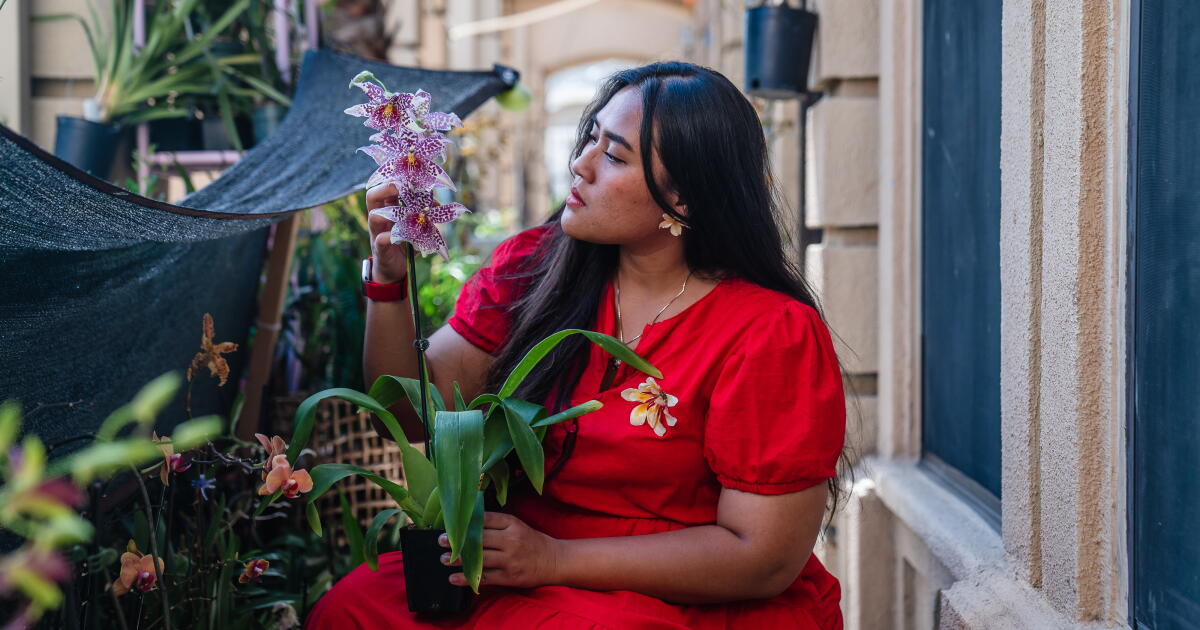
In 2020, Bunga Vidanska moved from Indonesia to Los Angeles to attend USC. Motivated by the goal of one day working at the United Nations, she sought to obtain a master’s degree in public diplomacy. But shortly after graduating in 2024, she pivoted to fostering a budding passion that had taken root back home.
The 29-year-old decided to become a botanical preservation artist and launched Bunga Karsa, a line of botanical jewelry and accessories featuring real flowers grown at her tiny University Park apartment.
She transforms a rainbow of blossoms into hair adornments, earrings, necklace pendants and rings, treating her homegrown organic materials like precious gems. The resin-coated pieces highlight all the natural beauty of a Gerbera daisy or a Stargazer lily, without the wilting and withering. They say diamonds are forever, but in her hands, plumeria blooms and cactus blossoms can be too.
It seems delving into a floral career was a fait accompli for Vidanska, whose first name means “flower” in her native tongue, and whose stepfather presided over a massive tropical garden outside her childhood home in the Indonesian province of West Papua.
“Karsa means ‘will, intention, or inner drive,’” she explained during a workspace tour. “I chose the name Bunga Karsa because I wanted my work to represent flowers created with intention — where every piece carries meaning, care and purpose.”


Artist Bunga Vidanska dips a Cymbidium orchid into resin in her work studio.
While sorting through stacks of well-organized translucent storage bins, plastic takeout containers and food storage bags filled with flowers, she went on to say, “Whenever possible, I’m involved in every stage of their journey — from planting and caring for them, to watching them bloom, preserving them, and finally transforming them into wearable art. Even the petals that can’t become jewelry are composted and returned to the garden as fertilizer. So in many ways, the process comes full circle.”
Some flowers were sourced at specialty flower vendors located up and down the California coast, while others are freebies she’s happened upon around town, or hand-me-downs donated by kindred spirits.
The exterior of the single-story, five-door apartment complex where she resides is almost completely paved — nothing like the rainforest terrain of her youth. Still, every spare inch is crammed with more than 32 different kinds of orchids imported from around the world, including such beauties as the flame-like Epidendrum radicans and the rare Dimorphorchis lowii. The narrow walkway separating the parking lot from her front door is filled with planters and flower pots of all sizes. They rest on small folding tables, they’re affixed to the columns and palm trees that flank her front door. Across the lot in an unused patch of pavement, pops of bright orange and yellow reach skyward toward the imposing barbed wire that’s laced atop metal security bars.



Vidanska applies resin to the flowers she grows at home, like plumeria and bougainvillea to make hair pins and other accessories.
“I have literally thousands of flowers I haven’t even touched yet,” she laughed.
When her blooms start to reach the end of their peak, they’re ready to begin their next phase of “life” inside the 180-square-foot live-work studio Vidanska shares with her boyfriend. She plucks them, then buries them in silica sand for up to two weeks to drain any moisture. After the flower is sufficiently “crispy,” she sits at an L-shaped desk overlooking her makeshift garden and coats individual petals with resin up to six times, curing them under a UV light between coats. Then come the notions and hardware, like earring posts, beads and crystal accents, that complete the transformation from fleeting flora to lasting adornment. Some creations can take up to four weeks to complete.
The road to perfecting her self-taught craft was studded with trial, error and copious online video tips. Her first successful attempt was a pair of sunflower earrings she made for herself. When passersby constantly stopped her on the street to ask about them, she got the idea to level up her hobby. Two years later, she’s making sold-out appearances at such pop-up events as the Renegade Craft market in San Francisco and the Jackalope Art Fair in San Diego. Heading into the fall, she’s scheduled to sell her wares at over a dozen artisan markets. All of this means much more time sifting through silica and wielding her tiny enamel brush. But she relishes these tasks.

“It’s meditative whenever I’m doing my art. And it’s fun,” she said. “But because it’s fun, sometimes people feel like this is not a real business.”

At a small table, Vidanska works on her floral accessories, with a view of her small patio garden.
“In Indonesia, you’re considered successful if you can land a job in the government, or you become a lawyer or doctor. A lot of people where I come from underestimate this job. They think it’s easy, but little do they know, I’m very busy every day — looking at each plant, watering them, fertilizing them, repotting them, collecting them.”
Her plans for the future include getting a PhD in horticulture and developing a marketplace experience in which shoppers learn about flower preservation, as well as the origins and cultural significance of her beloved blooms.

“I would say what I’m doing is actually a kind of diplomacy, but through art and plants,” she concluded. “That’s how I introduce Indonesia my way.”

