


On the Shelf
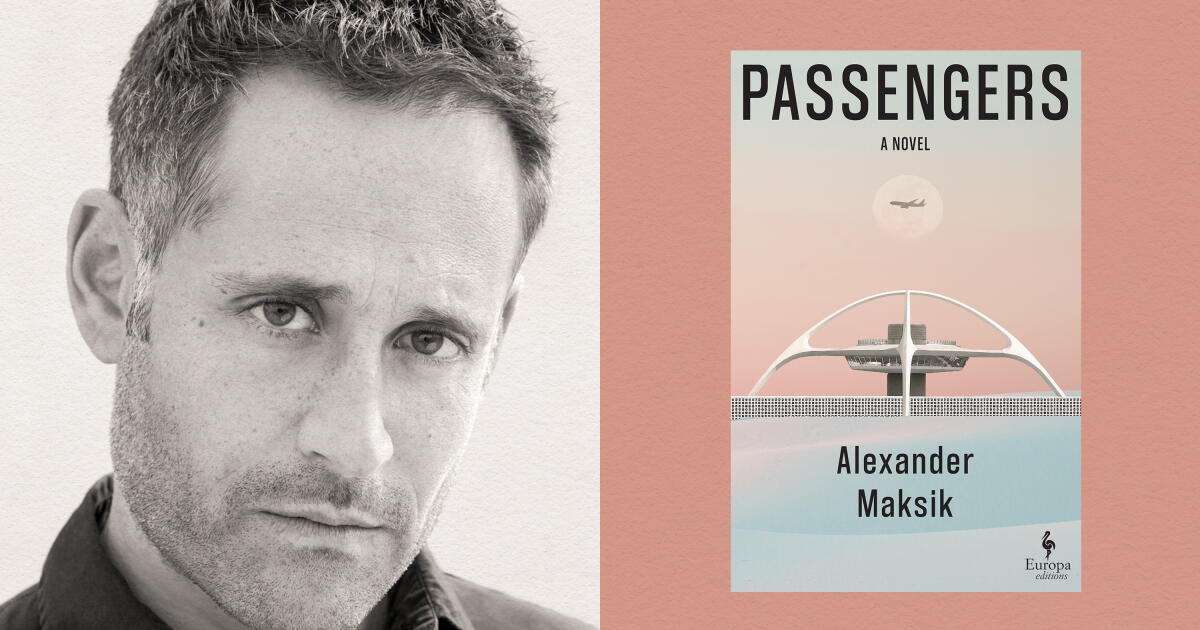
Passengers
By Alexander Maksik
Europa Editions: 256 pages, $26
If you buy books linked on our site, The Times may earn a commission from Bookshop.org, whose fees support independent bookstores.
With its gridlocked terminals, infuriating delays and long lines for everything from security checks to coffee, LAX might be where patience goes to die. It’s a place most dream of escaping; instead L.A.-born novelist Alexander Maksik takes readers inside the airport to witness both the unease and shared humanity of people passing through.
Longlisted for the 2026 National Book Award in fiction, Maksik’s new novel, “Passengers,” unfolds within the airport’s sprawling concourses. The story centers on Ivan and Nina, a distant father and daughter meeting up for a flight to Paris. For 75-year-old Ivan, it’s a chance to show his daughter where he once lived. For 29-year-old Nina, it’s a free trip and an opportunity to finally understand a parent she barely knows. When their flight is delayed, and then delayed again, frustration shifts from the departure boards to the fault lines between them.
Maksik, speaking via video conference from his Parisian apartment, always planned that the book would be about a father-daughter pair. “When my daughter was born, like many new parents, I found I could only think in clichés, and I didn’t try to resist them,” he says. “But as time went by, I started to toy with the idea of writing a novel about a father and daughter in which the battle against cliché would become central, would take on huge, even life-saving, importance.”
The author also plays with the idea of nostalgia. “Nostalgia brings you close to the edge of real feeling without forcing you to confront the weight, power and terror of real feeling. It’s too easy to keep yourself wrapped up in the false ease of the past.” One of the things that airports remind us of, he says, is change. Restaurants and boutiques close and open regularly. In one era, people sought out bookstores; in another, they’re looking for headphones and portable chargers.
“For a long time, airports felt to me like places of civility,” says Maksik. “I remember having real conversations with strangers at a bar or in various waiting areas. There was promise and possibility and warmth in such interactions. Now an airport is just one more place to look at your phone.”
As Ivan and Nina walk, talk, do tequila shots and observe their fellow travelers, those travelers are also observing them. One of the most powerful conceits in the book occurs when the two leave an airport venue and readers get the perspective of a person who served or overheard them. For example, one character, “an elegant woman, long gray hair in a braid” thinks about her dead husband when she notices Ivan and Nina: “It was impossible for the woman to see two people together, really any two people, and not feel his absence.” There’s another man who thinks he can tell that father and daughter “were the kind always looking for a way around the rules, who think waiting is for suckers like him.” Each underscores the fact that strangers affect and can even change one another (like our own offspring do).
Something else Ivan and Nina share is physical labor. Ivan spent decades as a building contractor, while Nina is a masseuse who goes to clients’ homes, not liking “the idea of going to the same place again and again. She wanted to travel, to peer inside different lives.” Maksik himself held service positions for many years, experience that gave him a different outlook than some of his colleagues at the renowned Iowa Writers Workshop, which he entered at the relatively senior age of 38.
“At Iowa, I was drawn to those who were writing about worlds that were far away from literature and academia,” he says. “Maybe that’s because I’ve worked so many different jobs. I washed dishes. I was a bartender. I cooked. I delivered pizza. Those experiences were vivid and interesting and at least as formative to me as a writer as anything I learned in the classroom. To write well about work is something I admire a great deal.”
Of course, Maksik is writing fiction, and can write about any sort of life, including that of a teacher, as he did in his critically acclaimed 2011 novel “You Deserve Nothing,” about an affair between an American teacher and his French high school student. As he knows, there’s a shadow over that book because one of his students alleged that the story was about Maksik’s affair with her when she was 17 years old.
“I will aways have to acknowledge my own history, and how I came to write that novel,” he says. “And there will always exist people to whom this acknowledgment means nothing. Perhaps this is as it should be. I’m certainly not proud of that period of my life, and, frankly, I’m no longer particularly proud of the novel either. Nevertheless, it will always be part and parcel of my history, and I have no intention of pretending otherwise.”
As Ivan and Nina wrestle with their own emotional truths, which range from her mother Nora’s departure from their lives to Ivan’s clumsy recitations of Nina’s childhood antics, something alarming is afoot. Nina can’t make or receive calls on her phone. The pair notices that others can’t make calls, either; a restaurant loses its checkout interface; and everyone is snaking cords around to keep devices charged for the moment when service returns.
Something is definitely wrong, and no one seems to know what it is. Soon Nina sees that her father is tired and weak, despite a meal and plenty of water; she becomes convinced that he needs fresh air. When they try to exit the airport, they find barriers set up and armed soldiers who say no one is allowed to leave.
The sense of unease Maksik creates mirrors the sense of disconnection between all of the people stranded, from a brusque young woman in bunny slippers and giant headphones to an older couple huddled beneath racks of merchandise: “We’re trying to sleep … Can’t you see that?” one of them says. This LAX, unlike the island of civility and good manners Maksik remembers from childhood, fosters alienation and dread.
The author laughs ruefully when accused of his own version of nostalgia, admitting that the version of the airport he’s created feels closer to our present-day reality. As it happens, Maksik himself will be taking a flight soon, from France to Florida, taking part in his fellow author Lauren Groff’s First Editions Book Club. How does he feel about that?
“Our daughter was born in late 2019, and then there was the pandemic. Each day since then seems more dangerous than the previous one. I wouldn’t at all be surprised to find myself trapped in an airport, whether as a result of climate change, AI, or one of the many petulant maniacs who run the world.”
Patrick is a freelance critic and author of the memoir “Life B.”

On the Shelf
Passengers
By Alexander Maksik
Europa Editions: 256 pages, $26
If you buy books linked on our site, The Times may earn a commission from Bookshop.org, whose fees support independent bookstores.
With its gridlocked terminals, infuriating delays and long lines for everything from security checks to coffee, LAX might be where patience goes to die. It’s a place most dream of escaping; instead L.A.-born novelist Alexander Maksik takes readers inside the airport to witness both the unease and shared humanity of people passing through.
Longlisted for the 2026 National Book Award in fiction, Maksik’s new novel, “Passengers,” unfolds within the airport’s sprawling concourses. The story centers on Ivan and Nina, a distant father and daughter meeting up for a flight to Paris. For 75-year-old Ivan, it’s a chance to show his daughter where he once lived. For 29-year-old Nina, it’s a free trip and an opportunity to finally understand a parent she barely knows. When their flight is delayed, and then delayed again, frustration shifts from the departure boards to the fault lines between them.
Maksik, speaking via video conference from his Parisian apartment, always planned that the book would be about a father-daughter pair. “When my daughter was born, like many new parents, I found I could only think in clichés, and I didn’t try to resist them,” he says. “But as time went by, I started to toy with the idea of writing a novel about a father and daughter in which the battle against cliché would become central, would take on huge, even life-saving, importance.”
The author also plays with the idea of nostalgia. “Nostalgia brings you close to the edge of real feeling without forcing you to confront the weight, power and terror of real feeling. It’s too easy to keep yourself wrapped up in the false ease of the past.” One of the things that airports remind us of, he says, is change. Restaurants and boutiques close and open regularly. In one era, people sought out bookstores; in another, they’re looking for headphones and portable chargers.
“For a long time, airports felt to me like places of civility,” says Maksik. “I remember having real conversations with strangers at a bar or in various waiting areas. There was promise and possibility and warmth in such interactions. Now an airport is just one more place to look at your phone.”
As Ivan and Nina walk, talk, do tequila shots and observe their fellow travelers, those travelers are also observing them. One of the most powerful conceits in the book occurs when the two leave an airport venue and readers get the perspective of a person who served or overheard them. For example, one character, “an elegant woman, long gray hair in a braid” thinks about her dead husband when she notices Ivan and Nina: “It was impossible for the woman to see two people together, really any two people, and not feel his absence.” There’s another man who thinks he can tell that father and daughter “were the kind always looking for a way around the rules, who think waiting is for suckers like him.” Each underscores the fact that strangers affect and can even change one another (like our own offspring do).
Something else Ivan and Nina share is physical labor. Ivan spent decades as a building contractor, while Nina is a masseuse who goes to clients’ homes, not liking “the idea of going to the same place again and again. She wanted to travel, to peer inside different lives.” Maksik himself held service positions for many years, experience that gave him a different outlook than some of his colleagues at the renowned Iowa Writers Workshop, which he entered at the relatively senior age of 38.
“At Iowa, I was drawn to those who were writing about worlds that were far away from literature and academia,” he says. “Maybe that’s because I’ve worked so many different jobs. I washed dishes. I was a bartender. I cooked. I delivered pizza. Those experiences were vivid and interesting and at least as formative to me as a writer as anything I learned in the classroom. To write well about work is something I admire a great deal.”
Of course, Maksik is writing fiction, and can write about any sort of life, including that of a teacher, as he did in his critically acclaimed 2011 novel “You Deserve Nothing,” about an affair between an American teacher and his French high school student. As he knows, there’s a shadow over that book because one of his students alleged that the story was about Maksik’s affair with her when she was 17 years old.
“I will aways have to acknowledge my own history, and how I came to write that novel,” he says. “And there will always exist people to whom this acknowledgment means nothing. Perhaps this is as it should be. I’m certainly not proud of that period of my life, and, frankly, I’m no longer particularly proud of the novel either. Nevertheless, it will always be part and parcel of my history, and I have no intention of pretending otherwise.”
As Ivan and Nina wrestle with their own emotional truths, which range from her mother Nora’s departure from their lives to Ivan’s clumsy recitations of Nina’s childhood antics, something alarming is afoot. Nina can’t make or receive calls on her phone. The pair notices that others can’t make calls, either; a restaurant loses its checkout interface; and everyone is snaking cords around to keep devices charged for the moment when service returns.
Something is definitely wrong, and no one seems to know what it is. Soon Nina sees that her father is tired and weak, despite a meal and plenty of water; she becomes convinced that he needs fresh air. When they try to exit the airport, they find barriers set up and armed soldiers who say no one is allowed to leave.
The sense of unease Maksik creates mirrors the sense of disconnection between all of the people stranded, from a brusque young woman in bunny slippers and giant headphones to an older couple huddled beneath racks of merchandise: “We’re trying to sleep … Can’t you see that?” one of them says. This LAX, unlike the island of civility and good manners Maksik remembers from childhood, fosters alienation and dread.
The author laughs ruefully when accused of his own version of nostalgia, admitting that the version of the airport he’s created feels closer to our present-day reality. As it happens, Maksik himself will be taking a flight soon, from France to Florida, taking part in his fellow author Lauren Groff’s First Editions Book Club. How does he feel about that?
“Our daughter was born in late 2019, and then there was the pandemic. Each day since then seems more dangerous than the previous one. I wouldn’t at all be surprised to find myself trapped in an airport, whether as a result of climate change, AI, or one of the many petulant maniacs who run the world.”
Patrick is a freelance critic and author of the memoir “Life B.”

On the Shelf
Passengers
By Alexander Maksik
Europa Editions: 256 pages, $26
If you buy books linked on our site, The Times may earn a commission from Bookshop.org, whose fees support independent bookstores.
With its gridlocked terminals, infuriating delays and long lines for everything from security checks to coffee, LAX might be where patience goes to die. It’s a place most dream of escaping; instead L.A.-born novelist Alexander Maksik takes readers inside the airport to witness both the unease and shared humanity of people passing through.
Longlisted for the 2026 National Book Award in fiction, Maksik’s new novel, “Passengers,” unfolds within the airport’s sprawling concourses. The story centers on Ivan and Nina, a distant father and daughter meeting up for a flight to Paris. For 75-year-old Ivan, it’s a chance to show his daughter where he once lived. For 29-year-old Nina, it’s a free trip and an opportunity to finally understand a parent she barely knows. When their flight is delayed, and then delayed again, frustration shifts from the departure boards to the fault lines between them.
Maksik, speaking via video conference from his Parisian apartment, always planned that the book would be about a father-daughter pair. “When my daughter was born, like many new parents, I found I could only think in clichés, and I didn’t try to resist them,” he says. “But as time went by, I started to toy with the idea of writing a novel about a father and daughter in which the battle against cliché would become central, would take on huge, even life-saving, importance.”
The author also plays with the idea of nostalgia. “Nostalgia brings you close to the edge of real feeling without forcing you to confront the weight, power and terror of real feeling. It’s too easy to keep yourself wrapped up in the false ease of the past.” One of the things that airports remind us of, he says, is change. Restaurants and boutiques close and open regularly. In one era, people sought out bookstores; in another, they’re looking for headphones and portable chargers.
“For a long time, airports felt to me like places of civility,” says Maksik. “I remember having real conversations with strangers at a bar or in various waiting areas. There was promise and possibility and warmth in such interactions. Now an airport is just one more place to look at your phone.”
As Ivan and Nina walk, talk, do tequila shots and observe their fellow travelers, those travelers are also observing them. One of the most powerful conceits in the book occurs when the two leave an airport venue and readers get the perspective of a person who served or overheard them. For example, one character, “an elegant woman, long gray hair in a braid” thinks about her dead husband when she notices Ivan and Nina: “It was impossible for the woman to see two people together, really any two people, and not feel his absence.” There’s another man who thinks he can tell that father and daughter “were the kind always looking for a way around the rules, who think waiting is for suckers like him.” Each underscores the fact that strangers affect and can even change one another (like our own offspring do).
Something else Ivan and Nina share is physical labor. Ivan spent decades as a building contractor, while Nina is a masseuse who goes to clients’ homes, not liking “the idea of going to the same place again and again. She wanted to travel, to peer inside different lives.” Maksik himself held service positions for many years, experience that gave him a different outlook than some of his colleagues at the renowned Iowa Writers Workshop, which he entered at the relatively senior age of 38.
“At Iowa, I was drawn to those who were writing about worlds that were far away from literature and academia,” he says. “Maybe that’s because I’ve worked so many different jobs. I washed dishes. I was a bartender. I cooked. I delivered pizza. Those experiences were vivid and interesting and at least as formative to me as a writer as anything I learned in the classroom. To write well about work is something I admire a great deal.”
Of course, Maksik is writing fiction, and can write about any sort of life, including that of a teacher, as he did in his critically acclaimed 2011 novel “You Deserve Nothing,” about an affair between an American teacher and his French high school student. As he knows, there’s a shadow over that book because one of his students alleged that the story was about Maksik’s affair with her when she was 17 years old.
“I will aways have to acknowledge my own history, and how I came to write that novel,” he says. “And there will always exist people to whom this acknowledgment means nothing. Perhaps this is as it should be. I’m certainly not proud of that period of my life, and, frankly, I’m no longer particularly proud of the novel either. Nevertheless, it will always be part and parcel of my history, and I have no intention of pretending otherwise.”
As Ivan and Nina wrestle with their own emotional truths, which range from her mother Nora’s departure from their lives to Ivan’s clumsy recitations of Nina’s childhood antics, something alarming is afoot. Nina can’t make or receive calls on her phone. The pair notices that others can’t make calls, either; a restaurant loses its checkout interface; and everyone is snaking cords around to keep devices charged for the moment when service returns.
Something is definitely wrong, and no one seems to know what it is. Soon Nina sees that her father is tired and weak, despite a meal and plenty of water; she becomes convinced that he needs fresh air. When they try to exit the airport, they find barriers set up and armed soldiers who say no one is allowed to leave.
The sense of unease Maksik creates mirrors the sense of disconnection between all of the people stranded, from a brusque young woman in bunny slippers and giant headphones to an older couple huddled beneath racks of merchandise: “We’re trying to sleep … Can’t you see that?” one of them says. This LAX, unlike the island of civility and good manners Maksik remembers from childhood, fosters alienation and dread.
The author laughs ruefully when accused of his own version of nostalgia, admitting that the version of the airport he’s created feels closer to our present-day reality. As it happens, Maksik himself will be taking a flight soon, from France to Florida, taking part in his fellow author Lauren Groff’s First Editions Book Club. How does he feel about that?
“Our daughter was born in late 2019, and then there was the pandemic. Each day since then seems more dangerous than the previous one. I wouldn’t at all be surprised to find myself trapped in an airport, whether as a result of climate change, AI, or one of the many petulant maniacs who run the world.”
Patrick is a freelance critic and author of the memoir “Life B.”

On the Shelf
Passengers
By Alexander Maksik
Europa Editions: 256 pages, $26
If you buy books linked on our site, The Times may earn a commission from Bookshop.org, whose fees support independent bookstores.
With its gridlocked terminals, infuriating delays and long lines for everything from security checks to coffee, LAX might be where patience goes to die. It’s a place most dream of escaping; instead L.A.-born novelist Alexander Maksik takes readers inside the airport to witness both the unease and shared humanity of people passing through.
Longlisted for the 2026 National Book Award in fiction, Maksik’s new novel, “Passengers,” unfolds within the airport’s sprawling concourses. The story centers on Ivan and Nina, a distant father and daughter meeting up for a flight to Paris. For 75-year-old Ivan, it’s a chance to show his daughter where he once lived. For 29-year-old Nina, it’s a free trip and an opportunity to finally understand a parent she barely knows. When their flight is delayed, and then delayed again, frustration shifts from the departure boards to the fault lines between them.
Maksik, speaking via video conference from his Parisian apartment, always planned that the book would be about a father-daughter pair. “When my daughter was born, like many new parents, I found I could only think in clichés, and I didn’t try to resist them,” he says. “But as time went by, I started to toy with the idea of writing a novel about a father and daughter in which the battle against cliché would become central, would take on huge, even life-saving, importance.”
The author also plays with the idea of nostalgia. “Nostalgia brings you close to the edge of real feeling without forcing you to confront the weight, power and terror of real feeling. It’s too easy to keep yourself wrapped up in the false ease of the past.” One of the things that airports remind us of, he says, is change. Restaurants and boutiques close and open regularly. In one era, people sought out bookstores; in another, they’re looking for headphones and portable chargers.
“For a long time, airports felt to me like places of civility,” says Maksik. “I remember having real conversations with strangers at a bar or in various waiting areas. There was promise and possibility and warmth in such interactions. Now an airport is just one more place to look at your phone.”
As Ivan and Nina walk, talk, do tequila shots and observe their fellow travelers, those travelers are also observing them. One of the most powerful conceits in the book occurs when the two leave an airport venue and readers get the perspective of a person who served or overheard them. For example, one character, “an elegant woman, long gray hair in a braid” thinks about her dead husband when she notices Ivan and Nina: “It was impossible for the woman to see two people together, really any two people, and not feel his absence.” There’s another man who thinks he can tell that father and daughter “were the kind always looking for a way around the rules, who think waiting is for suckers like him.” Each underscores the fact that strangers affect and can even change one another (like our own offspring do).
Something else Ivan and Nina share is physical labor. Ivan spent decades as a building contractor, while Nina is a masseuse who goes to clients’ homes, not liking “the idea of going to the same place again and again. She wanted to travel, to peer inside different lives.” Maksik himself held service positions for many years, experience that gave him a different outlook than some of his colleagues at the renowned Iowa Writers Workshop, which he entered at the relatively senior age of 38.
“At Iowa, I was drawn to those who were writing about worlds that were far away from literature and academia,” he says. “Maybe that’s because I’ve worked so many different jobs. I washed dishes. I was a bartender. I cooked. I delivered pizza. Those experiences were vivid and interesting and at least as formative to me as a writer as anything I learned in the classroom. To write well about work is something I admire a great deal.”
Of course, Maksik is writing fiction, and can write about any sort of life, including that of a teacher, as he did in his critically acclaimed 2011 novel “You Deserve Nothing,” about an affair between an American teacher and his French high school student. As he knows, there’s a shadow over that book because one of his students alleged that the story was about Maksik’s affair with her when she was 17 years old.
“I will aways have to acknowledge my own history, and how I came to write that novel,” he says. “And there will always exist people to whom this acknowledgment means nothing. Perhaps this is as it should be. I’m certainly not proud of that period of my life, and, frankly, I’m no longer particularly proud of the novel either. Nevertheless, it will always be part and parcel of my history, and I have no intention of pretending otherwise.”
As Ivan and Nina wrestle with their own emotional truths, which range from her mother Nora’s departure from their lives to Ivan’s clumsy recitations of Nina’s childhood antics, something alarming is afoot. Nina can’t make or receive calls on her phone. The pair notices that others can’t make calls, either; a restaurant loses its checkout interface; and everyone is snaking cords around to keep devices charged for the moment when service returns.
Something is definitely wrong, and no one seems to know what it is. Soon Nina sees that her father is tired and weak, despite a meal and plenty of water; she becomes convinced that he needs fresh air. When they try to exit the airport, they find barriers set up and armed soldiers who say no one is allowed to leave.
The sense of unease Maksik creates mirrors the sense of disconnection between all of the people stranded, from a brusque young woman in bunny slippers and giant headphones to an older couple huddled beneath racks of merchandise: “We’re trying to sleep … Can’t you see that?” one of them says. This LAX, unlike the island of civility and good manners Maksik remembers from childhood, fosters alienation and dread.
The author laughs ruefully when accused of his own version of nostalgia, admitting that the version of the airport he’s created feels closer to our present-day reality. As it happens, Maksik himself will be taking a flight soon, from France to Florida, taking part in his fellow author Lauren Groff’s First Editions Book Club. How does he feel about that?
“Our daughter was born in late 2019, and then there was the pandemic. Each day since then seems more dangerous than the previous one. I wouldn’t at all be surprised to find myself trapped in an airport, whether as a result of climate change, AI, or one of the many petulant maniacs who run the world.”
Patrick is a freelance critic and author of the memoir “Life B.”

