

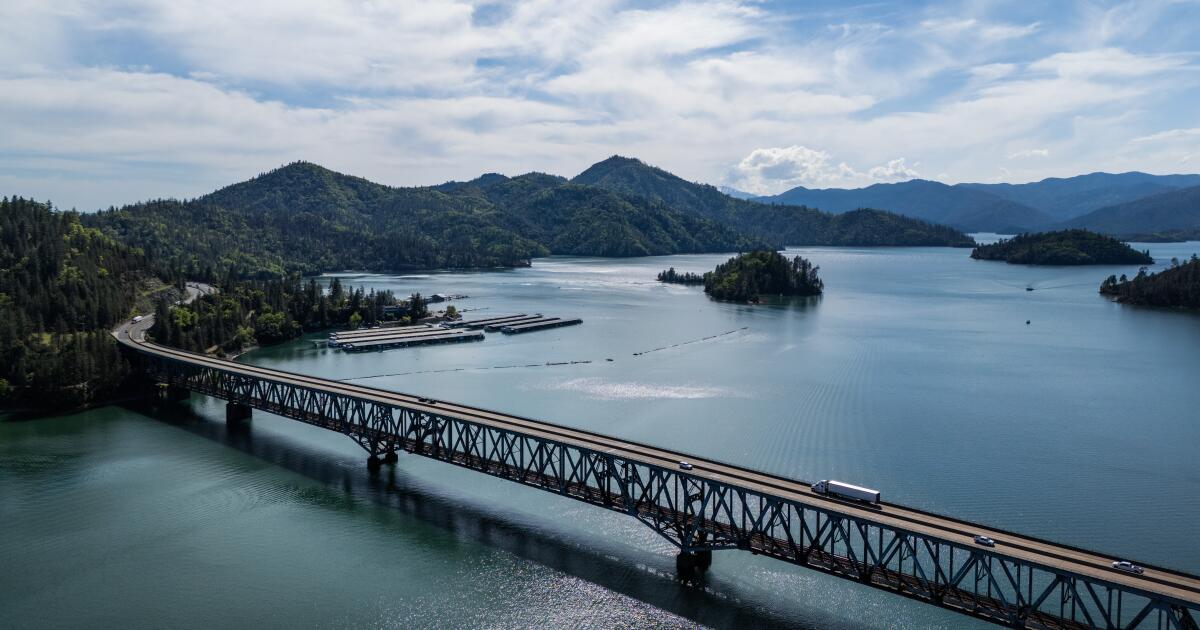

The Trump administration says it will increase the water it’s sending to Central Valley farmlands this year from Shasta Lake, the state’s largest reservoir.
The U.S. Bureau of Reclamation said agricultural water agencies south of the Sacramento-San Joaquin River Delta will receive 25% of their total contracted amount, up from an initial 20%. Cities and towns will also get more from the federal canals that are part of the Central Valley Project.
The agency cited “modest improvements” in reservoir levels after some rainstorms in April.
Environmental and fishing groups reacted to Tuesday’s announcement with concern, saying that taking too much water out of Shasta Lake threatens to harm Chinook salmon by depriving them of vital cold water in the Sacramento River in the late summer and fall.
“This is really bad,” said Vance Staplin, executive director of the nonprofit Golden State Salmon Assn.
The Trump administration’s plan, he said, “is likely to kill salmon.”
The dispute is the latest fight over what California needs to do to protect seriously declining fish as it draws heavily from rivers.
When Chinook salmon swim upstream from the ocean to spawn in rivers and creeks, they need cold water for their eggs to survive. Research shows the water needs to be below 56 degrees.
But when Shasta Lake is drawn down to low levels, the water flowing from Shasta Dam can get dangerously warm.
During the last drought in 2021, it got so warm at one point that most of the eggs and young fish died.
“The Trump administration has proven that they are very aggressive as far as sending water south,” Staplin said. “I would hope that they would rethink what they’re doing and come back and adjust their plan to save these fish.”
Shasta Lake is now 89% full. Each year, the Bureau of Reclamation is required to release a plan detailing how it will keep water downstream of Shasta Dam cold enough to protect salmon.
But California regulators have told the Trump administration they’re concerned this year’s draft plan would likely put salmon at risk.
In a letter last week, Diane Riddle, an official with the State Water Resources Control Board, warned the federal plan would “threaten conditions” for returning adult salmon in September and “lead to mortality” of salmon eggs.
Riddle asked the Bureau of Reclamation to revise the plan so the water that’s released from the dam stays cold enough for salmon.
The bureau said in its announcement that it is taking “prudent” steps and continuing to meet environmental requirements.
The state water board said in a written statement that it expects the Bureau of Reclamation will submit an updated plan for managing water temperatures in the next two weeks.
Salmon numbers have declined due to dams, which have blocked off their spawning areas; the loss of floodplain habitat; and global warming, which is intensifying drought and heating rivers.
Biologists track distinct runs of salmon in the Sacramento River, each named for when the fish return from the Pacific.
The winter-run Chinook is endangered, while the spring-run is listed as threatened under the Endangered Species Act.
The most numerous are the fall-run Chinook, which fishers catch commercially and recreationally along the coast when salmon numbers are high enough. For the last three years, however, there were so few fall-run Chinook that regulators banned commercial fishing.
This year, commercial fishers have resumed going for salmon after a rebound in the population prompted regulators to allow it under strict limits.
The long shutdown put some fishermen out of work and led others to turn to catching crabs or other fish to make a living. Staplin said he blames state and federal officials for failing to ensure sufficient river flows for salmon during the last drought.
He said he hopes the Bureau of Reclamation will heed the state’s call for compromise “to avoid another massive salmon kill.”
“They need to learn that we’ve got to come up with a balance, a balance between the fish and water needs,” Staplin said.
Much of the water released from the dam goes to irrigate crops including almonds, pistachios, oranges, grapes and tomatoes.
Managers of agricultural water agencies in the San Joaquin Valley welcomed the announcement of an increase in supply, but also said 25% is disappointing and less than they had hoped for.
“While we appreciate the Bureau’s ongoing effort to update allocations as conditions evolve … this allocation update falls short of our growers’ water needs,” Allison Febbo, general manager of Westlands Water District, said in a written statement. She called for changing water management policies to “fix an outdated and broken system.”
Agriculture uses most of the water from the Central Valley Project. But the federal government announced that cities south of the Delta will also receive more water — 75% of their historical usage. Among them are Tracy, Huron and Coalinga, as well as Santa Clara Valley Water District, which serves Silicon Valley.
Last year, President Trump signed an executive order directing federal agencies to “maximize” water deliveries in California. State officials and Democratic lawmakers criticized that approach as ill-conceived and harmful.
The Central Valley Project includes 20 dams and about 500 miles of aqueducts and canals, stretching from the Redding area to near Bakersfield. One of California’s two main north-south water conduits, it pumps water from the Delta near the intakes of the other major system, the State Water Project.
Pumping from the Delta has taken a toll on the ecosystem. Various types of native fish have suffered declines, including steelhead trout, white sturgeon and longfin smelt.
Jon Rosenfield, science director for the group San Francisco Baykeeper, said the Trump administration is moving toward the same kind of water mismanagement that caused the last shutdown of salmon fishing. He said the federal plan conflicts with permits that require sufficient cold water for salmon.
If the plan stands, he said, “we know that it’s going to be lethal for some salmon eggs this summer.”
“This is a desperate situation where you have a lawless agency flouting the laws and threatening resources,” Rosenfield said. “The outcome is, we’re going to lose these and other fish that exist nowhere else on Earth.”

The Trump administration says it will increase the water it’s sending to Central Valley farmlands this year from Shasta Lake, the state’s largest reservoir.
The U.S. Bureau of Reclamation said agricultural water agencies south of the Sacramento-San Joaquin River Delta will receive 25% of their total contracted amount, up from an initial 20%. Cities and towns will also get more from the federal canals that are part of the Central Valley Project.
The agency cited “modest improvements” in reservoir levels after some rainstorms in April.
Environmental and fishing groups reacted to Tuesday’s announcement with concern, saying that taking too much water out of Shasta Lake threatens to harm Chinook salmon by depriving them of vital cold water in the Sacramento River in the late summer and fall.
“This is really bad,” said Vance Staplin, executive director of the nonprofit Golden State Salmon Assn.
The Trump administration’s plan, he said, “is likely to kill salmon.”
The dispute is the latest fight over what California needs to do to protect seriously declining fish as it draws heavily from rivers.
When Chinook salmon swim upstream from the ocean to spawn in rivers and creeks, they need cold water for their eggs to survive. Research shows the water needs to be below 56 degrees.
But when Shasta Lake is drawn down to low levels, the water flowing from Shasta Dam can get dangerously warm.
During the last drought in 2021, it got so warm at one point that most of the eggs and young fish died.
“The Trump administration has proven that they are very aggressive as far as sending water south,” Staplin said. “I would hope that they would rethink what they’re doing and come back and adjust their plan to save these fish.”
Shasta Lake is now 89% full. Each year, the Bureau of Reclamation is required to release a plan detailing how it will keep water downstream of Shasta Dam cold enough to protect salmon.
But California regulators have told the Trump administration they’re concerned this year’s draft plan would likely put salmon at risk.
In a letter last week, Diane Riddle, an official with the State Water Resources Control Board, warned the federal plan would “threaten conditions” for returning adult salmon in September and “lead to mortality” of salmon eggs.
Riddle asked the Bureau of Reclamation to revise the plan so the water that’s released from the dam stays cold enough for salmon.
The bureau said in its announcement that it is taking “prudent” steps and continuing to meet environmental requirements.
The state water board said in a written statement that it expects the Bureau of Reclamation will submit an updated plan for managing water temperatures in the next two weeks.
Salmon numbers have declined due to dams, which have blocked off their spawning areas; the loss of floodplain habitat; and global warming, which is intensifying drought and heating rivers.
Biologists track distinct runs of salmon in the Sacramento River, each named for when the fish return from the Pacific.
The winter-run Chinook is endangered, while the spring-run is listed as threatened under the Endangered Species Act.
The most numerous are the fall-run Chinook, which fishers catch commercially and recreationally along the coast when salmon numbers are high enough. For the last three years, however, there were so few fall-run Chinook that regulators banned commercial fishing.
This year, commercial fishers have resumed going for salmon after a rebound in the population prompted regulators to allow it under strict limits.
The long shutdown put some fishermen out of work and led others to turn to catching crabs or other fish to make a living. Staplin said he blames state and federal officials for failing to ensure sufficient river flows for salmon during the last drought.
He said he hopes the Bureau of Reclamation will heed the state’s call for compromise “to avoid another massive salmon kill.”
“They need to learn that we’ve got to come up with a balance, a balance between the fish and water needs,” Staplin said.
Much of the water released from the dam goes to irrigate crops including almonds, pistachios, oranges, grapes and tomatoes.
Managers of agricultural water agencies in the San Joaquin Valley welcomed the announcement of an increase in supply, but also said 25% is disappointing and less than they had hoped for.
“While we appreciate the Bureau’s ongoing effort to update allocations as conditions evolve … this allocation update falls short of our growers’ water needs,” Allison Febbo, general manager of Westlands Water District, said in a written statement. She called for changing water management policies to “fix an outdated and broken system.”
Agriculture uses most of the water from the Central Valley Project. But the federal government announced that cities south of the Delta will also receive more water — 75% of their historical usage. Among them are Tracy, Huron and Coalinga, as well as Santa Clara Valley Water District, which serves Silicon Valley.
Last year, President Trump signed an executive order directing federal agencies to “maximize” water deliveries in California. State officials and Democratic lawmakers criticized that approach as ill-conceived and harmful.
The Central Valley Project includes 20 dams and about 500 miles of aqueducts and canals, stretching from the Redding area to near Bakersfield. One of California’s two main north-south water conduits, it pumps water from the Delta near the intakes of the other major system, the State Water Project.
Pumping from the Delta has taken a toll on the ecosystem. Various types of native fish have suffered declines, including steelhead trout, white sturgeon and longfin smelt.
Jon Rosenfield, science director for the group San Francisco Baykeeper, said the Trump administration is moving toward the same kind of water mismanagement that caused the last shutdown of salmon fishing. He said the federal plan conflicts with permits that require sufficient cold water for salmon.
If the plan stands, he said, “we know that it’s going to be lethal for some salmon eggs this summer.”
“This is a desperate situation where you have a lawless agency flouting the laws and threatening resources,” Rosenfield said. “The outcome is, we’re going to lose these and other fish that exist nowhere else on Earth.”

The Trump administration says it will increase the water it’s sending to Central Valley farmlands this year from Shasta Lake, the state’s largest reservoir.
The U.S. Bureau of Reclamation said agricultural water agencies south of the Sacramento-San Joaquin River Delta will receive 25% of their total contracted amount, up from an initial 20%. Cities and towns will also get more from the federal canals that are part of the Central Valley Project.
The agency cited “modest improvements” in reservoir levels after some rainstorms in April.
Environmental and fishing groups reacted to Tuesday’s announcement with concern, saying that taking too much water out of Shasta Lake threatens to harm Chinook salmon by depriving them of vital cold water in the Sacramento River in the late summer and fall.
“This is really bad,” said Vance Staplin, executive director of the nonprofit Golden State Salmon Assn.
The Trump administration’s plan, he said, “is likely to kill salmon.”
The dispute is the latest fight over what California needs to do to protect seriously declining fish as it draws heavily from rivers.
When Chinook salmon swim upstream from the ocean to spawn in rivers and creeks, they need cold water for their eggs to survive. Research shows the water needs to be below 56 degrees.
But when Shasta Lake is drawn down to low levels, the water flowing from Shasta Dam can get dangerously warm.
During the last drought in 2021, it got so warm at one point that most of the eggs and young fish died.
“The Trump administration has proven that they are very aggressive as far as sending water south,” Staplin said. “I would hope that they would rethink what they’re doing and come back and adjust their plan to save these fish.”
Shasta Lake is now 89% full. Each year, the Bureau of Reclamation is required to release a plan detailing how it will keep water downstream of Shasta Dam cold enough to protect salmon.
But California regulators have told the Trump administration they’re concerned this year’s draft plan would likely put salmon at risk.
In a letter last week, Diane Riddle, an official with the State Water Resources Control Board, warned the federal plan would “threaten conditions” for returning adult salmon in September and “lead to mortality” of salmon eggs.
Riddle asked the Bureau of Reclamation to revise the plan so the water that’s released from the dam stays cold enough for salmon.
The bureau said in its announcement that it is taking “prudent” steps and continuing to meet environmental requirements.
The state water board said in a written statement that it expects the Bureau of Reclamation will submit an updated plan for managing water temperatures in the next two weeks.
Salmon numbers have declined due to dams, which have blocked off their spawning areas; the loss of floodplain habitat; and global warming, which is intensifying drought and heating rivers.
Biologists track distinct runs of salmon in the Sacramento River, each named for when the fish return from the Pacific.
The winter-run Chinook is endangered, while the spring-run is listed as threatened under the Endangered Species Act.
The most numerous are the fall-run Chinook, which fishers catch commercially and recreationally along the coast when salmon numbers are high enough. For the last three years, however, there were so few fall-run Chinook that regulators banned commercial fishing.
This year, commercial fishers have resumed going for salmon after a rebound in the population prompted regulators to allow it under strict limits.
The long shutdown put some fishermen out of work and led others to turn to catching crabs or other fish to make a living. Staplin said he blames state and federal officials for failing to ensure sufficient river flows for salmon during the last drought.
He said he hopes the Bureau of Reclamation will heed the state’s call for compromise “to avoid another massive salmon kill.”
“They need to learn that we’ve got to come up with a balance, a balance between the fish and water needs,” Staplin said.
Much of the water released from the dam goes to irrigate crops including almonds, pistachios, oranges, grapes and tomatoes.
Managers of agricultural water agencies in the San Joaquin Valley welcomed the announcement of an increase in supply, but also said 25% is disappointing and less than they had hoped for.
“While we appreciate the Bureau’s ongoing effort to update allocations as conditions evolve … this allocation update falls short of our growers’ water needs,” Allison Febbo, general manager of Westlands Water District, said in a written statement. She called for changing water management policies to “fix an outdated and broken system.”
Agriculture uses most of the water from the Central Valley Project. But the federal government announced that cities south of the Delta will also receive more water — 75% of their historical usage. Among them are Tracy, Huron and Coalinga, as well as Santa Clara Valley Water District, which serves Silicon Valley.
Last year, President Trump signed an executive order directing federal agencies to “maximize” water deliveries in California. State officials and Democratic lawmakers criticized that approach as ill-conceived and harmful.
The Central Valley Project includes 20 dams and about 500 miles of aqueducts and canals, stretching from the Redding area to near Bakersfield. One of California’s two main north-south water conduits, it pumps water from the Delta near the intakes of the other major system, the State Water Project.
Pumping from the Delta has taken a toll on the ecosystem. Various types of native fish have suffered declines, including steelhead trout, white sturgeon and longfin smelt.
Jon Rosenfield, science director for the group San Francisco Baykeeper, said the Trump administration is moving toward the same kind of water mismanagement that caused the last shutdown of salmon fishing. He said the federal plan conflicts with permits that require sufficient cold water for salmon.
If the plan stands, he said, “we know that it’s going to be lethal for some salmon eggs this summer.”
“This is a desperate situation where you have a lawless agency flouting the laws and threatening resources,” Rosenfield said. “The outcome is, we’re going to lose these and other fish that exist nowhere else on Earth.”
The Trump administration says it will increase the water it’s sending to Central Valley farmlands this year from Shasta Lake, the state’s largest reservoir.
The U.S. Bureau of Reclamation said agricultural water agencies south of the Sacramento-San Joaquin River Delta will receive 25% of their total contracted amount, up from an initial 20%. Cities and towns will also get more from the federal canals that are part of the Central Valley Project.
The agency cited “modest improvements” in reservoir levels after some rainstorms in April.
Environmental and fishing groups reacted to Tuesday’s announcement with concern, saying that taking too much water out of Shasta Lake threatens to harm Chinook salmon by depriving them of vital cold water in the Sacramento River in the late summer and fall.
“This is really bad,” said Vance Staplin, executive director of the nonprofit Golden State Salmon Assn.
The Trump administration’s plan, he said, “is likely to kill salmon.”
The dispute is the latest fight over what California needs to do to protect seriously declining fish as it draws heavily from rivers.
When Chinook salmon swim upstream from the ocean to spawn in rivers and creeks, they need cold water for their eggs to survive. Research shows the water needs to be below 56 degrees.
But when Shasta Lake is drawn down to low levels, the water flowing from Shasta Dam can get dangerously warm.
During the last drought in 2021, it got so warm at one point that most of the eggs and young fish died.
“The Trump administration has proven that they are very aggressive as far as sending water south,” Staplin said. “I would hope that they would rethink what they’re doing and come back and adjust their plan to save these fish.”
Shasta Lake is now 89% full. Each year, the Bureau of Reclamation is required to release a plan detailing how it will keep water downstream of Shasta Dam cold enough to protect salmon.
But California regulators have told the Trump administration they’re concerned this year’s draft plan would likely put salmon at risk.
In a letter last week, Diane Riddle, an official with the State Water Resources Control Board, warned the federal plan would “threaten conditions” for returning adult salmon in September and “lead to mortality” of salmon eggs.
Riddle asked the Bureau of Reclamation to revise the plan so the water that’s released from the dam stays cold enough for salmon.
The bureau said in its announcement that it is taking “prudent” steps and continuing to meet environmental requirements.
The state water board said in a written statement that it expects the Bureau of Reclamation will submit an updated plan for managing water temperatures in the next two weeks.
Salmon numbers have declined due to dams, which have blocked off their spawning areas; the loss of floodplain habitat; and global warming, which is intensifying drought and heating rivers.
Biologists track distinct runs of salmon in the Sacramento River, each named for when the fish return from the Pacific.
The winter-run Chinook is endangered, while the spring-run is listed as threatened under the Endangered Species Act.
The most numerous are the fall-run Chinook, which fishers catch commercially and recreationally along the coast when salmon numbers are high enough. For the last three years, however, there were so few fall-run Chinook that regulators banned commercial fishing.
This year, commercial fishers have resumed going for salmon after a rebound in the population prompted regulators to allow it under strict limits.
The long shutdown put some fishermen out of work and led others to turn to catching crabs or other fish to make a living. Staplin said he blames state and federal officials for failing to ensure sufficient river flows for salmon during the last drought.
He said he hopes the Bureau of Reclamation will heed the state’s call for compromise “to avoid another massive salmon kill.”
“They need to learn that we’ve got to come up with a balance, a balance between the fish and water needs,” Staplin said.
Much of the water released from the dam goes to irrigate crops including almonds, pistachios, oranges, grapes and tomatoes.
Managers of agricultural water agencies in the San Joaquin Valley welcomed the announcement of an increase in supply, but also said 25% is disappointing and less than they had hoped for.
“While we appreciate the Bureau’s ongoing effort to update allocations as conditions evolve … this allocation update falls short of our growers’ water needs,” Allison Febbo, general manager of Westlands Water District, said in a written statement. She called for changing water management policies to “fix an outdated and broken system.”
Agriculture uses most of the water from the Central Valley Project. But the federal government announced that cities south of the Delta will also receive more water — 75% of their historical usage. Among them are Tracy, Huron and Coalinga, as well as Santa Clara Valley Water District, which serves Silicon Valley.
Last year, President Trump signed an executive order directing federal agencies to “maximize” water deliveries in California. State officials and Democratic lawmakers criticized that approach as ill-conceived and harmful.
The Central Valley Project includes 20 dams and about 500 miles of aqueducts and canals, stretching from the Redding area to near Bakersfield. One of California’s two main north-south water conduits, it pumps water from the Delta near the intakes of the other major system, the State Water Project.
Pumping from the Delta has taken a toll on the ecosystem. Various types of native fish have suffered declines, including steelhead trout, white sturgeon and longfin smelt.
Jon Rosenfield, science director for the group San Francisco Baykeeper, said the Trump administration is moving toward the same kind of water mismanagement that caused the last shutdown of salmon fishing. He said the federal plan conflicts with permits that require sufficient cold water for salmon.
If the plan stands, he said, “we know that it’s going to be lethal for some salmon eggs this summer.”
“This is a desperate situation where you have a lawless agency flouting the laws and threatening resources,” Rosenfield said. “The outcome is, we’re going to lose these and other fish that exist nowhere else on Earth.”

The Trump administration says it will increase the water it’s sending to Central Valley farmlands this year from Shasta Lake, the state’s largest reservoir.
The U.S. Bureau of Reclamation said agricultural water agencies south of the Sacramento-San Joaquin River Delta will receive 25% of their total contracted amount, up from an initial 20%. Cities and towns will also get more from the federal canals that are part of the Central Valley Project.
The agency cited “modest improvements” in reservoir levels after some rainstorms in April.
Environmental and fishing groups reacted to Tuesday’s announcement with concern, saying that taking too much water out of Shasta Lake threatens to harm Chinook salmon by depriving them of vital cold water in the Sacramento River in the late summer and fall.
“This is really bad,” said Vance Staplin, executive director of the nonprofit Golden State Salmon Assn.
The Trump administration’s plan, he said, “is likely to kill salmon.”
The dispute is the latest fight over what California needs to do to protect seriously declining fish as it draws heavily from rivers.
When Chinook salmon swim upstream from the ocean to spawn in rivers and creeks, they need cold water for their eggs to survive. Research shows the water needs to be below 56 degrees.
But when Shasta Lake is drawn down to low levels, the water flowing from Shasta Dam can get dangerously warm.
During the last drought in 2021, it got so warm at one point that most of the eggs and young fish died.
“The Trump administration has proven that they are very aggressive as far as sending water south,” Staplin said. “I would hope that they would rethink what they’re doing and come back and adjust their plan to save these fish.”
Shasta Lake is now 89% full. Each year, the Bureau of Reclamation is required to release a plan detailing how it will keep water downstream of Shasta Dam cold enough to protect salmon.
But California regulators have told the Trump administration they’re concerned this year’s draft plan would likely put salmon at risk.
In a letter last week, Diane Riddle, an official with the State Water Resources Control Board, warned the federal plan would “threaten conditions” for returning adult salmon in September and “lead to mortality” of salmon eggs.
Riddle asked the Bureau of Reclamation to revise the plan so the water that’s released from the dam stays cold enough for salmon.
The bureau said in its announcement that it is taking “prudent” steps and continuing to meet environmental requirements.
The state water board said in a written statement that it expects the Bureau of Reclamation will submit an updated plan for managing water temperatures in the next two weeks.
Salmon numbers have declined due to dams, which have blocked off their spawning areas; the loss of floodplain habitat; and global warming, which is intensifying drought and heating rivers.
Biologists track distinct runs of salmon in the Sacramento River, each named for when the fish return from the Pacific.
The winter-run Chinook is endangered, while the spring-run is listed as threatened under the Endangered Species Act.
The most numerous are the fall-run Chinook, which fishers catch commercially and recreationally along the coast when salmon numbers are high enough. For the last three years, however, there were so few fall-run Chinook that regulators banned commercial fishing.
This year, commercial fishers have resumed going for salmon after a rebound in the population prompted regulators to allow it under strict limits.
The long shutdown put some fishermen out of work and led others to turn to catching crabs or other fish to make a living. Staplin said he blames state and federal officials for failing to ensure sufficient river flows for salmon during the last drought.
He said he hopes the Bureau of Reclamation will heed the state’s call for compromise “to avoid another massive salmon kill.”
“They need to learn that we’ve got to come up with a balance, a balance between the fish and water needs,” Staplin said.
Much of the water released from the dam goes to irrigate crops including almonds, pistachios, oranges, grapes and tomatoes.
Managers of agricultural water agencies in the San Joaquin Valley welcomed the announcement of an increase in supply, but also said 25% is disappointing and less than they had hoped for.
“While we appreciate the Bureau’s ongoing effort to update allocations as conditions evolve … this allocation update falls short of our growers’ water needs,” Allison Febbo, general manager of Westlands Water District, said in a written statement. She called for changing water management policies to “fix an outdated and broken system.”
Agriculture uses most of the water from the Central Valley Project. But the federal government announced that cities south of the Delta will also receive more water — 75% of their historical usage. Among them are Tracy, Huron and Coalinga, as well as Santa Clara Valley Water District, which serves Silicon Valley.
Last year, President Trump signed an executive order directing federal agencies to “maximize” water deliveries in California. State officials and Democratic lawmakers criticized that approach as ill-conceived and harmful.
The Central Valley Project includes 20 dams and about 500 miles of aqueducts and canals, stretching from the Redding area to near Bakersfield. One of California’s two main north-south water conduits, it pumps water from the Delta near the intakes of the other major system, the State Water Project.
Pumping from the Delta has taken a toll on the ecosystem. Various types of native fish have suffered declines, including steelhead trout, white sturgeon and longfin smelt.
Jon Rosenfield, science director for the group San Francisco Baykeeper, said the Trump administration is moving toward the same kind of water mismanagement that caused the last shutdown of salmon fishing. He said the federal plan conflicts with permits that require sufficient cold water for salmon.
If the plan stands, he said, “we know that it’s going to be lethal for some salmon eggs this summer.”
“This is a desperate situation where you have a lawless agency flouting the laws and threatening resources,” Rosenfield said. “The outcome is, we’re going to lose these and other fish that exist nowhere else on Earth.”
The Trump administration says it will increase the water it’s sending to Central Valley farmlands this year from Shasta Lake, the state’s largest reservoir.
The U.S. Bureau of Reclamation said agricultural water agencies south of the Sacramento-San Joaquin River Delta will receive 25% of their total contracted amount, up from an initial 20%. Cities and towns will also get more from the federal canals that are part of the Central Valley Project.
The agency cited “modest improvements” in reservoir levels after some rainstorms in April.
Environmental and fishing groups reacted to Tuesday’s announcement with concern, saying that taking too much water out of Shasta Lake threatens to harm Chinook salmon by depriving them of vital cold water in the Sacramento River in the late summer and fall.
“This is really bad,” said Vance Staplin, executive director of the nonprofit Golden State Salmon Assn.
The Trump administration’s plan, he said, “is likely to kill salmon.”
The dispute is the latest fight over what California needs to do to protect seriously declining fish as it draws heavily from rivers.
When Chinook salmon swim upstream from the ocean to spawn in rivers and creeks, they need cold water for their eggs to survive. Research shows the water needs to be below 56 degrees.
But when Shasta Lake is drawn down to low levels, the water flowing from Shasta Dam can get dangerously warm.
During the last drought in 2021, it got so warm at one point that most of the eggs and young fish died.
“The Trump administration has proven that they are very aggressive as far as sending water south,” Staplin said. “I would hope that they would rethink what they’re doing and come back and adjust their plan to save these fish.”
Shasta Lake is now 89% full. Each year, the Bureau of Reclamation is required to release a plan detailing how it will keep water downstream of Shasta Dam cold enough to protect salmon.
But California regulators have told the Trump administration they’re concerned this year’s draft plan would likely put salmon at risk.
In a letter last week, Diane Riddle, an official with the State Water Resources Control Board, warned the federal plan would “threaten conditions” for returning adult salmon in September and “lead to mortality” of salmon eggs.
Riddle asked the Bureau of Reclamation to revise the plan so the water that’s released from the dam stays cold enough for salmon.
The bureau said in its announcement that it is taking “prudent” steps and continuing to meet environmental requirements.
The state water board said in a written statement that it expects the Bureau of Reclamation will submit an updated plan for managing water temperatures in the next two weeks.
Salmon numbers have declined due to dams, which have blocked off their spawning areas; the loss of floodplain habitat; and global warming, which is intensifying drought and heating rivers.
Biologists track distinct runs of salmon in the Sacramento River, each named for when the fish return from the Pacific.
The winter-run Chinook is endangered, while the spring-run is listed as threatened under the Endangered Species Act.
The most numerous are the fall-run Chinook, which fishers catch commercially and recreationally along the coast when salmon numbers are high enough. For the last three years, however, there were so few fall-run Chinook that regulators banned commercial fishing.
This year, commercial fishers have resumed going for salmon after a rebound in the population prompted regulators to allow it under strict limits.
The long shutdown put some fishermen out of work and led others to turn to catching crabs or other fish to make a living. Staplin said he blames state and federal officials for failing to ensure sufficient river flows for salmon during the last drought.
He said he hopes the Bureau of Reclamation will heed the state’s call for compromise “to avoid another massive salmon kill.”
“They need to learn that we’ve got to come up with a balance, a balance between the fish and water needs,” Staplin said.
Much of the water released from the dam goes to irrigate crops including almonds, pistachios, oranges, grapes and tomatoes.
Managers of agricultural water agencies in the San Joaquin Valley welcomed the announcement of an increase in supply, but also said 25% is disappointing and less than they had hoped for.
“While we appreciate the Bureau’s ongoing effort to update allocations as conditions evolve … this allocation update falls short of our growers’ water needs,” Allison Febbo, general manager of Westlands Water District, said in a written statement. She called for changing water management policies to “fix an outdated and broken system.”
Agriculture uses most of the water from the Central Valley Project. But the federal government announced that cities south of the Delta will also receive more water — 75% of their historical usage. Among them are Tracy, Huron and Coalinga, as well as Santa Clara Valley Water District, which serves Silicon Valley.
Last year, President Trump signed an executive order directing federal agencies to “maximize” water deliveries in California. State officials and Democratic lawmakers criticized that approach as ill-conceived and harmful.
The Central Valley Project includes 20 dams and about 500 miles of aqueducts and canals, stretching from the Redding area to near Bakersfield. One of California’s two main north-south water conduits, it pumps water from the Delta near the intakes of the other major system, the State Water Project.
Pumping from the Delta has taken a toll on the ecosystem. Various types of native fish have suffered declines, including steelhead trout, white sturgeon and longfin smelt.
Jon Rosenfield, science director for the group San Francisco Baykeeper, said the Trump administration is moving toward the same kind of water mismanagement that caused the last shutdown of salmon fishing. He said the federal plan conflicts with permits that require sufficient cold water for salmon.
If the plan stands, he said, “we know that it’s going to be lethal for some salmon eggs this summer.”
“This is a desperate situation where you have a lawless agency flouting the laws and threatening resources,” Rosenfield said. “The outcome is, we’re going to lose these and other fish that exist nowhere else on Earth.”
The Trump administration says it will increase the water it’s sending to Central Valley farmlands this year from Shasta Lake, the state’s largest reservoir.
The U.S. Bureau of Reclamation said agricultural water agencies south of the Sacramento-San Joaquin River Delta will receive 25% of their total contracted amount, up from an initial 20%. Cities and towns will also get more from the federal canals that are part of the Central Valley Project.
The agency cited “modest improvements” in reservoir levels after some rainstorms in April.
Environmental and fishing groups reacted to Tuesday’s announcement with concern, saying that taking too much water out of Shasta Lake threatens to harm Chinook salmon by depriving them of vital cold water in the Sacramento River in the late summer and fall.
“This is really bad,” said Vance Staplin, executive director of the nonprofit Golden State Salmon Assn.
The Trump administration’s plan, he said, “is likely to kill salmon.”
The dispute is the latest fight over what California needs to do to protect seriously declining fish as it draws heavily from rivers.
When Chinook salmon swim upstream from the ocean to spawn in rivers and creeks, they need cold water for their eggs to survive. Research shows the water needs to be below 56 degrees.
But when Shasta Lake is drawn down to low levels, the water flowing from Shasta Dam can get dangerously warm.
During the last drought in 2021, it got so warm at one point that most of the eggs and young fish died.
“The Trump administration has proven that they are very aggressive as far as sending water south,” Staplin said. “I would hope that they would rethink what they’re doing and come back and adjust their plan to save these fish.”
Shasta Lake is now 89% full. Each year, the Bureau of Reclamation is required to release a plan detailing how it will keep water downstream of Shasta Dam cold enough to protect salmon.
But California regulators have told the Trump administration they’re concerned this year’s draft plan would likely put salmon at risk.
In a letter last week, Diane Riddle, an official with the State Water Resources Control Board, warned the federal plan would “threaten conditions” for returning adult salmon in September and “lead to mortality” of salmon eggs.
Riddle asked the Bureau of Reclamation to revise the plan so the water that’s released from the dam stays cold enough for salmon.
The bureau said in its announcement that it is taking “prudent” steps and continuing to meet environmental requirements.
The state water board said in a written statement that it expects the Bureau of Reclamation will submit an updated plan for managing water temperatures in the next two weeks.
Salmon numbers have declined due to dams, which have blocked off their spawning areas; the loss of floodplain habitat; and global warming, which is intensifying drought and heating rivers.
Biologists track distinct runs of salmon in the Sacramento River, each named for when the fish return from the Pacific.
The winter-run Chinook is endangered, while the spring-run is listed as threatened under the Endangered Species Act.
The most numerous are the fall-run Chinook, which fishers catch commercially and recreationally along the coast when salmon numbers are high enough. For the last three years, however, there were so few fall-run Chinook that regulators banned commercial fishing.
This year, commercial fishers have resumed going for salmon after a rebound in the population prompted regulators to allow it under strict limits.
The long shutdown put some fishermen out of work and led others to turn to catching crabs or other fish to make a living. Staplin said he blames state and federal officials for failing to ensure sufficient river flows for salmon during the last drought.
He said he hopes the Bureau of Reclamation will heed the state’s call for compromise “to avoid another massive salmon kill.”
“They need to learn that we’ve got to come up with a balance, a balance between the fish and water needs,” Staplin said.
Much of the water released from the dam goes to irrigate crops including almonds, pistachios, oranges, grapes and tomatoes.
Managers of agricultural water agencies in the San Joaquin Valley welcomed the announcement of an increase in supply, but also said 25% is disappointing and less than they had hoped for.
“While we appreciate the Bureau’s ongoing effort to update allocations as conditions evolve … this allocation update falls short of our growers’ water needs,” Allison Febbo, general manager of Westlands Water District, said in a written statement. She called for changing water management policies to “fix an outdated and broken system.”
Agriculture uses most of the water from the Central Valley Project. But the federal government announced that cities south of the Delta will also receive more water — 75% of their historical usage. Among them are Tracy, Huron and Coalinga, as well as Santa Clara Valley Water District, which serves Silicon Valley.
Last year, President Trump signed an executive order directing federal agencies to “maximize” water deliveries in California. State officials and Democratic lawmakers criticized that approach as ill-conceived and harmful.
The Central Valley Project includes 20 dams and about 500 miles of aqueducts and canals, stretching from the Redding area to near Bakersfield. One of California’s two main north-south water conduits, it pumps water from the Delta near the intakes of the other major system, the State Water Project.
Pumping from the Delta has taken a toll on the ecosystem. Various types of native fish have suffered declines, including steelhead trout, white sturgeon and longfin smelt.
Jon Rosenfield, science director for the group San Francisco Baykeeper, said the Trump administration is moving toward the same kind of water mismanagement that caused the last shutdown of salmon fishing. He said the federal plan conflicts with permits that require sufficient cold water for salmon.
If the plan stands, he said, “we know that it’s going to be lethal for some salmon eggs this summer.”
“This is a desperate situation where you have a lawless agency flouting the laws and threatening resources,” Rosenfield said. “The outcome is, we’re going to lose these and other fish that exist nowhere else on Earth.”
The Trump administration says it will increase the water it’s sending to Central Valley farmlands this year from Shasta Lake, the state’s largest reservoir.
The U.S. Bureau of Reclamation said agricultural water agencies south of the Sacramento-San Joaquin River Delta will receive 25% of their total contracted amount, up from an initial 20%. Cities and towns will also get more from the federal canals that are part of the Central Valley Project.
The agency cited “modest improvements” in reservoir levels after some rainstorms in April.
Environmental and fishing groups reacted to Tuesday’s announcement with concern, saying that taking too much water out of Shasta Lake threatens to harm Chinook salmon by depriving them of vital cold water in the Sacramento River in the late summer and fall.
“This is really bad,” said Vance Staplin, executive director of the nonprofit Golden State Salmon Assn.
The Trump administration’s plan, he said, “is likely to kill salmon.”
The dispute is the latest fight over what California needs to do to protect seriously declining fish as it draws heavily from rivers.
When Chinook salmon swim upstream from the ocean to spawn in rivers and creeks, they need cold water for their eggs to survive. Research shows the water needs to be below 56 degrees.
But when Shasta Lake is drawn down to low levels, the water flowing from Shasta Dam can get dangerously warm.
During the last drought in 2021, it got so warm at one point that most of the eggs and young fish died.
“The Trump administration has proven that they are very aggressive as far as sending water south,” Staplin said. “I would hope that they would rethink what they’re doing and come back and adjust their plan to save these fish.”
Shasta Lake is now 89% full. Each year, the Bureau of Reclamation is required to release a plan detailing how it will keep water downstream of Shasta Dam cold enough to protect salmon.
But California regulators have told the Trump administration they’re concerned this year’s draft plan would likely put salmon at risk.
In a letter last week, Diane Riddle, an official with the State Water Resources Control Board, warned the federal plan would “threaten conditions” for returning adult salmon in September and “lead to mortality” of salmon eggs.
Riddle asked the Bureau of Reclamation to revise the plan so the water that’s released from the dam stays cold enough for salmon.
The bureau said in its announcement that it is taking “prudent” steps and continuing to meet environmental requirements.
The state water board said in a written statement that it expects the Bureau of Reclamation will submit an updated plan for managing water temperatures in the next two weeks.
Salmon numbers have declined due to dams, which have blocked off their spawning areas; the loss of floodplain habitat; and global warming, which is intensifying drought and heating rivers.
Biologists track distinct runs of salmon in the Sacramento River, each named for when the fish return from the Pacific.
The winter-run Chinook is endangered, while the spring-run is listed as threatened under the Endangered Species Act.
The most numerous are the fall-run Chinook, which fishers catch commercially and recreationally along the coast when salmon numbers are high enough. For the last three years, however, there were so few fall-run Chinook that regulators banned commercial fishing.
This year, commercial fishers have resumed going for salmon after a rebound in the population prompted regulators to allow it under strict limits.
The long shutdown put some fishermen out of work and led others to turn to catching crabs or other fish to make a living. Staplin said he blames state and federal officials for failing to ensure sufficient river flows for salmon during the last drought.
He said he hopes the Bureau of Reclamation will heed the state’s call for compromise “to avoid another massive salmon kill.”
“They need to learn that we’ve got to come up with a balance, a balance between the fish and water needs,” Staplin said.
Much of the water released from the dam goes to irrigate crops including almonds, pistachios, oranges, grapes and tomatoes.
Managers of agricultural water agencies in the San Joaquin Valley welcomed the announcement of an increase in supply, but also said 25% is disappointing and less than they had hoped for.
“While we appreciate the Bureau’s ongoing effort to update allocations as conditions evolve … this allocation update falls short of our growers’ water needs,” Allison Febbo, general manager of Westlands Water District, said in a written statement. She called for changing water management policies to “fix an outdated and broken system.”
Agriculture uses most of the water from the Central Valley Project. But the federal government announced that cities south of the Delta will also receive more water — 75% of their historical usage. Among them are Tracy, Huron and Coalinga, as well as Santa Clara Valley Water District, which serves Silicon Valley.
Last year, President Trump signed an executive order directing federal agencies to “maximize” water deliveries in California. State officials and Democratic lawmakers criticized that approach as ill-conceived and harmful.
The Central Valley Project includes 20 dams and about 500 miles of aqueducts and canals, stretching from the Redding area to near Bakersfield. One of California’s two main north-south water conduits, it pumps water from the Delta near the intakes of the other major system, the State Water Project.
Pumping from the Delta has taken a toll on the ecosystem. Various types of native fish have suffered declines, including steelhead trout, white sturgeon and longfin smelt.
Jon Rosenfield, science director for the group San Francisco Baykeeper, said the Trump administration is moving toward the same kind of water mismanagement that caused the last shutdown of salmon fishing. He said the federal plan conflicts with permits that require sufficient cold water for salmon.
If the plan stands, he said, “we know that it’s going to be lethal for some salmon eggs this summer.”
“This is a desperate situation where you have a lawless agency flouting the laws and threatening resources,” Rosenfield said. “The outcome is, we’re going to lose these and other fish that exist nowhere else on Earth.”

