

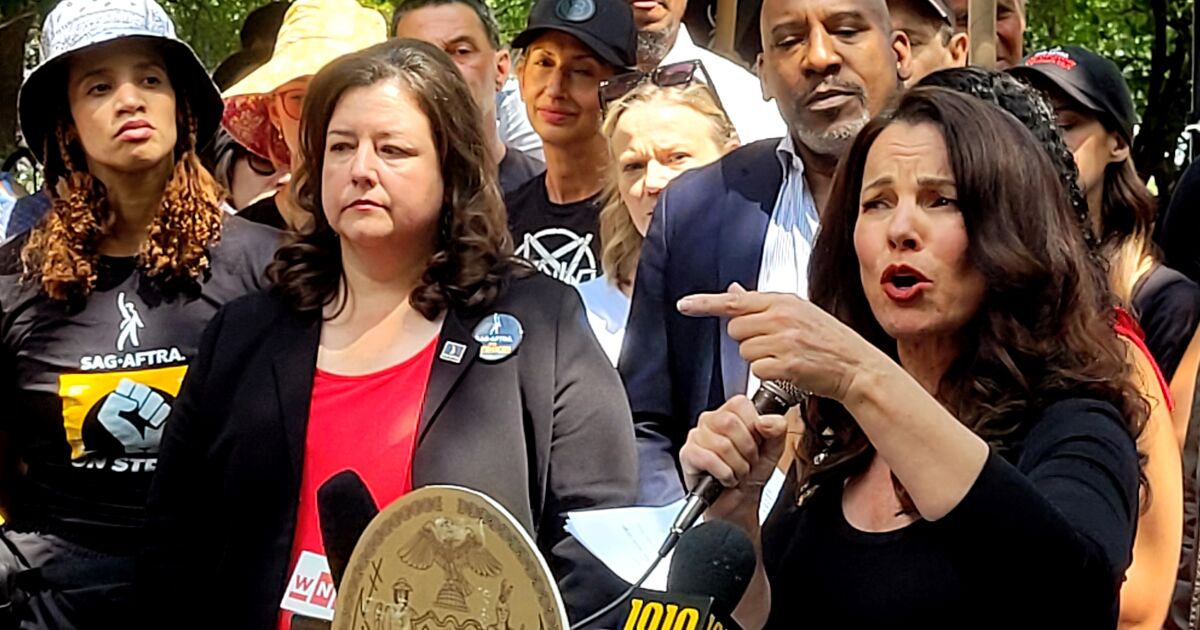

SAG-AFTRA President Fran Drescher came home Tuesday to New York as striking actors gathered outside of City Hall in a show of support nearly three weeks after they staged a nationwide walkout against the Hollywood studios.
The Queens, N.Y., native and star of “The Nanny” was joined by other SAG-AFTRA officials and supportive New York City politicians as they stressed their demands for improved residual payments for streamed programs and movies and protections on the use of the likeness of performers through artificial intelligence.
They also continued to spotlight the wealth gap between the top executives running media companies — such as the Walt Disney Co.’s Bob Iger and Warner Bros. Discovery’s David Zaslav — and the rank-and-file actors who create television programs and film.
“The AMPTP’s maniacal corporate culture for greed must stop,” Drescher said, referring to the negotiating entity for the studios. “Industry profit and doing the right thing on behalf of workers does not have to be mutually exclusive.”
A representative of the AMPTP declined to comment.
The studios have previously disputed the guild’s claims, saying they offered the union the “highest percentage increase” in guild minimums in 35 years as well as limits to self-taped auditions and substantial increases in pension and health contribution caps, among other proposals.
The rally preceded a meeting of the New York City Council’s Committee on Civil Service and Labor, which voted unanimously to pass two resolutions supporting the actions by SAG-AFTRA and the Writers Guild of America, whose members walked off the job on May 2.
There is no indication of when negotiations on new contracts for both guilds will resume.
“We are here today because we know our brothers and sisters in labor need us right now,” said Carmen De La Rosa, the city council member who chairs the labor committee.
The unions hammered away at the message that most of their members are looking for a middle-class living through fair compensation.
“Eighty-six percent of my members cannot even make the $26,500-a-year threshold to be eligible for their health benefits,” Drescher said. “They are working people who simply want to pay their rent and put food on the table. My members want the same things for their children that these uber-wealthy CEOs want for theirs.”
Ezra Knight, the union’s New York president, described himself to the crowd as “one of the 86% of actor-performers in SAG-AFTRA who work one audition at a time, sometimes one paycheck at a time, but most definitely one day at a time.”
New York is the second-largest hub of the entertainment industry after Los Angeles, with 36,000 SAG-AFTRA members. Overall, the film and TV business accounts for $18 billion in total wages annually in the city and $81.6 billion in total economic output, according to the Mayor’s Office of Media and Entertainment.
About 100 striking performers gathered at City Hall Park for the rally, including Dascha Polanco, a co-star of one of the first streaming hits, Netflix’s “Orange Is the New Black.”
A recent report in the New Yorker described the paltry residual payments received by the series’ cast members, who had no data to measure the popularity of the series.
“It’s not what people think,” Polanco said. “We’re more famous than what we get paid for.”
For Polanco, the rally was a break from a stressful time, as the strike meant the actor had to walk away from a project in production and her voice-over work.
“I’m taking care of my mental health,” Polanco said. “It has me on the edge.”

SAG-AFTRA President Fran Drescher came home Tuesday to New York as striking actors gathered outside of City Hall in a show of support nearly three weeks after they staged a nationwide walkout against the Hollywood studios.
The Queens, N.Y., native and star of “The Nanny” was joined by other SAG-AFTRA officials and supportive New York City politicians as they stressed their demands for improved residual payments for streamed programs and movies and protections on the use of the likeness of performers through artificial intelligence.
They also continued to spotlight the wealth gap between the top executives running media companies — such as the Walt Disney Co.’s Bob Iger and Warner Bros. Discovery’s David Zaslav — and the rank-and-file actors who create television programs and film.
“The AMPTP’s maniacal corporate culture for greed must stop,” Drescher said, referring to the negotiating entity for the studios. “Industry profit and doing the right thing on behalf of workers does not have to be mutually exclusive.”
A representative of the AMPTP declined to comment.
The studios have previously disputed the guild’s claims, saying they offered the union the “highest percentage increase” in guild minimums in 35 years as well as limits to self-taped auditions and substantial increases in pension and health contribution caps, among other proposals.
The rally preceded a meeting of the New York City Council’s Committee on Civil Service and Labor, which voted unanimously to pass two resolutions supporting the actions by SAG-AFTRA and the Writers Guild of America, whose members walked off the job on May 2.
There is no indication of when negotiations on new contracts for both guilds will resume.
“We are here today because we know our brothers and sisters in labor need us right now,” said Carmen De La Rosa, the city council member who chairs the labor committee.
The unions hammered away at the message that most of their members are looking for a middle-class living through fair compensation.
“Eighty-six percent of my members cannot even make the $26,500-a-year threshold to be eligible for their health benefits,” Drescher said. “They are working people who simply want to pay their rent and put food on the table. My members want the same things for their children that these uber-wealthy CEOs want for theirs.”
Ezra Knight, the union’s New York president, described himself to the crowd as “one of the 86% of actor-performers in SAG-AFTRA who work one audition at a time, sometimes one paycheck at a time, but most definitely one day at a time.”
New York is the second-largest hub of the entertainment industry after Los Angeles, with 36,000 SAG-AFTRA members. Overall, the film and TV business accounts for $18 billion in total wages annually in the city and $81.6 billion in total economic output, according to the Mayor’s Office of Media and Entertainment.
About 100 striking performers gathered at City Hall Park for the rally, including Dascha Polanco, a co-star of one of the first streaming hits, Netflix’s “Orange Is the New Black.”
A recent report in the New Yorker described the paltry residual payments received by the series’ cast members, who had no data to measure the popularity of the series.
“It’s not what people think,” Polanco said. “We’re more famous than what we get paid for.”
For Polanco, the rally was a break from a stressful time, as the strike meant the actor had to walk away from a project in production and her voice-over work.
“I’m taking care of my mental health,” Polanco said. “It has me on the edge.”

SAG-AFTRA President Fran Drescher came home Tuesday to New York as striking actors gathered outside of City Hall in a show of support nearly three weeks after they staged a nationwide walkout against the Hollywood studios.
The Queens, N.Y., native and star of “The Nanny” was joined by other SAG-AFTRA officials and supportive New York City politicians as they stressed their demands for improved residual payments for streamed programs and movies and protections on the use of the likeness of performers through artificial intelligence.
They also continued to spotlight the wealth gap between the top executives running media companies — such as the Walt Disney Co.’s Bob Iger and Warner Bros. Discovery’s David Zaslav — and the rank-and-file actors who create television programs and film.
“The AMPTP’s maniacal corporate culture for greed must stop,” Drescher said, referring to the negotiating entity for the studios. “Industry profit and doing the right thing on behalf of workers does not have to be mutually exclusive.”
A representative of the AMPTP declined to comment.
The studios have previously disputed the guild’s claims, saying they offered the union the “highest percentage increase” in guild minimums in 35 years as well as limits to self-taped auditions and substantial increases in pension and health contribution caps, among other proposals.
The rally preceded a meeting of the New York City Council’s Committee on Civil Service and Labor, which voted unanimously to pass two resolutions supporting the actions by SAG-AFTRA and the Writers Guild of America, whose members walked off the job on May 2.
There is no indication of when negotiations on new contracts for both guilds will resume.
“We are here today because we know our brothers and sisters in labor need us right now,” said Carmen De La Rosa, the city council member who chairs the labor committee.
The unions hammered away at the message that most of their members are looking for a middle-class living through fair compensation.
“Eighty-six percent of my members cannot even make the $26,500-a-year threshold to be eligible for their health benefits,” Drescher said. “They are working people who simply want to pay their rent and put food on the table. My members want the same things for their children that these uber-wealthy CEOs want for theirs.”
Ezra Knight, the union’s New York president, described himself to the crowd as “one of the 86% of actor-performers in SAG-AFTRA who work one audition at a time, sometimes one paycheck at a time, but most definitely one day at a time.”
New York is the second-largest hub of the entertainment industry after Los Angeles, with 36,000 SAG-AFTRA members. Overall, the film and TV business accounts for $18 billion in total wages annually in the city and $81.6 billion in total economic output, according to the Mayor’s Office of Media and Entertainment.
About 100 striking performers gathered at City Hall Park for the rally, including Dascha Polanco, a co-star of one of the first streaming hits, Netflix’s “Orange Is the New Black.”
A recent report in the New Yorker described the paltry residual payments received by the series’ cast members, who had no data to measure the popularity of the series.
“It’s not what people think,” Polanco said. “We’re more famous than what we get paid for.”
For Polanco, the rally was a break from a stressful time, as the strike meant the actor had to walk away from a project in production and her voice-over work.
“I’m taking care of my mental health,” Polanco said. “It has me on the edge.”
SAG-AFTRA President Fran Drescher came home Tuesday to New York as striking actors gathered outside of City Hall in a show of support nearly three weeks after they staged a nationwide walkout against the Hollywood studios.
The Queens, N.Y., native and star of “The Nanny” was joined by other SAG-AFTRA officials and supportive New York City politicians as they stressed their demands for improved residual payments for streamed programs and movies and protections on the use of the likeness of performers through artificial intelligence.
They also continued to spotlight the wealth gap between the top executives running media companies — such as the Walt Disney Co.’s Bob Iger and Warner Bros. Discovery’s David Zaslav — and the rank-and-file actors who create television programs and film.
“The AMPTP’s maniacal corporate culture for greed must stop,” Drescher said, referring to the negotiating entity for the studios. “Industry profit and doing the right thing on behalf of workers does not have to be mutually exclusive.”
A representative of the AMPTP declined to comment.
The studios have previously disputed the guild’s claims, saying they offered the union the “highest percentage increase” in guild minimums in 35 years as well as limits to self-taped auditions and substantial increases in pension and health contribution caps, among other proposals.
The rally preceded a meeting of the New York City Council’s Committee on Civil Service and Labor, which voted unanimously to pass two resolutions supporting the actions by SAG-AFTRA and the Writers Guild of America, whose members walked off the job on May 2.
There is no indication of when negotiations on new contracts for both guilds will resume.
“We are here today because we know our brothers and sisters in labor need us right now,” said Carmen De La Rosa, the city council member who chairs the labor committee.
The unions hammered away at the message that most of their members are looking for a middle-class living through fair compensation.
“Eighty-six percent of my members cannot even make the $26,500-a-year threshold to be eligible for their health benefits,” Drescher said. “They are working people who simply want to pay their rent and put food on the table. My members want the same things for their children that these uber-wealthy CEOs want for theirs.”
Ezra Knight, the union’s New York president, described himself to the crowd as “one of the 86% of actor-performers in SAG-AFTRA who work one audition at a time, sometimes one paycheck at a time, but most definitely one day at a time.”
New York is the second-largest hub of the entertainment industry after Los Angeles, with 36,000 SAG-AFTRA members. Overall, the film and TV business accounts for $18 billion in total wages annually in the city and $81.6 billion in total economic output, according to the Mayor’s Office of Media and Entertainment.
About 100 striking performers gathered at City Hall Park for the rally, including Dascha Polanco, a co-star of one of the first streaming hits, Netflix’s “Orange Is the New Black.”
A recent report in the New Yorker described the paltry residual payments received by the series’ cast members, who had no data to measure the popularity of the series.
“It’s not what people think,” Polanco said. “We’re more famous than what we get paid for.”
For Polanco, the rally was a break from a stressful time, as the strike meant the actor had to walk away from a project in production and her voice-over work.
“I’m taking care of my mental health,” Polanco said. “It has me on the edge.”

SAG-AFTRA President Fran Drescher came home Tuesday to New York as striking actors gathered outside of City Hall in a show of support nearly three weeks after they staged a nationwide walkout against the Hollywood studios.
The Queens, N.Y., native and star of “The Nanny” was joined by other SAG-AFTRA officials and supportive New York City politicians as they stressed their demands for improved residual payments for streamed programs and movies and protections on the use of the likeness of performers through artificial intelligence.
They also continued to spotlight the wealth gap between the top executives running media companies — such as the Walt Disney Co.’s Bob Iger and Warner Bros. Discovery’s David Zaslav — and the rank-and-file actors who create television programs and film.
“The AMPTP’s maniacal corporate culture for greed must stop,” Drescher said, referring to the negotiating entity for the studios. “Industry profit and doing the right thing on behalf of workers does not have to be mutually exclusive.”
A representative of the AMPTP declined to comment.
The studios have previously disputed the guild’s claims, saying they offered the union the “highest percentage increase” in guild minimums in 35 years as well as limits to self-taped auditions and substantial increases in pension and health contribution caps, among other proposals.
The rally preceded a meeting of the New York City Council’s Committee on Civil Service and Labor, which voted unanimously to pass two resolutions supporting the actions by SAG-AFTRA and the Writers Guild of America, whose members walked off the job on May 2.
There is no indication of when negotiations on new contracts for both guilds will resume.
“We are here today because we know our brothers and sisters in labor need us right now,” said Carmen De La Rosa, the city council member who chairs the labor committee.
The unions hammered away at the message that most of their members are looking for a middle-class living through fair compensation.
“Eighty-six percent of my members cannot even make the $26,500-a-year threshold to be eligible for their health benefits,” Drescher said. “They are working people who simply want to pay their rent and put food on the table. My members want the same things for their children that these uber-wealthy CEOs want for theirs.”
Ezra Knight, the union’s New York president, described himself to the crowd as “one of the 86% of actor-performers in SAG-AFTRA who work one audition at a time, sometimes one paycheck at a time, but most definitely one day at a time.”
New York is the second-largest hub of the entertainment industry after Los Angeles, with 36,000 SAG-AFTRA members. Overall, the film and TV business accounts for $18 billion in total wages annually in the city and $81.6 billion in total economic output, according to the Mayor’s Office of Media and Entertainment.
About 100 striking performers gathered at City Hall Park for the rally, including Dascha Polanco, a co-star of one of the first streaming hits, Netflix’s “Orange Is the New Black.”
A recent report in the New Yorker described the paltry residual payments received by the series’ cast members, who had no data to measure the popularity of the series.
“It’s not what people think,” Polanco said. “We’re more famous than what we get paid for.”
For Polanco, the rally was a break from a stressful time, as the strike meant the actor had to walk away from a project in production and her voice-over work.
“I’m taking care of my mental health,” Polanco said. “It has me on the edge.”
SAG-AFTRA President Fran Drescher came home Tuesday to New York as striking actors gathered outside of City Hall in a show of support nearly three weeks after they staged a nationwide walkout against the Hollywood studios.
The Queens, N.Y., native and star of “The Nanny” was joined by other SAG-AFTRA officials and supportive New York City politicians as they stressed their demands for improved residual payments for streamed programs and movies and protections on the use of the likeness of performers through artificial intelligence.
They also continued to spotlight the wealth gap between the top executives running media companies — such as the Walt Disney Co.’s Bob Iger and Warner Bros. Discovery’s David Zaslav — and the rank-and-file actors who create television programs and film.
“The AMPTP’s maniacal corporate culture for greed must stop,” Drescher said, referring to the negotiating entity for the studios. “Industry profit and doing the right thing on behalf of workers does not have to be mutually exclusive.”
A representative of the AMPTP declined to comment.
The studios have previously disputed the guild’s claims, saying they offered the union the “highest percentage increase” in guild minimums in 35 years as well as limits to self-taped auditions and substantial increases in pension and health contribution caps, among other proposals.
The rally preceded a meeting of the New York City Council’s Committee on Civil Service and Labor, which voted unanimously to pass two resolutions supporting the actions by SAG-AFTRA and the Writers Guild of America, whose members walked off the job on May 2.
There is no indication of when negotiations on new contracts for both guilds will resume.
“We are here today because we know our brothers and sisters in labor need us right now,” said Carmen De La Rosa, the city council member who chairs the labor committee.
The unions hammered away at the message that most of their members are looking for a middle-class living through fair compensation.
“Eighty-six percent of my members cannot even make the $26,500-a-year threshold to be eligible for their health benefits,” Drescher said. “They are working people who simply want to pay their rent and put food on the table. My members want the same things for their children that these uber-wealthy CEOs want for theirs.”
Ezra Knight, the union’s New York president, described himself to the crowd as “one of the 86% of actor-performers in SAG-AFTRA who work one audition at a time, sometimes one paycheck at a time, but most definitely one day at a time.”
New York is the second-largest hub of the entertainment industry after Los Angeles, with 36,000 SAG-AFTRA members. Overall, the film and TV business accounts for $18 billion in total wages annually in the city and $81.6 billion in total economic output, according to the Mayor’s Office of Media and Entertainment.
About 100 striking performers gathered at City Hall Park for the rally, including Dascha Polanco, a co-star of one of the first streaming hits, Netflix’s “Orange Is the New Black.”
A recent report in the New Yorker described the paltry residual payments received by the series’ cast members, who had no data to measure the popularity of the series.
“It’s not what people think,” Polanco said. “We’re more famous than what we get paid for.”
For Polanco, the rally was a break from a stressful time, as the strike meant the actor had to walk away from a project in production and her voice-over work.
“I’m taking care of my mental health,” Polanco said. “It has me on the edge.”
SAG-AFTRA President Fran Drescher came home Tuesday to New York as striking actors gathered outside of City Hall in a show of support nearly three weeks after they staged a nationwide walkout against the Hollywood studios.
The Queens, N.Y., native and star of “The Nanny” was joined by other SAG-AFTRA officials and supportive New York City politicians as they stressed their demands for improved residual payments for streamed programs and movies and protections on the use of the likeness of performers through artificial intelligence.
They also continued to spotlight the wealth gap between the top executives running media companies — such as the Walt Disney Co.’s Bob Iger and Warner Bros. Discovery’s David Zaslav — and the rank-and-file actors who create television programs and film.
“The AMPTP’s maniacal corporate culture for greed must stop,” Drescher said, referring to the negotiating entity for the studios. “Industry profit and doing the right thing on behalf of workers does not have to be mutually exclusive.”
A representative of the AMPTP declined to comment.
The studios have previously disputed the guild’s claims, saying they offered the union the “highest percentage increase” in guild minimums in 35 years as well as limits to self-taped auditions and substantial increases in pension and health contribution caps, among other proposals.
The rally preceded a meeting of the New York City Council’s Committee on Civil Service and Labor, which voted unanimously to pass two resolutions supporting the actions by SAG-AFTRA and the Writers Guild of America, whose members walked off the job on May 2.
There is no indication of when negotiations on new contracts for both guilds will resume.
“We are here today because we know our brothers and sisters in labor need us right now,” said Carmen De La Rosa, the city council member who chairs the labor committee.
The unions hammered away at the message that most of their members are looking for a middle-class living through fair compensation.
“Eighty-six percent of my members cannot even make the $26,500-a-year threshold to be eligible for their health benefits,” Drescher said. “They are working people who simply want to pay their rent and put food on the table. My members want the same things for their children that these uber-wealthy CEOs want for theirs.”
Ezra Knight, the union’s New York president, described himself to the crowd as “one of the 86% of actor-performers in SAG-AFTRA who work one audition at a time, sometimes one paycheck at a time, but most definitely one day at a time.”
New York is the second-largest hub of the entertainment industry after Los Angeles, with 36,000 SAG-AFTRA members. Overall, the film and TV business accounts for $18 billion in total wages annually in the city and $81.6 billion in total economic output, according to the Mayor’s Office of Media and Entertainment.
About 100 striking performers gathered at City Hall Park for the rally, including Dascha Polanco, a co-star of one of the first streaming hits, Netflix’s “Orange Is the New Black.”
A recent report in the New Yorker described the paltry residual payments received by the series’ cast members, who had no data to measure the popularity of the series.
“It’s not what people think,” Polanco said. “We’re more famous than what we get paid for.”
For Polanco, the rally was a break from a stressful time, as the strike meant the actor had to walk away from a project in production and her voice-over work.
“I’m taking care of my mental health,” Polanco said. “It has me on the edge.”
SAG-AFTRA President Fran Drescher came home Tuesday to New York as striking actors gathered outside of City Hall in a show of support nearly three weeks after they staged a nationwide walkout against the Hollywood studios.
The Queens, N.Y., native and star of “The Nanny” was joined by other SAG-AFTRA officials and supportive New York City politicians as they stressed their demands for improved residual payments for streamed programs and movies and protections on the use of the likeness of performers through artificial intelligence.
They also continued to spotlight the wealth gap between the top executives running media companies — such as the Walt Disney Co.’s Bob Iger and Warner Bros. Discovery’s David Zaslav — and the rank-and-file actors who create television programs and film.
“The AMPTP’s maniacal corporate culture for greed must stop,” Drescher said, referring to the negotiating entity for the studios. “Industry profit and doing the right thing on behalf of workers does not have to be mutually exclusive.”
A representative of the AMPTP declined to comment.
The studios have previously disputed the guild’s claims, saying they offered the union the “highest percentage increase” in guild minimums in 35 years as well as limits to self-taped auditions and substantial increases in pension and health contribution caps, among other proposals.
The rally preceded a meeting of the New York City Council’s Committee on Civil Service and Labor, which voted unanimously to pass two resolutions supporting the actions by SAG-AFTRA and the Writers Guild of America, whose members walked off the job on May 2.
There is no indication of when negotiations on new contracts for both guilds will resume.
“We are here today because we know our brothers and sisters in labor need us right now,” said Carmen De La Rosa, the city council member who chairs the labor committee.
The unions hammered away at the message that most of their members are looking for a middle-class living through fair compensation.
“Eighty-six percent of my members cannot even make the $26,500-a-year threshold to be eligible for their health benefits,” Drescher said. “They are working people who simply want to pay their rent and put food on the table. My members want the same things for their children that these uber-wealthy CEOs want for theirs.”
Ezra Knight, the union’s New York president, described himself to the crowd as “one of the 86% of actor-performers in SAG-AFTRA who work one audition at a time, sometimes one paycheck at a time, but most definitely one day at a time.”
New York is the second-largest hub of the entertainment industry after Los Angeles, with 36,000 SAG-AFTRA members. Overall, the film and TV business accounts for $18 billion in total wages annually in the city and $81.6 billion in total economic output, according to the Mayor’s Office of Media and Entertainment.
About 100 striking performers gathered at City Hall Park for the rally, including Dascha Polanco, a co-star of one of the first streaming hits, Netflix’s “Orange Is the New Black.”
A recent report in the New Yorker described the paltry residual payments received by the series’ cast members, who had no data to measure the popularity of the series.
“It’s not what people think,” Polanco said. “We’re more famous than what we get paid for.”
For Polanco, the rally was a break from a stressful time, as the strike meant the actor had to walk away from a project in production and her voice-over work.
“I’m taking care of my mental health,” Polanco said. “It has me on the edge.”

