

Animation is an art of the impossible, though it often settles for the ordinary. Much of what comprises adult animation merely translates into line what might be shown in live action — humans in human settings. Which is fine. Some great shows fit that bill — “King of the Hill” and “Bob’s Burgers,” for example. Still, there are infinite avenues to explore, and so it’s good to have Adult Swim, the network that once produced a series whose heroes are a meatball, a shake and a bag of fries, still making aesthetic trouble.
“The Elephant,” which premieres Friday on the network, and Saturday on HBO Max alongside a documentary on its creation, “Behind the Elephant,” is an animated take on exquisite corpse, the old surrealist game in which three artists contribute the head, torso or legs of a single figure, folding the paper so as not to see what the others had drawn. This project enlists four fab animators over three acts — “Adventure Time” creator Pendleton Ward, Ian Jones-Quartey (“OK K.O.! Let’s Be Heroes”), Rebecca Sugar (“Steven Universe”) and Patrick McHale (“Over the Garden Wall”) — to make something that not only had we not seen before, but none of them had either, until their independently produced parts were put together. All are “Adventure Time” vets, as are Jack Pendarvis and Kent Osborne, who conceived the idea, served as “game keepers,” and share story credit with the animators.
Exquisite corpse was also used in character design. It invariably produces monsters, if amusing ones, which explains why the character — let’s call her The Character — in Ward’s act has a cactus for an arm and a giant pink foot in place of one leg. In the Jones-Quartey and Sugar act, she has robot arms, fishnet stockings and a “music button” in her chest (the city parties when its disco plays), and in McHale’s, a TV for a torso. One regards The Character as the same person in each act, and through changes that occur within each act — identity, death and reincarnation are at the heart of the show. She’s always different, though always the protagonist. (And seemingly female.) Which is not surprising if you’ve ever watched “Adventure Time,” where even every villain is also a protagonist.
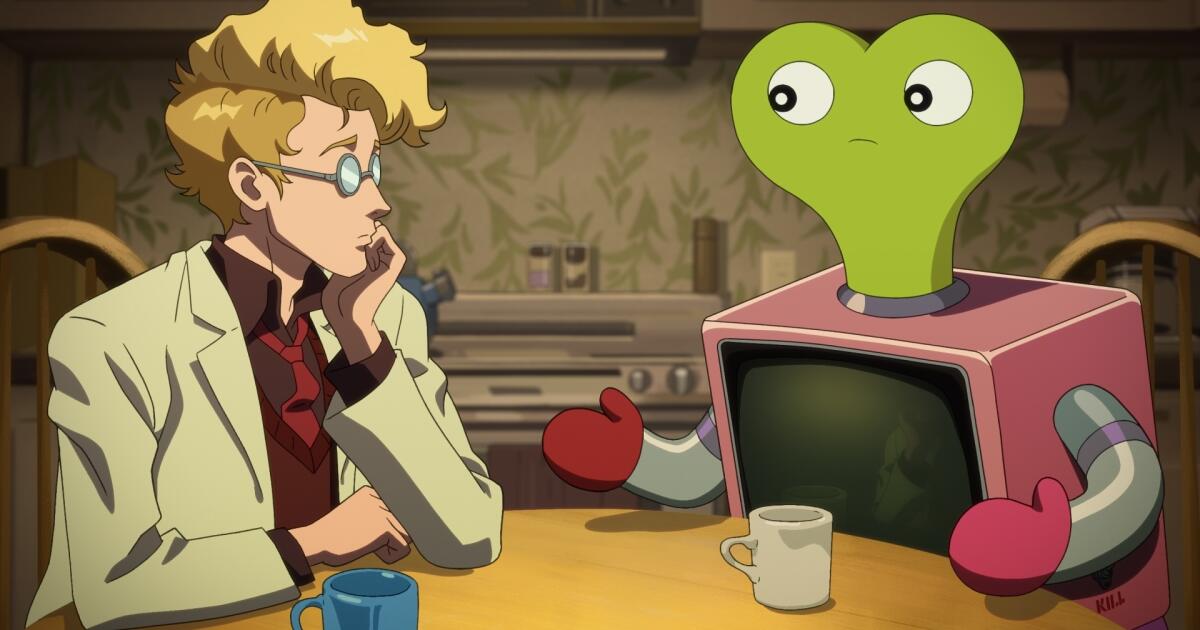
Ward takes the first act; Jones-Quartey and Sugar, who are married, worked together on the second; and McHale brings it home with Act 3. Ward’s section is easily recognizable as his work in its mix of the uncanny and the offhand, both from “Adventure Time” and the psychedelic “Midnight Gospel.” Sugar and Jones-Quartey opt for a New Wave angularity far from their usual styles, and McHale cycles through several looks until his Character, who arrives already hoping to get off this wheel of endless rebirth and cease to exist, settles down for a spell in a realistically portrayed city in the snow — New York, I’d say — in conversation with a lonely inventor. McHale also brings in, for just a few seconds, the eponymous elephant in an apropos reference to the parable of the blind men who imagined that animal to be a different sort of beast depending on where they laid their hands.
Each animator (or team) integrates their position in the game — and the nature of the game itself — into their storytelling. Ward’s Character, born onscreen, wonders “What am I? I’m not sure.” In the second section, Sugar and Jones-Quartey have their narrating Character say, “I could feel my existence stretching in both directions, back to the nothingness before anything happened and forward to the nothingness after everything is over. And if everything has a beginning and also a end then this was just the middle.” By virtue of owning the conclusion, and it’s a moving one, McHale brings order to the whole; given the scattered process, and the changes between and within each section, it feels remarkably cohesive and intentional. But metamorphosis is the soul of animation.
If “The Elephant,” described by the network as “a creative experience,” had appeared before it was already published, it would have certainly joined four other animated series — three from Adult Swim — on my list of 2025 favorites. It demands a second viewing, and you’ll want to watch “Behind the Elephant” to learn more. You may want to watch that twice as well.

Animation is an art of the impossible, though it often settles for the ordinary. Much of what comprises adult animation merely translates into line what might be shown in live action — humans in human settings. Which is fine. Some great shows fit that bill — “King of the Hill” and “Bob’s Burgers,” for example. Still, there are infinite avenues to explore, and so it’s good to have Adult Swim, the network that once produced a series whose heroes are a meatball, a shake and a bag of fries, still making aesthetic trouble.
“The Elephant,” which premieres Friday on the network, and Saturday on HBO Max alongside a documentary on its creation, “Behind the Elephant,” is an animated take on exquisite corpse, the old surrealist game in which three artists contribute the head, torso or legs of a single figure, folding the paper so as not to see what the others had drawn. This project enlists four fab animators over three acts — “Adventure Time” creator Pendleton Ward, Ian Jones-Quartey (“OK K.O.! Let’s Be Heroes”), Rebecca Sugar (“Steven Universe”) and Patrick McHale (“Over the Garden Wall”) — to make something that not only had we not seen before, but none of them had either, until their independently produced parts were put together. All are “Adventure Time” vets, as are Jack Pendarvis and Kent Osborne, who conceived the idea, served as “game keepers,” and share story credit with the animators.
Exquisite corpse was also used in character design. It invariably produces monsters, if amusing ones, which explains why the character — let’s call her The Character — in Ward’s act has a cactus for an arm and a giant pink foot in place of one leg. In the Jones-Quartey and Sugar act, she has robot arms, fishnet stockings and a “music button” in her chest (the city parties when its disco plays), and in McHale’s, a TV for a torso. One regards The Character as the same person in each act, and through changes that occur within each act — identity, death and reincarnation are at the heart of the show. She’s always different, though always the protagonist. (And seemingly female.) Which is not surprising if you’ve ever watched “Adventure Time,” where even every villain is also a protagonist.
Ward takes the first act; Jones-Quartey and Sugar, who are married, worked together on the second; and McHale brings it home with Act 3. Ward’s section is easily recognizable as his work in its mix of the uncanny and the offhand, both from “Adventure Time” and the psychedelic “Midnight Gospel.” Sugar and Jones-Quartey opt for a New Wave angularity far from their usual styles, and McHale cycles through several looks until his Character, who arrives already hoping to get off this wheel of endless rebirth and cease to exist, settles down for a spell in a realistically portrayed city in the snow — New York, I’d say — in conversation with a lonely inventor. McHale also brings in, for just a few seconds, the eponymous elephant in an apropos reference to the parable of the blind men who imagined that animal to be a different sort of beast depending on where they laid their hands.
Each animator (or team) integrates their position in the game — and the nature of the game itself — into their storytelling. Ward’s Character, born onscreen, wonders “What am I? I’m not sure.” In the second section, Sugar and Jones-Quartey have their narrating Character say, “I could feel my existence stretching in both directions, back to the nothingness before anything happened and forward to the nothingness after everything is over. And if everything has a beginning and also a end then this was just the middle.” By virtue of owning the conclusion, and it’s a moving one, McHale brings order to the whole; given the scattered process, and the changes between and within each section, it feels remarkably cohesive and intentional. But metamorphosis is the soul of animation.
If “The Elephant,” described by the network as “a creative experience,” had appeared before it was already published, it would have certainly joined four other animated series — three from Adult Swim — on my list of 2025 favorites. It demands a second viewing, and you’ll want to watch “Behind the Elephant” to learn more. You may want to watch that twice as well.

Animation is an art of the impossible, though it often settles for the ordinary. Much of what comprises adult animation merely translates into line what might be shown in live action — humans in human settings. Which is fine. Some great shows fit that bill — “King of the Hill” and “Bob’s Burgers,” for example. Still, there are infinite avenues to explore, and so it’s good to have Adult Swim, the network that once produced a series whose heroes are a meatball, a shake and a bag of fries, still making aesthetic trouble.
“The Elephant,” which premieres Friday on the network, and Saturday on HBO Max alongside a documentary on its creation, “Behind the Elephant,” is an animated take on exquisite corpse, the old surrealist game in which three artists contribute the head, torso or legs of a single figure, folding the paper so as not to see what the others had drawn. This project enlists four fab animators over three acts — “Adventure Time” creator Pendleton Ward, Ian Jones-Quartey (“OK K.O.! Let’s Be Heroes”), Rebecca Sugar (“Steven Universe”) and Patrick McHale (“Over the Garden Wall”) — to make something that not only had we not seen before, but none of them had either, until their independently produced parts were put together. All are “Adventure Time” vets, as are Jack Pendarvis and Kent Osborne, who conceived the idea, served as “game keepers,” and share story credit with the animators.
Exquisite corpse was also used in character design. It invariably produces monsters, if amusing ones, which explains why the character — let’s call her The Character — in Ward’s act has a cactus for an arm and a giant pink foot in place of one leg. In the Jones-Quartey and Sugar act, she has robot arms, fishnet stockings and a “music button” in her chest (the city parties when its disco plays), and in McHale’s, a TV for a torso. One regards The Character as the same person in each act, and through changes that occur within each act — identity, death and reincarnation are at the heart of the show. She’s always different, though always the protagonist. (And seemingly female.) Which is not surprising if you’ve ever watched “Adventure Time,” where even every villain is also a protagonist.
Ward takes the first act; Jones-Quartey and Sugar, who are married, worked together on the second; and McHale brings it home with Act 3. Ward’s section is easily recognizable as his work in its mix of the uncanny and the offhand, both from “Adventure Time” and the psychedelic “Midnight Gospel.” Sugar and Jones-Quartey opt for a New Wave angularity far from their usual styles, and McHale cycles through several looks until his Character, who arrives already hoping to get off this wheel of endless rebirth and cease to exist, settles down for a spell in a realistically portrayed city in the snow — New York, I’d say — in conversation with a lonely inventor. McHale also brings in, for just a few seconds, the eponymous elephant in an apropos reference to the parable of the blind men who imagined that animal to be a different sort of beast depending on where they laid their hands.
Each animator (or team) integrates their position in the game — and the nature of the game itself — into their storytelling. Ward’s Character, born onscreen, wonders “What am I? I’m not sure.” In the second section, Sugar and Jones-Quartey have their narrating Character say, “I could feel my existence stretching in both directions, back to the nothingness before anything happened and forward to the nothingness after everything is over. And if everything has a beginning and also a end then this was just the middle.” By virtue of owning the conclusion, and it’s a moving one, McHale brings order to the whole; given the scattered process, and the changes between and within each section, it feels remarkably cohesive and intentional. But metamorphosis is the soul of animation.
If “The Elephant,” described by the network as “a creative experience,” had appeared before it was already published, it would have certainly joined four other animated series — three from Adult Swim — on my list of 2025 favorites. It demands a second viewing, and you’ll want to watch “Behind the Elephant” to learn more. You may want to watch that twice as well.
Animation is an art of the impossible, though it often settles for the ordinary. Much of what comprises adult animation merely translates into line what might be shown in live action — humans in human settings. Which is fine. Some great shows fit that bill — “King of the Hill” and “Bob’s Burgers,” for example. Still, there are infinite avenues to explore, and so it’s good to have Adult Swim, the network that once produced a series whose heroes are a meatball, a shake and a bag of fries, still making aesthetic trouble.
“The Elephant,” which premieres Friday on the network, and Saturday on HBO Max alongside a documentary on its creation, “Behind the Elephant,” is an animated take on exquisite corpse, the old surrealist game in which three artists contribute the head, torso or legs of a single figure, folding the paper so as not to see what the others had drawn. This project enlists four fab animators over three acts — “Adventure Time” creator Pendleton Ward, Ian Jones-Quartey (“OK K.O.! Let’s Be Heroes”), Rebecca Sugar (“Steven Universe”) and Patrick McHale (“Over the Garden Wall”) — to make something that not only had we not seen before, but none of them had either, until their independently produced parts were put together. All are “Adventure Time” vets, as are Jack Pendarvis and Kent Osborne, who conceived the idea, served as “game keepers,” and share story credit with the animators.
Exquisite corpse was also used in character design. It invariably produces monsters, if amusing ones, which explains why the character — let’s call her The Character — in Ward’s act has a cactus for an arm and a giant pink foot in place of one leg. In the Jones-Quartey and Sugar act, she has robot arms, fishnet stockings and a “music button” in her chest (the city parties when its disco plays), and in McHale’s, a TV for a torso. One regards The Character as the same person in each act, and through changes that occur within each act — identity, death and reincarnation are at the heart of the show. She’s always different, though always the protagonist. (And seemingly female.) Which is not surprising if you’ve ever watched “Adventure Time,” where even every villain is also a protagonist.
Ward takes the first act; Jones-Quartey and Sugar, who are married, worked together on the second; and McHale brings it home with Act 3. Ward’s section is easily recognizable as his work in its mix of the uncanny and the offhand, both from “Adventure Time” and the psychedelic “Midnight Gospel.” Sugar and Jones-Quartey opt for a New Wave angularity far from their usual styles, and McHale cycles through several looks until his Character, who arrives already hoping to get off this wheel of endless rebirth and cease to exist, settles down for a spell in a realistically portrayed city in the snow — New York, I’d say — in conversation with a lonely inventor. McHale also brings in, for just a few seconds, the eponymous elephant in an apropos reference to the parable of the blind men who imagined that animal to be a different sort of beast depending on where they laid their hands.
Each animator (or team) integrates their position in the game — and the nature of the game itself — into their storytelling. Ward’s Character, born onscreen, wonders “What am I? I’m not sure.” In the second section, Sugar and Jones-Quartey have their narrating Character say, “I could feel my existence stretching in both directions, back to the nothingness before anything happened and forward to the nothingness after everything is over. And if everything has a beginning and also a end then this was just the middle.” By virtue of owning the conclusion, and it’s a moving one, McHale brings order to the whole; given the scattered process, and the changes between and within each section, it feels remarkably cohesive and intentional. But metamorphosis is the soul of animation.
If “The Elephant,” described by the network as “a creative experience,” had appeared before it was already published, it would have certainly joined four other animated series — three from Adult Swim — on my list of 2025 favorites. It demands a second viewing, and you’ll want to watch “Behind the Elephant” to learn more. You may want to watch that twice as well.

Animation is an art of the impossible, though it often settles for the ordinary. Much of what comprises adult animation merely translates into line what might be shown in live action — humans in human settings. Which is fine. Some great shows fit that bill — “King of the Hill” and “Bob’s Burgers,” for example. Still, there are infinite avenues to explore, and so it’s good to have Adult Swim, the network that once produced a series whose heroes are a meatball, a shake and a bag of fries, still making aesthetic trouble.
“The Elephant,” which premieres Friday on the network, and Saturday on HBO Max alongside a documentary on its creation, “Behind the Elephant,” is an animated take on exquisite corpse, the old surrealist game in which three artists contribute the head, torso or legs of a single figure, folding the paper so as not to see what the others had drawn. This project enlists four fab animators over three acts — “Adventure Time” creator Pendleton Ward, Ian Jones-Quartey (“OK K.O.! Let’s Be Heroes”), Rebecca Sugar (“Steven Universe”) and Patrick McHale (“Over the Garden Wall”) — to make something that not only had we not seen before, but none of them had either, until their independently produced parts were put together. All are “Adventure Time” vets, as are Jack Pendarvis and Kent Osborne, who conceived the idea, served as “game keepers,” and share story credit with the animators.
Exquisite corpse was also used in character design. It invariably produces monsters, if amusing ones, which explains why the character — let’s call her The Character — in Ward’s act has a cactus for an arm and a giant pink foot in place of one leg. In the Jones-Quartey and Sugar act, she has robot arms, fishnet stockings and a “music button” in her chest (the city parties when its disco plays), and in McHale’s, a TV for a torso. One regards The Character as the same person in each act, and through changes that occur within each act — identity, death and reincarnation are at the heart of the show. She’s always different, though always the protagonist. (And seemingly female.) Which is not surprising if you’ve ever watched “Adventure Time,” where even every villain is also a protagonist.
Ward takes the first act; Jones-Quartey and Sugar, who are married, worked together on the second; and McHale brings it home with Act 3. Ward’s section is easily recognizable as his work in its mix of the uncanny and the offhand, both from “Adventure Time” and the psychedelic “Midnight Gospel.” Sugar and Jones-Quartey opt for a New Wave angularity far from their usual styles, and McHale cycles through several looks until his Character, who arrives already hoping to get off this wheel of endless rebirth and cease to exist, settles down for a spell in a realistically portrayed city in the snow — New York, I’d say — in conversation with a lonely inventor. McHale also brings in, for just a few seconds, the eponymous elephant in an apropos reference to the parable of the blind men who imagined that animal to be a different sort of beast depending on where they laid their hands.
Each animator (or team) integrates their position in the game — and the nature of the game itself — into their storytelling. Ward’s Character, born onscreen, wonders “What am I? I’m not sure.” In the second section, Sugar and Jones-Quartey have their narrating Character say, “I could feel my existence stretching in both directions, back to the nothingness before anything happened and forward to the nothingness after everything is over. And if everything has a beginning and also a end then this was just the middle.” By virtue of owning the conclusion, and it’s a moving one, McHale brings order to the whole; given the scattered process, and the changes between and within each section, it feels remarkably cohesive and intentional. But metamorphosis is the soul of animation.
If “The Elephant,” described by the network as “a creative experience,” had appeared before it was already published, it would have certainly joined four other animated series — three from Adult Swim — on my list of 2025 favorites. It demands a second viewing, and you’ll want to watch “Behind the Elephant” to learn more. You may want to watch that twice as well.
Animation is an art of the impossible, though it often settles for the ordinary. Much of what comprises adult animation merely translates into line what might be shown in live action — humans in human settings. Which is fine. Some great shows fit that bill — “King of the Hill” and “Bob’s Burgers,” for example. Still, there are infinite avenues to explore, and so it’s good to have Adult Swim, the network that once produced a series whose heroes are a meatball, a shake and a bag of fries, still making aesthetic trouble.
“The Elephant,” which premieres Friday on the network, and Saturday on HBO Max alongside a documentary on its creation, “Behind the Elephant,” is an animated take on exquisite corpse, the old surrealist game in which three artists contribute the head, torso or legs of a single figure, folding the paper so as not to see what the others had drawn. This project enlists four fab animators over three acts — “Adventure Time” creator Pendleton Ward, Ian Jones-Quartey (“OK K.O.! Let’s Be Heroes”), Rebecca Sugar (“Steven Universe”) and Patrick McHale (“Over the Garden Wall”) — to make something that not only had we not seen before, but none of them had either, until their independently produced parts were put together. All are “Adventure Time” vets, as are Jack Pendarvis and Kent Osborne, who conceived the idea, served as “game keepers,” and share story credit with the animators.
Exquisite corpse was also used in character design. It invariably produces monsters, if amusing ones, which explains why the character — let’s call her The Character — in Ward’s act has a cactus for an arm and a giant pink foot in place of one leg. In the Jones-Quartey and Sugar act, she has robot arms, fishnet stockings and a “music button” in her chest (the city parties when its disco plays), and in McHale’s, a TV for a torso. One regards The Character as the same person in each act, and through changes that occur within each act — identity, death and reincarnation are at the heart of the show. She’s always different, though always the protagonist. (And seemingly female.) Which is not surprising if you’ve ever watched “Adventure Time,” where even every villain is also a protagonist.
Ward takes the first act; Jones-Quartey and Sugar, who are married, worked together on the second; and McHale brings it home with Act 3. Ward’s section is easily recognizable as his work in its mix of the uncanny and the offhand, both from “Adventure Time” and the psychedelic “Midnight Gospel.” Sugar and Jones-Quartey opt for a New Wave angularity far from their usual styles, and McHale cycles through several looks until his Character, who arrives already hoping to get off this wheel of endless rebirth and cease to exist, settles down for a spell in a realistically portrayed city in the snow — New York, I’d say — in conversation with a lonely inventor. McHale also brings in, for just a few seconds, the eponymous elephant in an apropos reference to the parable of the blind men who imagined that animal to be a different sort of beast depending on where they laid their hands.
Each animator (or team) integrates their position in the game — and the nature of the game itself — into their storytelling. Ward’s Character, born onscreen, wonders “What am I? I’m not sure.” In the second section, Sugar and Jones-Quartey have their narrating Character say, “I could feel my existence stretching in both directions, back to the nothingness before anything happened and forward to the nothingness after everything is over. And if everything has a beginning and also a end then this was just the middle.” By virtue of owning the conclusion, and it’s a moving one, McHale brings order to the whole; given the scattered process, and the changes between and within each section, it feels remarkably cohesive and intentional. But metamorphosis is the soul of animation.
If “The Elephant,” described by the network as “a creative experience,” had appeared before it was already published, it would have certainly joined four other animated series — three from Adult Swim — on my list of 2025 favorites. It demands a second viewing, and you’ll want to watch “Behind the Elephant” to learn more. You may want to watch that twice as well.
Animation is an art of the impossible, though it often settles for the ordinary. Much of what comprises adult animation merely translates into line what might be shown in live action — humans in human settings. Which is fine. Some great shows fit that bill — “King of the Hill” and “Bob’s Burgers,” for example. Still, there are infinite avenues to explore, and so it’s good to have Adult Swim, the network that once produced a series whose heroes are a meatball, a shake and a bag of fries, still making aesthetic trouble.
“The Elephant,” which premieres Friday on the network, and Saturday on HBO Max alongside a documentary on its creation, “Behind the Elephant,” is an animated take on exquisite corpse, the old surrealist game in which three artists contribute the head, torso or legs of a single figure, folding the paper so as not to see what the others had drawn. This project enlists four fab animators over three acts — “Adventure Time” creator Pendleton Ward, Ian Jones-Quartey (“OK K.O.! Let’s Be Heroes”), Rebecca Sugar (“Steven Universe”) and Patrick McHale (“Over the Garden Wall”) — to make something that not only had we not seen before, but none of them had either, until their independently produced parts were put together. All are “Adventure Time” vets, as are Jack Pendarvis and Kent Osborne, who conceived the idea, served as “game keepers,” and share story credit with the animators.
Exquisite corpse was also used in character design. It invariably produces monsters, if amusing ones, which explains why the character — let’s call her The Character — in Ward’s act has a cactus for an arm and a giant pink foot in place of one leg. In the Jones-Quartey and Sugar act, she has robot arms, fishnet stockings and a “music button” in her chest (the city parties when its disco plays), and in McHale’s, a TV for a torso. One regards The Character as the same person in each act, and through changes that occur within each act — identity, death and reincarnation are at the heart of the show. She’s always different, though always the protagonist. (And seemingly female.) Which is not surprising if you’ve ever watched “Adventure Time,” where even every villain is also a protagonist.
Ward takes the first act; Jones-Quartey and Sugar, who are married, worked together on the second; and McHale brings it home with Act 3. Ward’s section is easily recognizable as his work in its mix of the uncanny and the offhand, both from “Adventure Time” and the psychedelic “Midnight Gospel.” Sugar and Jones-Quartey opt for a New Wave angularity far from their usual styles, and McHale cycles through several looks until his Character, who arrives already hoping to get off this wheel of endless rebirth and cease to exist, settles down for a spell in a realistically portrayed city in the snow — New York, I’d say — in conversation with a lonely inventor. McHale also brings in, for just a few seconds, the eponymous elephant in an apropos reference to the parable of the blind men who imagined that animal to be a different sort of beast depending on where they laid their hands.
Each animator (or team) integrates their position in the game — and the nature of the game itself — into their storytelling. Ward’s Character, born onscreen, wonders “What am I? I’m not sure.” In the second section, Sugar and Jones-Quartey have their narrating Character say, “I could feel my existence stretching in both directions, back to the nothingness before anything happened and forward to the nothingness after everything is over. And if everything has a beginning and also a end then this was just the middle.” By virtue of owning the conclusion, and it’s a moving one, McHale brings order to the whole; given the scattered process, and the changes between and within each section, it feels remarkably cohesive and intentional. But metamorphosis is the soul of animation.
If “The Elephant,” described by the network as “a creative experience,” had appeared before it was already published, it would have certainly joined four other animated series — three from Adult Swim — on my list of 2025 favorites. It demands a second viewing, and you’ll want to watch “Behind the Elephant” to learn more. You may want to watch that twice as well.
Animation is an art of the impossible, though it often settles for the ordinary. Much of what comprises adult animation merely translates into line what might be shown in live action — humans in human settings. Which is fine. Some great shows fit that bill — “King of the Hill” and “Bob’s Burgers,” for example. Still, there are infinite avenues to explore, and so it’s good to have Adult Swim, the network that once produced a series whose heroes are a meatball, a shake and a bag of fries, still making aesthetic trouble.
“The Elephant,” which premieres Friday on the network, and Saturday on HBO Max alongside a documentary on its creation, “Behind the Elephant,” is an animated take on exquisite corpse, the old surrealist game in which three artists contribute the head, torso or legs of a single figure, folding the paper so as not to see what the others had drawn. This project enlists four fab animators over three acts — “Adventure Time” creator Pendleton Ward, Ian Jones-Quartey (“OK K.O.! Let’s Be Heroes”), Rebecca Sugar (“Steven Universe”) and Patrick McHale (“Over the Garden Wall”) — to make something that not only had we not seen before, but none of them had either, until their independently produced parts were put together. All are “Adventure Time” vets, as are Jack Pendarvis and Kent Osborne, who conceived the idea, served as “game keepers,” and share story credit with the animators.
Exquisite corpse was also used in character design. It invariably produces monsters, if amusing ones, which explains why the character — let’s call her The Character — in Ward’s act has a cactus for an arm and a giant pink foot in place of one leg. In the Jones-Quartey and Sugar act, she has robot arms, fishnet stockings and a “music button” in her chest (the city parties when its disco plays), and in McHale’s, a TV for a torso. One regards The Character as the same person in each act, and through changes that occur within each act — identity, death and reincarnation are at the heart of the show. She’s always different, though always the protagonist. (And seemingly female.) Which is not surprising if you’ve ever watched “Adventure Time,” where even every villain is also a protagonist.
Ward takes the first act; Jones-Quartey and Sugar, who are married, worked together on the second; and McHale brings it home with Act 3. Ward’s section is easily recognizable as his work in its mix of the uncanny and the offhand, both from “Adventure Time” and the psychedelic “Midnight Gospel.” Sugar and Jones-Quartey opt for a New Wave angularity far from their usual styles, and McHale cycles through several looks until his Character, who arrives already hoping to get off this wheel of endless rebirth and cease to exist, settles down for a spell in a realistically portrayed city in the snow — New York, I’d say — in conversation with a lonely inventor. McHale also brings in, for just a few seconds, the eponymous elephant in an apropos reference to the parable of the blind men who imagined that animal to be a different sort of beast depending on where they laid their hands.
Each animator (or team) integrates their position in the game — and the nature of the game itself — into their storytelling. Ward’s Character, born onscreen, wonders “What am I? I’m not sure.” In the second section, Sugar and Jones-Quartey have their narrating Character say, “I could feel my existence stretching in both directions, back to the nothingness before anything happened and forward to the nothingness after everything is over. And if everything has a beginning and also a end then this was just the middle.” By virtue of owning the conclusion, and it’s a moving one, McHale brings order to the whole; given the scattered process, and the changes between and within each section, it feels remarkably cohesive and intentional. But metamorphosis is the soul of animation.
If “The Elephant,” described by the network as “a creative experience,” had appeared before it was already published, it would have certainly joined four other animated series — three from Adult Swim — on my list of 2025 favorites. It demands a second viewing, and you’ll want to watch “Behind the Elephant” to learn more. You may want to watch that twice as well.

Animation is an art of the impossible, though it often settles for the ordinary. Much of what comprises adult animation merely translates into line what might be shown in live action — humans in human settings. Which is fine. Some great shows fit that bill — “King of the Hill” and “Bob’s Burgers,” for example. Still, there are infinite avenues to explore, and so it’s good to have Adult Swim, the network that once produced a series whose heroes are a meatball, a shake and a bag of fries, still making aesthetic trouble.
“The Elephant,” which premieres Friday on the network, and Saturday on HBO Max alongside a documentary on its creation, “Behind the Elephant,” is an animated take on exquisite corpse, the old surrealist game in which three artists contribute the head, torso or legs of a single figure, folding the paper so as not to see what the others had drawn. This project enlists four fab animators over three acts — “Adventure Time” creator Pendleton Ward, Ian Jones-Quartey (“OK K.O.! Let’s Be Heroes”), Rebecca Sugar (“Steven Universe”) and Patrick McHale (“Over the Garden Wall”) — to make something that not only had we not seen before, but none of them had either, until their independently produced parts were put together. All are “Adventure Time” vets, as are Jack Pendarvis and Kent Osborne, who conceived the idea, served as “game keepers,” and share story credit with the animators.
Exquisite corpse was also used in character design. It invariably produces monsters, if amusing ones, which explains why the character — let’s call her The Character — in Ward’s act has a cactus for an arm and a giant pink foot in place of one leg. In the Jones-Quartey and Sugar act, she has robot arms, fishnet stockings and a “music button” in her chest (the city parties when its disco plays), and in McHale’s, a TV for a torso. One regards The Character as the same person in each act, and through changes that occur within each act — identity, death and reincarnation are at the heart of the show. She’s always different, though always the protagonist. (And seemingly female.) Which is not surprising if you’ve ever watched “Adventure Time,” where even every villain is also a protagonist.
Ward takes the first act; Jones-Quartey and Sugar, who are married, worked together on the second; and McHale brings it home with Act 3. Ward’s section is easily recognizable as his work in its mix of the uncanny and the offhand, both from “Adventure Time” and the psychedelic “Midnight Gospel.” Sugar and Jones-Quartey opt for a New Wave angularity far from their usual styles, and McHale cycles through several looks until his Character, who arrives already hoping to get off this wheel of endless rebirth and cease to exist, settles down for a spell in a realistically portrayed city in the snow — New York, I’d say — in conversation with a lonely inventor. McHale also brings in, for just a few seconds, the eponymous elephant in an apropos reference to the parable of the blind men who imagined that animal to be a different sort of beast depending on where they laid their hands.
Each animator (or team) integrates their position in the game — and the nature of the game itself — into their storytelling. Ward’s Character, born onscreen, wonders “What am I? I’m not sure.” In the second section, Sugar and Jones-Quartey have their narrating Character say, “I could feel my existence stretching in both directions, back to the nothingness before anything happened and forward to the nothingness after everything is over. And if everything has a beginning and also a end then this was just the middle.” By virtue of owning the conclusion, and it’s a moving one, McHale brings order to the whole; given the scattered process, and the changes between and within each section, it feels remarkably cohesive and intentional. But metamorphosis is the soul of animation.
If “The Elephant,” described by the network as “a creative experience,” had appeared before it was already published, it would have certainly joined four other animated series — three from Adult Swim — on my list of 2025 favorites. It demands a second viewing, and you’ll want to watch “Behind the Elephant” to learn more. You may want to watch that twice as well.
Animation is an art of the impossible, though it often settles for the ordinary. Much of what comprises adult animation merely translates into line what might be shown in live action — humans in human settings. Which is fine. Some great shows fit that bill — “King of the Hill” and “Bob’s Burgers,” for example. Still, there are infinite avenues to explore, and so it’s good to have Adult Swim, the network that once produced a series whose heroes are a meatball, a shake and a bag of fries, still making aesthetic trouble.
“The Elephant,” which premieres Friday on the network, and Saturday on HBO Max alongside a documentary on its creation, “Behind the Elephant,” is an animated take on exquisite corpse, the old surrealist game in which three artists contribute the head, torso or legs of a single figure, folding the paper so as not to see what the others had drawn. This project enlists four fab animators over three acts — “Adventure Time” creator Pendleton Ward, Ian Jones-Quartey (“OK K.O.! Let’s Be Heroes”), Rebecca Sugar (“Steven Universe”) and Patrick McHale (“Over the Garden Wall”) — to make something that not only had we not seen before, but none of them had either, until their independently produced parts were put together. All are “Adventure Time” vets, as are Jack Pendarvis and Kent Osborne, who conceived the idea, served as “game keepers,” and share story credit with the animators.
Exquisite corpse was also used in character design. It invariably produces monsters, if amusing ones, which explains why the character — let’s call her The Character — in Ward’s act has a cactus for an arm and a giant pink foot in place of one leg. In the Jones-Quartey and Sugar act, she has robot arms, fishnet stockings and a “music button” in her chest (the city parties when its disco plays), and in McHale’s, a TV for a torso. One regards The Character as the same person in each act, and through changes that occur within each act — identity, death and reincarnation are at the heart of the show. She’s always different, though always the protagonist. (And seemingly female.) Which is not surprising if you’ve ever watched “Adventure Time,” where even every villain is also a protagonist.
Ward takes the first act; Jones-Quartey and Sugar, who are married, worked together on the second; and McHale brings it home with Act 3. Ward’s section is easily recognizable as his work in its mix of the uncanny and the offhand, both from “Adventure Time” and the psychedelic “Midnight Gospel.” Sugar and Jones-Quartey opt for a New Wave angularity far from their usual styles, and McHale cycles through several looks until his Character, who arrives already hoping to get off this wheel of endless rebirth and cease to exist, settles down for a spell in a realistically portrayed city in the snow — New York, I’d say — in conversation with a lonely inventor. McHale also brings in, for just a few seconds, the eponymous elephant in an apropos reference to the parable of the blind men who imagined that animal to be a different sort of beast depending on where they laid their hands.
Each animator (or team) integrates their position in the game — and the nature of the game itself — into their storytelling. Ward’s Character, born onscreen, wonders “What am I? I’m not sure.” In the second section, Sugar and Jones-Quartey have their narrating Character say, “I could feel my existence stretching in both directions, back to the nothingness before anything happened and forward to the nothingness after everything is over. And if everything has a beginning and also a end then this was just the middle.” By virtue of owning the conclusion, and it’s a moving one, McHale brings order to the whole; given the scattered process, and the changes between and within each section, it feels remarkably cohesive and intentional. But metamorphosis is the soul of animation.
If “The Elephant,” described by the network as “a creative experience,” had appeared before it was already published, it would have certainly joined four other animated series — three from Adult Swim — on my list of 2025 favorites. It demands a second viewing, and you’ll want to watch “Behind the Elephant” to learn more. You may want to watch that twice as well.
Animation is an art of the impossible, though it often settles for the ordinary. Much of what comprises adult animation merely translates into line what might be shown in live action — humans in human settings. Which is fine. Some great shows fit that bill — “King of the Hill” and “Bob’s Burgers,” for example. Still, there are infinite avenues to explore, and so it’s good to have Adult Swim, the network that once produced a series whose heroes are a meatball, a shake and a bag of fries, still making aesthetic trouble.
“The Elephant,” which premieres Friday on the network, and Saturday on HBO Max alongside a documentary on its creation, “Behind the Elephant,” is an animated take on exquisite corpse, the old surrealist game in which three artists contribute the head, torso or legs of a single figure, folding the paper so as not to see what the others had drawn. This project enlists four fab animators over three acts — “Adventure Time” creator Pendleton Ward, Ian Jones-Quartey (“OK K.O.! Let’s Be Heroes”), Rebecca Sugar (“Steven Universe”) and Patrick McHale (“Over the Garden Wall”) — to make something that not only had we not seen before, but none of them had either, until their independently produced parts were put together. All are “Adventure Time” vets, as are Jack Pendarvis and Kent Osborne, who conceived the idea, served as “game keepers,” and share story credit with the animators.
Exquisite corpse was also used in character design. It invariably produces monsters, if amusing ones, which explains why the character — let’s call her The Character — in Ward’s act has a cactus for an arm and a giant pink foot in place of one leg. In the Jones-Quartey and Sugar act, she has robot arms, fishnet stockings and a “music button” in her chest (the city parties when its disco plays), and in McHale’s, a TV for a torso. One regards The Character as the same person in each act, and through changes that occur within each act — identity, death and reincarnation are at the heart of the show. She’s always different, though always the protagonist. (And seemingly female.) Which is not surprising if you’ve ever watched “Adventure Time,” where even every villain is also a protagonist.
Ward takes the first act; Jones-Quartey and Sugar, who are married, worked together on the second; and McHale brings it home with Act 3. Ward’s section is easily recognizable as his work in its mix of the uncanny and the offhand, both from “Adventure Time” and the psychedelic “Midnight Gospel.” Sugar and Jones-Quartey opt for a New Wave angularity far from their usual styles, and McHale cycles through several looks until his Character, who arrives already hoping to get off this wheel of endless rebirth and cease to exist, settles down for a spell in a realistically portrayed city in the snow — New York, I’d say — in conversation with a lonely inventor. McHale also brings in, for just a few seconds, the eponymous elephant in an apropos reference to the parable of the blind men who imagined that animal to be a different sort of beast depending on where they laid their hands.
Each animator (or team) integrates their position in the game — and the nature of the game itself — into their storytelling. Ward’s Character, born onscreen, wonders “What am I? I’m not sure.” In the second section, Sugar and Jones-Quartey have their narrating Character say, “I could feel my existence stretching in both directions, back to the nothingness before anything happened and forward to the nothingness after everything is over. And if everything has a beginning and also a end then this was just the middle.” By virtue of owning the conclusion, and it’s a moving one, McHale brings order to the whole; given the scattered process, and the changes between and within each section, it feels remarkably cohesive and intentional. But metamorphosis is the soul of animation.
If “The Elephant,” described by the network as “a creative experience,” had appeared before it was already published, it would have certainly joined four other animated series — three from Adult Swim — on my list of 2025 favorites. It demands a second viewing, and you’ll want to watch “Behind the Elephant” to learn more. You may want to watch that twice as well.
Animation is an art of the impossible, though it often settles for the ordinary. Much of what comprises adult animation merely translates into line what might be shown in live action — humans in human settings. Which is fine. Some great shows fit that bill — “King of the Hill” and “Bob’s Burgers,” for example. Still, there are infinite avenues to explore, and so it’s good to have Adult Swim, the network that once produced a series whose heroes are a meatball, a shake and a bag of fries, still making aesthetic trouble.
“The Elephant,” which premieres Friday on the network, and Saturday on HBO Max alongside a documentary on its creation, “Behind the Elephant,” is an animated take on exquisite corpse, the old surrealist game in which three artists contribute the head, torso or legs of a single figure, folding the paper so as not to see what the others had drawn. This project enlists four fab animators over three acts — “Adventure Time” creator Pendleton Ward, Ian Jones-Quartey (“OK K.O.! Let’s Be Heroes”), Rebecca Sugar (“Steven Universe”) and Patrick McHale (“Over the Garden Wall”) — to make something that not only had we not seen before, but none of them had either, until their independently produced parts were put together. All are “Adventure Time” vets, as are Jack Pendarvis and Kent Osborne, who conceived the idea, served as “game keepers,” and share story credit with the animators.
Exquisite corpse was also used in character design. It invariably produces monsters, if amusing ones, which explains why the character — let’s call her The Character — in Ward’s act has a cactus for an arm and a giant pink foot in place of one leg. In the Jones-Quartey and Sugar act, she has robot arms, fishnet stockings and a “music button” in her chest (the city parties when its disco plays), and in McHale’s, a TV for a torso. One regards The Character as the same person in each act, and through changes that occur within each act — identity, death and reincarnation are at the heart of the show. She’s always different, though always the protagonist. (And seemingly female.) Which is not surprising if you’ve ever watched “Adventure Time,” where even every villain is also a protagonist.
Ward takes the first act; Jones-Quartey and Sugar, who are married, worked together on the second; and McHale brings it home with Act 3. Ward’s section is easily recognizable as his work in its mix of the uncanny and the offhand, both from “Adventure Time” and the psychedelic “Midnight Gospel.” Sugar and Jones-Quartey opt for a New Wave angularity far from their usual styles, and McHale cycles through several looks until his Character, who arrives already hoping to get off this wheel of endless rebirth and cease to exist, settles down for a spell in a realistically portrayed city in the snow — New York, I’d say — in conversation with a lonely inventor. McHale also brings in, for just a few seconds, the eponymous elephant in an apropos reference to the parable of the blind men who imagined that animal to be a different sort of beast depending on where they laid their hands.
Each animator (or team) integrates their position in the game — and the nature of the game itself — into their storytelling. Ward’s Character, born onscreen, wonders “What am I? I’m not sure.” In the second section, Sugar and Jones-Quartey have their narrating Character say, “I could feel my existence stretching in both directions, back to the nothingness before anything happened and forward to the nothingness after everything is over. And if everything has a beginning and also a end then this was just the middle.” By virtue of owning the conclusion, and it’s a moving one, McHale brings order to the whole; given the scattered process, and the changes between and within each section, it feels remarkably cohesive and intentional. But metamorphosis is the soul of animation.
If “The Elephant,” described by the network as “a creative experience,” had appeared before it was already published, it would have certainly joined four other animated series — three from Adult Swim — on my list of 2025 favorites. It demands a second viewing, and you’ll want to watch “Behind the Elephant” to learn more. You may want to watch that twice as well.
Animation is an art of the impossible, though it often settles for the ordinary. Much of what comprises adult animation merely translates into line what might be shown in live action — humans in human settings. Which is fine. Some great shows fit that bill — “King of the Hill” and “Bob’s Burgers,” for example. Still, there are infinite avenues to explore, and so it’s good to have Adult Swim, the network that once produced a series whose heroes are a meatball, a shake and a bag of fries, still making aesthetic trouble.
“The Elephant,” which premieres Friday on the network, and Saturday on HBO Max alongside a documentary on its creation, “Behind the Elephant,” is an animated take on exquisite corpse, the old surrealist game in which three artists contribute the head, torso or legs of a single figure, folding the paper so as not to see what the others had drawn. This project enlists four fab animators over three acts — “Adventure Time” creator Pendleton Ward, Ian Jones-Quartey (“OK K.O.! Let’s Be Heroes”), Rebecca Sugar (“Steven Universe”) and Patrick McHale (“Over the Garden Wall”) — to make something that not only had we not seen before, but none of them had either, until their independently produced parts were put together. All are “Adventure Time” vets, as are Jack Pendarvis and Kent Osborne, who conceived the idea, served as “game keepers,” and share story credit with the animators.
Exquisite corpse was also used in character design. It invariably produces monsters, if amusing ones, which explains why the character — let’s call her The Character — in Ward’s act has a cactus for an arm and a giant pink foot in place of one leg. In the Jones-Quartey and Sugar act, she has robot arms, fishnet stockings and a “music button” in her chest (the city parties when its disco plays), and in McHale’s, a TV for a torso. One regards The Character as the same person in each act, and through changes that occur within each act — identity, death and reincarnation are at the heart of the show. She’s always different, though always the protagonist. (And seemingly female.) Which is not surprising if you’ve ever watched “Adventure Time,” where even every villain is also a protagonist.
Ward takes the first act; Jones-Quartey and Sugar, who are married, worked together on the second; and McHale brings it home with Act 3. Ward’s section is easily recognizable as his work in its mix of the uncanny and the offhand, both from “Adventure Time” and the psychedelic “Midnight Gospel.” Sugar and Jones-Quartey opt for a New Wave angularity far from their usual styles, and McHale cycles through several looks until his Character, who arrives already hoping to get off this wheel of endless rebirth and cease to exist, settles down for a spell in a realistically portrayed city in the snow — New York, I’d say — in conversation with a lonely inventor. McHale also brings in, for just a few seconds, the eponymous elephant in an apropos reference to the parable of the blind men who imagined that animal to be a different sort of beast depending on where they laid their hands.
Each animator (or team) integrates their position in the game — and the nature of the game itself — into their storytelling. Ward’s Character, born onscreen, wonders “What am I? I’m not sure.” In the second section, Sugar and Jones-Quartey have their narrating Character say, “I could feel my existence stretching in both directions, back to the nothingness before anything happened and forward to the nothingness after everything is over. And if everything has a beginning and also a end then this was just the middle.” By virtue of owning the conclusion, and it’s a moving one, McHale brings order to the whole; given the scattered process, and the changes between and within each section, it feels remarkably cohesive and intentional. But metamorphosis is the soul of animation.
If “The Elephant,” described by the network as “a creative experience,” had appeared before it was already published, it would have certainly joined four other animated series — three from Adult Swim — on my list of 2025 favorites. It demands a second viewing, and you’ll want to watch “Behind the Elephant” to learn more. You may want to watch that twice as well.
Animation is an art of the impossible, though it often settles for the ordinary. Much of what comprises adult animation merely translates into line what might be shown in live action — humans in human settings. Which is fine. Some great shows fit that bill — “King of the Hill” and “Bob’s Burgers,” for example. Still, there are infinite avenues to explore, and so it’s good to have Adult Swim, the network that once produced a series whose heroes are a meatball, a shake and a bag of fries, still making aesthetic trouble.
“The Elephant,” which premieres Friday on the network, and Saturday on HBO Max alongside a documentary on its creation, “Behind the Elephant,” is an animated take on exquisite corpse, the old surrealist game in which three artists contribute the head, torso or legs of a single figure, folding the paper so as not to see what the others had drawn. This project enlists four fab animators over three acts — “Adventure Time” creator Pendleton Ward, Ian Jones-Quartey (“OK K.O.! Let’s Be Heroes”), Rebecca Sugar (“Steven Universe”) and Patrick McHale (“Over the Garden Wall”) — to make something that not only had we not seen before, but none of them had either, until their independently produced parts were put together. All are “Adventure Time” vets, as are Jack Pendarvis and Kent Osborne, who conceived the idea, served as “game keepers,” and share story credit with the animators.
Exquisite corpse was also used in character design. It invariably produces monsters, if amusing ones, which explains why the character — let’s call her The Character — in Ward’s act has a cactus for an arm and a giant pink foot in place of one leg. In the Jones-Quartey and Sugar act, she has robot arms, fishnet stockings and a “music button” in her chest (the city parties when its disco plays), and in McHale’s, a TV for a torso. One regards The Character as the same person in each act, and through changes that occur within each act — identity, death and reincarnation are at the heart of the show. She’s always different, though always the protagonist. (And seemingly female.) Which is not surprising if you’ve ever watched “Adventure Time,” where even every villain is also a protagonist.
Ward takes the first act; Jones-Quartey and Sugar, who are married, worked together on the second; and McHale brings it home with Act 3. Ward’s section is easily recognizable as his work in its mix of the uncanny and the offhand, both from “Adventure Time” and the psychedelic “Midnight Gospel.” Sugar and Jones-Quartey opt for a New Wave angularity far from their usual styles, and McHale cycles through several looks until his Character, who arrives already hoping to get off this wheel of endless rebirth and cease to exist, settles down for a spell in a realistically portrayed city in the snow — New York, I’d say — in conversation with a lonely inventor. McHale also brings in, for just a few seconds, the eponymous elephant in an apropos reference to the parable of the blind men who imagined that animal to be a different sort of beast depending on where they laid their hands.
Each animator (or team) integrates their position in the game — and the nature of the game itself — into their storytelling. Ward’s Character, born onscreen, wonders “What am I? I’m not sure.” In the second section, Sugar and Jones-Quartey have their narrating Character say, “I could feel my existence stretching in both directions, back to the nothingness before anything happened and forward to the nothingness after everything is over. And if everything has a beginning and also a end then this was just the middle.” By virtue of owning the conclusion, and it’s a moving one, McHale brings order to the whole; given the scattered process, and the changes between and within each section, it feels remarkably cohesive and intentional. But metamorphosis is the soul of animation.
If “The Elephant,” described by the network as “a creative experience,” had appeared before it was already published, it would have certainly joined four other animated series — three from Adult Swim — on my list of 2025 favorites. It demands a second viewing, and you’ll want to watch “Behind the Elephant” to learn more. You may want to watch that twice as well.
Animation is an art of the impossible, though it often settles for the ordinary. Much of what comprises adult animation merely translates into line what might be shown in live action — humans in human settings. Which is fine. Some great shows fit that bill — “King of the Hill” and “Bob’s Burgers,” for example. Still, there are infinite avenues to explore, and so it’s good to have Adult Swim, the network that once produced a series whose heroes are a meatball, a shake and a bag of fries, still making aesthetic trouble.
“The Elephant,” which premieres Friday on the network, and Saturday on HBO Max alongside a documentary on its creation, “Behind the Elephant,” is an animated take on exquisite corpse, the old surrealist game in which three artists contribute the head, torso or legs of a single figure, folding the paper so as not to see what the others had drawn. This project enlists four fab animators over three acts — “Adventure Time” creator Pendleton Ward, Ian Jones-Quartey (“OK K.O.! Let’s Be Heroes”), Rebecca Sugar (“Steven Universe”) and Patrick McHale (“Over the Garden Wall”) — to make something that not only had we not seen before, but none of them had either, until their independently produced parts were put together. All are “Adventure Time” vets, as are Jack Pendarvis and Kent Osborne, who conceived the idea, served as “game keepers,” and share story credit with the animators.
Exquisite corpse was also used in character design. It invariably produces monsters, if amusing ones, which explains why the character — let’s call her The Character — in Ward’s act has a cactus for an arm and a giant pink foot in place of one leg. In the Jones-Quartey and Sugar act, she has robot arms, fishnet stockings and a “music button” in her chest (the city parties when its disco plays), and in McHale’s, a TV for a torso. One regards The Character as the same person in each act, and through changes that occur within each act — identity, death and reincarnation are at the heart of the show. She’s always different, though always the protagonist. (And seemingly female.) Which is not surprising if you’ve ever watched “Adventure Time,” where even every villain is also a protagonist.
Ward takes the first act; Jones-Quartey and Sugar, who are married, worked together on the second; and McHale brings it home with Act 3. Ward’s section is easily recognizable as his work in its mix of the uncanny and the offhand, both from “Adventure Time” and the psychedelic “Midnight Gospel.” Sugar and Jones-Quartey opt for a New Wave angularity far from their usual styles, and McHale cycles through several looks until his Character, who arrives already hoping to get off this wheel of endless rebirth and cease to exist, settles down for a spell in a realistically portrayed city in the snow — New York, I’d say — in conversation with a lonely inventor. McHale also brings in, for just a few seconds, the eponymous elephant in an apropos reference to the parable of the blind men who imagined that animal to be a different sort of beast depending on where they laid their hands.
Each animator (or team) integrates their position in the game — and the nature of the game itself — into their storytelling. Ward’s Character, born onscreen, wonders “What am I? I’m not sure.” In the second section, Sugar and Jones-Quartey have their narrating Character say, “I could feel my existence stretching in both directions, back to the nothingness before anything happened and forward to the nothingness after everything is over. And if everything has a beginning and also a end then this was just the middle.” By virtue of owning the conclusion, and it’s a moving one, McHale brings order to the whole; given the scattered process, and the changes between and within each section, it feels remarkably cohesive and intentional. But metamorphosis is the soul of animation.
If “The Elephant,” described by the network as “a creative experience,” had appeared before it was already published, it would have certainly joined four other animated series — three from Adult Swim — on my list of 2025 favorites. It demands a second viewing, and you’ll want to watch “Behind the Elephant” to learn more. You may want to watch that twice as well.
Animation is an art of the impossible, though it often settles for the ordinary. Much of what comprises adult animation merely translates into line what might be shown in live action — humans in human settings. Which is fine. Some great shows fit that bill — “King of the Hill” and “Bob’s Burgers,” for example. Still, there are infinite avenues to explore, and so it’s good to have Adult Swim, the network that once produced a series whose heroes are a meatball, a shake and a bag of fries, still making aesthetic trouble.
“The Elephant,” which premieres Friday on the network, and Saturday on HBO Max alongside a documentary on its creation, “Behind the Elephant,” is an animated take on exquisite corpse, the old surrealist game in which three artists contribute the head, torso or legs of a single figure, folding the paper so as not to see what the others had drawn. This project enlists four fab animators over three acts — “Adventure Time” creator Pendleton Ward, Ian Jones-Quartey (“OK K.O.! Let’s Be Heroes”), Rebecca Sugar (“Steven Universe”) and Patrick McHale (“Over the Garden Wall”) — to make something that not only had we not seen before, but none of them had either, until their independently produced parts were put together. All are “Adventure Time” vets, as are Jack Pendarvis and Kent Osborne, who conceived the idea, served as “game keepers,” and share story credit with the animators.
Exquisite corpse was also used in character design. It invariably produces monsters, if amusing ones, which explains why the character — let’s call her The Character — in Ward’s act has a cactus for an arm and a giant pink foot in place of one leg. In the Jones-Quartey and Sugar act, she has robot arms, fishnet stockings and a “music button” in her chest (the city parties when its disco plays), and in McHale’s, a TV for a torso. One regards The Character as the same person in each act, and through changes that occur within each act — identity, death and reincarnation are at the heart of the show. She’s always different, though always the protagonist. (And seemingly female.) Which is not surprising if you’ve ever watched “Adventure Time,” where even every villain is also a protagonist.
Ward takes the first act; Jones-Quartey and Sugar, who are married, worked together on the second; and McHale brings it home with Act 3. Ward’s section is easily recognizable as his work in its mix of the uncanny and the offhand, both from “Adventure Time” and the psychedelic “Midnight Gospel.” Sugar and Jones-Quartey opt for a New Wave angularity far from their usual styles, and McHale cycles through several looks until his Character, who arrives already hoping to get off this wheel of endless rebirth and cease to exist, settles down for a spell in a realistically portrayed city in the snow — New York, I’d say — in conversation with a lonely inventor. McHale also brings in, for just a few seconds, the eponymous elephant in an apropos reference to the parable of the blind men who imagined that animal to be a different sort of beast depending on where they laid their hands.
Each animator (or team) integrates their position in the game — and the nature of the game itself — into their storytelling. Ward’s Character, born onscreen, wonders “What am I? I’m not sure.” In the second section, Sugar and Jones-Quartey have their narrating Character say, “I could feel my existence stretching in both directions, back to the nothingness before anything happened and forward to the nothingness after everything is over. And if everything has a beginning and also a end then this was just the middle.” By virtue of owning the conclusion, and it’s a moving one, McHale brings order to the whole; given the scattered process, and the changes between and within each section, it feels remarkably cohesive and intentional. But metamorphosis is the soul of animation.
If “The Elephant,” described by the network as “a creative experience,” had appeared before it was already published, it would have certainly joined four other animated series — three from Adult Swim — on my list of 2025 favorites. It demands a second viewing, and you’ll want to watch “Behind the Elephant” to learn more. You may want to watch that twice as well.

