

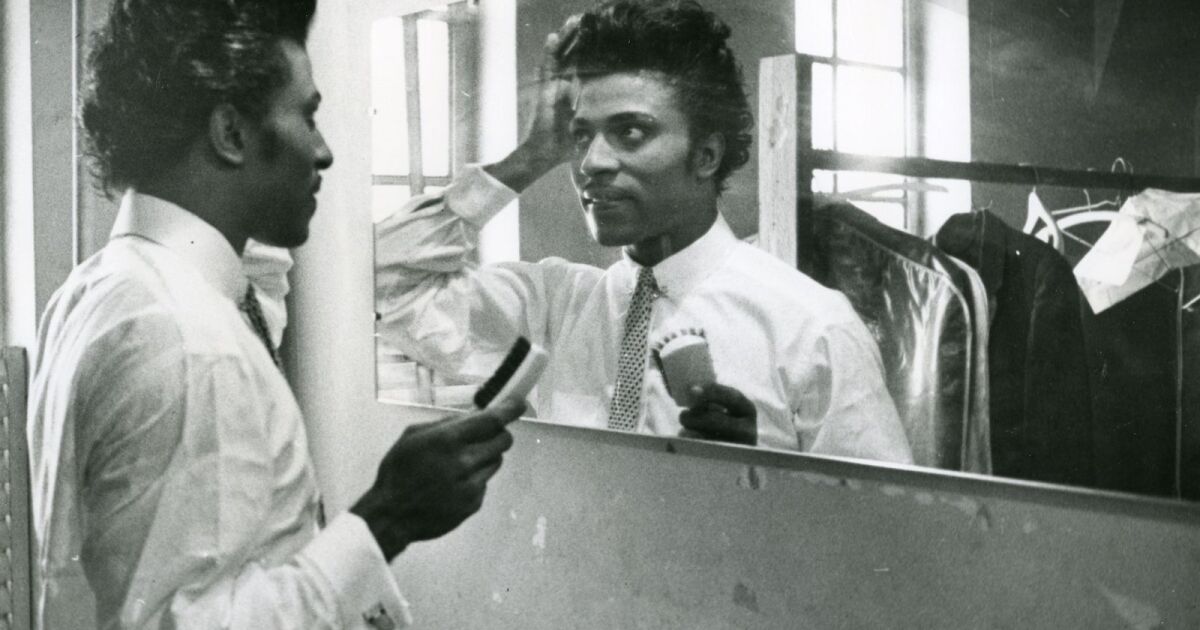

There’s a first for everything, and when it comes to rock ’n’ roll, Little Richard was first and everything: the decades since, full of pop music ecstasies and controversies, can nearly all be traced back to his style-setting, out, raucously innovative brilliance.
The many strains in Georgia-born Richard Penniman that produced all that legendary music — chords of Black and queer, gospel and boogie woogie, spiritual and devilish, and always loud and proud — also kept him a perennially overlooked, shape-shifting outsider in a white-favored industry, one with its own powerful counter-riffs of exclusion and exploitation.
All of it gets unpacked in Lisa Cortés’ embracing, ear-pleasing and fizzy documentary “Little Richard: I Am Everything,” a long-overdue creation corrective that gives an outwardly revolutionary cultural icon his trailblazing due at the same time it grapples with the conflicted soul that rarely knew a lasting inner peace.
From the performance clips alone of his rock-birthing heyday, when he looked like a flame and played like an inferno, the time travel fantasies will be intense for viewers who never saw him command a stage. But outside those snippets, and the well-deployed footage from his typically revealing talk show appearances, the flamboyant architect of rock ’n’ roll isn’t around any longer to speak for himself. (Richard died in 2020 at the age of 87.)
And yet one wonders which Richard might have shown up if Cortés could have interviewed him: the freewheeling raconteur who called it like it was (“I’m not conceited, I’m convinced”) and enjoyed spilling the raunchy origins of “Tutti Frutti,” or the Bible-thumping minister’s son, renouncing the gender-nonconforming self-expression that electrified the world. What he invented gave him a life, while stardom set loose his hedonism, but when guilt overtook him, he’d credit God with delivering him, not the immensely talented, cross-dressing boy whose scorched-and-sexy fabulousness freed teenagers everywhere. A common refrain we hear is how Richard’s message of liberation had another edge: he sometimes fled from who he was too.
The Little Richard story is a roller-coaster ride of highs and lows, and Cortés’ telling of it finds a keen balance between zigzagging energy and artful context. Interviews and footage dominate, naturally, but there are also original performances — Valerie June channeling gospel godmother of rock Sister Rosetta Tharpe (an early influence of Richard’s) — and the occasional visual effects overlay of luminous particulates, suggesting variously what’s cosmic and fiery about key moments in the artist’s narrative.
Naturally there are famous faces lauding his influence — Mick Jagger, who co-opted his stage-roaming swagger; John Waters, whose mustache is a tribute; and Tom Jones, who wasn’t the first target of tossed panties — but they don’t overpower the affecting testimony from those who knew him intimately, who give voice to his split personae. Seminary classmate turned road manager Keith Winslow describes tour nights marked by both debauchery and prayer. Trans performer Sir Lady Java found an early friend/supporter in Richard — himself a pancaked-and-pompadoured graduate of the Black South’s drag clubs — but was pained by the anti-gay rhetoric of his later, more evangelically driven years.
Rounding out the empathy-fueled contextualizing in “Little Richard: I Am Everything” are a heady mix of scholars and writers of color (including Jason King, Fredara Hadley, Zandria Robinson) offering potent commentary on rock’s Black and queer roots, and the visibility problem created when the record is enshrined in whiteness — literally and figuratively, from Pat Boone covers to Hall of Fame recognition. That these interviewees’ analysis isn’t solely from an academic remove helps Cortés craft a prism for viewing Richard — an understandably tough nut to crack as a human being — that’s as emotional as it is historical. That approach is needed right now, too, especially with the political winds getting scarier for the marginalized pockets of culture that produced this documentary’s raw, glittering, gifted subject.
‘Little Richard: I Am Everything’
Not rated
Running time: 1 hour, 38 minutes
Playing: Starts April 21 in general release

There’s a first for everything, and when it comes to rock ’n’ roll, Little Richard was first and everything: the decades since, full of pop music ecstasies and controversies, can nearly all be traced back to his style-setting, out, raucously innovative brilliance.
The many strains in Georgia-born Richard Penniman that produced all that legendary music — chords of Black and queer, gospel and boogie woogie, spiritual and devilish, and always loud and proud — also kept him a perennially overlooked, shape-shifting outsider in a white-favored industry, one with its own powerful counter-riffs of exclusion and exploitation.
All of it gets unpacked in Lisa Cortés’ embracing, ear-pleasing and fizzy documentary “Little Richard: I Am Everything,” a long-overdue creation corrective that gives an outwardly revolutionary cultural icon his trailblazing due at the same time it grapples with the conflicted soul that rarely knew a lasting inner peace.
From the performance clips alone of his rock-birthing heyday, when he looked like a flame and played like an inferno, the time travel fantasies will be intense for viewers who never saw him command a stage. But outside those snippets, and the well-deployed footage from his typically revealing talk show appearances, the flamboyant architect of rock ’n’ roll isn’t around any longer to speak for himself. (Richard died in 2020 at the age of 87.)
And yet one wonders which Richard might have shown up if Cortés could have interviewed him: the freewheeling raconteur who called it like it was (“I’m not conceited, I’m convinced”) and enjoyed spilling the raunchy origins of “Tutti Frutti,” or the Bible-thumping minister’s son, renouncing the gender-nonconforming self-expression that electrified the world. What he invented gave him a life, while stardom set loose his hedonism, but when guilt overtook him, he’d credit God with delivering him, not the immensely talented, cross-dressing boy whose scorched-and-sexy fabulousness freed teenagers everywhere. A common refrain we hear is how Richard’s message of liberation had another edge: he sometimes fled from who he was too.
The Little Richard story is a roller-coaster ride of highs and lows, and Cortés’ telling of it finds a keen balance between zigzagging energy and artful context. Interviews and footage dominate, naturally, but there are also original performances — Valerie June channeling gospel godmother of rock Sister Rosetta Tharpe (an early influence of Richard’s) — and the occasional visual effects overlay of luminous particulates, suggesting variously what’s cosmic and fiery about key moments in the artist’s narrative.
Naturally there are famous faces lauding his influence — Mick Jagger, who co-opted his stage-roaming swagger; John Waters, whose mustache is a tribute; and Tom Jones, who wasn’t the first target of tossed panties — but they don’t overpower the affecting testimony from those who knew him intimately, who give voice to his split personae. Seminary classmate turned road manager Keith Winslow describes tour nights marked by both debauchery and prayer. Trans performer Sir Lady Java found an early friend/supporter in Richard — himself a pancaked-and-pompadoured graduate of the Black South’s drag clubs — but was pained by the anti-gay rhetoric of his later, more evangelically driven years.
Rounding out the empathy-fueled contextualizing in “Little Richard: I Am Everything” are a heady mix of scholars and writers of color (including Jason King, Fredara Hadley, Zandria Robinson) offering potent commentary on rock’s Black and queer roots, and the visibility problem created when the record is enshrined in whiteness — literally and figuratively, from Pat Boone covers to Hall of Fame recognition. That these interviewees’ analysis isn’t solely from an academic remove helps Cortés craft a prism for viewing Richard — an understandably tough nut to crack as a human being — that’s as emotional as it is historical. That approach is needed right now, too, especially with the political winds getting scarier for the marginalized pockets of culture that produced this documentary’s raw, glittering, gifted subject.
‘Little Richard: I Am Everything’
Not rated
Running time: 1 hour, 38 minutes
Playing: Starts April 21 in general release

There’s a first for everything, and when it comes to rock ’n’ roll, Little Richard was first and everything: the decades since, full of pop music ecstasies and controversies, can nearly all be traced back to his style-setting, out, raucously innovative brilliance.
The many strains in Georgia-born Richard Penniman that produced all that legendary music — chords of Black and queer, gospel and boogie woogie, spiritual and devilish, and always loud and proud — also kept him a perennially overlooked, shape-shifting outsider in a white-favored industry, one with its own powerful counter-riffs of exclusion and exploitation.
All of it gets unpacked in Lisa Cortés’ embracing, ear-pleasing and fizzy documentary “Little Richard: I Am Everything,” a long-overdue creation corrective that gives an outwardly revolutionary cultural icon his trailblazing due at the same time it grapples with the conflicted soul that rarely knew a lasting inner peace.
From the performance clips alone of his rock-birthing heyday, when he looked like a flame and played like an inferno, the time travel fantasies will be intense for viewers who never saw him command a stage. But outside those snippets, and the well-deployed footage from his typically revealing talk show appearances, the flamboyant architect of rock ’n’ roll isn’t around any longer to speak for himself. (Richard died in 2020 at the age of 87.)
And yet one wonders which Richard might have shown up if Cortés could have interviewed him: the freewheeling raconteur who called it like it was (“I’m not conceited, I’m convinced”) and enjoyed spilling the raunchy origins of “Tutti Frutti,” or the Bible-thumping minister’s son, renouncing the gender-nonconforming self-expression that electrified the world. What he invented gave him a life, while stardom set loose his hedonism, but when guilt overtook him, he’d credit God with delivering him, not the immensely talented, cross-dressing boy whose scorched-and-sexy fabulousness freed teenagers everywhere. A common refrain we hear is how Richard’s message of liberation had another edge: he sometimes fled from who he was too.
The Little Richard story is a roller-coaster ride of highs and lows, and Cortés’ telling of it finds a keen balance between zigzagging energy and artful context. Interviews and footage dominate, naturally, but there are also original performances — Valerie June channeling gospel godmother of rock Sister Rosetta Tharpe (an early influence of Richard’s) — and the occasional visual effects overlay of luminous particulates, suggesting variously what’s cosmic and fiery about key moments in the artist’s narrative.
Naturally there are famous faces lauding his influence — Mick Jagger, who co-opted his stage-roaming swagger; John Waters, whose mustache is a tribute; and Tom Jones, who wasn’t the first target of tossed panties — but they don’t overpower the affecting testimony from those who knew him intimately, who give voice to his split personae. Seminary classmate turned road manager Keith Winslow describes tour nights marked by both debauchery and prayer. Trans performer Sir Lady Java found an early friend/supporter in Richard — himself a pancaked-and-pompadoured graduate of the Black South’s drag clubs — but was pained by the anti-gay rhetoric of his later, more evangelically driven years.
Rounding out the empathy-fueled contextualizing in “Little Richard: I Am Everything” are a heady mix of scholars and writers of color (including Jason King, Fredara Hadley, Zandria Robinson) offering potent commentary on rock’s Black and queer roots, and the visibility problem created when the record is enshrined in whiteness — literally and figuratively, from Pat Boone covers to Hall of Fame recognition. That these interviewees’ analysis isn’t solely from an academic remove helps Cortés craft a prism for viewing Richard — an understandably tough nut to crack as a human being — that’s as emotional as it is historical. That approach is needed right now, too, especially with the political winds getting scarier for the marginalized pockets of culture that produced this documentary’s raw, glittering, gifted subject.
‘Little Richard: I Am Everything’
Not rated
Running time: 1 hour, 38 minutes
Playing: Starts April 21 in general release
There’s a first for everything, and when it comes to rock ’n’ roll, Little Richard was first and everything: the decades since, full of pop music ecstasies and controversies, can nearly all be traced back to his style-setting, out, raucously innovative brilliance.
The many strains in Georgia-born Richard Penniman that produced all that legendary music — chords of Black and queer, gospel and boogie woogie, spiritual and devilish, and always loud and proud — also kept him a perennially overlooked, shape-shifting outsider in a white-favored industry, one with its own powerful counter-riffs of exclusion and exploitation.
All of it gets unpacked in Lisa Cortés’ embracing, ear-pleasing and fizzy documentary “Little Richard: I Am Everything,” a long-overdue creation corrective that gives an outwardly revolutionary cultural icon his trailblazing due at the same time it grapples with the conflicted soul that rarely knew a lasting inner peace.
From the performance clips alone of his rock-birthing heyday, when he looked like a flame and played like an inferno, the time travel fantasies will be intense for viewers who never saw him command a stage. But outside those snippets, and the well-deployed footage from his typically revealing talk show appearances, the flamboyant architect of rock ’n’ roll isn’t around any longer to speak for himself. (Richard died in 2020 at the age of 87.)
And yet one wonders which Richard might have shown up if Cortés could have interviewed him: the freewheeling raconteur who called it like it was (“I’m not conceited, I’m convinced”) and enjoyed spilling the raunchy origins of “Tutti Frutti,” or the Bible-thumping minister’s son, renouncing the gender-nonconforming self-expression that electrified the world. What he invented gave him a life, while stardom set loose his hedonism, but when guilt overtook him, he’d credit God with delivering him, not the immensely talented, cross-dressing boy whose scorched-and-sexy fabulousness freed teenagers everywhere. A common refrain we hear is how Richard’s message of liberation had another edge: he sometimes fled from who he was too.
The Little Richard story is a roller-coaster ride of highs and lows, and Cortés’ telling of it finds a keen balance between zigzagging energy and artful context. Interviews and footage dominate, naturally, but there are also original performances — Valerie June channeling gospel godmother of rock Sister Rosetta Tharpe (an early influence of Richard’s) — and the occasional visual effects overlay of luminous particulates, suggesting variously what’s cosmic and fiery about key moments in the artist’s narrative.
Naturally there are famous faces lauding his influence — Mick Jagger, who co-opted his stage-roaming swagger; John Waters, whose mustache is a tribute; and Tom Jones, who wasn’t the first target of tossed panties — but they don’t overpower the affecting testimony from those who knew him intimately, who give voice to his split personae. Seminary classmate turned road manager Keith Winslow describes tour nights marked by both debauchery and prayer. Trans performer Sir Lady Java found an early friend/supporter in Richard — himself a pancaked-and-pompadoured graduate of the Black South’s drag clubs — but was pained by the anti-gay rhetoric of his later, more evangelically driven years.
Rounding out the empathy-fueled contextualizing in “Little Richard: I Am Everything” are a heady mix of scholars and writers of color (including Jason King, Fredara Hadley, Zandria Robinson) offering potent commentary on rock’s Black and queer roots, and the visibility problem created when the record is enshrined in whiteness — literally and figuratively, from Pat Boone covers to Hall of Fame recognition. That these interviewees’ analysis isn’t solely from an academic remove helps Cortés craft a prism for viewing Richard — an understandably tough nut to crack as a human being — that’s as emotional as it is historical. That approach is needed right now, too, especially with the political winds getting scarier for the marginalized pockets of culture that produced this documentary’s raw, glittering, gifted subject.
‘Little Richard: I Am Everything’
Not rated
Running time: 1 hour, 38 minutes
Playing: Starts April 21 in general release

There’s a first for everything, and when it comes to rock ’n’ roll, Little Richard was first and everything: the decades since, full of pop music ecstasies and controversies, can nearly all be traced back to his style-setting, out, raucously innovative brilliance.
The many strains in Georgia-born Richard Penniman that produced all that legendary music — chords of Black and queer, gospel and boogie woogie, spiritual and devilish, and always loud and proud — also kept him a perennially overlooked, shape-shifting outsider in a white-favored industry, one with its own powerful counter-riffs of exclusion and exploitation.
All of it gets unpacked in Lisa Cortés’ embracing, ear-pleasing and fizzy documentary “Little Richard: I Am Everything,” a long-overdue creation corrective that gives an outwardly revolutionary cultural icon his trailblazing due at the same time it grapples with the conflicted soul that rarely knew a lasting inner peace.
From the performance clips alone of his rock-birthing heyday, when he looked like a flame and played like an inferno, the time travel fantasies will be intense for viewers who never saw him command a stage. But outside those snippets, and the well-deployed footage from his typically revealing talk show appearances, the flamboyant architect of rock ’n’ roll isn’t around any longer to speak for himself. (Richard died in 2020 at the age of 87.)
And yet one wonders which Richard might have shown up if Cortés could have interviewed him: the freewheeling raconteur who called it like it was (“I’m not conceited, I’m convinced”) and enjoyed spilling the raunchy origins of “Tutti Frutti,” or the Bible-thumping minister’s son, renouncing the gender-nonconforming self-expression that electrified the world. What he invented gave him a life, while stardom set loose his hedonism, but when guilt overtook him, he’d credit God with delivering him, not the immensely talented, cross-dressing boy whose scorched-and-sexy fabulousness freed teenagers everywhere. A common refrain we hear is how Richard’s message of liberation had another edge: he sometimes fled from who he was too.
The Little Richard story is a roller-coaster ride of highs and lows, and Cortés’ telling of it finds a keen balance between zigzagging energy and artful context. Interviews and footage dominate, naturally, but there are also original performances — Valerie June channeling gospel godmother of rock Sister Rosetta Tharpe (an early influence of Richard’s) — and the occasional visual effects overlay of luminous particulates, suggesting variously what’s cosmic and fiery about key moments in the artist’s narrative.
Naturally there are famous faces lauding his influence — Mick Jagger, who co-opted his stage-roaming swagger; John Waters, whose mustache is a tribute; and Tom Jones, who wasn’t the first target of tossed panties — but they don’t overpower the affecting testimony from those who knew him intimately, who give voice to his split personae. Seminary classmate turned road manager Keith Winslow describes tour nights marked by both debauchery and prayer. Trans performer Sir Lady Java found an early friend/supporter in Richard — himself a pancaked-and-pompadoured graduate of the Black South’s drag clubs — but was pained by the anti-gay rhetoric of his later, more evangelically driven years.
Rounding out the empathy-fueled contextualizing in “Little Richard: I Am Everything” are a heady mix of scholars and writers of color (including Jason King, Fredara Hadley, Zandria Robinson) offering potent commentary on rock’s Black and queer roots, and the visibility problem created when the record is enshrined in whiteness — literally and figuratively, from Pat Boone covers to Hall of Fame recognition. That these interviewees’ analysis isn’t solely from an academic remove helps Cortés craft a prism for viewing Richard — an understandably tough nut to crack as a human being — that’s as emotional as it is historical. That approach is needed right now, too, especially with the political winds getting scarier for the marginalized pockets of culture that produced this documentary’s raw, glittering, gifted subject.
‘Little Richard: I Am Everything’
Not rated
Running time: 1 hour, 38 minutes
Playing: Starts April 21 in general release
There’s a first for everything, and when it comes to rock ’n’ roll, Little Richard was first and everything: the decades since, full of pop music ecstasies and controversies, can nearly all be traced back to his style-setting, out, raucously innovative brilliance.
The many strains in Georgia-born Richard Penniman that produced all that legendary music — chords of Black and queer, gospel and boogie woogie, spiritual and devilish, and always loud and proud — also kept him a perennially overlooked, shape-shifting outsider in a white-favored industry, one with its own powerful counter-riffs of exclusion and exploitation.
All of it gets unpacked in Lisa Cortés’ embracing, ear-pleasing and fizzy documentary “Little Richard: I Am Everything,” a long-overdue creation corrective that gives an outwardly revolutionary cultural icon his trailblazing due at the same time it grapples with the conflicted soul that rarely knew a lasting inner peace.
From the performance clips alone of his rock-birthing heyday, when he looked like a flame and played like an inferno, the time travel fantasies will be intense for viewers who never saw him command a stage. But outside those snippets, and the well-deployed footage from his typically revealing talk show appearances, the flamboyant architect of rock ’n’ roll isn’t around any longer to speak for himself. (Richard died in 2020 at the age of 87.)
And yet one wonders which Richard might have shown up if Cortés could have interviewed him: the freewheeling raconteur who called it like it was (“I’m not conceited, I’m convinced”) and enjoyed spilling the raunchy origins of “Tutti Frutti,” or the Bible-thumping minister’s son, renouncing the gender-nonconforming self-expression that electrified the world. What he invented gave him a life, while stardom set loose his hedonism, but when guilt overtook him, he’d credit God with delivering him, not the immensely talented, cross-dressing boy whose scorched-and-sexy fabulousness freed teenagers everywhere. A common refrain we hear is how Richard’s message of liberation had another edge: he sometimes fled from who he was too.
The Little Richard story is a roller-coaster ride of highs and lows, and Cortés’ telling of it finds a keen balance between zigzagging energy and artful context. Interviews and footage dominate, naturally, but there are also original performances — Valerie June channeling gospel godmother of rock Sister Rosetta Tharpe (an early influence of Richard’s) — and the occasional visual effects overlay of luminous particulates, suggesting variously what’s cosmic and fiery about key moments in the artist’s narrative.
Naturally there are famous faces lauding his influence — Mick Jagger, who co-opted his stage-roaming swagger; John Waters, whose mustache is a tribute; and Tom Jones, who wasn’t the first target of tossed panties — but they don’t overpower the affecting testimony from those who knew him intimately, who give voice to his split personae. Seminary classmate turned road manager Keith Winslow describes tour nights marked by both debauchery and prayer. Trans performer Sir Lady Java found an early friend/supporter in Richard — himself a pancaked-and-pompadoured graduate of the Black South’s drag clubs — but was pained by the anti-gay rhetoric of his later, more evangelically driven years.
Rounding out the empathy-fueled contextualizing in “Little Richard: I Am Everything” are a heady mix of scholars and writers of color (including Jason King, Fredara Hadley, Zandria Robinson) offering potent commentary on rock’s Black and queer roots, and the visibility problem created when the record is enshrined in whiteness — literally and figuratively, from Pat Boone covers to Hall of Fame recognition. That these interviewees’ analysis isn’t solely from an academic remove helps Cortés craft a prism for viewing Richard — an understandably tough nut to crack as a human being — that’s as emotional as it is historical. That approach is needed right now, too, especially with the political winds getting scarier for the marginalized pockets of culture that produced this documentary’s raw, glittering, gifted subject.
‘Little Richard: I Am Everything’
Not rated
Running time: 1 hour, 38 minutes
Playing: Starts April 21 in general release
There’s a first for everything, and when it comes to rock ’n’ roll, Little Richard was first and everything: the decades since, full of pop music ecstasies and controversies, can nearly all be traced back to his style-setting, out, raucously innovative brilliance.
The many strains in Georgia-born Richard Penniman that produced all that legendary music — chords of Black and queer, gospel and boogie woogie, spiritual and devilish, and always loud and proud — also kept him a perennially overlooked, shape-shifting outsider in a white-favored industry, one with its own powerful counter-riffs of exclusion and exploitation.
All of it gets unpacked in Lisa Cortés’ embracing, ear-pleasing and fizzy documentary “Little Richard: I Am Everything,” a long-overdue creation corrective that gives an outwardly revolutionary cultural icon his trailblazing due at the same time it grapples with the conflicted soul that rarely knew a lasting inner peace.
From the performance clips alone of his rock-birthing heyday, when he looked like a flame and played like an inferno, the time travel fantasies will be intense for viewers who never saw him command a stage. But outside those snippets, and the well-deployed footage from his typically revealing talk show appearances, the flamboyant architect of rock ’n’ roll isn’t around any longer to speak for himself. (Richard died in 2020 at the age of 87.)
And yet one wonders which Richard might have shown up if Cortés could have interviewed him: the freewheeling raconteur who called it like it was (“I’m not conceited, I’m convinced”) and enjoyed spilling the raunchy origins of “Tutti Frutti,” or the Bible-thumping minister’s son, renouncing the gender-nonconforming self-expression that electrified the world. What he invented gave him a life, while stardom set loose his hedonism, but when guilt overtook him, he’d credit God with delivering him, not the immensely talented, cross-dressing boy whose scorched-and-sexy fabulousness freed teenagers everywhere. A common refrain we hear is how Richard’s message of liberation had another edge: he sometimes fled from who he was too.
The Little Richard story is a roller-coaster ride of highs and lows, and Cortés’ telling of it finds a keen balance between zigzagging energy and artful context. Interviews and footage dominate, naturally, but there are also original performances — Valerie June channeling gospel godmother of rock Sister Rosetta Tharpe (an early influence of Richard’s) — and the occasional visual effects overlay of luminous particulates, suggesting variously what’s cosmic and fiery about key moments in the artist’s narrative.
Naturally there are famous faces lauding his influence — Mick Jagger, who co-opted his stage-roaming swagger; John Waters, whose mustache is a tribute; and Tom Jones, who wasn’t the first target of tossed panties — but they don’t overpower the affecting testimony from those who knew him intimately, who give voice to his split personae. Seminary classmate turned road manager Keith Winslow describes tour nights marked by both debauchery and prayer. Trans performer Sir Lady Java found an early friend/supporter in Richard — himself a pancaked-and-pompadoured graduate of the Black South’s drag clubs — but was pained by the anti-gay rhetoric of his later, more evangelically driven years.
Rounding out the empathy-fueled contextualizing in “Little Richard: I Am Everything” are a heady mix of scholars and writers of color (including Jason King, Fredara Hadley, Zandria Robinson) offering potent commentary on rock’s Black and queer roots, and the visibility problem created when the record is enshrined in whiteness — literally and figuratively, from Pat Boone covers to Hall of Fame recognition. That these interviewees’ analysis isn’t solely from an academic remove helps Cortés craft a prism for viewing Richard — an understandably tough nut to crack as a human being — that’s as emotional as it is historical. That approach is needed right now, too, especially with the political winds getting scarier for the marginalized pockets of culture that produced this documentary’s raw, glittering, gifted subject.
‘Little Richard: I Am Everything’
Not rated
Running time: 1 hour, 38 minutes
Playing: Starts April 21 in general release
There’s a first for everything, and when it comes to rock ’n’ roll, Little Richard was first and everything: the decades since, full of pop music ecstasies and controversies, can nearly all be traced back to his style-setting, out, raucously innovative brilliance.
The many strains in Georgia-born Richard Penniman that produced all that legendary music — chords of Black and queer, gospel and boogie woogie, spiritual and devilish, and always loud and proud — also kept him a perennially overlooked, shape-shifting outsider in a white-favored industry, one with its own powerful counter-riffs of exclusion and exploitation.
All of it gets unpacked in Lisa Cortés’ embracing, ear-pleasing and fizzy documentary “Little Richard: I Am Everything,” a long-overdue creation corrective that gives an outwardly revolutionary cultural icon his trailblazing due at the same time it grapples with the conflicted soul that rarely knew a lasting inner peace.
From the performance clips alone of his rock-birthing heyday, when he looked like a flame and played like an inferno, the time travel fantasies will be intense for viewers who never saw him command a stage. But outside those snippets, and the well-deployed footage from his typically revealing talk show appearances, the flamboyant architect of rock ’n’ roll isn’t around any longer to speak for himself. (Richard died in 2020 at the age of 87.)
And yet one wonders which Richard might have shown up if Cortés could have interviewed him: the freewheeling raconteur who called it like it was (“I’m not conceited, I’m convinced”) and enjoyed spilling the raunchy origins of “Tutti Frutti,” or the Bible-thumping minister’s son, renouncing the gender-nonconforming self-expression that electrified the world. What he invented gave him a life, while stardom set loose his hedonism, but when guilt overtook him, he’d credit God with delivering him, not the immensely talented, cross-dressing boy whose scorched-and-sexy fabulousness freed teenagers everywhere. A common refrain we hear is how Richard’s message of liberation had another edge: he sometimes fled from who he was too.
The Little Richard story is a roller-coaster ride of highs and lows, and Cortés’ telling of it finds a keen balance between zigzagging energy and artful context. Interviews and footage dominate, naturally, but there are also original performances — Valerie June channeling gospel godmother of rock Sister Rosetta Tharpe (an early influence of Richard’s) — and the occasional visual effects overlay of luminous particulates, suggesting variously what’s cosmic and fiery about key moments in the artist’s narrative.
Naturally there are famous faces lauding his influence — Mick Jagger, who co-opted his stage-roaming swagger; John Waters, whose mustache is a tribute; and Tom Jones, who wasn’t the first target of tossed panties — but they don’t overpower the affecting testimony from those who knew him intimately, who give voice to his split personae. Seminary classmate turned road manager Keith Winslow describes tour nights marked by both debauchery and prayer. Trans performer Sir Lady Java found an early friend/supporter in Richard — himself a pancaked-and-pompadoured graduate of the Black South’s drag clubs — but was pained by the anti-gay rhetoric of his later, more evangelically driven years.
Rounding out the empathy-fueled contextualizing in “Little Richard: I Am Everything” are a heady mix of scholars and writers of color (including Jason King, Fredara Hadley, Zandria Robinson) offering potent commentary on rock’s Black and queer roots, and the visibility problem created when the record is enshrined in whiteness — literally and figuratively, from Pat Boone covers to Hall of Fame recognition. That these interviewees’ analysis isn’t solely from an academic remove helps Cortés craft a prism for viewing Richard — an understandably tough nut to crack as a human being — that’s as emotional as it is historical. That approach is needed right now, too, especially with the political winds getting scarier for the marginalized pockets of culture that produced this documentary’s raw, glittering, gifted subject.
‘Little Richard: I Am Everything’
Not rated
Running time: 1 hour, 38 minutes
Playing: Starts April 21 in general release

