

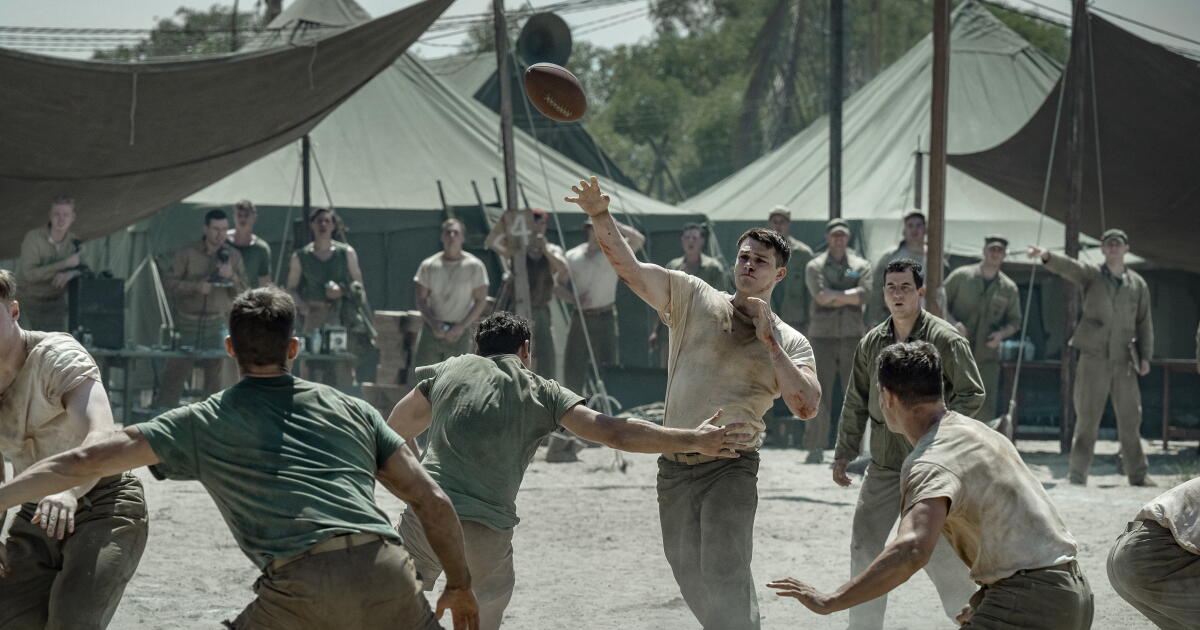

A football game in the middle of a war sounds as high concept as movies get. And yet Peter Berg’s Netflix epic “The Mosquito Bowl” is based on a scrimmage that really happened in the Pacific theater during World War II, when two Marine regiments squared off on Guadalcanal Beach on Christmas Eve of 1944. It wasn’t some amateur contest, either: Most of the players, in a curious fluke, were college stars with serious pro prospects. They’d just need to stay alive to realize those dreams.
Berg, a full-tilt kind of director whose love of combat scenarios and gridiron drama has elsewhere yielded his best films, “Lone Survivor” and “Friday Night Lights,” was surely the guy to adapt this story, drawn from “Friday” author Buzz Bissinger’s 2022 book. Except that in his admirable attempt to juxtapose a violent game against the hell of war, Berg has regrettably hewed to a standard playbook of tropes without sending fleshed-out characters onto the field.
Which is too bad, because the real-life athletes-turned-soldiers he and co-screenwriter Mark L. Smith have built their movie around have been well-cast with quartet of ascendant stars. Brooding hunk Nicholas Galitzine plays brainy, good-natured Brown graduate John McLaughry; Bill Skarsgård is wily-eyed Wisconsin Badger Bob Bauman; Tom Francis is All-American tight end Dave Schreiner, who can’t get over his school having lost to Purdue; and record-breaking fullback Ray Butkovich is played with grinning confidence by Ray Nicholson (maybe you know his dad).
Introduced in muddy, crunchy scenes of big game highlights and raucous partying, the boys hear news of the attack on Pearl Harbor. Then it’s quiet goodbyes to loved ones (one scene per lead) as they enter basic training, where a drill sergeant (played by football analyst Pat McAfee) whips them into killing shape. By the time they’re at sea, it feels as if Berg, a supremely fidgety ringmaster, has engineered everything so far to be one big montage machine hurtling us toward the brutal reality of a sobering quote that opens the film: “Older men declare war. But it is the youth that must fight and die.”
You may be immune by now to the gory verisimilitude required of combat depiction since Spielberg supercharged it in “Saving Private Ryan,” but Berg demands newfound attention to its bloody, deafening chaos. These in-your-face sequences are a technical achievement, for sure, but also a stark reminder that we don’t know the main characters very well beyond the broadest of strokes. There’s even tacit acknowledgment that it was a meat grinder for the Japanese, too, and that sometimes, our men — shown realistically entering the war with a demonizing mindset — grasped that.
The real head-scratcher here, however, is that when the game finally arrives, it seems to fly by, another casualty of Berg’s restless energy. An opportunity is lost for catharsis. Some of that feeling is there but it feels skimmed, not hard-won because of characterization or scene dynamics. I’ve never been more ready for a football game to be cinematically stirring, and more disappointed that it amounted to a supercut.
‘The Mosquito Bowl’
Rated: R, for intense sequences of graphic war violence, grisly images, and language throughout
Running time: 2 hours, 7 minutes
Playing: Opens Friday, Oct. 30 in limited release

A football game in the middle of a war sounds as high concept as movies get. And yet Peter Berg’s Netflix epic “The Mosquito Bowl” is based on a scrimmage that really happened in the Pacific theater during World War II, when two Marine regiments squared off on Guadalcanal Beach on Christmas Eve of 1944. It wasn’t some amateur contest, either: Most of the players, in a curious fluke, were college stars with serious pro prospects. They’d just need to stay alive to realize those dreams.
Berg, a full-tilt kind of director whose love of combat scenarios and gridiron drama has elsewhere yielded his best films, “Lone Survivor” and “Friday Night Lights,” was surely the guy to adapt this story, drawn from “Friday” author Buzz Bissinger’s 2022 book. Except that in his admirable attempt to juxtapose a violent game against the hell of war, Berg has regrettably hewed to a standard playbook of tropes without sending fleshed-out characters onto the field.
Which is too bad, because the real-life athletes-turned-soldiers he and co-screenwriter Mark L. Smith have built their movie around have been well-cast with quartet of ascendant stars. Brooding hunk Nicholas Galitzine plays brainy, good-natured Brown graduate John McLaughry; Bill Skarsgård is wily-eyed Wisconsin Badger Bob Bauman; Tom Francis is All-American tight end Dave Schreiner, who can’t get over his school having lost to Purdue; and record-breaking fullback Ray Butkovich is played with grinning confidence by Ray Nicholson (maybe you know his dad).
Introduced in muddy, crunchy scenes of big game highlights and raucous partying, the boys hear news of the attack on Pearl Harbor. Then it’s quiet goodbyes to loved ones (one scene per lead) as they enter basic training, where a drill sergeant (played by football analyst Pat McAfee) whips them into killing shape. By the time they’re at sea, it feels as if Berg, a supremely fidgety ringmaster, has engineered everything so far to be one big montage machine hurtling us toward the brutal reality of a sobering quote that opens the film: “Older men declare war. But it is the youth that must fight and die.”
You may be immune by now to the gory verisimilitude required of combat depiction since Spielberg supercharged it in “Saving Private Ryan,” but Berg demands newfound attention to its bloody, deafening chaos. These in-your-face sequences are a technical achievement, for sure, but also a stark reminder that we don’t know the main characters very well beyond the broadest of strokes. There’s even tacit acknowledgment that it was a meat grinder for the Japanese, too, and that sometimes, our men — shown realistically entering the war with a demonizing mindset — grasped that.
The real head-scratcher here, however, is that when the game finally arrives, it seems to fly by, another casualty of Berg’s restless energy. An opportunity is lost for catharsis. Some of that feeling is there but it feels skimmed, not hard-won because of characterization or scene dynamics. I’ve never been more ready for a football game to be cinematically stirring, and more disappointed that it amounted to a supercut.
‘The Mosquito Bowl’
Rated: R, for intense sequences of graphic war violence, grisly images, and language throughout
Running time: 2 hours, 7 minutes
Playing: Opens Friday, Oct. 30 in limited release

A football game in the middle of a war sounds as high concept as movies get. And yet Peter Berg’s Netflix epic “The Mosquito Bowl” is based on a scrimmage that really happened in the Pacific theater during World War II, when two Marine regiments squared off on Guadalcanal Beach on Christmas Eve of 1944. It wasn’t some amateur contest, either: Most of the players, in a curious fluke, were college stars with serious pro prospects. They’d just need to stay alive to realize those dreams.
Berg, a full-tilt kind of director whose love of combat scenarios and gridiron drama has elsewhere yielded his best films, “Lone Survivor” and “Friday Night Lights,” was surely the guy to adapt this story, drawn from “Friday” author Buzz Bissinger’s 2022 book. Except that in his admirable attempt to juxtapose a violent game against the hell of war, Berg has regrettably hewed to a standard playbook of tropes without sending fleshed-out characters onto the field.
Which is too bad, because the real-life athletes-turned-soldiers he and co-screenwriter Mark L. Smith have built their movie around have been well-cast with quartet of ascendant stars. Brooding hunk Nicholas Galitzine plays brainy, good-natured Brown graduate John McLaughry; Bill Skarsgård is wily-eyed Wisconsin Badger Bob Bauman; Tom Francis is All-American tight end Dave Schreiner, who can’t get over his school having lost to Purdue; and record-breaking fullback Ray Butkovich is played with grinning confidence by Ray Nicholson (maybe you know his dad).
Introduced in muddy, crunchy scenes of big game highlights and raucous partying, the boys hear news of the attack on Pearl Harbor. Then it’s quiet goodbyes to loved ones (one scene per lead) as they enter basic training, where a drill sergeant (played by football analyst Pat McAfee) whips them into killing shape. By the time they’re at sea, it feels as if Berg, a supremely fidgety ringmaster, has engineered everything so far to be one big montage machine hurtling us toward the brutal reality of a sobering quote that opens the film: “Older men declare war. But it is the youth that must fight and die.”
You may be immune by now to the gory verisimilitude required of combat depiction since Spielberg supercharged it in “Saving Private Ryan,” but Berg demands newfound attention to its bloody, deafening chaos. These in-your-face sequences are a technical achievement, for sure, but also a stark reminder that we don’t know the main characters very well beyond the broadest of strokes. There’s even tacit acknowledgment that it was a meat grinder for the Japanese, too, and that sometimes, our men — shown realistically entering the war with a demonizing mindset — grasped that.
The real head-scratcher here, however, is that when the game finally arrives, it seems to fly by, another casualty of Berg’s restless energy. An opportunity is lost for catharsis. Some of that feeling is there but it feels skimmed, not hard-won because of characterization or scene dynamics. I’ve never been more ready for a football game to be cinematically stirring, and more disappointed that it amounted to a supercut.
‘The Mosquito Bowl’
Rated: R, for intense sequences of graphic war violence, grisly images, and language throughout
Running time: 2 hours, 7 minutes
Playing: Opens Friday, Oct. 30 in limited release

A football game in the middle of a war sounds as high concept as movies get. And yet Peter Berg’s Netflix epic “The Mosquito Bowl” is based on a scrimmage that really happened in the Pacific theater during World War II, when two Marine regiments squared off on Guadalcanal Beach on Christmas Eve of 1944. It wasn’t some amateur contest, either: Most of the players, in a curious fluke, were college stars with serious pro prospects. They’d just need to stay alive to realize those dreams.
Berg, a full-tilt kind of director whose love of combat scenarios and gridiron drama has elsewhere yielded his best films, “Lone Survivor” and “Friday Night Lights,” was surely the guy to adapt this story, drawn from “Friday” author Buzz Bissinger’s 2022 book. Except that in his admirable attempt to juxtapose a violent game against the hell of war, Berg has regrettably hewed to a standard playbook of tropes without sending fleshed-out characters onto the field.
Which is too bad, because the real-life athletes-turned-soldiers he and co-screenwriter Mark L. Smith have built their movie around have been well-cast with quartet of ascendant stars. Brooding hunk Nicholas Galitzine plays brainy, good-natured Brown graduate John McLaughry; Bill Skarsgård is wily-eyed Wisconsin Badger Bob Bauman; Tom Francis is All-American tight end Dave Schreiner, who can’t get over his school having lost to Purdue; and record-breaking fullback Ray Butkovich is played with grinning confidence by Ray Nicholson (maybe you know his dad).
Introduced in muddy, crunchy scenes of big game highlights and raucous partying, the boys hear news of the attack on Pearl Harbor. Then it’s quiet goodbyes to loved ones (one scene per lead) as they enter basic training, where a drill sergeant (played by football analyst Pat McAfee) whips them into killing shape. By the time they’re at sea, it feels as if Berg, a supremely fidgety ringmaster, has engineered everything so far to be one big montage machine hurtling us toward the brutal reality of a sobering quote that opens the film: “Older men declare war. But it is the youth that must fight and die.”
You may be immune by now to the gory verisimilitude required of combat depiction since Spielberg supercharged it in “Saving Private Ryan,” but Berg demands newfound attention to its bloody, deafening chaos. These in-your-face sequences are a technical achievement, for sure, but also a stark reminder that we don’t know the main characters very well beyond the broadest of strokes. There’s even tacit acknowledgment that it was a meat grinder for the Japanese, too, and that sometimes, our men — shown realistically entering the war with a demonizing mindset — grasped that.
The real head-scratcher here, however, is that when the game finally arrives, it seems to fly by, another casualty of Berg’s restless energy. An opportunity is lost for catharsis. Some of that feeling is there but it feels skimmed, not hard-won because of characterization or scene dynamics. I’ve never been more ready for a football game to be cinematically stirring, and more disappointed that it amounted to a supercut.
‘The Mosquito Bowl’
Rated: R, for intense sequences of graphic war violence, grisly images, and language throughout
Running time: 2 hours, 7 minutes
Playing: Opens Friday, Oct. 30 in limited release

