

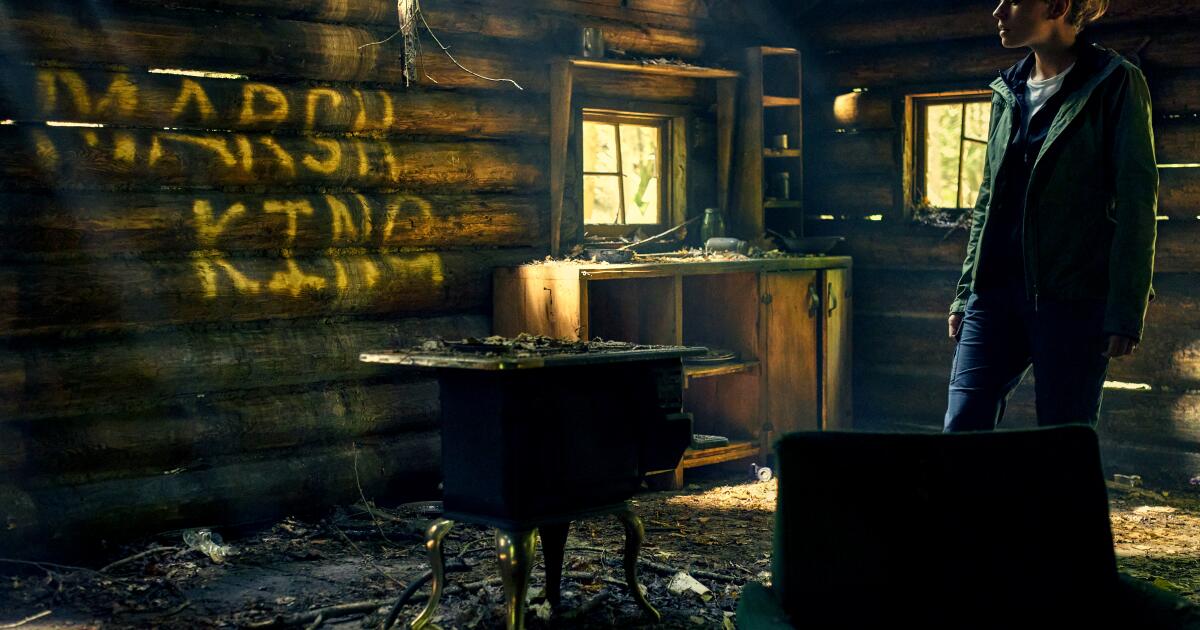
Leave behind your hopes for an epic fable of swampy intrigue if the title “The Marsh King’s Daughter” puts you in a fantasy frame of mind. The reality is much more pedestrian: a flimsy present-day American thriller about a conflicted young woman and her controlling father that misses every opportunity to raise your neck hairs or quicken your heartbeat or simply keep your disbelief suspended. (The fantasy tag isn’t totally off-base.)
Readers coming to Neil Burger’s film already familiar with Karen Dionne’s bestselling 2017 novel will know what the opening sequences set in Michigan’s Upper Peninsula are all about. To the uninitiated, things would seem to point toward an intimate, rural family drama about wilderness hardship as we take in the wide-eyed perspective of 10-year-old Helena (an engaging Brooklynn Prince from “The Florida Project”) eagerly absorbing the soft-spoken hunting and survival tips from her protective, rifle-wielding father, Jacob (Ben Mendelsohn), who calls Helena his “little shadow.” Mom (Caren Pistorius) seems grimly distant and Jacob, giving his daughter tattoos as rewards or punishments, is weird. But the daddy-daughter bond seems strong.
A sudden intrusion from the outside world, however, violently shatters this woodsy bubble, revealing a disturbing scenario that puts Jacob behind bars, upending Helena’s idealized view of her father. Cut to years later, when “The Force Awakens” star Daisy Ridley takes over the role, and we find Helena has carved out a quiet life for herself, working in an office, living in a big house with a nice husband (Garrett Hedlund) and an adoring daughter of her own. She lies cagily about her childhood, covering her body’s ink with concealer to hide signs of a past she’d like to dodge.
That carefully constructed world bursts when her father — dubbed the “Marsh King” in the media — escapes from a prison transport van, the news not only exposing her connection to him but leaving Helena with the distinct impression that her criminal dad is not finished teaching her lessons in how to keep loved ones close.
Ben Mendelsohn in the movie “The Marsh King’s Daughter.”
(Philippe Bosse / Lionsgate)
With situational echoes of “Room” by way of “Leave No Trace,” the set-up has a pulpy promise, built around a character long freed from an illusion but still connected to it, creating expectations for an explosive showdown of hunter-prey reversals. But everything feels schematic in the screenplay by Elle Smith and Mark L. Smith. The characters — including Gil Birmingham as the adoptive guardian in Helena’s post-Jacob life — behave according to a structured, three-act plan, but there’s nothing about this story that benefits from being predictable.
Another key problem is that the movie, though appealingly shot in gradations of dreaminess and realism by cinematographer Alwin H. Küchler, is trapped between character study and avenging thriller, leaving both sides starved for oxygen. Ridley’s Helena is mostly a succession of bottled-up stares broken up by bursts of fear for her child’s safety, and even those moments don’t track with the implausibility of some of her own actions. Our sense of what she’s thinking about her awful father is ultimately too opaque to be intriguing, which doesn’t help a film trying to seed a gathering danger about a potential reunion.
Mendelsohn, a crime-genre stalwart, produces an inexplicably dull turn, as if he were too bored by the role to work up any effort to make his character either entertainingly villainous or wildman-mysterious. A figure who should be haunting scenes he’s not in ultimately isn’t much of a presence in the ones he is, which leaves Burger little to work with when trying to orchestrate a life-or-death climax. When we need the churning dread of an intimate tale of generational trauma, “The Marsh King’s Daughter” goes formulaic, and when we’re primed for exploitation sweats, it gets flabby.
‘The Marsh King’s Daughter’
Rating: R, for violence
Running time: 1 hour, 48 minutes
Playing: In wide release

Leave behind your hopes for an epic fable of swampy intrigue if the title “The Marsh King’s Daughter” puts you in a fantasy frame of mind. The reality is much more pedestrian: a flimsy present-day American thriller about a conflicted young woman and her controlling father that misses every opportunity to raise your neck hairs or quicken your heartbeat or simply keep your disbelief suspended. (The fantasy tag isn’t totally off-base.)
Readers coming to Neil Burger’s film already familiar with Karen Dionne’s bestselling 2017 novel will know what the opening sequences set in Michigan’s Upper Peninsula are all about. To the uninitiated, things would seem to point toward an intimate, rural family drama about wilderness hardship as we take in the wide-eyed perspective of 10-year-old Helena (an engaging Brooklynn Prince from “The Florida Project”) eagerly absorbing the soft-spoken hunting and survival tips from her protective, rifle-wielding father, Jacob (Ben Mendelsohn), who calls Helena his “little shadow.” Mom (Caren Pistorius) seems grimly distant and Jacob, giving his daughter tattoos as rewards or punishments, is weird. But the daddy-daughter bond seems strong.
A sudden intrusion from the outside world, however, violently shatters this woodsy bubble, revealing a disturbing scenario that puts Jacob behind bars, upending Helena’s idealized view of her father. Cut to years later, when “The Force Awakens” star Daisy Ridley takes over the role, and we find Helena has carved out a quiet life for herself, working in an office, living in a big house with a nice husband (Garrett Hedlund) and an adoring daughter of her own. She lies cagily about her childhood, covering her body’s ink with concealer to hide signs of a past she’d like to dodge.
That carefully constructed world bursts when her father — dubbed the “Marsh King” in the media — escapes from a prison transport van, the news not only exposing her connection to him but leaving Helena with the distinct impression that her criminal dad is not finished teaching her lessons in how to keep loved ones close.
Ben Mendelsohn in the movie “The Marsh King’s Daughter.”
(Philippe Bosse / Lionsgate)
With situational echoes of “Room” by way of “Leave No Trace,” the set-up has a pulpy promise, built around a character long freed from an illusion but still connected to it, creating expectations for an explosive showdown of hunter-prey reversals. But everything feels schematic in the screenplay by Elle Smith and Mark L. Smith. The characters — including Gil Birmingham as the adoptive guardian in Helena’s post-Jacob life — behave according to a structured, three-act plan, but there’s nothing about this story that benefits from being predictable.
Another key problem is that the movie, though appealingly shot in gradations of dreaminess and realism by cinematographer Alwin H. Küchler, is trapped between character study and avenging thriller, leaving both sides starved for oxygen. Ridley’s Helena is mostly a succession of bottled-up stares broken up by bursts of fear for her child’s safety, and even those moments don’t track with the implausibility of some of her own actions. Our sense of what she’s thinking about her awful father is ultimately too opaque to be intriguing, which doesn’t help a film trying to seed a gathering danger about a potential reunion.
Mendelsohn, a crime-genre stalwart, produces an inexplicably dull turn, as if he were too bored by the role to work up any effort to make his character either entertainingly villainous or wildman-mysterious. A figure who should be haunting scenes he’s not in ultimately isn’t much of a presence in the ones he is, which leaves Burger little to work with when trying to orchestrate a life-or-death climax. When we need the churning dread of an intimate tale of generational trauma, “The Marsh King’s Daughter” goes formulaic, and when we’re primed for exploitation sweats, it gets flabby.
‘The Marsh King’s Daughter’
Rating: R, for violence
Running time: 1 hour, 48 minutes
Playing: In wide release

Leave behind your hopes for an epic fable of swampy intrigue if the title “The Marsh King’s Daughter” puts you in a fantasy frame of mind. The reality is much more pedestrian: a flimsy present-day American thriller about a conflicted young woman and her controlling father that misses every opportunity to raise your neck hairs or quicken your heartbeat or simply keep your disbelief suspended. (The fantasy tag isn’t totally off-base.)
Readers coming to Neil Burger’s film already familiar with Karen Dionne’s bestselling 2017 novel will know what the opening sequences set in Michigan’s Upper Peninsula are all about. To the uninitiated, things would seem to point toward an intimate, rural family drama about wilderness hardship as we take in the wide-eyed perspective of 10-year-old Helena (an engaging Brooklynn Prince from “The Florida Project”) eagerly absorbing the soft-spoken hunting and survival tips from her protective, rifle-wielding father, Jacob (Ben Mendelsohn), who calls Helena his “little shadow.” Mom (Caren Pistorius) seems grimly distant and Jacob, giving his daughter tattoos as rewards or punishments, is weird. But the daddy-daughter bond seems strong.
A sudden intrusion from the outside world, however, violently shatters this woodsy bubble, revealing a disturbing scenario that puts Jacob behind bars, upending Helena’s idealized view of her father. Cut to years later, when “The Force Awakens” star Daisy Ridley takes over the role, and we find Helena has carved out a quiet life for herself, working in an office, living in a big house with a nice husband (Garrett Hedlund) and an adoring daughter of her own. She lies cagily about her childhood, covering her body’s ink with concealer to hide signs of a past she’d like to dodge.
That carefully constructed world bursts when her father — dubbed the “Marsh King” in the media — escapes from a prison transport van, the news not only exposing her connection to him but leaving Helena with the distinct impression that her criminal dad is not finished teaching her lessons in how to keep loved ones close.
Ben Mendelsohn in the movie “The Marsh King’s Daughter.”
(Philippe Bosse / Lionsgate)
With situational echoes of “Room” by way of “Leave No Trace,” the set-up has a pulpy promise, built around a character long freed from an illusion but still connected to it, creating expectations for an explosive showdown of hunter-prey reversals. But everything feels schematic in the screenplay by Elle Smith and Mark L. Smith. The characters — including Gil Birmingham as the adoptive guardian in Helena’s post-Jacob life — behave according to a structured, three-act plan, but there’s nothing about this story that benefits from being predictable.
Another key problem is that the movie, though appealingly shot in gradations of dreaminess and realism by cinematographer Alwin H. Küchler, is trapped between character study and avenging thriller, leaving both sides starved for oxygen. Ridley’s Helena is mostly a succession of bottled-up stares broken up by bursts of fear for her child’s safety, and even those moments don’t track with the implausibility of some of her own actions. Our sense of what she’s thinking about her awful father is ultimately too opaque to be intriguing, which doesn’t help a film trying to seed a gathering danger about a potential reunion.
Mendelsohn, a crime-genre stalwart, produces an inexplicably dull turn, as if he were too bored by the role to work up any effort to make his character either entertainingly villainous or wildman-mysterious. A figure who should be haunting scenes he’s not in ultimately isn’t much of a presence in the ones he is, which leaves Burger little to work with when trying to orchestrate a life-or-death climax. When we need the churning dread of an intimate tale of generational trauma, “The Marsh King’s Daughter” goes formulaic, and when we’re primed for exploitation sweats, it gets flabby.
‘The Marsh King’s Daughter’
Rating: R, for violence
Running time: 1 hour, 48 minutes
Playing: In wide release
Leave behind your hopes for an epic fable of swampy intrigue if the title “The Marsh King’s Daughter” puts you in a fantasy frame of mind. The reality is much more pedestrian: a flimsy present-day American thriller about a conflicted young woman and her controlling father that misses every opportunity to raise your neck hairs or quicken your heartbeat or simply keep your disbelief suspended. (The fantasy tag isn’t totally off-base.)
Readers coming to Neil Burger’s film already familiar with Karen Dionne’s bestselling 2017 novel will know what the opening sequences set in Michigan’s Upper Peninsula are all about. To the uninitiated, things would seem to point toward an intimate, rural family drama about wilderness hardship as we take in the wide-eyed perspective of 10-year-old Helena (an engaging Brooklynn Prince from “The Florida Project”) eagerly absorbing the soft-spoken hunting and survival tips from her protective, rifle-wielding father, Jacob (Ben Mendelsohn), who calls Helena his “little shadow.” Mom (Caren Pistorius) seems grimly distant and Jacob, giving his daughter tattoos as rewards or punishments, is weird. But the daddy-daughter bond seems strong.
A sudden intrusion from the outside world, however, violently shatters this woodsy bubble, revealing a disturbing scenario that puts Jacob behind bars, upending Helena’s idealized view of her father. Cut to years later, when “The Force Awakens” star Daisy Ridley takes over the role, and we find Helena has carved out a quiet life for herself, working in an office, living in a big house with a nice husband (Garrett Hedlund) and an adoring daughter of her own. She lies cagily about her childhood, covering her body’s ink with concealer to hide signs of a past she’d like to dodge.
That carefully constructed world bursts when her father — dubbed the “Marsh King” in the media — escapes from a prison transport van, the news not only exposing her connection to him but leaving Helena with the distinct impression that her criminal dad is not finished teaching her lessons in how to keep loved ones close.
Ben Mendelsohn in the movie “The Marsh King’s Daughter.”
(Philippe Bosse / Lionsgate)
With situational echoes of “Room” by way of “Leave No Trace,” the set-up has a pulpy promise, built around a character long freed from an illusion but still connected to it, creating expectations for an explosive showdown of hunter-prey reversals. But everything feels schematic in the screenplay by Elle Smith and Mark L. Smith. The characters — including Gil Birmingham as the adoptive guardian in Helena’s post-Jacob life — behave according to a structured, three-act plan, but there’s nothing about this story that benefits from being predictable.
Another key problem is that the movie, though appealingly shot in gradations of dreaminess and realism by cinematographer Alwin H. Küchler, is trapped between character study and avenging thriller, leaving both sides starved for oxygen. Ridley’s Helena is mostly a succession of bottled-up stares broken up by bursts of fear for her child’s safety, and even those moments don’t track with the implausibility of some of her own actions. Our sense of what she’s thinking about her awful father is ultimately too opaque to be intriguing, which doesn’t help a film trying to seed a gathering danger about a potential reunion.
Mendelsohn, a crime-genre stalwart, produces an inexplicably dull turn, as if he were too bored by the role to work up any effort to make his character either entertainingly villainous or wildman-mysterious. A figure who should be haunting scenes he’s not in ultimately isn’t much of a presence in the ones he is, which leaves Burger little to work with when trying to orchestrate a life-or-death climax. When we need the churning dread of an intimate tale of generational trauma, “The Marsh King’s Daughter” goes formulaic, and when we’re primed for exploitation sweats, it gets flabby.
‘The Marsh King’s Daughter’
Rating: R, for violence
Running time: 1 hour, 48 minutes
Playing: In wide release

Leave behind your hopes for an epic fable of swampy intrigue if the title “The Marsh King’s Daughter” puts you in a fantasy frame of mind. The reality is much more pedestrian: a flimsy present-day American thriller about a conflicted young woman and her controlling father that misses every opportunity to raise your neck hairs or quicken your heartbeat or simply keep your disbelief suspended. (The fantasy tag isn’t totally off-base.)
Readers coming to Neil Burger’s film already familiar with Karen Dionne’s bestselling 2017 novel will know what the opening sequences set in Michigan’s Upper Peninsula are all about. To the uninitiated, things would seem to point toward an intimate, rural family drama about wilderness hardship as we take in the wide-eyed perspective of 10-year-old Helena (an engaging Brooklynn Prince from “The Florida Project”) eagerly absorbing the soft-spoken hunting and survival tips from her protective, rifle-wielding father, Jacob (Ben Mendelsohn), who calls Helena his “little shadow.” Mom (Caren Pistorius) seems grimly distant and Jacob, giving his daughter tattoos as rewards or punishments, is weird. But the daddy-daughter bond seems strong.
A sudden intrusion from the outside world, however, violently shatters this woodsy bubble, revealing a disturbing scenario that puts Jacob behind bars, upending Helena’s idealized view of her father. Cut to years later, when “The Force Awakens” star Daisy Ridley takes over the role, and we find Helena has carved out a quiet life for herself, working in an office, living in a big house with a nice husband (Garrett Hedlund) and an adoring daughter of her own. She lies cagily about her childhood, covering her body’s ink with concealer to hide signs of a past she’d like to dodge.
That carefully constructed world bursts when her father — dubbed the “Marsh King” in the media — escapes from a prison transport van, the news not only exposing her connection to him but leaving Helena with the distinct impression that her criminal dad is not finished teaching her lessons in how to keep loved ones close.
Ben Mendelsohn in the movie “The Marsh King’s Daughter.”
(Philippe Bosse / Lionsgate)
With situational echoes of “Room” by way of “Leave No Trace,” the set-up has a pulpy promise, built around a character long freed from an illusion but still connected to it, creating expectations for an explosive showdown of hunter-prey reversals. But everything feels schematic in the screenplay by Elle Smith and Mark L. Smith. The characters — including Gil Birmingham as the adoptive guardian in Helena’s post-Jacob life — behave according to a structured, three-act plan, but there’s nothing about this story that benefits from being predictable.
Another key problem is that the movie, though appealingly shot in gradations of dreaminess and realism by cinematographer Alwin H. Küchler, is trapped between character study and avenging thriller, leaving both sides starved for oxygen. Ridley’s Helena is mostly a succession of bottled-up stares broken up by bursts of fear for her child’s safety, and even those moments don’t track with the implausibility of some of her own actions. Our sense of what she’s thinking about her awful father is ultimately too opaque to be intriguing, which doesn’t help a film trying to seed a gathering danger about a potential reunion.
Mendelsohn, a crime-genre stalwart, produces an inexplicably dull turn, as if he were too bored by the role to work up any effort to make his character either entertainingly villainous or wildman-mysterious. A figure who should be haunting scenes he’s not in ultimately isn’t much of a presence in the ones he is, which leaves Burger little to work with when trying to orchestrate a life-or-death climax. When we need the churning dread of an intimate tale of generational trauma, “The Marsh King’s Daughter” goes formulaic, and when we’re primed for exploitation sweats, it gets flabby.
‘The Marsh King’s Daughter’
Rating: R, for violence
Running time: 1 hour, 48 minutes
Playing: In wide release
Leave behind your hopes for an epic fable of swampy intrigue if the title “The Marsh King’s Daughter” puts you in a fantasy frame of mind. The reality is much more pedestrian: a flimsy present-day American thriller about a conflicted young woman and her controlling father that misses every opportunity to raise your neck hairs or quicken your heartbeat or simply keep your disbelief suspended. (The fantasy tag isn’t totally off-base.)
Readers coming to Neil Burger’s film already familiar with Karen Dionne’s bestselling 2017 novel will know what the opening sequences set in Michigan’s Upper Peninsula are all about. To the uninitiated, things would seem to point toward an intimate, rural family drama about wilderness hardship as we take in the wide-eyed perspective of 10-year-old Helena (an engaging Brooklynn Prince from “The Florida Project”) eagerly absorbing the soft-spoken hunting and survival tips from her protective, rifle-wielding father, Jacob (Ben Mendelsohn), who calls Helena his “little shadow.” Mom (Caren Pistorius) seems grimly distant and Jacob, giving his daughter tattoos as rewards or punishments, is weird. But the daddy-daughter bond seems strong.
A sudden intrusion from the outside world, however, violently shatters this woodsy bubble, revealing a disturbing scenario that puts Jacob behind bars, upending Helena’s idealized view of her father. Cut to years later, when “The Force Awakens” star Daisy Ridley takes over the role, and we find Helena has carved out a quiet life for herself, working in an office, living in a big house with a nice husband (Garrett Hedlund) and an adoring daughter of her own. She lies cagily about her childhood, covering her body’s ink with concealer to hide signs of a past she’d like to dodge.
That carefully constructed world bursts when her father — dubbed the “Marsh King” in the media — escapes from a prison transport van, the news not only exposing her connection to him but leaving Helena with the distinct impression that her criminal dad is not finished teaching her lessons in how to keep loved ones close.
Ben Mendelsohn in the movie “The Marsh King’s Daughter.”
(Philippe Bosse / Lionsgate)
With situational echoes of “Room” by way of “Leave No Trace,” the set-up has a pulpy promise, built around a character long freed from an illusion but still connected to it, creating expectations for an explosive showdown of hunter-prey reversals. But everything feels schematic in the screenplay by Elle Smith and Mark L. Smith. The characters — including Gil Birmingham as the adoptive guardian in Helena’s post-Jacob life — behave according to a structured, three-act plan, but there’s nothing about this story that benefits from being predictable.
Another key problem is that the movie, though appealingly shot in gradations of dreaminess and realism by cinematographer Alwin H. Küchler, is trapped between character study and avenging thriller, leaving both sides starved for oxygen. Ridley’s Helena is mostly a succession of bottled-up stares broken up by bursts of fear for her child’s safety, and even those moments don’t track with the implausibility of some of her own actions. Our sense of what she’s thinking about her awful father is ultimately too opaque to be intriguing, which doesn’t help a film trying to seed a gathering danger about a potential reunion.
Mendelsohn, a crime-genre stalwart, produces an inexplicably dull turn, as if he were too bored by the role to work up any effort to make his character either entertainingly villainous or wildman-mysterious. A figure who should be haunting scenes he’s not in ultimately isn’t much of a presence in the ones he is, which leaves Burger little to work with when trying to orchestrate a life-or-death climax. When we need the churning dread of an intimate tale of generational trauma, “The Marsh King’s Daughter” goes formulaic, and when we’re primed for exploitation sweats, it gets flabby.
‘The Marsh King’s Daughter’
Rating: R, for violence
Running time: 1 hour, 48 minutes
Playing: In wide release
Leave behind your hopes for an epic fable of swampy intrigue if the title “The Marsh King’s Daughter” puts you in a fantasy frame of mind. The reality is much more pedestrian: a flimsy present-day American thriller about a conflicted young woman and her controlling father that misses every opportunity to raise your neck hairs or quicken your heartbeat or simply keep your disbelief suspended. (The fantasy tag isn’t totally off-base.)
Readers coming to Neil Burger’s film already familiar with Karen Dionne’s bestselling 2017 novel will know what the opening sequences set in Michigan’s Upper Peninsula are all about. To the uninitiated, things would seem to point toward an intimate, rural family drama about wilderness hardship as we take in the wide-eyed perspective of 10-year-old Helena (an engaging Brooklynn Prince from “The Florida Project”) eagerly absorbing the soft-spoken hunting and survival tips from her protective, rifle-wielding father, Jacob (Ben Mendelsohn), who calls Helena his “little shadow.” Mom (Caren Pistorius) seems grimly distant and Jacob, giving his daughter tattoos as rewards or punishments, is weird. But the daddy-daughter bond seems strong.
A sudden intrusion from the outside world, however, violently shatters this woodsy bubble, revealing a disturbing scenario that puts Jacob behind bars, upending Helena’s idealized view of her father. Cut to years later, when “The Force Awakens” star Daisy Ridley takes over the role, and we find Helena has carved out a quiet life for herself, working in an office, living in a big house with a nice husband (Garrett Hedlund) and an adoring daughter of her own. She lies cagily about her childhood, covering her body’s ink with concealer to hide signs of a past she’d like to dodge.
That carefully constructed world bursts when her father — dubbed the “Marsh King” in the media — escapes from a prison transport van, the news not only exposing her connection to him but leaving Helena with the distinct impression that her criminal dad is not finished teaching her lessons in how to keep loved ones close.
Ben Mendelsohn in the movie “The Marsh King’s Daughter.”
(Philippe Bosse / Lionsgate)
With situational echoes of “Room” by way of “Leave No Trace,” the set-up has a pulpy promise, built around a character long freed from an illusion but still connected to it, creating expectations for an explosive showdown of hunter-prey reversals. But everything feels schematic in the screenplay by Elle Smith and Mark L. Smith. The characters — including Gil Birmingham as the adoptive guardian in Helena’s post-Jacob life — behave according to a structured, three-act plan, but there’s nothing about this story that benefits from being predictable.
Another key problem is that the movie, though appealingly shot in gradations of dreaminess and realism by cinematographer Alwin H. Küchler, is trapped between character study and avenging thriller, leaving both sides starved for oxygen. Ridley’s Helena is mostly a succession of bottled-up stares broken up by bursts of fear for her child’s safety, and even those moments don’t track with the implausibility of some of her own actions. Our sense of what she’s thinking about her awful father is ultimately too opaque to be intriguing, which doesn’t help a film trying to seed a gathering danger about a potential reunion.
Mendelsohn, a crime-genre stalwart, produces an inexplicably dull turn, as if he were too bored by the role to work up any effort to make his character either entertainingly villainous or wildman-mysterious. A figure who should be haunting scenes he’s not in ultimately isn’t much of a presence in the ones he is, which leaves Burger little to work with when trying to orchestrate a life-or-death climax. When we need the churning dread of an intimate tale of generational trauma, “The Marsh King’s Daughter” goes formulaic, and when we’re primed for exploitation sweats, it gets flabby.
‘The Marsh King’s Daughter’
Rating: R, for violence
Running time: 1 hour, 48 minutes
Playing: In wide release
Leave behind your hopes for an epic fable of swampy intrigue if the title “The Marsh King’s Daughter” puts you in a fantasy frame of mind. The reality is much more pedestrian: a flimsy present-day American thriller about a conflicted young woman and her controlling father that misses every opportunity to raise your neck hairs or quicken your heartbeat or simply keep your disbelief suspended. (The fantasy tag isn’t totally off-base.)
Readers coming to Neil Burger’s film already familiar with Karen Dionne’s bestselling 2017 novel will know what the opening sequences set in Michigan’s Upper Peninsula are all about. To the uninitiated, things would seem to point toward an intimate, rural family drama about wilderness hardship as we take in the wide-eyed perspective of 10-year-old Helena (an engaging Brooklynn Prince from “The Florida Project”) eagerly absorbing the soft-spoken hunting and survival tips from her protective, rifle-wielding father, Jacob (Ben Mendelsohn), who calls Helena his “little shadow.” Mom (Caren Pistorius) seems grimly distant and Jacob, giving his daughter tattoos as rewards or punishments, is weird. But the daddy-daughter bond seems strong.
A sudden intrusion from the outside world, however, violently shatters this woodsy bubble, revealing a disturbing scenario that puts Jacob behind bars, upending Helena’s idealized view of her father. Cut to years later, when “The Force Awakens” star Daisy Ridley takes over the role, and we find Helena has carved out a quiet life for herself, working in an office, living in a big house with a nice husband (Garrett Hedlund) and an adoring daughter of her own. She lies cagily about her childhood, covering her body’s ink with concealer to hide signs of a past she’d like to dodge.
That carefully constructed world bursts when her father — dubbed the “Marsh King” in the media — escapes from a prison transport van, the news not only exposing her connection to him but leaving Helena with the distinct impression that her criminal dad is not finished teaching her lessons in how to keep loved ones close.
Ben Mendelsohn in the movie “The Marsh King’s Daughter.”
(Philippe Bosse / Lionsgate)
With situational echoes of “Room” by way of “Leave No Trace,” the set-up has a pulpy promise, built around a character long freed from an illusion but still connected to it, creating expectations for an explosive showdown of hunter-prey reversals. But everything feels schematic in the screenplay by Elle Smith and Mark L. Smith. The characters — including Gil Birmingham as the adoptive guardian in Helena’s post-Jacob life — behave according to a structured, three-act plan, but there’s nothing about this story that benefits from being predictable.
Another key problem is that the movie, though appealingly shot in gradations of dreaminess and realism by cinematographer Alwin H. Küchler, is trapped between character study and avenging thriller, leaving both sides starved for oxygen. Ridley’s Helena is mostly a succession of bottled-up stares broken up by bursts of fear for her child’s safety, and even those moments don’t track with the implausibility of some of her own actions. Our sense of what she’s thinking about her awful father is ultimately too opaque to be intriguing, which doesn’t help a film trying to seed a gathering danger about a potential reunion.
Mendelsohn, a crime-genre stalwart, produces an inexplicably dull turn, as if he were too bored by the role to work up any effort to make his character either entertainingly villainous or wildman-mysterious. A figure who should be haunting scenes he’s not in ultimately isn’t much of a presence in the ones he is, which leaves Burger little to work with when trying to orchestrate a life-or-death climax. When we need the churning dread of an intimate tale of generational trauma, “The Marsh King’s Daughter” goes formulaic, and when we’re primed for exploitation sweats, it gets flabby.
‘The Marsh King’s Daughter’
Rating: R, for violence
Running time: 1 hour, 48 minutes
Playing: In wide release

Leave behind your hopes for an epic fable of swampy intrigue if the title “The Marsh King’s Daughter” puts you in a fantasy frame of mind. The reality is much more pedestrian: a flimsy present-day American thriller about a conflicted young woman and her controlling father that misses every opportunity to raise your neck hairs or quicken your heartbeat or simply keep your disbelief suspended. (The fantasy tag isn’t totally off-base.)
Readers coming to Neil Burger’s film already familiar with Karen Dionne’s bestselling 2017 novel will know what the opening sequences set in Michigan’s Upper Peninsula are all about. To the uninitiated, things would seem to point toward an intimate, rural family drama about wilderness hardship as we take in the wide-eyed perspective of 10-year-old Helena (an engaging Brooklynn Prince from “The Florida Project”) eagerly absorbing the soft-spoken hunting and survival tips from her protective, rifle-wielding father, Jacob (Ben Mendelsohn), who calls Helena his “little shadow.” Mom (Caren Pistorius) seems grimly distant and Jacob, giving his daughter tattoos as rewards or punishments, is weird. But the daddy-daughter bond seems strong.
A sudden intrusion from the outside world, however, violently shatters this woodsy bubble, revealing a disturbing scenario that puts Jacob behind bars, upending Helena’s idealized view of her father. Cut to years later, when “The Force Awakens” star Daisy Ridley takes over the role, and we find Helena has carved out a quiet life for herself, working in an office, living in a big house with a nice husband (Garrett Hedlund) and an adoring daughter of her own. She lies cagily about her childhood, covering her body’s ink with concealer to hide signs of a past she’d like to dodge.
That carefully constructed world bursts when her father — dubbed the “Marsh King” in the media — escapes from a prison transport van, the news not only exposing her connection to him but leaving Helena with the distinct impression that her criminal dad is not finished teaching her lessons in how to keep loved ones close.
Ben Mendelsohn in the movie “The Marsh King’s Daughter.”
(Philippe Bosse / Lionsgate)
With situational echoes of “Room” by way of “Leave No Trace,” the set-up has a pulpy promise, built around a character long freed from an illusion but still connected to it, creating expectations for an explosive showdown of hunter-prey reversals. But everything feels schematic in the screenplay by Elle Smith and Mark L. Smith. The characters — including Gil Birmingham as the adoptive guardian in Helena’s post-Jacob life — behave according to a structured, three-act plan, but there’s nothing about this story that benefits from being predictable.
Another key problem is that the movie, though appealingly shot in gradations of dreaminess and realism by cinematographer Alwin H. Küchler, is trapped between character study and avenging thriller, leaving both sides starved for oxygen. Ridley’s Helena is mostly a succession of bottled-up stares broken up by bursts of fear for her child’s safety, and even those moments don’t track with the implausibility of some of her own actions. Our sense of what she’s thinking about her awful father is ultimately too opaque to be intriguing, which doesn’t help a film trying to seed a gathering danger about a potential reunion.
Mendelsohn, a crime-genre stalwart, produces an inexplicably dull turn, as if he were too bored by the role to work up any effort to make his character either entertainingly villainous or wildman-mysterious. A figure who should be haunting scenes he’s not in ultimately isn’t much of a presence in the ones he is, which leaves Burger little to work with when trying to orchestrate a life-or-death climax. When we need the churning dread of an intimate tale of generational trauma, “The Marsh King’s Daughter” goes formulaic, and when we’re primed for exploitation sweats, it gets flabby.
‘The Marsh King’s Daughter’
Rating: R, for violence
Running time: 1 hour, 48 minutes
Playing: In wide release
Leave behind your hopes for an epic fable of swampy intrigue if the title “The Marsh King’s Daughter” puts you in a fantasy frame of mind. The reality is much more pedestrian: a flimsy present-day American thriller about a conflicted young woman and her controlling father that misses every opportunity to raise your neck hairs or quicken your heartbeat or simply keep your disbelief suspended. (The fantasy tag isn’t totally off-base.)
Readers coming to Neil Burger’s film already familiar with Karen Dionne’s bestselling 2017 novel will know what the opening sequences set in Michigan’s Upper Peninsula are all about. To the uninitiated, things would seem to point toward an intimate, rural family drama about wilderness hardship as we take in the wide-eyed perspective of 10-year-old Helena (an engaging Brooklynn Prince from “The Florida Project”) eagerly absorbing the soft-spoken hunting and survival tips from her protective, rifle-wielding father, Jacob (Ben Mendelsohn), who calls Helena his “little shadow.” Mom (Caren Pistorius) seems grimly distant and Jacob, giving his daughter tattoos as rewards or punishments, is weird. But the daddy-daughter bond seems strong.
A sudden intrusion from the outside world, however, violently shatters this woodsy bubble, revealing a disturbing scenario that puts Jacob behind bars, upending Helena’s idealized view of her father. Cut to years later, when “The Force Awakens” star Daisy Ridley takes over the role, and we find Helena has carved out a quiet life for herself, working in an office, living in a big house with a nice husband (Garrett Hedlund) and an adoring daughter of her own. She lies cagily about her childhood, covering her body’s ink with concealer to hide signs of a past she’d like to dodge.
That carefully constructed world bursts when her father — dubbed the “Marsh King” in the media — escapes from a prison transport van, the news not only exposing her connection to him but leaving Helena with the distinct impression that her criminal dad is not finished teaching her lessons in how to keep loved ones close.
Ben Mendelsohn in the movie “The Marsh King’s Daughter.”
(Philippe Bosse / Lionsgate)
With situational echoes of “Room” by way of “Leave No Trace,” the set-up has a pulpy promise, built around a character long freed from an illusion but still connected to it, creating expectations for an explosive showdown of hunter-prey reversals. But everything feels schematic in the screenplay by Elle Smith and Mark L. Smith. The characters — including Gil Birmingham as the adoptive guardian in Helena’s post-Jacob life — behave according to a structured, three-act plan, but there’s nothing about this story that benefits from being predictable.
Another key problem is that the movie, though appealingly shot in gradations of dreaminess and realism by cinematographer Alwin H. Küchler, is trapped between character study and avenging thriller, leaving both sides starved for oxygen. Ridley’s Helena is mostly a succession of bottled-up stares broken up by bursts of fear for her child’s safety, and even those moments don’t track with the implausibility of some of her own actions. Our sense of what she’s thinking about her awful father is ultimately too opaque to be intriguing, which doesn’t help a film trying to seed a gathering danger about a potential reunion.
Mendelsohn, a crime-genre stalwart, produces an inexplicably dull turn, as if he were too bored by the role to work up any effort to make his character either entertainingly villainous or wildman-mysterious. A figure who should be haunting scenes he’s not in ultimately isn’t much of a presence in the ones he is, which leaves Burger little to work with when trying to orchestrate a life-or-death climax. When we need the churning dread of an intimate tale of generational trauma, “The Marsh King’s Daughter” goes formulaic, and when we’re primed for exploitation sweats, it gets flabby.
‘The Marsh King’s Daughter’
Rating: R, for violence
Running time: 1 hour, 48 minutes
Playing: In wide release
Leave behind your hopes for an epic fable of swampy intrigue if the title “The Marsh King’s Daughter” puts you in a fantasy frame of mind. The reality is much more pedestrian: a flimsy present-day American thriller about a conflicted young woman and her controlling father that misses every opportunity to raise your neck hairs or quicken your heartbeat or simply keep your disbelief suspended. (The fantasy tag isn’t totally off-base.)
Readers coming to Neil Burger’s film already familiar with Karen Dionne’s bestselling 2017 novel will know what the opening sequences set in Michigan’s Upper Peninsula are all about. To the uninitiated, things would seem to point toward an intimate, rural family drama about wilderness hardship as we take in the wide-eyed perspective of 10-year-old Helena (an engaging Brooklynn Prince from “The Florida Project”) eagerly absorbing the soft-spoken hunting and survival tips from her protective, rifle-wielding father, Jacob (Ben Mendelsohn), who calls Helena his “little shadow.” Mom (Caren Pistorius) seems grimly distant and Jacob, giving his daughter tattoos as rewards or punishments, is weird. But the daddy-daughter bond seems strong.
A sudden intrusion from the outside world, however, violently shatters this woodsy bubble, revealing a disturbing scenario that puts Jacob behind bars, upending Helena’s idealized view of her father. Cut to years later, when “The Force Awakens” star Daisy Ridley takes over the role, and we find Helena has carved out a quiet life for herself, working in an office, living in a big house with a nice husband (Garrett Hedlund) and an adoring daughter of her own. She lies cagily about her childhood, covering her body’s ink with concealer to hide signs of a past she’d like to dodge.
That carefully constructed world bursts when her father — dubbed the “Marsh King” in the media — escapes from a prison transport van, the news not only exposing her connection to him but leaving Helena with the distinct impression that her criminal dad is not finished teaching her lessons in how to keep loved ones close.
Ben Mendelsohn in the movie “The Marsh King’s Daughter.”
(Philippe Bosse / Lionsgate)
With situational echoes of “Room” by way of “Leave No Trace,” the set-up has a pulpy promise, built around a character long freed from an illusion but still connected to it, creating expectations for an explosive showdown of hunter-prey reversals. But everything feels schematic in the screenplay by Elle Smith and Mark L. Smith. The characters — including Gil Birmingham as the adoptive guardian in Helena’s post-Jacob life — behave according to a structured, three-act plan, but there’s nothing about this story that benefits from being predictable.
Another key problem is that the movie, though appealingly shot in gradations of dreaminess and realism by cinematographer Alwin H. Küchler, is trapped between character study and avenging thriller, leaving both sides starved for oxygen. Ridley’s Helena is mostly a succession of bottled-up stares broken up by bursts of fear for her child’s safety, and even those moments don’t track with the implausibility of some of her own actions. Our sense of what she’s thinking about her awful father is ultimately too opaque to be intriguing, which doesn’t help a film trying to seed a gathering danger about a potential reunion.
Mendelsohn, a crime-genre stalwart, produces an inexplicably dull turn, as if he were too bored by the role to work up any effort to make his character either entertainingly villainous or wildman-mysterious. A figure who should be haunting scenes he’s not in ultimately isn’t much of a presence in the ones he is, which leaves Burger little to work with when trying to orchestrate a life-or-death climax. When we need the churning dread of an intimate tale of generational trauma, “The Marsh King’s Daughter” goes formulaic, and when we’re primed for exploitation sweats, it gets flabby.
‘The Marsh King’s Daughter’
Rating: R, for violence
Running time: 1 hour, 48 minutes
Playing: In wide release
Leave behind your hopes for an epic fable of swampy intrigue if the title “The Marsh King’s Daughter” puts you in a fantasy frame of mind. The reality is much more pedestrian: a flimsy present-day American thriller about a conflicted young woman and her controlling father that misses every opportunity to raise your neck hairs or quicken your heartbeat or simply keep your disbelief suspended. (The fantasy tag isn’t totally off-base.)
Readers coming to Neil Burger’s film already familiar with Karen Dionne’s bestselling 2017 novel will know what the opening sequences set in Michigan’s Upper Peninsula are all about. To the uninitiated, things would seem to point toward an intimate, rural family drama about wilderness hardship as we take in the wide-eyed perspective of 10-year-old Helena (an engaging Brooklynn Prince from “The Florida Project”) eagerly absorbing the soft-spoken hunting and survival tips from her protective, rifle-wielding father, Jacob (Ben Mendelsohn), who calls Helena his “little shadow.” Mom (Caren Pistorius) seems grimly distant and Jacob, giving his daughter tattoos as rewards or punishments, is weird. But the daddy-daughter bond seems strong.
A sudden intrusion from the outside world, however, violently shatters this woodsy bubble, revealing a disturbing scenario that puts Jacob behind bars, upending Helena’s idealized view of her father. Cut to years later, when “The Force Awakens” star Daisy Ridley takes over the role, and we find Helena has carved out a quiet life for herself, working in an office, living in a big house with a nice husband (Garrett Hedlund) and an adoring daughter of her own. She lies cagily about her childhood, covering her body’s ink with concealer to hide signs of a past she’d like to dodge.
That carefully constructed world bursts when her father — dubbed the “Marsh King” in the media — escapes from a prison transport van, the news not only exposing her connection to him but leaving Helena with the distinct impression that her criminal dad is not finished teaching her lessons in how to keep loved ones close.
Ben Mendelsohn in the movie “The Marsh King’s Daughter.”
(Philippe Bosse / Lionsgate)
With situational echoes of “Room” by way of “Leave No Trace,” the set-up has a pulpy promise, built around a character long freed from an illusion but still connected to it, creating expectations for an explosive showdown of hunter-prey reversals. But everything feels schematic in the screenplay by Elle Smith and Mark L. Smith. The characters — including Gil Birmingham as the adoptive guardian in Helena’s post-Jacob life — behave according to a structured, three-act plan, but there’s nothing about this story that benefits from being predictable.
Another key problem is that the movie, though appealingly shot in gradations of dreaminess and realism by cinematographer Alwin H. Küchler, is trapped between character study and avenging thriller, leaving both sides starved for oxygen. Ridley’s Helena is mostly a succession of bottled-up stares broken up by bursts of fear for her child’s safety, and even those moments don’t track with the implausibility of some of her own actions. Our sense of what she’s thinking about her awful father is ultimately too opaque to be intriguing, which doesn’t help a film trying to seed a gathering danger about a potential reunion.
Mendelsohn, a crime-genre stalwart, produces an inexplicably dull turn, as if he were too bored by the role to work up any effort to make his character either entertainingly villainous or wildman-mysterious. A figure who should be haunting scenes he’s not in ultimately isn’t much of a presence in the ones he is, which leaves Burger little to work with when trying to orchestrate a life-or-death climax. When we need the churning dread of an intimate tale of generational trauma, “The Marsh King’s Daughter” goes formulaic, and when we’re primed for exploitation sweats, it gets flabby.
‘The Marsh King’s Daughter’
Rating: R, for violence
Running time: 1 hour, 48 minutes
Playing: In wide release
Leave behind your hopes for an epic fable of swampy intrigue if the title “The Marsh King’s Daughter” puts you in a fantasy frame of mind. The reality is much more pedestrian: a flimsy present-day American thriller about a conflicted young woman and her controlling father that misses every opportunity to raise your neck hairs or quicken your heartbeat or simply keep your disbelief suspended. (The fantasy tag isn’t totally off-base.)
Readers coming to Neil Burger’s film already familiar with Karen Dionne’s bestselling 2017 novel will know what the opening sequences set in Michigan’s Upper Peninsula are all about. To the uninitiated, things would seem to point toward an intimate, rural family drama about wilderness hardship as we take in the wide-eyed perspective of 10-year-old Helena (an engaging Brooklynn Prince from “The Florida Project”) eagerly absorbing the soft-spoken hunting and survival tips from her protective, rifle-wielding father, Jacob (Ben Mendelsohn), who calls Helena his “little shadow.” Mom (Caren Pistorius) seems grimly distant and Jacob, giving his daughter tattoos as rewards or punishments, is weird. But the daddy-daughter bond seems strong.
A sudden intrusion from the outside world, however, violently shatters this woodsy bubble, revealing a disturbing scenario that puts Jacob behind bars, upending Helena’s idealized view of her father. Cut to years later, when “The Force Awakens” star Daisy Ridley takes over the role, and we find Helena has carved out a quiet life for herself, working in an office, living in a big house with a nice husband (Garrett Hedlund) and an adoring daughter of her own. She lies cagily about her childhood, covering her body’s ink with concealer to hide signs of a past she’d like to dodge.
That carefully constructed world bursts when her father — dubbed the “Marsh King” in the media — escapes from a prison transport van, the news not only exposing her connection to him but leaving Helena with the distinct impression that her criminal dad is not finished teaching her lessons in how to keep loved ones close.
Ben Mendelsohn in the movie “The Marsh King’s Daughter.”
(Philippe Bosse / Lionsgate)
With situational echoes of “Room” by way of “Leave No Trace,” the set-up has a pulpy promise, built around a character long freed from an illusion but still connected to it, creating expectations for an explosive showdown of hunter-prey reversals. But everything feels schematic in the screenplay by Elle Smith and Mark L. Smith. The characters — including Gil Birmingham as the adoptive guardian in Helena’s post-Jacob life — behave according to a structured, three-act plan, but there’s nothing about this story that benefits from being predictable.
Another key problem is that the movie, though appealingly shot in gradations of dreaminess and realism by cinematographer Alwin H. Küchler, is trapped between character study and avenging thriller, leaving both sides starved for oxygen. Ridley’s Helena is mostly a succession of bottled-up stares broken up by bursts of fear for her child’s safety, and even those moments don’t track with the implausibility of some of her own actions. Our sense of what she’s thinking about her awful father is ultimately too opaque to be intriguing, which doesn’t help a film trying to seed a gathering danger about a potential reunion.
Mendelsohn, a crime-genre stalwart, produces an inexplicably dull turn, as if he were too bored by the role to work up any effort to make his character either entertainingly villainous or wildman-mysterious. A figure who should be haunting scenes he’s not in ultimately isn’t much of a presence in the ones he is, which leaves Burger little to work with when trying to orchestrate a life-or-death climax. When we need the churning dread of an intimate tale of generational trauma, “The Marsh King’s Daughter” goes formulaic, and when we’re primed for exploitation sweats, it gets flabby.
‘The Marsh King’s Daughter’
Rating: R, for violence
Running time: 1 hour, 48 minutes
Playing: In wide release
Leave behind your hopes for an epic fable of swampy intrigue if the title “The Marsh King’s Daughter” puts you in a fantasy frame of mind. The reality is much more pedestrian: a flimsy present-day American thriller about a conflicted young woman and her controlling father that misses every opportunity to raise your neck hairs or quicken your heartbeat or simply keep your disbelief suspended. (The fantasy tag isn’t totally off-base.)
Readers coming to Neil Burger’s film already familiar with Karen Dionne’s bestselling 2017 novel will know what the opening sequences set in Michigan’s Upper Peninsula are all about. To the uninitiated, things would seem to point toward an intimate, rural family drama about wilderness hardship as we take in the wide-eyed perspective of 10-year-old Helena (an engaging Brooklynn Prince from “The Florida Project”) eagerly absorbing the soft-spoken hunting and survival tips from her protective, rifle-wielding father, Jacob (Ben Mendelsohn), who calls Helena his “little shadow.” Mom (Caren Pistorius) seems grimly distant and Jacob, giving his daughter tattoos as rewards or punishments, is weird. But the daddy-daughter bond seems strong.
A sudden intrusion from the outside world, however, violently shatters this woodsy bubble, revealing a disturbing scenario that puts Jacob behind bars, upending Helena’s idealized view of her father. Cut to years later, when “The Force Awakens” star Daisy Ridley takes over the role, and we find Helena has carved out a quiet life for herself, working in an office, living in a big house with a nice husband (Garrett Hedlund) and an adoring daughter of her own. She lies cagily about her childhood, covering her body’s ink with concealer to hide signs of a past she’d like to dodge.
That carefully constructed world bursts when her father — dubbed the “Marsh King” in the media — escapes from a prison transport van, the news not only exposing her connection to him but leaving Helena with the distinct impression that her criminal dad is not finished teaching her lessons in how to keep loved ones close.
Ben Mendelsohn in the movie “The Marsh King’s Daughter.”
(Philippe Bosse / Lionsgate)
With situational echoes of “Room” by way of “Leave No Trace,” the set-up has a pulpy promise, built around a character long freed from an illusion but still connected to it, creating expectations for an explosive showdown of hunter-prey reversals. But everything feels schematic in the screenplay by Elle Smith and Mark L. Smith. The characters — including Gil Birmingham as the adoptive guardian in Helena’s post-Jacob life — behave according to a structured, three-act plan, but there’s nothing about this story that benefits from being predictable.
Another key problem is that the movie, though appealingly shot in gradations of dreaminess and realism by cinematographer Alwin H. Küchler, is trapped between character study and avenging thriller, leaving both sides starved for oxygen. Ridley’s Helena is mostly a succession of bottled-up stares broken up by bursts of fear for her child’s safety, and even those moments don’t track with the implausibility of some of her own actions. Our sense of what she’s thinking about her awful father is ultimately too opaque to be intriguing, which doesn’t help a film trying to seed a gathering danger about a potential reunion.
Mendelsohn, a crime-genre stalwart, produces an inexplicably dull turn, as if he were too bored by the role to work up any effort to make his character either entertainingly villainous or wildman-mysterious. A figure who should be haunting scenes he’s not in ultimately isn’t much of a presence in the ones he is, which leaves Burger little to work with when trying to orchestrate a life-or-death climax. When we need the churning dread of an intimate tale of generational trauma, “The Marsh King’s Daughter” goes formulaic, and when we’re primed for exploitation sweats, it gets flabby.
‘The Marsh King’s Daughter’
Rating: R, for violence
Running time: 1 hour, 48 minutes
Playing: In wide release
Leave behind your hopes for an epic fable of swampy intrigue if the title “The Marsh King’s Daughter” puts you in a fantasy frame of mind. The reality is much more pedestrian: a flimsy present-day American thriller about a conflicted young woman and her controlling father that misses every opportunity to raise your neck hairs or quicken your heartbeat or simply keep your disbelief suspended. (The fantasy tag isn’t totally off-base.)
Readers coming to Neil Burger’s film already familiar with Karen Dionne’s bestselling 2017 novel will know what the opening sequences set in Michigan’s Upper Peninsula are all about. To the uninitiated, things would seem to point toward an intimate, rural family drama about wilderness hardship as we take in the wide-eyed perspective of 10-year-old Helena (an engaging Brooklynn Prince from “The Florida Project”) eagerly absorbing the soft-spoken hunting and survival tips from her protective, rifle-wielding father, Jacob (Ben Mendelsohn), who calls Helena his “little shadow.” Mom (Caren Pistorius) seems grimly distant and Jacob, giving his daughter tattoos as rewards or punishments, is weird. But the daddy-daughter bond seems strong.
A sudden intrusion from the outside world, however, violently shatters this woodsy bubble, revealing a disturbing scenario that puts Jacob behind bars, upending Helena’s idealized view of her father. Cut to years later, when “The Force Awakens” star Daisy Ridley takes over the role, and we find Helena has carved out a quiet life for herself, working in an office, living in a big house with a nice husband (Garrett Hedlund) and an adoring daughter of her own. She lies cagily about her childhood, covering her body’s ink with concealer to hide signs of a past she’d like to dodge.
That carefully constructed world bursts when her father — dubbed the “Marsh King” in the media — escapes from a prison transport van, the news not only exposing her connection to him but leaving Helena with the distinct impression that her criminal dad is not finished teaching her lessons in how to keep loved ones close.
Ben Mendelsohn in the movie “The Marsh King’s Daughter.”
(Philippe Bosse / Lionsgate)
With situational echoes of “Room” by way of “Leave No Trace,” the set-up has a pulpy promise, built around a character long freed from an illusion but still connected to it, creating expectations for an explosive showdown of hunter-prey reversals. But everything feels schematic in the screenplay by Elle Smith and Mark L. Smith. The characters — including Gil Birmingham as the adoptive guardian in Helena’s post-Jacob life — behave according to a structured, three-act plan, but there’s nothing about this story that benefits from being predictable.
Another key problem is that the movie, though appealingly shot in gradations of dreaminess and realism by cinematographer Alwin H. Küchler, is trapped between character study and avenging thriller, leaving both sides starved for oxygen. Ridley’s Helena is mostly a succession of bottled-up stares broken up by bursts of fear for her child’s safety, and even those moments don’t track with the implausibility of some of her own actions. Our sense of what she’s thinking about her awful father is ultimately too opaque to be intriguing, which doesn’t help a film trying to seed a gathering danger about a potential reunion.
Mendelsohn, a crime-genre stalwart, produces an inexplicably dull turn, as if he were too bored by the role to work up any effort to make his character either entertainingly villainous or wildman-mysterious. A figure who should be haunting scenes he’s not in ultimately isn’t much of a presence in the ones he is, which leaves Burger little to work with when trying to orchestrate a life-or-death climax. When we need the churning dread of an intimate tale of generational trauma, “The Marsh King’s Daughter” goes formulaic, and when we’re primed for exploitation sweats, it gets flabby.
‘The Marsh King’s Daughter’
Rating: R, for violence
Running time: 1 hour, 48 minutes
Playing: In wide release
Leave behind your hopes for an epic fable of swampy intrigue if the title “The Marsh King’s Daughter” puts you in a fantasy frame of mind. The reality is much more pedestrian: a flimsy present-day American thriller about a conflicted young woman and her controlling father that misses every opportunity to raise your neck hairs or quicken your heartbeat or simply keep your disbelief suspended. (The fantasy tag isn’t totally off-base.)
Readers coming to Neil Burger’s film already familiar with Karen Dionne’s bestselling 2017 novel will know what the opening sequences set in Michigan’s Upper Peninsula are all about. To the uninitiated, things would seem to point toward an intimate, rural family drama about wilderness hardship as we take in the wide-eyed perspective of 10-year-old Helena (an engaging Brooklynn Prince from “The Florida Project”) eagerly absorbing the soft-spoken hunting and survival tips from her protective, rifle-wielding father, Jacob (Ben Mendelsohn), who calls Helena his “little shadow.” Mom (Caren Pistorius) seems grimly distant and Jacob, giving his daughter tattoos as rewards or punishments, is weird. But the daddy-daughter bond seems strong.
A sudden intrusion from the outside world, however, violently shatters this woodsy bubble, revealing a disturbing scenario that puts Jacob behind bars, upending Helena’s idealized view of her father. Cut to years later, when “The Force Awakens” star Daisy Ridley takes over the role, and we find Helena has carved out a quiet life for herself, working in an office, living in a big house with a nice husband (Garrett Hedlund) and an adoring daughter of her own. She lies cagily about her childhood, covering her body’s ink with concealer to hide signs of a past she’d like to dodge.
That carefully constructed world bursts when her father — dubbed the “Marsh King” in the media — escapes from a prison transport van, the news not only exposing her connection to him but leaving Helena with the distinct impression that her criminal dad is not finished teaching her lessons in how to keep loved ones close.
Ben Mendelsohn in the movie “The Marsh King’s Daughter.”
(Philippe Bosse / Lionsgate)
With situational echoes of “Room” by way of “Leave No Trace,” the set-up has a pulpy promise, built around a character long freed from an illusion but still connected to it, creating expectations for an explosive showdown of hunter-prey reversals. But everything feels schematic in the screenplay by Elle Smith and Mark L. Smith. The characters — including Gil Birmingham as the adoptive guardian in Helena’s post-Jacob life — behave according to a structured, three-act plan, but there’s nothing about this story that benefits from being predictable.
Another key problem is that the movie, though appealingly shot in gradations of dreaminess and realism by cinematographer Alwin H. Küchler, is trapped between character study and avenging thriller, leaving both sides starved for oxygen. Ridley’s Helena is mostly a succession of bottled-up stares broken up by bursts of fear for her child’s safety, and even those moments don’t track with the implausibility of some of her own actions. Our sense of what she’s thinking about her awful father is ultimately too opaque to be intriguing, which doesn’t help a film trying to seed a gathering danger about a potential reunion.
Mendelsohn, a crime-genre stalwart, produces an inexplicably dull turn, as if he were too bored by the role to work up any effort to make his character either entertainingly villainous or wildman-mysterious. A figure who should be haunting scenes he’s not in ultimately isn’t much of a presence in the ones he is, which leaves Burger little to work with when trying to orchestrate a life-or-death climax. When we need the churning dread of an intimate tale of generational trauma, “The Marsh King’s Daughter” goes formulaic, and when we’re primed for exploitation sweats, it gets flabby.
‘The Marsh King’s Daughter’
Rating: R, for violence
Running time: 1 hour, 48 minutes
Playing: In wide release

