

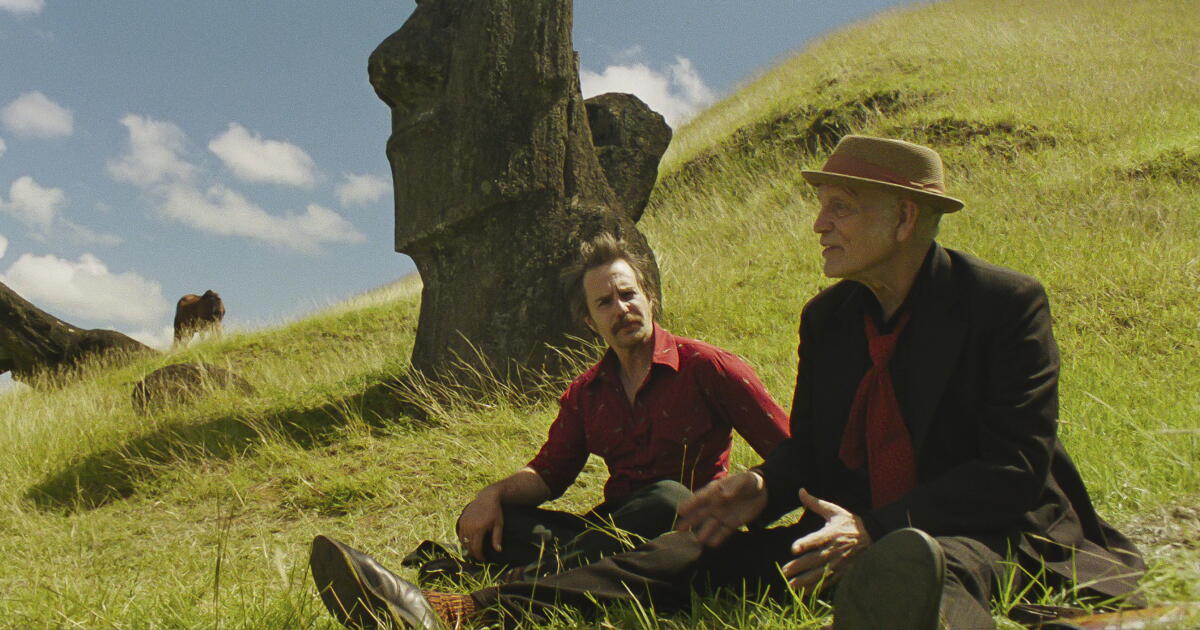

Whether in Missouri or Bruges, an isle off the coast of Ireland or a speck in the Pacific Ocean, a Martin McDonagh movie whisks audiences someplace remote for a detached view of the mess we’ve made of civilization. Human society continually tries to organize itself around religion, politics, empathy and law. His whip-smart and violent comedies are insights into why it keeps failing.
“Wild Horse Nine,” an exemplar of the format, is about two CIA agents, Chris and Lee (John Malkovich and Sam Rockwell), enjoying a getaway on Easter Island. It’s 1973 and the men are stationed in Santiago, Chile, where the U.S. has spent millions of dollars on a propaganda campaign to prevent the socialist Salvador Allende from winning the presidency. When Chileans vote for him anyway, Richard Nixon gives secret orders to “kick them in the ass,” empowering Henry Kissinger to tank the country’s economy, raise inflation, fund paid protesters and stoke extremist polarization.
“We came here to destabilize your country, and it’s going great,” Chris brags to a pair of flabbergasted young Chilean women, Monica and Alicia (Mariana di Girolamo and Ailín Salas), fellow tourists who gape at this Yankee old-timer in dismay. In a few months, a military coup will install Gen. Augusto Pinochet as dictator and begin to disappear liberal dissenters. The folk singer Victor Jara (Aron Hernández), the Woody Guthrie of Chile, is also in Easter Island to play a show and he, too, will soon be machine-gunned by the Army. McDonagh doesn’t show us this (and the soundtrack leans more on Jara’s mentor, Violeta Parra). But he’s definitely hoping you leave the theater and look him up.
Chris likely doesn’t have that long to live himself. The aging spy is suffering from several diseases including dementia, impaired judgment and a mildly guilty conscience — a fatal combination for a blabbermouth who claims to know the whereabouts of the rifle that may have shot John F. Kennedy. Some of what Chris says is a lie; some is addled and confused. His scariest statements are unapologetic facts about the CIA’s involvement in removing other progressive leaders in the Congo and Guatemala. Chris describes overthrowing governments as casually as if he was recalling yesterday’s lunch.
Only classic screwball comedians have delivered dialogue as blithely as Malkovich does here, with zingers that float off unburdened by the heaviness of the real world. He’s marvelous in this. His rogue is as destructive as his villains in “Dangerous Liaisons” and “Con Air,” but carries himself with the lightness of his self-mocking performance in “Being John Malkovich.” While Malkovich gets the best lines, Rockwell gets the best reaction shots, staring aghast at his pesky colleague. Yet, McDonagh himself doesn’t have quite as light of a touch as usual. One of Chris’ digressions about how he’s becoming kinder to insects is terrific, until the script goes one sentence too far and forces the character to blurt out the subtext: He’s nicer to Chile’s moths than to its people.
Ostensibly, the duo are on vacation. Narratively, one has evaded punishment for an outrageous crime and the other has been ordered by their boss, MJ (Steve Buscemi), to assassinate his friend before the truth escapes. The plot is so similar to McDonagh’s 2008 feature film debut, the masterpiece “In Bruges,” which starred Brendan Gleeson and Colin Farrell as exiled hit men, that the filmmaker should sue himself for plagiarism. I’ll forgive it only because “In Bruges” is one of the best movies of the 21st century. (And anyway, both films already owe a debt to John Steinbeck’s sympathetic galumphs George and Lennie in “Of Mice and Men.”)
In transplanting the setting from “Bruges’” moody, gloomy medieval hamlet to a sunshiny island populated by free-roaming ponies, McDonagh teases the idea that this is a western with a twist: a moral showdown told from the perspective of the hired guns who claim they’re too ignorant to take blame. (He even finagles an excuse to cut to Monument Valley.) Together, Chris and Lee have killed over six dozen people, but never for personal reasons — they’re employees. “Maybe I should have learned more about the places I went into,” Chris muses. Staying dumb allows him to pretend that he’s not John Wayne massacring the Comanches. He’s just the horse underneath John Wayne who doesn’t have any control over where he’s told to go.
McDonagh gets a kick out of making us enjoy palling around with sinners as they chitchat about the correlation between democracies and good cheese. Like him, they refuse to retire their favorite retrograde insults which, at this point, feels like McDonagh’s own in-joke for himself. I suspect it amuses him that audiences get more upset when one of his characters says a slur than when that same character shoots someone in the face.
No filmmaker working today is as merciless with a quip. Debating the power of mass protest with Monica and Alicia, Chris says, “Marches are just the place where we can get the cleanest photos of you without you knowing,” a punchline that lands with a wallop in today’s era of constant surveillance. We cringe at Chris’ aberrant chattiness and recoil from his stony confidence that men like him and Lee will continue to control the world, an assurance as implacable as Easter Island’s monolithic statues. Occasionally, cinematographer Ben Davis even lines up those centuries-old face carvings behind Malkovich to note their resemblance to his imposing profile.
Doom engulfs the movie much like the water circling the stunning coastline. The script’s air of inevitability prevents it from mustering up much suspense. Even when the danger ripples all the way to Lee’s wife (Parker Posey) back in the States, the tension drains away. You expect McDonagh to play around more with Chris’ memory loss and morphine addiction than he does; meanwhile, another junkie beat is so convenient that I can’t believe the film even tried to get away with it, and nearly succeeds.
“Wild Horse Nine’s” darkest prank is convincing us that a charming scoundrel like Chris should have a say in how and when he dies — a privilege he didn’t grant his own victims. What’s the use of punishing a terminally ill man? But that, McDonagh suggests, is how life actually works. Normal westerns mete out justice. This tropical one refuses.
‘Wild Horse Nine’
Rated: R, for pervasive language, some strong violence, drug use and sexual references
Running time: 1 hour, 58 minutes
Playing: Opens Friday, Nov. 6 in wide release

Whether in Missouri or Bruges, an isle off the coast of Ireland or a speck in the Pacific Ocean, a Martin McDonagh movie whisks audiences someplace remote for a detached view of the mess we’ve made of civilization. Human society continually tries to organize itself around religion, politics, empathy and law. His whip-smart and violent comedies are insights into why it keeps failing.
“Wild Horse Nine,” an exemplar of the format, is about two CIA agents, Chris and Lee (John Malkovich and Sam Rockwell), enjoying a getaway on Easter Island. It’s 1973 and the men are stationed in Santiago, Chile, where the U.S. has spent millions of dollars on a propaganda campaign to prevent the socialist Salvador Allende from winning the presidency. When Chileans vote for him anyway, Richard Nixon gives secret orders to “kick them in the ass,” empowering Henry Kissinger to tank the country’s economy, raise inflation, fund paid protesters and stoke extremist polarization.
“We came here to destabilize your country, and it’s going great,” Chris brags to a pair of flabbergasted young Chilean women, Monica and Alicia (Mariana di Girolamo and Ailín Salas), fellow tourists who gape at this Yankee old-timer in dismay. In a few months, a military coup will install Gen. Augusto Pinochet as dictator and begin to disappear liberal dissenters. The folk singer Victor Jara (Aron Hernández), the Woody Guthrie of Chile, is also in Easter Island to play a show and he, too, will soon be machine-gunned by the Army. McDonagh doesn’t show us this (and the soundtrack leans more on Jara’s mentor, Violeta Parra). But he’s definitely hoping you leave the theater and look him up.
Chris likely doesn’t have that long to live himself. The aging spy is suffering from several diseases including dementia, impaired judgment and a mildly guilty conscience — a fatal combination for a blabbermouth who claims to know the whereabouts of the rifle that may have shot John F. Kennedy. Some of what Chris says is a lie; some is addled and confused. His scariest statements are unapologetic facts about the CIA’s involvement in removing other progressive leaders in the Congo and Guatemala. Chris describes overthrowing governments as casually as if he was recalling yesterday’s lunch.
Only classic screwball comedians have delivered dialogue as blithely as Malkovich does here, with zingers that float off unburdened by the heaviness of the real world. He’s marvelous in this. His rogue is as destructive as his villains in “Dangerous Liaisons” and “Con Air,” but carries himself with the lightness of his self-mocking performance in “Being John Malkovich.” While Malkovich gets the best lines, Rockwell gets the best reaction shots, staring aghast at his pesky colleague. Yet, McDonagh himself doesn’t have quite as light of a touch as usual. One of Chris’ digressions about how he’s becoming kinder to insects is terrific, until the script goes one sentence too far and forces the character to blurt out the subtext: He’s nicer to Chile’s moths than to its people.
Ostensibly, the duo are on vacation. Narratively, one has evaded punishment for an outrageous crime and the other has been ordered by their boss, MJ (Steve Buscemi), to assassinate his friend before the truth escapes. The plot is so similar to McDonagh’s 2008 feature film debut, the masterpiece “In Bruges,” which starred Brendan Gleeson and Colin Farrell as exiled hit men, that the filmmaker should sue himself for plagiarism. I’ll forgive it only because “In Bruges” is one of the best movies of the 21st century. (And anyway, both films already owe a debt to John Steinbeck’s sympathetic galumphs George and Lennie in “Of Mice and Men.”)
In transplanting the setting from “Bruges’” moody, gloomy medieval hamlet to a sunshiny island populated by free-roaming ponies, McDonagh teases the idea that this is a western with a twist: a moral showdown told from the perspective of the hired guns who claim they’re too ignorant to take blame. (He even finagles an excuse to cut to Monument Valley.) Together, Chris and Lee have killed over six dozen people, but never for personal reasons — they’re employees. “Maybe I should have learned more about the places I went into,” Chris muses. Staying dumb allows him to pretend that he’s not John Wayne massacring the Comanches. He’s just the horse underneath John Wayne who doesn’t have any control over where he’s told to go.
McDonagh gets a kick out of making us enjoy palling around with sinners as they chitchat about the correlation between democracies and good cheese. Like him, they refuse to retire their favorite retrograde insults which, at this point, feels like McDonagh’s own in-joke for himself. I suspect it amuses him that audiences get more upset when one of his characters says a slur than when that same character shoots someone in the face.
No filmmaker working today is as merciless with a quip. Debating the power of mass protest with Monica and Alicia, Chris says, “Marches are just the place where we can get the cleanest photos of you without you knowing,” a punchline that lands with a wallop in today’s era of constant surveillance. We cringe at Chris’ aberrant chattiness and recoil from his stony confidence that men like him and Lee will continue to control the world, an assurance as implacable as Easter Island’s monolithic statues. Occasionally, cinematographer Ben Davis even lines up those centuries-old face carvings behind Malkovich to note their resemblance to his imposing profile.
Doom engulfs the movie much like the water circling the stunning coastline. The script’s air of inevitability prevents it from mustering up much suspense. Even when the danger ripples all the way to Lee’s wife (Parker Posey) back in the States, the tension drains away. You expect McDonagh to play around more with Chris’ memory loss and morphine addiction than he does; meanwhile, another junkie beat is so convenient that I can’t believe the film even tried to get away with it, and nearly succeeds.
“Wild Horse Nine’s” darkest prank is convincing us that a charming scoundrel like Chris should have a say in how and when he dies — a privilege he didn’t grant his own victims. What’s the use of punishing a terminally ill man? But that, McDonagh suggests, is how life actually works. Normal westerns mete out justice. This tropical one refuses.
‘Wild Horse Nine’
Rated: R, for pervasive language, some strong violence, drug use and sexual references
Running time: 1 hour, 58 minutes
Playing: Opens Friday, Nov. 6 in wide release

Whether in Missouri or Bruges, an isle off the coast of Ireland or a speck in the Pacific Ocean, a Martin McDonagh movie whisks audiences someplace remote for a detached view of the mess we’ve made of civilization. Human society continually tries to organize itself around religion, politics, empathy and law. His whip-smart and violent comedies are insights into why it keeps failing.
“Wild Horse Nine,” an exemplar of the format, is about two CIA agents, Chris and Lee (John Malkovich and Sam Rockwell), enjoying a getaway on Easter Island. It’s 1973 and the men are stationed in Santiago, Chile, where the U.S. has spent millions of dollars on a propaganda campaign to prevent the socialist Salvador Allende from winning the presidency. When Chileans vote for him anyway, Richard Nixon gives secret orders to “kick them in the ass,” empowering Henry Kissinger to tank the country’s economy, raise inflation, fund paid protesters and stoke extremist polarization.
“We came here to destabilize your country, and it’s going great,” Chris brags to a pair of flabbergasted young Chilean women, Monica and Alicia (Mariana di Girolamo and Ailín Salas), fellow tourists who gape at this Yankee old-timer in dismay. In a few months, a military coup will install Gen. Augusto Pinochet as dictator and begin to disappear liberal dissenters. The folk singer Victor Jara (Aron Hernández), the Woody Guthrie of Chile, is also in Easter Island to play a show and he, too, will soon be machine-gunned by the Army. McDonagh doesn’t show us this (and the soundtrack leans more on Jara’s mentor, Violeta Parra). But he’s definitely hoping you leave the theater and look him up.
Chris likely doesn’t have that long to live himself. The aging spy is suffering from several diseases including dementia, impaired judgment and a mildly guilty conscience — a fatal combination for a blabbermouth who claims to know the whereabouts of the rifle that may have shot John F. Kennedy. Some of what Chris says is a lie; some is addled and confused. His scariest statements are unapologetic facts about the CIA’s involvement in removing other progressive leaders in the Congo and Guatemala. Chris describes overthrowing governments as casually as if he was recalling yesterday’s lunch.
Only classic screwball comedians have delivered dialogue as blithely as Malkovich does here, with zingers that float off unburdened by the heaviness of the real world. He’s marvelous in this. His rogue is as destructive as his villains in “Dangerous Liaisons” and “Con Air,” but carries himself with the lightness of his self-mocking performance in “Being John Malkovich.” While Malkovich gets the best lines, Rockwell gets the best reaction shots, staring aghast at his pesky colleague. Yet, McDonagh himself doesn’t have quite as light of a touch as usual. One of Chris’ digressions about how he’s becoming kinder to insects is terrific, until the script goes one sentence too far and forces the character to blurt out the subtext: He’s nicer to Chile’s moths than to its people.
Ostensibly, the duo are on vacation. Narratively, one has evaded punishment for an outrageous crime and the other has been ordered by their boss, MJ (Steve Buscemi), to assassinate his friend before the truth escapes. The plot is so similar to McDonagh’s 2008 feature film debut, the masterpiece “In Bruges,” which starred Brendan Gleeson and Colin Farrell as exiled hit men, that the filmmaker should sue himself for plagiarism. I’ll forgive it only because “In Bruges” is one of the best movies of the 21st century. (And anyway, both films already owe a debt to John Steinbeck’s sympathetic galumphs George and Lennie in “Of Mice and Men.”)
In transplanting the setting from “Bruges’” moody, gloomy medieval hamlet to a sunshiny island populated by free-roaming ponies, McDonagh teases the idea that this is a western with a twist: a moral showdown told from the perspective of the hired guns who claim they’re too ignorant to take blame. (He even finagles an excuse to cut to Monument Valley.) Together, Chris and Lee have killed over six dozen people, but never for personal reasons — they’re employees. “Maybe I should have learned more about the places I went into,” Chris muses. Staying dumb allows him to pretend that he’s not John Wayne massacring the Comanches. He’s just the horse underneath John Wayne who doesn’t have any control over where he’s told to go.
McDonagh gets a kick out of making us enjoy palling around with sinners as they chitchat about the correlation between democracies and good cheese. Like him, they refuse to retire their favorite retrograde insults which, at this point, feels like McDonagh’s own in-joke for himself. I suspect it amuses him that audiences get more upset when one of his characters says a slur than when that same character shoots someone in the face.
No filmmaker working today is as merciless with a quip. Debating the power of mass protest with Monica and Alicia, Chris says, “Marches are just the place where we can get the cleanest photos of you without you knowing,” a punchline that lands with a wallop in today’s era of constant surveillance. We cringe at Chris’ aberrant chattiness and recoil from his stony confidence that men like him and Lee will continue to control the world, an assurance as implacable as Easter Island’s monolithic statues. Occasionally, cinematographer Ben Davis even lines up those centuries-old face carvings behind Malkovich to note their resemblance to his imposing profile.
Doom engulfs the movie much like the water circling the stunning coastline. The script’s air of inevitability prevents it from mustering up much suspense. Even when the danger ripples all the way to Lee’s wife (Parker Posey) back in the States, the tension drains away. You expect McDonagh to play around more with Chris’ memory loss and morphine addiction than he does; meanwhile, another junkie beat is so convenient that I can’t believe the film even tried to get away with it, and nearly succeeds.
“Wild Horse Nine’s” darkest prank is convincing us that a charming scoundrel like Chris should have a say in how and when he dies — a privilege he didn’t grant his own victims. What’s the use of punishing a terminally ill man? But that, McDonagh suggests, is how life actually works. Normal westerns mete out justice. This tropical one refuses.
‘Wild Horse Nine’
Rated: R, for pervasive language, some strong violence, drug use and sexual references
Running time: 1 hour, 58 minutes
Playing: Opens Friday, Nov. 6 in wide release

Whether in Missouri or Bruges, an isle off the coast of Ireland or a speck in the Pacific Ocean, a Martin McDonagh movie whisks audiences someplace remote for a detached view of the mess we’ve made of civilization. Human society continually tries to organize itself around religion, politics, empathy and law. His whip-smart and violent comedies are insights into why it keeps failing.
“Wild Horse Nine,” an exemplar of the format, is about two CIA agents, Chris and Lee (John Malkovich and Sam Rockwell), enjoying a getaway on Easter Island. It’s 1973 and the men are stationed in Santiago, Chile, where the U.S. has spent millions of dollars on a propaganda campaign to prevent the socialist Salvador Allende from winning the presidency. When Chileans vote for him anyway, Richard Nixon gives secret orders to “kick them in the ass,” empowering Henry Kissinger to tank the country’s economy, raise inflation, fund paid protesters and stoke extremist polarization.
“We came here to destabilize your country, and it’s going great,” Chris brags to a pair of flabbergasted young Chilean women, Monica and Alicia (Mariana di Girolamo and Ailín Salas), fellow tourists who gape at this Yankee old-timer in dismay. In a few months, a military coup will install Gen. Augusto Pinochet as dictator and begin to disappear liberal dissenters. The folk singer Victor Jara (Aron Hernández), the Woody Guthrie of Chile, is also in Easter Island to play a show and he, too, will soon be machine-gunned by the Army. McDonagh doesn’t show us this (and the soundtrack leans more on Jara’s mentor, Violeta Parra). But he’s definitely hoping you leave the theater and look him up.
Chris likely doesn’t have that long to live himself. The aging spy is suffering from several diseases including dementia, impaired judgment and a mildly guilty conscience — a fatal combination for a blabbermouth who claims to know the whereabouts of the rifle that may have shot John F. Kennedy. Some of what Chris says is a lie; some is addled and confused. His scariest statements are unapologetic facts about the CIA’s involvement in removing other progressive leaders in the Congo and Guatemala. Chris describes overthrowing governments as casually as if he was recalling yesterday’s lunch.
Only classic screwball comedians have delivered dialogue as blithely as Malkovich does here, with zingers that float off unburdened by the heaviness of the real world. He’s marvelous in this. His rogue is as destructive as his villains in “Dangerous Liaisons” and “Con Air,” but carries himself with the lightness of his self-mocking performance in “Being John Malkovich.” While Malkovich gets the best lines, Rockwell gets the best reaction shots, staring aghast at his pesky colleague. Yet, McDonagh himself doesn’t have quite as light of a touch as usual. One of Chris’ digressions about how he’s becoming kinder to insects is terrific, until the script goes one sentence too far and forces the character to blurt out the subtext: He’s nicer to Chile’s moths than to its people.
Ostensibly, the duo are on vacation. Narratively, one has evaded punishment for an outrageous crime and the other has been ordered by their boss, MJ (Steve Buscemi), to assassinate his friend before the truth escapes. The plot is so similar to McDonagh’s 2008 feature film debut, the masterpiece “In Bruges,” which starred Brendan Gleeson and Colin Farrell as exiled hit men, that the filmmaker should sue himself for plagiarism. I’ll forgive it only because “In Bruges” is one of the best movies of the 21st century. (And anyway, both films already owe a debt to John Steinbeck’s sympathetic galumphs George and Lennie in “Of Mice and Men.”)
In transplanting the setting from “Bruges’” moody, gloomy medieval hamlet to a sunshiny island populated by free-roaming ponies, McDonagh teases the idea that this is a western with a twist: a moral showdown told from the perspective of the hired guns who claim they’re too ignorant to take blame. (He even finagles an excuse to cut to Monument Valley.) Together, Chris and Lee have killed over six dozen people, but never for personal reasons — they’re employees. “Maybe I should have learned more about the places I went into,” Chris muses. Staying dumb allows him to pretend that he’s not John Wayne massacring the Comanches. He’s just the horse underneath John Wayne who doesn’t have any control over where he’s told to go.
McDonagh gets a kick out of making us enjoy palling around with sinners as they chitchat about the correlation between democracies and good cheese. Like him, they refuse to retire their favorite retrograde insults which, at this point, feels like McDonagh’s own in-joke for himself. I suspect it amuses him that audiences get more upset when one of his characters says a slur than when that same character shoots someone in the face.
No filmmaker working today is as merciless with a quip. Debating the power of mass protest with Monica and Alicia, Chris says, “Marches are just the place where we can get the cleanest photos of you without you knowing,” a punchline that lands with a wallop in today’s era of constant surveillance. We cringe at Chris’ aberrant chattiness and recoil from his stony confidence that men like him and Lee will continue to control the world, an assurance as implacable as Easter Island’s monolithic statues. Occasionally, cinematographer Ben Davis even lines up those centuries-old face carvings behind Malkovich to note their resemblance to his imposing profile.
Doom engulfs the movie much like the water circling the stunning coastline. The script’s air of inevitability prevents it from mustering up much suspense. Even when the danger ripples all the way to Lee’s wife (Parker Posey) back in the States, the tension drains away. You expect McDonagh to play around more with Chris’ memory loss and morphine addiction than he does; meanwhile, another junkie beat is so convenient that I can’t believe the film even tried to get away with it, and nearly succeeds.
“Wild Horse Nine’s” darkest prank is convincing us that a charming scoundrel like Chris should have a say in how and when he dies — a privilege he didn’t grant his own victims. What’s the use of punishing a terminally ill man? But that, McDonagh suggests, is how life actually works. Normal westerns mete out justice. This tropical one refuses.
‘Wild Horse Nine’
Rated: R, for pervasive language, some strong violence, drug use and sexual references
Running time: 1 hour, 58 minutes
Playing: Opens Friday, Nov. 6 in wide release

