

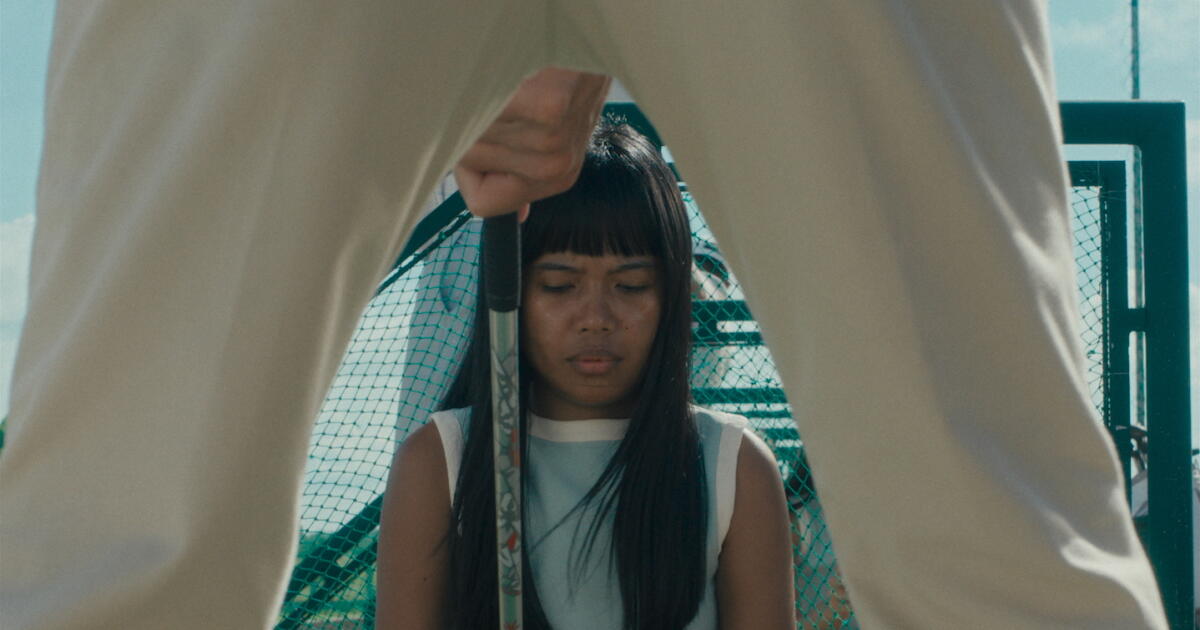
It’s no exaggeration to say that every carefully crafted image in Rafael Manuel’s stunning debut feature “Filipiñana” is like an exclusive, disturbing world unto itself, telling its own story. At the same time, each frame builds upon the last to create a gripping, caustically funny narrative about patriarchy, disempowerment and compliance. In other words, everything a day at a golf resort should bring to mind.
Before Manuel escorts us into the lavish links getaway that is his central metaphor for a rapidly changing Philippines, we’re in a bus — full of middle-aged, white-clad tourists — that cuts through a sweltering central Manila where parched citizens scrabble for water. Cut to our beatific destination, where vast private tracts of perfectly manicured green are getting plenty of water, busy sprinklers in rhythmic harmony. That applies to the uniformed resort staff, too, as they prepare, like choreographed musical extras, for a day serving wealthy men’s recreational needs.
With what seems like little embellishment to real locations (including a genuine culture of female-only caddies sporting bright colors), the movie captures a languid, top-down strangeness. This could be sci-fi, fantasy or an adult cartoon. But it also suggests that if golf resorts didn’t already exist, Dr. Seuss or Jacques Tati might have had to invent them.
Early on, we meet the characters who will ground us in this social satire’s absurd environment: 17-year-old Isabel (Jorrybell Agoto), a driving range “tee girl” — look cute, set up ball, don’t get hit — whose spare time is spent exploring the grounds like a waif in an alien wilderness; and bored New York transplant Clara (Carmen Castellanos), who’s visiting her rich, connected Uncle Renato (a perfectly oily Carlitos Siguion-Reyna) and getting an earful all day long about moving back to enjoy a cushier life. “More comfortable doesn’t always mean happier,” she responds.
Isabel can sometimes be found softly singing under a mango tree, as if trying to invoke something lost. She’s low-key obsessed with the club’s president, the powerful, married Dr. Palanca (Teroy Guzman), so when his caddie Charlie (Elle Velasco) asks her to return a stray golf club to him personally, Isabel begins an eccentric quest. But across this setting’s liminal, glistening affluence, something consequential emerges about the meaning behind her presence there.
In certain ways “Filipiñana,” which was developed from a short film, is a tweaked, post-colonial revising of Dorothy’s Oz awakening. But despite a mischievous style, where an iron gleams like a talisman and a pine tree can look forlorn, it’s savagely serious about what’s in store globally — not just in the Philippines. It isn’t surprising to learn that Manuel was mentored by Jia Zhangke (“Still Life,” “Caught by the Tides”), the great Chinese chronicler of generational transformation, also an executive producer here. Like Jia, Manuel has a masterful eye for layered image-making, but he’s forged his own singular blend of humor and atmosphere. He’s building worlds and dissecting them at the same time.
He’s also thinking about how films start and stop. That water usage juxtaposition at the beginning is pointedly funny, but Manuel bookends it in his closing moments with another ironic contrast in moneyed, rarefied bubbles that stings and saddens. “Filipiñana” may be set on a golf course sculpted to perfection, but all you’ll see are the traps.
‘Filipiñana’
In Filipino, English and Ilokano, with subtitles
Not rated
Running time: 1 hour, 40 minutes
Playing: Opens Friday, Sept. 4 at Laemmle Monica Film Center and Laemmle Glendale

It’s no exaggeration to say that every carefully crafted image in Rafael Manuel’s stunning debut feature “Filipiñana” is like an exclusive, disturbing world unto itself, telling its own story. At the same time, each frame builds upon the last to create a gripping, caustically funny narrative about patriarchy, disempowerment and compliance. In other words, everything a day at a golf resort should bring to mind.
Before Manuel escorts us into the lavish links getaway that is his central metaphor for a rapidly changing Philippines, we’re in a bus — full of middle-aged, white-clad tourists — that cuts through a sweltering central Manila where parched citizens scrabble for water. Cut to our beatific destination, where vast private tracts of perfectly manicured green are getting plenty of water, busy sprinklers in rhythmic harmony. That applies to the uniformed resort staff, too, as they prepare, like choreographed musical extras, for a day serving wealthy men’s recreational needs.
With what seems like little embellishment to real locations (including a genuine culture of female-only caddies sporting bright colors), the movie captures a languid, top-down strangeness. This could be sci-fi, fantasy or an adult cartoon. But it also suggests that if golf resorts didn’t already exist, Dr. Seuss or Jacques Tati might have had to invent them.
Early on, we meet the characters who will ground us in this social satire’s absurd environment: 17-year-old Isabel (Jorrybell Agoto), a driving range “tee girl” — look cute, set up ball, don’t get hit — whose spare time is spent exploring the grounds like a waif in an alien wilderness; and bored New York transplant Clara (Carmen Castellanos), who’s visiting her rich, connected Uncle Renato (a perfectly oily Carlitos Siguion-Reyna) and getting an earful all day long about moving back to enjoy a cushier life. “More comfortable doesn’t always mean happier,” she responds.
Isabel can sometimes be found softly singing under a mango tree, as if trying to invoke something lost. She’s low-key obsessed with the club’s president, the powerful, married Dr. Palanca (Teroy Guzman), so when his caddie Charlie (Elle Velasco) asks her to return a stray golf club to him personally, Isabel begins an eccentric quest. But across this setting’s liminal, glistening affluence, something consequential emerges about the meaning behind her presence there.
In certain ways “Filipiñana,” which was developed from a short film, is a tweaked, post-colonial revising of Dorothy’s Oz awakening. But despite a mischievous style, where an iron gleams like a talisman and a pine tree can look forlorn, it’s savagely serious about what’s in store globally — not just in the Philippines. It isn’t surprising to learn that Manuel was mentored by Jia Zhangke (“Still Life,” “Caught by the Tides”), the great Chinese chronicler of generational transformation, also an executive producer here. Like Jia, Manuel has a masterful eye for layered image-making, but he’s forged his own singular blend of humor and atmosphere. He’s building worlds and dissecting them at the same time.
He’s also thinking about how films start and stop. That water usage juxtaposition at the beginning is pointedly funny, but Manuel bookends it in his closing moments with another ironic contrast in moneyed, rarefied bubbles that stings and saddens. “Filipiñana” may be set on a golf course sculpted to perfection, but all you’ll see are the traps.
‘Filipiñana’
In Filipino, English and Ilokano, with subtitles
Not rated
Running time: 1 hour, 40 minutes
Playing: Opens Friday, Sept. 4 at Laemmle Monica Film Center and Laemmle Glendale

It’s no exaggeration to say that every carefully crafted image in Rafael Manuel’s stunning debut feature “Filipiñana” is like an exclusive, disturbing world unto itself, telling its own story. At the same time, each frame builds upon the last to create a gripping, caustically funny narrative about patriarchy, disempowerment and compliance. In other words, everything a day at a golf resort should bring to mind.
Before Manuel escorts us into the lavish links getaway that is his central metaphor for a rapidly changing Philippines, we’re in a bus — full of middle-aged, white-clad tourists — that cuts through a sweltering central Manila where parched citizens scrabble for water. Cut to our beatific destination, where vast private tracts of perfectly manicured green are getting plenty of water, busy sprinklers in rhythmic harmony. That applies to the uniformed resort staff, too, as they prepare, like choreographed musical extras, for a day serving wealthy men’s recreational needs.
With what seems like little embellishment to real locations (including a genuine culture of female-only caddies sporting bright colors), the movie captures a languid, top-down strangeness. This could be sci-fi, fantasy or an adult cartoon. But it also suggests that if golf resorts didn’t already exist, Dr. Seuss or Jacques Tati might have had to invent them.
Early on, we meet the characters who will ground us in this social satire’s absurd environment: 17-year-old Isabel (Jorrybell Agoto), a driving range “tee girl” — look cute, set up ball, don’t get hit — whose spare time is spent exploring the grounds like a waif in an alien wilderness; and bored New York transplant Clara (Carmen Castellanos), who’s visiting her rich, connected Uncle Renato (a perfectly oily Carlitos Siguion-Reyna) and getting an earful all day long about moving back to enjoy a cushier life. “More comfortable doesn’t always mean happier,” she responds.
Isabel can sometimes be found softly singing under a mango tree, as if trying to invoke something lost. She’s low-key obsessed with the club’s president, the powerful, married Dr. Palanca (Teroy Guzman), so when his caddie Charlie (Elle Velasco) asks her to return a stray golf club to him personally, Isabel begins an eccentric quest. But across this setting’s liminal, glistening affluence, something consequential emerges about the meaning behind her presence there.
In certain ways “Filipiñana,” which was developed from a short film, is a tweaked, post-colonial revising of Dorothy’s Oz awakening. But despite a mischievous style, where an iron gleams like a talisman and a pine tree can look forlorn, it’s savagely serious about what’s in store globally — not just in the Philippines. It isn’t surprising to learn that Manuel was mentored by Jia Zhangke (“Still Life,” “Caught by the Tides”), the great Chinese chronicler of generational transformation, also an executive producer here. Like Jia, Manuel has a masterful eye for layered image-making, but he’s forged his own singular blend of humor and atmosphere. He’s building worlds and dissecting them at the same time.
He’s also thinking about how films start and stop. That water usage juxtaposition at the beginning is pointedly funny, but Manuel bookends it in his closing moments with another ironic contrast in moneyed, rarefied bubbles that stings and saddens. “Filipiñana” may be set on a golf course sculpted to perfection, but all you’ll see are the traps.
‘Filipiñana’
In Filipino, English and Ilokano, with subtitles
Not rated
Running time: 1 hour, 40 minutes
Playing: Opens Friday, Sept. 4 at Laemmle Monica Film Center and Laemmle Glendale
It’s no exaggeration to say that every carefully crafted image in Rafael Manuel’s stunning debut feature “Filipiñana” is like an exclusive, disturbing world unto itself, telling its own story. At the same time, each frame builds upon the last to create a gripping, caustically funny narrative about patriarchy, disempowerment and compliance. In other words, everything a day at a golf resort should bring to mind.
Before Manuel escorts us into the lavish links getaway that is his central metaphor for a rapidly changing Philippines, we’re in a bus — full of middle-aged, white-clad tourists — that cuts through a sweltering central Manila where parched citizens scrabble for water. Cut to our beatific destination, where vast private tracts of perfectly manicured green are getting plenty of water, busy sprinklers in rhythmic harmony. That applies to the uniformed resort staff, too, as they prepare, like choreographed musical extras, for a day serving wealthy men’s recreational needs.
With what seems like little embellishment to real locations (including a genuine culture of female-only caddies sporting bright colors), the movie captures a languid, top-down strangeness. This could be sci-fi, fantasy or an adult cartoon. But it also suggests that if golf resorts didn’t already exist, Dr. Seuss or Jacques Tati might have had to invent them.
Early on, we meet the characters who will ground us in this social satire’s absurd environment: 17-year-old Isabel (Jorrybell Agoto), a driving range “tee girl” — look cute, set up ball, don’t get hit — whose spare time is spent exploring the grounds like a waif in an alien wilderness; and bored New York transplant Clara (Carmen Castellanos), who’s visiting her rich, connected Uncle Renato (a perfectly oily Carlitos Siguion-Reyna) and getting an earful all day long about moving back to enjoy a cushier life. “More comfortable doesn’t always mean happier,” she responds.
Isabel can sometimes be found softly singing under a mango tree, as if trying to invoke something lost. She’s low-key obsessed with the club’s president, the powerful, married Dr. Palanca (Teroy Guzman), so when his caddie Charlie (Elle Velasco) asks her to return a stray golf club to him personally, Isabel begins an eccentric quest. But across this setting’s liminal, glistening affluence, something consequential emerges about the meaning behind her presence there.
In certain ways “Filipiñana,” which was developed from a short film, is a tweaked, post-colonial revising of Dorothy’s Oz awakening. But despite a mischievous style, where an iron gleams like a talisman and a pine tree can look forlorn, it’s savagely serious about what’s in store globally — not just in the Philippines. It isn’t surprising to learn that Manuel was mentored by Jia Zhangke (“Still Life,” “Caught by the Tides”), the great Chinese chronicler of generational transformation, also an executive producer here. Like Jia, Manuel has a masterful eye for layered image-making, but he’s forged his own singular blend of humor and atmosphere. He’s building worlds and dissecting them at the same time.
He’s also thinking about how films start and stop. That water usage juxtaposition at the beginning is pointedly funny, but Manuel bookends it in his closing moments with another ironic contrast in moneyed, rarefied bubbles that stings and saddens. “Filipiñana” may be set on a golf course sculpted to perfection, but all you’ll see are the traps.
‘Filipiñana’
In Filipino, English and Ilokano, with subtitles
Not rated
Running time: 1 hour, 40 minutes
Playing: Opens Friday, Sept. 4 at Laemmle Monica Film Center and Laemmle Glendale

It’s no exaggeration to say that every carefully crafted image in Rafael Manuel’s stunning debut feature “Filipiñana” is like an exclusive, disturbing world unto itself, telling its own story. At the same time, each frame builds upon the last to create a gripping, caustically funny narrative about patriarchy, disempowerment and compliance. In other words, everything a day at a golf resort should bring to mind.
Before Manuel escorts us into the lavish links getaway that is his central metaphor for a rapidly changing Philippines, we’re in a bus — full of middle-aged, white-clad tourists — that cuts through a sweltering central Manila where parched citizens scrabble for water. Cut to our beatific destination, where vast private tracts of perfectly manicured green are getting plenty of water, busy sprinklers in rhythmic harmony. That applies to the uniformed resort staff, too, as they prepare, like choreographed musical extras, for a day serving wealthy men’s recreational needs.
With what seems like little embellishment to real locations (including a genuine culture of female-only caddies sporting bright colors), the movie captures a languid, top-down strangeness. This could be sci-fi, fantasy or an adult cartoon. But it also suggests that if golf resorts didn’t already exist, Dr. Seuss or Jacques Tati might have had to invent them.
Early on, we meet the characters who will ground us in this social satire’s absurd environment: 17-year-old Isabel (Jorrybell Agoto), a driving range “tee girl” — look cute, set up ball, don’t get hit — whose spare time is spent exploring the grounds like a waif in an alien wilderness; and bored New York transplant Clara (Carmen Castellanos), who’s visiting her rich, connected Uncle Renato (a perfectly oily Carlitos Siguion-Reyna) and getting an earful all day long about moving back to enjoy a cushier life. “More comfortable doesn’t always mean happier,” she responds.
Isabel can sometimes be found softly singing under a mango tree, as if trying to invoke something lost. She’s low-key obsessed with the club’s president, the powerful, married Dr. Palanca (Teroy Guzman), so when his caddie Charlie (Elle Velasco) asks her to return a stray golf club to him personally, Isabel begins an eccentric quest. But across this setting’s liminal, glistening affluence, something consequential emerges about the meaning behind her presence there.
In certain ways “Filipiñana,” which was developed from a short film, is a tweaked, post-colonial revising of Dorothy’s Oz awakening. But despite a mischievous style, where an iron gleams like a talisman and a pine tree can look forlorn, it’s savagely serious about what’s in store globally — not just in the Philippines. It isn’t surprising to learn that Manuel was mentored by Jia Zhangke (“Still Life,” “Caught by the Tides”), the great Chinese chronicler of generational transformation, also an executive producer here. Like Jia, Manuel has a masterful eye for layered image-making, but he’s forged his own singular blend of humor and atmosphere. He’s building worlds and dissecting them at the same time.
He’s also thinking about how films start and stop. That water usage juxtaposition at the beginning is pointedly funny, but Manuel bookends it in his closing moments with another ironic contrast in moneyed, rarefied bubbles that stings and saddens. “Filipiñana” may be set on a golf course sculpted to perfection, but all you’ll see are the traps.
‘Filipiñana’
In Filipino, English and Ilokano, with subtitles
Not rated
Running time: 1 hour, 40 minutes
Playing: Opens Friday, Sept. 4 at Laemmle Monica Film Center and Laemmle Glendale
It’s no exaggeration to say that every carefully crafted image in Rafael Manuel’s stunning debut feature “Filipiñana” is like an exclusive, disturbing world unto itself, telling its own story. At the same time, each frame builds upon the last to create a gripping, caustically funny narrative about patriarchy, disempowerment and compliance. In other words, everything a day at a golf resort should bring to mind.
Before Manuel escorts us into the lavish links getaway that is his central metaphor for a rapidly changing Philippines, we’re in a bus — full of middle-aged, white-clad tourists — that cuts through a sweltering central Manila where parched citizens scrabble for water. Cut to our beatific destination, where vast private tracts of perfectly manicured green are getting plenty of water, busy sprinklers in rhythmic harmony. That applies to the uniformed resort staff, too, as they prepare, like choreographed musical extras, for a day serving wealthy men’s recreational needs.
With what seems like little embellishment to real locations (including a genuine culture of female-only caddies sporting bright colors), the movie captures a languid, top-down strangeness. This could be sci-fi, fantasy or an adult cartoon. But it also suggests that if golf resorts didn’t already exist, Dr. Seuss or Jacques Tati might have had to invent them.
Early on, we meet the characters who will ground us in this social satire’s absurd environment: 17-year-old Isabel (Jorrybell Agoto), a driving range “tee girl” — look cute, set up ball, don’t get hit — whose spare time is spent exploring the grounds like a waif in an alien wilderness; and bored New York transplant Clara (Carmen Castellanos), who’s visiting her rich, connected Uncle Renato (a perfectly oily Carlitos Siguion-Reyna) and getting an earful all day long about moving back to enjoy a cushier life. “More comfortable doesn’t always mean happier,” she responds.
Isabel can sometimes be found softly singing under a mango tree, as if trying to invoke something lost. She’s low-key obsessed with the club’s president, the powerful, married Dr. Palanca (Teroy Guzman), so when his caddie Charlie (Elle Velasco) asks her to return a stray golf club to him personally, Isabel begins an eccentric quest. But across this setting’s liminal, glistening affluence, something consequential emerges about the meaning behind her presence there.
In certain ways “Filipiñana,” which was developed from a short film, is a tweaked, post-colonial revising of Dorothy’s Oz awakening. But despite a mischievous style, where an iron gleams like a talisman and a pine tree can look forlorn, it’s savagely serious about what’s in store globally — not just in the Philippines. It isn’t surprising to learn that Manuel was mentored by Jia Zhangke (“Still Life,” “Caught by the Tides”), the great Chinese chronicler of generational transformation, also an executive producer here. Like Jia, Manuel has a masterful eye for layered image-making, but he’s forged his own singular blend of humor and atmosphere. He’s building worlds and dissecting them at the same time.
He’s also thinking about how films start and stop. That water usage juxtaposition at the beginning is pointedly funny, but Manuel bookends it in his closing moments with another ironic contrast in moneyed, rarefied bubbles that stings and saddens. “Filipiñana” may be set on a golf course sculpted to perfection, but all you’ll see are the traps.
‘Filipiñana’
In Filipino, English and Ilokano, with subtitles
Not rated
Running time: 1 hour, 40 minutes
Playing: Opens Friday, Sept. 4 at Laemmle Monica Film Center and Laemmle Glendale
It’s no exaggeration to say that every carefully crafted image in Rafael Manuel’s stunning debut feature “Filipiñana” is like an exclusive, disturbing world unto itself, telling its own story. At the same time, each frame builds upon the last to create a gripping, caustically funny narrative about patriarchy, disempowerment and compliance. In other words, everything a day at a golf resort should bring to mind.
Before Manuel escorts us into the lavish links getaway that is his central metaphor for a rapidly changing Philippines, we’re in a bus — full of middle-aged, white-clad tourists — that cuts through a sweltering central Manila where parched citizens scrabble for water. Cut to our beatific destination, where vast private tracts of perfectly manicured green are getting plenty of water, busy sprinklers in rhythmic harmony. That applies to the uniformed resort staff, too, as they prepare, like choreographed musical extras, for a day serving wealthy men’s recreational needs.
With what seems like little embellishment to real locations (including a genuine culture of female-only caddies sporting bright colors), the movie captures a languid, top-down strangeness. This could be sci-fi, fantasy or an adult cartoon. But it also suggests that if golf resorts didn’t already exist, Dr. Seuss or Jacques Tati might have had to invent them.
Early on, we meet the characters who will ground us in this social satire’s absurd environment: 17-year-old Isabel (Jorrybell Agoto), a driving range “tee girl” — look cute, set up ball, don’t get hit — whose spare time is spent exploring the grounds like a waif in an alien wilderness; and bored New York transplant Clara (Carmen Castellanos), who’s visiting her rich, connected Uncle Renato (a perfectly oily Carlitos Siguion-Reyna) and getting an earful all day long about moving back to enjoy a cushier life. “More comfortable doesn’t always mean happier,” she responds.
Isabel can sometimes be found softly singing under a mango tree, as if trying to invoke something lost. She’s low-key obsessed with the club’s president, the powerful, married Dr. Palanca (Teroy Guzman), so when his caddie Charlie (Elle Velasco) asks her to return a stray golf club to him personally, Isabel begins an eccentric quest. But across this setting’s liminal, glistening affluence, something consequential emerges about the meaning behind her presence there.
In certain ways “Filipiñana,” which was developed from a short film, is a tweaked, post-colonial revising of Dorothy’s Oz awakening. But despite a mischievous style, where an iron gleams like a talisman and a pine tree can look forlorn, it’s savagely serious about what’s in store globally — not just in the Philippines. It isn’t surprising to learn that Manuel was mentored by Jia Zhangke (“Still Life,” “Caught by the Tides”), the great Chinese chronicler of generational transformation, also an executive producer here. Like Jia, Manuel has a masterful eye for layered image-making, but he’s forged his own singular blend of humor and atmosphere. He’s building worlds and dissecting them at the same time.
He’s also thinking about how films start and stop. That water usage juxtaposition at the beginning is pointedly funny, but Manuel bookends it in his closing moments with another ironic contrast in moneyed, rarefied bubbles that stings and saddens. “Filipiñana” may be set on a golf course sculpted to perfection, but all you’ll see are the traps.
‘Filipiñana’
In Filipino, English and Ilokano, with subtitles
Not rated
Running time: 1 hour, 40 minutes
Playing: Opens Friday, Sept. 4 at Laemmle Monica Film Center and Laemmle Glendale
It’s no exaggeration to say that every carefully crafted image in Rafael Manuel’s stunning debut feature “Filipiñana” is like an exclusive, disturbing world unto itself, telling its own story. At the same time, each frame builds upon the last to create a gripping, caustically funny narrative about patriarchy, disempowerment and compliance. In other words, everything a day at a golf resort should bring to mind.
Before Manuel escorts us into the lavish links getaway that is his central metaphor for a rapidly changing Philippines, we’re in a bus — full of middle-aged, white-clad tourists — that cuts through a sweltering central Manila where parched citizens scrabble for water. Cut to our beatific destination, where vast private tracts of perfectly manicured green are getting plenty of water, busy sprinklers in rhythmic harmony. That applies to the uniformed resort staff, too, as they prepare, like choreographed musical extras, for a day serving wealthy men’s recreational needs.
With what seems like little embellishment to real locations (including a genuine culture of female-only caddies sporting bright colors), the movie captures a languid, top-down strangeness. This could be sci-fi, fantasy or an adult cartoon. But it also suggests that if golf resorts didn’t already exist, Dr. Seuss or Jacques Tati might have had to invent them.
Early on, we meet the characters who will ground us in this social satire’s absurd environment: 17-year-old Isabel (Jorrybell Agoto), a driving range “tee girl” — look cute, set up ball, don’t get hit — whose spare time is spent exploring the grounds like a waif in an alien wilderness; and bored New York transplant Clara (Carmen Castellanos), who’s visiting her rich, connected Uncle Renato (a perfectly oily Carlitos Siguion-Reyna) and getting an earful all day long about moving back to enjoy a cushier life. “More comfortable doesn’t always mean happier,” she responds.
Isabel can sometimes be found softly singing under a mango tree, as if trying to invoke something lost. She’s low-key obsessed with the club’s president, the powerful, married Dr. Palanca (Teroy Guzman), so when his caddie Charlie (Elle Velasco) asks her to return a stray golf club to him personally, Isabel begins an eccentric quest. But across this setting’s liminal, glistening affluence, something consequential emerges about the meaning behind her presence there.
In certain ways “Filipiñana,” which was developed from a short film, is a tweaked, post-colonial revising of Dorothy’s Oz awakening. But despite a mischievous style, where an iron gleams like a talisman and a pine tree can look forlorn, it’s savagely serious about what’s in store globally — not just in the Philippines. It isn’t surprising to learn that Manuel was mentored by Jia Zhangke (“Still Life,” “Caught by the Tides”), the great Chinese chronicler of generational transformation, also an executive producer here. Like Jia, Manuel has a masterful eye for layered image-making, but he’s forged his own singular blend of humor and atmosphere. He’s building worlds and dissecting them at the same time.
He’s also thinking about how films start and stop. That water usage juxtaposition at the beginning is pointedly funny, but Manuel bookends it in his closing moments with another ironic contrast in moneyed, rarefied bubbles that stings and saddens. “Filipiñana” may be set on a golf course sculpted to perfection, but all you’ll see are the traps.
‘Filipiñana’
In Filipino, English and Ilokano, with subtitles
Not rated
Running time: 1 hour, 40 minutes
Playing: Opens Friday, Sept. 4 at Laemmle Monica Film Center and Laemmle Glendale

It’s no exaggeration to say that every carefully crafted image in Rafael Manuel’s stunning debut feature “Filipiñana” is like an exclusive, disturbing world unto itself, telling its own story. At the same time, each frame builds upon the last to create a gripping, caustically funny narrative about patriarchy, disempowerment and compliance. In other words, everything a day at a golf resort should bring to mind.
Before Manuel escorts us into the lavish links getaway that is his central metaphor for a rapidly changing Philippines, we’re in a bus — full of middle-aged, white-clad tourists — that cuts through a sweltering central Manila where parched citizens scrabble for water. Cut to our beatific destination, where vast private tracts of perfectly manicured green are getting plenty of water, busy sprinklers in rhythmic harmony. That applies to the uniformed resort staff, too, as they prepare, like choreographed musical extras, for a day serving wealthy men’s recreational needs.
With what seems like little embellishment to real locations (including a genuine culture of female-only caddies sporting bright colors), the movie captures a languid, top-down strangeness. This could be sci-fi, fantasy or an adult cartoon. But it also suggests that if golf resorts didn’t already exist, Dr. Seuss or Jacques Tati might have had to invent them.
Early on, we meet the characters who will ground us in this social satire’s absurd environment: 17-year-old Isabel (Jorrybell Agoto), a driving range “tee girl” — look cute, set up ball, don’t get hit — whose spare time is spent exploring the grounds like a waif in an alien wilderness; and bored New York transplant Clara (Carmen Castellanos), who’s visiting her rich, connected Uncle Renato (a perfectly oily Carlitos Siguion-Reyna) and getting an earful all day long about moving back to enjoy a cushier life. “More comfortable doesn’t always mean happier,” she responds.
Isabel can sometimes be found softly singing under a mango tree, as if trying to invoke something lost. She’s low-key obsessed with the club’s president, the powerful, married Dr. Palanca (Teroy Guzman), so when his caddie Charlie (Elle Velasco) asks her to return a stray golf club to him personally, Isabel begins an eccentric quest. But across this setting’s liminal, glistening affluence, something consequential emerges about the meaning behind her presence there.
In certain ways “Filipiñana,” which was developed from a short film, is a tweaked, post-colonial revising of Dorothy’s Oz awakening. But despite a mischievous style, where an iron gleams like a talisman and a pine tree can look forlorn, it’s savagely serious about what’s in store globally — not just in the Philippines. It isn’t surprising to learn that Manuel was mentored by Jia Zhangke (“Still Life,” “Caught by the Tides”), the great Chinese chronicler of generational transformation, also an executive producer here. Like Jia, Manuel has a masterful eye for layered image-making, but he’s forged his own singular blend of humor and atmosphere. He’s building worlds and dissecting them at the same time.
He’s also thinking about how films start and stop. That water usage juxtaposition at the beginning is pointedly funny, but Manuel bookends it in his closing moments with another ironic contrast in moneyed, rarefied bubbles that stings and saddens. “Filipiñana” may be set on a golf course sculpted to perfection, but all you’ll see are the traps.
‘Filipiñana’
In Filipino, English and Ilokano, with subtitles
Not rated
Running time: 1 hour, 40 minutes
Playing: Opens Friday, Sept. 4 at Laemmle Monica Film Center and Laemmle Glendale
It’s no exaggeration to say that every carefully crafted image in Rafael Manuel’s stunning debut feature “Filipiñana” is like an exclusive, disturbing world unto itself, telling its own story. At the same time, each frame builds upon the last to create a gripping, caustically funny narrative about patriarchy, disempowerment and compliance. In other words, everything a day at a golf resort should bring to mind.
Before Manuel escorts us into the lavish links getaway that is his central metaphor for a rapidly changing Philippines, we’re in a bus — full of middle-aged, white-clad tourists — that cuts through a sweltering central Manila where parched citizens scrabble for water. Cut to our beatific destination, where vast private tracts of perfectly manicured green are getting plenty of water, busy sprinklers in rhythmic harmony. That applies to the uniformed resort staff, too, as they prepare, like choreographed musical extras, for a day serving wealthy men’s recreational needs.
With what seems like little embellishment to real locations (including a genuine culture of female-only caddies sporting bright colors), the movie captures a languid, top-down strangeness. This could be sci-fi, fantasy or an adult cartoon. But it also suggests that if golf resorts didn’t already exist, Dr. Seuss or Jacques Tati might have had to invent them.
Early on, we meet the characters who will ground us in this social satire’s absurd environment: 17-year-old Isabel (Jorrybell Agoto), a driving range “tee girl” — look cute, set up ball, don’t get hit — whose spare time is spent exploring the grounds like a waif in an alien wilderness; and bored New York transplant Clara (Carmen Castellanos), who’s visiting her rich, connected Uncle Renato (a perfectly oily Carlitos Siguion-Reyna) and getting an earful all day long about moving back to enjoy a cushier life. “More comfortable doesn’t always mean happier,” she responds.
Isabel can sometimes be found softly singing under a mango tree, as if trying to invoke something lost. She’s low-key obsessed with the club’s president, the powerful, married Dr. Palanca (Teroy Guzman), so when his caddie Charlie (Elle Velasco) asks her to return a stray golf club to him personally, Isabel begins an eccentric quest. But across this setting’s liminal, glistening affluence, something consequential emerges about the meaning behind her presence there.
In certain ways “Filipiñana,” which was developed from a short film, is a tweaked, post-colonial revising of Dorothy’s Oz awakening. But despite a mischievous style, where an iron gleams like a talisman and a pine tree can look forlorn, it’s savagely serious about what’s in store globally — not just in the Philippines. It isn’t surprising to learn that Manuel was mentored by Jia Zhangke (“Still Life,” “Caught by the Tides”), the great Chinese chronicler of generational transformation, also an executive producer here. Like Jia, Manuel has a masterful eye for layered image-making, but he’s forged his own singular blend of humor and atmosphere. He’s building worlds and dissecting them at the same time.
He’s also thinking about how films start and stop. That water usage juxtaposition at the beginning is pointedly funny, but Manuel bookends it in his closing moments with another ironic contrast in moneyed, rarefied bubbles that stings and saddens. “Filipiñana” may be set on a golf course sculpted to perfection, but all you’ll see are the traps.
‘Filipiñana’
In Filipino, English and Ilokano, with subtitles
Not rated
Running time: 1 hour, 40 minutes
Playing: Opens Friday, Sept. 4 at Laemmle Monica Film Center and Laemmle Glendale
It’s no exaggeration to say that every carefully crafted image in Rafael Manuel’s stunning debut feature “Filipiñana” is like an exclusive, disturbing world unto itself, telling its own story. At the same time, each frame builds upon the last to create a gripping, caustically funny narrative about patriarchy, disempowerment and compliance. In other words, everything a day at a golf resort should bring to mind.
Before Manuel escorts us into the lavish links getaway that is his central metaphor for a rapidly changing Philippines, we’re in a bus — full of middle-aged, white-clad tourists — that cuts through a sweltering central Manila where parched citizens scrabble for water. Cut to our beatific destination, where vast private tracts of perfectly manicured green are getting plenty of water, busy sprinklers in rhythmic harmony. That applies to the uniformed resort staff, too, as they prepare, like choreographed musical extras, for a day serving wealthy men’s recreational needs.
With what seems like little embellishment to real locations (including a genuine culture of female-only caddies sporting bright colors), the movie captures a languid, top-down strangeness. This could be sci-fi, fantasy or an adult cartoon. But it also suggests that if golf resorts didn’t already exist, Dr. Seuss or Jacques Tati might have had to invent them.
Early on, we meet the characters who will ground us in this social satire’s absurd environment: 17-year-old Isabel (Jorrybell Agoto), a driving range “tee girl” — look cute, set up ball, don’t get hit — whose spare time is spent exploring the grounds like a waif in an alien wilderness; and bored New York transplant Clara (Carmen Castellanos), who’s visiting her rich, connected Uncle Renato (a perfectly oily Carlitos Siguion-Reyna) and getting an earful all day long about moving back to enjoy a cushier life. “More comfortable doesn’t always mean happier,” she responds.
Isabel can sometimes be found softly singing under a mango tree, as if trying to invoke something lost. She’s low-key obsessed with the club’s president, the powerful, married Dr. Palanca (Teroy Guzman), so when his caddie Charlie (Elle Velasco) asks her to return a stray golf club to him personally, Isabel begins an eccentric quest. But across this setting’s liminal, glistening affluence, something consequential emerges about the meaning behind her presence there.
In certain ways “Filipiñana,” which was developed from a short film, is a tweaked, post-colonial revising of Dorothy’s Oz awakening. But despite a mischievous style, where an iron gleams like a talisman and a pine tree can look forlorn, it’s savagely serious about what’s in store globally — not just in the Philippines. It isn’t surprising to learn that Manuel was mentored by Jia Zhangke (“Still Life,” “Caught by the Tides”), the great Chinese chronicler of generational transformation, also an executive producer here. Like Jia, Manuel has a masterful eye for layered image-making, but he’s forged his own singular blend of humor and atmosphere. He’s building worlds and dissecting them at the same time.
He’s also thinking about how films start and stop. That water usage juxtaposition at the beginning is pointedly funny, but Manuel bookends it in his closing moments with another ironic contrast in moneyed, rarefied bubbles that stings and saddens. “Filipiñana” may be set on a golf course sculpted to perfection, but all you’ll see are the traps.
‘Filipiñana’
In Filipino, English and Ilokano, with subtitles
Not rated
Running time: 1 hour, 40 minutes
Playing: Opens Friday, Sept. 4 at Laemmle Monica Film Center and Laemmle Glendale
It’s no exaggeration to say that every carefully crafted image in Rafael Manuel’s stunning debut feature “Filipiñana” is like an exclusive, disturbing world unto itself, telling its own story. At the same time, each frame builds upon the last to create a gripping, caustically funny narrative about patriarchy, disempowerment and compliance. In other words, everything a day at a golf resort should bring to mind.
Before Manuel escorts us into the lavish links getaway that is his central metaphor for a rapidly changing Philippines, we’re in a bus — full of middle-aged, white-clad tourists — that cuts through a sweltering central Manila where parched citizens scrabble for water. Cut to our beatific destination, where vast private tracts of perfectly manicured green are getting plenty of water, busy sprinklers in rhythmic harmony. That applies to the uniformed resort staff, too, as they prepare, like choreographed musical extras, for a day serving wealthy men’s recreational needs.
With what seems like little embellishment to real locations (including a genuine culture of female-only caddies sporting bright colors), the movie captures a languid, top-down strangeness. This could be sci-fi, fantasy or an adult cartoon. But it also suggests that if golf resorts didn’t already exist, Dr. Seuss or Jacques Tati might have had to invent them.
Early on, we meet the characters who will ground us in this social satire’s absurd environment: 17-year-old Isabel (Jorrybell Agoto), a driving range “tee girl” — look cute, set up ball, don’t get hit — whose spare time is spent exploring the grounds like a waif in an alien wilderness; and bored New York transplant Clara (Carmen Castellanos), who’s visiting her rich, connected Uncle Renato (a perfectly oily Carlitos Siguion-Reyna) and getting an earful all day long about moving back to enjoy a cushier life. “More comfortable doesn’t always mean happier,” she responds.
Isabel can sometimes be found softly singing under a mango tree, as if trying to invoke something lost. She’s low-key obsessed with the club’s president, the powerful, married Dr. Palanca (Teroy Guzman), so when his caddie Charlie (Elle Velasco) asks her to return a stray golf club to him personally, Isabel begins an eccentric quest. But across this setting’s liminal, glistening affluence, something consequential emerges about the meaning behind her presence there.
In certain ways “Filipiñana,” which was developed from a short film, is a tweaked, post-colonial revising of Dorothy’s Oz awakening. But despite a mischievous style, where an iron gleams like a talisman and a pine tree can look forlorn, it’s savagely serious about what’s in store globally — not just in the Philippines. It isn’t surprising to learn that Manuel was mentored by Jia Zhangke (“Still Life,” “Caught by the Tides”), the great Chinese chronicler of generational transformation, also an executive producer here. Like Jia, Manuel has a masterful eye for layered image-making, but he’s forged his own singular blend of humor and atmosphere. He’s building worlds and dissecting them at the same time.
He’s also thinking about how films start and stop. That water usage juxtaposition at the beginning is pointedly funny, but Manuel bookends it in his closing moments with another ironic contrast in moneyed, rarefied bubbles that stings and saddens. “Filipiñana” may be set on a golf course sculpted to perfection, but all you’ll see are the traps.
‘Filipiñana’
In Filipino, English and Ilokano, with subtitles
Not rated
Running time: 1 hour, 40 minutes
Playing: Opens Friday, Sept. 4 at Laemmle Monica Film Center and Laemmle Glendale
It’s no exaggeration to say that every carefully crafted image in Rafael Manuel’s stunning debut feature “Filipiñana” is like an exclusive, disturbing world unto itself, telling its own story. At the same time, each frame builds upon the last to create a gripping, caustically funny narrative about patriarchy, disempowerment and compliance. In other words, everything a day at a golf resort should bring to mind.
Before Manuel escorts us into the lavish links getaway that is his central metaphor for a rapidly changing Philippines, we’re in a bus — full of middle-aged, white-clad tourists — that cuts through a sweltering central Manila where parched citizens scrabble for water. Cut to our beatific destination, where vast private tracts of perfectly manicured green are getting plenty of water, busy sprinklers in rhythmic harmony. That applies to the uniformed resort staff, too, as they prepare, like choreographed musical extras, for a day serving wealthy men’s recreational needs.
With what seems like little embellishment to real locations (including a genuine culture of female-only caddies sporting bright colors), the movie captures a languid, top-down strangeness. This could be sci-fi, fantasy or an adult cartoon. But it also suggests that if golf resorts didn’t already exist, Dr. Seuss or Jacques Tati might have had to invent them.
Early on, we meet the characters who will ground us in this social satire’s absurd environment: 17-year-old Isabel (Jorrybell Agoto), a driving range “tee girl” — look cute, set up ball, don’t get hit — whose spare time is spent exploring the grounds like a waif in an alien wilderness; and bored New York transplant Clara (Carmen Castellanos), who’s visiting her rich, connected Uncle Renato (a perfectly oily Carlitos Siguion-Reyna) and getting an earful all day long about moving back to enjoy a cushier life. “More comfortable doesn’t always mean happier,” she responds.
Isabel can sometimes be found softly singing under a mango tree, as if trying to invoke something lost. She’s low-key obsessed with the club’s president, the powerful, married Dr. Palanca (Teroy Guzman), so when his caddie Charlie (Elle Velasco) asks her to return a stray golf club to him personally, Isabel begins an eccentric quest. But across this setting’s liminal, glistening affluence, something consequential emerges about the meaning behind her presence there.
In certain ways “Filipiñana,” which was developed from a short film, is a tweaked, post-colonial revising of Dorothy’s Oz awakening. But despite a mischievous style, where an iron gleams like a talisman and a pine tree can look forlorn, it’s savagely serious about what’s in store globally — not just in the Philippines. It isn’t surprising to learn that Manuel was mentored by Jia Zhangke (“Still Life,” “Caught by the Tides”), the great Chinese chronicler of generational transformation, also an executive producer here. Like Jia, Manuel has a masterful eye for layered image-making, but he’s forged his own singular blend of humor and atmosphere. He’s building worlds and dissecting them at the same time.
He’s also thinking about how films start and stop. That water usage juxtaposition at the beginning is pointedly funny, but Manuel bookends it in his closing moments with another ironic contrast in moneyed, rarefied bubbles that stings and saddens. “Filipiñana” may be set on a golf course sculpted to perfection, but all you’ll see are the traps.
‘Filipiñana’
In Filipino, English and Ilokano, with subtitles
Not rated
Running time: 1 hour, 40 minutes
Playing: Opens Friday, Sept. 4 at Laemmle Monica Film Center and Laemmle Glendale
It’s no exaggeration to say that every carefully crafted image in Rafael Manuel’s stunning debut feature “Filipiñana” is like an exclusive, disturbing world unto itself, telling its own story. At the same time, each frame builds upon the last to create a gripping, caustically funny narrative about patriarchy, disempowerment and compliance. In other words, everything a day at a golf resort should bring to mind.
Before Manuel escorts us into the lavish links getaway that is his central metaphor for a rapidly changing Philippines, we’re in a bus — full of middle-aged, white-clad tourists — that cuts through a sweltering central Manila where parched citizens scrabble for water. Cut to our beatific destination, where vast private tracts of perfectly manicured green are getting plenty of water, busy sprinklers in rhythmic harmony. That applies to the uniformed resort staff, too, as they prepare, like choreographed musical extras, for a day serving wealthy men’s recreational needs.
With what seems like little embellishment to real locations (including a genuine culture of female-only caddies sporting bright colors), the movie captures a languid, top-down strangeness. This could be sci-fi, fantasy or an adult cartoon. But it also suggests that if golf resorts didn’t already exist, Dr. Seuss or Jacques Tati might have had to invent them.
Early on, we meet the characters who will ground us in this social satire’s absurd environment: 17-year-old Isabel (Jorrybell Agoto), a driving range “tee girl” — look cute, set up ball, don’t get hit — whose spare time is spent exploring the grounds like a waif in an alien wilderness; and bored New York transplant Clara (Carmen Castellanos), who’s visiting her rich, connected Uncle Renato (a perfectly oily Carlitos Siguion-Reyna) and getting an earful all day long about moving back to enjoy a cushier life. “More comfortable doesn’t always mean happier,” she responds.
Isabel can sometimes be found softly singing under a mango tree, as if trying to invoke something lost. She’s low-key obsessed with the club’s president, the powerful, married Dr. Palanca (Teroy Guzman), so when his caddie Charlie (Elle Velasco) asks her to return a stray golf club to him personally, Isabel begins an eccentric quest. But across this setting’s liminal, glistening affluence, something consequential emerges about the meaning behind her presence there.
In certain ways “Filipiñana,” which was developed from a short film, is a tweaked, post-colonial revising of Dorothy’s Oz awakening. But despite a mischievous style, where an iron gleams like a talisman and a pine tree can look forlorn, it’s savagely serious about what’s in store globally — not just in the Philippines. It isn’t surprising to learn that Manuel was mentored by Jia Zhangke (“Still Life,” “Caught by the Tides”), the great Chinese chronicler of generational transformation, also an executive producer here. Like Jia, Manuel has a masterful eye for layered image-making, but he’s forged his own singular blend of humor and atmosphere. He’s building worlds and dissecting them at the same time.
He’s also thinking about how films start and stop. That water usage juxtaposition at the beginning is pointedly funny, but Manuel bookends it in his closing moments with another ironic contrast in moneyed, rarefied bubbles that stings and saddens. “Filipiñana” may be set on a golf course sculpted to perfection, but all you’ll see are the traps.
‘Filipiñana’
In Filipino, English and Ilokano, with subtitles
Not rated
Running time: 1 hour, 40 minutes
Playing: Opens Friday, Sept. 4 at Laemmle Monica Film Center and Laemmle Glendale
It’s no exaggeration to say that every carefully crafted image in Rafael Manuel’s stunning debut feature “Filipiñana” is like an exclusive, disturbing world unto itself, telling its own story. At the same time, each frame builds upon the last to create a gripping, caustically funny narrative about patriarchy, disempowerment and compliance. In other words, everything a day at a golf resort should bring to mind.
Before Manuel escorts us into the lavish links getaway that is his central metaphor for a rapidly changing Philippines, we’re in a bus — full of middle-aged, white-clad tourists — that cuts through a sweltering central Manila where parched citizens scrabble for water. Cut to our beatific destination, where vast private tracts of perfectly manicured green are getting plenty of water, busy sprinklers in rhythmic harmony. That applies to the uniformed resort staff, too, as they prepare, like choreographed musical extras, for a day serving wealthy men’s recreational needs.
With what seems like little embellishment to real locations (including a genuine culture of female-only caddies sporting bright colors), the movie captures a languid, top-down strangeness. This could be sci-fi, fantasy or an adult cartoon. But it also suggests that if golf resorts didn’t already exist, Dr. Seuss or Jacques Tati might have had to invent them.
Early on, we meet the characters who will ground us in this social satire’s absurd environment: 17-year-old Isabel (Jorrybell Agoto), a driving range “tee girl” — look cute, set up ball, don’t get hit — whose spare time is spent exploring the grounds like a waif in an alien wilderness; and bored New York transplant Clara (Carmen Castellanos), who’s visiting her rich, connected Uncle Renato (a perfectly oily Carlitos Siguion-Reyna) and getting an earful all day long about moving back to enjoy a cushier life. “More comfortable doesn’t always mean happier,” she responds.
Isabel can sometimes be found softly singing under a mango tree, as if trying to invoke something lost. She’s low-key obsessed with the club’s president, the powerful, married Dr. Palanca (Teroy Guzman), so when his caddie Charlie (Elle Velasco) asks her to return a stray golf club to him personally, Isabel begins an eccentric quest. But across this setting’s liminal, glistening affluence, something consequential emerges about the meaning behind her presence there.
In certain ways “Filipiñana,” which was developed from a short film, is a tweaked, post-colonial revising of Dorothy’s Oz awakening. But despite a mischievous style, where an iron gleams like a talisman and a pine tree can look forlorn, it’s savagely serious about what’s in store globally — not just in the Philippines. It isn’t surprising to learn that Manuel was mentored by Jia Zhangke (“Still Life,” “Caught by the Tides”), the great Chinese chronicler of generational transformation, also an executive producer here. Like Jia, Manuel has a masterful eye for layered image-making, but he’s forged his own singular blend of humor and atmosphere. He’s building worlds and dissecting them at the same time.
He’s also thinking about how films start and stop. That water usage juxtaposition at the beginning is pointedly funny, but Manuel bookends it in his closing moments with another ironic contrast in moneyed, rarefied bubbles that stings and saddens. “Filipiñana” may be set on a golf course sculpted to perfection, but all you’ll see are the traps.
‘Filipiñana’
In Filipino, English and Ilokano, with subtitles
Not rated
Running time: 1 hour, 40 minutes
Playing: Opens Friday, Sept. 4 at Laemmle Monica Film Center and Laemmle Glendale
It’s no exaggeration to say that every carefully crafted image in Rafael Manuel’s stunning debut feature “Filipiñana” is like an exclusive, disturbing world unto itself, telling its own story. At the same time, each frame builds upon the last to create a gripping, caustically funny narrative about patriarchy, disempowerment and compliance. In other words, everything a day at a golf resort should bring to mind.
Before Manuel escorts us into the lavish links getaway that is his central metaphor for a rapidly changing Philippines, we’re in a bus — full of middle-aged, white-clad tourists — that cuts through a sweltering central Manila where parched citizens scrabble for water. Cut to our beatific destination, where vast private tracts of perfectly manicured green are getting plenty of water, busy sprinklers in rhythmic harmony. That applies to the uniformed resort staff, too, as they prepare, like choreographed musical extras, for a day serving wealthy men’s recreational needs.
With what seems like little embellishment to real locations (including a genuine culture of female-only caddies sporting bright colors), the movie captures a languid, top-down strangeness. This could be sci-fi, fantasy or an adult cartoon. But it also suggests that if golf resorts didn’t already exist, Dr. Seuss or Jacques Tati might have had to invent them.
Early on, we meet the characters who will ground us in this social satire’s absurd environment: 17-year-old Isabel (Jorrybell Agoto), a driving range “tee girl” — look cute, set up ball, don’t get hit — whose spare time is spent exploring the grounds like a waif in an alien wilderness; and bored New York transplant Clara (Carmen Castellanos), who’s visiting her rich, connected Uncle Renato (a perfectly oily Carlitos Siguion-Reyna) and getting an earful all day long about moving back to enjoy a cushier life. “More comfortable doesn’t always mean happier,” she responds.
Isabel can sometimes be found softly singing under a mango tree, as if trying to invoke something lost. She’s low-key obsessed with the club’s president, the powerful, married Dr. Palanca (Teroy Guzman), so when his caddie Charlie (Elle Velasco) asks her to return a stray golf club to him personally, Isabel begins an eccentric quest. But across this setting’s liminal, glistening affluence, something consequential emerges about the meaning behind her presence there.
In certain ways “Filipiñana,” which was developed from a short film, is a tweaked, post-colonial revising of Dorothy’s Oz awakening. But despite a mischievous style, where an iron gleams like a talisman and a pine tree can look forlorn, it’s savagely serious about what’s in store globally — not just in the Philippines. It isn’t surprising to learn that Manuel was mentored by Jia Zhangke (“Still Life,” “Caught by the Tides”), the great Chinese chronicler of generational transformation, also an executive producer here. Like Jia, Manuel has a masterful eye for layered image-making, but he’s forged his own singular blend of humor and atmosphere. He’s building worlds and dissecting them at the same time.
He’s also thinking about how films start and stop. That water usage juxtaposition at the beginning is pointedly funny, but Manuel bookends it in his closing moments with another ironic contrast in moneyed, rarefied bubbles that stings and saddens. “Filipiñana” may be set on a golf course sculpted to perfection, but all you’ll see are the traps.
‘Filipiñana’
In Filipino, English and Ilokano, with subtitles
Not rated
Running time: 1 hour, 40 minutes
Playing: Opens Friday, Sept. 4 at Laemmle Monica Film Center and Laemmle Glendale

