

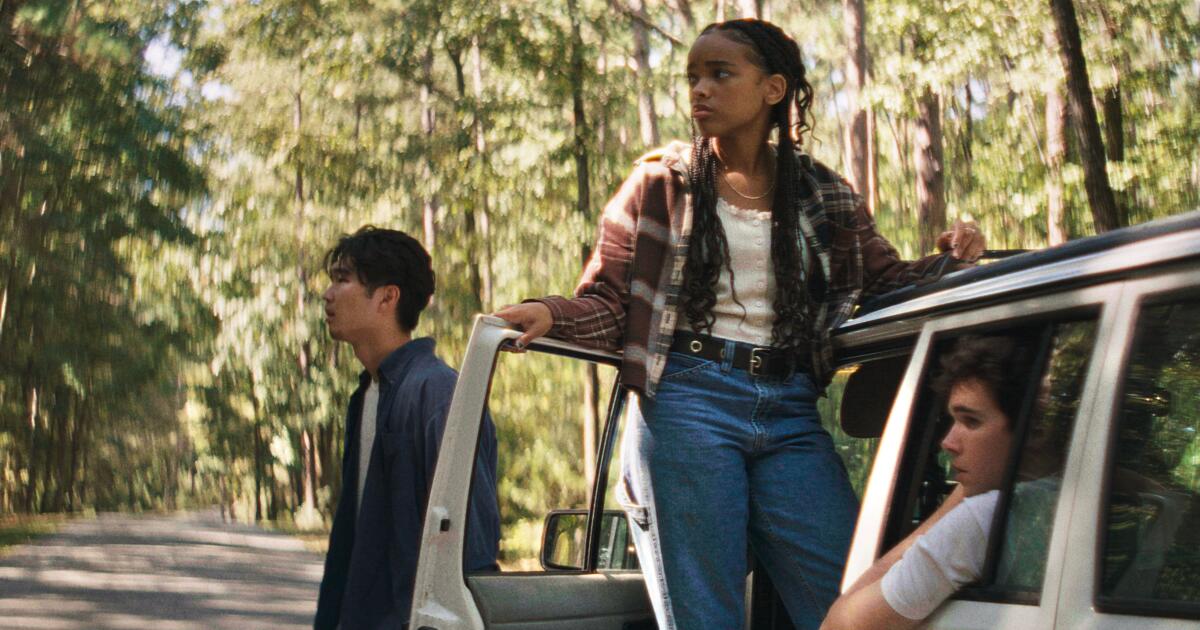
“It Ends,” a microbudget marvel by 20-something writer-director Alexander Ullom, has a straightforward premise that expands in your imagination.
Four school pals — go-getter James (Phinehas Yoon), drop-out Tyler (Mitchell Cole), anxious Fisher (Noah Toth) and creative Day (Akira Jackson) — pile into a Jeep just after college graduation. The car turns onto a dark road that, to the youngsters’ growing unease, appears to stretch on forever through an infinite forest. There’s no safe place to pull over, no signs pointing toward escape, no assurance that their lives have a destination. Stop moving and a horde of desperate, violent strangers sprint from the woods to try to steal their car. Keep going … for how long? Is this hell, purgatory or just a cosmic punchline?
“It Ends” premiered at SXSW in the spring of 2025, over a year before audiences stormed Kane Parsons’ “Backrooms,” yet the two breakout filmmakers share a suspicion that our seemingly ordinary existence hides something very, very wrong. The scale of the peril is hard to comprehend and harder to articulate; they’re more curious to explore the crisis than find a fix. What matters is that humanity feels lost.
Everyone in the car already seems to sense it even before this particular ride goes awry. Yoon’s dour James has impressively (and depressingly) mapped out his next few money-making decades down to his eventual diminished sperm count. To him, the future “seems like it sucks ass.” Weary Tyler has resigned himself to blue-collar work. Fisher and Day can’t even secure jobs, stuck literally and metaphorically frittering away their youth in the back seat.
The first act has a visceral, terrifying sequence with panicky close-ups of extras sprinting pell-mell toward the car. (The credits list as many background actors as crew members.) Matthew Robert Cooper’s unnerving ambient score bleeds into the relentless dink-dink-dink of the Jeep’s strobing hazard lights.
For several minutes afterward, the images are so disorienting that we can’t even make out where anyone in the car is sitting. Then cinematographers Evan Draper and Jazleana Jones along with Ullom, who also edits, take a steadier hand with evocative montages that emphasize the passage of time.
With rare exception, the camera stays tethered to the vehicle. The blur outside becomes enveloping and unfathomable; the universe inside the car evolves as the friends invent tension-defusing rituals to keep from screaming at one another. The mood toggles between cozily habituated and heavy. How long have they been driving now?
Early on, I kept a running tally of the hours until that began to feel naive. The days blend together with no time stamps, although Ullom occasionally reveals how many miles the car has gone. I did some back-of-my-notepad math and realized you can drive massive distances faster than I would have guessed. Then I pictured myself in their seats. Excruciating.
Evading plot holes, “It Ends” paves over the obvious biological needs. The foursome discover they no longer need to eat or drink. Likewise, the car no longer needs gas. The characters check off every idea you want them to try in the small space of the car, plus other brilliant brainstorms. Bursting through the confinements of movie logic, “It Ends” untrains audiences out of their certainty that every crisis has a solution. Does it even matter what they do?
Dread runs through “It Ends,” yet I’m hesitant to frame it as a horror movie. Scares fall by the wayside when it shifts into a more philosophical gear, vibrating with questions about how to live a meaningful life: Should these victims accept their fate or keep struggling? At least one will leave the car, never to be seen again as Ullom shrewdly refuses to reveal whether that choice was right. I think the filmmaker has an answer for himself, but he’d rather ask how we feel about it. Keep an open mind. Your opinion may change more than once.
This car setting taps into our cultural belief that speeding ahead is progress, an opinion shared by films as varied as “The Fast and the Furious,” “Mad Max: Fury Road,” “Two-Lane Blacktop,” and “Thelma & Louise.” Like actual religion, to continue on versus stopping becomes a question of faith. Some find comfort deciding on an answer, any answer. Others are driven by the spiritual quest itself.
The cast of unknowns is fantastic. It’s a major feat to shoulder a movie sitting still. Yoon’s prickly, unlikable James is the character many will align with, to their chagrin. Cole’s Tyler acts practically while collapsing into a black hole of cynicism. You’ve met a dozen guys like him who all claim “So what?” is the only sensible reaction. The jokers Toth and Jackson, bless them, keep things endearing and funny.
I’m bored of studios and indie financiers forcing filmmakers to stick to so-called bankable names. From “Heated Rivalry” to “Obsession,” this has been a phenomenal year for discovering fresh faces. Hopefully Hollywood won’t misunderstand the lesson in those projects’ success. It’s not to add Connor Storrie and Inde Navarrette to that stifling shortlist — it’s how much more talent there is waiting for a shot. (And it’s worth mentioning that Yoon and Cole also direct their own movies.)
Some of Ullom’s richest themes need only a casual mention, like Fisher muttering that he has fewer photos of his family on his phone than stupid memes. The friends are passingly concerned that they’ve outsourced too much of their mental stimulation to the internet. Now that they don’t have Wi-Fi, will they run out of topics to discuss? In these murmurs, Ullom wonders how much modern technology has led us astray. Obeying GPS has trapped them on this road in the first place, and may have done the same to those wretches in the woods, each so individually fixated on carjacking the Jeep that it never occurs to them to team up. A material goal devolves people into savages. At least Ullom has a slight optimism that society can turn things around.
Climbing into my car after “It Ends” felt like a sick joke. Was I really steering straight back to work? When was the last time I pulled over for an ice cream? But I kept on driving until I made it to my desk to start this review. That’s how excited I was to share the news of Ullom’s staggering debut. It’s a thrill to see his generation of filmmakers take the wheel.
‘It Ends’
Rated: R, for pervasive language
Running time: 1 hour, 29 minutes
Playing: Opening Friday, Aug. 21, in wide release

“It Ends,” a microbudget marvel by 20-something writer-director Alexander Ullom, has a straightforward premise that expands in your imagination.
Four school pals — go-getter James (Phinehas Yoon), drop-out Tyler (Mitchell Cole), anxious Fisher (Noah Toth) and creative Day (Akira Jackson) — pile into a Jeep just after college graduation. The car turns onto a dark road that, to the youngsters’ growing unease, appears to stretch on forever through an infinite forest. There’s no safe place to pull over, no signs pointing toward escape, no assurance that their lives have a destination. Stop moving and a horde of desperate, violent strangers sprint from the woods to try to steal their car. Keep going … for how long? Is this hell, purgatory or just a cosmic punchline?
“It Ends” premiered at SXSW in the spring of 2025, over a year before audiences stormed Kane Parsons’ “Backrooms,” yet the two breakout filmmakers share a suspicion that our seemingly ordinary existence hides something very, very wrong. The scale of the peril is hard to comprehend and harder to articulate; they’re more curious to explore the crisis than find a fix. What matters is that humanity feels lost.
Everyone in the car already seems to sense it even before this particular ride goes awry. Yoon’s dour James has impressively (and depressingly) mapped out his next few money-making decades down to his eventual diminished sperm count. To him, the future “seems like it sucks ass.” Weary Tyler has resigned himself to blue-collar work. Fisher and Day can’t even secure jobs, stuck literally and metaphorically frittering away their youth in the back seat.
The first act has a visceral, terrifying sequence with panicky close-ups of extras sprinting pell-mell toward the car. (The credits list as many background actors as crew members.) Matthew Robert Cooper’s unnerving ambient score bleeds into the relentless dink-dink-dink of the Jeep’s strobing hazard lights.
For several minutes afterward, the images are so disorienting that we can’t even make out where anyone in the car is sitting. Then cinematographers Evan Draper and Jazleana Jones along with Ullom, who also edits, take a steadier hand with evocative montages that emphasize the passage of time.
With rare exception, the camera stays tethered to the vehicle. The blur outside becomes enveloping and unfathomable; the universe inside the car evolves as the friends invent tension-defusing rituals to keep from screaming at one another. The mood toggles between cozily habituated and heavy. How long have they been driving now?
Early on, I kept a running tally of the hours until that began to feel naive. The days blend together with no time stamps, although Ullom occasionally reveals how many miles the car has gone. I did some back-of-my-notepad math and realized you can drive massive distances faster than I would have guessed. Then I pictured myself in their seats. Excruciating.
Evading plot holes, “It Ends” paves over the obvious biological needs. The foursome discover they no longer need to eat or drink. Likewise, the car no longer needs gas. The characters check off every idea you want them to try in the small space of the car, plus other brilliant brainstorms. Bursting through the confinements of movie logic, “It Ends” untrains audiences out of their certainty that every crisis has a solution. Does it even matter what they do?
Dread runs through “It Ends,” yet I’m hesitant to frame it as a horror movie. Scares fall by the wayside when it shifts into a more philosophical gear, vibrating with questions about how to live a meaningful life: Should these victims accept their fate or keep struggling? At least one will leave the car, never to be seen again as Ullom shrewdly refuses to reveal whether that choice was right. I think the filmmaker has an answer for himself, but he’d rather ask how we feel about it. Keep an open mind. Your opinion may change more than once.
This car setting taps into our cultural belief that speeding ahead is progress, an opinion shared by films as varied as “The Fast and the Furious,” “Mad Max: Fury Road,” “Two-Lane Blacktop,” and “Thelma & Louise.” Like actual religion, to continue on versus stopping becomes a question of faith. Some find comfort deciding on an answer, any answer. Others are driven by the spiritual quest itself.
The cast of unknowns is fantastic. It’s a major feat to shoulder a movie sitting still. Yoon’s prickly, unlikable James is the character many will align with, to their chagrin. Cole’s Tyler acts practically while collapsing into a black hole of cynicism. You’ve met a dozen guys like him who all claim “So what?” is the only sensible reaction. The jokers Toth and Jackson, bless them, keep things endearing and funny.
I’m bored of studios and indie financiers forcing filmmakers to stick to so-called bankable names. From “Heated Rivalry” to “Obsession,” this has been a phenomenal year for discovering fresh faces. Hopefully Hollywood won’t misunderstand the lesson in those projects’ success. It’s not to add Connor Storrie and Inde Navarrette to that stifling shortlist — it’s how much more talent there is waiting for a shot. (And it’s worth mentioning that Yoon and Cole also direct their own movies.)
Some of Ullom’s richest themes need only a casual mention, like Fisher muttering that he has fewer photos of his family on his phone than stupid memes. The friends are passingly concerned that they’ve outsourced too much of their mental stimulation to the internet. Now that they don’t have Wi-Fi, will they run out of topics to discuss? In these murmurs, Ullom wonders how much modern technology has led us astray. Obeying GPS has trapped them on this road in the first place, and may have done the same to those wretches in the woods, each so individually fixated on carjacking the Jeep that it never occurs to them to team up. A material goal devolves people into savages. At least Ullom has a slight optimism that society can turn things around.
Climbing into my car after “It Ends” felt like a sick joke. Was I really steering straight back to work? When was the last time I pulled over for an ice cream? But I kept on driving until I made it to my desk to start this review. That’s how excited I was to share the news of Ullom’s staggering debut. It’s a thrill to see his generation of filmmakers take the wheel.
‘It Ends’
Rated: R, for pervasive language
Running time: 1 hour, 29 minutes
Playing: Opening Friday, Aug. 21, in wide release

“It Ends,” a microbudget marvel by 20-something writer-director Alexander Ullom, has a straightforward premise that expands in your imagination.
Four school pals — go-getter James (Phinehas Yoon), drop-out Tyler (Mitchell Cole), anxious Fisher (Noah Toth) and creative Day (Akira Jackson) — pile into a Jeep just after college graduation. The car turns onto a dark road that, to the youngsters’ growing unease, appears to stretch on forever through an infinite forest. There’s no safe place to pull over, no signs pointing toward escape, no assurance that their lives have a destination. Stop moving and a horde of desperate, violent strangers sprint from the woods to try to steal their car. Keep going … for how long? Is this hell, purgatory or just a cosmic punchline?
“It Ends” premiered at SXSW in the spring of 2025, over a year before audiences stormed Kane Parsons’ “Backrooms,” yet the two breakout filmmakers share a suspicion that our seemingly ordinary existence hides something very, very wrong. The scale of the peril is hard to comprehend and harder to articulate; they’re more curious to explore the crisis than find a fix. What matters is that humanity feels lost.
Everyone in the car already seems to sense it even before this particular ride goes awry. Yoon’s dour James has impressively (and depressingly) mapped out his next few money-making decades down to his eventual diminished sperm count. To him, the future “seems like it sucks ass.” Weary Tyler has resigned himself to blue-collar work. Fisher and Day can’t even secure jobs, stuck literally and metaphorically frittering away their youth in the back seat.
The first act has a visceral, terrifying sequence with panicky close-ups of extras sprinting pell-mell toward the car. (The credits list as many background actors as crew members.) Matthew Robert Cooper’s unnerving ambient score bleeds into the relentless dink-dink-dink of the Jeep’s strobing hazard lights.
For several minutes afterward, the images are so disorienting that we can’t even make out where anyone in the car is sitting. Then cinematographers Evan Draper and Jazleana Jones along with Ullom, who also edits, take a steadier hand with evocative montages that emphasize the passage of time.
With rare exception, the camera stays tethered to the vehicle. The blur outside becomes enveloping and unfathomable; the universe inside the car evolves as the friends invent tension-defusing rituals to keep from screaming at one another. The mood toggles between cozily habituated and heavy. How long have they been driving now?
Early on, I kept a running tally of the hours until that began to feel naive. The days blend together with no time stamps, although Ullom occasionally reveals how many miles the car has gone. I did some back-of-my-notepad math and realized you can drive massive distances faster than I would have guessed. Then I pictured myself in their seats. Excruciating.
Evading plot holes, “It Ends” paves over the obvious biological needs. The foursome discover they no longer need to eat or drink. Likewise, the car no longer needs gas. The characters check off every idea you want them to try in the small space of the car, plus other brilliant brainstorms. Bursting through the confinements of movie logic, “It Ends” untrains audiences out of their certainty that every crisis has a solution. Does it even matter what they do?
Dread runs through “It Ends,” yet I’m hesitant to frame it as a horror movie. Scares fall by the wayside when it shifts into a more philosophical gear, vibrating with questions about how to live a meaningful life: Should these victims accept their fate or keep struggling? At least one will leave the car, never to be seen again as Ullom shrewdly refuses to reveal whether that choice was right. I think the filmmaker has an answer for himself, but he’d rather ask how we feel about it. Keep an open mind. Your opinion may change more than once.
This car setting taps into our cultural belief that speeding ahead is progress, an opinion shared by films as varied as “The Fast and the Furious,” “Mad Max: Fury Road,” “Two-Lane Blacktop,” and “Thelma & Louise.” Like actual religion, to continue on versus stopping becomes a question of faith. Some find comfort deciding on an answer, any answer. Others are driven by the spiritual quest itself.
The cast of unknowns is fantastic. It’s a major feat to shoulder a movie sitting still. Yoon’s prickly, unlikable James is the character many will align with, to their chagrin. Cole’s Tyler acts practically while collapsing into a black hole of cynicism. You’ve met a dozen guys like him who all claim “So what?” is the only sensible reaction. The jokers Toth and Jackson, bless them, keep things endearing and funny.
I’m bored of studios and indie financiers forcing filmmakers to stick to so-called bankable names. From “Heated Rivalry” to “Obsession,” this has been a phenomenal year for discovering fresh faces. Hopefully Hollywood won’t misunderstand the lesson in those projects’ success. It’s not to add Connor Storrie and Inde Navarrette to that stifling shortlist — it’s how much more talent there is waiting for a shot. (And it’s worth mentioning that Yoon and Cole also direct their own movies.)
Some of Ullom’s richest themes need only a casual mention, like Fisher muttering that he has fewer photos of his family on his phone than stupid memes. The friends are passingly concerned that they’ve outsourced too much of their mental stimulation to the internet. Now that they don’t have Wi-Fi, will they run out of topics to discuss? In these murmurs, Ullom wonders how much modern technology has led us astray. Obeying GPS has trapped them on this road in the first place, and may have done the same to those wretches in the woods, each so individually fixated on carjacking the Jeep that it never occurs to them to team up. A material goal devolves people into savages. At least Ullom has a slight optimism that society can turn things around.
Climbing into my car after “It Ends” felt like a sick joke. Was I really steering straight back to work? When was the last time I pulled over for an ice cream? But I kept on driving until I made it to my desk to start this review. That’s how excited I was to share the news of Ullom’s staggering debut. It’s a thrill to see his generation of filmmakers take the wheel.
‘It Ends’
Rated: R, for pervasive language
Running time: 1 hour, 29 minutes
Playing: Opening Friday, Aug. 21, in wide release
“It Ends,” a microbudget marvel by 20-something writer-director Alexander Ullom, has a straightforward premise that expands in your imagination.
Four school pals — go-getter James (Phinehas Yoon), drop-out Tyler (Mitchell Cole), anxious Fisher (Noah Toth) and creative Day (Akira Jackson) — pile into a Jeep just after college graduation. The car turns onto a dark road that, to the youngsters’ growing unease, appears to stretch on forever through an infinite forest. There’s no safe place to pull over, no signs pointing toward escape, no assurance that their lives have a destination. Stop moving and a horde of desperate, violent strangers sprint from the woods to try to steal their car. Keep going … for how long? Is this hell, purgatory or just a cosmic punchline?
“It Ends” premiered at SXSW in the spring of 2025, over a year before audiences stormed Kane Parsons’ “Backrooms,” yet the two breakout filmmakers share a suspicion that our seemingly ordinary existence hides something very, very wrong. The scale of the peril is hard to comprehend and harder to articulate; they’re more curious to explore the crisis than find a fix. What matters is that humanity feels lost.
Everyone in the car already seems to sense it even before this particular ride goes awry. Yoon’s dour James has impressively (and depressingly) mapped out his next few money-making decades down to his eventual diminished sperm count. To him, the future “seems like it sucks ass.” Weary Tyler has resigned himself to blue-collar work. Fisher and Day can’t even secure jobs, stuck literally and metaphorically frittering away their youth in the back seat.
The first act has a visceral, terrifying sequence with panicky close-ups of extras sprinting pell-mell toward the car. (The credits list as many background actors as crew members.) Matthew Robert Cooper’s unnerving ambient score bleeds into the relentless dink-dink-dink of the Jeep’s strobing hazard lights.
For several minutes afterward, the images are so disorienting that we can’t even make out where anyone in the car is sitting. Then cinematographers Evan Draper and Jazleana Jones along with Ullom, who also edits, take a steadier hand with evocative montages that emphasize the passage of time.
With rare exception, the camera stays tethered to the vehicle. The blur outside becomes enveloping and unfathomable; the universe inside the car evolves as the friends invent tension-defusing rituals to keep from screaming at one another. The mood toggles between cozily habituated and heavy. How long have they been driving now?
Early on, I kept a running tally of the hours until that began to feel naive. The days blend together with no time stamps, although Ullom occasionally reveals how many miles the car has gone. I did some back-of-my-notepad math and realized you can drive massive distances faster than I would have guessed. Then I pictured myself in their seats. Excruciating.
Evading plot holes, “It Ends” paves over the obvious biological needs. The foursome discover they no longer need to eat or drink. Likewise, the car no longer needs gas. The characters check off every idea you want them to try in the small space of the car, plus other brilliant brainstorms. Bursting through the confinements of movie logic, “It Ends” untrains audiences out of their certainty that every crisis has a solution. Does it even matter what they do?
Dread runs through “It Ends,” yet I’m hesitant to frame it as a horror movie. Scares fall by the wayside when it shifts into a more philosophical gear, vibrating with questions about how to live a meaningful life: Should these victims accept their fate or keep struggling? At least one will leave the car, never to be seen again as Ullom shrewdly refuses to reveal whether that choice was right. I think the filmmaker has an answer for himself, but he’d rather ask how we feel about it. Keep an open mind. Your opinion may change more than once.
This car setting taps into our cultural belief that speeding ahead is progress, an opinion shared by films as varied as “The Fast and the Furious,” “Mad Max: Fury Road,” “Two-Lane Blacktop,” and “Thelma & Louise.” Like actual religion, to continue on versus stopping becomes a question of faith. Some find comfort deciding on an answer, any answer. Others are driven by the spiritual quest itself.
The cast of unknowns is fantastic. It’s a major feat to shoulder a movie sitting still. Yoon’s prickly, unlikable James is the character many will align with, to their chagrin. Cole’s Tyler acts practically while collapsing into a black hole of cynicism. You’ve met a dozen guys like him who all claim “So what?” is the only sensible reaction. The jokers Toth and Jackson, bless them, keep things endearing and funny.
I’m bored of studios and indie financiers forcing filmmakers to stick to so-called bankable names. From “Heated Rivalry” to “Obsession,” this has been a phenomenal year for discovering fresh faces. Hopefully Hollywood won’t misunderstand the lesson in those projects’ success. It’s not to add Connor Storrie and Inde Navarrette to that stifling shortlist — it’s how much more talent there is waiting for a shot. (And it’s worth mentioning that Yoon and Cole also direct their own movies.)
Some of Ullom’s richest themes need only a casual mention, like Fisher muttering that he has fewer photos of his family on his phone than stupid memes. The friends are passingly concerned that they’ve outsourced too much of their mental stimulation to the internet. Now that they don’t have Wi-Fi, will they run out of topics to discuss? In these murmurs, Ullom wonders how much modern technology has led us astray. Obeying GPS has trapped them on this road in the first place, and may have done the same to those wretches in the woods, each so individually fixated on carjacking the Jeep that it never occurs to them to team up. A material goal devolves people into savages. At least Ullom has a slight optimism that society can turn things around.
Climbing into my car after “It Ends” felt like a sick joke. Was I really steering straight back to work? When was the last time I pulled over for an ice cream? But I kept on driving until I made it to my desk to start this review. That’s how excited I was to share the news of Ullom’s staggering debut. It’s a thrill to see his generation of filmmakers take the wheel.
‘It Ends’
Rated: R, for pervasive language
Running time: 1 hour, 29 minutes
Playing: Opening Friday, Aug. 21, in wide release

“It Ends,” a microbudget marvel by 20-something writer-director Alexander Ullom, has a straightforward premise that expands in your imagination.
Four school pals — go-getter James (Phinehas Yoon), drop-out Tyler (Mitchell Cole), anxious Fisher (Noah Toth) and creative Day (Akira Jackson) — pile into a Jeep just after college graduation. The car turns onto a dark road that, to the youngsters’ growing unease, appears to stretch on forever through an infinite forest. There’s no safe place to pull over, no signs pointing toward escape, no assurance that their lives have a destination. Stop moving and a horde of desperate, violent strangers sprint from the woods to try to steal their car. Keep going … for how long? Is this hell, purgatory or just a cosmic punchline?
“It Ends” premiered at SXSW in the spring of 2025, over a year before audiences stormed Kane Parsons’ “Backrooms,” yet the two breakout filmmakers share a suspicion that our seemingly ordinary existence hides something very, very wrong. The scale of the peril is hard to comprehend and harder to articulate; they’re more curious to explore the crisis than find a fix. What matters is that humanity feels lost.
Everyone in the car already seems to sense it even before this particular ride goes awry. Yoon’s dour James has impressively (and depressingly) mapped out his next few money-making decades down to his eventual diminished sperm count. To him, the future “seems like it sucks ass.” Weary Tyler has resigned himself to blue-collar work. Fisher and Day can’t even secure jobs, stuck literally and metaphorically frittering away their youth in the back seat.
The first act has a visceral, terrifying sequence with panicky close-ups of extras sprinting pell-mell toward the car. (The credits list as many background actors as crew members.) Matthew Robert Cooper’s unnerving ambient score bleeds into the relentless dink-dink-dink of the Jeep’s strobing hazard lights.
For several minutes afterward, the images are so disorienting that we can’t even make out where anyone in the car is sitting. Then cinematographers Evan Draper and Jazleana Jones along with Ullom, who also edits, take a steadier hand with evocative montages that emphasize the passage of time.
With rare exception, the camera stays tethered to the vehicle. The blur outside becomes enveloping and unfathomable; the universe inside the car evolves as the friends invent tension-defusing rituals to keep from screaming at one another. The mood toggles between cozily habituated and heavy. How long have they been driving now?
Early on, I kept a running tally of the hours until that began to feel naive. The days blend together with no time stamps, although Ullom occasionally reveals how many miles the car has gone. I did some back-of-my-notepad math and realized you can drive massive distances faster than I would have guessed. Then I pictured myself in their seats. Excruciating.
Evading plot holes, “It Ends” paves over the obvious biological needs. The foursome discover they no longer need to eat or drink. Likewise, the car no longer needs gas. The characters check off every idea you want them to try in the small space of the car, plus other brilliant brainstorms. Bursting through the confinements of movie logic, “It Ends” untrains audiences out of their certainty that every crisis has a solution. Does it even matter what they do?
Dread runs through “It Ends,” yet I’m hesitant to frame it as a horror movie. Scares fall by the wayside when it shifts into a more philosophical gear, vibrating with questions about how to live a meaningful life: Should these victims accept their fate or keep struggling? At least one will leave the car, never to be seen again as Ullom shrewdly refuses to reveal whether that choice was right. I think the filmmaker has an answer for himself, but he’d rather ask how we feel about it. Keep an open mind. Your opinion may change more than once.
This car setting taps into our cultural belief that speeding ahead is progress, an opinion shared by films as varied as “The Fast and the Furious,” “Mad Max: Fury Road,” “Two-Lane Blacktop,” and “Thelma & Louise.” Like actual religion, to continue on versus stopping becomes a question of faith. Some find comfort deciding on an answer, any answer. Others are driven by the spiritual quest itself.
The cast of unknowns is fantastic. It’s a major feat to shoulder a movie sitting still. Yoon’s prickly, unlikable James is the character many will align with, to their chagrin. Cole’s Tyler acts practically while collapsing into a black hole of cynicism. You’ve met a dozen guys like him who all claim “So what?” is the only sensible reaction. The jokers Toth and Jackson, bless them, keep things endearing and funny.
I’m bored of studios and indie financiers forcing filmmakers to stick to so-called bankable names. From “Heated Rivalry” to “Obsession,” this has been a phenomenal year for discovering fresh faces. Hopefully Hollywood won’t misunderstand the lesson in those projects’ success. It’s not to add Connor Storrie and Inde Navarrette to that stifling shortlist — it’s how much more talent there is waiting for a shot. (And it’s worth mentioning that Yoon and Cole also direct their own movies.)
Some of Ullom’s richest themes need only a casual mention, like Fisher muttering that he has fewer photos of his family on his phone than stupid memes. The friends are passingly concerned that they’ve outsourced too much of their mental stimulation to the internet. Now that they don’t have Wi-Fi, will they run out of topics to discuss? In these murmurs, Ullom wonders how much modern technology has led us astray. Obeying GPS has trapped them on this road in the first place, and may have done the same to those wretches in the woods, each so individually fixated on carjacking the Jeep that it never occurs to them to team up. A material goal devolves people into savages. At least Ullom has a slight optimism that society can turn things around.
Climbing into my car after “It Ends” felt like a sick joke. Was I really steering straight back to work? When was the last time I pulled over for an ice cream? But I kept on driving until I made it to my desk to start this review. That’s how excited I was to share the news of Ullom’s staggering debut. It’s a thrill to see his generation of filmmakers take the wheel.
‘It Ends’
Rated: R, for pervasive language
Running time: 1 hour, 29 minutes
Playing: Opening Friday, Aug. 21, in wide release
“It Ends,” a microbudget marvel by 20-something writer-director Alexander Ullom, has a straightforward premise that expands in your imagination.
Four school pals — go-getter James (Phinehas Yoon), drop-out Tyler (Mitchell Cole), anxious Fisher (Noah Toth) and creative Day (Akira Jackson) — pile into a Jeep just after college graduation. The car turns onto a dark road that, to the youngsters’ growing unease, appears to stretch on forever through an infinite forest. There’s no safe place to pull over, no signs pointing toward escape, no assurance that their lives have a destination. Stop moving and a horde of desperate, violent strangers sprint from the woods to try to steal their car. Keep going … for how long? Is this hell, purgatory or just a cosmic punchline?
“It Ends” premiered at SXSW in the spring of 2025, over a year before audiences stormed Kane Parsons’ “Backrooms,” yet the two breakout filmmakers share a suspicion that our seemingly ordinary existence hides something very, very wrong. The scale of the peril is hard to comprehend and harder to articulate; they’re more curious to explore the crisis than find a fix. What matters is that humanity feels lost.
Everyone in the car already seems to sense it even before this particular ride goes awry. Yoon’s dour James has impressively (and depressingly) mapped out his next few money-making decades down to his eventual diminished sperm count. To him, the future “seems like it sucks ass.” Weary Tyler has resigned himself to blue-collar work. Fisher and Day can’t even secure jobs, stuck literally and metaphorically frittering away their youth in the back seat.
The first act has a visceral, terrifying sequence with panicky close-ups of extras sprinting pell-mell toward the car. (The credits list as many background actors as crew members.) Matthew Robert Cooper’s unnerving ambient score bleeds into the relentless dink-dink-dink of the Jeep’s strobing hazard lights.
For several minutes afterward, the images are so disorienting that we can’t even make out where anyone in the car is sitting. Then cinematographers Evan Draper and Jazleana Jones along with Ullom, who also edits, take a steadier hand with evocative montages that emphasize the passage of time.
With rare exception, the camera stays tethered to the vehicle. The blur outside becomes enveloping and unfathomable; the universe inside the car evolves as the friends invent tension-defusing rituals to keep from screaming at one another. The mood toggles between cozily habituated and heavy. How long have they been driving now?
Early on, I kept a running tally of the hours until that began to feel naive. The days blend together with no time stamps, although Ullom occasionally reveals how many miles the car has gone. I did some back-of-my-notepad math and realized you can drive massive distances faster than I would have guessed. Then I pictured myself in their seats. Excruciating.
Evading plot holes, “It Ends” paves over the obvious biological needs. The foursome discover they no longer need to eat or drink. Likewise, the car no longer needs gas. The characters check off every idea you want them to try in the small space of the car, plus other brilliant brainstorms. Bursting through the confinements of movie logic, “It Ends” untrains audiences out of their certainty that every crisis has a solution. Does it even matter what they do?
Dread runs through “It Ends,” yet I’m hesitant to frame it as a horror movie. Scares fall by the wayside when it shifts into a more philosophical gear, vibrating with questions about how to live a meaningful life: Should these victims accept their fate or keep struggling? At least one will leave the car, never to be seen again as Ullom shrewdly refuses to reveal whether that choice was right. I think the filmmaker has an answer for himself, but he’d rather ask how we feel about it. Keep an open mind. Your opinion may change more than once.
This car setting taps into our cultural belief that speeding ahead is progress, an opinion shared by films as varied as “The Fast and the Furious,” “Mad Max: Fury Road,” “Two-Lane Blacktop,” and “Thelma & Louise.” Like actual religion, to continue on versus stopping becomes a question of faith. Some find comfort deciding on an answer, any answer. Others are driven by the spiritual quest itself.
The cast of unknowns is fantastic. It’s a major feat to shoulder a movie sitting still. Yoon’s prickly, unlikable James is the character many will align with, to their chagrin. Cole’s Tyler acts practically while collapsing into a black hole of cynicism. You’ve met a dozen guys like him who all claim “So what?” is the only sensible reaction. The jokers Toth and Jackson, bless them, keep things endearing and funny.
I’m bored of studios and indie financiers forcing filmmakers to stick to so-called bankable names. From “Heated Rivalry” to “Obsession,” this has been a phenomenal year for discovering fresh faces. Hopefully Hollywood won’t misunderstand the lesson in those projects’ success. It’s not to add Connor Storrie and Inde Navarrette to that stifling shortlist — it’s how much more talent there is waiting for a shot. (And it’s worth mentioning that Yoon and Cole also direct their own movies.)
Some of Ullom’s richest themes need only a casual mention, like Fisher muttering that he has fewer photos of his family on his phone than stupid memes. The friends are passingly concerned that they’ve outsourced too much of their mental stimulation to the internet. Now that they don’t have Wi-Fi, will they run out of topics to discuss? In these murmurs, Ullom wonders how much modern technology has led us astray. Obeying GPS has trapped them on this road in the first place, and may have done the same to those wretches in the woods, each so individually fixated on carjacking the Jeep that it never occurs to them to team up. A material goal devolves people into savages. At least Ullom has a slight optimism that society can turn things around.
Climbing into my car after “It Ends” felt like a sick joke. Was I really steering straight back to work? When was the last time I pulled over for an ice cream? But I kept on driving until I made it to my desk to start this review. That’s how excited I was to share the news of Ullom’s staggering debut. It’s a thrill to see his generation of filmmakers take the wheel.
‘It Ends’
Rated: R, for pervasive language
Running time: 1 hour, 29 minutes
Playing: Opening Friday, Aug. 21, in wide release
“It Ends,” a microbudget marvel by 20-something writer-director Alexander Ullom, has a straightforward premise that expands in your imagination.
Four school pals — go-getter James (Phinehas Yoon), drop-out Tyler (Mitchell Cole), anxious Fisher (Noah Toth) and creative Day (Akira Jackson) — pile into a Jeep just after college graduation. The car turns onto a dark road that, to the youngsters’ growing unease, appears to stretch on forever through an infinite forest. There’s no safe place to pull over, no signs pointing toward escape, no assurance that their lives have a destination. Stop moving and a horde of desperate, violent strangers sprint from the woods to try to steal their car. Keep going … for how long? Is this hell, purgatory or just a cosmic punchline?
“It Ends” premiered at SXSW in the spring of 2025, over a year before audiences stormed Kane Parsons’ “Backrooms,” yet the two breakout filmmakers share a suspicion that our seemingly ordinary existence hides something very, very wrong. The scale of the peril is hard to comprehend and harder to articulate; they’re more curious to explore the crisis than find a fix. What matters is that humanity feels lost.
Everyone in the car already seems to sense it even before this particular ride goes awry. Yoon’s dour James has impressively (and depressingly) mapped out his next few money-making decades down to his eventual diminished sperm count. To him, the future “seems like it sucks ass.” Weary Tyler has resigned himself to blue-collar work. Fisher and Day can’t even secure jobs, stuck literally and metaphorically frittering away their youth in the back seat.
The first act has a visceral, terrifying sequence with panicky close-ups of extras sprinting pell-mell toward the car. (The credits list as many background actors as crew members.) Matthew Robert Cooper’s unnerving ambient score bleeds into the relentless dink-dink-dink of the Jeep’s strobing hazard lights.
For several minutes afterward, the images are so disorienting that we can’t even make out where anyone in the car is sitting. Then cinematographers Evan Draper and Jazleana Jones along with Ullom, who also edits, take a steadier hand with evocative montages that emphasize the passage of time.
With rare exception, the camera stays tethered to the vehicle. The blur outside becomes enveloping and unfathomable; the universe inside the car evolves as the friends invent tension-defusing rituals to keep from screaming at one another. The mood toggles between cozily habituated and heavy. How long have they been driving now?
Early on, I kept a running tally of the hours until that began to feel naive. The days blend together with no time stamps, although Ullom occasionally reveals how many miles the car has gone. I did some back-of-my-notepad math and realized you can drive massive distances faster than I would have guessed. Then I pictured myself in their seats. Excruciating.
Evading plot holes, “It Ends” paves over the obvious biological needs. The foursome discover they no longer need to eat or drink. Likewise, the car no longer needs gas. The characters check off every idea you want them to try in the small space of the car, plus other brilliant brainstorms. Bursting through the confinements of movie logic, “It Ends” untrains audiences out of their certainty that every crisis has a solution. Does it even matter what they do?
Dread runs through “It Ends,” yet I’m hesitant to frame it as a horror movie. Scares fall by the wayside when it shifts into a more philosophical gear, vibrating with questions about how to live a meaningful life: Should these victims accept their fate or keep struggling? At least one will leave the car, never to be seen again as Ullom shrewdly refuses to reveal whether that choice was right. I think the filmmaker has an answer for himself, but he’d rather ask how we feel about it. Keep an open mind. Your opinion may change more than once.
This car setting taps into our cultural belief that speeding ahead is progress, an opinion shared by films as varied as “The Fast and the Furious,” “Mad Max: Fury Road,” “Two-Lane Blacktop,” and “Thelma & Louise.” Like actual religion, to continue on versus stopping becomes a question of faith. Some find comfort deciding on an answer, any answer. Others are driven by the spiritual quest itself.
The cast of unknowns is fantastic. It’s a major feat to shoulder a movie sitting still. Yoon’s prickly, unlikable James is the character many will align with, to their chagrin. Cole’s Tyler acts practically while collapsing into a black hole of cynicism. You’ve met a dozen guys like him who all claim “So what?” is the only sensible reaction. The jokers Toth and Jackson, bless them, keep things endearing and funny.
I’m bored of studios and indie financiers forcing filmmakers to stick to so-called bankable names. From “Heated Rivalry” to “Obsession,” this has been a phenomenal year for discovering fresh faces. Hopefully Hollywood won’t misunderstand the lesson in those projects’ success. It’s not to add Connor Storrie and Inde Navarrette to that stifling shortlist — it’s how much more talent there is waiting for a shot. (And it’s worth mentioning that Yoon and Cole also direct their own movies.)
Some of Ullom’s richest themes need only a casual mention, like Fisher muttering that he has fewer photos of his family on his phone than stupid memes. The friends are passingly concerned that they’ve outsourced too much of their mental stimulation to the internet. Now that they don’t have Wi-Fi, will they run out of topics to discuss? In these murmurs, Ullom wonders how much modern technology has led us astray. Obeying GPS has trapped them on this road in the first place, and may have done the same to those wretches in the woods, each so individually fixated on carjacking the Jeep that it never occurs to them to team up. A material goal devolves people into savages. At least Ullom has a slight optimism that society can turn things around.
Climbing into my car after “It Ends” felt like a sick joke. Was I really steering straight back to work? When was the last time I pulled over for an ice cream? But I kept on driving until I made it to my desk to start this review. That’s how excited I was to share the news of Ullom’s staggering debut. It’s a thrill to see his generation of filmmakers take the wheel.
‘It Ends’
Rated: R, for pervasive language
Running time: 1 hour, 29 minutes
Playing: Opening Friday, Aug. 21, in wide release
“It Ends,” a microbudget marvel by 20-something writer-director Alexander Ullom, has a straightforward premise that expands in your imagination.
Four school pals — go-getter James (Phinehas Yoon), drop-out Tyler (Mitchell Cole), anxious Fisher (Noah Toth) and creative Day (Akira Jackson) — pile into a Jeep just after college graduation. The car turns onto a dark road that, to the youngsters’ growing unease, appears to stretch on forever through an infinite forest. There’s no safe place to pull over, no signs pointing toward escape, no assurance that their lives have a destination. Stop moving and a horde of desperate, violent strangers sprint from the woods to try to steal their car. Keep going … for how long? Is this hell, purgatory or just a cosmic punchline?
“It Ends” premiered at SXSW in the spring of 2025, over a year before audiences stormed Kane Parsons’ “Backrooms,” yet the two breakout filmmakers share a suspicion that our seemingly ordinary existence hides something very, very wrong. The scale of the peril is hard to comprehend and harder to articulate; they’re more curious to explore the crisis than find a fix. What matters is that humanity feels lost.
Everyone in the car already seems to sense it even before this particular ride goes awry. Yoon’s dour James has impressively (and depressingly) mapped out his next few money-making decades down to his eventual diminished sperm count. To him, the future “seems like it sucks ass.” Weary Tyler has resigned himself to blue-collar work. Fisher and Day can’t even secure jobs, stuck literally and metaphorically frittering away their youth in the back seat.
The first act has a visceral, terrifying sequence with panicky close-ups of extras sprinting pell-mell toward the car. (The credits list as many background actors as crew members.) Matthew Robert Cooper’s unnerving ambient score bleeds into the relentless dink-dink-dink of the Jeep’s strobing hazard lights.
For several minutes afterward, the images are so disorienting that we can’t even make out where anyone in the car is sitting. Then cinematographers Evan Draper and Jazleana Jones along with Ullom, who also edits, take a steadier hand with evocative montages that emphasize the passage of time.
With rare exception, the camera stays tethered to the vehicle. The blur outside becomes enveloping and unfathomable; the universe inside the car evolves as the friends invent tension-defusing rituals to keep from screaming at one another. The mood toggles between cozily habituated and heavy. How long have they been driving now?
Early on, I kept a running tally of the hours until that began to feel naive. The days blend together with no time stamps, although Ullom occasionally reveals how many miles the car has gone. I did some back-of-my-notepad math and realized you can drive massive distances faster than I would have guessed. Then I pictured myself in their seats. Excruciating.
Evading plot holes, “It Ends” paves over the obvious biological needs. The foursome discover they no longer need to eat or drink. Likewise, the car no longer needs gas. The characters check off every idea you want them to try in the small space of the car, plus other brilliant brainstorms. Bursting through the confinements of movie logic, “It Ends” untrains audiences out of their certainty that every crisis has a solution. Does it even matter what they do?
Dread runs through “It Ends,” yet I’m hesitant to frame it as a horror movie. Scares fall by the wayside when it shifts into a more philosophical gear, vibrating with questions about how to live a meaningful life: Should these victims accept their fate or keep struggling? At least one will leave the car, never to be seen again as Ullom shrewdly refuses to reveal whether that choice was right. I think the filmmaker has an answer for himself, but he’d rather ask how we feel about it. Keep an open mind. Your opinion may change more than once.
This car setting taps into our cultural belief that speeding ahead is progress, an opinion shared by films as varied as “The Fast and the Furious,” “Mad Max: Fury Road,” “Two-Lane Blacktop,” and “Thelma & Louise.” Like actual religion, to continue on versus stopping becomes a question of faith. Some find comfort deciding on an answer, any answer. Others are driven by the spiritual quest itself.
The cast of unknowns is fantastic. It’s a major feat to shoulder a movie sitting still. Yoon’s prickly, unlikable James is the character many will align with, to their chagrin. Cole’s Tyler acts practically while collapsing into a black hole of cynicism. You’ve met a dozen guys like him who all claim “So what?” is the only sensible reaction. The jokers Toth and Jackson, bless them, keep things endearing and funny.
I’m bored of studios and indie financiers forcing filmmakers to stick to so-called bankable names. From “Heated Rivalry” to “Obsession,” this has been a phenomenal year for discovering fresh faces. Hopefully Hollywood won’t misunderstand the lesson in those projects’ success. It’s not to add Connor Storrie and Inde Navarrette to that stifling shortlist — it’s how much more talent there is waiting for a shot. (And it’s worth mentioning that Yoon and Cole also direct their own movies.)
Some of Ullom’s richest themes need only a casual mention, like Fisher muttering that he has fewer photos of his family on his phone than stupid memes. The friends are passingly concerned that they’ve outsourced too much of their mental stimulation to the internet. Now that they don’t have Wi-Fi, will they run out of topics to discuss? In these murmurs, Ullom wonders how much modern technology has led us astray. Obeying GPS has trapped them on this road in the first place, and may have done the same to those wretches in the woods, each so individually fixated on carjacking the Jeep that it never occurs to them to team up. A material goal devolves people into savages. At least Ullom has a slight optimism that society can turn things around.
Climbing into my car after “It Ends” felt like a sick joke. Was I really steering straight back to work? When was the last time I pulled over for an ice cream? But I kept on driving until I made it to my desk to start this review. That’s how excited I was to share the news of Ullom’s staggering debut. It’s a thrill to see his generation of filmmakers take the wheel.
‘It Ends’
Rated: R, for pervasive language
Running time: 1 hour, 29 minutes
Playing: Opening Friday, Aug. 21, in wide release

“It Ends,” a microbudget marvel by 20-something writer-director Alexander Ullom, has a straightforward premise that expands in your imagination.
Four school pals — go-getter James (Phinehas Yoon), drop-out Tyler (Mitchell Cole), anxious Fisher (Noah Toth) and creative Day (Akira Jackson) — pile into a Jeep just after college graduation. The car turns onto a dark road that, to the youngsters’ growing unease, appears to stretch on forever through an infinite forest. There’s no safe place to pull over, no signs pointing toward escape, no assurance that their lives have a destination. Stop moving and a horde of desperate, violent strangers sprint from the woods to try to steal their car. Keep going … for how long? Is this hell, purgatory or just a cosmic punchline?
“It Ends” premiered at SXSW in the spring of 2025, over a year before audiences stormed Kane Parsons’ “Backrooms,” yet the two breakout filmmakers share a suspicion that our seemingly ordinary existence hides something very, very wrong. The scale of the peril is hard to comprehend and harder to articulate; they’re more curious to explore the crisis than find a fix. What matters is that humanity feels lost.
Everyone in the car already seems to sense it even before this particular ride goes awry. Yoon’s dour James has impressively (and depressingly) mapped out his next few money-making decades down to his eventual diminished sperm count. To him, the future “seems like it sucks ass.” Weary Tyler has resigned himself to blue-collar work. Fisher and Day can’t even secure jobs, stuck literally and metaphorically frittering away their youth in the back seat.
The first act has a visceral, terrifying sequence with panicky close-ups of extras sprinting pell-mell toward the car. (The credits list as many background actors as crew members.) Matthew Robert Cooper’s unnerving ambient score bleeds into the relentless dink-dink-dink of the Jeep’s strobing hazard lights.
For several minutes afterward, the images are so disorienting that we can’t even make out where anyone in the car is sitting. Then cinematographers Evan Draper and Jazleana Jones along with Ullom, who also edits, take a steadier hand with evocative montages that emphasize the passage of time.
With rare exception, the camera stays tethered to the vehicle. The blur outside becomes enveloping and unfathomable; the universe inside the car evolves as the friends invent tension-defusing rituals to keep from screaming at one another. The mood toggles between cozily habituated and heavy. How long have they been driving now?
Early on, I kept a running tally of the hours until that began to feel naive. The days blend together with no time stamps, although Ullom occasionally reveals how many miles the car has gone. I did some back-of-my-notepad math and realized you can drive massive distances faster than I would have guessed. Then I pictured myself in their seats. Excruciating.
Evading plot holes, “It Ends” paves over the obvious biological needs. The foursome discover they no longer need to eat or drink. Likewise, the car no longer needs gas. The characters check off every idea you want them to try in the small space of the car, plus other brilliant brainstorms. Bursting through the confinements of movie logic, “It Ends” untrains audiences out of their certainty that every crisis has a solution. Does it even matter what they do?
Dread runs through “It Ends,” yet I’m hesitant to frame it as a horror movie. Scares fall by the wayside when it shifts into a more philosophical gear, vibrating with questions about how to live a meaningful life: Should these victims accept their fate or keep struggling? At least one will leave the car, never to be seen again as Ullom shrewdly refuses to reveal whether that choice was right. I think the filmmaker has an answer for himself, but he’d rather ask how we feel about it. Keep an open mind. Your opinion may change more than once.
This car setting taps into our cultural belief that speeding ahead is progress, an opinion shared by films as varied as “The Fast and the Furious,” “Mad Max: Fury Road,” “Two-Lane Blacktop,” and “Thelma & Louise.” Like actual religion, to continue on versus stopping becomes a question of faith. Some find comfort deciding on an answer, any answer. Others are driven by the spiritual quest itself.
The cast of unknowns is fantastic. It’s a major feat to shoulder a movie sitting still. Yoon’s prickly, unlikable James is the character many will align with, to their chagrin. Cole’s Tyler acts practically while collapsing into a black hole of cynicism. You’ve met a dozen guys like him who all claim “So what?” is the only sensible reaction. The jokers Toth and Jackson, bless them, keep things endearing and funny.
I’m bored of studios and indie financiers forcing filmmakers to stick to so-called bankable names. From “Heated Rivalry” to “Obsession,” this has been a phenomenal year for discovering fresh faces. Hopefully Hollywood won’t misunderstand the lesson in those projects’ success. It’s not to add Connor Storrie and Inde Navarrette to that stifling shortlist — it’s how much more talent there is waiting for a shot. (And it’s worth mentioning that Yoon and Cole also direct their own movies.)
Some of Ullom’s richest themes need only a casual mention, like Fisher muttering that he has fewer photos of his family on his phone than stupid memes. The friends are passingly concerned that they’ve outsourced too much of their mental stimulation to the internet. Now that they don’t have Wi-Fi, will they run out of topics to discuss? In these murmurs, Ullom wonders how much modern technology has led us astray. Obeying GPS has trapped them on this road in the first place, and may have done the same to those wretches in the woods, each so individually fixated on carjacking the Jeep that it never occurs to them to team up. A material goal devolves people into savages. At least Ullom has a slight optimism that society can turn things around.
Climbing into my car after “It Ends” felt like a sick joke. Was I really steering straight back to work? When was the last time I pulled over for an ice cream? But I kept on driving until I made it to my desk to start this review. That’s how excited I was to share the news of Ullom’s staggering debut. It’s a thrill to see his generation of filmmakers take the wheel.
‘It Ends’
Rated: R, for pervasive language
Running time: 1 hour, 29 minutes
Playing: Opening Friday, Aug. 21, in wide release
“It Ends,” a microbudget marvel by 20-something writer-director Alexander Ullom, has a straightforward premise that expands in your imagination.
Four school pals — go-getter James (Phinehas Yoon), drop-out Tyler (Mitchell Cole), anxious Fisher (Noah Toth) and creative Day (Akira Jackson) — pile into a Jeep just after college graduation. The car turns onto a dark road that, to the youngsters’ growing unease, appears to stretch on forever through an infinite forest. There’s no safe place to pull over, no signs pointing toward escape, no assurance that their lives have a destination. Stop moving and a horde of desperate, violent strangers sprint from the woods to try to steal their car. Keep going … for how long? Is this hell, purgatory or just a cosmic punchline?
“It Ends” premiered at SXSW in the spring of 2025, over a year before audiences stormed Kane Parsons’ “Backrooms,” yet the two breakout filmmakers share a suspicion that our seemingly ordinary existence hides something very, very wrong. The scale of the peril is hard to comprehend and harder to articulate; they’re more curious to explore the crisis than find a fix. What matters is that humanity feels lost.
Everyone in the car already seems to sense it even before this particular ride goes awry. Yoon’s dour James has impressively (and depressingly) mapped out his next few money-making decades down to his eventual diminished sperm count. To him, the future “seems like it sucks ass.” Weary Tyler has resigned himself to blue-collar work. Fisher and Day can’t even secure jobs, stuck literally and metaphorically frittering away their youth in the back seat.
The first act has a visceral, terrifying sequence with panicky close-ups of extras sprinting pell-mell toward the car. (The credits list as many background actors as crew members.) Matthew Robert Cooper’s unnerving ambient score bleeds into the relentless dink-dink-dink of the Jeep’s strobing hazard lights.
For several minutes afterward, the images are so disorienting that we can’t even make out where anyone in the car is sitting. Then cinematographers Evan Draper and Jazleana Jones along with Ullom, who also edits, take a steadier hand with evocative montages that emphasize the passage of time.
With rare exception, the camera stays tethered to the vehicle. The blur outside becomes enveloping and unfathomable; the universe inside the car evolves as the friends invent tension-defusing rituals to keep from screaming at one another. The mood toggles between cozily habituated and heavy. How long have they been driving now?
Early on, I kept a running tally of the hours until that began to feel naive. The days blend together with no time stamps, although Ullom occasionally reveals how many miles the car has gone. I did some back-of-my-notepad math and realized you can drive massive distances faster than I would have guessed. Then I pictured myself in their seats. Excruciating.
Evading plot holes, “It Ends” paves over the obvious biological needs. The foursome discover they no longer need to eat or drink. Likewise, the car no longer needs gas. The characters check off every idea you want them to try in the small space of the car, plus other brilliant brainstorms. Bursting through the confinements of movie logic, “It Ends” untrains audiences out of their certainty that every crisis has a solution. Does it even matter what they do?
Dread runs through “It Ends,” yet I’m hesitant to frame it as a horror movie. Scares fall by the wayside when it shifts into a more philosophical gear, vibrating with questions about how to live a meaningful life: Should these victims accept their fate or keep struggling? At least one will leave the car, never to be seen again as Ullom shrewdly refuses to reveal whether that choice was right. I think the filmmaker has an answer for himself, but he’d rather ask how we feel about it. Keep an open mind. Your opinion may change more than once.
This car setting taps into our cultural belief that speeding ahead is progress, an opinion shared by films as varied as “The Fast and the Furious,” “Mad Max: Fury Road,” “Two-Lane Blacktop,” and “Thelma & Louise.” Like actual religion, to continue on versus stopping becomes a question of faith. Some find comfort deciding on an answer, any answer. Others are driven by the spiritual quest itself.
The cast of unknowns is fantastic. It’s a major feat to shoulder a movie sitting still. Yoon’s prickly, unlikable James is the character many will align with, to their chagrin. Cole’s Tyler acts practically while collapsing into a black hole of cynicism. You’ve met a dozen guys like him who all claim “So what?” is the only sensible reaction. The jokers Toth and Jackson, bless them, keep things endearing and funny.
I’m bored of studios and indie financiers forcing filmmakers to stick to so-called bankable names. From “Heated Rivalry” to “Obsession,” this has been a phenomenal year for discovering fresh faces. Hopefully Hollywood won’t misunderstand the lesson in those projects’ success. It’s not to add Connor Storrie and Inde Navarrette to that stifling shortlist — it’s how much more talent there is waiting for a shot. (And it’s worth mentioning that Yoon and Cole also direct their own movies.)
Some of Ullom’s richest themes need only a casual mention, like Fisher muttering that he has fewer photos of his family on his phone than stupid memes. The friends are passingly concerned that they’ve outsourced too much of their mental stimulation to the internet. Now that they don’t have Wi-Fi, will they run out of topics to discuss? In these murmurs, Ullom wonders how much modern technology has led us astray. Obeying GPS has trapped them on this road in the first place, and may have done the same to those wretches in the woods, each so individually fixated on carjacking the Jeep that it never occurs to them to team up. A material goal devolves people into savages. At least Ullom has a slight optimism that society can turn things around.
Climbing into my car after “It Ends” felt like a sick joke. Was I really steering straight back to work? When was the last time I pulled over for an ice cream? But I kept on driving until I made it to my desk to start this review. That’s how excited I was to share the news of Ullom’s staggering debut. It’s a thrill to see his generation of filmmakers take the wheel.
‘It Ends’
Rated: R, for pervasive language
Running time: 1 hour, 29 minutes
Playing: Opening Friday, Aug. 21, in wide release
“It Ends,” a microbudget marvel by 20-something writer-director Alexander Ullom, has a straightforward premise that expands in your imagination.
Four school pals — go-getter James (Phinehas Yoon), drop-out Tyler (Mitchell Cole), anxious Fisher (Noah Toth) and creative Day (Akira Jackson) — pile into a Jeep just after college graduation. The car turns onto a dark road that, to the youngsters’ growing unease, appears to stretch on forever through an infinite forest. There’s no safe place to pull over, no signs pointing toward escape, no assurance that their lives have a destination. Stop moving and a horde of desperate, violent strangers sprint from the woods to try to steal their car. Keep going … for how long? Is this hell, purgatory or just a cosmic punchline?
“It Ends” premiered at SXSW in the spring of 2025, over a year before audiences stormed Kane Parsons’ “Backrooms,” yet the two breakout filmmakers share a suspicion that our seemingly ordinary existence hides something very, very wrong. The scale of the peril is hard to comprehend and harder to articulate; they’re more curious to explore the crisis than find a fix. What matters is that humanity feels lost.
Everyone in the car already seems to sense it even before this particular ride goes awry. Yoon’s dour James has impressively (and depressingly) mapped out his next few money-making decades down to his eventual diminished sperm count. To him, the future “seems like it sucks ass.” Weary Tyler has resigned himself to blue-collar work. Fisher and Day can’t even secure jobs, stuck literally and metaphorically frittering away their youth in the back seat.
The first act has a visceral, terrifying sequence with panicky close-ups of extras sprinting pell-mell toward the car. (The credits list as many background actors as crew members.) Matthew Robert Cooper’s unnerving ambient score bleeds into the relentless dink-dink-dink of the Jeep’s strobing hazard lights.
For several minutes afterward, the images are so disorienting that we can’t even make out where anyone in the car is sitting. Then cinematographers Evan Draper and Jazleana Jones along with Ullom, who also edits, take a steadier hand with evocative montages that emphasize the passage of time.
With rare exception, the camera stays tethered to the vehicle. The blur outside becomes enveloping and unfathomable; the universe inside the car evolves as the friends invent tension-defusing rituals to keep from screaming at one another. The mood toggles between cozily habituated and heavy. How long have they been driving now?
Early on, I kept a running tally of the hours until that began to feel naive. The days blend together with no time stamps, although Ullom occasionally reveals how many miles the car has gone. I did some back-of-my-notepad math and realized you can drive massive distances faster than I would have guessed. Then I pictured myself in their seats. Excruciating.
Evading plot holes, “It Ends” paves over the obvious biological needs. The foursome discover they no longer need to eat or drink. Likewise, the car no longer needs gas. The characters check off every idea you want them to try in the small space of the car, plus other brilliant brainstorms. Bursting through the confinements of movie logic, “It Ends” untrains audiences out of their certainty that every crisis has a solution. Does it even matter what they do?
Dread runs through “It Ends,” yet I’m hesitant to frame it as a horror movie. Scares fall by the wayside when it shifts into a more philosophical gear, vibrating with questions about how to live a meaningful life: Should these victims accept their fate or keep struggling? At least one will leave the car, never to be seen again as Ullom shrewdly refuses to reveal whether that choice was right. I think the filmmaker has an answer for himself, but he’d rather ask how we feel about it. Keep an open mind. Your opinion may change more than once.
This car setting taps into our cultural belief that speeding ahead is progress, an opinion shared by films as varied as “The Fast and the Furious,” “Mad Max: Fury Road,” “Two-Lane Blacktop,” and “Thelma & Louise.” Like actual religion, to continue on versus stopping becomes a question of faith. Some find comfort deciding on an answer, any answer. Others are driven by the spiritual quest itself.
The cast of unknowns is fantastic. It’s a major feat to shoulder a movie sitting still. Yoon’s prickly, unlikable James is the character many will align with, to their chagrin. Cole’s Tyler acts practically while collapsing into a black hole of cynicism. You’ve met a dozen guys like him who all claim “So what?” is the only sensible reaction. The jokers Toth and Jackson, bless them, keep things endearing and funny.
I’m bored of studios and indie financiers forcing filmmakers to stick to so-called bankable names. From “Heated Rivalry” to “Obsession,” this has been a phenomenal year for discovering fresh faces. Hopefully Hollywood won’t misunderstand the lesson in those projects’ success. It’s not to add Connor Storrie and Inde Navarrette to that stifling shortlist — it’s how much more talent there is waiting for a shot. (And it’s worth mentioning that Yoon and Cole also direct their own movies.)
Some of Ullom’s richest themes need only a casual mention, like Fisher muttering that he has fewer photos of his family on his phone than stupid memes. The friends are passingly concerned that they’ve outsourced too much of their mental stimulation to the internet. Now that they don’t have Wi-Fi, will they run out of topics to discuss? In these murmurs, Ullom wonders how much modern technology has led us astray. Obeying GPS has trapped them on this road in the first place, and may have done the same to those wretches in the woods, each so individually fixated on carjacking the Jeep that it never occurs to them to team up. A material goal devolves people into savages. At least Ullom has a slight optimism that society can turn things around.
Climbing into my car after “It Ends” felt like a sick joke. Was I really steering straight back to work? When was the last time I pulled over for an ice cream? But I kept on driving until I made it to my desk to start this review. That’s how excited I was to share the news of Ullom’s staggering debut. It’s a thrill to see his generation of filmmakers take the wheel.
‘It Ends’
Rated: R, for pervasive language
Running time: 1 hour, 29 minutes
Playing: Opening Friday, Aug. 21, in wide release
“It Ends,” a microbudget marvel by 20-something writer-director Alexander Ullom, has a straightforward premise that expands in your imagination.
Four school pals — go-getter James (Phinehas Yoon), drop-out Tyler (Mitchell Cole), anxious Fisher (Noah Toth) and creative Day (Akira Jackson) — pile into a Jeep just after college graduation. The car turns onto a dark road that, to the youngsters’ growing unease, appears to stretch on forever through an infinite forest. There’s no safe place to pull over, no signs pointing toward escape, no assurance that their lives have a destination. Stop moving and a horde of desperate, violent strangers sprint from the woods to try to steal their car. Keep going … for how long? Is this hell, purgatory or just a cosmic punchline?
“It Ends” premiered at SXSW in the spring of 2025, over a year before audiences stormed Kane Parsons’ “Backrooms,” yet the two breakout filmmakers share a suspicion that our seemingly ordinary existence hides something very, very wrong. The scale of the peril is hard to comprehend and harder to articulate; they’re more curious to explore the crisis than find a fix. What matters is that humanity feels lost.
Everyone in the car already seems to sense it even before this particular ride goes awry. Yoon’s dour James has impressively (and depressingly) mapped out his next few money-making decades down to his eventual diminished sperm count. To him, the future “seems like it sucks ass.” Weary Tyler has resigned himself to blue-collar work. Fisher and Day can’t even secure jobs, stuck literally and metaphorically frittering away their youth in the back seat.
The first act has a visceral, terrifying sequence with panicky close-ups of extras sprinting pell-mell toward the car. (The credits list as many background actors as crew members.) Matthew Robert Cooper’s unnerving ambient score bleeds into the relentless dink-dink-dink of the Jeep’s strobing hazard lights.
For several minutes afterward, the images are so disorienting that we can’t even make out where anyone in the car is sitting. Then cinematographers Evan Draper and Jazleana Jones along with Ullom, who also edits, take a steadier hand with evocative montages that emphasize the passage of time.
With rare exception, the camera stays tethered to the vehicle. The blur outside becomes enveloping and unfathomable; the universe inside the car evolves as the friends invent tension-defusing rituals to keep from screaming at one another. The mood toggles between cozily habituated and heavy. How long have they been driving now?
Early on, I kept a running tally of the hours until that began to feel naive. The days blend together with no time stamps, although Ullom occasionally reveals how many miles the car has gone. I did some back-of-my-notepad math and realized you can drive massive distances faster than I would have guessed. Then I pictured myself in their seats. Excruciating.
Evading plot holes, “It Ends” paves over the obvious biological needs. The foursome discover they no longer need to eat or drink. Likewise, the car no longer needs gas. The characters check off every idea you want them to try in the small space of the car, plus other brilliant brainstorms. Bursting through the confinements of movie logic, “It Ends” untrains audiences out of their certainty that every crisis has a solution. Does it even matter what they do?
Dread runs through “It Ends,” yet I’m hesitant to frame it as a horror movie. Scares fall by the wayside when it shifts into a more philosophical gear, vibrating with questions about how to live a meaningful life: Should these victims accept their fate or keep struggling? At least one will leave the car, never to be seen again as Ullom shrewdly refuses to reveal whether that choice was right. I think the filmmaker has an answer for himself, but he’d rather ask how we feel about it. Keep an open mind. Your opinion may change more than once.
This car setting taps into our cultural belief that speeding ahead is progress, an opinion shared by films as varied as “The Fast and the Furious,” “Mad Max: Fury Road,” “Two-Lane Blacktop,” and “Thelma & Louise.” Like actual religion, to continue on versus stopping becomes a question of faith. Some find comfort deciding on an answer, any answer. Others are driven by the spiritual quest itself.
The cast of unknowns is fantastic. It’s a major feat to shoulder a movie sitting still. Yoon’s prickly, unlikable James is the character many will align with, to their chagrin. Cole’s Tyler acts practically while collapsing into a black hole of cynicism. You’ve met a dozen guys like him who all claim “So what?” is the only sensible reaction. The jokers Toth and Jackson, bless them, keep things endearing and funny.
I’m bored of studios and indie financiers forcing filmmakers to stick to so-called bankable names. From “Heated Rivalry” to “Obsession,” this has been a phenomenal year for discovering fresh faces. Hopefully Hollywood won’t misunderstand the lesson in those projects’ success. It’s not to add Connor Storrie and Inde Navarrette to that stifling shortlist — it’s how much more talent there is waiting for a shot. (And it’s worth mentioning that Yoon and Cole also direct their own movies.)
Some of Ullom’s richest themes need only a casual mention, like Fisher muttering that he has fewer photos of his family on his phone than stupid memes. The friends are passingly concerned that they’ve outsourced too much of their mental stimulation to the internet. Now that they don’t have Wi-Fi, will they run out of topics to discuss? In these murmurs, Ullom wonders how much modern technology has led us astray. Obeying GPS has trapped them on this road in the first place, and may have done the same to those wretches in the woods, each so individually fixated on carjacking the Jeep that it never occurs to them to team up. A material goal devolves people into savages. At least Ullom has a slight optimism that society can turn things around.
Climbing into my car after “It Ends” felt like a sick joke. Was I really steering straight back to work? When was the last time I pulled over for an ice cream? But I kept on driving until I made it to my desk to start this review. That’s how excited I was to share the news of Ullom’s staggering debut. It’s a thrill to see his generation of filmmakers take the wheel.
‘It Ends’
Rated: R, for pervasive language
Running time: 1 hour, 29 minutes
Playing: Opening Friday, Aug. 21, in wide release
“It Ends,” a microbudget marvel by 20-something writer-director Alexander Ullom, has a straightforward premise that expands in your imagination.
Four school pals — go-getter James (Phinehas Yoon), drop-out Tyler (Mitchell Cole), anxious Fisher (Noah Toth) and creative Day (Akira Jackson) — pile into a Jeep just after college graduation. The car turns onto a dark road that, to the youngsters’ growing unease, appears to stretch on forever through an infinite forest. There’s no safe place to pull over, no signs pointing toward escape, no assurance that their lives have a destination. Stop moving and a horde of desperate, violent strangers sprint from the woods to try to steal their car. Keep going … for how long? Is this hell, purgatory or just a cosmic punchline?
“It Ends” premiered at SXSW in the spring of 2025, over a year before audiences stormed Kane Parsons’ “Backrooms,” yet the two breakout filmmakers share a suspicion that our seemingly ordinary existence hides something very, very wrong. The scale of the peril is hard to comprehend and harder to articulate; they’re more curious to explore the crisis than find a fix. What matters is that humanity feels lost.
Everyone in the car already seems to sense it even before this particular ride goes awry. Yoon’s dour James has impressively (and depressingly) mapped out his next few money-making decades down to his eventual diminished sperm count. To him, the future “seems like it sucks ass.” Weary Tyler has resigned himself to blue-collar work. Fisher and Day can’t even secure jobs, stuck literally and metaphorically frittering away their youth in the back seat.
The first act has a visceral, terrifying sequence with panicky close-ups of extras sprinting pell-mell toward the car. (The credits list as many background actors as crew members.) Matthew Robert Cooper’s unnerving ambient score bleeds into the relentless dink-dink-dink of the Jeep’s strobing hazard lights.
For several minutes afterward, the images are so disorienting that we can’t even make out where anyone in the car is sitting. Then cinematographers Evan Draper and Jazleana Jones along with Ullom, who also edits, take a steadier hand with evocative montages that emphasize the passage of time.
With rare exception, the camera stays tethered to the vehicle. The blur outside becomes enveloping and unfathomable; the universe inside the car evolves as the friends invent tension-defusing rituals to keep from screaming at one another. The mood toggles between cozily habituated and heavy. How long have they been driving now?
Early on, I kept a running tally of the hours until that began to feel naive. The days blend together with no time stamps, although Ullom occasionally reveals how many miles the car has gone. I did some back-of-my-notepad math and realized you can drive massive distances faster than I would have guessed. Then I pictured myself in their seats. Excruciating.
Evading plot holes, “It Ends” paves over the obvious biological needs. The foursome discover they no longer need to eat or drink. Likewise, the car no longer needs gas. The characters check off every idea you want them to try in the small space of the car, plus other brilliant brainstorms. Bursting through the confinements of movie logic, “It Ends” untrains audiences out of their certainty that every crisis has a solution. Does it even matter what they do?
Dread runs through “It Ends,” yet I’m hesitant to frame it as a horror movie. Scares fall by the wayside when it shifts into a more philosophical gear, vibrating with questions about how to live a meaningful life: Should these victims accept their fate or keep struggling? At least one will leave the car, never to be seen again as Ullom shrewdly refuses to reveal whether that choice was right. I think the filmmaker has an answer for himself, but he’d rather ask how we feel about it. Keep an open mind. Your opinion may change more than once.
This car setting taps into our cultural belief that speeding ahead is progress, an opinion shared by films as varied as “The Fast and the Furious,” “Mad Max: Fury Road,” “Two-Lane Blacktop,” and “Thelma & Louise.” Like actual religion, to continue on versus stopping becomes a question of faith. Some find comfort deciding on an answer, any answer. Others are driven by the spiritual quest itself.
The cast of unknowns is fantastic. It’s a major feat to shoulder a movie sitting still. Yoon’s prickly, unlikable James is the character many will align with, to their chagrin. Cole’s Tyler acts practically while collapsing into a black hole of cynicism. You’ve met a dozen guys like him who all claim “So what?” is the only sensible reaction. The jokers Toth and Jackson, bless them, keep things endearing and funny.
I’m bored of studios and indie financiers forcing filmmakers to stick to so-called bankable names. From “Heated Rivalry” to “Obsession,” this has been a phenomenal year for discovering fresh faces. Hopefully Hollywood won’t misunderstand the lesson in those projects’ success. It’s not to add Connor Storrie and Inde Navarrette to that stifling shortlist — it’s how much more talent there is waiting for a shot. (And it’s worth mentioning that Yoon and Cole also direct their own movies.)
Some of Ullom’s richest themes need only a casual mention, like Fisher muttering that he has fewer photos of his family on his phone than stupid memes. The friends are passingly concerned that they’ve outsourced too much of their mental stimulation to the internet. Now that they don’t have Wi-Fi, will they run out of topics to discuss? In these murmurs, Ullom wonders how much modern technology has led us astray. Obeying GPS has trapped them on this road in the first place, and may have done the same to those wretches in the woods, each so individually fixated on carjacking the Jeep that it never occurs to them to team up. A material goal devolves people into savages. At least Ullom has a slight optimism that society can turn things around.
Climbing into my car after “It Ends” felt like a sick joke. Was I really steering straight back to work? When was the last time I pulled over for an ice cream? But I kept on driving until I made it to my desk to start this review. That’s how excited I was to share the news of Ullom’s staggering debut. It’s a thrill to see his generation of filmmakers take the wheel.
‘It Ends’
Rated: R, for pervasive language
Running time: 1 hour, 29 minutes
Playing: Opening Friday, Aug. 21, in wide release
“It Ends,” a microbudget marvel by 20-something writer-director Alexander Ullom, has a straightforward premise that expands in your imagination.
Four school pals — go-getter James (Phinehas Yoon), drop-out Tyler (Mitchell Cole), anxious Fisher (Noah Toth) and creative Day (Akira Jackson) — pile into a Jeep just after college graduation. The car turns onto a dark road that, to the youngsters’ growing unease, appears to stretch on forever through an infinite forest. There’s no safe place to pull over, no signs pointing toward escape, no assurance that their lives have a destination. Stop moving and a horde of desperate, violent strangers sprint from the woods to try to steal their car. Keep going … for how long? Is this hell, purgatory or just a cosmic punchline?
“It Ends” premiered at SXSW in the spring of 2025, over a year before audiences stormed Kane Parsons’ “Backrooms,” yet the two breakout filmmakers share a suspicion that our seemingly ordinary existence hides something very, very wrong. The scale of the peril is hard to comprehend and harder to articulate; they’re more curious to explore the crisis than find a fix. What matters is that humanity feels lost.
Everyone in the car already seems to sense it even before this particular ride goes awry. Yoon’s dour James has impressively (and depressingly) mapped out his next few money-making decades down to his eventual diminished sperm count. To him, the future “seems like it sucks ass.” Weary Tyler has resigned himself to blue-collar work. Fisher and Day can’t even secure jobs, stuck literally and metaphorically frittering away their youth in the back seat.
The first act has a visceral, terrifying sequence with panicky close-ups of extras sprinting pell-mell toward the car. (The credits list as many background actors as crew members.) Matthew Robert Cooper’s unnerving ambient score bleeds into the relentless dink-dink-dink of the Jeep’s strobing hazard lights.
For several minutes afterward, the images are so disorienting that we can’t even make out where anyone in the car is sitting. Then cinematographers Evan Draper and Jazleana Jones along with Ullom, who also edits, take a steadier hand with evocative montages that emphasize the passage of time.
With rare exception, the camera stays tethered to the vehicle. The blur outside becomes enveloping and unfathomable; the universe inside the car evolves as the friends invent tension-defusing rituals to keep from screaming at one another. The mood toggles between cozily habituated and heavy. How long have they been driving now?
Early on, I kept a running tally of the hours until that began to feel naive. The days blend together with no time stamps, although Ullom occasionally reveals how many miles the car has gone. I did some back-of-my-notepad math and realized you can drive massive distances faster than I would have guessed. Then I pictured myself in their seats. Excruciating.
Evading plot holes, “It Ends” paves over the obvious biological needs. The foursome discover they no longer need to eat or drink. Likewise, the car no longer needs gas. The characters check off every idea you want them to try in the small space of the car, plus other brilliant brainstorms. Bursting through the confinements of movie logic, “It Ends” untrains audiences out of their certainty that every crisis has a solution. Does it even matter what they do?
Dread runs through “It Ends,” yet I’m hesitant to frame it as a horror movie. Scares fall by the wayside when it shifts into a more philosophical gear, vibrating with questions about how to live a meaningful life: Should these victims accept their fate or keep struggling? At least one will leave the car, never to be seen again as Ullom shrewdly refuses to reveal whether that choice was right. I think the filmmaker has an answer for himself, but he’d rather ask how we feel about it. Keep an open mind. Your opinion may change more than once.
This car setting taps into our cultural belief that speeding ahead is progress, an opinion shared by films as varied as “The Fast and the Furious,” “Mad Max: Fury Road,” “Two-Lane Blacktop,” and “Thelma & Louise.” Like actual religion, to continue on versus stopping becomes a question of faith. Some find comfort deciding on an answer, any answer. Others are driven by the spiritual quest itself.
The cast of unknowns is fantastic. It’s a major feat to shoulder a movie sitting still. Yoon’s prickly, unlikable James is the character many will align with, to their chagrin. Cole’s Tyler acts practically while collapsing into a black hole of cynicism. You’ve met a dozen guys like him who all claim “So what?” is the only sensible reaction. The jokers Toth and Jackson, bless them, keep things endearing and funny.
I’m bored of studios and indie financiers forcing filmmakers to stick to so-called bankable names. From “Heated Rivalry” to “Obsession,” this has been a phenomenal year for discovering fresh faces. Hopefully Hollywood won’t misunderstand the lesson in those projects’ success. It’s not to add Connor Storrie and Inde Navarrette to that stifling shortlist — it’s how much more talent there is waiting for a shot. (And it’s worth mentioning that Yoon and Cole also direct their own movies.)
Some of Ullom’s richest themes need only a casual mention, like Fisher muttering that he has fewer photos of his family on his phone than stupid memes. The friends are passingly concerned that they’ve outsourced too much of their mental stimulation to the internet. Now that they don’t have Wi-Fi, will they run out of topics to discuss? In these murmurs, Ullom wonders how much modern technology has led us astray. Obeying GPS has trapped them on this road in the first place, and may have done the same to those wretches in the woods, each so individually fixated on carjacking the Jeep that it never occurs to them to team up. A material goal devolves people into savages. At least Ullom has a slight optimism that society can turn things around.
Climbing into my car after “It Ends” felt like a sick joke. Was I really steering straight back to work? When was the last time I pulled over for an ice cream? But I kept on driving until I made it to my desk to start this review. That’s how excited I was to share the news of Ullom’s staggering debut. It’s a thrill to see his generation of filmmakers take the wheel.
‘It Ends’
Rated: R, for pervasive language
Running time: 1 hour, 29 minutes
Playing: Opening Friday, Aug. 21, in wide release
“It Ends,” a microbudget marvel by 20-something writer-director Alexander Ullom, has a straightforward premise that expands in your imagination.
Four school pals — go-getter James (Phinehas Yoon), drop-out Tyler (Mitchell Cole), anxious Fisher (Noah Toth) and creative Day (Akira Jackson) — pile into a Jeep just after college graduation. The car turns onto a dark road that, to the youngsters’ growing unease, appears to stretch on forever through an infinite forest. There’s no safe place to pull over, no signs pointing toward escape, no assurance that their lives have a destination. Stop moving and a horde of desperate, violent strangers sprint from the woods to try to steal their car. Keep going … for how long? Is this hell, purgatory or just a cosmic punchline?
“It Ends” premiered at SXSW in the spring of 2025, over a year before audiences stormed Kane Parsons’ “Backrooms,” yet the two breakout filmmakers share a suspicion that our seemingly ordinary existence hides something very, very wrong. The scale of the peril is hard to comprehend and harder to articulate; they’re more curious to explore the crisis than find a fix. What matters is that humanity feels lost.
Everyone in the car already seems to sense it even before this particular ride goes awry. Yoon’s dour James has impressively (and depressingly) mapped out his next few money-making decades down to his eventual diminished sperm count. To him, the future “seems like it sucks ass.” Weary Tyler has resigned himself to blue-collar work. Fisher and Day can’t even secure jobs, stuck literally and metaphorically frittering away their youth in the back seat.
The first act has a visceral, terrifying sequence with panicky close-ups of extras sprinting pell-mell toward the car. (The credits list as many background actors as crew members.) Matthew Robert Cooper’s unnerving ambient score bleeds into the relentless dink-dink-dink of the Jeep’s strobing hazard lights.
For several minutes afterward, the images are so disorienting that we can’t even make out where anyone in the car is sitting. Then cinematographers Evan Draper and Jazleana Jones along with Ullom, who also edits, take a steadier hand with evocative montages that emphasize the passage of time.
With rare exception, the camera stays tethered to the vehicle. The blur outside becomes enveloping and unfathomable; the universe inside the car evolves as the friends invent tension-defusing rituals to keep from screaming at one another. The mood toggles between cozily habituated and heavy. How long have they been driving now?
Early on, I kept a running tally of the hours until that began to feel naive. The days blend together with no time stamps, although Ullom occasionally reveals how many miles the car has gone. I did some back-of-my-notepad math and realized you can drive massive distances faster than I would have guessed. Then I pictured myself in their seats. Excruciating.
Evading plot holes, “It Ends” paves over the obvious biological needs. The foursome discover they no longer need to eat or drink. Likewise, the car no longer needs gas. The characters check off every idea you want them to try in the small space of the car, plus other brilliant brainstorms. Bursting through the confinements of movie logic, “It Ends” untrains audiences out of their certainty that every crisis has a solution. Does it even matter what they do?
Dread runs through “It Ends,” yet I’m hesitant to frame it as a horror movie. Scares fall by the wayside when it shifts into a more philosophical gear, vibrating with questions about how to live a meaningful life: Should these victims accept their fate or keep struggling? At least one will leave the car, never to be seen again as Ullom shrewdly refuses to reveal whether that choice was right. I think the filmmaker has an answer for himself, but he’d rather ask how we feel about it. Keep an open mind. Your opinion may change more than once.
This car setting taps into our cultural belief that speeding ahead is progress, an opinion shared by films as varied as “The Fast and the Furious,” “Mad Max: Fury Road,” “Two-Lane Blacktop,” and “Thelma & Louise.” Like actual religion, to continue on versus stopping becomes a question of faith. Some find comfort deciding on an answer, any answer. Others are driven by the spiritual quest itself.
The cast of unknowns is fantastic. It’s a major feat to shoulder a movie sitting still. Yoon’s prickly, unlikable James is the character many will align with, to their chagrin. Cole’s Tyler acts practically while collapsing into a black hole of cynicism. You’ve met a dozen guys like him who all claim “So what?” is the only sensible reaction. The jokers Toth and Jackson, bless them, keep things endearing and funny.
I’m bored of studios and indie financiers forcing filmmakers to stick to so-called bankable names. From “Heated Rivalry” to “Obsession,” this has been a phenomenal year for discovering fresh faces. Hopefully Hollywood won’t misunderstand the lesson in those projects’ success. It’s not to add Connor Storrie and Inde Navarrette to that stifling shortlist — it’s how much more talent there is waiting for a shot. (And it’s worth mentioning that Yoon and Cole also direct their own movies.)
Some of Ullom’s richest themes need only a casual mention, like Fisher muttering that he has fewer photos of his family on his phone than stupid memes. The friends are passingly concerned that they’ve outsourced too much of their mental stimulation to the internet. Now that they don’t have Wi-Fi, will they run out of topics to discuss? In these murmurs, Ullom wonders how much modern technology has led us astray. Obeying GPS has trapped them on this road in the first place, and may have done the same to those wretches in the woods, each so individually fixated on carjacking the Jeep that it never occurs to them to team up. A material goal devolves people into savages. At least Ullom has a slight optimism that society can turn things around.
Climbing into my car after “It Ends” felt like a sick joke. Was I really steering straight back to work? When was the last time I pulled over for an ice cream? But I kept on driving until I made it to my desk to start this review. That’s how excited I was to share the news of Ullom’s staggering debut. It’s a thrill to see his generation of filmmakers take the wheel.
‘It Ends’
Rated: R, for pervasive language
Running time: 1 hour, 29 minutes
Playing: Opening Friday, Aug. 21, in wide release
“It Ends,” a microbudget marvel by 20-something writer-director Alexander Ullom, has a straightforward premise that expands in your imagination.
Four school pals — go-getter James (Phinehas Yoon), drop-out Tyler (Mitchell Cole), anxious Fisher (Noah Toth) and creative Day (Akira Jackson) — pile into a Jeep just after college graduation. The car turns onto a dark road that, to the youngsters’ growing unease, appears to stretch on forever through an infinite forest. There’s no safe place to pull over, no signs pointing toward escape, no assurance that their lives have a destination. Stop moving and a horde of desperate, violent strangers sprint from the woods to try to steal their car. Keep going … for how long? Is this hell, purgatory or just a cosmic punchline?
“It Ends” premiered at SXSW in the spring of 2025, over a year before audiences stormed Kane Parsons’ “Backrooms,” yet the two breakout filmmakers share a suspicion that our seemingly ordinary existence hides something very, very wrong. The scale of the peril is hard to comprehend and harder to articulate; they’re more curious to explore the crisis than find a fix. What matters is that humanity feels lost.
Everyone in the car already seems to sense it even before this particular ride goes awry. Yoon’s dour James has impressively (and depressingly) mapped out his next few money-making decades down to his eventual diminished sperm count. To him, the future “seems like it sucks ass.” Weary Tyler has resigned himself to blue-collar work. Fisher and Day can’t even secure jobs, stuck literally and metaphorically frittering away their youth in the back seat.
The first act has a visceral, terrifying sequence with panicky close-ups of extras sprinting pell-mell toward the car. (The credits list as many background actors as crew members.) Matthew Robert Cooper’s unnerving ambient score bleeds into the relentless dink-dink-dink of the Jeep’s strobing hazard lights.
For several minutes afterward, the images are so disorienting that we can’t even make out where anyone in the car is sitting. Then cinematographers Evan Draper and Jazleana Jones along with Ullom, who also edits, take a steadier hand with evocative montages that emphasize the passage of time.
With rare exception, the camera stays tethered to the vehicle. The blur outside becomes enveloping and unfathomable; the universe inside the car evolves as the friends invent tension-defusing rituals to keep from screaming at one another. The mood toggles between cozily habituated and heavy. How long have they been driving now?
Early on, I kept a running tally of the hours until that began to feel naive. The days blend together with no time stamps, although Ullom occasionally reveals how many miles the car has gone. I did some back-of-my-notepad math and realized you can drive massive distances faster than I would have guessed. Then I pictured myself in their seats. Excruciating.
Evading plot holes, “It Ends” paves over the obvious biological needs. The foursome discover they no longer need to eat or drink. Likewise, the car no longer needs gas. The characters check off every idea you want them to try in the small space of the car, plus other brilliant brainstorms. Bursting through the confinements of movie logic, “It Ends” untrains audiences out of their certainty that every crisis has a solution. Does it even matter what they do?
Dread runs through “It Ends,” yet I’m hesitant to frame it as a horror movie. Scares fall by the wayside when it shifts into a more philosophical gear, vibrating with questions about how to live a meaningful life: Should these victims accept their fate or keep struggling? At least one will leave the car, never to be seen again as Ullom shrewdly refuses to reveal whether that choice was right. I think the filmmaker has an answer for himself, but he’d rather ask how we feel about it. Keep an open mind. Your opinion may change more than once.
This car setting taps into our cultural belief that speeding ahead is progress, an opinion shared by films as varied as “The Fast and the Furious,” “Mad Max: Fury Road,” “Two-Lane Blacktop,” and “Thelma & Louise.” Like actual religion, to continue on versus stopping becomes a question of faith. Some find comfort deciding on an answer, any answer. Others are driven by the spiritual quest itself.
The cast of unknowns is fantastic. It’s a major feat to shoulder a movie sitting still. Yoon’s prickly, unlikable James is the character many will align with, to their chagrin. Cole’s Tyler acts practically while collapsing into a black hole of cynicism. You’ve met a dozen guys like him who all claim “So what?” is the only sensible reaction. The jokers Toth and Jackson, bless them, keep things endearing and funny.
I’m bored of studios and indie financiers forcing filmmakers to stick to so-called bankable names. From “Heated Rivalry” to “Obsession,” this has been a phenomenal year for discovering fresh faces. Hopefully Hollywood won’t misunderstand the lesson in those projects’ success. It’s not to add Connor Storrie and Inde Navarrette to that stifling shortlist — it’s how much more talent there is waiting for a shot. (And it’s worth mentioning that Yoon and Cole also direct their own movies.)
Some of Ullom’s richest themes need only a casual mention, like Fisher muttering that he has fewer photos of his family on his phone than stupid memes. The friends are passingly concerned that they’ve outsourced too much of their mental stimulation to the internet. Now that they don’t have Wi-Fi, will they run out of topics to discuss? In these murmurs, Ullom wonders how much modern technology has led us astray. Obeying GPS has trapped them on this road in the first place, and may have done the same to those wretches in the woods, each so individually fixated on carjacking the Jeep that it never occurs to them to team up. A material goal devolves people into savages. At least Ullom has a slight optimism that society can turn things around.
Climbing into my car after “It Ends” felt like a sick joke. Was I really steering straight back to work? When was the last time I pulled over for an ice cream? But I kept on driving until I made it to my desk to start this review. That’s how excited I was to share the news of Ullom’s staggering debut. It’s a thrill to see his generation of filmmakers take the wheel.
‘It Ends’
Rated: R, for pervasive language
Running time: 1 hour, 29 minutes
Playing: Opening Friday, Aug. 21, in wide release

