



Washington DC
New York
Toronto
Distribution: (800) 510 9863
Press ID
  • Login
Binghamton Herald
Advertisement
Saturday, April 18, 2026
  • Home
  • World
  • Politics
  • Business
  • Technology
  • Culture
  • Health
  • Entertainment
  • Trending
No Result
View All Result
Binghamton Herald
No Result
View All Result
Home Entertainment

Review: In the cryptic ‘The Shadowless Tower,’ connection is stymied by a murky past

by Binghamton Herald Report
March 30, 2024
in Entertainment
Share on FacebookShare on Twitter

Chinese director Zhang Lu’s contemporary drama “The Shadowless Tower” is a gently enigmatic character piece that resists telling you too much about its characters. Zhang’s preference is to present them to you in small moments and simple exchanges, with the idea that the oblique approach will eventually lead to what’s insightful — in this case, a brooding, middle-aged Beijing man’s acceptance of his unresolved past and possible future.

Gu Wentong (Xin Baiqing) is a divorced former poet and current restaurant critic with an endearing 6-year-old daughter everyone calls Smiley, who lives with Gu’s sister and brother-in-law. The reasoning behind that custody arrangement isn’t made clear. There’s love between the kid and her dad, and the split with Gu’s wife wasn’t acrimonious so much as due to a passion-depleting excess of mutual politeness.

But what is apparent after just a few unhurried scenes with the melancholic, chain-smoking Gu — whose mother has recently died, to boot — is that he’s hardly in a space to look after anyone, including himself. Gu’s Beijing neighborhood is known for the 13th-century Buddhist temple of the title, whose tall white pagoda is visible far and wide. The structure is famous for never creating shade. Gu, meanwhile, seems to exist only in shadows.

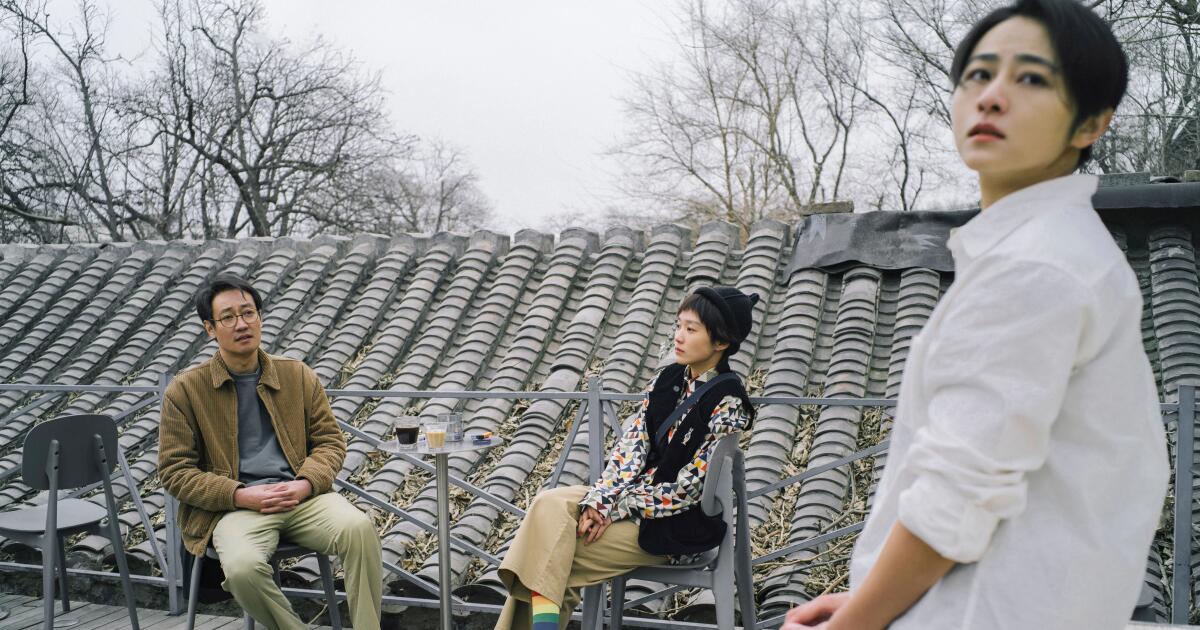
Xin Baiqing in the movie “The Shadowless Tower.”

(Strand Releasing)

Why, for instance, is he so hesitant to respond to the almost comically flirtatious advances of his younger, attractive, headstrong photographer colleague Ouyang (a winningly spirited Huang Yao)? It’s not a crazy-sounding match: They enjoy talking, long walks and what a couple of drinks will do for talking and long walks. Maybe romance with an extrovert is too much for an introvert to contemplate. Also pressing on Gu: He has recently learned that the disgraced father he hasn’t seen since childhood — since his mother kicked him out of the house — is living nearby, in the seaside town of his youth.

As Gu explores that reconnection, which Ouyang becomes a part of (for reasons to do with her own emotionally fraught background), “The Shadowless Tower” settles into an easygoing grace about lives moving forward while looking back: heartfelt, but never sentimental. Just don’t expect any answers as to why people are who they are. Aided by the soft pull of Piao Songri’s cinematography, Zhang would rather you feel the ripple effect of any given moment’s moods and signals. What emerges is an unwitting communication, signs of a separation needing to be bridged.

There’s a rich quietude at work in “The Shadowless Tower,” which makes one realize how that virtue varies from filmmaker to filmmaker. In an Ingmar Bergman film, it felt imposing, heavy with portent. Chantal Akerman’s silences were like vulnerable room tones. Zhang uses quiet to suggest an active calmness, so when a particular sound punctures the air — gurgling water, the music on a videotape, a child’s questions — it feels like the notes of life, the stuff that’s supposed to spark us.

Zhang occasionally tosses in a distant whirr like the kind you hear in sci-fi films denoting an approaching UFO. Is this a comment on the everyday strangeness of existence? Maybe. It could also just be something to keep us on our toes, alive to the rhythms around us — our own shadowless towers — that may seem ordinary, always there, unmissable and permanent, keeping us from life in the darkness.

‘The Shadowless Tower’

Not rated

In Mandarin Chinese and Cantonese with English subtitles

Running time: 2 hours, 24 minutes

Playing: Now at Laemmle Glendale

Chinese director Zhang Lu’s contemporary drama “The Shadowless Tower” is a gently enigmatic character piece that resists telling you too much about its characters. Zhang’s preference is to present them to you in small moments and simple exchanges, with the idea that the oblique approach will eventually lead to what’s insightful — in this case, a brooding, middle-aged Beijing man’s acceptance of his unresolved past and possible future.

Gu Wentong (Xin Baiqing) is a divorced former poet and current restaurant critic with an endearing 6-year-old daughter everyone calls Smiley, who lives with Gu’s sister and brother-in-law. The reasoning behind that custody arrangement isn’t made clear. There’s love between the kid and her dad, and the split with Gu’s wife wasn’t acrimonious so much as due to a passion-depleting excess of mutual politeness.

But what is apparent after just a few unhurried scenes with the melancholic, chain-smoking Gu — whose mother has recently died, to boot — is that he’s hardly in a space to look after anyone, including himself. Gu’s Beijing neighborhood is known for the 13th-century Buddhist temple of the title, whose tall white pagoda is visible far and wide. The structure is famous for never creating shade. Gu, meanwhile, seems to exist only in shadows.

Xin Baiqing in the movie “The Shadowless Tower.”

(Strand Releasing)

Why, for instance, is he so hesitant to respond to the almost comically flirtatious advances of his younger, attractive, headstrong photographer colleague Ouyang (a winningly spirited Huang Yao)? It’s not a crazy-sounding match: They enjoy talking, long walks and what a couple of drinks will do for talking and long walks. Maybe romance with an extrovert is too much for an introvert to contemplate. Also pressing on Gu: He has recently learned that the disgraced father he hasn’t seen since childhood — since his mother kicked him out of the house — is living nearby, in the seaside town of his youth.

As Gu explores that reconnection, which Ouyang becomes a part of (for reasons to do with her own emotionally fraught background), “The Shadowless Tower” settles into an easygoing grace about lives moving forward while looking back: heartfelt, but never sentimental. Just don’t expect any answers as to why people are who they are. Aided by the soft pull of Piao Songri’s cinematography, Zhang would rather you feel the ripple effect of any given moment’s moods and signals. What emerges is an unwitting communication, signs of a separation needing to be bridged.

There’s a rich quietude at work in “The Shadowless Tower,” which makes one realize how that virtue varies from filmmaker to filmmaker. In an Ingmar Bergman film, it felt imposing, heavy with portent. Chantal Akerman’s silences were like vulnerable room tones. Zhang uses quiet to suggest an active calmness, so when a particular sound punctures the air — gurgling water, the music on a videotape, a child’s questions — it feels like the notes of life, the stuff that’s supposed to spark us.

Zhang occasionally tosses in a distant whirr like the kind you hear in sci-fi films denoting an approaching UFO. Is this a comment on the everyday strangeness of existence? Maybe. It could also just be something to keep us on our toes, alive to the rhythms around us — our own shadowless towers — that may seem ordinary, always there, unmissable and permanent, keeping us from life in the darkness.

‘The Shadowless Tower’

Not rated

In Mandarin Chinese and Cantonese with English subtitles

Running time: 2 hours, 24 minutes

Playing: Now at Laemmle Glendale

Chinese director Zhang Lu’s contemporary drama “The Shadowless Tower” is a gently enigmatic character piece that resists telling you too much about its characters. Zhang’s preference is to present them to you in small moments and simple exchanges, with the idea that the oblique approach will eventually lead to what’s insightful — in this case, a brooding, middle-aged Beijing man’s acceptance of his unresolved past and possible future.

Gu Wentong (Xin Baiqing) is a divorced former poet and current restaurant critic with an endearing 6-year-old daughter everyone calls Smiley, who lives with Gu’s sister and brother-in-law. The reasoning behind that custody arrangement isn’t made clear. There’s love between the kid and her dad, and the split with Gu’s wife wasn’t acrimonious so much as due to a passion-depleting excess of mutual politeness.

But what is apparent after just a few unhurried scenes with the melancholic, chain-smoking Gu — whose mother has recently died, to boot — is that he’s hardly in a space to look after anyone, including himself. Gu’s Beijing neighborhood is known for the 13th-century Buddhist temple of the title, whose tall white pagoda is visible far and wide. The structure is famous for never creating shade. Gu, meanwhile, seems to exist only in shadows.

Xin Baiqing in the movie “The Shadowless Tower.”

(Strand Releasing)

Why, for instance, is he so hesitant to respond to the almost comically flirtatious advances of his younger, attractive, headstrong photographer colleague Ouyang (a winningly spirited Huang Yao)? It’s not a crazy-sounding match: They enjoy talking, long walks and what a couple of drinks will do for talking and long walks. Maybe romance with an extrovert is too much for an introvert to contemplate. Also pressing on Gu: He has recently learned that the disgraced father he hasn’t seen since childhood — since his mother kicked him out of the house — is living nearby, in the seaside town of his youth.

As Gu explores that reconnection, which Ouyang becomes a part of (for reasons to do with her own emotionally fraught background), “The Shadowless Tower” settles into an easygoing grace about lives moving forward while looking back: heartfelt, but never sentimental. Just don’t expect any answers as to why people are who they are. Aided by the soft pull of Piao Songri’s cinematography, Zhang would rather you feel the ripple effect of any given moment’s moods and signals. What emerges is an unwitting communication, signs of a separation needing to be bridged.

There’s a rich quietude at work in “The Shadowless Tower,” which makes one realize how that virtue varies from filmmaker to filmmaker. In an Ingmar Bergman film, it felt imposing, heavy with portent. Chantal Akerman’s silences were like vulnerable room tones. Zhang uses quiet to suggest an active calmness, so when a particular sound punctures the air — gurgling water, the music on a videotape, a child’s questions — it feels like the notes of life, the stuff that’s supposed to spark us.

Zhang occasionally tosses in a distant whirr like the kind you hear in sci-fi films denoting an approaching UFO. Is this a comment on the everyday strangeness of existence? Maybe. It could also just be something to keep us on our toes, alive to the rhythms around us — our own shadowless towers — that may seem ordinary, always there, unmissable and permanent, keeping us from life in the darkness.

‘The Shadowless Tower’

Not rated

In Mandarin Chinese and Cantonese with English subtitles

Running time: 2 hours, 24 minutes

Playing: Now at Laemmle Glendale

Chinese director Zhang Lu’s contemporary drama “The Shadowless Tower” is a gently enigmatic character piece that resists telling you too much about its characters. Zhang’s preference is to present them to you in small moments and simple exchanges, with the idea that the oblique approach will eventually lead to what’s insightful — in this case, a brooding, middle-aged Beijing man’s acceptance of his unresolved past and possible future.

Gu Wentong (Xin Baiqing) is a divorced former poet and current restaurant critic with an endearing 6-year-old daughter everyone calls Smiley, who lives with Gu’s sister and brother-in-law. The reasoning behind that custody arrangement isn’t made clear. There’s love between the kid and her dad, and the split with Gu’s wife wasn’t acrimonious so much as due to a passion-depleting excess of mutual politeness.

But what is apparent after just a few unhurried scenes with the melancholic, chain-smoking Gu — whose mother has recently died, to boot — is that he’s hardly in a space to look after anyone, including himself. Gu’s Beijing neighborhood is known for the 13th-century Buddhist temple of the title, whose tall white pagoda is visible far and wide. The structure is famous for never creating shade. Gu, meanwhile, seems to exist only in shadows.

Xin Baiqing in the movie “The Shadowless Tower.”

(Strand Releasing)

Why, for instance, is he so hesitant to respond to the almost comically flirtatious advances of his younger, attractive, headstrong photographer colleague Ouyang (a winningly spirited Huang Yao)? It’s not a crazy-sounding match: They enjoy talking, long walks and what a couple of drinks will do for talking and long walks. Maybe romance with an extrovert is too much for an introvert to contemplate. Also pressing on Gu: He has recently learned that the disgraced father he hasn’t seen since childhood — since his mother kicked him out of the house — is living nearby, in the seaside town of his youth.

As Gu explores that reconnection, which Ouyang becomes a part of (for reasons to do with her own emotionally fraught background), “The Shadowless Tower” settles into an easygoing grace about lives moving forward while looking back: heartfelt, but never sentimental. Just don’t expect any answers as to why people are who they are. Aided by the soft pull of Piao Songri’s cinematography, Zhang would rather you feel the ripple effect of any given moment’s moods and signals. What emerges is an unwitting communication, signs of a separation needing to be bridged.

There’s a rich quietude at work in “The Shadowless Tower,” which makes one realize how that virtue varies from filmmaker to filmmaker. In an Ingmar Bergman film, it felt imposing, heavy with portent. Chantal Akerman’s silences were like vulnerable room tones. Zhang uses quiet to suggest an active calmness, so when a particular sound punctures the air — gurgling water, the music on a videotape, a child’s questions — it feels like the notes of life, the stuff that’s supposed to spark us.

Zhang occasionally tosses in a distant whirr like the kind you hear in sci-fi films denoting an approaching UFO. Is this a comment on the everyday strangeness of existence? Maybe. It could also just be something to keep us on our toes, alive to the rhythms around us — our own shadowless towers — that may seem ordinary, always there, unmissable and permanent, keeping us from life in the darkness.

‘The Shadowless Tower’

Not rated

In Mandarin Chinese and Cantonese with English subtitles

Running time: 2 hours, 24 minutes

Playing: Now at Laemmle Glendale

Chinese director Zhang Lu’s contemporary drama “The Shadowless Tower” is a gently enigmatic character piece that resists telling you too much about its characters. Zhang’s preference is to present them to you in small moments and simple exchanges, with the idea that the oblique approach will eventually lead to what’s insightful — in this case, a brooding, middle-aged Beijing man’s acceptance of his unresolved past and possible future.

Gu Wentong (Xin Baiqing) is a divorced former poet and current restaurant critic with an endearing 6-year-old daughter everyone calls Smiley, who lives with Gu’s sister and brother-in-law. The reasoning behind that custody arrangement isn’t made clear. There’s love between the kid and her dad, and the split with Gu’s wife wasn’t acrimonious so much as due to a passion-depleting excess of mutual politeness.

But what is apparent after just a few unhurried scenes with the melancholic, chain-smoking Gu — whose mother has recently died, to boot — is that he’s hardly in a space to look after anyone, including himself. Gu’s Beijing neighborhood is known for the 13th-century Buddhist temple of the title, whose tall white pagoda is visible far and wide. The structure is famous for never creating shade. Gu, meanwhile, seems to exist only in shadows.

Xin Baiqing in the movie “The Shadowless Tower.”

(Strand Releasing)

Why, for instance, is he so hesitant to respond to the almost comically flirtatious advances of his younger, attractive, headstrong photographer colleague Ouyang (a winningly spirited Huang Yao)? It’s not a crazy-sounding match: They enjoy talking, long walks and what a couple of drinks will do for talking and long walks. Maybe romance with an extrovert is too much for an introvert to contemplate. Also pressing on Gu: He has recently learned that the disgraced father he hasn’t seen since childhood — since his mother kicked him out of the house — is living nearby, in the seaside town of his youth.

As Gu explores that reconnection, which Ouyang becomes a part of (for reasons to do with her own emotionally fraught background), “The Shadowless Tower” settles into an easygoing grace about lives moving forward while looking back: heartfelt, but never sentimental. Just don’t expect any answers as to why people are who they are. Aided by the soft pull of Piao Songri’s cinematography, Zhang would rather you feel the ripple effect of any given moment’s moods and signals. What emerges is an unwitting communication, signs of a separation needing to be bridged.

There’s a rich quietude at work in “The Shadowless Tower,” which makes one realize how that virtue varies from filmmaker to filmmaker. In an Ingmar Bergman film, it felt imposing, heavy with portent. Chantal Akerman’s silences were like vulnerable room tones. Zhang uses quiet to suggest an active calmness, so when a particular sound punctures the air — gurgling water, the music on a videotape, a child’s questions — it feels like the notes of life, the stuff that’s supposed to spark us.

Zhang occasionally tosses in a distant whirr like the kind you hear in sci-fi films denoting an approaching UFO. Is this a comment on the everyday strangeness of existence? Maybe. It could also just be something to keep us on our toes, alive to the rhythms around us — our own shadowless towers — that may seem ordinary, always there, unmissable and permanent, keeping us from life in the darkness.

‘The Shadowless Tower’

Not rated

In Mandarin Chinese and Cantonese with English subtitles

Running time: 2 hours, 24 minutes

Playing: Now at Laemmle Glendale

Chinese director Zhang Lu’s contemporary drama “The Shadowless Tower” is a gently enigmatic character piece that resists telling you too much about its characters. Zhang’s preference is to present them to you in small moments and simple exchanges, with the idea that the oblique approach will eventually lead to what’s insightful — in this case, a brooding, middle-aged Beijing man’s acceptance of his unresolved past and possible future.

Gu Wentong (Xin Baiqing) is a divorced former poet and current restaurant critic with an endearing 6-year-old daughter everyone calls Smiley, who lives with Gu’s sister and brother-in-law. The reasoning behind that custody arrangement isn’t made clear. There’s love between the kid and her dad, and the split with Gu’s wife wasn’t acrimonious so much as due to a passion-depleting excess of mutual politeness.

But what is apparent after just a few unhurried scenes with the melancholic, chain-smoking Gu — whose mother has recently died, to boot — is that he’s hardly in a space to look after anyone, including himself. Gu’s Beijing neighborhood is known for the 13th-century Buddhist temple of the title, whose tall white pagoda is visible far and wide. The structure is famous for never creating shade. Gu, meanwhile, seems to exist only in shadows.

Xin Baiqing in the movie “The Shadowless Tower.”

(Strand Releasing)

Why, for instance, is he so hesitant to respond to the almost comically flirtatious advances of his younger, attractive, headstrong photographer colleague Ouyang (a winningly spirited Huang Yao)? It’s not a crazy-sounding match: They enjoy talking, long walks and what a couple of drinks will do for talking and long walks. Maybe romance with an extrovert is too much for an introvert to contemplate. Also pressing on Gu: He has recently learned that the disgraced father he hasn’t seen since childhood — since his mother kicked him out of the house — is living nearby, in the seaside town of his youth.

As Gu explores that reconnection, which Ouyang becomes a part of (for reasons to do with her own emotionally fraught background), “The Shadowless Tower” settles into an easygoing grace about lives moving forward while looking back: heartfelt, but never sentimental. Just don’t expect any answers as to why people are who they are. Aided by the soft pull of Piao Songri’s cinematography, Zhang would rather you feel the ripple effect of any given moment’s moods and signals. What emerges is an unwitting communication, signs of a separation needing to be bridged.

There’s a rich quietude at work in “The Shadowless Tower,” which makes one realize how that virtue varies from filmmaker to filmmaker. In an Ingmar Bergman film, it felt imposing, heavy with portent. Chantal Akerman’s silences were like vulnerable room tones. Zhang uses quiet to suggest an active calmness, so when a particular sound punctures the air — gurgling water, the music on a videotape, a child’s questions — it feels like the notes of life, the stuff that’s supposed to spark us.

Zhang occasionally tosses in a distant whirr like the kind you hear in sci-fi films denoting an approaching UFO. Is this a comment on the everyday strangeness of existence? Maybe. It could also just be something to keep us on our toes, alive to the rhythms around us — our own shadowless towers — that may seem ordinary, always there, unmissable and permanent, keeping us from life in the darkness.

‘The Shadowless Tower’

Not rated

In Mandarin Chinese and Cantonese with English subtitles

Running time: 2 hours, 24 minutes

Playing: Now at Laemmle Glendale

Chinese director Zhang Lu’s contemporary drama “The Shadowless Tower” is a gently enigmatic character piece that resists telling you too much about its characters. Zhang’s preference is to present them to you in small moments and simple exchanges, with the idea that the oblique approach will eventually lead to what’s insightful — in this case, a brooding, middle-aged Beijing man’s acceptance of his unresolved past and possible future.

Gu Wentong (Xin Baiqing) is a divorced former poet and current restaurant critic with an endearing 6-year-old daughter everyone calls Smiley, who lives with Gu’s sister and brother-in-law. The reasoning behind that custody arrangement isn’t made clear. There’s love between the kid and her dad, and the split with Gu’s wife wasn’t acrimonious so much as due to a passion-depleting excess of mutual politeness.

But what is apparent after just a few unhurried scenes with the melancholic, chain-smoking Gu — whose mother has recently died, to boot — is that he’s hardly in a space to look after anyone, including himself. Gu’s Beijing neighborhood is known for the 13th-century Buddhist temple of the title, whose tall white pagoda is visible far and wide. The structure is famous for never creating shade. Gu, meanwhile, seems to exist only in shadows.

Xin Baiqing in the movie “The Shadowless Tower.”

(Strand Releasing)

Why, for instance, is he so hesitant to respond to the almost comically flirtatious advances of his younger, attractive, headstrong photographer colleague Ouyang (a winningly spirited Huang Yao)? It’s not a crazy-sounding match: They enjoy talking, long walks and what a couple of drinks will do for talking and long walks. Maybe romance with an extrovert is too much for an introvert to contemplate. Also pressing on Gu: He has recently learned that the disgraced father he hasn’t seen since childhood — since his mother kicked him out of the house — is living nearby, in the seaside town of his youth.

As Gu explores that reconnection, which Ouyang becomes a part of (for reasons to do with her own emotionally fraught background), “The Shadowless Tower” settles into an easygoing grace about lives moving forward while looking back: heartfelt, but never sentimental. Just don’t expect any answers as to why people are who they are. Aided by the soft pull of Piao Songri’s cinematography, Zhang would rather you feel the ripple effect of any given moment’s moods and signals. What emerges is an unwitting communication, signs of a separation needing to be bridged.

There’s a rich quietude at work in “The Shadowless Tower,” which makes one realize how that virtue varies from filmmaker to filmmaker. In an Ingmar Bergman film, it felt imposing, heavy with portent. Chantal Akerman’s silences were like vulnerable room tones. Zhang uses quiet to suggest an active calmness, so when a particular sound punctures the air — gurgling water, the music on a videotape, a child’s questions — it feels like the notes of life, the stuff that’s supposed to spark us.

Zhang occasionally tosses in a distant whirr like the kind you hear in sci-fi films denoting an approaching UFO. Is this a comment on the everyday strangeness of existence? Maybe. It could also just be something to keep us on our toes, alive to the rhythms around us — our own shadowless towers — that may seem ordinary, always there, unmissable and permanent, keeping us from life in the darkness.

‘The Shadowless Tower’

Not rated

In Mandarin Chinese and Cantonese with English subtitles

Running time: 2 hours, 24 minutes

Playing: Now at Laemmle Glendale

Chinese director Zhang Lu’s contemporary drama “The Shadowless Tower” is a gently enigmatic character piece that resists telling you too much about its characters. Zhang’s preference is to present them to you in small moments and simple exchanges, with the idea that the oblique approach will eventually lead to what’s insightful — in this case, a brooding, middle-aged Beijing man’s acceptance of his unresolved past and possible future.

Gu Wentong (Xin Baiqing) is a divorced former poet and current restaurant critic with an endearing 6-year-old daughter everyone calls Smiley, who lives with Gu’s sister and brother-in-law. The reasoning behind that custody arrangement isn’t made clear. There’s love between the kid and her dad, and the split with Gu’s wife wasn’t acrimonious so much as due to a passion-depleting excess of mutual politeness.

But what is apparent after just a few unhurried scenes with the melancholic, chain-smoking Gu — whose mother has recently died, to boot — is that he’s hardly in a space to look after anyone, including himself. Gu’s Beijing neighborhood is known for the 13th-century Buddhist temple of the title, whose tall white pagoda is visible far and wide. The structure is famous for never creating shade. Gu, meanwhile, seems to exist only in shadows.

Xin Baiqing in the movie “The Shadowless Tower.”

(Strand Releasing)

Why, for instance, is he so hesitant to respond to the almost comically flirtatious advances of his younger, attractive, headstrong photographer colleague Ouyang (a winningly spirited Huang Yao)? It’s not a crazy-sounding match: They enjoy talking, long walks and what a couple of drinks will do for talking and long walks. Maybe romance with an extrovert is too much for an introvert to contemplate. Also pressing on Gu: He has recently learned that the disgraced father he hasn’t seen since childhood — since his mother kicked him out of the house — is living nearby, in the seaside town of his youth.

As Gu explores that reconnection, which Ouyang becomes a part of (for reasons to do with her own emotionally fraught background), “The Shadowless Tower” settles into an easygoing grace about lives moving forward while looking back: heartfelt, but never sentimental. Just don’t expect any answers as to why people are who they are. Aided by the soft pull of Piao Songri’s cinematography, Zhang would rather you feel the ripple effect of any given moment’s moods and signals. What emerges is an unwitting communication, signs of a separation needing to be bridged.

There’s a rich quietude at work in “The Shadowless Tower,” which makes one realize how that virtue varies from filmmaker to filmmaker. In an Ingmar Bergman film, it felt imposing, heavy with portent. Chantal Akerman’s silences were like vulnerable room tones. Zhang uses quiet to suggest an active calmness, so when a particular sound punctures the air — gurgling water, the music on a videotape, a child’s questions — it feels like the notes of life, the stuff that’s supposed to spark us.

Zhang occasionally tosses in a distant whirr like the kind you hear in sci-fi films denoting an approaching UFO. Is this a comment on the everyday strangeness of existence? Maybe. It could also just be something to keep us on our toes, alive to the rhythms around us — our own shadowless towers — that may seem ordinary, always there, unmissable and permanent, keeping us from life in the darkness.

‘The Shadowless Tower’

Not rated

In Mandarin Chinese and Cantonese with English subtitles

Running time: 2 hours, 24 minutes

Playing: Now at Laemmle Glendale

Previous Post

250 Indians, Lured With Job Opportunities, Rescued From Cambodia, Says MEA

Next Post

Review: In ‘Wicked Little Letters,’ the shock value feels about a century too late

Leave a Reply Cancel reply

Your email address will not be published. Required fields are marked *

BROWSE BY CATEGORIES

  • Business
  • Culture
  • Entertainment
  • Health
  • Politics
  • Technology
  • Trending
  • Uncategorized
  • World
Binghamton Herald

© 2024 Binghamton Herald or its affiliated companies.

Navigate Site

  • About
  • Advertise
  • Terms & Conditions
  • Privacy Policy
  • Disclaimer
  • Contact

Follow Us

No Result
View All Result
  • Home
  • World
  • Politics
  • Business
  • Technology
  • Culture
  • Health
  • Entertainment
  • Trending

© 2024 Binghamton Herald or its affiliated companies.

Welcome Back!

Login to your account below

Forgotten Password?

Retrieve your password

Please enter your username or email address to reset your password.

Log In