

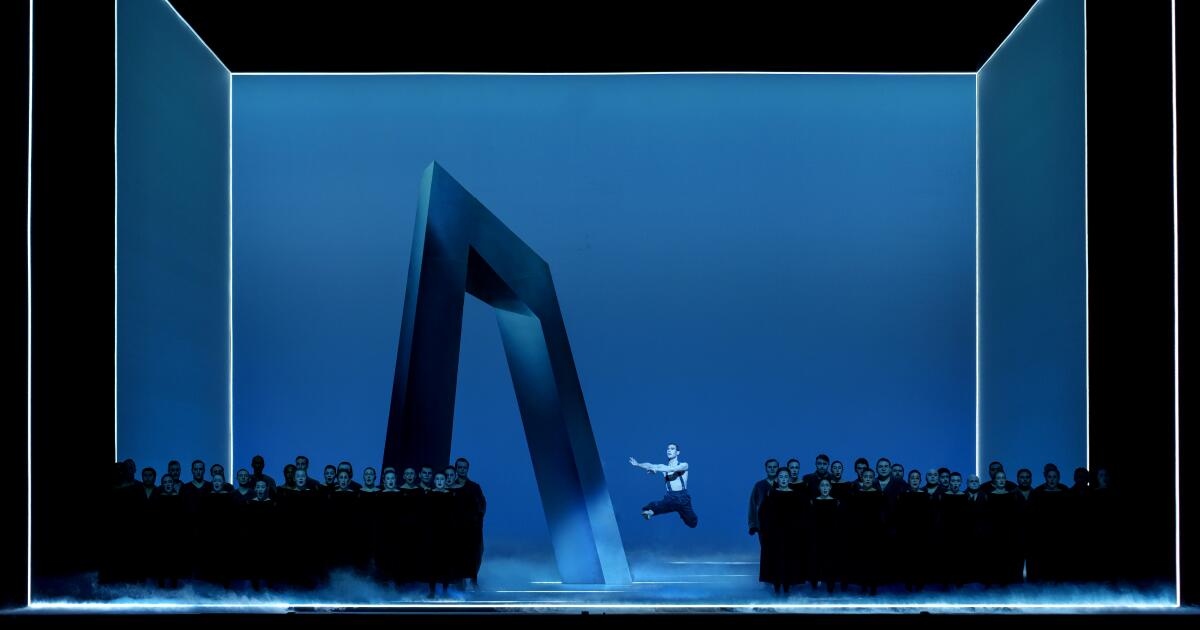

Robert Wilson used theater to change the way we see the world. The German playwright Heiner Müller once warned that you will not understand what Wilson was up to when you see his work. But give it a couple of weeks. Your sense of perception has been altered.
When Wilson died last summer, he was widely eulogized as one of the great visionary artists of our time, and his requisite for altered perception has only since flourished. So far this year, there have been, or will be through the end of June, major Wilson opera and theater productions in Moscow; Paris; Ljubljana, Slovenia; Düsseldorf, Germany; Adelaide, Australia; Kaunas, Lithuania; Vienna; Rome; Tokyo; Luxembourg City, Luxembourg; Berlin; Riga, Latvia; and Sophia, Bulgaria. That is to say, pretty much Wilson business as usual.
Altered perception would seem right up America’s alley as well. We stand, after all, in addictive awe of powerful new realities proposed by the politic, media and advancement of technology. In terror, we throw trillions of dollars at artificial intelligence hoping, in the process, to cure it of hallucinations perilous to humanity.
Yet we close our eyes to arguably America’s most profound hallucinatory artist when we need him the most. Wilson, who was born in Waco, Texas, and spent his career from the late 1960s on in New York, has hardly been more than a blip in his own country during the last decade. CAP UCLA presented “Letters to a Man,” staring Mikhail Baryshnikov in 2016. Houston Grand Opera staged Wilson’s “Turandot” in 2012. Last year, Brooklyn Academy, once a second home to Wilson, imported “Mary Said What She Said,” staring Isabelle Huppert from Paris, where hardly a year goes by without at least one big-deal Wilson work.
But with what seemed a classic Wilsonian snap of the fingers, he was suddenly, however briefly, back with Houston Grand Opera’s staging of a magnificently spiritual production of Handel’s “Messiah” and a wackily transcendent “Moby Dick” at the Brooklyn Academy of Music.
Seen back-to-back last week, these late works showed that Wilson has gone out in a blaze of glory.
In conjunction with both events in Houston and New York, there were screenings of the newly restored documentary “Robert Wilson and the Civil Wars,” which follows Wilson in his heroic effort to create the most ambitious operatic spectacle since Wagner’s “Ring” Cycle a century earlier for the 1984 Los Angeles Olympic Arts Festival.
The five acts and entr’actes (or knee plays) of the eight-hour epic, originally meant to star soprano Jessye Norman and David Bowie in the Shrine Auditorium, were individually staged and locally financed in Rome; Cologne, Germany; Tokyo; Rotterdam, the Netherlands; Marseille, France; and Minneapolis. But L.A. did not come through with its funding to put the whole shebang together. A $1-million shortfall meant the last-minute cancellation. The film movingly details what may well have been L.A.’s single most significant missed arts opportunity.
My hope in returning to L.A. from Houston and Brooklyn, with perception already well altered, became that the documentary (thus far not slated for L.A. screenings) might serve as a great motivator to do the seemingly impossible. The lesson from the ’84 Olympics is that if you do the right thing and mean it, we can attempt alternate perception funding. The tightwad L.A. Olympics wound up with a $225-million surplus.
We have since become a far more cultivated arts capital preparing for what we are dubbing the LA28 Cultural Olympiad. “The CIVIL warS: a tree is best measured when it is down,” the full title with Wilsonian capitalization, was Wilson’s sole failure in his legendary career.
L.A. was once, after New York, America’s most friendly Wilson city. Between 1985 and 2016, he was everywhere: Los Angeles Opera, Los Angeles Philharmonic, Center Theater Group, UCLA, USC and more. But “Messiah” and “Moby Dick” showed what we’ve been missing.
I don’t expect to see a Wilson exhibition in the Lucas Museum of Narrative Art when it opens. Wilson operated outside of conventional narrative, trusting in the magic of unexpected illogic. And it is fascinating to observe that Handel’s oratorio and Melville’s novel, two works of immense popularity that are among the greatest works of their genres, both function on the outskirts of narrative.
Soprano Ying Fang and dancer Alexis Fousekis perform in “Messiah” at Houston Grand Opera.
(Michael Bishop / Houston Grand Opera)
“Messiah,” an Easter oratorio beloved for Christmas, suggests Christ’s meaning rather than clearly tracing his life. His name is only mentioned once. Handel controversially wrote it for the theater, not the church. Arias, recitatives and choruses are more like ruminations from the King James Bible, as part of a spiritual journey.
Wilson, who first staged “Messiah” at the Salzburg Festival in 2020 using Mozart’s seldom-heard orchestration, treats this as a spiritual fantasy. No story necessary. Characters? They are what they are. No why.
Like all of Wilson’s work, herein lies a feast of charmed imagery. Paranormal lighting produces a neurological effect on the viewer yet to be identified. Handel bids us “Rejoice Greatly”; we do so with the benefit of a weirdo 19th century Frenchman, one Gérard de Nerval. An astronaut makes an appearance, as does a headless man with a lobster. Tenor Ben Bliss at one point impersonates (fabulously) a song-and-dance man.
Yet through it all (the above is but a sampler), we are unmistakably in a spiritual space. Patrick Summers, who chose this to end his 28 years as a music director, conducted a sumptuous performance in the Brown Theater. Chorus and other soloists (soprano Ying Fang, countertenor Aryeh Nussbaum Cohen and bass-baritone Nicholas Newton) were all convincing. A breathtaking dancer, Alexis Fousekis, served as what might be heaven’s most eccentric angel.

Ralph Gehrmann plays Ishmael in Robert Wilson’s production of “Moby Dick” at Brooklyn Academy of Music.
(Julieta Cervantes / BAM)
I’ve written about Wilson’s works for nearly half a century, but a visit to the Marcel Duchamp retrospective at MoMA in New York reminded me of the folly of trying to describe a Wilson experience. “As soon as we start putting our thought into words and sentences,” Duchamp proclaimed, “everything goes wrong.”
“Moby Dick” suited Wilson who, himself, readily ran out of words. When speaking about his own work, he sometimes interrupted himself with an arresting scream. Or he might chirp like a bird. Yet he had a feel for Melville’s sentences, in which everything might go spectacularly right. Plot is the least of it in “Moby Dick,” in which the oddities of the way of the world captivate.
The last work he staged, “Moby Dick” was for Wilson “Messiah”-like in that he picked and chose bits from a novel with an already interrupted narrative the way Handel’s librettist did from the Bible. Wilson, in fact, begins the show mocking narrative as Ishmael, an old man with a long white beard (as if a figure out of “Messiah”), attempts to recall his voyage to a restless young boy. The boy turns out to be a distrupter — part Puck from “Midsummer Night’s Dream,” part Ariel from “The Tempest” and very much all Wilson. In her “Moby Dick” opera Olga Neuwirth made Ishmael a woman; Wilson, instead, makes Captain Ahab a woman.

Rosa Enskat, left, plays Captain Ahab in Robert Wilson’s production of “Moby Dick” at Brooklyn Academy of Music.
(Julieta Cervantes / BAM)
There are songs and lyrics by Anna Calvi you can’t get out of your head. The same goes for the vast panoply of striking images and lighting. The performance in German and English is on all levels the kind of theatrical spectacle that makes Broadway seem like a dying street in Nowheresville. Everyone on stage mesmerizes, yet Christopher Nell as The Boy, a barrel of laughs and an acrobat, nonetheless steals the show.
“God is not enough / We’re wild gods / We’re too wild to die,” from the final song, an earworm sung by all the characters, are Wilson’s last words to us. And they are delivered with a theatrical joy that is simply overwhelming.
We failed Wilson in 1984. He never quite got over it. Neither should we. But for 30 years we did our best to make him part of L.A.’s artistic zeitgeist. He was devoted to our institutions and to the most impressive of our arts leaders and patrons in music, theater and visual art. He made new work for us.
The Cultural Olympiad is asking us only to look at ourselves. Wilson got us to look at ourselves by looking far beyond ourselves in other cultures and other universes and under our own skins. He paved the way for a second and third generation of L.A. theatrical mavericks, notably Peter Sellars and Yuval Sharon, who newly and profoundly alter perception.
In Houston and Brooklyn (where I attended “Moby Dick” twice) you could feel something happening with audiences, a sense of collective stupefaction turning into wonderment. These were the hottest tickets in town.
In our town, we’re told in the new LA28 announcement of the Cultural Olympiad: “It’s been forty years. Los Angeles is ready to do it again.” That will include free screenings of sports films “at iconic L.A. locations.” But why wait?
How about next week? Screen “Robert Wilson and Civil Wars” at the Shrine Auditorium. A tree, as Wilson reminded us in “CIVIL warS,” is best measured when it is down. So, too, a Cultural Olympiad.

Robert Wilson used theater to change the way we see the world. The German playwright Heiner Müller once warned that you will not understand what Wilson was up to when you see his work. But give it a couple of weeks. Your sense of perception has been altered.
When Wilson died last summer, he was widely eulogized as one of the great visionary artists of our time, and his requisite for altered perception has only since flourished. So far this year, there have been, or will be through the end of June, major Wilson opera and theater productions in Moscow; Paris; Ljubljana, Slovenia; Düsseldorf, Germany; Adelaide, Australia; Kaunas, Lithuania; Vienna; Rome; Tokyo; Luxembourg City, Luxembourg; Berlin; Riga, Latvia; and Sophia, Bulgaria. That is to say, pretty much Wilson business as usual.
Altered perception would seem right up America’s alley as well. We stand, after all, in addictive awe of powerful new realities proposed by the politic, media and advancement of technology. In terror, we throw trillions of dollars at artificial intelligence hoping, in the process, to cure it of hallucinations perilous to humanity.
Yet we close our eyes to arguably America’s most profound hallucinatory artist when we need him the most. Wilson, who was born in Waco, Texas, and spent his career from the late 1960s on in New York, has hardly been more than a blip in his own country during the last decade. CAP UCLA presented “Letters to a Man,” staring Mikhail Baryshnikov in 2016. Houston Grand Opera staged Wilson’s “Turandot” in 2012. Last year, Brooklyn Academy, once a second home to Wilson, imported “Mary Said What She Said,” staring Isabelle Huppert from Paris, where hardly a year goes by without at least one big-deal Wilson work.
But with what seemed a classic Wilsonian snap of the fingers, he was suddenly, however briefly, back with Houston Grand Opera’s staging of a magnificently spiritual production of Handel’s “Messiah” and a wackily transcendent “Moby Dick” at the Brooklyn Academy of Music.
Seen back-to-back last week, these late works showed that Wilson has gone out in a blaze of glory.
In conjunction with both events in Houston and New York, there were screenings of the newly restored documentary “Robert Wilson and the Civil Wars,” which follows Wilson in his heroic effort to create the most ambitious operatic spectacle since Wagner’s “Ring” Cycle a century earlier for the 1984 Los Angeles Olympic Arts Festival.
The five acts and entr’actes (or knee plays) of the eight-hour epic, originally meant to star soprano Jessye Norman and David Bowie in the Shrine Auditorium, were individually staged and locally financed in Rome; Cologne, Germany; Tokyo; Rotterdam, the Netherlands; Marseille, France; and Minneapolis. But L.A. did not come through with its funding to put the whole shebang together. A $1-million shortfall meant the last-minute cancellation. The film movingly details what may well have been L.A.’s single most significant missed arts opportunity.
My hope in returning to L.A. from Houston and Brooklyn, with perception already well altered, became that the documentary (thus far not slated for L.A. screenings) might serve as a great motivator to do the seemingly impossible. The lesson from the ’84 Olympics is that if you do the right thing and mean it, we can attempt alternate perception funding. The tightwad L.A. Olympics wound up with a $225-million surplus.
We have since become a far more cultivated arts capital preparing for what we are dubbing the LA28 Cultural Olympiad. “The CIVIL warS: a tree is best measured when it is down,” the full title with Wilsonian capitalization, was Wilson’s sole failure in his legendary career.
L.A. was once, after New York, America’s most friendly Wilson city. Between 1985 and 2016, he was everywhere: Los Angeles Opera, Los Angeles Philharmonic, Center Theater Group, UCLA, USC and more. But “Messiah” and “Moby Dick” showed what we’ve been missing.
I don’t expect to see a Wilson exhibition in the Lucas Museum of Narrative Art when it opens. Wilson operated outside of conventional narrative, trusting in the magic of unexpected illogic. And it is fascinating to observe that Handel’s oratorio and Melville’s novel, two works of immense popularity that are among the greatest works of their genres, both function on the outskirts of narrative.
Soprano Ying Fang and dancer Alexis Fousekis perform in “Messiah” at Houston Grand Opera.
(Michael Bishop / Houston Grand Opera)
“Messiah,” an Easter oratorio beloved for Christmas, suggests Christ’s meaning rather than clearly tracing his life. His name is only mentioned once. Handel controversially wrote it for the theater, not the church. Arias, recitatives and choruses are more like ruminations from the King James Bible, as part of a spiritual journey.
Wilson, who first staged “Messiah” at the Salzburg Festival in 2020 using Mozart’s seldom-heard orchestration, treats this as a spiritual fantasy. No story necessary. Characters? They are what they are. No why.
Like all of Wilson’s work, herein lies a feast of charmed imagery. Paranormal lighting produces a neurological effect on the viewer yet to be identified. Handel bids us “Rejoice Greatly”; we do so with the benefit of a weirdo 19th century Frenchman, one Gérard de Nerval. An astronaut makes an appearance, as does a headless man with a lobster. Tenor Ben Bliss at one point impersonates (fabulously) a song-and-dance man.
Yet through it all (the above is but a sampler), we are unmistakably in a spiritual space. Patrick Summers, who chose this to end his 28 years as a music director, conducted a sumptuous performance in the Brown Theater. Chorus and other soloists (soprano Ying Fang, countertenor Aryeh Nussbaum Cohen and bass-baritone Nicholas Newton) were all convincing. A breathtaking dancer, Alexis Fousekis, served as what might be heaven’s most eccentric angel.
Ralph Gehrmann plays Ishmael in Robert Wilson’s production of “Moby Dick” at Brooklyn Academy of Music.
(Julieta Cervantes / BAM)
I’ve written about Wilson’s works for nearly half a century, but a visit to the Marcel Duchamp retrospective at MoMA in New York reminded me of the folly of trying to describe a Wilson experience. “As soon as we start putting our thought into words and sentences,” Duchamp proclaimed, “everything goes wrong.”
“Moby Dick” suited Wilson who, himself, readily ran out of words. When speaking about his own work, he sometimes interrupted himself with an arresting scream. Or he might chirp like a bird. Yet he had a feel for Melville’s sentences, in which everything might go spectacularly right. Plot is the least of it in “Moby Dick,” in which the oddities of the way of the world captivate.
The last work he staged, “Moby Dick” was for Wilson “Messiah”-like in that he picked and chose bits from a novel with an already interrupted narrative the way Handel’s librettist did from the Bible. Wilson, in fact, begins the show mocking narrative as Ishmael, an old man with a long white beard (as if a figure out of “Messiah”), attempts to recall his voyage to a restless young boy. The boy turns out to be a distrupter — part Puck from “Midsummer Night’s Dream,” part Ariel from “The Tempest” and very much all Wilson. In her “Moby Dick” opera Olga Neuwirth made Ishmael a woman; Wilson, instead, makes Captain Ahab a woman.
Rosa Enskat, left, plays Captain Ahab in Robert Wilson’s production of “Moby Dick” at Brooklyn Academy of Music.
(Julieta Cervantes / BAM)
There are songs and lyrics by Anna Calvi you can’t get out of your head. The same goes for the vast panoply of striking images and lighting. The performance in German and English is on all levels the kind of theatrical spectacle that makes Broadway seem like a dying street in Nowheresville. Everyone on stage mesmerizes, yet Christopher Nell as The Boy, a barrel of laughs and an acrobat, nonetheless steals the show.
“God is not enough / We’re wild gods / We’re too wild to die,” from the final song, an earworm sung by all the characters, are Wilson’s last words to us. And they are delivered with a theatrical joy that is simply overwhelming.
We failed Wilson in 1984. He never quite got over it. Neither should we. But for 30 years we did our best to make him part of L.A.’s artistic zeitgeist. He was devoted to our institutions and to the most impressive of our arts leaders and patrons in music, theater and visual art. He made new work for us.
The Cultural Olympiad is asking us only to look at ourselves. Wilson got us to look at ourselves by looking far beyond ourselves in other cultures and other universes and under our own skins. He paved the way for a second and third generation of L.A. theatrical mavericks, notably Peter Sellars and Yuval Sharon, who newly and profoundly alter perception.
In Houston and Brooklyn (where I attended “Moby Dick” twice) you could feel something happening with audiences, a sense of collective stupefaction turning into wonderment. These were the hottest tickets in town.
In our town, we’re told in the new LA28 announcement of the Cultural Olympiad: “It’s been forty years. Los Angeles is ready to do it again.” That will include free screenings of sports films “at iconic L.A. locations.” But why wait?
How about next week? Screen “Robert Wilson and Civil Wars” at the Shrine Auditorium. A tree, as Wilson reminded us in “CIVIL warS,” is best measured when it is down. So, too, a Cultural Olympiad.

Robert Wilson used theater to change the way we see the world. The German playwright Heiner Müller once warned that you will not understand what Wilson was up to when you see his work. But give it a couple of weeks. Your sense of perception has been altered.
When Wilson died last summer, he was widely eulogized as one of the great visionary artists of our time, and his requisite for altered perception has only since flourished. So far this year, there have been, or will be through the end of June, major Wilson opera and theater productions in Moscow; Paris; Ljubljana, Slovenia; Düsseldorf, Germany; Adelaide, Australia; Kaunas, Lithuania; Vienna; Rome; Tokyo; Luxembourg City, Luxembourg; Berlin; Riga, Latvia; and Sophia, Bulgaria. That is to say, pretty much Wilson business as usual.
Altered perception would seem right up America’s alley as well. We stand, after all, in addictive awe of powerful new realities proposed by the politic, media and advancement of technology. In terror, we throw trillions of dollars at artificial intelligence hoping, in the process, to cure it of hallucinations perilous to humanity.
Yet we close our eyes to arguably America’s most profound hallucinatory artist when we need him the most. Wilson, who was born in Waco, Texas, and spent his career from the late 1960s on in New York, has hardly been more than a blip in his own country during the last decade. CAP UCLA presented “Letters to a Man,” staring Mikhail Baryshnikov in 2016. Houston Grand Opera staged Wilson’s “Turandot” in 2012. Last year, Brooklyn Academy, once a second home to Wilson, imported “Mary Said What She Said,” staring Isabelle Huppert from Paris, where hardly a year goes by without at least one big-deal Wilson work.
But with what seemed a classic Wilsonian snap of the fingers, he was suddenly, however briefly, back with Houston Grand Opera’s staging of a magnificently spiritual production of Handel’s “Messiah” and a wackily transcendent “Moby Dick” at the Brooklyn Academy of Music.
Seen back-to-back last week, these late works showed that Wilson has gone out in a blaze of glory.
In conjunction with both events in Houston and New York, there were screenings of the newly restored documentary “Robert Wilson and the Civil Wars,” which follows Wilson in his heroic effort to create the most ambitious operatic spectacle since Wagner’s “Ring” Cycle a century earlier for the 1984 Los Angeles Olympic Arts Festival.
The five acts and entr’actes (or knee plays) of the eight-hour epic, originally meant to star soprano Jessye Norman and David Bowie in the Shrine Auditorium, were individually staged and locally financed in Rome; Cologne, Germany; Tokyo; Rotterdam, the Netherlands; Marseille, France; and Minneapolis. But L.A. did not come through with its funding to put the whole shebang together. A $1-million shortfall meant the last-minute cancellation. The film movingly details what may well have been L.A.’s single most significant missed arts opportunity.
My hope in returning to L.A. from Houston and Brooklyn, with perception already well altered, became that the documentary (thus far not slated for L.A. screenings) might serve as a great motivator to do the seemingly impossible. The lesson from the ’84 Olympics is that if you do the right thing and mean it, we can attempt alternate perception funding. The tightwad L.A. Olympics wound up with a $225-million surplus.
We have since become a far more cultivated arts capital preparing for what we are dubbing the LA28 Cultural Olympiad. “The CIVIL warS: a tree is best measured when it is down,” the full title with Wilsonian capitalization, was Wilson’s sole failure in his legendary career.
L.A. was once, after New York, America’s most friendly Wilson city. Between 1985 and 2016, he was everywhere: Los Angeles Opera, Los Angeles Philharmonic, Center Theater Group, UCLA, USC and more. But “Messiah” and “Moby Dick” showed what we’ve been missing.
I don’t expect to see a Wilson exhibition in the Lucas Museum of Narrative Art when it opens. Wilson operated outside of conventional narrative, trusting in the magic of unexpected illogic. And it is fascinating to observe that Handel’s oratorio and Melville’s novel, two works of immense popularity that are among the greatest works of their genres, both function on the outskirts of narrative.
Soprano Ying Fang and dancer Alexis Fousekis perform in “Messiah” at Houston Grand Opera.
(Michael Bishop / Houston Grand Opera)
“Messiah,” an Easter oratorio beloved for Christmas, suggests Christ’s meaning rather than clearly tracing his life. His name is only mentioned once. Handel controversially wrote it for the theater, not the church. Arias, recitatives and choruses are more like ruminations from the King James Bible, as part of a spiritual journey.
Wilson, who first staged “Messiah” at the Salzburg Festival in 2020 using Mozart’s seldom-heard orchestration, treats this as a spiritual fantasy. No story necessary. Characters? They are what they are. No why.
Like all of Wilson’s work, herein lies a feast of charmed imagery. Paranormal lighting produces a neurological effect on the viewer yet to be identified. Handel bids us “Rejoice Greatly”; we do so with the benefit of a weirdo 19th century Frenchman, one Gérard de Nerval. An astronaut makes an appearance, as does a headless man with a lobster. Tenor Ben Bliss at one point impersonates (fabulously) a song-and-dance man.
Yet through it all (the above is but a sampler), we are unmistakably in a spiritual space. Patrick Summers, who chose this to end his 28 years as a music director, conducted a sumptuous performance in the Brown Theater. Chorus and other soloists (soprano Ying Fang, countertenor Aryeh Nussbaum Cohen and bass-baritone Nicholas Newton) were all convincing. A breathtaking dancer, Alexis Fousekis, served as what might be heaven’s most eccentric angel.
Ralph Gehrmann plays Ishmael in Robert Wilson’s production of “Moby Dick” at Brooklyn Academy of Music.
(Julieta Cervantes / BAM)
I’ve written about Wilson’s works for nearly half a century, but a visit to the Marcel Duchamp retrospective at MoMA in New York reminded me of the folly of trying to describe a Wilson experience. “As soon as we start putting our thought into words and sentences,” Duchamp proclaimed, “everything goes wrong.”
“Moby Dick” suited Wilson who, himself, readily ran out of words. When speaking about his own work, he sometimes interrupted himself with an arresting scream. Or he might chirp like a bird. Yet he had a feel for Melville’s sentences, in which everything might go spectacularly right. Plot is the least of it in “Moby Dick,” in which the oddities of the way of the world captivate.
The last work he staged, “Moby Dick” was for Wilson “Messiah”-like in that he picked and chose bits from a novel with an already interrupted narrative the way Handel’s librettist did from the Bible. Wilson, in fact, begins the show mocking narrative as Ishmael, an old man with a long white beard (as if a figure out of “Messiah”), attempts to recall his voyage to a restless young boy. The boy turns out to be a distrupter — part Puck from “Midsummer Night’s Dream,” part Ariel from “The Tempest” and very much all Wilson. In her “Moby Dick” opera Olga Neuwirth made Ishmael a woman; Wilson, instead, makes Captain Ahab a woman.
Rosa Enskat, left, plays Captain Ahab in Robert Wilson’s production of “Moby Dick” at Brooklyn Academy of Music.
(Julieta Cervantes / BAM)
There are songs and lyrics by Anna Calvi you can’t get out of your head. The same goes for the vast panoply of striking images and lighting. The performance in German and English is on all levels the kind of theatrical spectacle that makes Broadway seem like a dying street in Nowheresville. Everyone on stage mesmerizes, yet Christopher Nell as The Boy, a barrel of laughs and an acrobat, nonetheless steals the show.
“God is not enough / We’re wild gods / We’re too wild to die,” from the final song, an earworm sung by all the characters, are Wilson’s last words to us. And they are delivered with a theatrical joy that is simply overwhelming.
We failed Wilson in 1984. He never quite got over it. Neither should we. But for 30 years we did our best to make him part of L.A.’s artistic zeitgeist. He was devoted to our institutions and to the most impressive of our arts leaders and patrons in music, theater and visual art. He made new work for us.
The Cultural Olympiad is asking us only to look at ourselves. Wilson got us to look at ourselves by looking far beyond ourselves in other cultures and other universes and under our own skins. He paved the way for a second and third generation of L.A. theatrical mavericks, notably Peter Sellars and Yuval Sharon, who newly and profoundly alter perception.
In Houston and Brooklyn (where I attended “Moby Dick” twice) you could feel something happening with audiences, a sense of collective stupefaction turning into wonderment. These were the hottest tickets in town.
In our town, we’re told in the new LA28 announcement of the Cultural Olympiad: “It’s been forty years. Los Angeles is ready to do it again.” That will include free screenings of sports films “at iconic L.A. locations.” But why wait?
How about next week? Screen “Robert Wilson and Civil Wars” at the Shrine Auditorium. A tree, as Wilson reminded us in “CIVIL warS,” is best measured when it is down. So, too, a Cultural Olympiad.
Robert Wilson used theater to change the way we see the world. The German playwright Heiner Müller once warned that you will not understand what Wilson was up to when you see his work. But give it a couple of weeks. Your sense of perception has been altered.
When Wilson died last summer, he was widely eulogized as one of the great visionary artists of our time, and his requisite for altered perception has only since flourished. So far this year, there have been, or will be through the end of June, major Wilson opera and theater productions in Moscow; Paris; Ljubljana, Slovenia; Düsseldorf, Germany; Adelaide, Australia; Kaunas, Lithuania; Vienna; Rome; Tokyo; Luxembourg City, Luxembourg; Berlin; Riga, Latvia; and Sophia, Bulgaria. That is to say, pretty much Wilson business as usual.
Altered perception would seem right up America’s alley as well. We stand, after all, in addictive awe of powerful new realities proposed by the politic, media and advancement of technology. In terror, we throw trillions of dollars at artificial intelligence hoping, in the process, to cure it of hallucinations perilous to humanity.
Yet we close our eyes to arguably America’s most profound hallucinatory artist when we need him the most. Wilson, who was born in Waco, Texas, and spent his career from the late 1960s on in New York, has hardly been more than a blip in his own country during the last decade. CAP UCLA presented “Letters to a Man,” staring Mikhail Baryshnikov in 2016. Houston Grand Opera staged Wilson’s “Turandot” in 2012. Last year, Brooklyn Academy, once a second home to Wilson, imported “Mary Said What She Said,” staring Isabelle Huppert from Paris, where hardly a year goes by without at least one big-deal Wilson work.
But with what seemed a classic Wilsonian snap of the fingers, he was suddenly, however briefly, back with Houston Grand Opera’s staging of a magnificently spiritual production of Handel’s “Messiah” and a wackily transcendent “Moby Dick” at the Brooklyn Academy of Music.
Seen back-to-back last week, these late works showed that Wilson has gone out in a blaze of glory.
In conjunction with both events in Houston and New York, there were screenings of the newly restored documentary “Robert Wilson and the Civil Wars,” which follows Wilson in his heroic effort to create the most ambitious operatic spectacle since Wagner’s “Ring” Cycle a century earlier for the 1984 Los Angeles Olympic Arts Festival.
The five acts and entr’actes (or knee plays) of the eight-hour epic, originally meant to star soprano Jessye Norman and David Bowie in the Shrine Auditorium, were individually staged and locally financed in Rome; Cologne, Germany; Tokyo; Rotterdam, the Netherlands; Marseille, France; and Minneapolis. But L.A. did not come through with its funding to put the whole shebang together. A $1-million shortfall meant the last-minute cancellation. The film movingly details what may well have been L.A.’s single most significant missed arts opportunity.
My hope in returning to L.A. from Houston and Brooklyn, with perception already well altered, became that the documentary (thus far not slated for L.A. screenings) might serve as a great motivator to do the seemingly impossible. The lesson from the ’84 Olympics is that if you do the right thing and mean it, we can attempt alternate perception funding. The tightwad L.A. Olympics wound up with a $225-million surplus.
We have since become a far more cultivated arts capital preparing for what we are dubbing the LA28 Cultural Olympiad. “The CIVIL warS: a tree is best measured when it is down,” the full title with Wilsonian capitalization, was Wilson’s sole failure in his legendary career.
L.A. was once, after New York, America’s most friendly Wilson city. Between 1985 and 2016, he was everywhere: Los Angeles Opera, Los Angeles Philharmonic, Center Theater Group, UCLA, USC and more. But “Messiah” and “Moby Dick” showed what we’ve been missing.
I don’t expect to see a Wilson exhibition in the Lucas Museum of Narrative Art when it opens. Wilson operated outside of conventional narrative, trusting in the magic of unexpected illogic. And it is fascinating to observe that Handel’s oratorio and Melville’s novel, two works of immense popularity that are among the greatest works of their genres, both function on the outskirts of narrative.
Soprano Ying Fang and dancer Alexis Fousekis perform in “Messiah” at Houston Grand Opera.
(Michael Bishop / Houston Grand Opera)
“Messiah,” an Easter oratorio beloved for Christmas, suggests Christ’s meaning rather than clearly tracing his life. His name is only mentioned once. Handel controversially wrote it for the theater, not the church. Arias, recitatives and choruses are more like ruminations from the King James Bible, as part of a spiritual journey.
Wilson, who first staged “Messiah” at the Salzburg Festival in 2020 using Mozart’s seldom-heard orchestration, treats this as a spiritual fantasy. No story necessary. Characters? They are what they are. No why.
Like all of Wilson’s work, herein lies a feast of charmed imagery. Paranormal lighting produces a neurological effect on the viewer yet to be identified. Handel bids us “Rejoice Greatly”; we do so with the benefit of a weirdo 19th century Frenchman, one Gérard de Nerval. An astronaut makes an appearance, as does a headless man with a lobster. Tenor Ben Bliss at one point impersonates (fabulously) a song-and-dance man.
Yet through it all (the above is but a sampler), we are unmistakably in a spiritual space. Patrick Summers, who chose this to end his 28 years as a music director, conducted a sumptuous performance in the Brown Theater. Chorus and other soloists (soprano Ying Fang, countertenor Aryeh Nussbaum Cohen and bass-baritone Nicholas Newton) were all convincing. A breathtaking dancer, Alexis Fousekis, served as what might be heaven’s most eccentric angel.
Ralph Gehrmann plays Ishmael in Robert Wilson’s production of “Moby Dick” at Brooklyn Academy of Music.
(Julieta Cervantes / BAM)
I’ve written about Wilson’s works for nearly half a century, but a visit to the Marcel Duchamp retrospective at MoMA in New York reminded me of the folly of trying to describe a Wilson experience. “As soon as we start putting our thought into words and sentences,” Duchamp proclaimed, “everything goes wrong.”
“Moby Dick” suited Wilson who, himself, readily ran out of words. When speaking about his own work, he sometimes interrupted himself with an arresting scream. Or he might chirp like a bird. Yet he had a feel for Melville’s sentences, in which everything might go spectacularly right. Plot is the least of it in “Moby Dick,” in which the oddities of the way of the world captivate.
The last work he staged, “Moby Dick” was for Wilson “Messiah”-like in that he picked and chose bits from a novel with an already interrupted narrative the way Handel’s librettist did from the Bible. Wilson, in fact, begins the show mocking narrative as Ishmael, an old man with a long white beard (as if a figure out of “Messiah”), attempts to recall his voyage to a restless young boy. The boy turns out to be a distrupter — part Puck from “Midsummer Night’s Dream,” part Ariel from “The Tempest” and very much all Wilson. In her “Moby Dick” opera Olga Neuwirth made Ishmael a woman; Wilson, instead, makes Captain Ahab a woman.
Rosa Enskat, left, plays Captain Ahab in Robert Wilson’s production of “Moby Dick” at Brooklyn Academy of Music.
(Julieta Cervantes / BAM)
There are songs and lyrics by Anna Calvi you can’t get out of your head. The same goes for the vast panoply of striking images and lighting. The performance in German and English is on all levels the kind of theatrical spectacle that makes Broadway seem like a dying street in Nowheresville. Everyone on stage mesmerizes, yet Christopher Nell as The Boy, a barrel of laughs and an acrobat, nonetheless steals the show.
“God is not enough / We’re wild gods / We’re too wild to die,” from the final song, an earworm sung by all the characters, are Wilson’s last words to us. And they are delivered with a theatrical joy that is simply overwhelming.
We failed Wilson in 1984. He never quite got over it. Neither should we. But for 30 years we did our best to make him part of L.A.’s artistic zeitgeist. He was devoted to our institutions and to the most impressive of our arts leaders and patrons in music, theater and visual art. He made new work for us.
The Cultural Olympiad is asking us only to look at ourselves. Wilson got us to look at ourselves by looking far beyond ourselves in other cultures and other universes and under our own skins. He paved the way for a second and third generation of L.A. theatrical mavericks, notably Peter Sellars and Yuval Sharon, who newly and profoundly alter perception.
In Houston and Brooklyn (where I attended “Moby Dick” twice) you could feel something happening with audiences, a sense of collective stupefaction turning into wonderment. These were the hottest tickets in town.
In our town, we’re told in the new LA28 announcement of the Cultural Olympiad: “It’s been forty years. Los Angeles is ready to do it again.” That will include free screenings of sports films “at iconic L.A. locations.” But why wait?
How about next week? Screen “Robert Wilson and Civil Wars” at the Shrine Auditorium. A tree, as Wilson reminded us in “CIVIL warS,” is best measured when it is down. So, too, a Cultural Olympiad.

Robert Wilson used theater to change the way we see the world. The German playwright Heiner Müller once warned that you will not understand what Wilson was up to when you see his work. But give it a couple of weeks. Your sense of perception has been altered.
When Wilson died last summer, he was widely eulogized as one of the great visionary artists of our time, and his requisite for altered perception has only since flourished. So far this year, there have been, or will be through the end of June, major Wilson opera and theater productions in Moscow; Paris; Ljubljana, Slovenia; Düsseldorf, Germany; Adelaide, Australia; Kaunas, Lithuania; Vienna; Rome; Tokyo; Luxembourg City, Luxembourg; Berlin; Riga, Latvia; and Sophia, Bulgaria. That is to say, pretty much Wilson business as usual.
Altered perception would seem right up America’s alley as well. We stand, after all, in addictive awe of powerful new realities proposed by the politic, media and advancement of technology. In terror, we throw trillions of dollars at artificial intelligence hoping, in the process, to cure it of hallucinations perilous to humanity.
Yet we close our eyes to arguably America’s most profound hallucinatory artist when we need him the most. Wilson, who was born in Waco, Texas, and spent his career from the late 1960s on in New York, has hardly been more than a blip in his own country during the last decade. CAP UCLA presented “Letters to a Man,” staring Mikhail Baryshnikov in 2016. Houston Grand Opera staged Wilson’s “Turandot” in 2012. Last year, Brooklyn Academy, once a second home to Wilson, imported “Mary Said What She Said,” staring Isabelle Huppert from Paris, where hardly a year goes by without at least one big-deal Wilson work.
But with what seemed a classic Wilsonian snap of the fingers, he was suddenly, however briefly, back with Houston Grand Opera’s staging of a magnificently spiritual production of Handel’s “Messiah” and a wackily transcendent “Moby Dick” at the Brooklyn Academy of Music.
Seen back-to-back last week, these late works showed that Wilson has gone out in a blaze of glory.
In conjunction with both events in Houston and New York, there were screenings of the newly restored documentary “Robert Wilson and the Civil Wars,” which follows Wilson in his heroic effort to create the most ambitious operatic spectacle since Wagner’s “Ring” Cycle a century earlier for the 1984 Los Angeles Olympic Arts Festival.
The five acts and entr’actes (or knee plays) of the eight-hour epic, originally meant to star soprano Jessye Norman and David Bowie in the Shrine Auditorium, were individually staged and locally financed in Rome; Cologne, Germany; Tokyo; Rotterdam, the Netherlands; Marseille, France; and Minneapolis. But L.A. did not come through with its funding to put the whole shebang together. A $1-million shortfall meant the last-minute cancellation. The film movingly details what may well have been L.A.’s single most significant missed arts opportunity.
My hope in returning to L.A. from Houston and Brooklyn, with perception already well altered, became that the documentary (thus far not slated for L.A. screenings) might serve as a great motivator to do the seemingly impossible. The lesson from the ’84 Olympics is that if you do the right thing and mean it, we can attempt alternate perception funding. The tightwad L.A. Olympics wound up with a $225-million surplus.
We have since become a far more cultivated arts capital preparing for what we are dubbing the LA28 Cultural Olympiad. “The CIVIL warS: a tree is best measured when it is down,” the full title with Wilsonian capitalization, was Wilson’s sole failure in his legendary career.
L.A. was once, after New York, America’s most friendly Wilson city. Between 1985 and 2016, he was everywhere: Los Angeles Opera, Los Angeles Philharmonic, Center Theater Group, UCLA, USC and more. But “Messiah” and “Moby Dick” showed what we’ve been missing.
I don’t expect to see a Wilson exhibition in the Lucas Museum of Narrative Art when it opens. Wilson operated outside of conventional narrative, trusting in the magic of unexpected illogic. And it is fascinating to observe that Handel’s oratorio and Melville’s novel, two works of immense popularity that are among the greatest works of their genres, both function on the outskirts of narrative.
Soprano Ying Fang and dancer Alexis Fousekis perform in “Messiah” at Houston Grand Opera.
(Michael Bishop / Houston Grand Opera)
“Messiah,” an Easter oratorio beloved for Christmas, suggests Christ’s meaning rather than clearly tracing his life. His name is only mentioned once. Handel controversially wrote it for the theater, not the church. Arias, recitatives and choruses are more like ruminations from the King James Bible, as part of a spiritual journey.
Wilson, who first staged “Messiah” at the Salzburg Festival in 2020 using Mozart’s seldom-heard orchestration, treats this as a spiritual fantasy. No story necessary. Characters? They are what they are. No why.
Like all of Wilson’s work, herein lies a feast of charmed imagery. Paranormal lighting produces a neurological effect on the viewer yet to be identified. Handel bids us “Rejoice Greatly”; we do so with the benefit of a weirdo 19th century Frenchman, one Gérard de Nerval. An astronaut makes an appearance, as does a headless man with a lobster. Tenor Ben Bliss at one point impersonates (fabulously) a song-and-dance man.
Yet through it all (the above is but a sampler), we are unmistakably in a spiritual space. Patrick Summers, who chose this to end his 28 years as a music director, conducted a sumptuous performance in the Brown Theater. Chorus and other soloists (soprano Ying Fang, countertenor Aryeh Nussbaum Cohen and bass-baritone Nicholas Newton) were all convincing. A breathtaking dancer, Alexis Fousekis, served as what might be heaven’s most eccentric angel.
Ralph Gehrmann plays Ishmael in Robert Wilson’s production of “Moby Dick” at Brooklyn Academy of Music.
(Julieta Cervantes / BAM)
I’ve written about Wilson’s works for nearly half a century, but a visit to the Marcel Duchamp retrospective at MoMA in New York reminded me of the folly of trying to describe a Wilson experience. “As soon as we start putting our thought into words and sentences,” Duchamp proclaimed, “everything goes wrong.”
“Moby Dick” suited Wilson who, himself, readily ran out of words. When speaking about his own work, he sometimes interrupted himself with an arresting scream. Or he might chirp like a bird. Yet he had a feel for Melville’s sentences, in which everything might go spectacularly right. Plot is the least of it in “Moby Dick,” in which the oddities of the way of the world captivate.
The last work he staged, “Moby Dick” was for Wilson “Messiah”-like in that he picked and chose bits from a novel with an already interrupted narrative the way Handel’s librettist did from the Bible. Wilson, in fact, begins the show mocking narrative as Ishmael, an old man with a long white beard (as if a figure out of “Messiah”), attempts to recall his voyage to a restless young boy. The boy turns out to be a distrupter — part Puck from “Midsummer Night’s Dream,” part Ariel from “The Tempest” and very much all Wilson. In her “Moby Dick” opera Olga Neuwirth made Ishmael a woman; Wilson, instead, makes Captain Ahab a woman.
Rosa Enskat, left, plays Captain Ahab in Robert Wilson’s production of “Moby Dick” at Brooklyn Academy of Music.
(Julieta Cervantes / BAM)
There are songs and lyrics by Anna Calvi you can’t get out of your head. The same goes for the vast panoply of striking images and lighting. The performance in German and English is on all levels the kind of theatrical spectacle that makes Broadway seem like a dying street in Nowheresville. Everyone on stage mesmerizes, yet Christopher Nell as The Boy, a barrel of laughs and an acrobat, nonetheless steals the show.
“God is not enough / We’re wild gods / We’re too wild to die,” from the final song, an earworm sung by all the characters, are Wilson’s last words to us. And they are delivered with a theatrical joy that is simply overwhelming.
We failed Wilson in 1984. He never quite got over it. Neither should we. But for 30 years we did our best to make him part of L.A.’s artistic zeitgeist. He was devoted to our institutions and to the most impressive of our arts leaders and patrons in music, theater and visual art. He made new work for us.
The Cultural Olympiad is asking us only to look at ourselves. Wilson got us to look at ourselves by looking far beyond ourselves in other cultures and other universes and under our own skins. He paved the way for a second and third generation of L.A. theatrical mavericks, notably Peter Sellars and Yuval Sharon, who newly and profoundly alter perception.
In Houston and Brooklyn (where I attended “Moby Dick” twice) you could feel something happening with audiences, a sense of collective stupefaction turning into wonderment. These were the hottest tickets in town.
In our town, we’re told in the new LA28 announcement of the Cultural Olympiad: “It’s been forty years. Los Angeles is ready to do it again.” That will include free screenings of sports films “at iconic L.A. locations.” But why wait?
How about next week? Screen “Robert Wilson and Civil Wars” at the Shrine Auditorium. A tree, as Wilson reminded us in “CIVIL warS,” is best measured when it is down. So, too, a Cultural Olympiad.
Robert Wilson used theater to change the way we see the world. The German playwright Heiner Müller once warned that you will not understand what Wilson was up to when you see his work. But give it a couple of weeks. Your sense of perception has been altered.
When Wilson died last summer, he was widely eulogized as one of the great visionary artists of our time, and his requisite for altered perception has only since flourished. So far this year, there have been, or will be through the end of June, major Wilson opera and theater productions in Moscow; Paris; Ljubljana, Slovenia; Düsseldorf, Germany; Adelaide, Australia; Kaunas, Lithuania; Vienna; Rome; Tokyo; Luxembourg City, Luxembourg; Berlin; Riga, Latvia; and Sophia, Bulgaria. That is to say, pretty much Wilson business as usual.
Altered perception would seem right up America’s alley as well. We stand, after all, in addictive awe of powerful new realities proposed by the politic, media and advancement of technology. In terror, we throw trillions of dollars at artificial intelligence hoping, in the process, to cure it of hallucinations perilous to humanity.
Yet we close our eyes to arguably America’s most profound hallucinatory artist when we need him the most. Wilson, who was born in Waco, Texas, and spent his career from the late 1960s on in New York, has hardly been more than a blip in his own country during the last decade. CAP UCLA presented “Letters to a Man,” staring Mikhail Baryshnikov in 2016. Houston Grand Opera staged Wilson’s “Turandot” in 2012. Last year, Brooklyn Academy, once a second home to Wilson, imported “Mary Said What She Said,” staring Isabelle Huppert from Paris, where hardly a year goes by without at least one big-deal Wilson work.
But with what seemed a classic Wilsonian snap of the fingers, he was suddenly, however briefly, back with Houston Grand Opera’s staging of a magnificently spiritual production of Handel’s “Messiah” and a wackily transcendent “Moby Dick” at the Brooklyn Academy of Music.
Seen back-to-back last week, these late works showed that Wilson has gone out in a blaze of glory.
In conjunction with both events in Houston and New York, there were screenings of the newly restored documentary “Robert Wilson and the Civil Wars,” which follows Wilson in his heroic effort to create the most ambitious operatic spectacle since Wagner’s “Ring” Cycle a century earlier for the 1984 Los Angeles Olympic Arts Festival.
The five acts and entr’actes (or knee plays) of the eight-hour epic, originally meant to star soprano Jessye Norman and David Bowie in the Shrine Auditorium, were individually staged and locally financed in Rome; Cologne, Germany; Tokyo; Rotterdam, the Netherlands; Marseille, France; and Minneapolis. But L.A. did not come through with its funding to put the whole shebang together. A $1-million shortfall meant the last-minute cancellation. The film movingly details what may well have been L.A.’s single most significant missed arts opportunity.
My hope in returning to L.A. from Houston and Brooklyn, with perception already well altered, became that the documentary (thus far not slated for L.A. screenings) might serve as a great motivator to do the seemingly impossible. The lesson from the ’84 Olympics is that if you do the right thing and mean it, we can attempt alternate perception funding. The tightwad L.A. Olympics wound up with a $225-million surplus.
We have since become a far more cultivated arts capital preparing for what we are dubbing the LA28 Cultural Olympiad. “The CIVIL warS: a tree is best measured when it is down,” the full title with Wilsonian capitalization, was Wilson’s sole failure in his legendary career.
L.A. was once, after New York, America’s most friendly Wilson city. Between 1985 and 2016, he was everywhere: Los Angeles Opera, Los Angeles Philharmonic, Center Theater Group, UCLA, USC and more. But “Messiah” and “Moby Dick” showed what we’ve been missing.
I don’t expect to see a Wilson exhibition in the Lucas Museum of Narrative Art when it opens. Wilson operated outside of conventional narrative, trusting in the magic of unexpected illogic. And it is fascinating to observe that Handel’s oratorio and Melville’s novel, two works of immense popularity that are among the greatest works of their genres, both function on the outskirts of narrative.
Soprano Ying Fang and dancer Alexis Fousekis perform in “Messiah” at Houston Grand Opera.
(Michael Bishop / Houston Grand Opera)
“Messiah,” an Easter oratorio beloved for Christmas, suggests Christ’s meaning rather than clearly tracing his life. His name is only mentioned once. Handel controversially wrote it for the theater, not the church. Arias, recitatives and choruses are more like ruminations from the King James Bible, as part of a spiritual journey.
Wilson, who first staged “Messiah” at the Salzburg Festival in 2020 using Mozart’s seldom-heard orchestration, treats this as a spiritual fantasy. No story necessary. Characters? They are what they are. No why.
Like all of Wilson’s work, herein lies a feast of charmed imagery. Paranormal lighting produces a neurological effect on the viewer yet to be identified. Handel bids us “Rejoice Greatly”; we do so with the benefit of a weirdo 19th century Frenchman, one Gérard de Nerval. An astronaut makes an appearance, as does a headless man with a lobster. Tenor Ben Bliss at one point impersonates (fabulously) a song-and-dance man.
Yet through it all (the above is but a sampler), we are unmistakably in a spiritual space. Patrick Summers, who chose this to end his 28 years as a music director, conducted a sumptuous performance in the Brown Theater. Chorus and other soloists (soprano Ying Fang, countertenor Aryeh Nussbaum Cohen and bass-baritone Nicholas Newton) were all convincing. A breathtaking dancer, Alexis Fousekis, served as what might be heaven’s most eccentric angel.
Ralph Gehrmann plays Ishmael in Robert Wilson’s production of “Moby Dick” at Brooklyn Academy of Music.
(Julieta Cervantes / BAM)
I’ve written about Wilson’s works for nearly half a century, but a visit to the Marcel Duchamp retrospective at MoMA in New York reminded me of the folly of trying to describe a Wilson experience. “As soon as we start putting our thought into words and sentences,” Duchamp proclaimed, “everything goes wrong.”
“Moby Dick” suited Wilson who, himself, readily ran out of words. When speaking about his own work, he sometimes interrupted himself with an arresting scream. Or he might chirp like a bird. Yet he had a feel for Melville’s sentences, in which everything might go spectacularly right. Plot is the least of it in “Moby Dick,” in which the oddities of the way of the world captivate.
The last work he staged, “Moby Dick” was for Wilson “Messiah”-like in that he picked and chose bits from a novel with an already interrupted narrative the way Handel’s librettist did from the Bible. Wilson, in fact, begins the show mocking narrative as Ishmael, an old man with a long white beard (as if a figure out of “Messiah”), attempts to recall his voyage to a restless young boy. The boy turns out to be a distrupter — part Puck from “Midsummer Night’s Dream,” part Ariel from “The Tempest” and very much all Wilson. In her “Moby Dick” opera Olga Neuwirth made Ishmael a woman; Wilson, instead, makes Captain Ahab a woman.
Rosa Enskat, left, plays Captain Ahab in Robert Wilson’s production of “Moby Dick” at Brooklyn Academy of Music.
(Julieta Cervantes / BAM)
There are songs and lyrics by Anna Calvi you can’t get out of your head. The same goes for the vast panoply of striking images and lighting. The performance in German and English is on all levels the kind of theatrical spectacle that makes Broadway seem like a dying street in Nowheresville. Everyone on stage mesmerizes, yet Christopher Nell as The Boy, a barrel of laughs and an acrobat, nonetheless steals the show.
“God is not enough / We’re wild gods / We’re too wild to die,” from the final song, an earworm sung by all the characters, are Wilson’s last words to us. And they are delivered with a theatrical joy that is simply overwhelming.
We failed Wilson in 1984. He never quite got over it. Neither should we. But for 30 years we did our best to make him part of L.A.’s artistic zeitgeist. He was devoted to our institutions and to the most impressive of our arts leaders and patrons in music, theater and visual art. He made new work for us.
The Cultural Olympiad is asking us only to look at ourselves. Wilson got us to look at ourselves by looking far beyond ourselves in other cultures and other universes and under our own skins. He paved the way for a second and third generation of L.A. theatrical mavericks, notably Peter Sellars and Yuval Sharon, who newly and profoundly alter perception.
In Houston and Brooklyn (where I attended “Moby Dick” twice) you could feel something happening with audiences, a sense of collective stupefaction turning into wonderment. These were the hottest tickets in town.
In our town, we’re told in the new LA28 announcement of the Cultural Olympiad: “It’s been forty years. Los Angeles is ready to do it again.” That will include free screenings of sports films “at iconic L.A. locations.” But why wait?
How about next week? Screen “Robert Wilson and Civil Wars” at the Shrine Auditorium. A tree, as Wilson reminded us in “CIVIL warS,” is best measured when it is down. So, too, a Cultural Olympiad.
Robert Wilson used theater to change the way we see the world. The German playwright Heiner Müller once warned that you will not understand what Wilson was up to when you see his work. But give it a couple of weeks. Your sense of perception has been altered.
When Wilson died last summer, he was widely eulogized as one of the great visionary artists of our time, and his requisite for altered perception has only since flourished. So far this year, there have been, or will be through the end of June, major Wilson opera and theater productions in Moscow; Paris; Ljubljana, Slovenia; Düsseldorf, Germany; Adelaide, Australia; Kaunas, Lithuania; Vienna; Rome; Tokyo; Luxembourg City, Luxembourg; Berlin; Riga, Latvia; and Sophia, Bulgaria. That is to say, pretty much Wilson business as usual.
Altered perception would seem right up America’s alley as well. We stand, after all, in addictive awe of powerful new realities proposed by the politic, media and advancement of technology. In terror, we throw trillions of dollars at artificial intelligence hoping, in the process, to cure it of hallucinations perilous to humanity.
Yet we close our eyes to arguably America’s most profound hallucinatory artist when we need him the most. Wilson, who was born in Waco, Texas, and spent his career from the late 1960s on in New York, has hardly been more than a blip in his own country during the last decade. CAP UCLA presented “Letters to a Man,” staring Mikhail Baryshnikov in 2016. Houston Grand Opera staged Wilson’s “Turandot” in 2012. Last year, Brooklyn Academy, once a second home to Wilson, imported “Mary Said What She Said,” staring Isabelle Huppert from Paris, where hardly a year goes by without at least one big-deal Wilson work.
But with what seemed a classic Wilsonian snap of the fingers, he was suddenly, however briefly, back with Houston Grand Opera’s staging of a magnificently spiritual production of Handel’s “Messiah” and a wackily transcendent “Moby Dick” at the Brooklyn Academy of Music.
Seen back-to-back last week, these late works showed that Wilson has gone out in a blaze of glory.
In conjunction with both events in Houston and New York, there were screenings of the newly restored documentary “Robert Wilson and the Civil Wars,” which follows Wilson in his heroic effort to create the most ambitious operatic spectacle since Wagner’s “Ring” Cycle a century earlier for the 1984 Los Angeles Olympic Arts Festival.
The five acts and entr’actes (or knee plays) of the eight-hour epic, originally meant to star soprano Jessye Norman and David Bowie in the Shrine Auditorium, were individually staged and locally financed in Rome; Cologne, Germany; Tokyo; Rotterdam, the Netherlands; Marseille, France; and Minneapolis. But L.A. did not come through with its funding to put the whole shebang together. A $1-million shortfall meant the last-minute cancellation. The film movingly details what may well have been L.A.’s single most significant missed arts opportunity.
My hope in returning to L.A. from Houston and Brooklyn, with perception already well altered, became that the documentary (thus far not slated for L.A. screenings) might serve as a great motivator to do the seemingly impossible. The lesson from the ’84 Olympics is that if you do the right thing and mean it, we can attempt alternate perception funding. The tightwad L.A. Olympics wound up with a $225-million surplus.
We have since become a far more cultivated arts capital preparing for what we are dubbing the LA28 Cultural Olympiad. “The CIVIL warS: a tree is best measured when it is down,” the full title with Wilsonian capitalization, was Wilson’s sole failure in his legendary career.
L.A. was once, after New York, America’s most friendly Wilson city. Between 1985 and 2016, he was everywhere: Los Angeles Opera, Los Angeles Philharmonic, Center Theater Group, UCLA, USC and more. But “Messiah” and “Moby Dick” showed what we’ve been missing.
I don’t expect to see a Wilson exhibition in the Lucas Museum of Narrative Art when it opens. Wilson operated outside of conventional narrative, trusting in the magic of unexpected illogic. And it is fascinating to observe that Handel’s oratorio and Melville’s novel, two works of immense popularity that are among the greatest works of their genres, both function on the outskirts of narrative.
Soprano Ying Fang and dancer Alexis Fousekis perform in “Messiah” at Houston Grand Opera.
(Michael Bishop / Houston Grand Opera)
“Messiah,” an Easter oratorio beloved for Christmas, suggests Christ’s meaning rather than clearly tracing his life. His name is only mentioned once. Handel controversially wrote it for the theater, not the church. Arias, recitatives and choruses are more like ruminations from the King James Bible, as part of a spiritual journey.
Wilson, who first staged “Messiah” at the Salzburg Festival in 2020 using Mozart’s seldom-heard orchestration, treats this as a spiritual fantasy. No story necessary. Characters? They are what they are. No why.
Like all of Wilson’s work, herein lies a feast of charmed imagery. Paranormal lighting produces a neurological effect on the viewer yet to be identified. Handel bids us “Rejoice Greatly”; we do so with the benefit of a weirdo 19th century Frenchman, one Gérard de Nerval. An astronaut makes an appearance, as does a headless man with a lobster. Tenor Ben Bliss at one point impersonates (fabulously) a song-and-dance man.
Yet through it all (the above is but a sampler), we are unmistakably in a spiritual space. Patrick Summers, who chose this to end his 28 years as a music director, conducted a sumptuous performance in the Brown Theater. Chorus and other soloists (soprano Ying Fang, countertenor Aryeh Nussbaum Cohen and bass-baritone Nicholas Newton) were all convincing. A breathtaking dancer, Alexis Fousekis, served as what might be heaven’s most eccentric angel.
Ralph Gehrmann plays Ishmael in Robert Wilson’s production of “Moby Dick” at Brooklyn Academy of Music.
(Julieta Cervantes / BAM)
I’ve written about Wilson’s works for nearly half a century, but a visit to the Marcel Duchamp retrospective at MoMA in New York reminded me of the folly of trying to describe a Wilson experience. “As soon as we start putting our thought into words and sentences,” Duchamp proclaimed, “everything goes wrong.”
“Moby Dick” suited Wilson who, himself, readily ran out of words. When speaking about his own work, he sometimes interrupted himself with an arresting scream. Or he might chirp like a bird. Yet he had a feel for Melville’s sentences, in which everything might go spectacularly right. Plot is the least of it in “Moby Dick,” in which the oddities of the way of the world captivate.
The last work he staged, “Moby Dick” was for Wilson “Messiah”-like in that he picked and chose bits from a novel with an already interrupted narrative the way Handel’s librettist did from the Bible. Wilson, in fact, begins the show mocking narrative as Ishmael, an old man with a long white beard (as if a figure out of “Messiah”), attempts to recall his voyage to a restless young boy. The boy turns out to be a distrupter — part Puck from “Midsummer Night’s Dream,” part Ariel from “The Tempest” and very much all Wilson. In her “Moby Dick” opera Olga Neuwirth made Ishmael a woman; Wilson, instead, makes Captain Ahab a woman.
Rosa Enskat, left, plays Captain Ahab in Robert Wilson’s production of “Moby Dick” at Brooklyn Academy of Music.
(Julieta Cervantes / BAM)
There are songs and lyrics by Anna Calvi you can’t get out of your head. The same goes for the vast panoply of striking images and lighting. The performance in German and English is on all levels the kind of theatrical spectacle that makes Broadway seem like a dying street in Nowheresville. Everyone on stage mesmerizes, yet Christopher Nell as The Boy, a barrel of laughs and an acrobat, nonetheless steals the show.
“God is not enough / We’re wild gods / We’re too wild to die,” from the final song, an earworm sung by all the characters, are Wilson’s last words to us. And they are delivered with a theatrical joy that is simply overwhelming.
We failed Wilson in 1984. He never quite got over it. Neither should we. But for 30 years we did our best to make him part of L.A.’s artistic zeitgeist. He was devoted to our institutions and to the most impressive of our arts leaders and patrons in music, theater and visual art. He made new work for us.
The Cultural Olympiad is asking us only to look at ourselves. Wilson got us to look at ourselves by looking far beyond ourselves in other cultures and other universes and under our own skins. He paved the way for a second and third generation of L.A. theatrical mavericks, notably Peter Sellars and Yuval Sharon, who newly and profoundly alter perception.
In Houston and Brooklyn (where I attended “Moby Dick” twice) you could feel something happening with audiences, a sense of collective stupefaction turning into wonderment. These were the hottest tickets in town.
In our town, we’re told in the new LA28 announcement of the Cultural Olympiad: “It’s been forty years. Los Angeles is ready to do it again.” That will include free screenings of sports films “at iconic L.A. locations.” But why wait?
How about next week? Screen “Robert Wilson and Civil Wars” at the Shrine Auditorium. A tree, as Wilson reminded us in “CIVIL warS,” is best measured when it is down. So, too, a Cultural Olympiad.
Robert Wilson used theater to change the way we see the world. The German playwright Heiner Müller once warned that you will not understand what Wilson was up to when you see his work. But give it a couple of weeks. Your sense of perception has been altered.
When Wilson died last summer, he was widely eulogized as one of the great visionary artists of our time, and his requisite for altered perception has only since flourished. So far this year, there have been, or will be through the end of June, major Wilson opera and theater productions in Moscow; Paris; Ljubljana, Slovenia; Düsseldorf, Germany; Adelaide, Australia; Kaunas, Lithuania; Vienna; Rome; Tokyo; Luxembourg City, Luxembourg; Berlin; Riga, Latvia; and Sophia, Bulgaria. That is to say, pretty much Wilson business as usual.
Altered perception would seem right up America’s alley as well. We stand, after all, in addictive awe of powerful new realities proposed by the politic, media and advancement of technology. In terror, we throw trillions of dollars at artificial intelligence hoping, in the process, to cure it of hallucinations perilous to humanity.
Yet we close our eyes to arguably America’s most profound hallucinatory artist when we need him the most. Wilson, who was born in Waco, Texas, and spent his career from the late 1960s on in New York, has hardly been more than a blip in his own country during the last decade. CAP UCLA presented “Letters to a Man,” staring Mikhail Baryshnikov in 2016. Houston Grand Opera staged Wilson’s “Turandot” in 2012. Last year, Brooklyn Academy, once a second home to Wilson, imported “Mary Said What She Said,” staring Isabelle Huppert from Paris, where hardly a year goes by without at least one big-deal Wilson work.
But with what seemed a classic Wilsonian snap of the fingers, he was suddenly, however briefly, back with Houston Grand Opera’s staging of a magnificently spiritual production of Handel’s “Messiah” and a wackily transcendent “Moby Dick” at the Brooklyn Academy of Music.
Seen back-to-back last week, these late works showed that Wilson has gone out in a blaze of glory.
In conjunction with both events in Houston and New York, there were screenings of the newly restored documentary “Robert Wilson and the Civil Wars,” which follows Wilson in his heroic effort to create the most ambitious operatic spectacle since Wagner’s “Ring” Cycle a century earlier for the 1984 Los Angeles Olympic Arts Festival.
The five acts and entr’actes (or knee plays) of the eight-hour epic, originally meant to star soprano Jessye Norman and David Bowie in the Shrine Auditorium, were individually staged and locally financed in Rome; Cologne, Germany; Tokyo; Rotterdam, the Netherlands; Marseille, France; and Minneapolis. But L.A. did not come through with its funding to put the whole shebang together. A $1-million shortfall meant the last-minute cancellation. The film movingly details what may well have been L.A.’s single most significant missed arts opportunity.
My hope in returning to L.A. from Houston and Brooklyn, with perception already well altered, became that the documentary (thus far not slated for L.A. screenings) might serve as a great motivator to do the seemingly impossible. The lesson from the ’84 Olympics is that if you do the right thing and mean it, we can attempt alternate perception funding. The tightwad L.A. Olympics wound up with a $225-million surplus.
We have since become a far more cultivated arts capital preparing for what we are dubbing the LA28 Cultural Olympiad. “The CIVIL warS: a tree is best measured when it is down,” the full title with Wilsonian capitalization, was Wilson’s sole failure in his legendary career.
L.A. was once, after New York, America’s most friendly Wilson city. Between 1985 and 2016, he was everywhere: Los Angeles Opera, Los Angeles Philharmonic, Center Theater Group, UCLA, USC and more. But “Messiah” and “Moby Dick” showed what we’ve been missing.
I don’t expect to see a Wilson exhibition in the Lucas Museum of Narrative Art when it opens. Wilson operated outside of conventional narrative, trusting in the magic of unexpected illogic. And it is fascinating to observe that Handel’s oratorio and Melville’s novel, two works of immense popularity that are among the greatest works of their genres, both function on the outskirts of narrative.
Soprano Ying Fang and dancer Alexis Fousekis perform in “Messiah” at Houston Grand Opera.
(Michael Bishop / Houston Grand Opera)
“Messiah,” an Easter oratorio beloved for Christmas, suggests Christ’s meaning rather than clearly tracing his life. His name is only mentioned once. Handel controversially wrote it for the theater, not the church. Arias, recitatives and choruses are more like ruminations from the King James Bible, as part of a spiritual journey.
Wilson, who first staged “Messiah” at the Salzburg Festival in 2020 using Mozart’s seldom-heard orchestration, treats this as a spiritual fantasy. No story necessary. Characters? They are what they are. No why.
Like all of Wilson’s work, herein lies a feast of charmed imagery. Paranormal lighting produces a neurological effect on the viewer yet to be identified. Handel bids us “Rejoice Greatly”; we do so with the benefit of a weirdo 19th century Frenchman, one Gérard de Nerval. An astronaut makes an appearance, as does a headless man with a lobster. Tenor Ben Bliss at one point impersonates (fabulously) a song-and-dance man.
Yet through it all (the above is but a sampler), we are unmistakably in a spiritual space. Patrick Summers, who chose this to end his 28 years as a music director, conducted a sumptuous performance in the Brown Theater. Chorus and other soloists (soprano Ying Fang, countertenor Aryeh Nussbaum Cohen and bass-baritone Nicholas Newton) were all convincing. A breathtaking dancer, Alexis Fousekis, served as what might be heaven’s most eccentric angel.
Ralph Gehrmann plays Ishmael in Robert Wilson’s production of “Moby Dick” at Brooklyn Academy of Music.
(Julieta Cervantes / BAM)
I’ve written about Wilson’s works for nearly half a century, but a visit to the Marcel Duchamp retrospective at MoMA in New York reminded me of the folly of trying to describe a Wilson experience. “As soon as we start putting our thought into words and sentences,” Duchamp proclaimed, “everything goes wrong.”
“Moby Dick” suited Wilson who, himself, readily ran out of words. When speaking about his own work, he sometimes interrupted himself with an arresting scream. Or he might chirp like a bird. Yet he had a feel for Melville’s sentences, in which everything might go spectacularly right. Plot is the least of it in “Moby Dick,” in which the oddities of the way of the world captivate.
The last work he staged, “Moby Dick” was for Wilson “Messiah”-like in that he picked and chose bits from a novel with an already interrupted narrative the way Handel’s librettist did from the Bible. Wilson, in fact, begins the show mocking narrative as Ishmael, an old man with a long white beard (as if a figure out of “Messiah”), attempts to recall his voyage to a restless young boy. The boy turns out to be a distrupter — part Puck from “Midsummer Night’s Dream,” part Ariel from “The Tempest” and very much all Wilson. In her “Moby Dick” opera Olga Neuwirth made Ishmael a woman; Wilson, instead, makes Captain Ahab a woman.
Rosa Enskat, left, plays Captain Ahab in Robert Wilson’s production of “Moby Dick” at Brooklyn Academy of Music.
(Julieta Cervantes / BAM)
There are songs and lyrics by Anna Calvi you can’t get out of your head. The same goes for the vast panoply of striking images and lighting. The performance in German and English is on all levels the kind of theatrical spectacle that makes Broadway seem like a dying street in Nowheresville. Everyone on stage mesmerizes, yet Christopher Nell as The Boy, a barrel of laughs and an acrobat, nonetheless steals the show.
“God is not enough / We’re wild gods / We’re too wild to die,” from the final song, an earworm sung by all the characters, are Wilson’s last words to us. And they are delivered with a theatrical joy that is simply overwhelming.
We failed Wilson in 1984. He never quite got over it. Neither should we. But for 30 years we did our best to make him part of L.A.’s artistic zeitgeist. He was devoted to our institutions and to the most impressive of our arts leaders and patrons in music, theater and visual art. He made new work for us.
The Cultural Olympiad is asking us only to look at ourselves. Wilson got us to look at ourselves by looking far beyond ourselves in other cultures and other universes and under our own skins. He paved the way for a second and third generation of L.A. theatrical mavericks, notably Peter Sellars and Yuval Sharon, who newly and profoundly alter perception.
In Houston and Brooklyn (where I attended “Moby Dick” twice) you could feel something happening with audiences, a sense of collective stupefaction turning into wonderment. These were the hottest tickets in town.
In our town, we’re told in the new LA28 announcement of the Cultural Olympiad: “It’s been forty years. Los Angeles is ready to do it again.” That will include free screenings of sports films “at iconic L.A. locations.” But why wait?
How about next week? Screen “Robert Wilson and Civil Wars” at the Shrine Auditorium. A tree, as Wilson reminded us in “CIVIL warS,” is best measured when it is down. So, too, a Cultural Olympiad.

