

A researcher falls down a rabbit hole of academia in “Chronovisor,” a singular indie that sneaks up on you. Filmmakers Jack Auen and Kevin Walker — who operate under the name Cosmic Salon — make movies in the belief that intellectual pursuits can be both exciting and cinematic. “Chronovisor,” a pleasurably hand-crafted curio, firmly asserts that the sensorial possibilities of film can seem infinite.
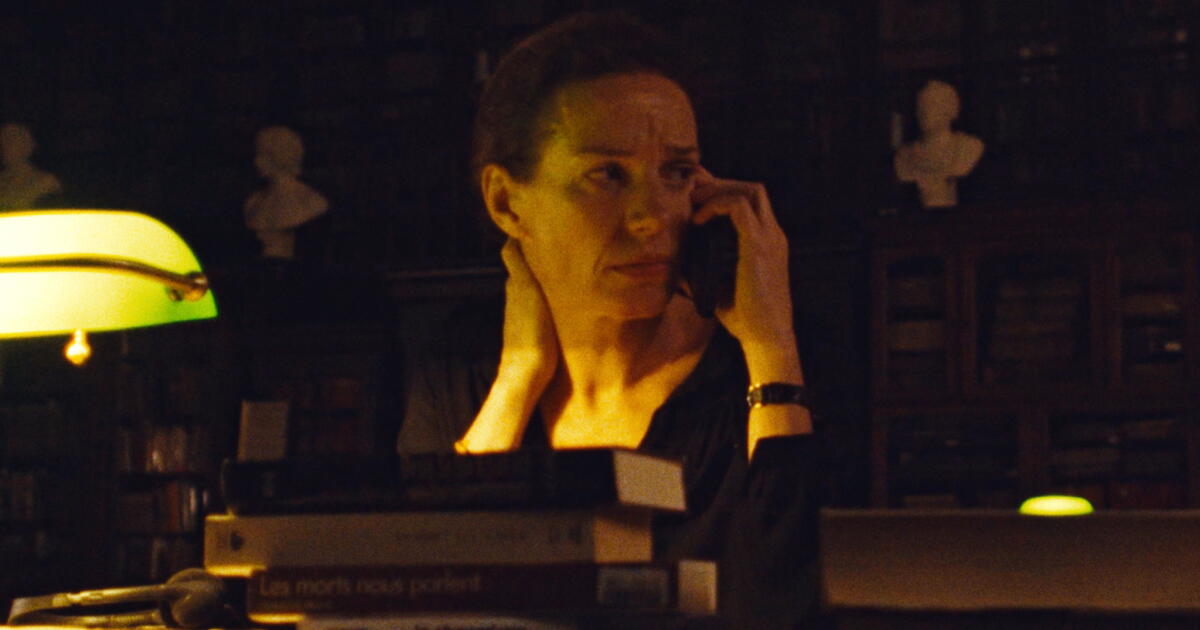
That said, the movie opens deceptively: Béatrice (Anne-Laure Sellier), a professor of philosophy at Columbia in New York, is clearly boring her two unseen colleagues over drinks with a monologue about her theories of memory and brain function. Alone afterward, however, with the camera following her as if she were a secret agent and the orchestral swell of Gustav Holst’s “The Planets” lending Hitchcockian tension, the real story begins to unfold in large, ornate libraries.
What draws Béatrice’s attention is a fantastical claim made by a Benedictine monk in an Italian magazine article from the 1970s. He insists he discovered an instrument with the power to pull images and sound from the whole of human history, presenting them on a television screen. With this time-shaping device called the Chronovisor, Father Pellegrino Ernetti professed to have seen footage of the crucified Christ and even enjoyed a lost play staged by an ancient Roman dramatist. At the end of a slow zoom shot, we see the article’s title in Italian until it’s translated for us in English: “A Machine Has Been Invented That Photographs the Past.”
With that, “Chronovisor” and its obsessed protagonist enter a trancelike, analog-heavy state in which obscure texts in myriad languages tease a concealed parascientific history of potentially great importance. In other words, get ready to read a lot and yet, surprisingly, to enjoy the immersion, as one might the hushed thrill of a surveillance sequence. As Béatrice’s amateur detective work pulls her in deeper, the strands begin to suggest a conspiracy, one marked by mysterious disappearances and the clandestine sway of the Vatican.
The question of what’s real and not isn’t only Béatrice’s to unpack — you may wonder yourself whether Auen and Walker have fabricated their esoteric source materials and invented the strange saga of Ernetti. They haven’t. Not entirely, that is, which is part of the woozy enjoyment. Enhanced by cinematographer Leo Zhang’s atmospheric 16mm grain and a natural onscreen performance from first-time actor Sellier (a real-life French scholar in behavioral science), “Chronovisor” hums with deep appreciation for research and evidence. We get both a tantalizing armchair mystery steeped in occult-ish authenticity, but also a sly commentary on our own relationship to the pursuit of curiosity.
If your own interpretation of Béatrice’s quest leads to the realization that this supposedly long-lost technology may already be with us, so be it. The filmmakers surely won’t disabuse you of that notion. They save their most disorienting trick for last: a reality-bending sequence that could qualify as video art. Whether it proves anything is, of course, up for grabs, but it surely helps “Chronovisor” remain wonderfully unclassifiable.
‘Chronovisor’
In English, French, Italian and German, with subtitles
Not rated
Running time: 1 hour, 40 minutes
Playing: Opens Friday, Oct. 2 at Laemmle Glendale

A researcher falls down a rabbit hole of academia in “Chronovisor,” a singular indie that sneaks up on you. Filmmakers Jack Auen and Kevin Walker — who operate under the name Cosmic Salon — make movies in the belief that intellectual pursuits can be both exciting and cinematic. “Chronovisor,” a pleasurably hand-crafted curio, firmly asserts that the sensorial possibilities of film can seem infinite.
That said, the movie opens deceptively: Béatrice (Anne-Laure Sellier), a professor of philosophy at Columbia in New York, is clearly boring her two unseen colleagues over drinks with a monologue about her theories of memory and brain function. Alone afterward, however, with the camera following her as if she were a secret agent and the orchestral swell of Gustav Holst’s “The Planets” lending Hitchcockian tension, the real story begins to unfold in large, ornate libraries.
What draws Béatrice’s attention is a fantastical claim made by a Benedictine monk in an Italian magazine article from the 1970s. He insists he discovered an instrument with the power to pull images and sound from the whole of human history, presenting them on a television screen. With this time-shaping device called the Chronovisor, Father Pellegrino Ernetti professed to have seen footage of the crucified Christ and even enjoyed a lost play staged by an ancient Roman dramatist. At the end of a slow zoom shot, we see the article’s title in Italian until it’s translated for us in English: “A Machine Has Been Invented That Photographs the Past.”
With that, “Chronovisor” and its obsessed protagonist enter a trancelike, analog-heavy state in which obscure texts in myriad languages tease a concealed parascientific history of potentially great importance. In other words, get ready to read a lot and yet, surprisingly, to enjoy the immersion, as one might the hushed thrill of a surveillance sequence. As Béatrice’s amateur detective work pulls her in deeper, the strands begin to suggest a conspiracy, one marked by mysterious disappearances and the clandestine sway of the Vatican.
The question of what’s real and not isn’t only Béatrice’s to unpack — you may wonder yourself whether Auen and Walker have fabricated their esoteric source materials and invented the strange saga of Ernetti. They haven’t. Not entirely, that is, which is part of the woozy enjoyment. Enhanced by cinematographer Leo Zhang’s atmospheric 16mm grain and a natural onscreen performance from first-time actor Sellier (a real-life French scholar in behavioral science), “Chronovisor” hums with deep appreciation for research and evidence. We get both a tantalizing armchair mystery steeped in occult-ish authenticity, but also a sly commentary on our own relationship to the pursuit of curiosity.
If your own interpretation of Béatrice’s quest leads to the realization that this supposedly long-lost technology may already be with us, so be it. The filmmakers surely won’t disabuse you of that notion. They save their most disorienting trick for last: a reality-bending sequence that could qualify as video art. Whether it proves anything is, of course, up for grabs, but it surely helps “Chronovisor” remain wonderfully unclassifiable.
‘Chronovisor’
In English, French, Italian and German, with subtitles
Not rated
Running time: 1 hour, 40 minutes
Playing: Opens Friday, Oct. 2 at Laemmle Glendale

A researcher falls down a rabbit hole of academia in “Chronovisor,” a singular indie that sneaks up on you. Filmmakers Jack Auen and Kevin Walker — who operate under the name Cosmic Salon — make movies in the belief that intellectual pursuits can be both exciting and cinematic. “Chronovisor,” a pleasurably hand-crafted curio, firmly asserts that the sensorial possibilities of film can seem infinite.
That said, the movie opens deceptively: Béatrice (Anne-Laure Sellier), a professor of philosophy at Columbia in New York, is clearly boring her two unseen colleagues over drinks with a monologue about her theories of memory and brain function. Alone afterward, however, with the camera following her as if she were a secret agent and the orchestral swell of Gustav Holst’s “The Planets” lending Hitchcockian tension, the real story begins to unfold in large, ornate libraries.
What draws Béatrice’s attention is a fantastical claim made by a Benedictine monk in an Italian magazine article from the 1970s. He insists he discovered an instrument with the power to pull images and sound from the whole of human history, presenting them on a television screen. With this time-shaping device called the Chronovisor, Father Pellegrino Ernetti professed to have seen footage of the crucified Christ and even enjoyed a lost play staged by an ancient Roman dramatist. At the end of a slow zoom shot, we see the article’s title in Italian until it’s translated for us in English: “A Machine Has Been Invented That Photographs the Past.”
With that, “Chronovisor” and its obsessed protagonist enter a trancelike, analog-heavy state in which obscure texts in myriad languages tease a concealed parascientific history of potentially great importance. In other words, get ready to read a lot and yet, surprisingly, to enjoy the immersion, as one might the hushed thrill of a surveillance sequence. As Béatrice’s amateur detective work pulls her in deeper, the strands begin to suggest a conspiracy, one marked by mysterious disappearances and the clandestine sway of the Vatican.
The question of what’s real and not isn’t only Béatrice’s to unpack — you may wonder yourself whether Auen and Walker have fabricated their esoteric source materials and invented the strange saga of Ernetti. They haven’t. Not entirely, that is, which is part of the woozy enjoyment. Enhanced by cinematographer Leo Zhang’s atmospheric 16mm grain and a natural onscreen performance from first-time actor Sellier (a real-life French scholar in behavioral science), “Chronovisor” hums with deep appreciation for research and evidence. We get both a tantalizing armchair mystery steeped in occult-ish authenticity, but also a sly commentary on our own relationship to the pursuit of curiosity.
If your own interpretation of Béatrice’s quest leads to the realization that this supposedly long-lost technology may already be with us, so be it. The filmmakers surely won’t disabuse you of that notion. They save their most disorienting trick for last: a reality-bending sequence that could qualify as video art. Whether it proves anything is, of course, up for grabs, but it surely helps “Chronovisor” remain wonderfully unclassifiable.
‘Chronovisor’
In English, French, Italian and German, with subtitles
Not rated
Running time: 1 hour, 40 minutes
Playing: Opens Friday, Oct. 2 at Laemmle Glendale
A researcher falls down a rabbit hole of academia in “Chronovisor,” a singular indie that sneaks up on you. Filmmakers Jack Auen and Kevin Walker — who operate under the name Cosmic Salon — make movies in the belief that intellectual pursuits can be both exciting and cinematic. “Chronovisor,” a pleasurably hand-crafted curio, firmly asserts that the sensorial possibilities of film can seem infinite.
That said, the movie opens deceptively: Béatrice (Anne-Laure Sellier), a professor of philosophy at Columbia in New York, is clearly boring her two unseen colleagues over drinks with a monologue about her theories of memory and brain function. Alone afterward, however, with the camera following her as if she were a secret agent and the orchestral swell of Gustav Holst’s “The Planets” lending Hitchcockian tension, the real story begins to unfold in large, ornate libraries.
What draws Béatrice’s attention is a fantastical claim made by a Benedictine monk in an Italian magazine article from the 1970s. He insists he discovered an instrument with the power to pull images and sound from the whole of human history, presenting them on a television screen. With this time-shaping device called the Chronovisor, Father Pellegrino Ernetti professed to have seen footage of the crucified Christ and even enjoyed a lost play staged by an ancient Roman dramatist. At the end of a slow zoom shot, we see the article’s title in Italian until it’s translated for us in English: “A Machine Has Been Invented That Photographs the Past.”
With that, “Chronovisor” and its obsessed protagonist enter a trancelike, analog-heavy state in which obscure texts in myriad languages tease a concealed parascientific history of potentially great importance. In other words, get ready to read a lot and yet, surprisingly, to enjoy the immersion, as one might the hushed thrill of a surveillance sequence. As Béatrice’s amateur detective work pulls her in deeper, the strands begin to suggest a conspiracy, one marked by mysterious disappearances and the clandestine sway of the Vatican.
The question of what’s real and not isn’t only Béatrice’s to unpack — you may wonder yourself whether Auen and Walker have fabricated their esoteric source materials and invented the strange saga of Ernetti. They haven’t. Not entirely, that is, which is part of the woozy enjoyment. Enhanced by cinematographer Leo Zhang’s atmospheric 16mm grain and a natural onscreen performance from first-time actor Sellier (a real-life French scholar in behavioral science), “Chronovisor” hums with deep appreciation for research and evidence. We get both a tantalizing armchair mystery steeped in occult-ish authenticity, but also a sly commentary on our own relationship to the pursuit of curiosity.
If your own interpretation of Béatrice’s quest leads to the realization that this supposedly long-lost technology may already be with us, so be it. The filmmakers surely won’t disabuse you of that notion. They save their most disorienting trick for last: a reality-bending sequence that could qualify as video art. Whether it proves anything is, of course, up for grabs, but it surely helps “Chronovisor” remain wonderfully unclassifiable.
‘Chronovisor’
In English, French, Italian and German, with subtitles
Not rated
Running time: 1 hour, 40 minutes
Playing: Opens Friday, Oct. 2 at Laemmle Glendale

A researcher falls down a rabbit hole of academia in “Chronovisor,” a singular indie that sneaks up on you. Filmmakers Jack Auen and Kevin Walker — who operate under the name Cosmic Salon — make movies in the belief that intellectual pursuits can be both exciting and cinematic. “Chronovisor,” a pleasurably hand-crafted curio, firmly asserts that the sensorial possibilities of film can seem infinite.
That said, the movie opens deceptively: Béatrice (Anne-Laure Sellier), a professor of philosophy at Columbia in New York, is clearly boring her two unseen colleagues over drinks with a monologue about her theories of memory and brain function. Alone afterward, however, with the camera following her as if she were a secret agent and the orchestral swell of Gustav Holst’s “The Planets” lending Hitchcockian tension, the real story begins to unfold in large, ornate libraries.
What draws Béatrice’s attention is a fantastical claim made by a Benedictine monk in an Italian magazine article from the 1970s. He insists he discovered an instrument with the power to pull images and sound from the whole of human history, presenting them on a television screen. With this time-shaping device called the Chronovisor, Father Pellegrino Ernetti professed to have seen footage of the crucified Christ and even enjoyed a lost play staged by an ancient Roman dramatist. At the end of a slow zoom shot, we see the article’s title in Italian until it’s translated for us in English: “A Machine Has Been Invented That Photographs the Past.”
With that, “Chronovisor” and its obsessed protagonist enter a trancelike, analog-heavy state in which obscure texts in myriad languages tease a concealed parascientific history of potentially great importance. In other words, get ready to read a lot and yet, surprisingly, to enjoy the immersion, as one might the hushed thrill of a surveillance sequence. As Béatrice’s amateur detective work pulls her in deeper, the strands begin to suggest a conspiracy, one marked by mysterious disappearances and the clandestine sway of the Vatican.
The question of what’s real and not isn’t only Béatrice’s to unpack — you may wonder yourself whether Auen and Walker have fabricated their esoteric source materials and invented the strange saga of Ernetti. They haven’t. Not entirely, that is, which is part of the woozy enjoyment. Enhanced by cinematographer Leo Zhang’s atmospheric 16mm grain and a natural onscreen performance from first-time actor Sellier (a real-life French scholar in behavioral science), “Chronovisor” hums with deep appreciation for research and evidence. We get both a tantalizing armchair mystery steeped in occult-ish authenticity, but also a sly commentary on our own relationship to the pursuit of curiosity.
If your own interpretation of Béatrice’s quest leads to the realization that this supposedly long-lost technology may already be with us, so be it. The filmmakers surely won’t disabuse you of that notion. They save their most disorienting trick for last: a reality-bending sequence that could qualify as video art. Whether it proves anything is, of course, up for grabs, but it surely helps “Chronovisor” remain wonderfully unclassifiable.
‘Chronovisor’
In English, French, Italian and German, with subtitles
Not rated
Running time: 1 hour, 40 minutes
Playing: Opens Friday, Oct. 2 at Laemmle Glendale
A researcher falls down a rabbit hole of academia in “Chronovisor,” a singular indie that sneaks up on you. Filmmakers Jack Auen and Kevin Walker — who operate under the name Cosmic Salon — make movies in the belief that intellectual pursuits can be both exciting and cinematic. “Chronovisor,” a pleasurably hand-crafted curio, firmly asserts that the sensorial possibilities of film can seem infinite.
That said, the movie opens deceptively: Béatrice (Anne-Laure Sellier), a professor of philosophy at Columbia in New York, is clearly boring her two unseen colleagues over drinks with a monologue about her theories of memory and brain function. Alone afterward, however, with the camera following her as if she were a secret agent and the orchestral swell of Gustav Holst’s “The Planets” lending Hitchcockian tension, the real story begins to unfold in large, ornate libraries.
What draws Béatrice’s attention is a fantastical claim made by a Benedictine monk in an Italian magazine article from the 1970s. He insists he discovered an instrument with the power to pull images and sound from the whole of human history, presenting them on a television screen. With this time-shaping device called the Chronovisor, Father Pellegrino Ernetti professed to have seen footage of the crucified Christ and even enjoyed a lost play staged by an ancient Roman dramatist. At the end of a slow zoom shot, we see the article’s title in Italian until it’s translated for us in English: “A Machine Has Been Invented That Photographs the Past.”
With that, “Chronovisor” and its obsessed protagonist enter a trancelike, analog-heavy state in which obscure texts in myriad languages tease a concealed parascientific history of potentially great importance. In other words, get ready to read a lot and yet, surprisingly, to enjoy the immersion, as one might the hushed thrill of a surveillance sequence. As Béatrice’s amateur detective work pulls her in deeper, the strands begin to suggest a conspiracy, one marked by mysterious disappearances and the clandestine sway of the Vatican.
The question of what’s real and not isn’t only Béatrice’s to unpack — you may wonder yourself whether Auen and Walker have fabricated their esoteric source materials and invented the strange saga of Ernetti. They haven’t. Not entirely, that is, which is part of the woozy enjoyment. Enhanced by cinematographer Leo Zhang’s atmospheric 16mm grain and a natural onscreen performance from first-time actor Sellier (a real-life French scholar in behavioral science), “Chronovisor” hums with deep appreciation for research and evidence. We get both a tantalizing armchair mystery steeped in occult-ish authenticity, but also a sly commentary on our own relationship to the pursuit of curiosity.
If your own interpretation of Béatrice’s quest leads to the realization that this supposedly long-lost technology may already be with us, so be it. The filmmakers surely won’t disabuse you of that notion. They save their most disorienting trick for last: a reality-bending sequence that could qualify as video art. Whether it proves anything is, of course, up for grabs, but it surely helps “Chronovisor” remain wonderfully unclassifiable.
‘Chronovisor’
In English, French, Italian and German, with subtitles
Not rated
Running time: 1 hour, 40 minutes
Playing: Opens Friday, Oct. 2 at Laemmle Glendale
A researcher falls down a rabbit hole of academia in “Chronovisor,” a singular indie that sneaks up on you. Filmmakers Jack Auen and Kevin Walker — who operate under the name Cosmic Salon — make movies in the belief that intellectual pursuits can be both exciting and cinematic. “Chronovisor,” a pleasurably hand-crafted curio, firmly asserts that the sensorial possibilities of film can seem infinite.
That said, the movie opens deceptively: Béatrice (Anne-Laure Sellier), a professor of philosophy at Columbia in New York, is clearly boring her two unseen colleagues over drinks with a monologue about her theories of memory and brain function. Alone afterward, however, with the camera following her as if she were a secret agent and the orchestral swell of Gustav Holst’s “The Planets” lending Hitchcockian tension, the real story begins to unfold in large, ornate libraries.
What draws Béatrice’s attention is a fantastical claim made by a Benedictine monk in an Italian magazine article from the 1970s. He insists he discovered an instrument with the power to pull images and sound from the whole of human history, presenting them on a television screen. With this time-shaping device called the Chronovisor, Father Pellegrino Ernetti professed to have seen footage of the crucified Christ and even enjoyed a lost play staged by an ancient Roman dramatist. At the end of a slow zoom shot, we see the article’s title in Italian until it’s translated for us in English: “A Machine Has Been Invented That Photographs the Past.”
With that, “Chronovisor” and its obsessed protagonist enter a trancelike, analog-heavy state in which obscure texts in myriad languages tease a concealed parascientific history of potentially great importance. In other words, get ready to read a lot and yet, surprisingly, to enjoy the immersion, as one might the hushed thrill of a surveillance sequence. As Béatrice’s amateur detective work pulls her in deeper, the strands begin to suggest a conspiracy, one marked by mysterious disappearances and the clandestine sway of the Vatican.
The question of what’s real and not isn’t only Béatrice’s to unpack — you may wonder yourself whether Auen and Walker have fabricated their esoteric source materials and invented the strange saga of Ernetti. They haven’t. Not entirely, that is, which is part of the woozy enjoyment. Enhanced by cinematographer Leo Zhang’s atmospheric 16mm grain and a natural onscreen performance from first-time actor Sellier (a real-life French scholar in behavioral science), “Chronovisor” hums with deep appreciation for research and evidence. We get both a tantalizing armchair mystery steeped in occult-ish authenticity, but also a sly commentary on our own relationship to the pursuit of curiosity.
If your own interpretation of Béatrice’s quest leads to the realization that this supposedly long-lost technology may already be with us, so be it. The filmmakers surely won’t disabuse you of that notion. They save their most disorienting trick for last: a reality-bending sequence that could qualify as video art. Whether it proves anything is, of course, up for grabs, but it surely helps “Chronovisor” remain wonderfully unclassifiable.
‘Chronovisor’
In English, French, Italian and German, with subtitles
Not rated
Running time: 1 hour, 40 minutes
Playing: Opens Friday, Oct. 2 at Laemmle Glendale
A researcher falls down a rabbit hole of academia in “Chronovisor,” a singular indie that sneaks up on you. Filmmakers Jack Auen and Kevin Walker — who operate under the name Cosmic Salon — make movies in the belief that intellectual pursuits can be both exciting and cinematic. “Chronovisor,” a pleasurably hand-crafted curio, firmly asserts that the sensorial possibilities of film can seem infinite.
That said, the movie opens deceptively: Béatrice (Anne-Laure Sellier), a professor of philosophy at Columbia in New York, is clearly boring her two unseen colleagues over drinks with a monologue about her theories of memory and brain function. Alone afterward, however, with the camera following her as if she were a secret agent and the orchestral swell of Gustav Holst’s “The Planets” lending Hitchcockian tension, the real story begins to unfold in large, ornate libraries.
What draws Béatrice’s attention is a fantastical claim made by a Benedictine monk in an Italian magazine article from the 1970s. He insists he discovered an instrument with the power to pull images and sound from the whole of human history, presenting them on a television screen. With this time-shaping device called the Chronovisor, Father Pellegrino Ernetti professed to have seen footage of the crucified Christ and even enjoyed a lost play staged by an ancient Roman dramatist. At the end of a slow zoom shot, we see the article’s title in Italian until it’s translated for us in English: “A Machine Has Been Invented That Photographs the Past.”
With that, “Chronovisor” and its obsessed protagonist enter a trancelike, analog-heavy state in which obscure texts in myriad languages tease a concealed parascientific history of potentially great importance. In other words, get ready to read a lot and yet, surprisingly, to enjoy the immersion, as one might the hushed thrill of a surveillance sequence. As Béatrice’s amateur detective work pulls her in deeper, the strands begin to suggest a conspiracy, one marked by mysterious disappearances and the clandestine sway of the Vatican.
The question of what’s real and not isn’t only Béatrice’s to unpack — you may wonder yourself whether Auen and Walker have fabricated their esoteric source materials and invented the strange saga of Ernetti. They haven’t. Not entirely, that is, which is part of the woozy enjoyment. Enhanced by cinematographer Leo Zhang’s atmospheric 16mm grain and a natural onscreen performance from first-time actor Sellier (a real-life French scholar in behavioral science), “Chronovisor” hums with deep appreciation for research and evidence. We get both a tantalizing armchair mystery steeped in occult-ish authenticity, but also a sly commentary on our own relationship to the pursuit of curiosity.
If your own interpretation of Béatrice’s quest leads to the realization that this supposedly long-lost technology may already be with us, so be it. The filmmakers surely won’t disabuse you of that notion. They save their most disorienting trick for last: a reality-bending sequence that could qualify as video art. Whether it proves anything is, of course, up for grabs, but it surely helps “Chronovisor” remain wonderfully unclassifiable.
‘Chronovisor’
In English, French, Italian and German, with subtitles
Not rated
Running time: 1 hour, 40 minutes
Playing: Opens Friday, Oct. 2 at Laemmle Glendale

A researcher falls down a rabbit hole of academia in “Chronovisor,” a singular indie that sneaks up on you. Filmmakers Jack Auen and Kevin Walker — who operate under the name Cosmic Salon — make movies in the belief that intellectual pursuits can be both exciting and cinematic. “Chronovisor,” a pleasurably hand-crafted curio, firmly asserts that the sensorial possibilities of film can seem infinite.
That said, the movie opens deceptively: Béatrice (Anne-Laure Sellier), a professor of philosophy at Columbia in New York, is clearly boring her two unseen colleagues over drinks with a monologue about her theories of memory and brain function. Alone afterward, however, with the camera following her as if she were a secret agent and the orchestral swell of Gustav Holst’s “The Planets” lending Hitchcockian tension, the real story begins to unfold in large, ornate libraries.
What draws Béatrice’s attention is a fantastical claim made by a Benedictine monk in an Italian magazine article from the 1970s. He insists he discovered an instrument with the power to pull images and sound from the whole of human history, presenting them on a television screen. With this time-shaping device called the Chronovisor, Father Pellegrino Ernetti professed to have seen footage of the crucified Christ and even enjoyed a lost play staged by an ancient Roman dramatist. At the end of a slow zoom shot, we see the article’s title in Italian until it’s translated for us in English: “A Machine Has Been Invented That Photographs the Past.”
With that, “Chronovisor” and its obsessed protagonist enter a trancelike, analog-heavy state in which obscure texts in myriad languages tease a concealed parascientific history of potentially great importance. In other words, get ready to read a lot and yet, surprisingly, to enjoy the immersion, as one might the hushed thrill of a surveillance sequence. As Béatrice’s amateur detective work pulls her in deeper, the strands begin to suggest a conspiracy, one marked by mysterious disappearances and the clandestine sway of the Vatican.
The question of what’s real and not isn’t only Béatrice’s to unpack — you may wonder yourself whether Auen and Walker have fabricated their esoteric source materials and invented the strange saga of Ernetti. They haven’t. Not entirely, that is, which is part of the woozy enjoyment. Enhanced by cinematographer Leo Zhang’s atmospheric 16mm grain and a natural onscreen performance from first-time actor Sellier (a real-life French scholar in behavioral science), “Chronovisor” hums with deep appreciation for research and evidence. We get both a tantalizing armchair mystery steeped in occult-ish authenticity, but also a sly commentary on our own relationship to the pursuit of curiosity.
If your own interpretation of Béatrice’s quest leads to the realization that this supposedly long-lost technology may already be with us, so be it. The filmmakers surely won’t disabuse you of that notion. They save their most disorienting trick for last: a reality-bending sequence that could qualify as video art. Whether it proves anything is, of course, up for grabs, but it surely helps “Chronovisor” remain wonderfully unclassifiable.
‘Chronovisor’
In English, French, Italian and German, with subtitles
Not rated
Running time: 1 hour, 40 minutes
Playing: Opens Friday, Oct. 2 at Laemmle Glendale
A researcher falls down a rabbit hole of academia in “Chronovisor,” a singular indie that sneaks up on you. Filmmakers Jack Auen and Kevin Walker — who operate under the name Cosmic Salon — make movies in the belief that intellectual pursuits can be both exciting and cinematic. “Chronovisor,” a pleasurably hand-crafted curio, firmly asserts that the sensorial possibilities of film can seem infinite.
That said, the movie opens deceptively: Béatrice (Anne-Laure Sellier), a professor of philosophy at Columbia in New York, is clearly boring her two unseen colleagues over drinks with a monologue about her theories of memory and brain function. Alone afterward, however, with the camera following her as if she were a secret agent and the orchestral swell of Gustav Holst’s “The Planets” lending Hitchcockian tension, the real story begins to unfold in large, ornate libraries.
What draws Béatrice’s attention is a fantastical claim made by a Benedictine monk in an Italian magazine article from the 1970s. He insists he discovered an instrument with the power to pull images and sound from the whole of human history, presenting them on a television screen. With this time-shaping device called the Chronovisor, Father Pellegrino Ernetti professed to have seen footage of the crucified Christ and even enjoyed a lost play staged by an ancient Roman dramatist. At the end of a slow zoom shot, we see the article’s title in Italian until it’s translated for us in English: “A Machine Has Been Invented That Photographs the Past.”
With that, “Chronovisor” and its obsessed protagonist enter a trancelike, analog-heavy state in which obscure texts in myriad languages tease a concealed parascientific history of potentially great importance. In other words, get ready to read a lot and yet, surprisingly, to enjoy the immersion, as one might the hushed thrill of a surveillance sequence. As Béatrice’s amateur detective work pulls her in deeper, the strands begin to suggest a conspiracy, one marked by mysterious disappearances and the clandestine sway of the Vatican.
The question of what’s real and not isn’t only Béatrice’s to unpack — you may wonder yourself whether Auen and Walker have fabricated their esoteric source materials and invented the strange saga of Ernetti. They haven’t. Not entirely, that is, which is part of the woozy enjoyment. Enhanced by cinematographer Leo Zhang’s atmospheric 16mm grain and a natural onscreen performance from first-time actor Sellier (a real-life French scholar in behavioral science), “Chronovisor” hums with deep appreciation for research and evidence. We get both a tantalizing armchair mystery steeped in occult-ish authenticity, but also a sly commentary on our own relationship to the pursuit of curiosity.
If your own interpretation of Béatrice’s quest leads to the realization that this supposedly long-lost technology may already be with us, so be it. The filmmakers surely won’t disabuse you of that notion. They save their most disorienting trick for last: a reality-bending sequence that could qualify as video art. Whether it proves anything is, of course, up for grabs, but it surely helps “Chronovisor” remain wonderfully unclassifiable.
‘Chronovisor’
In English, French, Italian and German, with subtitles
Not rated
Running time: 1 hour, 40 minutes
Playing: Opens Friday, Oct. 2 at Laemmle Glendale
A researcher falls down a rabbit hole of academia in “Chronovisor,” a singular indie that sneaks up on you. Filmmakers Jack Auen and Kevin Walker — who operate under the name Cosmic Salon — make movies in the belief that intellectual pursuits can be both exciting and cinematic. “Chronovisor,” a pleasurably hand-crafted curio, firmly asserts that the sensorial possibilities of film can seem infinite.
That said, the movie opens deceptively: Béatrice (Anne-Laure Sellier), a professor of philosophy at Columbia in New York, is clearly boring her two unseen colleagues over drinks with a monologue about her theories of memory and brain function. Alone afterward, however, with the camera following her as if she were a secret agent and the orchestral swell of Gustav Holst’s “The Planets” lending Hitchcockian tension, the real story begins to unfold in large, ornate libraries.
What draws Béatrice’s attention is a fantastical claim made by a Benedictine monk in an Italian magazine article from the 1970s. He insists he discovered an instrument with the power to pull images and sound from the whole of human history, presenting them on a television screen. With this time-shaping device called the Chronovisor, Father Pellegrino Ernetti professed to have seen footage of the crucified Christ and even enjoyed a lost play staged by an ancient Roman dramatist. At the end of a slow zoom shot, we see the article’s title in Italian until it’s translated for us in English: “A Machine Has Been Invented That Photographs the Past.”
With that, “Chronovisor” and its obsessed protagonist enter a trancelike, analog-heavy state in which obscure texts in myriad languages tease a concealed parascientific history of potentially great importance. In other words, get ready to read a lot and yet, surprisingly, to enjoy the immersion, as one might the hushed thrill of a surveillance sequence. As Béatrice’s amateur detective work pulls her in deeper, the strands begin to suggest a conspiracy, one marked by mysterious disappearances and the clandestine sway of the Vatican.
The question of what’s real and not isn’t only Béatrice’s to unpack — you may wonder yourself whether Auen and Walker have fabricated their esoteric source materials and invented the strange saga of Ernetti. They haven’t. Not entirely, that is, which is part of the woozy enjoyment. Enhanced by cinematographer Leo Zhang’s atmospheric 16mm grain and a natural onscreen performance from first-time actor Sellier (a real-life French scholar in behavioral science), “Chronovisor” hums with deep appreciation for research and evidence. We get both a tantalizing armchair mystery steeped in occult-ish authenticity, but also a sly commentary on our own relationship to the pursuit of curiosity.
If your own interpretation of Béatrice’s quest leads to the realization that this supposedly long-lost technology may already be with us, so be it. The filmmakers surely won’t disabuse you of that notion. They save their most disorienting trick for last: a reality-bending sequence that could qualify as video art. Whether it proves anything is, of course, up for grabs, but it surely helps “Chronovisor” remain wonderfully unclassifiable.
‘Chronovisor’
In English, French, Italian and German, with subtitles
Not rated
Running time: 1 hour, 40 minutes
Playing: Opens Friday, Oct. 2 at Laemmle Glendale
A researcher falls down a rabbit hole of academia in “Chronovisor,” a singular indie that sneaks up on you. Filmmakers Jack Auen and Kevin Walker — who operate under the name Cosmic Salon — make movies in the belief that intellectual pursuits can be both exciting and cinematic. “Chronovisor,” a pleasurably hand-crafted curio, firmly asserts that the sensorial possibilities of film can seem infinite.
That said, the movie opens deceptively: Béatrice (Anne-Laure Sellier), a professor of philosophy at Columbia in New York, is clearly boring her two unseen colleagues over drinks with a monologue about her theories of memory and brain function. Alone afterward, however, with the camera following her as if she were a secret agent and the orchestral swell of Gustav Holst’s “The Planets” lending Hitchcockian tension, the real story begins to unfold in large, ornate libraries.
What draws Béatrice’s attention is a fantastical claim made by a Benedictine monk in an Italian magazine article from the 1970s. He insists he discovered an instrument with the power to pull images and sound from the whole of human history, presenting them on a television screen. With this time-shaping device called the Chronovisor, Father Pellegrino Ernetti professed to have seen footage of the crucified Christ and even enjoyed a lost play staged by an ancient Roman dramatist. At the end of a slow zoom shot, we see the article’s title in Italian until it’s translated for us in English: “A Machine Has Been Invented That Photographs the Past.”
With that, “Chronovisor” and its obsessed protagonist enter a trancelike, analog-heavy state in which obscure texts in myriad languages tease a concealed parascientific history of potentially great importance. In other words, get ready to read a lot and yet, surprisingly, to enjoy the immersion, as one might the hushed thrill of a surveillance sequence. As Béatrice’s amateur detective work pulls her in deeper, the strands begin to suggest a conspiracy, one marked by mysterious disappearances and the clandestine sway of the Vatican.
The question of what’s real and not isn’t only Béatrice’s to unpack — you may wonder yourself whether Auen and Walker have fabricated their esoteric source materials and invented the strange saga of Ernetti. They haven’t. Not entirely, that is, which is part of the woozy enjoyment. Enhanced by cinematographer Leo Zhang’s atmospheric 16mm grain and a natural onscreen performance from first-time actor Sellier (a real-life French scholar in behavioral science), “Chronovisor” hums with deep appreciation for research and evidence. We get both a tantalizing armchair mystery steeped in occult-ish authenticity, but also a sly commentary on our own relationship to the pursuit of curiosity.
If your own interpretation of Béatrice’s quest leads to the realization that this supposedly long-lost technology may already be with us, so be it. The filmmakers surely won’t disabuse you of that notion. They save their most disorienting trick for last: a reality-bending sequence that could qualify as video art. Whether it proves anything is, of course, up for grabs, but it surely helps “Chronovisor” remain wonderfully unclassifiable.
‘Chronovisor’
In English, French, Italian and German, with subtitles
Not rated
Running time: 1 hour, 40 minutes
Playing: Opens Friday, Oct. 2 at Laemmle Glendale
A researcher falls down a rabbit hole of academia in “Chronovisor,” a singular indie that sneaks up on you. Filmmakers Jack Auen and Kevin Walker — who operate under the name Cosmic Salon — make movies in the belief that intellectual pursuits can be both exciting and cinematic. “Chronovisor,” a pleasurably hand-crafted curio, firmly asserts that the sensorial possibilities of film can seem infinite.
That said, the movie opens deceptively: Béatrice (Anne-Laure Sellier), a professor of philosophy at Columbia in New York, is clearly boring her two unseen colleagues over drinks with a monologue about her theories of memory and brain function. Alone afterward, however, with the camera following her as if she were a secret agent and the orchestral swell of Gustav Holst’s “The Planets” lending Hitchcockian tension, the real story begins to unfold in large, ornate libraries.
What draws Béatrice’s attention is a fantastical claim made by a Benedictine monk in an Italian magazine article from the 1970s. He insists he discovered an instrument with the power to pull images and sound from the whole of human history, presenting them on a television screen. With this time-shaping device called the Chronovisor, Father Pellegrino Ernetti professed to have seen footage of the crucified Christ and even enjoyed a lost play staged by an ancient Roman dramatist. At the end of a slow zoom shot, we see the article’s title in Italian until it’s translated for us in English: “A Machine Has Been Invented That Photographs the Past.”
With that, “Chronovisor” and its obsessed protagonist enter a trancelike, analog-heavy state in which obscure texts in myriad languages tease a concealed parascientific history of potentially great importance. In other words, get ready to read a lot and yet, surprisingly, to enjoy the immersion, as one might the hushed thrill of a surveillance sequence. As Béatrice’s amateur detective work pulls her in deeper, the strands begin to suggest a conspiracy, one marked by mysterious disappearances and the clandestine sway of the Vatican.
The question of what’s real and not isn’t only Béatrice’s to unpack — you may wonder yourself whether Auen and Walker have fabricated their esoteric source materials and invented the strange saga of Ernetti. They haven’t. Not entirely, that is, which is part of the woozy enjoyment. Enhanced by cinematographer Leo Zhang’s atmospheric 16mm grain and a natural onscreen performance from first-time actor Sellier (a real-life French scholar in behavioral science), “Chronovisor” hums with deep appreciation for research and evidence. We get both a tantalizing armchair mystery steeped in occult-ish authenticity, but also a sly commentary on our own relationship to the pursuit of curiosity.
If your own interpretation of Béatrice’s quest leads to the realization that this supposedly long-lost technology may already be with us, so be it. The filmmakers surely won’t disabuse you of that notion. They save their most disorienting trick for last: a reality-bending sequence that could qualify as video art. Whether it proves anything is, of course, up for grabs, but it surely helps “Chronovisor” remain wonderfully unclassifiable.
‘Chronovisor’
In English, French, Italian and German, with subtitles
Not rated
Running time: 1 hour, 40 minutes
Playing: Opens Friday, Oct. 2 at Laemmle Glendale
A researcher falls down a rabbit hole of academia in “Chronovisor,” a singular indie that sneaks up on you. Filmmakers Jack Auen and Kevin Walker — who operate under the name Cosmic Salon — make movies in the belief that intellectual pursuits can be both exciting and cinematic. “Chronovisor,” a pleasurably hand-crafted curio, firmly asserts that the sensorial possibilities of film can seem infinite.
That said, the movie opens deceptively: Béatrice (Anne-Laure Sellier), a professor of philosophy at Columbia in New York, is clearly boring her two unseen colleagues over drinks with a monologue about her theories of memory and brain function. Alone afterward, however, with the camera following her as if she were a secret agent and the orchestral swell of Gustav Holst’s “The Planets” lending Hitchcockian tension, the real story begins to unfold in large, ornate libraries.
What draws Béatrice’s attention is a fantastical claim made by a Benedictine monk in an Italian magazine article from the 1970s. He insists he discovered an instrument with the power to pull images and sound from the whole of human history, presenting them on a television screen. With this time-shaping device called the Chronovisor, Father Pellegrino Ernetti professed to have seen footage of the crucified Christ and even enjoyed a lost play staged by an ancient Roman dramatist. At the end of a slow zoom shot, we see the article’s title in Italian until it’s translated for us in English: “A Machine Has Been Invented That Photographs the Past.”
With that, “Chronovisor” and its obsessed protagonist enter a trancelike, analog-heavy state in which obscure texts in myriad languages tease a concealed parascientific history of potentially great importance. In other words, get ready to read a lot and yet, surprisingly, to enjoy the immersion, as one might the hushed thrill of a surveillance sequence. As Béatrice’s amateur detective work pulls her in deeper, the strands begin to suggest a conspiracy, one marked by mysterious disappearances and the clandestine sway of the Vatican.
The question of what’s real and not isn’t only Béatrice’s to unpack — you may wonder yourself whether Auen and Walker have fabricated their esoteric source materials and invented the strange saga of Ernetti. They haven’t. Not entirely, that is, which is part of the woozy enjoyment. Enhanced by cinematographer Leo Zhang’s atmospheric 16mm grain and a natural onscreen performance from first-time actor Sellier (a real-life French scholar in behavioral science), “Chronovisor” hums with deep appreciation for research and evidence. We get both a tantalizing armchair mystery steeped in occult-ish authenticity, but also a sly commentary on our own relationship to the pursuit of curiosity.
If your own interpretation of Béatrice’s quest leads to the realization that this supposedly long-lost technology may already be with us, so be it. The filmmakers surely won’t disabuse you of that notion. They save their most disorienting trick for last: a reality-bending sequence that could qualify as video art. Whether it proves anything is, of course, up for grabs, but it surely helps “Chronovisor” remain wonderfully unclassifiable.
‘Chronovisor’
In English, French, Italian and German, with subtitles
Not rated
Running time: 1 hour, 40 minutes
Playing: Opens Friday, Oct. 2 at Laemmle Glendale
A researcher falls down a rabbit hole of academia in “Chronovisor,” a singular indie that sneaks up on you. Filmmakers Jack Auen and Kevin Walker — who operate under the name Cosmic Salon — make movies in the belief that intellectual pursuits can be both exciting and cinematic. “Chronovisor,” a pleasurably hand-crafted curio, firmly asserts that the sensorial possibilities of film can seem infinite.
That said, the movie opens deceptively: Béatrice (Anne-Laure Sellier), a professor of philosophy at Columbia in New York, is clearly boring her two unseen colleagues over drinks with a monologue about her theories of memory and brain function. Alone afterward, however, with the camera following her as if she were a secret agent and the orchestral swell of Gustav Holst’s “The Planets” lending Hitchcockian tension, the real story begins to unfold in large, ornate libraries.
What draws Béatrice’s attention is a fantastical claim made by a Benedictine monk in an Italian magazine article from the 1970s. He insists he discovered an instrument with the power to pull images and sound from the whole of human history, presenting them on a television screen. With this time-shaping device called the Chronovisor, Father Pellegrino Ernetti professed to have seen footage of the crucified Christ and even enjoyed a lost play staged by an ancient Roman dramatist. At the end of a slow zoom shot, we see the article’s title in Italian until it’s translated for us in English: “A Machine Has Been Invented That Photographs the Past.”
With that, “Chronovisor” and its obsessed protagonist enter a trancelike, analog-heavy state in which obscure texts in myriad languages tease a concealed parascientific history of potentially great importance. In other words, get ready to read a lot and yet, surprisingly, to enjoy the immersion, as one might the hushed thrill of a surveillance sequence. As Béatrice’s amateur detective work pulls her in deeper, the strands begin to suggest a conspiracy, one marked by mysterious disappearances and the clandestine sway of the Vatican.
The question of what’s real and not isn’t only Béatrice’s to unpack — you may wonder yourself whether Auen and Walker have fabricated their esoteric source materials and invented the strange saga of Ernetti. They haven’t. Not entirely, that is, which is part of the woozy enjoyment. Enhanced by cinematographer Leo Zhang’s atmospheric 16mm grain and a natural onscreen performance from first-time actor Sellier (a real-life French scholar in behavioral science), “Chronovisor” hums with deep appreciation for research and evidence. We get both a tantalizing armchair mystery steeped in occult-ish authenticity, but also a sly commentary on our own relationship to the pursuit of curiosity.
If your own interpretation of Béatrice’s quest leads to the realization that this supposedly long-lost technology may already be with us, so be it. The filmmakers surely won’t disabuse you of that notion. They save their most disorienting trick for last: a reality-bending sequence that could qualify as video art. Whether it proves anything is, of course, up for grabs, but it surely helps “Chronovisor” remain wonderfully unclassifiable.
‘Chronovisor’
In English, French, Italian and German, with subtitles
Not rated
Running time: 1 hour, 40 minutes
Playing: Opens Friday, Oct. 2 at Laemmle Glendale
A researcher falls down a rabbit hole of academia in “Chronovisor,” a singular indie that sneaks up on you. Filmmakers Jack Auen and Kevin Walker — who operate under the name Cosmic Salon — make movies in the belief that intellectual pursuits can be both exciting and cinematic. “Chronovisor,” a pleasurably hand-crafted curio, firmly asserts that the sensorial possibilities of film can seem infinite.
That said, the movie opens deceptively: Béatrice (Anne-Laure Sellier), a professor of philosophy at Columbia in New York, is clearly boring her two unseen colleagues over drinks with a monologue about her theories of memory and brain function. Alone afterward, however, with the camera following her as if she were a secret agent and the orchestral swell of Gustav Holst’s “The Planets” lending Hitchcockian tension, the real story begins to unfold in large, ornate libraries.
What draws Béatrice’s attention is a fantastical claim made by a Benedictine monk in an Italian magazine article from the 1970s. He insists he discovered an instrument with the power to pull images and sound from the whole of human history, presenting them on a television screen. With this time-shaping device called the Chronovisor, Father Pellegrino Ernetti professed to have seen footage of the crucified Christ and even enjoyed a lost play staged by an ancient Roman dramatist. At the end of a slow zoom shot, we see the article’s title in Italian until it’s translated for us in English: “A Machine Has Been Invented That Photographs the Past.”
With that, “Chronovisor” and its obsessed protagonist enter a trancelike, analog-heavy state in which obscure texts in myriad languages tease a concealed parascientific history of potentially great importance. In other words, get ready to read a lot and yet, surprisingly, to enjoy the immersion, as one might the hushed thrill of a surveillance sequence. As Béatrice’s amateur detective work pulls her in deeper, the strands begin to suggest a conspiracy, one marked by mysterious disappearances and the clandestine sway of the Vatican.
The question of what’s real and not isn’t only Béatrice’s to unpack — you may wonder yourself whether Auen and Walker have fabricated their esoteric source materials and invented the strange saga of Ernetti. They haven’t. Not entirely, that is, which is part of the woozy enjoyment. Enhanced by cinematographer Leo Zhang’s atmospheric 16mm grain and a natural onscreen performance from first-time actor Sellier (a real-life French scholar in behavioral science), “Chronovisor” hums with deep appreciation for research and evidence. We get both a tantalizing armchair mystery steeped in occult-ish authenticity, but also a sly commentary on our own relationship to the pursuit of curiosity.
If your own interpretation of Béatrice’s quest leads to the realization that this supposedly long-lost technology may already be with us, so be it. The filmmakers surely won’t disabuse you of that notion. They save their most disorienting trick for last: a reality-bending sequence that could qualify as video art. Whether it proves anything is, of course, up for grabs, but it surely helps “Chronovisor” remain wonderfully unclassifiable.
‘Chronovisor’
In English, French, Italian and German, with subtitles
Not rated
Running time: 1 hour, 40 minutes
Playing: Opens Friday, Oct. 2 at Laemmle Glendale

