

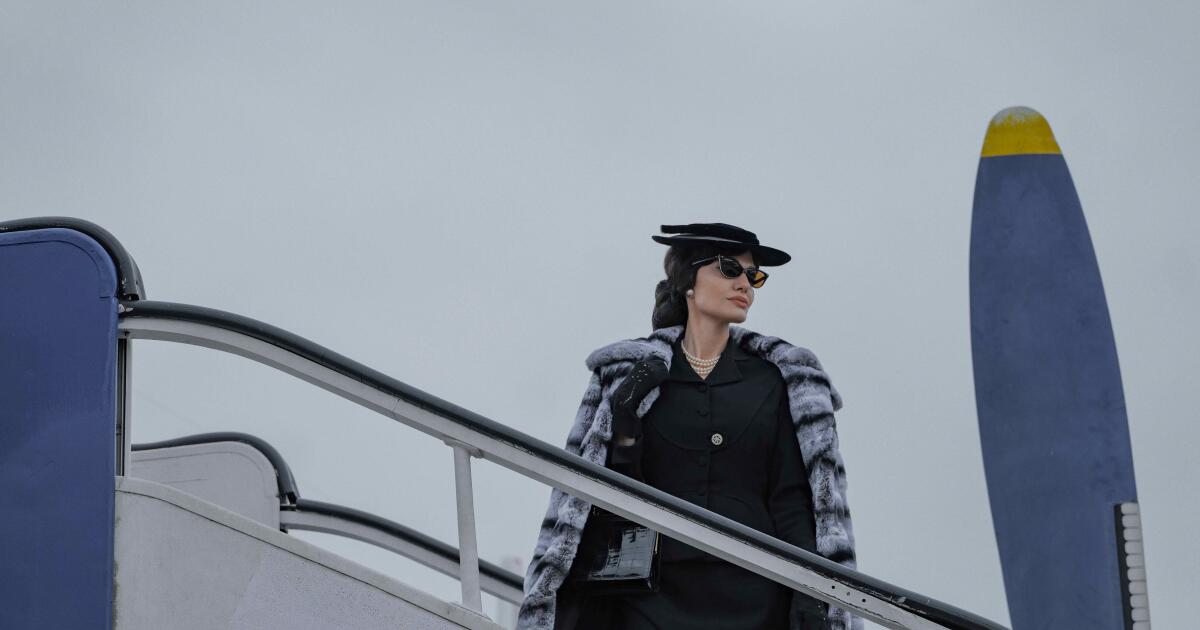
Maria Callas seized fame as the voice of Tosca, Medea and Carmen, opera’s eternally doomed heroines. If opera still commands audiences a century from now, perhaps it will sing of Callas, a fighter who survived the Nazi occupation of Greece, a heckling at La Scala, a media hazing on multiple continents and a humiliating public affair only to be hobbled by her own coping tools: sedatives and starvation.
“Maria,” starring Angelina Jolie, is director Pablo Larraín’s latest effort to build his own canon of 20th-century tragediennes. His previous melodramas “Jackie” and “Spencer” were fables about two painfully self-aware celebrities at their nadirs: Larraín peeked behind Jacqueline Kennedy‘s and Princess Diana’s facades less to humanize them than to expose their wounds. Callas, however, was infamous for her fits, so Larraín, perversely and underwhelmingly, chooses to respect her imperious veneer. If she’s the big boss-level diva he’s been working up to, Larraín lets her win.
This is Callas at the end of her life. Her corpse is the first thing we see onscreen, although cinematographer Edward Lachman has such a dazzling trick of cramming chandeliers into the frame that it takes a minute to spot her body. In the flashbacks that follow, Callas attempts to grandly dismiss liver disease as though it were spoiled wine. She spends most of the film doped up on Quaaludes, which in ’70s Paris were sold under the brand name Mandrax. Screenwriter Steven Knight even has her stroll around with an imaginary character named Mandrax (Kodi Smit-McPhee), a TV reporter she’s hallucinated into existence in order to feel important. Mandrax tosses her softball questions. She swats them down.
If you’ve seen any old interviews with Callas, you know that actual journalists tended to be rude with her. First, they’d ask Callas if she was a monster. Then they’d needle her about spending nine years with Aristotle Onassis only to get dumped for the future Jackie O. They needed to prick the goddess to see if she bled.
Early on, Callas parried these inquisitions with humor. Accused of hurtling a bottle of brandy at a director, she replied: “I wish I did. It would be a shame for the bottle.” As Callas got older, though, she got stiffer, and that’s the version we’re staring at here. Regal, guarded and stubborn, Jolie plays Callas as a lonely 50-something who rejected love, fame, joy and music and won’t fight that hard to get them back. Her character arc is just a blueprint plan of one; from scene to scene, you’re never sure whether she’s going to take action. Callas wants to be adored but she doesn’t want to be known. Her exhausted housekeepers Ferruccio (Pierfrancesco Favino) and Bruna (Alba Rohrwacher) speak volumes with every silent, fearful look, and when they get too personal with her, Callas commands them to move the piano as punishment.
Larraín makes a half-hearted attempt to recast Callas as a feminist martyr, alleging, as obliquely as possible, that she was once forced to trade her body to soldiers for cash and food. Biographical dots are unapologetically skipped, including her marriage to a man who doesn’t even merit a name before he’s ditched for Onassis (Haluk Bilginer). Adding to the disorientation, young Callas (Aggelina Papadopoulou) looks nothing like Jolie — not her lips, eyes, nose, jaw, frame, nothing. Yet the casting choice highlights how Callas recast herself in the 1950s, shedding a third of her body mass to transform from a zaftig soprano cliché into a high-fashion sylph (and in the process, sacrificing a bit of her oomph).
Callas could fold herself in a cloak and force an audience to focus on her. Her stillness was magnetic. All the emotions flooded out through her eyes and throat. Jolie trained in opera for seven months to prepare for the role and, according to Larraín, did her own singing on set. What we’re hearing is her voice blended into the real one at concentrations that range from 1% to 70% — the latter, I assume, in the scenes when a retired Callas tests her own vocal strength. To my ears, Jolie sounds fantastic, the kind of voice that would knock ’em dead on karaoke night. But peak Callas hits the senses like a lightning strike. Larraín tries to capture that power in his first close-up of Jolie, shoulders bare, singing at the camera in bold black and white. But the starkness of the shot works against him, giving us too much time to notice that Jolie’s throat barely seems to move, to wonder if her eyes shouldn’t have more passion.
Angelina Jolie in the movie “Maria.”
(Netflix)
Blazing passion used to be Jolie’s whole thing. I could close my eyes right now and see the wicked grin that made her a star in 1999’s “Girl, Interrupted.” But having endured her own tabloid scrutiny, she too has emerged too tightly controlled. Here, there’s only one second in one montage when, during a performance of Medea, Jolie unleashes a hot glare. The moment is so electric that you wish the whole film had that juice. We don’t see Callas that vibrant again until the end credits, and then, it’s archival footage of the real thing flashing a mischievous smile.
“A song should never be perfect,” Callas insists. I agree. Some critics called her singing ugly. Not in the factual sense, because that would be crazy, but closer to how fashionistas know to add one discordant accessory. The clash keeps things interesting. Jolie, however, uses perfection as armor, so no matter how much her Callas insists that opera is intoxicating, no matter how intoxicated her character actually is, her performance is a sober take on madness.
Larraín allows himself the occasional visual thrill, say a throng of Parisians suddenly assembling into a chorus. Otherwise, we’re so deep inside Callas’ delusions that things just feel flat. “What is real and what is not real is my business,” she pronounces, having bent the world to her will.
Oddly, after swooning along with giant aria after giant aria, I left the theater fixating on one of Larraín’s smallest sound-design choices. It comes when Callas, resplendent even in a bathrobe, glides into the kitchen to sing at Bruna while the poor deary cooks her an omelet. The solo goes on forever, long enough to make the point that, yes, Callas had fans clamoring outside the Metropolitan Opera, but she could also be a bit of a bore. And then, mid-song, Larraín adds a tiny clang — the sound of the spatula hitting the pan — to let us know that even in the prima donna’s fiercely protected bubble, her ego doesn’t always trump a plate of eggs.
I wish Larraín had cut Callas down to size more. He’s too protective of his fellow artist to slosh around in the fury that fueled her art. Callas could sing three octaves, but the film is mostly one note.
‘Maria’
In English and Greek, with subtitles
Rated: R, for some language including a sexual reference
Running time: 2 hours, 4 minutes
Playing: In limited release, Nov. 27

Maria Callas seized fame as the voice of Tosca, Medea and Carmen, opera’s eternally doomed heroines. If opera still commands audiences a century from now, perhaps it will sing of Callas, a fighter who survived the Nazi occupation of Greece, a heckling at La Scala, a media hazing on multiple continents and a humiliating public affair only to be hobbled by her own coping tools: sedatives and starvation.
“Maria,” starring Angelina Jolie, is director Pablo Larraín’s latest effort to build his own canon of 20th-century tragediennes. His previous melodramas “Jackie” and “Spencer” were fables about two painfully self-aware celebrities at their nadirs: Larraín peeked behind Jacqueline Kennedy‘s and Princess Diana’s facades less to humanize them than to expose their wounds. Callas, however, was infamous for her fits, so Larraín, perversely and underwhelmingly, chooses to respect her imperious veneer. If she’s the big boss-level diva he’s been working up to, Larraín lets her win.
This is Callas at the end of her life. Her corpse is the first thing we see onscreen, although cinematographer Edward Lachman has such a dazzling trick of cramming chandeliers into the frame that it takes a minute to spot her body. In the flashbacks that follow, Callas attempts to grandly dismiss liver disease as though it were spoiled wine. She spends most of the film doped up on Quaaludes, which in ’70s Paris were sold under the brand name Mandrax. Screenwriter Steven Knight even has her stroll around with an imaginary character named Mandrax (Kodi Smit-McPhee), a TV reporter she’s hallucinated into existence in order to feel important. Mandrax tosses her softball questions. She swats them down.
If you’ve seen any old interviews with Callas, you know that actual journalists tended to be rude with her. First, they’d ask Callas if she was a monster. Then they’d needle her about spending nine years with Aristotle Onassis only to get dumped for the future Jackie O. They needed to prick the goddess to see if she bled.
Early on, Callas parried these inquisitions with humor. Accused of hurtling a bottle of brandy at a director, she replied: “I wish I did. It would be a shame for the bottle.” As Callas got older, though, she got stiffer, and that’s the version we’re staring at here. Regal, guarded and stubborn, Jolie plays Callas as a lonely 50-something who rejected love, fame, joy and music and won’t fight that hard to get them back. Her character arc is just a blueprint plan of one; from scene to scene, you’re never sure whether she’s going to take action. Callas wants to be adored but she doesn’t want to be known. Her exhausted housekeepers Ferruccio (Pierfrancesco Favino) and Bruna (Alba Rohrwacher) speak volumes with every silent, fearful look, and when they get too personal with her, Callas commands them to move the piano as punishment.
Larraín makes a half-hearted attempt to recast Callas as a feminist martyr, alleging, as obliquely as possible, that she was once forced to trade her body to soldiers for cash and food. Biographical dots are unapologetically skipped, including her marriage to a man who doesn’t even merit a name before he’s ditched for Onassis (Haluk Bilginer). Adding to the disorientation, young Callas (Aggelina Papadopoulou) looks nothing like Jolie — not her lips, eyes, nose, jaw, frame, nothing. Yet the casting choice highlights how Callas recast herself in the 1950s, shedding a third of her body mass to transform from a zaftig soprano cliché into a high-fashion sylph (and in the process, sacrificing a bit of her oomph).
Callas could fold herself in a cloak and force an audience to focus on her. Her stillness was magnetic. All the emotions flooded out through her eyes and throat. Jolie trained in opera for seven months to prepare for the role and, according to Larraín, did her own singing on set. What we’re hearing is her voice blended into the real one at concentrations that range from 1% to 70% — the latter, I assume, in the scenes when a retired Callas tests her own vocal strength. To my ears, Jolie sounds fantastic, the kind of voice that would knock ’em dead on karaoke night. But peak Callas hits the senses like a lightning strike. Larraín tries to capture that power in his first close-up of Jolie, shoulders bare, singing at the camera in bold black and white. But the starkness of the shot works against him, giving us too much time to notice that Jolie’s throat barely seems to move, to wonder if her eyes shouldn’t have more passion.
Angelina Jolie in the movie “Maria.”
(Netflix)
Blazing passion used to be Jolie’s whole thing. I could close my eyes right now and see the wicked grin that made her a star in 1999’s “Girl, Interrupted.” But having endured her own tabloid scrutiny, she too has emerged too tightly controlled. Here, there’s only one second in one montage when, during a performance of Medea, Jolie unleashes a hot glare. The moment is so electric that you wish the whole film had that juice. We don’t see Callas that vibrant again until the end credits, and then, it’s archival footage of the real thing flashing a mischievous smile.
“A song should never be perfect,” Callas insists. I agree. Some critics called her singing ugly. Not in the factual sense, because that would be crazy, but closer to how fashionistas know to add one discordant accessory. The clash keeps things interesting. Jolie, however, uses perfection as armor, so no matter how much her Callas insists that opera is intoxicating, no matter how intoxicated her character actually is, her performance is a sober take on madness.
Larraín allows himself the occasional visual thrill, say a throng of Parisians suddenly assembling into a chorus. Otherwise, we’re so deep inside Callas’ delusions that things just feel flat. “What is real and what is not real is my business,” she pronounces, having bent the world to her will.
Oddly, after swooning along with giant aria after giant aria, I left the theater fixating on one of Larraín’s smallest sound-design choices. It comes when Callas, resplendent even in a bathrobe, glides into the kitchen to sing at Bruna while the poor deary cooks her an omelet. The solo goes on forever, long enough to make the point that, yes, Callas had fans clamoring outside the Metropolitan Opera, but she could also be a bit of a bore. And then, mid-song, Larraín adds a tiny clang — the sound of the spatula hitting the pan — to let us know that even in the prima donna’s fiercely protected bubble, her ego doesn’t always trump a plate of eggs.
I wish Larraín had cut Callas down to size more. He’s too protective of his fellow artist to slosh around in the fury that fueled her art. Callas could sing three octaves, but the film is mostly one note.
‘Maria’
In English and Greek, with subtitles
Rated: R, for some language including a sexual reference
Running time: 2 hours, 4 minutes
Playing: In limited release, Nov. 27

Maria Callas seized fame as the voice of Tosca, Medea and Carmen, opera’s eternally doomed heroines. If opera still commands audiences a century from now, perhaps it will sing of Callas, a fighter who survived the Nazi occupation of Greece, a heckling at La Scala, a media hazing on multiple continents and a humiliating public affair only to be hobbled by her own coping tools: sedatives and starvation.
“Maria,” starring Angelina Jolie, is director Pablo Larraín’s latest effort to build his own canon of 20th-century tragediennes. His previous melodramas “Jackie” and “Spencer” were fables about two painfully self-aware celebrities at their nadirs: Larraín peeked behind Jacqueline Kennedy‘s and Princess Diana’s facades less to humanize them than to expose their wounds. Callas, however, was infamous for her fits, so Larraín, perversely and underwhelmingly, chooses to respect her imperious veneer. If she’s the big boss-level diva he’s been working up to, Larraín lets her win.
This is Callas at the end of her life. Her corpse is the first thing we see onscreen, although cinematographer Edward Lachman has such a dazzling trick of cramming chandeliers into the frame that it takes a minute to spot her body. In the flashbacks that follow, Callas attempts to grandly dismiss liver disease as though it were spoiled wine. She spends most of the film doped up on Quaaludes, which in ’70s Paris were sold under the brand name Mandrax. Screenwriter Steven Knight even has her stroll around with an imaginary character named Mandrax (Kodi Smit-McPhee), a TV reporter she’s hallucinated into existence in order to feel important. Mandrax tosses her softball questions. She swats them down.
If you’ve seen any old interviews with Callas, you know that actual journalists tended to be rude with her. First, they’d ask Callas if she was a monster. Then they’d needle her about spending nine years with Aristotle Onassis only to get dumped for the future Jackie O. They needed to prick the goddess to see if she bled.
Early on, Callas parried these inquisitions with humor. Accused of hurtling a bottle of brandy at a director, she replied: “I wish I did. It would be a shame for the bottle.” As Callas got older, though, she got stiffer, and that’s the version we’re staring at here. Regal, guarded and stubborn, Jolie plays Callas as a lonely 50-something who rejected love, fame, joy and music and won’t fight that hard to get them back. Her character arc is just a blueprint plan of one; from scene to scene, you’re never sure whether she’s going to take action. Callas wants to be adored but she doesn’t want to be known. Her exhausted housekeepers Ferruccio (Pierfrancesco Favino) and Bruna (Alba Rohrwacher) speak volumes with every silent, fearful look, and when they get too personal with her, Callas commands them to move the piano as punishment.
Larraín makes a half-hearted attempt to recast Callas as a feminist martyr, alleging, as obliquely as possible, that she was once forced to trade her body to soldiers for cash and food. Biographical dots are unapologetically skipped, including her marriage to a man who doesn’t even merit a name before he’s ditched for Onassis (Haluk Bilginer). Adding to the disorientation, young Callas (Aggelina Papadopoulou) looks nothing like Jolie — not her lips, eyes, nose, jaw, frame, nothing. Yet the casting choice highlights how Callas recast herself in the 1950s, shedding a third of her body mass to transform from a zaftig soprano cliché into a high-fashion sylph (and in the process, sacrificing a bit of her oomph).
Callas could fold herself in a cloak and force an audience to focus on her. Her stillness was magnetic. All the emotions flooded out through her eyes and throat. Jolie trained in opera for seven months to prepare for the role and, according to Larraín, did her own singing on set. What we’re hearing is her voice blended into the real one at concentrations that range from 1% to 70% — the latter, I assume, in the scenes when a retired Callas tests her own vocal strength. To my ears, Jolie sounds fantastic, the kind of voice that would knock ’em dead on karaoke night. But peak Callas hits the senses like a lightning strike. Larraín tries to capture that power in his first close-up of Jolie, shoulders bare, singing at the camera in bold black and white. But the starkness of the shot works against him, giving us too much time to notice that Jolie’s throat barely seems to move, to wonder if her eyes shouldn’t have more passion.
Angelina Jolie in the movie “Maria.”
(Netflix)
Blazing passion used to be Jolie’s whole thing. I could close my eyes right now and see the wicked grin that made her a star in 1999’s “Girl, Interrupted.” But having endured her own tabloid scrutiny, she too has emerged too tightly controlled. Here, there’s only one second in one montage when, during a performance of Medea, Jolie unleashes a hot glare. The moment is so electric that you wish the whole film had that juice. We don’t see Callas that vibrant again until the end credits, and then, it’s archival footage of the real thing flashing a mischievous smile.
“A song should never be perfect,” Callas insists. I agree. Some critics called her singing ugly. Not in the factual sense, because that would be crazy, but closer to how fashionistas know to add one discordant accessory. The clash keeps things interesting. Jolie, however, uses perfection as armor, so no matter how much her Callas insists that opera is intoxicating, no matter how intoxicated her character actually is, her performance is a sober take on madness.
Larraín allows himself the occasional visual thrill, say a throng of Parisians suddenly assembling into a chorus. Otherwise, we’re so deep inside Callas’ delusions that things just feel flat. “What is real and what is not real is my business,” she pronounces, having bent the world to her will.
Oddly, after swooning along with giant aria after giant aria, I left the theater fixating on one of Larraín’s smallest sound-design choices. It comes when Callas, resplendent even in a bathrobe, glides into the kitchen to sing at Bruna while the poor deary cooks her an omelet. The solo goes on forever, long enough to make the point that, yes, Callas had fans clamoring outside the Metropolitan Opera, but she could also be a bit of a bore. And then, mid-song, Larraín adds a tiny clang — the sound of the spatula hitting the pan — to let us know that even in the prima donna’s fiercely protected bubble, her ego doesn’t always trump a plate of eggs.
I wish Larraín had cut Callas down to size more. He’s too protective of his fellow artist to slosh around in the fury that fueled her art. Callas could sing three octaves, but the film is mostly one note.
‘Maria’
In English and Greek, with subtitles
Rated: R, for some language including a sexual reference
Running time: 2 hours, 4 minutes
Playing: In limited release, Nov. 27
Maria Callas seized fame as the voice of Tosca, Medea and Carmen, opera’s eternally doomed heroines. If opera still commands audiences a century from now, perhaps it will sing of Callas, a fighter who survived the Nazi occupation of Greece, a heckling at La Scala, a media hazing on multiple continents and a humiliating public affair only to be hobbled by her own coping tools: sedatives and starvation.
“Maria,” starring Angelina Jolie, is director Pablo Larraín’s latest effort to build his own canon of 20th-century tragediennes. His previous melodramas “Jackie” and “Spencer” were fables about two painfully self-aware celebrities at their nadirs: Larraín peeked behind Jacqueline Kennedy‘s and Princess Diana’s facades less to humanize them than to expose their wounds. Callas, however, was infamous for her fits, so Larraín, perversely and underwhelmingly, chooses to respect her imperious veneer. If she’s the big boss-level diva he’s been working up to, Larraín lets her win.
This is Callas at the end of her life. Her corpse is the first thing we see onscreen, although cinematographer Edward Lachman has such a dazzling trick of cramming chandeliers into the frame that it takes a minute to spot her body. In the flashbacks that follow, Callas attempts to grandly dismiss liver disease as though it were spoiled wine. She spends most of the film doped up on Quaaludes, which in ’70s Paris were sold under the brand name Mandrax. Screenwriter Steven Knight even has her stroll around with an imaginary character named Mandrax (Kodi Smit-McPhee), a TV reporter she’s hallucinated into existence in order to feel important. Mandrax tosses her softball questions. She swats them down.
If you’ve seen any old interviews with Callas, you know that actual journalists tended to be rude with her. First, they’d ask Callas if she was a monster. Then they’d needle her about spending nine years with Aristotle Onassis only to get dumped for the future Jackie O. They needed to prick the goddess to see if she bled.
Early on, Callas parried these inquisitions with humor. Accused of hurtling a bottle of brandy at a director, she replied: “I wish I did. It would be a shame for the bottle.” As Callas got older, though, she got stiffer, and that’s the version we’re staring at here. Regal, guarded and stubborn, Jolie plays Callas as a lonely 50-something who rejected love, fame, joy and music and won’t fight that hard to get them back. Her character arc is just a blueprint plan of one; from scene to scene, you’re never sure whether she’s going to take action. Callas wants to be adored but she doesn’t want to be known. Her exhausted housekeepers Ferruccio (Pierfrancesco Favino) and Bruna (Alba Rohrwacher) speak volumes with every silent, fearful look, and when they get too personal with her, Callas commands them to move the piano as punishment.
Larraín makes a half-hearted attempt to recast Callas as a feminist martyr, alleging, as obliquely as possible, that she was once forced to trade her body to soldiers for cash and food. Biographical dots are unapologetically skipped, including her marriage to a man who doesn’t even merit a name before he’s ditched for Onassis (Haluk Bilginer). Adding to the disorientation, young Callas (Aggelina Papadopoulou) looks nothing like Jolie — not her lips, eyes, nose, jaw, frame, nothing. Yet the casting choice highlights how Callas recast herself in the 1950s, shedding a third of her body mass to transform from a zaftig soprano cliché into a high-fashion sylph (and in the process, sacrificing a bit of her oomph).
Callas could fold herself in a cloak and force an audience to focus on her. Her stillness was magnetic. All the emotions flooded out through her eyes and throat. Jolie trained in opera for seven months to prepare for the role and, according to Larraín, did her own singing on set. What we’re hearing is her voice blended into the real one at concentrations that range from 1% to 70% — the latter, I assume, in the scenes when a retired Callas tests her own vocal strength. To my ears, Jolie sounds fantastic, the kind of voice that would knock ’em dead on karaoke night. But peak Callas hits the senses like a lightning strike. Larraín tries to capture that power in his first close-up of Jolie, shoulders bare, singing at the camera in bold black and white. But the starkness of the shot works against him, giving us too much time to notice that Jolie’s throat barely seems to move, to wonder if her eyes shouldn’t have more passion.
Angelina Jolie in the movie “Maria.”
(Netflix)
Blazing passion used to be Jolie’s whole thing. I could close my eyes right now and see the wicked grin that made her a star in 1999’s “Girl, Interrupted.” But having endured her own tabloid scrutiny, she too has emerged too tightly controlled. Here, there’s only one second in one montage when, during a performance of Medea, Jolie unleashes a hot glare. The moment is so electric that you wish the whole film had that juice. We don’t see Callas that vibrant again until the end credits, and then, it’s archival footage of the real thing flashing a mischievous smile.
“A song should never be perfect,” Callas insists. I agree. Some critics called her singing ugly. Not in the factual sense, because that would be crazy, but closer to how fashionistas know to add one discordant accessory. The clash keeps things interesting. Jolie, however, uses perfection as armor, so no matter how much her Callas insists that opera is intoxicating, no matter how intoxicated her character actually is, her performance is a sober take on madness.
Larraín allows himself the occasional visual thrill, say a throng of Parisians suddenly assembling into a chorus. Otherwise, we’re so deep inside Callas’ delusions that things just feel flat. “What is real and what is not real is my business,” she pronounces, having bent the world to her will.
Oddly, after swooning along with giant aria after giant aria, I left the theater fixating on one of Larraín’s smallest sound-design choices. It comes when Callas, resplendent even in a bathrobe, glides into the kitchen to sing at Bruna while the poor deary cooks her an omelet. The solo goes on forever, long enough to make the point that, yes, Callas had fans clamoring outside the Metropolitan Opera, but she could also be a bit of a bore. And then, mid-song, Larraín adds a tiny clang — the sound of the spatula hitting the pan — to let us know that even in the prima donna’s fiercely protected bubble, her ego doesn’t always trump a plate of eggs.
I wish Larraín had cut Callas down to size more. He’s too protective of his fellow artist to slosh around in the fury that fueled her art. Callas could sing three octaves, but the film is mostly one note.
‘Maria’
In English and Greek, with subtitles
Rated: R, for some language including a sexual reference
Running time: 2 hours, 4 minutes
Playing: In limited release, Nov. 27

Maria Callas seized fame as the voice of Tosca, Medea and Carmen, opera’s eternally doomed heroines. If opera still commands audiences a century from now, perhaps it will sing of Callas, a fighter who survived the Nazi occupation of Greece, a heckling at La Scala, a media hazing on multiple continents and a humiliating public affair only to be hobbled by her own coping tools: sedatives and starvation.
“Maria,” starring Angelina Jolie, is director Pablo Larraín’s latest effort to build his own canon of 20th-century tragediennes. His previous melodramas “Jackie” and “Spencer” were fables about two painfully self-aware celebrities at their nadirs: Larraín peeked behind Jacqueline Kennedy‘s and Princess Diana’s facades less to humanize them than to expose their wounds. Callas, however, was infamous for her fits, so Larraín, perversely and underwhelmingly, chooses to respect her imperious veneer. If she’s the big boss-level diva he’s been working up to, Larraín lets her win.
This is Callas at the end of her life. Her corpse is the first thing we see onscreen, although cinematographer Edward Lachman has such a dazzling trick of cramming chandeliers into the frame that it takes a minute to spot her body. In the flashbacks that follow, Callas attempts to grandly dismiss liver disease as though it were spoiled wine. She spends most of the film doped up on Quaaludes, which in ’70s Paris were sold under the brand name Mandrax. Screenwriter Steven Knight even has her stroll around with an imaginary character named Mandrax (Kodi Smit-McPhee), a TV reporter she’s hallucinated into existence in order to feel important. Mandrax tosses her softball questions. She swats them down.
If you’ve seen any old interviews with Callas, you know that actual journalists tended to be rude with her. First, they’d ask Callas if she was a monster. Then they’d needle her about spending nine years with Aristotle Onassis only to get dumped for the future Jackie O. They needed to prick the goddess to see if she bled.
Early on, Callas parried these inquisitions with humor. Accused of hurtling a bottle of brandy at a director, she replied: “I wish I did. It would be a shame for the bottle.” As Callas got older, though, she got stiffer, and that’s the version we’re staring at here. Regal, guarded and stubborn, Jolie plays Callas as a lonely 50-something who rejected love, fame, joy and music and won’t fight that hard to get them back. Her character arc is just a blueprint plan of one; from scene to scene, you’re never sure whether she’s going to take action. Callas wants to be adored but she doesn’t want to be known. Her exhausted housekeepers Ferruccio (Pierfrancesco Favino) and Bruna (Alba Rohrwacher) speak volumes with every silent, fearful look, and when they get too personal with her, Callas commands them to move the piano as punishment.
Larraín makes a half-hearted attempt to recast Callas as a feminist martyr, alleging, as obliquely as possible, that she was once forced to trade her body to soldiers for cash and food. Biographical dots are unapologetically skipped, including her marriage to a man who doesn’t even merit a name before he’s ditched for Onassis (Haluk Bilginer). Adding to the disorientation, young Callas (Aggelina Papadopoulou) looks nothing like Jolie — not her lips, eyes, nose, jaw, frame, nothing. Yet the casting choice highlights how Callas recast herself in the 1950s, shedding a third of her body mass to transform from a zaftig soprano cliché into a high-fashion sylph (and in the process, sacrificing a bit of her oomph).
Callas could fold herself in a cloak and force an audience to focus on her. Her stillness was magnetic. All the emotions flooded out through her eyes and throat. Jolie trained in opera for seven months to prepare for the role and, according to Larraín, did her own singing on set. What we’re hearing is her voice blended into the real one at concentrations that range from 1% to 70% — the latter, I assume, in the scenes when a retired Callas tests her own vocal strength. To my ears, Jolie sounds fantastic, the kind of voice that would knock ’em dead on karaoke night. But peak Callas hits the senses like a lightning strike. Larraín tries to capture that power in his first close-up of Jolie, shoulders bare, singing at the camera in bold black and white. But the starkness of the shot works against him, giving us too much time to notice that Jolie’s throat barely seems to move, to wonder if her eyes shouldn’t have more passion.
Angelina Jolie in the movie “Maria.”
(Netflix)
Blazing passion used to be Jolie’s whole thing. I could close my eyes right now and see the wicked grin that made her a star in 1999’s “Girl, Interrupted.” But having endured her own tabloid scrutiny, she too has emerged too tightly controlled. Here, there’s only one second in one montage when, during a performance of Medea, Jolie unleashes a hot glare. The moment is so electric that you wish the whole film had that juice. We don’t see Callas that vibrant again until the end credits, and then, it’s archival footage of the real thing flashing a mischievous smile.
“A song should never be perfect,” Callas insists. I agree. Some critics called her singing ugly. Not in the factual sense, because that would be crazy, but closer to how fashionistas know to add one discordant accessory. The clash keeps things interesting. Jolie, however, uses perfection as armor, so no matter how much her Callas insists that opera is intoxicating, no matter how intoxicated her character actually is, her performance is a sober take on madness.
Larraín allows himself the occasional visual thrill, say a throng of Parisians suddenly assembling into a chorus. Otherwise, we’re so deep inside Callas’ delusions that things just feel flat. “What is real and what is not real is my business,” she pronounces, having bent the world to her will.
Oddly, after swooning along with giant aria after giant aria, I left the theater fixating on one of Larraín’s smallest sound-design choices. It comes when Callas, resplendent even in a bathrobe, glides into the kitchen to sing at Bruna while the poor deary cooks her an omelet. The solo goes on forever, long enough to make the point that, yes, Callas had fans clamoring outside the Metropolitan Opera, but she could also be a bit of a bore. And then, mid-song, Larraín adds a tiny clang — the sound of the spatula hitting the pan — to let us know that even in the prima donna’s fiercely protected bubble, her ego doesn’t always trump a plate of eggs.
I wish Larraín had cut Callas down to size more. He’s too protective of his fellow artist to slosh around in the fury that fueled her art. Callas could sing three octaves, but the film is mostly one note.
‘Maria’
In English and Greek, with subtitles
Rated: R, for some language including a sexual reference
Running time: 2 hours, 4 minutes
Playing: In limited release, Nov. 27
Maria Callas seized fame as the voice of Tosca, Medea and Carmen, opera’s eternally doomed heroines. If opera still commands audiences a century from now, perhaps it will sing of Callas, a fighter who survived the Nazi occupation of Greece, a heckling at La Scala, a media hazing on multiple continents and a humiliating public affair only to be hobbled by her own coping tools: sedatives and starvation.
“Maria,” starring Angelina Jolie, is director Pablo Larraín’s latest effort to build his own canon of 20th-century tragediennes. His previous melodramas “Jackie” and “Spencer” were fables about two painfully self-aware celebrities at their nadirs: Larraín peeked behind Jacqueline Kennedy‘s and Princess Diana’s facades less to humanize them than to expose their wounds. Callas, however, was infamous for her fits, so Larraín, perversely and underwhelmingly, chooses to respect her imperious veneer. If she’s the big boss-level diva he’s been working up to, Larraín lets her win.
This is Callas at the end of her life. Her corpse is the first thing we see onscreen, although cinematographer Edward Lachman has such a dazzling trick of cramming chandeliers into the frame that it takes a minute to spot her body. In the flashbacks that follow, Callas attempts to grandly dismiss liver disease as though it were spoiled wine. She spends most of the film doped up on Quaaludes, which in ’70s Paris were sold under the brand name Mandrax. Screenwriter Steven Knight even has her stroll around with an imaginary character named Mandrax (Kodi Smit-McPhee), a TV reporter she’s hallucinated into existence in order to feel important. Mandrax tosses her softball questions. She swats them down.
If you’ve seen any old interviews with Callas, you know that actual journalists tended to be rude with her. First, they’d ask Callas if she was a monster. Then they’d needle her about spending nine years with Aristotle Onassis only to get dumped for the future Jackie O. They needed to prick the goddess to see if she bled.
Early on, Callas parried these inquisitions with humor. Accused of hurtling a bottle of brandy at a director, she replied: “I wish I did. It would be a shame for the bottle.” As Callas got older, though, she got stiffer, and that’s the version we’re staring at here. Regal, guarded and stubborn, Jolie plays Callas as a lonely 50-something who rejected love, fame, joy and music and won’t fight that hard to get them back. Her character arc is just a blueprint plan of one; from scene to scene, you’re never sure whether she’s going to take action. Callas wants to be adored but she doesn’t want to be known. Her exhausted housekeepers Ferruccio (Pierfrancesco Favino) and Bruna (Alba Rohrwacher) speak volumes with every silent, fearful look, and when they get too personal with her, Callas commands them to move the piano as punishment.
Larraín makes a half-hearted attempt to recast Callas as a feminist martyr, alleging, as obliquely as possible, that she was once forced to trade her body to soldiers for cash and food. Biographical dots are unapologetically skipped, including her marriage to a man who doesn’t even merit a name before he’s ditched for Onassis (Haluk Bilginer). Adding to the disorientation, young Callas (Aggelina Papadopoulou) looks nothing like Jolie — not her lips, eyes, nose, jaw, frame, nothing. Yet the casting choice highlights how Callas recast herself in the 1950s, shedding a third of her body mass to transform from a zaftig soprano cliché into a high-fashion sylph (and in the process, sacrificing a bit of her oomph).
Callas could fold herself in a cloak and force an audience to focus on her. Her stillness was magnetic. All the emotions flooded out through her eyes and throat. Jolie trained in opera for seven months to prepare for the role and, according to Larraín, did her own singing on set. What we’re hearing is her voice blended into the real one at concentrations that range from 1% to 70% — the latter, I assume, in the scenes when a retired Callas tests her own vocal strength. To my ears, Jolie sounds fantastic, the kind of voice that would knock ’em dead on karaoke night. But peak Callas hits the senses like a lightning strike. Larraín tries to capture that power in his first close-up of Jolie, shoulders bare, singing at the camera in bold black and white. But the starkness of the shot works against him, giving us too much time to notice that Jolie’s throat barely seems to move, to wonder if her eyes shouldn’t have more passion.
Angelina Jolie in the movie “Maria.”
(Netflix)
Blazing passion used to be Jolie’s whole thing. I could close my eyes right now and see the wicked grin that made her a star in 1999’s “Girl, Interrupted.” But having endured her own tabloid scrutiny, she too has emerged too tightly controlled. Here, there’s only one second in one montage when, during a performance of Medea, Jolie unleashes a hot glare. The moment is so electric that you wish the whole film had that juice. We don’t see Callas that vibrant again until the end credits, and then, it’s archival footage of the real thing flashing a mischievous smile.
“A song should never be perfect,” Callas insists. I agree. Some critics called her singing ugly. Not in the factual sense, because that would be crazy, but closer to how fashionistas know to add one discordant accessory. The clash keeps things interesting. Jolie, however, uses perfection as armor, so no matter how much her Callas insists that opera is intoxicating, no matter how intoxicated her character actually is, her performance is a sober take on madness.
Larraín allows himself the occasional visual thrill, say a throng of Parisians suddenly assembling into a chorus. Otherwise, we’re so deep inside Callas’ delusions that things just feel flat. “What is real and what is not real is my business,” she pronounces, having bent the world to her will.
Oddly, after swooning along with giant aria after giant aria, I left the theater fixating on one of Larraín’s smallest sound-design choices. It comes when Callas, resplendent even in a bathrobe, glides into the kitchen to sing at Bruna while the poor deary cooks her an omelet. The solo goes on forever, long enough to make the point that, yes, Callas had fans clamoring outside the Metropolitan Opera, but she could also be a bit of a bore. And then, mid-song, Larraín adds a tiny clang — the sound of the spatula hitting the pan — to let us know that even in the prima donna’s fiercely protected bubble, her ego doesn’t always trump a plate of eggs.
I wish Larraín had cut Callas down to size more. He’s too protective of his fellow artist to slosh around in the fury that fueled her art. Callas could sing three octaves, but the film is mostly one note.
‘Maria’
In English and Greek, with subtitles
Rated: R, for some language including a sexual reference
Running time: 2 hours, 4 minutes
Playing: In limited release, Nov. 27
Maria Callas seized fame as the voice of Tosca, Medea and Carmen, opera’s eternally doomed heroines. If opera still commands audiences a century from now, perhaps it will sing of Callas, a fighter who survived the Nazi occupation of Greece, a heckling at La Scala, a media hazing on multiple continents and a humiliating public affair only to be hobbled by her own coping tools: sedatives and starvation.
“Maria,” starring Angelina Jolie, is director Pablo Larraín’s latest effort to build his own canon of 20th-century tragediennes. His previous melodramas “Jackie” and “Spencer” were fables about two painfully self-aware celebrities at their nadirs: Larraín peeked behind Jacqueline Kennedy‘s and Princess Diana’s facades less to humanize them than to expose their wounds. Callas, however, was infamous for her fits, so Larraín, perversely and underwhelmingly, chooses to respect her imperious veneer. If she’s the big boss-level diva he’s been working up to, Larraín lets her win.
This is Callas at the end of her life. Her corpse is the first thing we see onscreen, although cinematographer Edward Lachman has such a dazzling trick of cramming chandeliers into the frame that it takes a minute to spot her body. In the flashbacks that follow, Callas attempts to grandly dismiss liver disease as though it were spoiled wine. She spends most of the film doped up on Quaaludes, which in ’70s Paris were sold under the brand name Mandrax. Screenwriter Steven Knight even has her stroll around with an imaginary character named Mandrax (Kodi Smit-McPhee), a TV reporter she’s hallucinated into existence in order to feel important. Mandrax tosses her softball questions. She swats them down.
If you’ve seen any old interviews with Callas, you know that actual journalists tended to be rude with her. First, they’d ask Callas if she was a monster. Then they’d needle her about spending nine years with Aristotle Onassis only to get dumped for the future Jackie O. They needed to prick the goddess to see if she bled.
Early on, Callas parried these inquisitions with humor. Accused of hurtling a bottle of brandy at a director, she replied: “I wish I did. It would be a shame for the bottle.” As Callas got older, though, she got stiffer, and that’s the version we’re staring at here. Regal, guarded and stubborn, Jolie plays Callas as a lonely 50-something who rejected love, fame, joy and music and won’t fight that hard to get them back. Her character arc is just a blueprint plan of one; from scene to scene, you’re never sure whether she’s going to take action. Callas wants to be adored but she doesn’t want to be known. Her exhausted housekeepers Ferruccio (Pierfrancesco Favino) and Bruna (Alba Rohrwacher) speak volumes with every silent, fearful look, and when they get too personal with her, Callas commands them to move the piano as punishment.
Larraín makes a half-hearted attempt to recast Callas as a feminist martyr, alleging, as obliquely as possible, that she was once forced to trade her body to soldiers for cash and food. Biographical dots are unapologetically skipped, including her marriage to a man who doesn’t even merit a name before he’s ditched for Onassis (Haluk Bilginer). Adding to the disorientation, young Callas (Aggelina Papadopoulou) looks nothing like Jolie — not her lips, eyes, nose, jaw, frame, nothing. Yet the casting choice highlights how Callas recast herself in the 1950s, shedding a third of her body mass to transform from a zaftig soprano cliché into a high-fashion sylph (and in the process, sacrificing a bit of her oomph).
Callas could fold herself in a cloak and force an audience to focus on her. Her stillness was magnetic. All the emotions flooded out through her eyes and throat. Jolie trained in opera for seven months to prepare for the role and, according to Larraín, did her own singing on set. What we’re hearing is her voice blended into the real one at concentrations that range from 1% to 70% — the latter, I assume, in the scenes when a retired Callas tests her own vocal strength. To my ears, Jolie sounds fantastic, the kind of voice that would knock ’em dead on karaoke night. But peak Callas hits the senses like a lightning strike. Larraín tries to capture that power in his first close-up of Jolie, shoulders bare, singing at the camera in bold black and white. But the starkness of the shot works against him, giving us too much time to notice that Jolie’s throat barely seems to move, to wonder if her eyes shouldn’t have more passion.
Angelina Jolie in the movie “Maria.”
(Netflix)
Blazing passion used to be Jolie’s whole thing. I could close my eyes right now and see the wicked grin that made her a star in 1999’s “Girl, Interrupted.” But having endured her own tabloid scrutiny, she too has emerged too tightly controlled. Here, there’s only one second in one montage when, during a performance of Medea, Jolie unleashes a hot glare. The moment is so electric that you wish the whole film had that juice. We don’t see Callas that vibrant again until the end credits, and then, it’s archival footage of the real thing flashing a mischievous smile.
“A song should never be perfect,” Callas insists. I agree. Some critics called her singing ugly. Not in the factual sense, because that would be crazy, but closer to how fashionistas know to add one discordant accessory. The clash keeps things interesting. Jolie, however, uses perfection as armor, so no matter how much her Callas insists that opera is intoxicating, no matter how intoxicated her character actually is, her performance is a sober take on madness.
Larraín allows himself the occasional visual thrill, say a throng of Parisians suddenly assembling into a chorus. Otherwise, we’re so deep inside Callas’ delusions that things just feel flat. “What is real and what is not real is my business,” she pronounces, having bent the world to her will.
Oddly, after swooning along with giant aria after giant aria, I left the theater fixating on one of Larraín’s smallest sound-design choices. It comes when Callas, resplendent even in a bathrobe, glides into the kitchen to sing at Bruna while the poor deary cooks her an omelet. The solo goes on forever, long enough to make the point that, yes, Callas had fans clamoring outside the Metropolitan Opera, but she could also be a bit of a bore. And then, mid-song, Larraín adds a tiny clang — the sound of the spatula hitting the pan — to let us know that even in the prima donna’s fiercely protected bubble, her ego doesn’t always trump a plate of eggs.
I wish Larraín had cut Callas down to size more. He’s too protective of his fellow artist to slosh around in the fury that fueled her art. Callas could sing three octaves, but the film is mostly one note.
‘Maria’
In English and Greek, with subtitles
Rated: R, for some language including a sexual reference
Running time: 2 hours, 4 minutes
Playing: In limited release, Nov. 27
Maria Callas seized fame as the voice of Tosca, Medea and Carmen, opera’s eternally doomed heroines. If opera still commands audiences a century from now, perhaps it will sing of Callas, a fighter who survived the Nazi occupation of Greece, a heckling at La Scala, a media hazing on multiple continents and a humiliating public affair only to be hobbled by her own coping tools: sedatives and starvation.
“Maria,” starring Angelina Jolie, is director Pablo Larraín’s latest effort to build his own canon of 20th-century tragediennes. His previous melodramas “Jackie” and “Spencer” were fables about two painfully self-aware celebrities at their nadirs: Larraín peeked behind Jacqueline Kennedy‘s and Princess Diana’s facades less to humanize them than to expose their wounds. Callas, however, was infamous for her fits, so Larraín, perversely and underwhelmingly, chooses to respect her imperious veneer. If she’s the big boss-level diva he’s been working up to, Larraín lets her win.
This is Callas at the end of her life. Her corpse is the first thing we see onscreen, although cinematographer Edward Lachman has such a dazzling trick of cramming chandeliers into the frame that it takes a minute to spot her body. In the flashbacks that follow, Callas attempts to grandly dismiss liver disease as though it were spoiled wine. She spends most of the film doped up on Quaaludes, which in ’70s Paris were sold under the brand name Mandrax. Screenwriter Steven Knight even has her stroll around with an imaginary character named Mandrax (Kodi Smit-McPhee), a TV reporter she’s hallucinated into existence in order to feel important. Mandrax tosses her softball questions. She swats them down.
If you’ve seen any old interviews with Callas, you know that actual journalists tended to be rude with her. First, they’d ask Callas if she was a monster. Then they’d needle her about spending nine years with Aristotle Onassis only to get dumped for the future Jackie O. They needed to prick the goddess to see if she bled.
Early on, Callas parried these inquisitions with humor. Accused of hurtling a bottle of brandy at a director, she replied: “I wish I did. It would be a shame for the bottle.” As Callas got older, though, she got stiffer, and that’s the version we’re staring at here. Regal, guarded and stubborn, Jolie plays Callas as a lonely 50-something who rejected love, fame, joy and music and won’t fight that hard to get them back. Her character arc is just a blueprint plan of one; from scene to scene, you’re never sure whether she’s going to take action. Callas wants to be adored but she doesn’t want to be known. Her exhausted housekeepers Ferruccio (Pierfrancesco Favino) and Bruna (Alba Rohrwacher) speak volumes with every silent, fearful look, and when they get too personal with her, Callas commands them to move the piano as punishment.
Larraín makes a half-hearted attempt to recast Callas as a feminist martyr, alleging, as obliquely as possible, that she was once forced to trade her body to soldiers for cash and food. Biographical dots are unapologetically skipped, including her marriage to a man who doesn’t even merit a name before he’s ditched for Onassis (Haluk Bilginer). Adding to the disorientation, young Callas (Aggelina Papadopoulou) looks nothing like Jolie — not her lips, eyes, nose, jaw, frame, nothing. Yet the casting choice highlights how Callas recast herself in the 1950s, shedding a third of her body mass to transform from a zaftig soprano cliché into a high-fashion sylph (and in the process, sacrificing a bit of her oomph).
Callas could fold herself in a cloak and force an audience to focus on her. Her stillness was magnetic. All the emotions flooded out through her eyes and throat. Jolie trained in opera for seven months to prepare for the role and, according to Larraín, did her own singing on set. What we’re hearing is her voice blended into the real one at concentrations that range from 1% to 70% — the latter, I assume, in the scenes when a retired Callas tests her own vocal strength. To my ears, Jolie sounds fantastic, the kind of voice that would knock ’em dead on karaoke night. But peak Callas hits the senses like a lightning strike. Larraín tries to capture that power in his first close-up of Jolie, shoulders bare, singing at the camera in bold black and white. But the starkness of the shot works against him, giving us too much time to notice that Jolie’s throat barely seems to move, to wonder if her eyes shouldn’t have more passion.
Angelina Jolie in the movie “Maria.”
(Netflix)
Blazing passion used to be Jolie’s whole thing. I could close my eyes right now and see the wicked grin that made her a star in 1999’s “Girl, Interrupted.” But having endured her own tabloid scrutiny, she too has emerged too tightly controlled. Here, there’s only one second in one montage when, during a performance of Medea, Jolie unleashes a hot glare. The moment is so electric that you wish the whole film had that juice. We don’t see Callas that vibrant again until the end credits, and then, it’s archival footage of the real thing flashing a mischievous smile.
“A song should never be perfect,” Callas insists. I agree. Some critics called her singing ugly. Not in the factual sense, because that would be crazy, but closer to how fashionistas know to add one discordant accessory. The clash keeps things interesting. Jolie, however, uses perfection as armor, so no matter how much her Callas insists that opera is intoxicating, no matter how intoxicated her character actually is, her performance is a sober take on madness.
Larraín allows himself the occasional visual thrill, say a throng of Parisians suddenly assembling into a chorus. Otherwise, we’re so deep inside Callas’ delusions that things just feel flat. “What is real and what is not real is my business,” she pronounces, having bent the world to her will.
Oddly, after swooning along with giant aria after giant aria, I left the theater fixating on one of Larraín’s smallest sound-design choices. It comes when Callas, resplendent even in a bathrobe, glides into the kitchen to sing at Bruna while the poor deary cooks her an omelet. The solo goes on forever, long enough to make the point that, yes, Callas had fans clamoring outside the Metropolitan Opera, but she could also be a bit of a bore. And then, mid-song, Larraín adds a tiny clang — the sound of the spatula hitting the pan — to let us know that even in the prima donna’s fiercely protected bubble, her ego doesn’t always trump a plate of eggs.
I wish Larraín had cut Callas down to size more. He’s too protective of his fellow artist to slosh around in the fury that fueled her art. Callas could sing three octaves, but the film is mostly one note.
‘Maria’
In English and Greek, with subtitles
Rated: R, for some language including a sexual reference
Running time: 2 hours, 4 minutes
Playing: In limited release, Nov. 27

Maria Callas seized fame as the voice of Tosca, Medea and Carmen, opera’s eternally doomed heroines. If opera still commands audiences a century from now, perhaps it will sing of Callas, a fighter who survived the Nazi occupation of Greece, a heckling at La Scala, a media hazing on multiple continents and a humiliating public affair only to be hobbled by her own coping tools: sedatives and starvation.
“Maria,” starring Angelina Jolie, is director Pablo Larraín’s latest effort to build his own canon of 20th-century tragediennes. His previous melodramas “Jackie” and “Spencer” were fables about two painfully self-aware celebrities at their nadirs: Larraín peeked behind Jacqueline Kennedy‘s and Princess Diana’s facades less to humanize them than to expose their wounds. Callas, however, was infamous for her fits, so Larraín, perversely and underwhelmingly, chooses to respect her imperious veneer. If she’s the big boss-level diva he’s been working up to, Larraín lets her win.
This is Callas at the end of her life. Her corpse is the first thing we see onscreen, although cinematographer Edward Lachman has such a dazzling trick of cramming chandeliers into the frame that it takes a minute to spot her body. In the flashbacks that follow, Callas attempts to grandly dismiss liver disease as though it were spoiled wine. She spends most of the film doped up on Quaaludes, which in ’70s Paris were sold under the brand name Mandrax. Screenwriter Steven Knight even has her stroll around with an imaginary character named Mandrax (Kodi Smit-McPhee), a TV reporter she’s hallucinated into existence in order to feel important. Mandrax tosses her softball questions. She swats them down.
If you’ve seen any old interviews with Callas, you know that actual journalists tended to be rude with her. First, they’d ask Callas if she was a monster. Then they’d needle her about spending nine years with Aristotle Onassis only to get dumped for the future Jackie O. They needed to prick the goddess to see if she bled.
Early on, Callas parried these inquisitions with humor. Accused of hurtling a bottle of brandy at a director, she replied: “I wish I did. It would be a shame for the bottle.” As Callas got older, though, she got stiffer, and that’s the version we’re staring at here. Regal, guarded and stubborn, Jolie plays Callas as a lonely 50-something who rejected love, fame, joy and music and won’t fight that hard to get them back. Her character arc is just a blueprint plan of one; from scene to scene, you’re never sure whether she’s going to take action. Callas wants to be adored but she doesn’t want to be known. Her exhausted housekeepers Ferruccio (Pierfrancesco Favino) and Bruna (Alba Rohrwacher) speak volumes with every silent, fearful look, and when they get too personal with her, Callas commands them to move the piano as punishment.
Larraín makes a half-hearted attempt to recast Callas as a feminist martyr, alleging, as obliquely as possible, that she was once forced to trade her body to soldiers for cash and food. Biographical dots are unapologetically skipped, including her marriage to a man who doesn’t even merit a name before he’s ditched for Onassis (Haluk Bilginer). Adding to the disorientation, young Callas (Aggelina Papadopoulou) looks nothing like Jolie — not her lips, eyes, nose, jaw, frame, nothing. Yet the casting choice highlights how Callas recast herself in the 1950s, shedding a third of her body mass to transform from a zaftig soprano cliché into a high-fashion sylph (and in the process, sacrificing a bit of her oomph).
Callas could fold herself in a cloak and force an audience to focus on her. Her stillness was magnetic. All the emotions flooded out through her eyes and throat. Jolie trained in opera for seven months to prepare for the role and, according to Larraín, did her own singing on set. What we’re hearing is her voice blended into the real one at concentrations that range from 1% to 70% — the latter, I assume, in the scenes when a retired Callas tests her own vocal strength. To my ears, Jolie sounds fantastic, the kind of voice that would knock ’em dead on karaoke night. But peak Callas hits the senses like a lightning strike. Larraín tries to capture that power in his first close-up of Jolie, shoulders bare, singing at the camera in bold black and white. But the starkness of the shot works against him, giving us too much time to notice that Jolie’s throat barely seems to move, to wonder if her eyes shouldn’t have more passion.
Angelina Jolie in the movie “Maria.”
(Netflix)
Blazing passion used to be Jolie’s whole thing. I could close my eyes right now and see the wicked grin that made her a star in 1999’s “Girl, Interrupted.” But having endured her own tabloid scrutiny, she too has emerged too tightly controlled. Here, there’s only one second in one montage when, during a performance of Medea, Jolie unleashes a hot glare. The moment is so electric that you wish the whole film had that juice. We don’t see Callas that vibrant again until the end credits, and then, it’s archival footage of the real thing flashing a mischievous smile.
“A song should never be perfect,” Callas insists. I agree. Some critics called her singing ugly. Not in the factual sense, because that would be crazy, but closer to how fashionistas know to add one discordant accessory. The clash keeps things interesting. Jolie, however, uses perfection as armor, so no matter how much her Callas insists that opera is intoxicating, no matter how intoxicated her character actually is, her performance is a sober take on madness.
Larraín allows himself the occasional visual thrill, say a throng of Parisians suddenly assembling into a chorus. Otherwise, we’re so deep inside Callas’ delusions that things just feel flat. “What is real and what is not real is my business,” she pronounces, having bent the world to her will.
Oddly, after swooning along with giant aria after giant aria, I left the theater fixating on one of Larraín’s smallest sound-design choices. It comes when Callas, resplendent even in a bathrobe, glides into the kitchen to sing at Bruna while the poor deary cooks her an omelet. The solo goes on forever, long enough to make the point that, yes, Callas had fans clamoring outside the Metropolitan Opera, but she could also be a bit of a bore. And then, mid-song, Larraín adds a tiny clang — the sound of the spatula hitting the pan — to let us know that even in the prima donna’s fiercely protected bubble, her ego doesn’t always trump a plate of eggs.
I wish Larraín had cut Callas down to size more. He’s too protective of his fellow artist to slosh around in the fury that fueled her art. Callas could sing three octaves, but the film is mostly one note.
‘Maria’
In English and Greek, with subtitles
Rated: R, for some language including a sexual reference
Running time: 2 hours, 4 minutes
Playing: In limited release, Nov. 27
Maria Callas seized fame as the voice of Tosca, Medea and Carmen, opera’s eternally doomed heroines. If opera still commands audiences a century from now, perhaps it will sing of Callas, a fighter who survived the Nazi occupation of Greece, a heckling at La Scala, a media hazing on multiple continents and a humiliating public affair only to be hobbled by her own coping tools: sedatives and starvation.
“Maria,” starring Angelina Jolie, is director Pablo Larraín’s latest effort to build his own canon of 20th-century tragediennes. His previous melodramas “Jackie” and “Spencer” were fables about two painfully self-aware celebrities at their nadirs: Larraín peeked behind Jacqueline Kennedy‘s and Princess Diana’s facades less to humanize them than to expose their wounds. Callas, however, was infamous for her fits, so Larraín, perversely and underwhelmingly, chooses to respect her imperious veneer. If she’s the big boss-level diva he’s been working up to, Larraín lets her win.
This is Callas at the end of her life. Her corpse is the first thing we see onscreen, although cinematographer Edward Lachman has such a dazzling trick of cramming chandeliers into the frame that it takes a minute to spot her body. In the flashbacks that follow, Callas attempts to grandly dismiss liver disease as though it were spoiled wine. She spends most of the film doped up on Quaaludes, which in ’70s Paris were sold under the brand name Mandrax. Screenwriter Steven Knight even has her stroll around with an imaginary character named Mandrax (Kodi Smit-McPhee), a TV reporter she’s hallucinated into existence in order to feel important. Mandrax tosses her softball questions. She swats them down.
If you’ve seen any old interviews with Callas, you know that actual journalists tended to be rude with her. First, they’d ask Callas if she was a monster. Then they’d needle her about spending nine years with Aristotle Onassis only to get dumped for the future Jackie O. They needed to prick the goddess to see if she bled.
Early on, Callas parried these inquisitions with humor. Accused of hurtling a bottle of brandy at a director, she replied: “I wish I did. It would be a shame for the bottle.” As Callas got older, though, she got stiffer, and that’s the version we’re staring at here. Regal, guarded and stubborn, Jolie plays Callas as a lonely 50-something who rejected love, fame, joy and music and won’t fight that hard to get them back. Her character arc is just a blueprint plan of one; from scene to scene, you’re never sure whether she’s going to take action. Callas wants to be adored but she doesn’t want to be known. Her exhausted housekeepers Ferruccio (Pierfrancesco Favino) and Bruna (Alba Rohrwacher) speak volumes with every silent, fearful look, and when they get too personal with her, Callas commands them to move the piano as punishment.
Larraín makes a half-hearted attempt to recast Callas as a feminist martyr, alleging, as obliquely as possible, that she was once forced to trade her body to soldiers for cash and food. Biographical dots are unapologetically skipped, including her marriage to a man who doesn’t even merit a name before he’s ditched for Onassis (Haluk Bilginer). Adding to the disorientation, young Callas (Aggelina Papadopoulou) looks nothing like Jolie — not her lips, eyes, nose, jaw, frame, nothing. Yet the casting choice highlights how Callas recast herself in the 1950s, shedding a third of her body mass to transform from a zaftig soprano cliché into a high-fashion sylph (and in the process, sacrificing a bit of her oomph).
Callas could fold herself in a cloak and force an audience to focus on her. Her stillness was magnetic. All the emotions flooded out through her eyes and throat. Jolie trained in opera for seven months to prepare for the role and, according to Larraín, did her own singing on set. What we’re hearing is her voice blended into the real one at concentrations that range from 1% to 70% — the latter, I assume, in the scenes when a retired Callas tests her own vocal strength. To my ears, Jolie sounds fantastic, the kind of voice that would knock ’em dead on karaoke night. But peak Callas hits the senses like a lightning strike. Larraín tries to capture that power in his first close-up of Jolie, shoulders bare, singing at the camera in bold black and white. But the starkness of the shot works against him, giving us too much time to notice that Jolie’s throat barely seems to move, to wonder if her eyes shouldn’t have more passion.
Angelina Jolie in the movie “Maria.”
(Netflix)
Blazing passion used to be Jolie’s whole thing. I could close my eyes right now and see the wicked grin that made her a star in 1999’s “Girl, Interrupted.” But having endured her own tabloid scrutiny, she too has emerged too tightly controlled. Here, there’s only one second in one montage when, during a performance of Medea, Jolie unleashes a hot glare. The moment is so electric that you wish the whole film had that juice. We don’t see Callas that vibrant again until the end credits, and then, it’s archival footage of the real thing flashing a mischievous smile.
“A song should never be perfect,” Callas insists. I agree. Some critics called her singing ugly. Not in the factual sense, because that would be crazy, but closer to how fashionistas know to add one discordant accessory. The clash keeps things interesting. Jolie, however, uses perfection as armor, so no matter how much her Callas insists that opera is intoxicating, no matter how intoxicated her character actually is, her performance is a sober take on madness.
Larraín allows himself the occasional visual thrill, say a throng of Parisians suddenly assembling into a chorus. Otherwise, we’re so deep inside Callas’ delusions that things just feel flat. “What is real and what is not real is my business,” she pronounces, having bent the world to her will.
Oddly, after swooning along with giant aria after giant aria, I left the theater fixating on one of Larraín’s smallest sound-design choices. It comes when Callas, resplendent even in a bathrobe, glides into the kitchen to sing at Bruna while the poor deary cooks her an omelet. The solo goes on forever, long enough to make the point that, yes, Callas had fans clamoring outside the Metropolitan Opera, but she could also be a bit of a bore. And then, mid-song, Larraín adds a tiny clang — the sound of the spatula hitting the pan — to let us know that even in the prima donna’s fiercely protected bubble, her ego doesn’t always trump a plate of eggs.
I wish Larraín had cut Callas down to size more. He’s too protective of his fellow artist to slosh around in the fury that fueled her art. Callas could sing three octaves, but the film is mostly one note.
‘Maria’
In English and Greek, with subtitles
Rated: R, for some language including a sexual reference
Running time: 2 hours, 4 minutes
Playing: In limited release, Nov. 27
Maria Callas seized fame as the voice of Tosca, Medea and Carmen, opera’s eternally doomed heroines. If opera still commands audiences a century from now, perhaps it will sing of Callas, a fighter who survived the Nazi occupation of Greece, a heckling at La Scala, a media hazing on multiple continents and a humiliating public affair only to be hobbled by her own coping tools: sedatives and starvation.
“Maria,” starring Angelina Jolie, is director Pablo Larraín’s latest effort to build his own canon of 20th-century tragediennes. His previous melodramas “Jackie” and “Spencer” were fables about two painfully self-aware celebrities at their nadirs: Larraín peeked behind Jacqueline Kennedy‘s and Princess Diana’s facades less to humanize them than to expose their wounds. Callas, however, was infamous for her fits, so Larraín, perversely and underwhelmingly, chooses to respect her imperious veneer. If she’s the big boss-level diva he’s been working up to, Larraín lets her win.
This is Callas at the end of her life. Her corpse is the first thing we see onscreen, although cinematographer Edward Lachman has such a dazzling trick of cramming chandeliers into the frame that it takes a minute to spot her body. In the flashbacks that follow, Callas attempts to grandly dismiss liver disease as though it were spoiled wine. She spends most of the film doped up on Quaaludes, which in ’70s Paris were sold under the brand name Mandrax. Screenwriter Steven Knight even has her stroll around with an imaginary character named Mandrax (Kodi Smit-McPhee), a TV reporter she’s hallucinated into existence in order to feel important. Mandrax tosses her softball questions. She swats them down.
If you’ve seen any old interviews with Callas, you know that actual journalists tended to be rude with her. First, they’d ask Callas if she was a monster. Then they’d needle her about spending nine years with Aristotle Onassis only to get dumped for the future Jackie O. They needed to prick the goddess to see if she bled.
Early on, Callas parried these inquisitions with humor. Accused of hurtling a bottle of brandy at a director, she replied: “I wish I did. It would be a shame for the bottle.” As Callas got older, though, she got stiffer, and that’s the version we’re staring at here. Regal, guarded and stubborn, Jolie plays Callas as a lonely 50-something who rejected love, fame, joy and music and won’t fight that hard to get them back. Her character arc is just a blueprint plan of one; from scene to scene, you’re never sure whether she’s going to take action. Callas wants to be adored but she doesn’t want to be known. Her exhausted housekeepers Ferruccio (Pierfrancesco Favino) and Bruna (Alba Rohrwacher) speak volumes with every silent, fearful look, and when they get too personal with her, Callas commands them to move the piano as punishment.
Larraín makes a half-hearted attempt to recast Callas as a feminist martyr, alleging, as obliquely as possible, that she was once forced to trade her body to soldiers for cash and food. Biographical dots are unapologetically skipped, including her marriage to a man who doesn’t even merit a name before he’s ditched for Onassis (Haluk Bilginer). Adding to the disorientation, young Callas (Aggelina Papadopoulou) looks nothing like Jolie — not her lips, eyes, nose, jaw, frame, nothing. Yet the casting choice highlights how Callas recast herself in the 1950s, shedding a third of her body mass to transform from a zaftig soprano cliché into a high-fashion sylph (and in the process, sacrificing a bit of her oomph).
Callas could fold herself in a cloak and force an audience to focus on her. Her stillness was magnetic. All the emotions flooded out through her eyes and throat. Jolie trained in opera for seven months to prepare for the role and, according to Larraín, did her own singing on set. What we’re hearing is her voice blended into the real one at concentrations that range from 1% to 70% — the latter, I assume, in the scenes when a retired Callas tests her own vocal strength. To my ears, Jolie sounds fantastic, the kind of voice that would knock ’em dead on karaoke night. But peak Callas hits the senses like a lightning strike. Larraín tries to capture that power in his first close-up of Jolie, shoulders bare, singing at the camera in bold black and white. But the starkness of the shot works against him, giving us too much time to notice that Jolie’s throat barely seems to move, to wonder if her eyes shouldn’t have more passion.
Angelina Jolie in the movie “Maria.”
(Netflix)
Blazing passion used to be Jolie’s whole thing. I could close my eyes right now and see the wicked grin that made her a star in 1999’s “Girl, Interrupted.” But having endured her own tabloid scrutiny, she too has emerged too tightly controlled. Here, there’s only one second in one montage when, during a performance of Medea, Jolie unleashes a hot glare. The moment is so electric that you wish the whole film had that juice. We don’t see Callas that vibrant again until the end credits, and then, it’s archival footage of the real thing flashing a mischievous smile.
“A song should never be perfect,” Callas insists. I agree. Some critics called her singing ugly. Not in the factual sense, because that would be crazy, but closer to how fashionistas know to add one discordant accessory. The clash keeps things interesting. Jolie, however, uses perfection as armor, so no matter how much her Callas insists that opera is intoxicating, no matter how intoxicated her character actually is, her performance is a sober take on madness.
Larraín allows himself the occasional visual thrill, say a throng of Parisians suddenly assembling into a chorus. Otherwise, we’re so deep inside Callas’ delusions that things just feel flat. “What is real and what is not real is my business,” she pronounces, having bent the world to her will.
Oddly, after swooning along with giant aria after giant aria, I left the theater fixating on one of Larraín’s smallest sound-design choices. It comes when Callas, resplendent even in a bathrobe, glides into the kitchen to sing at Bruna while the poor deary cooks her an omelet. The solo goes on forever, long enough to make the point that, yes, Callas had fans clamoring outside the Metropolitan Opera, but she could also be a bit of a bore. And then, mid-song, Larraín adds a tiny clang — the sound of the spatula hitting the pan — to let us know that even in the prima donna’s fiercely protected bubble, her ego doesn’t always trump a plate of eggs.
I wish Larraín had cut Callas down to size more. He’s too protective of his fellow artist to slosh around in the fury that fueled her art. Callas could sing three octaves, but the film is mostly one note.
‘Maria’
In English and Greek, with subtitles
Rated: R, for some language including a sexual reference
Running time: 2 hours, 4 minutes
Playing: In limited release, Nov. 27
Maria Callas seized fame as the voice of Tosca, Medea and Carmen, opera’s eternally doomed heroines. If opera still commands audiences a century from now, perhaps it will sing of Callas, a fighter who survived the Nazi occupation of Greece, a heckling at La Scala, a media hazing on multiple continents and a humiliating public affair only to be hobbled by her own coping tools: sedatives and starvation.
“Maria,” starring Angelina Jolie, is director Pablo Larraín’s latest effort to build his own canon of 20th-century tragediennes. His previous melodramas “Jackie” and “Spencer” were fables about two painfully self-aware celebrities at their nadirs: Larraín peeked behind Jacqueline Kennedy‘s and Princess Diana’s facades less to humanize them than to expose their wounds. Callas, however, was infamous for her fits, so Larraín, perversely and underwhelmingly, chooses to respect her imperious veneer. If she’s the big boss-level diva he’s been working up to, Larraín lets her win.
This is Callas at the end of her life. Her corpse is the first thing we see onscreen, although cinematographer Edward Lachman has such a dazzling trick of cramming chandeliers into the frame that it takes a minute to spot her body. In the flashbacks that follow, Callas attempts to grandly dismiss liver disease as though it were spoiled wine. She spends most of the film doped up on Quaaludes, which in ’70s Paris were sold under the brand name Mandrax. Screenwriter Steven Knight even has her stroll around with an imaginary character named Mandrax (Kodi Smit-McPhee), a TV reporter she’s hallucinated into existence in order to feel important. Mandrax tosses her softball questions. She swats them down.
If you’ve seen any old interviews with Callas, you know that actual journalists tended to be rude with her. First, they’d ask Callas if she was a monster. Then they’d needle her about spending nine years with Aristotle Onassis only to get dumped for the future Jackie O. They needed to prick the goddess to see if she bled.
Early on, Callas parried these inquisitions with humor. Accused of hurtling a bottle of brandy at a director, she replied: “I wish I did. It would be a shame for the bottle.” As Callas got older, though, she got stiffer, and that’s the version we’re staring at here. Regal, guarded and stubborn, Jolie plays Callas as a lonely 50-something who rejected love, fame, joy and music and won’t fight that hard to get them back. Her character arc is just a blueprint plan of one; from scene to scene, you’re never sure whether she’s going to take action. Callas wants to be adored but she doesn’t want to be known. Her exhausted housekeepers Ferruccio (Pierfrancesco Favino) and Bruna (Alba Rohrwacher) speak volumes with every silent, fearful look, and when they get too personal with her, Callas commands them to move the piano as punishment.
Larraín makes a half-hearted attempt to recast Callas as a feminist martyr, alleging, as obliquely as possible, that she was once forced to trade her body to soldiers for cash and food. Biographical dots are unapologetically skipped, including her marriage to a man who doesn’t even merit a name before he’s ditched for Onassis (Haluk Bilginer). Adding to the disorientation, young Callas (Aggelina Papadopoulou) looks nothing like Jolie — not her lips, eyes, nose, jaw, frame, nothing. Yet the casting choice highlights how Callas recast herself in the 1950s, shedding a third of her body mass to transform from a zaftig soprano cliché into a high-fashion sylph (and in the process, sacrificing a bit of her oomph).
Callas could fold herself in a cloak and force an audience to focus on her. Her stillness was magnetic. All the emotions flooded out through her eyes and throat. Jolie trained in opera for seven months to prepare for the role and, according to Larraín, did her own singing on set. What we’re hearing is her voice blended into the real one at concentrations that range from 1% to 70% — the latter, I assume, in the scenes when a retired Callas tests her own vocal strength. To my ears, Jolie sounds fantastic, the kind of voice that would knock ’em dead on karaoke night. But peak Callas hits the senses like a lightning strike. Larraín tries to capture that power in his first close-up of Jolie, shoulders bare, singing at the camera in bold black and white. But the starkness of the shot works against him, giving us too much time to notice that Jolie’s throat barely seems to move, to wonder if her eyes shouldn’t have more passion.
Angelina Jolie in the movie “Maria.”
(Netflix)
Blazing passion used to be Jolie’s whole thing. I could close my eyes right now and see the wicked grin that made her a star in 1999’s “Girl, Interrupted.” But having endured her own tabloid scrutiny, she too has emerged too tightly controlled. Here, there’s only one second in one montage when, during a performance of Medea, Jolie unleashes a hot glare. The moment is so electric that you wish the whole film had that juice. We don’t see Callas that vibrant again until the end credits, and then, it’s archival footage of the real thing flashing a mischievous smile.
“A song should never be perfect,” Callas insists. I agree. Some critics called her singing ugly. Not in the factual sense, because that would be crazy, but closer to how fashionistas know to add one discordant accessory. The clash keeps things interesting. Jolie, however, uses perfection as armor, so no matter how much her Callas insists that opera is intoxicating, no matter how intoxicated her character actually is, her performance is a sober take on madness.
Larraín allows himself the occasional visual thrill, say a throng of Parisians suddenly assembling into a chorus. Otherwise, we’re so deep inside Callas’ delusions that things just feel flat. “What is real and what is not real is my business,” she pronounces, having bent the world to her will.
Oddly, after swooning along with giant aria after giant aria, I left the theater fixating on one of Larraín’s smallest sound-design choices. It comes when Callas, resplendent even in a bathrobe, glides into the kitchen to sing at Bruna while the poor deary cooks her an omelet. The solo goes on forever, long enough to make the point that, yes, Callas had fans clamoring outside the Metropolitan Opera, but she could also be a bit of a bore. And then, mid-song, Larraín adds a tiny clang — the sound of the spatula hitting the pan — to let us know that even in the prima donna’s fiercely protected bubble, her ego doesn’t always trump a plate of eggs.
I wish Larraín had cut Callas down to size more. He’s too protective of his fellow artist to slosh around in the fury that fueled her art. Callas could sing three octaves, but the film is mostly one note.
‘Maria’
In English and Greek, with subtitles
Rated: R, for some language including a sexual reference
Running time: 2 hours, 4 minutes
Playing: In limited release, Nov. 27
Maria Callas seized fame as the voice of Tosca, Medea and Carmen, opera’s eternally doomed heroines. If opera still commands audiences a century from now, perhaps it will sing of Callas, a fighter who survived the Nazi occupation of Greece, a heckling at La Scala, a media hazing on multiple continents and a humiliating public affair only to be hobbled by her own coping tools: sedatives and starvation.
“Maria,” starring Angelina Jolie, is director Pablo Larraín’s latest effort to build his own canon of 20th-century tragediennes. His previous melodramas “Jackie” and “Spencer” were fables about two painfully self-aware celebrities at their nadirs: Larraín peeked behind Jacqueline Kennedy‘s and Princess Diana’s facades less to humanize them than to expose their wounds. Callas, however, was infamous for her fits, so Larraín, perversely and underwhelmingly, chooses to respect her imperious veneer. If she’s the big boss-level diva he’s been working up to, Larraín lets her win.
This is Callas at the end of her life. Her corpse is the first thing we see onscreen, although cinematographer Edward Lachman has such a dazzling trick of cramming chandeliers into the frame that it takes a minute to spot her body. In the flashbacks that follow, Callas attempts to grandly dismiss liver disease as though it were spoiled wine. She spends most of the film doped up on Quaaludes, which in ’70s Paris were sold under the brand name Mandrax. Screenwriter Steven Knight even has her stroll around with an imaginary character named Mandrax (Kodi Smit-McPhee), a TV reporter she’s hallucinated into existence in order to feel important. Mandrax tosses her softball questions. She swats them down.
If you’ve seen any old interviews with Callas, you know that actual journalists tended to be rude with her. First, they’d ask Callas if she was a monster. Then they’d needle her about spending nine years with Aristotle Onassis only to get dumped for the future Jackie O. They needed to prick the goddess to see if she bled.
Early on, Callas parried these inquisitions with humor. Accused of hurtling a bottle of brandy at a director, she replied: “I wish I did. It would be a shame for the bottle.” As Callas got older, though, she got stiffer, and that’s the version we’re staring at here. Regal, guarded and stubborn, Jolie plays Callas as a lonely 50-something who rejected love, fame, joy and music and won’t fight that hard to get them back. Her character arc is just a blueprint plan of one; from scene to scene, you’re never sure whether she’s going to take action. Callas wants to be adored but she doesn’t want to be known. Her exhausted housekeepers Ferruccio (Pierfrancesco Favino) and Bruna (Alba Rohrwacher) speak volumes with every silent, fearful look, and when they get too personal with her, Callas commands them to move the piano as punishment.
Larraín makes a half-hearted attempt to recast Callas as a feminist martyr, alleging, as obliquely as possible, that she was once forced to trade her body to soldiers for cash and food. Biographical dots are unapologetically skipped, including her marriage to a man who doesn’t even merit a name before he’s ditched for Onassis (Haluk Bilginer). Adding to the disorientation, young Callas (Aggelina Papadopoulou) looks nothing like Jolie — not her lips, eyes, nose, jaw, frame, nothing. Yet the casting choice highlights how Callas recast herself in the 1950s, shedding a third of her body mass to transform from a zaftig soprano cliché into a high-fashion sylph (and in the process, sacrificing a bit of her oomph).
Callas could fold herself in a cloak and force an audience to focus on her. Her stillness was magnetic. All the emotions flooded out through her eyes and throat. Jolie trained in opera for seven months to prepare for the role and, according to Larraín, did her own singing on set. What we’re hearing is her voice blended into the real one at concentrations that range from 1% to 70% — the latter, I assume, in the scenes when a retired Callas tests her own vocal strength. To my ears, Jolie sounds fantastic, the kind of voice that would knock ’em dead on karaoke night. But peak Callas hits the senses like a lightning strike. Larraín tries to capture that power in his first close-up of Jolie, shoulders bare, singing at the camera in bold black and white. But the starkness of the shot works against him, giving us too much time to notice that Jolie’s throat barely seems to move, to wonder if her eyes shouldn’t have more passion.
Angelina Jolie in the movie “Maria.”
(Netflix)
Blazing passion used to be Jolie’s whole thing. I could close my eyes right now and see the wicked grin that made her a star in 1999’s “Girl, Interrupted.” But having endured her own tabloid scrutiny, she too has emerged too tightly controlled. Here, there’s only one second in one montage when, during a performance of Medea, Jolie unleashes a hot glare. The moment is so electric that you wish the whole film had that juice. We don’t see Callas that vibrant again until the end credits, and then, it’s archival footage of the real thing flashing a mischievous smile.
“A song should never be perfect,” Callas insists. I agree. Some critics called her singing ugly. Not in the factual sense, because that would be crazy, but closer to how fashionistas know to add one discordant accessory. The clash keeps things interesting. Jolie, however, uses perfection as armor, so no matter how much her Callas insists that opera is intoxicating, no matter how intoxicated her character actually is, her performance is a sober take on madness.
Larraín allows himself the occasional visual thrill, say a throng of Parisians suddenly assembling into a chorus. Otherwise, we’re so deep inside Callas’ delusions that things just feel flat. “What is real and what is not real is my business,” she pronounces, having bent the world to her will.
Oddly, after swooning along with giant aria after giant aria, I left the theater fixating on one of Larraín’s smallest sound-design choices. It comes when Callas, resplendent even in a bathrobe, glides into the kitchen to sing at Bruna while the poor deary cooks her an omelet. The solo goes on forever, long enough to make the point that, yes, Callas had fans clamoring outside the Metropolitan Opera, but she could also be a bit of a bore. And then, mid-song, Larraín adds a tiny clang — the sound of the spatula hitting the pan — to let us know that even in the prima donna’s fiercely protected bubble, her ego doesn’t always trump a plate of eggs.
I wish Larraín had cut Callas down to size more. He’s too protective of his fellow artist to slosh around in the fury that fueled her art. Callas could sing three octaves, but the film is mostly one note.
‘Maria’
In English and Greek, with subtitles
Rated: R, for some language including a sexual reference
Running time: 2 hours, 4 minutes
Playing: In limited release, Nov. 27
Maria Callas seized fame as the voice of Tosca, Medea and Carmen, opera’s eternally doomed heroines. If opera still commands audiences a century from now, perhaps it will sing of Callas, a fighter who survived the Nazi occupation of Greece, a heckling at La Scala, a media hazing on multiple continents and a humiliating public affair only to be hobbled by her own coping tools: sedatives and starvation.
“Maria,” starring Angelina Jolie, is director Pablo Larraín’s latest effort to build his own canon of 20th-century tragediennes. His previous melodramas “Jackie” and “Spencer” were fables about two painfully self-aware celebrities at their nadirs: Larraín peeked behind Jacqueline Kennedy‘s and Princess Diana’s facades less to humanize them than to expose their wounds. Callas, however, was infamous for her fits, so Larraín, perversely and underwhelmingly, chooses to respect her imperious veneer. If she’s the big boss-level diva he’s been working up to, Larraín lets her win.
This is Callas at the end of her life. Her corpse is the first thing we see onscreen, although cinematographer Edward Lachman has such a dazzling trick of cramming chandeliers into the frame that it takes a minute to spot her body. In the flashbacks that follow, Callas attempts to grandly dismiss liver disease as though it were spoiled wine. She spends most of the film doped up on Quaaludes, which in ’70s Paris were sold under the brand name Mandrax. Screenwriter Steven Knight even has her stroll around with an imaginary character named Mandrax (Kodi Smit-McPhee), a TV reporter she’s hallucinated into existence in order to feel important. Mandrax tosses her softball questions. She swats them down.
If you’ve seen any old interviews with Callas, you know that actual journalists tended to be rude with her. First, they’d ask Callas if she was a monster. Then they’d needle her about spending nine years with Aristotle Onassis only to get dumped for the future Jackie O. They needed to prick the goddess to see if she bled.
Early on, Callas parried these inquisitions with humor. Accused of hurtling a bottle of brandy at a director, she replied: “I wish I did. It would be a shame for the bottle.” As Callas got older, though, she got stiffer, and that’s the version we’re staring at here. Regal, guarded and stubborn, Jolie plays Callas as a lonely 50-something who rejected love, fame, joy and music and won’t fight that hard to get them back. Her character arc is just a blueprint plan of one; from scene to scene, you’re never sure whether she’s going to take action. Callas wants to be adored but she doesn’t want to be known. Her exhausted housekeepers Ferruccio (Pierfrancesco Favino) and Bruna (Alba Rohrwacher) speak volumes with every silent, fearful look, and when they get too personal with her, Callas commands them to move the piano as punishment.
Larraín makes a half-hearted attempt to recast Callas as a feminist martyr, alleging, as obliquely as possible, that she was once forced to trade her body to soldiers for cash and food. Biographical dots are unapologetically skipped, including her marriage to a man who doesn’t even merit a name before he’s ditched for Onassis (Haluk Bilginer). Adding to the disorientation, young Callas (Aggelina Papadopoulou) looks nothing like Jolie — not her lips, eyes, nose, jaw, frame, nothing. Yet the casting choice highlights how Callas recast herself in the 1950s, shedding a third of her body mass to transform from a zaftig soprano cliché into a high-fashion sylph (and in the process, sacrificing a bit of her oomph).
Callas could fold herself in a cloak and force an audience to focus on her. Her stillness was magnetic. All the emotions flooded out through her eyes and throat. Jolie trained in opera for seven months to prepare for the role and, according to Larraín, did her own singing on set. What we’re hearing is her voice blended into the real one at concentrations that range from 1% to 70% — the latter, I assume, in the scenes when a retired Callas tests her own vocal strength. To my ears, Jolie sounds fantastic, the kind of voice that would knock ’em dead on karaoke night. But peak Callas hits the senses like a lightning strike. Larraín tries to capture that power in his first close-up of Jolie, shoulders bare, singing at the camera in bold black and white. But the starkness of the shot works against him, giving us too much time to notice that Jolie’s throat barely seems to move, to wonder if her eyes shouldn’t have more passion.
Angelina Jolie in the movie “Maria.”
(Netflix)
Blazing passion used to be Jolie’s whole thing. I could close my eyes right now and see the wicked grin that made her a star in 1999’s “Girl, Interrupted.” But having endured her own tabloid scrutiny, she too has emerged too tightly controlled. Here, there’s only one second in one montage when, during a performance of Medea, Jolie unleashes a hot glare. The moment is so electric that you wish the whole film had that juice. We don’t see Callas that vibrant again until the end credits, and then, it’s archival footage of the real thing flashing a mischievous smile.
“A song should never be perfect,” Callas insists. I agree. Some critics called her singing ugly. Not in the factual sense, because that would be crazy, but closer to how fashionistas know to add one discordant accessory. The clash keeps things interesting. Jolie, however, uses perfection as armor, so no matter how much her Callas insists that opera is intoxicating, no matter how intoxicated her character actually is, her performance is a sober take on madness.
Larraín allows himself the occasional visual thrill, say a throng of Parisians suddenly assembling into a chorus. Otherwise, we’re so deep inside Callas’ delusions that things just feel flat. “What is real and what is not real is my business,” she pronounces, having bent the world to her will.
Oddly, after swooning along with giant aria after giant aria, I left the theater fixating on one of Larraín’s smallest sound-design choices. It comes when Callas, resplendent even in a bathrobe, glides into the kitchen to sing at Bruna while the poor deary cooks her an omelet. The solo goes on forever, long enough to make the point that, yes, Callas had fans clamoring outside the Metropolitan Opera, but she could also be a bit of a bore. And then, mid-song, Larraín adds a tiny clang — the sound of the spatula hitting the pan — to let us know that even in the prima donna’s fiercely protected bubble, her ego doesn’t always trump a plate of eggs.
I wish Larraín had cut Callas down to size more. He’s too protective of his fellow artist to slosh around in the fury that fueled her art. Callas could sing three octaves, but the film is mostly one note.
‘Maria’
In English and Greek, with subtitles
Rated: R, for some language including a sexual reference
Running time: 2 hours, 4 minutes
Playing: In limited release, Nov. 27
Maria Callas seized fame as the voice of Tosca, Medea and Carmen, opera’s eternally doomed heroines. If opera still commands audiences a century from now, perhaps it will sing of Callas, a fighter who survived the Nazi occupation of Greece, a heckling at La Scala, a media hazing on multiple continents and a humiliating public affair only to be hobbled by her own coping tools: sedatives and starvation.
“Maria,” starring Angelina Jolie, is director Pablo Larraín’s latest effort to build his own canon of 20th-century tragediennes. His previous melodramas “Jackie” and “Spencer” were fables about two painfully self-aware celebrities at their nadirs: Larraín peeked behind Jacqueline Kennedy‘s and Princess Diana’s facades less to humanize them than to expose their wounds. Callas, however, was infamous for her fits, so Larraín, perversely and underwhelmingly, chooses to respect her imperious veneer. If she’s the big boss-level diva he’s been working up to, Larraín lets her win.
This is Callas at the end of her life. Her corpse is the first thing we see onscreen, although cinematographer Edward Lachman has such a dazzling trick of cramming chandeliers into the frame that it takes a minute to spot her body. In the flashbacks that follow, Callas attempts to grandly dismiss liver disease as though it were spoiled wine. She spends most of the film doped up on Quaaludes, which in ’70s Paris were sold under the brand name Mandrax. Screenwriter Steven Knight even has her stroll around with an imaginary character named Mandrax (Kodi Smit-McPhee), a TV reporter she’s hallucinated into existence in order to feel important. Mandrax tosses her softball questions. She swats them down.
If you’ve seen any old interviews with Callas, you know that actual journalists tended to be rude with her. First, they’d ask Callas if she was a monster. Then they’d needle her about spending nine years with Aristotle Onassis only to get dumped for the future Jackie O. They needed to prick the goddess to see if she bled.
Early on, Callas parried these inquisitions with humor. Accused of hurtling a bottle of brandy at a director, she replied: “I wish I did. It would be a shame for the bottle.” As Callas got older, though, she got stiffer, and that’s the version we’re staring at here. Regal, guarded and stubborn, Jolie plays Callas as a lonely 50-something who rejected love, fame, joy and music and won’t fight that hard to get them back. Her character arc is just a blueprint plan of one; from scene to scene, you’re never sure whether she’s going to take action. Callas wants to be adored but she doesn’t want to be known. Her exhausted housekeepers Ferruccio (Pierfrancesco Favino) and Bruna (Alba Rohrwacher) speak volumes with every silent, fearful look, and when they get too personal with her, Callas commands them to move the piano as punishment.
Larraín makes a half-hearted attempt to recast Callas as a feminist martyr, alleging, as obliquely as possible, that she was once forced to trade her body to soldiers for cash and food. Biographical dots are unapologetically skipped, including her marriage to a man who doesn’t even merit a name before he’s ditched for Onassis (Haluk Bilginer). Adding to the disorientation, young Callas (Aggelina Papadopoulou) looks nothing like Jolie — not her lips, eyes, nose, jaw, frame, nothing. Yet the casting choice highlights how Callas recast herself in the 1950s, shedding a third of her body mass to transform from a zaftig soprano cliché into a high-fashion sylph (and in the process, sacrificing a bit of her oomph).
Callas could fold herself in a cloak and force an audience to focus on her. Her stillness was magnetic. All the emotions flooded out through her eyes and throat. Jolie trained in opera for seven months to prepare for the role and, according to Larraín, did her own singing on set. What we’re hearing is her voice blended into the real one at concentrations that range from 1% to 70% — the latter, I assume, in the scenes when a retired Callas tests her own vocal strength. To my ears, Jolie sounds fantastic, the kind of voice that would knock ’em dead on karaoke night. But peak Callas hits the senses like a lightning strike. Larraín tries to capture that power in his first close-up of Jolie, shoulders bare, singing at the camera in bold black and white. But the starkness of the shot works against him, giving us too much time to notice that Jolie’s throat barely seems to move, to wonder if her eyes shouldn’t have more passion.
Angelina Jolie in the movie “Maria.”
(Netflix)
Blazing passion used to be Jolie’s whole thing. I could close my eyes right now and see the wicked grin that made her a star in 1999’s “Girl, Interrupted.” But having endured her own tabloid scrutiny, she too has emerged too tightly controlled. Here, there’s only one second in one montage when, during a performance of Medea, Jolie unleashes a hot glare. The moment is so electric that you wish the whole film had that juice. We don’t see Callas that vibrant again until the end credits, and then, it’s archival footage of the real thing flashing a mischievous smile.
“A song should never be perfect,” Callas insists. I agree. Some critics called her singing ugly. Not in the factual sense, because that would be crazy, but closer to how fashionistas know to add one discordant accessory. The clash keeps things interesting. Jolie, however, uses perfection as armor, so no matter how much her Callas insists that opera is intoxicating, no matter how intoxicated her character actually is, her performance is a sober take on madness.
Larraín allows himself the occasional visual thrill, say a throng of Parisians suddenly assembling into a chorus. Otherwise, we’re so deep inside Callas’ delusions that things just feel flat. “What is real and what is not real is my business,” she pronounces, having bent the world to her will.
Oddly, after swooning along with giant aria after giant aria, I left the theater fixating on one of Larraín’s smallest sound-design choices. It comes when Callas, resplendent even in a bathrobe, glides into the kitchen to sing at Bruna while the poor deary cooks her an omelet. The solo goes on forever, long enough to make the point that, yes, Callas had fans clamoring outside the Metropolitan Opera, but she could also be a bit of a bore. And then, mid-song, Larraín adds a tiny clang — the sound of the spatula hitting the pan — to let us know that even in the prima donna’s fiercely protected bubble, her ego doesn’t always trump a plate of eggs.
I wish Larraín had cut Callas down to size more. He’s too protective of his fellow artist to slosh around in the fury that fueled her art. Callas could sing three octaves, but the film is mostly one note.
‘Maria’
In English and Greek, with subtitles
Rated: R, for some language including a sexual reference
Running time: 2 hours, 4 minutes
Playing: In limited release, Nov. 27
Maria Callas seized fame as the voice of Tosca, Medea and Carmen, opera’s eternally doomed heroines. If opera still commands audiences a century from now, perhaps it will sing of Callas, a fighter who survived the Nazi occupation of Greece, a heckling at La Scala, a media hazing on multiple continents and a humiliating public affair only to be hobbled by her own coping tools: sedatives and starvation.
“Maria,” starring Angelina Jolie, is director Pablo Larraín’s latest effort to build his own canon of 20th-century tragediennes. His previous melodramas “Jackie” and “Spencer” were fables about two painfully self-aware celebrities at their nadirs: Larraín peeked behind Jacqueline Kennedy‘s and Princess Diana’s facades less to humanize them than to expose their wounds. Callas, however, was infamous for her fits, so Larraín, perversely and underwhelmingly, chooses to respect her imperious veneer. If she’s the big boss-level diva he’s been working up to, Larraín lets her win.
This is Callas at the end of her life. Her corpse is the first thing we see onscreen, although cinematographer Edward Lachman has such a dazzling trick of cramming chandeliers into the frame that it takes a minute to spot her body. In the flashbacks that follow, Callas attempts to grandly dismiss liver disease as though it were spoiled wine. She spends most of the film doped up on Quaaludes, which in ’70s Paris were sold under the brand name Mandrax. Screenwriter Steven Knight even has her stroll around with an imaginary character named Mandrax (Kodi Smit-McPhee), a TV reporter she’s hallucinated into existence in order to feel important. Mandrax tosses her softball questions. She swats them down.
If you’ve seen any old interviews with Callas, you know that actual journalists tended to be rude with her. First, they’d ask Callas if she was a monster. Then they’d needle her about spending nine years with Aristotle Onassis only to get dumped for the future Jackie O. They needed to prick the goddess to see if she bled.
Early on, Callas parried these inquisitions with humor. Accused of hurtling a bottle of brandy at a director, she replied: “I wish I did. It would be a shame for the bottle.” As Callas got older, though, she got stiffer, and that’s the version we’re staring at here. Regal, guarded and stubborn, Jolie plays Callas as a lonely 50-something who rejected love, fame, joy and music and won’t fight that hard to get them back. Her character arc is just a blueprint plan of one; from scene to scene, you’re never sure whether she’s going to take action. Callas wants to be adored but she doesn’t want to be known. Her exhausted housekeepers Ferruccio (Pierfrancesco Favino) and Bruna (Alba Rohrwacher) speak volumes with every silent, fearful look, and when they get too personal with her, Callas commands them to move the piano as punishment.
Larraín makes a half-hearted attempt to recast Callas as a feminist martyr, alleging, as obliquely as possible, that she was once forced to trade her body to soldiers for cash and food. Biographical dots are unapologetically skipped, including her marriage to a man who doesn’t even merit a name before he’s ditched for Onassis (Haluk Bilginer). Adding to the disorientation, young Callas (Aggelina Papadopoulou) looks nothing like Jolie — not her lips, eyes, nose, jaw, frame, nothing. Yet the casting choice highlights how Callas recast herself in the 1950s, shedding a third of her body mass to transform from a zaftig soprano cliché into a high-fashion sylph (and in the process, sacrificing a bit of her oomph).
Callas could fold herself in a cloak and force an audience to focus on her. Her stillness was magnetic. All the emotions flooded out through her eyes and throat. Jolie trained in opera for seven months to prepare for the role and, according to Larraín, did her own singing on set. What we’re hearing is her voice blended into the real one at concentrations that range from 1% to 70% — the latter, I assume, in the scenes when a retired Callas tests her own vocal strength. To my ears, Jolie sounds fantastic, the kind of voice that would knock ’em dead on karaoke night. But peak Callas hits the senses like a lightning strike. Larraín tries to capture that power in his first close-up of Jolie, shoulders bare, singing at the camera in bold black and white. But the starkness of the shot works against him, giving us too much time to notice that Jolie’s throat barely seems to move, to wonder if her eyes shouldn’t have more passion.
Angelina Jolie in the movie “Maria.”
(Netflix)
Blazing passion used to be Jolie’s whole thing. I could close my eyes right now and see the wicked grin that made her a star in 1999’s “Girl, Interrupted.” But having endured her own tabloid scrutiny, she too has emerged too tightly controlled. Here, there’s only one second in one montage when, during a performance of Medea, Jolie unleashes a hot glare. The moment is so electric that you wish the whole film had that juice. We don’t see Callas that vibrant again until the end credits, and then, it’s archival footage of the real thing flashing a mischievous smile.
“A song should never be perfect,” Callas insists. I agree. Some critics called her singing ugly. Not in the factual sense, because that would be crazy, but closer to how fashionistas know to add one discordant accessory. The clash keeps things interesting. Jolie, however, uses perfection as armor, so no matter how much her Callas insists that opera is intoxicating, no matter how intoxicated her character actually is, her performance is a sober take on madness.
Larraín allows himself the occasional visual thrill, say a throng of Parisians suddenly assembling into a chorus. Otherwise, we’re so deep inside Callas’ delusions that things just feel flat. “What is real and what is not real is my business,” she pronounces, having bent the world to her will.
Oddly, after swooning along with giant aria after giant aria, I left the theater fixating on one of Larraín’s smallest sound-design choices. It comes when Callas, resplendent even in a bathrobe, glides into the kitchen to sing at Bruna while the poor deary cooks her an omelet. The solo goes on forever, long enough to make the point that, yes, Callas had fans clamoring outside the Metropolitan Opera, but she could also be a bit of a bore. And then, mid-song, Larraín adds a tiny clang — the sound of the spatula hitting the pan — to let us know that even in the prima donna’s fiercely protected bubble, her ego doesn’t always trump a plate of eggs.
I wish Larraín had cut Callas down to size more. He’s too protective of his fellow artist to slosh around in the fury that fueled her art. Callas could sing three octaves, but the film is mostly one note.
‘Maria’
In English and Greek, with subtitles
Rated: R, for some language including a sexual reference
Running time: 2 hours, 4 minutes
Playing: In limited release, Nov. 27

