

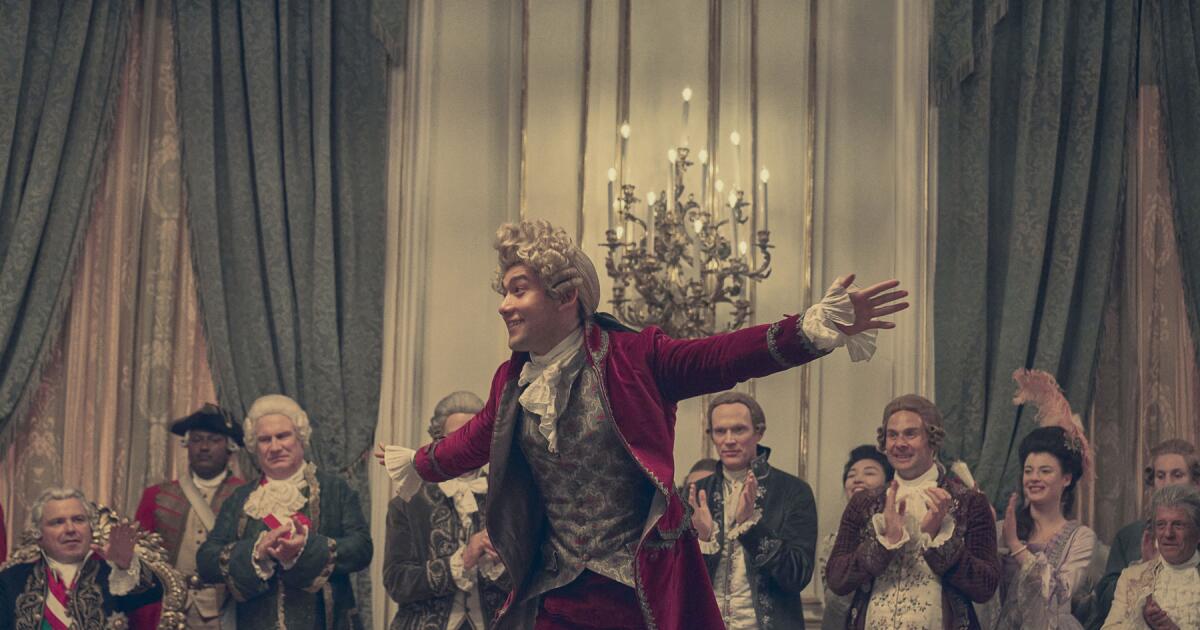
My first thought upon learning that “Amadeus,” the award-winning play and film, had been made into a miniseries, premiering Friday on Starz, was “well, this could be interesting.” And of course it could, though a successful work of film is rarely improved by making it twice as long, and given that playwright Peter Shaffer was also the screenwriter, and Miloš Forman the director of the movie, the project struck me, too, as something of a fool’s errand.
Still, foolishness can sometimes bring good results; there are good results here, and some less than good. One might say it is less than the sum of its parts; if in the end I was not moved in the way I was surely meant to be — the five-part series is a little repetitious, a little exhausting — there was much to like along the way. It did prove interesting.
Written by Joe Barton (creator of the wonderful sentimental Christmas thriller “Black Doves”), this new “Amadeus” somehow qualifies as both an interpretation and a remake. By nature, a play changes from performance to performance, depending on the director, players, designers and so forth, while keeping the text intact. (Usually.) (As Times theater critic Charles McNulty wrote, reviewing a revival at the Pasadena Playhouse this February, every “Amadeus” staging “has one foot in the Vienna of Mozart and another foot in whatever period the production is taking place in.”) In a film remake, even the text is up for grabs. Barton’s “Amadeus” does both, honoring Shaffer’s structure, themes and events while tossing in a lot of new business — they’ve got to fill that extra time with something, and somehow, it wasn’t more music — to varying effect.
Shaffer built his play from the actual, completely unsupported rumor that Mozart (Will Sharpe) was poisoned by Antonio Salieri (Paul Bettany), a rival composer in the Viennese court of Austrian emperor Joseph II (Rory Kinnear); although, as an unreliable narrator, all that matters is that Salieri, telling his tale from the future, believes he was somehow responsible for the composer’s death. The argument of the play is this: As a young man, Salieri had asked God to make him a great and famous composer; he’s done well, but is jealous of and confused by the newly arrived Mozart, a greater talent who seems a conduit for the divine inspiration Salieri lacks, while being vulgar, boisterous, licentious and sure of his superiority in a way another composer might find insulting. (He is also, comparatively, a guileless, pure spirit.) And so, as court composer and Mozart’s boss, he determines to do all he can to undermine the newcomer — much of the plot has to do with these shenanigans, with some new ones inserted by Barton — ultimately deciding that the only thing to do is murder him.
An antagonist who feels himself a protagonist, Salieri is the main character of the play, and to a great extent, the film, while Mozart functions as the unwitting instrument through which Salieri loses his faith in God. Barton builds up Mozart’s role, with emphasis on his home life, which he fills with discord and challenges of his own devising. Librettist Lorenzo Da Ponte (Enyi Okoronkwo) is promoted to chief fellow party animal and tempter, showing up at Mozart’s door draped in women. Mozart’s missus, Constanze (Gabrielle Creevy), is a much bigger presence here than before, extending into scenes set after the composer’s death. She’s made the ear into which Salieri pours his late-life confessions, and in an even later episode is visited by Alexander Pushkin (Jack Farthing), the Russian writer, who wants to write a play based on the Mozart-Salieri legend. (Pushkin did, in fact, write his “Mozart and Salieri,” which has been accounted as the inspiration for “Amadeus.” Meta!)
The actors are all very fine. Casting sexy, hunky Sharpe as Mozart — quite in contrast to the movie’s Tom Hulce, with his Harpo Marx energy and strange explosive giggle — signals that this is meant to be a Serious Take on the material. (The animated opening credits, in which a sheep is disemboweled to make violin strings, underscores the impression.) Bettany, too, is more tamped down, more monkish as Salieri than his Oscar-winning screen predecessor, F. Murray Abraham. The series, which can run to melodrama, with lead director Julian Farino piling on flash montages and tipsy camera effects, is best when these two are simply talking; Mozart is unable to recognize Salieri’s antipathy through his assumed cordiality (he’s simple that way), and Salieri is honestly intrigued by Mozart despite himself.
Biopics are suspect as a class, though “Amadeus,” which is so clearly a work of the imagination, gets at least a partial pass. The series, which filmed in Budapest, Hungary — not all that far from Vienna — recreates some documented events, including Mozart’s famous piano duel with Muzio Clementi and a funeral for his pet starling, and it is, of course, full of period pomp. We get glimpses of “The Abduction From the Seraglio,” “The Marriage of Figaro” and “The Magic Flute” — operas, apart from the unfinished “Requiem” that figures in Salieri’s final plot, are practically the only works mentioned here because they have plots and characters and can be used to suggest dubious psychological motivations on the part of the composer. “Don Giovanni” somehow becomes about Mozart’s father issues. (You would not know from “Amadeus” that the man wrote 41 symphonies, 27 piano concertos and so on.)
The broader biographical facts are obeyed, but “Amadeus” is fundamentally ahistorical, and sometimes implausible: It is to be trusted only as television.

My first thought upon learning that “Amadeus,” the award-winning play and film, had been made into a miniseries, premiering Friday on Starz, was “well, this could be interesting.” And of course it could, though a successful work of film is rarely improved by making it twice as long, and given that playwright Peter Shaffer was also the screenwriter, and Miloš Forman the director of the movie, the project struck me, too, as something of a fool’s errand.
Still, foolishness can sometimes bring good results; there are good results here, and some less than good. One might say it is less than the sum of its parts; if in the end I was not moved in the way I was surely meant to be — the five-part series is a little repetitious, a little exhausting — there was much to like along the way. It did prove interesting.
Written by Joe Barton (creator of the wonderful sentimental Christmas thriller “Black Doves”), this new “Amadeus” somehow qualifies as both an interpretation and a remake. By nature, a play changes from performance to performance, depending on the director, players, designers and so forth, while keeping the text intact. (Usually.) (As Times theater critic Charles McNulty wrote, reviewing a revival at the Pasadena Playhouse this February, every “Amadeus” staging “has one foot in the Vienna of Mozart and another foot in whatever period the production is taking place in.”) In a film remake, even the text is up for grabs. Barton’s “Amadeus” does both, honoring Shaffer’s structure, themes and events while tossing in a lot of new business — they’ve got to fill that extra time with something, and somehow, it wasn’t more music — to varying effect.
Shaffer built his play from the actual, completely unsupported rumor that Mozart (Will Sharpe) was poisoned by Antonio Salieri (Paul Bettany), a rival composer in the Viennese court of Austrian emperor Joseph II (Rory Kinnear); although, as an unreliable narrator, all that matters is that Salieri, telling his tale from the future, believes he was somehow responsible for the composer’s death. The argument of the play is this: As a young man, Salieri had asked God to make him a great and famous composer; he’s done well, but is jealous of and confused by the newly arrived Mozart, a greater talent who seems a conduit for the divine inspiration Salieri lacks, while being vulgar, boisterous, licentious and sure of his superiority in a way another composer might find insulting. (He is also, comparatively, a guileless, pure spirit.) And so, as court composer and Mozart’s boss, he determines to do all he can to undermine the newcomer — much of the plot has to do with these shenanigans, with some new ones inserted by Barton — ultimately deciding that the only thing to do is murder him.
An antagonist who feels himself a protagonist, Salieri is the main character of the play, and to a great extent, the film, while Mozart functions as the unwitting instrument through which Salieri loses his faith in God. Barton builds up Mozart’s role, with emphasis on his home life, which he fills with discord and challenges of his own devising. Librettist Lorenzo Da Ponte (Enyi Okoronkwo) is promoted to chief fellow party animal and tempter, showing up at Mozart’s door draped in women. Mozart’s missus, Constanze (Gabrielle Creevy), is a much bigger presence here than before, extending into scenes set after the composer’s death. She’s made the ear into which Salieri pours his late-life confessions, and in an even later episode is visited by Alexander Pushkin (Jack Farthing), the Russian writer, who wants to write a play based on the Mozart-Salieri legend. (Pushkin did, in fact, write his “Mozart and Salieri,” which has been accounted as the inspiration for “Amadeus.” Meta!)
The actors are all very fine. Casting sexy, hunky Sharpe as Mozart — quite in contrast to the movie’s Tom Hulce, with his Harpo Marx energy and strange explosive giggle — signals that this is meant to be a Serious Take on the material. (The animated opening credits, in which a sheep is disemboweled to make violin strings, underscores the impression.) Bettany, too, is more tamped down, more monkish as Salieri than his Oscar-winning screen predecessor, F. Murray Abraham. The series, which can run to melodrama, with lead director Julian Farino piling on flash montages and tipsy camera effects, is best when these two are simply talking; Mozart is unable to recognize Salieri’s antipathy through his assumed cordiality (he’s simple that way), and Salieri is honestly intrigued by Mozart despite himself.
Biopics are suspect as a class, though “Amadeus,” which is so clearly a work of the imagination, gets at least a partial pass. The series, which filmed in Budapest, Hungary — not all that far from Vienna — recreates some documented events, including Mozart’s famous piano duel with Muzio Clementi and a funeral for his pet starling, and it is, of course, full of period pomp. We get glimpses of “The Abduction From the Seraglio,” “The Marriage of Figaro” and “The Magic Flute” — operas, apart from the unfinished “Requiem” that figures in Salieri’s final plot, are practically the only works mentioned here because they have plots and characters and can be used to suggest dubious psychological motivations on the part of the composer. “Don Giovanni” somehow becomes about Mozart’s father issues. (You would not know from “Amadeus” that the man wrote 41 symphonies, 27 piano concertos and so on.)
The broader biographical facts are obeyed, but “Amadeus” is fundamentally ahistorical, and sometimes implausible: It is to be trusted only as television.

My first thought upon learning that “Amadeus,” the award-winning play and film, had been made into a miniseries, premiering Friday on Starz, was “well, this could be interesting.” And of course it could, though a successful work of film is rarely improved by making it twice as long, and given that playwright Peter Shaffer was also the screenwriter, and Miloš Forman the director of the movie, the project struck me, too, as something of a fool’s errand.
Still, foolishness can sometimes bring good results; there are good results here, and some less than good. One might say it is less than the sum of its parts; if in the end I was not moved in the way I was surely meant to be — the five-part series is a little repetitious, a little exhausting — there was much to like along the way. It did prove interesting.
Written by Joe Barton (creator of the wonderful sentimental Christmas thriller “Black Doves”), this new “Amadeus” somehow qualifies as both an interpretation and a remake. By nature, a play changes from performance to performance, depending on the director, players, designers and so forth, while keeping the text intact. (Usually.) (As Times theater critic Charles McNulty wrote, reviewing a revival at the Pasadena Playhouse this February, every “Amadeus” staging “has one foot in the Vienna of Mozart and another foot in whatever period the production is taking place in.”) In a film remake, even the text is up for grabs. Barton’s “Amadeus” does both, honoring Shaffer’s structure, themes and events while tossing in a lot of new business — they’ve got to fill that extra time with something, and somehow, it wasn’t more music — to varying effect.
Shaffer built his play from the actual, completely unsupported rumor that Mozart (Will Sharpe) was poisoned by Antonio Salieri (Paul Bettany), a rival composer in the Viennese court of Austrian emperor Joseph II (Rory Kinnear); although, as an unreliable narrator, all that matters is that Salieri, telling his tale from the future, believes he was somehow responsible for the composer’s death. The argument of the play is this: As a young man, Salieri had asked God to make him a great and famous composer; he’s done well, but is jealous of and confused by the newly arrived Mozart, a greater talent who seems a conduit for the divine inspiration Salieri lacks, while being vulgar, boisterous, licentious and sure of his superiority in a way another composer might find insulting. (He is also, comparatively, a guileless, pure spirit.) And so, as court composer and Mozart’s boss, he determines to do all he can to undermine the newcomer — much of the plot has to do with these shenanigans, with some new ones inserted by Barton — ultimately deciding that the only thing to do is murder him.
An antagonist who feels himself a protagonist, Salieri is the main character of the play, and to a great extent, the film, while Mozart functions as the unwitting instrument through which Salieri loses his faith in God. Barton builds up Mozart’s role, with emphasis on his home life, which he fills with discord and challenges of his own devising. Librettist Lorenzo Da Ponte (Enyi Okoronkwo) is promoted to chief fellow party animal and tempter, showing up at Mozart’s door draped in women. Mozart’s missus, Constanze (Gabrielle Creevy), is a much bigger presence here than before, extending into scenes set after the composer’s death. She’s made the ear into which Salieri pours his late-life confessions, and in an even later episode is visited by Alexander Pushkin (Jack Farthing), the Russian writer, who wants to write a play based on the Mozart-Salieri legend. (Pushkin did, in fact, write his “Mozart and Salieri,” which has been accounted as the inspiration for “Amadeus.” Meta!)
The actors are all very fine. Casting sexy, hunky Sharpe as Mozart — quite in contrast to the movie’s Tom Hulce, with his Harpo Marx energy and strange explosive giggle — signals that this is meant to be a Serious Take on the material. (The animated opening credits, in which a sheep is disemboweled to make violin strings, underscores the impression.) Bettany, too, is more tamped down, more monkish as Salieri than his Oscar-winning screen predecessor, F. Murray Abraham. The series, which can run to melodrama, with lead director Julian Farino piling on flash montages and tipsy camera effects, is best when these two are simply talking; Mozart is unable to recognize Salieri’s antipathy through his assumed cordiality (he’s simple that way), and Salieri is honestly intrigued by Mozart despite himself.
Biopics are suspect as a class, though “Amadeus,” which is so clearly a work of the imagination, gets at least a partial pass. The series, which filmed in Budapest, Hungary — not all that far from Vienna — recreates some documented events, including Mozart’s famous piano duel with Muzio Clementi and a funeral for his pet starling, and it is, of course, full of period pomp. We get glimpses of “The Abduction From the Seraglio,” “The Marriage of Figaro” and “The Magic Flute” — operas, apart from the unfinished “Requiem” that figures in Salieri’s final plot, are practically the only works mentioned here because they have plots and characters and can be used to suggest dubious psychological motivations on the part of the composer. “Don Giovanni” somehow becomes about Mozart’s father issues. (You would not know from “Amadeus” that the man wrote 41 symphonies, 27 piano concertos and so on.)
The broader biographical facts are obeyed, but “Amadeus” is fundamentally ahistorical, and sometimes implausible: It is to be trusted only as television.
My first thought upon learning that “Amadeus,” the award-winning play and film, had been made into a miniseries, premiering Friday on Starz, was “well, this could be interesting.” And of course it could, though a successful work of film is rarely improved by making it twice as long, and given that playwright Peter Shaffer was also the screenwriter, and Miloš Forman the director of the movie, the project struck me, too, as something of a fool’s errand.
Still, foolishness can sometimes bring good results; there are good results here, and some less than good. One might say it is less than the sum of its parts; if in the end I was not moved in the way I was surely meant to be — the five-part series is a little repetitious, a little exhausting — there was much to like along the way. It did prove interesting.
Written by Joe Barton (creator of the wonderful sentimental Christmas thriller “Black Doves”), this new “Amadeus” somehow qualifies as both an interpretation and a remake. By nature, a play changes from performance to performance, depending on the director, players, designers and so forth, while keeping the text intact. (Usually.) (As Times theater critic Charles McNulty wrote, reviewing a revival at the Pasadena Playhouse this February, every “Amadeus” staging “has one foot in the Vienna of Mozart and another foot in whatever period the production is taking place in.”) In a film remake, even the text is up for grabs. Barton’s “Amadeus” does both, honoring Shaffer’s structure, themes and events while tossing in a lot of new business — they’ve got to fill that extra time with something, and somehow, it wasn’t more music — to varying effect.
Shaffer built his play from the actual, completely unsupported rumor that Mozart (Will Sharpe) was poisoned by Antonio Salieri (Paul Bettany), a rival composer in the Viennese court of Austrian emperor Joseph II (Rory Kinnear); although, as an unreliable narrator, all that matters is that Salieri, telling his tale from the future, believes he was somehow responsible for the composer’s death. The argument of the play is this: As a young man, Salieri had asked God to make him a great and famous composer; he’s done well, but is jealous of and confused by the newly arrived Mozart, a greater talent who seems a conduit for the divine inspiration Salieri lacks, while being vulgar, boisterous, licentious and sure of his superiority in a way another composer might find insulting. (He is also, comparatively, a guileless, pure spirit.) And so, as court composer and Mozart’s boss, he determines to do all he can to undermine the newcomer — much of the plot has to do with these shenanigans, with some new ones inserted by Barton — ultimately deciding that the only thing to do is murder him.
An antagonist who feels himself a protagonist, Salieri is the main character of the play, and to a great extent, the film, while Mozart functions as the unwitting instrument through which Salieri loses his faith in God. Barton builds up Mozart’s role, with emphasis on his home life, which he fills with discord and challenges of his own devising. Librettist Lorenzo Da Ponte (Enyi Okoronkwo) is promoted to chief fellow party animal and tempter, showing up at Mozart’s door draped in women. Mozart’s missus, Constanze (Gabrielle Creevy), is a much bigger presence here than before, extending into scenes set after the composer’s death. She’s made the ear into which Salieri pours his late-life confessions, and in an even later episode is visited by Alexander Pushkin (Jack Farthing), the Russian writer, who wants to write a play based on the Mozart-Salieri legend. (Pushkin did, in fact, write his “Mozart and Salieri,” which has been accounted as the inspiration for “Amadeus.” Meta!)
The actors are all very fine. Casting sexy, hunky Sharpe as Mozart — quite in contrast to the movie’s Tom Hulce, with his Harpo Marx energy and strange explosive giggle — signals that this is meant to be a Serious Take on the material. (The animated opening credits, in which a sheep is disemboweled to make violin strings, underscores the impression.) Bettany, too, is more tamped down, more monkish as Salieri than his Oscar-winning screen predecessor, F. Murray Abraham. The series, which can run to melodrama, with lead director Julian Farino piling on flash montages and tipsy camera effects, is best when these two are simply talking; Mozart is unable to recognize Salieri’s antipathy through his assumed cordiality (he’s simple that way), and Salieri is honestly intrigued by Mozart despite himself.
Biopics are suspect as a class, though “Amadeus,” which is so clearly a work of the imagination, gets at least a partial pass. The series, which filmed in Budapest, Hungary — not all that far from Vienna — recreates some documented events, including Mozart’s famous piano duel with Muzio Clementi and a funeral for his pet starling, and it is, of course, full of period pomp. We get glimpses of “The Abduction From the Seraglio,” “The Marriage of Figaro” and “The Magic Flute” — operas, apart from the unfinished “Requiem” that figures in Salieri’s final plot, are practically the only works mentioned here because they have plots and characters and can be used to suggest dubious psychological motivations on the part of the composer. “Don Giovanni” somehow becomes about Mozart’s father issues. (You would not know from “Amadeus” that the man wrote 41 symphonies, 27 piano concertos and so on.)
The broader biographical facts are obeyed, but “Amadeus” is fundamentally ahistorical, and sometimes implausible: It is to be trusted only as television.

My first thought upon learning that “Amadeus,” the award-winning play and film, had been made into a miniseries, premiering Friday on Starz, was “well, this could be interesting.” And of course it could, though a successful work of film is rarely improved by making it twice as long, and given that playwright Peter Shaffer was also the screenwriter, and Miloš Forman the director of the movie, the project struck me, too, as something of a fool’s errand.
Still, foolishness can sometimes bring good results; there are good results here, and some less than good. One might say it is less than the sum of its parts; if in the end I was not moved in the way I was surely meant to be — the five-part series is a little repetitious, a little exhausting — there was much to like along the way. It did prove interesting.
Written by Joe Barton (creator of the wonderful sentimental Christmas thriller “Black Doves”), this new “Amadeus” somehow qualifies as both an interpretation and a remake. By nature, a play changes from performance to performance, depending on the director, players, designers and so forth, while keeping the text intact. (Usually.) (As Times theater critic Charles McNulty wrote, reviewing a revival at the Pasadena Playhouse this February, every “Amadeus” staging “has one foot in the Vienna of Mozart and another foot in whatever period the production is taking place in.”) In a film remake, even the text is up for grabs. Barton’s “Amadeus” does both, honoring Shaffer’s structure, themes and events while tossing in a lot of new business — they’ve got to fill that extra time with something, and somehow, it wasn’t more music — to varying effect.
Shaffer built his play from the actual, completely unsupported rumor that Mozart (Will Sharpe) was poisoned by Antonio Salieri (Paul Bettany), a rival composer in the Viennese court of Austrian emperor Joseph II (Rory Kinnear); although, as an unreliable narrator, all that matters is that Salieri, telling his tale from the future, believes he was somehow responsible for the composer’s death. The argument of the play is this: As a young man, Salieri had asked God to make him a great and famous composer; he’s done well, but is jealous of and confused by the newly arrived Mozart, a greater talent who seems a conduit for the divine inspiration Salieri lacks, while being vulgar, boisterous, licentious and sure of his superiority in a way another composer might find insulting. (He is also, comparatively, a guileless, pure spirit.) And so, as court composer and Mozart’s boss, he determines to do all he can to undermine the newcomer — much of the plot has to do with these shenanigans, with some new ones inserted by Barton — ultimately deciding that the only thing to do is murder him.
An antagonist who feels himself a protagonist, Salieri is the main character of the play, and to a great extent, the film, while Mozart functions as the unwitting instrument through which Salieri loses his faith in God. Barton builds up Mozart’s role, with emphasis on his home life, which he fills with discord and challenges of his own devising. Librettist Lorenzo Da Ponte (Enyi Okoronkwo) is promoted to chief fellow party animal and tempter, showing up at Mozart’s door draped in women. Mozart’s missus, Constanze (Gabrielle Creevy), is a much bigger presence here than before, extending into scenes set after the composer’s death. She’s made the ear into which Salieri pours his late-life confessions, and in an even later episode is visited by Alexander Pushkin (Jack Farthing), the Russian writer, who wants to write a play based on the Mozart-Salieri legend. (Pushkin did, in fact, write his “Mozart and Salieri,” which has been accounted as the inspiration for “Amadeus.” Meta!)
The actors are all very fine. Casting sexy, hunky Sharpe as Mozart — quite in contrast to the movie’s Tom Hulce, with his Harpo Marx energy and strange explosive giggle — signals that this is meant to be a Serious Take on the material. (The animated opening credits, in which a sheep is disemboweled to make violin strings, underscores the impression.) Bettany, too, is more tamped down, more monkish as Salieri than his Oscar-winning screen predecessor, F. Murray Abraham. The series, which can run to melodrama, with lead director Julian Farino piling on flash montages and tipsy camera effects, is best when these two are simply talking; Mozart is unable to recognize Salieri’s antipathy through his assumed cordiality (he’s simple that way), and Salieri is honestly intrigued by Mozart despite himself.
Biopics are suspect as a class, though “Amadeus,” which is so clearly a work of the imagination, gets at least a partial pass. The series, which filmed in Budapest, Hungary — not all that far from Vienna — recreates some documented events, including Mozart’s famous piano duel with Muzio Clementi and a funeral for his pet starling, and it is, of course, full of period pomp. We get glimpses of “The Abduction From the Seraglio,” “The Marriage of Figaro” and “The Magic Flute” — operas, apart from the unfinished “Requiem” that figures in Salieri’s final plot, are practically the only works mentioned here because they have plots and characters and can be used to suggest dubious psychological motivations on the part of the composer. “Don Giovanni” somehow becomes about Mozart’s father issues. (You would not know from “Amadeus” that the man wrote 41 symphonies, 27 piano concertos and so on.)
The broader biographical facts are obeyed, but “Amadeus” is fundamentally ahistorical, and sometimes implausible: It is to be trusted only as television.
My first thought upon learning that “Amadeus,” the award-winning play and film, had been made into a miniseries, premiering Friday on Starz, was “well, this could be interesting.” And of course it could, though a successful work of film is rarely improved by making it twice as long, and given that playwright Peter Shaffer was also the screenwriter, and Miloš Forman the director of the movie, the project struck me, too, as something of a fool’s errand.
Still, foolishness can sometimes bring good results; there are good results here, and some less than good. One might say it is less than the sum of its parts; if in the end I was not moved in the way I was surely meant to be — the five-part series is a little repetitious, a little exhausting — there was much to like along the way. It did prove interesting.
Written by Joe Barton (creator of the wonderful sentimental Christmas thriller “Black Doves”), this new “Amadeus” somehow qualifies as both an interpretation and a remake. By nature, a play changes from performance to performance, depending on the director, players, designers and so forth, while keeping the text intact. (Usually.) (As Times theater critic Charles McNulty wrote, reviewing a revival at the Pasadena Playhouse this February, every “Amadeus” staging “has one foot in the Vienna of Mozart and another foot in whatever period the production is taking place in.”) In a film remake, even the text is up for grabs. Barton’s “Amadeus” does both, honoring Shaffer’s structure, themes and events while tossing in a lot of new business — they’ve got to fill that extra time with something, and somehow, it wasn’t more music — to varying effect.
Shaffer built his play from the actual, completely unsupported rumor that Mozart (Will Sharpe) was poisoned by Antonio Salieri (Paul Bettany), a rival composer in the Viennese court of Austrian emperor Joseph II (Rory Kinnear); although, as an unreliable narrator, all that matters is that Salieri, telling his tale from the future, believes he was somehow responsible for the composer’s death. The argument of the play is this: As a young man, Salieri had asked God to make him a great and famous composer; he’s done well, but is jealous of and confused by the newly arrived Mozart, a greater talent who seems a conduit for the divine inspiration Salieri lacks, while being vulgar, boisterous, licentious and sure of his superiority in a way another composer might find insulting. (He is also, comparatively, a guileless, pure spirit.) And so, as court composer and Mozart’s boss, he determines to do all he can to undermine the newcomer — much of the plot has to do with these shenanigans, with some new ones inserted by Barton — ultimately deciding that the only thing to do is murder him.
An antagonist who feels himself a protagonist, Salieri is the main character of the play, and to a great extent, the film, while Mozart functions as the unwitting instrument through which Salieri loses his faith in God. Barton builds up Mozart’s role, with emphasis on his home life, which he fills with discord and challenges of his own devising. Librettist Lorenzo Da Ponte (Enyi Okoronkwo) is promoted to chief fellow party animal and tempter, showing up at Mozart’s door draped in women. Mozart’s missus, Constanze (Gabrielle Creevy), is a much bigger presence here than before, extending into scenes set after the composer’s death. She’s made the ear into which Salieri pours his late-life confessions, and in an even later episode is visited by Alexander Pushkin (Jack Farthing), the Russian writer, who wants to write a play based on the Mozart-Salieri legend. (Pushkin did, in fact, write his “Mozart and Salieri,” which has been accounted as the inspiration for “Amadeus.” Meta!)
The actors are all very fine. Casting sexy, hunky Sharpe as Mozart — quite in contrast to the movie’s Tom Hulce, with his Harpo Marx energy and strange explosive giggle — signals that this is meant to be a Serious Take on the material. (The animated opening credits, in which a sheep is disemboweled to make violin strings, underscores the impression.) Bettany, too, is more tamped down, more monkish as Salieri than his Oscar-winning screen predecessor, F. Murray Abraham. The series, which can run to melodrama, with lead director Julian Farino piling on flash montages and tipsy camera effects, is best when these two are simply talking; Mozart is unable to recognize Salieri’s antipathy through his assumed cordiality (he’s simple that way), and Salieri is honestly intrigued by Mozart despite himself.
Biopics are suspect as a class, though “Amadeus,” which is so clearly a work of the imagination, gets at least a partial pass. The series, which filmed in Budapest, Hungary — not all that far from Vienna — recreates some documented events, including Mozart’s famous piano duel with Muzio Clementi and a funeral for his pet starling, and it is, of course, full of period pomp. We get glimpses of “The Abduction From the Seraglio,” “The Marriage of Figaro” and “The Magic Flute” — operas, apart from the unfinished “Requiem” that figures in Salieri’s final plot, are practically the only works mentioned here because they have plots and characters and can be used to suggest dubious psychological motivations on the part of the composer. “Don Giovanni” somehow becomes about Mozart’s father issues. (You would not know from “Amadeus” that the man wrote 41 symphonies, 27 piano concertos and so on.)
The broader biographical facts are obeyed, but “Amadeus” is fundamentally ahistorical, and sometimes implausible: It is to be trusted only as television.
My first thought upon learning that “Amadeus,” the award-winning play and film, had been made into a miniseries, premiering Friday on Starz, was “well, this could be interesting.” And of course it could, though a successful work of film is rarely improved by making it twice as long, and given that playwright Peter Shaffer was also the screenwriter, and Miloš Forman the director of the movie, the project struck me, too, as something of a fool’s errand.
Still, foolishness can sometimes bring good results; there are good results here, and some less than good. One might say it is less than the sum of its parts; if in the end I was not moved in the way I was surely meant to be — the five-part series is a little repetitious, a little exhausting — there was much to like along the way. It did prove interesting.
Written by Joe Barton (creator of the wonderful sentimental Christmas thriller “Black Doves”), this new “Amadeus” somehow qualifies as both an interpretation and a remake. By nature, a play changes from performance to performance, depending on the director, players, designers and so forth, while keeping the text intact. (Usually.) (As Times theater critic Charles McNulty wrote, reviewing a revival at the Pasadena Playhouse this February, every “Amadeus” staging “has one foot in the Vienna of Mozart and another foot in whatever period the production is taking place in.”) In a film remake, even the text is up for grabs. Barton’s “Amadeus” does both, honoring Shaffer’s structure, themes and events while tossing in a lot of new business — they’ve got to fill that extra time with something, and somehow, it wasn’t more music — to varying effect.
Shaffer built his play from the actual, completely unsupported rumor that Mozart (Will Sharpe) was poisoned by Antonio Salieri (Paul Bettany), a rival composer in the Viennese court of Austrian emperor Joseph II (Rory Kinnear); although, as an unreliable narrator, all that matters is that Salieri, telling his tale from the future, believes he was somehow responsible for the composer’s death. The argument of the play is this: As a young man, Salieri had asked God to make him a great and famous composer; he’s done well, but is jealous of and confused by the newly arrived Mozart, a greater talent who seems a conduit for the divine inspiration Salieri lacks, while being vulgar, boisterous, licentious and sure of his superiority in a way another composer might find insulting. (He is also, comparatively, a guileless, pure spirit.) And so, as court composer and Mozart’s boss, he determines to do all he can to undermine the newcomer — much of the plot has to do with these shenanigans, with some new ones inserted by Barton — ultimately deciding that the only thing to do is murder him.
An antagonist who feels himself a protagonist, Salieri is the main character of the play, and to a great extent, the film, while Mozart functions as the unwitting instrument through which Salieri loses his faith in God. Barton builds up Mozart’s role, with emphasis on his home life, which he fills with discord and challenges of his own devising. Librettist Lorenzo Da Ponte (Enyi Okoronkwo) is promoted to chief fellow party animal and tempter, showing up at Mozart’s door draped in women. Mozart’s missus, Constanze (Gabrielle Creevy), is a much bigger presence here than before, extending into scenes set after the composer’s death. She’s made the ear into which Salieri pours his late-life confessions, and in an even later episode is visited by Alexander Pushkin (Jack Farthing), the Russian writer, who wants to write a play based on the Mozart-Salieri legend. (Pushkin did, in fact, write his “Mozart and Salieri,” which has been accounted as the inspiration for “Amadeus.” Meta!)
The actors are all very fine. Casting sexy, hunky Sharpe as Mozart — quite in contrast to the movie’s Tom Hulce, with his Harpo Marx energy and strange explosive giggle — signals that this is meant to be a Serious Take on the material. (The animated opening credits, in which a sheep is disemboweled to make violin strings, underscores the impression.) Bettany, too, is more tamped down, more monkish as Salieri than his Oscar-winning screen predecessor, F. Murray Abraham. The series, which can run to melodrama, with lead director Julian Farino piling on flash montages and tipsy camera effects, is best when these two are simply talking; Mozart is unable to recognize Salieri’s antipathy through his assumed cordiality (he’s simple that way), and Salieri is honestly intrigued by Mozart despite himself.
Biopics are suspect as a class, though “Amadeus,” which is so clearly a work of the imagination, gets at least a partial pass. The series, which filmed in Budapest, Hungary — not all that far from Vienna — recreates some documented events, including Mozart’s famous piano duel with Muzio Clementi and a funeral for his pet starling, and it is, of course, full of period pomp. We get glimpses of “The Abduction From the Seraglio,” “The Marriage of Figaro” and “The Magic Flute” — operas, apart from the unfinished “Requiem” that figures in Salieri’s final plot, are practically the only works mentioned here because they have plots and characters and can be used to suggest dubious psychological motivations on the part of the composer. “Don Giovanni” somehow becomes about Mozart’s father issues. (You would not know from “Amadeus” that the man wrote 41 symphonies, 27 piano concertos and so on.)
The broader biographical facts are obeyed, but “Amadeus” is fundamentally ahistorical, and sometimes implausible: It is to be trusted only as television.
My first thought upon learning that “Amadeus,” the award-winning play and film, had been made into a miniseries, premiering Friday on Starz, was “well, this could be interesting.” And of course it could, though a successful work of film is rarely improved by making it twice as long, and given that playwright Peter Shaffer was also the screenwriter, and Miloš Forman the director of the movie, the project struck me, too, as something of a fool’s errand.
Still, foolishness can sometimes bring good results; there are good results here, and some less than good. One might say it is less than the sum of its parts; if in the end I was not moved in the way I was surely meant to be — the five-part series is a little repetitious, a little exhausting — there was much to like along the way. It did prove interesting.
Written by Joe Barton (creator of the wonderful sentimental Christmas thriller “Black Doves”), this new “Amadeus” somehow qualifies as both an interpretation and a remake. By nature, a play changes from performance to performance, depending on the director, players, designers and so forth, while keeping the text intact. (Usually.) (As Times theater critic Charles McNulty wrote, reviewing a revival at the Pasadena Playhouse this February, every “Amadeus” staging “has one foot in the Vienna of Mozart and another foot in whatever period the production is taking place in.”) In a film remake, even the text is up for grabs. Barton’s “Amadeus” does both, honoring Shaffer’s structure, themes and events while tossing in a lot of new business — they’ve got to fill that extra time with something, and somehow, it wasn’t more music — to varying effect.
Shaffer built his play from the actual, completely unsupported rumor that Mozart (Will Sharpe) was poisoned by Antonio Salieri (Paul Bettany), a rival composer in the Viennese court of Austrian emperor Joseph II (Rory Kinnear); although, as an unreliable narrator, all that matters is that Salieri, telling his tale from the future, believes he was somehow responsible for the composer’s death. The argument of the play is this: As a young man, Salieri had asked God to make him a great and famous composer; he’s done well, but is jealous of and confused by the newly arrived Mozart, a greater talent who seems a conduit for the divine inspiration Salieri lacks, while being vulgar, boisterous, licentious and sure of his superiority in a way another composer might find insulting. (He is also, comparatively, a guileless, pure spirit.) And so, as court composer and Mozart’s boss, he determines to do all he can to undermine the newcomer — much of the plot has to do with these shenanigans, with some new ones inserted by Barton — ultimately deciding that the only thing to do is murder him.
An antagonist who feels himself a protagonist, Salieri is the main character of the play, and to a great extent, the film, while Mozart functions as the unwitting instrument through which Salieri loses his faith in God. Barton builds up Mozart’s role, with emphasis on his home life, which he fills with discord and challenges of his own devising. Librettist Lorenzo Da Ponte (Enyi Okoronkwo) is promoted to chief fellow party animal and tempter, showing up at Mozart’s door draped in women. Mozart’s missus, Constanze (Gabrielle Creevy), is a much bigger presence here than before, extending into scenes set after the composer’s death. She’s made the ear into which Salieri pours his late-life confessions, and in an even later episode is visited by Alexander Pushkin (Jack Farthing), the Russian writer, who wants to write a play based on the Mozart-Salieri legend. (Pushkin did, in fact, write his “Mozart and Salieri,” which has been accounted as the inspiration for “Amadeus.” Meta!)
The actors are all very fine. Casting sexy, hunky Sharpe as Mozart — quite in contrast to the movie’s Tom Hulce, with his Harpo Marx energy and strange explosive giggle — signals that this is meant to be a Serious Take on the material. (The animated opening credits, in which a sheep is disemboweled to make violin strings, underscores the impression.) Bettany, too, is more tamped down, more monkish as Salieri than his Oscar-winning screen predecessor, F. Murray Abraham. The series, which can run to melodrama, with lead director Julian Farino piling on flash montages and tipsy camera effects, is best when these two are simply talking; Mozart is unable to recognize Salieri’s antipathy through his assumed cordiality (he’s simple that way), and Salieri is honestly intrigued by Mozart despite himself.
Biopics are suspect as a class, though “Amadeus,” which is so clearly a work of the imagination, gets at least a partial pass. The series, which filmed in Budapest, Hungary — not all that far from Vienna — recreates some documented events, including Mozart’s famous piano duel with Muzio Clementi and a funeral for his pet starling, and it is, of course, full of period pomp. We get glimpses of “The Abduction From the Seraglio,” “The Marriage of Figaro” and “The Magic Flute” — operas, apart from the unfinished “Requiem” that figures in Salieri’s final plot, are practically the only works mentioned here because they have plots and characters and can be used to suggest dubious psychological motivations on the part of the composer. “Don Giovanni” somehow becomes about Mozart’s father issues. (You would not know from “Amadeus” that the man wrote 41 symphonies, 27 piano concertos and so on.)
The broader biographical facts are obeyed, but “Amadeus” is fundamentally ahistorical, and sometimes implausible: It is to be trusted only as television.

My first thought upon learning that “Amadeus,” the award-winning play and film, had been made into a miniseries, premiering Friday on Starz, was “well, this could be interesting.” And of course it could, though a successful work of film is rarely improved by making it twice as long, and given that playwright Peter Shaffer was also the screenwriter, and Miloš Forman the director of the movie, the project struck me, too, as something of a fool’s errand.
Still, foolishness can sometimes bring good results; there are good results here, and some less than good. One might say it is less than the sum of its parts; if in the end I was not moved in the way I was surely meant to be — the five-part series is a little repetitious, a little exhausting — there was much to like along the way. It did prove interesting.
Written by Joe Barton (creator of the wonderful sentimental Christmas thriller “Black Doves”), this new “Amadeus” somehow qualifies as both an interpretation and a remake. By nature, a play changes from performance to performance, depending on the director, players, designers and so forth, while keeping the text intact. (Usually.) (As Times theater critic Charles McNulty wrote, reviewing a revival at the Pasadena Playhouse this February, every “Amadeus” staging “has one foot in the Vienna of Mozart and another foot in whatever period the production is taking place in.”) In a film remake, even the text is up for grabs. Barton’s “Amadeus” does both, honoring Shaffer’s structure, themes and events while tossing in a lot of new business — they’ve got to fill that extra time with something, and somehow, it wasn’t more music — to varying effect.
Shaffer built his play from the actual, completely unsupported rumor that Mozart (Will Sharpe) was poisoned by Antonio Salieri (Paul Bettany), a rival composer in the Viennese court of Austrian emperor Joseph II (Rory Kinnear); although, as an unreliable narrator, all that matters is that Salieri, telling his tale from the future, believes he was somehow responsible for the composer’s death. The argument of the play is this: As a young man, Salieri had asked God to make him a great and famous composer; he’s done well, but is jealous of and confused by the newly arrived Mozart, a greater talent who seems a conduit for the divine inspiration Salieri lacks, while being vulgar, boisterous, licentious and sure of his superiority in a way another composer might find insulting. (He is also, comparatively, a guileless, pure spirit.) And so, as court composer and Mozart’s boss, he determines to do all he can to undermine the newcomer — much of the plot has to do with these shenanigans, with some new ones inserted by Barton — ultimately deciding that the only thing to do is murder him.
An antagonist who feels himself a protagonist, Salieri is the main character of the play, and to a great extent, the film, while Mozart functions as the unwitting instrument through which Salieri loses his faith in God. Barton builds up Mozart’s role, with emphasis on his home life, which he fills with discord and challenges of his own devising. Librettist Lorenzo Da Ponte (Enyi Okoronkwo) is promoted to chief fellow party animal and tempter, showing up at Mozart’s door draped in women. Mozart’s missus, Constanze (Gabrielle Creevy), is a much bigger presence here than before, extending into scenes set after the composer’s death. She’s made the ear into which Salieri pours his late-life confessions, and in an even later episode is visited by Alexander Pushkin (Jack Farthing), the Russian writer, who wants to write a play based on the Mozart-Salieri legend. (Pushkin did, in fact, write his “Mozart and Salieri,” which has been accounted as the inspiration for “Amadeus.” Meta!)
The actors are all very fine. Casting sexy, hunky Sharpe as Mozart — quite in contrast to the movie’s Tom Hulce, with his Harpo Marx energy and strange explosive giggle — signals that this is meant to be a Serious Take on the material. (The animated opening credits, in which a sheep is disemboweled to make violin strings, underscores the impression.) Bettany, too, is more tamped down, more monkish as Salieri than his Oscar-winning screen predecessor, F. Murray Abraham. The series, which can run to melodrama, with lead director Julian Farino piling on flash montages and tipsy camera effects, is best when these two are simply talking; Mozart is unable to recognize Salieri’s antipathy through his assumed cordiality (he’s simple that way), and Salieri is honestly intrigued by Mozart despite himself.
Biopics are suspect as a class, though “Amadeus,” which is so clearly a work of the imagination, gets at least a partial pass. The series, which filmed in Budapest, Hungary — not all that far from Vienna — recreates some documented events, including Mozart’s famous piano duel with Muzio Clementi and a funeral for his pet starling, and it is, of course, full of period pomp. We get glimpses of “The Abduction From the Seraglio,” “The Marriage of Figaro” and “The Magic Flute” — operas, apart from the unfinished “Requiem” that figures in Salieri’s final plot, are practically the only works mentioned here because they have plots and characters and can be used to suggest dubious psychological motivations on the part of the composer. “Don Giovanni” somehow becomes about Mozart’s father issues. (You would not know from “Amadeus” that the man wrote 41 symphonies, 27 piano concertos and so on.)
The broader biographical facts are obeyed, but “Amadeus” is fundamentally ahistorical, and sometimes implausible: It is to be trusted only as television.
My first thought upon learning that “Amadeus,” the award-winning play and film, had been made into a miniseries, premiering Friday on Starz, was “well, this could be interesting.” And of course it could, though a successful work of film is rarely improved by making it twice as long, and given that playwright Peter Shaffer was also the screenwriter, and Miloš Forman the director of the movie, the project struck me, too, as something of a fool’s errand.
Still, foolishness can sometimes bring good results; there are good results here, and some less than good. One might say it is less than the sum of its parts; if in the end I was not moved in the way I was surely meant to be — the five-part series is a little repetitious, a little exhausting — there was much to like along the way. It did prove interesting.
Written by Joe Barton (creator of the wonderful sentimental Christmas thriller “Black Doves”), this new “Amadeus” somehow qualifies as both an interpretation and a remake. By nature, a play changes from performance to performance, depending on the director, players, designers and so forth, while keeping the text intact. (Usually.) (As Times theater critic Charles McNulty wrote, reviewing a revival at the Pasadena Playhouse this February, every “Amadeus” staging “has one foot in the Vienna of Mozart and another foot in whatever period the production is taking place in.”) In a film remake, even the text is up for grabs. Barton’s “Amadeus” does both, honoring Shaffer’s structure, themes and events while tossing in a lot of new business — they’ve got to fill that extra time with something, and somehow, it wasn’t more music — to varying effect.
Shaffer built his play from the actual, completely unsupported rumor that Mozart (Will Sharpe) was poisoned by Antonio Salieri (Paul Bettany), a rival composer in the Viennese court of Austrian emperor Joseph II (Rory Kinnear); although, as an unreliable narrator, all that matters is that Salieri, telling his tale from the future, believes he was somehow responsible for the composer’s death. The argument of the play is this: As a young man, Salieri had asked God to make him a great and famous composer; he’s done well, but is jealous of and confused by the newly arrived Mozart, a greater talent who seems a conduit for the divine inspiration Salieri lacks, while being vulgar, boisterous, licentious and sure of his superiority in a way another composer might find insulting. (He is also, comparatively, a guileless, pure spirit.) And so, as court composer and Mozart’s boss, he determines to do all he can to undermine the newcomer — much of the plot has to do with these shenanigans, with some new ones inserted by Barton — ultimately deciding that the only thing to do is murder him.
An antagonist who feels himself a protagonist, Salieri is the main character of the play, and to a great extent, the film, while Mozart functions as the unwitting instrument through which Salieri loses his faith in God. Barton builds up Mozart’s role, with emphasis on his home life, which he fills with discord and challenges of his own devising. Librettist Lorenzo Da Ponte (Enyi Okoronkwo) is promoted to chief fellow party animal and tempter, showing up at Mozart’s door draped in women. Mozart’s missus, Constanze (Gabrielle Creevy), is a much bigger presence here than before, extending into scenes set after the composer’s death. She’s made the ear into which Salieri pours his late-life confessions, and in an even later episode is visited by Alexander Pushkin (Jack Farthing), the Russian writer, who wants to write a play based on the Mozart-Salieri legend. (Pushkin did, in fact, write his “Mozart and Salieri,” which has been accounted as the inspiration for “Amadeus.” Meta!)
The actors are all very fine. Casting sexy, hunky Sharpe as Mozart — quite in contrast to the movie’s Tom Hulce, with his Harpo Marx energy and strange explosive giggle — signals that this is meant to be a Serious Take on the material. (The animated opening credits, in which a sheep is disemboweled to make violin strings, underscores the impression.) Bettany, too, is more tamped down, more monkish as Salieri than his Oscar-winning screen predecessor, F. Murray Abraham. The series, which can run to melodrama, with lead director Julian Farino piling on flash montages and tipsy camera effects, is best when these two are simply talking; Mozart is unable to recognize Salieri’s antipathy through his assumed cordiality (he’s simple that way), and Salieri is honestly intrigued by Mozart despite himself.
Biopics are suspect as a class, though “Amadeus,” which is so clearly a work of the imagination, gets at least a partial pass. The series, which filmed in Budapest, Hungary — not all that far from Vienna — recreates some documented events, including Mozart’s famous piano duel with Muzio Clementi and a funeral for his pet starling, and it is, of course, full of period pomp. We get glimpses of “The Abduction From the Seraglio,” “The Marriage of Figaro” and “The Magic Flute” — operas, apart from the unfinished “Requiem” that figures in Salieri’s final plot, are practically the only works mentioned here because they have plots and characters and can be used to suggest dubious psychological motivations on the part of the composer. “Don Giovanni” somehow becomes about Mozart’s father issues. (You would not know from “Amadeus” that the man wrote 41 symphonies, 27 piano concertos and so on.)
The broader biographical facts are obeyed, but “Amadeus” is fundamentally ahistorical, and sometimes implausible: It is to be trusted only as television.
My first thought upon learning that “Amadeus,” the award-winning play and film, had been made into a miniseries, premiering Friday on Starz, was “well, this could be interesting.” And of course it could, though a successful work of film is rarely improved by making it twice as long, and given that playwright Peter Shaffer was also the screenwriter, and Miloš Forman the director of the movie, the project struck me, too, as something of a fool’s errand.
Still, foolishness can sometimes bring good results; there are good results here, and some less than good. One might say it is less than the sum of its parts; if in the end I was not moved in the way I was surely meant to be — the five-part series is a little repetitious, a little exhausting — there was much to like along the way. It did prove interesting.
Written by Joe Barton (creator of the wonderful sentimental Christmas thriller “Black Doves”), this new “Amadeus” somehow qualifies as both an interpretation and a remake. By nature, a play changes from performance to performance, depending on the director, players, designers and so forth, while keeping the text intact. (Usually.) (As Times theater critic Charles McNulty wrote, reviewing a revival at the Pasadena Playhouse this February, every “Amadeus” staging “has one foot in the Vienna of Mozart and another foot in whatever period the production is taking place in.”) In a film remake, even the text is up for grabs. Barton’s “Amadeus” does both, honoring Shaffer’s structure, themes and events while tossing in a lot of new business — they’ve got to fill that extra time with something, and somehow, it wasn’t more music — to varying effect.
Shaffer built his play from the actual, completely unsupported rumor that Mozart (Will Sharpe) was poisoned by Antonio Salieri (Paul Bettany), a rival composer in the Viennese court of Austrian emperor Joseph II (Rory Kinnear); although, as an unreliable narrator, all that matters is that Salieri, telling his tale from the future, believes he was somehow responsible for the composer’s death. The argument of the play is this: As a young man, Salieri had asked God to make him a great and famous composer; he’s done well, but is jealous of and confused by the newly arrived Mozart, a greater talent who seems a conduit for the divine inspiration Salieri lacks, while being vulgar, boisterous, licentious and sure of his superiority in a way another composer might find insulting. (He is also, comparatively, a guileless, pure spirit.) And so, as court composer and Mozart’s boss, he determines to do all he can to undermine the newcomer — much of the plot has to do with these shenanigans, with some new ones inserted by Barton — ultimately deciding that the only thing to do is murder him.
An antagonist who feels himself a protagonist, Salieri is the main character of the play, and to a great extent, the film, while Mozart functions as the unwitting instrument through which Salieri loses his faith in God. Barton builds up Mozart’s role, with emphasis on his home life, which he fills with discord and challenges of his own devising. Librettist Lorenzo Da Ponte (Enyi Okoronkwo) is promoted to chief fellow party animal and tempter, showing up at Mozart’s door draped in women. Mozart’s missus, Constanze (Gabrielle Creevy), is a much bigger presence here than before, extending into scenes set after the composer’s death. She’s made the ear into which Salieri pours his late-life confessions, and in an even later episode is visited by Alexander Pushkin (Jack Farthing), the Russian writer, who wants to write a play based on the Mozart-Salieri legend. (Pushkin did, in fact, write his “Mozart and Salieri,” which has been accounted as the inspiration for “Amadeus.” Meta!)
The actors are all very fine. Casting sexy, hunky Sharpe as Mozart — quite in contrast to the movie’s Tom Hulce, with his Harpo Marx energy and strange explosive giggle — signals that this is meant to be a Serious Take on the material. (The animated opening credits, in which a sheep is disemboweled to make violin strings, underscores the impression.) Bettany, too, is more tamped down, more monkish as Salieri than his Oscar-winning screen predecessor, F. Murray Abraham. The series, which can run to melodrama, with lead director Julian Farino piling on flash montages and tipsy camera effects, is best when these two are simply talking; Mozart is unable to recognize Salieri’s antipathy through his assumed cordiality (he’s simple that way), and Salieri is honestly intrigued by Mozart despite himself.
Biopics are suspect as a class, though “Amadeus,” which is so clearly a work of the imagination, gets at least a partial pass. The series, which filmed in Budapest, Hungary — not all that far from Vienna — recreates some documented events, including Mozart’s famous piano duel with Muzio Clementi and a funeral for his pet starling, and it is, of course, full of period pomp. We get glimpses of “The Abduction From the Seraglio,” “The Marriage of Figaro” and “The Magic Flute” — operas, apart from the unfinished “Requiem” that figures in Salieri’s final plot, are practically the only works mentioned here because they have plots and characters and can be used to suggest dubious psychological motivations on the part of the composer. “Don Giovanni” somehow becomes about Mozart’s father issues. (You would not know from “Amadeus” that the man wrote 41 symphonies, 27 piano concertos and so on.)
The broader biographical facts are obeyed, but “Amadeus” is fundamentally ahistorical, and sometimes implausible: It is to be trusted only as television.
My first thought upon learning that “Amadeus,” the award-winning play and film, had been made into a miniseries, premiering Friday on Starz, was “well, this could be interesting.” And of course it could, though a successful work of film is rarely improved by making it twice as long, and given that playwright Peter Shaffer was also the screenwriter, and Miloš Forman the director of the movie, the project struck me, too, as something of a fool’s errand.
Still, foolishness can sometimes bring good results; there are good results here, and some less than good. One might say it is less than the sum of its parts; if in the end I was not moved in the way I was surely meant to be — the five-part series is a little repetitious, a little exhausting — there was much to like along the way. It did prove interesting.
Written by Joe Barton (creator of the wonderful sentimental Christmas thriller “Black Doves”), this new “Amadeus” somehow qualifies as both an interpretation and a remake. By nature, a play changes from performance to performance, depending on the director, players, designers and so forth, while keeping the text intact. (Usually.) (As Times theater critic Charles McNulty wrote, reviewing a revival at the Pasadena Playhouse this February, every “Amadeus” staging “has one foot in the Vienna of Mozart and another foot in whatever period the production is taking place in.”) In a film remake, even the text is up for grabs. Barton’s “Amadeus” does both, honoring Shaffer’s structure, themes and events while tossing in a lot of new business — they’ve got to fill that extra time with something, and somehow, it wasn’t more music — to varying effect.
Shaffer built his play from the actual, completely unsupported rumor that Mozart (Will Sharpe) was poisoned by Antonio Salieri (Paul Bettany), a rival composer in the Viennese court of Austrian emperor Joseph II (Rory Kinnear); although, as an unreliable narrator, all that matters is that Salieri, telling his tale from the future, believes he was somehow responsible for the composer’s death. The argument of the play is this: As a young man, Salieri had asked God to make him a great and famous composer; he’s done well, but is jealous of and confused by the newly arrived Mozart, a greater talent who seems a conduit for the divine inspiration Salieri lacks, while being vulgar, boisterous, licentious and sure of his superiority in a way another composer might find insulting. (He is also, comparatively, a guileless, pure spirit.) And so, as court composer and Mozart’s boss, he determines to do all he can to undermine the newcomer — much of the plot has to do with these shenanigans, with some new ones inserted by Barton — ultimately deciding that the only thing to do is murder him.
An antagonist who feels himself a protagonist, Salieri is the main character of the play, and to a great extent, the film, while Mozart functions as the unwitting instrument through which Salieri loses his faith in God. Barton builds up Mozart’s role, with emphasis on his home life, which he fills with discord and challenges of his own devising. Librettist Lorenzo Da Ponte (Enyi Okoronkwo) is promoted to chief fellow party animal and tempter, showing up at Mozart’s door draped in women. Mozart’s missus, Constanze (Gabrielle Creevy), is a much bigger presence here than before, extending into scenes set after the composer’s death. She’s made the ear into which Salieri pours his late-life confessions, and in an even later episode is visited by Alexander Pushkin (Jack Farthing), the Russian writer, who wants to write a play based on the Mozart-Salieri legend. (Pushkin did, in fact, write his “Mozart and Salieri,” which has been accounted as the inspiration for “Amadeus.” Meta!)
The actors are all very fine. Casting sexy, hunky Sharpe as Mozart — quite in contrast to the movie’s Tom Hulce, with his Harpo Marx energy and strange explosive giggle — signals that this is meant to be a Serious Take on the material. (The animated opening credits, in which a sheep is disemboweled to make violin strings, underscores the impression.) Bettany, too, is more tamped down, more monkish as Salieri than his Oscar-winning screen predecessor, F. Murray Abraham. The series, which can run to melodrama, with lead director Julian Farino piling on flash montages and tipsy camera effects, is best when these two are simply talking; Mozart is unable to recognize Salieri’s antipathy through his assumed cordiality (he’s simple that way), and Salieri is honestly intrigued by Mozart despite himself.
Biopics are suspect as a class, though “Amadeus,” which is so clearly a work of the imagination, gets at least a partial pass. The series, which filmed in Budapest, Hungary — not all that far from Vienna — recreates some documented events, including Mozart’s famous piano duel with Muzio Clementi and a funeral for his pet starling, and it is, of course, full of period pomp. We get glimpses of “The Abduction From the Seraglio,” “The Marriage of Figaro” and “The Magic Flute” — operas, apart from the unfinished “Requiem” that figures in Salieri’s final plot, are practically the only works mentioned here because they have plots and characters and can be used to suggest dubious psychological motivations on the part of the composer. “Don Giovanni” somehow becomes about Mozart’s father issues. (You would not know from “Amadeus” that the man wrote 41 symphonies, 27 piano concertos and so on.)
The broader biographical facts are obeyed, but “Amadeus” is fundamentally ahistorical, and sometimes implausible: It is to be trusted only as television.
My first thought upon learning that “Amadeus,” the award-winning play and film, had been made into a miniseries, premiering Friday on Starz, was “well, this could be interesting.” And of course it could, though a successful work of film is rarely improved by making it twice as long, and given that playwright Peter Shaffer was also the screenwriter, and Miloš Forman the director of the movie, the project struck me, too, as something of a fool’s errand.
Still, foolishness can sometimes bring good results; there are good results here, and some less than good. One might say it is less than the sum of its parts; if in the end I was not moved in the way I was surely meant to be — the five-part series is a little repetitious, a little exhausting — there was much to like along the way. It did prove interesting.
Written by Joe Barton (creator of the wonderful sentimental Christmas thriller “Black Doves”), this new “Amadeus” somehow qualifies as both an interpretation and a remake. By nature, a play changes from performance to performance, depending on the director, players, designers and so forth, while keeping the text intact. (Usually.) (As Times theater critic Charles McNulty wrote, reviewing a revival at the Pasadena Playhouse this February, every “Amadeus” staging “has one foot in the Vienna of Mozart and another foot in whatever period the production is taking place in.”) In a film remake, even the text is up for grabs. Barton’s “Amadeus” does both, honoring Shaffer’s structure, themes and events while tossing in a lot of new business — they’ve got to fill that extra time with something, and somehow, it wasn’t more music — to varying effect.
Shaffer built his play from the actual, completely unsupported rumor that Mozart (Will Sharpe) was poisoned by Antonio Salieri (Paul Bettany), a rival composer in the Viennese court of Austrian emperor Joseph II (Rory Kinnear); although, as an unreliable narrator, all that matters is that Salieri, telling his tale from the future, believes he was somehow responsible for the composer’s death. The argument of the play is this: As a young man, Salieri had asked God to make him a great and famous composer; he’s done well, but is jealous of and confused by the newly arrived Mozart, a greater talent who seems a conduit for the divine inspiration Salieri lacks, while being vulgar, boisterous, licentious and sure of his superiority in a way another composer might find insulting. (He is also, comparatively, a guileless, pure spirit.) And so, as court composer and Mozart’s boss, he determines to do all he can to undermine the newcomer — much of the plot has to do with these shenanigans, with some new ones inserted by Barton — ultimately deciding that the only thing to do is murder him.
An antagonist who feels himself a protagonist, Salieri is the main character of the play, and to a great extent, the film, while Mozart functions as the unwitting instrument through which Salieri loses his faith in God. Barton builds up Mozart’s role, with emphasis on his home life, which he fills with discord and challenges of his own devising. Librettist Lorenzo Da Ponte (Enyi Okoronkwo) is promoted to chief fellow party animal and tempter, showing up at Mozart’s door draped in women. Mozart’s missus, Constanze (Gabrielle Creevy), is a much bigger presence here than before, extending into scenes set after the composer’s death. She’s made the ear into which Salieri pours his late-life confessions, and in an even later episode is visited by Alexander Pushkin (Jack Farthing), the Russian writer, who wants to write a play based on the Mozart-Salieri legend. (Pushkin did, in fact, write his “Mozart and Salieri,” which has been accounted as the inspiration for “Amadeus.” Meta!)
The actors are all very fine. Casting sexy, hunky Sharpe as Mozart — quite in contrast to the movie’s Tom Hulce, with his Harpo Marx energy and strange explosive giggle — signals that this is meant to be a Serious Take on the material. (The animated opening credits, in which a sheep is disemboweled to make violin strings, underscores the impression.) Bettany, too, is more tamped down, more monkish as Salieri than his Oscar-winning screen predecessor, F. Murray Abraham. The series, which can run to melodrama, with lead director Julian Farino piling on flash montages and tipsy camera effects, is best when these two are simply talking; Mozart is unable to recognize Salieri’s antipathy through his assumed cordiality (he’s simple that way), and Salieri is honestly intrigued by Mozart despite himself.
Biopics are suspect as a class, though “Amadeus,” which is so clearly a work of the imagination, gets at least a partial pass. The series, which filmed in Budapest, Hungary — not all that far from Vienna — recreates some documented events, including Mozart’s famous piano duel with Muzio Clementi and a funeral for his pet starling, and it is, of course, full of period pomp. We get glimpses of “The Abduction From the Seraglio,” “The Marriage of Figaro” and “The Magic Flute” — operas, apart from the unfinished “Requiem” that figures in Salieri’s final plot, are practically the only works mentioned here because they have plots and characters and can be used to suggest dubious psychological motivations on the part of the composer. “Don Giovanni” somehow becomes about Mozart’s father issues. (You would not know from “Amadeus” that the man wrote 41 symphonies, 27 piano concertos and so on.)
The broader biographical facts are obeyed, but “Amadeus” is fundamentally ahistorical, and sometimes implausible: It is to be trusted only as television.
My first thought upon learning that “Amadeus,” the award-winning play and film, had been made into a miniseries, premiering Friday on Starz, was “well, this could be interesting.” And of course it could, though a successful work of film is rarely improved by making it twice as long, and given that playwright Peter Shaffer was also the screenwriter, and Miloš Forman the director of the movie, the project struck me, too, as something of a fool’s errand.
Still, foolishness can sometimes bring good results; there are good results here, and some less than good. One might say it is less than the sum of its parts; if in the end I was not moved in the way I was surely meant to be — the five-part series is a little repetitious, a little exhausting — there was much to like along the way. It did prove interesting.
Written by Joe Barton (creator of the wonderful sentimental Christmas thriller “Black Doves”), this new “Amadeus” somehow qualifies as both an interpretation and a remake. By nature, a play changes from performance to performance, depending on the director, players, designers and so forth, while keeping the text intact. (Usually.) (As Times theater critic Charles McNulty wrote, reviewing a revival at the Pasadena Playhouse this February, every “Amadeus” staging “has one foot in the Vienna of Mozart and another foot in whatever period the production is taking place in.”) In a film remake, even the text is up for grabs. Barton’s “Amadeus” does both, honoring Shaffer’s structure, themes and events while tossing in a lot of new business — they’ve got to fill that extra time with something, and somehow, it wasn’t more music — to varying effect.
Shaffer built his play from the actual, completely unsupported rumor that Mozart (Will Sharpe) was poisoned by Antonio Salieri (Paul Bettany), a rival composer in the Viennese court of Austrian emperor Joseph II (Rory Kinnear); although, as an unreliable narrator, all that matters is that Salieri, telling his tale from the future, believes he was somehow responsible for the composer’s death. The argument of the play is this: As a young man, Salieri had asked God to make him a great and famous composer; he’s done well, but is jealous of and confused by the newly arrived Mozart, a greater talent who seems a conduit for the divine inspiration Salieri lacks, while being vulgar, boisterous, licentious and sure of his superiority in a way another composer might find insulting. (He is also, comparatively, a guileless, pure spirit.) And so, as court composer and Mozart’s boss, he determines to do all he can to undermine the newcomer — much of the plot has to do with these shenanigans, with some new ones inserted by Barton — ultimately deciding that the only thing to do is murder him.
An antagonist who feels himself a protagonist, Salieri is the main character of the play, and to a great extent, the film, while Mozart functions as the unwitting instrument through which Salieri loses his faith in God. Barton builds up Mozart’s role, with emphasis on his home life, which he fills with discord and challenges of his own devising. Librettist Lorenzo Da Ponte (Enyi Okoronkwo) is promoted to chief fellow party animal and tempter, showing up at Mozart’s door draped in women. Mozart’s missus, Constanze (Gabrielle Creevy), is a much bigger presence here than before, extending into scenes set after the composer’s death. She’s made the ear into which Salieri pours his late-life confessions, and in an even later episode is visited by Alexander Pushkin (Jack Farthing), the Russian writer, who wants to write a play based on the Mozart-Salieri legend. (Pushkin did, in fact, write his “Mozart and Salieri,” which has been accounted as the inspiration for “Amadeus.” Meta!)
The actors are all very fine. Casting sexy, hunky Sharpe as Mozart — quite in contrast to the movie’s Tom Hulce, with his Harpo Marx energy and strange explosive giggle — signals that this is meant to be a Serious Take on the material. (The animated opening credits, in which a sheep is disemboweled to make violin strings, underscores the impression.) Bettany, too, is more tamped down, more monkish as Salieri than his Oscar-winning screen predecessor, F. Murray Abraham. The series, which can run to melodrama, with lead director Julian Farino piling on flash montages and tipsy camera effects, is best when these two are simply talking; Mozart is unable to recognize Salieri’s antipathy through his assumed cordiality (he’s simple that way), and Salieri is honestly intrigued by Mozart despite himself.
Biopics are suspect as a class, though “Amadeus,” which is so clearly a work of the imagination, gets at least a partial pass. The series, which filmed in Budapest, Hungary — not all that far from Vienna — recreates some documented events, including Mozart’s famous piano duel with Muzio Clementi and a funeral for his pet starling, and it is, of course, full of period pomp. We get glimpses of “The Abduction From the Seraglio,” “The Marriage of Figaro” and “The Magic Flute” — operas, apart from the unfinished “Requiem” that figures in Salieri’s final plot, are practically the only works mentioned here because they have plots and characters and can be used to suggest dubious psychological motivations on the part of the composer. “Don Giovanni” somehow becomes about Mozart’s father issues. (You would not know from “Amadeus” that the man wrote 41 symphonies, 27 piano concertos and so on.)
The broader biographical facts are obeyed, but “Amadeus” is fundamentally ahistorical, and sometimes implausible: It is to be trusted only as television.
My first thought upon learning that “Amadeus,” the award-winning play and film, had been made into a miniseries, premiering Friday on Starz, was “well, this could be interesting.” And of course it could, though a successful work of film is rarely improved by making it twice as long, and given that playwright Peter Shaffer was also the screenwriter, and Miloš Forman the director of the movie, the project struck me, too, as something of a fool’s errand.
Still, foolishness can sometimes bring good results; there are good results here, and some less than good. One might say it is less than the sum of its parts; if in the end I was not moved in the way I was surely meant to be — the five-part series is a little repetitious, a little exhausting — there was much to like along the way. It did prove interesting.
Written by Joe Barton (creator of the wonderful sentimental Christmas thriller “Black Doves”), this new “Amadeus” somehow qualifies as both an interpretation and a remake. By nature, a play changes from performance to performance, depending on the director, players, designers and so forth, while keeping the text intact. (Usually.) (As Times theater critic Charles McNulty wrote, reviewing a revival at the Pasadena Playhouse this February, every “Amadeus” staging “has one foot in the Vienna of Mozart and another foot in whatever period the production is taking place in.”) In a film remake, even the text is up for grabs. Barton’s “Amadeus” does both, honoring Shaffer’s structure, themes and events while tossing in a lot of new business — they’ve got to fill that extra time with something, and somehow, it wasn’t more music — to varying effect.
Shaffer built his play from the actual, completely unsupported rumor that Mozart (Will Sharpe) was poisoned by Antonio Salieri (Paul Bettany), a rival composer in the Viennese court of Austrian emperor Joseph II (Rory Kinnear); although, as an unreliable narrator, all that matters is that Salieri, telling his tale from the future, believes he was somehow responsible for the composer’s death. The argument of the play is this: As a young man, Salieri had asked God to make him a great and famous composer; he’s done well, but is jealous of and confused by the newly arrived Mozart, a greater talent who seems a conduit for the divine inspiration Salieri lacks, while being vulgar, boisterous, licentious and sure of his superiority in a way another composer might find insulting. (He is also, comparatively, a guileless, pure spirit.) And so, as court composer and Mozart’s boss, he determines to do all he can to undermine the newcomer — much of the plot has to do with these shenanigans, with some new ones inserted by Barton — ultimately deciding that the only thing to do is murder him.
An antagonist who feels himself a protagonist, Salieri is the main character of the play, and to a great extent, the film, while Mozart functions as the unwitting instrument through which Salieri loses his faith in God. Barton builds up Mozart’s role, with emphasis on his home life, which he fills with discord and challenges of his own devising. Librettist Lorenzo Da Ponte (Enyi Okoronkwo) is promoted to chief fellow party animal and tempter, showing up at Mozart’s door draped in women. Mozart’s missus, Constanze (Gabrielle Creevy), is a much bigger presence here than before, extending into scenes set after the composer’s death. She’s made the ear into which Salieri pours his late-life confessions, and in an even later episode is visited by Alexander Pushkin (Jack Farthing), the Russian writer, who wants to write a play based on the Mozart-Salieri legend. (Pushkin did, in fact, write his “Mozart and Salieri,” which has been accounted as the inspiration for “Amadeus.” Meta!)
The actors are all very fine. Casting sexy, hunky Sharpe as Mozart — quite in contrast to the movie’s Tom Hulce, with his Harpo Marx energy and strange explosive giggle — signals that this is meant to be a Serious Take on the material. (The animated opening credits, in which a sheep is disemboweled to make violin strings, underscores the impression.) Bettany, too, is more tamped down, more monkish as Salieri than his Oscar-winning screen predecessor, F. Murray Abraham. The series, which can run to melodrama, with lead director Julian Farino piling on flash montages and tipsy camera effects, is best when these two are simply talking; Mozart is unable to recognize Salieri’s antipathy through his assumed cordiality (he’s simple that way), and Salieri is honestly intrigued by Mozart despite himself.
Biopics are suspect as a class, though “Amadeus,” which is so clearly a work of the imagination, gets at least a partial pass. The series, which filmed in Budapest, Hungary — not all that far from Vienna — recreates some documented events, including Mozart’s famous piano duel with Muzio Clementi and a funeral for his pet starling, and it is, of course, full of period pomp. We get glimpses of “The Abduction From the Seraglio,” “The Marriage of Figaro” and “The Magic Flute” — operas, apart from the unfinished “Requiem” that figures in Salieri’s final plot, are practically the only works mentioned here because they have plots and characters and can be used to suggest dubious psychological motivations on the part of the composer. “Don Giovanni” somehow becomes about Mozart’s father issues. (You would not know from “Amadeus” that the man wrote 41 symphonies, 27 piano concertos and so on.)
The broader biographical facts are obeyed, but “Amadeus” is fundamentally ahistorical, and sometimes implausible: It is to be trusted only as television.
My first thought upon learning that “Amadeus,” the award-winning play and film, had been made into a miniseries, premiering Friday on Starz, was “well, this could be interesting.” And of course it could, though a successful work of film is rarely improved by making it twice as long, and given that playwright Peter Shaffer was also the screenwriter, and Miloš Forman the director of the movie, the project struck me, too, as something of a fool’s errand.
Still, foolishness can sometimes bring good results; there are good results here, and some less than good. One might say it is less than the sum of its parts; if in the end I was not moved in the way I was surely meant to be — the five-part series is a little repetitious, a little exhausting — there was much to like along the way. It did prove interesting.
Written by Joe Barton (creator of the wonderful sentimental Christmas thriller “Black Doves”), this new “Amadeus” somehow qualifies as both an interpretation and a remake. By nature, a play changes from performance to performance, depending on the director, players, designers and so forth, while keeping the text intact. (Usually.) (As Times theater critic Charles McNulty wrote, reviewing a revival at the Pasadena Playhouse this February, every “Amadeus” staging “has one foot in the Vienna of Mozart and another foot in whatever period the production is taking place in.”) In a film remake, even the text is up for grabs. Barton’s “Amadeus” does both, honoring Shaffer’s structure, themes and events while tossing in a lot of new business — they’ve got to fill that extra time with something, and somehow, it wasn’t more music — to varying effect.
Shaffer built his play from the actual, completely unsupported rumor that Mozart (Will Sharpe) was poisoned by Antonio Salieri (Paul Bettany), a rival composer in the Viennese court of Austrian emperor Joseph II (Rory Kinnear); although, as an unreliable narrator, all that matters is that Salieri, telling his tale from the future, believes he was somehow responsible for the composer’s death. The argument of the play is this: As a young man, Salieri had asked God to make him a great and famous composer; he’s done well, but is jealous of and confused by the newly arrived Mozart, a greater talent who seems a conduit for the divine inspiration Salieri lacks, while being vulgar, boisterous, licentious and sure of his superiority in a way another composer might find insulting. (He is also, comparatively, a guileless, pure spirit.) And so, as court composer and Mozart’s boss, he determines to do all he can to undermine the newcomer — much of the plot has to do with these shenanigans, with some new ones inserted by Barton — ultimately deciding that the only thing to do is murder him.
An antagonist who feels himself a protagonist, Salieri is the main character of the play, and to a great extent, the film, while Mozart functions as the unwitting instrument through which Salieri loses his faith in God. Barton builds up Mozart’s role, with emphasis on his home life, which he fills with discord and challenges of his own devising. Librettist Lorenzo Da Ponte (Enyi Okoronkwo) is promoted to chief fellow party animal and tempter, showing up at Mozart’s door draped in women. Mozart’s missus, Constanze (Gabrielle Creevy), is a much bigger presence here than before, extending into scenes set after the composer’s death. She’s made the ear into which Salieri pours his late-life confessions, and in an even later episode is visited by Alexander Pushkin (Jack Farthing), the Russian writer, who wants to write a play based on the Mozart-Salieri legend. (Pushkin did, in fact, write his “Mozart and Salieri,” which has been accounted as the inspiration for “Amadeus.” Meta!)
The actors are all very fine. Casting sexy, hunky Sharpe as Mozart — quite in contrast to the movie’s Tom Hulce, with his Harpo Marx energy and strange explosive giggle — signals that this is meant to be a Serious Take on the material. (The animated opening credits, in which a sheep is disemboweled to make violin strings, underscores the impression.) Bettany, too, is more tamped down, more monkish as Salieri than his Oscar-winning screen predecessor, F. Murray Abraham. The series, which can run to melodrama, with lead director Julian Farino piling on flash montages and tipsy camera effects, is best when these two are simply talking; Mozart is unable to recognize Salieri’s antipathy through his assumed cordiality (he’s simple that way), and Salieri is honestly intrigued by Mozart despite himself.
Biopics are suspect as a class, though “Amadeus,” which is so clearly a work of the imagination, gets at least a partial pass. The series, which filmed in Budapest, Hungary — not all that far from Vienna — recreates some documented events, including Mozart’s famous piano duel with Muzio Clementi and a funeral for his pet starling, and it is, of course, full of period pomp. We get glimpses of “The Abduction From the Seraglio,” “The Marriage of Figaro” and “The Magic Flute” — operas, apart from the unfinished “Requiem” that figures in Salieri’s final plot, are practically the only works mentioned here because they have plots and characters and can be used to suggest dubious psychological motivations on the part of the composer. “Don Giovanni” somehow becomes about Mozart’s father issues. (You would not know from “Amadeus” that the man wrote 41 symphonies, 27 piano concertos and so on.)
The broader biographical facts are obeyed, but “Amadeus” is fundamentally ahistorical, and sometimes implausible: It is to be trusted only as television.

