

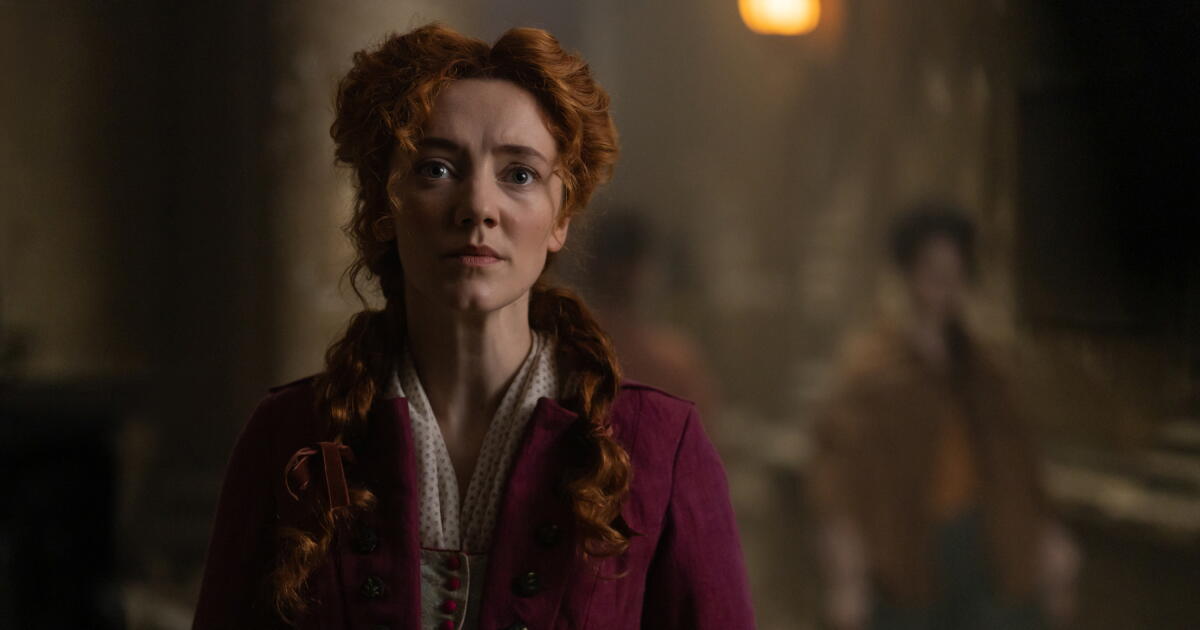

Kit Harington’s self-loathing lawyer is drawn into a perilous cross-Channel love triangle and political turmoil in the first major screen adaptation of Charles Dickens’ French Revolution classic in the 21st century,
Even had you never read Charles Dickens’ “A Tale of Two Cities,” or even known of its existence, the odds are good that you have somewhere encountered its much quoted opening and closing lines: “It was the best of times, it was the worst of times” and (spoiler) “It is a far, far better thing that I do, than I have ever done; it is a far, far better rest that I go to than I have ever known,” respectively, the latter possibly in the course of a Ronald Colman imitation. (Please do not ask who Ronald Colman is.)
Reckoned to be Dickens’ most popular novel, it has been several times filmed for the big and small screens, going back to 1911 — the big-budget Colman version came in 1935 — but has not been mounted in this century, until now, with a four-part adaptation premiering Sunday on MGM+ in a co-production with BBC One. It stars Kit Harington, whom “Game of Thrones” people know as Jon Snow, as Sydney Carton, a disheveled, cynical, self-loathing, alcoholic, yet clever London lawyer. London is one of the two cities whose tale this is. Paris, before and during the Revolution, is the other.
Daniel West’s adaptation hits the major plot points and select lines of dialogue, but has typically, unavoidably, been streamlined and compressed. Characters disappear, or have their attributes and actions assigned to different characters. But much has been added as well. Most of these alterations are trivial, although one major change, coming near the end, is a very bad idea. I can’t tell you what it is, though.
Francois Civil, left, and Kit Harington in “A Tale of Two Cities.”
(Marcell Piti / MGM+)
Other than that, the most substantial changes are to Lucie Manette (Mirren Mack), the female lead, in order to give her a more active, heroic role in the story, this being 2026. (Not that Dickens didn’t write a heroine or two.) So we meet her, a Frenchwoman raised in England, sneaking out at night to dissect corpses in a sort of one-woman underground medical school — knowledge that will come in handy when Charles Darnay (François Civil), a Frenchman living in London, shows up at the place where she lives, dying from a knife wound acquired in the process of chaperoning into England a young woman in danger from the French ancien régime (the king is still in his counting house); laying him out on the dining room table, she cauterizes the wound.
Darnay has also been tasked with delivering the message “Recalled to life,” which refers to the fact that the father Lucie believed dead has merely been languishing in the Bastille for 18 years and is now out. In the novel, he is simply released, but here he has escaped — or rather, has been escaped, since he is something of a wreck, as you might imagine — and is being hidden at the wine shop of the pre-revolutionary Defarges, Ernest and Thérèse. Like the novel’s first and last lines, Madame Defarge (Roxane Duran), with her knitting needles, has transcended the text into folklore.

“A Tale of Two Cities”
(Marcell Piti / MGM+)
But before a recovering Darnay can clear any of this up, he’s dragged away by English police, accused of spying for the French for the benefit of the Americans — our own revolution is in progress at this point — and put on trial. Lucie, having exhausted all other possibilities, and needing Darnay in order to find her father, hires a very reluctant Carton, who in a trick worthy of Perry Mason, gets him off when a witness cannot tell him and Darnay apart. (Make a note of their resemblance; it will be important later.) By this time, both men are in love with Lucie, which, historical action scenes and social commentary aside, is the real point of the story, which might as easily be titled “A Tale of Three Citizens.”
All this gets the miniseries off to an energetic start. After this, there will be a lot of going back and forth across the Channel; crimes of the aristocracy; Darnay’s own Big Secret revealed; more trials, more imprisonments. Still, though it wakes up when we get to the storming of the Bastille, economically but effectively rendered, and, later the Reign of Terror, in between it can turn into a murky, mopey slog. It is often dark, visually and temperamentally; the music tends to moodiness. The actors speak quietly, as if fearful of being overheard, whether or not there is anyone around to hear, and often regard one another with pained or stunned expressions. It’s not necessarily inappropriate — there’s a lot of death in the book, and in a love triangle, someone is bound to lose, at least in the pre-polyamorous 19th century. But this “Two Cities” does lean into the worst of times.
Nevertheless, as Lucie, Mack makes a consistently vital impression — one can see why everyone’s in love with her. (Harington, the big name here, is less vivid; he’s more interesting before Carton falls for Lucie, when he’s still a bit of jerk and not simply sad most of the time.) And as Madame Defarge , who will become the symbol of the revolution’s bloodthirsty overreach, Duran is splendid; she’s a monster, finally, but layered and human. She has her reasons.

Kit Harington’s self-loathing lawyer is drawn into a perilous cross-Channel love triangle and political turmoil in the first major screen adaptation of Charles Dickens’ French Revolution classic in the 21st century,
Even had you never read Charles Dickens’ “A Tale of Two Cities,” or even known of its existence, the odds are good that you have somewhere encountered its much quoted opening and closing lines: “It was the best of times, it was the worst of times” and (spoiler) “It is a far, far better thing that I do, than I have ever done; it is a far, far better rest that I go to than I have ever known,” respectively, the latter possibly in the course of a Ronald Colman imitation. (Please do not ask who Ronald Colman is.)
Reckoned to be Dickens’ most popular novel, it has been several times filmed for the big and small screens, going back to 1911 — the big-budget Colman version came in 1935 — but has not been mounted in this century, until now, with a four-part adaptation premiering Sunday on MGM+ in a co-production with BBC One. It stars Kit Harington, whom “Game of Thrones” people know as Jon Snow, as Sydney Carton, a disheveled, cynical, self-loathing, alcoholic, yet clever London lawyer. London is one of the two cities whose tale this is. Paris, before and during the Revolution, is the other.
Daniel West’s adaptation hits the major plot points and select lines of dialogue, but has typically, unavoidably, been streamlined and compressed. Characters disappear, or have their attributes and actions assigned to different characters. But much has been added as well. Most of these alterations are trivial, although one major change, coming near the end, is a very bad idea. I can’t tell you what it is, though.
Francois Civil, left, and Kit Harington in “A Tale of Two Cities.”
(Marcell Piti / MGM+)
Other than that, the most substantial changes are to Lucie Manette (Mirren Mack), the female lead, in order to give her a more active, heroic role in the story, this being 2026. (Not that Dickens didn’t write a heroine or two.) So we meet her, a Frenchwoman raised in England, sneaking out at night to dissect corpses in a sort of one-woman underground medical school — knowledge that will come in handy when Charles Darnay (François Civil), a Frenchman living in London, shows up at the place where she lives, dying from a knife wound acquired in the process of chaperoning into England a young woman in danger from the French ancien régime (the king is still in his counting house); laying him out on the dining room table, she cauterizes the wound.
Darnay has also been tasked with delivering the message “Recalled to life,” which refers to the fact that the father Lucie believed dead has merely been languishing in the Bastille for 18 years and is now out. In the novel, he is simply released, but here he has escaped — or rather, has been escaped, since he is something of a wreck, as you might imagine — and is being hidden at the wine shop of the pre-revolutionary Defarges, Ernest and Thérèse. Like the novel’s first and last lines, Madame Defarge (Roxane Duran), with her knitting needles, has transcended the text into folklore.
“A Tale of Two Cities”
(Marcell Piti / MGM+)
But before a recovering Darnay can clear any of this up, he’s dragged away by English police, accused of spying for the French for the benefit of the Americans — our own revolution is in progress at this point — and put on trial. Lucie, having exhausted all other possibilities, and needing Darnay in order to find her father, hires a very reluctant Carton, who in a trick worthy of Perry Mason, gets him off when a witness cannot tell him and Darnay apart. (Make a note of their resemblance; it will be important later.) By this time, both men are in love with Lucie, which, historical action scenes and social commentary aside, is the real point of the story, which might as easily be titled “A Tale of Three Citizens.”
All this gets the miniseries off to an energetic start. After this, there will be a lot of going back and forth across the Channel; crimes of the aristocracy; Darnay’s own Big Secret revealed; more trials, more imprisonments. Still, though it wakes up when we get to the storming of the Bastille, economically but effectively rendered, and, later the Reign of Terror, in between it can turn into a murky, mopey slog. It is often dark, visually and temperamentally; the music tends to moodiness. The actors speak quietly, as if fearful of being overheard, whether or not there is anyone around to hear, and often regard one another with pained or stunned expressions. It’s not necessarily inappropriate — there’s a lot of death in the book, and in a love triangle, someone is bound to lose, at least in the pre-polyamorous 19th century. But this “Two Cities” does lean into the worst of times.
Nevertheless, as Lucie, Mack makes a consistently vital impression — one can see why everyone’s in love with her. (Harington, the big name here, is less vivid; he’s more interesting before Carton falls for Lucie, when he’s still a bit of jerk and not simply sad most of the time.) And as Madame Defarge , who will become the symbol of the revolution’s bloodthirsty overreach, Duran is splendid; she’s a monster, finally, but layered and human. She has her reasons.

Kit Harington’s self-loathing lawyer is drawn into a perilous cross-Channel love triangle and political turmoil in the first major screen adaptation of Charles Dickens’ French Revolution classic in the 21st century,
Even had you never read Charles Dickens’ “A Tale of Two Cities,” or even known of its existence, the odds are good that you have somewhere encountered its much quoted opening and closing lines: “It was the best of times, it was the worst of times” and (spoiler) “It is a far, far better thing that I do, than I have ever done; it is a far, far better rest that I go to than I have ever known,” respectively, the latter possibly in the course of a Ronald Colman imitation. (Please do not ask who Ronald Colman is.)
Reckoned to be Dickens’ most popular novel, it has been several times filmed for the big and small screens, going back to 1911 — the big-budget Colman version came in 1935 — but has not been mounted in this century, until now, with a four-part adaptation premiering Sunday on MGM+ in a co-production with BBC One. It stars Kit Harington, whom “Game of Thrones” people know as Jon Snow, as Sydney Carton, a disheveled, cynical, self-loathing, alcoholic, yet clever London lawyer. London is one of the two cities whose tale this is. Paris, before and during the Revolution, is the other.
Daniel West’s adaptation hits the major plot points and select lines of dialogue, but has typically, unavoidably, been streamlined and compressed. Characters disappear, or have their attributes and actions assigned to different characters. But much has been added as well. Most of these alterations are trivial, although one major change, coming near the end, is a very bad idea. I can’t tell you what it is, though.
Francois Civil, left, and Kit Harington in “A Tale of Two Cities.”
(Marcell Piti / MGM+)
Other than that, the most substantial changes are to Lucie Manette (Mirren Mack), the female lead, in order to give her a more active, heroic role in the story, this being 2026. (Not that Dickens didn’t write a heroine or two.) So we meet her, a Frenchwoman raised in England, sneaking out at night to dissect corpses in a sort of one-woman underground medical school — knowledge that will come in handy when Charles Darnay (François Civil), a Frenchman living in London, shows up at the place where she lives, dying from a knife wound acquired in the process of chaperoning into England a young woman in danger from the French ancien régime (the king is still in his counting house); laying him out on the dining room table, she cauterizes the wound.
Darnay has also been tasked with delivering the message “Recalled to life,” which refers to the fact that the father Lucie believed dead has merely been languishing in the Bastille for 18 years and is now out. In the novel, he is simply released, but here he has escaped — or rather, has been escaped, since he is something of a wreck, as you might imagine — and is being hidden at the wine shop of the pre-revolutionary Defarges, Ernest and Thérèse. Like the novel’s first and last lines, Madame Defarge (Roxane Duran), with her knitting needles, has transcended the text into folklore.
“A Tale of Two Cities”
(Marcell Piti / MGM+)
But before a recovering Darnay can clear any of this up, he’s dragged away by English police, accused of spying for the French for the benefit of the Americans — our own revolution is in progress at this point — and put on trial. Lucie, having exhausted all other possibilities, and needing Darnay in order to find her father, hires a very reluctant Carton, who in a trick worthy of Perry Mason, gets him off when a witness cannot tell him and Darnay apart. (Make a note of their resemblance; it will be important later.) By this time, both men are in love with Lucie, which, historical action scenes and social commentary aside, is the real point of the story, which might as easily be titled “A Tale of Three Citizens.”
All this gets the miniseries off to an energetic start. After this, there will be a lot of going back and forth across the Channel; crimes of the aristocracy; Darnay’s own Big Secret revealed; more trials, more imprisonments. Still, though it wakes up when we get to the storming of the Bastille, economically but effectively rendered, and, later the Reign of Terror, in between it can turn into a murky, mopey slog. It is often dark, visually and temperamentally; the music tends to moodiness. The actors speak quietly, as if fearful of being overheard, whether or not there is anyone around to hear, and often regard one another with pained or stunned expressions. It’s not necessarily inappropriate — there’s a lot of death in the book, and in a love triangle, someone is bound to lose, at least in the pre-polyamorous 19th century. But this “Two Cities” does lean into the worst of times.
Nevertheless, as Lucie, Mack makes a consistently vital impression — one can see why everyone’s in love with her. (Harington, the big name here, is less vivid; he’s more interesting before Carton falls for Lucie, when he’s still a bit of jerk and not simply sad most of the time.) And as Madame Defarge , who will become the symbol of the revolution’s bloodthirsty overreach, Duran is splendid; she’s a monster, finally, but layered and human. She has her reasons.
Kit Harington’s self-loathing lawyer is drawn into a perilous cross-Channel love triangle and political turmoil in the first major screen adaptation of Charles Dickens’ French Revolution classic in the 21st century,
Even had you never read Charles Dickens’ “A Tale of Two Cities,” or even known of its existence, the odds are good that you have somewhere encountered its much quoted opening and closing lines: “It was the best of times, it was the worst of times” and (spoiler) “It is a far, far better thing that I do, than I have ever done; it is a far, far better rest that I go to than I have ever known,” respectively, the latter possibly in the course of a Ronald Colman imitation. (Please do not ask who Ronald Colman is.)
Reckoned to be Dickens’ most popular novel, it has been several times filmed for the big and small screens, going back to 1911 — the big-budget Colman version came in 1935 — but has not been mounted in this century, until now, with a four-part adaptation premiering Sunday on MGM+ in a co-production with BBC One. It stars Kit Harington, whom “Game of Thrones” people know as Jon Snow, as Sydney Carton, a disheveled, cynical, self-loathing, alcoholic, yet clever London lawyer. London is one of the two cities whose tale this is. Paris, before and during the Revolution, is the other.
Daniel West’s adaptation hits the major plot points and select lines of dialogue, but has typically, unavoidably, been streamlined and compressed. Characters disappear, or have their attributes and actions assigned to different characters. But much has been added as well. Most of these alterations are trivial, although one major change, coming near the end, is a very bad idea. I can’t tell you what it is, though.
Francois Civil, left, and Kit Harington in “A Tale of Two Cities.”
(Marcell Piti / MGM+)
Other than that, the most substantial changes are to Lucie Manette (Mirren Mack), the female lead, in order to give her a more active, heroic role in the story, this being 2026. (Not that Dickens didn’t write a heroine or two.) So we meet her, a Frenchwoman raised in England, sneaking out at night to dissect corpses in a sort of one-woman underground medical school — knowledge that will come in handy when Charles Darnay (François Civil), a Frenchman living in London, shows up at the place where she lives, dying from a knife wound acquired in the process of chaperoning into England a young woman in danger from the French ancien régime (the king is still in his counting house); laying him out on the dining room table, she cauterizes the wound.
Darnay has also been tasked with delivering the message “Recalled to life,” which refers to the fact that the father Lucie believed dead has merely been languishing in the Bastille for 18 years and is now out. In the novel, he is simply released, but here he has escaped — or rather, has been escaped, since he is something of a wreck, as you might imagine — and is being hidden at the wine shop of the pre-revolutionary Defarges, Ernest and Thérèse. Like the novel’s first and last lines, Madame Defarge (Roxane Duran), with her knitting needles, has transcended the text into folklore.
“A Tale of Two Cities”
(Marcell Piti / MGM+)
But before a recovering Darnay can clear any of this up, he’s dragged away by English police, accused of spying for the French for the benefit of the Americans — our own revolution is in progress at this point — and put on trial. Lucie, having exhausted all other possibilities, and needing Darnay in order to find her father, hires a very reluctant Carton, who in a trick worthy of Perry Mason, gets him off when a witness cannot tell him and Darnay apart. (Make a note of their resemblance; it will be important later.) By this time, both men are in love with Lucie, which, historical action scenes and social commentary aside, is the real point of the story, which might as easily be titled “A Tale of Three Citizens.”
All this gets the miniseries off to an energetic start. After this, there will be a lot of going back and forth across the Channel; crimes of the aristocracy; Darnay’s own Big Secret revealed; more trials, more imprisonments. Still, though it wakes up when we get to the storming of the Bastille, economically but effectively rendered, and, later the Reign of Terror, in between it can turn into a murky, mopey slog. It is often dark, visually and temperamentally; the music tends to moodiness. The actors speak quietly, as if fearful of being overheard, whether or not there is anyone around to hear, and often regard one another with pained or stunned expressions. It’s not necessarily inappropriate — there’s a lot of death in the book, and in a love triangle, someone is bound to lose, at least in the pre-polyamorous 19th century. But this “Two Cities” does lean into the worst of times.
Nevertheless, as Lucie, Mack makes a consistently vital impression — one can see why everyone’s in love with her. (Harington, the big name here, is less vivid; he’s more interesting before Carton falls for Lucie, when he’s still a bit of jerk and not simply sad most of the time.) And as Madame Defarge , who will become the symbol of the revolution’s bloodthirsty overreach, Duran is splendid; she’s a monster, finally, but layered and human. She has her reasons.

Kit Harington’s self-loathing lawyer is drawn into a perilous cross-Channel love triangle and political turmoil in the first major screen adaptation of Charles Dickens’ French Revolution classic in the 21st century,
Even had you never read Charles Dickens’ “A Tale of Two Cities,” or even known of its existence, the odds are good that you have somewhere encountered its much quoted opening and closing lines: “It was the best of times, it was the worst of times” and (spoiler) “It is a far, far better thing that I do, than I have ever done; it is a far, far better rest that I go to than I have ever known,” respectively, the latter possibly in the course of a Ronald Colman imitation. (Please do not ask who Ronald Colman is.)
Reckoned to be Dickens’ most popular novel, it has been several times filmed for the big and small screens, going back to 1911 — the big-budget Colman version came in 1935 — but has not been mounted in this century, until now, with a four-part adaptation premiering Sunday on MGM+ in a co-production with BBC One. It stars Kit Harington, whom “Game of Thrones” people know as Jon Snow, as Sydney Carton, a disheveled, cynical, self-loathing, alcoholic, yet clever London lawyer. London is one of the two cities whose tale this is. Paris, before and during the Revolution, is the other.
Daniel West’s adaptation hits the major plot points and select lines of dialogue, but has typically, unavoidably, been streamlined and compressed. Characters disappear, or have their attributes and actions assigned to different characters. But much has been added as well. Most of these alterations are trivial, although one major change, coming near the end, is a very bad idea. I can’t tell you what it is, though.
Francois Civil, left, and Kit Harington in “A Tale of Two Cities.”
(Marcell Piti / MGM+)
Other than that, the most substantial changes are to Lucie Manette (Mirren Mack), the female lead, in order to give her a more active, heroic role in the story, this being 2026. (Not that Dickens didn’t write a heroine or two.) So we meet her, a Frenchwoman raised in England, sneaking out at night to dissect corpses in a sort of one-woman underground medical school — knowledge that will come in handy when Charles Darnay (François Civil), a Frenchman living in London, shows up at the place where she lives, dying from a knife wound acquired in the process of chaperoning into England a young woman in danger from the French ancien régime (the king is still in his counting house); laying him out on the dining room table, she cauterizes the wound.
Darnay has also been tasked with delivering the message “Recalled to life,” which refers to the fact that the father Lucie believed dead has merely been languishing in the Bastille for 18 years and is now out. In the novel, he is simply released, but here he has escaped — or rather, has been escaped, since he is something of a wreck, as you might imagine — and is being hidden at the wine shop of the pre-revolutionary Defarges, Ernest and Thérèse. Like the novel’s first and last lines, Madame Defarge (Roxane Duran), with her knitting needles, has transcended the text into folklore.
“A Tale of Two Cities”
(Marcell Piti / MGM+)
But before a recovering Darnay can clear any of this up, he’s dragged away by English police, accused of spying for the French for the benefit of the Americans — our own revolution is in progress at this point — and put on trial. Lucie, having exhausted all other possibilities, and needing Darnay in order to find her father, hires a very reluctant Carton, who in a trick worthy of Perry Mason, gets him off when a witness cannot tell him and Darnay apart. (Make a note of their resemblance; it will be important later.) By this time, both men are in love with Lucie, which, historical action scenes and social commentary aside, is the real point of the story, which might as easily be titled “A Tale of Three Citizens.”
All this gets the miniseries off to an energetic start. After this, there will be a lot of going back and forth across the Channel; crimes of the aristocracy; Darnay’s own Big Secret revealed; more trials, more imprisonments. Still, though it wakes up when we get to the storming of the Bastille, economically but effectively rendered, and, later the Reign of Terror, in between it can turn into a murky, mopey slog. It is often dark, visually and temperamentally; the music tends to moodiness. The actors speak quietly, as if fearful of being overheard, whether or not there is anyone around to hear, and often regard one another with pained or stunned expressions. It’s not necessarily inappropriate — there’s a lot of death in the book, and in a love triangle, someone is bound to lose, at least in the pre-polyamorous 19th century. But this “Two Cities” does lean into the worst of times.
Nevertheless, as Lucie, Mack makes a consistently vital impression — one can see why everyone’s in love with her. (Harington, the big name here, is less vivid; he’s more interesting before Carton falls for Lucie, when he’s still a bit of jerk and not simply sad most of the time.) And as Madame Defarge , who will become the symbol of the revolution’s bloodthirsty overreach, Duran is splendid; she’s a monster, finally, but layered and human. She has her reasons.
Kit Harington’s self-loathing lawyer is drawn into a perilous cross-Channel love triangle and political turmoil in the first major screen adaptation of Charles Dickens’ French Revolution classic in the 21st century,
Even had you never read Charles Dickens’ “A Tale of Two Cities,” or even known of its existence, the odds are good that you have somewhere encountered its much quoted opening and closing lines: “It was the best of times, it was the worst of times” and (spoiler) “It is a far, far better thing that I do, than I have ever done; it is a far, far better rest that I go to than I have ever known,” respectively, the latter possibly in the course of a Ronald Colman imitation. (Please do not ask who Ronald Colman is.)
Reckoned to be Dickens’ most popular novel, it has been several times filmed for the big and small screens, going back to 1911 — the big-budget Colman version came in 1935 — but has not been mounted in this century, until now, with a four-part adaptation premiering Sunday on MGM+ in a co-production with BBC One. It stars Kit Harington, whom “Game of Thrones” people know as Jon Snow, as Sydney Carton, a disheveled, cynical, self-loathing, alcoholic, yet clever London lawyer. London is one of the two cities whose tale this is. Paris, before and during the Revolution, is the other.
Daniel West’s adaptation hits the major plot points and select lines of dialogue, but has typically, unavoidably, been streamlined and compressed. Characters disappear, or have their attributes and actions assigned to different characters. But much has been added as well. Most of these alterations are trivial, although one major change, coming near the end, is a very bad idea. I can’t tell you what it is, though.
Francois Civil, left, and Kit Harington in “A Tale of Two Cities.”
(Marcell Piti / MGM+)
Other than that, the most substantial changes are to Lucie Manette (Mirren Mack), the female lead, in order to give her a more active, heroic role in the story, this being 2026. (Not that Dickens didn’t write a heroine or two.) So we meet her, a Frenchwoman raised in England, sneaking out at night to dissect corpses in a sort of one-woman underground medical school — knowledge that will come in handy when Charles Darnay (François Civil), a Frenchman living in London, shows up at the place where she lives, dying from a knife wound acquired in the process of chaperoning into England a young woman in danger from the French ancien régime (the king is still in his counting house); laying him out on the dining room table, she cauterizes the wound.
Darnay has also been tasked with delivering the message “Recalled to life,” which refers to the fact that the father Lucie believed dead has merely been languishing in the Bastille for 18 years and is now out. In the novel, he is simply released, but here he has escaped — or rather, has been escaped, since he is something of a wreck, as you might imagine — and is being hidden at the wine shop of the pre-revolutionary Defarges, Ernest and Thérèse. Like the novel’s first and last lines, Madame Defarge (Roxane Duran), with her knitting needles, has transcended the text into folklore.
“A Tale of Two Cities”
(Marcell Piti / MGM+)
But before a recovering Darnay can clear any of this up, he’s dragged away by English police, accused of spying for the French for the benefit of the Americans — our own revolution is in progress at this point — and put on trial. Lucie, having exhausted all other possibilities, and needing Darnay in order to find her father, hires a very reluctant Carton, who in a trick worthy of Perry Mason, gets him off when a witness cannot tell him and Darnay apart. (Make a note of their resemblance; it will be important later.) By this time, both men are in love with Lucie, which, historical action scenes and social commentary aside, is the real point of the story, which might as easily be titled “A Tale of Three Citizens.”
All this gets the miniseries off to an energetic start. After this, there will be a lot of going back and forth across the Channel; crimes of the aristocracy; Darnay’s own Big Secret revealed; more trials, more imprisonments. Still, though it wakes up when we get to the storming of the Bastille, economically but effectively rendered, and, later the Reign of Terror, in between it can turn into a murky, mopey slog. It is often dark, visually and temperamentally; the music tends to moodiness. The actors speak quietly, as if fearful of being overheard, whether or not there is anyone around to hear, and often regard one another with pained or stunned expressions. It’s not necessarily inappropriate — there’s a lot of death in the book, and in a love triangle, someone is bound to lose, at least in the pre-polyamorous 19th century. But this “Two Cities” does lean into the worst of times.
Nevertheless, as Lucie, Mack makes a consistently vital impression — one can see why everyone’s in love with her. (Harington, the big name here, is less vivid; he’s more interesting before Carton falls for Lucie, when he’s still a bit of jerk and not simply sad most of the time.) And as Madame Defarge , who will become the symbol of the revolution’s bloodthirsty overreach, Duran is splendid; she’s a monster, finally, but layered and human. She has her reasons.
Kit Harington’s self-loathing lawyer is drawn into a perilous cross-Channel love triangle and political turmoil in the first major screen adaptation of Charles Dickens’ French Revolution classic in the 21st century,
Even had you never read Charles Dickens’ “A Tale of Two Cities,” or even known of its existence, the odds are good that you have somewhere encountered its much quoted opening and closing lines: “It was the best of times, it was the worst of times” and (spoiler) “It is a far, far better thing that I do, than I have ever done; it is a far, far better rest that I go to than I have ever known,” respectively, the latter possibly in the course of a Ronald Colman imitation. (Please do not ask who Ronald Colman is.)
Reckoned to be Dickens’ most popular novel, it has been several times filmed for the big and small screens, going back to 1911 — the big-budget Colman version came in 1935 — but has not been mounted in this century, until now, with a four-part adaptation premiering Sunday on MGM+ in a co-production with BBC One. It stars Kit Harington, whom “Game of Thrones” people know as Jon Snow, as Sydney Carton, a disheveled, cynical, self-loathing, alcoholic, yet clever London lawyer. London is one of the two cities whose tale this is. Paris, before and during the Revolution, is the other.
Daniel West’s adaptation hits the major plot points and select lines of dialogue, but has typically, unavoidably, been streamlined and compressed. Characters disappear, or have their attributes and actions assigned to different characters. But much has been added as well. Most of these alterations are trivial, although one major change, coming near the end, is a very bad idea. I can’t tell you what it is, though.
Francois Civil, left, and Kit Harington in “A Tale of Two Cities.”
(Marcell Piti / MGM+)
Other than that, the most substantial changes are to Lucie Manette (Mirren Mack), the female lead, in order to give her a more active, heroic role in the story, this being 2026. (Not that Dickens didn’t write a heroine or two.) So we meet her, a Frenchwoman raised in England, sneaking out at night to dissect corpses in a sort of one-woman underground medical school — knowledge that will come in handy when Charles Darnay (François Civil), a Frenchman living in London, shows up at the place where she lives, dying from a knife wound acquired in the process of chaperoning into England a young woman in danger from the French ancien régime (the king is still in his counting house); laying him out on the dining room table, she cauterizes the wound.
Darnay has also been tasked with delivering the message “Recalled to life,” which refers to the fact that the father Lucie believed dead has merely been languishing in the Bastille for 18 years and is now out. In the novel, he is simply released, but here he has escaped — or rather, has been escaped, since he is something of a wreck, as you might imagine — and is being hidden at the wine shop of the pre-revolutionary Defarges, Ernest and Thérèse. Like the novel’s first and last lines, Madame Defarge (Roxane Duran), with her knitting needles, has transcended the text into folklore.
“A Tale of Two Cities”
(Marcell Piti / MGM+)
But before a recovering Darnay can clear any of this up, he’s dragged away by English police, accused of spying for the French for the benefit of the Americans — our own revolution is in progress at this point — and put on trial. Lucie, having exhausted all other possibilities, and needing Darnay in order to find her father, hires a very reluctant Carton, who in a trick worthy of Perry Mason, gets him off when a witness cannot tell him and Darnay apart. (Make a note of their resemblance; it will be important later.) By this time, both men are in love with Lucie, which, historical action scenes and social commentary aside, is the real point of the story, which might as easily be titled “A Tale of Three Citizens.”
All this gets the miniseries off to an energetic start. After this, there will be a lot of going back and forth across the Channel; crimes of the aristocracy; Darnay’s own Big Secret revealed; more trials, more imprisonments. Still, though it wakes up when we get to the storming of the Bastille, economically but effectively rendered, and, later the Reign of Terror, in between it can turn into a murky, mopey slog. It is often dark, visually and temperamentally; the music tends to moodiness. The actors speak quietly, as if fearful of being overheard, whether or not there is anyone around to hear, and often regard one another with pained or stunned expressions. It’s not necessarily inappropriate — there’s a lot of death in the book, and in a love triangle, someone is bound to lose, at least in the pre-polyamorous 19th century. But this “Two Cities” does lean into the worst of times.
Nevertheless, as Lucie, Mack makes a consistently vital impression — one can see why everyone’s in love with her. (Harington, the big name here, is less vivid; he’s more interesting before Carton falls for Lucie, when he’s still a bit of jerk and not simply sad most of the time.) And as Madame Defarge , who will become the symbol of the revolution’s bloodthirsty overreach, Duran is splendid; she’s a monster, finally, but layered and human. She has her reasons.
Kit Harington’s self-loathing lawyer is drawn into a perilous cross-Channel love triangle and political turmoil in the first major screen adaptation of Charles Dickens’ French Revolution classic in the 21st century,
Even had you never read Charles Dickens’ “A Tale of Two Cities,” or even known of its existence, the odds are good that you have somewhere encountered its much quoted opening and closing lines: “It was the best of times, it was the worst of times” and (spoiler) “It is a far, far better thing that I do, than I have ever done; it is a far, far better rest that I go to than I have ever known,” respectively, the latter possibly in the course of a Ronald Colman imitation. (Please do not ask who Ronald Colman is.)
Reckoned to be Dickens’ most popular novel, it has been several times filmed for the big and small screens, going back to 1911 — the big-budget Colman version came in 1935 — but has not been mounted in this century, until now, with a four-part adaptation premiering Sunday on MGM+ in a co-production with BBC One. It stars Kit Harington, whom “Game of Thrones” people know as Jon Snow, as Sydney Carton, a disheveled, cynical, self-loathing, alcoholic, yet clever London lawyer. London is one of the two cities whose tale this is. Paris, before and during the Revolution, is the other.
Daniel West’s adaptation hits the major plot points and select lines of dialogue, but has typically, unavoidably, been streamlined and compressed. Characters disappear, or have their attributes and actions assigned to different characters. But much has been added as well. Most of these alterations are trivial, although one major change, coming near the end, is a very bad idea. I can’t tell you what it is, though.
Francois Civil, left, and Kit Harington in “A Tale of Two Cities.”
(Marcell Piti / MGM+)
Other than that, the most substantial changes are to Lucie Manette (Mirren Mack), the female lead, in order to give her a more active, heroic role in the story, this being 2026. (Not that Dickens didn’t write a heroine or two.) So we meet her, a Frenchwoman raised in England, sneaking out at night to dissect corpses in a sort of one-woman underground medical school — knowledge that will come in handy when Charles Darnay (François Civil), a Frenchman living in London, shows up at the place where she lives, dying from a knife wound acquired in the process of chaperoning into England a young woman in danger from the French ancien régime (the king is still in his counting house); laying him out on the dining room table, she cauterizes the wound.
Darnay has also been tasked with delivering the message “Recalled to life,” which refers to the fact that the father Lucie believed dead has merely been languishing in the Bastille for 18 years and is now out. In the novel, he is simply released, but here he has escaped — or rather, has been escaped, since he is something of a wreck, as you might imagine — and is being hidden at the wine shop of the pre-revolutionary Defarges, Ernest and Thérèse. Like the novel’s first and last lines, Madame Defarge (Roxane Duran), with her knitting needles, has transcended the text into folklore.
“A Tale of Two Cities”
(Marcell Piti / MGM+)
But before a recovering Darnay can clear any of this up, he’s dragged away by English police, accused of spying for the French for the benefit of the Americans — our own revolution is in progress at this point — and put on trial. Lucie, having exhausted all other possibilities, and needing Darnay in order to find her father, hires a very reluctant Carton, who in a trick worthy of Perry Mason, gets him off when a witness cannot tell him and Darnay apart. (Make a note of their resemblance; it will be important later.) By this time, both men are in love with Lucie, which, historical action scenes and social commentary aside, is the real point of the story, which might as easily be titled “A Tale of Three Citizens.”
All this gets the miniseries off to an energetic start. After this, there will be a lot of going back and forth across the Channel; crimes of the aristocracy; Darnay’s own Big Secret revealed; more trials, more imprisonments. Still, though it wakes up when we get to the storming of the Bastille, economically but effectively rendered, and, later the Reign of Terror, in between it can turn into a murky, mopey slog. It is often dark, visually and temperamentally; the music tends to moodiness. The actors speak quietly, as if fearful of being overheard, whether or not there is anyone around to hear, and often regard one another with pained or stunned expressions. It’s not necessarily inappropriate — there’s a lot of death in the book, and in a love triangle, someone is bound to lose, at least in the pre-polyamorous 19th century. But this “Two Cities” does lean into the worst of times.
Nevertheless, as Lucie, Mack makes a consistently vital impression — one can see why everyone’s in love with her. (Harington, the big name here, is less vivid; he’s more interesting before Carton falls for Lucie, when he’s still a bit of jerk and not simply sad most of the time.) And as Madame Defarge , who will become the symbol of the revolution’s bloodthirsty overreach, Duran is splendid; she’s a monster, finally, but layered and human. She has her reasons.

