

Lately, Pamela Abdy has been feeling “pure, unadulterated rage.”
Abdy exited her role as co-chair and chief executive officer of Warner Bros. after the studio was acquired by Paramount Skydance in a controversial merger that closed last month.
The now-former studio executive received the inaugural Vanguard Award at the Women in Film Honors gala on Thursday evening. She thanked every single woman director, producer and executive she has worked with throughout her career, including Greta Gerwig, Emerald Fennell, Zoë Kravitz, Margot Robbie, Sandra Bullock and Nicole Kidman, whom she feels ever-growing gratitude toward.
“But lately, other feelings, and one in particular, have risen to the surface with undeniable ferocity, and that feeling is pure, unadulterated rage,” she said onstage in the Beverly Hilton’s opulent ballroom. “Rage for these women, rage for me and even more rage for the entire generation of women who deserve to have their potential recognized and elevated.”
“Rage at how women are under attack everywhere,” she continued. “Rage at how our health and our wellbeing always seem to come second to how we show up in a room. And here’s the problem: As a leader who happens to be a woman, I am supposed to sublimate this rage. And you know what happens when they tell you to tamp down a fever? Sometimes it just burns hotter.” (All remarks onstage were interpreted into ASL by Keturah Holiday and Amber Berteloot.)
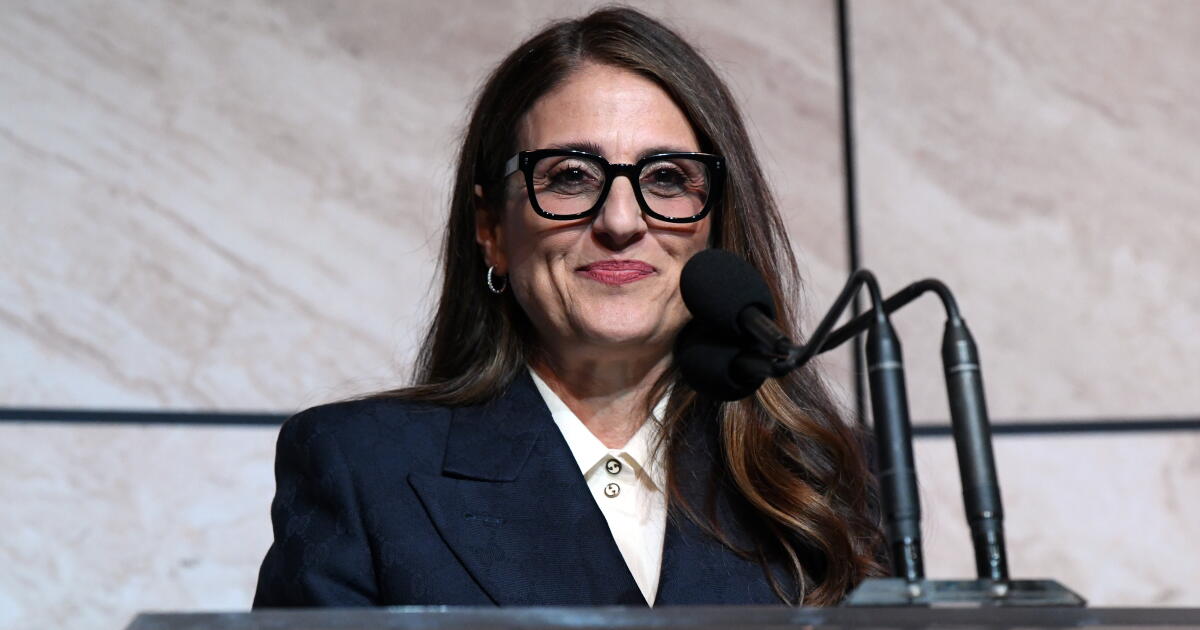
“When I researched the term vanguard, I came across a few meanings,” Pamela Abdy said at the 2026 Women in Film Honors gala, where she received the inaugural Vanguard Award. It can mean “a leader who brings new ideas, political movements or art.”
(Unique Nicole / Getty Images)
She has been called difficult, emotional and combative, Abdy said. She’s been told to put on her “big boy pants,” to smile more. She’s been told that movies starring women and directed by women don’t make as much money as those made by men, that their audience is limited. (Even after “Barbie,” which she oversaw alongside Mike De Luca, grossed more than $1.4 billion.)
“It is getting harder, not easier, to be a woman in the business,” Abdy said. “We tell ourselves because a few of us made it into these chairperson seats, we broke through, that we paved the way for the next generation. But I don’t think it’s true.”
When Gerwig made “Barbie,” people consistently referred to her as a “female director,” Abdy said — not a “director.” But when people talk about the highest-grossing male directors, they don’t call them “male directors.” We still have the “Most Powerful Women in Hollywood” lists. But the men don’t have a separate list; they are the list, she added.
“So I have to ask: What business are we leaving for future vanguards?” Abdy said. “Is it a healthy industry for the next generation of storytellers and executives to step into? One that allows women to enter with an open heart and mind, without having to fight the fights we’re still fighting?”
“These are the questions I think about when I focus on funneling my rage,” she continued. “Rage can be destructive, but I think of it as fuel, as something that can burn bright, something that can be harnessed to fight on for what we think is right, what we believe in and what we deserve.”

Jane Fonda, right, presented Salma Hayek Pinault with the Jane Fonda Humanitarian Award at Thursday’s Women in Film Honors gala.
(Unique Nicole / Getty Images)
Abdy then paused to acknowledge how heartening it was to see so many women elected in the midterms on Tuesday. Earlier in the evening, WIF Chief Executive Kirsten Schaffer shouted out Keisha Lance Bottoms, the first Black woman elected governor of a state, in Georgia; Gina Hinojosa, the first Latina governor elected in Texas; and the six transgender and nonbinary candidates who made history.
Filmmaker Nancy Meyers, who presented Abdy with her honor, praised Abdy and De Luca’s historic tenure: “Barbie” is the highest-grossing film in Warner Bros. history. “Sinners” set an Oscar record with the most nominations ever by a single movie. And last year’s best picture winner, “One Battle After Another,” was “another feather in Pam’s very crowded hat.”
After Meyers’ introduction, a highlight reel played Abdy’s greatest hits, including video submissions from some of her friends in the industry: Gerwig, Robbie, Kidman, Bullock and Ryan Coogler, among others.
Bullock cheekily reminded Abdy that, when she accepts her award, “remember that when they gave it to you, you were initially employed at the place where you are no longer employed.” Then, when Bullock “realizes” that this is the WIF Honors gala, she backtracks. “Never mind, forget everything I just said. Say everything you want to say, toot your own horn. They love you.”
This seemed, for the most part, true about the hundreds of women in attendance. As soon as Abdy turned her speech toward rage, a faint “preach!” rang from somewhere in the ballroom. The 15-minute speech was met with a standing ovation. (When Schaffer asked attendees to donate to WIF’s fellowship program, Skydance‘s “$25 donation” was among the contributions included in a video presentation, which prompted some disquiet, but this seemed like an ill-timed joke.)

At the 2026 Women in Film Honors gala, WIF Chief Executive Kirsten Schaffer asked: “Whose stories make it to the big screen? Whose vision of the future are we living in?”
(Unique Nicole / Getty Images)
“In the executive suites of Hollywood, in the past three months, we’ve lost 50% of our top women leaders, which has been a major blow, because it’s not like we had that many to begin with,” Schaffer said. “So what are we going to do about it? At WIF, we have a very simple answer: We keep going. We keep opening doors. We keep investing in each other. We keep hiring each other. We keep fostering the next generation of storytellers.”
Abdy wasn’t the only honoree Thursday evening. Jane Fonda presented Salma Hayek Pinault with the Jane Fonda Humanitarian Award for her philanthropic work, including with the Kering Foundation (established by her husband’s luxury group), which fights gender-based violence across the U.S., Mexico, France, Italy, Korea and the U.K. Hayek Pinault dedicated the award to Dolores Huerta, who attended the gala last year, and called Huerta “a womb for our community.”
Sharon Stone presented Hannah Waddingham with the Crystal Award for Advocacy in TV, and Maria Giulia Prezioso Maramotti (granddaughter of the founder of Italian clothing brand Max Mara, which sponsored the event) presented actor Adria Arjona with the WIF Max Mara Face of the Future Award. Emmy Rossum presented writer, director and producer Beth de Araújo and actor Gemma Chan (in absentia) with the Crystal Award for Advocacy in Film for their upcoming movie “Josephine,” about a young girl who has witnessed a sexual assault.

Beth de Araújo — who wrote, directed and produced the upcoming movie “Josephine” — received the Crystal Award for Advocacy in Film (along with star Gemma Chan, in absentia) at the gala.
(Unique Nicole / Getty Images)
“In our film ‘Josephine,’ we attempt to transport you back to your youth, to a time before you understood the concept of sexual assault,” de Araújo said. “What happened to you once you became aware of it? How did this start to inform the way you moved your body through the world, the way you thought about your own safety?”
“For me, I certainly became very, very scared, and I hid. I locked myself inside so that there were barriers between myself and danger,” she continued, tearing up. “But I’m very tired of being scared. It is time for those who are committed to violence to be scared of us.”

Lately, Pamela Abdy has been feeling “pure, unadulterated rage.”
Abdy exited her role as co-chair and chief executive officer of Warner Bros. after the studio was acquired by Paramount Skydance in a controversial merger that closed last month.
The now-former studio executive received the inaugural Vanguard Award at the Women in Film Honors gala on Thursday evening. She thanked every single woman director, producer and executive she has worked with throughout her career, including Greta Gerwig, Emerald Fennell, Zoë Kravitz, Margot Robbie, Sandra Bullock and Nicole Kidman, whom she feels ever-growing gratitude toward.
“But lately, other feelings, and one in particular, have risen to the surface with undeniable ferocity, and that feeling is pure, unadulterated rage,” she said onstage in the Beverly Hilton’s opulent ballroom. “Rage for these women, rage for me and even more rage for the entire generation of women who deserve to have their potential recognized and elevated.”
“Rage at how women are under attack everywhere,” she continued. “Rage at how our health and our wellbeing always seem to come second to how we show up in a room. And here’s the problem: As a leader who happens to be a woman, I am supposed to sublimate this rage. And you know what happens when they tell you to tamp down a fever? Sometimes it just burns hotter.” (All remarks onstage were interpreted into ASL by Keturah Holiday and Amber Berteloot.)
“When I researched the term vanguard, I came across a few meanings,” Pamela Abdy said at the 2026 Women in Film Honors gala, where she received the inaugural Vanguard Award. It can mean “a leader who brings new ideas, political movements or art.”
(Unique Nicole / Getty Images)
She has been called difficult, emotional and combative, Abdy said. She’s been told to put on her “big boy pants,” to smile more. She’s been told that movies starring women and directed by women don’t make as much money as those made by men, that their audience is limited. (Even after “Barbie,” which she oversaw alongside Mike De Luca, grossed more than $1.4 billion.)
“It is getting harder, not easier, to be a woman in the business,” Abdy said. “We tell ourselves because a few of us made it into these chairperson seats, we broke through, that we paved the way for the next generation. But I don’t think it’s true.”
When Gerwig made “Barbie,” people consistently referred to her as a “female director,” Abdy said — not a “director.” But when people talk about the highest-grossing male directors, they don’t call them “male directors.” We still have the “Most Powerful Women in Hollywood” lists. But the men don’t have a separate list; they are the list, she added.
“So I have to ask: What business are we leaving for future vanguards?” Abdy said. “Is it a healthy industry for the next generation of storytellers and executives to step into? One that allows women to enter with an open heart and mind, without having to fight the fights we’re still fighting?”
“These are the questions I think about when I focus on funneling my rage,” she continued. “Rage can be destructive, but I think of it as fuel, as something that can burn bright, something that can be harnessed to fight on for what we think is right, what we believe in and what we deserve.”
Jane Fonda, right, presented Salma Hayek Pinault with the Jane Fonda Humanitarian Award at Thursday’s Women in Film Honors gala.
(Unique Nicole / Getty Images)
Abdy then paused to acknowledge how heartening it was to see so many women elected in the midterms on Tuesday. Earlier in the evening, WIF Chief Executive Kirsten Schaffer shouted out Keisha Lance Bottoms, the first Black woman elected governor of a state, in Georgia; Gina Hinojosa, the first Latina governor elected in Texas; and the six transgender and nonbinary candidates who made history.
Filmmaker Nancy Meyers, who presented Abdy with her honor, praised Abdy and De Luca’s historic tenure: “Barbie” is the highest-grossing film in Warner Bros. history. “Sinners” set an Oscar record with the most nominations ever by a single movie. And last year’s best picture winner, “One Battle After Another,” was “another feather in Pam’s very crowded hat.”
After Meyers’ introduction, a highlight reel played Abdy’s greatest hits, including video submissions from some of her friends in the industry: Gerwig, Robbie, Kidman, Bullock and Ryan Coogler, among others.
Bullock cheekily reminded Abdy that, when she accepts her award, “remember that when they gave it to you, you were initially employed at the place where you are no longer employed.” Then, when Bullock “realizes” that this is the WIF Honors gala, she backtracks. “Never mind, forget everything I just said. Say everything you want to say, toot your own horn. They love you.”
This seemed, for the most part, true about the hundreds of women in attendance. As soon as Abdy turned her speech toward rage, a faint “preach!” rang from somewhere in the ballroom. The 15-minute speech was met with a standing ovation. (When Schaffer asked attendees to donate to WIF’s fellowship program, Skydance‘s “$25 donation” was among the contributions included in a video presentation, which prompted some disquiet, but this seemed like an ill-timed joke.)
At the 2026 Women in Film Honors gala, WIF Chief Executive Kirsten Schaffer asked: “Whose stories make it to the big screen? Whose vision of the future are we living in?”
(Unique Nicole / Getty Images)
“In the executive suites of Hollywood, in the past three months, we’ve lost 50% of our top women leaders, which has been a major blow, because it’s not like we had that many to begin with,” Schaffer said. “So what are we going to do about it? At WIF, we have a very simple answer: We keep going. We keep opening doors. We keep investing in each other. We keep hiring each other. We keep fostering the next generation of storytellers.”
Abdy wasn’t the only honoree Thursday evening. Jane Fonda presented Salma Hayek Pinault with the Jane Fonda Humanitarian Award for her philanthropic work, including with the Kering Foundation (established by her husband’s luxury group), which fights gender-based violence across the U.S., Mexico, France, Italy, Korea and the U.K. Hayek Pinault dedicated the award to Dolores Huerta, who attended the gala last year, and called Huerta “a womb for our community.”
Sharon Stone presented Hannah Waddingham with the Crystal Award for Advocacy in TV, and Maria Giulia Prezioso Maramotti (granddaughter of the founder of Italian clothing brand Max Mara, which sponsored the event) presented actor Adria Arjona with the WIF Max Mara Face of the Future Award. Emmy Rossum presented writer, director and producer Beth de Araújo and actor Gemma Chan (in absentia) with the Crystal Award for Advocacy in Film for their upcoming movie “Josephine,” about a young girl who has witnessed a sexual assault.
Beth de Araújo — who wrote, directed and produced the upcoming movie “Josephine” — received the Crystal Award for Advocacy in Film (along with star Gemma Chan, in absentia) at the gala.
(Unique Nicole / Getty Images)
“In our film ‘Josephine,’ we attempt to transport you back to your youth, to a time before you understood the concept of sexual assault,” de Araújo said. “What happened to you once you became aware of it? How did this start to inform the way you moved your body through the world, the way you thought about your own safety?”
“For me, I certainly became very, very scared, and I hid. I locked myself inside so that there were barriers between myself and danger,” she continued, tearing up. “But I’m very tired of being scared. It is time for those who are committed to violence to be scared of us.”

Lately, Pamela Abdy has been feeling “pure, unadulterated rage.”
Abdy exited her role as co-chair and chief executive officer of Warner Bros. after the studio was acquired by Paramount Skydance in a controversial merger that closed last month.
The now-former studio executive received the inaugural Vanguard Award at the Women in Film Honors gala on Thursday evening. She thanked every single woman director, producer and executive she has worked with throughout her career, including Greta Gerwig, Emerald Fennell, Zoë Kravitz, Margot Robbie, Sandra Bullock and Nicole Kidman, whom she feels ever-growing gratitude toward.
“But lately, other feelings, and one in particular, have risen to the surface with undeniable ferocity, and that feeling is pure, unadulterated rage,” she said onstage in the Beverly Hilton’s opulent ballroom. “Rage for these women, rage for me and even more rage for the entire generation of women who deserve to have their potential recognized and elevated.”
“Rage at how women are under attack everywhere,” she continued. “Rage at how our health and our wellbeing always seem to come second to how we show up in a room. And here’s the problem: As a leader who happens to be a woman, I am supposed to sublimate this rage. And you know what happens when they tell you to tamp down a fever? Sometimes it just burns hotter.” (All remarks onstage were interpreted into ASL by Keturah Holiday and Amber Berteloot.)
“When I researched the term vanguard, I came across a few meanings,” Pamela Abdy said at the 2026 Women in Film Honors gala, where she received the inaugural Vanguard Award. It can mean “a leader who brings new ideas, political movements or art.”
(Unique Nicole / Getty Images)
She has been called difficult, emotional and combative, Abdy said. She’s been told to put on her “big boy pants,” to smile more. She’s been told that movies starring women and directed by women don’t make as much money as those made by men, that their audience is limited. (Even after “Barbie,” which she oversaw alongside Mike De Luca, grossed more than $1.4 billion.)
“It is getting harder, not easier, to be a woman in the business,” Abdy said. “We tell ourselves because a few of us made it into these chairperson seats, we broke through, that we paved the way for the next generation. But I don’t think it’s true.”
When Gerwig made “Barbie,” people consistently referred to her as a “female director,” Abdy said — not a “director.” But when people talk about the highest-grossing male directors, they don’t call them “male directors.” We still have the “Most Powerful Women in Hollywood” lists. But the men don’t have a separate list; they are the list, she added.
“So I have to ask: What business are we leaving for future vanguards?” Abdy said. “Is it a healthy industry for the next generation of storytellers and executives to step into? One that allows women to enter with an open heart and mind, without having to fight the fights we’re still fighting?”
“These are the questions I think about when I focus on funneling my rage,” she continued. “Rage can be destructive, but I think of it as fuel, as something that can burn bright, something that can be harnessed to fight on for what we think is right, what we believe in and what we deserve.”
Jane Fonda, right, presented Salma Hayek Pinault with the Jane Fonda Humanitarian Award at Thursday’s Women in Film Honors gala.
(Unique Nicole / Getty Images)
Abdy then paused to acknowledge how heartening it was to see so many women elected in the midterms on Tuesday. Earlier in the evening, WIF Chief Executive Kirsten Schaffer shouted out Keisha Lance Bottoms, the first Black woman elected governor of a state, in Georgia; Gina Hinojosa, the first Latina governor elected in Texas; and the six transgender and nonbinary candidates who made history.
Filmmaker Nancy Meyers, who presented Abdy with her honor, praised Abdy and De Luca’s historic tenure: “Barbie” is the highest-grossing film in Warner Bros. history. “Sinners” set an Oscar record with the most nominations ever by a single movie. And last year’s best picture winner, “One Battle After Another,” was “another feather in Pam’s very crowded hat.”
After Meyers’ introduction, a highlight reel played Abdy’s greatest hits, including video submissions from some of her friends in the industry: Gerwig, Robbie, Kidman, Bullock and Ryan Coogler, among others.
Bullock cheekily reminded Abdy that, when she accepts her award, “remember that when they gave it to you, you were initially employed at the place where you are no longer employed.” Then, when Bullock “realizes” that this is the WIF Honors gala, she backtracks. “Never mind, forget everything I just said. Say everything you want to say, toot your own horn. They love you.”
This seemed, for the most part, true about the hundreds of women in attendance. As soon as Abdy turned her speech toward rage, a faint “preach!” rang from somewhere in the ballroom. The 15-minute speech was met with a standing ovation. (When Schaffer asked attendees to donate to WIF’s fellowship program, Skydance‘s “$25 donation” was among the contributions included in a video presentation, which prompted some disquiet, but this seemed like an ill-timed joke.)
At the 2026 Women in Film Honors gala, WIF Chief Executive Kirsten Schaffer asked: “Whose stories make it to the big screen? Whose vision of the future are we living in?”
(Unique Nicole / Getty Images)
“In the executive suites of Hollywood, in the past three months, we’ve lost 50% of our top women leaders, which has been a major blow, because it’s not like we had that many to begin with,” Schaffer said. “So what are we going to do about it? At WIF, we have a very simple answer: We keep going. We keep opening doors. We keep investing in each other. We keep hiring each other. We keep fostering the next generation of storytellers.”
Abdy wasn’t the only honoree Thursday evening. Jane Fonda presented Salma Hayek Pinault with the Jane Fonda Humanitarian Award for her philanthropic work, including with the Kering Foundation (established by her husband’s luxury group), which fights gender-based violence across the U.S., Mexico, France, Italy, Korea and the U.K. Hayek Pinault dedicated the award to Dolores Huerta, who attended the gala last year, and called Huerta “a womb for our community.”
Sharon Stone presented Hannah Waddingham with the Crystal Award for Advocacy in TV, and Maria Giulia Prezioso Maramotti (granddaughter of the founder of Italian clothing brand Max Mara, which sponsored the event) presented actor Adria Arjona with the WIF Max Mara Face of the Future Award. Emmy Rossum presented writer, director and producer Beth de Araújo and actor Gemma Chan (in absentia) with the Crystal Award for Advocacy in Film for their upcoming movie “Josephine,” about a young girl who has witnessed a sexual assault.
Beth de Araújo — who wrote, directed and produced the upcoming movie “Josephine” — received the Crystal Award for Advocacy in Film (along with star Gemma Chan, in absentia) at the gala.
(Unique Nicole / Getty Images)
“In our film ‘Josephine,’ we attempt to transport you back to your youth, to a time before you understood the concept of sexual assault,” de Araújo said. “What happened to you once you became aware of it? How did this start to inform the way you moved your body through the world, the way you thought about your own safety?”
“For me, I certainly became very, very scared, and I hid. I locked myself inside so that there were barriers between myself and danger,” she continued, tearing up. “But I’m very tired of being scared. It is time for those who are committed to violence to be scared of us.”

Lately, Pamela Abdy has been feeling “pure, unadulterated rage.”
Abdy exited her role as co-chair and chief executive officer of Warner Bros. after the studio was acquired by Paramount Skydance in a controversial merger that closed last month.
The now-former studio executive received the inaugural Vanguard Award at the Women in Film Honors gala on Thursday evening. She thanked every single woman director, producer and executive she has worked with throughout her career, including Greta Gerwig, Emerald Fennell, Zoë Kravitz, Margot Robbie, Sandra Bullock and Nicole Kidman, whom she feels ever-growing gratitude toward.
“But lately, other feelings, and one in particular, have risen to the surface with undeniable ferocity, and that feeling is pure, unadulterated rage,” she said onstage in the Beverly Hilton’s opulent ballroom. “Rage for these women, rage for me and even more rage for the entire generation of women who deserve to have their potential recognized and elevated.”
“Rage at how women are under attack everywhere,” she continued. “Rage at how our health and our wellbeing always seem to come second to how we show up in a room. And here’s the problem: As a leader who happens to be a woman, I am supposed to sublimate this rage. And you know what happens when they tell you to tamp down a fever? Sometimes it just burns hotter.” (All remarks onstage were interpreted into ASL by Keturah Holiday and Amber Berteloot.)
“When I researched the term vanguard, I came across a few meanings,” Pamela Abdy said at the 2026 Women in Film Honors gala, where she received the inaugural Vanguard Award. It can mean “a leader who brings new ideas, political movements or art.”
(Unique Nicole / Getty Images)
She has been called difficult, emotional and combative, Abdy said. She’s been told to put on her “big boy pants,” to smile more. She’s been told that movies starring women and directed by women don’t make as much money as those made by men, that their audience is limited. (Even after “Barbie,” which she oversaw alongside Mike De Luca, grossed more than $1.4 billion.)
“It is getting harder, not easier, to be a woman in the business,” Abdy said. “We tell ourselves because a few of us made it into these chairperson seats, we broke through, that we paved the way for the next generation. But I don’t think it’s true.”
When Gerwig made “Barbie,” people consistently referred to her as a “female director,” Abdy said — not a “director.” But when people talk about the highest-grossing male directors, they don’t call them “male directors.” We still have the “Most Powerful Women in Hollywood” lists. But the men don’t have a separate list; they are the list, she added.
“So I have to ask: What business are we leaving for future vanguards?” Abdy said. “Is it a healthy industry for the next generation of storytellers and executives to step into? One that allows women to enter with an open heart and mind, without having to fight the fights we’re still fighting?”
“These are the questions I think about when I focus on funneling my rage,” she continued. “Rage can be destructive, but I think of it as fuel, as something that can burn bright, something that can be harnessed to fight on for what we think is right, what we believe in and what we deserve.”
Jane Fonda, right, presented Salma Hayek Pinault with the Jane Fonda Humanitarian Award at Thursday’s Women in Film Honors gala.
(Unique Nicole / Getty Images)
Abdy then paused to acknowledge how heartening it was to see so many women elected in the midterms on Tuesday. Earlier in the evening, WIF Chief Executive Kirsten Schaffer shouted out Keisha Lance Bottoms, the first Black woman elected governor of a state, in Georgia; Gina Hinojosa, the first Latina governor elected in Texas; and the six transgender and nonbinary candidates who made history.
Filmmaker Nancy Meyers, who presented Abdy with her honor, praised Abdy and De Luca’s historic tenure: “Barbie” is the highest-grossing film in Warner Bros. history. “Sinners” set an Oscar record with the most nominations ever by a single movie. And last year’s best picture winner, “One Battle After Another,” was “another feather in Pam’s very crowded hat.”
After Meyers’ introduction, a highlight reel played Abdy’s greatest hits, including video submissions from some of her friends in the industry: Gerwig, Robbie, Kidman, Bullock and Ryan Coogler, among others.
Bullock cheekily reminded Abdy that, when she accepts her award, “remember that when they gave it to you, you were initially employed at the place where you are no longer employed.” Then, when Bullock “realizes” that this is the WIF Honors gala, she backtracks. “Never mind, forget everything I just said. Say everything you want to say, toot your own horn. They love you.”
This seemed, for the most part, true about the hundreds of women in attendance. As soon as Abdy turned her speech toward rage, a faint “preach!” rang from somewhere in the ballroom. The 15-minute speech was met with a standing ovation. (When Schaffer asked attendees to donate to WIF’s fellowship program, Skydance‘s “$25 donation” was among the contributions included in a video presentation, which prompted some disquiet, but this seemed like an ill-timed joke.)
At the 2026 Women in Film Honors gala, WIF Chief Executive Kirsten Schaffer asked: “Whose stories make it to the big screen? Whose vision of the future are we living in?”
(Unique Nicole / Getty Images)
“In the executive suites of Hollywood, in the past three months, we’ve lost 50% of our top women leaders, which has been a major blow, because it’s not like we had that many to begin with,” Schaffer said. “So what are we going to do about it? At WIF, we have a very simple answer: We keep going. We keep opening doors. We keep investing in each other. We keep hiring each other. We keep fostering the next generation of storytellers.”
Abdy wasn’t the only honoree Thursday evening. Jane Fonda presented Salma Hayek Pinault with the Jane Fonda Humanitarian Award for her philanthropic work, including with the Kering Foundation (established by her husband’s luxury group), which fights gender-based violence across the U.S., Mexico, France, Italy, Korea and the U.K. Hayek Pinault dedicated the award to Dolores Huerta, who attended the gala last year, and called Huerta “a womb for our community.”
Sharon Stone presented Hannah Waddingham with the Crystal Award for Advocacy in TV, and Maria Giulia Prezioso Maramotti (granddaughter of the founder of Italian clothing brand Max Mara, which sponsored the event) presented actor Adria Arjona with the WIF Max Mara Face of the Future Award. Emmy Rossum presented writer, director and producer Beth de Araújo and actor Gemma Chan (in absentia) with the Crystal Award for Advocacy in Film for their upcoming movie “Josephine,” about a young girl who has witnessed a sexual assault.
Beth de Araújo — who wrote, directed and produced the upcoming movie “Josephine” — received the Crystal Award for Advocacy in Film (along with star Gemma Chan, in absentia) at the gala.
(Unique Nicole / Getty Images)
“In our film ‘Josephine,’ we attempt to transport you back to your youth, to a time before you understood the concept of sexual assault,” de Araújo said. “What happened to you once you became aware of it? How did this start to inform the way you moved your body through the world, the way you thought about your own safety?”
“For me, I certainly became very, very scared, and I hid. I locked myself inside so that there were barriers between myself and danger,” she continued, tearing up. “But I’m very tired of being scared. It is time for those who are committed to violence to be scared of us.”

Lately, Pamela Abdy has been feeling “pure, unadulterated rage.”
Abdy exited her role as co-chair and chief executive officer of Warner Bros. after the studio was acquired by Paramount Skydance in a controversial merger that closed last month.
The now-former studio executive received the inaugural Vanguard Award at the Women in Film Honors gala on Thursday evening. She thanked every single woman director, producer and executive she has worked with throughout her career, including Greta Gerwig, Emerald Fennell, Zoë Kravitz, Margot Robbie, Sandra Bullock and Nicole Kidman, whom she feels ever-growing gratitude toward.
“But lately, other feelings, and one in particular, have risen to the surface with undeniable ferocity, and that feeling is pure, unadulterated rage,” she said onstage in the Beverly Hilton’s opulent ballroom. “Rage for these women, rage for me and even more rage for the entire generation of women who deserve to have their potential recognized and elevated.”
“Rage at how women are under attack everywhere,” she continued. “Rage at how our health and our wellbeing always seem to come second to how we show up in a room. And here’s the problem: As a leader who happens to be a woman, I am supposed to sublimate this rage. And you know what happens when they tell you to tamp down a fever? Sometimes it just burns hotter.” (All remarks onstage were interpreted into ASL by Keturah Holiday and Amber Berteloot.)
“When I researched the term vanguard, I came across a few meanings,” Pamela Abdy said at the 2026 Women in Film Honors gala, where she received the inaugural Vanguard Award. It can mean “a leader who brings new ideas, political movements or art.”
(Unique Nicole / Getty Images)
She has been called difficult, emotional and combative, Abdy said. She’s been told to put on her “big boy pants,” to smile more. She’s been told that movies starring women and directed by women don’t make as much money as those made by men, that their audience is limited. (Even after “Barbie,” which she oversaw alongside Mike De Luca, grossed more than $1.4 billion.)
“It is getting harder, not easier, to be a woman in the business,” Abdy said. “We tell ourselves because a few of us made it into these chairperson seats, we broke through, that we paved the way for the next generation. But I don’t think it’s true.”
When Gerwig made “Barbie,” people consistently referred to her as a “female director,” Abdy said — not a “director.” But when people talk about the highest-grossing male directors, they don’t call them “male directors.” We still have the “Most Powerful Women in Hollywood” lists. But the men don’t have a separate list; they are the list, she added.
“So I have to ask: What business are we leaving for future vanguards?” Abdy said. “Is it a healthy industry for the next generation of storytellers and executives to step into? One that allows women to enter with an open heart and mind, without having to fight the fights we’re still fighting?”
“These are the questions I think about when I focus on funneling my rage,” she continued. “Rage can be destructive, but I think of it as fuel, as something that can burn bright, something that can be harnessed to fight on for what we think is right, what we believe in and what we deserve.”
Jane Fonda, right, presented Salma Hayek Pinault with the Jane Fonda Humanitarian Award at Thursday’s Women in Film Honors gala.
(Unique Nicole / Getty Images)
Abdy then paused to acknowledge how heartening it was to see so many women elected in the midterms on Tuesday. Earlier in the evening, WIF Chief Executive Kirsten Schaffer shouted out Keisha Lance Bottoms, the first Black woman elected governor of a state, in Georgia; Gina Hinojosa, the first Latina governor elected in Texas; and the six transgender and nonbinary candidates who made history.
Filmmaker Nancy Meyers, who presented Abdy with her honor, praised Abdy and De Luca’s historic tenure: “Barbie” is the highest-grossing film in Warner Bros. history. “Sinners” set an Oscar record with the most nominations ever by a single movie. And last year’s best picture winner, “One Battle After Another,” was “another feather in Pam’s very crowded hat.”
After Meyers’ introduction, a highlight reel played Abdy’s greatest hits, including video submissions from some of her friends in the industry: Gerwig, Robbie, Kidman, Bullock and Ryan Coogler, among others.
Bullock cheekily reminded Abdy that, when she accepts her award, “remember that when they gave it to you, you were initially employed at the place where you are no longer employed.” Then, when Bullock “realizes” that this is the WIF Honors gala, she backtracks. “Never mind, forget everything I just said. Say everything you want to say, toot your own horn. They love you.”
This seemed, for the most part, true about the hundreds of women in attendance. As soon as Abdy turned her speech toward rage, a faint “preach!” rang from somewhere in the ballroom. The 15-minute speech was met with a standing ovation. (When Schaffer asked attendees to donate to WIF’s fellowship program, Skydance‘s “$25 donation” was among the contributions included in a video presentation, which prompted some disquiet, but this seemed like an ill-timed joke.)
At the 2026 Women in Film Honors gala, WIF Chief Executive Kirsten Schaffer asked: “Whose stories make it to the big screen? Whose vision of the future are we living in?”
(Unique Nicole / Getty Images)
“In the executive suites of Hollywood, in the past three months, we’ve lost 50% of our top women leaders, which has been a major blow, because it’s not like we had that many to begin with,” Schaffer said. “So what are we going to do about it? At WIF, we have a very simple answer: We keep going. We keep opening doors. We keep investing in each other. We keep hiring each other. We keep fostering the next generation of storytellers.”
Abdy wasn’t the only honoree Thursday evening. Jane Fonda presented Salma Hayek Pinault with the Jane Fonda Humanitarian Award for her philanthropic work, including with the Kering Foundation (established by her husband’s luxury group), which fights gender-based violence across the U.S., Mexico, France, Italy, Korea and the U.K. Hayek Pinault dedicated the award to Dolores Huerta, who attended the gala last year, and called Huerta “a womb for our community.”
Sharon Stone presented Hannah Waddingham with the Crystal Award for Advocacy in TV, and Maria Giulia Prezioso Maramotti (granddaughter of the founder of Italian clothing brand Max Mara, which sponsored the event) presented actor Adria Arjona with the WIF Max Mara Face of the Future Award. Emmy Rossum presented writer, director and producer Beth de Araújo and actor Gemma Chan (in absentia) with the Crystal Award for Advocacy in Film for their upcoming movie “Josephine,” about a young girl who has witnessed a sexual assault.
Beth de Araújo — who wrote, directed and produced the upcoming movie “Josephine” — received the Crystal Award for Advocacy in Film (along with star Gemma Chan, in absentia) at the gala.
(Unique Nicole / Getty Images)
“In our film ‘Josephine,’ we attempt to transport you back to your youth, to a time before you understood the concept of sexual assault,” de Araújo said. “What happened to you once you became aware of it? How did this start to inform the way you moved your body through the world, the way you thought about your own safety?”
“For me, I certainly became very, very scared, and I hid. I locked myself inside so that there were barriers between myself and danger,” she continued, tearing up. “But I’m very tired of being scared. It is time for those who are committed to violence to be scared of us.”

