

California farmworkers can now unionize more easily after Gov. Gavin Newsom signed legislation Monday in the final step of an unusual compromise struck last year between the Democratic leader and union advocates.
Under intense political pressure, Newsom agreed to sign a high-profile bill last year expanding unionization rights for agricultural workers, but only on the condition that the United Farm Workers and the California Labor Federation supported follow-up legislation in 2023 rescinding some of its provisions.
The rare agreement allows farmworkers to unionize by signing cards under a process known as “card-check” instead of being required to vote in-person at a polling place, but removed their ability to unionize through mail-in ballots as the original bill would have allowed.
“Card-check” essentially gives workers an opportunity to organize without the employer knowing.
“Allowing farmworkers to organize without the fear of intimidation and deportation has been our dream in California for decades,” said Lorena Gonzalez Fletcher, executive-secretary treasurer of the California Labor Federation. “Nothing good comes easy but we’re excited we finally have this tool.”
Newsom’s signature on the follow up bill, AB 113, concludes a politically challenging episode for the Democratic governor, who rose to power and has stayed there with the backing of the state’s most influential labor unions.
After vetoing similar legislation in 2021, Newsom indicated that he was prepared to reject the proposal again last year that allowed “card check” elections and mail-in ballots. A month before the bill, AB 2183, reached his desk, a spokesman for Newsom said the governor could not “support an untested mail-election process that lacks critical provisions to protect the integrity of the election.”
Unions lobbied the bill through the state Legislature to his desk anyway, creating a political face-off with Newsom that drew national headlines.
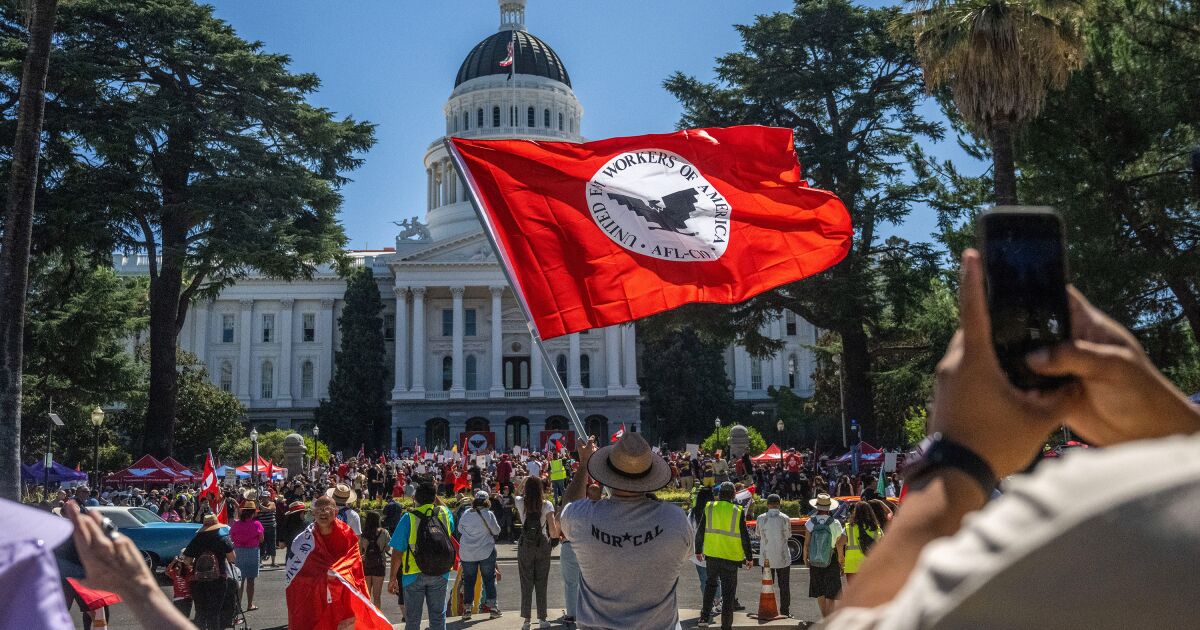
Farmworkers marched across the state and camped out in Sacramento in support of the legislation last year. President Biden, Vice President Kamala Harris and House Speaker Nancy Pelosi (D-San Francisco) ramped up the pressure and publicly urged their fellow Democrat to sign the bill.
Instead of vetoing the bill and facing criticism from Democrats nationally and in California a month before his reelection, Newsom struck an agreement with unions. The governor agreed to sign the bill only if the United Farm Workers and the California Labor Federation supported and pushed follow up language this year that eliminated the mail-in ballot option, limited “card-check” certification to 75 workplaces and allowed the “card-check” option to expire in 2028.
AB 113, which Newsom signed Monday, made those changes to the 2022 law. The governor also signed a bill to create a new $150 million program to offer zero-interest loans to struggling medical centers in hopes of preventing closures often in rural communities.
Newsom’s office did not immediately respond to a request for comment about the farmworker bill after he signed the legislation Monday.

California farmworkers can now unionize more easily after Gov. Gavin Newsom signed legislation Monday in the final step of an unusual compromise struck last year between the Democratic leader and union advocates.
Under intense political pressure, Newsom agreed to sign a high-profile bill last year expanding unionization rights for agricultural workers, but only on the condition that the United Farm Workers and the California Labor Federation supported follow-up legislation in 2023 rescinding some of its provisions.
The rare agreement allows farmworkers to unionize by signing cards under a process known as “card-check” instead of being required to vote in-person at a polling place, but removed their ability to unionize through mail-in ballots as the original bill would have allowed.
“Card-check” essentially gives workers an opportunity to organize without the employer knowing.
“Allowing farmworkers to organize without the fear of intimidation and deportation has been our dream in California for decades,” said Lorena Gonzalez Fletcher, executive-secretary treasurer of the California Labor Federation. “Nothing good comes easy but we’re excited we finally have this tool.”
Newsom’s signature on the follow up bill, AB 113, concludes a politically challenging episode for the Democratic governor, who rose to power and has stayed there with the backing of the state’s most influential labor unions.
After vetoing similar legislation in 2021, Newsom indicated that he was prepared to reject the proposal again last year that allowed “card check” elections and mail-in ballots. A month before the bill, AB 2183, reached his desk, a spokesman for Newsom said the governor could not “support an untested mail-election process that lacks critical provisions to protect the integrity of the election.”
Unions lobbied the bill through the state Legislature to his desk anyway, creating a political face-off with Newsom that drew national headlines.
Farmworkers marched across the state and camped out in Sacramento in support of the legislation last year. President Biden, Vice President Kamala Harris and House Speaker Nancy Pelosi (D-San Francisco) ramped up the pressure and publicly urged their fellow Democrat to sign the bill.
Instead of vetoing the bill and facing criticism from Democrats nationally and in California a month before his reelection, Newsom struck an agreement with unions. The governor agreed to sign the bill only if the United Farm Workers and the California Labor Federation supported and pushed follow up language this year that eliminated the mail-in ballot option, limited “card-check” certification to 75 workplaces and allowed the “card-check” option to expire in 2028.
AB 113, which Newsom signed Monday, made those changes to the 2022 law. The governor also signed a bill to create a new $150 million program to offer zero-interest loans to struggling medical centers in hopes of preventing closures often in rural communities.
Newsom’s office did not immediately respond to a request for comment about the farmworker bill after he signed the legislation Monday.

California farmworkers can now unionize more easily after Gov. Gavin Newsom signed legislation Monday in the final step of an unusual compromise struck last year between the Democratic leader and union advocates.
Under intense political pressure, Newsom agreed to sign a high-profile bill last year expanding unionization rights for agricultural workers, but only on the condition that the United Farm Workers and the California Labor Federation supported follow-up legislation in 2023 rescinding some of its provisions.
The rare agreement allows farmworkers to unionize by signing cards under a process known as “card-check” instead of being required to vote in-person at a polling place, but removed their ability to unionize through mail-in ballots as the original bill would have allowed.
“Card-check” essentially gives workers an opportunity to organize without the employer knowing.
“Allowing farmworkers to organize without the fear of intimidation and deportation has been our dream in California for decades,” said Lorena Gonzalez Fletcher, executive-secretary treasurer of the California Labor Federation. “Nothing good comes easy but we’re excited we finally have this tool.”
Newsom’s signature on the follow up bill, AB 113, concludes a politically challenging episode for the Democratic governor, who rose to power and has stayed there with the backing of the state’s most influential labor unions.
After vetoing similar legislation in 2021, Newsom indicated that he was prepared to reject the proposal again last year that allowed “card check” elections and mail-in ballots. A month before the bill, AB 2183, reached his desk, a spokesman for Newsom said the governor could not “support an untested mail-election process that lacks critical provisions to protect the integrity of the election.”
Unions lobbied the bill through the state Legislature to his desk anyway, creating a political face-off with Newsom that drew national headlines.
Farmworkers marched across the state and camped out in Sacramento in support of the legislation last year. President Biden, Vice President Kamala Harris and House Speaker Nancy Pelosi (D-San Francisco) ramped up the pressure and publicly urged their fellow Democrat to sign the bill.
Instead of vetoing the bill and facing criticism from Democrats nationally and in California a month before his reelection, Newsom struck an agreement with unions. The governor agreed to sign the bill only if the United Farm Workers and the California Labor Federation supported and pushed follow up language this year that eliminated the mail-in ballot option, limited “card-check” certification to 75 workplaces and allowed the “card-check” option to expire in 2028.
AB 113, which Newsom signed Monday, made those changes to the 2022 law. The governor also signed a bill to create a new $150 million program to offer zero-interest loans to struggling medical centers in hopes of preventing closures often in rural communities.
Newsom’s office did not immediately respond to a request for comment about the farmworker bill after he signed the legislation Monday.
California farmworkers can now unionize more easily after Gov. Gavin Newsom signed legislation Monday in the final step of an unusual compromise struck last year between the Democratic leader and union advocates.
Under intense political pressure, Newsom agreed to sign a high-profile bill last year expanding unionization rights for agricultural workers, but only on the condition that the United Farm Workers and the California Labor Federation supported follow-up legislation in 2023 rescinding some of its provisions.
The rare agreement allows farmworkers to unionize by signing cards under a process known as “card-check” instead of being required to vote in-person at a polling place, but removed their ability to unionize through mail-in ballots as the original bill would have allowed.
“Card-check” essentially gives workers an opportunity to organize without the employer knowing.
“Allowing farmworkers to organize without the fear of intimidation and deportation has been our dream in California for decades,” said Lorena Gonzalez Fletcher, executive-secretary treasurer of the California Labor Federation. “Nothing good comes easy but we’re excited we finally have this tool.”
Newsom’s signature on the follow up bill, AB 113, concludes a politically challenging episode for the Democratic governor, who rose to power and has stayed there with the backing of the state’s most influential labor unions.
After vetoing similar legislation in 2021, Newsom indicated that he was prepared to reject the proposal again last year that allowed “card check” elections and mail-in ballots. A month before the bill, AB 2183, reached his desk, a spokesman for Newsom said the governor could not “support an untested mail-election process that lacks critical provisions to protect the integrity of the election.”
Unions lobbied the bill through the state Legislature to his desk anyway, creating a political face-off with Newsom that drew national headlines.
Farmworkers marched across the state and camped out in Sacramento in support of the legislation last year. President Biden, Vice President Kamala Harris and House Speaker Nancy Pelosi (D-San Francisco) ramped up the pressure and publicly urged their fellow Democrat to sign the bill.
Instead of vetoing the bill and facing criticism from Democrats nationally and in California a month before his reelection, Newsom struck an agreement with unions. The governor agreed to sign the bill only if the United Farm Workers and the California Labor Federation supported and pushed follow up language this year that eliminated the mail-in ballot option, limited “card-check” certification to 75 workplaces and allowed the “card-check” option to expire in 2028.
AB 113, which Newsom signed Monday, made those changes to the 2022 law. The governor also signed a bill to create a new $150 million program to offer zero-interest loans to struggling medical centers in hopes of preventing closures often in rural communities.
Newsom’s office did not immediately respond to a request for comment about the farmworker bill after he signed the legislation Monday.

California farmworkers can now unionize more easily after Gov. Gavin Newsom signed legislation Monday in the final step of an unusual compromise struck last year between the Democratic leader and union advocates.
Under intense political pressure, Newsom agreed to sign a high-profile bill last year expanding unionization rights for agricultural workers, but only on the condition that the United Farm Workers and the California Labor Federation supported follow-up legislation in 2023 rescinding some of its provisions.
The rare agreement allows farmworkers to unionize by signing cards under a process known as “card-check” instead of being required to vote in-person at a polling place, but removed their ability to unionize through mail-in ballots as the original bill would have allowed.
“Card-check” essentially gives workers an opportunity to organize without the employer knowing.
“Allowing farmworkers to organize without the fear of intimidation and deportation has been our dream in California for decades,” said Lorena Gonzalez Fletcher, executive-secretary treasurer of the California Labor Federation. “Nothing good comes easy but we’re excited we finally have this tool.”
Newsom’s signature on the follow up bill, AB 113, concludes a politically challenging episode for the Democratic governor, who rose to power and has stayed there with the backing of the state’s most influential labor unions.
After vetoing similar legislation in 2021, Newsom indicated that he was prepared to reject the proposal again last year that allowed “card check” elections and mail-in ballots. A month before the bill, AB 2183, reached his desk, a spokesman for Newsom said the governor could not “support an untested mail-election process that lacks critical provisions to protect the integrity of the election.”
Unions lobbied the bill through the state Legislature to his desk anyway, creating a political face-off with Newsom that drew national headlines.
Farmworkers marched across the state and camped out in Sacramento in support of the legislation last year. President Biden, Vice President Kamala Harris and House Speaker Nancy Pelosi (D-San Francisco) ramped up the pressure and publicly urged their fellow Democrat to sign the bill.
Instead of vetoing the bill and facing criticism from Democrats nationally and in California a month before his reelection, Newsom struck an agreement with unions. The governor agreed to sign the bill only if the United Farm Workers and the California Labor Federation supported and pushed follow up language this year that eliminated the mail-in ballot option, limited “card-check” certification to 75 workplaces and allowed the “card-check” option to expire in 2028.
AB 113, which Newsom signed Monday, made those changes to the 2022 law. The governor also signed a bill to create a new $150 million program to offer zero-interest loans to struggling medical centers in hopes of preventing closures often in rural communities.
Newsom’s office did not immediately respond to a request for comment about the farmworker bill after he signed the legislation Monday.
California farmworkers can now unionize more easily after Gov. Gavin Newsom signed legislation Monday in the final step of an unusual compromise struck last year between the Democratic leader and union advocates.
Under intense political pressure, Newsom agreed to sign a high-profile bill last year expanding unionization rights for agricultural workers, but only on the condition that the United Farm Workers and the California Labor Federation supported follow-up legislation in 2023 rescinding some of its provisions.
The rare agreement allows farmworkers to unionize by signing cards under a process known as “card-check” instead of being required to vote in-person at a polling place, but removed their ability to unionize through mail-in ballots as the original bill would have allowed.
“Card-check” essentially gives workers an opportunity to organize without the employer knowing.
“Allowing farmworkers to organize without the fear of intimidation and deportation has been our dream in California for decades,” said Lorena Gonzalez Fletcher, executive-secretary treasurer of the California Labor Federation. “Nothing good comes easy but we’re excited we finally have this tool.”
Newsom’s signature on the follow up bill, AB 113, concludes a politically challenging episode for the Democratic governor, who rose to power and has stayed there with the backing of the state’s most influential labor unions.
After vetoing similar legislation in 2021, Newsom indicated that he was prepared to reject the proposal again last year that allowed “card check” elections and mail-in ballots. A month before the bill, AB 2183, reached his desk, a spokesman for Newsom said the governor could not “support an untested mail-election process that lacks critical provisions to protect the integrity of the election.”
Unions lobbied the bill through the state Legislature to his desk anyway, creating a political face-off with Newsom that drew national headlines.
Farmworkers marched across the state and camped out in Sacramento in support of the legislation last year. President Biden, Vice President Kamala Harris and House Speaker Nancy Pelosi (D-San Francisco) ramped up the pressure and publicly urged their fellow Democrat to sign the bill.
Instead of vetoing the bill and facing criticism from Democrats nationally and in California a month before his reelection, Newsom struck an agreement with unions. The governor agreed to sign the bill only if the United Farm Workers and the California Labor Federation supported and pushed follow up language this year that eliminated the mail-in ballot option, limited “card-check” certification to 75 workplaces and allowed the “card-check” option to expire in 2028.
AB 113, which Newsom signed Monday, made those changes to the 2022 law. The governor also signed a bill to create a new $150 million program to offer zero-interest loans to struggling medical centers in hopes of preventing closures often in rural communities.
Newsom’s office did not immediately respond to a request for comment about the farmworker bill after he signed the legislation Monday.
California farmworkers can now unionize more easily after Gov. Gavin Newsom signed legislation Monday in the final step of an unusual compromise struck last year between the Democratic leader and union advocates.
Under intense political pressure, Newsom agreed to sign a high-profile bill last year expanding unionization rights for agricultural workers, but only on the condition that the United Farm Workers and the California Labor Federation supported follow-up legislation in 2023 rescinding some of its provisions.
The rare agreement allows farmworkers to unionize by signing cards under a process known as “card-check” instead of being required to vote in-person at a polling place, but removed their ability to unionize through mail-in ballots as the original bill would have allowed.
“Card-check” essentially gives workers an opportunity to organize without the employer knowing.
“Allowing farmworkers to organize without the fear of intimidation and deportation has been our dream in California for decades,” said Lorena Gonzalez Fletcher, executive-secretary treasurer of the California Labor Federation. “Nothing good comes easy but we’re excited we finally have this tool.”
Newsom’s signature on the follow up bill, AB 113, concludes a politically challenging episode for the Democratic governor, who rose to power and has stayed there with the backing of the state’s most influential labor unions.
After vetoing similar legislation in 2021, Newsom indicated that he was prepared to reject the proposal again last year that allowed “card check” elections and mail-in ballots. A month before the bill, AB 2183, reached his desk, a spokesman for Newsom said the governor could not “support an untested mail-election process that lacks critical provisions to protect the integrity of the election.”
Unions lobbied the bill through the state Legislature to his desk anyway, creating a political face-off with Newsom that drew national headlines.
Farmworkers marched across the state and camped out in Sacramento in support of the legislation last year. President Biden, Vice President Kamala Harris and House Speaker Nancy Pelosi (D-San Francisco) ramped up the pressure and publicly urged their fellow Democrat to sign the bill.
Instead of vetoing the bill and facing criticism from Democrats nationally and in California a month before his reelection, Newsom struck an agreement with unions. The governor agreed to sign the bill only if the United Farm Workers and the California Labor Federation supported and pushed follow up language this year that eliminated the mail-in ballot option, limited “card-check” certification to 75 workplaces and allowed the “card-check” option to expire in 2028.
AB 113, which Newsom signed Monday, made those changes to the 2022 law. The governor also signed a bill to create a new $150 million program to offer zero-interest loans to struggling medical centers in hopes of preventing closures often in rural communities.
Newsom’s office did not immediately respond to a request for comment about the farmworker bill after he signed the legislation Monday.
California farmworkers can now unionize more easily after Gov. Gavin Newsom signed legislation Monday in the final step of an unusual compromise struck last year between the Democratic leader and union advocates.
Under intense political pressure, Newsom agreed to sign a high-profile bill last year expanding unionization rights for agricultural workers, but only on the condition that the United Farm Workers and the California Labor Federation supported follow-up legislation in 2023 rescinding some of its provisions.
The rare agreement allows farmworkers to unionize by signing cards under a process known as “card-check” instead of being required to vote in-person at a polling place, but removed their ability to unionize through mail-in ballots as the original bill would have allowed.
“Card-check” essentially gives workers an opportunity to organize without the employer knowing.
“Allowing farmworkers to organize without the fear of intimidation and deportation has been our dream in California for decades,” said Lorena Gonzalez Fletcher, executive-secretary treasurer of the California Labor Federation. “Nothing good comes easy but we’re excited we finally have this tool.”
Newsom’s signature on the follow up bill, AB 113, concludes a politically challenging episode for the Democratic governor, who rose to power and has stayed there with the backing of the state’s most influential labor unions.
After vetoing similar legislation in 2021, Newsom indicated that he was prepared to reject the proposal again last year that allowed “card check” elections and mail-in ballots. A month before the bill, AB 2183, reached his desk, a spokesman for Newsom said the governor could not “support an untested mail-election process that lacks critical provisions to protect the integrity of the election.”
Unions lobbied the bill through the state Legislature to his desk anyway, creating a political face-off with Newsom that drew national headlines.
Farmworkers marched across the state and camped out in Sacramento in support of the legislation last year. President Biden, Vice President Kamala Harris and House Speaker Nancy Pelosi (D-San Francisco) ramped up the pressure and publicly urged their fellow Democrat to sign the bill.
Instead of vetoing the bill and facing criticism from Democrats nationally and in California a month before his reelection, Newsom struck an agreement with unions. The governor agreed to sign the bill only if the United Farm Workers and the California Labor Federation supported and pushed follow up language this year that eliminated the mail-in ballot option, limited “card-check” certification to 75 workplaces and allowed the “card-check” option to expire in 2028.
AB 113, which Newsom signed Monday, made those changes to the 2022 law. The governor also signed a bill to create a new $150 million program to offer zero-interest loans to struggling medical centers in hopes of preventing closures often in rural communities.
Newsom’s office did not immediately respond to a request for comment about the farmworker bill after he signed the legislation Monday.

California farmworkers can now unionize more easily after Gov. Gavin Newsom signed legislation Monday in the final step of an unusual compromise struck last year between the Democratic leader and union advocates.
Under intense political pressure, Newsom agreed to sign a high-profile bill last year expanding unionization rights for agricultural workers, but only on the condition that the United Farm Workers and the California Labor Federation supported follow-up legislation in 2023 rescinding some of its provisions.
The rare agreement allows farmworkers to unionize by signing cards under a process known as “card-check” instead of being required to vote in-person at a polling place, but removed their ability to unionize through mail-in ballots as the original bill would have allowed.
“Card-check” essentially gives workers an opportunity to organize without the employer knowing.
“Allowing farmworkers to organize without the fear of intimidation and deportation has been our dream in California for decades,” said Lorena Gonzalez Fletcher, executive-secretary treasurer of the California Labor Federation. “Nothing good comes easy but we’re excited we finally have this tool.”
Newsom’s signature on the follow up bill, AB 113, concludes a politically challenging episode for the Democratic governor, who rose to power and has stayed there with the backing of the state’s most influential labor unions.
After vetoing similar legislation in 2021, Newsom indicated that he was prepared to reject the proposal again last year that allowed “card check” elections and mail-in ballots. A month before the bill, AB 2183, reached his desk, a spokesman for Newsom said the governor could not “support an untested mail-election process that lacks critical provisions to protect the integrity of the election.”
Unions lobbied the bill through the state Legislature to his desk anyway, creating a political face-off with Newsom that drew national headlines.
Farmworkers marched across the state and camped out in Sacramento in support of the legislation last year. President Biden, Vice President Kamala Harris and House Speaker Nancy Pelosi (D-San Francisco) ramped up the pressure and publicly urged their fellow Democrat to sign the bill.
Instead of vetoing the bill and facing criticism from Democrats nationally and in California a month before his reelection, Newsom struck an agreement with unions. The governor agreed to sign the bill only if the United Farm Workers and the California Labor Federation supported and pushed follow up language this year that eliminated the mail-in ballot option, limited “card-check” certification to 75 workplaces and allowed the “card-check” option to expire in 2028.
AB 113, which Newsom signed Monday, made those changes to the 2022 law. The governor also signed a bill to create a new $150 million program to offer zero-interest loans to struggling medical centers in hopes of preventing closures often in rural communities.
Newsom’s office did not immediately respond to a request for comment about the farmworker bill after he signed the legislation Monday.
California farmworkers can now unionize more easily after Gov. Gavin Newsom signed legislation Monday in the final step of an unusual compromise struck last year between the Democratic leader and union advocates.
Under intense political pressure, Newsom agreed to sign a high-profile bill last year expanding unionization rights for agricultural workers, but only on the condition that the United Farm Workers and the California Labor Federation supported follow-up legislation in 2023 rescinding some of its provisions.
The rare agreement allows farmworkers to unionize by signing cards under a process known as “card-check” instead of being required to vote in-person at a polling place, but removed their ability to unionize through mail-in ballots as the original bill would have allowed.
“Card-check” essentially gives workers an opportunity to organize without the employer knowing.
“Allowing farmworkers to organize without the fear of intimidation and deportation has been our dream in California for decades,” said Lorena Gonzalez Fletcher, executive-secretary treasurer of the California Labor Federation. “Nothing good comes easy but we’re excited we finally have this tool.”
Newsom’s signature on the follow up bill, AB 113, concludes a politically challenging episode for the Democratic governor, who rose to power and has stayed there with the backing of the state’s most influential labor unions.
After vetoing similar legislation in 2021, Newsom indicated that he was prepared to reject the proposal again last year that allowed “card check” elections and mail-in ballots. A month before the bill, AB 2183, reached his desk, a spokesman for Newsom said the governor could not “support an untested mail-election process that lacks critical provisions to protect the integrity of the election.”
Unions lobbied the bill through the state Legislature to his desk anyway, creating a political face-off with Newsom that drew national headlines.
Farmworkers marched across the state and camped out in Sacramento in support of the legislation last year. President Biden, Vice President Kamala Harris and House Speaker Nancy Pelosi (D-San Francisco) ramped up the pressure and publicly urged their fellow Democrat to sign the bill.
Instead of vetoing the bill and facing criticism from Democrats nationally and in California a month before his reelection, Newsom struck an agreement with unions. The governor agreed to sign the bill only if the United Farm Workers and the California Labor Federation supported and pushed follow up language this year that eliminated the mail-in ballot option, limited “card-check” certification to 75 workplaces and allowed the “card-check” option to expire in 2028.
AB 113, which Newsom signed Monday, made those changes to the 2022 law. The governor also signed a bill to create a new $150 million program to offer zero-interest loans to struggling medical centers in hopes of preventing closures often in rural communities.
Newsom’s office did not immediately respond to a request for comment about the farmworker bill after he signed the legislation Monday.
California farmworkers can now unionize more easily after Gov. Gavin Newsom signed legislation Monday in the final step of an unusual compromise struck last year between the Democratic leader and union advocates.
Under intense political pressure, Newsom agreed to sign a high-profile bill last year expanding unionization rights for agricultural workers, but only on the condition that the United Farm Workers and the California Labor Federation supported follow-up legislation in 2023 rescinding some of its provisions.
The rare agreement allows farmworkers to unionize by signing cards under a process known as “card-check” instead of being required to vote in-person at a polling place, but removed their ability to unionize through mail-in ballots as the original bill would have allowed.
“Card-check” essentially gives workers an opportunity to organize without the employer knowing.
“Allowing farmworkers to organize without the fear of intimidation and deportation has been our dream in California for decades,” said Lorena Gonzalez Fletcher, executive-secretary treasurer of the California Labor Federation. “Nothing good comes easy but we’re excited we finally have this tool.”
Newsom’s signature on the follow up bill, AB 113, concludes a politically challenging episode for the Democratic governor, who rose to power and has stayed there with the backing of the state’s most influential labor unions.
After vetoing similar legislation in 2021, Newsom indicated that he was prepared to reject the proposal again last year that allowed “card check” elections and mail-in ballots. A month before the bill, AB 2183, reached his desk, a spokesman for Newsom said the governor could not “support an untested mail-election process that lacks critical provisions to protect the integrity of the election.”
Unions lobbied the bill through the state Legislature to his desk anyway, creating a political face-off with Newsom that drew national headlines.
Farmworkers marched across the state and camped out in Sacramento in support of the legislation last year. President Biden, Vice President Kamala Harris and House Speaker Nancy Pelosi (D-San Francisco) ramped up the pressure and publicly urged their fellow Democrat to sign the bill.
Instead of vetoing the bill and facing criticism from Democrats nationally and in California a month before his reelection, Newsom struck an agreement with unions. The governor agreed to sign the bill only if the United Farm Workers and the California Labor Federation supported and pushed follow up language this year that eliminated the mail-in ballot option, limited “card-check” certification to 75 workplaces and allowed the “card-check” option to expire in 2028.
AB 113, which Newsom signed Monday, made those changes to the 2022 law. The governor also signed a bill to create a new $150 million program to offer zero-interest loans to struggling medical centers in hopes of preventing closures often in rural communities.
Newsom’s office did not immediately respond to a request for comment about the farmworker bill after he signed the legislation Monday.
California farmworkers can now unionize more easily after Gov. Gavin Newsom signed legislation Monday in the final step of an unusual compromise struck last year between the Democratic leader and union advocates.
Under intense political pressure, Newsom agreed to sign a high-profile bill last year expanding unionization rights for agricultural workers, but only on the condition that the United Farm Workers and the California Labor Federation supported follow-up legislation in 2023 rescinding some of its provisions.
The rare agreement allows farmworkers to unionize by signing cards under a process known as “card-check” instead of being required to vote in-person at a polling place, but removed their ability to unionize through mail-in ballots as the original bill would have allowed.
“Card-check” essentially gives workers an opportunity to organize without the employer knowing.
“Allowing farmworkers to organize without the fear of intimidation and deportation has been our dream in California for decades,” said Lorena Gonzalez Fletcher, executive-secretary treasurer of the California Labor Federation. “Nothing good comes easy but we’re excited we finally have this tool.”
Newsom’s signature on the follow up bill, AB 113, concludes a politically challenging episode for the Democratic governor, who rose to power and has stayed there with the backing of the state’s most influential labor unions.
After vetoing similar legislation in 2021, Newsom indicated that he was prepared to reject the proposal again last year that allowed “card check” elections and mail-in ballots. A month before the bill, AB 2183, reached his desk, a spokesman for Newsom said the governor could not “support an untested mail-election process that lacks critical provisions to protect the integrity of the election.”
Unions lobbied the bill through the state Legislature to his desk anyway, creating a political face-off with Newsom that drew national headlines.
Farmworkers marched across the state and camped out in Sacramento in support of the legislation last year. President Biden, Vice President Kamala Harris and House Speaker Nancy Pelosi (D-San Francisco) ramped up the pressure and publicly urged their fellow Democrat to sign the bill.
Instead of vetoing the bill and facing criticism from Democrats nationally and in California a month before his reelection, Newsom struck an agreement with unions. The governor agreed to sign the bill only if the United Farm Workers and the California Labor Federation supported and pushed follow up language this year that eliminated the mail-in ballot option, limited “card-check” certification to 75 workplaces and allowed the “card-check” option to expire in 2028.
AB 113, which Newsom signed Monday, made those changes to the 2022 law. The governor also signed a bill to create a new $150 million program to offer zero-interest loans to struggling medical centers in hopes of preventing closures often in rural communities.
Newsom’s office did not immediately respond to a request for comment about the farmworker bill after he signed the legislation Monday.
California farmworkers can now unionize more easily after Gov. Gavin Newsom signed legislation Monday in the final step of an unusual compromise struck last year between the Democratic leader and union advocates.
Under intense political pressure, Newsom agreed to sign a high-profile bill last year expanding unionization rights for agricultural workers, but only on the condition that the United Farm Workers and the California Labor Federation supported follow-up legislation in 2023 rescinding some of its provisions.
The rare agreement allows farmworkers to unionize by signing cards under a process known as “card-check” instead of being required to vote in-person at a polling place, but removed their ability to unionize through mail-in ballots as the original bill would have allowed.
“Card-check” essentially gives workers an opportunity to organize without the employer knowing.
“Allowing farmworkers to organize without the fear of intimidation and deportation has been our dream in California for decades,” said Lorena Gonzalez Fletcher, executive-secretary treasurer of the California Labor Federation. “Nothing good comes easy but we’re excited we finally have this tool.”
Newsom’s signature on the follow up bill, AB 113, concludes a politically challenging episode for the Democratic governor, who rose to power and has stayed there with the backing of the state’s most influential labor unions.
After vetoing similar legislation in 2021, Newsom indicated that he was prepared to reject the proposal again last year that allowed “card check” elections and mail-in ballots. A month before the bill, AB 2183, reached his desk, a spokesman for Newsom said the governor could not “support an untested mail-election process that lacks critical provisions to protect the integrity of the election.”
Unions lobbied the bill through the state Legislature to his desk anyway, creating a political face-off with Newsom that drew national headlines.
Farmworkers marched across the state and camped out in Sacramento in support of the legislation last year. President Biden, Vice President Kamala Harris and House Speaker Nancy Pelosi (D-San Francisco) ramped up the pressure and publicly urged their fellow Democrat to sign the bill.
Instead of vetoing the bill and facing criticism from Democrats nationally and in California a month before his reelection, Newsom struck an agreement with unions. The governor agreed to sign the bill only if the United Farm Workers and the California Labor Federation supported and pushed follow up language this year that eliminated the mail-in ballot option, limited “card-check” certification to 75 workplaces and allowed the “card-check” option to expire in 2028.
AB 113, which Newsom signed Monday, made those changes to the 2022 law. The governor also signed a bill to create a new $150 million program to offer zero-interest loans to struggling medical centers in hopes of preventing closures often in rural communities.
Newsom’s office did not immediately respond to a request for comment about the farmworker bill after he signed the legislation Monday.
California farmworkers can now unionize more easily after Gov. Gavin Newsom signed legislation Monday in the final step of an unusual compromise struck last year between the Democratic leader and union advocates.
Under intense political pressure, Newsom agreed to sign a high-profile bill last year expanding unionization rights for agricultural workers, but only on the condition that the United Farm Workers and the California Labor Federation supported follow-up legislation in 2023 rescinding some of its provisions.
The rare agreement allows farmworkers to unionize by signing cards under a process known as “card-check” instead of being required to vote in-person at a polling place, but removed their ability to unionize through mail-in ballots as the original bill would have allowed.
“Card-check” essentially gives workers an opportunity to organize without the employer knowing.
“Allowing farmworkers to organize without the fear of intimidation and deportation has been our dream in California for decades,” said Lorena Gonzalez Fletcher, executive-secretary treasurer of the California Labor Federation. “Nothing good comes easy but we’re excited we finally have this tool.”
Newsom’s signature on the follow up bill, AB 113, concludes a politically challenging episode for the Democratic governor, who rose to power and has stayed there with the backing of the state’s most influential labor unions.
After vetoing similar legislation in 2021, Newsom indicated that he was prepared to reject the proposal again last year that allowed “card check” elections and mail-in ballots. A month before the bill, AB 2183, reached his desk, a spokesman for Newsom said the governor could not “support an untested mail-election process that lacks critical provisions to protect the integrity of the election.”
Unions lobbied the bill through the state Legislature to his desk anyway, creating a political face-off with Newsom that drew national headlines.
Farmworkers marched across the state and camped out in Sacramento in support of the legislation last year. President Biden, Vice President Kamala Harris and House Speaker Nancy Pelosi (D-San Francisco) ramped up the pressure and publicly urged their fellow Democrat to sign the bill.
Instead of vetoing the bill and facing criticism from Democrats nationally and in California a month before his reelection, Newsom struck an agreement with unions. The governor agreed to sign the bill only if the United Farm Workers and the California Labor Federation supported and pushed follow up language this year that eliminated the mail-in ballot option, limited “card-check” certification to 75 workplaces and allowed the “card-check” option to expire in 2028.
AB 113, which Newsom signed Monday, made those changes to the 2022 law. The governor also signed a bill to create a new $150 million program to offer zero-interest loans to struggling medical centers in hopes of preventing closures often in rural communities.
Newsom’s office did not immediately respond to a request for comment about the farmworker bill after he signed the legislation Monday.
California farmworkers can now unionize more easily after Gov. Gavin Newsom signed legislation Monday in the final step of an unusual compromise struck last year between the Democratic leader and union advocates.
Under intense political pressure, Newsom agreed to sign a high-profile bill last year expanding unionization rights for agricultural workers, but only on the condition that the United Farm Workers and the California Labor Federation supported follow-up legislation in 2023 rescinding some of its provisions.
The rare agreement allows farmworkers to unionize by signing cards under a process known as “card-check” instead of being required to vote in-person at a polling place, but removed their ability to unionize through mail-in ballots as the original bill would have allowed.
“Card-check” essentially gives workers an opportunity to organize without the employer knowing.
“Allowing farmworkers to organize without the fear of intimidation and deportation has been our dream in California for decades,” said Lorena Gonzalez Fletcher, executive-secretary treasurer of the California Labor Federation. “Nothing good comes easy but we’re excited we finally have this tool.”
Newsom’s signature on the follow up bill, AB 113, concludes a politically challenging episode for the Democratic governor, who rose to power and has stayed there with the backing of the state’s most influential labor unions.
After vetoing similar legislation in 2021, Newsom indicated that he was prepared to reject the proposal again last year that allowed “card check” elections and mail-in ballots. A month before the bill, AB 2183, reached his desk, a spokesman for Newsom said the governor could not “support an untested mail-election process that lacks critical provisions to protect the integrity of the election.”
Unions lobbied the bill through the state Legislature to his desk anyway, creating a political face-off with Newsom that drew national headlines.
Farmworkers marched across the state and camped out in Sacramento in support of the legislation last year. President Biden, Vice President Kamala Harris and House Speaker Nancy Pelosi (D-San Francisco) ramped up the pressure and publicly urged their fellow Democrat to sign the bill.
Instead of vetoing the bill and facing criticism from Democrats nationally and in California a month before his reelection, Newsom struck an agreement with unions. The governor agreed to sign the bill only if the United Farm Workers and the California Labor Federation supported and pushed follow up language this year that eliminated the mail-in ballot option, limited “card-check” certification to 75 workplaces and allowed the “card-check” option to expire in 2028.
AB 113, which Newsom signed Monday, made those changes to the 2022 law. The governor also signed a bill to create a new $150 million program to offer zero-interest loans to struggling medical centers in hopes of preventing closures often in rural communities.
Newsom’s office did not immediately respond to a request for comment about the farmworker bill after he signed the legislation Monday.
California farmworkers can now unionize more easily after Gov. Gavin Newsom signed legislation Monday in the final step of an unusual compromise struck last year between the Democratic leader and union advocates.
Under intense political pressure, Newsom agreed to sign a high-profile bill last year expanding unionization rights for agricultural workers, but only on the condition that the United Farm Workers and the California Labor Federation supported follow-up legislation in 2023 rescinding some of its provisions.
The rare agreement allows farmworkers to unionize by signing cards under a process known as “card-check” instead of being required to vote in-person at a polling place, but removed their ability to unionize through mail-in ballots as the original bill would have allowed.
“Card-check” essentially gives workers an opportunity to organize without the employer knowing.
“Allowing farmworkers to organize without the fear of intimidation and deportation has been our dream in California for decades,” said Lorena Gonzalez Fletcher, executive-secretary treasurer of the California Labor Federation. “Nothing good comes easy but we’re excited we finally have this tool.”
Newsom’s signature on the follow up bill, AB 113, concludes a politically challenging episode for the Democratic governor, who rose to power and has stayed there with the backing of the state’s most influential labor unions.
After vetoing similar legislation in 2021, Newsom indicated that he was prepared to reject the proposal again last year that allowed “card check” elections and mail-in ballots. A month before the bill, AB 2183, reached his desk, a spokesman for Newsom said the governor could not “support an untested mail-election process that lacks critical provisions to protect the integrity of the election.”
Unions lobbied the bill through the state Legislature to his desk anyway, creating a political face-off with Newsom that drew national headlines.
Farmworkers marched across the state and camped out in Sacramento in support of the legislation last year. President Biden, Vice President Kamala Harris and House Speaker Nancy Pelosi (D-San Francisco) ramped up the pressure and publicly urged their fellow Democrat to sign the bill.
Instead of vetoing the bill and facing criticism from Democrats nationally and in California a month before his reelection, Newsom struck an agreement with unions. The governor agreed to sign the bill only if the United Farm Workers and the California Labor Federation supported and pushed follow up language this year that eliminated the mail-in ballot option, limited “card-check” certification to 75 workplaces and allowed the “card-check” option to expire in 2028.
AB 113, which Newsom signed Monday, made those changes to the 2022 law. The governor also signed a bill to create a new $150 million program to offer zero-interest loans to struggling medical centers in hopes of preventing closures often in rural communities.
Newsom’s office did not immediately respond to a request for comment about the farmworker bill after he signed the legislation Monday.

