

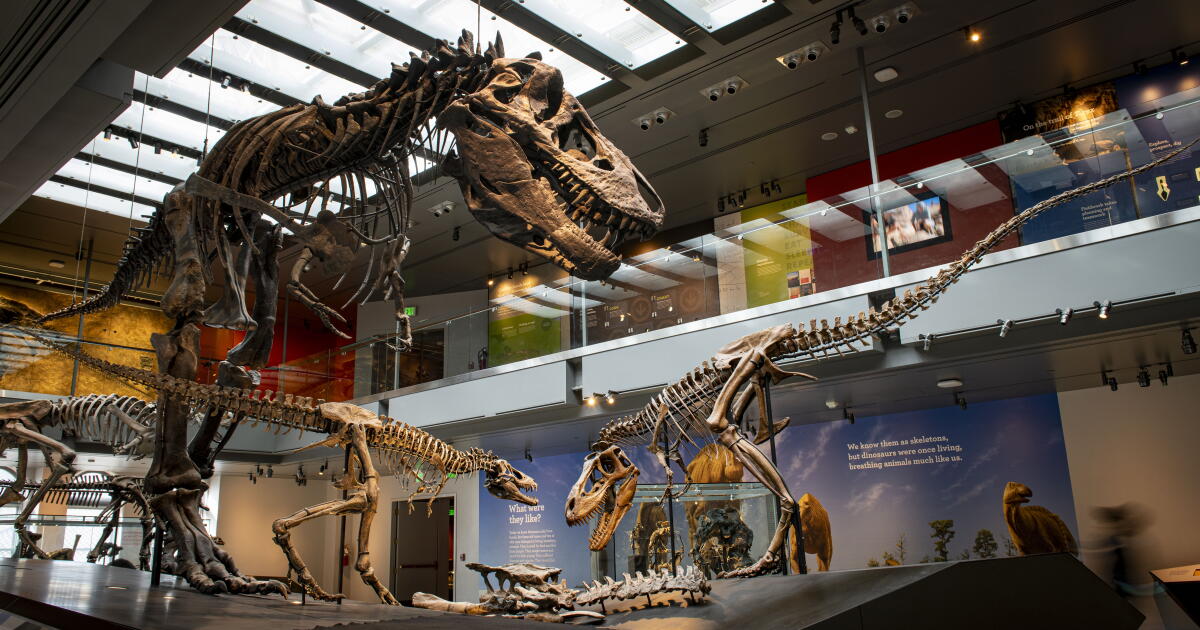


If you’ve been to the Natural History Museum of Los Angeles County, you’ve probably been wowed by the fossilized remains of Thomas, the formidable 34-foot-long Tyrannosaurus rex dominating the Dinosaur Hall.
More than 66 million years after Thomas’ death around the age of 17, the animal is continuing to contribute to science’s understanding of his famous species.
Chemical analysis of one of Thomas’s fossilized teeth has provided the most precise estimate yet of T. rex’s body temperature. The predator was not a cold-blooded creature, but a warm-blooded one with a body temperature probably around 97.3 degrees Fahrenheit, plus or minus 4.5 degrees.
The findings were published Wednesday in the journal Science Advances.
New analysis techniques developed in recent years have provided strong evidence that theropods like T. rex, velociraptors and other two-legged dinosaurs were endothermic animals like mammals and birds, rather than cold-blooded, or exothermic, like reptiles.
“The significance of this study is the ability to place an unambiguous measurement on the body temperature,” said co-author Robert Eagle, an associate professor at UCLA’s Institute of the Environment and Sustainability. “This is a sort of very direct way of getting at their physiology that’s not been possible before.”
The study looked at bonds between carbon and oxygen isotopes in the fossil. The fewer bonds present, the higher the temperature at which the minerals in the tooth formed.
“The amount of these chemical bonds is basically set 70 million years ago when this tooth first formed in the body of a dinosaur,” Eagle said.
Mapped against the climate of the Cretaceous Period, the T. rex’s likely body temperature would have suited it for life all over what is now North America, a hypothesis born out by the fossil record, Eagle said.
Eagle’s team is conducting further analysis on the tooth, after which it will be returned to the museum’s collection. Museum paleontologists excavated some 70% of Thomas’s fossilized skeleton in the early 2000s, making it one of the most complete T. rex specimens ever found.
“Natural history collections are reservoirs of evidence, often used in ways no one could have predicted when they were first built,” said Luis Chiappe, director of the Dinosaur Institute at the Natural History Museum. “The T. rex teeth we studied were collected decades ago, before the analytical techniques we used were even possible.”

If you’ve been to the Natural History Museum of Los Angeles County, you’ve probably been wowed by the fossilized remains of Thomas, the formidable 34-foot-long Tyrannosaurus rex dominating the Dinosaur Hall.
More than 66 million years after Thomas’ death around the age of 17, the animal is continuing to contribute to science’s understanding of his famous species.
Chemical analysis of one of Thomas’s fossilized teeth has provided the most precise estimate yet of T. rex’s body temperature. The predator was not a cold-blooded creature, but a warm-blooded one with a body temperature probably around 97.3 degrees Fahrenheit, plus or minus 4.5 degrees.
The findings were published Wednesday in the journal Science Advances.
New analysis techniques developed in recent years have provided strong evidence that theropods like T. rex, velociraptors and other two-legged dinosaurs were endothermic animals like mammals and birds, rather than cold-blooded, or exothermic, like reptiles.
“The significance of this study is the ability to place an unambiguous measurement on the body temperature,” said co-author Robert Eagle, an associate professor at UCLA’s Institute of the Environment and Sustainability. “This is a sort of very direct way of getting at their physiology that’s not been possible before.”
The study looked at bonds between carbon and oxygen isotopes in the fossil. The fewer bonds present, the higher the temperature at which the minerals in the tooth formed.
“The amount of these chemical bonds is basically set 70 million years ago when this tooth first formed in the body of a dinosaur,” Eagle said.
Mapped against the climate of the Cretaceous Period, the T. rex’s likely body temperature would have suited it for life all over what is now North America, a hypothesis born out by the fossil record, Eagle said.
Eagle’s team is conducting further analysis on the tooth, after which it will be returned to the museum’s collection. Museum paleontologists excavated some 70% of Thomas’s fossilized skeleton in the early 2000s, making it one of the most complete T. rex specimens ever found.
“Natural history collections are reservoirs of evidence, often used in ways no one could have predicted when they were first built,” said Luis Chiappe, director of the Dinosaur Institute at the Natural History Museum. “The T. rex teeth we studied were collected decades ago, before the analytical techniques we used were even possible.”

If you’ve been to the Natural History Museum of Los Angeles County, you’ve probably been wowed by the fossilized remains of Thomas, the formidable 34-foot-long Tyrannosaurus rex dominating the Dinosaur Hall.
More than 66 million years after Thomas’ death around the age of 17, the animal is continuing to contribute to science’s understanding of his famous species.
Chemical analysis of one of Thomas’s fossilized teeth has provided the most precise estimate yet of T. rex’s body temperature. The predator was not a cold-blooded creature, but a warm-blooded one with a body temperature probably around 97.3 degrees Fahrenheit, plus or minus 4.5 degrees.
The findings were published Wednesday in the journal Science Advances.
New analysis techniques developed in recent years have provided strong evidence that theropods like T. rex, velociraptors and other two-legged dinosaurs were endothermic animals like mammals and birds, rather than cold-blooded, or exothermic, like reptiles.
“The significance of this study is the ability to place an unambiguous measurement on the body temperature,” said co-author Robert Eagle, an associate professor at UCLA’s Institute of the Environment and Sustainability. “This is a sort of very direct way of getting at their physiology that’s not been possible before.”
The study looked at bonds between carbon and oxygen isotopes in the fossil. The fewer bonds present, the higher the temperature at which the minerals in the tooth formed.
“The amount of these chemical bonds is basically set 70 million years ago when this tooth first formed in the body of a dinosaur,” Eagle said.
Mapped against the climate of the Cretaceous Period, the T. rex’s likely body temperature would have suited it for life all over what is now North America, a hypothesis born out by the fossil record, Eagle said.
Eagle’s team is conducting further analysis on the tooth, after which it will be returned to the museum’s collection. Museum paleontologists excavated some 70% of Thomas’s fossilized skeleton in the early 2000s, making it one of the most complete T. rex specimens ever found.
“Natural history collections are reservoirs of evidence, often used in ways no one could have predicted when they were first built,” said Luis Chiappe, director of the Dinosaur Institute at the Natural History Museum. “The T. rex teeth we studied were collected decades ago, before the analytical techniques we used were even possible.”
If you’ve been to the Natural History Museum of Los Angeles County, you’ve probably been wowed by the fossilized remains of Thomas, the formidable 34-foot-long Tyrannosaurus rex dominating the Dinosaur Hall.
More than 66 million years after Thomas’ death around the age of 17, the animal is continuing to contribute to science’s understanding of his famous species.
Chemical analysis of one of Thomas’s fossilized teeth has provided the most precise estimate yet of T. rex’s body temperature. The predator was not a cold-blooded creature, but a warm-blooded one with a body temperature probably around 97.3 degrees Fahrenheit, plus or minus 4.5 degrees.
The findings were published Wednesday in the journal Science Advances.
New analysis techniques developed in recent years have provided strong evidence that theropods like T. rex, velociraptors and other two-legged dinosaurs were endothermic animals like mammals and birds, rather than cold-blooded, or exothermic, like reptiles.
“The significance of this study is the ability to place an unambiguous measurement on the body temperature,” said co-author Robert Eagle, an associate professor at UCLA’s Institute of the Environment and Sustainability. “This is a sort of very direct way of getting at their physiology that’s not been possible before.”
The study looked at bonds between carbon and oxygen isotopes in the fossil. The fewer bonds present, the higher the temperature at which the minerals in the tooth formed.
“The amount of these chemical bonds is basically set 70 million years ago when this tooth first formed in the body of a dinosaur,” Eagle said.
Mapped against the climate of the Cretaceous Period, the T. rex’s likely body temperature would have suited it for life all over what is now North America, a hypothesis born out by the fossil record, Eagle said.
Eagle’s team is conducting further analysis on the tooth, after which it will be returned to the museum’s collection. Museum paleontologists excavated some 70% of Thomas’s fossilized skeleton in the early 2000s, making it one of the most complete T. rex specimens ever found.
“Natural history collections are reservoirs of evidence, often used in ways no one could have predicted when they were first built,” said Luis Chiappe, director of the Dinosaur Institute at the Natural History Museum. “The T. rex teeth we studied were collected decades ago, before the analytical techniques we used were even possible.”

