

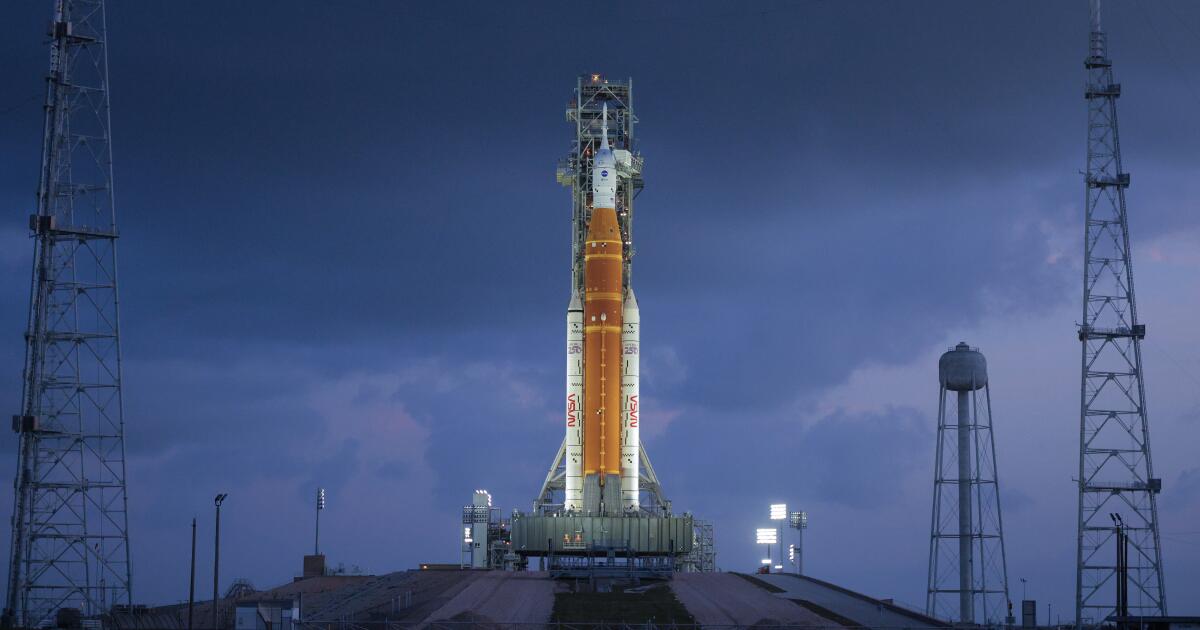
On Wednesday, for the first time since 1972, NASA is attempting to launch astronauts to the moon.
The space agency is targeting a 3:24 p.m. Pacific time launch of the colossal Space Launch System rocket with four astronauts aboard. Once off the ground, the crew — including Southern California native Victor Glover — will fly past the moon (but not land on the lunar surface or enter its orbit) and splash down off the coast of San Diego in roughly 10 days.
How to watch
NASA has already begun around-the-clock coverage of the entire mission — including launch preparations, liftoff, the lunar flyby and splashdown — on its YouTube page.
NASA is also livestreaming major milestones, including the launch, on its X account, Facebook page, Twitch profile and website.
If cable television is more your speed, C-SPAN is covering the launch (featuring its famous viewer calls).
Backup dates
The launch is ultimately dependent on the weather. The forecast shows an 80% chance of favorable weather for launch, with some potential for clouds and high winds at ground level that could delay the mission. Wednesday’s launch opportunity is open for two hours, until 5:24 p.m.
If weather or minor technical concerns prevent launch Wednesday, NASA has additional two-hour launch windows every evening through April 6. After that, it would have to wait until at least April 30.
The historical significance
Artemis II is the first mission since Apollo 17 in 1972 to carry humans to the moon. The capsule will carry the first Black person, first woman and first non-American to travel around the moon — potentially traveling farther and reentering the Earth’s atmosphere faster than any other human mission in history.
Although the astronauts will not land on the moon, Artemis II mimics early Apollo missions that were designed as a stepping stone to test all of the equipment and procedures before making the daring landing.
A springboard to Mars
The Artemis program ultimately aims to land humans back on the moon, help the space agency establish a lunar base and serve as the testing grounds for future missions to Mars.
NASA plans to launch Artemis III, a mission in Earth’s orbit to test docking the NASA spacecraft with SpaceX’s and Blue Origin’s lunar landers, in 2027. It aspires to launch Artemis IV, which would put humans on the surface of the moon, in 2028.

On Wednesday, for the first time since 1972, NASA is attempting to launch astronauts to the moon.
The space agency is targeting a 3:24 p.m. Pacific time launch of the colossal Space Launch System rocket with four astronauts aboard. Once off the ground, the crew — including Southern California native Victor Glover — will fly past the moon (but not land on the lunar surface or enter its orbit) and splash down off the coast of San Diego in roughly 10 days.
How to watch
NASA has already begun around-the-clock coverage of the entire mission — including launch preparations, liftoff, the lunar flyby and splashdown — on its YouTube page.
NASA is also livestreaming major milestones, including the launch, on its X account, Facebook page, Twitch profile and website.
If cable television is more your speed, C-SPAN is covering the launch (featuring its famous viewer calls).
Backup dates
The launch is ultimately dependent on the weather. The forecast shows an 80% chance of favorable weather for launch, with some potential for clouds and high winds at ground level that could delay the mission. Wednesday’s launch opportunity is open for two hours, until 5:24 p.m.
If weather or minor technical concerns prevent launch Wednesday, NASA has additional two-hour launch windows every evening through April 6. After that, it would have to wait until at least April 30.
The historical significance
Artemis II is the first mission since Apollo 17 in 1972 to carry humans to the moon. The capsule will carry the first Black person, first woman and first non-American to travel around the moon — potentially traveling farther and reentering the Earth’s atmosphere faster than any other human mission in history.
Although the astronauts will not land on the moon, Artemis II mimics early Apollo missions that were designed as a stepping stone to test all of the equipment and procedures before making the daring landing.
A springboard to Mars
The Artemis program ultimately aims to land humans back on the moon, help the space agency establish a lunar base and serve as the testing grounds for future missions to Mars.
NASA plans to launch Artemis III, a mission in Earth’s orbit to test docking the NASA spacecraft with SpaceX’s and Blue Origin’s lunar landers, in 2027. It aspires to launch Artemis IV, which would put humans on the surface of the moon, in 2028.

On Wednesday, for the first time since 1972, NASA is attempting to launch astronauts to the moon.
The space agency is targeting a 3:24 p.m. Pacific time launch of the colossal Space Launch System rocket with four astronauts aboard. Once off the ground, the crew — including Southern California native Victor Glover — will fly past the moon (but not land on the lunar surface or enter its orbit) and splash down off the coast of San Diego in roughly 10 days.
How to watch
NASA has already begun around-the-clock coverage of the entire mission — including launch preparations, liftoff, the lunar flyby and splashdown — on its YouTube page.
NASA is also livestreaming major milestones, including the launch, on its X account, Facebook page, Twitch profile and website.
If cable television is more your speed, C-SPAN is covering the launch (featuring its famous viewer calls).
Backup dates
The launch is ultimately dependent on the weather. The forecast shows an 80% chance of favorable weather for launch, with some potential for clouds and high winds at ground level that could delay the mission. Wednesday’s launch opportunity is open for two hours, until 5:24 p.m.
If weather or minor technical concerns prevent launch Wednesday, NASA has additional two-hour launch windows every evening through April 6. After that, it would have to wait until at least April 30.
The historical significance
Artemis II is the first mission since Apollo 17 in 1972 to carry humans to the moon. The capsule will carry the first Black person, first woman and first non-American to travel around the moon — potentially traveling farther and reentering the Earth’s atmosphere faster than any other human mission in history.
Although the astronauts will not land on the moon, Artemis II mimics early Apollo missions that were designed as a stepping stone to test all of the equipment and procedures before making the daring landing.
A springboard to Mars
The Artemis program ultimately aims to land humans back on the moon, help the space agency establish a lunar base and serve as the testing grounds for future missions to Mars.
NASA plans to launch Artemis III, a mission in Earth’s orbit to test docking the NASA spacecraft with SpaceX’s and Blue Origin’s lunar landers, in 2027. It aspires to launch Artemis IV, which would put humans on the surface of the moon, in 2028.
On Wednesday, for the first time since 1972, NASA is attempting to launch astronauts to the moon.
The space agency is targeting a 3:24 p.m. Pacific time launch of the colossal Space Launch System rocket with four astronauts aboard. Once off the ground, the crew — including Southern California native Victor Glover — will fly past the moon (but not land on the lunar surface or enter its orbit) and splash down off the coast of San Diego in roughly 10 days.
How to watch
NASA has already begun around-the-clock coverage of the entire mission — including launch preparations, liftoff, the lunar flyby and splashdown — on its YouTube page.
NASA is also livestreaming major milestones, including the launch, on its X account, Facebook page, Twitch profile and website.
If cable television is more your speed, C-SPAN is covering the launch (featuring its famous viewer calls).
Backup dates
The launch is ultimately dependent on the weather. The forecast shows an 80% chance of favorable weather for launch, with some potential for clouds and high winds at ground level that could delay the mission. Wednesday’s launch opportunity is open for two hours, until 5:24 p.m.
If weather or minor technical concerns prevent launch Wednesday, NASA has additional two-hour launch windows every evening through April 6. After that, it would have to wait until at least April 30.
The historical significance
Artemis II is the first mission since Apollo 17 in 1972 to carry humans to the moon. The capsule will carry the first Black person, first woman and first non-American to travel around the moon — potentially traveling farther and reentering the Earth’s atmosphere faster than any other human mission in history.
Although the astronauts will not land on the moon, Artemis II mimics early Apollo missions that were designed as a stepping stone to test all of the equipment and procedures before making the daring landing.
A springboard to Mars
The Artemis program ultimately aims to land humans back on the moon, help the space agency establish a lunar base and serve as the testing grounds for future missions to Mars.
NASA plans to launch Artemis III, a mission in Earth’s orbit to test docking the NASA spacecraft with SpaceX’s and Blue Origin’s lunar landers, in 2027. It aspires to launch Artemis IV, which would put humans on the surface of the moon, in 2028.

On Wednesday, for the first time since 1972, NASA is attempting to launch astronauts to the moon.
The space agency is targeting a 3:24 p.m. Pacific time launch of the colossal Space Launch System rocket with four astronauts aboard. Once off the ground, the crew — including Southern California native Victor Glover — will fly past the moon (but not land on the lunar surface or enter its orbit) and splash down off the coast of San Diego in roughly 10 days.
How to watch
NASA has already begun around-the-clock coverage of the entire mission — including launch preparations, liftoff, the lunar flyby and splashdown — on its YouTube page.
NASA is also livestreaming major milestones, including the launch, on its X account, Facebook page, Twitch profile and website.
If cable television is more your speed, C-SPAN is covering the launch (featuring its famous viewer calls).
Backup dates
The launch is ultimately dependent on the weather. The forecast shows an 80% chance of favorable weather for launch, with some potential for clouds and high winds at ground level that could delay the mission. Wednesday’s launch opportunity is open for two hours, until 5:24 p.m.
If weather or minor technical concerns prevent launch Wednesday, NASA has additional two-hour launch windows every evening through April 6. After that, it would have to wait until at least April 30.
The historical significance
Artemis II is the first mission since Apollo 17 in 1972 to carry humans to the moon. The capsule will carry the first Black person, first woman and first non-American to travel around the moon — potentially traveling farther and reentering the Earth’s atmosphere faster than any other human mission in history.
Although the astronauts will not land on the moon, Artemis II mimics early Apollo missions that were designed as a stepping stone to test all of the equipment and procedures before making the daring landing.
A springboard to Mars
The Artemis program ultimately aims to land humans back on the moon, help the space agency establish a lunar base and serve as the testing grounds for future missions to Mars.
NASA plans to launch Artemis III, a mission in Earth’s orbit to test docking the NASA spacecraft with SpaceX’s and Blue Origin’s lunar landers, in 2027. It aspires to launch Artemis IV, which would put humans on the surface of the moon, in 2028.
On Wednesday, for the first time since 1972, NASA is attempting to launch astronauts to the moon.
The space agency is targeting a 3:24 p.m. Pacific time launch of the colossal Space Launch System rocket with four astronauts aboard. Once off the ground, the crew — including Southern California native Victor Glover — will fly past the moon (but not land on the lunar surface or enter its orbit) and splash down off the coast of San Diego in roughly 10 days.
How to watch
NASA has already begun around-the-clock coverage of the entire mission — including launch preparations, liftoff, the lunar flyby and splashdown — on its YouTube page.
NASA is also livestreaming major milestones, including the launch, on its X account, Facebook page, Twitch profile and website.
If cable television is more your speed, C-SPAN is covering the launch (featuring its famous viewer calls).
Backup dates
The launch is ultimately dependent on the weather. The forecast shows an 80% chance of favorable weather for launch, with some potential for clouds and high winds at ground level that could delay the mission. Wednesday’s launch opportunity is open for two hours, until 5:24 p.m.
If weather or minor technical concerns prevent launch Wednesday, NASA has additional two-hour launch windows every evening through April 6. After that, it would have to wait until at least April 30.
The historical significance
Artemis II is the first mission since Apollo 17 in 1972 to carry humans to the moon. The capsule will carry the first Black person, first woman and first non-American to travel around the moon — potentially traveling farther and reentering the Earth’s atmosphere faster than any other human mission in history.
Although the astronauts will not land on the moon, Artemis II mimics early Apollo missions that were designed as a stepping stone to test all of the equipment and procedures before making the daring landing.
A springboard to Mars
The Artemis program ultimately aims to land humans back on the moon, help the space agency establish a lunar base and serve as the testing grounds for future missions to Mars.
NASA plans to launch Artemis III, a mission in Earth’s orbit to test docking the NASA spacecraft with SpaceX’s and Blue Origin’s lunar landers, in 2027. It aspires to launch Artemis IV, which would put humans on the surface of the moon, in 2028.
On Wednesday, for the first time since 1972, NASA is attempting to launch astronauts to the moon.
The space agency is targeting a 3:24 p.m. Pacific time launch of the colossal Space Launch System rocket with four astronauts aboard. Once off the ground, the crew — including Southern California native Victor Glover — will fly past the moon (but not land on the lunar surface or enter its orbit) and splash down off the coast of San Diego in roughly 10 days.
How to watch
NASA has already begun around-the-clock coverage of the entire mission — including launch preparations, liftoff, the lunar flyby and splashdown — on its YouTube page.
NASA is also livestreaming major milestones, including the launch, on its X account, Facebook page, Twitch profile and website.
If cable television is more your speed, C-SPAN is covering the launch (featuring its famous viewer calls).
Backup dates
The launch is ultimately dependent on the weather. The forecast shows an 80% chance of favorable weather for launch, with some potential for clouds and high winds at ground level that could delay the mission. Wednesday’s launch opportunity is open for two hours, until 5:24 p.m.
If weather or minor technical concerns prevent launch Wednesday, NASA has additional two-hour launch windows every evening through April 6. After that, it would have to wait until at least April 30.
The historical significance
Artemis II is the first mission since Apollo 17 in 1972 to carry humans to the moon. The capsule will carry the first Black person, first woman and first non-American to travel around the moon — potentially traveling farther and reentering the Earth’s atmosphere faster than any other human mission in history.
Although the astronauts will not land on the moon, Artemis II mimics early Apollo missions that were designed as a stepping stone to test all of the equipment and procedures before making the daring landing.
A springboard to Mars
The Artemis program ultimately aims to land humans back on the moon, help the space agency establish a lunar base and serve as the testing grounds for future missions to Mars.
NASA plans to launch Artemis III, a mission in Earth’s orbit to test docking the NASA spacecraft with SpaceX’s and Blue Origin’s lunar landers, in 2027. It aspires to launch Artemis IV, which would put humans on the surface of the moon, in 2028.
On Wednesday, for the first time since 1972, NASA is attempting to launch astronauts to the moon.
The space agency is targeting a 3:24 p.m. Pacific time launch of the colossal Space Launch System rocket with four astronauts aboard. Once off the ground, the crew — including Southern California native Victor Glover — will fly past the moon (but not land on the lunar surface or enter its orbit) and splash down off the coast of San Diego in roughly 10 days.
How to watch
NASA has already begun around-the-clock coverage of the entire mission — including launch preparations, liftoff, the lunar flyby and splashdown — on its YouTube page.
NASA is also livestreaming major milestones, including the launch, on its X account, Facebook page, Twitch profile and website.
If cable television is more your speed, C-SPAN is covering the launch (featuring its famous viewer calls).
Backup dates
The launch is ultimately dependent on the weather. The forecast shows an 80% chance of favorable weather for launch, with some potential for clouds and high winds at ground level that could delay the mission. Wednesday’s launch opportunity is open for two hours, until 5:24 p.m.
If weather or minor technical concerns prevent launch Wednesday, NASA has additional two-hour launch windows every evening through April 6. After that, it would have to wait until at least April 30.
The historical significance
Artemis II is the first mission since Apollo 17 in 1972 to carry humans to the moon. The capsule will carry the first Black person, first woman and first non-American to travel around the moon — potentially traveling farther and reentering the Earth’s atmosphere faster than any other human mission in history.
Although the astronauts will not land on the moon, Artemis II mimics early Apollo missions that were designed as a stepping stone to test all of the equipment and procedures before making the daring landing.
A springboard to Mars
The Artemis program ultimately aims to land humans back on the moon, help the space agency establish a lunar base and serve as the testing grounds for future missions to Mars.
NASA plans to launch Artemis III, a mission in Earth’s orbit to test docking the NASA spacecraft with SpaceX’s and Blue Origin’s lunar landers, in 2027. It aspires to launch Artemis IV, which would put humans on the surface of the moon, in 2028.

On Wednesday, for the first time since 1972, NASA is attempting to launch astronauts to the moon.
The space agency is targeting a 3:24 p.m. Pacific time launch of the colossal Space Launch System rocket with four astronauts aboard. Once off the ground, the crew — including Southern California native Victor Glover — will fly past the moon (but not land on the lunar surface or enter its orbit) and splash down off the coast of San Diego in roughly 10 days.
How to watch
NASA has already begun around-the-clock coverage of the entire mission — including launch preparations, liftoff, the lunar flyby and splashdown — on its YouTube page.
NASA is also livestreaming major milestones, including the launch, on its X account, Facebook page, Twitch profile and website.
If cable television is more your speed, C-SPAN is covering the launch (featuring its famous viewer calls).
Backup dates
The launch is ultimately dependent on the weather. The forecast shows an 80% chance of favorable weather for launch, with some potential for clouds and high winds at ground level that could delay the mission. Wednesday’s launch opportunity is open for two hours, until 5:24 p.m.
If weather or minor technical concerns prevent launch Wednesday, NASA has additional two-hour launch windows every evening through April 6. After that, it would have to wait until at least April 30.
The historical significance
Artemis II is the first mission since Apollo 17 in 1972 to carry humans to the moon. The capsule will carry the first Black person, first woman and first non-American to travel around the moon — potentially traveling farther and reentering the Earth’s atmosphere faster than any other human mission in history.
Although the astronauts will not land on the moon, Artemis II mimics early Apollo missions that were designed as a stepping stone to test all of the equipment and procedures before making the daring landing.
A springboard to Mars
The Artemis program ultimately aims to land humans back on the moon, help the space agency establish a lunar base and serve as the testing grounds for future missions to Mars.
NASA plans to launch Artemis III, a mission in Earth’s orbit to test docking the NASA spacecraft with SpaceX’s and Blue Origin’s lunar landers, in 2027. It aspires to launch Artemis IV, which would put humans on the surface of the moon, in 2028.
On Wednesday, for the first time since 1972, NASA is attempting to launch astronauts to the moon.
The space agency is targeting a 3:24 p.m. Pacific time launch of the colossal Space Launch System rocket with four astronauts aboard. Once off the ground, the crew — including Southern California native Victor Glover — will fly past the moon (but not land on the lunar surface or enter its orbit) and splash down off the coast of San Diego in roughly 10 days.
How to watch
NASA has already begun around-the-clock coverage of the entire mission — including launch preparations, liftoff, the lunar flyby and splashdown — on its YouTube page.
NASA is also livestreaming major milestones, including the launch, on its X account, Facebook page, Twitch profile and website.
If cable television is more your speed, C-SPAN is covering the launch (featuring its famous viewer calls).
Backup dates
The launch is ultimately dependent on the weather. The forecast shows an 80% chance of favorable weather for launch, with some potential for clouds and high winds at ground level that could delay the mission. Wednesday’s launch opportunity is open for two hours, until 5:24 p.m.
If weather or minor technical concerns prevent launch Wednesday, NASA has additional two-hour launch windows every evening through April 6. After that, it would have to wait until at least April 30.
The historical significance
Artemis II is the first mission since Apollo 17 in 1972 to carry humans to the moon. The capsule will carry the first Black person, first woman and first non-American to travel around the moon — potentially traveling farther and reentering the Earth’s atmosphere faster than any other human mission in history.
Although the astronauts will not land on the moon, Artemis II mimics early Apollo missions that were designed as a stepping stone to test all of the equipment and procedures before making the daring landing.
A springboard to Mars
The Artemis program ultimately aims to land humans back on the moon, help the space agency establish a lunar base and serve as the testing grounds for future missions to Mars.
NASA plans to launch Artemis III, a mission in Earth’s orbit to test docking the NASA spacecraft with SpaceX’s and Blue Origin’s lunar landers, in 2027. It aspires to launch Artemis IV, which would put humans on the surface of the moon, in 2028.
On Wednesday, for the first time since 1972, NASA is attempting to launch astronauts to the moon.
The space agency is targeting a 3:24 p.m. Pacific time launch of the colossal Space Launch System rocket with four astronauts aboard. Once off the ground, the crew — including Southern California native Victor Glover — will fly past the moon (but not land on the lunar surface or enter its orbit) and splash down off the coast of San Diego in roughly 10 days.
How to watch
NASA has already begun around-the-clock coverage of the entire mission — including launch preparations, liftoff, the lunar flyby and splashdown — on its YouTube page.
NASA is also livestreaming major milestones, including the launch, on its X account, Facebook page, Twitch profile and website.
If cable television is more your speed, C-SPAN is covering the launch (featuring its famous viewer calls).
Backup dates
The launch is ultimately dependent on the weather. The forecast shows an 80% chance of favorable weather for launch, with some potential for clouds and high winds at ground level that could delay the mission. Wednesday’s launch opportunity is open for two hours, until 5:24 p.m.
If weather or minor technical concerns prevent launch Wednesday, NASA has additional two-hour launch windows every evening through April 6. After that, it would have to wait until at least April 30.
The historical significance
Artemis II is the first mission since Apollo 17 in 1972 to carry humans to the moon. The capsule will carry the first Black person, first woman and first non-American to travel around the moon — potentially traveling farther and reentering the Earth’s atmosphere faster than any other human mission in history.
Although the astronauts will not land on the moon, Artemis II mimics early Apollo missions that were designed as a stepping stone to test all of the equipment and procedures before making the daring landing.
A springboard to Mars
The Artemis program ultimately aims to land humans back on the moon, help the space agency establish a lunar base and serve as the testing grounds for future missions to Mars.
NASA plans to launch Artemis III, a mission in Earth’s orbit to test docking the NASA spacecraft with SpaceX’s and Blue Origin’s lunar landers, in 2027. It aspires to launch Artemis IV, which would put humans on the surface of the moon, in 2028.
On Wednesday, for the first time since 1972, NASA is attempting to launch astronauts to the moon.
The space agency is targeting a 3:24 p.m. Pacific time launch of the colossal Space Launch System rocket with four astronauts aboard. Once off the ground, the crew — including Southern California native Victor Glover — will fly past the moon (but not land on the lunar surface or enter its orbit) and splash down off the coast of San Diego in roughly 10 days.
How to watch
NASA has already begun around-the-clock coverage of the entire mission — including launch preparations, liftoff, the lunar flyby and splashdown — on its YouTube page.
NASA is also livestreaming major milestones, including the launch, on its X account, Facebook page, Twitch profile and website.
If cable television is more your speed, C-SPAN is covering the launch (featuring its famous viewer calls).
Backup dates
The launch is ultimately dependent on the weather. The forecast shows an 80% chance of favorable weather for launch, with some potential for clouds and high winds at ground level that could delay the mission. Wednesday’s launch opportunity is open for two hours, until 5:24 p.m.
If weather or minor technical concerns prevent launch Wednesday, NASA has additional two-hour launch windows every evening through April 6. After that, it would have to wait until at least April 30.
The historical significance
Artemis II is the first mission since Apollo 17 in 1972 to carry humans to the moon. The capsule will carry the first Black person, first woman and first non-American to travel around the moon — potentially traveling farther and reentering the Earth’s atmosphere faster than any other human mission in history.
Although the astronauts will not land on the moon, Artemis II mimics early Apollo missions that were designed as a stepping stone to test all of the equipment and procedures before making the daring landing.
A springboard to Mars
The Artemis program ultimately aims to land humans back on the moon, help the space agency establish a lunar base and serve as the testing grounds for future missions to Mars.
NASA plans to launch Artemis III, a mission in Earth’s orbit to test docking the NASA spacecraft with SpaceX’s and Blue Origin’s lunar landers, in 2027. It aspires to launch Artemis IV, which would put humans on the surface of the moon, in 2028.
On Wednesday, for the first time since 1972, NASA is attempting to launch astronauts to the moon.
The space agency is targeting a 3:24 p.m. Pacific time launch of the colossal Space Launch System rocket with four astronauts aboard. Once off the ground, the crew — including Southern California native Victor Glover — will fly past the moon (but not land on the lunar surface or enter its orbit) and splash down off the coast of San Diego in roughly 10 days.
How to watch
NASA has already begun around-the-clock coverage of the entire mission — including launch preparations, liftoff, the lunar flyby and splashdown — on its YouTube page.
NASA is also livestreaming major milestones, including the launch, on its X account, Facebook page, Twitch profile and website.
If cable television is more your speed, C-SPAN is covering the launch (featuring its famous viewer calls).
Backup dates
The launch is ultimately dependent on the weather. The forecast shows an 80% chance of favorable weather for launch, with some potential for clouds and high winds at ground level that could delay the mission. Wednesday’s launch opportunity is open for two hours, until 5:24 p.m.
If weather or minor technical concerns prevent launch Wednesday, NASA has additional two-hour launch windows every evening through April 6. After that, it would have to wait until at least April 30.
The historical significance
Artemis II is the first mission since Apollo 17 in 1972 to carry humans to the moon. The capsule will carry the first Black person, first woman and first non-American to travel around the moon — potentially traveling farther and reentering the Earth’s atmosphere faster than any other human mission in history.
Although the astronauts will not land on the moon, Artemis II mimics early Apollo missions that were designed as a stepping stone to test all of the equipment and procedures before making the daring landing.
A springboard to Mars
The Artemis program ultimately aims to land humans back on the moon, help the space agency establish a lunar base and serve as the testing grounds for future missions to Mars.
NASA plans to launch Artemis III, a mission in Earth’s orbit to test docking the NASA spacecraft with SpaceX’s and Blue Origin’s lunar landers, in 2027. It aspires to launch Artemis IV, which would put humans on the surface of the moon, in 2028.
On Wednesday, for the first time since 1972, NASA is attempting to launch astronauts to the moon.
The space agency is targeting a 3:24 p.m. Pacific time launch of the colossal Space Launch System rocket with four astronauts aboard. Once off the ground, the crew — including Southern California native Victor Glover — will fly past the moon (but not land on the lunar surface or enter its orbit) and splash down off the coast of San Diego in roughly 10 days.
How to watch
NASA has already begun around-the-clock coverage of the entire mission — including launch preparations, liftoff, the lunar flyby and splashdown — on its YouTube page.
NASA is also livestreaming major milestones, including the launch, on its X account, Facebook page, Twitch profile and website.
If cable television is more your speed, C-SPAN is covering the launch (featuring its famous viewer calls).
Backup dates
The launch is ultimately dependent on the weather. The forecast shows an 80% chance of favorable weather for launch, with some potential for clouds and high winds at ground level that could delay the mission. Wednesday’s launch opportunity is open for two hours, until 5:24 p.m.
If weather or minor technical concerns prevent launch Wednesday, NASA has additional two-hour launch windows every evening through April 6. After that, it would have to wait until at least April 30.
The historical significance
Artemis II is the first mission since Apollo 17 in 1972 to carry humans to the moon. The capsule will carry the first Black person, first woman and first non-American to travel around the moon — potentially traveling farther and reentering the Earth’s atmosphere faster than any other human mission in history.
Although the astronauts will not land on the moon, Artemis II mimics early Apollo missions that were designed as a stepping stone to test all of the equipment and procedures before making the daring landing.
A springboard to Mars
The Artemis program ultimately aims to land humans back on the moon, help the space agency establish a lunar base and serve as the testing grounds for future missions to Mars.
NASA plans to launch Artemis III, a mission in Earth’s orbit to test docking the NASA spacecraft with SpaceX’s and Blue Origin’s lunar landers, in 2027. It aspires to launch Artemis IV, which would put humans on the surface of the moon, in 2028.
On Wednesday, for the first time since 1972, NASA is attempting to launch astronauts to the moon.
The space agency is targeting a 3:24 p.m. Pacific time launch of the colossal Space Launch System rocket with four astronauts aboard. Once off the ground, the crew — including Southern California native Victor Glover — will fly past the moon (but not land on the lunar surface or enter its orbit) and splash down off the coast of San Diego in roughly 10 days.
How to watch
NASA has already begun around-the-clock coverage of the entire mission — including launch preparations, liftoff, the lunar flyby and splashdown — on its YouTube page.
NASA is also livestreaming major milestones, including the launch, on its X account, Facebook page, Twitch profile and website.
If cable television is more your speed, C-SPAN is covering the launch (featuring its famous viewer calls).
Backup dates
The launch is ultimately dependent on the weather. The forecast shows an 80% chance of favorable weather for launch, with some potential for clouds and high winds at ground level that could delay the mission. Wednesday’s launch opportunity is open for two hours, until 5:24 p.m.
If weather or minor technical concerns prevent launch Wednesday, NASA has additional two-hour launch windows every evening through April 6. After that, it would have to wait until at least April 30.
The historical significance
Artemis II is the first mission since Apollo 17 in 1972 to carry humans to the moon. The capsule will carry the first Black person, first woman and first non-American to travel around the moon — potentially traveling farther and reentering the Earth’s atmosphere faster than any other human mission in history.
Although the astronauts will not land on the moon, Artemis II mimics early Apollo missions that were designed as a stepping stone to test all of the equipment and procedures before making the daring landing.
A springboard to Mars
The Artemis program ultimately aims to land humans back on the moon, help the space agency establish a lunar base and serve as the testing grounds for future missions to Mars.
NASA plans to launch Artemis III, a mission in Earth’s orbit to test docking the NASA spacecraft with SpaceX’s and Blue Origin’s lunar landers, in 2027. It aspires to launch Artemis IV, which would put humans on the surface of the moon, in 2028.
On Wednesday, for the first time since 1972, NASA is attempting to launch astronauts to the moon.
The space agency is targeting a 3:24 p.m. Pacific time launch of the colossal Space Launch System rocket with four astronauts aboard. Once off the ground, the crew — including Southern California native Victor Glover — will fly past the moon (but not land on the lunar surface or enter its orbit) and splash down off the coast of San Diego in roughly 10 days.
How to watch
NASA has already begun around-the-clock coverage of the entire mission — including launch preparations, liftoff, the lunar flyby and splashdown — on its YouTube page.
NASA is also livestreaming major milestones, including the launch, on its X account, Facebook page, Twitch profile and website.
If cable television is more your speed, C-SPAN is covering the launch (featuring its famous viewer calls).
Backup dates
The launch is ultimately dependent on the weather. The forecast shows an 80% chance of favorable weather for launch, with some potential for clouds and high winds at ground level that could delay the mission. Wednesday’s launch opportunity is open for two hours, until 5:24 p.m.
If weather or minor technical concerns prevent launch Wednesday, NASA has additional two-hour launch windows every evening through April 6. After that, it would have to wait until at least April 30.
The historical significance
Artemis II is the first mission since Apollo 17 in 1972 to carry humans to the moon. The capsule will carry the first Black person, first woman and first non-American to travel around the moon — potentially traveling farther and reentering the Earth’s atmosphere faster than any other human mission in history.
Although the astronauts will not land on the moon, Artemis II mimics early Apollo missions that were designed as a stepping stone to test all of the equipment and procedures before making the daring landing.
A springboard to Mars
The Artemis program ultimately aims to land humans back on the moon, help the space agency establish a lunar base and serve as the testing grounds for future missions to Mars.
NASA plans to launch Artemis III, a mission in Earth’s orbit to test docking the NASA spacecraft with SpaceX’s and Blue Origin’s lunar landers, in 2027. It aspires to launch Artemis IV, which would put humans on the surface of the moon, in 2028.

