

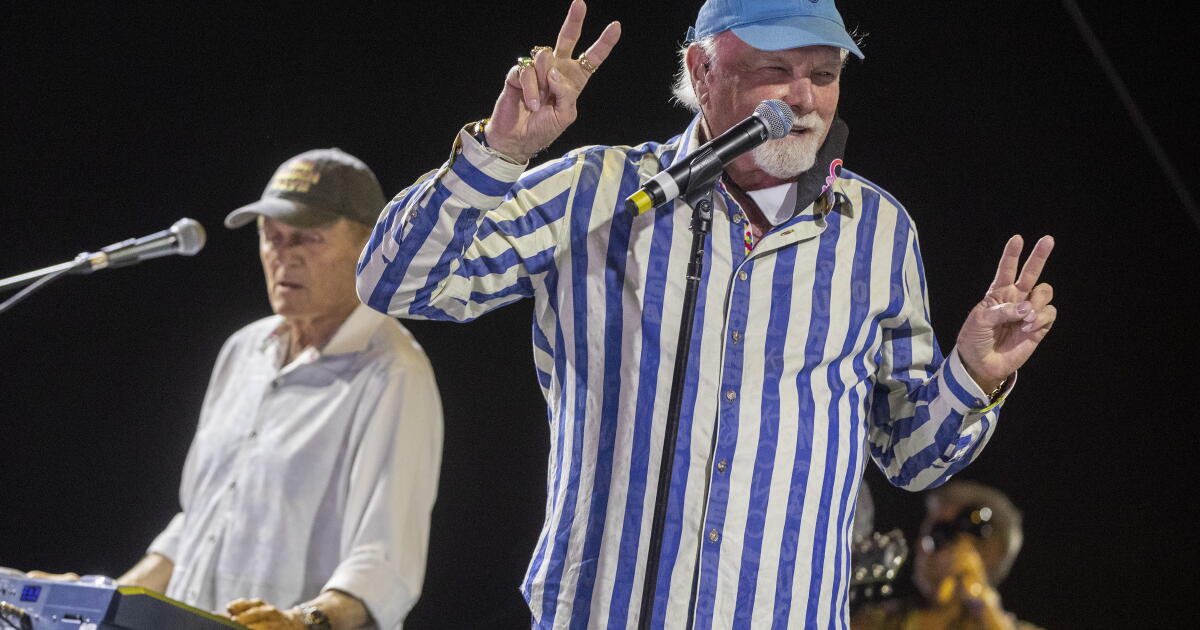


As a kid, Mike Love could ride a wave, but nobody expected it to last more than six decades.
The only one of the original Beach Boys to spend his entire career performing as a Beach Boy, Love’s long ride as the front man for the cherished Southern California band came to an end Saturday, when the singer died at age 85. In a statement, a spokesperson said he was surrounded by family but didn’t specify a cause or say where he died.
Even as an octogenarian, he was on the road more than 100 nights a year playing cruise ships and casinos, concert halls and county fairs. After Love’s appearance during a show last month in Cincinnati triggered widespread speculation about his health, the actor John Stamos — a latter-day member of Love’s touring band — wrote on social media that Love was “facing serious health challenges”; he performed his final concert Oct. 11 in Nashville.
A singer and lyricist, Love wrote or co-wrote some of the Beach Boys’ biggest hits but was seen by many fans as a corrosive influence in a group battered by drugs, alcohol and mental health issues. His defenders lauded him for preserving the Beach Boys’ legacy even as the public’s taste for nostalgia waxed and waned through the years.
“I have met a pile of so-called pop stars, and in terms of being a decent man with a decent heart, Mike Love is pretty goddamn high on the list,” wrote New York Observer music critic Tim Sommer. He “has kept the Beach Boys, a vital American institution, alive and working in the face of great odds and even greater derision.”
A group of clean-cut teens who jammed in the Wilson family living room in Hawthorne, the Beach Boys in 1962 were composed of the brothers Brian, Dennis and Carl Wilson; their cousin Love; and their friend Al Jardine. Sixty years later, only Love and a rotating group of musicians he fronted were legally authorized to tour as the Beach Boys.
Some of Love’s lyrics would become classic tributes to sun-streaked, lovestruck Southern California teens having fun, fun, fun.
Among his most popular pieces were “Surfin’ Safari,” “Help Me Rhonda” and “California Girls.” He wrote the chorus to “Kokomo”, a widely ridiculed 1988 confection that nonetheless became the Beach Boys’ top seller. In 1966, he dictated the words to “Good Vibrations,” a Beach Boys masterpiece, as he drove down the Hollywood Freeway on his way to the recording studio: I’m pickin’ up good vibrations, She’s giving me excitations …
“I’ll be the first to acknowledge that ‘excitations’ is not really a word, but it rhymed,” he wrote in his 2016 autobiography, “Good Vibrations.”
A bald, upbeat, wisecracking evangelist for the Beach Boys’ easygoing California vibe, Love looked the part in his baseball caps and Hawaiian shirts. He wrote that he wanted to move audiences “to a joyous, warm place just east of the sun.”
At the same time, he angered fans with a string of lawsuits against his cousin Brian Wilson, the group’s acknowledged musical genius, who died last year. It was only after a two-month trial in 1994 that Love received credit — and $5 million in back royalties — for lyrics to 35 Beach Boys songs. His detractors viewed it as a typically confrontational move from a musician allegedly jealous of Wilson’s considerable talents.
“By now, the myth was too strong,” Love wrote. “Brian was the tormented genius who suffered to deliver us his music — the forever victim.”
The Beach Boys in 1964: Al Jardine, from left, Brian Wilson, Mike Love, Carl Wilson and Dennis Wilson.
(Michael Ochs Archives)
The on-and-off feud between the two spanned decades and included a $1.5-million settlement in Love’s lawsuit alleging defamation in his cousin’s 1991 memoir, “Wouldn’t It Be Nice?” A quarter-century later, Love still was vexed that he had always been cast as the heavy while Brian was the sensitive, if drug-addled, crowd favorite.
“What did I do?” Love would sometimes ask his wife, Jackie, according to a 2016 article in Rolling Stone. “Why am I the villain? How did it get to this?”
Even the band’s 50th anniversary tour, which had sparked hopes of a reconciliation, ended acrimoniously, with Love and Wilson duking it out in dueling Los Angeles Times opinion pieces.
The group had always been volatile.
At a Des Moines airport lounge in the early 1960s, Dennis Wilson sprayed Love with a water pistol filled with urine before the two pummeled each other and Love bit deep into his cousin’s wrist. At the Universal Amphitheater in 1979, there was a repeat performance — this time before a crowd of 15,000 — when Dennis Wilson angrily kicked over his drum kit and took off after Love, his fists flying.
The sniping between Love and Brian Wilson was legendary. In his autobiography, Wilson described Love as a commercial hack who, “if not for me, would still be pumping gas.” Love at one point called Wilson an unrelenting perfectionist, “the Stalin of the studio.” He blamed Wilson for following the example of their early manager — Brian’s father, Murry Wilson — and denying Love credit for his songs.
After suffering what was described as a nervous breakdown on a 1964 flight to Houston, Wilson quit touring, dropped a lot of acid and composed music that broke the Beach Boys’ surf-band mold. Despite his hallucinations and a mental illness diagnosed as schizoaffective disorder, his songs on the 1966 album “Pet Sounds” won acclaim from the likes of Paul McCartney and Leonard Bernstein.

Bryan Wilson and Mike Love in the studio in 1969.
(Iconic Artists Group LLC / Brother Records Inc.
)
But Love, Wilson said, mocked songs he couldn’t understand and bullied him when he strayed from their fun-in-the-sun roots. According to fan lore, Love’s criticism even led Wilson to shelve his “teenage symphony to God” for decades. The album “Smile” finally was completed and came out in 2004.
Love did object to lyrics he found obscure, such as the line by writer Van Dyke Parks in Wilson’s “Surf’s Up”: Columnated ruins domino. A reference to empires falling, such lines would mean nothing to most audiences, Love said.
“I always thought our lyrics should connect with the largest number of people possible,” he wrote. “I used to think, ‘How will our fans in Peoria react to this song?’”
Still, there were times when Love, straightforward to a fault, would have benefited from being more cryptic.
When the Beach Boys were inducted into the Rock and Roll of Fame in 1988, he gave a thank-you speech that managed to insult the Beatles, the Rolling Stones, Diana Ross, Bruce Springsteen and the industry executives who had gathered for the ceremony at New York’s Waldorf-Astoria.
He recalled the night ruefully, saying that he was off his game because he’d skipped his customary Transcendental Meditation session that morning.
“I could’ve phrased things a little more politically correct and nicer,” he later told Billboard magazine.
Born in Los Angeles on March 15, 1941, Michael Edward Love was one of six children. His father, Milton Love, ran a family sheet-metal company where Mike briefly worked after graduating from Dorsey High School in 1959.
On the school’s track team, he ran a 4-minute, 30-second mile. In most other respects, he was unmotivated. In a summer school chemistry lab, he sold tequila to his classmates for a nickel a shot. He cut class to surf with his pals but was more turned on by the scene than by the sport itself.
Love came from a musical family. His mother, Glee Wilson Love, tap-danced, sang and staged home musicals. His sister Maureen Love, a harpist, later performed with Pink Martini. As teenagers, Love and his cousin Brian would harmonize on riffs from the Everly Brothers and the Four Freshmen as they strolled home from youth nights at Angeles Mesa Presbyterian Church.
On Nov. 27, 1961, their little band — originally called the Pendletones, after the Pendleton plaid shirts then favored by the surf crowd — came out with “Surfin’’”: Surfin’ is the only life, the only way for me. Now surf! Surf with me!
While the tiny Candix label that released the song soon folded, “Surfin’” received plenty of Southern California airtime as the newly minted Beach Boys played school dances, ribbon cuttings and a diaper derby — a baby race — in Oxnard. Soon they had a contract with Capitol Records. At the end of 1963, four of their singles and three of their LPs sat on top-10 lists.
The next year, though, the Beatles invaded. Even “Fun, Fun, Fun” — the tale of an errant girl whose daddy took her T-Bird away — couldn’t stem the tide. “Little Deuce Coupe,” “California Girls,” “I Get Around”: As the country veered into Vietnam and hundreds of thousands of young people poured into Woodstock, beach ballads and odes to hot cars seemed increasingly stale.
“We remained clueless, or at least stuck in the 1950s, in our image,” Love wrote. “Music fans wanted jambalaya; we were selling vanilla ice cream.”
On Thanksgiving night 1969, the Beach Boys played the Corn Palace in Mitchell, S.D. Fifty fans showed up. But over the years, an America wrung out from war, Watergate and countless other crises appeared to yearn for the good old days evoked by the early songs.
By July 4, 1984, the Beach Boys played to a crowd of 500,000 at the National Mall in Washington, D.C. That was after Interior Secretary James Watt had futilely tried to ban rock groups — most prominently, the Beach Boys — from the annual celebration, saying they drew “the wrong element.”
“When we played our new stuff at concerts, it just didn’t go over as well as, say, ‘Barbara Ann’ or ‘Help Me, Rhonda,’ and we found ourselves at odds with the audience,” Love wrote. “We once performed at the University of Virginia and were doing our newer tracks, and a guy in the audience yelled, ‘I want to hear the car songs!’
“I shouted back, ‘We’ll do that for the encore!’
“He blurted, ‘What encore?’”
There would be many, many encores. In 2016, Love estimated that he’d sung “Fun, Fun, Fun” nearly 6,000 times.
Along the way, he’d morphed from a kid in striped shirts and chinos to a bearded, bare-chested disco dude in tight, gold-lame bell bottoms, and, finally to a genial icon belting out oldies and joking about newfangled cellphones. The critics were not always kind: In 2020, The Times’ Mikael Wood wrote of Love’s “decidedly out-of-touch vibe.”
Love was fascinated by astrology and Eastern religious traditions. He continued meditating twice a day, though the 1968 Beach Boys tour he organized with his guru, Maharishi Mahesh Yogi, proved a disaster.
The Beach Boys — dubbed “America’s Band” by President Reagan — changed too. In 1983, Dennis Wilson drowned while diving, drunk, off Marina del Rey. In 1998, Carl Wilson died of lung cancer. Brian Wilson kept composing and performing but had to cancel a 2019 tour to tend to his mental health problems.
Love’s survivors include eight children and his wife, Jacquelyne Piesen Love. He was married six times. His brother Stan Love, who died in 2025, was a former professional basketball player; Stan’s son Kevin — Mike Love’s nephew — has also played in the NBA.
Love was often asked what kept him going, and he gave much the same answer.
“The music itself never gets old,” he said. “It’s now part of our country’s DNA. It’s heard in airports and bowling alleys, supermarkets and restaurants, dental offices and health clubs, and of course, on the radio —and if anything, I’m more in awe of it now than ever.”
Steve Chawkins is a former Times staff writer.

As a kid, Mike Love could ride a wave, but nobody expected it to last more than six decades.
The only one of the original Beach Boys to spend his entire career performing as a Beach Boy, Love’s long ride as the front man for the cherished Southern California band came to an end Saturday, when the singer died at age 85. In a statement, a spokesperson said he was surrounded by family but didn’t specify a cause or say where he died.
Even as an octogenarian, he was on the road more than 100 nights a year playing cruise ships and casinos, concert halls and county fairs. After Love’s appearance during a show last month in Cincinnati triggered widespread speculation about his health, the actor John Stamos — a latter-day member of Love’s touring band — wrote on social media that Love was “facing serious health challenges”; he performed his final concert Oct. 11 in Nashville.
A singer and lyricist, Love wrote or co-wrote some of the Beach Boys’ biggest hits but was seen by many fans as a corrosive influence in a group battered by drugs, alcohol and mental health issues. His defenders lauded him for preserving the Beach Boys’ legacy even as the public’s taste for nostalgia waxed and waned through the years.
“I have met a pile of so-called pop stars, and in terms of being a decent man with a decent heart, Mike Love is pretty goddamn high on the list,” wrote New York Observer music critic Tim Sommer. He “has kept the Beach Boys, a vital American institution, alive and working in the face of great odds and even greater derision.”
A group of clean-cut teens who jammed in the Wilson family living room in Hawthorne, the Beach Boys in 1962 were composed of the brothers Brian, Dennis and Carl Wilson; their cousin Love; and their friend Al Jardine. Sixty years later, only Love and a rotating group of musicians he fronted were legally authorized to tour as the Beach Boys.
Some of Love’s lyrics would become classic tributes to sun-streaked, lovestruck Southern California teens having fun, fun, fun.
Among his most popular pieces were “Surfin’ Safari,” “Help Me Rhonda” and “California Girls.” He wrote the chorus to “Kokomo”, a widely ridiculed 1988 confection that nonetheless became the Beach Boys’ top seller. In 1966, he dictated the words to “Good Vibrations,” a Beach Boys masterpiece, as he drove down the Hollywood Freeway on his way to the recording studio: I’m pickin’ up good vibrations, She’s giving me excitations …
“I’ll be the first to acknowledge that ‘excitations’ is not really a word, but it rhymed,” he wrote in his 2016 autobiography, “Good Vibrations.”
A bald, upbeat, wisecracking evangelist for the Beach Boys’ easygoing California vibe, Love looked the part in his baseball caps and Hawaiian shirts. He wrote that he wanted to move audiences “to a joyous, warm place just east of the sun.”
At the same time, he angered fans with a string of lawsuits against his cousin Brian Wilson, the group’s acknowledged musical genius, who died last year. It was only after a two-month trial in 1994 that Love received credit — and $5 million in back royalties — for lyrics to 35 Beach Boys songs. His detractors viewed it as a typically confrontational move from a musician allegedly jealous of Wilson’s considerable talents.
“By now, the myth was too strong,” Love wrote. “Brian was the tormented genius who suffered to deliver us his music — the forever victim.”
The Beach Boys in 1964: Al Jardine, from left, Brian Wilson, Mike Love, Carl Wilson and Dennis Wilson.
(Michael Ochs Archives)
The on-and-off feud between the two spanned decades and included a $1.5-million settlement in Love’s lawsuit alleging defamation in his cousin’s 1991 memoir, “Wouldn’t It Be Nice?” A quarter-century later, Love still was vexed that he had always been cast as the heavy while Brian was the sensitive, if drug-addled, crowd favorite.
“What did I do?” Love would sometimes ask his wife, Jackie, according to a 2016 article in Rolling Stone. “Why am I the villain? How did it get to this?”
Even the band’s 50th anniversary tour, which had sparked hopes of a reconciliation, ended acrimoniously, with Love and Wilson duking it out in dueling Los Angeles Times opinion pieces.
The group had always been volatile.
At a Des Moines airport lounge in the early 1960s, Dennis Wilson sprayed Love with a water pistol filled with urine before the two pummeled each other and Love bit deep into his cousin’s wrist. At the Universal Amphitheater in 1979, there was a repeat performance — this time before a crowd of 15,000 — when Dennis Wilson angrily kicked over his drum kit and took off after Love, his fists flying.
The sniping between Love and Brian Wilson was legendary. In his autobiography, Wilson described Love as a commercial hack who, “if not for me, would still be pumping gas.” Love at one point called Wilson an unrelenting perfectionist, “the Stalin of the studio.” He blamed Wilson for following the example of their early manager — Brian’s father, Murry Wilson — and denying Love credit for his songs.
After suffering what was described as a nervous breakdown on a 1964 flight to Houston, Wilson quit touring, dropped a lot of acid and composed music that broke the Beach Boys’ surf-band mold. Despite his hallucinations and a mental illness diagnosed as schizoaffective disorder, his songs on the 1966 album “Pet Sounds” won acclaim from the likes of Paul McCartney and Leonard Bernstein.
Bryan Wilson and Mike Love in the studio in 1969.
(Iconic Artists Group LLC / Brother Records Inc.
)
But Love, Wilson said, mocked songs he couldn’t understand and bullied him when he strayed from their fun-in-the-sun roots. According to fan lore, Love’s criticism even led Wilson to shelve his “teenage symphony to God” for decades. The album “Smile” finally was completed and came out in 2004.
Love did object to lyrics he found obscure, such as the line by writer Van Dyke Parks in Wilson’s “Surf’s Up”: Columnated ruins domino. A reference to empires falling, such lines would mean nothing to most audiences, Love said.
“I always thought our lyrics should connect with the largest number of people possible,” he wrote. “I used to think, ‘How will our fans in Peoria react to this song?’”
Still, there were times when Love, straightforward to a fault, would have benefited from being more cryptic.
When the Beach Boys were inducted into the Rock and Roll of Fame in 1988, he gave a thank-you speech that managed to insult the Beatles, the Rolling Stones, Diana Ross, Bruce Springsteen and the industry executives who had gathered for the ceremony at New York’s Waldorf-Astoria.
He recalled the night ruefully, saying that he was off his game because he’d skipped his customary Transcendental Meditation session that morning.
“I could’ve phrased things a little more politically correct and nicer,” he later told Billboard magazine.
Born in Los Angeles on March 15, 1941, Michael Edward Love was one of six children. His father, Milton Love, ran a family sheet-metal company where Mike briefly worked after graduating from Dorsey High School in 1959.
On the school’s track team, he ran a 4-minute, 30-second mile. In most other respects, he was unmotivated. In a summer school chemistry lab, he sold tequila to his classmates for a nickel a shot. He cut class to surf with his pals but was more turned on by the scene than by the sport itself.
Love came from a musical family. His mother, Glee Wilson Love, tap-danced, sang and staged home musicals. His sister Maureen Love, a harpist, later performed with Pink Martini. As teenagers, Love and his cousin Brian would harmonize on riffs from the Everly Brothers and the Four Freshmen as they strolled home from youth nights at Angeles Mesa Presbyterian Church.
On Nov. 27, 1961, their little band — originally called the Pendletones, after the Pendleton plaid shirts then favored by the surf crowd — came out with “Surfin’’”: Surfin’ is the only life, the only way for me. Now surf! Surf with me!
While the tiny Candix label that released the song soon folded, “Surfin’” received plenty of Southern California airtime as the newly minted Beach Boys played school dances, ribbon cuttings and a diaper derby — a baby race — in Oxnard. Soon they had a contract with Capitol Records. At the end of 1963, four of their singles and three of their LPs sat on top-10 lists.
The next year, though, the Beatles invaded. Even “Fun, Fun, Fun” — the tale of an errant girl whose daddy took her T-Bird away — couldn’t stem the tide. “Little Deuce Coupe,” “California Girls,” “I Get Around”: As the country veered into Vietnam and hundreds of thousands of young people poured into Woodstock, beach ballads and odes to hot cars seemed increasingly stale.
“We remained clueless, or at least stuck in the 1950s, in our image,” Love wrote. “Music fans wanted jambalaya; we were selling vanilla ice cream.”
On Thanksgiving night 1969, the Beach Boys played the Corn Palace in Mitchell, S.D. Fifty fans showed up. But over the years, an America wrung out from war, Watergate and countless other crises appeared to yearn for the good old days evoked by the early songs.
By July 4, 1984, the Beach Boys played to a crowd of 500,000 at the National Mall in Washington, D.C. That was after Interior Secretary James Watt had futilely tried to ban rock groups — most prominently, the Beach Boys — from the annual celebration, saying they drew “the wrong element.”
“When we played our new stuff at concerts, it just didn’t go over as well as, say, ‘Barbara Ann’ or ‘Help Me, Rhonda,’ and we found ourselves at odds with the audience,” Love wrote. “We once performed at the University of Virginia and were doing our newer tracks, and a guy in the audience yelled, ‘I want to hear the car songs!’
“I shouted back, ‘We’ll do that for the encore!’
“He blurted, ‘What encore?’”
There would be many, many encores. In 2016, Love estimated that he’d sung “Fun, Fun, Fun” nearly 6,000 times.
Along the way, he’d morphed from a kid in striped shirts and chinos to a bearded, bare-chested disco dude in tight, gold-lame bell bottoms, and, finally to a genial icon belting out oldies and joking about newfangled cellphones. The critics were not always kind: In 2020, The Times’ Mikael Wood wrote of Love’s “decidedly out-of-touch vibe.”
Love was fascinated by astrology and Eastern religious traditions. He continued meditating twice a day, though the 1968 Beach Boys tour he organized with his guru, Maharishi Mahesh Yogi, proved a disaster.
The Beach Boys — dubbed “America’s Band” by President Reagan — changed too. In 1983, Dennis Wilson drowned while diving, drunk, off Marina del Rey. In 1998, Carl Wilson died of lung cancer. Brian Wilson kept composing and performing but had to cancel a 2019 tour to tend to his mental health problems.
Love’s survivors include eight children and his wife, Jacquelyne Piesen Love. He was married six times. His brother Stan Love, who died in 2025, was a former professional basketball player; Stan’s son Kevin — Mike Love’s nephew — has also played in the NBA.
Love was often asked what kept him going, and he gave much the same answer.
“The music itself never gets old,” he said. “It’s now part of our country’s DNA. It’s heard in airports and bowling alleys, supermarkets and restaurants, dental offices and health clubs, and of course, on the radio —and if anything, I’m more in awe of it now than ever.”
Steve Chawkins is a former Times staff writer.

As a kid, Mike Love could ride a wave, but nobody expected it to last more than six decades.
The only one of the original Beach Boys to spend his entire career performing as a Beach Boy, Love’s long ride as the front man for the cherished Southern California band came to an end Saturday, when the singer died at age 85. In a statement, a spokesperson said he was surrounded by family but didn’t specify a cause or say where he died.
Even as an octogenarian, he was on the road more than 100 nights a year playing cruise ships and casinos, concert halls and county fairs. After Love’s appearance during a show last month in Cincinnati triggered widespread speculation about his health, the actor John Stamos — a latter-day member of Love’s touring band — wrote on social media that Love was “facing serious health challenges”; he performed his final concert Oct. 11 in Nashville.
A singer and lyricist, Love wrote or co-wrote some of the Beach Boys’ biggest hits but was seen by many fans as a corrosive influence in a group battered by drugs, alcohol and mental health issues. His defenders lauded him for preserving the Beach Boys’ legacy even as the public’s taste for nostalgia waxed and waned through the years.
“I have met a pile of so-called pop stars, and in terms of being a decent man with a decent heart, Mike Love is pretty goddamn high on the list,” wrote New York Observer music critic Tim Sommer. He “has kept the Beach Boys, a vital American institution, alive and working in the face of great odds and even greater derision.”
A group of clean-cut teens who jammed in the Wilson family living room in Hawthorne, the Beach Boys in 1962 were composed of the brothers Brian, Dennis and Carl Wilson; their cousin Love; and their friend Al Jardine. Sixty years later, only Love and a rotating group of musicians he fronted were legally authorized to tour as the Beach Boys.
Some of Love’s lyrics would become classic tributes to sun-streaked, lovestruck Southern California teens having fun, fun, fun.
Among his most popular pieces were “Surfin’ Safari,” “Help Me Rhonda” and “California Girls.” He wrote the chorus to “Kokomo”, a widely ridiculed 1988 confection that nonetheless became the Beach Boys’ top seller. In 1966, he dictated the words to “Good Vibrations,” a Beach Boys masterpiece, as he drove down the Hollywood Freeway on his way to the recording studio: I’m pickin’ up good vibrations, She’s giving me excitations …
“I’ll be the first to acknowledge that ‘excitations’ is not really a word, but it rhymed,” he wrote in his 2016 autobiography, “Good Vibrations.”
A bald, upbeat, wisecracking evangelist for the Beach Boys’ easygoing California vibe, Love looked the part in his baseball caps and Hawaiian shirts. He wrote that he wanted to move audiences “to a joyous, warm place just east of the sun.”
At the same time, he angered fans with a string of lawsuits against his cousin Brian Wilson, the group’s acknowledged musical genius, who died last year. It was only after a two-month trial in 1994 that Love received credit — and $5 million in back royalties — for lyrics to 35 Beach Boys songs. His detractors viewed it as a typically confrontational move from a musician allegedly jealous of Wilson’s considerable talents.
“By now, the myth was too strong,” Love wrote. “Brian was the tormented genius who suffered to deliver us his music — the forever victim.”
The Beach Boys in 1964: Al Jardine, from left, Brian Wilson, Mike Love, Carl Wilson and Dennis Wilson.
(Michael Ochs Archives)
The on-and-off feud between the two spanned decades and included a $1.5-million settlement in Love’s lawsuit alleging defamation in his cousin’s 1991 memoir, “Wouldn’t It Be Nice?” A quarter-century later, Love still was vexed that he had always been cast as the heavy while Brian was the sensitive, if drug-addled, crowd favorite.
“What did I do?” Love would sometimes ask his wife, Jackie, according to a 2016 article in Rolling Stone. “Why am I the villain? How did it get to this?”
Even the band’s 50th anniversary tour, which had sparked hopes of a reconciliation, ended acrimoniously, with Love and Wilson duking it out in dueling Los Angeles Times opinion pieces.
The group had always been volatile.
At a Des Moines airport lounge in the early 1960s, Dennis Wilson sprayed Love with a water pistol filled with urine before the two pummeled each other and Love bit deep into his cousin’s wrist. At the Universal Amphitheater in 1979, there was a repeat performance — this time before a crowd of 15,000 — when Dennis Wilson angrily kicked over his drum kit and took off after Love, his fists flying.
The sniping between Love and Brian Wilson was legendary. In his autobiography, Wilson described Love as a commercial hack who, “if not for me, would still be pumping gas.” Love at one point called Wilson an unrelenting perfectionist, “the Stalin of the studio.” He blamed Wilson for following the example of their early manager — Brian’s father, Murry Wilson — and denying Love credit for his songs.
After suffering what was described as a nervous breakdown on a 1964 flight to Houston, Wilson quit touring, dropped a lot of acid and composed music that broke the Beach Boys’ surf-band mold. Despite his hallucinations and a mental illness diagnosed as schizoaffective disorder, his songs on the 1966 album “Pet Sounds” won acclaim from the likes of Paul McCartney and Leonard Bernstein.
Bryan Wilson and Mike Love in the studio in 1969.
(Iconic Artists Group LLC / Brother Records Inc.
)
But Love, Wilson said, mocked songs he couldn’t understand and bullied him when he strayed from their fun-in-the-sun roots. According to fan lore, Love’s criticism even led Wilson to shelve his “teenage symphony to God” for decades. The album “Smile” finally was completed and came out in 2004.
Love did object to lyrics he found obscure, such as the line by writer Van Dyke Parks in Wilson’s “Surf’s Up”: Columnated ruins domino. A reference to empires falling, such lines would mean nothing to most audiences, Love said.
“I always thought our lyrics should connect with the largest number of people possible,” he wrote. “I used to think, ‘How will our fans in Peoria react to this song?’”
Still, there were times when Love, straightforward to a fault, would have benefited from being more cryptic.
When the Beach Boys were inducted into the Rock and Roll of Fame in 1988, he gave a thank-you speech that managed to insult the Beatles, the Rolling Stones, Diana Ross, Bruce Springsteen and the industry executives who had gathered for the ceremony at New York’s Waldorf-Astoria.
He recalled the night ruefully, saying that he was off his game because he’d skipped his customary Transcendental Meditation session that morning.
“I could’ve phrased things a little more politically correct and nicer,” he later told Billboard magazine.
Born in Los Angeles on March 15, 1941, Michael Edward Love was one of six children. His father, Milton Love, ran a family sheet-metal company where Mike briefly worked after graduating from Dorsey High School in 1959.
On the school’s track team, he ran a 4-minute, 30-second mile. In most other respects, he was unmotivated. In a summer school chemistry lab, he sold tequila to his classmates for a nickel a shot. He cut class to surf with his pals but was more turned on by the scene than by the sport itself.
Love came from a musical family. His mother, Glee Wilson Love, tap-danced, sang and staged home musicals. His sister Maureen Love, a harpist, later performed with Pink Martini. As teenagers, Love and his cousin Brian would harmonize on riffs from the Everly Brothers and the Four Freshmen as they strolled home from youth nights at Angeles Mesa Presbyterian Church.
On Nov. 27, 1961, their little band — originally called the Pendletones, after the Pendleton plaid shirts then favored by the surf crowd — came out with “Surfin’’”: Surfin’ is the only life, the only way for me. Now surf! Surf with me!
While the tiny Candix label that released the song soon folded, “Surfin’” received plenty of Southern California airtime as the newly minted Beach Boys played school dances, ribbon cuttings and a diaper derby — a baby race — in Oxnard. Soon they had a contract with Capitol Records. At the end of 1963, four of their singles and three of their LPs sat on top-10 lists.
The next year, though, the Beatles invaded. Even “Fun, Fun, Fun” — the tale of an errant girl whose daddy took her T-Bird away — couldn’t stem the tide. “Little Deuce Coupe,” “California Girls,” “I Get Around”: As the country veered into Vietnam and hundreds of thousands of young people poured into Woodstock, beach ballads and odes to hot cars seemed increasingly stale.
“We remained clueless, or at least stuck in the 1950s, in our image,” Love wrote. “Music fans wanted jambalaya; we were selling vanilla ice cream.”
On Thanksgiving night 1969, the Beach Boys played the Corn Palace in Mitchell, S.D. Fifty fans showed up. But over the years, an America wrung out from war, Watergate and countless other crises appeared to yearn for the good old days evoked by the early songs.
By July 4, 1984, the Beach Boys played to a crowd of 500,000 at the National Mall in Washington, D.C. That was after Interior Secretary James Watt had futilely tried to ban rock groups — most prominently, the Beach Boys — from the annual celebration, saying they drew “the wrong element.”
“When we played our new stuff at concerts, it just didn’t go over as well as, say, ‘Barbara Ann’ or ‘Help Me, Rhonda,’ and we found ourselves at odds with the audience,” Love wrote. “We once performed at the University of Virginia and were doing our newer tracks, and a guy in the audience yelled, ‘I want to hear the car songs!’
“I shouted back, ‘We’ll do that for the encore!’
“He blurted, ‘What encore?’”
There would be many, many encores. In 2016, Love estimated that he’d sung “Fun, Fun, Fun” nearly 6,000 times.
Along the way, he’d morphed from a kid in striped shirts and chinos to a bearded, bare-chested disco dude in tight, gold-lame bell bottoms, and, finally to a genial icon belting out oldies and joking about newfangled cellphones. The critics were not always kind: In 2020, The Times’ Mikael Wood wrote of Love’s “decidedly out-of-touch vibe.”
Love was fascinated by astrology and Eastern religious traditions. He continued meditating twice a day, though the 1968 Beach Boys tour he organized with his guru, Maharishi Mahesh Yogi, proved a disaster.
The Beach Boys — dubbed “America’s Band” by President Reagan — changed too. In 1983, Dennis Wilson drowned while diving, drunk, off Marina del Rey. In 1998, Carl Wilson died of lung cancer. Brian Wilson kept composing and performing but had to cancel a 2019 tour to tend to his mental health problems.
Love’s survivors include eight children and his wife, Jacquelyne Piesen Love. He was married six times. His brother Stan Love, who died in 2025, was a former professional basketball player; Stan’s son Kevin — Mike Love’s nephew — has also played in the NBA.
Love was often asked what kept him going, and he gave much the same answer.
“The music itself never gets old,” he said. “It’s now part of our country’s DNA. It’s heard in airports and bowling alleys, supermarkets and restaurants, dental offices and health clubs, and of course, on the radio —and if anything, I’m more in awe of it now than ever.”
Steve Chawkins is a former Times staff writer.