

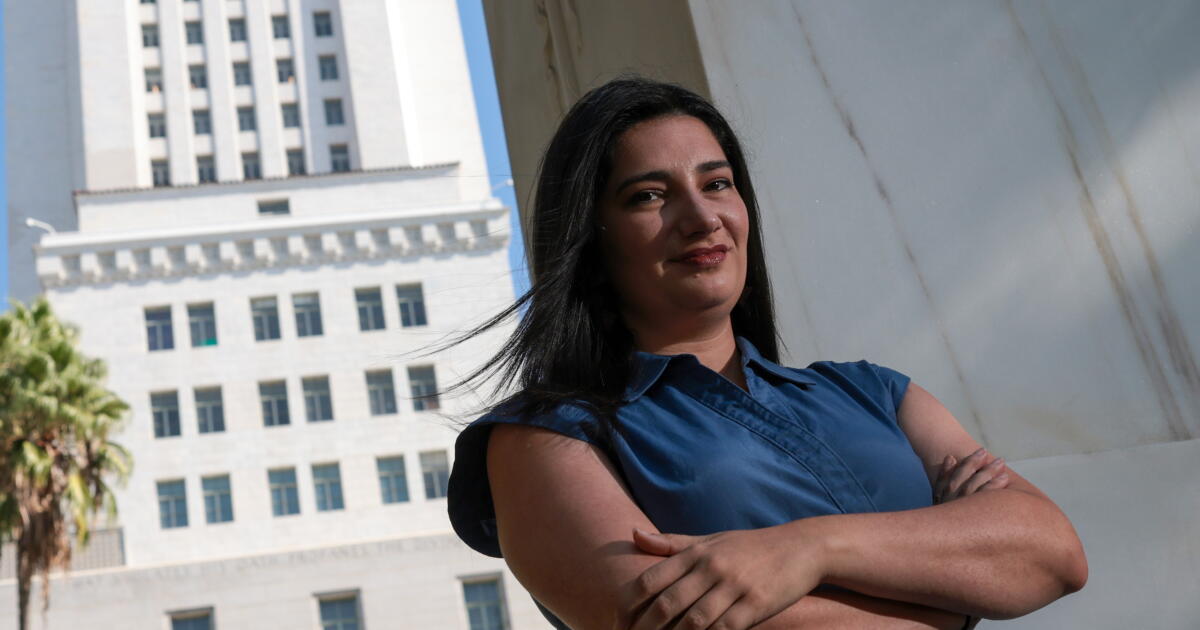
Marissa Roy is on track to become Los Angeles’ next city attorney after jumping out to a significant lead over L.A. County prosecutor John McKinney based on early returns.
Roy, 34, a deputy state attorney general, campaigned on a promise to convert the city attorney’s office into a massive “public interest law firm,” vowing to champion renters and defend Angelenos from an increasingly hostile White House.
The bubbly coalition-builder had long been the favorite in the race, leading McKinney by double digits in polls leading up to Tuesday. She won the June primary with more than 40% of the vote.
Roy and McKinney’s head-to-head race came after voters and powerful city unions turned on the incumbent, Hydee Feldstein Soto, whose June primary defeat marked the first time a sitting L.A. elected official failed to advance to a general election in nearly a century.
Supporters at Roy’s watch party at the downtown Audio Graph brewery erupted in cheers when the first batch of results dropped, showing Roy doubling up McKinney’s early vote total. The mood was ebullient as the first batch of returns trickled in, buoyed by dramatic wins for Democrats across the country and a better than expected early lead for their candidate.
Roy arrived around 9 p.m. in a plum-colored dress, her arms stacked with bangles that rang as she embraced supporters and took the stage.
“I was planning on hedging and saying, ‘It looks like we’re winning,’ but I think we won!” Roy told the crowd to whoops and cheers.
Roy ran to the left of her opponent and tried to paint him as the preferred choice of Republicans in L.A. County. McKinney is a lifelong Democrat and has been critical of President Trump.
At Hill Street bar, close to the downtown criminal courthouse where McKinney has built his career, supporters swayed to smooth jazz and Top 40 radio hits, nursing cocktails and betraying no reaction to the dismal early returns.
In a brief interview outside the bar, McKinney remained positive and said he always knew he faced an uphill battle. He announced his candidacy long after Roy and Feldstein Soto began their campaigns, yet still surged to a surprise second-place finish in June. He said he was proud he was able to inject discussion of public safety issues and real strategies for solving homelessness into the race.
“I got into this race nine months ago because the people of Los Angeles deserve better,” he said.
Although he said he had “no bitterness” toward Roy and wished her the best of luck, he did express disappointment at the efforts her campaign and some of her supporters took to incorrectly paint him as a conservative.
“I just felt that it was very misleading … it’s not a political position. It’s not a partisan position,” he said.
The candidates were a study in contrasts: Roy is a stylish progressive with savvy social media campaign videos, while McKinney is a stoic law-and-order-type. They also offered voters starkly different plans for leading the city attorney’s office.
A core part of the California Department of Justice legal team that won a historic $17-billion settlement from Meta this summer, Roy ran as a champion of the average Angeleno, promising to hold corporations and landlords accountable for misconduct. A Yale-educated lawyer, she positioned herself as the only candidate who would stand up to Trump administration policies that have harmed Los Angeles.
McKinney, who often noted he has been a lawyer nearly as long as Roy has been alive, leaned on his nearly unblemished record prosecuting some of the region’s most notorious and violent crimes and his compelling personal history. Orphaned at 5, he was raised by an older sister in a household where money was extremely tight and found himself painting houses just to afford college classes. In a 28-year career as an L.A. County prosecutor, McKinney won convictions in a number of high-profile cases, including the murder of rapper Nipsey Hussle.
The veteran prosecutor promised to focus his energy on reducing homelessness and improving public safety through misdemeanors he believed the prior administration under-enforced, including street racing and animal abuse on Skid Row. He also vowed to conduct more aggressive reviews of the way nonprofits that do business with the city spend funds meant to aid unhoused citizens.
Although they aligned in few places, both Roy and McKinney said they would work to bring down the city’s out-of-control legal costs. That figure exploded to nearly $300 million in city payouts last year.
Roy was supported by the L.A. County Democratic Party, the local chapter of the Democratic Socialists of America, Atty. Gen. Rob Bonta and U.S. Sen. Bernie Sanders (I-Vt.). McKinney was backed by a coalition of law enforcement unions, four former city attorneys and L.A. County Dist. Atty. Nathan Hochman.

Marissa Roy is on track to become Los Angeles’ next city attorney after jumping out to a significant lead over L.A. County prosecutor John McKinney based on early returns.
Roy, 34, a deputy state attorney general, campaigned on a promise to convert the city attorney’s office into a massive “public interest law firm,” vowing to champion renters and defend Angelenos from an increasingly hostile White House.
The bubbly coalition-builder had long been the favorite in the race, leading McKinney by double digits in polls leading up to Tuesday. She won the June primary with more than 40% of the vote.
Roy and McKinney’s head-to-head race came after voters and powerful city unions turned on the incumbent, Hydee Feldstein Soto, whose June primary defeat marked the first time a sitting L.A. elected official failed to advance to a general election in nearly a century.
Supporters at Roy’s watch party at the downtown Audio Graph brewery erupted in cheers when the first batch of results dropped, showing Roy doubling up McKinney’s early vote total. The mood was ebullient as the first batch of returns trickled in, buoyed by dramatic wins for Democrats across the country and a better than expected early lead for their candidate.
Roy arrived around 9 p.m. in a plum-colored dress, her arms stacked with bangles that rang as she embraced supporters and took the stage.
“I was planning on hedging and saying, ‘It looks like we’re winning,’ but I think we won!” Roy told the crowd to whoops and cheers.
Roy ran to the left of her opponent and tried to paint him as the preferred choice of Republicans in L.A. County. McKinney is a lifelong Democrat and has been critical of President Trump.
At Hill Street bar, close to the downtown criminal courthouse where McKinney has built his career, supporters swayed to smooth jazz and Top 40 radio hits, nursing cocktails and betraying no reaction to the dismal early returns.
In a brief interview outside the bar, McKinney remained positive and said he always knew he faced an uphill battle. He announced his candidacy long after Roy and Feldstein Soto began their campaigns, yet still surged to a surprise second-place finish in June. He said he was proud he was able to inject discussion of public safety issues and real strategies for solving homelessness into the race.
“I got into this race nine months ago because the people of Los Angeles deserve better,” he said.
Although he said he had “no bitterness” toward Roy and wished her the best of luck, he did express disappointment at the efforts her campaign and some of her supporters took to incorrectly paint him as a conservative.
“I just felt that it was very misleading … it’s not a political position. It’s not a partisan position,” he said.
The candidates were a study in contrasts: Roy is a stylish progressive with savvy social media campaign videos, while McKinney is a stoic law-and-order-type. They also offered voters starkly different plans for leading the city attorney’s office.
A core part of the California Department of Justice legal team that won a historic $17-billion settlement from Meta this summer, Roy ran as a champion of the average Angeleno, promising to hold corporations and landlords accountable for misconduct. A Yale-educated lawyer, she positioned herself as the only candidate who would stand up to Trump administration policies that have harmed Los Angeles.
McKinney, who often noted he has been a lawyer nearly as long as Roy has been alive, leaned on his nearly unblemished record prosecuting some of the region’s most notorious and violent crimes and his compelling personal history. Orphaned at 5, he was raised by an older sister in a household where money was extremely tight and found himself painting houses just to afford college classes. In a 28-year career as an L.A. County prosecutor, McKinney won convictions in a number of high-profile cases, including the murder of rapper Nipsey Hussle.
The veteran prosecutor promised to focus his energy on reducing homelessness and improving public safety through misdemeanors he believed the prior administration under-enforced, including street racing and animal abuse on Skid Row. He also vowed to conduct more aggressive reviews of the way nonprofits that do business with the city spend funds meant to aid unhoused citizens.
Although they aligned in few places, both Roy and McKinney said they would work to bring down the city’s out-of-control legal costs. That figure exploded to nearly $300 million in city payouts last year.
Roy was supported by the L.A. County Democratic Party, the local chapter of the Democratic Socialists of America, Atty. Gen. Rob Bonta and U.S. Sen. Bernie Sanders (I-Vt.). McKinney was backed by a coalition of law enforcement unions, four former city attorneys and L.A. County Dist. Atty. Nathan Hochman.

Marissa Roy is on track to become Los Angeles’ next city attorney after jumping out to a significant lead over L.A. County prosecutor John McKinney based on early returns.
Roy, 34, a deputy state attorney general, campaigned on a promise to convert the city attorney’s office into a massive “public interest law firm,” vowing to champion renters and defend Angelenos from an increasingly hostile White House.
The bubbly coalition-builder had long been the favorite in the race, leading McKinney by double digits in polls leading up to Tuesday. She won the June primary with more than 40% of the vote.
Roy and McKinney’s head-to-head race came after voters and powerful city unions turned on the incumbent, Hydee Feldstein Soto, whose June primary defeat marked the first time a sitting L.A. elected official failed to advance to a general election in nearly a century.
Supporters at Roy’s watch party at the downtown Audio Graph brewery erupted in cheers when the first batch of results dropped, showing Roy doubling up McKinney’s early vote total. The mood was ebullient as the first batch of returns trickled in, buoyed by dramatic wins for Democrats across the country and a better than expected early lead for their candidate.
Roy arrived around 9 p.m. in a plum-colored dress, her arms stacked with bangles that rang as she embraced supporters and took the stage.
“I was planning on hedging and saying, ‘It looks like we’re winning,’ but I think we won!” Roy told the crowd to whoops and cheers.
Roy ran to the left of her opponent and tried to paint him as the preferred choice of Republicans in L.A. County. McKinney is a lifelong Democrat and has been critical of President Trump.
At Hill Street bar, close to the downtown criminal courthouse where McKinney has built his career, supporters swayed to smooth jazz and Top 40 radio hits, nursing cocktails and betraying no reaction to the dismal early returns.
In a brief interview outside the bar, McKinney remained positive and said he always knew he faced an uphill battle. He announced his candidacy long after Roy and Feldstein Soto began their campaigns, yet still surged to a surprise second-place finish in June. He said he was proud he was able to inject discussion of public safety issues and real strategies for solving homelessness into the race.
“I got into this race nine months ago because the people of Los Angeles deserve better,” he said.
Although he said he had “no bitterness” toward Roy and wished her the best of luck, he did express disappointment at the efforts her campaign and some of her supporters took to incorrectly paint him as a conservative.
“I just felt that it was very misleading … it’s not a political position. It’s not a partisan position,” he said.
The candidates were a study in contrasts: Roy is a stylish progressive with savvy social media campaign videos, while McKinney is a stoic law-and-order-type. They also offered voters starkly different plans for leading the city attorney’s office.
A core part of the California Department of Justice legal team that won a historic $17-billion settlement from Meta this summer, Roy ran as a champion of the average Angeleno, promising to hold corporations and landlords accountable for misconduct. A Yale-educated lawyer, she positioned herself as the only candidate who would stand up to Trump administration policies that have harmed Los Angeles.
McKinney, who often noted he has been a lawyer nearly as long as Roy has been alive, leaned on his nearly unblemished record prosecuting some of the region’s most notorious and violent crimes and his compelling personal history. Orphaned at 5, he was raised by an older sister in a household where money was extremely tight and found himself painting houses just to afford college classes. In a 28-year career as an L.A. County prosecutor, McKinney won convictions in a number of high-profile cases, including the murder of rapper Nipsey Hussle.
The veteran prosecutor promised to focus his energy on reducing homelessness and improving public safety through misdemeanors he believed the prior administration under-enforced, including street racing and animal abuse on Skid Row. He also vowed to conduct more aggressive reviews of the way nonprofits that do business with the city spend funds meant to aid unhoused citizens.
Although they aligned in few places, both Roy and McKinney said they would work to bring down the city’s out-of-control legal costs. That figure exploded to nearly $300 million in city payouts last year.
Roy was supported by the L.A. County Democratic Party, the local chapter of the Democratic Socialists of America, Atty. Gen. Rob Bonta and U.S. Sen. Bernie Sanders (I-Vt.). McKinney was backed by a coalition of law enforcement unions, four former city attorneys and L.A. County Dist. Atty. Nathan Hochman.

Marissa Roy is on track to become Los Angeles’ next city attorney after jumping out to a significant lead over L.A. County prosecutor John McKinney based on early returns.
Roy, 34, a deputy state attorney general, campaigned on a promise to convert the city attorney’s office into a massive “public interest law firm,” vowing to champion renters and defend Angelenos from an increasingly hostile White House.
The bubbly coalition-builder had long been the favorite in the race, leading McKinney by double digits in polls leading up to Tuesday. She won the June primary with more than 40% of the vote.
Roy and McKinney’s head-to-head race came after voters and powerful city unions turned on the incumbent, Hydee Feldstein Soto, whose June primary defeat marked the first time a sitting L.A. elected official failed to advance to a general election in nearly a century.
Supporters at Roy’s watch party at the downtown Audio Graph brewery erupted in cheers when the first batch of results dropped, showing Roy doubling up McKinney’s early vote total. The mood was ebullient as the first batch of returns trickled in, buoyed by dramatic wins for Democrats across the country and a better than expected early lead for their candidate.
Roy arrived around 9 p.m. in a plum-colored dress, her arms stacked with bangles that rang as she embraced supporters and took the stage.
“I was planning on hedging and saying, ‘It looks like we’re winning,’ but I think we won!” Roy told the crowd to whoops and cheers.
Roy ran to the left of her opponent and tried to paint him as the preferred choice of Republicans in L.A. County. McKinney is a lifelong Democrat and has been critical of President Trump.
At Hill Street bar, close to the downtown criminal courthouse where McKinney has built his career, supporters swayed to smooth jazz and Top 40 radio hits, nursing cocktails and betraying no reaction to the dismal early returns.
In a brief interview outside the bar, McKinney remained positive and said he always knew he faced an uphill battle. He announced his candidacy long after Roy and Feldstein Soto began their campaigns, yet still surged to a surprise second-place finish in June. He said he was proud he was able to inject discussion of public safety issues and real strategies for solving homelessness into the race.
“I got into this race nine months ago because the people of Los Angeles deserve better,” he said.
Although he said he had “no bitterness” toward Roy and wished her the best of luck, he did express disappointment at the efforts her campaign and some of her supporters took to incorrectly paint him as a conservative.
“I just felt that it was very misleading … it’s not a political position. It’s not a partisan position,” he said.
The candidates were a study in contrasts: Roy is a stylish progressive with savvy social media campaign videos, while McKinney is a stoic law-and-order-type. They also offered voters starkly different plans for leading the city attorney’s office.
A core part of the California Department of Justice legal team that won a historic $17-billion settlement from Meta this summer, Roy ran as a champion of the average Angeleno, promising to hold corporations and landlords accountable for misconduct. A Yale-educated lawyer, she positioned herself as the only candidate who would stand up to Trump administration policies that have harmed Los Angeles.
McKinney, who often noted he has been a lawyer nearly as long as Roy has been alive, leaned on his nearly unblemished record prosecuting some of the region’s most notorious and violent crimes and his compelling personal history. Orphaned at 5, he was raised by an older sister in a household where money was extremely tight and found himself painting houses just to afford college classes. In a 28-year career as an L.A. County prosecutor, McKinney won convictions in a number of high-profile cases, including the murder of rapper Nipsey Hussle.
The veteran prosecutor promised to focus his energy on reducing homelessness and improving public safety through misdemeanors he believed the prior administration under-enforced, including street racing and animal abuse on Skid Row. He also vowed to conduct more aggressive reviews of the way nonprofits that do business with the city spend funds meant to aid unhoused citizens.
Although they aligned in few places, both Roy and McKinney said they would work to bring down the city’s out-of-control legal costs. That figure exploded to nearly $300 million in city payouts last year.
Roy was supported by the L.A. County Democratic Party, the local chapter of the Democratic Socialists of America, Atty. Gen. Rob Bonta and U.S. Sen. Bernie Sanders (I-Vt.). McKinney was backed by a coalition of law enforcement unions, four former city attorneys and L.A. County Dist. Atty. Nathan Hochman.

Marissa Roy is on track to become Los Angeles’ next city attorney after jumping out to a significant lead over L.A. County prosecutor John McKinney based on early returns.
Roy, 34, a deputy state attorney general, campaigned on a promise to convert the city attorney’s office into a massive “public interest law firm,” vowing to champion renters and defend Angelenos from an increasingly hostile White House.
The bubbly coalition-builder had long been the favorite in the race, leading McKinney by double digits in polls leading up to Tuesday. She won the June primary with more than 40% of the vote.
Roy and McKinney’s head-to-head race came after voters and powerful city unions turned on the incumbent, Hydee Feldstein Soto, whose June primary defeat marked the first time a sitting L.A. elected official failed to advance to a general election in nearly a century.
Supporters at Roy’s watch party at the downtown Audio Graph brewery erupted in cheers when the first batch of results dropped, showing Roy doubling up McKinney’s early vote total. The mood was ebullient as the first batch of returns trickled in, buoyed by dramatic wins for Democrats across the country and a better than expected early lead for their candidate.
Roy arrived around 9 p.m. in a plum-colored dress, her arms stacked with bangles that rang as she embraced supporters and took the stage.
“I was planning on hedging and saying, ‘It looks like we’re winning,’ but I think we won!” Roy told the crowd to whoops and cheers.
Roy ran to the left of her opponent and tried to paint him as the preferred choice of Republicans in L.A. County. McKinney is a lifelong Democrat and has been critical of President Trump.
At Hill Street bar, close to the downtown criminal courthouse where McKinney has built his career, supporters swayed to smooth jazz and Top 40 radio hits, nursing cocktails and betraying no reaction to the dismal early returns.
In a brief interview outside the bar, McKinney remained positive and said he always knew he faced an uphill battle. He announced his candidacy long after Roy and Feldstein Soto began their campaigns, yet still surged to a surprise second-place finish in June. He said he was proud he was able to inject discussion of public safety issues and real strategies for solving homelessness into the race.
“I got into this race nine months ago because the people of Los Angeles deserve better,” he said.
Although he said he had “no bitterness” toward Roy and wished her the best of luck, he did express disappointment at the efforts her campaign and some of her supporters took to incorrectly paint him as a conservative.
“I just felt that it was very misleading … it’s not a political position. It’s not a partisan position,” he said.
The candidates were a study in contrasts: Roy is a stylish progressive with savvy social media campaign videos, while McKinney is a stoic law-and-order-type. They also offered voters starkly different plans for leading the city attorney’s office.
A core part of the California Department of Justice legal team that won a historic $17-billion settlement from Meta this summer, Roy ran as a champion of the average Angeleno, promising to hold corporations and landlords accountable for misconduct. A Yale-educated lawyer, she positioned herself as the only candidate who would stand up to Trump administration policies that have harmed Los Angeles.
McKinney, who often noted he has been a lawyer nearly as long as Roy has been alive, leaned on his nearly unblemished record prosecuting some of the region’s most notorious and violent crimes and his compelling personal history. Orphaned at 5, he was raised by an older sister in a household where money was extremely tight and found himself painting houses just to afford college classes. In a 28-year career as an L.A. County prosecutor, McKinney won convictions in a number of high-profile cases, including the murder of rapper Nipsey Hussle.
The veteran prosecutor promised to focus his energy on reducing homelessness and improving public safety through misdemeanors he believed the prior administration under-enforced, including street racing and animal abuse on Skid Row. He also vowed to conduct more aggressive reviews of the way nonprofits that do business with the city spend funds meant to aid unhoused citizens.
Although they aligned in few places, both Roy and McKinney said they would work to bring down the city’s out-of-control legal costs. That figure exploded to nearly $300 million in city payouts last year.
Roy was supported by the L.A. County Democratic Party, the local chapter of the Democratic Socialists of America, Atty. Gen. Rob Bonta and U.S. Sen. Bernie Sanders (I-Vt.). McKinney was backed by a coalition of law enforcement unions, four former city attorneys and L.A. County Dist. Atty. Nathan Hochman.

