

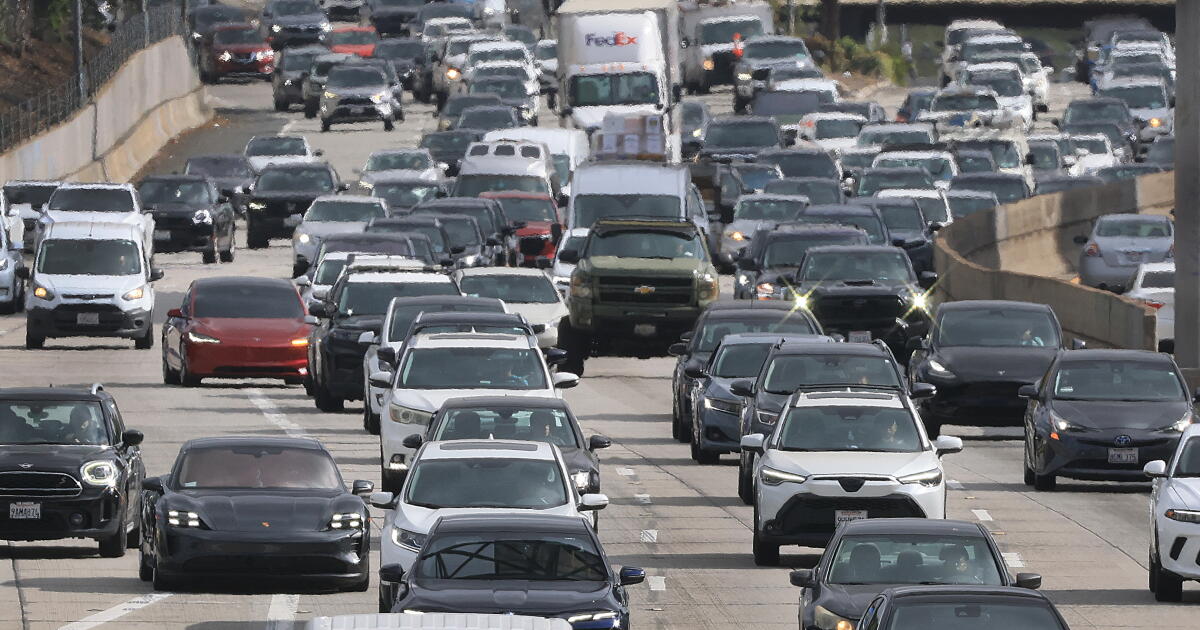
The Trump administration on Monday released new fuel-efficiency rules that loosen pressure on automakers to control pollution from gasoline-powered vehicles, further complicating California’s ability to meet its climate and clean car goals.
President Trump pitched the changes, which he announced in December, as a way to boost the domestic auto industry and lower consumer costs. He made the original announcement standing alongside several auto executives.
The new rule applies to Corporate Average Fuel Economy Standards, or CAFE Standards, which have been implemented by the federal government since the 1970s, when cars averaged about 13 miles per gallon.
The change will set the requirement for 2031 model-year vehicles to 34.9 miles per gallon, when it would have been 50.4 miles per gallon under rules from the Biden administration. U.S. Transportation Secretary Sean Duffy said the move will end the “illegal mandate that forced automakers to produce more expensive electric vehicles that American families didn’t want.”
“With our commonsense standards in place, we are making the American dream affordable again, putting safer cars on the road, and investing in the American autoworker,” Duffy said in a statement.
But experts say the plan enables automakers to manufacture and sell larger, heavier and less fuel-efficient vehicles in states across the country.
“What this rule does is sends a signal to the auto industry that they don’t have to make their vehicles more efficient, and they don’t have to create vehicles that will save drivers money anymore,” said Kathy Harris, director of clean vehicles, climate and energy at the nonprofit Natural Resources Defense Council. “It’s just focusing on the cost [to] industry and ignoring the real affordability crisis that Californians and Americas are really feeling right now.”
Monday’s action will hit people’s wallets hard, Harris said. Californians are already facing extremely high costs at the pump, with gasoline averaging about $6.37 a gallon in the state, according to AAA.
Only the federal government is allowed to set miles-per-gallon rules. But to address climate change, and the role of cars in it, California has required vehicles to emit less carbon dioxide per mile.
The Trump administration recognizes this and also has moved to revoke California’s authority over tailpipe requirements, as well as its ambitious plan to ban the sale of new gasoline-powered cars in 2035.
When taken together, the actions could have a real effect on the state’s air pollution and climate goals, said Ann Carlson, a professor of environmental law at UCLA who served as acting administrator of the National Highway Traffic Safety Administration under President Biden.
“It’s this cumulative effect of basically no standards in place to tighten fuel economy or to cut greenhouse gases from automobiles at the federal level, at the state level, through [the Environmental Protection Agency] or through the Department of Transportation,” she said.
Trump has long criticized the Biden-era rules, and he rolled back Obama-era miles-per-gallon rules in his first term. The Biden administration approach was part of a set of policies to spur production and purchases of electric vehicles.
EV production and sales plummeted nationally as a consequence of Trump administration policies, although they have started to bounce back in California. The state recently announced new incentives to fill the gap left by Trump’s termination of federal EV rebates.
Trump, whose party is struggling in the polls ahead of the November midterm elections, has been under pressure to do more to address concerns about rising prices for consumer goods, particularly as oil prices have remained high since the start of the Iran war in February.
Gasoline prices reached their highest level ever for September, driven also by Russia’s war in Ukraine.
Administration officials said in a news release that the new standards will reduce oil consumption by about 1.3 billion barrels by 2050, as compared to average yearly oil consumption in 2024. However, it did not note that the NHTSA previously estimated the Biden-era rules would save almost 70 billion gallons of gasoline through 2050, and prevent more than 710 million metric tons of planet-warming carbon dioxide emissions by that same year.
The change also has direct implications for EV companies with ties to California, such as Rivian, Tesla and Lucid, by eliminating a mechanism that allowed them to sell credits to other manufacturers to help them comply with the standards, said UCLA’s Carlson.
The lowered standards represent a major win for the oil industry and those automakers that complained Biden-era requirements pushed the bounds of available technology and effectively discouraged the sale of traditional gasoline-powered vehicles in favor of electric models.
“We welcome the administration’s efforts to reset the CAFE regulations to more achievable targets that are better aligned with market realities,” Jodi Tinson, a spokesperson for Stellantis, said in an email. Tinson added that the standards “will allow us to offer our customers the freedom to choose from a range of vehicles and power trains that meet their needs, from brands they love and trust.”
California and other states are likely to challenge the move in court, as are coalitions of environmental groups that are already fighting other similar rollbacks from the administration, such as the recent move scrapping Biden-era rules for greenhouse gas emissions from power plants.
“It’s simple: less fuel efficiency means spending more money at the pump and poisoning the air in our communities,” California Atty. Gen. Rob Bonta said in a statement to The Times. “California will do what it does best — fight back to protect consumers, public health, and a better, sustainable future.”
States also have the ability to encourage the transition to cleaner vehicles, such as California’s investment in EV infrastructure and rebates, said Harris, of the Natural Resources Defense Council.
“We need to see this not only to help consumers save money at the pump, not only to help our climate and our environment, but also to stay competitive globally,” she said. “The rest of the world is turning to these cleaner, more efficient vehicles, and we are increasingly becoming an island of gas guzzlers.”
Bloomberg reporters María Paula Mijares Torres and Ari Natter contributed to this report.

The Trump administration on Monday released new fuel-efficiency rules that loosen pressure on automakers to control pollution from gasoline-powered vehicles, further complicating California’s ability to meet its climate and clean car goals.
President Trump pitched the changes, which he announced in December, as a way to boost the domestic auto industry and lower consumer costs. He made the original announcement standing alongside several auto executives.
The new rule applies to Corporate Average Fuel Economy Standards, or CAFE Standards, which have been implemented by the federal government since the 1970s, when cars averaged about 13 miles per gallon.
The change will set the requirement for 2031 model-year vehicles to 34.9 miles per gallon, when it would have been 50.4 miles per gallon under rules from the Biden administration. U.S. Transportation Secretary Sean Duffy said the move will end the “illegal mandate that forced automakers to produce more expensive electric vehicles that American families didn’t want.”
“With our commonsense standards in place, we are making the American dream affordable again, putting safer cars on the road, and investing in the American autoworker,” Duffy said in a statement.
But experts say the plan enables automakers to manufacture and sell larger, heavier and less fuel-efficient vehicles in states across the country.
“What this rule does is sends a signal to the auto industry that they don’t have to make their vehicles more efficient, and they don’t have to create vehicles that will save drivers money anymore,” said Kathy Harris, director of clean vehicles, climate and energy at the nonprofit Natural Resources Defense Council. “It’s just focusing on the cost [to] industry and ignoring the real affordability crisis that Californians and Americas are really feeling right now.”
Monday’s action will hit people’s wallets hard, Harris said. Californians are already facing extremely high costs at the pump, with gasoline averaging about $6.37 a gallon in the state, according to AAA.
Only the federal government is allowed to set miles-per-gallon rules. But to address climate change, and the role of cars in it, California has required vehicles to emit less carbon dioxide per mile.
The Trump administration recognizes this and also has moved to revoke California’s authority over tailpipe requirements, as well as its ambitious plan to ban the sale of new gasoline-powered cars in 2035.
When taken together, the actions could have a real effect on the state’s air pollution and climate goals, said Ann Carlson, a professor of environmental law at UCLA who served as acting administrator of the National Highway Traffic Safety Administration under President Biden.
“It’s this cumulative effect of basically no standards in place to tighten fuel economy or to cut greenhouse gases from automobiles at the federal level, at the state level, through [the Environmental Protection Agency] or through the Department of Transportation,” she said.
Trump has long criticized the Biden-era rules, and he rolled back Obama-era miles-per-gallon rules in his first term. The Biden administration approach was part of a set of policies to spur production and purchases of electric vehicles.
EV production and sales plummeted nationally as a consequence of Trump administration policies, although they have started to bounce back in California. The state recently announced new incentives to fill the gap left by Trump’s termination of federal EV rebates.
Trump, whose party is struggling in the polls ahead of the November midterm elections, has been under pressure to do more to address concerns about rising prices for consumer goods, particularly as oil prices have remained high since the start of the Iran war in February.
Gasoline prices reached their highest level ever for September, driven also by Russia’s war in Ukraine.
Administration officials said in a news release that the new standards will reduce oil consumption by about 1.3 billion barrels by 2050, as compared to average yearly oil consumption in 2024. However, it did not note that the NHTSA previously estimated the Biden-era rules would save almost 70 billion gallons of gasoline through 2050, and prevent more than 710 million metric tons of planet-warming carbon dioxide emissions by that same year.
The change also has direct implications for EV companies with ties to California, such as Rivian, Tesla and Lucid, by eliminating a mechanism that allowed them to sell credits to other manufacturers to help them comply with the standards, said UCLA’s Carlson.
The lowered standards represent a major win for the oil industry and those automakers that complained Biden-era requirements pushed the bounds of available technology and effectively discouraged the sale of traditional gasoline-powered vehicles in favor of electric models.
“We welcome the administration’s efforts to reset the CAFE regulations to more achievable targets that are better aligned with market realities,” Jodi Tinson, a spokesperson for Stellantis, said in an email. Tinson added that the standards “will allow us to offer our customers the freedom to choose from a range of vehicles and power trains that meet their needs, from brands they love and trust.”
California and other states are likely to challenge the move in court, as are coalitions of environmental groups that are already fighting other similar rollbacks from the administration, such as the recent move scrapping Biden-era rules for greenhouse gas emissions from power plants.
“It’s simple: less fuel efficiency means spending more money at the pump and poisoning the air in our communities,” California Atty. Gen. Rob Bonta said in a statement to The Times. “California will do what it does best — fight back to protect consumers, public health, and a better, sustainable future.”
States also have the ability to encourage the transition to cleaner vehicles, such as California’s investment in EV infrastructure and rebates, said Harris, of the Natural Resources Defense Council.
“We need to see this not only to help consumers save money at the pump, not only to help our climate and our environment, but also to stay competitive globally,” she said. “The rest of the world is turning to these cleaner, more efficient vehicles, and we are increasingly becoming an island of gas guzzlers.”
Bloomberg reporters María Paula Mijares Torres and Ari Natter contributed to this report.

The Trump administration on Monday released new fuel-efficiency rules that loosen pressure on automakers to control pollution from gasoline-powered vehicles, further complicating California’s ability to meet its climate and clean car goals.
President Trump pitched the changes, which he announced in December, as a way to boost the domestic auto industry and lower consumer costs. He made the original announcement standing alongside several auto executives.
The new rule applies to Corporate Average Fuel Economy Standards, or CAFE Standards, which have been implemented by the federal government since the 1970s, when cars averaged about 13 miles per gallon.
The change will set the requirement for 2031 model-year vehicles to 34.9 miles per gallon, when it would have been 50.4 miles per gallon under rules from the Biden administration. U.S. Transportation Secretary Sean Duffy said the move will end the “illegal mandate that forced automakers to produce more expensive electric vehicles that American families didn’t want.”
“With our commonsense standards in place, we are making the American dream affordable again, putting safer cars on the road, and investing in the American autoworker,” Duffy said in a statement.
But experts say the plan enables automakers to manufacture and sell larger, heavier and less fuel-efficient vehicles in states across the country.
“What this rule does is sends a signal to the auto industry that they don’t have to make their vehicles more efficient, and they don’t have to create vehicles that will save drivers money anymore,” said Kathy Harris, director of clean vehicles, climate and energy at the nonprofit Natural Resources Defense Council. “It’s just focusing on the cost [to] industry and ignoring the real affordability crisis that Californians and Americas are really feeling right now.”
Monday’s action will hit people’s wallets hard, Harris said. Californians are already facing extremely high costs at the pump, with gasoline averaging about $6.37 a gallon in the state, according to AAA.
Only the federal government is allowed to set miles-per-gallon rules. But to address climate change, and the role of cars in it, California has required vehicles to emit less carbon dioxide per mile.
The Trump administration recognizes this and also has moved to revoke California’s authority over tailpipe requirements, as well as its ambitious plan to ban the sale of new gasoline-powered cars in 2035.
When taken together, the actions could have a real effect on the state’s air pollution and climate goals, said Ann Carlson, a professor of environmental law at UCLA who served as acting administrator of the National Highway Traffic Safety Administration under President Biden.
“It’s this cumulative effect of basically no standards in place to tighten fuel economy or to cut greenhouse gases from automobiles at the federal level, at the state level, through [the Environmental Protection Agency] or through the Department of Transportation,” she said.
Trump has long criticized the Biden-era rules, and he rolled back Obama-era miles-per-gallon rules in his first term. The Biden administration approach was part of a set of policies to spur production and purchases of electric vehicles.
EV production and sales plummeted nationally as a consequence of Trump administration policies, although they have started to bounce back in California. The state recently announced new incentives to fill the gap left by Trump’s termination of federal EV rebates.
Trump, whose party is struggling in the polls ahead of the November midterm elections, has been under pressure to do more to address concerns about rising prices for consumer goods, particularly as oil prices have remained high since the start of the Iran war in February.
Gasoline prices reached their highest level ever for September, driven also by Russia’s war in Ukraine.
Administration officials said in a news release that the new standards will reduce oil consumption by about 1.3 billion barrels by 2050, as compared to average yearly oil consumption in 2024. However, it did not note that the NHTSA previously estimated the Biden-era rules would save almost 70 billion gallons of gasoline through 2050, and prevent more than 710 million metric tons of planet-warming carbon dioxide emissions by that same year.
The change also has direct implications for EV companies with ties to California, such as Rivian, Tesla and Lucid, by eliminating a mechanism that allowed them to sell credits to other manufacturers to help them comply with the standards, said UCLA’s Carlson.
The lowered standards represent a major win for the oil industry and those automakers that complained Biden-era requirements pushed the bounds of available technology and effectively discouraged the sale of traditional gasoline-powered vehicles in favor of electric models.
“We welcome the administration’s efforts to reset the CAFE regulations to more achievable targets that are better aligned with market realities,” Jodi Tinson, a spokesperson for Stellantis, said in an email. Tinson added that the standards “will allow us to offer our customers the freedom to choose from a range of vehicles and power trains that meet their needs, from brands they love and trust.”
California and other states are likely to challenge the move in court, as are coalitions of environmental groups that are already fighting other similar rollbacks from the administration, such as the recent move scrapping Biden-era rules for greenhouse gas emissions from power plants.
“It’s simple: less fuel efficiency means spending more money at the pump and poisoning the air in our communities,” California Atty. Gen. Rob Bonta said in a statement to The Times. “California will do what it does best — fight back to protect consumers, public health, and a better, sustainable future.”
States also have the ability to encourage the transition to cleaner vehicles, such as California’s investment in EV infrastructure and rebates, said Harris, of the Natural Resources Defense Council.
“We need to see this not only to help consumers save money at the pump, not only to help our climate and our environment, but also to stay competitive globally,” she said. “The rest of the world is turning to these cleaner, more efficient vehicles, and we are increasingly becoming an island of gas guzzlers.”
Bloomberg reporters María Paula Mijares Torres and Ari Natter contributed to this report.
The Trump administration on Monday released new fuel-efficiency rules that loosen pressure on automakers to control pollution from gasoline-powered vehicles, further complicating California’s ability to meet its climate and clean car goals.
President Trump pitched the changes, which he announced in December, as a way to boost the domestic auto industry and lower consumer costs. He made the original announcement standing alongside several auto executives.
The new rule applies to Corporate Average Fuel Economy Standards, or CAFE Standards, which have been implemented by the federal government since the 1970s, when cars averaged about 13 miles per gallon.
The change will set the requirement for 2031 model-year vehicles to 34.9 miles per gallon, when it would have been 50.4 miles per gallon under rules from the Biden administration. U.S. Transportation Secretary Sean Duffy said the move will end the “illegal mandate that forced automakers to produce more expensive electric vehicles that American families didn’t want.”
“With our commonsense standards in place, we are making the American dream affordable again, putting safer cars on the road, and investing in the American autoworker,” Duffy said in a statement.
But experts say the plan enables automakers to manufacture and sell larger, heavier and less fuel-efficient vehicles in states across the country.
“What this rule does is sends a signal to the auto industry that they don’t have to make their vehicles more efficient, and they don’t have to create vehicles that will save drivers money anymore,” said Kathy Harris, director of clean vehicles, climate and energy at the nonprofit Natural Resources Defense Council. “It’s just focusing on the cost [to] industry and ignoring the real affordability crisis that Californians and Americas are really feeling right now.”
Monday’s action will hit people’s wallets hard, Harris said. Californians are already facing extremely high costs at the pump, with gasoline averaging about $6.37 a gallon in the state, according to AAA.
Only the federal government is allowed to set miles-per-gallon rules. But to address climate change, and the role of cars in it, California has required vehicles to emit less carbon dioxide per mile.
The Trump administration recognizes this and also has moved to revoke California’s authority over tailpipe requirements, as well as its ambitious plan to ban the sale of new gasoline-powered cars in 2035.
When taken together, the actions could have a real effect on the state’s air pollution and climate goals, said Ann Carlson, a professor of environmental law at UCLA who served as acting administrator of the National Highway Traffic Safety Administration under President Biden.
“It’s this cumulative effect of basically no standards in place to tighten fuel economy or to cut greenhouse gases from automobiles at the federal level, at the state level, through [the Environmental Protection Agency] or through the Department of Transportation,” she said.
Trump has long criticized the Biden-era rules, and he rolled back Obama-era miles-per-gallon rules in his first term. The Biden administration approach was part of a set of policies to spur production and purchases of electric vehicles.
EV production and sales plummeted nationally as a consequence of Trump administration policies, although they have started to bounce back in California. The state recently announced new incentives to fill the gap left by Trump’s termination of federal EV rebates.
Trump, whose party is struggling in the polls ahead of the November midterm elections, has been under pressure to do more to address concerns about rising prices for consumer goods, particularly as oil prices have remained high since the start of the Iran war in February.
Gasoline prices reached their highest level ever for September, driven also by Russia’s war in Ukraine.
Administration officials said in a news release that the new standards will reduce oil consumption by about 1.3 billion barrels by 2050, as compared to average yearly oil consumption in 2024. However, it did not note that the NHTSA previously estimated the Biden-era rules would save almost 70 billion gallons of gasoline through 2050, and prevent more than 710 million metric tons of planet-warming carbon dioxide emissions by that same year.
The change also has direct implications for EV companies with ties to California, such as Rivian, Tesla and Lucid, by eliminating a mechanism that allowed them to sell credits to other manufacturers to help them comply with the standards, said UCLA’s Carlson.
The lowered standards represent a major win for the oil industry and those automakers that complained Biden-era requirements pushed the bounds of available technology and effectively discouraged the sale of traditional gasoline-powered vehicles in favor of electric models.
“We welcome the administration’s efforts to reset the CAFE regulations to more achievable targets that are better aligned with market realities,” Jodi Tinson, a spokesperson for Stellantis, said in an email. Tinson added that the standards “will allow us to offer our customers the freedom to choose from a range of vehicles and power trains that meet their needs, from brands they love and trust.”
California and other states are likely to challenge the move in court, as are coalitions of environmental groups that are already fighting other similar rollbacks from the administration, such as the recent move scrapping Biden-era rules for greenhouse gas emissions from power plants.
“It’s simple: less fuel efficiency means spending more money at the pump and poisoning the air in our communities,” California Atty. Gen. Rob Bonta said in a statement to The Times. “California will do what it does best — fight back to protect consumers, public health, and a better, sustainable future.”
States also have the ability to encourage the transition to cleaner vehicles, such as California’s investment in EV infrastructure and rebates, said Harris, of the Natural Resources Defense Council.
“We need to see this not only to help consumers save money at the pump, not only to help our climate and our environment, but also to stay competitive globally,” she said. “The rest of the world is turning to these cleaner, more efficient vehicles, and we are increasingly becoming an island of gas guzzlers.”
Bloomberg reporters María Paula Mijares Torres and Ari Natter contributed to this report.

The Trump administration on Monday released new fuel-efficiency rules that loosen pressure on automakers to control pollution from gasoline-powered vehicles, further complicating California’s ability to meet its climate and clean car goals.
President Trump pitched the changes, which he announced in December, as a way to boost the domestic auto industry and lower consumer costs. He made the original announcement standing alongside several auto executives.
The new rule applies to Corporate Average Fuel Economy Standards, or CAFE Standards, which have been implemented by the federal government since the 1970s, when cars averaged about 13 miles per gallon.
The change will set the requirement for 2031 model-year vehicles to 34.9 miles per gallon, when it would have been 50.4 miles per gallon under rules from the Biden administration. U.S. Transportation Secretary Sean Duffy said the move will end the “illegal mandate that forced automakers to produce more expensive electric vehicles that American families didn’t want.”
“With our commonsense standards in place, we are making the American dream affordable again, putting safer cars on the road, and investing in the American autoworker,” Duffy said in a statement.
But experts say the plan enables automakers to manufacture and sell larger, heavier and less fuel-efficient vehicles in states across the country.
“What this rule does is sends a signal to the auto industry that they don’t have to make their vehicles more efficient, and they don’t have to create vehicles that will save drivers money anymore,” said Kathy Harris, director of clean vehicles, climate and energy at the nonprofit Natural Resources Defense Council. “It’s just focusing on the cost [to] industry and ignoring the real affordability crisis that Californians and Americas are really feeling right now.”
Monday’s action will hit people’s wallets hard, Harris said. Californians are already facing extremely high costs at the pump, with gasoline averaging about $6.37 a gallon in the state, according to AAA.
Only the federal government is allowed to set miles-per-gallon rules. But to address climate change, and the role of cars in it, California has required vehicles to emit less carbon dioxide per mile.
The Trump administration recognizes this and also has moved to revoke California’s authority over tailpipe requirements, as well as its ambitious plan to ban the sale of new gasoline-powered cars in 2035.
When taken together, the actions could have a real effect on the state’s air pollution and climate goals, said Ann Carlson, a professor of environmental law at UCLA who served as acting administrator of the National Highway Traffic Safety Administration under President Biden.
“It’s this cumulative effect of basically no standards in place to tighten fuel economy or to cut greenhouse gases from automobiles at the federal level, at the state level, through [the Environmental Protection Agency] or through the Department of Transportation,” she said.
Trump has long criticized the Biden-era rules, and he rolled back Obama-era miles-per-gallon rules in his first term. The Biden administration approach was part of a set of policies to spur production and purchases of electric vehicles.
EV production and sales plummeted nationally as a consequence of Trump administration policies, although they have started to bounce back in California. The state recently announced new incentives to fill the gap left by Trump’s termination of federal EV rebates.
Trump, whose party is struggling in the polls ahead of the November midterm elections, has been under pressure to do more to address concerns about rising prices for consumer goods, particularly as oil prices have remained high since the start of the Iran war in February.
Gasoline prices reached their highest level ever for September, driven also by Russia’s war in Ukraine.
Administration officials said in a news release that the new standards will reduce oil consumption by about 1.3 billion barrels by 2050, as compared to average yearly oil consumption in 2024. However, it did not note that the NHTSA previously estimated the Biden-era rules would save almost 70 billion gallons of gasoline through 2050, and prevent more than 710 million metric tons of planet-warming carbon dioxide emissions by that same year.
The change also has direct implications for EV companies with ties to California, such as Rivian, Tesla and Lucid, by eliminating a mechanism that allowed them to sell credits to other manufacturers to help them comply with the standards, said UCLA’s Carlson.
The lowered standards represent a major win for the oil industry and those automakers that complained Biden-era requirements pushed the bounds of available technology and effectively discouraged the sale of traditional gasoline-powered vehicles in favor of electric models.
“We welcome the administration’s efforts to reset the CAFE regulations to more achievable targets that are better aligned with market realities,” Jodi Tinson, a spokesperson for Stellantis, said in an email. Tinson added that the standards “will allow us to offer our customers the freedom to choose from a range of vehicles and power trains that meet their needs, from brands they love and trust.”
California and other states are likely to challenge the move in court, as are coalitions of environmental groups that are already fighting other similar rollbacks from the administration, such as the recent move scrapping Biden-era rules for greenhouse gas emissions from power plants.
“It’s simple: less fuel efficiency means spending more money at the pump and poisoning the air in our communities,” California Atty. Gen. Rob Bonta said in a statement to The Times. “California will do what it does best — fight back to protect consumers, public health, and a better, sustainable future.”
States also have the ability to encourage the transition to cleaner vehicles, such as California’s investment in EV infrastructure and rebates, said Harris, of the Natural Resources Defense Council.
“We need to see this not only to help consumers save money at the pump, not only to help our climate and our environment, but also to stay competitive globally,” she said. “The rest of the world is turning to these cleaner, more efficient vehicles, and we are increasingly becoming an island of gas guzzlers.”
Bloomberg reporters María Paula Mijares Torres and Ari Natter contributed to this report.
The Trump administration on Monday released new fuel-efficiency rules that loosen pressure on automakers to control pollution from gasoline-powered vehicles, further complicating California’s ability to meet its climate and clean car goals.
President Trump pitched the changes, which he announced in December, as a way to boost the domestic auto industry and lower consumer costs. He made the original announcement standing alongside several auto executives.
The new rule applies to Corporate Average Fuel Economy Standards, or CAFE Standards, which have been implemented by the federal government since the 1970s, when cars averaged about 13 miles per gallon.
The change will set the requirement for 2031 model-year vehicles to 34.9 miles per gallon, when it would have been 50.4 miles per gallon under rules from the Biden administration. U.S. Transportation Secretary Sean Duffy said the move will end the “illegal mandate that forced automakers to produce more expensive electric vehicles that American families didn’t want.”
“With our commonsense standards in place, we are making the American dream affordable again, putting safer cars on the road, and investing in the American autoworker,” Duffy said in a statement.
But experts say the plan enables automakers to manufacture and sell larger, heavier and less fuel-efficient vehicles in states across the country.
“What this rule does is sends a signal to the auto industry that they don’t have to make their vehicles more efficient, and they don’t have to create vehicles that will save drivers money anymore,” said Kathy Harris, director of clean vehicles, climate and energy at the nonprofit Natural Resources Defense Council. “It’s just focusing on the cost [to] industry and ignoring the real affordability crisis that Californians and Americas are really feeling right now.”
Monday’s action will hit people’s wallets hard, Harris said. Californians are already facing extremely high costs at the pump, with gasoline averaging about $6.37 a gallon in the state, according to AAA.
Only the federal government is allowed to set miles-per-gallon rules. But to address climate change, and the role of cars in it, California has required vehicles to emit less carbon dioxide per mile.
The Trump administration recognizes this and also has moved to revoke California’s authority over tailpipe requirements, as well as its ambitious plan to ban the sale of new gasoline-powered cars in 2035.
When taken together, the actions could have a real effect on the state’s air pollution and climate goals, said Ann Carlson, a professor of environmental law at UCLA who served as acting administrator of the National Highway Traffic Safety Administration under President Biden.
“It’s this cumulative effect of basically no standards in place to tighten fuel economy or to cut greenhouse gases from automobiles at the federal level, at the state level, through [the Environmental Protection Agency] or through the Department of Transportation,” she said.
Trump has long criticized the Biden-era rules, and he rolled back Obama-era miles-per-gallon rules in his first term. The Biden administration approach was part of a set of policies to spur production and purchases of electric vehicles.
EV production and sales plummeted nationally as a consequence of Trump administration policies, although they have started to bounce back in California. The state recently announced new incentives to fill the gap left by Trump’s termination of federal EV rebates.
Trump, whose party is struggling in the polls ahead of the November midterm elections, has been under pressure to do more to address concerns about rising prices for consumer goods, particularly as oil prices have remained high since the start of the Iran war in February.
Gasoline prices reached their highest level ever for September, driven also by Russia’s war in Ukraine.
Administration officials said in a news release that the new standards will reduce oil consumption by about 1.3 billion barrels by 2050, as compared to average yearly oil consumption in 2024. However, it did not note that the NHTSA previously estimated the Biden-era rules would save almost 70 billion gallons of gasoline through 2050, and prevent more than 710 million metric tons of planet-warming carbon dioxide emissions by that same year.
The change also has direct implications for EV companies with ties to California, such as Rivian, Tesla and Lucid, by eliminating a mechanism that allowed them to sell credits to other manufacturers to help them comply with the standards, said UCLA’s Carlson.
The lowered standards represent a major win for the oil industry and those automakers that complained Biden-era requirements pushed the bounds of available technology and effectively discouraged the sale of traditional gasoline-powered vehicles in favor of electric models.
“We welcome the administration’s efforts to reset the CAFE regulations to more achievable targets that are better aligned with market realities,” Jodi Tinson, a spokesperson for Stellantis, said in an email. Tinson added that the standards “will allow us to offer our customers the freedom to choose from a range of vehicles and power trains that meet their needs, from brands they love and trust.”
California and other states are likely to challenge the move in court, as are coalitions of environmental groups that are already fighting other similar rollbacks from the administration, such as the recent move scrapping Biden-era rules for greenhouse gas emissions from power plants.
“It’s simple: less fuel efficiency means spending more money at the pump and poisoning the air in our communities,” California Atty. Gen. Rob Bonta said in a statement to The Times. “California will do what it does best — fight back to protect consumers, public health, and a better, sustainable future.”
States also have the ability to encourage the transition to cleaner vehicles, such as California’s investment in EV infrastructure and rebates, said Harris, of the Natural Resources Defense Council.
“We need to see this not only to help consumers save money at the pump, not only to help our climate and our environment, but also to stay competitive globally,” she said. “The rest of the world is turning to these cleaner, more efficient vehicles, and we are increasingly becoming an island of gas guzzlers.”
Bloomberg reporters María Paula Mijares Torres and Ari Natter contributed to this report.
The Trump administration on Monday released new fuel-efficiency rules that loosen pressure on automakers to control pollution from gasoline-powered vehicles, further complicating California’s ability to meet its climate and clean car goals.
President Trump pitched the changes, which he announced in December, as a way to boost the domestic auto industry and lower consumer costs. He made the original announcement standing alongside several auto executives.
The new rule applies to Corporate Average Fuel Economy Standards, or CAFE Standards, which have been implemented by the federal government since the 1970s, when cars averaged about 13 miles per gallon.
The change will set the requirement for 2031 model-year vehicles to 34.9 miles per gallon, when it would have been 50.4 miles per gallon under rules from the Biden administration. U.S. Transportation Secretary Sean Duffy said the move will end the “illegal mandate that forced automakers to produce more expensive electric vehicles that American families didn’t want.”
“With our commonsense standards in place, we are making the American dream affordable again, putting safer cars on the road, and investing in the American autoworker,” Duffy said in a statement.
But experts say the plan enables automakers to manufacture and sell larger, heavier and less fuel-efficient vehicles in states across the country.
“What this rule does is sends a signal to the auto industry that they don’t have to make their vehicles more efficient, and they don’t have to create vehicles that will save drivers money anymore,” said Kathy Harris, director of clean vehicles, climate and energy at the nonprofit Natural Resources Defense Council. “It’s just focusing on the cost [to] industry and ignoring the real affordability crisis that Californians and Americas are really feeling right now.”
Monday’s action will hit people’s wallets hard, Harris said. Californians are already facing extremely high costs at the pump, with gasoline averaging about $6.37 a gallon in the state, according to AAA.
Only the federal government is allowed to set miles-per-gallon rules. But to address climate change, and the role of cars in it, California has required vehicles to emit less carbon dioxide per mile.
The Trump administration recognizes this and also has moved to revoke California’s authority over tailpipe requirements, as well as its ambitious plan to ban the sale of new gasoline-powered cars in 2035.
When taken together, the actions could have a real effect on the state’s air pollution and climate goals, said Ann Carlson, a professor of environmental law at UCLA who served as acting administrator of the National Highway Traffic Safety Administration under President Biden.
“It’s this cumulative effect of basically no standards in place to tighten fuel economy or to cut greenhouse gases from automobiles at the federal level, at the state level, through [the Environmental Protection Agency] or through the Department of Transportation,” she said.
Trump has long criticized the Biden-era rules, and he rolled back Obama-era miles-per-gallon rules in his first term. The Biden administration approach was part of a set of policies to spur production and purchases of electric vehicles.
EV production and sales plummeted nationally as a consequence of Trump administration policies, although they have started to bounce back in California. The state recently announced new incentives to fill the gap left by Trump’s termination of federal EV rebates.
Trump, whose party is struggling in the polls ahead of the November midterm elections, has been under pressure to do more to address concerns about rising prices for consumer goods, particularly as oil prices have remained high since the start of the Iran war in February.
Gasoline prices reached their highest level ever for September, driven also by Russia’s war in Ukraine.
Administration officials said in a news release that the new standards will reduce oil consumption by about 1.3 billion barrels by 2050, as compared to average yearly oil consumption in 2024. However, it did not note that the NHTSA previously estimated the Biden-era rules would save almost 70 billion gallons of gasoline through 2050, and prevent more than 710 million metric tons of planet-warming carbon dioxide emissions by that same year.
The change also has direct implications for EV companies with ties to California, such as Rivian, Tesla and Lucid, by eliminating a mechanism that allowed them to sell credits to other manufacturers to help them comply with the standards, said UCLA’s Carlson.
The lowered standards represent a major win for the oil industry and those automakers that complained Biden-era requirements pushed the bounds of available technology and effectively discouraged the sale of traditional gasoline-powered vehicles in favor of electric models.
“We welcome the administration’s efforts to reset the CAFE regulations to more achievable targets that are better aligned with market realities,” Jodi Tinson, a spokesperson for Stellantis, said in an email. Tinson added that the standards “will allow us to offer our customers the freedom to choose from a range of vehicles and power trains that meet their needs, from brands they love and trust.”
California and other states are likely to challenge the move in court, as are coalitions of environmental groups that are already fighting other similar rollbacks from the administration, such as the recent move scrapping Biden-era rules for greenhouse gas emissions from power plants.
“It’s simple: less fuel efficiency means spending more money at the pump and poisoning the air in our communities,” California Atty. Gen. Rob Bonta said in a statement to The Times. “California will do what it does best — fight back to protect consumers, public health, and a better, sustainable future.”
States also have the ability to encourage the transition to cleaner vehicles, such as California’s investment in EV infrastructure and rebates, said Harris, of the Natural Resources Defense Council.
“We need to see this not only to help consumers save money at the pump, not only to help our climate and our environment, but also to stay competitive globally,” she said. “The rest of the world is turning to these cleaner, more efficient vehicles, and we are increasingly becoming an island of gas guzzlers.”
Bloomberg reporters María Paula Mijares Torres and Ari Natter contributed to this report.
The Trump administration on Monday released new fuel-efficiency rules that loosen pressure on automakers to control pollution from gasoline-powered vehicles, further complicating California’s ability to meet its climate and clean car goals.
President Trump pitched the changes, which he announced in December, as a way to boost the domestic auto industry and lower consumer costs. He made the original announcement standing alongside several auto executives.
The new rule applies to Corporate Average Fuel Economy Standards, or CAFE Standards, which have been implemented by the federal government since the 1970s, when cars averaged about 13 miles per gallon.
The change will set the requirement for 2031 model-year vehicles to 34.9 miles per gallon, when it would have been 50.4 miles per gallon under rules from the Biden administration. U.S. Transportation Secretary Sean Duffy said the move will end the “illegal mandate that forced automakers to produce more expensive electric vehicles that American families didn’t want.”
“With our commonsense standards in place, we are making the American dream affordable again, putting safer cars on the road, and investing in the American autoworker,” Duffy said in a statement.
But experts say the plan enables automakers to manufacture and sell larger, heavier and less fuel-efficient vehicles in states across the country.
“What this rule does is sends a signal to the auto industry that they don’t have to make their vehicles more efficient, and they don’t have to create vehicles that will save drivers money anymore,” said Kathy Harris, director of clean vehicles, climate and energy at the nonprofit Natural Resources Defense Council. “It’s just focusing on the cost [to] industry and ignoring the real affordability crisis that Californians and Americas are really feeling right now.”
Monday’s action will hit people’s wallets hard, Harris said. Californians are already facing extremely high costs at the pump, with gasoline averaging about $6.37 a gallon in the state, according to AAA.
Only the federal government is allowed to set miles-per-gallon rules. But to address climate change, and the role of cars in it, California has required vehicles to emit less carbon dioxide per mile.
The Trump administration recognizes this and also has moved to revoke California’s authority over tailpipe requirements, as well as its ambitious plan to ban the sale of new gasoline-powered cars in 2035.
When taken together, the actions could have a real effect on the state’s air pollution and climate goals, said Ann Carlson, a professor of environmental law at UCLA who served as acting administrator of the National Highway Traffic Safety Administration under President Biden.
“It’s this cumulative effect of basically no standards in place to tighten fuel economy or to cut greenhouse gases from automobiles at the federal level, at the state level, through [the Environmental Protection Agency] or through the Department of Transportation,” she said.
Trump has long criticized the Biden-era rules, and he rolled back Obama-era miles-per-gallon rules in his first term. The Biden administration approach was part of a set of policies to spur production and purchases of electric vehicles.
EV production and sales plummeted nationally as a consequence of Trump administration policies, although they have started to bounce back in California. The state recently announced new incentives to fill the gap left by Trump’s termination of federal EV rebates.
Trump, whose party is struggling in the polls ahead of the November midterm elections, has been under pressure to do more to address concerns about rising prices for consumer goods, particularly as oil prices have remained high since the start of the Iran war in February.
Gasoline prices reached their highest level ever for September, driven also by Russia’s war in Ukraine.
Administration officials said in a news release that the new standards will reduce oil consumption by about 1.3 billion barrels by 2050, as compared to average yearly oil consumption in 2024. However, it did not note that the NHTSA previously estimated the Biden-era rules would save almost 70 billion gallons of gasoline through 2050, and prevent more than 710 million metric tons of planet-warming carbon dioxide emissions by that same year.
The change also has direct implications for EV companies with ties to California, such as Rivian, Tesla and Lucid, by eliminating a mechanism that allowed them to sell credits to other manufacturers to help them comply with the standards, said UCLA’s Carlson.
The lowered standards represent a major win for the oil industry and those automakers that complained Biden-era requirements pushed the bounds of available technology and effectively discouraged the sale of traditional gasoline-powered vehicles in favor of electric models.
“We welcome the administration’s efforts to reset the CAFE regulations to more achievable targets that are better aligned with market realities,” Jodi Tinson, a spokesperson for Stellantis, said in an email. Tinson added that the standards “will allow us to offer our customers the freedom to choose from a range of vehicles and power trains that meet their needs, from brands they love and trust.”
California and other states are likely to challenge the move in court, as are coalitions of environmental groups that are already fighting other similar rollbacks from the administration, such as the recent move scrapping Biden-era rules for greenhouse gas emissions from power plants.
“It’s simple: less fuel efficiency means spending more money at the pump and poisoning the air in our communities,” California Atty. Gen. Rob Bonta said in a statement to The Times. “California will do what it does best — fight back to protect consumers, public health, and a better, sustainable future.”
States also have the ability to encourage the transition to cleaner vehicles, such as California’s investment in EV infrastructure and rebates, said Harris, of the Natural Resources Defense Council.
“We need to see this not only to help consumers save money at the pump, not only to help our climate and our environment, but also to stay competitive globally,” she said. “The rest of the world is turning to these cleaner, more efficient vehicles, and we are increasingly becoming an island of gas guzzlers.”
Bloomberg reporters María Paula Mijares Torres and Ari Natter contributed to this report.

The Trump administration on Monday released new fuel-efficiency rules that loosen pressure on automakers to control pollution from gasoline-powered vehicles, further complicating California’s ability to meet its climate and clean car goals.
President Trump pitched the changes, which he announced in December, as a way to boost the domestic auto industry and lower consumer costs. He made the original announcement standing alongside several auto executives.
The new rule applies to Corporate Average Fuel Economy Standards, or CAFE Standards, which have been implemented by the federal government since the 1970s, when cars averaged about 13 miles per gallon.
The change will set the requirement for 2031 model-year vehicles to 34.9 miles per gallon, when it would have been 50.4 miles per gallon under rules from the Biden administration. U.S. Transportation Secretary Sean Duffy said the move will end the “illegal mandate that forced automakers to produce more expensive electric vehicles that American families didn’t want.”
“With our commonsense standards in place, we are making the American dream affordable again, putting safer cars on the road, and investing in the American autoworker,” Duffy said in a statement.
But experts say the plan enables automakers to manufacture and sell larger, heavier and less fuel-efficient vehicles in states across the country.
“What this rule does is sends a signal to the auto industry that they don’t have to make their vehicles more efficient, and they don’t have to create vehicles that will save drivers money anymore,” said Kathy Harris, director of clean vehicles, climate and energy at the nonprofit Natural Resources Defense Council. “It’s just focusing on the cost [to] industry and ignoring the real affordability crisis that Californians and Americas are really feeling right now.”
Monday’s action will hit people’s wallets hard, Harris said. Californians are already facing extremely high costs at the pump, with gasoline averaging about $6.37 a gallon in the state, according to AAA.
Only the federal government is allowed to set miles-per-gallon rules. But to address climate change, and the role of cars in it, California has required vehicles to emit less carbon dioxide per mile.
The Trump administration recognizes this and also has moved to revoke California’s authority over tailpipe requirements, as well as its ambitious plan to ban the sale of new gasoline-powered cars in 2035.
When taken together, the actions could have a real effect on the state’s air pollution and climate goals, said Ann Carlson, a professor of environmental law at UCLA who served as acting administrator of the National Highway Traffic Safety Administration under President Biden.
“It’s this cumulative effect of basically no standards in place to tighten fuel economy or to cut greenhouse gases from automobiles at the federal level, at the state level, through [the Environmental Protection Agency] or through the Department of Transportation,” she said.
Trump has long criticized the Biden-era rules, and he rolled back Obama-era miles-per-gallon rules in his first term. The Biden administration approach was part of a set of policies to spur production and purchases of electric vehicles.
EV production and sales plummeted nationally as a consequence of Trump administration policies, although they have started to bounce back in California. The state recently announced new incentives to fill the gap left by Trump’s termination of federal EV rebates.
Trump, whose party is struggling in the polls ahead of the November midterm elections, has been under pressure to do more to address concerns about rising prices for consumer goods, particularly as oil prices have remained high since the start of the Iran war in February.
Gasoline prices reached their highest level ever for September, driven also by Russia’s war in Ukraine.
Administration officials said in a news release that the new standards will reduce oil consumption by about 1.3 billion barrels by 2050, as compared to average yearly oil consumption in 2024. However, it did not note that the NHTSA previously estimated the Biden-era rules would save almost 70 billion gallons of gasoline through 2050, and prevent more than 710 million metric tons of planet-warming carbon dioxide emissions by that same year.
The change also has direct implications for EV companies with ties to California, such as Rivian, Tesla and Lucid, by eliminating a mechanism that allowed them to sell credits to other manufacturers to help them comply with the standards, said UCLA’s Carlson.
The lowered standards represent a major win for the oil industry and those automakers that complained Biden-era requirements pushed the bounds of available technology and effectively discouraged the sale of traditional gasoline-powered vehicles in favor of electric models.
“We welcome the administration’s efforts to reset the CAFE regulations to more achievable targets that are better aligned with market realities,” Jodi Tinson, a spokesperson for Stellantis, said in an email. Tinson added that the standards “will allow us to offer our customers the freedom to choose from a range of vehicles and power trains that meet their needs, from brands they love and trust.”
California and other states are likely to challenge the move in court, as are coalitions of environmental groups that are already fighting other similar rollbacks from the administration, such as the recent move scrapping Biden-era rules for greenhouse gas emissions from power plants.
“It’s simple: less fuel efficiency means spending more money at the pump and poisoning the air in our communities,” California Atty. Gen. Rob Bonta said in a statement to The Times. “California will do what it does best — fight back to protect consumers, public health, and a better, sustainable future.”
States also have the ability to encourage the transition to cleaner vehicles, such as California’s investment in EV infrastructure and rebates, said Harris, of the Natural Resources Defense Council.
“We need to see this not only to help consumers save money at the pump, not only to help our climate and our environment, but also to stay competitive globally,” she said. “The rest of the world is turning to these cleaner, more efficient vehicles, and we are increasingly becoming an island of gas guzzlers.”
Bloomberg reporters María Paula Mijares Torres and Ari Natter contributed to this report.
The Trump administration on Monday released new fuel-efficiency rules that loosen pressure on automakers to control pollution from gasoline-powered vehicles, further complicating California’s ability to meet its climate and clean car goals.
President Trump pitched the changes, which he announced in December, as a way to boost the domestic auto industry and lower consumer costs. He made the original announcement standing alongside several auto executives.
The new rule applies to Corporate Average Fuel Economy Standards, or CAFE Standards, which have been implemented by the federal government since the 1970s, when cars averaged about 13 miles per gallon.
The change will set the requirement for 2031 model-year vehicles to 34.9 miles per gallon, when it would have been 50.4 miles per gallon under rules from the Biden administration. U.S. Transportation Secretary Sean Duffy said the move will end the “illegal mandate that forced automakers to produce more expensive electric vehicles that American families didn’t want.”
“With our commonsense standards in place, we are making the American dream affordable again, putting safer cars on the road, and investing in the American autoworker,” Duffy said in a statement.
But experts say the plan enables automakers to manufacture and sell larger, heavier and less fuel-efficient vehicles in states across the country.
“What this rule does is sends a signal to the auto industry that they don’t have to make their vehicles more efficient, and they don’t have to create vehicles that will save drivers money anymore,” said Kathy Harris, director of clean vehicles, climate and energy at the nonprofit Natural Resources Defense Council. “It’s just focusing on the cost [to] industry and ignoring the real affordability crisis that Californians and Americas are really feeling right now.”
Monday’s action will hit people’s wallets hard, Harris said. Californians are already facing extremely high costs at the pump, with gasoline averaging about $6.37 a gallon in the state, according to AAA.
Only the federal government is allowed to set miles-per-gallon rules. But to address climate change, and the role of cars in it, California has required vehicles to emit less carbon dioxide per mile.
The Trump administration recognizes this and also has moved to revoke California’s authority over tailpipe requirements, as well as its ambitious plan to ban the sale of new gasoline-powered cars in 2035.
When taken together, the actions could have a real effect on the state’s air pollution and climate goals, said Ann Carlson, a professor of environmental law at UCLA who served as acting administrator of the National Highway Traffic Safety Administration under President Biden.
“It’s this cumulative effect of basically no standards in place to tighten fuel economy or to cut greenhouse gases from automobiles at the federal level, at the state level, through [the Environmental Protection Agency] or through the Department of Transportation,” she said.
Trump has long criticized the Biden-era rules, and he rolled back Obama-era miles-per-gallon rules in his first term. The Biden administration approach was part of a set of policies to spur production and purchases of electric vehicles.
EV production and sales plummeted nationally as a consequence of Trump administration policies, although they have started to bounce back in California. The state recently announced new incentives to fill the gap left by Trump’s termination of federal EV rebates.
Trump, whose party is struggling in the polls ahead of the November midterm elections, has been under pressure to do more to address concerns about rising prices for consumer goods, particularly as oil prices have remained high since the start of the Iran war in February.
Gasoline prices reached their highest level ever for September, driven also by Russia’s war in Ukraine.
Administration officials said in a news release that the new standards will reduce oil consumption by about 1.3 billion barrels by 2050, as compared to average yearly oil consumption in 2024. However, it did not note that the NHTSA previously estimated the Biden-era rules would save almost 70 billion gallons of gasoline through 2050, and prevent more than 710 million metric tons of planet-warming carbon dioxide emissions by that same year.
The change also has direct implications for EV companies with ties to California, such as Rivian, Tesla and Lucid, by eliminating a mechanism that allowed them to sell credits to other manufacturers to help them comply with the standards, said UCLA’s Carlson.
The lowered standards represent a major win for the oil industry and those automakers that complained Biden-era requirements pushed the bounds of available technology and effectively discouraged the sale of traditional gasoline-powered vehicles in favor of electric models.
“We welcome the administration’s efforts to reset the CAFE regulations to more achievable targets that are better aligned with market realities,” Jodi Tinson, a spokesperson for Stellantis, said in an email. Tinson added that the standards “will allow us to offer our customers the freedom to choose from a range of vehicles and power trains that meet their needs, from brands they love and trust.”
California and other states are likely to challenge the move in court, as are coalitions of environmental groups that are already fighting other similar rollbacks from the administration, such as the recent move scrapping Biden-era rules for greenhouse gas emissions from power plants.
“It’s simple: less fuel efficiency means spending more money at the pump and poisoning the air in our communities,” California Atty. Gen. Rob Bonta said in a statement to The Times. “California will do what it does best — fight back to protect consumers, public health, and a better, sustainable future.”
States also have the ability to encourage the transition to cleaner vehicles, such as California’s investment in EV infrastructure and rebates, said Harris, of the Natural Resources Defense Council.
“We need to see this not only to help consumers save money at the pump, not only to help our climate and our environment, but also to stay competitive globally,” she said. “The rest of the world is turning to these cleaner, more efficient vehicles, and we are increasingly becoming an island of gas guzzlers.”
Bloomberg reporters María Paula Mijares Torres and Ari Natter contributed to this report.
The Trump administration on Monday released new fuel-efficiency rules that loosen pressure on automakers to control pollution from gasoline-powered vehicles, further complicating California’s ability to meet its climate and clean car goals.
President Trump pitched the changes, which he announced in December, as a way to boost the domestic auto industry and lower consumer costs. He made the original announcement standing alongside several auto executives.
The new rule applies to Corporate Average Fuel Economy Standards, or CAFE Standards, which have been implemented by the federal government since the 1970s, when cars averaged about 13 miles per gallon.
The change will set the requirement for 2031 model-year vehicles to 34.9 miles per gallon, when it would have been 50.4 miles per gallon under rules from the Biden administration. U.S. Transportation Secretary Sean Duffy said the move will end the “illegal mandate that forced automakers to produce more expensive electric vehicles that American families didn’t want.”
“With our commonsense standards in place, we are making the American dream affordable again, putting safer cars on the road, and investing in the American autoworker,” Duffy said in a statement.
But experts say the plan enables automakers to manufacture and sell larger, heavier and less fuel-efficient vehicles in states across the country.
“What this rule does is sends a signal to the auto industry that they don’t have to make their vehicles more efficient, and they don’t have to create vehicles that will save drivers money anymore,” said Kathy Harris, director of clean vehicles, climate and energy at the nonprofit Natural Resources Defense Council. “It’s just focusing on the cost [to] industry and ignoring the real affordability crisis that Californians and Americas are really feeling right now.”
Monday’s action will hit people’s wallets hard, Harris said. Californians are already facing extremely high costs at the pump, with gasoline averaging about $6.37 a gallon in the state, according to AAA.
Only the federal government is allowed to set miles-per-gallon rules. But to address climate change, and the role of cars in it, California has required vehicles to emit less carbon dioxide per mile.
The Trump administration recognizes this and also has moved to revoke California’s authority over tailpipe requirements, as well as its ambitious plan to ban the sale of new gasoline-powered cars in 2035.
When taken together, the actions could have a real effect on the state’s air pollution and climate goals, said Ann Carlson, a professor of environmental law at UCLA who served as acting administrator of the National Highway Traffic Safety Administration under President Biden.
“It’s this cumulative effect of basically no standards in place to tighten fuel economy or to cut greenhouse gases from automobiles at the federal level, at the state level, through [the Environmental Protection Agency] or through the Department of Transportation,” she said.
Trump has long criticized the Biden-era rules, and he rolled back Obama-era miles-per-gallon rules in his first term. The Biden administration approach was part of a set of policies to spur production and purchases of electric vehicles.
EV production and sales plummeted nationally as a consequence of Trump administration policies, although they have started to bounce back in California. The state recently announced new incentives to fill the gap left by Trump’s termination of federal EV rebates.
Trump, whose party is struggling in the polls ahead of the November midterm elections, has been under pressure to do more to address concerns about rising prices for consumer goods, particularly as oil prices have remained high since the start of the Iran war in February.
Gasoline prices reached their highest level ever for September, driven also by Russia’s war in Ukraine.
Administration officials said in a news release that the new standards will reduce oil consumption by about 1.3 billion barrels by 2050, as compared to average yearly oil consumption in 2024. However, it did not note that the NHTSA previously estimated the Biden-era rules would save almost 70 billion gallons of gasoline through 2050, and prevent more than 710 million metric tons of planet-warming carbon dioxide emissions by that same year.
The change also has direct implications for EV companies with ties to California, such as Rivian, Tesla and Lucid, by eliminating a mechanism that allowed them to sell credits to other manufacturers to help them comply with the standards, said UCLA’s Carlson.
The lowered standards represent a major win for the oil industry and those automakers that complained Biden-era requirements pushed the bounds of available technology and effectively discouraged the sale of traditional gasoline-powered vehicles in favor of electric models.
“We welcome the administration’s efforts to reset the CAFE regulations to more achievable targets that are better aligned with market realities,” Jodi Tinson, a spokesperson for Stellantis, said in an email. Tinson added that the standards “will allow us to offer our customers the freedom to choose from a range of vehicles and power trains that meet their needs, from brands they love and trust.”
California and other states are likely to challenge the move in court, as are coalitions of environmental groups that are already fighting other similar rollbacks from the administration, such as the recent move scrapping Biden-era rules for greenhouse gas emissions from power plants.
“It’s simple: less fuel efficiency means spending more money at the pump and poisoning the air in our communities,” California Atty. Gen. Rob Bonta said in a statement to The Times. “California will do what it does best — fight back to protect consumers, public health, and a better, sustainable future.”
States also have the ability to encourage the transition to cleaner vehicles, such as California’s investment in EV infrastructure and rebates, said Harris, of the Natural Resources Defense Council.
“We need to see this not only to help consumers save money at the pump, not only to help our climate and our environment, but also to stay competitive globally,” she said. “The rest of the world is turning to these cleaner, more efficient vehicles, and we are increasingly becoming an island of gas guzzlers.”
Bloomberg reporters María Paula Mijares Torres and Ari Natter contributed to this report.
The Trump administration on Monday released new fuel-efficiency rules that loosen pressure on automakers to control pollution from gasoline-powered vehicles, further complicating California’s ability to meet its climate and clean car goals.
President Trump pitched the changes, which he announced in December, as a way to boost the domestic auto industry and lower consumer costs. He made the original announcement standing alongside several auto executives.
The new rule applies to Corporate Average Fuel Economy Standards, or CAFE Standards, which have been implemented by the federal government since the 1970s, when cars averaged about 13 miles per gallon.
The change will set the requirement for 2031 model-year vehicles to 34.9 miles per gallon, when it would have been 50.4 miles per gallon under rules from the Biden administration. U.S. Transportation Secretary Sean Duffy said the move will end the “illegal mandate that forced automakers to produce more expensive electric vehicles that American families didn’t want.”
“With our commonsense standards in place, we are making the American dream affordable again, putting safer cars on the road, and investing in the American autoworker,” Duffy said in a statement.
But experts say the plan enables automakers to manufacture and sell larger, heavier and less fuel-efficient vehicles in states across the country.
“What this rule does is sends a signal to the auto industry that they don’t have to make their vehicles more efficient, and they don’t have to create vehicles that will save drivers money anymore,” said Kathy Harris, director of clean vehicles, climate and energy at the nonprofit Natural Resources Defense Council. “It’s just focusing on the cost [to] industry and ignoring the real affordability crisis that Californians and Americas are really feeling right now.”
Monday’s action will hit people’s wallets hard, Harris said. Californians are already facing extremely high costs at the pump, with gasoline averaging about $6.37 a gallon in the state, according to AAA.
Only the federal government is allowed to set miles-per-gallon rules. But to address climate change, and the role of cars in it, California has required vehicles to emit less carbon dioxide per mile.
The Trump administration recognizes this and also has moved to revoke California’s authority over tailpipe requirements, as well as its ambitious plan to ban the sale of new gasoline-powered cars in 2035.
When taken together, the actions could have a real effect on the state’s air pollution and climate goals, said Ann Carlson, a professor of environmental law at UCLA who served as acting administrator of the National Highway Traffic Safety Administration under President Biden.
“It’s this cumulative effect of basically no standards in place to tighten fuel economy or to cut greenhouse gases from automobiles at the federal level, at the state level, through [the Environmental Protection Agency] or through the Department of Transportation,” she said.
Trump has long criticized the Biden-era rules, and he rolled back Obama-era miles-per-gallon rules in his first term. The Biden administration approach was part of a set of policies to spur production and purchases of electric vehicles.
EV production and sales plummeted nationally as a consequence of Trump administration policies, although they have started to bounce back in California. The state recently announced new incentives to fill the gap left by Trump’s termination of federal EV rebates.
Trump, whose party is struggling in the polls ahead of the November midterm elections, has been under pressure to do more to address concerns about rising prices for consumer goods, particularly as oil prices have remained high since the start of the Iran war in February.
Gasoline prices reached their highest level ever for September, driven also by Russia’s war in Ukraine.
Administration officials said in a news release that the new standards will reduce oil consumption by about 1.3 billion barrels by 2050, as compared to average yearly oil consumption in 2024. However, it did not note that the NHTSA previously estimated the Biden-era rules would save almost 70 billion gallons of gasoline through 2050, and prevent more than 710 million metric tons of planet-warming carbon dioxide emissions by that same year.
The change also has direct implications for EV companies with ties to California, such as Rivian, Tesla and Lucid, by eliminating a mechanism that allowed them to sell credits to other manufacturers to help them comply with the standards, said UCLA’s Carlson.
The lowered standards represent a major win for the oil industry and those automakers that complained Biden-era requirements pushed the bounds of available technology and effectively discouraged the sale of traditional gasoline-powered vehicles in favor of electric models.
“We welcome the administration’s efforts to reset the CAFE regulations to more achievable targets that are better aligned with market realities,” Jodi Tinson, a spokesperson for Stellantis, said in an email. Tinson added that the standards “will allow us to offer our customers the freedom to choose from a range of vehicles and power trains that meet their needs, from brands they love and trust.”
California and other states are likely to challenge the move in court, as are coalitions of environmental groups that are already fighting other similar rollbacks from the administration, such as the recent move scrapping Biden-era rules for greenhouse gas emissions from power plants.
“It’s simple: less fuel efficiency means spending more money at the pump and poisoning the air in our communities,” California Atty. Gen. Rob Bonta said in a statement to The Times. “California will do what it does best — fight back to protect consumers, public health, and a better, sustainable future.”
States also have the ability to encourage the transition to cleaner vehicles, such as California’s investment in EV infrastructure and rebates, said Harris, of the Natural Resources Defense Council.
“We need to see this not only to help consumers save money at the pump, not only to help our climate and our environment, but also to stay competitive globally,” she said. “The rest of the world is turning to these cleaner, more efficient vehicles, and we are increasingly becoming an island of gas guzzlers.”
Bloomberg reporters María Paula Mijares Torres and Ari Natter contributed to this report.
The Trump administration on Monday released new fuel-efficiency rules that loosen pressure on automakers to control pollution from gasoline-powered vehicles, further complicating California’s ability to meet its climate and clean car goals.
President Trump pitched the changes, which he announced in December, as a way to boost the domestic auto industry and lower consumer costs. He made the original announcement standing alongside several auto executives.
The new rule applies to Corporate Average Fuel Economy Standards, or CAFE Standards, which have been implemented by the federal government since the 1970s, when cars averaged about 13 miles per gallon.
The change will set the requirement for 2031 model-year vehicles to 34.9 miles per gallon, when it would have been 50.4 miles per gallon under rules from the Biden administration. U.S. Transportation Secretary Sean Duffy said the move will end the “illegal mandate that forced automakers to produce more expensive electric vehicles that American families didn’t want.”
“With our commonsense standards in place, we are making the American dream affordable again, putting safer cars on the road, and investing in the American autoworker,” Duffy said in a statement.
But experts say the plan enables automakers to manufacture and sell larger, heavier and less fuel-efficient vehicles in states across the country.
“What this rule does is sends a signal to the auto industry that they don’t have to make their vehicles more efficient, and they don’t have to create vehicles that will save drivers money anymore,” said Kathy Harris, director of clean vehicles, climate and energy at the nonprofit Natural Resources Defense Council. “It’s just focusing on the cost [to] industry and ignoring the real affordability crisis that Californians and Americas are really feeling right now.”
Monday’s action will hit people’s wallets hard, Harris said. Californians are already facing extremely high costs at the pump, with gasoline averaging about $6.37 a gallon in the state, according to AAA.
Only the federal government is allowed to set miles-per-gallon rules. But to address climate change, and the role of cars in it, California has required vehicles to emit less carbon dioxide per mile.
The Trump administration recognizes this and also has moved to revoke California’s authority over tailpipe requirements, as well as its ambitious plan to ban the sale of new gasoline-powered cars in 2035.
When taken together, the actions could have a real effect on the state’s air pollution and climate goals, said Ann Carlson, a professor of environmental law at UCLA who served as acting administrator of the National Highway Traffic Safety Administration under President Biden.
“It’s this cumulative effect of basically no standards in place to tighten fuel economy or to cut greenhouse gases from automobiles at the federal level, at the state level, through [the Environmental Protection Agency] or through the Department of Transportation,” she said.
Trump has long criticized the Biden-era rules, and he rolled back Obama-era miles-per-gallon rules in his first term. The Biden administration approach was part of a set of policies to spur production and purchases of electric vehicles.
EV production and sales plummeted nationally as a consequence of Trump administration policies, although they have started to bounce back in California. The state recently announced new incentives to fill the gap left by Trump’s termination of federal EV rebates.
Trump, whose party is struggling in the polls ahead of the November midterm elections, has been under pressure to do more to address concerns about rising prices for consumer goods, particularly as oil prices have remained high since the start of the Iran war in February.
Gasoline prices reached their highest level ever for September, driven also by Russia’s war in Ukraine.
Administration officials said in a news release that the new standards will reduce oil consumption by about 1.3 billion barrels by 2050, as compared to average yearly oil consumption in 2024. However, it did not note that the NHTSA previously estimated the Biden-era rules would save almost 70 billion gallons of gasoline through 2050, and prevent more than 710 million metric tons of planet-warming carbon dioxide emissions by that same year.
The change also has direct implications for EV companies with ties to California, such as Rivian, Tesla and Lucid, by eliminating a mechanism that allowed them to sell credits to other manufacturers to help them comply with the standards, said UCLA’s Carlson.
The lowered standards represent a major win for the oil industry and those automakers that complained Biden-era requirements pushed the bounds of available technology and effectively discouraged the sale of traditional gasoline-powered vehicles in favor of electric models.
“We welcome the administration’s efforts to reset the CAFE regulations to more achievable targets that are better aligned with market realities,” Jodi Tinson, a spokesperson for Stellantis, said in an email. Tinson added that the standards “will allow us to offer our customers the freedom to choose from a range of vehicles and power trains that meet their needs, from brands they love and trust.”
California and other states are likely to challenge the move in court, as are coalitions of environmental groups that are already fighting other similar rollbacks from the administration, such as the recent move scrapping Biden-era rules for greenhouse gas emissions from power plants.
“It’s simple: less fuel efficiency means spending more money at the pump and poisoning the air in our communities,” California Atty. Gen. Rob Bonta said in a statement to The Times. “California will do what it does best — fight back to protect consumers, public health, and a better, sustainable future.”
States also have the ability to encourage the transition to cleaner vehicles, such as California’s investment in EV infrastructure and rebates, said Harris, of the Natural Resources Defense Council.
“We need to see this not only to help consumers save money at the pump, not only to help our climate and our environment, but also to stay competitive globally,” she said. “The rest of the world is turning to these cleaner, more efficient vehicles, and we are increasingly becoming an island of gas guzzlers.”
Bloomberg reporters María Paula Mijares Torres and Ari Natter contributed to this report.
The Trump administration on Monday released new fuel-efficiency rules that loosen pressure on automakers to control pollution from gasoline-powered vehicles, further complicating California’s ability to meet its climate and clean car goals.
President Trump pitched the changes, which he announced in December, as a way to boost the domestic auto industry and lower consumer costs. He made the original announcement standing alongside several auto executives.
The new rule applies to Corporate Average Fuel Economy Standards, or CAFE Standards, which have been implemented by the federal government since the 1970s, when cars averaged about 13 miles per gallon.
The change will set the requirement for 2031 model-year vehicles to 34.9 miles per gallon, when it would have been 50.4 miles per gallon under rules from the Biden administration. U.S. Transportation Secretary Sean Duffy said the move will end the “illegal mandate that forced automakers to produce more expensive electric vehicles that American families didn’t want.”
“With our commonsense standards in place, we are making the American dream affordable again, putting safer cars on the road, and investing in the American autoworker,” Duffy said in a statement.
But experts say the plan enables automakers to manufacture and sell larger, heavier and less fuel-efficient vehicles in states across the country.
“What this rule does is sends a signal to the auto industry that they don’t have to make their vehicles more efficient, and they don’t have to create vehicles that will save drivers money anymore,” said Kathy Harris, director of clean vehicles, climate and energy at the nonprofit Natural Resources Defense Council. “It’s just focusing on the cost [to] industry and ignoring the real affordability crisis that Californians and Americas are really feeling right now.”
Monday’s action will hit people’s wallets hard, Harris said. Californians are already facing extremely high costs at the pump, with gasoline averaging about $6.37 a gallon in the state, according to AAA.
Only the federal government is allowed to set miles-per-gallon rules. But to address climate change, and the role of cars in it, California has required vehicles to emit less carbon dioxide per mile.
The Trump administration recognizes this and also has moved to revoke California’s authority over tailpipe requirements, as well as its ambitious plan to ban the sale of new gasoline-powered cars in 2035.
When taken together, the actions could have a real effect on the state’s air pollution and climate goals, said Ann Carlson, a professor of environmental law at UCLA who served as acting administrator of the National Highway Traffic Safety Administration under President Biden.
“It’s this cumulative effect of basically no standards in place to tighten fuel economy or to cut greenhouse gases from automobiles at the federal level, at the state level, through [the Environmental Protection Agency] or through the Department of Transportation,” she said.
Trump has long criticized the Biden-era rules, and he rolled back Obama-era miles-per-gallon rules in his first term. The Biden administration approach was part of a set of policies to spur production and purchases of electric vehicles.
EV production and sales plummeted nationally as a consequence of Trump administration policies, although they have started to bounce back in California. The state recently announced new incentives to fill the gap left by Trump’s termination of federal EV rebates.
Trump, whose party is struggling in the polls ahead of the November midterm elections, has been under pressure to do more to address concerns about rising prices for consumer goods, particularly as oil prices have remained high since the start of the Iran war in February.
Gasoline prices reached their highest level ever for September, driven also by Russia’s war in Ukraine.
Administration officials said in a news release that the new standards will reduce oil consumption by about 1.3 billion barrels by 2050, as compared to average yearly oil consumption in 2024. However, it did not note that the NHTSA previously estimated the Biden-era rules would save almost 70 billion gallons of gasoline through 2050, and prevent more than 710 million metric tons of planet-warming carbon dioxide emissions by that same year.
The change also has direct implications for EV companies with ties to California, such as Rivian, Tesla and Lucid, by eliminating a mechanism that allowed them to sell credits to other manufacturers to help them comply with the standards, said UCLA’s Carlson.
The lowered standards represent a major win for the oil industry and those automakers that complained Biden-era requirements pushed the bounds of available technology and effectively discouraged the sale of traditional gasoline-powered vehicles in favor of electric models.
“We welcome the administration’s efforts to reset the CAFE regulations to more achievable targets that are better aligned with market realities,” Jodi Tinson, a spokesperson for Stellantis, said in an email. Tinson added that the standards “will allow us to offer our customers the freedom to choose from a range of vehicles and power trains that meet their needs, from brands they love and trust.”
California and other states are likely to challenge the move in court, as are coalitions of environmental groups that are already fighting other similar rollbacks from the administration, such as the recent move scrapping Biden-era rules for greenhouse gas emissions from power plants.
“It’s simple: less fuel efficiency means spending more money at the pump and poisoning the air in our communities,” California Atty. Gen. Rob Bonta said in a statement to The Times. “California will do what it does best — fight back to protect consumers, public health, and a better, sustainable future.”
States also have the ability to encourage the transition to cleaner vehicles, such as California’s investment in EV infrastructure and rebates, said Harris, of the Natural Resources Defense Council.
“We need to see this not only to help consumers save money at the pump, not only to help our climate and our environment, but also to stay competitive globally,” she said. “The rest of the world is turning to these cleaner, more efficient vehicles, and we are increasingly becoming an island of gas guzzlers.”
Bloomberg reporters María Paula Mijares Torres and Ari Natter contributed to this report.
The Trump administration on Monday released new fuel-efficiency rules that loosen pressure on automakers to control pollution from gasoline-powered vehicles, further complicating California’s ability to meet its climate and clean car goals.
President Trump pitched the changes, which he announced in December, as a way to boost the domestic auto industry and lower consumer costs. He made the original announcement standing alongside several auto executives.
The new rule applies to Corporate Average Fuel Economy Standards, or CAFE Standards, which have been implemented by the federal government since the 1970s, when cars averaged about 13 miles per gallon.
The change will set the requirement for 2031 model-year vehicles to 34.9 miles per gallon, when it would have been 50.4 miles per gallon under rules from the Biden administration. U.S. Transportation Secretary Sean Duffy said the move will end the “illegal mandate that forced automakers to produce more expensive electric vehicles that American families didn’t want.”
“With our commonsense standards in place, we are making the American dream affordable again, putting safer cars on the road, and investing in the American autoworker,” Duffy said in a statement.
But experts say the plan enables automakers to manufacture and sell larger, heavier and less fuel-efficient vehicles in states across the country.
“What this rule does is sends a signal to the auto industry that they don’t have to make their vehicles more efficient, and they don’t have to create vehicles that will save drivers money anymore,” said Kathy Harris, director of clean vehicles, climate and energy at the nonprofit Natural Resources Defense Council. “It’s just focusing on the cost [to] industry and ignoring the real affordability crisis that Californians and Americas are really feeling right now.”
Monday’s action will hit people’s wallets hard, Harris said. Californians are already facing extremely high costs at the pump, with gasoline averaging about $6.37 a gallon in the state, according to AAA.
Only the federal government is allowed to set miles-per-gallon rules. But to address climate change, and the role of cars in it, California has required vehicles to emit less carbon dioxide per mile.
The Trump administration recognizes this and also has moved to revoke California’s authority over tailpipe requirements, as well as its ambitious plan to ban the sale of new gasoline-powered cars in 2035.
When taken together, the actions could have a real effect on the state’s air pollution and climate goals, said Ann Carlson, a professor of environmental law at UCLA who served as acting administrator of the National Highway Traffic Safety Administration under President Biden.
“It’s this cumulative effect of basically no standards in place to tighten fuel economy or to cut greenhouse gases from automobiles at the federal level, at the state level, through [the Environmental Protection Agency] or through the Department of Transportation,” she said.
Trump has long criticized the Biden-era rules, and he rolled back Obama-era miles-per-gallon rules in his first term. The Biden administration approach was part of a set of policies to spur production and purchases of electric vehicles.
EV production and sales plummeted nationally as a consequence of Trump administration policies, although they have started to bounce back in California. The state recently announced new incentives to fill the gap left by Trump’s termination of federal EV rebates.
Trump, whose party is struggling in the polls ahead of the November midterm elections, has been under pressure to do more to address concerns about rising prices for consumer goods, particularly as oil prices have remained high since the start of the Iran war in February.
Gasoline prices reached their highest level ever for September, driven also by Russia’s war in Ukraine.
Administration officials said in a news release that the new standards will reduce oil consumption by about 1.3 billion barrels by 2050, as compared to average yearly oil consumption in 2024. However, it did not note that the NHTSA previously estimated the Biden-era rules would save almost 70 billion gallons of gasoline through 2050, and prevent more than 710 million metric tons of planet-warming carbon dioxide emissions by that same year.
The change also has direct implications for EV companies with ties to California, such as Rivian, Tesla and Lucid, by eliminating a mechanism that allowed them to sell credits to other manufacturers to help them comply with the standards, said UCLA’s Carlson.
The lowered standards represent a major win for the oil industry and those automakers that complained Biden-era requirements pushed the bounds of available technology and effectively discouraged the sale of traditional gasoline-powered vehicles in favor of electric models.
“We welcome the administration’s efforts to reset the CAFE regulations to more achievable targets that are better aligned with market realities,” Jodi Tinson, a spokesperson for Stellantis, said in an email. Tinson added that the standards “will allow us to offer our customers the freedom to choose from a range of vehicles and power trains that meet their needs, from brands they love and trust.”
California and other states are likely to challenge the move in court, as are coalitions of environmental groups that are already fighting other similar rollbacks from the administration, such as the recent move scrapping Biden-era rules for greenhouse gas emissions from power plants.
“It’s simple: less fuel efficiency means spending more money at the pump and poisoning the air in our communities,” California Atty. Gen. Rob Bonta said in a statement to The Times. “California will do what it does best — fight back to protect consumers, public health, and a better, sustainable future.”
States also have the ability to encourage the transition to cleaner vehicles, such as California’s investment in EV infrastructure and rebates, said Harris, of the Natural Resources Defense Council.
“We need to see this not only to help consumers save money at the pump, not only to help our climate and our environment, but also to stay competitive globally,” she said. “The rest of the world is turning to these cleaner, more efficient vehicles, and we are increasingly becoming an island of gas guzzlers.”
Bloomberg reporters María Paula Mijares Torres and Ari Natter contributed to this report.
The Trump administration on Monday released new fuel-efficiency rules that loosen pressure on automakers to control pollution from gasoline-powered vehicles, further complicating California’s ability to meet its climate and clean car goals.
President Trump pitched the changes, which he announced in December, as a way to boost the domestic auto industry and lower consumer costs. He made the original announcement standing alongside several auto executives.
The new rule applies to Corporate Average Fuel Economy Standards, or CAFE Standards, which have been implemented by the federal government since the 1970s, when cars averaged about 13 miles per gallon.
The change will set the requirement for 2031 model-year vehicles to 34.9 miles per gallon, when it would have been 50.4 miles per gallon under rules from the Biden administration. U.S. Transportation Secretary Sean Duffy said the move will end the “illegal mandate that forced automakers to produce more expensive electric vehicles that American families didn’t want.”
“With our commonsense standards in place, we are making the American dream affordable again, putting safer cars on the road, and investing in the American autoworker,” Duffy said in a statement.
But experts say the plan enables automakers to manufacture and sell larger, heavier and less fuel-efficient vehicles in states across the country.
“What this rule does is sends a signal to the auto industry that they don’t have to make their vehicles more efficient, and they don’t have to create vehicles that will save drivers money anymore,” said Kathy Harris, director of clean vehicles, climate and energy at the nonprofit Natural Resources Defense Council. “It’s just focusing on the cost [to] industry and ignoring the real affordability crisis that Californians and Americas are really feeling right now.”
Monday’s action will hit people’s wallets hard, Harris said. Californians are already facing extremely high costs at the pump, with gasoline averaging about $6.37 a gallon in the state, according to AAA.
Only the federal government is allowed to set miles-per-gallon rules. But to address climate change, and the role of cars in it, California has required vehicles to emit less carbon dioxide per mile.
The Trump administration recognizes this and also has moved to revoke California’s authority over tailpipe requirements, as well as its ambitious plan to ban the sale of new gasoline-powered cars in 2035.
When taken together, the actions could have a real effect on the state’s air pollution and climate goals, said Ann Carlson, a professor of environmental law at UCLA who served as acting administrator of the National Highway Traffic Safety Administration under President Biden.
“It’s this cumulative effect of basically no standards in place to tighten fuel economy or to cut greenhouse gases from automobiles at the federal level, at the state level, through [the Environmental Protection Agency] or through the Department of Transportation,” she said.
Trump has long criticized the Biden-era rules, and he rolled back Obama-era miles-per-gallon rules in his first term. The Biden administration approach was part of a set of policies to spur production and purchases of electric vehicles.
EV production and sales plummeted nationally as a consequence of Trump administration policies, although they have started to bounce back in California. The state recently announced new incentives to fill the gap left by Trump’s termination of federal EV rebates.
Trump, whose party is struggling in the polls ahead of the November midterm elections, has been under pressure to do more to address concerns about rising prices for consumer goods, particularly as oil prices have remained high since the start of the Iran war in February.
Gasoline prices reached their highest level ever for September, driven also by Russia’s war in Ukraine.
Administration officials said in a news release that the new standards will reduce oil consumption by about 1.3 billion barrels by 2050, as compared to average yearly oil consumption in 2024. However, it did not note that the NHTSA previously estimated the Biden-era rules would save almost 70 billion gallons of gasoline through 2050, and prevent more than 710 million metric tons of planet-warming carbon dioxide emissions by that same year.
The change also has direct implications for EV companies with ties to California, such as Rivian, Tesla and Lucid, by eliminating a mechanism that allowed them to sell credits to other manufacturers to help them comply with the standards, said UCLA’s Carlson.
The lowered standards represent a major win for the oil industry and those automakers that complained Biden-era requirements pushed the bounds of available technology and effectively discouraged the sale of traditional gasoline-powered vehicles in favor of electric models.
“We welcome the administration’s efforts to reset the CAFE regulations to more achievable targets that are better aligned with market realities,” Jodi Tinson, a spokesperson for Stellantis, said in an email. Tinson added that the standards “will allow us to offer our customers the freedom to choose from a range of vehicles and power trains that meet their needs, from brands they love and trust.”
California and other states are likely to challenge the move in court, as are coalitions of environmental groups that are already fighting other similar rollbacks from the administration, such as the recent move scrapping Biden-era rules for greenhouse gas emissions from power plants.
“It’s simple: less fuel efficiency means spending more money at the pump and poisoning the air in our communities,” California Atty. Gen. Rob Bonta said in a statement to The Times. “California will do what it does best — fight back to protect consumers, public health, and a better, sustainable future.”
States also have the ability to encourage the transition to cleaner vehicles, such as California’s investment in EV infrastructure and rebates, said Harris, of the Natural Resources Defense Council.
“We need to see this not only to help consumers save money at the pump, not only to help our climate and our environment, but also to stay competitive globally,” she said. “The rest of the world is turning to these cleaner, more efficient vehicles, and we are increasingly becoming an island of gas guzzlers.”
Bloomberg reporters María Paula Mijares Torres and Ari Natter contributed to this report.

