

As President Biden leans into pitching voters on economic progress made under his watch ahead of the 2024 election, Vice President Kamala Harris is on a mission to highlight how small businesses have fared under “Bidenomics.”
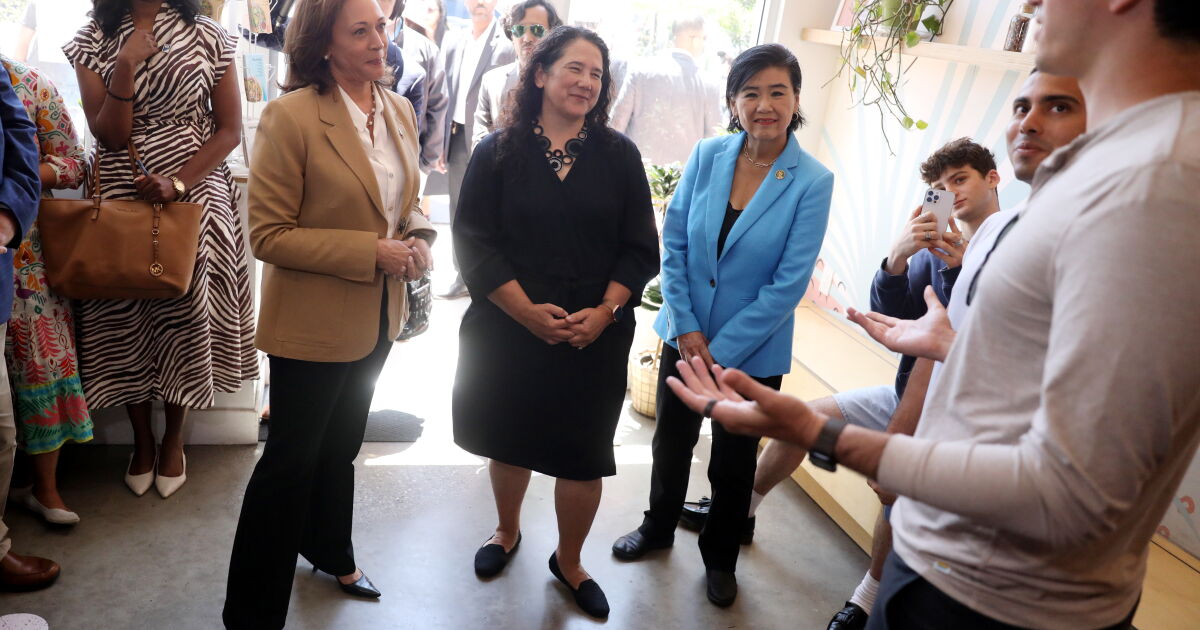
In a visit to salad restaurant Alfalfa on Santa Monica’s Main Street, Harris, alongside Small Business Administration head Isabella Casillas Guzman and Rep. Judy Chu (D-Monterey Park), touted the White House’s moves to fortify the Community Advantage Program, an Obama-era lending program aimed at helping entrepreneurs struggling to secure capital for their businesses.
Established in 2011, the Community Advantage Program was designed to increase loan access specifically for low-income, underserved business owners through mostly nonprofit, approved lenders. The program was extended into 2023 and expanded under the Biden administration, which boosted loan maximums to $350,000, up from $250,000, and provided a pathway for more financial institutions to become SBA lenders.
“The Community Advantage Program is about giving support and access to capital to small businesses like this,” said Harris. “We have so many small businesses that are doing great work, they are part of the community, they are leaders in the community, but they don’t necessarily have the access, or the relationships with the big banks, or the big banks don’t necessarily see the value in what some of these small businesses do.”
Alfalfa co-founders Andrew Arrospide and Daniel Londono opened their first location in 2019 in Hoboken, N.J. When they initially tried to secure the funding to bring their salad concept to the West Coast, banks and investors turned them down, the co-founders said. In 2021, Arrospide and Londono secured a Community Advantage loan, as well as a loan from the American Rescue Plan’s Revitalization Fund for their expansion.
“Being able to open our second store 3,000 miles away was really difficult, but it’s really because of the funding that we received when no bank would believe in us,” said Londono. “We are an example of how you can use these programs to really build a great business.”
The company now employs over 100 people and will be opening a new location in Larchmont this year.
Harris used the Santa Monica stop to pitch the Biden administration’s support of small businesses as part of the president’s overall campaign theme of bolstering the economy from the bottom up. Under the Community Advantage Program, Black business owners have received 23% of SBA Community Advantage funding compared to 4% of traditional SBA 7(a) loans, according to the SBA. Latino business owners have received 13% of Community Advantage loans compared to 10% of 7(a) loans. The program made 661 loans totaling $104 million in fiscal year 2022.
“The president and I feel very strongly about our approach to the economy. It has been called Bidenomics,” Harris said. “It’s about saying, ‘Look, we’re going to grow the economy from the middle out, we’re going to grow the economy from the bottom up, not the top down.’”
During the debt ceiling impasse in May, House Republicans pushed cuts in government spending that the Biden administration said would have slashed SBA and other small business assistance programs by 22%. In the final debt ceiling package that Biden signed, approximately $2 billion in unused COVID-19 relief funds was clawed back from the SBA, but the Community Advantage Program was untouched.

As President Biden leans into pitching voters on economic progress made under his watch ahead of the 2024 election, Vice President Kamala Harris is on a mission to highlight how small businesses have fared under “Bidenomics.”
In a visit to salad restaurant Alfalfa on Santa Monica’s Main Street, Harris, alongside Small Business Administration head Isabella Casillas Guzman and Rep. Judy Chu (D-Monterey Park), touted the White House’s moves to fortify the Community Advantage Program, an Obama-era lending program aimed at helping entrepreneurs struggling to secure capital for their businesses.
Established in 2011, the Community Advantage Program was designed to increase loan access specifically for low-income, underserved business owners through mostly nonprofit, approved lenders. The program was extended into 2023 and expanded under the Biden administration, which boosted loan maximums to $350,000, up from $250,000, and provided a pathway for more financial institutions to become SBA lenders.
“The Community Advantage Program is about giving support and access to capital to small businesses like this,” said Harris. “We have so many small businesses that are doing great work, they are part of the community, they are leaders in the community, but they don’t necessarily have the access, or the relationships with the big banks, or the big banks don’t necessarily see the value in what some of these small businesses do.”
Alfalfa co-founders Andrew Arrospide and Daniel Londono opened their first location in 2019 in Hoboken, N.J. When they initially tried to secure the funding to bring their salad concept to the West Coast, banks and investors turned them down, the co-founders said. In 2021, Arrospide and Londono secured a Community Advantage loan, as well as a loan from the American Rescue Plan’s Revitalization Fund for their expansion.
“Being able to open our second store 3,000 miles away was really difficult, but it’s really because of the funding that we received when no bank would believe in us,” said Londono. “We are an example of how you can use these programs to really build a great business.”
The company now employs over 100 people and will be opening a new location in Larchmont this year.
Harris used the Santa Monica stop to pitch the Biden administration’s support of small businesses as part of the president’s overall campaign theme of bolstering the economy from the bottom up. Under the Community Advantage Program, Black business owners have received 23% of SBA Community Advantage funding compared to 4% of traditional SBA 7(a) loans, according to the SBA. Latino business owners have received 13% of Community Advantage loans compared to 10% of 7(a) loans. The program made 661 loans totaling $104 million in fiscal year 2022.
“The president and I feel very strongly about our approach to the economy. It has been called Bidenomics,” Harris said. “It’s about saying, ‘Look, we’re going to grow the economy from the middle out, we’re going to grow the economy from the bottom up, not the top down.’”
During the debt ceiling impasse in May, House Republicans pushed cuts in government spending that the Biden administration said would have slashed SBA and other small business assistance programs by 22%. In the final debt ceiling package that Biden signed, approximately $2 billion in unused COVID-19 relief funds was clawed back from the SBA, but the Community Advantage Program was untouched.

As President Biden leans into pitching voters on economic progress made under his watch ahead of the 2024 election, Vice President Kamala Harris is on a mission to highlight how small businesses have fared under “Bidenomics.”
In a visit to salad restaurant Alfalfa on Santa Monica’s Main Street, Harris, alongside Small Business Administration head Isabella Casillas Guzman and Rep. Judy Chu (D-Monterey Park), touted the White House’s moves to fortify the Community Advantage Program, an Obama-era lending program aimed at helping entrepreneurs struggling to secure capital for their businesses.
Established in 2011, the Community Advantage Program was designed to increase loan access specifically for low-income, underserved business owners through mostly nonprofit, approved lenders. The program was extended into 2023 and expanded under the Biden administration, which boosted loan maximums to $350,000, up from $250,000, and provided a pathway for more financial institutions to become SBA lenders.
“The Community Advantage Program is about giving support and access to capital to small businesses like this,” said Harris. “We have so many small businesses that are doing great work, they are part of the community, they are leaders in the community, but they don’t necessarily have the access, or the relationships with the big banks, or the big banks don’t necessarily see the value in what some of these small businesses do.”
Alfalfa co-founders Andrew Arrospide and Daniel Londono opened their first location in 2019 in Hoboken, N.J. When they initially tried to secure the funding to bring their salad concept to the West Coast, banks and investors turned them down, the co-founders said. In 2021, Arrospide and Londono secured a Community Advantage loan, as well as a loan from the American Rescue Plan’s Revitalization Fund for their expansion.
“Being able to open our second store 3,000 miles away was really difficult, but it’s really because of the funding that we received when no bank would believe in us,” said Londono. “We are an example of how you can use these programs to really build a great business.”
The company now employs over 100 people and will be opening a new location in Larchmont this year.
Harris used the Santa Monica stop to pitch the Biden administration’s support of small businesses as part of the president’s overall campaign theme of bolstering the economy from the bottom up. Under the Community Advantage Program, Black business owners have received 23% of SBA Community Advantage funding compared to 4% of traditional SBA 7(a) loans, according to the SBA. Latino business owners have received 13% of Community Advantage loans compared to 10% of 7(a) loans. The program made 661 loans totaling $104 million in fiscal year 2022.
“The president and I feel very strongly about our approach to the economy. It has been called Bidenomics,” Harris said. “It’s about saying, ‘Look, we’re going to grow the economy from the middle out, we’re going to grow the economy from the bottom up, not the top down.’”
During the debt ceiling impasse in May, House Republicans pushed cuts in government spending that the Biden administration said would have slashed SBA and other small business assistance programs by 22%. In the final debt ceiling package that Biden signed, approximately $2 billion in unused COVID-19 relief funds was clawed back from the SBA, but the Community Advantage Program was untouched.
As President Biden leans into pitching voters on economic progress made under his watch ahead of the 2024 election, Vice President Kamala Harris is on a mission to highlight how small businesses have fared under “Bidenomics.”
In a visit to salad restaurant Alfalfa on Santa Monica’s Main Street, Harris, alongside Small Business Administration head Isabella Casillas Guzman and Rep. Judy Chu (D-Monterey Park), touted the White House’s moves to fortify the Community Advantage Program, an Obama-era lending program aimed at helping entrepreneurs struggling to secure capital for their businesses.
Established in 2011, the Community Advantage Program was designed to increase loan access specifically for low-income, underserved business owners through mostly nonprofit, approved lenders. The program was extended into 2023 and expanded under the Biden administration, which boosted loan maximums to $350,000, up from $250,000, and provided a pathway for more financial institutions to become SBA lenders.
“The Community Advantage Program is about giving support and access to capital to small businesses like this,” said Harris. “We have so many small businesses that are doing great work, they are part of the community, they are leaders in the community, but they don’t necessarily have the access, or the relationships with the big banks, or the big banks don’t necessarily see the value in what some of these small businesses do.”
Alfalfa co-founders Andrew Arrospide and Daniel Londono opened their first location in 2019 in Hoboken, N.J. When they initially tried to secure the funding to bring their salad concept to the West Coast, banks and investors turned them down, the co-founders said. In 2021, Arrospide and Londono secured a Community Advantage loan, as well as a loan from the American Rescue Plan’s Revitalization Fund for their expansion.
“Being able to open our second store 3,000 miles away was really difficult, but it’s really because of the funding that we received when no bank would believe in us,” said Londono. “We are an example of how you can use these programs to really build a great business.”
The company now employs over 100 people and will be opening a new location in Larchmont this year.
Harris used the Santa Monica stop to pitch the Biden administration’s support of small businesses as part of the president’s overall campaign theme of bolstering the economy from the bottom up. Under the Community Advantage Program, Black business owners have received 23% of SBA Community Advantage funding compared to 4% of traditional SBA 7(a) loans, according to the SBA. Latino business owners have received 13% of Community Advantage loans compared to 10% of 7(a) loans. The program made 661 loans totaling $104 million in fiscal year 2022.
“The president and I feel very strongly about our approach to the economy. It has been called Bidenomics,” Harris said. “It’s about saying, ‘Look, we’re going to grow the economy from the middle out, we’re going to grow the economy from the bottom up, not the top down.’”
During the debt ceiling impasse in May, House Republicans pushed cuts in government spending that the Biden administration said would have slashed SBA and other small business assistance programs by 22%. In the final debt ceiling package that Biden signed, approximately $2 billion in unused COVID-19 relief funds was clawed back from the SBA, but the Community Advantage Program was untouched.

As President Biden leans into pitching voters on economic progress made under his watch ahead of the 2024 election, Vice President Kamala Harris is on a mission to highlight how small businesses have fared under “Bidenomics.”
In a visit to salad restaurant Alfalfa on Santa Monica’s Main Street, Harris, alongside Small Business Administration head Isabella Casillas Guzman and Rep. Judy Chu (D-Monterey Park), touted the White House’s moves to fortify the Community Advantage Program, an Obama-era lending program aimed at helping entrepreneurs struggling to secure capital for their businesses.
Established in 2011, the Community Advantage Program was designed to increase loan access specifically for low-income, underserved business owners through mostly nonprofit, approved lenders. The program was extended into 2023 and expanded under the Biden administration, which boosted loan maximums to $350,000, up from $250,000, and provided a pathway for more financial institutions to become SBA lenders.
“The Community Advantage Program is about giving support and access to capital to small businesses like this,” said Harris. “We have so many small businesses that are doing great work, they are part of the community, they are leaders in the community, but they don’t necessarily have the access, or the relationships with the big banks, or the big banks don’t necessarily see the value in what some of these small businesses do.”
Alfalfa co-founders Andrew Arrospide and Daniel Londono opened their first location in 2019 in Hoboken, N.J. When they initially tried to secure the funding to bring their salad concept to the West Coast, banks and investors turned them down, the co-founders said. In 2021, Arrospide and Londono secured a Community Advantage loan, as well as a loan from the American Rescue Plan’s Revitalization Fund for their expansion.
“Being able to open our second store 3,000 miles away was really difficult, but it’s really because of the funding that we received when no bank would believe in us,” said Londono. “We are an example of how you can use these programs to really build a great business.”
The company now employs over 100 people and will be opening a new location in Larchmont this year.
Harris used the Santa Monica stop to pitch the Biden administration’s support of small businesses as part of the president’s overall campaign theme of bolstering the economy from the bottom up. Under the Community Advantage Program, Black business owners have received 23% of SBA Community Advantage funding compared to 4% of traditional SBA 7(a) loans, according to the SBA. Latino business owners have received 13% of Community Advantage loans compared to 10% of 7(a) loans. The program made 661 loans totaling $104 million in fiscal year 2022.
“The president and I feel very strongly about our approach to the economy. It has been called Bidenomics,” Harris said. “It’s about saying, ‘Look, we’re going to grow the economy from the middle out, we’re going to grow the economy from the bottom up, not the top down.’”
During the debt ceiling impasse in May, House Republicans pushed cuts in government spending that the Biden administration said would have slashed SBA and other small business assistance programs by 22%. In the final debt ceiling package that Biden signed, approximately $2 billion in unused COVID-19 relief funds was clawed back from the SBA, but the Community Advantage Program was untouched.
As President Biden leans into pitching voters on economic progress made under his watch ahead of the 2024 election, Vice President Kamala Harris is on a mission to highlight how small businesses have fared under “Bidenomics.”
In a visit to salad restaurant Alfalfa on Santa Monica’s Main Street, Harris, alongside Small Business Administration head Isabella Casillas Guzman and Rep. Judy Chu (D-Monterey Park), touted the White House’s moves to fortify the Community Advantage Program, an Obama-era lending program aimed at helping entrepreneurs struggling to secure capital for their businesses.
Established in 2011, the Community Advantage Program was designed to increase loan access specifically for low-income, underserved business owners through mostly nonprofit, approved lenders. The program was extended into 2023 and expanded under the Biden administration, which boosted loan maximums to $350,000, up from $250,000, and provided a pathway for more financial institutions to become SBA lenders.
“The Community Advantage Program is about giving support and access to capital to small businesses like this,” said Harris. “We have so many small businesses that are doing great work, they are part of the community, they are leaders in the community, but they don’t necessarily have the access, or the relationships with the big banks, or the big banks don’t necessarily see the value in what some of these small businesses do.”
Alfalfa co-founders Andrew Arrospide and Daniel Londono opened their first location in 2019 in Hoboken, N.J. When they initially tried to secure the funding to bring their salad concept to the West Coast, banks and investors turned them down, the co-founders said. In 2021, Arrospide and Londono secured a Community Advantage loan, as well as a loan from the American Rescue Plan’s Revitalization Fund for their expansion.
“Being able to open our second store 3,000 miles away was really difficult, but it’s really because of the funding that we received when no bank would believe in us,” said Londono. “We are an example of how you can use these programs to really build a great business.”
The company now employs over 100 people and will be opening a new location in Larchmont this year.
Harris used the Santa Monica stop to pitch the Biden administration’s support of small businesses as part of the president’s overall campaign theme of bolstering the economy from the bottom up. Under the Community Advantage Program, Black business owners have received 23% of SBA Community Advantage funding compared to 4% of traditional SBA 7(a) loans, according to the SBA. Latino business owners have received 13% of Community Advantage loans compared to 10% of 7(a) loans. The program made 661 loans totaling $104 million in fiscal year 2022.
“The president and I feel very strongly about our approach to the economy. It has been called Bidenomics,” Harris said. “It’s about saying, ‘Look, we’re going to grow the economy from the middle out, we’re going to grow the economy from the bottom up, not the top down.’”
During the debt ceiling impasse in May, House Republicans pushed cuts in government spending that the Biden administration said would have slashed SBA and other small business assistance programs by 22%. In the final debt ceiling package that Biden signed, approximately $2 billion in unused COVID-19 relief funds was clawed back from the SBA, but the Community Advantage Program was untouched.
As President Biden leans into pitching voters on economic progress made under his watch ahead of the 2024 election, Vice President Kamala Harris is on a mission to highlight how small businesses have fared under “Bidenomics.”
In a visit to salad restaurant Alfalfa on Santa Monica’s Main Street, Harris, alongside Small Business Administration head Isabella Casillas Guzman and Rep. Judy Chu (D-Monterey Park), touted the White House’s moves to fortify the Community Advantage Program, an Obama-era lending program aimed at helping entrepreneurs struggling to secure capital for their businesses.
Established in 2011, the Community Advantage Program was designed to increase loan access specifically for low-income, underserved business owners through mostly nonprofit, approved lenders. The program was extended into 2023 and expanded under the Biden administration, which boosted loan maximums to $350,000, up from $250,000, and provided a pathway for more financial institutions to become SBA lenders.
“The Community Advantage Program is about giving support and access to capital to small businesses like this,” said Harris. “We have so many small businesses that are doing great work, they are part of the community, they are leaders in the community, but they don’t necessarily have the access, or the relationships with the big banks, or the big banks don’t necessarily see the value in what some of these small businesses do.”
Alfalfa co-founders Andrew Arrospide and Daniel Londono opened their first location in 2019 in Hoboken, N.J. When they initially tried to secure the funding to bring their salad concept to the West Coast, banks and investors turned them down, the co-founders said. In 2021, Arrospide and Londono secured a Community Advantage loan, as well as a loan from the American Rescue Plan’s Revitalization Fund for their expansion.
“Being able to open our second store 3,000 miles away was really difficult, but it’s really because of the funding that we received when no bank would believe in us,” said Londono. “We are an example of how you can use these programs to really build a great business.”
The company now employs over 100 people and will be opening a new location in Larchmont this year.
Harris used the Santa Monica stop to pitch the Biden administration’s support of small businesses as part of the president’s overall campaign theme of bolstering the economy from the bottom up. Under the Community Advantage Program, Black business owners have received 23% of SBA Community Advantage funding compared to 4% of traditional SBA 7(a) loans, according to the SBA. Latino business owners have received 13% of Community Advantage loans compared to 10% of 7(a) loans. The program made 661 loans totaling $104 million in fiscal year 2022.
“The president and I feel very strongly about our approach to the economy. It has been called Bidenomics,” Harris said. “It’s about saying, ‘Look, we’re going to grow the economy from the middle out, we’re going to grow the economy from the bottom up, not the top down.’”
During the debt ceiling impasse in May, House Republicans pushed cuts in government spending that the Biden administration said would have slashed SBA and other small business assistance programs by 22%. In the final debt ceiling package that Biden signed, approximately $2 billion in unused COVID-19 relief funds was clawed back from the SBA, but the Community Advantage Program was untouched.
As President Biden leans into pitching voters on economic progress made under his watch ahead of the 2024 election, Vice President Kamala Harris is on a mission to highlight how small businesses have fared under “Bidenomics.”
In a visit to salad restaurant Alfalfa on Santa Monica’s Main Street, Harris, alongside Small Business Administration head Isabella Casillas Guzman and Rep. Judy Chu (D-Monterey Park), touted the White House’s moves to fortify the Community Advantage Program, an Obama-era lending program aimed at helping entrepreneurs struggling to secure capital for their businesses.
Established in 2011, the Community Advantage Program was designed to increase loan access specifically for low-income, underserved business owners through mostly nonprofit, approved lenders. The program was extended into 2023 and expanded under the Biden administration, which boosted loan maximums to $350,000, up from $250,000, and provided a pathway for more financial institutions to become SBA lenders.
“The Community Advantage Program is about giving support and access to capital to small businesses like this,” said Harris. “We have so many small businesses that are doing great work, they are part of the community, they are leaders in the community, but they don’t necessarily have the access, or the relationships with the big banks, or the big banks don’t necessarily see the value in what some of these small businesses do.”
Alfalfa co-founders Andrew Arrospide and Daniel Londono opened their first location in 2019 in Hoboken, N.J. When they initially tried to secure the funding to bring their salad concept to the West Coast, banks and investors turned them down, the co-founders said. In 2021, Arrospide and Londono secured a Community Advantage loan, as well as a loan from the American Rescue Plan’s Revitalization Fund for their expansion.
“Being able to open our second store 3,000 miles away was really difficult, but it’s really because of the funding that we received when no bank would believe in us,” said Londono. “We are an example of how you can use these programs to really build a great business.”
The company now employs over 100 people and will be opening a new location in Larchmont this year.
Harris used the Santa Monica stop to pitch the Biden administration’s support of small businesses as part of the president’s overall campaign theme of bolstering the economy from the bottom up. Under the Community Advantage Program, Black business owners have received 23% of SBA Community Advantage funding compared to 4% of traditional SBA 7(a) loans, according to the SBA. Latino business owners have received 13% of Community Advantage loans compared to 10% of 7(a) loans. The program made 661 loans totaling $104 million in fiscal year 2022.
“The president and I feel very strongly about our approach to the economy. It has been called Bidenomics,” Harris said. “It’s about saying, ‘Look, we’re going to grow the economy from the middle out, we’re going to grow the economy from the bottom up, not the top down.’”
During the debt ceiling impasse in May, House Republicans pushed cuts in government spending that the Biden administration said would have slashed SBA and other small business assistance programs by 22%. In the final debt ceiling package that Biden signed, approximately $2 billion in unused COVID-19 relief funds was clawed back from the SBA, but the Community Advantage Program was untouched.

As President Biden leans into pitching voters on economic progress made under his watch ahead of the 2024 election, Vice President Kamala Harris is on a mission to highlight how small businesses have fared under “Bidenomics.”
In a visit to salad restaurant Alfalfa on Santa Monica’s Main Street, Harris, alongside Small Business Administration head Isabella Casillas Guzman and Rep. Judy Chu (D-Monterey Park), touted the White House’s moves to fortify the Community Advantage Program, an Obama-era lending program aimed at helping entrepreneurs struggling to secure capital for their businesses.
Established in 2011, the Community Advantage Program was designed to increase loan access specifically for low-income, underserved business owners through mostly nonprofit, approved lenders. The program was extended into 2023 and expanded under the Biden administration, which boosted loan maximums to $350,000, up from $250,000, and provided a pathway for more financial institutions to become SBA lenders.
“The Community Advantage Program is about giving support and access to capital to small businesses like this,” said Harris. “We have so many small businesses that are doing great work, they are part of the community, they are leaders in the community, but they don’t necessarily have the access, or the relationships with the big banks, or the big banks don’t necessarily see the value in what some of these small businesses do.”
Alfalfa co-founders Andrew Arrospide and Daniel Londono opened their first location in 2019 in Hoboken, N.J. When they initially tried to secure the funding to bring their salad concept to the West Coast, banks and investors turned them down, the co-founders said. In 2021, Arrospide and Londono secured a Community Advantage loan, as well as a loan from the American Rescue Plan’s Revitalization Fund for their expansion.
“Being able to open our second store 3,000 miles away was really difficult, but it’s really because of the funding that we received when no bank would believe in us,” said Londono. “We are an example of how you can use these programs to really build a great business.”
The company now employs over 100 people and will be opening a new location in Larchmont this year.
Harris used the Santa Monica stop to pitch the Biden administration’s support of small businesses as part of the president’s overall campaign theme of bolstering the economy from the bottom up. Under the Community Advantage Program, Black business owners have received 23% of SBA Community Advantage funding compared to 4% of traditional SBA 7(a) loans, according to the SBA. Latino business owners have received 13% of Community Advantage loans compared to 10% of 7(a) loans. The program made 661 loans totaling $104 million in fiscal year 2022.
“The president and I feel very strongly about our approach to the economy. It has been called Bidenomics,” Harris said. “It’s about saying, ‘Look, we’re going to grow the economy from the middle out, we’re going to grow the economy from the bottom up, not the top down.’”
During the debt ceiling impasse in May, House Republicans pushed cuts in government spending that the Biden administration said would have slashed SBA and other small business assistance programs by 22%. In the final debt ceiling package that Biden signed, approximately $2 billion in unused COVID-19 relief funds was clawed back from the SBA, but the Community Advantage Program was untouched.
As President Biden leans into pitching voters on economic progress made under his watch ahead of the 2024 election, Vice President Kamala Harris is on a mission to highlight how small businesses have fared under “Bidenomics.”
In a visit to salad restaurant Alfalfa on Santa Monica’s Main Street, Harris, alongside Small Business Administration head Isabella Casillas Guzman and Rep. Judy Chu (D-Monterey Park), touted the White House’s moves to fortify the Community Advantage Program, an Obama-era lending program aimed at helping entrepreneurs struggling to secure capital for their businesses.
Established in 2011, the Community Advantage Program was designed to increase loan access specifically for low-income, underserved business owners through mostly nonprofit, approved lenders. The program was extended into 2023 and expanded under the Biden administration, which boosted loan maximums to $350,000, up from $250,000, and provided a pathway for more financial institutions to become SBA lenders.
“The Community Advantage Program is about giving support and access to capital to small businesses like this,” said Harris. “We have so many small businesses that are doing great work, they are part of the community, they are leaders in the community, but they don’t necessarily have the access, or the relationships with the big banks, or the big banks don’t necessarily see the value in what some of these small businesses do.”
Alfalfa co-founders Andrew Arrospide and Daniel Londono opened their first location in 2019 in Hoboken, N.J. When they initially tried to secure the funding to bring their salad concept to the West Coast, banks and investors turned them down, the co-founders said. In 2021, Arrospide and Londono secured a Community Advantage loan, as well as a loan from the American Rescue Plan’s Revitalization Fund for their expansion.
“Being able to open our second store 3,000 miles away was really difficult, but it’s really because of the funding that we received when no bank would believe in us,” said Londono. “We are an example of how you can use these programs to really build a great business.”
The company now employs over 100 people and will be opening a new location in Larchmont this year.
Harris used the Santa Monica stop to pitch the Biden administration’s support of small businesses as part of the president’s overall campaign theme of bolstering the economy from the bottom up. Under the Community Advantage Program, Black business owners have received 23% of SBA Community Advantage funding compared to 4% of traditional SBA 7(a) loans, according to the SBA. Latino business owners have received 13% of Community Advantage loans compared to 10% of 7(a) loans. The program made 661 loans totaling $104 million in fiscal year 2022.
“The president and I feel very strongly about our approach to the economy. It has been called Bidenomics,” Harris said. “It’s about saying, ‘Look, we’re going to grow the economy from the middle out, we’re going to grow the economy from the bottom up, not the top down.’”
During the debt ceiling impasse in May, House Republicans pushed cuts in government spending that the Biden administration said would have slashed SBA and other small business assistance programs by 22%. In the final debt ceiling package that Biden signed, approximately $2 billion in unused COVID-19 relief funds was clawed back from the SBA, but the Community Advantage Program was untouched.
As President Biden leans into pitching voters on economic progress made under his watch ahead of the 2024 election, Vice President Kamala Harris is on a mission to highlight how small businesses have fared under “Bidenomics.”
In a visit to salad restaurant Alfalfa on Santa Monica’s Main Street, Harris, alongside Small Business Administration head Isabella Casillas Guzman and Rep. Judy Chu (D-Monterey Park), touted the White House’s moves to fortify the Community Advantage Program, an Obama-era lending program aimed at helping entrepreneurs struggling to secure capital for their businesses.
Established in 2011, the Community Advantage Program was designed to increase loan access specifically for low-income, underserved business owners through mostly nonprofit, approved lenders. The program was extended into 2023 and expanded under the Biden administration, which boosted loan maximums to $350,000, up from $250,000, and provided a pathway for more financial institutions to become SBA lenders.
“The Community Advantage Program is about giving support and access to capital to small businesses like this,” said Harris. “We have so many small businesses that are doing great work, they are part of the community, they are leaders in the community, but they don’t necessarily have the access, or the relationships with the big banks, or the big banks don’t necessarily see the value in what some of these small businesses do.”
Alfalfa co-founders Andrew Arrospide and Daniel Londono opened their first location in 2019 in Hoboken, N.J. When they initially tried to secure the funding to bring their salad concept to the West Coast, banks and investors turned them down, the co-founders said. In 2021, Arrospide and Londono secured a Community Advantage loan, as well as a loan from the American Rescue Plan’s Revitalization Fund for their expansion.
“Being able to open our second store 3,000 miles away was really difficult, but it’s really because of the funding that we received when no bank would believe in us,” said Londono. “We are an example of how you can use these programs to really build a great business.”
The company now employs over 100 people and will be opening a new location in Larchmont this year.
Harris used the Santa Monica stop to pitch the Biden administration’s support of small businesses as part of the president’s overall campaign theme of bolstering the economy from the bottom up. Under the Community Advantage Program, Black business owners have received 23% of SBA Community Advantage funding compared to 4% of traditional SBA 7(a) loans, according to the SBA. Latino business owners have received 13% of Community Advantage loans compared to 10% of 7(a) loans. The program made 661 loans totaling $104 million in fiscal year 2022.
“The president and I feel very strongly about our approach to the economy. It has been called Bidenomics,” Harris said. “It’s about saying, ‘Look, we’re going to grow the economy from the middle out, we’re going to grow the economy from the bottom up, not the top down.’”
During the debt ceiling impasse in May, House Republicans pushed cuts in government spending that the Biden administration said would have slashed SBA and other small business assistance programs by 22%. In the final debt ceiling package that Biden signed, approximately $2 billion in unused COVID-19 relief funds was clawed back from the SBA, but the Community Advantage Program was untouched.
As President Biden leans into pitching voters on economic progress made under his watch ahead of the 2024 election, Vice President Kamala Harris is on a mission to highlight how small businesses have fared under “Bidenomics.”
In a visit to salad restaurant Alfalfa on Santa Monica’s Main Street, Harris, alongside Small Business Administration head Isabella Casillas Guzman and Rep. Judy Chu (D-Monterey Park), touted the White House’s moves to fortify the Community Advantage Program, an Obama-era lending program aimed at helping entrepreneurs struggling to secure capital for their businesses.
Established in 2011, the Community Advantage Program was designed to increase loan access specifically for low-income, underserved business owners through mostly nonprofit, approved lenders. The program was extended into 2023 and expanded under the Biden administration, which boosted loan maximums to $350,000, up from $250,000, and provided a pathway for more financial institutions to become SBA lenders.
“The Community Advantage Program is about giving support and access to capital to small businesses like this,” said Harris. “We have so many small businesses that are doing great work, they are part of the community, they are leaders in the community, but they don’t necessarily have the access, or the relationships with the big banks, or the big banks don’t necessarily see the value in what some of these small businesses do.”
Alfalfa co-founders Andrew Arrospide and Daniel Londono opened their first location in 2019 in Hoboken, N.J. When they initially tried to secure the funding to bring their salad concept to the West Coast, banks and investors turned them down, the co-founders said. In 2021, Arrospide and Londono secured a Community Advantage loan, as well as a loan from the American Rescue Plan’s Revitalization Fund for their expansion.
“Being able to open our second store 3,000 miles away was really difficult, but it’s really because of the funding that we received when no bank would believe in us,” said Londono. “We are an example of how you can use these programs to really build a great business.”
The company now employs over 100 people and will be opening a new location in Larchmont this year.
Harris used the Santa Monica stop to pitch the Biden administration’s support of small businesses as part of the president’s overall campaign theme of bolstering the economy from the bottom up. Under the Community Advantage Program, Black business owners have received 23% of SBA Community Advantage funding compared to 4% of traditional SBA 7(a) loans, according to the SBA. Latino business owners have received 13% of Community Advantage loans compared to 10% of 7(a) loans. The program made 661 loans totaling $104 million in fiscal year 2022.
“The president and I feel very strongly about our approach to the economy. It has been called Bidenomics,” Harris said. “It’s about saying, ‘Look, we’re going to grow the economy from the middle out, we’re going to grow the economy from the bottom up, not the top down.’”
During the debt ceiling impasse in May, House Republicans pushed cuts in government spending that the Biden administration said would have slashed SBA and other small business assistance programs by 22%. In the final debt ceiling package that Biden signed, approximately $2 billion in unused COVID-19 relief funds was clawed back from the SBA, but the Community Advantage Program was untouched.
As President Biden leans into pitching voters on economic progress made under his watch ahead of the 2024 election, Vice President Kamala Harris is on a mission to highlight how small businesses have fared under “Bidenomics.”
In a visit to salad restaurant Alfalfa on Santa Monica’s Main Street, Harris, alongside Small Business Administration head Isabella Casillas Guzman and Rep. Judy Chu (D-Monterey Park), touted the White House’s moves to fortify the Community Advantage Program, an Obama-era lending program aimed at helping entrepreneurs struggling to secure capital for their businesses.
Established in 2011, the Community Advantage Program was designed to increase loan access specifically for low-income, underserved business owners through mostly nonprofit, approved lenders. The program was extended into 2023 and expanded under the Biden administration, which boosted loan maximums to $350,000, up from $250,000, and provided a pathway for more financial institutions to become SBA lenders.
“The Community Advantage Program is about giving support and access to capital to small businesses like this,” said Harris. “We have so many small businesses that are doing great work, they are part of the community, they are leaders in the community, but they don’t necessarily have the access, or the relationships with the big banks, or the big banks don’t necessarily see the value in what some of these small businesses do.”
Alfalfa co-founders Andrew Arrospide and Daniel Londono opened their first location in 2019 in Hoboken, N.J. When they initially tried to secure the funding to bring their salad concept to the West Coast, banks and investors turned them down, the co-founders said. In 2021, Arrospide and Londono secured a Community Advantage loan, as well as a loan from the American Rescue Plan’s Revitalization Fund for their expansion.
“Being able to open our second store 3,000 miles away was really difficult, but it’s really because of the funding that we received when no bank would believe in us,” said Londono. “We are an example of how you can use these programs to really build a great business.”
The company now employs over 100 people and will be opening a new location in Larchmont this year.
Harris used the Santa Monica stop to pitch the Biden administration’s support of small businesses as part of the president’s overall campaign theme of bolstering the economy from the bottom up. Under the Community Advantage Program, Black business owners have received 23% of SBA Community Advantage funding compared to 4% of traditional SBA 7(a) loans, according to the SBA. Latino business owners have received 13% of Community Advantage loans compared to 10% of 7(a) loans. The program made 661 loans totaling $104 million in fiscal year 2022.
“The president and I feel very strongly about our approach to the economy. It has been called Bidenomics,” Harris said. “It’s about saying, ‘Look, we’re going to grow the economy from the middle out, we’re going to grow the economy from the bottom up, not the top down.’”
During the debt ceiling impasse in May, House Republicans pushed cuts in government spending that the Biden administration said would have slashed SBA and other small business assistance programs by 22%. In the final debt ceiling package that Biden signed, approximately $2 billion in unused COVID-19 relief funds was clawed back from the SBA, but the Community Advantage Program was untouched.
As President Biden leans into pitching voters on economic progress made under his watch ahead of the 2024 election, Vice President Kamala Harris is on a mission to highlight how small businesses have fared under “Bidenomics.”
In a visit to salad restaurant Alfalfa on Santa Monica’s Main Street, Harris, alongside Small Business Administration head Isabella Casillas Guzman and Rep. Judy Chu (D-Monterey Park), touted the White House’s moves to fortify the Community Advantage Program, an Obama-era lending program aimed at helping entrepreneurs struggling to secure capital for their businesses.
Established in 2011, the Community Advantage Program was designed to increase loan access specifically for low-income, underserved business owners through mostly nonprofit, approved lenders. The program was extended into 2023 and expanded under the Biden administration, which boosted loan maximums to $350,000, up from $250,000, and provided a pathway for more financial institutions to become SBA lenders.
“The Community Advantage Program is about giving support and access to capital to small businesses like this,” said Harris. “We have so many small businesses that are doing great work, they are part of the community, they are leaders in the community, but they don’t necessarily have the access, or the relationships with the big banks, or the big banks don’t necessarily see the value in what some of these small businesses do.”
Alfalfa co-founders Andrew Arrospide and Daniel Londono opened their first location in 2019 in Hoboken, N.J. When they initially tried to secure the funding to bring their salad concept to the West Coast, banks and investors turned them down, the co-founders said. In 2021, Arrospide and Londono secured a Community Advantage loan, as well as a loan from the American Rescue Plan’s Revitalization Fund for their expansion.
“Being able to open our second store 3,000 miles away was really difficult, but it’s really because of the funding that we received when no bank would believe in us,” said Londono. “We are an example of how you can use these programs to really build a great business.”
The company now employs over 100 people and will be opening a new location in Larchmont this year.
Harris used the Santa Monica stop to pitch the Biden administration’s support of small businesses as part of the president’s overall campaign theme of bolstering the economy from the bottom up. Under the Community Advantage Program, Black business owners have received 23% of SBA Community Advantage funding compared to 4% of traditional SBA 7(a) loans, according to the SBA. Latino business owners have received 13% of Community Advantage loans compared to 10% of 7(a) loans. The program made 661 loans totaling $104 million in fiscal year 2022.
“The president and I feel very strongly about our approach to the economy. It has been called Bidenomics,” Harris said. “It’s about saying, ‘Look, we’re going to grow the economy from the middle out, we’re going to grow the economy from the bottom up, not the top down.’”
During the debt ceiling impasse in May, House Republicans pushed cuts in government spending that the Biden administration said would have slashed SBA and other small business assistance programs by 22%. In the final debt ceiling package that Biden signed, approximately $2 billion in unused COVID-19 relief funds was clawed back from the SBA, but the Community Advantage Program was untouched.
As President Biden leans into pitching voters on economic progress made under his watch ahead of the 2024 election, Vice President Kamala Harris is on a mission to highlight how small businesses have fared under “Bidenomics.”
In a visit to salad restaurant Alfalfa on Santa Monica’s Main Street, Harris, alongside Small Business Administration head Isabella Casillas Guzman and Rep. Judy Chu (D-Monterey Park), touted the White House’s moves to fortify the Community Advantage Program, an Obama-era lending program aimed at helping entrepreneurs struggling to secure capital for their businesses.
Established in 2011, the Community Advantage Program was designed to increase loan access specifically for low-income, underserved business owners through mostly nonprofit, approved lenders. The program was extended into 2023 and expanded under the Biden administration, which boosted loan maximums to $350,000, up from $250,000, and provided a pathway for more financial institutions to become SBA lenders.
“The Community Advantage Program is about giving support and access to capital to small businesses like this,” said Harris. “We have so many small businesses that are doing great work, they are part of the community, they are leaders in the community, but they don’t necessarily have the access, or the relationships with the big banks, or the big banks don’t necessarily see the value in what some of these small businesses do.”
Alfalfa co-founders Andrew Arrospide and Daniel Londono opened their first location in 2019 in Hoboken, N.J. When they initially tried to secure the funding to bring their salad concept to the West Coast, banks and investors turned them down, the co-founders said. In 2021, Arrospide and Londono secured a Community Advantage loan, as well as a loan from the American Rescue Plan’s Revitalization Fund for their expansion.
“Being able to open our second store 3,000 miles away was really difficult, but it’s really because of the funding that we received when no bank would believe in us,” said Londono. “We are an example of how you can use these programs to really build a great business.”
The company now employs over 100 people and will be opening a new location in Larchmont this year.
Harris used the Santa Monica stop to pitch the Biden administration’s support of small businesses as part of the president’s overall campaign theme of bolstering the economy from the bottom up. Under the Community Advantage Program, Black business owners have received 23% of SBA Community Advantage funding compared to 4% of traditional SBA 7(a) loans, according to the SBA. Latino business owners have received 13% of Community Advantage loans compared to 10% of 7(a) loans. The program made 661 loans totaling $104 million in fiscal year 2022.
“The president and I feel very strongly about our approach to the economy. It has been called Bidenomics,” Harris said. “It’s about saying, ‘Look, we’re going to grow the economy from the middle out, we’re going to grow the economy from the bottom up, not the top down.’”
During the debt ceiling impasse in May, House Republicans pushed cuts in government spending that the Biden administration said would have slashed SBA and other small business assistance programs by 22%. In the final debt ceiling package that Biden signed, approximately $2 billion in unused COVID-19 relief funds was clawed back from the SBA, but the Community Advantage Program was untouched.
As President Biden leans into pitching voters on economic progress made under his watch ahead of the 2024 election, Vice President Kamala Harris is on a mission to highlight how small businesses have fared under “Bidenomics.”
In a visit to salad restaurant Alfalfa on Santa Monica’s Main Street, Harris, alongside Small Business Administration head Isabella Casillas Guzman and Rep. Judy Chu (D-Monterey Park), touted the White House’s moves to fortify the Community Advantage Program, an Obama-era lending program aimed at helping entrepreneurs struggling to secure capital for their businesses.
Established in 2011, the Community Advantage Program was designed to increase loan access specifically for low-income, underserved business owners through mostly nonprofit, approved lenders. The program was extended into 2023 and expanded under the Biden administration, which boosted loan maximums to $350,000, up from $250,000, and provided a pathway for more financial institutions to become SBA lenders.
“The Community Advantage Program is about giving support and access to capital to small businesses like this,” said Harris. “We have so many small businesses that are doing great work, they are part of the community, they are leaders in the community, but they don’t necessarily have the access, or the relationships with the big banks, or the big banks don’t necessarily see the value in what some of these small businesses do.”
Alfalfa co-founders Andrew Arrospide and Daniel Londono opened their first location in 2019 in Hoboken, N.J. When they initially tried to secure the funding to bring their salad concept to the West Coast, banks and investors turned them down, the co-founders said. In 2021, Arrospide and Londono secured a Community Advantage loan, as well as a loan from the American Rescue Plan’s Revitalization Fund for their expansion.
“Being able to open our second store 3,000 miles away was really difficult, but it’s really because of the funding that we received when no bank would believe in us,” said Londono. “We are an example of how you can use these programs to really build a great business.”
The company now employs over 100 people and will be opening a new location in Larchmont this year.
Harris used the Santa Monica stop to pitch the Biden administration’s support of small businesses as part of the president’s overall campaign theme of bolstering the economy from the bottom up. Under the Community Advantage Program, Black business owners have received 23% of SBA Community Advantage funding compared to 4% of traditional SBA 7(a) loans, according to the SBA. Latino business owners have received 13% of Community Advantage loans compared to 10% of 7(a) loans. The program made 661 loans totaling $104 million in fiscal year 2022.
“The president and I feel very strongly about our approach to the economy. It has been called Bidenomics,” Harris said. “It’s about saying, ‘Look, we’re going to grow the economy from the middle out, we’re going to grow the economy from the bottom up, not the top down.’”
During the debt ceiling impasse in May, House Republicans pushed cuts in government spending that the Biden administration said would have slashed SBA and other small business assistance programs by 22%. In the final debt ceiling package that Biden signed, approximately $2 billion in unused COVID-19 relief funds was clawed back from the SBA, but the Community Advantage Program was untouched.

