

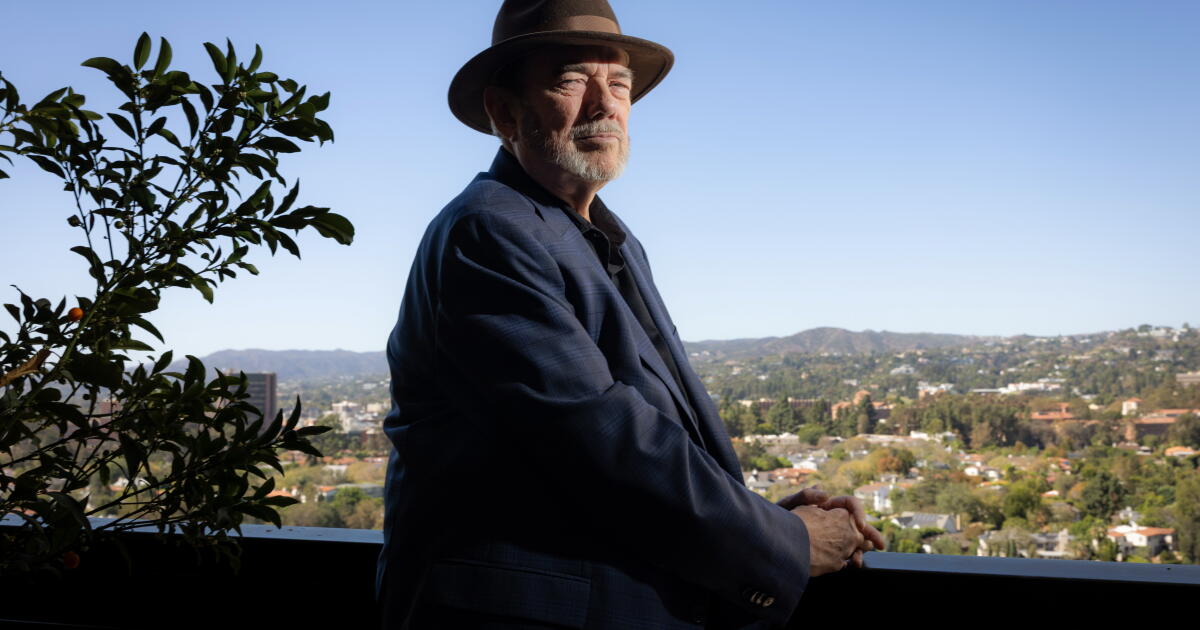


“By the way, can I get you something to drink?” Jimmy Webb asks, rising slowly from his chair. “Would you like to wet your whistle?” The 80-year-old songwriter and I have been talking for a while on a recent afternoon about some of the many, many renditions of his song “Wichita Lineman,” and as he rhapsodizes about the sexy-sinister version Flea and Nick Cave just released, Webb moseys over to the kitchen of his friend’s Westwood apartment and pulls an O’Doul’s out of the fridge to match his own.
“They found the dark side of the lineman, which I don’t think anybody else ever thought of,” he says, opening the beer with a well-worn pocketknife. “I was like, You brilliant motherf—.”
More than half a century after he won his first Grammy Award — he took song of the year in 1968 for writing the 5th Dimension’s swooning “Up, Up and Away” — Webb is in town from Long Island with his wife, Laura, for a couple of gigs he’s got booked at the Catalina Jazz Club.
He’s also spreading the word about a new album, “Yours for the Taking,” and a PBS special in which he looks back at some of his best-known songs, including “Wichita” and “By the Time I Get to Phoenix” (both made famous by Glen Campbell), “MacArthur Park” (a hit for both Richard Harris and Donna Summer) and “Highwayman” (which Johnny Cash, Waylon Jennings, Willie Nelson and Kris Kristofferson liked so much they named their supergroup after it).
“Yours for the Taking” collects 11 new recordings of tunes Webb wrote over the years for himself or for others but which never made it onto a record; it features appearances by Michael McDonald, Amy Grant and Graham Nash, the last of whom joins Webb for “Winter Clothes,” which the songwriter once pitched to Frank Sinatra.
So the album is basically songs that people said no to. Accurate?
Not inaccurate. But they weren’t all turn-downs. Every songwriter has a trunk, and the trunk is full of songs that got tossed out of the show or were passed over when they were submitted or may have just not been finished. Detritus accumulates like a wake behind a songwriter because songwriters are loath to continue to try to promote a piece of material that has any disappointment attached to it.
It’s like a stink.
And if you put it with the other songs, they may start smelling too. It’s keeping the good apples with the good apples.
Which means these are the bad apples.
Problem children, I’d say. I can illustrate it with an anecdote. I went to Mr. Sinatra regularly — every year or two, we might have a meeting.
Where would you meet?
Wherever — in his apartment at the Waldorf hotel, sometimes up on Mulholland Drive, where he had a house. The first time, I’d just come back from the Monterey Pop Festival, and I was in my hippie regalia. I showed up on his front porch on Mulholland with a paper sack — I carried my songs around in horrific fashion — and he came to the door in his silk Bergdorf Goodman dressing gown. He said, “What are you doing on my porch? You one of those Charlie Manson guys?” Then a little grin started breaking out at the corners of his mouth. He said, “Come on in, kid — I hope you got some good songs.”
Was Sinatra the ultimate get for a songwriter?
It was a rite of passage to play songs for him. He loved songwriters, and he loved to listen to songs — even the bad ones. This one particular time, I had a song I’d been working on called “Winter Clothes.” It was an end-of-relationship song, but in his sense I was overlaying the idea that this could be career-related in some way — he could be getting ready to cut his farewell album or something. So I pitched it even though I wished it was a little better.
Better in what way?
Fairly good first verse but then a weak verse that wasn’t quite as strong. It’s hard to explain: Sometimes there’s one word wrong but you don’t realize it until the dust settles 30 years later and you go, “I could have done this and it would’ve been perfect.”
What’s a Jimmy Webb classic where something sticks in your craw?
The end of “Wichita Lineman.” I didn’t notice it until I was working on my book “Tunesmith,” which purports to be a bible of songwriting.
Which would make you —
The maharishi of whatever. So I’m listening to the song in the car, and I get to the end of the last verse: “And I need you more than want you / And I want you for all time / And the Wichita lineman is still on the line.” It’s a false rhyme — a blatant false rhyme. And I just had a whole chapter of preaching about the evils of all these quasi-sinful things one can do when trying to rhyme.
I wanted to ask about your song “Campo de Encino.”
[Laughs.]
To me, this is one of the great songs about moneyed L.A. in the ’70s: “I want to drive a sporty car / And be a pinball star / And have a waterfall bar that revolves around my swimming pool / I want to take touch therapy / I want to wipe out VD / And set the animals free / But most of all, I want to soar away.”
OK, the primary reason I wrote that is because I had become a sailplane fanatic.
Real rich-guy hobby.
A sport too good for kings.
Did you just come up with that?
It’s in the vernacular. I used to take all the celebs for rides: David Crosby, Joni Mitchell, everybody. Paul Williams doesn’t know how close I came to killing him one day.
Where’d you keep your plane?
The Crystalaire airport out by Palmdale. Half the fun was driving out to the desert and getting drunk, spending the night in an RV and getting up with a hangover.
So how did that lead to a song about wanting to wipe out VD?
“But most of all, I want to soar away.”
Right.
I was living this very hedonistic lifestyle in a house that Phil Harris built for Alice Faye — beautiful terracotta hacienda on top of a hill with a kidney-shaped swimming pool and a stable and two wrought iron gates that I did my best to copy from the Rudolph Valentino estate because I didn’t think I would get away with stealing them, even though the thought crossed my mind and was encouraged by Harry Nilsson.
This was in the Encino hills.
Before that I lived in what had been the Philippine consulate near Grauman’s Chinese. But then we got out to the suburbs — a lot of people were moving to these nicer places. Even David Geffen moved into Johnny Rivers’ house. David called me one day and said, “I have this kid over here who can write his ass off — you ought to hear him sing.” So I went up there to Johnny’s house, which I’d lived in when I was signed to Johnny Rivers Music. We listened to “Sgt. Pepper” on acid in that house, and while we were listening, the house next door caught fire. The Fire Department came — we thought it was the acid.
Who did Geffen want to show you?
Jackson Browne. Jackson crossed his legs, sat down on the floor and played a song called “My Opening Farewell.” I thought: This kid is already where he wants to be, he just doesn’t know it yet. I can’t remember what the point of this story was, except that we had descended into the world of wretched excess.
Some people recognize that only in retrospect. You seem like a guy who knew it at the time.
I think “Campo de Encino” is an admission of guilt, in a way — a kind of mea culpa. It’s saying: Yeah, we’re drunk all the time and we’re doing all this s—, but we can’t help it. That was about the time cocaine hit as well.
Was that a vibe-changer?
Yes. I wrote songs like “Once in the Morning,” which I cut with the Supremes: “Once in the morning and once at night / I’m not sure that it will help you, but you think it’s all right / Once in the afternoon and once at twilight / Once for the money and again ’round midnight.” I like that lyric, actually — pretty good. It’s not just talking about cocaine — it’s about Sigmund Freud. Nobody got that at all.
Even your biggest hits have something of an enigmatic quality.
I’m thinking of Billy Joel at the Songwriters Hall of Fame as he was deconstructing “Wichita Lineman” — one of the best nights of my life. He goes, “‘Need you more than want you’? Sounds like a diss.”
You like Billy Joel?
I love him. He’s a kid from Levittown. Him and his motorcycles and his man-of-the-people thing, that’s for real. You walk down the street with him and there’s a bunch of ConEd guys digging a hole in the street — you think, “Uh-oh, these guys are gonna want him to sign their jackhammer.” He walks by and it’s just, “Yo, Billy!” He’s one of them.
Who do you consider among your surviving peers?
Well, some of them might not want to be my peers — I can think of one in particular. Tell you the truth, I’ve always been on fairly good terms with Paul Simon. But he’s a monolith: “The Sound of Silence,” “The Boxer,” “For Emily, Wherever I May Find Her.” This is a guy who incorporated poetic techniques into the songwriting experience and came up with a new folk music. Also Paul McCartney I find to be an absolute genius. There are times when I take issue with some of the personal aspects of our relationship — I’ll just leave it at that. He’s Paul McCartney, and he knows he’s Paul McCartney, which must be very difficult. I also rate Randy Newman very, very highly.
Who’s overrated?
Oh my God, I’d love to tell you, but Laura won’t let me.
Best interpreter of your work?
I’d have to say Glen was the guy — there was just a natural fit. I heard my first Glen Campbell song when I was 14 years old. He recorded a song by a guy named Jerry Capehart called “Turn Around, Look at Me.” I was a kid driving a tractor, listening to a transistor radio hanging from my umbrella, and I said, “That’s the guy I want to write songs for.”
Do you think your connection was due to your similar backgrounds — you in Oklahoma, Glen in Arkansas?
Had to be. But Glen was no country bumpkin. I played a record for him over at my house one day by Allen Toussaint called “Southern Nights” — totally out there, like “Sgt. Pepper.” He said, “Can I have it?” He went over and took the needle off, put the vinyl in the sleeve and said, “I gotta go.” It was like Wile E. Coyote. And he went and turned that thing into a No. 1 record.
I saw Glen’s farewell tour at the Hollywood Bowl. Pretty tough emotionally.
It was more than tough. I remember we were playing a gig up north for Lexus or somebody — it was a lot of money, and the guy said, “We just want you guys to play those hits that everybody knows and loves.” Well, we could do that — nothing hard about that. We went out there and started playing, and about halfway through “By the Time I Get to Phoenix,” Glen forgot the lyrics — forgot whether he was in Albuquerque or Flagstaff or wherever. I thought: There’s something wrong. Another time we were playing somewhere in Indiana. They’re giving us a hell of an ovation, and we’re standing between the two fly curtains. I said, “Glen, I think we need to do an encore.” He stood there for a second and he looked at me funny — got this thousand-yard stare. He said, “Did you write ‘Wichita Lineman’?” That was the week they said he had Alzheimer’s.
We talked earlier about Sinatra. Where does Barbra Streisand rank for a songwriter looking to get his songs cut?
I think that most of my colleagues living and no longer living would agree that she was the greatest singer that ever came down the pike.
OK.
She had pipes that had pipes. She recorded one of my first songs, “Little Tin Soldier” — early piece of anti-Vietnam music. She did a beautiful job on “Didn’t We.” Then we hit a rough patch. She was one of the hardest — well, she’s not gone, so I’ll put it in the present tense — she is one of the hardest artists to pitch a song to. Maybe the hardest.
Why?
I don’t know why. You throw your best s— against the wall — I can’t do Barbra Streisand any better than this — then you send it over, and you don’t hear anything. I wrote what I thought was the most epic love paean of all time called “Love Lasts Forever.” Nice title, right? Eight girlfriends later, you still love her — that’s the concept. But she wouldn’t touch it. I used to wait two or three years for her to forget that she’d heard it, then I’d pitch it to her again. Never worked.
Streisand’s greatest vocal performance — what springs to mind?
It doesn’t spring to mind, it breaks my heart: “People.” I’m getting chills thinking about it. There are people out there who don’t understand that song — I’ve talked to them, and they say, “What’s ‘People’ about?” I’m thinking: If you don’t know what “People” is about, then you’re not one of the luckiest people in the world.
Thanks for your time.
You’re welcome. I love being back in L.A., though it gets me down a little bit — not depressed but melancholy in an autumn-of-my-years type of way. I’ll tell you a story: One night Harry Nilsson and I were working at RCA Studios, if you want to call it working — we were in there all night cutting with this Jamaican steel band and Van Dyke Parks. Eventually, we both stagger out of there. I don’t know what had been consumed — it defies pharmacological possibility. But we walk up the sidewalk to Sunset Boulevard, and I said, “Where’s your car?” Harry said, “I don’t have a car. Where’s your car?” Well, I didn’t have a car. So neither of us knew what the f— to do. We both sat down on the curb — we’re pondering how we’ve got ourselves into this impossible situation when a limo pulls up to the light. Window rolls down, beautiful lady looks out — it’s Linda Ronstadt: “Good morning, guys — how we doing?” We say, “Oh, thank God! You can take us where we’re going.” She says, “Bull—,” rolls up the window and drives away.

“By the way, can I get you something to drink?” Jimmy Webb asks, rising slowly from his chair. “Would you like to wet your whistle?” The 80-year-old songwriter and I have been talking for a while on a recent afternoon about some of the many, many renditions of his song “Wichita Lineman,” and as he rhapsodizes about the sexy-sinister version Flea and Nick Cave just released, Webb moseys over to the kitchen of his friend’s Westwood apartment and pulls an O’Doul’s out of the fridge to match his own.
“They found the dark side of the lineman, which I don’t think anybody else ever thought of,” he says, opening the beer with a well-worn pocketknife. “I was like, You brilliant motherf—.”
More than half a century after he won his first Grammy Award — he took song of the year in 1968 for writing the 5th Dimension’s swooning “Up, Up and Away” — Webb is in town from Long Island with his wife, Laura, for a couple of gigs he’s got booked at the Catalina Jazz Club.
He’s also spreading the word about a new album, “Yours for the Taking,” and a PBS special in which he looks back at some of his best-known songs, including “Wichita” and “By the Time I Get to Phoenix” (both made famous by Glen Campbell), “MacArthur Park” (a hit for both Richard Harris and Donna Summer) and “Highwayman” (which Johnny Cash, Waylon Jennings, Willie Nelson and Kris Kristofferson liked so much they named their supergroup after it).
“Yours for the Taking” collects 11 new recordings of tunes Webb wrote over the years for himself or for others but which never made it onto a record; it features appearances by Michael McDonald, Amy Grant and Graham Nash, the last of whom joins Webb for “Winter Clothes,” which the songwriter once pitched to Frank Sinatra.
So the album is basically songs that people said no to. Accurate?
Not inaccurate. But they weren’t all turn-downs. Every songwriter has a trunk, and the trunk is full of songs that got tossed out of the show or were passed over when they were submitted or may have just not been finished. Detritus accumulates like a wake behind a songwriter because songwriters are loath to continue to try to promote a piece of material that has any disappointment attached to it.
It’s like a stink.
And if you put it with the other songs, they may start smelling too. It’s keeping the good apples with the good apples.
Which means these are the bad apples.
Problem children, I’d say. I can illustrate it with an anecdote. I went to Mr. Sinatra regularly — every year or two, we might have a meeting.
Where would you meet?
Wherever — in his apartment at the Waldorf hotel, sometimes up on Mulholland Drive, where he had a house. The first time, I’d just come back from the Monterey Pop Festival, and I was in my hippie regalia. I showed up on his front porch on Mulholland with a paper sack — I carried my songs around in horrific fashion — and he came to the door in his silk Bergdorf Goodman dressing gown. He said, “What are you doing on my porch? You one of those Charlie Manson guys?” Then a little grin started breaking out at the corners of his mouth. He said, “Come on in, kid — I hope you got some good songs.”
Was Sinatra the ultimate get for a songwriter?
It was a rite of passage to play songs for him. He loved songwriters, and he loved to listen to songs — even the bad ones. This one particular time, I had a song I’d been working on called “Winter Clothes.” It was an end-of-relationship song, but in his sense I was overlaying the idea that this could be career-related in some way — he could be getting ready to cut his farewell album or something. So I pitched it even though I wished it was a little better.
Better in what way?
Fairly good first verse but then a weak verse that wasn’t quite as strong. It’s hard to explain: Sometimes there’s one word wrong but you don’t realize it until the dust settles 30 years later and you go, “I could have done this and it would’ve been perfect.”
What’s a Jimmy Webb classic where something sticks in your craw?
The end of “Wichita Lineman.” I didn’t notice it until I was working on my book “Tunesmith,” which purports to be a bible of songwriting.
Which would make you —
The maharishi of whatever. So I’m listening to the song in the car, and I get to the end of the last verse: “And I need you more than want you / And I want you for all time / And the Wichita lineman is still on the line.” It’s a false rhyme — a blatant false rhyme. And I just had a whole chapter of preaching about the evils of all these quasi-sinful things one can do when trying to rhyme.
I wanted to ask about your song “Campo de Encino.”
[Laughs.]
To me, this is one of the great songs about moneyed L.A. in the ’70s: “I want to drive a sporty car / And be a pinball star / And have a waterfall bar that revolves around my swimming pool / I want to take touch therapy / I want to wipe out VD / And set the animals free / But most of all, I want to soar away.”
OK, the primary reason I wrote that is because I had become a sailplane fanatic.
Real rich-guy hobby.
A sport too good for kings.
Did you just come up with that?
It’s in the vernacular. I used to take all the celebs for rides: David Crosby, Joni Mitchell, everybody. Paul Williams doesn’t know how close I came to killing him one day.
Where’d you keep your plane?
The Crystalaire airport out by Palmdale. Half the fun was driving out to the desert and getting drunk, spending the night in an RV and getting up with a hangover.
So how did that lead to a song about wanting to wipe out VD?
“But most of all, I want to soar away.”
Right.
I was living this very hedonistic lifestyle in a house that Phil Harris built for Alice Faye — beautiful terracotta hacienda on top of a hill with a kidney-shaped swimming pool and a stable and two wrought iron gates that I did my best to copy from the Rudolph Valentino estate because I didn’t think I would get away with stealing them, even though the thought crossed my mind and was encouraged by Harry Nilsson.
This was in the Encino hills.
Before that I lived in what had been the Philippine consulate near Grauman’s Chinese. But then we got out to the suburbs — a lot of people were moving to these nicer places. Even David Geffen moved into Johnny Rivers’ house. David called me one day and said, “I have this kid over here who can write his ass off — you ought to hear him sing.” So I went up there to Johnny’s house, which I’d lived in when I was signed to Johnny Rivers Music. We listened to “Sgt. Pepper” on acid in that house, and while we were listening, the house next door caught fire. The Fire Department came — we thought it was the acid.
Who did Geffen want to show you?
Jackson Browne. Jackson crossed his legs, sat down on the floor and played a song called “My Opening Farewell.” I thought: This kid is already where he wants to be, he just doesn’t know it yet. I can’t remember what the point of this story was, except that we had descended into the world of wretched excess.
Some people recognize that only in retrospect. You seem like a guy who knew it at the time.
I think “Campo de Encino” is an admission of guilt, in a way — a kind of mea culpa. It’s saying: Yeah, we’re drunk all the time and we’re doing all this s—, but we can’t help it. That was about the time cocaine hit as well.
Was that a vibe-changer?
Yes. I wrote songs like “Once in the Morning,” which I cut with the Supremes: “Once in the morning and once at night / I’m not sure that it will help you, but you think it’s all right / Once in the afternoon and once at twilight / Once for the money and again ’round midnight.” I like that lyric, actually — pretty good. It’s not just talking about cocaine — it’s about Sigmund Freud. Nobody got that at all.
Even your biggest hits have something of an enigmatic quality.
I’m thinking of Billy Joel at the Songwriters Hall of Fame as he was deconstructing “Wichita Lineman” — one of the best nights of my life. He goes, “‘Need you more than want you’? Sounds like a diss.”
You like Billy Joel?
I love him. He’s a kid from Levittown. Him and his motorcycles and his man-of-the-people thing, that’s for real. You walk down the street with him and there’s a bunch of ConEd guys digging a hole in the street — you think, “Uh-oh, these guys are gonna want him to sign their jackhammer.” He walks by and it’s just, “Yo, Billy!” He’s one of them.
Who do you consider among your surviving peers?
Well, some of them might not want to be my peers — I can think of one in particular. Tell you the truth, I’ve always been on fairly good terms with Paul Simon. But he’s a monolith: “The Sound of Silence,” “The Boxer,” “For Emily, Wherever I May Find Her.” This is a guy who incorporated poetic techniques into the songwriting experience and came up with a new folk music. Also Paul McCartney I find to be an absolute genius. There are times when I take issue with some of the personal aspects of our relationship — I’ll just leave it at that. He’s Paul McCartney, and he knows he’s Paul McCartney, which must be very difficult. I also rate Randy Newman very, very highly.
Who’s overrated?
Oh my God, I’d love to tell you, but Laura won’t let me.
Best interpreter of your work?
I’d have to say Glen was the guy — there was just a natural fit. I heard my first Glen Campbell song when I was 14 years old. He recorded a song by a guy named Jerry Capehart called “Turn Around, Look at Me.” I was a kid driving a tractor, listening to a transistor radio hanging from my umbrella, and I said, “That’s the guy I want to write songs for.”
Do you think your connection was due to your similar backgrounds — you in Oklahoma, Glen in Arkansas?
Had to be. But Glen was no country bumpkin. I played a record for him over at my house one day by Allen Toussaint called “Southern Nights” — totally out there, like “Sgt. Pepper.” He said, “Can I have it?” He went over and took the needle off, put the vinyl in the sleeve and said, “I gotta go.” It was like Wile E. Coyote. And he went and turned that thing into a No. 1 record.
I saw Glen’s farewell tour at the Hollywood Bowl. Pretty tough emotionally.
It was more than tough. I remember we were playing a gig up north for Lexus or somebody — it was a lot of money, and the guy said, “We just want you guys to play those hits that everybody knows and loves.” Well, we could do that — nothing hard about that. We went out there and started playing, and about halfway through “By the Time I Get to Phoenix,” Glen forgot the lyrics — forgot whether he was in Albuquerque or Flagstaff or wherever. I thought: There’s something wrong. Another time we were playing somewhere in Indiana. They’re giving us a hell of an ovation, and we’re standing between the two fly curtains. I said, “Glen, I think we need to do an encore.” He stood there for a second and he looked at me funny — got this thousand-yard stare. He said, “Did you write ‘Wichita Lineman’?” That was the week they said he had Alzheimer’s.
We talked earlier about Sinatra. Where does Barbra Streisand rank for a songwriter looking to get his songs cut?
I think that most of my colleagues living and no longer living would agree that she was the greatest singer that ever came down the pike.
OK.
She had pipes that had pipes. She recorded one of my first songs, “Little Tin Soldier” — early piece of anti-Vietnam music. She did a beautiful job on “Didn’t We.” Then we hit a rough patch. She was one of the hardest — well, she’s not gone, so I’ll put it in the present tense — she is one of the hardest artists to pitch a song to. Maybe the hardest.
Why?
I don’t know why. You throw your best s— against the wall — I can’t do Barbra Streisand any better than this — then you send it over, and you don’t hear anything. I wrote what I thought was the most epic love paean of all time called “Love Lasts Forever.” Nice title, right? Eight girlfriends later, you still love her — that’s the concept. But she wouldn’t touch it. I used to wait two or three years for her to forget that she’d heard it, then I’d pitch it to her again. Never worked.
Streisand’s greatest vocal performance — what springs to mind?
It doesn’t spring to mind, it breaks my heart: “People.” I’m getting chills thinking about it. There are people out there who don’t understand that song — I’ve talked to them, and they say, “What’s ‘People’ about?” I’m thinking: If you don’t know what “People” is about, then you’re not one of the luckiest people in the world.
Thanks for your time.
You’re welcome. I love being back in L.A., though it gets me down a little bit — not depressed but melancholy in an autumn-of-my-years type of way. I’ll tell you a story: One night Harry Nilsson and I were working at RCA Studios, if you want to call it working — we were in there all night cutting with this Jamaican steel band and Van Dyke Parks. Eventually, we both stagger out of there. I don’t know what had been consumed — it defies pharmacological possibility. But we walk up the sidewalk to Sunset Boulevard, and I said, “Where’s your car?” Harry said, “I don’t have a car. Where’s your car?” Well, I didn’t have a car. So neither of us knew what the f— to do. We both sat down on the curb — we’re pondering how we’ve got ourselves into this impossible situation when a limo pulls up to the light. Window rolls down, beautiful lady looks out — it’s Linda Ronstadt: “Good morning, guys — how we doing?” We say, “Oh, thank God! You can take us where we’re going.” She says, “Bull—,” rolls up the window and drives away.

“By the way, can I get you something to drink?” Jimmy Webb asks, rising slowly from his chair. “Would you like to wet your whistle?” The 80-year-old songwriter and I have been talking for a while on a recent afternoon about some of the many, many renditions of his song “Wichita Lineman,” and as he rhapsodizes about the sexy-sinister version Flea and Nick Cave just released, Webb moseys over to the kitchen of his friend’s Westwood apartment and pulls an O’Doul’s out of the fridge to match his own.
“They found the dark side of the lineman, which I don’t think anybody else ever thought of,” he says, opening the beer with a well-worn pocketknife. “I was like, You brilliant motherf—.”
More than half a century after he won his first Grammy Award — he took song of the year in 1968 for writing the 5th Dimension’s swooning “Up, Up and Away” — Webb is in town from Long Island with his wife, Laura, for a couple of gigs he’s got booked at the Catalina Jazz Club.
He’s also spreading the word about a new album, “Yours for the Taking,” and a PBS special in which he looks back at some of his best-known songs, including “Wichita” and “By the Time I Get to Phoenix” (both made famous by Glen Campbell), “MacArthur Park” (a hit for both Richard Harris and Donna Summer) and “Highwayman” (which Johnny Cash, Waylon Jennings, Willie Nelson and Kris Kristofferson liked so much they named their supergroup after it).
“Yours for the Taking” collects 11 new recordings of tunes Webb wrote over the years for himself or for others but which never made it onto a record; it features appearances by Michael McDonald, Amy Grant and Graham Nash, the last of whom joins Webb for “Winter Clothes,” which the songwriter once pitched to Frank Sinatra.
So the album is basically songs that people said no to. Accurate?
Not inaccurate. But they weren’t all turn-downs. Every songwriter has a trunk, and the trunk is full of songs that got tossed out of the show or were passed over when they were submitted or may have just not been finished. Detritus accumulates like a wake behind a songwriter because songwriters are loath to continue to try to promote a piece of material that has any disappointment attached to it.
It’s like a stink.
And if you put it with the other songs, they may start smelling too. It’s keeping the good apples with the good apples.
Which means these are the bad apples.
Problem children, I’d say. I can illustrate it with an anecdote. I went to Mr. Sinatra regularly — every year or two, we might have a meeting.
Where would you meet?
Wherever — in his apartment at the Waldorf hotel, sometimes up on Mulholland Drive, where he had a house. The first time, I’d just come back from the Monterey Pop Festival, and I was in my hippie regalia. I showed up on his front porch on Mulholland with a paper sack — I carried my songs around in horrific fashion — and he came to the door in his silk Bergdorf Goodman dressing gown. He said, “What are you doing on my porch? You one of those Charlie Manson guys?” Then a little grin started breaking out at the corners of his mouth. He said, “Come on in, kid — I hope you got some good songs.”
Was Sinatra the ultimate get for a songwriter?
It was a rite of passage to play songs for him. He loved songwriters, and he loved to listen to songs — even the bad ones. This one particular time, I had a song I’d been working on called “Winter Clothes.” It was an end-of-relationship song, but in his sense I was overlaying the idea that this could be career-related in some way — he could be getting ready to cut his farewell album or something. So I pitched it even though I wished it was a little better.
Better in what way?
Fairly good first verse but then a weak verse that wasn’t quite as strong. It’s hard to explain: Sometimes there’s one word wrong but you don’t realize it until the dust settles 30 years later and you go, “I could have done this and it would’ve been perfect.”
What’s a Jimmy Webb classic where something sticks in your craw?
The end of “Wichita Lineman.” I didn’t notice it until I was working on my book “Tunesmith,” which purports to be a bible of songwriting.
Which would make you —
The maharishi of whatever. So I’m listening to the song in the car, and I get to the end of the last verse: “And I need you more than want you / And I want you for all time / And the Wichita lineman is still on the line.” It’s a false rhyme — a blatant false rhyme. And I just had a whole chapter of preaching about the evils of all these quasi-sinful things one can do when trying to rhyme.
I wanted to ask about your song “Campo de Encino.”
[Laughs.]
To me, this is one of the great songs about moneyed L.A. in the ’70s: “I want to drive a sporty car / And be a pinball star / And have a waterfall bar that revolves around my swimming pool / I want to take touch therapy / I want to wipe out VD / And set the animals free / But most of all, I want to soar away.”
OK, the primary reason I wrote that is because I had become a sailplane fanatic.
Real rich-guy hobby.
A sport too good for kings.
Did you just come up with that?
It’s in the vernacular. I used to take all the celebs for rides: David Crosby, Joni Mitchell, everybody. Paul Williams doesn’t know how close I came to killing him one day.
Where’d you keep your plane?
The Crystalaire airport out by Palmdale. Half the fun was driving out to the desert and getting drunk, spending the night in an RV and getting up with a hangover.
So how did that lead to a song about wanting to wipe out VD?
“But most of all, I want to soar away.”
Right.
I was living this very hedonistic lifestyle in a house that Phil Harris built for Alice Faye — beautiful terracotta hacienda on top of a hill with a kidney-shaped swimming pool and a stable and two wrought iron gates that I did my best to copy from the Rudolph Valentino estate because I didn’t think I would get away with stealing them, even though the thought crossed my mind and was encouraged by Harry Nilsson.
This was in the Encino hills.
Before that I lived in what had been the Philippine consulate near Grauman’s Chinese. But then we got out to the suburbs — a lot of people were moving to these nicer places. Even David Geffen moved into Johnny Rivers’ house. David called me one day and said, “I have this kid over here who can write his ass off — you ought to hear him sing.” So I went up there to Johnny’s house, which I’d lived in when I was signed to Johnny Rivers Music. We listened to “Sgt. Pepper” on acid in that house, and while we were listening, the house next door caught fire. The Fire Department came — we thought it was the acid.
Who did Geffen want to show you?
Jackson Browne. Jackson crossed his legs, sat down on the floor and played a song called “My Opening Farewell.” I thought: This kid is already where he wants to be, he just doesn’t know it yet. I can’t remember what the point of this story was, except that we had descended into the world of wretched excess.
Some people recognize that only in retrospect. You seem like a guy who knew it at the time.
I think “Campo de Encino” is an admission of guilt, in a way — a kind of mea culpa. It’s saying: Yeah, we’re drunk all the time and we’re doing all this s—, but we can’t help it. That was about the time cocaine hit as well.
Was that a vibe-changer?
Yes. I wrote songs like “Once in the Morning,” which I cut with the Supremes: “Once in the morning and once at night / I’m not sure that it will help you, but you think it’s all right / Once in the afternoon and once at twilight / Once for the money and again ’round midnight.” I like that lyric, actually — pretty good. It’s not just talking about cocaine — it’s about Sigmund Freud. Nobody got that at all.
Even your biggest hits have something of an enigmatic quality.
I’m thinking of Billy Joel at the Songwriters Hall of Fame as he was deconstructing “Wichita Lineman” — one of the best nights of my life. He goes, “‘Need you more than want you’? Sounds like a diss.”
You like Billy Joel?
I love him. He’s a kid from Levittown. Him and his motorcycles and his man-of-the-people thing, that’s for real. You walk down the street with him and there’s a bunch of ConEd guys digging a hole in the street — you think, “Uh-oh, these guys are gonna want him to sign their jackhammer.” He walks by and it’s just, “Yo, Billy!” He’s one of them.
Who do you consider among your surviving peers?
Well, some of them might not want to be my peers — I can think of one in particular. Tell you the truth, I’ve always been on fairly good terms with Paul Simon. But he’s a monolith: “The Sound of Silence,” “The Boxer,” “For Emily, Wherever I May Find Her.” This is a guy who incorporated poetic techniques into the songwriting experience and came up with a new folk music. Also Paul McCartney I find to be an absolute genius. There are times when I take issue with some of the personal aspects of our relationship — I’ll just leave it at that. He’s Paul McCartney, and he knows he’s Paul McCartney, which must be very difficult. I also rate Randy Newman very, very highly.
Who’s overrated?
Oh my God, I’d love to tell you, but Laura won’t let me.
Best interpreter of your work?
I’d have to say Glen was the guy — there was just a natural fit. I heard my first Glen Campbell song when I was 14 years old. He recorded a song by a guy named Jerry Capehart called “Turn Around, Look at Me.” I was a kid driving a tractor, listening to a transistor radio hanging from my umbrella, and I said, “That’s the guy I want to write songs for.”
Do you think your connection was due to your similar backgrounds — you in Oklahoma, Glen in Arkansas?
Had to be. But Glen was no country bumpkin. I played a record for him over at my house one day by Allen Toussaint called “Southern Nights” — totally out there, like “Sgt. Pepper.” He said, “Can I have it?” He went over and took the needle off, put the vinyl in the sleeve and said, “I gotta go.” It was like Wile E. Coyote. And he went and turned that thing into a No. 1 record.
I saw Glen’s farewell tour at the Hollywood Bowl. Pretty tough emotionally.
It was more than tough. I remember we were playing a gig up north for Lexus or somebody — it was a lot of money, and the guy said, “We just want you guys to play those hits that everybody knows and loves.” Well, we could do that — nothing hard about that. We went out there and started playing, and about halfway through “By the Time I Get to Phoenix,” Glen forgot the lyrics — forgot whether he was in Albuquerque or Flagstaff or wherever. I thought: There’s something wrong. Another time we were playing somewhere in Indiana. They’re giving us a hell of an ovation, and we’re standing between the two fly curtains. I said, “Glen, I think we need to do an encore.” He stood there for a second and he looked at me funny — got this thousand-yard stare. He said, “Did you write ‘Wichita Lineman’?” That was the week they said he had Alzheimer’s.
We talked earlier about Sinatra. Where does Barbra Streisand rank for a songwriter looking to get his songs cut?
I think that most of my colleagues living and no longer living would agree that she was the greatest singer that ever came down the pike.
OK.
She had pipes that had pipes. She recorded one of my first songs, “Little Tin Soldier” — early piece of anti-Vietnam music. She did a beautiful job on “Didn’t We.” Then we hit a rough patch. She was one of the hardest — well, she’s not gone, so I’ll put it in the present tense — she is one of the hardest artists to pitch a song to. Maybe the hardest.
Why?
I don’t know why. You throw your best s— against the wall — I can’t do Barbra Streisand any better than this — then you send it over, and you don’t hear anything. I wrote what I thought was the most epic love paean of all time called “Love Lasts Forever.” Nice title, right? Eight girlfriends later, you still love her — that’s the concept. But she wouldn’t touch it. I used to wait two or three years for her to forget that she’d heard it, then I’d pitch it to her again. Never worked.
Streisand’s greatest vocal performance — what springs to mind?
It doesn’t spring to mind, it breaks my heart: “People.” I’m getting chills thinking about it. There are people out there who don’t understand that song — I’ve talked to them, and they say, “What’s ‘People’ about?” I’m thinking: If you don’t know what “People” is about, then you’re not one of the luckiest people in the world.
Thanks for your time.
You’re welcome. I love being back in L.A., though it gets me down a little bit — not depressed but melancholy in an autumn-of-my-years type of way. I’ll tell you a story: One night Harry Nilsson and I were working at RCA Studios, if you want to call it working — we were in there all night cutting with this Jamaican steel band and Van Dyke Parks. Eventually, we both stagger out of there. I don’t know what had been consumed — it defies pharmacological possibility. But we walk up the sidewalk to Sunset Boulevard, and I said, “Where’s your car?” Harry said, “I don’t have a car. Where’s your car?” Well, I didn’t have a car. So neither of us knew what the f— to do. We both sat down on the curb — we’re pondering how we’ve got ourselves into this impossible situation when a limo pulls up to the light. Window rolls down, beautiful lady looks out — it’s Linda Ronstadt: “Good morning, guys — how we doing?” We say, “Oh, thank God! You can take us where we’re going.” She says, “Bull—,” rolls up the window and drives away.

