

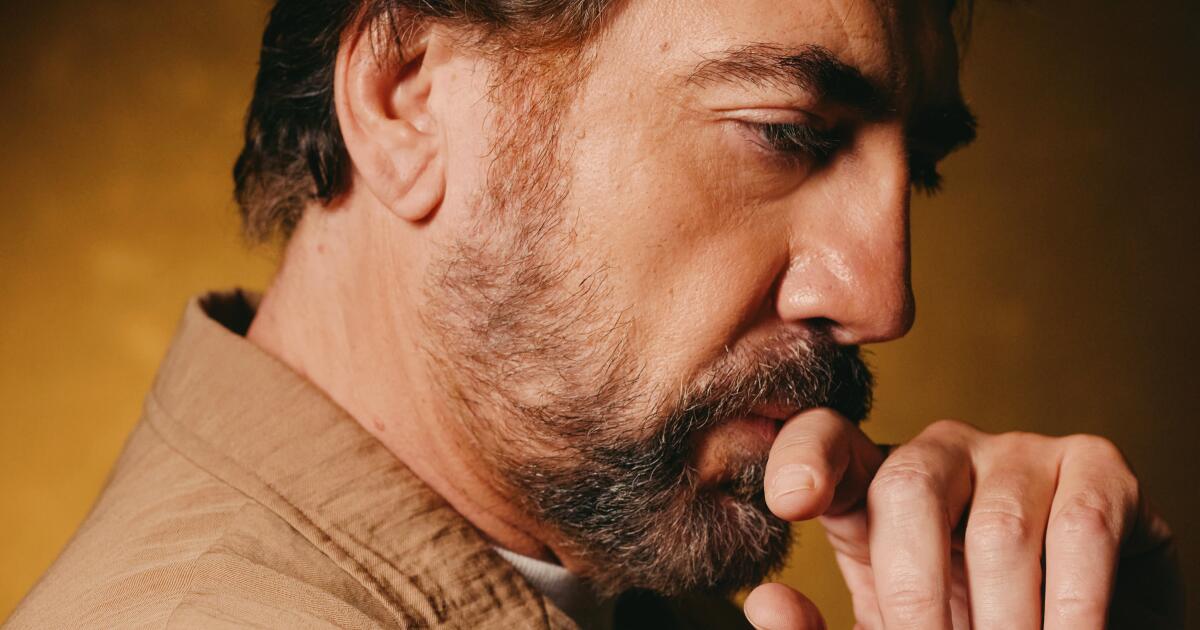
Alone and engulfed in the darkness of a Madrid cinema, Javier Bardem watched Martin Scorsese’s 1991 psychological thriller “Cape Fear” after learning he’d be starring in an episodic reimagining of the crime saga for Apple TV — the series finale is now streaming.
He arranged the private screening to symbolically request Robert De Niro’s blessing to play the dangerously charismatic Max Cady, an ex-con parched for revenge against those who had a hand in his imprisonment. De Niro received an Oscar nomination for that role.
“It was my way of honoring the work he did back then and, at the same time, to detach myself from that performance and ask his permission to create my own take,” Bardem tells me in Spanish while sitting at a restaurant inside a Beverly Hills hotel.
His informal getup, a T-shirt and shorts, contrasts with the elegant environment primed for business lunches and ostentatious dinners. He exudes an easy-going air. A quintessential cool dad casually sipping on an iced Diet Coke as he shares anecdotes about his passion for acting.
Bardem, 57, agreed to play Cady because the version of the character that the show’s creator, Nick Antosca, envisioned was not only decidedly distinct from those embodied by De Niro and Robert Mitchum, the latter of whom starred in a 1962 film adaptation, but also tailored to him as a Spanish man.
Had it been a standard remake, Bardem would have passed. Still, like the films, the show also “drinks from the fountain” of John D. MacDonald’s 1957 novel “The Executioners.” What remains intact across all versions of Cady is a devilish sense of humor and a lack of self-importance. In any of his iterations, he has nothing to lose. That makes him lethal.
In “Cape Fear,” Bardem’s Max Cady is distinct from the versions of the character played by Robert De Niro and Robert Mitchum in earlier films.
(Apple)
The cerebral Cady that Bardem inhabits spent nearly two decades in prison convicted for his wife’s murder. When the discovery of new evidence results in Cady’s freedom, his new mission is to torment Anna (Amy Adams) and Tom Bowden (Patrick Wilson), the attorney and prosecutor on his case, who are now married and have two teenaged children.
Cady turns their lives into a trap of paranoia and, indeed, fear, while procuring plausible deniability to avoid consequences. It’s a malicious and relentless barrage of the mind.
“He’s a 2026 Max Cady. It’s a different way of approaching violation of privacy, and the intrusion of the characters’ psyches. The digital world has made everything very different now,” he explains. “We are hyper-aware of what is said and written about us. We are inundated with so much information that, at times, we can’t tell what is true and what is false.”

While in the 1991 film the audience is aware that De Niro’s Cady committed sexual crimes making him “an absolutely despicable character,” Bardem says this new version portrays a complex person who’s suffered at the hands of the American justice system.
“Here we understand that he was imprisoned for something he didn’t do. He may have done other things, but he says, ‘You turned me into this monster.’ It’s true. From that point on, a vengeful and destructive mindset developed,” Bardem says of his Cady.
The final episode shows the public unmasking of Cady, just before he learns he is responsible for his own son’s death. Bardem describes him as a “dying beast” who has lost control of the narrative that he so meticulously orchestrated to rebuild his image.
The character was written to account for the actor’s Spanish accent. This Cady grew up in Spain until he moved to North Carolina at 13 and learned English on the streets. Bardem worked with renowned dialect coach Tim Monich to infuse his speech with a hint of a Southern drawl, aware that his character didn’t have to sound like a native speaker.
“I’m not bilingual,” Bardem says. The statement is somewhat shocking, considering he’s worked in the U.S. for decades in numerous English-language productions.
“Acting in English is easier for me because the dialogue is set,” he says. “But when the time comes to improvise, I find it difficult. That still doesn’t come naturally to me in English.”


The Spanish actor says acting in English is easier for him but that improvising is more challenging.
(Erik Carter / For The Times)
There’s a freedom to working in English since words have less emotional significance, the Oscar-winner believes. “I can be more daring in English. I can say the words or verbalize the thoughts with much less inhibition, because I am not as emotionally attached,” he explains. “But when you speak in your mother tongue, your body tenses up a bit because you think, ‘I understand the full emotional spectrum of what I’m talking about.’ ”
At this stage in his lauded career, Bardem is interested only in roles that explore “contradictions with an underlying humanity.” He’s played one-dimensional parts in the past, but the cost of being away from his loved ones is too high.
The job has to measure up to the trade-off of precious time he’s surrendering.
The “Cape Fear” production structured the schedule for Bardem to work for two weeks followed by five or six days off, allowing him to travel back to his family, which includes his famous and just as in-demand wife, Penélope Cruz, and their two teenaged children, Leo, 15, and Luna, 13.
“Cape Fear” filmed in Atlanta and Savannah, Ga. That’s a long trip back to Spain but manageable and certainly worthwhile, he says. “One of the few things I ask for contractually is time with family, and that has always been respected; Penélope and I have always managed our projects in such a way that one of us is always present for our kids.”
Thanks to his award-winning turn as an unnerving killer in “No Country for Old Man” and the dapper cyberterrorist in “Skyfall,” audiences might associate Bardem with sinister characters (his Cady joins the ranks). And they are satisfying to portray, he says.
“It’s true that characters with that kind of darkness are very attractive to play,” he says. “The villain is always more compelling than the hero. The hero is perfectly upright. A good villain has many cracks, which is what makes him more human.”

Bardem on playing sinister characters like Max Cady: “The villain is always more compelling than the hero. The hero is perfectly upright. A good villain has many cracks, which is what makes him more human.”
(Apple)
In recent years, however, Bardem made a deliberate effort to work on projects that his children could watch, particularly when they were younger, namely the fantasy musical “Lyle, Lyle, Crocodile” and the live-action remake of “The Little Mermaid,” in which he played King Triton.
“I needed my children to see what I do,” he says. “They knew I’d leave home for two weeks and then come back, and I’d tell them about it and show them photos, but they hadn’t been able to watch any of my movies yet because they were geared more toward adults.”
Cruz and Bardem have always encouraged their children’s creative pursuits. It wouldn’t surprise them if they eventually pursue a life in the arts. “I don’t see them becoming scientists or lawyers, which makes sense. I don’t know if they will become ‘nepo babies’ or not, but we are conscious that children always feed on what their parents do,” Bardem says.
Every time either Bardem or Cruz gets an offer for a new role, the couple discuss it and then bring their kids into the conversation. It’s important, Bardem believes, that Leo and Luna know how fulfilling acting is for both of their parents.
“They know we feel immense gratitude for being able to make a living from our passion. And they understand that the way we try to live up to that gift is by doing our absolute best and giving it the full attention it deserves,” he says.
When they were younger, the kids weren’t interested in seeing their parents on screen, but that’s changed. “They have seen ‘The Invite’ three times. They love it. And they’ve watched ‘Volver’ and ‘Bandidas,’” he says. “They’ve watched me in ‘F1,’ and Leo is watching ‘Cape Fear.’ ”
In June, Bardem became part of Hollywood history when his hands and footprints were added to the entrance of TCL Chinese Theatre. The ceremony included directors Michael Mann and Denis Villeneuve and producer Jerry Bruckheimer.
“I missed my mother so much at that moment because there are so many footprints of classic actors and actresses there. I imagine my mother seeing my hands and feet next to Gary Cooper, who was one of the loves of her life,” he says.


In June, Bardem’s hands and footprints were added to the entrance of TCL Chinese Theatre: “I missed my mother so much at that moment because there are so many footprints of classic actors and actresses there.”
(Erik Carter / For The Times)
It felt surreal, Bardem says, to have Mann present at the event. They worked together on “Collateral” over two decades ago. “I was crazy about ‘Miami Vice’ in the ’80s,” Bardem says. The suit he wore in the photo shoot for this piece, he adds, reminded him of that emblematic series and film.
Bardem’s latest collaboration with Villeneuve, “Dune: Part Three” hits theaters in December. He recalls the joy of shooting the film’s opening sequence, a battle where the cast was covered in mud. It reminded him of childhood play. “Denis would laugh and say to me, ‘But why are you laughing?’ And I’d say, ‘This is what I used to do in the schoolyard, but now it’s for real. Now I look to my right, and I have 50 guys under my command,’ ” he says.

“I was lucky enough to shoot some scenes with Timothée [Chalamet]. I saw him playing a Paul who is very different from the Paul in the second film,” Bardem continues. “Years have passed, and Paul is now wielding power and is a victim of that power.”
Outspoken about the ongoing plight of Palestinians, Bardem wishes more people could apply the lessons they mine from fiction they consume to the world in turmoil.
“We root for the rebels in ‘Star Wars’ and want them to defeat Darth Vader, or we side with the Fremen in ‘Dune.’ We always take sides in fiction. Yet, when we witness oppression, abuse and the violation of the most fundamental rights by an oppressor in real life, we seem to struggle to stand with the oppressed,” Bardem explains. “That cannot be.”
Even while attending matches at the recent World Cup, where Spain won the title, the actor advocated for an end to the carnage. A viral video shows him engaging with a Palestinian man at a match. “Existence is resistance,” Bardem tells him. On social media he’s shared images of Lamine Yamal, one of his national team’s stars, waving the Palestinian flag.
“The impunity Israel enjoys regarding these crimes, both legally and in terms of international support, creates a profound sense of powerlessness,” he says.
Bardem admits he’s been asked, whether directly or indirectly, to tone down his vocal support. But he doesn’t fear backlash. On the contrary, he’s never felt more support from everyday people who share his mindset.
“If I’m so privileged to have a good life where I work doing what I love and can provide my family with stability and security, how could I not use that privilege to denounce those things that I think are wrong?”

