

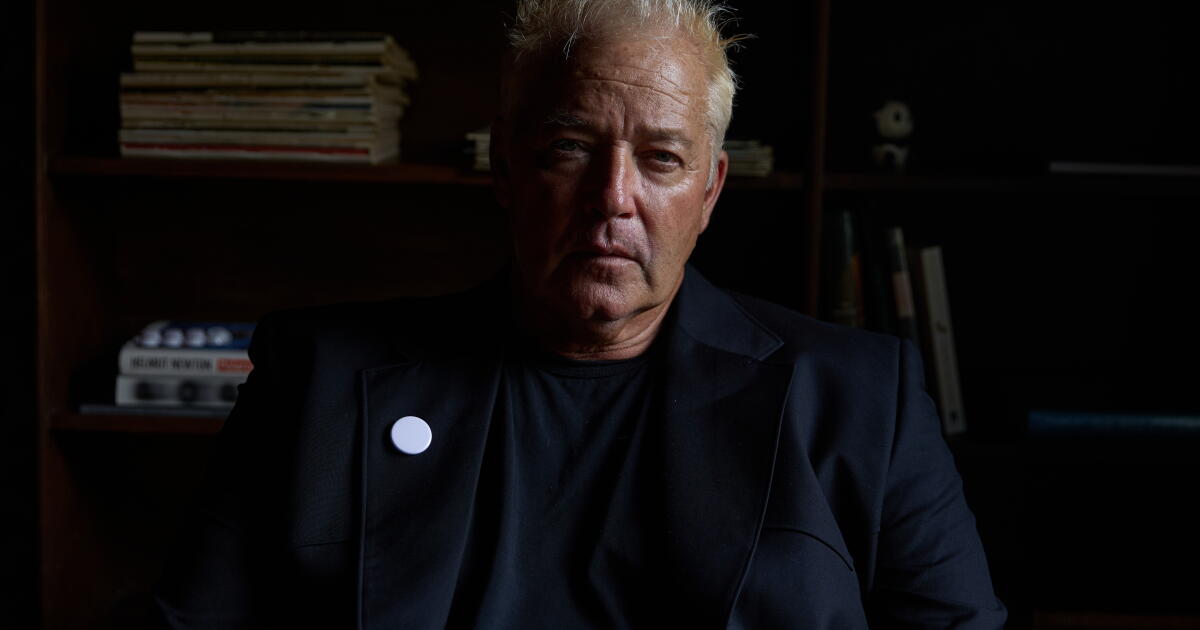
Turns out you can teach an old dog new tricks. The 13 pointed and personal songs on “Jack Grisham and the Life Undone” shine with a sometimes painful eloquence that highlights both a fresh creativity, and yes, even a certain emotional maturity from Jack Grisham, frontman of Orange County punk legends T.S.O.L.
This from a man who was tossed in “Disneyland jail” for shenanigans involving a machete at the Happiest Place on Earth; who penned a memoir called “An American Demon,” and can’t get into Canada thanks to more than a dozen arrests. “No prison; jail a lot,” Grisham, 65, clarifies with a laugh. “I’ve never been convicted of a felony.”
A big presence, drinking a coffee with a cigar in hand, Grisham is seated on a leafy patio of a sprawling home near the top of Laurel Canyon, next to his Life Undone co-conspirator, Berlin-based drummer/guitarist Lars Triesch. The multilevel, multi-style house and recording studio, in the midst of a renovation, once belonged to Frank Zappa. The duo are beyond excited to record album number two at this locale. Even though their debut — created with producer Kurt Ebelhäuser in Germany and Paul Roessler (the Screamers, 45 Grave) and one-time T.S.O.L. guitarist Trevor Lucca — came out in October, the ideas are still flowing.
Grisham’s mind is as fast as flexible and rampant as the age he feels inside … which, by the way, is 8 years old. Lately, he’s a “yes” man, all his leaps of faith leading to the Life Undone’s debut, written with Triesch, a successful vintage restorer and midcentury style fanatic who met the singer when he took Grisham’s tour at Las Vegas’ the Punk Rock Museum. That’s not to say he wasn’t a teenage admirer of the SoCal punk icon’s band: “When I was 14 years old, I had the makeup, the shirt, I was a big T.S.O.L. fan,” Triesch says.
Grisham’s new project, “The Life Undone,” trades nostalgia for 13 emotionally candid songs about Grisham’s struggles, self-doubt and determination to live fully.
(Parker Burr / For The Times)
The first week of January 2026 saw T.S.O.L., the iconic OC punk band Grisham co-founded in 1978, play its final Los Angeles gig at the Regent. The frontman was through with touring. Yet stage-divers ran rampant, merch flew off the shelves; clearly, fans couldn’t get enough. However, at this stage of his career with T.S.O.L., Grisham felt that “whenever you’re out and you’re playing old songs, you’re now a novelty act. I was feeling that all the time. I would tell [the band], I said, ‘we’re a f— state fair act.’ I’d have fun [playing live]. But there was also a little bit of embarrassment, where it’s like, ‘What am I doing?’ Artistically, it’s not going anywhere.”
The same cannot be said of “The Life Undone,” whose album was nearly complete by the time T.S.O.L. played its final note. The process — Grisham briefly going to Berlin to work with Triesch, then the duo prolifically texting so many song snippets between the U.S. and Germany that it was hard to keep track of the ideas. “It’s just chaos,” Triesch says.
“I like chaos,” Grisham says. “As far as I’m concerned, God is chaos. Structure is bull—. Chaos is where s— appears. It’s like ‘Hey, this just showed up. Let’s go down that road.’”
Triesch also plunged in headlong, and didn’t consider about Grisham’s history or voice when writing music, rather, just the pair’s musical conversations about the Fifth Dimension, Frank Zappa, the Kinks and more. “It naturally, organically, kind of developed,” says Triesch.

“I like chaos,” Grisham says. “As far as I’m concerned, God is chaos. Structure is bull—. Chaos is where s— appears. It’s like ‘Hey, this just showed up. Let’s go down that road.’”
(Parker Burr / For The Times)
“You’re playing me all sorts of weird s— today,” Grisham tosses at his partner.
“But not German,” Triesch protests. “I’m really into ‘60s stuff, so listen to underground pop psych American, British. Chamaeleon Church, we listened today. And Margo Guryan, you know her?”
Grisham does not. “I don’t listen. I’m not a fan of music,” he says, in a manner that makes it difficult to tell if he’s joking. “I sit at home and listen to jazz.”
Ironically, the crucial element in letting go of expectations and rules was control, as in not answering to a record label, managers or handlers. It was: “Let’s do it ourselves. We’re full control. It’s so basic. Nobody expects us to do anything. We put [the record] out, total relief. We don’t have to worry about touring. Hopefully people hear it and like it. If they don’t, well, then they don’t,” states Grisham. “It’s like we’re done trying to prove something.”
Yet as the process began, Grisham had no idea about Triesch’s musical bona fides, “Yeah, he could have been a shyster. Who knows.” The singer’s leap of faith was quick and productive.
“Dull Boy” begins with an acoustic guitar and Grisham’s sonorous voice before kicking into a lush and dark mid-tempo tune. Lyrically, it’s is self-referential, Grisham explaining, “I struggle with depression, untreated bipolar. Most of the time … cognitive behavioral therapy …” he says. “I’m very disciplined in what I’m doing, but then sometimes it goes dark, like it’s not good. So it’s ‘hey, dull boy, playing with sharp toys…’”

The lively, slightly punky album opener ‘“Pain Goes Around” finds Grisham singing, “Well I’ve been blind and I’ve been broken / Torn apart and I’ve misspoken yeah, oh yeah.” There’s at least one love song, “Anthem,” for his wife, who, while “younger-ish,” Grisham says with a chuckle, “we don’t look crazy together. She looks like she’s with her dad, but not her granddad.”
Despite the insightful catharsis of the lyrics — and being married to a therapist — he’s not immune to the occasional freak-out. His wife tells him, “How the f— do you have so many feelings in one day? It’s been an hour. You had like 15 feelings!” Outwardly loquacious and voluble, Grisham battles internal self-doubt, a mantra to help move past it being, “’just keep going, just keep going.’ I have to just keep telling myself ‘just keep going.’”
When one of Grisham’s freak-outs threatened during the songwriting process, Triesch told the singer, “You’re gonna like it in a minute.”
“Yeah, he has meltdowns,” Triesch says, “but then there is this great song we’re working on. I can see his face. There’s a nice melody, something really cool, and then it’s kind of like it’s going away. Then at the end, OK, we made a great song.”

“Nobody expects us to do anything. We put [the record] out, total relief. We don’t have to worry about touring. Hopefully people hear it and like it. If they don’t, well, then they don’t,” Grisham says.
(Parker Burr / For The Times)
And as for Grisham’s retirement from touring? He’s standing firm. “When Lars said, ‘You want to make a record?’ It’s like, ‘Great,’” the singer says. “But I kept telling Lars, ‘Look, dude, I don’t want to play live. I don’t want to be in a f—ing band. We even argue now. This isn’t a band. We’re not a band. I didn’t even want to use my name.”
“I thought it would be stupid not to do Jack’s name,” says Triesch.
“I disagree,” Grisham chimes in quickly. “I don’t like my name anyway. It sounds like a game show host: Jack Grisham. Monty Hall, Jack Grisham, Pat Sajak.”
Years of sobriety and service have made Grisham aware and introspective; a kinder, gentler O.G. punker, but still a work in progress. And that ties into the album and “band name.” While they don’t recall where the phrase “The Life Undone” came from, they liked its dual meanings. “It was therapeutic, like unboxing the life, what’s already been done. And then not over; the music thing’s still running. Life undone,” Grisham says.
The shadows are getting longer in Laurel Canyon, and Grisham looks at his watch. It’s nearly his bedtime, though the sun isn’t down. When home in OC, he’s up with the birds. It begins with phone calls. “It starts out with the Bishop [a friend who apparently is a bishop], then Lars, who is nine hours ahead, then Paul [Roessler],” explains Grisham. “Then I do my walk, three or four miles, then a swim in the ocean, then go write.”
“Then it’s 8 a.m.,” laughs Triesch.
Grisham is the living embodiment of carpe diem. He quotes some verses from the song “These Things”: “ ‘I got her in my hand and cash on my plate’; ‘I got lust in my mind and pride in my gait.’ And why not? Why can’t I have all this?” Grisham asks. “I’m gonna live this life completely and fully.”
Triesch and Grisham are ready to depart the sprawling onetime Zappa compound. Yet Grisham also frequently laments, in song and conversation, about the passing of time, wanting to “drag” moments out, to be present. “It goes so fast,” he says. “It’s like, ‘just slow down.’ There’s a part in ‘Pieces of the Sun’ where it says, ‘call my name / Can you say it, scream it, anchor me in place.’” His wants are simple: “Just anchor me for a minute, just put me right here, anchor me in place,” Grisham wishes, admitting, “But it doesn’t work.”

Turns out you can teach an old dog new tricks. The 13 pointed and personal songs on “Jack Grisham and the Life Undone” shine with a sometimes painful eloquence that highlights both a fresh creativity, and yes, even a certain emotional maturity from Jack Grisham, frontman of Orange County punk legends T.S.O.L.
This from a man who was tossed in “Disneyland jail” for shenanigans involving a machete at the Happiest Place on Earth; who penned a memoir called “An American Demon,” and can’t get into Canada thanks to more than a dozen arrests. “No prison; jail a lot,” Grisham, 65, clarifies with a laugh. “I’ve never been convicted of a felony.”
A big presence, drinking a coffee with a cigar in hand, Grisham is seated on a leafy patio of a sprawling home near the top of Laurel Canyon, next to his Life Undone co-conspirator, Berlin-based drummer/guitarist Lars Triesch. The multilevel, multi-style house and recording studio, in the midst of a renovation, once belonged to Frank Zappa. The duo are beyond excited to record album number two at this locale. Even though their debut — created with producer Kurt Ebelhäuser in Germany and Paul Roessler (the Screamers, 45 Grave) and one-time T.S.O.L. guitarist Trevor Lucca — came out in October, the ideas are still flowing.
Grisham’s mind is as fast as flexible and rampant as the age he feels inside … which, by the way, is 8 years old. Lately, he’s a “yes” man, all his leaps of faith leading to the Life Undone’s debut, written with Triesch, a successful vintage restorer and midcentury style fanatic who met the singer when he took Grisham’s tour at Las Vegas’ the Punk Rock Museum. That’s not to say he wasn’t a teenage admirer of the SoCal punk icon’s band: “When I was 14 years old, I had the makeup, the shirt, I was a big T.S.O.L. fan,” Triesch says.
Grisham’s new project, “The Life Undone,” trades nostalgia for 13 emotionally candid songs about Grisham’s struggles, self-doubt and determination to live fully.
(Parker Burr / For The Times)
The first week of January 2026 saw T.S.O.L., the iconic OC punk band Grisham co-founded in 1978, play its final Los Angeles gig at the Regent. The frontman was through with touring. Yet stage-divers ran rampant, merch flew off the shelves; clearly, fans couldn’t get enough. However, at this stage of his career with T.S.O.L., Grisham felt that “whenever you’re out and you’re playing old songs, you’re now a novelty act. I was feeling that all the time. I would tell [the band], I said, ‘we’re a f— state fair act.’ I’d have fun [playing live]. But there was also a little bit of embarrassment, where it’s like, ‘What am I doing?’ Artistically, it’s not going anywhere.”
The same cannot be said of “The Life Undone,” whose album was nearly complete by the time T.S.O.L. played its final note. The process — Grisham briefly going to Berlin to work with Triesch, then the duo prolifically texting so many song snippets between the U.S. and Germany that it was hard to keep track of the ideas. “It’s just chaos,” Triesch says.
“I like chaos,” Grisham says. “As far as I’m concerned, God is chaos. Structure is bull—. Chaos is where s— appears. It’s like ‘Hey, this just showed up. Let’s go down that road.’”
Triesch also plunged in headlong, and didn’t consider about Grisham’s history or voice when writing music, rather, just the pair’s musical conversations about the Fifth Dimension, Frank Zappa, the Kinks and more. “It naturally, organically, kind of developed,” says Triesch.
“I like chaos,” Grisham says. “As far as I’m concerned, God is chaos. Structure is bull—. Chaos is where s— appears. It’s like ‘Hey, this just showed up. Let’s go down that road.’”
(Parker Burr / For The Times)
“You’re playing me all sorts of weird s— today,” Grisham tosses at his partner.
“But not German,” Triesch protests. “I’m really into ‘60s stuff, so listen to underground pop psych American, British. Chamaeleon Church, we listened today. And Margo Guryan, you know her?”
Grisham does not. “I don’t listen. I’m not a fan of music,” he says, in a manner that makes it difficult to tell if he’s joking. “I sit at home and listen to jazz.”
Ironically, the crucial element in letting go of expectations and rules was control, as in not answering to a record label, managers or handlers. It was: “Let’s do it ourselves. We’re full control. It’s so basic. Nobody expects us to do anything. We put [the record] out, total relief. We don’t have to worry about touring. Hopefully people hear it and like it. If they don’t, well, then they don’t,” states Grisham. “It’s like we’re done trying to prove something.”
Yet as the process began, Grisham had no idea about Triesch’s musical bona fides, “Yeah, he could have been a shyster. Who knows.” The singer’s leap of faith was quick and productive.
“Dull Boy” begins with an acoustic guitar and Grisham’s sonorous voice before kicking into a lush and dark mid-tempo tune. Lyrically, it’s is self-referential, Grisham explaining, “I struggle with depression, untreated bipolar. Most of the time … cognitive behavioral therapy …” he says. “I’m very disciplined in what I’m doing, but then sometimes it goes dark, like it’s not good. So it’s ‘hey, dull boy, playing with sharp toys…’”
The lively, slightly punky album opener ‘“Pain Goes Around” finds Grisham singing, “Well I’ve been blind and I’ve been broken / Torn apart and I’ve misspoken yeah, oh yeah.” There’s at least one love song, “Anthem,” for his wife, who, while “younger-ish,” Grisham says with a chuckle, “we don’t look crazy together. She looks like she’s with her dad, but not her granddad.”
Despite the insightful catharsis of the lyrics — and being married to a therapist — he’s not immune to the occasional freak-out. His wife tells him, “How the f— do you have so many feelings in one day? It’s been an hour. You had like 15 feelings!” Outwardly loquacious and voluble, Grisham battles internal self-doubt, a mantra to help move past it being, “’just keep going, just keep going.’ I have to just keep telling myself ‘just keep going.’”
When one of Grisham’s freak-outs threatened during the songwriting process, Triesch told the singer, “You’re gonna like it in a minute.”
“Yeah, he has meltdowns,” Triesch says, “but then there is this great song we’re working on. I can see his face. There’s a nice melody, something really cool, and then it’s kind of like it’s going away. Then at the end, OK, we made a great song.”
“Nobody expects us to do anything. We put [the record] out, total relief. We don’t have to worry about touring. Hopefully people hear it and like it. If they don’t, well, then they don’t,” Grisham says.
(Parker Burr / For The Times)
And as for Grisham’s retirement from touring? He’s standing firm. “When Lars said, ‘You want to make a record?’ It’s like, ‘Great,’” the singer says. “But I kept telling Lars, ‘Look, dude, I don’t want to play live. I don’t want to be in a f—ing band. We even argue now. This isn’t a band. We’re not a band. I didn’t even want to use my name.”
“I thought it would be stupid not to do Jack’s name,” says Triesch.
“I disagree,” Grisham chimes in quickly. “I don’t like my name anyway. It sounds like a game show host: Jack Grisham. Monty Hall, Jack Grisham, Pat Sajak.”
Years of sobriety and service have made Grisham aware and introspective; a kinder, gentler O.G. punker, but still a work in progress. And that ties into the album and “band name.” While they don’t recall where the phrase “The Life Undone” came from, they liked its dual meanings. “It was therapeutic, like unboxing the life, what’s already been done. And then not over; the music thing’s still running. Life undone,” Grisham says.
The shadows are getting longer in Laurel Canyon, and Grisham looks at his watch. It’s nearly his bedtime, though the sun isn’t down. When home in OC, he’s up with the birds. It begins with phone calls. “It starts out with the Bishop [a friend who apparently is a bishop], then Lars, who is nine hours ahead, then Paul [Roessler],” explains Grisham. “Then I do my walk, three or four miles, then a swim in the ocean, then go write.”
“Then it’s 8 a.m.,” laughs Triesch.
Grisham is the living embodiment of carpe diem. He quotes some verses from the song “These Things”: “ ‘I got her in my hand and cash on my plate’; ‘I got lust in my mind and pride in my gait.’ And why not? Why can’t I have all this?” Grisham asks. “I’m gonna live this life completely and fully.”
Triesch and Grisham are ready to depart the sprawling onetime Zappa compound. Yet Grisham also frequently laments, in song and conversation, about the passing of time, wanting to “drag” moments out, to be present. “It goes so fast,” he says. “It’s like, ‘just slow down.’ There’s a part in ‘Pieces of the Sun’ where it says, ‘call my name / Can you say it, scream it, anchor me in place.’” His wants are simple: “Just anchor me for a minute, just put me right here, anchor me in place,” Grisham wishes, admitting, “But it doesn’t work.”

Turns out you can teach an old dog new tricks. The 13 pointed and personal songs on “Jack Grisham and the Life Undone” shine with a sometimes painful eloquence that highlights both a fresh creativity, and yes, even a certain emotional maturity from Jack Grisham, frontman of Orange County punk legends T.S.O.L.
This from a man who was tossed in “Disneyland jail” for shenanigans involving a machete at the Happiest Place on Earth; who penned a memoir called “An American Demon,” and can’t get into Canada thanks to more than a dozen arrests. “No prison; jail a lot,” Grisham, 65, clarifies with a laugh. “I’ve never been convicted of a felony.”
A big presence, drinking a coffee with a cigar in hand, Grisham is seated on a leafy patio of a sprawling home near the top of Laurel Canyon, next to his Life Undone co-conspirator, Berlin-based drummer/guitarist Lars Triesch. The multilevel, multi-style house and recording studio, in the midst of a renovation, once belonged to Frank Zappa. The duo are beyond excited to record album number two at this locale. Even though their debut — created with producer Kurt Ebelhäuser in Germany and Paul Roessler (the Screamers, 45 Grave) and one-time T.S.O.L. guitarist Trevor Lucca — came out in October, the ideas are still flowing.
Grisham’s mind is as fast as flexible and rampant as the age he feels inside … which, by the way, is 8 years old. Lately, he’s a “yes” man, all his leaps of faith leading to the Life Undone’s debut, written with Triesch, a successful vintage restorer and midcentury style fanatic who met the singer when he took Grisham’s tour at Las Vegas’ the Punk Rock Museum. That’s not to say he wasn’t a teenage admirer of the SoCal punk icon’s band: “When I was 14 years old, I had the makeup, the shirt, I was a big T.S.O.L. fan,” Triesch says.
Grisham’s new project, “The Life Undone,” trades nostalgia for 13 emotionally candid songs about Grisham’s struggles, self-doubt and determination to live fully.
(Parker Burr / For The Times)
The first week of January 2026 saw T.S.O.L., the iconic OC punk band Grisham co-founded in 1978, play its final Los Angeles gig at the Regent. The frontman was through with touring. Yet stage-divers ran rampant, merch flew off the shelves; clearly, fans couldn’t get enough. However, at this stage of his career with T.S.O.L., Grisham felt that “whenever you’re out and you’re playing old songs, you’re now a novelty act. I was feeling that all the time. I would tell [the band], I said, ‘we’re a f— state fair act.’ I’d have fun [playing live]. But there was also a little bit of embarrassment, where it’s like, ‘What am I doing?’ Artistically, it’s not going anywhere.”
The same cannot be said of “The Life Undone,” whose album was nearly complete by the time T.S.O.L. played its final note. The process — Grisham briefly going to Berlin to work with Triesch, then the duo prolifically texting so many song snippets between the U.S. and Germany that it was hard to keep track of the ideas. “It’s just chaos,” Triesch says.
“I like chaos,” Grisham says. “As far as I’m concerned, God is chaos. Structure is bull—. Chaos is where s— appears. It’s like ‘Hey, this just showed up. Let’s go down that road.’”
Triesch also plunged in headlong, and didn’t consider about Grisham’s history or voice when writing music, rather, just the pair’s musical conversations about the Fifth Dimension, Frank Zappa, the Kinks and more. “It naturally, organically, kind of developed,” says Triesch.
“I like chaos,” Grisham says. “As far as I’m concerned, God is chaos. Structure is bull—. Chaos is where s— appears. It’s like ‘Hey, this just showed up. Let’s go down that road.’”
(Parker Burr / For The Times)
“You’re playing me all sorts of weird s— today,” Grisham tosses at his partner.
“But not German,” Triesch protests. “I’m really into ‘60s stuff, so listen to underground pop psych American, British. Chamaeleon Church, we listened today. And Margo Guryan, you know her?”
Grisham does not. “I don’t listen. I’m not a fan of music,” he says, in a manner that makes it difficult to tell if he’s joking. “I sit at home and listen to jazz.”
Ironically, the crucial element in letting go of expectations and rules was control, as in not answering to a record label, managers or handlers. It was: “Let’s do it ourselves. We’re full control. It’s so basic. Nobody expects us to do anything. We put [the record] out, total relief. We don’t have to worry about touring. Hopefully people hear it and like it. If they don’t, well, then they don’t,” states Grisham. “It’s like we’re done trying to prove something.”
Yet as the process began, Grisham had no idea about Triesch’s musical bona fides, “Yeah, he could have been a shyster. Who knows.” The singer’s leap of faith was quick and productive.
“Dull Boy” begins with an acoustic guitar and Grisham’s sonorous voice before kicking into a lush and dark mid-tempo tune. Lyrically, it’s is self-referential, Grisham explaining, “I struggle with depression, untreated bipolar. Most of the time … cognitive behavioral therapy …” he says. “I’m very disciplined in what I’m doing, but then sometimes it goes dark, like it’s not good. So it’s ‘hey, dull boy, playing with sharp toys…’”
The lively, slightly punky album opener ‘“Pain Goes Around” finds Grisham singing, “Well I’ve been blind and I’ve been broken / Torn apart and I’ve misspoken yeah, oh yeah.” There’s at least one love song, “Anthem,” for his wife, who, while “younger-ish,” Grisham says with a chuckle, “we don’t look crazy together. She looks like she’s with her dad, but not her granddad.”
Despite the insightful catharsis of the lyrics — and being married to a therapist — he’s not immune to the occasional freak-out. His wife tells him, “How the f— do you have so many feelings in one day? It’s been an hour. You had like 15 feelings!” Outwardly loquacious and voluble, Grisham battles internal self-doubt, a mantra to help move past it being, “’just keep going, just keep going.’ I have to just keep telling myself ‘just keep going.’”
When one of Grisham’s freak-outs threatened during the songwriting process, Triesch told the singer, “You’re gonna like it in a minute.”
“Yeah, he has meltdowns,” Triesch says, “but then there is this great song we’re working on. I can see his face. There’s a nice melody, something really cool, and then it’s kind of like it’s going away. Then at the end, OK, we made a great song.”
“Nobody expects us to do anything. We put [the record] out, total relief. We don’t have to worry about touring. Hopefully people hear it and like it. If they don’t, well, then they don’t,” Grisham says.
(Parker Burr / For The Times)
And as for Grisham’s retirement from touring? He’s standing firm. “When Lars said, ‘You want to make a record?’ It’s like, ‘Great,’” the singer says. “But I kept telling Lars, ‘Look, dude, I don’t want to play live. I don’t want to be in a f—ing band. We even argue now. This isn’t a band. We’re not a band. I didn’t even want to use my name.”
“I thought it would be stupid not to do Jack’s name,” says Triesch.
“I disagree,” Grisham chimes in quickly. “I don’t like my name anyway. It sounds like a game show host: Jack Grisham. Monty Hall, Jack Grisham, Pat Sajak.”
Years of sobriety and service have made Grisham aware and introspective; a kinder, gentler O.G. punker, but still a work in progress. And that ties into the album and “band name.” While they don’t recall where the phrase “The Life Undone” came from, they liked its dual meanings. “It was therapeutic, like unboxing the life, what’s already been done. And then not over; the music thing’s still running. Life undone,” Grisham says.
The shadows are getting longer in Laurel Canyon, and Grisham looks at his watch. It’s nearly his bedtime, though the sun isn’t down. When home in OC, he’s up with the birds. It begins with phone calls. “It starts out with the Bishop [a friend who apparently is a bishop], then Lars, who is nine hours ahead, then Paul [Roessler],” explains Grisham. “Then I do my walk, three or four miles, then a swim in the ocean, then go write.”
“Then it’s 8 a.m.,” laughs Triesch.
Grisham is the living embodiment of carpe diem. He quotes some verses from the song “These Things”: “ ‘I got her in my hand and cash on my plate’; ‘I got lust in my mind and pride in my gait.’ And why not? Why can’t I have all this?” Grisham asks. “I’m gonna live this life completely and fully.”
Triesch and Grisham are ready to depart the sprawling onetime Zappa compound. Yet Grisham also frequently laments, in song and conversation, about the passing of time, wanting to “drag” moments out, to be present. “It goes so fast,” he says. “It’s like, ‘just slow down.’ There’s a part in ‘Pieces of the Sun’ where it says, ‘call my name / Can you say it, scream it, anchor me in place.’” His wants are simple: “Just anchor me for a minute, just put me right here, anchor me in place,” Grisham wishes, admitting, “But it doesn’t work.”

Turns out you can teach an old dog new tricks. The 13 pointed and personal songs on “Jack Grisham and the Life Undone” shine with a sometimes painful eloquence that highlights both a fresh creativity, and yes, even a certain emotional maturity from Jack Grisham, frontman of Orange County punk legends T.S.O.L.
This from a man who was tossed in “Disneyland jail” for shenanigans involving a machete at the Happiest Place on Earth; who penned a memoir called “An American Demon,” and can’t get into Canada thanks to more than a dozen arrests. “No prison; jail a lot,” Grisham, 65, clarifies with a laugh. “I’ve never been convicted of a felony.”
A big presence, drinking a coffee with a cigar in hand, Grisham is seated on a leafy patio of a sprawling home near the top of Laurel Canyon, next to his Life Undone co-conspirator, Berlin-based drummer/guitarist Lars Triesch. The multilevel, multi-style house and recording studio, in the midst of a renovation, once belonged to Frank Zappa. The duo are beyond excited to record album number two at this locale. Even though their debut — created with producer Kurt Ebelhäuser in Germany and Paul Roessler (the Screamers, 45 Grave) and one-time T.S.O.L. guitarist Trevor Lucca — came out in October, the ideas are still flowing.
Grisham’s mind is as fast as flexible and rampant as the age he feels inside … which, by the way, is 8 years old. Lately, he’s a “yes” man, all his leaps of faith leading to the Life Undone’s debut, written with Triesch, a successful vintage restorer and midcentury style fanatic who met the singer when he took Grisham’s tour at Las Vegas’ the Punk Rock Museum. That’s not to say he wasn’t a teenage admirer of the SoCal punk icon’s band: “When I was 14 years old, I had the makeup, the shirt, I was a big T.S.O.L. fan,” Triesch says.
Grisham’s new project, “The Life Undone,” trades nostalgia for 13 emotionally candid songs about Grisham’s struggles, self-doubt and determination to live fully.
(Parker Burr / For The Times)
The first week of January 2026 saw T.S.O.L., the iconic OC punk band Grisham co-founded in 1978, play its final Los Angeles gig at the Regent. The frontman was through with touring. Yet stage-divers ran rampant, merch flew off the shelves; clearly, fans couldn’t get enough. However, at this stage of his career with T.S.O.L., Grisham felt that “whenever you’re out and you’re playing old songs, you’re now a novelty act. I was feeling that all the time. I would tell [the band], I said, ‘we’re a f— state fair act.’ I’d have fun [playing live]. But there was also a little bit of embarrassment, where it’s like, ‘What am I doing?’ Artistically, it’s not going anywhere.”
The same cannot be said of “The Life Undone,” whose album was nearly complete by the time T.S.O.L. played its final note. The process — Grisham briefly going to Berlin to work with Triesch, then the duo prolifically texting so many song snippets between the U.S. and Germany that it was hard to keep track of the ideas. “It’s just chaos,” Triesch says.
“I like chaos,” Grisham says. “As far as I’m concerned, God is chaos. Structure is bull—. Chaos is where s— appears. It’s like ‘Hey, this just showed up. Let’s go down that road.’”
Triesch also plunged in headlong, and didn’t consider about Grisham’s history or voice when writing music, rather, just the pair’s musical conversations about the Fifth Dimension, Frank Zappa, the Kinks and more. “It naturally, organically, kind of developed,” says Triesch.
“I like chaos,” Grisham says. “As far as I’m concerned, God is chaos. Structure is bull—. Chaos is where s— appears. It’s like ‘Hey, this just showed up. Let’s go down that road.’”
(Parker Burr / For The Times)
“You’re playing me all sorts of weird s— today,” Grisham tosses at his partner.
“But not German,” Triesch protests. “I’m really into ‘60s stuff, so listen to underground pop psych American, British. Chamaeleon Church, we listened today. And Margo Guryan, you know her?”
Grisham does not. “I don’t listen. I’m not a fan of music,” he says, in a manner that makes it difficult to tell if he’s joking. “I sit at home and listen to jazz.”
Ironically, the crucial element in letting go of expectations and rules was control, as in not answering to a record label, managers or handlers. It was: “Let’s do it ourselves. We’re full control. It’s so basic. Nobody expects us to do anything. We put [the record] out, total relief. We don’t have to worry about touring. Hopefully people hear it and like it. If they don’t, well, then they don’t,” states Grisham. “It’s like we’re done trying to prove something.”
Yet as the process began, Grisham had no idea about Triesch’s musical bona fides, “Yeah, he could have been a shyster. Who knows.” The singer’s leap of faith was quick and productive.
“Dull Boy” begins with an acoustic guitar and Grisham’s sonorous voice before kicking into a lush and dark mid-tempo tune. Lyrically, it’s is self-referential, Grisham explaining, “I struggle with depression, untreated bipolar. Most of the time … cognitive behavioral therapy …” he says. “I’m very disciplined in what I’m doing, but then sometimes it goes dark, like it’s not good. So it’s ‘hey, dull boy, playing with sharp toys…’”
The lively, slightly punky album opener ‘“Pain Goes Around” finds Grisham singing, “Well I’ve been blind and I’ve been broken / Torn apart and I’ve misspoken yeah, oh yeah.” There’s at least one love song, “Anthem,” for his wife, who, while “younger-ish,” Grisham says with a chuckle, “we don’t look crazy together. She looks like she’s with her dad, but not her granddad.”
Despite the insightful catharsis of the lyrics — and being married to a therapist — he’s not immune to the occasional freak-out. His wife tells him, “How the f— do you have so many feelings in one day? It’s been an hour. You had like 15 feelings!” Outwardly loquacious and voluble, Grisham battles internal self-doubt, a mantra to help move past it being, “’just keep going, just keep going.’ I have to just keep telling myself ‘just keep going.’”
When one of Grisham’s freak-outs threatened during the songwriting process, Triesch told the singer, “You’re gonna like it in a minute.”
“Yeah, he has meltdowns,” Triesch says, “but then there is this great song we’re working on. I can see his face. There’s a nice melody, something really cool, and then it’s kind of like it’s going away. Then at the end, OK, we made a great song.”
“Nobody expects us to do anything. We put [the record] out, total relief. We don’t have to worry about touring. Hopefully people hear it and like it. If they don’t, well, then they don’t,” Grisham says.
(Parker Burr / For The Times)
And as for Grisham’s retirement from touring? He’s standing firm. “When Lars said, ‘You want to make a record?’ It’s like, ‘Great,’” the singer says. “But I kept telling Lars, ‘Look, dude, I don’t want to play live. I don’t want to be in a f—ing band. We even argue now. This isn’t a band. We’re not a band. I didn’t even want to use my name.”
“I thought it would be stupid not to do Jack’s name,” says Triesch.
“I disagree,” Grisham chimes in quickly. “I don’t like my name anyway. It sounds like a game show host: Jack Grisham. Monty Hall, Jack Grisham, Pat Sajak.”
Years of sobriety and service have made Grisham aware and introspective; a kinder, gentler O.G. punker, but still a work in progress. And that ties into the album and “band name.” While they don’t recall where the phrase “The Life Undone” came from, they liked its dual meanings. “It was therapeutic, like unboxing the life, what’s already been done. And then not over; the music thing’s still running. Life undone,” Grisham says.
The shadows are getting longer in Laurel Canyon, and Grisham looks at his watch. It’s nearly his bedtime, though the sun isn’t down. When home in OC, he’s up with the birds. It begins with phone calls. “It starts out with the Bishop [a friend who apparently is a bishop], then Lars, who is nine hours ahead, then Paul [Roessler],” explains Grisham. “Then I do my walk, three or four miles, then a swim in the ocean, then go write.”
“Then it’s 8 a.m.,” laughs Triesch.
Grisham is the living embodiment of carpe diem. He quotes some verses from the song “These Things”: “ ‘I got her in my hand and cash on my plate’; ‘I got lust in my mind and pride in my gait.’ And why not? Why can’t I have all this?” Grisham asks. “I’m gonna live this life completely and fully.”
Triesch and Grisham are ready to depart the sprawling onetime Zappa compound. Yet Grisham also frequently laments, in song and conversation, about the passing of time, wanting to “drag” moments out, to be present. “It goes so fast,” he says. “It’s like, ‘just slow down.’ There’s a part in ‘Pieces of the Sun’ where it says, ‘call my name / Can you say it, scream it, anchor me in place.’” His wants are simple: “Just anchor me for a minute, just put me right here, anchor me in place,” Grisham wishes, admitting, “But it doesn’t work.”

Turns out you can teach an old dog new tricks. The 13 pointed and personal songs on “Jack Grisham and the Life Undone” shine with a sometimes painful eloquence that highlights both a fresh creativity, and yes, even a certain emotional maturity from Jack Grisham, frontman of Orange County punk legends T.S.O.L.
This from a man who was tossed in “Disneyland jail” for shenanigans involving a machete at the Happiest Place on Earth; who penned a memoir called “An American Demon,” and can’t get into Canada thanks to more than a dozen arrests. “No prison; jail a lot,” Grisham, 65, clarifies with a laugh. “I’ve never been convicted of a felony.”
A big presence, drinking a coffee with a cigar in hand, Grisham is seated on a leafy patio of a sprawling home near the top of Laurel Canyon, next to his Life Undone co-conspirator, Berlin-based drummer/guitarist Lars Triesch. The multilevel, multi-style house and recording studio, in the midst of a renovation, once belonged to Frank Zappa. The duo are beyond excited to record album number two at this locale. Even though their debut — created with producer Kurt Ebelhäuser in Germany and Paul Roessler (the Screamers, 45 Grave) and one-time T.S.O.L. guitarist Trevor Lucca — came out in October, the ideas are still flowing.
Grisham’s mind is as fast as flexible and rampant as the age he feels inside … which, by the way, is 8 years old. Lately, he’s a “yes” man, all his leaps of faith leading to the Life Undone’s debut, written with Triesch, a successful vintage restorer and midcentury style fanatic who met the singer when he took Grisham’s tour at Las Vegas’ the Punk Rock Museum. That’s not to say he wasn’t a teenage admirer of the SoCal punk icon’s band: “When I was 14 years old, I had the makeup, the shirt, I was a big T.S.O.L. fan,” Triesch says.
Grisham’s new project, “The Life Undone,” trades nostalgia for 13 emotionally candid songs about Grisham’s struggles, self-doubt and determination to live fully.
(Parker Burr / For The Times)
The first week of January 2026 saw T.S.O.L., the iconic OC punk band Grisham co-founded in 1978, play its final Los Angeles gig at the Regent. The frontman was through with touring. Yet stage-divers ran rampant, merch flew off the shelves; clearly, fans couldn’t get enough. However, at this stage of his career with T.S.O.L., Grisham felt that “whenever you’re out and you’re playing old songs, you’re now a novelty act. I was feeling that all the time. I would tell [the band], I said, ‘we’re a f— state fair act.’ I’d have fun [playing live]. But there was also a little bit of embarrassment, where it’s like, ‘What am I doing?’ Artistically, it’s not going anywhere.”
The same cannot be said of “The Life Undone,” whose album was nearly complete by the time T.S.O.L. played its final note. The process — Grisham briefly going to Berlin to work with Triesch, then the duo prolifically texting so many song snippets between the U.S. and Germany that it was hard to keep track of the ideas. “It’s just chaos,” Triesch says.
“I like chaos,” Grisham says. “As far as I’m concerned, God is chaos. Structure is bull—. Chaos is where s— appears. It’s like ‘Hey, this just showed up. Let’s go down that road.’”
Triesch also plunged in headlong, and didn’t consider about Grisham’s history or voice when writing music, rather, just the pair’s musical conversations about the Fifth Dimension, Frank Zappa, the Kinks and more. “It naturally, organically, kind of developed,” says Triesch.
“I like chaos,” Grisham says. “As far as I’m concerned, God is chaos. Structure is bull—. Chaos is where s— appears. It’s like ‘Hey, this just showed up. Let’s go down that road.’”
(Parker Burr / For The Times)
“You’re playing me all sorts of weird s— today,” Grisham tosses at his partner.
“But not German,” Triesch protests. “I’m really into ‘60s stuff, so listen to underground pop psych American, British. Chamaeleon Church, we listened today. And Margo Guryan, you know her?”
Grisham does not. “I don’t listen. I’m not a fan of music,” he says, in a manner that makes it difficult to tell if he’s joking. “I sit at home and listen to jazz.”
Ironically, the crucial element in letting go of expectations and rules was control, as in not answering to a record label, managers or handlers. It was: “Let’s do it ourselves. We’re full control. It’s so basic. Nobody expects us to do anything. We put [the record] out, total relief. We don’t have to worry about touring. Hopefully people hear it and like it. If they don’t, well, then they don’t,” states Grisham. “It’s like we’re done trying to prove something.”
Yet as the process began, Grisham had no idea about Triesch’s musical bona fides, “Yeah, he could have been a shyster. Who knows.” The singer’s leap of faith was quick and productive.
“Dull Boy” begins with an acoustic guitar and Grisham’s sonorous voice before kicking into a lush and dark mid-tempo tune. Lyrically, it’s is self-referential, Grisham explaining, “I struggle with depression, untreated bipolar. Most of the time … cognitive behavioral therapy …” he says. “I’m very disciplined in what I’m doing, but then sometimes it goes dark, like it’s not good. So it’s ‘hey, dull boy, playing with sharp toys…’”
The lively, slightly punky album opener ‘“Pain Goes Around” finds Grisham singing, “Well I’ve been blind and I’ve been broken / Torn apart and I’ve misspoken yeah, oh yeah.” There’s at least one love song, “Anthem,” for his wife, who, while “younger-ish,” Grisham says with a chuckle, “we don’t look crazy together. She looks like she’s with her dad, but not her granddad.”
Despite the insightful catharsis of the lyrics — and being married to a therapist — he’s not immune to the occasional freak-out. His wife tells him, “How the f— do you have so many feelings in one day? It’s been an hour. You had like 15 feelings!” Outwardly loquacious and voluble, Grisham battles internal self-doubt, a mantra to help move past it being, “’just keep going, just keep going.’ I have to just keep telling myself ‘just keep going.’”
When one of Grisham’s freak-outs threatened during the songwriting process, Triesch told the singer, “You’re gonna like it in a minute.”
“Yeah, he has meltdowns,” Triesch says, “but then there is this great song we’re working on. I can see his face. There’s a nice melody, something really cool, and then it’s kind of like it’s going away. Then at the end, OK, we made a great song.”
“Nobody expects us to do anything. We put [the record] out, total relief. We don’t have to worry about touring. Hopefully people hear it and like it. If they don’t, well, then they don’t,” Grisham says.
(Parker Burr / For The Times)
And as for Grisham’s retirement from touring? He’s standing firm. “When Lars said, ‘You want to make a record?’ It’s like, ‘Great,’” the singer says. “But I kept telling Lars, ‘Look, dude, I don’t want to play live. I don’t want to be in a f—ing band. We even argue now. This isn’t a band. We’re not a band. I didn’t even want to use my name.”
“I thought it would be stupid not to do Jack’s name,” says Triesch.
“I disagree,” Grisham chimes in quickly. “I don’t like my name anyway. It sounds like a game show host: Jack Grisham. Monty Hall, Jack Grisham, Pat Sajak.”
Years of sobriety and service have made Grisham aware and introspective; a kinder, gentler O.G. punker, but still a work in progress. And that ties into the album and “band name.” While they don’t recall where the phrase “The Life Undone” came from, they liked its dual meanings. “It was therapeutic, like unboxing the life, what’s already been done. And then not over; the music thing’s still running. Life undone,” Grisham says.
The shadows are getting longer in Laurel Canyon, and Grisham looks at his watch. It’s nearly his bedtime, though the sun isn’t down. When home in OC, he’s up with the birds. It begins with phone calls. “It starts out with the Bishop [a friend who apparently is a bishop], then Lars, who is nine hours ahead, then Paul [Roessler],” explains Grisham. “Then I do my walk, three or four miles, then a swim in the ocean, then go write.”
“Then it’s 8 a.m.,” laughs Triesch.
Grisham is the living embodiment of carpe diem. He quotes some verses from the song “These Things”: “ ‘I got her in my hand and cash on my plate’; ‘I got lust in my mind and pride in my gait.’ And why not? Why can’t I have all this?” Grisham asks. “I’m gonna live this life completely and fully.”
Triesch and Grisham are ready to depart the sprawling onetime Zappa compound. Yet Grisham also frequently laments, in song and conversation, about the passing of time, wanting to “drag” moments out, to be present. “It goes so fast,” he says. “It’s like, ‘just slow down.’ There’s a part in ‘Pieces of the Sun’ where it says, ‘call my name / Can you say it, scream it, anchor me in place.’” His wants are simple: “Just anchor me for a minute, just put me right here, anchor me in place,” Grisham wishes, admitting, “But it doesn’t work.”