

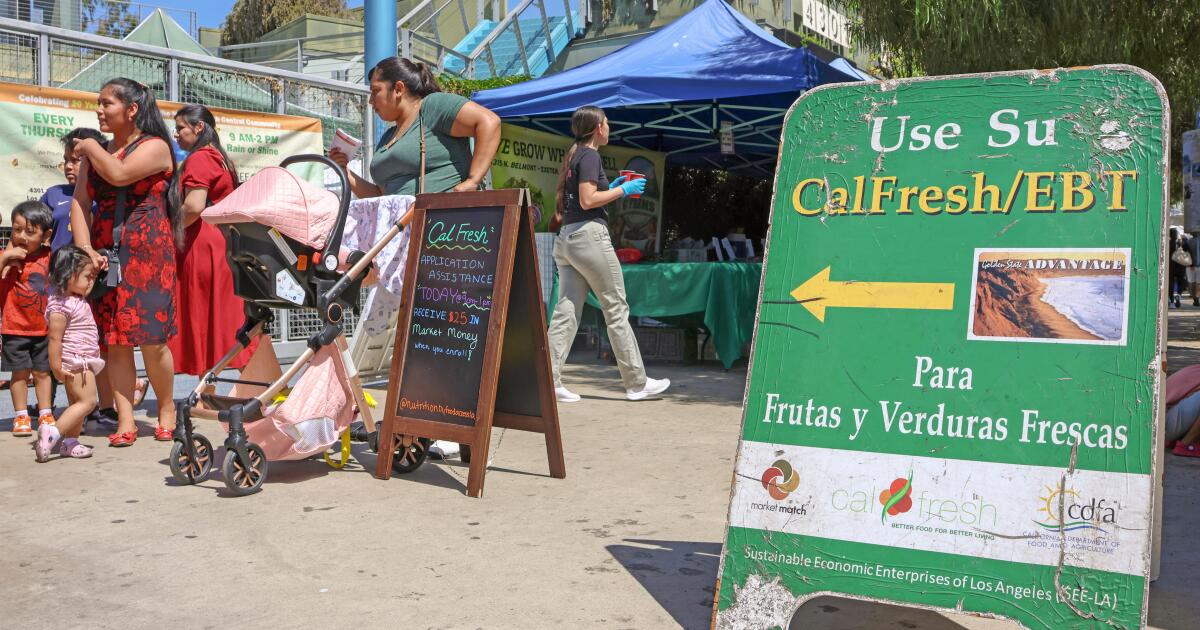
It’s a sweltering hot Thursday morning at the Central Avenue Farmers Market. Out of school for the summer, some kids chase each other around vendor booths while others snore in strollers next to their parents. Spirits seem high as laughter and conversations in Spanish and English mingle in the air. Today marks a new beginning for the neighborhood.
When ICE raids rattled the South L.A. community about a year ago, market organizers decided to move the weekly farmers market to a private courtyard — a hidden, cramped enclosure that was fenced off from the sidewalk. Alejandro Corona, the market manager, still remembers the incident last June that persuaded them to relocate.
“There was a lady actually coming out from the bus, she just walked down, and they took her,” he said. “Our customers were not feeling safe.”
Now the market is as visible as ever, with colorful, bilingual signs that advertise EBT, agricultural programs and other social services.
“Today we’re celebrating,” Corona says. He and other market organizers passed out refreshments to the vendors — tokens of appreciation for coming back outside amid continuing uncertainty.
Shoppers browse the vendor stalls at the Central Avenue Farmers Market in Historic South-Central.
(Nava Rawls / Los Angeles Times)
Although ICE raids aren’t as rampant here as they were a year ago, the South Central community faces new challenges in the midst of changes to federal spending.
Since the Trump administration passed HR 1, more commonly known as the “Big Beautiful Bill,” on July 4, 2025, EBT, known as CalFresh in California, is facing some of its largest funding cuts in U.S. history. Other changes include an increased budget of $85 billion for ICE, making it the single most funded federal law enforcement agency.
In Los Angeles County, it’s estimated that more than a quarter of residents receive CalFresh benefits. A wave of federal cuts on April 1 eliminated CalFresh assistance for several lawfully present immigrant groups in the state, including refugees and trafficking survivors.
CIELO, a nonprofit organization that works with Indigenous communities in Los Angeles, found that post-pandemic, one of the biggest challenges facing Indigenous migrant communities in Los Angeles is food insecurity. Over 80% of the migrants surveyed struggled to afford regular meals and housing, and these groups may face language barriers that make finding resources a challenge.
“We’ve been seeing that there’s an increase in the amount of people that are standing in our office when we give [out] food boxes, and they’re lining up,” said CIELO co-founder Janet Martinez. Since the pandemic, the organization has sent out email and text blasts to the community offering boxes of food — only 150 boxes are available each week.


1. Some vendors at the Central Avenue Farmers Market are open to bartering or trading with customers experiencing food scarcity. 2. Alejandro Corona, the manager of the Central Avenue Farmers Market. 3. A range of produce, including peas, is sold at the Central Avenue Farmers Market. (Nava Rawls / Los Angeles Times)
“A lot of us come to this community, to this farmers market, because we get seen as people, as human beings.” said Yoana Luvian, a vendor who sells Mexican food down the street and drives to the market from her home in Lincoln Heights.
“The help that they give here is very helpful to the moms, single moms, to people that are just trying to get through,” she said, her 10-year-old daughter Sarahi latched onto her arm.
Some, like Luvian, depend on markets like the one on Central Avenue to fill in the gaps that their EBT benefits can’t cover.
“You get $10 [in benefits], they give you 10 extra,” Luvian said in reference to the Market Match program, an incentive offered at the market that provides additional dollars to EBT users. “It gives us a little push.”

Yoana Luvian with her daughter, Sarahi, at the Central Avenue Farmers Market. She has used CalFresh benefits for the past decade.
(Nava Rawls / Los Angeles Times)
Others who are not eligible for federal benefits come to the market seeking additional resources.
Blanca, who chose not to provide her last name, is a mother who regularly visits the market at Central Avenue. Blanca and her husband are undocumented and do not qualify for CalFresh, but they have two children with disabilities who receive benefits each month.
Due to anxiety surrounding their immigration status, figuring out the paperwork for her children has been extremely difficult, Blanca said, as translated by Corona. She is concerned about what the future holds under the current administration, especially as her children grow older and require medical assistance.
“We have an autistic kid … someone said that we could apply for him, but it’s hard,” said Blanca. Market organizers also help her find resources in Spanish and navigate difficult paperwork.
Even before HR 1. was signed into law last July, the process of applying to and recertifying benefits was already extremely difficult, said Jennifer Grissom, executive director of Food Access Los Angeles, including complicated steps and paperwork. FALA is a nonprofit that organizes markets across L.A., including the one in South Central, and has a dedicated booth to help people register for CalFresh benefits. Recertification is required each year.
“When they try to go and recertify, they don’t know what they need, so it’s like jumping through hoops,” she said. “They may have done everything they needed to do, but there’s all these extra steps and administrative burden.”
Certification for CalFresh requires paperwork to prove residency and income, along with an interview that has to be held in real time.
Food banks and other local service providers are typically prepared for emergencies like wildfires and the occasional government shutdown — events that are temporarily disruptive but generally not ongoing. Under HR 1, agencies like the L.A. Regional Food Bank are being forced to make unprecedented changes in order to feed those in need.
“Distribution for the L.A. Regional Food Bank for 2026 is at 2025 levels, which for us is a little remarkable, because in the first half of 2025 we had the L.A. wildfires, which led to a huge increase in demand for food assistance,” said Michael Flood, the CEO of Los Angeles Regional Food Bank.
According to Grissom, some of the increased demand can be attributed to changes in work requirements for CalFresh recipients. As of June 1, able-bodied EBT users who work less than 30 hours per week, aren’t on unemployment and are between ages 18 to 64 without dependents under 14 are expected to find volunteer opportunities or part-time jobs that they might not be qualified for in an already “rough” job market, she said, in order to keep their benefits.


1. Farmer Brian Griffith of Griffith Family Farms at the Central Avenue Farmers Market. 2. The Market Match program is an incentive offered at the Central Avenue Farmers Market to encourage shoppers to use EBT benefits on local produce. 3. Oranges from the Central Avenue Farmers Market. (Nava Rawls / Los Angeles Times)
The effects of CalFresh cuts don’t stop at the recipients. Brian Griffith of Griffith Family Farms says that he has seen a 50% decrease in his profits since the cuts began.
“Many of the farmers are struggling,” said Griffith, who has been selling his produce at the Central Avenue Farmers Market for 15 years. “Whatever [EBT] benefits they get trickle down to us. And when I mean trickle down, I mean like little drips and drops.”
Griffith and other farmers at the market said that a large majority of their customers use EBT. When shoppers don’t have enough to cover purchases, several vendors suggested that they were open to bartering or offering deals for long-term customers. This kind of negotiation and mutual aid has proved essential in neighborhoods across Los Angeles, especially those that face food scarcity.
Chef Amin Muhammad, one of the partners behind the Crenshaw Food Hub, a collective kitchen space and market aimed at supporting BIPOC local farmers, says he increasingly has offered bartering and volunteer work in exchange for food in the past few months.
“If someone needs some[thing] more than the average customer, we work with them,” Muhammad said. He has one customer who picks lemons from his family’s tree to trade for other produce.
As funding cuts continue to limit food access for thousands of people across L.A., community members are also banding together to find the resources they need.
LaTonia Beason, a 67-year-old Leimert Park native, met her friend group through her weekly trek of visiting food assistance programs around the city. Holding an umbrella to protect herself from the sun, she heads there early in the morning to make sure she is first in line.
“We’re all [in this] together,” Beason said. She shares resources and extra groceries with friends whenever she can.

67-year-old Leimert Park native LaTonia Beason, is an EBT user who regularly attends food service programs around the city.
(Nava Rawls / Los Angeles Times)
In October 2026, a new wave of cuts to CalFresh will decrease the federal government’s contribution to CalFresh from 50% to 25%, leaving a larger portion of costs to states, counties and regional organizations.
“There’s this ripple effect that is gonna be a huge loss for all our communities,” said Grissom. “It’s creating such confusion, such anxiety, such an administrative burden, not just for the individuals, but for organizations like mine.”

It’s a sweltering hot Thursday morning at the Central Avenue Farmers Market. Out of school for the summer, some kids chase each other around vendor booths while others snore in strollers next to their parents. Spirits seem high as laughter and conversations in Spanish and English mingle in the air. Today marks a new beginning for the neighborhood.
When ICE raids rattled the South L.A. community about a year ago, market organizers decided to move the weekly farmers market to a private courtyard — a hidden, cramped enclosure that was fenced off from the sidewalk. Alejandro Corona, the market manager, still remembers the incident last June that persuaded them to relocate.
“There was a lady actually coming out from the bus, she just walked down, and they took her,” he said. “Our customers were not feeling safe.”
Now the market is as visible as ever, with colorful, bilingual signs that advertise EBT, agricultural programs and other social services.
“Today we’re celebrating,” Corona says. He and other market organizers passed out refreshments to the vendors — tokens of appreciation for coming back outside amid continuing uncertainty.
Shoppers browse the vendor stalls at the Central Avenue Farmers Market in Historic South-Central.
(Nava Rawls / Los Angeles Times)
Although ICE raids aren’t as rampant here as they were a year ago, the South Central community faces new challenges in the midst of changes to federal spending.
Since the Trump administration passed HR 1, more commonly known as the “Big Beautiful Bill,” on July 4, 2025, EBT, known as CalFresh in California, is facing some of its largest funding cuts in U.S. history. Other changes include an increased budget of $85 billion for ICE, making it the single most funded federal law enforcement agency.
In Los Angeles County, it’s estimated that more than a quarter of residents receive CalFresh benefits. A wave of federal cuts on April 1 eliminated CalFresh assistance for several lawfully present immigrant groups in the state, including refugees and trafficking survivors.
CIELO, a nonprofit organization that works with Indigenous communities in Los Angeles, found that post-pandemic, one of the biggest challenges facing Indigenous migrant communities in Los Angeles is food insecurity. Over 80% of the migrants surveyed struggled to afford regular meals and housing, and these groups may face language barriers that make finding resources a challenge.
“We’ve been seeing that there’s an increase in the amount of people that are standing in our office when we give [out] food boxes, and they’re lining up,” said CIELO co-founder Janet Martinez. Since the pandemic, the organization has sent out email and text blasts to the community offering boxes of food — only 150 boxes are available each week.
1. Some vendors at the Central Avenue Farmers Market are open to bartering or trading with customers experiencing food scarcity. 2. Alejandro Corona, the manager of the Central Avenue Farmers Market. 3. A range of produce, including peas, is sold at the Central Avenue Farmers Market. (Nava Rawls / Los Angeles Times)
“A lot of us come to this community, to this farmers market, because we get seen as people, as human beings.” said Yoana Luvian, a vendor who sells Mexican food down the street and drives to the market from her home in Lincoln Heights.
“The help that they give here is very helpful to the moms, single moms, to people that are just trying to get through,” she said, her 10-year-old daughter Sarahi latched onto her arm.
Some, like Luvian, depend on markets like the one on Central Avenue to fill in the gaps that their EBT benefits can’t cover.
“You get $10 [in benefits], they give you 10 extra,” Luvian said in reference to the Market Match program, an incentive offered at the market that provides additional dollars to EBT users. “It gives us a little push.”
Yoana Luvian with her daughter, Sarahi, at the Central Avenue Farmers Market. She has used CalFresh benefits for the past decade.
(Nava Rawls / Los Angeles Times)
Others who are not eligible for federal benefits come to the market seeking additional resources.
Blanca, who chose not to provide her last name, is a mother who regularly visits the market at Central Avenue. Blanca and her husband are undocumented and do not qualify for CalFresh, but they have two children with disabilities who receive benefits each month.
Due to anxiety surrounding their immigration status, figuring out the paperwork for her children has been extremely difficult, Blanca said, as translated by Corona. She is concerned about what the future holds under the current administration, especially as her children grow older and require medical assistance.
“We have an autistic kid … someone said that we could apply for him, but it’s hard,” said Blanca. Market organizers also help her find resources in Spanish and navigate difficult paperwork.
Even before HR 1. was signed into law last July, the process of applying to and recertifying benefits was already extremely difficult, said Jennifer Grissom, executive director of Food Access Los Angeles, including complicated steps and paperwork. FALA is a nonprofit that organizes markets across L.A., including the one in South Central, and has a dedicated booth to help people register for CalFresh benefits. Recertification is required each year.
“When they try to go and recertify, they don’t know what they need, so it’s like jumping through hoops,” she said. “They may have done everything they needed to do, but there’s all these extra steps and administrative burden.”
Certification for CalFresh requires paperwork to prove residency and income, along with an interview that has to be held in real time.
Food banks and other local service providers are typically prepared for emergencies like wildfires and the occasional government shutdown — events that are temporarily disruptive but generally not ongoing. Under HR 1, agencies like the L.A. Regional Food Bank are being forced to make unprecedented changes in order to feed those in need.
“Distribution for the L.A. Regional Food Bank for 2026 is at 2025 levels, which for us is a little remarkable, because in the first half of 2025 we had the L.A. wildfires, which led to a huge increase in demand for food assistance,” said Michael Flood, the CEO of Los Angeles Regional Food Bank.
According to Grissom, some of the increased demand can be attributed to changes in work requirements for CalFresh recipients. As of June 1, able-bodied EBT users who work less than 30 hours per week, aren’t on unemployment and are between ages 18 to 64 without dependents under 14 are expected to find volunteer opportunities or part-time jobs that they might not be qualified for in an already “rough” job market, she said, in order to keep their benefits.
1. Farmer Brian Griffith of Griffith Family Farms at the Central Avenue Farmers Market. 2. The Market Match program is an incentive offered at the Central Avenue Farmers Market to encourage shoppers to use EBT benefits on local produce. 3. Oranges from the Central Avenue Farmers Market. (Nava Rawls / Los Angeles Times)
The effects of CalFresh cuts don’t stop at the recipients. Brian Griffith of Griffith Family Farms says that he has seen a 50% decrease in his profits since the cuts began.
“Many of the farmers are struggling,” said Griffith, who has been selling his produce at the Central Avenue Farmers Market for 15 years. “Whatever [EBT] benefits they get trickle down to us. And when I mean trickle down, I mean like little drips and drops.”
Griffith and other farmers at the market said that a large majority of their customers use EBT. When shoppers don’t have enough to cover purchases, several vendors suggested that they were open to bartering or offering deals for long-term customers. This kind of negotiation and mutual aid has proved essential in neighborhoods across Los Angeles, especially those that face food scarcity.
Chef Amin Muhammad, one of the partners behind the Crenshaw Food Hub, a collective kitchen space and market aimed at supporting BIPOC local farmers, says he increasingly has offered bartering and volunteer work in exchange for food in the past few months.
“If someone needs some[thing] more than the average customer, we work with them,” Muhammad said. He has one customer who picks lemons from his family’s tree to trade for other produce.
As funding cuts continue to limit food access for thousands of people across L.A., community members are also banding together to find the resources they need.
LaTonia Beason, a 67-year-old Leimert Park native, met her friend group through her weekly trek of visiting food assistance programs around the city. Holding an umbrella to protect herself from the sun, she heads there early in the morning to make sure she is first in line.
“We’re all [in this] together,” Beason said. She shares resources and extra groceries with friends whenever she can.
67-year-old Leimert Park native LaTonia Beason, is an EBT user who regularly attends food service programs around the city.
(Nava Rawls / Los Angeles Times)
In October 2026, a new wave of cuts to CalFresh will decrease the federal government’s contribution to CalFresh from 50% to 25%, leaving a larger portion of costs to states, counties and regional organizations.
“There’s this ripple effect that is gonna be a huge loss for all our communities,” said Grissom. “It’s creating such confusion, such anxiety, such an administrative burden, not just for the individuals, but for organizations like mine.”

It’s a sweltering hot Thursday morning at the Central Avenue Farmers Market. Out of school for the summer, some kids chase each other around vendor booths while others snore in strollers next to their parents. Spirits seem high as laughter and conversations in Spanish and English mingle in the air. Today marks a new beginning for the neighborhood.
When ICE raids rattled the South L.A. community about a year ago, market organizers decided to move the weekly farmers market to a private courtyard — a hidden, cramped enclosure that was fenced off from the sidewalk. Alejandro Corona, the market manager, still remembers the incident last June that persuaded them to relocate.
“There was a lady actually coming out from the bus, she just walked down, and they took her,” he said. “Our customers were not feeling safe.”
Now the market is as visible as ever, with colorful, bilingual signs that advertise EBT, agricultural programs and other social services.
“Today we’re celebrating,” Corona says. He and other market organizers passed out refreshments to the vendors — tokens of appreciation for coming back outside amid continuing uncertainty.
Shoppers browse the vendor stalls at the Central Avenue Farmers Market in Historic South-Central.
(Nava Rawls / Los Angeles Times)
Although ICE raids aren’t as rampant here as they were a year ago, the South Central community faces new challenges in the midst of changes to federal spending.
Since the Trump administration passed HR 1, more commonly known as the “Big Beautiful Bill,” on July 4, 2025, EBT, known as CalFresh in California, is facing some of its largest funding cuts in U.S. history. Other changes include an increased budget of $85 billion for ICE, making it the single most funded federal law enforcement agency.
In Los Angeles County, it’s estimated that more than a quarter of residents receive CalFresh benefits. A wave of federal cuts on April 1 eliminated CalFresh assistance for several lawfully present immigrant groups in the state, including refugees and trafficking survivors.
CIELO, a nonprofit organization that works with Indigenous communities in Los Angeles, found that post-pandemic, one of the biggest challenges facing Indigenous migrant communities in Los Angeles is food insecurity. Over 80% of the migrants surveyed struggled to afford regular meals and housing, and these groups may face language barriers that make finding resources a challenge.
“We’ve been seeing that there’s an increase in the amount of people that are standing in our office when we give [out] food boxes, and they’re lining up,” said CIELO co-founder Janet Martinez. Since the pandemic, the organization has sent out email and text blasts to the community offering boxes of food — only 150 boxes are available each week.
1. Some vendors at the Central Avenue Farmers Market are open to bartering or trading with customers experiencing food scarcity. 2. Alejandro Corona, the manager of the Central Avenue Farmers Market. 3. A range of produce, including peas, is sold at the Central Avenue Farmers Market. (Nava Rawls / Los Angeles Times)
“A lot of us come to this community, to this farmers market, because we get seen as people, as human beings.” said Yoana Luvian, a vendor who sells Mexican food down the street and drives to the market from her home in Lincoln Heights.
“The help that they give here is very helpful to the moms, single moms, to people that are just trying to get through,” she said, her 10-year-old daughter Sarahi latched onto her arm.
Some, like Luvian, depend on markets like the one on Central Avenue to fill in the gaps that their EBT benefits can’t cover.
“You get $10 [in benefits], they give you 10 extra,” Luvian said in reference to the Market Match program, an incentive offered at the market that provides additional dollars to EBT users. “It gives us a little push.”
Yoana Luvian with her daughter, Sarahi, at the Central Avenue Farmers Market. She has used CalFresh benefits for the past decade.
(Nava Rawls / Los Angeles Times)
Others who are not eligible for federal benefits come to the market seeking additional resources.
Blanca, who chose not to provide her last name, is a mother who regularly visits the market at Central Avenue. Blanca and her husband are undocumented and do not qualify for CalFresh, but they have two children with disabilities who receive benefits each month.
Due to anxiety surrounding their immigration status, figuring out the paperwork for her children has been extremely difficult, Blanca said, as translated by Corona. She is concerned about what the future holds under the current administration, especially as her children grow older and require medical assistance.
“We have an autistic kid … someone said that we could apply for him, but it’s hard,” said Blanca. Market organizers also help her find resources in Spanish and navigate difficult paperwork.
Even before HR 1. was signed into law last July, the process of applying to and recertifying benefits was already extremely difficult, said Jennifer Grissom, executive director of Food Access Los Angeles, including complicated steps and paperwork. FALA is a nonprofit that organizes markets across L.A., including the one in South Central, and has a dedicated booth to help people register for CalFresh benefits. Recertification is required each year.
“When they try to go and recertify, they don’t know what they need, so it’s like jumping through hoops,” she said. “They may have done everything they needed to do, but there’s all these extra steps and administrative burden.”
Certification for CalFresh requires paperwork to prove residency and income, along with an interview that has to be held in real time.
Food banks and other local service providers are typically prepared for emergencies like wildfires and the occasional government shutdown — events that are temporarily disruptive but generally not ongoing. Under HR 1, agencies like the L.A. Regional Food Bank are being forced to make unprecedented changes in order to feed those in need.
“Distribution for the L.A. Regional Food Bank for 2026 is at 2025 levels, which for us is a little remarkable, because in the first half of 2025 we had the L.A. wildfires, which led to a huge increase in demand for food assistance,” said Michael Flood, the CEO of Los Angeles Regional Food Bank.
According to Grissom, some of the increased demand can be attributed to changes in work requirements for CalFresh recipients. As of June 1, able-bodied EBT users who work less than 30 hours per week, aren’t on unemployment and are between ages 18 to 64 without dependents under 14 are expected to find volunteer opportunities or part-time jobs that they might not be qualified for in an already “rough” job market, she said, in order to keep their benefits.
1. Farmer Brian Griffith of Griffith Family Farms at the Central Avenue Farmers Market. 2. The Market Match program is an incentive offered at the Central Avenue Farmers Market to encourage shoppers to use EBT benefits on local produce. 3. Oranges from the Central Avenue Farmers Market. (Nava Rawls / Los Angeles Times)
The effects of CalFresh cuts don’t stop at the recipients. Brian Griffith of Griffith Family Farms says that he has seen a 50% decrease in his profits since the cuts began.
“Many of the farmers are struggling,” said Griffith, who has been selling his produce at the Central Avenue Farmers Market for 15 years. “Whatever [EBT] benefits they get trickle down to us. And when I mean trickle down, I mean like little drips and drops.”
Griffith and other farmers at the market said that a large majority of their customers use EBT. When shoppers don’t have enough to cover purchases, several vendors suggested that they were open to bartering or offering deals for long-term customers. This kind of negotiation and mutual aid has proved essential in neighborhoods across Los Angeles, especially those that face food scarcity.
Chef Amin Muhammad, one of the partners behind the Crenshaw Food Hub, a collective kitchen space and market aimed at supporting BIPOC local farmers, says he increasingly has offered bartering and volunteer work in exchange for food in the past few months.
“If someone needs some[thing] more than the average customer, we work with them,” Muhammad said. He has one customer who picks lemons from his family’s tree to trade for other produce.
As funding cuts continue to limit food access for thousands of people across L.A., community members are also banding together to find the resources they need.
LaTonia Beason, a 67-year-old Leimert Park native, met her friend group through her weekly trek of visiting food assistance programs around the city. Holding an umbrella to protect herself from the sun, she heads there early in the morning to make sure she is first in line.
“We’re all [in this] together,” Beason said. She shares resources and extra groceries with friends whenever she can.
67-year-old Leimert Park native LaTonia Beason, is an EBT user who regularly attends food service programs around the city.
(Nava Rawls / Los Angeles Times)
In October 2026, a new wave of cuts to CalFresh will decrease the federal government’s contribution to CalFresh from 50% to 25%, leaving a larger portion of costs to states, counties and regional organizations.
“There’s this ripple effect that is gonna be a huge loss for all our communities,” said Grissom. “It’s creating such confusion, such anxiety, such an administrative burden, not just for the individuals, but for organizations like mine.”
It’s a sweltering hot Thursday morning at the Central Avenue Farmers Market. Out of school for the summer, some kids chase each other around vendor booths while others snore in strollers next to their parents. Spirits seem high as laughter and conversations in Spanish and English mingle in the air. Today marks a new beginning for the neighborhood.
When ICE raids rattled the South L.A. community about a year ago, market organizers decided to move the weekly farmers market to a private courtyard — a hidden, cramped enclosure that was fenced off from the sidewalk. Alejandro Corona, the market manager, still remembers the incident last June that persuaded them to relocate.
“There was a lady actually coming out from the bus, she just walked down, and they took her,” he said. “Our customers were not feeling safe.”
Now the market is as visible as ever, with colorful, bilingual signs that advertise EBT, agricultural programs and other social services.
“Today we’re celebrating,” Corona says. He and other market organizers passed out refreshments to the vendors — tokens of appreciation for coming back outside amid continuing uncertainty.
Shoppers browse the vendor stalls at the Central Avenue Farmers Market in Historic South-Central.
(Nava Rawls / Los Angeles Times)
Although ICE raids aren’t as rampant here as they were a year ago, the South Central community faces new challenges in the midst of changes to federal spending.
Since the Trump administration passed HR 1, more commonly known as the “Big Beautiful Bill,” on July 4, 2025, EBT, known as CalFresh in California, is facing some of its largest funding cuts in U.S. history. Other changes include an increased budget of $85 billion for ICE, making it the single most funded federal law enforcement agency.
In Los Angeles County, it’s estimated that more than a quarter of residents receive CalFresh benefits. A wave of federal cuts on April 1 eliminated CalFresh assistance for several lawfully present immigrant groups in the state, including refugees and trafficking survivors.
CIELO, a nonprofit organization that works with Indigenous communities in Los Angeles, found that post-pandemic, one of the biggest challenges facing Indigenous migrant communities in Los Angeles is food insecurity. Over 80% of the migrants surveyed struggled to afford regular meals and housing, and these groups may face language barriers that make finding resources a challenge.
“We’ve been seeing that there’s an increase in the amount of people that are standing in our office when we give [out] food boxes, and they’re lining up,” said CIELO co-founder Janet Martinez. Since the pandemic, the organization has sent out email and text blasts to the community offering boxes of food — only 150 boxes are available each week.
1. Some vendors at the Central Avenue Farmers Market are open to bartering or trading with customers experiencing food scarcity. 2. Alejandro Corona, the manager of the Central Avenue Farmers Market. 3. A range of produce, including peas, is sold at the Central Avenue Farmers Market. (Nava Rawls / Los Angeles Times)
“A lot of us come to this community, to this farmers market, because we get seen as people, as human beings.” said Yoana Luvian, a vendor who sells Mexican food down the street and drives to the market from her home in Lincoln Heights.
“The help that they give here is very helpful to the moms, single moms, to people that are just trying to get through,” she said, her 10-year-old daughter Sarahi latched onto her arm.
Some, like Luvian, depend on markets like the one on Central Avenue to fill in the gaps that their EBT benefits can’t cover.
“You get $10 [in benefits], they give you 10 extra,” Luvian said in reference to the Market Match program, an incentive offered at the market that provides additional dollars to EBT users. “It gives us a little push.”
Yoana Luvian with her daughter, Sarahi, at the Central Avenue Farmers Market. She has used CalFresh benefits for the past decade.
(Nava Rawls / Los Angeles Times)
Others who are not eligible for federal benefits come to the market seeking additional resources.
Blanca, who chose not to provide her last name, is a mother who regularly visits the market at Central Avenue. Blanca and her husband are undocumented and do not qualify for CalFresh, but they have two children with disabilities who receive benefits each month.
Due to anxiety surrounding their immigration status, figuring out the paperwork for her children has been extremely difficult, Blanca said, as translated by Corona. She is concerned about what the future holds under the current administration, especially as her children grow older and require medical assistance.
“We have an autistic kid … someone said that we could apply for him, but it’s hard,” said Blanca. Market organizers also help her find resources in Spanish and navigate difficult paperwork.
Even before HR 1. was signed into law last July, the process of applying to and recertifying benefits was already extremely difficult, said Jennifer Grissom, executive director of Food Access Los Angeles, including complicated steps and paperwork. FALA is a nonprofit that organizes markets across L.A., including the one in South Central, and has a dedicated booth to help people register for CalFresh benefits. Recertification is required each year.
“When they try to go and recertify, they don’t know what they need, so it’s like jumping through hoops,” she said. “They may have done everything they needed to do, but there’s all these extra steps and administrative burden.”
Certification for CalFresh requires paperwork to prove residency and income, along with an interview that has to be held in real time.
Food banks and other local service providers are typically prepared for emergencies like wildfires and the occasional government shutdown — events that are temporarily disruptive but generally not ongoing. Under HR 1, agencies like the L.A. Regional Food Bank are being forced to make unprecedented changes in order to feed those in need.
“Distribution for the L.A. Regional Food Bank for 2026 is at 2025 levels, which for us is a little remarkable, because in the first half of 2025 we had the L.A. wildfires, which led to a huge increase in demand for food assistance,” said Michael Flood, the CEO of Los Angeles Regional Food Bank.
According to Grissom, some of the increased demand can be attributed to changes in work requirements for CalFresh recipients. As of June 1, able-bodied EBT users who work less than 30 hours per week, aren’t on unemployment and are between ages 18 to 64 without dependents under 14 are expected to find volunteer opportunities or part-time jobs that they might not be qualified for in an already “rough” job market, she said, in order to keep their benefits.
1. Farmer Brian Griffith of Griffith Family Farms at the Central Avenue Farmers Market. 2. The Market Match program is an incentive offered at the Central Avenue Farmers Market to encourage shoppers to use EBT benefits on local produce. 3. Oranges from the Central Avenue Farmers Market. (Nava Rawls / Los Angeles Times)
The effects of CalFresh cuts don’t stop at the recipients. Brian Griffith of Griffith Family Farms says that he has seen a 50% decrease in his profits since the cuts began.
“Many of the farmers are struggling,” said Griffith, who has been selling his produce at the Central Avenue Farmers Market for 15 years. “Whatever [EBT] benefits they get trickle down to us. And when I mean trickle down, I mean like little drips and drops.”
Griffith and other farmers at the market said that a large majority of their customers use EBT. When shoppers don’t have enough to cover purchases, several vendors suggested that they were open to bartering or offering deals for long-term customers. This kind of negotiation and mutual aid has proved essential in neighborhoods across Los Angeles, especially those that face food scarcity.
Chef Amin Muhammad, one of the partners behind the Crenshaw Food Hub, a collective kitchen space and market aimed at supporting BIPOC local farmers, says he increasingly has offered bartering and volunteer work in exchange for food in the past few months.
“If someone needs some[thing] more than the average customer, we work with them,” Muhammad said. He has one customer who picks lemons from his family’s tree to trade for other produce.
As funding cuts continue to limit food access for thousands of people across L.A., community members are also banding together to find the resources they need.
LaTonia Beason, a 67-year-old Leimert Park native, met her friend group through her weekly trek of visiting food assistance programs around the city. Holding an umbrella to protect herself from the sun, she heads there early in the morning to make sure she is first in line.
“We’re all [in this] together,” Beason said. She shares resources and extra groceries with friends whenever she can.
67-year-old Leimert Park native LaTonia Beason, is an EBT user who regularly attends food service programs around the city.
(Nava Rawls / Los Angeles Times)
In October 2026, a new wave of cuts to CalFresh will decrease the federal government’s contribution to CalFresh from 50% to 25%, leaving a larger portion of costs to states, counties and regional organizations.
“There’s this ripple effect that is gonna be a huge loss for all our communities,” said Grissom. “It’s creating such confusion, such anxiety, such an administrative burden, not just for the individuals, but for organizations like mine.”

It’s a sweltering hot Thursday morning at the Central Avenue Farmers Market. Out of school for the summer, some kids chase each other around vendor booths while others snore in strollers next to their parents. Spirits seem high as laughter and conversations in Spanish and English mingle in the air. Today marks a new beginning for the neighborhood.
When ICE raids rattled the South L.A. community about a year ago, market organizers decided to move the weekly farmers market to a private courtyard — a hidden, cramped enclosure that was fenced off from the sidewalk. Alejandro Corona, the market manager, still remembers the incident last June that persuaded them to relocate.
“There was a lady actually coming out from the bus, she just walked down, and they took her,” he said. “Our customers were not feeling safe.”
Now the market is as visible as ever, with colorful, bilingual signs that advertise EBT, agricultural programs and other social services.
“Today we’re celebrating,” Corona says. He and other market organizers passed out refreshments to the vendors — tokens of appreciation for coming back outside amid continuing uncertainty.
Shoppers browse the vendor stalls at the Central Avenue Farmers Market in Historic South-Central.
(Nava Rawls / Los Angeles Times)
Although ICE raids aren’t as rampant here as they were a year ago, the South Central community faces new challenges in the midst of changes to federal spending.
Since the Trump administration passed HR 1, more commonly known as the “Big Beautiful Bill,” on July 4, 2025, EBT, known as CalFresh in California, is facing some of its largest funding cuts in U.S. history. Other changes include an increased budget of $85 billion for ICE, making it the single most funded federal law enforcement agency.
In Los Angeles County, it’s estimated that more than a quarter of residents receive CalFresh benefits. A wave of federal cuts on April 1 eliminated CalFresh assistance for several lawfully present immigrant groups in the state, including refugees and trafficking survivors.
CIELO, a nonprofit organization that works with Indigenous communities in Los Angeles, found that post-pandemic, one of the biggest challenges facing Indigenous migrant communities in Los Angeles is food insecurity. Over 80% of the migrants surveyed struggled to afford regular meals and housing, and these groups may face language barriers that make finding resources a challenge.
“We’ve been seeing that there’s an increase in the amount of people that are standing in our office when we give [out] food boxes, and they’re lining up,” said CIELO co-founder Janet Martinez. Since the pandemic, the organization has sent out email and text blasts to the community offering boxes of food — only 150 boxes are available each week.
1. Some vendors at the Central Avenue Farmers Market are open to bartering or trading with customers experiencing food scarcity. 2. Alejandro Corona, the manager of the Central Avenue Farmers Market. 3. A range of produce, including peas, is sold at the Central Avenue Farmers Market. (Nava Rawls / Los Angeles Times)
“A lot of us come to this community, to this farmers market, because we get seen as people, as human beings.” said Yoana Luvian, a vendor who sells Mexican food down the street and drives to the market from her home in Lincoln Heights.
“The help that they give here is very helpful to the moms, single moms, to people that are just trying to get through,” she said, her 10-year-old daughter Sarahi latched onto her arm.
Some, like Luvian, depend on markets like the one on Central Avenue to fill in the gaps that their EBT benefits can’t cover.
“You get $10 [in benefits], they give you 10 extra,” Luvian said in reference to the Market Match program, an incentive offered at the market that provides additional dollars to EBT users. “It gives us a little push.”
Yoana Luvian with her daughter, Sarahi, at the Central Avenue Farmers Market. She has used CalFresh benefits for the past decade.
(Nava Rawls / Los Angeles Times)
Others who are not eligible for federal benefits come to the market seeking additional resources.
Blanca, who chose not to provide her last name, is a mother who regularly visits the market at Central Avenue. Blanca and her husband are undocumented and do not qualify for CalFresh, but they have two children with disabilities who receive benefits each month.
Due to anxiety surrounding their immigration status, figuring out the paperwork for her children has been extremely difficult, Blanca said, as translated by Corona. She is concerned about what the future holds under the current administration, especially as her children grow older and require medical assistance.
“We have an autistic kid … someone said that we could apply for him, but it’s hard,” said Blanca. Market organizers also help her find resources in Spanish and navigate difficult paperwork.
Even before HR 1. was signed into law last July, the process of applying to and recertifying benefits was already extremely difficult, said Jennifer Grissom, executive director of Food Access Los Angeles, including complicated steps and paperwork. FALA is a nonprofit that organizes markets across L.A., including the one in South Central, and has a dedicated booth to help people register for CalFresh benefits. Recertification is required each year.
“When they try to go and recertify, they don’t know what they need, so it’s like jumping through hoops,” she said. “They may have done everything they needed to do, but there’s all these extra steps and administrative burden.”
Certification for CalFresh requires paperwork to prove residency and income, along with an interview that has to be held in real time.
Food banks and other local service providers are typically prepared for emergencies like wildfires and the occasional government shutdown — events that are temporarily disruptive but generally not ongoing. Under HR 1, agencies like the L.A. Regional Food Bank are being forced to make unprecedented changes in order to feed those in need.
“Distribution for the L.A. Regional Food Bank for 2026 is at 2025 levels, which for us is a little remarkable, because in the first half of 2025 we had the L.A. wildfires, which led to a huge increase in demand for food assistance,” said Michael Flood, the CEO of Los Angeles Regional Food Bank.
According to Grissom, some of the increased demand can be attributed to changes in work requirements for CalFresh recipients. As of June 1, able-bodied EBT users who work less than 30 hours per week, aren’t on unemployment and are between ages 18 to 64 without dependents under 14 are expected to find volunteer opportunities or part-time jobs that they might not be qualified for in an already “rough” job market, she said, in order to keep their benefits.
1. Farmer Brian Griffith of Griffith Family Farms at the Central Avenue Farmers Market. 2. The Market Match program is an incentive offered at the Central Avenue Farmers Market to encourage shoppers to use EBT benefits on local produce. 3. Oranges from the Central Avenue Farmers Market. (Nava Rawls / Los Angeles Times)
The effects of CalFresh cuts don’t stop at the recipients. Brian Griffith of Griffith Family Farms says that he has seen a 50% decrease in his profits since the cuts began.
“Many of the farmers are struggling,” said Griffith, who has been selling his produce at the Central Avenue Farmers Market for 15 years. “Whatever [EBT] benefits they get trickle down to us. And when I mean trickle down, I mean like little drips and drops.”
Griffith and other farmers at the market said that a large majority of their customers use EBT. When shoppers don’t have enough to cover purchases, several vendors suggested that they were open to bartering or offering deals for long-term customers. This kind of negotiation and mutual aid has proved essential in neighborhoods across Los Angeles, especially those that face food scarcity.
Chef Amin Muhammad, one of the partners behind the Crenshaw Food Hub, a collective kitchen space and market aimed at supporting BIPOC local farmers, says he increasingly has offered bartering and volunteer work in exchange for food in the past few months.
“If someone needs some[thing] more than the average customer, we work with them,” Muhammad said. He has one customer who picks lemons from his family’s tree to trade for other produce.
As funding cuts continue to limit food access for thousands of people across L.A., community members are also banding together to find the resources they need.
LaTonia Beason, a 67-year-old Leimert Park native, met her friend group through her weekly trek of visiting food assistance programs around the city. Holding an umbrella to protect herself from the sun, she heads there early in the morning to make sure she is first in line.
“We’re all [in this] together,” Beason said. She shares resources and extra groceries with friends whenever she can.
67-year-old Leimert Park native LaTonia Beason, is an EBT user who regularly attends food service programs around the city.
(Nava Rawls / Los Angeles Times)
In October 2026, a new wave of cuts to CalFresh will decrease the federal government’s contribution to CalFresh from 50% to 25%, leaving a larger portion of costs to states, counties and regional organizations.
“There’s this ripple effect that is gonna be a huge loss for all our communities,” said Grissom. “It’s creating such confusion, such anxiety, such an administrative burden, not just for the individuals, but for organizations like mine.”
It’s a sweltering hot Thursday morning at the Central Avenue Farmers Market. Out of school for the summer, some kids chase each other around vendor booths while others snore in strollers next to their parents. Spirits seem high as laughter and conversations in Spanish and English mingle in the air. Today marks a new beginning for the neighborhood.
When ICE raids rattled the South L.A. community about a year ago, market organizers decided to move the weekly farmers market to a private courtyard — a hidden, cramped enclosure that was fenced off from the sidewalk. Alejandro Corona, the market manager, still remembers the incident last June that persuaded them to relocate.
“There was a lady actually coming out from the bus, she just walked down, and they took her,” he said. “Our customers were not feeling safe.”
Now the market is as visible as ever, with colorful, bilingual signs that advertise EBT, agricultural programs and other social services.
“Today we’re celebrating,” Corona says. He and other market organizers passed out refreshments to the vendors — tokens of appreciation for coming back outside amid continuing uncertainty.
Shoppers browse the vendor stalls at the Central Avenue Farmers Market in Historic South-Central.
(Nava Rawls / Los Angeles Times)
Although ICE raids aren’t as rampant here as they were a year ago, the South Central community faces new challenges in the midst of changes to federal spending.
Since the Trump administration passed HR 1, more commonly known as the “Big Beautiful Bill,” on July 4, 2025, EBT, known as CalFresh in California, is facing some of its largest funding cuts in U.S. history. Other changes include an increased budget of $85 billion for ICE, making it the single most funded federal law enforcement agency.
In Los Angeles County, it’s estimated that more than a quarter of residents receive CalFresh benefits. A wave of federal cuts on April 1 eliminated CalFresh assistance for several lawfully present immigrant groups in the state, including refugees and trafficking survivors.
CIELO, a nonprofit organization that works with Indigenous communities in Los Angeles, found that post-pandemic, one of the biggest challenges facing Indigenous migrant communities in Los Angeles is food insecurity. Over 80% of the migrants surveyed struggled to afford regular meals and housing, and these groups may face language barriers that make finding resources a challenge.
“We’ve been seeing that there’s an increase in the amount of people that are standing in our office when we give [out] food boxes, and they’re lining up,” said CIELO co-founder Janet Martinez. Since the pandemic, the organization has sent out email and text blasts to the community offering boxes of food — only 150 boxes are available each week.
1. Some vendors at the Central Avenue Farmers Market are open to bartering or trading with customers experiencing food scarcity. 2. Alejandro Corona, the manager of the Central Avenue Farmers Market. 3. A range of produce, including peas, is sold at the Central Avenue Farmers Market. (Nava Rawls / Los Angeles Times)
“A lot of us come to this community, to this farmers market, because we get seen as people, as human beings.” said Yoana Luvian, a vendor who sells Mexican food down the street and drives to the market from her home in Lincoln Heights.
“The help that they give here is very helpful to the moms, single moms, to people that are just trying to get through,” she said, her 10-year-old daughter Sarahi latched onto her arm.
Some, like Luvian, depend on markets like the one on Central Avenue to fill in the gaps that their EBT benefits can’t cover.
“You get $10 [in benefits], they give you 10 extra,” Luvian said in reference to the Market Match program, an incentive offered at the market that provides additional dollars to EBT users. “It gives us a little push.”
Yoana Luvian with her daughter, Sarahi, at the Central Avenue Farmers Market. She has used CalFresh benefits for the past decade.
(Nava Rawls / Los Angeles Times)
Others who are not eligible for federal benefits come to the market seeking additional resources.
Blanca, who chose not to provide her last name, is a mother who regularly visits the market at Central Avenue. Blanca and her husband are undocumented and do not qualify for CalFresh, but they have two children with disabilities who receive benefits each month.
Due to anxiety surrounding their immigration status, figuring out the paperwork for her children has been extremely difficult, Blanca said, as translated by Corona. She is concerned about what the future holds under the current administration, especially as her children grow older and require medical assistance.
“We have an autistic kid … someone said that we could apply for him, but it’s hard,” said Blanca. Market organizers also help her find resources in Spanish and navigate difficult paperwork.
Even before HR 1. was signed into law last July, the process of applying to and recertifying benefits was already extremely difficult, said Jennifer Grissom, executive director of Food Access Los Angeles, including complicated steps and paperwork. FALA is a nonprofit that organizes markets across L.A., including the one in South Central, and has a dedicated booth to help people register for CalFresh benefits. Recertification is required each year.
“When they try to go and recertify, they don’t know what they need, so it’s like jumping through hoops,” she said. “They may have done everything they needed to do, but there’s all these extra steps and administrative burden.”
Certification for CalFresh requires paperwork to prove residency and income, along with an interview that has to be held in real time.
Food banks and other local service providers are typically prepared for emergencies like wildfires and the occasional government shutdown — events that are temporarily disruptive but generally not ongoing. Under HR 1, agencies like the L.A. Regional Food Bank are being forced to make unprecedented changes in order to feed those in need.
“Distribution for the L.A. Regional Food Bank for 2026 is at 2025 levels, which for us is a little remarkable, because in the first half of 2025 we had the L.A. wildfires, which led to a huge increase in demand for food assistance,” said Michael Flood, the CEO of Los Angeles Regional Food Bank.
According to Grissom, some of the increased demand can be attributed to changes in work requirements for CalFresh recipients. As of June 1, able-bodied EBT users who work less than 30 hours per week, aren’t on unemployment and are between ages 18 to 64 without dependents under 14 are expected to find volunteer opportunities or part-time jobs that they might not be qualified for in an already “rough” job market, she said, in order to keep their benefits.
1. Farmer Brian Griffith of Griffith Family Farms at the Central Avenue Farmers Market. 2. The Market Match program is an incentive offered at the Central Avenue Farmers Market to encourage shoppers to use EBT benefits on local produce. 3. Oranges from the Central Avenue Farmers Market. (Nava Rawls / Los Angeles Times)
The effects of CalFresh cuts don’t stop at the recipients. Brian Griffith of Griffith Family Farms says that he has seen a 50% decrease in his profits since the cuts began.
“Many of the farmers are struggling,” said Griffith, who has been selling his produce at the Central Avenue Farmers Market for 15 years. “Whatever [EBT] benefits they get trickle down to us. And when I mean trickle down, I mean like little drips and drops.”
Griffith and other farmers at the market said that a large majority of their customers use EBT. When shoppers don’t have enough to cover purchases, several vendors suggested that they were open to bartering or offering deals for long-term customers. This kind of negotiation and mutual aid has proved essential in neighborhoods across Los Angeles, especially those that face food scarcity.
Chef Amin Muhammad, one of the partners behind the Crenshaw Food Hub, a collective kitchen space and market aimed at supporting BIPOC local farmers, says he increasingly has offered bartering and volunteer work in exchange for food in the past few months.
“If someone needs some[thing] more than the average customer, we work with them,” Muhammad said. He has one customer who picks lemons from his family’s tree to trade for other produce.
As funding cuts continue to limit food access for thousands of people across L.A., community members are also banding together to find the resources they need.
LaTonia Beason, a 67-year-old Leimert Park native, met her friend group through her weekly trek of visiting food assistance programs around the city. Holding an umbrella to protect herself from the sun, she heads there early in the morning to make sure she is first in line.
“We’re all [in this] together,” Beason said. She shares resources and extra groceries with friends whenever she can.
67-year-old Leimert Park native LaTonia Beason, is an EBT user who regularly attends food service programs around the city.
(Nava Rawls / Los Angeles Times)
In October 2026, a new wave of cuts to CalFresh will decrease the federal government’s contribution to CalFresh from 50% to 25%, leaving a larger portion of costs to states, counties and regional organizations.
“There’s this ripple effect that is gonna be a huge loss for all our communities,” said Grissom. “It’s creating such confusion, such anxiety, such an administrative burden, not just for the individuals, but for organizations like mine.”
It’s a sweltering hot Thursday morning at the Central Avenue Farmers Market. Out of school for the summer, some kids chase each other around vendor booths while others snore in strollers next to their parents. Spirits seem high as laughter and conversations in Spanish and English mingle in the air. Today marks a new beginning for the neighborhood.
When ICE raids rattled the South L.A. community about a year ago, market organizers decided to move the weekly farmers market to a private courtyard — a hidden, cramped enclosure that was fenced off from the sidewalk. Alejandro Corona, the market manager, still remembers the incident last June that persuaded them to relocate.
“There was a lady actually coming out from the bus, she just walked down, and they took her,” he said. “Our customers were not feeling safe.”
Now the market is as visible as ever, with colorful, bilingual signs that advertise EBT, agricultural programs and other social services.
“Today we’re celebrating,” Corona says. He and other market organizers passed out refreshments to the vendors — tokens of appreciation for coming back outside amid continuing uncertainty.
Shoppers browse the vendor stalls at the Central Avenue Farmers Market in Historic South-Central.
(Nava Rawls / Los Angeles Times)
Although ICE raids aren’t as rampant here as they were a year ago, the South Central community faces new challenges in the midst of changes to federal spending.
Since the Trump administration passed HR 1, more commonly known as the “Big Beautiful Bill,” on July 4, 2025, EBT, known as CalFresh in California, is facing some of its largest funding cuts in U.S. history. Other changes include an increased budget of $85 billion for ICE, making it the single most funded federal law enforcement agency.
In Los Angeles County, it’s estimated that more than a quarter of residents receive CalFresh benefits. A wave of federal cuts on April 1 eliminated CalFresh assistance for several lawfully present immigrant groups in the state, including refugees and trafficking survivors.
CIELO, a nonprofit organization that works with Indigenous communities in Los Angeles, found that post-pandemic, one of the biggest challenges facing Indigenous migrant communities in Los Angeles is food insecurity. Over 80% of the migrants surveyed struggled to afford regular meals and housing, and these groups may face language barriers that make finding resources a challenge.
“We’ve been seeing that there’s an increase in the amount of people that are standing in our office when we give [out] food boxes, and they’re lining up,” said CIELO co-founder Janet Martinez. Since the pandemic, the organization has sent out email and text blasts to the community offering boxes of food — only 150 boxes are available each week.
1. Some vendors at the Central Avenue Farmers Market are open to bartering or trading with customers experiencing food scarcity. 2. Alejandro Corona, the manager of the Central Avenue Farmers Market. 3. A range of produce, including peas, is sold at the Central Avenue Farmers Market. (Nava Rawls / Los Angeles Times)
“A lot of us come to this community, to this farmers market, because we get seen as people, as human beings.” said Yoana Luvian, a vendor who sells Mexican food down the street and drives to the market from her home in Lincoln Heights.
“The help that they give here is very helpful to the moms, single moms, to people that are just trying to get through,” she said, her 10-year-old daughter Sarahi latched onto her arm.
Some, like Luvian, depend on markets like the one on Central Avenue to fill in the gaps that their EBT benefits can’t cover.
“You get $10 [in benefits], they give you 10 extra,” Luvian said in reference to the Market Match program, an incentive offered at the market that provides additional dollars to EBT users. “It gives us a little push.”
Yoana Luvian with her daughter, Sarahi, at the Central Avenue Farmers Market. She has used CalFresh benefits for the past decade.
(Nava Rawls / Los Angeles Times)
Others who are not eligible for federal benefits come to the market seeking additional resources.
Blanca, who chose not to provide her last name, is a mother who regularly visits the market at Central Avenue. Blanca and her husband are undocumented and do not qualify for CalFresh, but they have two children with disabilities who receive benefits each month.
Due to anxiety surrounding their immigration status, figuring out the paperwork for her children has been extremely difficult, Blanca said, as translated by Corona. She is concerned about what the future holds under the current administration, especially as her children grow older and require medical assistance.
“We have an autistic kid … someone said that we could apply for him, but it’s hard,” said Blanca. Market organizers also help her find resources in Spanish and navigate difficult paperwork.
Even before HR 1. was signed into law last July, the process of applying to and recertifying benefits was already extremely difficult, said Jennifer Grissom, executive director of Food Access Los Angeles, including complicated steps and paperwork. FALA is a nonprofit that organizes markets across L.A., including the one in South Central, and has a dedicated booth to help people register for CalFresh benefits. Recertification is required each year.
“When they try to go and recertify, they don’t know what they need, so it’s like jumping through hoops,” she said. “They may have done everything they needed to do, but there’s all these extra steps and administrative burden.”
Certification for CalFresh requires paperwork to prove residency and income, along with an interview that has to be held in real time.
Food banks and other local service providers are typically prepared for emergencies like wildfires and the occasional government shutdown — events that are temporarily disruptive but generally not ongoing. Under HR 1, agencies like the L.A. Regional Food Bank are being forced to make unprecedented changes in order to feed those in need.
“Distribution for the L.A. Regional Food Bank for 2026 is at 2025 levels, which for us is a little remarkable, because in the first half of 2025 we had the L.A. wildfires, which led to a huge increase in demand for food assistance,” said Michael Flood, the CEO of Los Angeles Regional Food Bank.
According to Grissom, some of the increased demand can be attributed to changes in work requirements for CalFresh recipients. As of June 1, able-bodied EBT users who work less than 30 hours per week, aren’t on unemployment and are between ages 18 to 64 without dependents under 14 are expected to find volunteer opportunities or part-time jobs that they might not be qualified for in an already “rough” job market, she said, in order to keep their benefits.
1. Farmer Brian Griffith of Griffith Family Farms at the Central Avenue Farmers Market. 2. The Market Match program is an incentive offered at the Central Avenue Farmers Market to encourage shoppers to use EBT benefits on local produce. 3. Oranges from the Central Avenue Farmers Market. (Nava Rawls / Los Angeles Times)
The effects of CalFresh cuts don’t stop at the recipients. Brian Griffith of Griffith Family Farms says that he has seen a 50% decrease in his profits since the cuts began.
“Many of the farmers are struggling,” said Griffith, who has been selling his produce at the Central Avenue Farmers Market for 15 years. “Whatever [EBT] benefits they get trickle down to us. And when I mean trickle down, I mean like little drips and drops.”
Griffith and other farmers at the market said that a large majority of their customers use EBT. When shoppers don’t have enough to cover purchases, several vendors suggested that they were open to bartering or offering deals for long-term customers. This kind of negotiation and mutual aid has proved essential in neighborhoods across Los Angeles, especially those that face food scarcity.
Chef Amin Muhammad, one of the partners behind the Crenshaw Food Hub, a collective kitchen space and market aimed at supporting BIPOC local farmers, says he increasingly has offered bartering and volunteer work in exchange for food in the past few months.
“If someone needs some[thing] more than the average customer, we work with them,” Muhammad said. He has one customer who picks lemons from his family’s tree to trade for other produce.
As funding cuts continue to limit food access for thousands of people across L.A., community members are also banding together to find the resources they need.
LaTonia Beason, a 67-year-old Leimert Park native, met her friend group through her weekly trek of visiting food assistance programs around the city. Holding an umbrella to protect herself from the sun, she heads there early in the morning to make sure she is first in line.
“We’re all [in this] together,” Beason said. She shares resources and extra groceries with friends whenever she can.
67-year-old Leimert Park native LaTonia Beason, is an EBT user who regularly attends food service programs around the city.
(Nava Rawls / Los Angeles Times)
In October 2026, a new wave of cuts to CalFresh will decrease the federal government’s contribution to CalFresh from 50% to 25%, leaving a larger portion of costs to states, counties and regional organizations.
“There’s this ripple effect that is gonna be a huge loss for all our communities,” said Grissom. “It’s creating such confusion, such anxiety, such an administrative burden, not just for the individuals, but for organizations like mine.”
It’s a sweltering hot Thursday morning at the Central Avenue Farmers Market. Out of school for the summer, some kids chase each other around vendor booths while others snore in strollers next to their parents. Spirits seem high as laughter and conversations in Spanish and English mingle in the air. Today marks a new beginning for the neighborhood.
When ICE raids rattled the South L.A. community about a year ago, market organizers decided to move the weekly farmers market to a private courtyard — a hidden, cramped enclosure that was fenced off from the sidewalk. Alejandro Corona, the market manager, still remembers the incident last June that persuaded them to relocate.
“There was a lady actually coming out from the bus, she just walked down, and they took her,” he said. “Our customers were not feeling safe.”
Now the market is as visible as ever, with colorful, bilingual signs that advertise EBT, agricultural programs and other social services.
“Today we’re celebrating,” Corona says. He and other market organizers passed out refreshments to the vendors — tokens of appreciation for coming back outside amid continuing uncertainty.
Shoppers browse the vendor stalls at the Central Avenue Farmers Market in Historic South-Central.
(Nava Rawls / Los Angeles Times)
Although ICE raids aren’t as rampant here as they were a year ago, the South Central community faces new challenges in the midst of changes to federal spending.
Since the Trump administration passed HR 1, more commonly known as the “Big Beautiful Bill,” on July 4, 2025, EBT, known as CalFresh in California, is facing some of its largest funding cuts in U.S. history. Other changes include an increased budget of $85 billion for ICE, making it the single most funded federal law enforcement agency.
In Los Angeles County, it’s estimated that more than a quarter of residents receive CalFresh benefits. A wave of federal cuts on April 1 eliminated CalFresh assistance for several lawfully present immigrant groups in the state, including refugees and trafficking survivors.
CIELO, a nonprofit organization that works with Indigenous communities in Los Angeles, found that post-pandemic, one of the biggest challenges facing Indigenous migrant communities in Los Angeles is food insecurity. Over 80% of the migrants surveyed struggled to afford regular meals and housing, and these groups may face language barriers that make finding resources a challenge.
“We’ve been seeing that there’s an increase in the amount of people that are standing in our office when we give [out] food boxes, and they’re lining up,” said CIELO co-founder Janet Martinez. Since the pandemic, the organization has sent out email and text blasts to the community offering boxes of food — only 150 boxes are available each week.
1. Some vendors at the Central Avenue Farmers Market are open to bartering or trading with customers experiencing food scarcity. 2. Alejandro Corona, the manager of the Central Avenue Farmers Market. 3. A range of produce, including peas, is sold at the Central Avenue Farmers Market. (Nava Rawls / Los Angeles Times)
“A lot of us come to this community, to this farmers market, because we get seen as people, as human beings.” said Yoana Luvian, a vendor who sells Mexican food down the street and drives to the market from her home in Lincoln Heights.
“The help that they give here is very helpful to the moms, single moms, to people that are just trying to get through,” she said, her 10-year-old daughter Sarahi latched onto her arm.
Some, like Luvian, depend on markets like the one on Central Avenue to fill in the gaps that their EBT benefits can’t cover.
“You get $10 [in benefits], they give you 10 extra,” Luvian said in reference to the Market Match program, an incentive offered at the market that provides additional dollars to EBT users. “It gives us a little push.”
Yoana Luvian with her daughter, Sarahi, at the Central Avenue Farmers Market. She has used CalFresh benefits for the past decade.
(Nava Rawls / Los Angeles Times)
Others who are not eligible for federal benefits come to the market seeking additional resources.
Blanca, who chose not to provide her last name, is a mother who regularly visits the market at Central Avenue. Blanca and her husband are undocumented and do not qualify for CalFresh, but they have two children with disabilities who receive benefits each month.
Due to anxiety surrounding their immigration status, figuring out the paperwork for her children has been extremely difficult, Blanca said, as translated by Corona. She is concerned about what the future holds under the current administration, especially as her children grow older and require medical assistance.
“We have an autistic kid … someone said that we could apply for him, but it’s hard,” said Blanca. Market organizers also help her find resources in Spanish and navigate difficult paperwork.
Even before HR 1. was signed into law last July, the process of applying to and recertifying benefits was already extremely difficult, said Jennifer Grissom, executive director of Food Access Los Angeles, including complicated steps and paperwork. FALA is a nonprofit that organizes markets across L.A., including the one in South Central, and has a dedicated booth to help people register for CalFresh benefits. Recertification is required each year.
“When they try to go and recertify, they don’t know what they need, so it’s like jumping through hoops,” she said. “They may have done everything they needed to do, but there’s all these extra steps and administrative burden.”
Certification for CalFresh requires paperwork to prove residency and income, along with an interview that has to be held in real time.
Food banks and other local service providers are typically prepared for emergencies like wildfires and the occasional government shutdown — events that are temporarily disruptive but generally not ongoing. Under HR 1, agencies like the L.A. Regional Food Bank are being forced to make unprecedented changes in order to feed those in need.
“Distribution for the L.A. Regional Food Bank for 2026 is at 2025 levels, which for us is a little remarkable, because in the first half of 2025 we had the L.A. wildfires, which led to a huge increase in demand for food assistance,” said Michael Flood, the CEO of Los Angeles Regional Food Bank.
According to Grissom, some of the increased demand can be attributed to changes in work requirements for CalFresh recipients. As of June 1, able-bodied EBT users who work less than 30 hours per week, aren’t on unemployment and are between ages 18 to 64 without dependents under 14 are expected to find volunteer opportunities or part-time jobs that they might not be qualified for in an already “rough” job market, she said, in order to keep their benefits.
1. Farmer Brian Griffith of Griffith Family Farms at the Central Avenue Farmers Market. 2. The Market Match program is an incentive offered at the Central Avenue Farmers Market to encourage shoppers to use EBT benefits on local produce. 3. Oranges from the Central Avenue Farmers Market. (Nava Rawls / Los Angeles Times)
The effects of CalFresh cuts don’t stop at the recipients. Brian Griffith of Griffith Family Farms says that he has seen a 50% decrease in his profits since the cuts began.
“Many of the farmers are struggling,” said Griffith, who has been selling his produce at the Central Avenue Farmers Market for 15 years. “Whatever [EBT] benefits they get trickle down to us. And when I mean trickle down, I mean like little drips and drops.”
Griffith and other farmers at the market said that a large majority of their customers use EBT. When shoppers don’t have enough to cover purchases, several vendors suggested that they were open to bartering or offering deals for long-term customers. This kind of negotiation and mutual aid has proved essential in neighborhoods across Los Angeles, especially those that face food scarcity.
Chef Amin Muhammad, one of the partners behind the Crenshaw Food Hub, a collective kitchen space and market aimed at supporting BIPOC local farmers, says he increasingly has offered bartering and volunteer work in exchange for food in the past few months.
“If someone needs some[thing] more than the average customer, we work with them,” Muhammad said. He has one customer who picks lemons from his family’s tree to trade for other produce.
As funding cuts continue to limit food access for thousands of people across L.A., community members are also banding together to find the resources they need.
LaTonia Beason, a 67-year-old Leimert Park native, met her friend group through her weekly trek of visiting food assistance programs around the city. Holding an umbrella to protect herself from the sun, she heads there early in the morning to make sure she is first in line.
“We’re all [in this] together,” Beason said. She shares resources and extra groceries with friends whenever she can.
67-year-old Leimert Park native LaTonia Beason, is an EBT user who regularly attends food service programs around the city.
(Nava Rawls / Los Angeles Times)
In October 2026, a new wave of cuts to CalFresh will decrease the federal government’s contribution to CalFresh from 50% to 25%, leaving a larger portion of costs to states, counties and regional organizations.
“There’s this ripple effect that is gonna be a huge loss for all our communities,” said Grissom. “It’s creating such confusion, such anxiety, such an administrative burden, not just for the individuals, but for organizations like mine.”

It’s a sweltering hot Thursday morning at the Central Avenue Farmers Market. Out of school for the summer, some kids chase each other around vendor booths while others snore in strollers next to their parents. Spirits seem high as laughter and conversations in Spanish and English mingle in the air. Today marks a new beginning for the neighborhood.
When ICE raids rattled the South L.A. community about a year ago, market organizers decided to move the weekly farmers market to a private courtyard — a hidden, cramped enclosure that was fenced off from the sidewalk. Alejandro Corona, the market manager, still remembers the incident last June that persuaded them to relocate.
“There was a lady actually coming out from the bus, she just walked down, and they took her,” he said. “Our customers were not feeling safe.”
Now the market is as visible as ever, with colorful, bilingual signs that advertise EBT, agricultural programs and other social services.
“Today we’re celebrating,” Corona says. He and other market organizers passed out refreshments to the vendors — tokens of appreciation for coming back outside amid continuing uncertainty.
Shoppers browse the vendor stalls at the Central Avenue Farmers Market in Historic South-Central.
(Nava Rawls / Los Angeles Times)
Although ICE raids aren’t as rampant here as they were a year ago, the South Central community faces new challenges in the midst of changes to federal spending.
Since the Trump administration passed HR 1, more commonly known as the “Big Beautiful Bill,” on July 4, 2025, EBT, known as CalFresh in California, is facing some of its largest funding cuts in U.S. history. Other changes include an increased budget of $85 billion for ICE, making it the single most funded federal law enforcement agency.
In Los Angeles County, it’s estimated that more than a quarter of residents receive CalFresh benefits. A wave of federal cuts on April 1 eliminated CalFresh assistance for several lawfully present immigrant groups in the state, including refugees and trafficking survivors.
CIELO, a nonprofit organization that works with Indigenous communities in Los Angeles, found that post-pandemic, one of the biggest challenges facing Indigenous migrant communities in Los Angeles is food insecurity. Over 80% of the migrants surveyed struggled to afford regular meals and housing, and these groups may face language barriers that make finding resources a challenge.
“We’ve been seeing that there’s an increase in the amount of people that are standing in our office when we give [out] food boxes, and they’re lining up,” said CIELO co-founder Janet Martinez. Since the pandemic, the organization has sent out email and text blasts to the community offering boxes of food — only 150 boxes are available each week.
1. Some vendors at the Central Avenue Farmers Market are open to bartering or trading with customers experiencing food scarcity. 2. Alejandro Corona, the manager of the Central Avenue Farmers Market. 3. A range of produce, including peas, is sold at the Central Avenue Farmers Market. (Nava Rawls / Los Angeles Times)
“A lot of us come to this community, to this farmers market, because we get seen as people, as human beings.” said Yoana Luvian, a vendor who sells Mexican food down the street and drives to the market from her home in Lincoln Heights.
“The help that they give here is very helpful to the moms, single moms, to people that are just trying to get through,” she said, her 10-year-old daughter Sarahi latched onto her arm.
Some, like Luvian, depend on markets like the one on Central Avenue to fill in the gaps that their EBT benefits can’t cover.
“You get $10 [in benefits], they give you 10 extra,” Luvian said in reference to the Market Match program, an incentive offered at the market that provides additional dollars to EBT users. “It gives us a little push.”
Yoana Luvian with her daughter, Sarahi, at the Central Avenue Farmers Market. She has used CalFresh benefits for the past decade.
(Nava Rawls / Los Angeles Times)
Others who are not eligible for federal benefits come to the market seeking additional resources.
Blanca, who chose not to provide her last name, is a mother who regularly visits the market at Central Avenue. Blanca and her husband are undocumented and do not qualify for CalFresh, but they have two children with disabilities who receive benefits each month.
Due to anxiety surrounding their immigration status, figuring out the paperwork for her children has been extremely difficult, Blanca said, as translated by Corona. She is concerned about what the future holds under the current administration, especially as her children grow older and require medical assistance.
“We have an autistic kid … someone said that we could apply for him, but it’s hard,” said Blanca. Market organizers also help her find resources in Spanish and navigate difficult paperwork.
Even before HR 1. was signed into law last July, the process of applying to and recertifying benefits was already extremely difficult, said Jennifer Grissom, executive director of Food Access Los Angeles, including complicated steps and paperwork. FALA is a nonprofit that organizes markets across L.A., including the one in South Central, and has a dedicated booth to help people register for CalFresh benefits. Recertification is required each year.
“When they try to go and recertify, they don’t know what they need, so it’s like jumping through hoops,” she said. “They may have done everything they needed to do, but there’s all these extra steps and administrative burden.”
Certification for CalFresh requires paperwork to prove residency and income, along with an interview that has to be held in real time.
Food banks and other local service providers are typically prepared for emergencies like wildfires and the occasional government shutdown — events that are temporarily disruptive but generally not ongoing. Under HR 1, agencies like the L.A. Regional Food Bank are being forced to make unprecedented changes in order to feed those in need.
“Distribution for the L.A. Regional Food Bank for 2026 is at 2025 levels, which for us is a little remarkable, because in the first half of 2025 we had the L.A. wildfires, which led to a huge increase in demand for food assistance,” said Michael Flood, the CEO of Los Angeles Regional Food Bank.
According to Grissom, some of the increased demand can be attributed to changes in work requirements for CalFresh recipients. As of June 1, able-bodied EBT users who work less than 30 hours per week, aren’t on unemployment and are between ages 18 to 64 without dependents under 14 are expected to find volunteer opportunities or part-time jobs that they might not be qualified for in an already “rough” job market, she said, in order to keep their benefits.
1. Farmer Brian Griffith of Griffith Family Farms at the Central Avenue Farmers Market. 2. The Market Match program is an incentive offered at the Central Avenue Farmers Market to encourage shoppers to use EBT benefits on local produce. 3. Oranges from the Central Avenue Farmers Market. (Nava Rawls / Los Angeles Times)
The effects of CalFresh cuts don’t stop at the recipients. Brian Griffith of Griffith Family Farms says that he has seen a 50% decrease in his profits since the cuts began.
“Many of the farmers are struggling,” said Griffith, who has been selling his produce at the Central Avenue Farmers Market for 15 years. “Whatever [EBT] benefits they get trickle down to us. And when I mean trickle down, I mean like little drips and drops.”
Griffith and other farmers at the market said that a large majority of their customers use EBT. When shoppers don’t have enough to cover purchases, several vendors suggested that they were open to bartering or offering deals for long-term customers. This kind of negotiation and mutual aid has proved essential in neighborhoods across Los Angeles, especially those that face food scarcity.
Chef Amin Muhammad, one of the partners behind the Crenshaw Food Hub, a collective kitchen space and market aimed at supporting BIPOC local farmers, says he increasingly has offered bartering and volunteer work in exchange for food in the past few months.
“If someone needs some[thing] more than the average customer, we work with them,” Muhammad said. He has one customer who picks lemons from his family’s tree to trade for other produce.
As funding cuts continue to limit food access for thousands of people across L.A., community members are also banding together to find the resources they need.
LaTonia Beason, a 67-year-old Leimert Park native, met her friend group through her weekly trek of visiting food assistance programs around the city. Holding an umbrella to protect herself from the sun, she heads there early in the morning to make sure she is first in line.
“We’re all [in this] together,” Beason said. She shares resources and extra groceries with friends whenever she can.
67-year-old Leimert Park native LaTonia Beason, is an EBT user who regularly attends food service programs around the city.
(Nava Rawls / Los Angeles Times)
In October 2026, a new wave of cuts to CalFresh will decrease the federal government’s contribution to CalFresh from 50% to 25%, leaving a larger portion of costs to states, counties and regional organizations.
“There’s this ripple effect that is gonna be a huge loss for all our communities,” said Grissom. “It’s creating such confusion, such anxiety, such an administrative burden, not just for the individuals, but for organizations like mine.”
It’s a sweltering hot Thursday morning at the Central Avenue Farmers Market. Out of school for the summer, some kids chase each other around vendor booths while others snore in strollers next to their parents. Spirits seem high as laughter and conversations in Spanish and English mingle in the air. Today marks a new beginning for the neighborhood.
When ICE raids rattled the South L.A. community about a year ago, market organizers decided to move the weekly farmers market to a private courtyard — a hidden, cramped enclosure that was fenced off from the sidewalk. Alejandro Corona, the market manager, still remembers the incident last June that persuaded them to relocate.
“There was a lady actually coming out from the bus, she just walked down, and they took her,” he said. “Our customers were not feeling safe.”
Now the market is as visible as ever, with colorful, bilingual signs that advertise EBT, agricultural programs and other social services.
“Today we’re celebrating,” Corona says. He and other market organizers passed out refreshments to the vendors — tokens of appreciation for coming back outside amid continuing uncertainty.
Shoppers browse the vendor stalls at the Central Avenue Farmers Market in Historic South-Central.
(Nava Rawls / Los Angeles Times)
Although ICE raids aren’t as rampant here as they were a year ago, the South Central community faces new challenges in the midst of changes to federal spending.
Since the Trump administration passed HR 1, more commonly known as the “Big Beautiful Bill,” on July 4, 2025, EBT, known as CalFresh in California, is facing some of its largest funding cuts in U.S. history. Other changes include an increased budget of $85 billion for ICE, making it the single most funded federal law enforcement agency.
In Los Angeles County, it’s estimated that more than a quarter of residents receive CalFresh benefits. A wave of federal cuts on April 1 eliminated CalFresh assistance for several lawfully present immigrant groups in the state, including refugees and trafficking survivors.
CIELO, a nonprofit organization that works with Indigenous communities in Los Angeles, found that post-pandemic, one of the biggest challenges facing Indigenous migrant communities in Los Angeles is food insecurity. Over 80% of the migrants surveyed struggled to afford regular meals and housing, and these groups may face language barriers that make finding resources a challenge.
“We’ve been seeing that there’s an increase in the amount of people that are standing in our office when we give [out] food boxes, and they’re lining up,” said CIELO co-founder Janet Martinez. Since the pandemic, the organization has sent out email and text blasts to the community offering boxes of food — only 150 boxes are available each week.
1. Some vendors at the Central Avenue Farmers Market are open to bartering or trading with customers experiencing food scarcity. 2. Alejandro Corona, the manager of the Central Avenue Farmers Market. 3. A range of produce, including peas, is sold at the Central Avenue Farmers Market. (Nava Rawls / Los Angeles Times)
“A lot of us come to this community, to this farmers market, because we get seen as people, as human beings.” said Yoana Luvian, a vendor who sells Mexican food down the street and drives to the market from her home in Lincoln Heights.
“The help that they give here is very helpful to the moms, single moms, to people that are just trying to get through,” she said, her 10-year-old daughter Sarahi latched onto her arm.
Some, like Luvian, depend on markets like the one on Central Avenue to fill in the gaps that their EBT benefits can’t cover.
“You get $10 [in benefits], they give you 10 extra,” Luvian said in reference to the Market Match program, an incentive offered at the market that provides additional dollars to EBT users. “It gives us a little push.”
Yoana Luvian with her daughter, Sarahi, at the Central Avenue Farmers Market. She has used CalFresh benefits for the past decade.
(Nava Rawls / Los Angeles Times)
Others who are not eligible for federal benefits come to the market seeking additional resources.
Blanca, who chose not to provide her last name, is a mother who regularly visits the market at Central Avenue. Blanca and her husband are undocumented and do not qualify for CalFresh, but they have two children with disabilities who receive benefits each month.
Due to anxiety surrounding their immigration status, figuring out the paperwork for her children has been extremely difficult, Blanca said, as translated by Corona. She is concerned about what the future holds under the current administration, especially as her children grow older and require medical assistance.
“We have an autistic kid … someone said that we could apply for him, but it’s hard,” said Blanca. Market organizers also help her find resources in Spanish and navigate difficult paperwork.
Even before HR 1. was signed into law last July, the process of applying to and recertifying benefits was already extremely difficult, said Jennifer Grissom, executive director of Food Access Los Angeles, including complicated steps and paperwork. FALA is a nonprofit that organizes markets across L.A., including the one in South Central, and has a dedicated booth to help people register for CalFresh benefits. Recertification is required each year.
“When they try to go and recertify, they don’t know what they need, so it’s like jumping through hoops,” she said. “They may have done everything they needed to do, but there’s all these extra steps and administrative burden.”
Certification for CalFresh requires paperwork to prove residency and income, along with an interview that has to be held in real time.
Food banks and other local service providers are typically prepared for emergencies like wildfires and the occasional government shutdown — events that are temporarily disruptive but generally not ongoing. Under HR 1, agencies like the L.A. Regional Food Bank are being forced to make unprecedented changes in order to feed those in need.
“Distribution for the L.A. Regional Food Bank for 2026 is at 2025 levels, which for us is a little remarkable, because in the first half of 2025 we had the L.A. wildfires, which led to a huge increase in demand for food assistance,” said Michael Flood, the CEO of Los Angeles Regional Food Bank.
According to Grissom, some of the increased demand can be attributed to changes in work requirements for CalFresh recipients. As of June 1, able-bodied EBT users who work less than 30 hours per week, aren’t on unemployment and are between ages 18 to 64 without dependents under 14 are expected to find volunteer opportunities or part-time jobs that they might not be qualified for in an already “rough” job market, she said, in order to keep their benefits.
1. Farmer Brian Griffith of Griffith Family Farms at the Central Avenue Farmers Market. 2. The Market Match program is an incentive offered at the Central Avenue Farmers Market to encourage shoppers to use EBT benefits on local produce. 3. Oranges from the Central Avenue Farmers Market. (Nava Rawls / Los Angeles Times)
The effects of CalFresh cuts don’t stop at the recipients. Brian Griffith of Griffith Family Farms says that he has seen a 50% decrease in his profits since the cuts began.
“Many of the farmers are struggling,” said Griffith, who has been selling his produce at the Central Avenue Farmers Market for 15 years. “Whatever [EBT] benefits they get trickle down to us. And when I mean trickle down, I mean like little drips and drops.”
Griffith and other farmers at the market said that a large majority of their customers use EBT. When shoppers don’t have enough to cover purchases, several vendors suggested that they were open to bartering or offering deals for long-term customers. This kind of negotiation and mutual aid has proved essential in neighborhoods across Los Angeles, especially those that face food scarcity.
Chef Amin Muhammad, one of the partners behind the Crenshaw Food Hub, a collective kitchen space and market aimed at supporting BIPOC local farmers, says he increasingly has offered bartering and volunteer work in exchange for food in the past few months.
“If someone needs some[thing] more than the average customer, we work with them,” Muhammad said. He has one customer who picks lemons from his family’s tree to trade for other produce.
As funding cuts continue to limit food access for thousands of people across L.A., community members are also banding together to find the resources they need.
LaTonia Beason, a 67-year-old Leimert Park native, met her friend group through her weekly trek of visiting food assistance programs around the city. Holding an umbrella to protect herself from the sun, she heads there early in the morning to make sure she is first in line.
“We’re all [in this] together,” Beason said. She shares resources and extra groceries with friends whenever she can.
67-year-old Leimert Park native LaTonia Beason, is an EBT user who regularly attends food service programs around the city.
(Nava Rawls / Los Angeles Times)
In October 2026, a new wave of cuts to CalFresh will decrease the federal government’s contribution to CalFresh from 50% to 25%, leaving a larger portion of costs to states, counties and regional organizations.
“There’s this ripple effect that is gonna be a huge loss for all our communities,” said Grissom. “It’s creating such confusion, such anxiety, such an administrative burden, not just for the individuals, but for organizations like mine.”
It’s a sweltering hot Thursday morning at the Central Avenue Farmers Market. Out of school for the summer, some kids chase each other around vendor booths while others snore in strollers next to their parents. Spirits seem high as laughter and conversations in Spanish and English mingle in the air. Today marks a new beginning for the neighborhood.
When ICE raids rattled the South L.A. community about a year ago, market organizers decided to move the weekly farmers market to a private courtyard — a hidden, cramped enclosure that was fenced off from the sidewalk. Alejandro Corona, the market manager, still remembers the incident last June that persuaded them to relocate.
“There was a lady actually coming out from the bus, she just walked down, and they took her,” he said. “Our customers were not feeling safe.”
Now the market is as visible as ever, with colorful, bilingual signs that advertise EBT, agricultural programs and other social services.
“Today we’re celebrating,” Corona says. He and other market organizers passed out refreshments to the vendors — tokens of appreciation for coming back outside amid continuing uncertainty.
Shoppers browse the vendor stalls at the Central Avenue Farmers Market in Historic South-Central.
(Nava Rawls / Los Angeles Times)
Although ICE raids aren’t as rampant here as they were a year ago, the South Central community faces new challenges in the midst of changes to federal spending.
Since the Trump administration passed HR 1, more commonly known as the “Big Beautiful Bill,” on July 4, 2025, EBT, known as CalFresh in California, is facing some of its largest funding cuts in U.S. history. Other changes include an increased budget of $85 billion for ICE, making it the single most funded federal law enforcement agency.
In Los Angeles County, it’s estimated that more than a quarter of residents receive CalFresh benefits. A wave of federal cuts on April 1 eliminated CalFresh assistance for several lawfully present immigrant groups in the state, including refugees and trafficking survivors.
CIELO, a nonprofit organization that works with Indigenous communities in Los Angeles, found that post-pandemic, one of the biggest challenges facing Indigenous migrant communities in Los Angeles is food insecurity. Over 80% of the migrants surveyed struggled to afford regular meals and housing, and these groups may face language barriers that make finding resources a challenge.
“We’ve been seeing that there’s an increase in the amount of people that are standing in our office when we give [out] food boxes, and they’re lining up,” said CIELO co-founder Janet Martinez. Since the pandemic, the organization has sent out email and text blasts to the community offering boxes of food — only 150 boxes are available each week.
1. Some vendors at the Central Avenue Farmers Market are open to bartering or trading with customers experiencing food scarcity. 2. Alejandro Corona, the manager of the Central Avenue Farmers Market. 3. A range of produce, including peas, is sold at the Central Avenue Farmers Market. (Nava Rawls / Los Angeles Times)
“A lot of us come to this community, to this farmers market, because we get seen as people, as human beings.” said Yoana Luvian, a vendor who sells Mexican food down the street and drives to the market from her home in Lincoln Heights.
“The help that they give here is very helpful to the moms, single moms, to people that are just trying to get through,” she said, her 10-year-old daughter Sarahi latched onto her arm.
Some, like Luvian, depend on markets like the one on Central Avenue to fill in the gaps that their EBT benefits can’t cover.
“You get $10 [in benefits], they give you 10 extra,” Luvian said in reference to the Market Match program, an incentive offered at the market that provides additional dollars to EBT users. “It gives us a little push.”
Yoana Luvian with her daughter, Sarahi, at the Central Avenue Farmers Market. She has used CalFresh benefits for the past decade.
(Nava Rawls / Los Angeles Times)
Others who are not eligible for federal benefits come to the market seeking additional resources.
Blanca, who chose not to provide her last name, is a mother who regularly visits the market at Central Avenue. Blanca and her husband are undocumented and do not qualify for CalFresh, but they have two children with disabilities who receive benefits each month.
Due to anxiety surrounding their immigration status, figuring out the paperwork for her children has been extremely difficult, Blanca said, as translated by Corona. She is concerned about what the future holds under the current administration, especially as her children grow older and require medical assistance.
“We have an autistic kid … someone said that we could apply for him, but it’s hard,” said Blanca. Market organizers also help her find resources in Spanish and navigate difficult paperwork.
Even before HR 1. was signed into law last July, the process of applying to and recertifying benefits was already extremely difficult, said Jennifer Grissom, executive director of Food Access Los Angeles, including complicated steps and paperwork. FALA is a nonprofit that organizes markets across L.A., including the one in South Central, and has a dedicated booth to help people register for CalFresh benefits. Recertification is required each year.
“When they try to go and recertify, they don’t know what they need, so it’s like jumping through hoops,” she said. “They may have done everything they needed to do, but there’s all these extra steps and administrative burden.”
Certification for CalFresh requires paperwork to prove residency and income, along with an interview that has to be held in real time.
Food banks and other local service providers are typically prepared for emergencies like wildfires and the occasional government shutdown — events that are temporarily disruptive but generally not ongoing. Under HR 1, agencies like the L.A. Regional Food Bank are being forced to make unprecedented changes in order to feed those in need.
“Distribution for the L.A. Regional Food Bank for 2026 is at 2025 levels, which for us is a little remarkable, because in the first half of 2025 we had the L.A. wildfires, which led to a huge increase in demand for food assistance,” said Michael Flood, the CEO of Los Angeles Regional Food Bank.
According to Grissom, some of the increased demand can be attributed to changes in work requirements for CalFresh recipients. As of June 1, able-bodied EBT users who work less than 30 hours per week, aren’t on unemployment and are between ages 18 to 64 without dependents under 14 are expected to find volunteer opportunities or part-time jobs that they might not be qualified for in an already “rough” job market, she said, in order to keep their benefits.
1. Farmer Brian Griffith of Griffith Family Farms at the Central Avenue Farmers Market. 2. The Market Match program is an incentive offered at the Central Avenue Farmers Market to encourage shoppers to use EBT benefits on local produce. 3. Oranges from the Central Avenue Farmers Market. (Nava Rawls / Los Angeles Times)
The effects of CalFresh cuts don’t stop at the recipients. Brian Griffith of Griffith Family Farms says that he has seen a 50% decrease in his profits since the cuts began.
“Many of the farmers are struggling,” said Griffith, who has been selling his produce at the Central Avenue Farmers Market for 15 years. “Whatever [EBT] benefits they get trickle down to us. And when I mean trickle down, I mean like little drips and drops.”
Griffith and other farmers at the market said that a large majority of their customers use EBT. When shoppers don’t have enough to cover purchases, several vendors suggested that they were open to bartering or offering deals for long-term customers. This kind of negotiation and mutual aid has proved essential in neighborhoods across Los Angeles, especially those that face food scarcity.
Chef Amin Muhammad, one of the partners behind the Crenshaw Food Hub, a collective kitchen space and market aimed at supporting BIPOC local farmers, says he increasingly has offered bartering and volunteer work in exchange for food in the past few months.
“If someone needs some[thing] more than the average customer, we work with them,” Muhammad said. He has one customer who picks lemons from his family’s tree to trade for other produce.
As funding cuts continue to limit food access for thousands of people across L.A., community members are also banding together to find the resources they need.
LaTonia Beason, a 67-year-old Leimert Park native, met her friend group through her weekly trek of visiting food assistance programs around the city. Holding an umbrella to protect herself from the sun, she heads there early in the morning to make sure she is first in line.
“We’re all [in this] together,” Beason said. She shares resources and extra groceries with friends whenever she can.
67-year-old Leimert Park native LaTonia Beason, is an EBT user who regularly attends food service programs around the city.
(Nava Rawls / Los Angeles Times)
In October 2026, a new wave of cuts to CalFresh will decrease the federal government’s contribution to CalFresh from 50% to 25%, leaving a larger portion of costs to states, counties and regional organizations.
“There’s this ripple effect that is gonna be a huge loss for all our communities,” said Grissom. “It’s creating such confusion, such anxiety, such an administrative burden, not just for the individuals, but for organizations like mine.”
It’s a sweltering hot Thursday morning at the Central Avenue Farmers Market. Out of school for the summer, some kids chase each other around vendor booths while others snore in strollers next to their parents. Spirits seem high as laughter and conversations in Spanish and English mingle in the air. Today marks a new beginning for the neighborhood.
When ICE raids rattled the South L.A. community about a year ago, market organizers decided to move the weekly farmers market to a private courtyard — a hidden, cramped enclosure that was fenced off from the sidewalk. Alejandro Corona, the market manager, still remembers the incident last June that persuaded them to relocate.
“There was a lady actually coming out from the bus, she just walked down, and they took her,” he said. “Our customers were not feeling safe.”
Now the market is as visible as ever, with colorful, bilingual signs that advertise EBT, agricultural programs and other social services.
“Today we’re celebrating,” Corona says. He and other market organizers passed out refreshments to the vendors — tokens of appreciation for coming back outside amid continuing uncertainty.
Shoppers browse the vendor stalls at the Central Avenue Farmers Market in Historic South-Central.
(Nava Rawls / Los Angeles Times)
Although ICE raids aren’t as rampant here as they were a year ago, the South Central community faces new challenges in the midst of changes to federal spending.
Since the Trump administration passed HR 1, more commonly known as the “Big Beautiful Bill,” on July 4, 2025, EBT, known as CalFresh in California, is facing some of its largest funding cuts in U.S. history. Other changes include an increased budget of $85 billion for ICE, making it the single most funded federal law enforcement agency.
In Los Angeles County, it’s estimated that more than a quarter of residents receive CalFresh benefits. A wave of federal cuts on April 1 eliminated CalFresh assistance for several lawfully present immigrant groups in the state, including refugees and trafficking survivors.
CIELO, a nonprofit organization that works with Indigenous communities in Los Angeles, found that post-pandemic, one of the biggest challenges facing Indigenous migrant communities in Los Angeles is food insecurity. Over 80% of the migrants surveyed struggled to afford regular meals and housing, and these groups may face language barriers that make finding resources a challenge.
“We’ve been seeing that there’s an increase in the amount of people that are standing in our office when we give [out] food boxes, and they’re lining up,” said CIELO co-founder Janet Martinez. Since the pandemic, the organization has sent out email and text blasts to the community offering boxes of food — only 150 boxes are available each week.
1. Some vendors at the Central Avenue Farmers Market are open to bartering or trading with customers experiencing food scarcity. 2. Alejandro Corona, the manager of the Central Avenue Farmers Market. 3. A range of produce, including peas, is sold at the Central Avenue Farmers Market. (Nava Rawls / Los Angeles Times)
“A lot of us come to this community, to this farmers market, because we get seen as people, as human beings.” said Yoana Luvian, a vendor who sells Mexican food down the street and drives to the market from her home in Lincoln Heights.
“The help that they give here is very helpful to the moms, single moms, to people that are just trying to get through,” she said, her 10-year-old daughter Sarahi latched onto her arm.
Some, like Luvian, depend on markets like the one on Central Avenue to fill in the gaps that their EBT benefits can’t cover.
“You get $10 [in benefits], they give you 10 extra,” Luvian said in reference to the Market Match program, an incentive offered at the market that provides additional dollars to EBT users. “It gives us a little push.”
Yoana Luvian with her daughter, Sarahi, at the Central Avenue Farmers Market. She has used CalFresh benefits for the past decade.
(Nava Rawls / Los Angeles Times)
Others who are not eligible for federal benefits come to the market seeking additional resources.
Blanca, who chose not to provide her last name, is a mother who regularly visits the market at Central Avenue. Blanca and her husband are undocumented and do not qualify for CalFresh, but they have two children with disabilities who receive benefits each month.
Due to anxiety surrounding their immigration status, figuring out the paperwork for her children has been extremely difficult, Blanca said, as translated by Corona. She is concerned about what the future holds under the current administration, especially as her children grow older and require medical assistance.
“We have an autistic kid … someone said that we could apply for him, but it’s hard,” said Blanca. Market organizers also help her find resources in Spanish and navigate difficult paperwork.
Even before HR 1. was signed into law last July, the process of applying to and recertifying benefits was already extremely difficult, said Jennifer Grissom, executive director of Food Access Los Angeles, including complicated steps and paperwork. FALA is a nonprofit that organizes markets across L.A., including the one in South Central, and has a dedicated booth to help people register for CalFresh benefits. Recertification is required each year.
“When they try to go and recertify, they don’t know what they need, so it’s like jumping through hoops,” she said. “They may have done everything they needed to do, but there’s all these extra steps and administrative burden.”
Certification for CalFresh requires paperwork to prove residency and income, along with an interview that has to be held in real time.
Food banks and other local service providers are typically prepared for emergencies like wildfires and the occasional government shutdown — events that are temporarily disruptive but generally not ongoing. Under HR 1, agencies like the L.A. Regional Food Bank are being forced to make unprecedented changes in order to feed those in need.
“Distribution for the L.A. Regional Food Bank for 2026 is at 2025 levels, which for us is a little remarkable, because in the first half of 2025 we had the L.A. wildfires, which led to a huge increase in demand for food assistance,” said Michael Flood, the CEO of Los Angeles Regional Food Bank.
According to Grissom, some of the increased demand can be attributed to changes in work requirements for CalFresh recipients. As of June 1, able-bodied EBT users who work less than 30 hours per week, aren’t on unemployment and are between ages 18 to 64 without dependents under 14 are expected to find volunteer opportunities or part-time jobs that they might not be qualified for in an already “rough” job market, she said, in order to keep their benefits.
1. Farmer Brian Griffith of Griffith Family Farms at the Central Avenue Farmers Market. 2. The Market Match program is an incentive offered at the Central Avenue Farmers Market to encourage shoppers to use EBT benefits on local produce. 3. Oranges from the Central Avenue Farmers Market. (Nava Rawls / Los Angeles Times)
The effects of CalFresh cuts don’t stop at the recipients. Brian Griffith of Griffith Family Farms says that he has seen a 50% decrease in his profits since the cuts began.
“Many of the farmers are struggling,” said Griffith, who has been selling his produce at the Central Avenue Farmers Market for 15 years. “Whatever [EBT] benefits they get trickle down to us. And when I mean trickle down, I mean like little drips and drops.”
Griffith and other farmers at the market said that a large majority of their customers use EBT. When shoppers don’t have enough to cover purchases, several vendors suggested that they were open to bartering or offering deals for long-term customers. This kind of negotiation and mutual aid has proved essential in neighborhoods across Los Angeles, especially those that face food scarcity.
Chef Amin Muhammad, one of the partners behind the Crenshaw Food Hub, a collective kitchen space and market aimed at supporting BIPOC local farmers, says he increasingly has offered bartering and volunteer work in exchange for food in the past few months.
“If someone needs some[thing] more than the average customer, we work with them,” Muhammad said. He has one customer who picks lemons from his family’s tree to trade for other produce.
As funding cuts continue to limit food access for thousands of people across L.A., community members are also banding together to find the resources they need.
LaTonia Beason, a 67-year-old Leimert Park native, met her friend group through her weekly trek of visiting food assistance programs around the city. Holding an umbrella to protect herself from the sun, she heads there early in the morning to make sure she is first in line.
“We’re all [in this] together,” Beason said. She shares resources and extra groceries with friends whenever she can.
67-year-old Leimert Park native LaTonia Beason, is an EBT user who regularly attends food service programs around the city.
(Nava Rawls / Los Angeles Times)
In October 2026, a new wave of cuts to CalFresh will decrease the federal government’s contribution to CalFresh from 50% to 25%, leaving a larger portion of costs to states, counties and regional organizations.
“There’s this ripple effect that is gonna be a huge loss for all our communities,” said Grissom. “It’s creating such confusion, such anxiety, such an administrative burden, not just for the individuals, but for organizations like mine.”
It’s a sweltering hot Thursday morning at the Central Avenue Farmers Market. Out of school for the summer, some kids chase each other around vendor booths while others snore in strollers next to their parents. Spirits seem high as laughter and conversations in Spanish and English mingle in the air. Today marks a new beginning for the neighborhood.
When ICE raids rattled the South L.A. community about a year ago, market organizers decided to move the weekly farmers market to a private courtyard — a hidden, cramped enclosure that was fenced off from the sidewalk. Alejandro Corona, the market manager, still remembers the incident last June that persuaded them to relocate.
“There was a lady actually coming out from the bus, she just walked down, and they took her,” he said. “Our customers were not feeling safe.”
Now the market is as visible as ever, with colorful, bilingual signs that advertise EBT, agricultural programs and other social services.
“Today we’re celebrating,” Corona says. He and other market organizers passed out refreshments to the vendors — tokens of appreciation for coming back outside amid continuing uncertainty.
Shoppers browse the vendor stalls at the Central Avenue Farmers Market in Historic South-Central.
(Nava Rawls / Los Angeles Times)
Although ICE raids aren’t as rampant here as they were a year ago, the South Central community faces new challenges in the midst of changes to federal spending.
Since the Trump administration passed HR 1, more commonly known as the “Big Beautiful Bill,” on July 4, 2025, EBT, known as CalFresh in California, is facing some of its largest funding cuts in U.S. history. Other changes include an increased budget of $85 billion for ICE, making it the single most funded federal law enforcement agency.
In Los Angeles County, it’s estimated that more than a quarter of residents receive CalFresh benefits. A wave of federal cuts on April 1 eliminated CalFresh assistance for several lawfully present immigrant groups in the state, including refugees and trafficking survivors.
CIELO, a nonprofit organization that works with Indigenous communities in Los Angeles, found that post-pandemic, one of the biggest challenges facing Indigenous migrant communities in Los Angeles is food insecurity. Over 80% of the migrants surveyed struggled to afford regular meals and housing, and these groups may face language barriers that make finding resources a challenge.
“We’ve been seeing that there’s an increase in the amount of people that are standing in our office when we give [out] food boxes, and they’re lining up,” said CIELO co-founder Janet Martinez. Since the pandemic, the organization has sent out email and text blasts to the community offering boxes of food — only 150 boxes are available each week.
1. Some vendors at the Central Avenue Farmers Market are open to bartering or trading with customers experiencing food scarcity. 2. Alejandro Corona, the manager of the Central Avenue Farmers Market. 3. A range of produce, including peas, is sold at the Central Avenue Farmers Market. (Nava Rawls / Los Angeles Times)
“A lot of us come to this community, to this farmers market, because we get seen as people, as human beings.” said Yoana Luvian, a vendor who sells Mexican food down the street and drives to the market from her home in Lincoln Heights.
“The help that they give here is very helpful to the moms, single moms, to people that are just trying to get through,” she said, her 10-year-old daughter Sarahi latched onto her arm.
Some, like Luvian, depend on markets like the one on Central Avenue to fill in the gaps that their EBT benefits can’t cover.
“You get $10 [in benefits], they give you 10 extra,” Luvian said in reference to the Market Match program, an incentive offered at the market that provides additional dollars to EBT users. “It gives us a little push.”
Yoana Luvian with her daughter, Sarahi, at the Central Avenue Farmers Market. She has used CalFresh benefits for the past decade.
(Nava Rawls / Los Angeles Times)
Others who are not eligible for federal benefits come to the market seeking additional resources.
Blanca, who chose not to provide her last name, is a mother who regularly visits the market at Central Avenue. Blanca and her husband are undocumented and do not qualify for CalFresh, but they have two children with disabilities who receive benefits each month.
Due to anxiety surrounding their immigration status, figuring out the paperwork for her children has been extremely difficult, Blanca said, as translated by Corona. She is concerned about what the future holds under the current administration, especially as her children grow older and require medical assistance.
“We have an autistic kid … someone said that we could apply for him, but it’s hard,” said Blanca. Market organizers also help her find resources in Spanish and navigate difficult paperwork.
Even before HR 1. was signed into law last July, the process of applying to and recertifying benefits was already extremely difficult, said Jennifer Grissom, executive director of Food Access Los Angeles, including complicated steps and paperwork. FALA is a nonprofit that organizes markets across L.A., including the one in South Central, and has a dedicated booth to help people register for CalFresh benefits. Recertification is required each year.
“When they try to go and recertify, they don’t know what they need, so it’s like jumping through hoops,” she said. “They may have done everything they needed to do, but there’s all these extra steps and administrative burden.”
Certification for CalFresh requires paperwork to prove residency and income, along with an interview that has to be held in real time.
Food banks and other local service providers are typically prepared for emergencies like wildfires and the occasional government shutdown — events that are temporarily disruptive but generally not ongoing. Under HR 1, agencies like the L.A. Regional Food Bank are being forced to make unprecedented changes in order to feed those in need.
“Distribution for the L.A. Regional Food Bank for 2026 is at 2025 levels, which for us is a little remarkable, because in the first half of 2025 we had the L.A. wildfires, which led to a huge increase in demand for food assistance,” said Michael Flood, the CEO of Los Angeles Regional Food Bank.
According to Grissom, some of the increased demand can be attributed to changes in work requirements for CalFresh recipients. As of June 1, able-bodied EBT users who work less than 30 hours per week, aren’t on unemployment and are between ages 18 to 64 without dependents under 14 are expected to find volunteer opportunities or part-time jobs that they might not be qualified for in an already “rough” job market, she said, in order to keep their benefits.
1. Farmer Brian Griffith of Griffith Family Farms at the Central Avenue Farmers Market. 2. The Market Match program is an incentive offered at the Central Avenue Farmers Market to encourage shoppers to use EBT benefits on local produce. 3. Oranges from the Central Avenue Farmers Market. (Nava Rawls / Los Angeles Times)
The effects of CalFresh cuts don’t stop at the recipients. Brian Griffith of Griffith Family Farms says that he has seen a 50% decrease in his profits since the cuts began.
“Many of the farmers are struggling,” said Griffith, who has been selling his produce at the Central Avenue Farmers Market for 15 years. “Whatever [EBT] benefits they get trickle down to us. And when I mean trickle down, I mean like little drips and drops.”
Griffith and other farmers at the market said that a large majority of their customers use EBT. When shoppers don’t have enough to cover purchases, several vendors suggested that they were open to bartering or offering deals for long-term customers. This kind of negotiation and mutual aid has proved essential in neighborhoods across Los Angeles, especially those that face food scarcity.
Chef Amin Muhammad, one of the partners behind the Crenshaw Food Hub, a collective kitchen space and market aimed at supporting BIPOC local farmers, says he increasingly has offered bartering and volunteer work in exchange for food in the past few months.
“If someone needs some[thing] more than the average customer, we work with them,” Muhammad said. He has one customer who picks lemons from his family’s tree to trade for other produce.
As funding cuts continue to limit food access for thousands of people across L.A., community members are also banding together to find the resources they need.
LaTonia Beason, a 67-year-old Leimert Park native, met her friend group through her weekly trek of visiting food assistance programs around the city. Holding an umbrella to protect herself from the sun, she heads there early in the morning to make sure she is first in line.
“We’re all [in this] together,” Beason said. She shares resources and extra groceries with friends whenever she can.
67-year-old Leimert Park native LaTonia Beason, is an EBT user who regularly attends food service programs around the city.
(Nava Rawls / Los Angeles Times)
In October 2026, a new wave of cuts to CalFresh will decrease the federal government’s contribution to CalFresh from 50% to 25%, leaving a larger portion of costs to states, counties and regional organizations.
“There’s this ripple effect that is gonna be a huge loss for all our communities,” said Grissom. “It’s creating such confusion, such anxiety, such an administrative burden, not just for the individuals, but for organizations like mine.”
It’s a sweltering hot Thursday morning at the Central Avenue Farmers Market. Out of school for the summer, some kids chase each other around vendor booths while others snore in strollers next to their parents. Spirits seem high as laughter and conversations in Spanish and English mingle in the air. Today marks a new beginning for the neighborhood.
When ICE raids rattled the South L.A. community about a year ago, market organizers decided to move the weekly farmers market to a private courtyard — a hidden, cramped enclosure that was fenced off from the sidewalk. Alejandro Corona, the market manager, still remembers the incident last June that persuaded them to relocate.
“There was a lady actually coming out from the bus, she just walked down, and they took her,” he said. “Our customers were not feeling safe.”
Now the market is as visible as ever, with colorful, bilingual signs that advertise EBT, agricultural programs and other social services.
“Today we’re celebrating,” Corona says. He and other market organizers passed out refreshments to the vendors — tokens of appreciation for coming back outside amid continuing uncertainty.
Shoppers browse the vendor stalls at the Central Avenue Farmers Market in Historic South-Central.
(Nava Rawls / Los Angeles Times)
Although ICE raids aren’t as rampant here as they were a year ago, the South Central community faces new challenges in the midst of changes to federal spending.
Since the Trump administration passed HR 1, more commonly known as the “Big Beautiful Bill,” on July 4, 2025, EBT, known as CalFresh in California, is facing some of its largest funding cuts in U.S. history. Other changes include an increased budget of $85 billion for ICE, making it the single most funded federal law enforcement agency.
In Los Angeles County, it’s estimated that more than a quarter of residents receive CalFresh benefits. A wave of federal cuts on April 1 eliminated CalFresh assistance for several lawfully present immigrant groups in the state, including refugees and trafficking survivors.
CIELO, a nonprofit organization that works with Indigenous communities in Los Angeles, found that post-pandemic, one of the biggest challenges facing Indigenous migrant communities in Los Angeles is food insecurity. Over 80% of the migrants surveyed struggled to afford regular meals and housing, and these groups may face language barriers that make finding resources a challenge.
“We’ve been seeing that there’s an increase in the amount of people that are standing in our office when we give [out] food boxes, and they’re lining up,” said CIELO co-founder Janet Martinez. Since the pandemic, the organization has sent out email and text blasts to the community offering boxes of food — only 150 boxes are available each week.
1. Some vendors at the Central Avenue Farmers Market are open to bartering or trading with customers experiencing food scarcity. 2. Alejandro Corona, the manager of the Central Avenue Farmers Market. 3. A range of produce, including peas, is sold at the Central Avenue Farmers Market. (Nava Rawls / Los Angeles Times)
“A lot of us come to this community, to this farmers market, because we get seen as people, as human beings.” said Yoana Luvian, a vendor who sells Mexican food down the street and drives to the market from her home in Lincoln Heights.
“The help that they give here is very helpful to the moms, single moms, to people that are just trying to get through,” she said, her 10-year-old daughter Sarahi latched onto her arm.
Some, like Luvian, depend on markets like the one on Central Avenue to fill in the gaps that their EBT benefits can’t cover.
“You get $10 [in benefits], they give you 10 extra,” Luvian said in reference to the Market Match program, an incentive offered at the market that provides additional dollars to EBT users. “It gives us a little push.”
Yoana Luvian with her daughter, Sarahi, at the Central Avenue Farmers Market. She has used CalFresh benefits for the past decade.
(Nava Rawls / Los Angeles Times)
Others who are not eligible for federal benefits come to the market seeking additional resources.
Blanca, who chose not to provide her last name, is a mother who regularly visits the market at Central Avenue. Blanca and her husband are undocumented and do not qualify for CalFresh, but they have two children with disabilities who receive benefits each month.
Due to anxiety surrounding their immigration status, figuring out the paperwork for her children has been extremely difficult, Blanca said, as translated by Corona. She is concerned about what the future holds under the current administration, especially as her children grow older and require medical assistance.
“We have an autistic kid … someone said that we could apply for him, but it’s hard,” said Blanca. Market organizers also help her find resources in Spanish and navigate difficult paperwork.
Even before HR 1. was signed into law last July, the process of applying to and recertifying benefits was already extremely difficult, said Jennifer Grissom, executive director of Food Access Los Angeles, including complicated steps and paperwork. FALA is a nonprofit that organizes markets across L.A., including the one in South Central, and has a dedicated booth to help people register for CalFresh benefits. Recertification is required each year.
“When they try to go and recertify, they don’t know what they need, so it’s like jumping through hoops,” she said. “They may have done everything they needed to do, but there’s all these extra steps and administrative burden.”
Certification for CalFresh requires paperwork to prove residency and income, along with an interview that has to be held in real time.
Food banks and other local service providers are typically prepared for emergencies like wildfires and the occasional government shutdown — events that are temporarily disruptive but generally not ongoing. Under HR 1, agencies like the L.A. Regional Food Bank are being forced to make unprecedented changes in order to feed those in need.
“Distribution for the L.A. Regional Food Bank for 2026 is at 2025 levels, which for us is a little remarkable, because in the first half of 2025 we had the L.A. wildfires, which led to a huge increase in demand for food assistance,” said Michael Flood, the CEO of Los Angeles Regional Food Bank.
According to Grissom, some of the increased demand can be attributed to changes in work requirements for CalFresh recipients. As of June 1, able-bodied EBT users who work less than 30 hours per week, aren’t on unemployment and are between ages 18 to 64 without dependents under 14 are expected to find volunteer opportunities or part-time jobs that they might not be qualified for in an already “rough” job market, she said, in order to keep their benefits.
1. Farmer Brian Griffith of Griffith Family Farms at the Central Avenue Farmers Market. 2. The Market Match program is an incentive offered at the Central Avenue Farmers Market to encourage shoppers to use EBT benefits on local produce. 3. Oranges from the Central Avenue Farmers Market. (Nava Rawls / Los Angeles Times)
The effects of CalFresh cuts don’t stop at the recipients. Brian Griffith of Griffith Family Farms says that he has seen a 50% decrease in his profits since the cuts began.
“Many of the farmers are struggling,” said Griffith, who has been selling his produce at the Central Avenue Farmers Market for 15 years. “Whatever [EBT] benefits they get trickle down to us. And when I mean trickle down, I mean like little drips and drops.”
Griffith and other farmers at the market said that a large majority of their customers use EBT. When shoppers don’t have enough to cover purchases, several vendors suggested that they were open to bartering or offering deals for long-term customers. This kind of negotiation and mutual aid has proved essential in neighborhoods across Los Angeles, especially those that face food scarcity.
Chef Amin Muhammad, one of the partners behind the Crenshaw Food Hub, a collective kitchen space and market aimed at supporting BIPOC local farmers, says he increasingly has offered bartering and volunteer work in exchange for food in the past few months.
“If someone needs some[thing] more than the average customer, we work with them,” Muhammad said. He has one customer who picks lemons from his family’s tree to trade for other produce.
As funding cuts continue to limit food access for thousands of people across L.A., community members are also banding together to find the resources they need.
LaTonia Beason, a 67-year-old Leimert Park native, met her friend group through her weekly trek of visiting food assistance programs around the city. Holding an umbrella to protect herself from the sun, she heads there early in the morning to make sure she is first in line.
“We’re all [in this] together,” Beason said. She shares resources and extra groceries with friends whenever she can.
67-year-old Leimert Park native LaTonia Beason, is an EBT user who regularly attends food service programs around the city.
(Nava Rawls / Los Angeles Times)
In October 2026, a new wave of cuts to CalFresh will decrease the federal government’s contribution to CalFresh from 50% to 25%, leaving a larger portion of costs to states, counties and regional organizations.
“There’s this ripple effect that is gonna be a huge loss for all our communities,” said Grissom. “It’s creating such confusion, such anxiety, such an administrative burden, not just for the individuals, but for organizations like mine.”
It’s a sweltering hot Thursday morning at the Central Avenue Farmers Market. Out of school for the summer, some kids chase each other around vendor booths while others snore in strollers next to their parents. Spirits seem high as laughter and conversations in Spanish and English mingle in the air. Today marks a new beginning for the neighborhood.
When ICE raids rattled the South L.A. community about a year ago, market organizers decided to move the weekly farmers market to a private courtyard — a hidden, cramped enclosure that was fenced off from the sidewalk. Alejandro Corona, the market manager, still remembers the incident last June that persuaded them to relocate.
“There was a lady actually coming out from the bus, she just walked down, and they took her,” he said. “Our customers were not feeling safe.”
Now the market is as visible as ever, with colorful, bilingual signs that advertise EBT, agricultural programs and other social services.
“Today we’re celebrating,” Corona says. He and other market organizers passed out refreshments to the vendors — tokens of appreciation for coming back outside amid continuing uncertainty.
Shoppers browse the vendor stalls at the Central Avenue Farmers Market in Historic South-Central.
(Nava Rawls / Los Angeles Times)
Although ICE raids aren’t as rampant here as they were a year ago, the South Central community faces new challenges in the midst of changes to federal spending.
Since the Trump administration passed HR 1, more commonly known as the “Big Beautiful Bill,” on July 4, 2025, EBT, known as CalFresh in California, is facing some of its largest funding cuts in U.S. history. Other changes include an increased budget of $85 billion for ICE, making it the single most funded federal law enforcement agency.
In Los Angeles County, it’s estimated that more than a quarter of residents receive CalFresh benefits. A wave of federal cuts on April 1 eliminated CalFresh assistance for several lawfully present immigrant groups in the state, including refugees and trafficking survivors.
CIELO, a nonprofit organization that works with Indigenous communities in Los Angeles, found that post-pandemic, one of the biggest challenges facing Indigenous migrant communities in Los Angeles is food insecurity. Over 80% of the migrants surveyed struggled to afford regular meals and housing, and these groups may face language barriers that make finding resources a challenge.
“We’ve been seeing that there’s an increase in the amount of people that are standing in our office when we give [out] food boxes, and they’re lining up,” said CIELO co-founder Janet Martinez. Since the pandemic, the organization has sent out email and text blasts to the community offering boxes of food — only 150 boxes are available each week.
1. Some vendors at the Central Avenue Farmers Market are open to bartering or trading with customers experiencing food scarcity. 2. Alejandro Corona, the manager of the Central Avenue Farmers Market. 3. A range of produce, including peas, is sold at the Central Avenue Farmers Market. (Nava Rawls / Los Angeles Times)
“A lot of us come to this community, to this farmers market, because we get seen as people, as human beings.” said Yoana Luvian, a vendor who sells Mexican food down the street and drives to the market from her home in Lincoln Heights.
“The help that they give here is very helpful to the moms, single moms, to people that are just trying to get through,” she said, her 10-year-old daughter Sarahi latched onto her arm.
Some, like Luvian, depend on markets like the one on Central Avenue to fill in the gaps that their EBT benefits can’t cover.
“You get $10 [in benefits], they give you 10 extra,” Luvian said in reference to the Market Match program, an incentive offered at the market that provides additional dollars to EBT users. “It gives us a little push.”
Yoana Luvian with her daughter, Sarahi, at the Central Avenue Farmers Market. She has used CalFresh benefits for the past decade.
(Nava Rawls / Los Angeles Times)
Others who are not eligible for federal benefits come to the market seeking additional resources.
Blanca, who chose not to provide her last name, is a mother who regularly visits the market at Central Avenue. Blanca and her husband are undocumented and do not qualify for CalFresh, but they have two children with disabilities who receive benefits each month.
Due to anxiety surrounding their immigration status, figuring out the paperwork for her children has been extremely difficult, Blanca said, as translated by Corona. She is concerned about what the future holds under the current administration, especially as her children grow older and require medical assistance.
“We have an autistic kid … someone said that we could apply for him, but it’s hard,” said Blanca. Market organizers also help her find resources in Spanish and navigate difficult paperwork.
Even before HR 1. was signed into law last July, the process of applying to and recertifying benefits was already extremely difficult, said Jennifer Grissom, executive director of Food Access Los Angeles, including complicated steps and paperwork. FALA is a nonprofit that organizes markets across L.A., including the one in South Central, and has a dedicated booth to help people register for CalFresh benefits. Recertification is required each year.
“When they try to go and recertify, they don’t know what they need, so it’s like jumping through hoops,” she said. “They may have done everything they needed to do, but there’s all these extra steps and administrative burden.”
Certification for CalFresh requires paperwork to prove residency and income, along with an interview that has to be held in real time.
Food banks and other local service providers are typically prepared for emergencies like wildfires and the occasional government shutdown — events that are temporarily disruptive but generally not ongoing. Under HR 1, agencies like the L.A. Regional Food Bank are being forced to make unprecedented changes in order to feed those in need.
“Distribution for the L.A. Regional Food Bank for 2026 is at 2025 levels, which for us is a little remarkable, because in the first half of 2025 we had the L.A. wildfires, which led to a huge increase in demand for food assistance,” said Michael Flood, the CEO of Los Angeles Regional Food Bank.
According to Grissom, some of the increased demand can be attributed to changes in work requirements for CalFresh recipients. As of June 1, able-bodied EBT users who work less than 30 hours per week, aren’t on unemployment and are between ages 18 to 64 without dependents under 14 are expected to find volunteer opportunities or part-time jobs that they might not be qualified for in an already “rough” job market, she said, in order to keep their benefits.
1. Farmer Brian Griffith of Griffith Family Farms at the Central Avenue Farmers Market. 2. The Market Match program is an incentive offered at the Central Avenue Farmers Market to encourage shoppers to use EBT benefits on local produce. 3. Oranges from the Central Avenue Farmers Market. (Nava Rawls / Los Angeles Times)
The effects of CalFresh cuts don’t stop at the recipients. Brian Griffith of Griffith Family Farms says that he has seen a 50% decrease in his profits since the cuts began.
“Many of the farmers are struggling,” said Griffith, who has been selling his produce at the Central Avenue Farmers Market for 15 years. “Whatever [EBT] benefits they get trickle down to us. And when I mean trickle down, I mean like little drips and drops.”
Griffith and other farmers at the market said that a large majority of their customers use EBT. When shoppers don’t have enough to cover purchases, several vendors suggested that they were open to bartering or offering deals for long-term customers. This kind of negotiation and mutual aid has proved essential in neighborhoods across Los Angeles, especially those that face food scarcity.
Chef Amin Muhammad, one of the partners behind the Crenshaw Food Hub, a collective kitchen space and market aimed at supporting BIPOC local farmers, says he increasingly has offered bartering and volunteer work in exchange for food in the past few months.
“If someone needs some[thing] more than the average customer, we work with them,” Muhammad said. He has one customer who picks lemons from his family’s tree to trade for other produce.
As funding cuts continue to limit food access for thousands of people across L.A., community members are also banding together to find the resources they need.
LaTonia Beason, a 67-year-old Leimert Park native, met her friend group through her weekly trek of visiting food assistance programs around the city. Holding an umbrella to protect herself from the sun, she heads there early in the morning to make sure she is first in line.
“We’re all [in this] together,” Beason said. She shares resources and extra groceries with friends whenever she can.
67-year-old Leimert Park native LaTonia Beason, is an EBT user who regularly attends food service programs around the city.
(Nava Rawls / Los Angeles Times)
In October 2026, a new wave of cuts to CalFresh will decrease the federal government’s contribution to CalFresh from 50% to 25%, leaving a larger portion of costs to states, counties and regional organizations.
“There’s this ripple effect that is gonna be a huge loss for all our communities,” said Grissom. “It’s creating such confusion, such anxiety, such an administrative burden, not just for the individuals, but for organizations like mine.”
It’s a sweltering hot Thursday morning at the Central Avenue Farmers Market. Out of school for the summer, some kids chase each other around vendor booths while others snore in strollers next to their parents. Spirits seem high as laughter and conversations in Spanish and English mingle in the air. Today marks a new beginning for the neighborhood.
When ICE raids rattled the South L.A. community about a year ago, market organizers decided to move the weekly farmers market to a private courtyard — a hidden, cramped enclosure that was fenced off from the sidewalk. Alejandro Corona, the market manager, still remembers the incident last June that persuaded them to relocate.
“There was a lady actually coming out from the bus, she just walked down, and they took her,” he said. “Our customers were not feeling safe.”
Now the market is as visible as ever, with colorful, bilingual signs that advertise EBT, agricultural programs and other social services.
“Today we’re celebrating,” Corona says. He and other market organizers passed out refreshments to the vendors — tokens of appreciation for coming back outside amid continuing uncertainty.
Shoppers browse the vendor stalls at the Central Avenue Farmers Market in Historic South-Central.
(Nava Rawls / Los Angeles Times)
Although ICE raids aren’t as rampant here as they were a year ago, the South Central community faces new challenges in the midst of changes to federal spending.
Since the Trump administration passed HR 1, more commonly known as the “Big Beautiful Bill,” on July 4, 2025, EBT, known as CalFresh in California, is facing some of its largest funding cuts in U.S. history. Other changes include an increased budget of $85 billion for ICE, making it the single most funded federal law enforcement agency.
In Los Angeles County, it’s estimated that more than a quarter of residents receive CalFresh benefits. A wave of federal cuts on April 1 eliminated CalFresh assistance for several lawfully present immigrant groups in the state, including refugees and trafficking survivors.
CIELO, a nonprofit organization that works with Indigenous communities in Los Angeles, found that post-pandemic, one of the biggest challenges facing Indigenous migrant communities in Los Angeles is food insecurity. Over 80% of the migrants surveyed struggled to afford regular meals and housing, and these groups may face language barriers that make finding resources a challenge.
“We’ve been seeing that there’s an increase in the amount of people that are standing in our office when we give [out] food boxes, and they’re lining up,” said CIELO co-founder Janet Martinez. Since the pandemic, the organization has sent out email and text blasts to the community offering boxes of food — only 150 boxes are available each week.
1. Some vendors at the Central Avenue Farmers Market are open to bartering or trading with customers experiencing food scarcity. 2. Alejandro Corona, the manager of the Central Avenue Farmers Market. 3. A range of produce, including peas, is sold at the Central Avenue Farmers Market. (Nava Rawls / Los Angeles Times)
“A lot of us come to this community, to this farmers market, because we get seen as people, as human beings.” said Yoana Luvian, a vendor who sells Mexican food down the street and drives to the market from her home in Lincoln Heights.
“The help that they give here is very helpful to the moms, single moms, to people that are just trying to get through,” she said, her 10-year-old daughter Sarahi latched onto her arm.
Some, like Luvian, depend on markets like the one on Central Avenue to fill in the gaps that their EBT benefits can’t cover.
“You get $10 [in benefits], they give you 10 extra,” Luvian said in reference to the Market Match program, an incentive offered at the market that provides additional dollars to EBT users. “It gives us a little push.”
Yoana Luvian with her daughter, Sarahi, at the Central Avenue Farmers Market. She has used CalFresh benefits for the past decade.
(Nava Rawls / Los Angeles Times)
Others who are not eligible for federal benefits come to the market seeking additional resources.
Blanca, who chose not to provide her last name, is a mother who regularly visits the market at Central Avenue. Blanca and her husband are undocumented and do not qualify for CalFresh, but they have two children with disabilities who receive benefits each month.
Due to anxiety surrounding their immigration status, figuring out the paperwork for her children has been extremely difficult, Blanca said, as translated by Corona. She is concerned about what the future holds under the current administration, especially as her children grow older and require medical assistance.
“We have an autistic kid … someone said that we could apply for him, but it’s hard,” said Blanca. Market organizers also help her find resources in Spanish and navigate difficult paperwork.
Even before HR 1. was signed into law last July, the process of applying to and recertifying benefits was already extremely difficult, said Jennifer Grissom, executive director of Food Access Los Angeles, including complicated steps and paperwork. FALA is a nonprofit that organizes markets across L.A., including the one in South Central, and has a dedicated booth to help people register for CalFresh benefits. Recertification is required each year.
“When they try to go and recertify, they don’t know what they need, so it’s like jumping through hoops,” she said. “They may have done everything they needed to do, but there’s all these extra steps and administrative burden.”
Certification for CalFresh requires paperwork to prove residency and income, along with an interview that has to be held in real time.
Food banks and other local service providers are typically prepared for emergencies like wildfires and the occasional government shutdown — events that are temporarily disruptive but generally not ongoing. Under HR 1, agencies like the L.A. Regional Food Bank are being forced to make unprecedented changes in order to feed those in need.
“Distribution for the L.A. Regional Food Bank for 2026 is at 2025 levels, which for us is a little remarkable, because in the first half of 2025 we had the L.A. wildfires, which led to a huge increase in demand for food assistance,” said Michael Flood, the CEO of Los Angeles Regional Food Bank.
According to Grissom, some of the increased demand can be attributed to changes in work requirements for CalFresh recipients. As of June 1, able-bodied EBT users who work less than 30 hours per week, aren’t on unemployment and are between ages 18 to 64 without dependents under 14 are expected to find volunteer opportunities or part-time jobs that they might not be qualified for in an already “rough” job market, she said, in order to keep their benefits.
1. Farmer Brian Griffith of Griffith Family Farms at the Central Avenue Farmers Market. 2. The Market Match program is an incentive offered at the Central Avenue Farmers Market to encourage shoppers to use EBT benefits on local produce. 3. Oranges from the Central Avenue Farmers Market. (Nava Rawls / Los Angeles Times)
The effects of CalFresh cuts don’t stop at the recipients. Brian Griffith of Griffith Family Farms says that he has seen a 50% decrease in his profits since the cuts began.
“Many of the farmers are struggling,” said Griffith, who has been selling his produce at the Central Avenue Farmers Market for 15 years. “Whatever [EBT] benefits they get trickle down to us. And when I mean trickle down, I mean like little drips and drops.”
Griffith and other farmers at the market said that a large majority of their customers use EBT. When shoppers don’t have enough to cover purchases, several vendors suggested that they were open to bartering or offering deals for long-term customers. This kind of negotiation and mutual aid has proved essential in neighborhoods across Los Angeles, especially those that face food scarcity.
Chef Amin Muhammad, one of the partners behind the Crenshaw Food Hub, a collective kitchen space and market aimed at supporting BIPOC local farmers, says he increasingly has offered bartering and volunteer work in exchange for food in the past few months.
“If someone needs some[thing] more than the average customer, we work with them,” Muhammad said. He has one customer who picks lemons from his family’s tree to trade for other produce.
As funding cuts continue to limit food access for thousands of people across L.A., community members are also banding together to find the resources they need.
LaTonia Beason, a 67-year-old Leimert Park native, met her friend group through her weekly trek of visiting food assistance programs around the city. Holding an umbrella to protect herself from the sun, she heads there early in the morning to make sure she is first in line.
“We’re all [in this] together,” Beason said. She shares resources and extra groceries with friends whenever she can.
67-year-old Leimert Park native LaTonia Beason, is an EBT user who regularly attends food service programs around the city.
(Nava Rawls / Los Angeles Times)
In October 2026, a new wave of cuts to CalFresh will decrease the federal government’s contribution to CalFresh from 50% to 25%, leaving a larger portion of costs to states, counties and regional organizations.
“There’s this ripple effect that is gonna be a huge loss for all our communities,” said Grissom. “It’s creating such confusion, such anxiety, such an administrative burden, not just for the individuals, but for organizations like mine.”

