

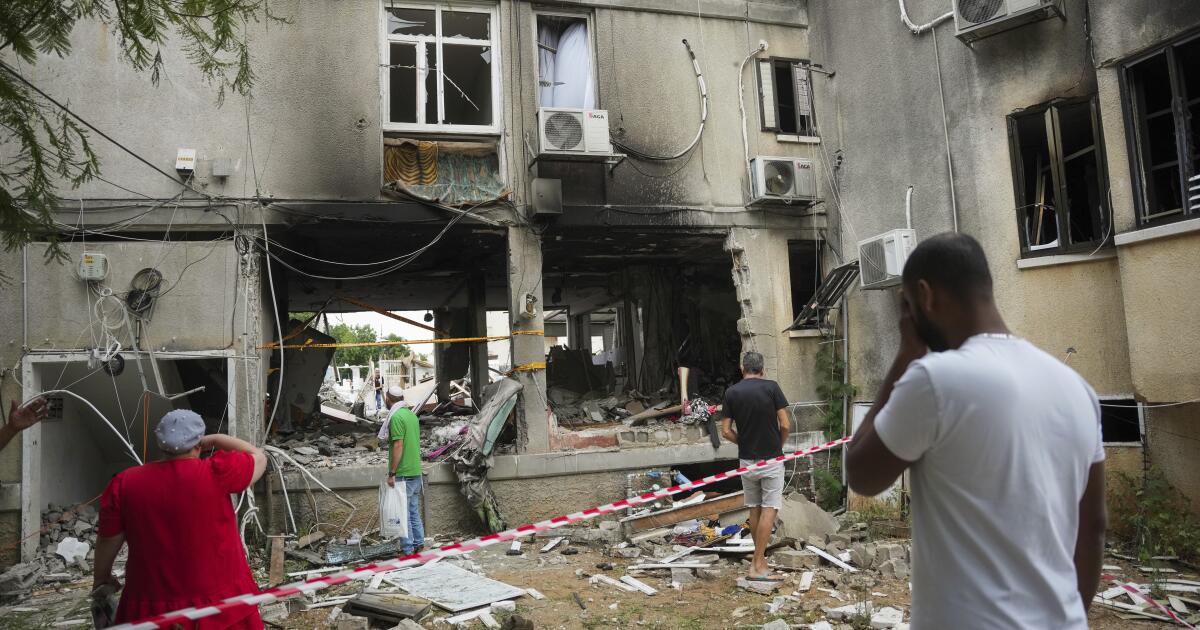
Israel battled Hamas infiltrators for a third day Monday, massing tens of thousands of troops near the Gaza Strip and making moves toward a full siege of the seaside territory, which Palestinian militants used as a springboard for the biggest attack in decades on Israeli soil.
Israeli Defense Minister Yoav Gallant called for a “complete closure” of the Mediterranean enclave, telling army commanders in southern Israel that “no electricity, no food, no water, no fuel” would be allowed into Gaza, which is home to about 2.3 million people.
Israel controls all formal points of access to the Gaza Strip. It already cut off the territory’s power supply soon after Hamas’ surprise attack on Israel on Saturday by land, sea and air.
An Israeli land invasion of the densely packed enclave also looked possible as the combined death toll on both sides surpassed 1,100. From the air, Israeli warplanes, helicopters and artillery pummeled Gaza for a second consecutive night, striking more than 500 targets that the Israeli military said were linked to Hamas and to Islamic Jihad, a smaller extremist group.
Israel has mounted a relentless aerial barrage of the Gaza Strip since Hamas fighters crossed the border in a surprise attack.
(Fatima Shbair / Associated Press)
At midafternoon Monday, residents in Gaza said they received messages from the Israeli army warning them to leave a neighborhood in Gaza City’s center. They also reported an uptick in airstrikes, with Israeli planes flying hours-long sorties overhead.
The prospect of a siege and an invasion came as Israel struggled to regain full control of a string of small southern Israeli communities that came under a highly coordinated, multipronged attack from Gaza-based militants before dawn Saturday, a military spokesman told reporters.
By late Monday morning, the Israeli military said that the fighting had dwindled to “isolated” clashes but that some of the infiltrators might still be in the area.
“It’s taking more time than we expected to get things back into a defensive security posture,” Lt. Col. Richard Hecht, the military spokesman, said. “We thought by yesterday we would have full control. I hope we will by the end of the day.”
Hecht added that more militants could still be crossing into Israel from Gaza, because not all the breaches in the border fence surrounding the enclave had been blocked.
Across Israel, daily life was upended as reservists reported for duty, flights into the main international airport were curtailed, volunteers rushed to donate blood and most schools remained closed. Rear Adm. Daniel Hagari, the top military spokesman, said Israel had mobilized 300,000 reservists in 48 hours — an unprecedentedly rapid call-up.

People take cover in a shelter in Ashkelon, Israel, as a siren warns of incoming rockets fired from the Gaza Strip.
(Ohad Zwigenberg / Associated Press)
Troops massed in fields about five miles north of the Gaza border alongside tanks, towed artillery, Humvees and other military vehicles. Late Monday afternoon, one group of soldiers quickly exited a bus and sought the safety of a roadside berm as Israel’s Iron Dome missile defense system kicked into gear, launching a rapid stream of rockets into the sky to intercept incoming Hamas fire in a furious puff of smoke.
Another soldier nearby, a 20-year-old second lieutenant who identified himself only as Sar for reasons of privacy, marveled at the head-spinning nature of the last 48 hours.
“I never thought this would happen. On Saturday, I was sitting at home. Then my commander calls me to come to the base. Next thing I’m here,” he said.”I expect this will be hard on Gaza. My only hope is that my soldiers go home safe.”

Fire and smoke rise following an Israeli airstrike on the Gaza Strip on Sunday.
(Fatima Shbair / Associated Press)
The death toll inside Israel rose to 700, according to officials and media reports, but the figure was clouded by chaotic conditions in some of the areas that were overrun in the surprise attack, which saw Israeli civilians gunned down at bus stops and on highways, or fleeing into barricaded rooms inside their homes.
U.S. State Department spokesman Matthew Miller said that nine American citizens were among the dead, with others still unaccounted for.
In one of the deadliest single episodes, Palestinian gunmen struck an all-night outdoor dance party in the desert a short distance from the Israel-Gaza border fence. Israeli media reports said more than 200 young people were killed, with militants hunting down those who tried to flee in their cars or hide in nearby wooded areas. Dozens remained unaccounted for, and social media platforms were flooded with frantic appeals from relatives trying to locate loved ones who were at the festival, some of them last seen in exuberant TikTok videos from early Saturday, shortly before the strike.
On the highway from Jerusalem to southern Israel, Adir Oanunu stood looking at a patch of blood on the divider, which he said had come from a Hamas fighter killed two days ago.
“He came on this bike and stood in the highway shooting at cars. The police got him,” said Oanunu, 34, pointing to a bullet-riddled Mazda.
In Gaza, the Israeli strikes targeted several multistory buildings, including the residence of Rawhi Mustafa, a member of Hamas’ political leadership, which the Israeli military said was being used as a command center.
Palestinian officials said the death toll in Gaza had mounted by Monday morning to 493, with more than 2,750 people injured.
At least 150 Israelis, including elderly people and children, were believed to remain captive inside Gaza, with many of them seized and dragged into the enclave in the early hours of the attack. Abu Ubaida, the spokesman for the Qassam Brigades, Hamas’ military wing, said on the group’s Telegram channel that four “enemy prisoners” and their captors were killed in the Israeli strikes overnight and Monday morning.

Residents of Ashkelon, Israel, run for cover in a shelter as a siren warns of incoming rocket fire.
(Ohad Zwigenberg / Associated Press)
The captives’ plight will complicate any Israeli land invasion of the crowded coastal strip and also any political or diplomatic moves by Israel’s far-right government once the fighting stops.
When that will happen, no one knows. Prime Minister Benjamin Netanyahu warned his compatriots Sunday of a protracted conflict as Israel tries to exact retribution and inflict a decisive defeat on Hamas, which has held sway in Gaza for more than 15 years.
On the highway Monday from Jerusalem to Israel’s south, signs of the country’s shift to a war footing were inescapable. Near one military base, hundreds of reservists assembled to join the mobilization for the “difficult war” that Netanyahu warned lay ahead. Farther on, long lines of cars waited at a checkpoint, with police inspecting every vehicle for Hamas militants.
Israel’s air force said in a statement that targets inside Gaza have included rocket launchers, a mosque being used as an operating base by militants and 21 high-rise buildings in which militant activity took place. Hamas, in a statement, accused Israel of hitting “homes inhabited by women and children, mosques and schools.”
Israeli officials have not said whether a ground invasion is in the offing, but convoys of Israeli armor headed south in possible preparation for such an assault.
Underscoring the fears around continued incursions from Gaza, officials in Sderot, a small Israeli city about eight miles from the Gaza frontier, called on residents to barricade themselves at home.
“Lock doors and windows, and do not open to any stranger,” the Sderot municipality told residents in a bulletin.

A mosque in Gaza City was destroyed in an Israeli airstrike.
(Majdi Fathi / NurPhoto)
Humanitarian conditions in Gaza, already desperate, worsened with the strife. The United Nations humanitarian agency said nearly 125,000 people inside the impoverished enclave had been displaced since the outbreak of hostilities Saturday.
Underscoring the potential for the conflict to spiral into a regional conflagration, a quartet of gunmen slipped through the Lebanese border into northern Israel, according to the Israeli military. It said that Israeli soldiers killed “armed suspects” and that its helicopters were conducting strikes in the area.
The Reuters news agency later quoted a source from Hezbollah, the anti-Israel Lebanese Shiite militant group, as saying that it had not conducted any operations on Israeli soil Monday. On Sunday, the group had said it launched artillery and guided rockets on the Israeli-occupied Shebaa Farms in southern Lebanon “in solidarity” with Palestinians.
Bulos reported from Jerusalem and King from France. Times staff writer Tracy Wilkinson in Washington contributed to this report.

Israel battled Hamas infiltrators for a third day Monday, massing tens of thousands of troops near the Gaza Strip and making moves toward a full siege of the seaside territory, which Palestinian militants used as a springboard for the biggest attack in decades on Israeli soil.
Israeli Defense Minister Yoav Gallant called for a “complete closure” of the Mediterranean enclave, telling army commanders in southern Israel that “no electricity, no food, no water, no fuel” would be allowed into Gaza, which is home to about 2.3 million people.
Israel controls all formal points of access to the Gaza Strip. It already cut off the territory’s power supply soon after Hamas’ surprise attack on Israel on Saturday by land, sea and air.
An Israeli land invasion of the densely packed enclave also looked possible as the combined death toll on both sides surpassed 1,100. From the air, Israeli warplanes, helicopters and artillery pummeled Gaza for a second consecutive night, striking more than 500 targets that the Israeli military said were linked to Hamas and to Islamic Jihad, a smaller extremist group.
Israel has mounted a relentless aerial barrage of the Gaza Strip since Hamas fighters crossed the border in a surprise attack.
(Fatima Shbair / Associated Press)
At midafternoon Monday, residents in Gaza said they received messages from the Israeli army warning them to leave a neighborhood in Gaza City’s center. They also reported an uptick in airstrikes, with Israeli planes flying hours-long sorties overhead.
The prospect of a siege and an invasion came as Israel struggled to regain full control of a string of small southern Israeli communities that came under a highly coordinated, multipronged attack from Gaza-based militants before dawn Saturday, a military spokesman told reporters.
By late Monday morning, the Israeli military said that the fighting had dwindled to “isolated” clashes but that some of the infiltrators might still be in the area.
“It’s taking more time than we expected to get things back into a defensive security posture,” Lt. Col. Richard Hecht, the military spokesman, said. “We thought by yesterday we would have full control. I hope we will by the end of the day.”
Hecht added that more militants could still be crossing into Israel from Gaza, because not all the breaches in the border fence surrounding the enclave had been blocked.
Across Israel, daily life was upended as reservists reported for duty, flights into the main international airport were curtailed, volunteers rushed to donate blood and most schools remained closed. Rear Adm. Daniel Hagari, the top military spokesman, said Israel had mobilized 300,000 reservists in 48 hours — an unprecedentedly rapid call-up.
People take cover in a shelter in Ashkelon, Israel, as a siren warns of incoming rockets fired from the Gaza Strip.
(Ohad Zwigenberg / Associated Press)
Troops massed in fields about five miles north of the Gaza border alongside tanks, towed artillery, Humvees and other military vehicles. Late Monday afternoon, one group of soldiers quickly exited a bus and sought the safety of a roadside berm as Israel’s Iron Dome missile defense system kicked into gear, launching a rapid stream of rockets into the sky to intercept incoming Hamas fire in a furious puff of smoke.
Another soldier nearby, a 20-year-old second lieutenant who identified himself only as Sar for reasons of privacy, marveled at the head-spinning nature of the last 48 hours.
“I never thought this would happen. On Saturday, I was sitting at home. Then my commander calls me to come to the base. Next thing I’m here,” he said.”I expect this will be hard on Gaza. My only hope is that my soldiers go home safe.”
Fire and smoke rise following an Israeli airstrike on the Gaza Strip on Sunday.
(Fatima Shbair / Associated Press)
The death toll inside Israel rose to 700, according to officials and media reports, but the figure was clouded by chaotic conditions in some of the areas that were overrun in the surprise attack, which saw Israeli civilians gunned down at bus stops and on highways, or fleeing into barricaded rooms inside their homes.
U.S. State Department spokesman Matthew Miller said that nine American citizens were among the dead, with others still unaccounted for.
In one of the deadliest single episodes, Palestinian gunmen struck an all-night outdoor dance party in the desert a short distance from the Israel-Gaza border fence. Israeli media reports said more than 200 young people were killed, with militants hunting down those who tried to flee in their cars or hide in nearby wooded areas. Dozens remained unaccounted for, and social media platforms were flooded with frantic appeals from relatives trying to locate loved ones who were at the festival, some of them last seen in exuberant TikTok videos from early Saturday, shortly before the strike.
On the highway from Jerusalem to southern Israel, Adir Oanunu stood looking at a patch of blood on the divider, which he said had come from a Hamas fighter killed two days ago.
“He came on this bike and stood in the highway shooting at cars. The police got him,” said Oanunu, 34, pointing to a bullet-riddled Mazda.
In Gaza, the Israeli strikes targeted several multistory buildings, including the residence of Rawhi Mustafa, a member of Hamas’ political leadership, which the Israeli military said was being used as a command center.
Palestinian officials said the death toll in Gaza had mounted by Monday morning to 493, with more than 2,750 people injured.
At least 150 Israelis, including elderly people and children, were believed to remain captive inside Gaza, with many of them seized and dragged into the enclave in the early hours of the attack. Abu Ubaida, the spokesman for the Qassam Brigades, Hamas’ military wing, said on the group’s Telegram channel that four “enemy prisoners” and their captors were killed in the Israeli strikes overnight and Monday morning.
Residents of Ashkelon, Israel, run for cover in a shelter as a siren warns of incoming rocket fire.
(Ohad Zwigenberg / Associated Press)
The captives’ plight will complicate any Israeli land invasion of the crowded coastal strip and also any political or diplomatic moves by Israel’s far-right government once the fighting stops.
When that will happen, no one knows. Prime Minister Benjamin Netanyahu warned his compatriots Sunday of a protracted conflict as Israel tries to exact retribution and inflict a decisive defeat on Hamas, which has held sway in Gaza for more than 15 years.
On the highway Monday from Jerusalem to Israel’s south, signs of the country’s shift to a war footing were inescapable. Near one military base, hundreds of reservists assembled to join the mobilization for the “difficult war” that Netanyahu warned lay ahead. Farther on, long lines of cars waited at a checkpoint, with police inspecting every vehicle for Hamas militants.
Israel’s air force said in a statement that targets inside Gaza have included rocket launchers, a mosque being used as an operating base by militants and 21 high-rise buildings in which militant activity took place. Hamas, in a statement, accused Israel of hitting “homes inhabited by women and children, mosques and schools.”
Israeli officials have not said whether a ground invasion is in the offing, but convoys of Israeli armor headed south in possible preparation for such an assault.
Underscoring the fears around continued incursions from Gaza, officials in Sderot, a small Israeli city about eight miles from the Gaza frontier, called on residents to barricade themselves at home.
“Lock doors and windows, and do not open to any stranger,” the Sderot municipality told residents in a bulletin.
A mosque in Gaza City was destroyed in an Israeli airstrike.
(Majdi Fathi / NurPhoto)
Humanitarian conditions in Gaza, already desperate, worsened with the strife. The United Nations humanitarian agency said nearly 125,000 people inside the impoverished enclave had been displaced since the outbreak of hostilities Saturday.
Underscoring the potential for the conflict to spiral into a regional conflagration, a quartet of gunmen slipped through the Lebanese border into northern Israel, according to the Israeli military. It said that Israeli soldiers killed “armed suspects” and that its helicopters were conducting strikes in the area.
The Reuters news agency later quoted a source from Hezbollah, the anti-Israel Lebanese Shiite militant group, as saying that it had not conducted any operations on Israeli soil Monday. On Sunday, the group had said it launched artillery and guided rockets on the Israeli-occupied Shebaa Farms in southern Lebanon “in solidarity” with Palestinians.
Bulos reported from Jerusalem and King from France. Times staff writer Tracy Wilkinson in Washington contributed to this report.

Israel battled Hamas infiltrators for a third day Monday, massing tens of thousands of troops near the Gaza Strip and making moves toward a full siege of the seaside territory, which Palestinian militants used as a springboard for the biggest attack in decades on Israeli soil.
Israeli Defense Minister Yoav Gallant called for a “complete closure” of the Mediterranean enclave, telling army commanders in southern Israel that “no electricity, no food, no water, no fuel” would be allowed into Gaza, which is home to about 2.3 million people.
Israel controls all formal points of access to the Gaza Strip. It already cut off the territory’s power supply soon after Hamas’ surprise attack on Israel on Saturday by land, sea and air.
An Israeli land invasion of the densely packed enclave also looked possible as the combined death toll on both sides surpassed 1,100. From the air, Israeli warplanes, helicopters and artillery pummeled Gaza for a second consecutive night, striking more than 500 targets that the Israeli military said were linked to Hamas and to Islamic Jihad, a smaller extremist group.
Israel has mounted a relentless aerial barrage of the Gaza Strip since Hamas fighters crossed the border in a surprise attack.
(Fatima Shbair / Associated Press)
At midafternoon Monday, residents in Gaza said they received messages from the Israeli army warning them to leave a neighborhood in Gaza City’s center. They also reported an uptick in airstrikes, with Israeli planes flying hours-long sorties overhead.
The prospect of a siege and an invasion came as Israel struggled to regain full control of a string of small southern Israeli communities that came under a highly coordinated, multipronged attack from Gaza-based militants before dawn Saturday, a military spokesman told reporters.
By late Monday morning, the Israeli military said that the fighting had dwindled to “isolated” clashes but that some of the infiltrators might still be in the area.
“It’s taking more time than we expected to get things back into a defensive security posture,” Lt. Col. Richard Hecht, the military spokesman, said. “We thought by yesterday we would have full control. I hope we will by the end of the day.”
Hecht added that more militants could still be crossing into Israel from Gaza, because not all the breaches in the border fence surrounding the enclave had been blocked.
Across Israel, daily life was upended as reservists reported for duty, flights into the main international airport were curtailed, volunteers rushed to donate blood and most schools remained closed. Rear Adm. Daniel Hagari, the top military spokesman, said Israel had mobilized 300,000 reservists in 48 hours — an unprecedentedly rapid call-up.
People take cover in a shelter in Ashkelon, Israel, as a siren warns of incoming rockets fired from the Gaza Strip.
(Ohad Zwigenberg / Associated Press)
Troops massed in fields about five miles north of the Gaza border alongside tanks, towed artillery, Humvees and other military vehicles. Late Monday afternoon, one group of soldiers quickly exited a bus and sought the safety of a roadside berm as Israel’s Iron Dome missile defense system kicked into gear, launching a rapid stream of rockets into the sky to intercept incoming Hamas fire in a furious puff of smoke.
Another soldier nearby, a 20-year-old second lieutenant who identified himself only as Sar for reasons of privacy, marveled at the head-spinning nature of the last 48 hours.
“I never thought this would happen. On Saturday, I was sitting at home. Then my commander calls me to come to the base. Next thing I’m here,” he said.”I expect this will be hard on Gaza. My only hope is that my soldiers go home safe.”
Fire and smoke rise following an Israeli airstrike on the Gaza Strip on Sunday.
(Fatima Shbair / Associated Press)
The death toll inside Israel rose to 700, according to officials and media reports, but the figure was clouded by chaotic conditions in some of the areas that were overrun in the surprise attack, which saw Israeli civilians gunned down at bus stops and on highways, or fleeing into barricaded rooms inside their homes.
U.S. State Department spokesman Matthew Miller said that nine American citizens were among the dead, with others still unaccounted for.
In one of the deadliest single episodes, Palestinian gunmen struck an all-night outdoor dance party in the desert a short distance from the Israel-Gaza border fence. Israeli media reports said more than 200 young people were killed, with militants hunting down those who tried to flee in their cars or hide in nearby wooded areas. Dozens remained unaccounted for, and social media platforms were flooded with frantic appeals from relatives trying to locate loved ones who were at the festival, some of them last seen in exuberant TikTok videos from early Saturday, shortly before the strike.
On the highway from Jerusalem to southern Israel, Adir Oanunu stood looking at a patch of blood on the divider, which he said had come from a Hamas fighter killed two days ago.
“He came on this bike and stood in the highway shooting at cars. The police got him,” said Oanunu, 34, pointing to a bullet-riddled Mazda.
In Gaza, the Israeli strikes targeted several multistory buildings, including the residence of Rawhi Mustafa, a member of Hamas’ political leadership, which the Israeli military said was being used as a command center.
Palestinian officials said the death toll in Gaza had mounted by Monday morning to 493, with more than 2,750 people injured.
At least 150 Israelis, including elderly people and children, were believed to remain captive inside Gaza, with many of them seized and dragged into the enclave in the early hours of the attack. Abu Ubaida, the spokesman for the Qassam Brigades, Hamas’ military wing, said on the group’s Telegram channel that four “enemy prisoners” and their captors were killed in the Israeli strikes overnight and Monday morning.
Residents of Ashkelon, Israel, run for cover in a shelter as a siren warns of incoming rocket fire.
(Ohad Zwigenberg / Associated Press)
The captives’ plight will complicate any Israeli land invasion of the crowded coastal strip and also any political or diplomatic moves by Israel’s far-right government once the fighting stops.
When that will happen, no one knows. Prime Minister Benjamin Netanyahu warned his compatriots Sunday of a protracted conflict as Israel tries to exact retribution and inflict a decisive defeat on Hamas, which has held sway in Gaza for more than 15 years.
On the highway Monday from Jerusalem to Israel’s south, signs of the country’s shift to a war footing were inescapable. Near one military base, hundreds of reservists assembled to join the mobilization for the “difficult war” that Netanyahu warned lay ahead. Farther on, long lines of cars waited at a checkpoint, with police inspecting every vehicle for Hamas militants.
Israel’s air force said in a statement that targets inside Gaza have included rocket launchers, a mosque being used as an operating base by militants and 21 high-rise buildings in which militant activity took place. Hamas, in a statement, accused Israel of hitting “homes inhabited by women and children, mosques and schools.”
Israeli officials have not said whether a ground invasion is in the offing, but convoys of Israeli armor headed south in possible preparation for such an assault.
Underscoring the fears around continued incursions from Gaza, officials in Sderot, a small Israeli city about eight miles from the Gaza frontier, called on residents to barricade themselves at home.
“Lock doors and windows, and do not open to any stranger,” the Sderot municipality told residents in a bulletin.
A mosque in Gaza City was destroyed in an Israeli airstrike.
(Majdi Fathi / NurPhoto)
Humanitarian conditions in Gaza, already desperate, worsened with the strife. The United Nations humanitarian agency said nearly 125,000 people inside the impoverished enclave had been displaced since the outbreak of hostilities Saturday.
Underscoring the potential for the conflict to spiral into a regional conflagration, a quartet of gunmen slipped through the Lebanese border into northern Israel, according to the Israeli military. It said that Israeli soldiers killed “armed suspects” and that its helicopters were conducting strikes in the area.
The Reuters news agency later quoted a source from Hezbollah, the anti-Israel Lebanese Shiite militant group, as saying that it had not conducted any operations on Israeli soil Monday. On Sunday, the group had said it launched artillery and guided rockets on the Israeli-occupied Shebaa Farms in southern Lebanon “in solidarity” with Palestinians.
Bulos reported from Jerusalem and King from France. Times staff writer Tracy Wilkinson in Washington contributed to this report.
Israel battled Hamas infiltrators for a third day Monday, massing tens of thousands of troops near the Gaza Strip and making moves toward a full siege of the seaside territory, which Palestinian militants used as a springboard for the biggest attack in decades on Israeli soil.
Israeli Defense Minister Yoav Gallant called for a “complete closure” of the Mediterranean enclave, telling army commanders in southern Israel that “no electricity, no food, no water, no fuel” would be allowed into Gaza, which is home to about 2.3 million people.
Israel controls all formal points of access to the Gaza Strip. It already cut off the territory’s power supply soon after Hamas’ surprise attack on Israel on Saturday by land, sea and air.
An Israeli land invasion of the densely packed enclave also looked possible as the combined death toll on both sides surpassed 1,100. From the air, Israeli warplanes, helicopters and artillery pummeled Gaza for a second consecutive night, striking more than 500 targets that the Israeli military said were linked to Hamas and to Islamic Jihad, a smaller extremist group.
Israel has mounted a relentless aerial barrage of the Gaza Strip since Hamas fighters crossed the border in a surprise attack.
(Fatima Shbair / Associated Press)
At midafternoon Monday, residents in Gaza said they received messages from the Israeli army warning them to leave a neighborhood in Gaza City’s center. They also reported an uptick in airstrikes, with Israeli planes flying hours-long sorties overhead.
The prospect of a siege and an invasion came as Israel struggled to regain full control of a string of small southern Israeli communities that came under a highly coordinated, multipronged attack from Gaza-based militants before dawn Saturday, a military spokesman told reporters.
By late Monday morning, the Israeli military said that the fighting had dwindled to “isolated” clashes but that some of the infiltrators might still be in the area.
“It’s taking more time than we expected to get things back into a defensive security posture,” Lt. Col. Richard Hecht, the military spokesman, said. “We thought by yesterday we would have full control. I hope we will by the end of the day.”
Hecht added that more militants could still be crossing into Israel from Gaza, because not all the breaches in the border fence surrounding the enclave had been blocked.
Across Israel, daily life was upended as reservists reported for duty, flights into the main international airport were curtailed, volunteers rushed to donate blood and most schools remained closed. Rear Adm. Daniel Hagari, the top military spokesman, said Israel had mobilized 300,000 reservists in 48 hours — an unprecedentedly rapid call-up.
People take cover in a shelter in Ashkelon, Israel, as a siren warns of incoming rockets fired from the Gaza Strip.
(Ohad Zwigenberg / Associated Press)
Troops massed in fields about five miles north of the Gaza border alongside tanks, towed artillery, Humvees and other military vehicles. Late Monday afternoon, one group of soldiers quickly exited a bus and sought the safety of a roadside berm as Israel’s Iron Dome missile defense system kicked into gear, launching a rapid stream of rockets into the sky to intercept incoming Hamas fire in a furious puff of smoke.
Another soldier nearby, a 20-year-old second lieutenant who identified himself only as Sar for reasons of privacy, marveled at the head-spinning nature of the last 48 hours.
“I never thought this would happen. On Saturday, I was sitting at home. Then my commander calls me to come to the base. Next thing I’m here,” he said.”I expect this will be hard on Gaza. My only hope is that my soldiers go home safe.”
Fire and smoke rise following an Israeli airstrike on the Gaza Strip on Sunday.
(Fatima Shbair / Associated Press)
The death toll inside Israel rose to 700, according to officials and media reports, but the figure was clouded by chaotic conditions in some of the areas that were overrun in the surprise attack, which saw Israeli civilians gunned down at bus stops and on highways, or fleeing into barricaded rooms inside their homes.
U.S. State Department spokesman Matthew Miller said that nine American citizens were among the dead, with others still unaccounted for.
In one of the deadliest single episodes, Palestinian gunmen struck an all-night outdoor dance party in the desert a short distance from the Israel-Gaza border fence. Israeli media reports said more than 200 young people were killed, with militants hunting down those who tried to flee in their cars or hide in nearby wooded areas. Dozens remained unaccounted for, and social media platforms were flooded with frantic appeals from relatives trying to locate loved ones who were at the festival, some of them last seen in exuberant TikTok videos from early Saturday, shortly before the strike.
On the highway from Jerusalem to southern Israel, Adir Oanunu stood looking at a patch of blood on the divider, which he said had come from a Hamas fighter killed two days ago.
“He came on this bike and stood in the highway shooting at cars. The police got him,” said Oanunu, 34, pointing to a bullet-riddled Mazda.
In Gaza, the Israeli strikes targeted several multistory buildings, including the residence of Rawhi Mustafa, a member of Hamas’ political leadership, which the Israeli military said was being used as a command center.
Palestinian officials said the death toll in Gaza had mounted by Monday morning to 493, with more than 2,750 people injured.
At least 150 Israelis, including elderly people and children, were believed to remain captive inside Gaza, with many of them seized and dragged into the enclave in the early hours of the attack. Abu Ubaida, the spokesman for the Qassam Brigades, Hamas’ military wing, said on the group’s Telegram channel that four “enemy prisoners” and their captors were killed in the Israeli strikes overnight and Monday morning.
Residents of Ashkelon, Israel, run for cover in a shelter as a siren warns of incoming rocket fire.
(Ohad Zwigenberg / Associated Press)
The captives’ plight will complicate any Israeli land invasion of the crowded coastal strip and also any political or diplomatic moves by Israel’s far-right government once the fighting stops.
When that will happen, no one knows. Prime Minister Benjamin Netanyahu warned his compatriots Sunday of a protracted conflict as Israel tries to exact retribution and inflict a decisive defeat on Hamas, which has held sway in Gaza for more than 15 years.
On the highway Monday from Jerusalem to Israel’s south, signs of the country’s shift to a war footing were inescapable. Near one military base, hundreds of reservists assembled to join the mobilization for the “difficult war” that Netanyahu warned lay ahead. Farther on, long lines of cars waited at a checkpoint, with police inspecting every vehicle for Hamas militants.
Israel’s air force said in a statement that targets inside Gaza have included rocket launchers, a mosque being used as an operating base by militants and 21 high-rise buildings in which militant activity took place. Hamas, in a statement, accused Israel of hitting “homes inhabited by women and children, mosques and schools.”
Israeli officials have not said whether a ground invasion is in the offing, but convoys of Israeli armor headed south in possible preparation for such an assault.
Underscoring the fears around continued incursions from Gaza, officials in Sderot, a small Israeli city about eight miles from the Gaza frontier, called on residents to barricade themselves at home.
“Lock doors and windows, and do not open to any stranger,” the Sderot municipality told residents in a bulletin.
A mosque in Gaza City was destroyed in an Israeli airstrike.
(Majdi Fathi / NurPhoto)
Humanitarian conditions in Gaza, already desperate, worsened with the strife. The United Nations humanitarian agency said nearly 125,000 people inside the impoverished enclave had been displaced since the outbreak of hostilities Saturday.
Underscoring the potential for the conflict to spiral into a regional conflagration, a quartet of gunmen slipped through the Lebanese border into northern Israel, according to the Israeli military. It said that Israeli soldiers killed “armed suspects” and that its helicopters were conducting strikes in the area.
The Reuters news agency later quoted a source from Hezbollah, the anti-Israel Lebanese Shiite militant group, as saying that it had not conducted any operations on Israeli soil Monday. On Sunday, the group had said it launched artillery and guided rockets on the Israeli-occupied Shebaa Farms in southern Lebanon “in solidarity” with Palestinians.
Bulos reported from Jerusalem and King from France. Times staff writer Tracy Wilkinson in Washington contributed to this report.

Israel battled Hamas infiltrators for a third day Monday, massing tens of thousands of troops near the Gaza Strip and making moves toward a full siege of the seaside territory, which Palestinian militants used as a springboard for the biggest attack in decades on Israeli soil.
Israeli Defense Minister Yoav Gallant called for a “complete closure” of the Mediterranean enclave, telling army commanders in southern Israel that “no electricity, no food, no water, no fuel” would be allowed into Gaza, which is home to about 2.3 million people.
Israel controls all formal points of access to the Gaza Strip. It already cut off the territory’s power supply soon after Hamas’ surprise attack on Israel on Saturday by land, sea and air.
An Israeli land invasion of the densely packed enclave also looked possible as the combined death toll on both sides surpassed 1,100. From the air, Israeli warplanes, helicopters and artillery pummeled Gaza for a second consecutive night, striking more than 500 targets that the Israeli military said were linked to Hamas and to Islamic Jihad, a smaller extremist group.
Israel has mounted a relentless aerial barrage of the Gaza Strip since Hamas fighters crossed the border in a surprise attack.
(Fatima Shbair / Associated Press)
At midafternoon Monday, residents in Gaza said they received messages from the Israeli army warning them to leave a neighborhood in Gaza City’s center. They also reported an uptick in airstrikes, with Israeli planes flying hours-long sorties overhead.
The prospect of a siege and an invasion came as Israel struggled to regain full control of a string of small southern Israeli communities that came under a highly coordinated, multipronged attack from Gaza-based militants before dawn Saturday, a military spokesman told reporters.
By late Monday morning, the Israeli military said that the fighting had dwindled to “isolated” clashes but that some of the infiltrators might still be in the area.
“It’s taking more time than we expected to get things back into a defensive security posture,” Lt. Col. Richard Hecht, the military spokesman, said. “We thought by yesterday we would have full control. I hope we will by the end of the day.”
Hecht added that more militants could still be crossing into Israel from Gaza, because not all the breaches in the border fence surrounding the enclave had been blocked.
Across Israel, daily life was upended as reservists reported for duty, flights into the main international airport were curtailed, volunteers rushed to donate blood and most schools remained closed. Rear Adm. Daniel Hagari, the top military spokesman, said Israel had mobilized 300,000 reservists in 48 hours — an unprecedentedly rapid call-up.
People take cover in a shelter in Ashkelon, Israel, as a siren warns of incoming rockets fired from the Gaza Strip.
(Ohad Zwigenberg / Associated Press)
Troops massed in fields about five miles north of the Gaza border alongside tanks, towed artillery, Humvees and other military vehicles. Late Monday afternoon, one group of soldiers quickly exited a bus and sought the safety of a roadside berm as Israel’s Iron Dome missile defense system kicked into gear, launching a rapid stream of rockets into the sky to intercept incoming Hamas fire in a furious puff of smoke.
Another soldier nearby, a 20-year-old second lieutenant who identified himself only as Sar for reasons of privacy, marveled at the head-spinning nature of the last 48 hours.
“I never thought this would happen. On Saturday, I was sitting at home. Then my commander calls me to come to the base. Next thing I’m here,” he said.”I expect this will be hard on Gaza. My only hope is that my soldiers go home safe.”
Fire and smoke rise following an Israeli airstrike on the Gaza Strip on Sunday.
(Fatima Shbair / Associated Press)
The death toll inside Israel rose to 700, according to officials and media reports, but the figure was clouded by chaotic conditions in some of the areas that were overrun in the surprise attack, which saw Israeli civilians gunned down at bus stops and on highways, or fleeing into barricaded rooms inside their homes.
U.S. State Department spokesman Matthew Miller said that nine American citizens were among the dead, with others still unaccounted for.
In one of the deadliest single episodes, Palestinian gunmen struck an all-night outdoor dance party in the desert a short distance from the Israel-Gaza border fence. Israeli media reports said more than 200 young people were killed, with militants hunting down those who tried to flee in their cars or hide in nearby wooded areas. Dozens remained unaccounted for, and social media platforms were flooded with frantic appeals from relatives trying to locate loved ones who were at the festival, some of them last seen in exuberant TikTok videos from early Saturday, shortly before the strike.
On the highway from Jerusalem to southern Israel, Adir Oanunu stood looking at a patch of blood on the divider, which he said had come from a Hamas fighter killed two days ago.
“He came on this bike and stood in the highway shooting at cars. The police got him,” said Oanunu, 34, pointing to a bullet-riddled Mazda.
In Gaza, the Israeli strikes targeted several multistory buildings, including the residence of Rawhi Mustafa, a member of Hamas’ political leadership, which the Israeli military said was being used as a command center.
Palestinian officials said the death toll in Gaza had mounted by Monday morning to 493, with more than 2,750 people injured.
At least 150 Israelis, including elderly people and children, were believed to remain captive inside Gaza, with many of them seized and dragged into the enclave in the early hours of the attack. Abu Ubaida, the spokesman for the Qassam Brigades, Hamas’ military wing, said on the group’s Telegram channel that four “enemy prisoners” and their captors were killed in the Israeli strikes overnight and Monday morning.
Residents of Ashkelon, Israel, run for cover in a shelter as a siren warns of incoming rocket fire.
(Ohad Zwigenberg / Associated Press)
The captives’ plight will complicate any Israeli land invasion of the crowded coastal strip and also any political or diplomatic moves by Israel’s far-right government once the fighting stops.
When that will happen, no one knows. Prime Minister Benjamin Netanyahu warned his compatriots Sunday of a protracted conflict as Israel tries to exact retribution and inflict a decisive defeat on Hamas, which has held sway in Gaza for more than 15 years.
On the highway Monday from Jerusalem to Israel’s south, signs of the country’s shift to a war footing were inescapable. Near one military base, hundreds of reservists assembled to join the mobilization for the “difficult war” that Netanyahu warned lay ahead. Farther on, long lines of cars waited at a checkpoint, with police inspecting every vehicle for Hamas militants.
Israel’s air force said in a statement that targets inside Gaza have included rocket launchers, a mosque being used as an operating base by militants and 21 high-rise buildings in which militant activity took place. Hamas, in a statement, accused Israel of hitting “homes inhabited by women and children, mosques and schools.”
Israeli officials have not said whether a ground invasion is in the offing, but convoys of Israeli armor headed south in possible preparation for such an assault.
Underscoring the fears around continued incursions from Gaza, officials in Sderot, a small Israeli city about eight miles from the Gaza frontier, called on residents to barricade themselves at home.
“Lock doors and windows, and do not open to any stranger,” the Sderot municipality told residents in a bulletin.
A mosque in Gaza City was destroyed in an Israeli airstrike.
(Majdi Fathi / NurPhoto)
Humanitarian conditions in Gaza, already desperate, worsened with the strife. The United Nations humanitarian agency said nearly 125,000 people inside the impoverished enclave had been displaced since the outbreak of hostilities Saturday.
Underscoring the potential for the conflict to spiral into a regional conflagration, a quartet of gunmen slipped through the Lebanese border into northern Israel, according to the Israeli military. It said that Israeli soldiers killed “armed suspects” and that its helicopters were conducting strikes in the area.
The Reuters news agency later quoted a source from Hezbollah, the anti-Israel Lebanese Shiite militant group, as saying that it had not conducted any operations on Israeli soil Monday. On Sunday, the group had said it launched artillery and guided rockets on the Israeli-occupied Shebaa Farms in southern Lebanon “in solidarity” with Palestinians.
Bulos reported from Jerusalem and King from France. Times staff writer Tracy Wilkinson in Washington contributed to this report.
Israel battled Hamas infiltrators for a third day Monday, massing tens of thousands of troops near the Gaza Strip and making moves toward a full siege of the seaside territory, which Palestinian militants used as a springboard for the biggest attack in decades on Israeli soil.
Israeli Defense Minister Yoav Gallant called for a “complete closure” of the Mediterranean enclave, telling army commanders in southern Israel that “no electricity, no food, no water, no fuel” would be allowed into Gaza, which is home to about 2.3 million people.
Israel controls all formal points of access to the Gaza Strip. It already cut off the territory’s power supply soon after Hamas’ surprise attack on Israel on Saturday by land, sea and air.
An Israeli land invasion of the densely packed enclave also looked possible as the combined death toll on both sides surpassed 1,100. From the air, Israeli warplanes, helicopters and artillery pummeled Gaza for a second consecutive night, striking more than 500 targets that the Israeli military said were linked to Hamas and to Islamic Jihad, a smaller extremist group.
Israel has mounted a relentless aerial barrage of the Gaza Strip since Hamas fighters crossed the border in a surprise attack.
(Fatima Shbair / Associated Press)
At midafternoon Monday, residents in Gaza said they received messages from the Israeli army warning them to leave a neighborhood in Gaza City’s center. They also reported an uptick in airstrikes, with Israeli planes flying hours-long sorties overhead.
The prospect of a siege and an invasion came as Israel struggled to regain full control of a string of small southern Israeli communities that came under a highly coordinated, multipronged attack from Gaza-based militants before dawn Saturday, a military spokesman told reporters.
By late Monday morning, the Israeli military said that the fighting had dwindled to “isolated” clashes but that some of the infiltrators might still be in the area.
“It’s taking more time than we expected to get things back into a defensive security posture,” Lt. Col. Richard Hecht, the military spokesman, said. “We thought by yesterday we would have full control. I hope we will by the end of the day.”
Hecht added that more militants could still be crossing into Israel from Gaza, because not all the breaches in the border fence surrounding the enclave had been blocked.
Across Israel, daily life was upended as reservists reported for duty, flights into the main international airport were curtailed, volunteers rushed to donate blood and most schools remained closed. Rear Adm. Daniel Hagari, the top military spokesman, said Israel had mobilized 300,000 reservists in 48 hours — an unprecedentedly rapid call-up.
People take cover in a shelter in Ashkelon, Israel, as a siren warns of incoming rockets fired from the Gaza Strip.
(Ohad Zwigenberg / Associated Press)
Troops massed in fields about five miles north of the Gaza border alongside tanks, towed artillery, Humvees and other military vehicles. Late Monday afternoon, one group of soldiers quickly exited a bus and sought the safety of a roadside berm as Israel’s Iron Dome missile defense system kicked into gear, launching a rapid stream of rockets into the sky to intercept incoming Hamas fire in a furious puff of smoke.
Another soldier nearby, a 20-year-old second lieutenant who identified himself only as Sar for reasons of privacy, marveled at the head-spinning nature of the last 48 hours.
“I never thought this would happen. On Saturday, I was sitting at home. Then my commander calls me to come to the base. Next thing I’m here,” he said.”I expect this will be hard on Gaza. My only hope is that my soldiers go home safe.”
Fire and smoke rise following an Israeli airstrike on the Gaza Strip on Sunday.
(Fatima Shbair / Associated Press)
The death toll inside Israel rose to 700, according to officials and media reports, but the figure was clouded by chaotic conditions in some of the areas that were overrun in the surprise attack, which saw Israeli civilians gunned down at bus stops and on highways, or fleeing into barricaded rooms inside their homes.
U.S. State Department spokesman Matthew Miller said that nine American citizens were among the dead, with others still unaccounted for.
In one of the deadliest single episodes, Palestinian gunmen struck an all-night outdoor dance party in the desert a short distance from the Israel-Gaza border fence. Israeli media reports said more than 200 young people were killed, with militants hunting down those who tried to flee in their cars or hide in nearby wooded areas. Dozens remained unaccounted for, and social media platforms were flooded with frantic appeals from relatives trying to locate loved ones who were at the festival, some of them last seen in exuberant TikTok videos from early Saturday, shortly before the strike.
On the highway from Jerusalem to southern Israel, Adir Oanunu stood looking at a patch of blood on the divider, which he said had come from a Hamas fighter killed two days ago.
“He came on this bike and stood in the highway shooting at cars. The police got him,” said Oanunu, 34, pointing to a bullet-riddled Mazda.
In Gaza, the Israeli strikes targeted several multistory buildings, including the residence of Rawhi Mustafa, a member of Hamas’ political leadership, which the Israeli military said was being used as a command center.
Palestinian officials said the death toll in Gaza had mounted by Monday morning to 493, with more than 2,750 people injured.
At least 150 Israelis, including elderly people and children, were believed to remain captive inside Gaza, with many of them seized and dragged into the enclave in the early hours of the attack. Abu Ubaida, the spokesman for the Qassam Brigades, Hamas’ military wing, said on the group’s Telegram channel that four “enemy prisoners” and their captors were killed in the Israeli strikes overnight and Monday morning.
Residents of Ashkelon, Israel, run for cover in a shelter as a siren warns of incoming rocket fire.
(Ohad Zwigenberg / Associated Press)
The captives’ plight will complicate any Israeli land invasion of the crowded coastal strip and also any political or diplomatic moves by Israel’s far-right government once the fighting stops.
When that will happen, no one knows. Prime Minister Benjamin Netanyahu warned his compatriots Sunday of a protracted conflict as Israel tries to exact retribution and inflict a decisive defeat on Hamas, which has held sway in Gaza for more than 15 years.
On the highway Monday from Jerusalem to Israel’s south, signs of the country’s shift to a war footing were inescapable. Near one military base, hundreds of reservists assembled to join the mobilization for the “difficult war” that Netanyahu warned lay ahead. Farther on, long lines of cars waited at a checkpoint, with police inspecting every vehicle for Hamas militants.
Israel’s air force said in a statement that targets inside Gaza have included rocket launchers, a mosque being used as an operating base by militants and 21 high-rise buildings in which militant activity took place. Hamas, in a statement, accused Israel of hitting “homes inhabited by women and children, mosques and schools.”
Israeli officials have not said whether a ground invasion is in the offing, but convoys of Israeli armor headed south in possible preparation for such an assault.
Underscoring the fears around continued incursions from Gaza, officials in Sderot, a small Israeli city about eight miles from the Gaza frontier, called on residents to barricade themselves at home.
“Lock doors and windows, and do not open to any stranger,” the Sderot municipality told residents in a bulletin.
A mosque in Gaza City was destroyed in an Israeli airstrike.
(Majdi Fathi / NurPhoto)
Humanitarian conditions in Gaza, already desperate, worsened with the strife. The United Nations humanitarian agency said nearly 125,000 people inside the impoverished enclave had been displaced since the outbreak of hostilities Saturday.
Underscoring the potential for the conflict to spiral into a regional conflagration, a quartet of gunmen slipped through the Lebanese border into northern Israel, according to the Israeli military. It said that Israeli soldiers killed “armed suspects” and that its helicopters were conducting strikes in the area.
The Reuters news agency later quoted a source from Hezbollah, the anti-Israel Lebanese Shiite militant group, as saying that it had not conducted any operations on Israeli soil Monday. On Sunday, the group had said it launched artillery and guided rockets on the Israeli-occupied Shebaa Farms in southern Lebanon “in solidarity” with Palestinians.
Bulos reported from Jerusalem and King from France. Times staff writer Tracy Wilkinson in Washington contributed to this report.
Israel battled Hamas infiltrators for a third day Monday, massing tens of thousands of troops near the Gaza Strip and making moves toward a full siege of the seaside territory, which Palestinian militants used as a springboard for the biggest attack in decades on Israeli soil.
Israeli Defense Minister Yoav Gallant called for a “complete closure” of the Mediterranean enclave, telling army commanders in southern Israel that “no electricity, no food, no water, no fuel” would be allowed into Gaza, which is home to about 2.3 million people.
Israel controls all formal points of access to the Gaza Strip. It already cut off the territory’s power supply soon after Hamas’ surprise attack on Israel on Saturday by land, sea and air.
An Israeli land invasion of the densely packed enclave also looked possible as the combined death toll on both sides surpassed 1,100. From the air, Israeli warplanes, helicopters and artillery pummeled Gaza for a second consecutive night, striking more than 500 targets that the Israeli military said were linked to Hamas and to Islamic Jihad, a smaller extremist group.
Israel has mounted a relentless aerial barrage of the Gaza Strip since Hamas fighters crossed the border in a surprise attack.
(Fatima Shbair / Associated Press)
At midafternoon Monday, residents in Gaza said they received messages from the Israeli army warning them to leave a neighborhood in Gaza City’s center. They also reported an uptick in airstrikes, with Israeli planes flying hours-long sorties overhead.
The prospect of a siege and an invasion came as Israel struggled to regain full control of a string of small southern Israeli communities that came under a highly coordinated, multipronged attack from Gaza-based militants before dawn Saturday, a military spokesman told reporters.
By late Monday morning, the Israeli military said that the fighting had dwindled to “isolated” clashes but that some of the infiltrators might still be in the area.
“It’s taking more time than we expected to get things back into a defensive security posture,” Lt. Col. Richard Hecht, the military spokesman, said. “We thought by yesterday we would have full control. I hope we will by the end of the day.”
Hecht added that more militants could still be crossing into Israel from Gaza, because not all the breaches in the border fence surrounding the enclave had been blocked.
Across Israel, daily life was upended as reservists reported for duty, flights into the main international airport were curtailed, volunteers rushed to donate blood and most schools remained closed. Rear Adm. Daniel Hagari, the top military spokesman, said Israel had mobilized 300,000 reservists in 48 hours — an unprecedentedly rapid call-up.
People take cover in a shelter in Ashkelon, Israel, as a siren warns of incoming rockets fired from the Gaza Strip.
(Ohad Zwigenberg / Associated Press)
Troops massed in fields about five miles north of the Gaza border alongside tanks, towed artillery, Humvees and other military vehicles. Late Monday afternoon, one group of soldiers quickly exited a bus and sought the safety of a roadside berm as Israel’s Iron Dome missile defense system kicked into gear, launching a rapid stream of rockets into the sky to intercept incoming Hamas fire in a furious puff of smoke.
Another soldier nearby, a 20-year-old second lieutenant who identified himself only as Sar for reasons of privacy, marveled at the head-spinning nature of the last 48 hours.
“I never thought this would happen. On Saturday, I was sitting at home. Then my commander calls me to come to the base. Next thing I’m here,” he said.”I expect this will be hard on Gaza. My only hope is that my soldiers go home safe.”
Fire and smoke rise following an Israeli airstrike on the Gaza Strip on Sunday.
(Fatima Shbair / Associated Press)
The death toll inside Israel rose to 700, according to officials and media reports, but the figure was clouded by chaotic conditions in some of the areas that were overrun in the surprise attack, which saw Israeli civilians gunned down at bus stops and on highways, or fleeing into barricaded rooms inside their homes.
U.S. State Department spokesman Matthew Miller said that nine American citizens were among the dead, with others still unaccounted for.
In one of the deadliest single episodes, Palestinian gunmen struck an all-night outdoor dance party in the desert a short distance from the Israel-Gaza border fence. Israeli media reports said more than 200 young people were killed, with militants hunting down those who tried to flee in their cars or hide in nearby wooded areas. Dozens remained unaccounted for, and social media platforms were flooded with frantic appeals from relatives trying to locate loved ones who were at the festival, some of them last seen in exuberant TikTok videos from early Saturday, shortly before the strike.
On the highway from Jerusalem to southern Israel, Adir Oanunu stood looking at a patch of blood on the divider, which he said had come from a Hamas fighter killed two days ago.
“He came on this bike and stood in the highway shooting at cars. The police got him,” said Oanunu, 34, pointing to a bullet-riddled Mazda.
In Gaza, the Israeli strikes targeted several multistory buildings, including the residence of Rawhi Mustafa, a member of Hamas’ political leadership, which the Israeli military said was being used as a command center.
Palestinian officials said the death toll in Gaza had mounted by Monday morning to 493, with more than 2,750 people injured.
At least 150 Israelis, including elderly people and children, were believed to remain captive inside Gaza, with many of them seized and dragged into the enclave in the early hours of the attack. Abu Ubaida, the spokesman for the Qassam Brigades, Hamas’ military wing, said on the group’s Telegram channel that four “enemy prisoners” and their captors were killed in the Israeli strikes overnight and Monday morning.
Residents of Ashkelon, Israel, run for cover in a shelter as a siren warns of incoming rocket fire.
(Ohad Zwigenberg / Associated Press)
The captives’ plight will complicate any Israeli land invasion of the crowded coastal strip and also any political or diplomatic moves by Israel’s far-right government once the fighting stops.
When that will happen, no one knows. Prime Minister Benjamin Netanyahu warned his compatriots Sunday of a protracted conflict as Israel tries to exact retribution and inflict a decisive defeat on Hamas, which has held sway in Gaza for more than 15 years.
On the highway Monday from Jerusalem to Israel’s south, signs of the country’s shift to a war footing were inescapable. Near one military base, hundreds of reservists assembled to join the mobilization for the “difficult war” that Netanyahu warned lay ahead. Farther on, long lines of cars waited at a checkpoint, with police inspecting every vehicle for Hamas militants.
Israel’s air force said in a statement that targets inside Gaza have included rocket launchers, a mosque being used as an operating base by militants and 21 high-rise buildings in which militant activity took place. Hamas, in a statement, accused Israel of hitting “homes inhabited by women and children, mosques and schools.”
Israeli officials have not said whether a ground invasion is in the offing, but convoys of Israeli armor headed south in possible preparation for such an assault.
Underscoring the fears around continued incursions from Gaza, officials in Sderot, a small Israeli city about eight miles from the Gaza frontier, called on residents to barricade themselves at home.
“Lock doors and windows, and do not open to any stranger,” the Sderot municipality told residents in a bulletin.
A mosque in Gaza City was destroyed in an Israeli airstrike.
(Majdi Fathi / NurPhoto)
Humanitarian conditions in Gaza, already desperate, worsened with the strife. The United Nations humanitarian agency said nearly 125,000 people inside the impoverished enclave had been displaced since the outbreak of hostilities Saturday.
Underscoring the potential for the conflict to spiral into a regional conflagration, a quartet of gunmen slipped through the Lebanese border into northern Israel, according to the Israeli military. It said that Israeli soldiers killed “armed suspects” and that its helicopters were conducting strikes in the area.
The Reuters news agency later quoted a source from Hezbollah, the anti-Israel Lebanese Shiite militant group, as saying that it had not conducted any operations on Israeli soil Monday. On Sunday, the group had said it launched artillery and guided rockets on the Israeli-occupied Shebaa Farms in southern Lebanon “in solidarity” with Palestinians.
Bulos reported from Jerusalem and King from France. Times staff writer Tracy Wilkinson in Washington contributed to this report.
Israel battled Hamas infiltrators for a third day Monday, massing tens of thousands of troops near the Gaza Strip and making moves toward a full siege of the seaside territory, which Palestinian militants used as a springboard for the biggest attack in decades on Israeli soil.
Israeli Defense Minister Yoav Gallant called for a “complete closure” of the Mediterranean enclave, telling army commanders in southern Israel that “no electricity, no food, no water, no fuel” would be allowed into Gaza, which is home to about 2.3 million people.
Israel controls all formal points of access to the Gaza Strip. It already cut off the territory’s power supply soon after Hamas’ surprise attack on Israel on Saturday by land, sea and air.
An Israeli land invasion of the densely packed enclave also looked possible as the combined death toll on both sides surpassed 1,100. From the air, Israeli warplanes, helicopters and artillery pummeled Gaza for a second consecutive night, striking more than 500 targets that the Israeli military said were linked to Hamas and to Islamic Jihad, a smaller extremist group.
Israel has mounted a relentless aerial barrage of the Gaza Strip since Hamas fighters crossed the border in a surprise attack.
(Fatima Shbair / Associated Press)
At midafternoon Monday, residents in Gaza said they received messages from the Israeli army warning them to leave a neighborhood in Gaza City’s center. They also reported an uptick in airstrikes, with Israeli planes flying hours-long sorties overhead.
The prospect of a siege and an invasion came as Israel struggled to regain full control of a string of small southern Israeli communities that came under a highly coordinated, multipronged attack from Gaza-based militants before dawn Saturday, a military spokesman told reporters.
By late Monday morning, the Israeli military said that the fighting had dwindled to “isolated” clashes but that some of the infiltrators might still be in the area.
“It’s taking more time than we expected to get things back into a defensive security posture,” Lt. Col. Richard Hecht, the military spokesman, said. “We thought by yesterday we would have full control. I hope we will by the end of the day.”
Hecht added that more militants could still be crossing into Israel from Gaza, because not all the breaches in the border fence surrounding the enclave had been blocked.
Across Israel, daily life was upended as reservists reported for duty, flights into the main international airport were curtailed, volunteers rushed to donate blood and most schools remained closed. Rear Adm. Daniel Hagari, the top military spokesman, said Israel had mobilized 300,000 reservists in 48 hours — an unprecedentedly rapid call-up.
People take cover in a shelter in Ashkelon, Israel, as a siren warns of incoming rockets fired from the Gaza Strip.
(Ohad Zwigenberg / Associated Press)
Troops massed in fields about five miles north of the Gaza border alongside tanks, towed artillery, Humvees and other military vehicles. Late Monday afternoon, one group of soldiers quickly exited a bus and sought the safety of a roadside berm as Israel’s Iron Dome missile defense system kicked into gear, launching a rapid stream of rockets into the sky to intercept incoming Hamas fire in a furious puff of smoke.
Another soldier nearby, a 20-year-old second lieutenant who identified himself only as Sar for reasons of privacy, marveled at the head-spinning nature of the last 48 hours.
“I never thought this would happen. On Saturday, I was sitting at home. Then my commander calls me to come to the base. Next thing I’m here,” he said.”I expect this will be hard on Gaza. My only hope is that my soldiers go home safe.”
Fire and smoke rise following an Israeli airstrike on the Gaza Strip on Sunday.
(Fatima Shbair / Associated Press)
The death toll inside Israel rose to 700, according to officials and media reports, but the figure was clouded by chaotic conditions in some of the areas that were overrun in the surprise attack, which saw Israeli civilians gunned down at bus stops and on highways, or fleeing into barricaded rooms inside their homes.
U.S. State Department spokesman Matthew Miller said that nine American citizens were among the dead, with others still unaccounted for.
In one of the deadliest single episodes, Palestinian gunmen struck an all-night outdoor dance party in the desert a short distance from the Israel-Gaza border fence. Israeli media reports said more than 200 young people were killed, with militants hunting down those who tried to flee in their cars or hide in nearby wooded areas. Dozens remained unaccounted for, and social media platforms were flooded with frantic appeals from relatives trying to locate loved ones who were at the festival, some of them last seen in exuberant TikTok videos from early Saturday, shortly before the strike.
On the highway from Jerusalem to southern Israel, Adir Oanunu stood looking at a patch of blood on the divider, which he said had come from a Hamas fighter killed two days ago.
“He came on this bike and stood in the highway shooting at cars. The police got him,” said Oanunu, 34, pointing to a bullet-riddled Mazda.
In Gaza, the Israeli strikes targeted several multistory buildings, including the residence of Rawhi Mustafa, a member of Hamas’ political leadership, which the Israeli military said was being used as a command center.
Palestinian officials said the death toll in Gaza had mounted by Monday morning to 493, with more than 2,750 people injured.
At least 150 Israelis, including elderly people and children, were believed to remain captive inside Gaza, with many of them seized and dragged into the enclave in the early hours of the attack. Abu Ubaida, the spokesman for the Qassam Brigades, Hamas’ military wing, said on the group’s Telegram channel that four “enemy prisoners” and their captors were killed in the Israeli strikes overnight and Monday morning.
Residents of Ashkelon, Israel, run for cover in a shelter as a siren warns of incoming rocket fire.
(Ohad Zwigenberg / Associated Press)
The captives’ plight will complicate any Israeli land invasion of the crowded coastal strip and also any political or diplomatic moves by Israel’s far-right government once the fighting stops.
When that will happen, no one knows. Prime Minister Benjamin Netanyahu warned his compatriots Sunday of a protracted conflict as Israel tries to exact retribution and inflict a decisive defeat on Hamas, which has held sway in Gaza for more than 15 years.
On the highway Monday from Jerusalem to Israel’s south, signs of the country’s shift to a war footing were inescapable. Near one military base, hundreds of reservists assembled to join the mobilization for the “difficult war” that Netanyahu warned lay ahead. Farther on, long lines of cars waited at a checkpoint, with police inspecting every vehicle for Hamas militants.
Israel’s air force said in a statement that targets inside Gaza have included rocket launchers, a mosque being used as an operating base by militants and 21 high-rise buildings in which militant activity took place. Hamas, in a statement, accused Israel of hitting “homes inhabited by women and children, mosques and schools.”
Israeli officials have not said whether a ground invasion is in the offing, but convoys of Israeli armor headed south in possible preparation for such an assault.
Underscoring the fears around continued incursions from Gaza, officials in Sderot, a small Israeli city about eight miles from the Gaza frontier, called on residents to barricade themselves at home.
“Lock doors and windows, and do not open to any stranger,” the Sderot municipality told residents in a bulletin.
A mosque in Gaza City was destroyed in an Israeli airstrike.
(Majdi Fathi / NurPhoto)
Humanitarian conditions in Gaza, already desperate, worsened with the strife. The United Nations humanitarian agency said nearly 125,000 people inside the impoverished enclave had been displaced since the outbreak of hostilities Saturday.
Underscoring the potential for the conflict to spiral into a regional conflagration, a quartet of gunmen slipped through the Lebanese border into northern Israel, according to the Israeli military. It said that Israeli soldiers killed “armed suspects” and that its helicopters were conducting strikes in the area.
The Reuters news agency later quoted a source from Hezbollah, the anti-Israel Lebanese Shiite militant group, as saying that it had not conducted any operations on Israeli soil Monday. On Sunday, the group had said it launched artillery and guided rockets on the Israeli-occupied Shebaa Farms in southern Lebanon “in solidarity” with Palestinians.
Bulos reported from Jerusalem and King from France. Times staff writer Tracy Wilkinson in Washington contributed to this report.

Israel battled Hamas infiltrators for a third day Monday, massing tens of thousands of troops near the Gaza Strip and making moves toward a full siege of the seaside territory, which Palestinian militants used as a springboard for the biggest attack in decades on Israeli soil.
Israeli Defense Minister Yoav Gallant called for a “complete closure” of the Mediterranean enclave, telling army commanders in southern Israel that “no electricity, no food, no water, no fuel” would be allowed into Gaza, which is home to about 2.3 million people.
Israel controls all formal points of access to the Gaza Strip. It already cut off the territory’s power supply soon after Hamas’ surprise attack on Israel on Saturday by land, sea and air.
An Israeli land invasion of the densely packed enclave also looked possible as the combined death toll on both sides surpassed 1,100. From the air, Israeli warplanes, helicopters and artillery pummeled Gaza for a second consecutive night, striking more than 500 targets that the Israeli military said were linked to Hamas and to Islamic Jihad, a smaller extremist group.
Israel has mounted a relentless aerial barrage of the Gaza Strip since Hamas fighters crossed the border in a surprise attack.
(Fatima Shbair / Associated Press)
At midafternoon Monday, residents in Gaza said they received messages from the Israeli army warning them to leave a neighborhood in Gaza City’s center. They also reported an uptick in airstrikes, with Israeli planes flying hours-long sorties overhead.
The prospect of a siege and an invasion came as Israel struggled to regain full control of a string of small southern Israeli communities that came under a highly coordinated, multipronged attack from Gaza-based militants before dawn Saturday, a military spokesman told reporters.
By late Monday morning, the Israeli military said that the fighting had dwindled to “isolated” clashes but that some of the infiltrators might still be in the area.
“It’s taking more time than we expected to get things back into a defensive security posture,” Lt. Col. Richard Hecht, the military spokesman, said. “We thought by yesterday we would have full control. I hope we will by the end of the day.”
Hecht added that more militants could still be crossing into Israel from Gaza, because not all the breaches in the border fence surrounding the enclave had been blocked.
Across Israel, daily life was upended as reservists reported for duty, flights into the main international airport were curtailed, volunteers rushed to donate blood and most schools remained closed. Rear Adm. Daniel Hagari, the top military spokesman, said Israel had mobilized 300,000 reservists in 48 hours — an unprecedentedly rapid call-up.
People take cover in a shelter in Ashkelon, Israel, as a siren warns of incoming rockets fired from the Gaza Strip.
(Ohad Zwigenberg / Associated Press)
Troops massed in fields about five miles north of the Gaza border alongside tanks, towed artillery, Humvees and other military vehicles. Late Monday afternoon, one group of soldiers quickly exited a bus and sought the safety of a roadside berm as Israel’s Iron Dome missile defense system kicked into gear, launching a rapid stream of rockets into the sky to intercept incoming Hamas fire in a furious puff of smoke.
Another soldier nearby, a 20-year-old second lieutenant who identified himself only as Sar for reasons of privacy, marveled at the head-spinning nature of the last 48 hours.
“I never thought this would happen. On Saturday, I was sitting at home. Then my commander calls me to come to the base. Next thing I’m here,” he said.”I expect this will be hard on Gaza. My only hope is that my soldiers go home safe.”
Fire and smoke rise following an Israeli airstrike on the Gaza Strip on Sunday.
(Fatima Shbair / Associated Press)
The death toll inside Israel rose to 700, according to officials and media reports, but the figure was clouded by chaotic conditions in some of the areas that were overrun in the surprise attack, which saw Israeli civilians gunned down at bus stops and on highways, or fleeing into barricaded rooms inside their homes.
U.S. State Department spokesman Matthew Miller said that nine American citizens were among the dead, with others still unaccounted for.
In one of the deadliest single episodes, Palestinian gunmen struck an all-night outdoor dance party in the desert a short distance from the Israel-Gaza border fence. Israeli media reports said more than 200 young people were killed, with militants hunting down those who tried to flee in their cars or hide in nearby wooded areas. Dozens remained unaccounted for, and social media platforms were flooded with frantic appeals from relatives trying to locate loved ones who were at the festival, some of them last seen in exuberant TikTok videos from early Saturday, shortly before the strike.
On the highway from Jerusalem to southern Israel, Adir Oanunu stood looking at a patch of blood on the divider, which he said had come from a Hamas fighter killed two days ago.
“He came on this bike and stood in the highway shooting at cars. The police got him,” said Oanunu, 34, pointing to a bullet-riddled Mazda.
In Gaza, the Israeli strikes targeted several multistory buildings, including the residence of Rawhi Mustafa, a member of Hamas’ political leadership, which the Israeli military said was being used as a command center.
Palestinian officials said the death toll in Gaza had mounted by Monday morning to 493, with more than 2,750 people injured.
At least 150 Israelis, including elderly people and children, were believed to remain captive inside Gaza, with many of them seized and dragged into the enclave in the early hours of the attack. Abu Ubaida, the spokesman for the Qassam Brigades, Hamas’ military wing, said on the group’s Telegram channel that four “enemy prisoners” and their captors were killed in the Israeli strikes overnight and Monday morning.
Residents of Ashkelon, Israel, run for cover in a shelter as a siren warns of incoming rocket fire.
(Ohad Zwigenberg / Associated Press)
The captives’ plight will complicate any Israeli land invasion of the crowded coastal strip and also any political or diplomatic moves by Israel’s far-right government once the fighting stops.
When that will happen, no one knows. Prime Minister Benjamin Netanyahu warned his compatriots Sunday of a protracted conflict as Israel tries to exact retribution and inflict a decisive defeat on Hamas, which has held sway in Gaza for more than 15 years.
On the highway Monday from Jerusalem to Israel’s south, signs of the country’s shift to a war footing were inescapable. Near one military base, hundreds of reservists assembled to join the mobilization for the “difficult war” that Netanyahu warned lay ahead. Farther on, long lines of cars waited at a checkpoint, with police inspecting every vehicle for Hamas militants.
Israel’s air force said in a statement that targets inside Gaza have included rocket launchers, a mosque being used as an operating base by militants and 21 high-rise buildings in which militant activity took place. Hamas, in a statement, accused Israel of hitting “homes inhabited by women and children, mosques and schools.”
Israeli officials have not said whether a ground invasion is in the offing, but convoys of Israeli armor headed south in possible preparation for such an assault.
Underscoring the fears around continued incursions from Gaza, officials in Sderot, a small Israeli city about eight miles from the Gaza frontier, called on residents to barricade themselves at home.
“Lock doors and windows, and do not open to any stranger,” the Sderot municipality told residents in a bulletin.
A mosque in Gaza City was destroyed in an Israeli airstrike.
(Majdi Fathi / NurPhoto)
Humanitarian conditions in Gaza, already desperate, worsened with the strife. The United Nations humanitarian agency said nearly 125,000 people inside the impoverished enclave had been displaced since the outbreak of hostilities Saturday.
Underscoring the potential for the conflict to spiral into a regional conflagration, a quartet of gunmen slipped through the Lebanese border into northern Israel, according to the Israeli military. It said that Israeli soldiers killed “armed suspects” and that its helicopters were conducting strikes in the area.
The Reuters news agency later quoted a source from Hezbollah, the anti-Israel Lebanese Shiite militant group, as saying that it had not conducted any operations on Israeli soil Monday. On Sunday, the group had said it launched artillery and guided rockets on the Israeli-occupied Shebaa Farms in southern Lebanon “in solidarity” with Palestinians.
Bulos reported from Jerusalem and King from France. Times staff writer Tracy Wilkinson in Washington contributed to this report.
Israel battled Hamas infiltrators for a third day Monday, massing tens of thousands of troops near the Gaza Strip and making moves toward a full siege of the seaside territory, which Palestinian militants used as a springboard for the biggest attack in decades on Israeli soil.
Israeli Defense Minister Yoav Gallant called for a “complete closure” of the Mediterranean enclave, telling army commanders in southern Israel that “no electricity, no food, no water, no fuel” would be allowed into Gaza, which is home to about 2.3 million people.
Israel controls all formal points of access to the Gaza Strip. It already cut off the territory’s power supply soon after Hamas’ surprise attack on Israel on Saturday by land, sea and air.
An Israeli land invasion of the densely packed enclave also looked possible as the combined death toll on both sides surpassed 1,100. From the air, Israeli warplanes, helicopters and artillery pummeled Gaza for a second consecutive night, striking more than 500 targets that the Israeli military said were linked to Hamas and to Islamic Jihad, a smaller extremist group.
Israel has mounted a relentless aerial barrage of the Gaza Strip since Hamas fighters crossed the border in a surprise attack.
(Fatima Shbair / Associated Press)
At midafternoon Monday, residents in Gaza said they received messages from the Israeli army warning them to leave a neighborhood in Gaza City’s center. They also reported an uptick in airstrikes, with Israeli planes flying hours-long sorties overhead.
The prospect of a siege and an invasion came as Israel struggled to regain full control of a string of small southern Israeli communities that came under a highly coordinated, multipronged attack from Gaza-based militants before dawn Saturday, a military spokesman told reporters.
By late Monday morning, the Israeli military said that the fighting had dwindled to “isolated” clashes but that some of the infiltrators might still be in the area.
“It’s taking more time than we expected to get things back into a defensive security posture,” Lt. Col. Richard Hecht, the military spokesman, said. “We thought by yesterday we would have full control. I hope we will by the end of the day.”
Hecht added that more militants could still be crossing into Israel from Gaza, because not all the breaches in the border fence surrounding the enclave had been blocked.
Across Israel, daily life was upended as reservists reported for duty, flights into the main international airport were curtailed, volunteers rushed to donate blood and most schools remained closed. Rear Adm. Daniel Hagari, the top military spokesman, said Israel had mobilized 300,000 reservists in 48 hours — an unprecedentedly rapid call-up.
People take cover in a shelter in Ashkelon, Israel, as a siren warns of incoming rockets fired from the Gaza Strip.
(Ohad Zwigenberg / Associated Press)
Troops massed in fields about five miles north of the Gaza border alongside tanks, towed artillery, Humvees and other military vehicles. Late Monday afternoon, one group of soldiers quickly exited a bus and sought the safety of a roadside berm as Israel’s Iron Dome missile defense system kicked into gear, launching a rapid stream of rockets into the sky to intercept incoming Hamas fire in a furious puff of smoke.
Another soldier nearby, a 20-year-old second lieutenant who identified himself only as Sar for reasons of privacy, marveled at the head-spinning nature of the last 48 hours.
“I never thought this would happen. On Saturday, I was sitting at home. Then my commander calls me to come to the base. Next thing I’m here,” he said.”I expect this will be hard on Gaza. My only hope is that my soldiers go home safe.”
Fire and smoke rise following an Israeli airstrike on the Gaza Strip on Sunday.
(Fatima Shbair / Associated Press)
The death toll inside Israel rose to 700, according to officials and media reports, but the figure was clouded by chaotic conditions in some of the areas that were overrun in the surprise attack, which saw Israeli civilians gunned down at bus stops and on highways, or fleeing into barricaded rooms inside their homes.
U.S. State Department spokesman Matthew Miller said that nine American citizens were among the dead, with others still unaccounted for.
In one of the deadliest single episodes, Palestinian gunmen struck an all-night outdoor dance party in the desert a short distance from the Israel-Gaza border fence. Israeli media reports said more than 200 young people were killed, with militants hunting down those who tried to flee in their cars or hide in nearby wooded areas. Dozens remained unaccounted for, and social media platforms were flooded with frantic appeals from relatives trying to locate loved ones who were at the festival, some of them last seen in exuberant TikTok videos from early Saturday, shortly before the strike.
On the highway from Jerusalem to southern Israel, Adir Oanunu stood looking at a patch of blood on the divider, which he said had come from a Hamas fighter killed two days ago.
“He came on this bike and stood in the highway shooting at cars. The police got him,” said Oanunu, 34, pointing to a bullet-riddled Mazda.
In Gaza, the Israeli strikes targeted several multistory buildings, including the residence of Rawhi Mustafa, a member of Hamas’ political leadership, which the Israeli military said was being used as a command center.
Palestinian officials said the death toll in Gaza had mounted by Monday morning to 493, with more than 2,750 people injured.
At least 150 Israelis, including elderly people and children, were believed to remain captive inside Gaza, with many of them seized and dragged into the enclave in the early hours of the attack. Abu Ubaida, the spokesman for the Qassam Brigades, Hamas’ military wing, said on the group’s Telegram channel that four “enemy prisoners” and their captors were killed in the Israeli strikes overnight and Monday morning.
Residents of Ashkelon, Israel, run for cover in a shelter as a siren warns of incoming rocket fire.
(Ohad Zwigenberg / Associated Press)
The captives’ plight will complicate any Israeli land invasion of the crowded coastal strip and also any political or diplomatic moves by Israel’s far-right government once the fighting stops.
When that will happen, no one knows. Prime Minister Benjamin Netanyahu warned his compatriots Sunday of a protracted conflict as Israel tries to exact retribution and inflict a decisive defeat on Hamas, which has held sway in Gaza for more than 15 years.
On the highway Monday from Jerusalem to Israel’s south, signs of the country’s shift to a war footing were inescapable. Near one military base, hundreds of reservists assembled to join the mobilization for the “difficult war” that Netanyahu warned lay ahead. Farther on, long lines of cars waited at a checkpoint, with police inspecting every vehicle for Hamas militants.
Israel’s air force said in a statement that targets inside Gaza have included rocket launchers, a mosque being used as an operating base by militants and 21 high-rise buildings in which militant activity took place. Hamas, in a statement, accused Israel of hitting “homes inhabited by women and children, mosques and schools.”
Israeli officials have not said whether a ground invasion is in the offing, but convoys of Israeli armor headed south in possible preparation for such an assault.
Underscoring the fears around continued incursions from Gaza, officials in Sderot, a small Israeli city about eight miles from the Gaza frontier, called on residents to barricade themselves at home.
“Lock doors and windows, and do not open to any stranger,” the Sderot municipality told residents in a bulletin.
A mosque in Gaza City was destroyed in an Israeli airstrike.
(Majdi Fathi / NurPhoto)
Humanitarian conditions in Gaza, already desperate, worsened with the strife. The United Nations humanitarian agency said nearly 125,000 people inside the impoverished enclave had been displaced since the outbreak of hostilities Saturday.
Underscoring the potential for the conflict to spiral into a regional conflagration, a quartet of gunmen slipped through the Lebanese border into northern Israel, according to the Israeli military. It said that Israeli soldiers killed “armed suspects” and that its helicopters were conducting strikes in the area.
The Reuters news agency later quoted a source from Hezbollah, the anti-Israel Lebanese Shiite militant group, as saying that it had not conducted any operations on Israeli soil Monday. On Sunday, the group had said it launched artillery and guided rockets on the Israeli-occupied Shebaa Farms in southern Lebanon “in solidarity” with Palestinians.
Bulos reported from Jerusalem and King from France. Times staff writer Tracy Wilkinson in Washington contributed to this report.
Israel battled Hamas infiltrators for a third day Monday, massing tens of thousands of troops near the Gaza Strip and making moves toward a full siege of the seaside territory, which Palestinian militants used as a springboard for the biggest attack in decades on Israeli soil.
Israeli Defense Minister Yoav Gallant called for a “complete closure” of the Mediterranean enclave, telling army commanders in southern Israel that “no electricity, no food, no water, no fuel” would be allowed into Gaza, which is home to about 2.3 million people.
Israel controls all formal points of access to the Gaza Strip. It already cut off the territory’s power supply soon after Hamas’ surprise attack on Israel on Saturday by land, sea and air.
An Israeli land invasion of the densely packed enclave also looked possible as the combined death toll on both sides surpassed 1,100. From the air, Israeli warplanes, helicopters and artillery pummeled Gaza for a second consecutive night, striking more than 500 targets that the Israeli military said were linked to Hamas and to Islamic Jihad, a smaller extremist group.
Israel has mounted a relentless aerial barrage of the Gaza Strip since Hamas fighters crossed the border in a surprise attack.
(Fatima Shbair / Associated Press)
At midafternoon Monday, residents in Gaza said they received messages from the Israeli army warning them to leave a neighborhood in Gaza City’s center. They also reported an uptick in airstrikes, with Israeli planes flying hours-long sorties overhead.
The prospect of a siege and an invasion came as Israel struggled to regain full control of a string of small southern Israeli communities that came under a highly coordinated, multipronged attack from Gaza-based militants before dawn Saturday, a military spokesman told reporters.
By late Monday morning, the Israeli military said that the fighting had dwindled to “isolated” clashes but that some of the infiltrators might still be in the area.
“It’s taking more time than we expected to get things back into a defensive security posture,” Lt. Col. Richard Hecht, the military spokesman, said. “We thought by yesterday we would have full control. I hope we will by the end of the day.”
Hecht added that more militants could still be crossing into Israel from Gaza, because not all the breaches in the border fence surrounding the enclave had been blocked.
Across Israel, daily life was upended as reservists reported for duty, flights into the main international airport were curtailed, volunteers rushed to donate blood and most schools remained closed. Rear Adm. Daniel Hagari, the top military spokesman, said Israel had mobilized 300,000 reservists in 48 hours — an unprecedentedly rapid call-up.
People take cover in a shelter in Ashkelon, Israel, as a siren warns of incoming rockets fired from the Gaza Strip.
(Ohad Zwigenberg / Associated Press)
Troops massed in fields about five miles north of the Gaza border alongside tanks, towed artillery, Humvees and other military vehicles. Late Monday afternoon, one group of soldiers quickly exited a bus and sought the safety of a roadside berm as Israel’s Iron Dome missile defense system kicked into gear, launching a rapid stream of rockets into the sky to intercept incoming Hamas fire in a furious puff of smoke.
Another soldier nearby, a 20-year-old second lieutenant who identified himself only as Sar for reasons of privacy, marveled at the head-spinning nature of the last 48 hours.
“I never thought this would happen. On Saturday, I was sitting at home. Then my commander calls me to come to the base. Next thing I’m here,” he said.”I expect this will be hard on Gaza. My only hope is that my soldiers go home safe.”
Fire and smoke rise following an Israeli airstrike on the Gaza Strip on Sunday.
(Fatima Shbair / Associated Press)
The death toll inside Israel rose to 700, according to officials and media reports, but the figure was clouded by chaotic conditions in some of the areas that were overrun in the surprise attack, which saw Israeli civilians gunned down at bus stops and on highways, or fleeing into barricaded rooms inside their homes.
U.S. State Department spokesman Matthew Miller said that nine American citizens were among the dead, with others still unaccounted for.
In one of the deadliest single episodes, Palestinian gunmen struck an all-night outdoor dance party in the desert a short distance from the Israel-Gaza border fence. Israeli media reports said more than 200 young people were killed, with militants hunting down those who tried to flee in their cars or hide in nearby wooded areas. Dozens remained unaccounted for, and social media platforms were flooded with frantic appeals from relatives trying to locate loved ones who were at the festival, some of them last seen in exuberant TikTok videos from early Saturday, shortly before the strike.
On the highway from Jerusalem to southern Israel, Adir Oanunu stood looking at a patch of blood on the divider, which he said had come from a Hamas fighter killed two days ago.
“He came on this bike and stood in the highway shooting at cars. The police got him,” said Oanunu, 34, pointing to a bullet-riddled Mazda.
In Gaza, the Israeli strikes targeted several multistory buildings, including the residence of Rawhi Mustafa, a member of Hamas’ political leadership, which the Israeli military said was being used as a command center.
Palestinian officials said the death toll in Gaza had mounted by Monday morning to 493, with more than 2,750 people injured.
At least 150 Israelis, including elderly people and children, were believed to remain captive inside Gaza, with many of them seized and dragged into the enclave in the early hours of the attack. Abu Ubaida, the spokesman for the Qassam Brigades, Hamas’ military wing, said on the group’s Telegram channel that four “enemy prisoners” and their captors were killed in the Israeli strikes overnight and Monday morning.
Residents of Ashkelon, Israel, run for cover in a shelter as a siren warns of incoming rocket fire.
(Ohad Zwigenberg / Associated Press)
The captives’ plight will complicate any Israeli land invasion of the crowded coastal strip and also any political or diplomatic moves by Israel’s far-right government once the fighting stops.
When that will happen, no one knows. Prime Minister Benjamin Netanyahu warned his compatriots Sunday of a protracted conflict as Israel tries to exact retribution and inflict a decisive defeat on Hamas, which has held sway in Gaza for more than 15 years.
On the highway Monday from Jerusalem to Israel’s south, signs of the country’s shift to a war footing were inescapable. Near one military base, hundreds of reservists assembled to join the mobilization for the “difficult war” that Netanyahu warned lay ahead. Farther on, long lines of cars waited at a checkpoint, with police inspecting every vehicle for Hamas militants.
Israel’s air force said in a statement that targets inside Gaza have included rocket launchers, a mosque being used as an operating base by militants and 21 high-rise buildings in which militant activity took place. Hamas, in a statement, accused Israel of hitting “homes inhabited by women and children, mosques and schools.”
Israeli officials have not said whether a ground invasion is in the offing, but convoys of Israeli armor headed south in possible preparation for such an assault.
Underscoring the fears around continued incursions from Gaza, officials in Sderot, a small Israeli city about eight miles from the Gaza frontier, called on residents to barricade themselves at home.
“Lock doors and windows, and do not open to any stranger,” the Sderot municipality told residents in a bulletin.
A mosque in Gaza City was destroyed in an Israeli airstrike.
(Majdi Fathi / NurPhoto)
Humanitarian conditions in Gaza, already desperate, worsened with the strife. The United Nations humanitarian agency said nearly 125,000 people inside the impoverished enclave had been displaced since the outbreak of hostilities Saturday.
Underscoring the potential for the conflict to spiral into a regional conflagration, a quartet of gunmen slipped through the Lebanese border into northern Israel, according to the Israeli military. It said that Israeli soldiers killed “armed suspects” and that its helicopters were conducting strikes in the area.
The Reuters news agency later quoted a source from Hezbollah, the anti-Israel Lebanese Shiite militant group, as saying that it had not conducted any operations on Israeli soil Monday. On Sunday, the group had said it launched artillery and guided rockets on the Israeli-occupied Shebaa Farms in southern Lebanon “in solidarity” with Palestinians.
Bulos reported from Jerusalem and King from France. Times staff writer Tracy Wilkinson in Washington contributed to this report.
Israel battled Hamas infiltrators for a third day Monday, massing tens of thousands of troops near the Gaza Strip and making moves toward a full siege of the seaside territory, which Palestinian militants used as a springboard for the biggest attack in decades on Israeli soil.
Israeli Defense Minister Yoav Gallant called for a “complete closure” of the Mediterranean enclave, telling army commanders in southern Israel that “no electricity, no food, no water, no fuel” would be allowed into Gaza, which is home to about 2.3 million people.
Israel controls all formal points of access to the Gaza Strip. It already cut off the territory’s power supply soon after Hamas’ surprise attack on Israel on Saturday by land, sea and air.
An Israeli land invasion of the densely packed enclave also looked possible as the combined death toll on both sides surpassed 1,100. From the air, Israeli warplanes, helicopters and artillery pummeled Gaza for a second consecutive night, striking more than 500 targets that the Israeli military said were linked to Hamas and to Islamic Jihad, a smaller extremist group.
Israel has mounted a relentless aerial barrage of the Gaza Strip since Hamas fighters crossed the border in a surprise attack.
(Fatima Shbair / Associated Press)
At midafternoon Monday, residents in Gaza said they received messages from the Israeli army warning them to leave a neighborhood in Gaza City’s center. They also reported an uptick in airstrikes, with Israeli planes flying hours-long sorties overhead.
The prospect of a siege and an invasion came as Israel struggled to regain full control of a string of small southern Israeli communities that came under a highly coordinated, multipronged attack from Gaza-based militants before dawn Saturday, a military spokesman told reporters.
By late Monday morning, the Israeli military said that the fighting had dwindled to “isolated” clashes but that some of the infiltrators might still be in the area.
“It’s taking more time than we expected to get things back into a defensive security posture,” Lt. Col. Richard Hecht, the military spokesman, said. “We thought by yesterday we would have full control. I hope we will by the end of the day.”
Hecht added that more militants could still be crossing into Israel from Gaza, because not all the breaches in the border fence surrounding the enclave had been blocked.
Across Israel, daily life was upended as reservists reported for duty, flights into the main international airport were curtailed, volunteers rushed to donate blood and most schools remained closed. Rear Adm. Daniel Hagari, the top military spokesman, said Israel had mobilized 300,000 reservists in 48 hours — an unprecedentedly rapid call-up.
People take cover in a shelter in Ashkelon, Israel, as a siren warns of incoming rockets fired from the Gaza Strip.
(Ohad Zwigenberg / Associated Press)
Troops massed in fields about five miles north of the Gaza border alongside tanks, towed artillery, Humvees and other military vehicles. Late Monday afternoon, one group of soldiers quickly exited a bus and sought the safety of a roadside berm as Israel’s Iron Dome missile defense system kicked into gear, launching a rapid stream of rockets into the sky to intercept incoming Hamas fire in a furious puff of smoke.
Another soldier nearby, a 20-year-old second lieutenant who identified himself only as Sar for reasons of privacy, marveled at the head-spinning nature of the last 48 hours.
“I never thought this would happen. On Saturday, I was sitting at home. Then my commander calls me to come to the base. Next thing I’m here,” he said.”I expect this will be hard on Gaza. My only hope is that my soldiers go home safe.”
Fire and smoke rise following an Israeli airstrike on the Gaza Strip on Sunday.
(Fatima Shbair / Associated Press)
The death toll inside Israel rose to 700, according to officials and media reports, but the figure was clouded by chaotic conditions in some of the areas that were overrun in the surprise attack, which saw Israeli civilians gunned down at bus stops and on highways, or fleeing into barricaded rooms inside their homes.
U.S. State Department spokesman Matthew Miller said that nine American citizens were among the dead, with others still unaccounted for.
In one of the deadliest single episodes, Palestinian gunmen struck an all-night outdoor dance party in the desert a short distance from the Israel-Gaza border fence. Israeli media reports said more than 200 young people were killed, with militants hunting down those who tried to flee in their cars or hide in nearby wooded areas. Dozens remained unaccounted for, and social media platforms were flooded with frantic appeals from relatives trying to locate loved ones who were at the festival, some of them last seen in exuberant TikTok videos from early Saturday, shortly before the strike.
On the highway from Jerusalem to southern Israel, Adir Oanunu stood looking at a patch of blood on the divider, which he said had come from a Hamas fighter killed two days ago.
“He came on this bike and stood in the highway shooting at cars. The police got him,” said Oanunu, 34, pointing to a bullet-riddled Mazda.
In Gaza, the Israeli strikes targeted several multistory buildings, including the residence of Rawhi Mustafa, a member of Hamas’ political leadership, which the Israeli military said was being used as a command center.
Palestinian officials said the death toll in Gaza had mounted by Monday morning to 493, with more than 2,750 people injured.
At least 150 Israelis, including elderly people and children, were believed to remain captive inside Gaza, with many of them seized and dragged into the enclave in the early hours of the attack. Abu Ubaida, the spokesman for the Qassam Brigades, Hamas’ military wing, said on the group’s Telegram channel that four “enemy prisoners” and their captors were killed in the Israeli strikes overnight and Monday morning.
Residents of Ashkelon, Israel, run for cover in a shelter as a siren warns of incoming rocket fire.
(Ohad Zwigenberg / Associated Press)
The captives’ plight will complicate any Israeli land invasion of the crowded coastal strip and also any political or diplomatic moves by Israel’s far-right government once the fighting stops.
When that will happen, no one knows. Prime Minister Benjamin Netanyahu warned his compatriots Sunday of a protracted conflict as Israel tries to exact retribution and inflict a decisive defeat on Hamas, which has held sway in Gaza for more than 15 years.
On the highway Monday from Jerusalem to Israel’s south, signs of the country’s shift to a war footing were inescapable. Near one military base, hundreds of reservists assembled to join the mobilization for the “difficult war” that Netanyahu warned lay ahead. Farther on, long lines of cars waited at a checkpoint, with police inspecting every vehicle for Hamas militants.
Israel’s air force said in a statement that targets inside Gaza have included rocket launchers, a mosque being used as an operating base by militants and 21 high-rise buildings in which militant activity took place. Hamas, in a statement, accused Israel of hitting “homes inhabited by women and children, mosques and schools.”
Israeli officials have not said whether a ground invasion is in the offing, but convoys of Israeli armor headed south in possible preparation for such an assault.
Underscoring the fears around continued incursions from Gaza, officials in Sderot, a small Israeli city about eight miles from the Gaza frontier, called on residents to barricade themselves at home.
“Lock doors and windows, and do not open to any stranger,” the Sderot municipality told residents in a bulletin.
A mosque in Gaza City was destroyed in an Israeli airstrike.
(Majdi Fathi / NurPhoto)
Humanitarian conditions in Gaza, already desperate, worsened with the strife. The United Nations humanitarian agency said nearly 125,000 people inside the impoverished enclave had been displaced since the outbreak of hostilities Saturday.
Underscoring the potential for the conflict to spiral into a regional conflagration, a quartet of gunmen slipped through the Lebanese border into northern Israel, according to the Israeli military. It said that Israeli soldiers killed “armed suspects” and that its helicopters were conducting strikes in the area.
The Reuters news agency later quoted a source from Hezbollah, the anti-Israel Lebanese Shiite militant group, as saying that it had not conducted any operations on Israeli soil Monday. On Sunday, the group had said it launched artillery and guided rockets on the Israeli-occupied Shebaa Farms in southern Lebanon “in solidarity” with Palestinians.
Bulos reported from Jerusalem and King from France. Times staff writer Tracy Wilkinson in Washington contributed to this report.
Israel battled Hamas infiltrators for a third day Monday, massing tens of thousands of troops near the Gaza Strip and making moves toward a full siege of the seaside territory, which Palestinian militants used as a springboard for the biggest attack in decades on Israeli soil.
Israeli Defense Minister Yoav Gallant called for a “complete closure” of the Mediterranean enclave, telling army commanders in southern Israel that “no electricity, no food, no water, no fuel” would be allowed into Gaza, which is home to about 2.3 million people.
Israel controls all formal points of access to the Gaza Strip. It already cut off the territory’s power supply soon after Hamas’ surprise attack on Israel on Saturday by land, sea and air.
An Israeli land invasion of the densely packed enclave also looked possible as the combined death toll on both sides surpassed 1,100. From the air, Israeli warplanes, helicopters and artillery pummeled Gaza for a second consecutive night, striking more than 500 targets that the Israeli military said were linked to Hamas and to Islamic Jihad, a smaller extremist group.
Israel has mounted a relentless aerial barrage of the Gaza Strip since Hamas fighters crossed the border in a surprise attack.
(Fatima Shbair / Associated Press)
At midafternoon Monday, residents in Gaza said they received messages from the Israeli army warning them to leave a neighborhood in Gaza City’s center. They also reported an uptick in airstrikes, with Israeli planes flying hours-long sorties overhead.
The prospect of a siege and an invasion came as Israel struggled to regain full control of a string of small southern Israeli communities that came under a highly coordinated, multipronged attack from Gaza-based militants before dawn Saturday, a military spokesman told reporters.
By late Monday morning, the Israeli military said that the fighting had dwindled to “isolated” clashes but that some of the infiltrators might still be in the area.
“It’s taking more time than we expected to get things back into a defensive security posture,” Lt. Col. Richard Hecht, the military spokesman, said. “We thought by yesterday we would have full control. I hope we will by the end of the day.”
Hecht added that more militants could still be crossing into Israel from Gaza, because not all the breaches in the border fence surrounding the enclave had been blocked.
Across Israel, daily life was upended as reservists reported for duty, flights into the main international airport were curtailed, volunteers rushed to donate blood and most schools remained closed. Rear Adm. Daniel Hagari, the top military spokesman, said Israel had mobilized 300,000 reservists in 48 hours — an unprecedentedly rapid call-up.
People take cover in a shelter in Ashkelon, Israel, as a siren warns of incoming rockets fired from the Gaza Strip.
(Ohad Zwigenberg / Associated Press)
Troops massed in fields about five miles north of the Gaza border alongside tanks, towed artillery, Humvees and other military vehicles. Late Monday afternoon, one group of soldiers quickly exited a bus and sought the safety of a roadside berm as Israel’s Iron Dome missile defense system kicked into gear, launching a rapid stream of rockets into the sky to intercept incoming Hamas fire in a furious puff of smoke.
Another soldier nearby, a 20-year-old second lieutenant who identified himself only as Sar for reasons of privacy, marveled at the head-spinning nature of the last 48 hours.
“I never thought this would happen. On Saturday, I was sitting at home. Then my commander calls me to come to the base. Next thing I’m here,” he said.”I expect this will be hard on Gaza. My only hope is that my soldiers go home safe.”
Fire and smoke rise following an Israeli airstrike on the Gaza Strip on Sunday.
(Fatima Shbair / Associated Press)
The death toll inside Israel rose to 700, according to officials and media reports, but the figure was clouded by chaotic conditions in some of the areas that were overrun in the surprise attack, which saw Israeli civilians gunned down at bus stops and on highways, or fleeing into barricaded rooms inside their homes.
U.S. State Department spokesman Matthew Miller said that nine American citizens were among the dead, with others still unaccounted for.
In one of the deadliest single episodes, Palestinian gunmen struck an all-night outdoor dance party in the desert a short distance from the Israel-Gaza border fence. Israeli media reports said more than 200 young people were killed, with militants hunting down those who tried to flee in their cars or hide in nearby wooded areas. Dozens remained unaccounted for, and social media platforms were flooded with frantic appeals from relatives trying to locate loved ones who were at the festival, some of them last seen in exuberant TikTok videos from early Saturday, shortly before the strike.
On the highway from Jerusalem to southern Israel, Adir Oanunu stood looking at a patch of blood on the divider, which he said had come from a Hamas fighter killed two days ago.
“He came on this bike and stood in the highway shooting at cars. The police got him,” said Oanunu, 34, pointing to a bullet-riddled Mazda.
In Gaza, the Israeli strikes targeted several multistory buildings, including the residence of Rawhi Mustafa, a member of Hamas’ political leadership, which the Israeli military said was being used as a command center.
Palestinian officials said the death toll in Gaza had mounted by Monday morning to 493, with more than 2,750 people injured.
At least 150 Israelis, including elderly people and children, were believed to remain captive inside Gaza, with many of them seized and dragged into the enclave in the early hours of the attack. Abu Ubaida, the spokesman for the Qassam Brigades, Hamas’ military wing, said on the group’s Telegram channel that four “enemy prisoners” and their captors were killed in the Israeli strikes overnight and Monday morning.
Residents of Ashkelon, Israel, run for cover in a shelter as a siren warns of incoming rocket fire.
(Ohad Zwigenberg / Associated Press)
The captives’ plight will complicate any Israeli land invasion of the crowded coastal strip and also any political or diplomatic moves by Israel’s far-right government once the fighting stops.
When that will happen, no one knows. Prime Minister Benjamin Netanyahu warned his compatriots Sunday of a protracted conflict as Israel tries to exact retribution and inflict a decisive defeat on Hamas, which has held sway in Gaza for more than 15 years.
On the highway Monday from Jerusalem to Israel’s south, signs of the country’s shift to a war footing were inescapable. Near one military base, hundreds of reservists assembled to join the mobilization for the “difficult war” that Netanyahu warned lay ahead. Farther on, long lines of cars waited at a checkpoint, with police inspecting every vehicle for Hamas militants.
Israel’s air force said in a statement that targets inside Gaza have included rocket launchers, a mosque being used as an operating base by militants and 21 high-rise buildings in which militant activity took place. Hamas, in a statement, accused Israel of hitting “homes inhabited by women and children, mosques and schools.”
Israeli officials have not said whether a ground invasion is in the offing, but convoys of Israeli armor headed south in possible preparation for such an assault.
Underscoring the fears around continued incursions from Gaza, officials in Sderot, a small Israeli city about eight miles from the Gaza frontier, called on residents to barricade themselves at home.
“Lock doors and windows, and do not open to any stranger,” the Sderot municipality told residents in a bulletin.
A mosque in Gaza City was destroyed in an Israeli airstrike.
(Majdi Fathi / NurPhoto)
Humanitarian conditions in Gaza, already desperate, worsened with the strife. The United Nations humanitarian agency said nearly 125,000 people inside the impoverished enclave had been displaced since the outbreak of hostilities Saturday.
Underscoring the potential for the conflict to spiral into a regional conflagration, a quartet of gunmen slipped through the Lebanese border into northern Israel, according to the Israeli military. It said that Israeli soldiers killed “armed suspects” and that its helicopters were conducting strikes in the area.
The Reuters news agency later quoted a source from Hezbollah, the anti-Israel Lebanese Shiite militant group, as saying that it had not conducted any operations on Israeli soil Monday. On Sunday, the group had said it launched artillery and guided rockets on the Israeli-occupied Shebaa Farms in southern Lebanon “in solidarity” with Palestinians.
Bulos reported from Jerusalem and King from France. Times staff writer Tracy Wilkinson in Washington contributed to this report.
Israel battled Hamas infiltrators for a third day Monday, massing tens of thousands of troops near the Gaza Strip and making moves toward a full siege of the seaside territory, which Palestinian militants used as a springboard for the biggest attack in decades on Israeli soil.
Israeli Defense Minister Yoav Gallant called for a “complete closure” of the Mediterranean enclave, telling army commanders in southern Israel that “no electricity, no food, no water, no fuel” would be allowed into Gaza, which is home to about 2.3 million people.
Israel controls all formal points of access to the Gaza Strip. It already cut off the territory’s power supply soon after Hamas’ surprise attack on Israel on Saturday by land, sea and air.
An Israeli land invasion of the densely packed enclave also looked possible as the combined death toll on both sides surpassed 1,100. From the air, Israeli warplanes, helicopters and artillery pummeled Gaza for a second consecutive night, striking more than 500 targets that the Israeli military said were linked to Hamas and to Islamic Jihad, a smaller extremist group.
Israel has mounted a relentless aerial barrage of the Gaza Strip since Hamas fighters crossed the border in a surprise attack.
(Fatima Shbair / Associated Press)
At midafternoon Monday, residents in Gaza said they received messages from the Israeli army warning them to leave a neighborhood in Gaza City’s center. They also reported an uptick in airstrikes, with Israeli planes flying hours-long sorties overhead.
The prospect of a siege and an invasion came as Israel struggled to regain full control of a string of small southern Israeli communities that came under a highly coordinated, multipronged attack from Gaza-based militants before dawn Saturday, a military spokesman told reporters.
By late Monday morning, the Israeli military said that the fighting had dwindled to “isolated” clashes but that some of the infiltrators might still be in the area.
“It’s taking more time than we expected to get things back into a defensive security posture,” Lt. Col. Richard Hecht, the military spokesman, said. “We thought by yesterday we would have full control. I hope we will by the end of the day.”
Hecht added that more militants could still be crossing into Israel from Gaza, because not all the breaches in the border fence surrounding the enclave had been blocked.
Across Israel, daily life was upended as reservists reported for duty, flights into the main international airport were curtailed, volunteers rushed to donate blood and most schools remained closed. Rear Adm. Daniel Hagari, the top military spokesman, said Israel had mobilized 300,000 reservists in 48 hours — an unprecedentedly rapid call-up.
People take cover in a shelter in Ashkelon, Israel, as a siren warns of incoming rockets fired from the Gaza Strip.
(Ohad Zwigenberg / Associated Press)
Troops massed in fields about five miles north of the Gaza border alongside tanks, towed artillery, Humvees and other military vehicles. Late Monday afternoon, one group of soldiers quickly exited a bus and sought the safety of a roadside berm as Israel’s Iron Dome missile defense system kicked into gear, launching a rapid stream of rockets into the sky to intercept incoming Hamas fire in a furious puff of smoke.
Another soldier nearby, a 20-year-old second lieutenant who identified himself only as Sar for reasons of privacy, marveled at the head-spinning nature of the last 48 hours.
“I never thought this would happen. On Saturday, I was sitting at home. Then my commander calls me to come to the base. Next thing I’m here,” he said.”I expect this will be hard on Gaza. My only hope is that my soldiers go home safe.”
Fire and smoke rise following an Israeli airstrike on the Gaza Strip on Sunday.
(Fatima Shbair / Associated Press)
The death toll inside Israel rose to 700, according to officials and media reports, but the figure was clouded by chaotic conditions in some of the areas that were overrun in the surprise attack, which saw Israeli civilians gunned down at bus stops and on highways, or fleeing into barricaded rooms inside their homes.
U.S. State Department spokesman Matthew Miller said that nine American citizens were among the dead, with others still unaccounted for.
In one of the deadliest single episodes, Palestinian gunmen struck an all-night outdoor dance party in the desert a short distance from the Israel-Gaza border fence. Israeli media reports said more than 200 young people were killed, with militants hunting down those who tried to flee in their cars or hide in nearby wooded areas. Dozens remained unaccounted for, and social media platforms were flooded with frantic appeals from relatives trying to locate loved ones who were at the festival, some of them last seen in exuberant TikTok videos from early Saturday, shortly before the strike.
On the highway from Jerusalem to southern Israel, Adir Oanunu stood looking at a patch of blood on the divider, which he said had come from a Hamas fighter killed two days ago.
“He came on this bike and stood in the highway shooting at cars. The police got him,” said Oanunu, 34, pointing to a bullet-riddled Mazda.
In Gaza, the Israeli strikes targeted several multistory buildings, including the residence of Rawhi Mustafa, a member of Hamas’ political leadership, which the Israeli military said was being used as a command center.
Palestinian officials said the death toll in Gaza had mounted by Monday morning to 493, with more than 2,750 people injured.
At least 150 Israelis, including elderly people and children, were believed to remain captive inside Gaza, with many of them seized and dragged into the enclave in the early hours of the attack. Abu Ubaida, the spokesman for the Qassam Brigades, Hamas’ military wing, said on the group’s Telegram channel that four “enemy prisoners” and their captors were killed in the Israeli strikes overnight and Monday morning.
Residents of Ashkelon, Israel, run for cover in a shelter as a siren warns of incoming rocket fire.
(Ohad Zwigenberg / Associated Press)
The captives’ plight will complicate any Israeli land invasion of the crowded coastal strip and also any political or diplomatic moves by Israel’s far-right government once the fighting stops.
When that will happen, no one knows. Prime Minister Benjamin Netanyahu warned his compatriots Sunday of a protracted conflict as Israel tries to exact retribution and inflict a decisive defeat on Hamas, which has held sway in Gaza for more than 15 years.
On the highway Monday from Jerusalem to Israel’s south, signs of the country’s shift to a war footing were inescapable. Near one military base, hundreds of reservists assembled to join the mobilization for the “difficult war” that Netanyahu warned lay ahead. Farther on, long lines of cars waited at a checkpoint, with police inspecting every vehicle for Hamas militants.
Israel’s air force said in a statement that targets inside Gaza have included rocket launchers, a mosque being used as an operating base by militants and 21 high-rise buildings in which militant activity took place. Hamas, in a statement, accused Israel of hitting “homes inhabited by women and children, mosques and schools.”
Israeli officials have not said whether a ground invasion is in the offing, but convoys of Israeli armor headed south in possible preparation for such an assault.
Underscoring the fears around continued incursions from Gaza, officials in Sderot, a small Israeli city about eight miles from the Gaza frontier, called on residents to barricade themselves at home.
“Lock doors and windows, and do not open to any stranger,” the Sderot municipality told residents in a bulletin.
A mosque in Gaza City was destroyed in an Israeli airstrike.
(Majdi Fathi / NurPhoto)
Humanitarian conditions in Gaza, already desperate, worsened with the strife. The United Nations humanitarian agency said nearly 125,000 people inside the impoverished enclave had been displaced since the outbreak of hostilities Saturday.
Underscoring the potential for the conflict to spiral into a regional conflagration, a quartet of gunmen slipped through the Lebanese border into northern Israel, according to the Israeli military. It said that Israeli soldiers killed “armed suspects” and that its helicopters were conducting strikes in the area.
The Reuters news agency later quoted a source from Hezbollah, the anti-Israel Lebanese Shiite militant group, as saying that it had not conducted any operations on Israeli soil Monday. On Sunday, the group had said it launched artillery and guided rockets on the Israeli-occupied Shebaa Farms in southern Lebanon “in solidarity” with Palestinians.
Bulos reported from Jerusalem and King from France. Times staff writer Tracy Wilkinson in Washington contributed to this report.
Israel battled Hamas infiltrators for a third day Monday, massing tens of thousands of troops near the Gaza Strip and making moves toward a full siege of the seaside territory, which Palestinian militants used as a springboard for the biggest attack in decades on Israeli soil.
Israeli Defense Minister Yoav Gallant called for a “complete closure” of the Mediterranean enclave, telling army commanders in southern Israel that “no electricity, no food, no water, no fuel” would be allowed into Gaza, which is home to about 2.3 million people.
Israel controls all formal points of access to the Gaza Strip. It already cut off the territory’s power supply soon after Hamas’ surprise attack on Israel on Saturday by land, sea and air.
An Israeli land invasion of the densely packed enclave also looked possible as the combined death toll on both sides surpassed 1,100. From the air, Israeli warplanes, helicopters and artillery pummeled Gaza for a second consecutive night, striking more than 500 targets that the Israeli military said were linked to Hamas and to Islamic Jihad, a smaller extremist group.
Israel has mounted a relentless aerial barrage of the Gaza Strip since Hamas fighters crossed the border in a surprise attack.
(Fatima Shbair / Associated Press)
At midafternoon Monday, residents in Gaza said they received messages from the Israeli army warning them to leave a neighborhood in Gaza City’s center. They also reported an uptick in airstrikes, with Israeli planes flying hours-long sorties overhead.
The prospect of a siege and an invasion came as Israel struggled to regain full control of a string of small southern Israeli communities that came under a highly coordinated, multipronged attack from Gaza-based militants before dawn Saturday, a military spokesman told reporters.
By late Monday morning, the Israeli military said that the fighting had dwindled to “isolated” clashes but that some of the infiltrators might still be in the area.
“It’s taking more time than we expected to get things back into a defensive security posture,” Lt. Col. Richard Hecht, the military spokesman, said. “We thought by yesterday we would have full control. I hope we will by the end of the day.”
Hecht added that more militants could still be crossing into Israel from Gaza, because not all the breaches in the border fence surrounding the enclave had been blocked.
Across Israel, daily life was upended as reservists reported for duty, flights into the main international airport were curtailed, volunteers rushed to donate blood and most schools remained closed. Rear Adm. Daniel Hagari, the top military spokesman, said Israel had mobilized 300,000 reservists in 48 hours — an unprecedentedly rapid call-up.
People take cover in a shelter in Ashkelon, Israel, as a siren warns of incoming rockets fired from the Gaza Strip.
(Ohad Zwigenberg / Associated Press)
Troops massed in fields about five miles north of the Gaza border alongside tanks, towed artillery, Humvees and other military vehicles. Late Monday afternoon, one group of soldiers quickly exited a bus and sought the safety of a roadside berm as Israel’s Iron Dome missile defense system kicked into gear, launching a rapid stream of rockets into the sky to intercept incoming Hamas fire in a furious puff of smoke.
Another soldier nearby, a 20-year-old second lieutenant who identified himself only as Sar for reasons of privacy, marveled at the head-spinning nature of the last 48 hours.
“I never thought this would happen. On Saturday, I was sitting at home. Then my commander calls me to come to the base. Next thing I’m here,” he said.”I expect this will be hard on Gaza. My only hope is that my soldiers go home safe.”
Fire and smoke rise following an Israeli airstrike on the Gaza Strip on Sunday.
(Fatima Shbair / Associated Press)
The death toll inside Israel rose to 700, according to officials and media reports, but the figure was clouded by chaotic conditions in some of the areas that were overrun in the surprise attack, which saw Israeli civilians gunned down at bus stops and on highways, or fleeing into barricaded rooms inside their homes.
U.S. State Department spokesman Matthew Miller said that nine American citizens were among the dead, with others still unaccounted for.
In one of the deadliest single episodes, Palestinian gunmen struck an all-night outdoor dance party in the desert a short distance from the Israel-Gaza border fence. Israeli media reports said more than 200 young people were killed, with militants hunting down those who tried to flee in their cars or hide in nearby wooded areas. Dozens remained unaccounted for, and social media platforms were flooded with frantic appeals from relatives trying to locate loved ones who were at the festival, some of them last seen in exuberant TikTok videos from early Saturday, shortly before the strike.
On the highway from Jerusalem to southern Israel, Adir Oanunu stood looking at a patch of blood on the divider, which he said had come from a Hamas fighter killed two days ago.
“He came on this bike and stood in the highway shooting at cars. The police got him,” said Oanunu, 34, pointing to a bullet-riddled Mazda.
In Gaza, the Israeli strikes targeted several multistory buildings, including the residence of Rawhi Mustafa, a member of Hamas’ political leadership, which the Israeli military said was being used as a command center.
Palestinian officials said the death toll in Gaza had mounted by Monday morning to 493, with more than 2,750 people injured.
At least 150 Israelis, including elderly people and children, were believed to remain captive inside Gaza, with many of them seized and dragged into the enclave in the early hours of the attack. Abu Ubaida, the spokesman for the Qassam Brigades, Hamas’ military wing, said on the group’s Telegram channel that four “enemy prisoners” and their captors were killed in the Israeli strikes overnight and Monday morning.
Residents of Ashkelon, Israel, run for cover in a shelter as a siren warns of incoming rocket fire.
(Ohad Zwigenberg / Associated Press)
The captives’ plight will complicate any Israeli land invasion of the crowded coastal strip and also any political or diplomatic moves by Israel’s far-right government once the fighting stops.
When that will happen, no one knows. Prime Minister Benjamin Netanyahu warned his compatriots Sunday of a protracted conflict as Israel tries to exact retribution and inflict a decisive defeat on Hamas, which has held sway in Gaza for more than 15 years.
On the highway Monday from Jerusalem to Israel’s south, signs of the country’s shift to a war footing were inescapable. Near one military base, hundreds of reservists assembled to join the mobilization for the “difficult war” that Netanyahu warned lay ahead. Farther on, long lines of cars waited at a checkpoint, with police inspecting every vehicle for Hamas militants.
Israel’s air force said in a statement that targets inside Gaza have included rocket launchers, a mosque being used as an operating base by militants and 21 high-rise buildings in which militant activity took place. Hamas, in a statement, accused Israel of hitting “homes inhabited by women and children, mosques and schools.”
Israeli officials have not said whether a ground invasion is in the offing, but convoys of Israeli armor headed south in possible preparation for such an assault.
Underscoring the fears around continued incursions from Gaza, officials in Sderot, a small Israeli city about eight miles from the Gaza frontier, called on residents to barricade themselves at home.
“Lock doors and windows, and do not open to any stranger,” the Sderot municipality told residents in a bulletin.
A mosque in Gaza City was destroyed in an Israeli airstrike.
(Majdi Fathi / NurPhoto)
Humanitarian conditions in Gaza, already desperate, worsened with the strife. The United Nations humanitarian agency said nearly 125,000 people inside the impoverished enclave had been displaced since the outbreak of hostilities Saturday.
Underscoring the potential for the conflict to spiral into a regional conflagration, a quartet of gunmen slipped through the Lebanese border into northern Israel, according to the Israeli military. It said that Israeli soldiers killed “armed suspects” and that its helicopters were conducting strikes in the area.
The Reuters news agency later quoted a source from Hezbollah, the anti-Israel Lebanese Shiite militant group, as saying that it had not conducted any operations on Israeli soil Monday. On Sunday, the group had said it launched artillery and guided rockets on the Israeli-occupied Shebaa Farms in southern Lebanon “in solidarity” with Palestinians.
Bulos reported from Jerusalem and King from France. Times staff writer Tracy Wilkinson in Washington contributed to this report.
Israel battled Hamas infiltrators for a third day Monday, massing tens of thousands of troops near the Gaza Strip and making moves toward a full siege of the seaside territory, which Palestinian militants used as a springboard for the biggest attack in decades on Israeli soil.
Israeli Defense Minister Yoav Gallant called for a “complete closure” of the Mediterranean enclave, telling army commanders in southern Israel that “no electricity, no food, no water, no fuel” would be allowed into Gaza, which is home to about 2.3 million people.
Israel controls all formal points of access to the Gaza Strip. It already cut off the territory’s power supply soon after Hamas’ surprise attack on Israel on Saturday by land, sea and air.
An Israeli land invasion of the densely packed enclave also looked possible as the combined death toll on both sides surpassed 1,100. From the air, Israeli warplanes, helicopters and artillery pummeled Gaza for a second consecutive night, striking more than 500 targets that the Israeli military said were linked to Hamas and to Islamic Jihad, a smaller extremist group.
Israel has mounted a relentless aerial barrage of the Gaza Strip since Hamas fighters crossed the border in a surprise attack.
(Fatima Shbair / Associated Press)
At midafternoon Monday, residents in Gaza said they received messages from the Israeli army warning them to leave a neighborhood in Gaza City’s center. They also reported an uptick in airstrikes, with Israeli planes flying hours-long sorties overhead.
The prospect of a siege and an invasion came as Israel struggled to regain full control of a string of small southern Israeli communities that came under a highly coordinated, multipronged attack from Gaza-based militants before dawn Saturday, a military spokesman told reporters.
By late Monday morning, the Israeli military said that the fighting had dwindled to “isolated” clashes but that some of the infiltrators might still be in the area.
“It’s taking more time than we expected to get things back into a defensive security posture,” Lt. Col. Richard Hecht, the military spokesman, said. “We thought by yesterday we would have full control. I hope we will by the end of the day.”
Hecht added that more militants could still be crossing into Israel from Gaza, because not all the breaches in the border fence surrounding the enclave had been blocked.
Across Israel, daily life was upended as reservists reported for duty, flights into the main international airport were curtailed, volunteers rushed to donate blood and most schools remained closed. Rear Adm. Daniel Hagari, the top military spokesman, said Israel had mobilized 300,000 reservists in 48 hours — an unprecedentedly rapid call-up.
People take cover in a shelter in Ashkelon, Israel, as a siren warns of incoming rockets fired from the Gaza Strip.
(Ohad Zwigenberg / Associated Press)
Troops massed in fields about five miles north of the Gaza border alongside tanks, towed artillery, Humvees and other military vehicles. Late Monday afternoon, one group of soldiers quickly exited a bus and sought the safety of a roadside berm as Israel’s Iron Dome missile defense system kicked into gear, launching a rapid stream of rockets into the sky to intercept incoming Hamas fire in a furious puff of smoke.
Another soldier nearby, a 20-year-old second lieutenant who identified himself only as Sar for reasons of privacy, marveled at the head-spinning nature of the last 48 hours.
“I never thought this would happen. On Saturday, I was sitting at home. Then my commander calls me to come to the base. Next thing I’m here,” he said.”I expect this will be hard on Gaza. My only hope is that my soldiers go home safe.”
Fire and smoke rise following an Israeli airstrike on the Gaza Strip on Sunday.
(Fatima Shbair / Associated Press)
The death toll inside Israel rose to 700, according to officials and media reports, but the figure was clouded by chaotic conditions in some of the areas that were overrun in the surprise attack, which saw Israeli civilians gunned down at bus stops and on highways, or fleeing into barricaded rooms inside their homes.
U.S. State Department spokesman Matthew Miller said that nine American citizens were among the dead, with others still unaccounted for.
In one of the deadliest single episodes, Palestinian gunmen struck an all-night outdoor dance party in the desert a short distance from the Israel-Gaza border fence. Israeli media reports said more than 200 young people were killed, with militants hunting down those who tried to flee in their cars or hide in nearby wooded areas. Dozens remained unaccounted for, and social media platforms were flooded with frantic appeals from relatives trying to locate loved ones who were at the festival, some of them last seen in exuberant TikTok videos from early Saturday, shortly before the strike.
On the highway from Jerusalem to southern Israel, Adir Oanunu stood looking at a patch of blood on the divider, which he said had come from a Hamas fighter killed two days ago.
“He came on this bike and stood in the highway shooting at cars. The police got him,” said Oanunu, 34, pointing to a bullet-riddled Mazda.
In Gaza, the Israeli strikes targeted several multistory buildings, including the residence of Rawhi Mustafa, a member of Hamas’ political leadership, which the Israeli military said was being used as a command center.
Palestinian officials said the death toll in Gaza had mounted by Monday morning to 493, with more than 2,750 people injured.
At least 150 Israelis, including elderly people and children, were believed to remain captive inside Gaza, with many of them seized and dragged into the enclave in the early hours of the attack. Abu Ubaida, the spokesman for the Qassam Brigades, Hamas’ military wing, said on the group’s Telegram channel that four “enemy prisoners” and their captors were killed in the Israeli strikes overnight and Monday morning.
Residents of Ashkelon, Israel, run for cover in a shelter as a siren warns of incoming rocket fire.
(Ohad Zwigenberg / Associated Press)
The captives’ plight will complicate any Israeli land invasion of the crowded coastal strip and also any political or diplomatic moves by Israel’s far-right government once the fighting stops.
When that will happen, no one knows. Prime Minister Benjamin Netanyahu warned his compatriots Sunday of a protracted conflict as Israel tries to exact retribution and inflict a decisive defeat on Hamas, which has held sway in Gaza for more than 15 years.
On the highway Monday from Jerusalem to Israel’s south, signs of the country’s shift to a war footing were inescapable. Near one military base, hundreds of reservists assembled to join the mobilization for the “difficult war” that Netanyahu warned lay ahead. Farther on, long lines of cars waited at a checkpoint, with police inspecting every vehicle for Hamas militants.
Israel’s air force said in a statement that targets inside Gaza have included rocket launchers, a mosque being used as an operating base by militants and 21 high-rise buildings in which militant activity took place. Hamas, in a statement, accused Israel of hitting “homes inhabited by women and children, mosques and schools.”
Israeli officials have not said whether a ground invasion is in the offing, but convoys of Israeli armor headed south in possible preparation for such an assault.
Underscoring the fears around continued incursions from Gaza, officials in Sderot, a small Israeli city about eight miles from the Gaza frontier, called on residents to barricade themselves at home.
“Lock doors and windows, and do not open to any stranger,” the Sderot municipality told residents in a bulletin.
A mosque in Gaza City was destroyed in an Israeli airstrike.
(Majdi Fathi / NurPhoto)
Humanitarian conditions in Gaza, already desperate, worsened with the strife. The United Nations humanitarian agency said nearly 125,000 people inside the impoverished enclave had been displaced since the outbreak of hostilities Saturday.
Underscoring the potential for the conflict to spiral into a regional conflagration, a quartet of gunmen slipped through the Lebanese border into northern Israel, according to the Israeli military. It said that Israeli soldiers killed “armed suspects” and that its helicopters were conducting strikes in the area.
The Reuters news agency later quoted a source from Hezbollah, the anti-Israel Lebanese Shiite militant group, as saying that it had not conducted any operations on Israeli soil Monday. On Sunday, the group had said it launched artillery and guided rockets on the Israeli-occupied Shebaa Farms in southern Lebanon “in solidarity” with Palestinians.
Bulos reported from Jerusalem and King from France. Times staff writer Tracy Wilkinson in Washington contributed to this report.

